EP0308483B1 - Magnetoresistiver dünnfilmkopf für digitale magnetische speichervorrichtung - Google Patents
Magnetoresistiver dünnfilmkopf für digitale magnetische speichervorrichtung Download PDFInfo
- Publication number
- EP0308483B1 EP0308483B1 EP88903602A EP88903602A EP0308483B1 EP 0308483 B1 EP0308483 B1 EP 0308483B1 EP 88903602 A EP88903602 A EP 88903602A EP 88903602 A EP88903602 A EP 88903602A EP 0308483 B1 EP0308483 B1 EP 0308483B1
- Authority
- EP
- European Patent Office
- Prior art keywords
- strip
- magneto
- head
- magnetic
- resistive
- Prior art date
- Legal status (The legal status is an assumption and is not a legal conclusion. Google has not performed a legal analysis and makes no representation as to the accuracy of the status listed.)
- Expired - Lifetime
Links
- 238000003860 storage Methods 0.000 title claims abstract description 10
- 239000010409 thin film Substances 0.000 title description 6
- 230000004907 flux Effects 0.000 claims abstract description 92
- 239000000463 material Substances 0.000 claims abstract description 10
- 238000012545 processing Methods 0.000 claims abstract description 6
- 230000004044 response Effects 0.000 claims abstract description 6
- 230000005381 magnetic domain Effects 0.000 claims description 11
- 230000005330 Barkhausen effect Effects 0.000 claims description 10
- 230000000694 effects Effects 0.000 claims description 10
- 230000005415 magnetization Effects 0.000 claims description 6
- 230000001154 acute effect Effects 0.000 claims description 4
- 238000009987 spinning Methods 0.000 abstract description 4
- 230000008859 change Effects 0.000 description 7
- 230000035945 sensitivity Effects 0.000 description 7
- 239000000696 magnetic material Substances 0.000 description 5
- 230000007704 transition Effects 0.000 description 5
- 239000012466 permeate Substances 0.000 description 4
- 229910001030 Iron–nickel alloy Inorganic materials 0.000 description 3
- 230000015572 biosynthetic process Effects 0.000 description 3
- 238000000926 separation method Methods 0.000 description 3
- VYPSYNLAJGMNEJ-UHFFFAOYSA-N Silicium dioxide Chemical compound O=[Si]=O VYPSYNLAJGMNEJ-UHFFFAOYSA-N 0.000 description 2
- 238000013500 data storage Methods 0.000 description 2
- 230000004048 modification Effects 0.000 description 2
- 238000012986 modification Methods 0.000 description 2
- 229910000889 permalloy Inorganic materials 0.000 description 2
- 101100313377 Caenorhabditis elegans stip-1 gene Proteins 0.000 description 1
- 101100313382 Dictyostelium discoideum stip-2 gene Proteins 0.000 description 1
- 101100516335 Rattus norvegicus Necab1 gene Proteins 0.000 description 1
- 101150059016 TFIP11 gene Proteins 0.000 description 1
- 229910045601 alloy Inorganic materials 0.000 description 1
- 239000000956 alloy Substances 0.000 description 1
- PNEYBMLMFCGWSK-UHFFFAOYSA-N aluminium oxide Inorganic materials [O-2].[O-2].[O-2].[Al+3].[Al+3] PNEYBMLMFCGWSK-UHFFFAOYSA-N 0.000 description 1
- 239000012141 concentrate Substances 0.000 description 1
- 230000001143 conditioned effect Effects 0.000 description 1
- 238000007796 conventional method Methods 0.000 description 1
- 238000011161 development Methods 0.000 description 1
- 230000002708 enhancing effect Effects 0.000 description 1
- 238000009413 insulation Methods 0.000 description 1
- 239000012212 insulator Substances 0.000 description 1
- 230000002452 interceptive effect Effects 0.000 description 1
- 238000012886 linear function Methods 0.000 description 1
- 238000004519 manufacturing process Methods 0.000 description 1
- 238000000034 method Methods 0.000 description 1
- 229920002120 photoresistant polymer Polymers 0.000 description 1
- 229920006395 saturated elastomer Polymers 0.000 description 1
- 239000004065 semiconductor Substances 0.000 description 1
- 235000012239 silicon dioxide Nutrition 0.000 description 1
- 239000000377 silicon dioxide Substances 0.000 description 1
- 230000007480 spreading Effects 0.000 description 1
- 238000003892 spreading Methods 0.000 description 1
Images


Classifications
-
- G—PHYSICS
- G11—INFORMATION STORAGE
- G11B—INFORMATION STORAGE BASED ON RELATIVE MOVEMENT BETWEEN RECORD CARRIER AND TRANSDUCER
- G11B5/00—Recording by magnetisation or demagnetisation of a record carrier; Reproducing by magnetic means; Record carriers therefor
- G11B5/127—Structure or manufacture of heads, e.g. inductive
- G11B5/33—Structure or manufacture of flux-sensitive heads, i.e. for reproduction only; Combination of such heads with means for recording or erasing only
- G11B5/39—Structure or manufacture of flux-sensitive heads, i.e. for reproduction only; Combination of such heads with means for recording or erasing only using magneto-resistive devices or effects
-
- G—PHYSICS
- G11—INFORMATION STORAGE
- G11B—INFORMATION STORAGE BASED ON RELATIVE MOVEMENT BETWEEN RECORD CARRIER AND TRANSDUCER
- G11B5/00—Recording by magnetisation or demagnetisation of a record carrier; Reproducing by magnetic means; Record carriers therefor
- G11B5/127—Structure or manufacture of heads, e.g. inductive
- G11B5/33—Structure or manufacture of flux-sensitive heads, i.e. for reproduction only; Combination of such heads with means for recording or erasing only
- G11B5/39—Structure or manufacture of flux-sensitive heads, i.e. for reproduction only; Combination of such heads with means for recording or erasing only using magneto-resistive devices or effects
- G11B5/3903—Structure or manufacture of flux-sensitive heads, i.e. for reproduction only; Combination of such heads with means for recording or erasing only using magneto-resistive devices or effects using magnetic thin film layers or their effects, the films being part of integrated structures
- G11B5/3906—Details related to the use of magnetic thin film layers or to their effects
- G11B5/3916—Arrangements in which the active read-out elements are coupled to the magnetic flux of the track by at least one magnetic thin film flux guide
- G11B5/3919—Arrangements in which the active read-out elements are coupled to the magnetic flux of the track by at least one magnetic thin film flux guide the guide being interposed in the flux path
- G11B5/3922—Arrangements in which the active read-out elements are coupled to the magnetic flux of the track by at least one magnetic thin film flux guide the guide being interposed in the flux path the read-out elements being disposed in magnetic shunt relative to at least two parts of the flux guide structure
- G11B5/3925—Arrangements in which the active read-out elements are coupled to the magnetic flux of the track by at least one magnetic thin film flux guide the guide being interposed in the flux path the read-out elements being disposed in magnetic shunt relative to at least two parts of the flux guide structure the two parts being thin films
-
- G—PHYSICS
- G11—INFORMATION STORAGE
- G11B—INFORMATION STORAGE BASED ON RELATIVE MOVEMENT BETWEEN RECORD CARRIER AND TRANSDUCER
- G11B5/00—Recording by magnetisation or demagnetisation of a record carrier; Reproducing by magnetic means; Record carriers therefor
- G11B5/127—Structure or manufacture of heads, e.g. inductive
- G11B5/33—Structure or manufacture of flux-sensitive heads, i.e. for reproduction only; Combination of such heads with means for recording or erasing only
- G11B5/39—Structure or manufacture of flux-sensitive heads, i.e. for reproduction only; Combination of such heads with means for recording or erasing only using magneto-resistive devices or effects
- G11B5/3903—Structure or manufacture of flux-sensitive heads, i.e. for reproduction only; Combination of such heads with means for recording or erasing only using magneto-resistive devices or effects using magnetic thin film layers or their effects, the films being part of integrated structures
-
- G—PHYSICS
- G11—INFORMATION STORAGE
- G11B—INFORMATION STORAGE BASED ON RELATIVE MOVEMENT BETWEEN RECORD CARRIER AND TRANSDUCER
- G11B5/00—Recording by magnetisation or demagnetisation of a record carrier; Reproducing by magnetic means; Record carriers therefor
- G11B5/127—Structure or manufacture of heads, e.g. inductive
- G11B5/33—Structure or manufacture of flux-sensitive heads, i.e. for reproduction only; Combination of such heads with means for recording or erasing only
- G11B5/39—Structure or manufacture of flux-sensitive heads, i.e. for reproduction only; Combination of such heads with means for recording or erasing only using magneto-resistive devices or effects
- G11B5/3903—Structure or manufacture of flux-sensitive heads, i.e. for reproduction only; Combination of such heads with means for recording or erasing only using magneto-resistive devices or effects using magnetic thin film layers or their effects, the films being part of integrated structures
- G11B5/3906—Details related to the use of magnetic thin film layers or to their effects
- G11B5/3945—Heads comprising more than one sensitive element
- G11B5/3948—Heads comprising more than one sensitive element the sensitive elements being active read-out elements
- G11B5/3951—Heads comprising more than one sensitive element the sensitive elements being active read-out elements the active elements being arranged on several parallel planes
- G11B5/3954—Heads comprising more than one sensitive element the sensitive elements being active read-out elements the active elements being arranged on several parallel planes the active elements transducing on a single track
-
- G—PHYSICS
- G11—INFORMATION STORAGE
- G11B—INFORMATION STORAGE BASED ON RELATIVE MOVEMENT BETWEEN RECORD CARRIER AND TRANSDUCER
- G11B5/00—Recording by magnetisation or demagnetisation of a record carrier; Reproducing by magnetic means; Record carriers therefor
- G11B5/127—Structure or manufacture of heads, e.g. inductive
- G11B5/33—Structure or manufacture of flux-sensitive heads, i.e. for reproduction only; Combination of such heads with means for recording or erasing only
- G11B5/39—Structure or manufacture of flux-sensitive heads, i.e. for reproduction only; Combination of such heads with means for recording or erasing only using magneto-resistive devices or effects
- G11B5/3903—Structure or manufacture of flux-sensitive heads, i.e. for reproduction only; Combination of such heads with means for recording or erasing only using magneto-resistive devices or effects using magnetic thin film layers or their effects, the films being part of integrated structures
- G11B5/398—Specially shaped layers
-
- G—PHYSICS
- G11—INFORMATION STORAGE
- G11B—INFORMATION STORAGE BASED ON RELATIVE MOVEMENT BETWEEN RECORD CARRIER AND TRANSDUCER
- G11B5/00—Recording by magnetisation or demagnetisation of a record carrier; Reproducing by magnetic means; Record carriers therefor
- G11B2005/0002—Special dispositions or recording techniques
- G11B2005/0005—Arrangements, methods or circuits
- G11B2005/0008—Magnetic conditionning of heads, e.g. biasing
-
- G—PHYSICS
- G11—INFORMATION STORAGE
- G11B—INFORMATION STORAGE BASED ON RELATIVE MOVEMENT BETWEEN RECORD CARRIER AND TRANSDUCER
- G11B5/00—Recording by magnetisation or demagnetisation of a record carrier; Reproducing by magnetic means; Record carriers therefor
- G11B5/02—Recording, reproducing, or erasing methods; Read, write or erase circuits therefor
- G11B5/09—Digital recording
-
- G—PHYSICS
- G11—INFORMATION STORAGE
- G11B—INFORMATION STORAGE BASED ON RELATIVE MOVEMENT BETWEEN RECORD CARRIER AND TRANSDUCER
- G11B5/00—Recording by magnetisation or demagnetisation of a record carrier; Reproducing by magnetic means; Record carriers therefor
- G11B5/10—Structure or manufacture of housings or shields for heads
- G11B5/11—Shielding of head against electric or magnetic fields
Definitions
- the invention relates generally to the field of magentic data storage devices, and particularly to read/write heads for use in such devices.
- the invention particularly provides a new magneto-resistive thin film head for use in disk data storage devices for use in digital data processing systems.
- a typical modern digital data processing system comprises a hierarchy of memory devices, including a semiconductor main memory of relatively small capacity, and one or more mass storage devices, which have a much greater capacity than the main memory, but which are also relatively much slower.
- the mass storage devices provide a back-up store for data which is in the main memory, and also for the voluminous amounts of data which will not fit into the main memory, but which can be called upon by the processor when it is needed.
- a processor typically only obtains information directly from the main memory, and so, when it needs information which at the moment is only in a mass storage device, it enables the mass storage device to copy the information into the main memory. Some time later, after it has processed the information, the processor enables the processed information to be stored in the mass storage device. This frees up storage in the main memory so that other information may be stored there.
- Typical mass storage devices store information on spinning magnetic disks, the information being recorded in the form of transitions in magnetic flux on the magnetic surface of the disk.
- the data is recorded in a plurarlity of tracks, with each track being a selected radial distance from the center of the disk.
- a read/write head flies in close proximity to the disk surface and is held in the appropriate radial position over the disk by an arm. Under the control of the system's processor unit the arm can move the read/write head to the appropriate track in which the data is recorded so that it may be read, or into which the data is to be written.
- a read/write head comprises two pole pieces formed from a magnetic material and a wire coil. At one end, the pole pieces are touching and at the other end there is a slight gap between the pole pieces. The head is positioned so that the gap is directed towards the disk surface. When electric current is impressed on the coil, a magentic flux is generated, which is impressed upon the pole pieces. At the gap, the magnetic flux is directed through the magnetic material in the adjacent disk surface to thereby impress magnetic flux therein.
- the coil is energized with a varying voltage pattern which corresponds to the data to be written.
- the varying voltage results in the generation of a corresponding pattern in the magnetic flux which the head applies to the surface of the rotating disk. Since the disk moves relative to the head, the magnetic flux on the disk surface also varies along the length of the arc traversed by the head on the disk.
- the head When the data is read, the head flies over the arc of the disk surface in which the data was written. A small amount of flux from the disk permeates the head. Tne flux in the head varies in response to the pattern of flux recorded on the disk. The varying flux results in the generation of a varying voltage in the coil, which, in turn, is sensed as the previously-recorded data.
- read/write heads which include a strip of magneto-resistive material, such as a nickel iron alloy.
- a nickel iron alloy is commercially known as "Permalloy”.
- the strip is positioned in the gap between the pole pieces that are adjacent the disk.
- the electrical resistance of the magneto-resisitive material is related to an applied magnetic field.
- the resistance of the magneto-resistive material varies in response to the variations in the flux in the head, which in turn reflects the variations in the flux on the disk.
- the resistance of the magneto-resistive strip is sensed by conventional sensing circuits to provide a signal that is related to the recorded flux.
- the voltage signals from such read/write heads, specifically from the magneto-resistive strip are not sensitive to the speed of the disk.
- the strip is formed so as to have a magnetization along the length of the strip; that is, the magnetic dipoles in the strip are aligned parallel to the strip's longitudinal axis.
- a current is applied longitudinally to the strip.
- a graph of the resistance of the strip to electric current, in relation to the direction of the strip's magnetic dipoles, is a bell-shaped curve. For example, if the strip is a nickel iron alloy, if no external flux is applied to the head, the resistance exhibited by the stip to current applied in a longitudinal direction through the strip (which is parallel to the magnetization) will be at a maximum. If, however, external magnetic flux is applied to the strip which forces the strip's magnetic dipoles into an orientation perpendicular to the length of the strip, the strip's resistance to the applied current will be at a minimum.
- the resistance of the strip is at a maximum, but if the current flow is orthogonal to the magnetization, the resistance is at a minimum.
- the change in resistance of the strip with respect to the applied magnetic field is approximately linear. It will be appreciated that the alignment of the strip's magentic dipoles is related to the applied magnetic flux, and thus the resistance of the strip will be related to the direction and amount of applied magnetic flux.
- magneto-resistive strips As read elements, there are two problems with heads using magneto-resistive strips as read elements.
- One problem is that the magneto-resistive strip requires external biasing to force it into the linear region so that the resistance changes as an approximately linear function of the applied flux. If a magneto-resistive strip is not biased, a small applied flux from a disk will be unable to change the orientation of the strip's magnetic dipoles sufficiently to provide a large enough change in the resistance of the strip. The same will occur if the strip is biased too much, so that the magnetic dipoles are perpendicular to the strip's longitudinal direction. In either case, the strip will have a very low sensitivity to the applied flux level.
- U.S. Patent No. 4,535,375 issued to G. Mowry, et al., on August 13, 1985, entitled Magnetoresistive Head, discloses a head with a complex magneto-resistive read element.
- the magneto-resistive element disclosed in that patent includes an elongated magneto-resistive strip and plurality of equipotential strips disposed along the element at a skewed angle (generally, approximately forty-five degrees) with respect to the element's longitudinal axis.
- a bias current is applied and the equipotential strips force the current to flow generally orthogonal to the strips. This bias current generates a bias field which orients the magneto-resistive strip's magnetic dipoles at a forty-five degree angle with respect to the current.
- magneto-resistive elements Another problem with magneto-resistive elements is a result of the tendency of an element, which was originally magnetized in a single magnetic domain (that is, a region in which all of the magnetic dipoles are oriented in a common direction), to develop a plurality of separate magnetic domains.
- One cause of formation of multiple domains is end effects, that is the perturbation of the dipoles at the ends of the strip, which are usually not precisely aligned with the longitudinal axis because of spreading typical at the end of a magnetic member. Over time, the effect may spread throughout the strip, resulting in multiple magnetic domains throughout the strip.
- Barkhausen noise is noise in the voltage signal will be noisy due to sudden jumps in the magnetization of the strip.
- the magneto-resistive element disclosed in the aforementioned U.S. Patent No. 4,535,375 proposes to minimize Barkhausen noise by providing a very long magneto-resistive strip and sensing the change in resistivity across only a small portion of its length. This can help with minimizing the Barkhausen noise due to end effects, but it does not significantly reduce the noise due to the creation of multiple domains along the strip caused by the write flux applied to the strip.
- the length of the magneto-resistive element disclosed in the patent and the placement of the element adjacent the disk in the pole tip combine to effectively limit the inter-track spacing, as the tracks must be far enough apart so that, while the element is positioned over one track, it does not receive interfering flux from an adjacent track.
- EP-0037967 there is described a magneto-resistive sensor in which a magneto-resistive strip is positioned in the wide yoke portion of a read head having a narrow tip portion, in order to increase the sensitivity of the element by enlarging the magnetic flux sensed from a small head tip.
- the element is limited in length to the width of the wide yoke portion.
- the invention provides a new and improved read/write head for a disk subsystem for use in a digital data processing system in which a magneto-resistive material is provided for reading purposes, which minimizes Barkhausen noise while facilitating increased track density.
- the invention provides a read/write head for use in a digital data processing system according to claim 1.
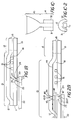
- a new read/write head 10 constructed in accordance with the invention includes two pole pieces 11 and 12 formed of a magnetic material separated by a layer 18 of insulation such as a hard-baked photoresist.
- Each pole piece defines a relatively large yoke region 13 which tapers to a pole tip 14 having an end 15.
- the head is suspended from an arm (not shown) so that the end 15 is generally directed toward the surface of a spinning disk (not shown) which has a magnetic media thereon, and the far end of the yoke region 13 (to the left as shown in Fig. 1B) will be distal from the disk surface.
- the head has an axis indicated by the legend X-X, and the arm holds the head so that the axis X-X is generally orthogonal to the disk surface.
- Head 10 also includes a multiple-turn planar helical coil 16 (a portion of which is depicted in Fig. 1A) positioned between the pole pieces 11 and 12 in the yoke region to generate magnetic flux for writing data onto the disk as described below.
- the pole pieces 11 and 12 touch so as to encircle a portion of the coil to provide a complete path of magnetic material between the pole pieces in the yoke region 13. Otherwise, a separation is maintained between the pole pieces in both the yoke region 13 and the pole tip 14.
- the separation between the pole pieces 11 and 12 may be relatively large, to allow the pole pieces to accommodate the coil 16 and ensure that there is minimal flux leakage between the pole pieces. In the pole tip, however, the separation between the pole pieces is relatively small.
- a slot 17 is formed in yoke region 13 of one pole piece in an orientation which is generally parallel to the expected orientation of the disk surface. That is, the orientation of the slot 17 is generally orthogonal to axis X-X.
- the slot is formed in pole piece 11. Adjacent the slot, a strip 20 of magneto-resistive material, such as a nickel iron alloy (such as "Permalloy”), is positioned, electrically insulated from the pole piece 11 by a thin, non-magnetic insulator such as alumina or silicon dioxide.
- the strip is formed so as to have a single magnetic domain with its magnetic dipoles situated parallel to the strip's longitudinal axis, that is perpendicular to the aixs X-X.
- the ends of the magneto-resistive strip 20 are connected to electrodes 21 and 22 which are also connected to sensing circuits (not shown) whose operation will be described below.
- the walls 23 and 24 defining slot 17 are not disposed orthogonally to strip 20, but instead are slanted at an acute angle with respect to the strip 20 so as to form pointed edges 26 and 27 adjacent the strip 20, as is shown in Fig. 1B.
- the coil 16 is used during a writing operation, in which magnetic signals representing digital data are impressed in the magnetic media comprising the disk surface.
- an electrical signal representing the digital data is applied to the coil 16.
- the electrical signal applied to coil 16 varies to define the digital data to be recorded in a known manner.
- the coil generates magnetic flux in the pole pieces. Assuming that, at one instance, the electrical signal is conditioned to enable the coil to generate magnetic flux upwardly (as shown in Fig. 1B) and forwardly (as shown in the Fig. 1A), that is, in the direction toward pole piece 12, the magnetic flux is first received in pole piece 12 in the yoke region 13.
- the flux travels in pole piece 12 through the yoke region toward the pole tip. Because the pole tip has a smaller cross-sectional area than the yoke region, the flux is concentrated in the gap; that is, the amount of flux per unit area in the gap is greater than in the yoke region. At the end 15 of pole piece 12, the flux exits the pole piece and goes through the magnetic surface of the disk thereby impressing the magnetic flux in the magnetic media that is then adjacent the gap.
- the flux returns from the disk through end 15 of pole piece 11. From there, it goes through the pole tip of pole piece 11 to the pole piece's yoke region. The larger yoke region permits the flux to spread out.
- the pointed edge 26 adjacent the magneto-resistive strip 20 concentrates the flux and directs it through the strip 20, which conducts it to edge 27.
- Edge 27 receives the flux from magneto-resistive strip 20 and directs it to the distal end of the yoke region 13 of pole piece 11. Since the flux during a write operation is generally very large, the magneto-resistive strip essentially saturates and largely acts as an air gap across the slot 17.
- the path of the flux through the pole pieces and disk's magnetic media is also reversed.
- the pole pieces 11 and 12, the disk magnetic media and strip 20 form a complete magnetic circuit for the flux generated by coil 16 during a writing operation.
- the arm (not shown) maintaining the head over one track on the disk the varying magnetic flux generated by head 10 in response to the variations in the digital data is applied to the magnetic media along the track. Accordingly, the flux changes representative of the digital data are impressed along the track on the disk.
- a current I ⁇ is applied to wires 30 positioned underneath the ends of the magneto-resistive strip 20.
- the current applied to the wires 30 establishes a small magnetic field in the magneto-resistive strip 20, which enables the magnetic dipoles in the strip, which during the writing operation had been in an orientation parallel to the axis X-X (that is, orthogonal to the longitudinal axis of the strip 20) to orient themselves in one direction along the longitudinal axis.
- the write flux through the magneto-resistive strip 20 forces the strip's dipoles in an orientation orthogonal to the longitudinal direction.
- the dipoles When the write flux is removed, the dipoles may return to a longitudinal orientation, but in either direction.
- the magnetic field applied by the wires 30 enable the dipoles to return to a selected direction, which is determined by the field generated by the wires. Accordingly, the wires 30, and application of current thereto after the writing operation, maintain the magneto-resistive strip in a single magnetic domain.
- a constant current I bias is applied to the coil 16.
- a constant magnetic flux is generated, which is applied to the pole pieces 11 and 12, and, accordingly, to magneto-resistive strip 20.
- This flux is a bias flux in the magneto-resistive strip 20.
- the current which generates the reference flux is high enough to generate sufficient flux to be used as a biasing flux, but is small enough that the flux does not interfere with the data which has been recorded on the disk.
- the transitions in the flux recorded on the disk provides magnetic flux which permeates the pole pieces 11 and 12 through the end 15 of the pole tip 14.
- the magneto-resitive strip 20 essentially senses the flux in the pole piece 11 in which it is situated.
- the flux permeating the other pole piece 12 has little effect on strip 20.
- the edges 26 and 27 in pole piece 11, which are defined by the respective waslls 23 and 24 positioned at acute angles ensure that the flux is efficiently conducted to and through the magneto-resistive strip 20 and to reduce fringing edge effects of the magnetic flux at the walls 23 and 24 which might cause at least some of the flux to bypass some or all of magneto-resistive strip 20.
- Sensing equipment applies a current I s between the electrodes 21 and 22, and detects changes in the voltage due to the field from the transitions.
- the changes in the voltage sensed by the sensing equipment are directly related to the changes in resistance of the magneto-resistive strip 20, and specifically the changes in the resistance of the portion of the strip between end faces 28 and 29 of the electrodes 21 and 22.
- the changes in the voltage level, relative to the voltage level resulting from only the bias flux from coil 16 are directly related to the changes in the resistance of the magneto-resistive material, and, accordingly, the change in the flux pattern on the disk.
- the number of tracks which can be recorded per unit of radius of the disk limits the density with which data can be recorded on the disk, namely, the number of tracks which can be recorded per unit of radius of the disk, and the number of flux transitions which may be recorded per length of track.
- the number of tracks per unit of radius is, in turn, related to the width of the pole pieces 11 and 12 at the end 15. Thus, the wider the pole pieces at end 15, the fewer the number of tracks which may be recorded per unit of radius.
- the number of flux transitions which may be recorded per length of track is related to several factors, including the width of the gap, that is, the distance between pole pieces at end 15. It will be appreciated that the larger the gap width, the less data may be recorded on a track.
- the arrangement depicted in the Figs. 1A and 1B permits both the width of the pole pieces at end 15 and the gap width to be minimized, thus enhancing the density of data which may be recorded, while using a magneto-resistive strip 20 of sufficient length to minimize the effects of the Barkhausen noise due to creation of multiple magnetic domains at the ends of the magneto-resistive strip 20.
- the gap had to be of greater width to accommodate the strip
- the head is relatively long to minimize the Barkhausen noise, but the length is constrained by the desired track density.
- both the width of the pole pieces and the width of the gap at end 15 may be made smaller. Since the width of the pole pieces in the yoke region 13 is much larger than width in the pole tip, the magneto-resistive strip 20 may be made longer, thus minimizing the Barkhausen noise due to end effects.
- the coil 30 further reduces Barkhausen noise in the other portions of the strip by urging the magnetic dipoles in a common direction following writing operations.
- the width of the pole pieces 11 and 12 in the yoke region 13 of the new read/write head is independent of the track density
- the length of the magneto-resistive strip between the ends 28 and 29 of the electrodes 21 and 22 is also independent of the track density
- the sensitivity during reading is also independent of the track density. If the portion of the magento-resistive strip 20 between the sensing electrodes 21 and 22 is short, as is the case when the strip is in the gap in the pole tip region, the resistance of the strip and the change in resistance during reading are both low, and so the sensitivity of the strip is also low.
- the strip 20 in the new head is in the yoke region 13
- the portion of the strip between the electrodes 21 and 22 is relatively long, permitting a higher sensitivity. Since the width of the yoke is independent of the track density. the sensitivity of the new head is also independent of the track density.
- Fig. 1C-1 and 1C-2 depict a detail of a modification of the pole tip region 14 to provide side shields 31 and 32.
- the side shields 31 and 32 are attached to and form part of the pole tip portion 14 of pole piece 12, and depend along the side of the pole tip portion 14 of pole piece 11.
- the side shields 31 and 32 may be formed from the same magnetic material comprising the pole pieces 11 and 12.
- the side shields 31 and 32 shield the pole tip portion 14 of pole piece 11 from fringing flux from adjacent tracks during a reading operation.
- the fringing flux from adjacent tracks can permeate the pole piece in the same manner as flux from the track the head 10 is reading and can result in noise in the signal obtained by the sensing equipment (not shown) that is connected to the head. Since, as described above, the output from the magneto-resistive strip 20 relates to the magnetic flux permeating pole piece 11, and is substantially unrelated to the flux permeating pole piece 12, with the side shields 31 and 32 the magneto-resistive strip is not effected by the fringing flux from the adjacent tracks. Thus, by shielding the head from the fringing flux, the side shield 31 and 32 can improve the signal-to-noise ratio and permit closer spacing between tracks.
- Fig. 2 depicts another read/write head 40 which is similar to head 10 (Fig. 1), with the addition of a slot 41 in the yoke region 13 of pole piece 12 and the positioning of a portion of a magneto-resistive strip 42 therein, separated from pole piece 12 by an insulating layer 49, which is similar to insulating layer 19.
- Elements of head 40 which are similar to the elements of head 10 have common reference numerals.
- slot 41 includes surfaces 43 and 44 situated at acute angles with respect to the pole piece 12 so as to form edges 45 and 46 adjacent the strip 42.
- Strip 42 is generally in the shape of a U, with portions 47 and 48 being adjacent the slots 17 and 41, respectively, and a connecting portion 49 connecting the portions 47 and 48.
- Electrodes 21 and 22 are positioned adjacent to, and in electrical contact with portion 47 of strip 42, and a second pair of electrodes 50 and 51 is positioned adjacent to and in electrical contact with portion 48. If the head 40 is formed using conventional thin-film techniques, the connecting portion 49 may be a via formed using conventional techniques.
- read/write head 40 (Fig. 2A) is similar to that of head 10 (Fig. 1), with the addition that, during a read operation, the the flux permeating both pole pieces 11 and 12 will affect the resistance of strip 42, whereas with head 10 the resistance of strip 20 is affected primarily by the flux permeating the pole piece 11 adjacent the strip 20. Accordingly, the signal sensed by the sensing equipment (not shown) connected to electrodes 21, 22, 51 and 52 adjacent both pole pieces 11 and 12 of head 40 (Fig. 2A) would be more symmetric than would be the signal sensed by sensing equipment connected to electrodes 21 and 22 adjacent only one pole piece 11 of head 10 (Fig. 1A). A symmetric read signal is more readily processed by other circuitry (not shown) with which the head is used than is an asymmetric read signal.
- the strip 42 (Fig. 3) effectively long in the shape of a horseshoe magnet, the strip is more resistant to formation of multiple magnetic domains by externally applied magnetic flux which is present, in particular, during writing operations.
- additional slots may be formed in the pole pieces to accommodate additional portions of a magneto-resistive strip.
- a single magneto-resistive strip will be positioned, in a serpentine configuration, adjacent all of said slots.
- the longer magneto-resistive strip 20 will serve to further minimize the Barkhausen noise, and will also serve to increase the sensitivity of the head to the flux read from the disk.
- magneto-resistive strips depicted in the Figures that is, generally beneath the respective pole pieces 11 and 12, is by way of example and not of limitation.
- the particular side of the respective pole pieces on which the magneto-resistive strips are formed does not effect the operation of the respective heads 10 and 40.
Landscapes
- Engineering & Computer Science (AREA)
- Manufacturing & Machinery (AREA)
- Magnetic Heads (AREA)
Claims (8)
- Lese-/Schreibkopf zur Verwendung in einem Magnetspeichergerät in einem digitalen Datenverarbeitungssystem, zum Schreiben von Daten in Form eines magnetischen Flusses auf ein und Lesen von Daten von einem Magnetspeichermedium, das sich relativ zu dem Kopf bewegt, wobei der Kopf zwei magnetische Polschuhe (11, 12), die jeder einen Jochbereich (13) haben, und eine zwischen den Polschuhen in dem Jochbereich befindliche erregbare Spule (16) zur Erzeugung eines magnetischen Flusses aufweist, wobei einer der Polschuhe einen Schlitz (17) in dem Jochbereich aufweist, und wobei der Kopf weiterhin einen Streifen Magneto-Widerstandsmaterial (20), das an den beabsichtigten Weg des den Schlitz überquerenden magnetischen Flusses angrenzt und allgemein quer dazu ausgerichtet ist, und eine elektrisch isolierende Schicht (19) enthält, die den Magneto-Widerstandsstreifen von dem geschlitzten Polschuh trennt, wobei der Streifen (20) dafür eingerichtet ist, mit einer Abfühleinrichtung verbunden zu werden, so daß, wenn das Speichermedium relativ zu dem Kopf bewegt wird, der Widerstand des Magneto-Widerstandsstreifens sich in Reaktion auf die Änderungen des auf dem Speichermedium aufgezeichneten magnetischen Flusses ändert und die Abfühleinrichtung die Widerstandsänderungen des Magneto-Widerstandsstreifens abfühlt, wobei die magnetischen Polschuhe (11, 12) so geformt sind, daß sie einen schmalen Spitzenabschnitt (14) und einen breiten Jochabschnitt (13) sowie einen veränderlich breiten Bereich bilden, der den schmalen Spitzenabschnitt (14) mit dem breiten Jochabschnitt (13) verbindet, dadurch gekennzeichnet, daß sich der Polschuh-Schlitz (17) in dem breiten Jochabschnitt (13) des magnetischen Polschuhs (11) befindet, der Magneto-Widerstandsstreifen (20) ein ausreichendes Maß über die Enden des Polschuh-Schlitzes (17) hinaus vorsteht, um die Auswirkungen des Barkhausen-Rauschens aufgrund der Erzeugung von vielfachen magnetischen Domänen an den Enden des Magneto-Widerstandsstreifens (20) zu minimieren, und Abfühlelektroden (21, 22) an den Enden des Schlitzes (17) mit dem Magneto-Widerstandsstreifen (20) verbunden sind.
- Kopf, wie in Anspruch 1 angegeben, der weiterhin eine mit der Spule (16) verbundene Einrichtung für die Zufuhr eines sich ändernden Stroms, um die Spule (16) während eines Schreibbetriebs zu erregen, und eines konstanten Stroms aufweist, um die Spule während eines Lesebetriebs zu erregen, wobei die Erregung der Spule während eines Lesebetriebs ausreicht, um eine Vormagnetisierung des Magneto-Widerstandsstreifens (20) auf einen im wesentlichen linearen Bereich des magnetischen Flusses und elektrischen Widerstandes zu erzeugen.
- Kopf, wie in Anspruch 1 angegeben, wobei der Magneto-Widerstandsstreifen (20) mit einer einzigen magnetischen Domäne gebildet ist, die durch magnetische Dipole mit einer ausgewählten Orientierung in bezug auf die Längsachse des Streifens gebildet wird, und wobei der Kopf weiterhin eine zweite erregbare Spuleneinrichtung (30) aufweist, die nahe bei dem Magneto-Widerstandsstreifen (20) liegt, so ausgerichtet ist, daß sie ein mit der Längsachse des Streifens koaxiales Magnetfeld erzeugt, und dafür eingerichtet ist, am Ende eines Schreibbetriebs erregt zu werden, um die magnetischen Dipole in die ausgewählte Orientierung zu zwingen.
- Kopf, wie in Anspruch 1 angegeben, wobei beide Polschuhe (11, 12) Schlitze (17, 41) aufweisen, die in ihren jeweiligen Jochbereichen gebildet sind, wobei die Schlitze (17, 41) allgemein parallel zueinander sind und der Magneto-Wider standsstreifen (20) ein U-förmiges Element mit geraden Abschnitten aufweist, die an den die jeweiligen Schlitze überquerenden magnetischen Fluß angrenzen und quer dazu ausgerichtet sind.
- Kopf, wie in Anspruch 1 angegeben, wobei der Polschuh (12) ohne den Schlitz weiterhin eine seitliche Abschirmung (31, 32) enthält, die von seiner Polspitze (14) um die Seite der Polspitze (14) des anderen Polschuhs herum verläuft, so daß die seitliche Abschirmung (31, 32) während des Gebrauchs des Kopfs wirksam ist, um die Polspitze des anderen Polschuhs gegen Streufluß von benachbarten Spuren abzuschirmen.
- Kopf, wie in einem der vorstehenden Ansprüche angegeben, wobei der Schlitz (17, 41) in dem Jochbereich im wesentlichen parallel zu der Ebene des Speichermediums während des Betriebs gebildet ist und der Streifen aus Magneto-Widerstandsmaterial (20) mit einer einzigen magnetischen Domäne gebildet ist, die durch magnetische Dipole mit einer ausgewählten Orientierung in bezug auf die Längsachse des Streifens gebildet wird.
- Kopf, wie in einem der vorstehenden Ansprüche angegeben, wobei die Polschuhe (11, 12) um eine Strecke getrennt sind, die in dem Jochbereich (13) relativ groß ist, um die erregbare Spule (16) unterzubringen, und in dem Polschuhbereich (14) relativ klein ist, um die Datendichte auf dem Magnetspeichermedium zu erhöhen, und wobei einer der Polschuhe (11) einen Schlitz (17) in dem Jochbereich (13) aufweist, der Wände (23, 24) aufweist, die einen spitzen Winkel in bezug auf die Außenseite des Jochs bilden.
- Kopf, wie in Anspruch 7 angegeben, wobei die erregbare Spule (16) vielfache Windungen aufweist und eben und spiralisch ist.
Applications Claiming Priority (3)
| Application Number | Priority Date | Filing Date | Title |
|---|---|---|---|
| US3344687A | 1987-04-01 | 1987-04-01 | |
| US33446 | 1987-04-01 | ||
| PCT/US1988/000908 WO1988007741A1 (en) | 1987-04-01 | 1988-03-21 | Magneto-resistive thin film head for digital magnetic storage device |
Publications (2)
| Publication Number | Publication Date |
|---|---|
| EP0308483A1 EP0308483A1 (de) | 1989-03-29 |
| EP0308483B1 true EP0308483B1 (de) | 1994-12-28 |
Family
ID=21870447
Family Applications (1)
| Application Number | Title | Priority Date | Filing Date |
|---|---|---|---|
| EP88903602A Expired - Lifetime EP0308483B1 (de) | 1987-04-01 | 1988-03-21 | Magnetoresistiver dünnfilmkopf für digitale magnetische speichervorrichtung |
Country Status (8)
| Country | Link |
|---|---|
| EP (1) | EP0308483B1 (de) |
| JP (1) | JPH0738251B2 (de) |
| KR (1) | KR930005338B1 (de) |
| AU (1) | AU1628188A (de) |
| CA (1) | CA1301315C (de) |
| DE (1) | DE3852593T2 (de) |
| HK (1) | HK174595A (de) |
| WO (1) | WO1988007741A1 (de) |
Families Citing this family (13)
| Publication number | Priority date | Publication date | Assignee | Title |
|---|---|---|---|---|
| US4935832A (en) * | 1987-04-01 | 1990-06-19 | Digital Equipment Corporation | Recording heads with side shields |
| US5081554A (en) * | 1987-04-01 | 1992-01-14 | Digital Equipment Corporation | Biasing conductor for MR head |
| US5068959A (en) * | 1988-07-11 | 1991-12-03 | Digital Equipment Corporation | Method of manufacturing a thin film head |
| US5097372A (en) * | 1989-08-04 | 1992-03-17 | Matsushita Electric Industrial Co., Ltd. | Thin film magnetic head with wide recording area and narrow reproducing area |
| JP2563597B2 (ja) * | 1989-08-04 | 1996-12-11 | 松下電器産業株式会社 | 複合型薄膜磁気ヘッド |
| FR2657189B1 (fr) * | 1990-01-18 | 1993-12-31 | Commissariat A Energie Atomique | Tete magnetique de lecture et d'ecriture a element magnetoresistant. |
| DE69217416T2 (de) * | 1991-04-22 | 1997-09-04 | Sharp Kk | Kombinierter Dünnfilmmagnetkopf |
| US5255141A (en) * | 1991-12-16 | 1993-10-19 | Read-Rite Corp. | Read-write magnetic head with flux sensing read element |
| JPH06251339A (ja) * | 1993-02-26 | 1994-09-09 | Sony Corp | 磁気抵抗効果型薄膜磁気ヘッド及びバイアス特性測定方法 |
| JP2788403B2 (ja) * | 1993-03-18 | 1998-08-20 | 富士通株式会社 | 磁気抵抗効果ヘッド |
| FR2709855B1 (fr) * | 1993-09-06 | 1995-10-20 | Commissariat Energie Atomique | Tête magnétique de lecture et d'écriture à élément magnétorésistant compensé en écriture. |
| EP0651374A3 (de) * | 1993-11-01 | 1995-09-06 | Hewlett Packard Co | Planarer magnetoresistiver Kopf. |
| FR2715507B1 (fr) * | 1994-01-25 | 1996-04-05 | Commissariat Energie Atomique | Magnétorésistance multicouche polarisée. |
Family Cites Families (6)
| Publication number | Priority date | Publication date | Assignee | Title |
|---|---|---|---|---|
| US3921217A (en) * | 1971-12-27 | 1975-11-18 | Ibm | Three-legged magnetic recording head using a magnetorestive element |
| US4300177A (en) * | 1975-07-17 | 1981-11-10 | U.S. Philips Corporation | Thin-film magnetic head for reading and writing information |
| US4164770A (en) * | 1977-09-21 | 1979-08-14 | Eastman Technology, Inc. | Thin film magnetoresistive head |
| DE3014459A1 (de) * | 1980-04-15 | 1981-10-22 | Siemens AG, 1000 Berlin und 8000 München | Abgeschirmter magnetoresistiver sensor zum abtasten von informationsspuren eines magnetischen aufzeichungstraegers |
| US4626946A (en) * | 1984-02-28 | 1986-12-02 | International Business Machines Corporation | Twin track vertical read-write head structure |
| JPH0630130B2 (ja) * | 1984-08-11 | 1994-04-20 | 富士通株式会社 | 薄膜磁気ヘッドの製造方法 |
-
1988
- 1988-03-21 KR KR1019880701579A patent/KR930005338B1/ko not_active Expired - Fee Related
- 1988-03-21 WO PCT/US1988/000908 patent/WO1988007741A1/en not_active Ceased
- 1988-03-21 EP EP88903602A patent/EP0308483B1/de not_active Expired - Lifetime
- 1988-03-21 AU AU16281/88A patent/AU1628188A/en not_active Abandoned
- 1988-03-21 JP JP63503548A patent/JPH0738251B2/ja not_active Expired - Lifetime
- 1988-03-21 DE DE3852593T patent/DE3852593T2/de not_active Expired - Fee Related
- 1988-03-31 CA CA000563066A patent/CA1301315C/en not_active Expired - Fee Related
-
1995
- 1995-11-16 HK HK174595A patent/HK174595A/en not_active IP Right Cessation
Also Published As
| Publication number | Publication date |
|---|---|
| EP0308483A1 (de) | 1989-03-29 |
| JPH01503500A (ja) | 1989-11-22 |
| KR930005338B1 (ko) | 1993-06-17 |
| KR890700890A (ko) | 1989-04-28 |
| WO1988007741A1 (en) | 1988-10-06 |
| DE3852593D1 (de) | 1995-02-09 |
| DE3852593T2 (de) | 1995-07-27 |
| CA1301315C (en) | 1992-05-19 |
| AU1628188A (en) | 1988-11-02 |
| HK174595A (en) | 1995-11-24 |
| JPH0738251B2 (ja) | 1995-04-26 |
Similar Documents
| Publication | Publication Date | Title |
|---|---|---|
| US4885649A (en) | Thin film head having a magneto-restrictive read element | |
| US5081554A (en) | Biasing conductor for MR head | |
| KR100259429B1 (ko) | 강화된 자기저항을 갖는 스핀 밸브 센서 | |
| US5159511A (en) | Biasing conductor for MR head | |
| US4713708A (en) | Magnetoresistive read transducer | |
| KR940009723B1 (ko) | 박막자기헤드 제조방법과 그것을 내장한 자기정보 저장장치 | |
| EP0308483B1 (de) | Magnetoresistiver dünnfilmkopf für digitale magnetische speichervorrichtung | |
| US4644432A (en) | Three pole single element magnetic read/write head | |
| US4001890A (en) | Double chip flying head | |
| EP0021392A1 (de) | Magnetische Wandlerkopfstrukturen | |
| US6191925B1 (en) | Dual element read with shaped elements | |
| US5986856A (en) | Magnetoresistive sensor with improved stability | |
| US5742457A (en) | Horizontal shared-pole magnetic read/write head having polarization conductor disabling write pole | |
| US4547824A (en) | Dual biasing for integrated inductive MR head | |
| EP0573155B1 (de) | Leiteranordnung eines magnetoresistiven Wandlers | |
| KR100373672B1 (ko) | 자기 헤드, 그 제조 방법 및 수직 자기 기록 장치 | |
| US7187519B2 (en) | High gradient disc drive writer | |
| KR0145034B1 (ko) | 자기 트랜스듀서와, 자기 트랜스듀서를 포함하는 매체 드라이브 | |
| JPS63108503A (ja) | 2重トラック磁気デ−タ記録方法及び装置 | |
| KR100280300B1 (ko) | 조합된 판독/기입 자기 헤드 | |
| EP0265798A2 (de) | Magnetoresistiver Lesewandler | |
| JP2000207707A (ja) | 薄膜磁気ヘッド及びこれを用いた磁気ディスク装置 | |
| US6600636B1 (en) | Magnetic head with write element offset from read element | |
| EP0834864B1 (de) | Magnetoresistiver Kopf mit aktiver Stabilisierung | |
| JPH08221718A (ja) | 磁気ヘッド |
Legal Events
| Date | Code | Title | Description |
|---|---|---|---|
| PUAI | Public reference made under article 153(3) epc to a published international application that has entered the european phase |
Free format text: ORIGINAL CODE: 0009012 |
|
| 17P | Request for examination filed |
Effective date: 19881220 |
|
| AK | Designated contracting states |
Kind code of ref document: A1 Designated state(s): DE FR GB IT NL |
|
| 17Q | First examination report despatched |
Effective date: 19900924 |
|
| GRAA | (expected) grant |
Free format text: ORIGINAL CODE: 0009210 |
|
| PG25 | Lapsed in a contracting state [announced via postgrant information from national office to epo] |
Ref country code: NL Effective date: 19941228 |
|
| REF | Corresponds to: |
Ref document number: 3852593 Country of ref document: DE Date of ref document: 19950209 |
|
| ITF | It: translation for a ep patent filed | ||
| ET | Fr: translation filed | ||
| PGFP | Annual fee paid to national office [announced via postgrant information from national office to epo] |
Ref country code: NL Payment date: 19950331 Year of fee payment: 8 |
|
| NLV1 | Nl: lapsed or annulled due to failure to fulfill the requirements of art. 29p and 29m of the patents act | ||
| REG | Reference to a national code |
Ref country code: GB Ref legal event code: 732E |
|
| PLBE | No opposition filed within time limit |
Free format text: ORIGINAL CODE: 0009261 |
|
| STAA | Information on the status of an ep patent application or granted ep patent |
Free format text: STATUS: NO OPPOSITION FILED WITHIN TIME LIMIT |
|
| 26N | No opposition filed | ||
| PGFP | Annual fee paid to national office [announced via postgrant information from national office to epo] |
Ref country code: FR Payment date: 19980221 Year of fee payment: 11 |
|
| PGFP | Annual fee paid to national office [announced via postgrant information from national office to epo] |
Ref country code: GB Payment date: 19990303 Year of fee payment: 12 |
|
| PGFP | Annual fee paid to national office [announced via postgrant information from national office to epo] |
Ref country code: DE Payment date: 19990305 Year of fee payment: 12 |
|
| PG25 | Lapsed in a contracting state [announced via postgrant information from national office to epo] |
Ref country code: FR Free format text: LAPSE BECAUSE OF NON-PAYMENT OF DUE FEES Effective date: 19991130 |
|
| REG | Reference to a national code |
Ref country code: FR Ref legal event code: ST |
|
| PG25 | Lapsed in a contracting state [announced via postgrant information from national office to epo] |
Ref country code: GB Free format text: LAPSE BECAUSE OF NON-PAYMENT OF DUE FEES Effective date: 20000321 |
|
| GBPC | Gb: european patent ceased through non-payment of renewal fee |
Effective date: 20000321 |
|
| PG25 | Lapsed in a contracting state [announced via postgrant information from national office to epo] |
Ref country code: DE Free format text: LAPSE BECAUSE OF NON-PAYMENT OF DUE FEES Effective date: 20010103 |
|
| PG25 | Lapsed in a contracting state [announced via postgrant information from national office to epo] |
Ref country code: IT Free format text: LAPSE BECAUSE OF NON-PAYMENT OF DUE FEES;WARNING: LAPSES OF ITALIAN PATENTS WITH EFFECTIVE DATE BEFORE 2007 MAY HAVE OCCURRED AT ANY TIME BEFORE 2007. THE CORRECT EFFECTIVE DATE MAY BE DIFFERENT FROM THE ONE RECORDED. Effective date: 20050321 |
|
| APAH | Appeal reference modified |
Free format text: ORIGINAL CODE: EPIDOSCREFNO |