EP0308047A2 - Kopiersystem - Google Patents
Kopiersystem Download PDFInfo
- Publication number
- EP0308047A2 EP0308047A2 EP88306619A EP88306619A EP0308047A2 EP 0308047 A2 EP0308047 A2 EP 0308047A2 EP 88306619 A EP88306619 A EP 88306619A EP 88306619 A EP88306619 A EP 88306619A EP 0308047 A2 EP0308047 A2 EP 0308047A2
- Authority
- EP
- European Patent Office
- Prior art keywords
- copy
- bin
- bins
- copies
- document
- Prior art date
- Legal status (The legal status is an assumption and is not a legal conclusion. Google has not performed a legal analysis and makes no representation as to the accuracy of the status listed.)
- Granted
Links
Images

Classifications
-
- G—PHYSICS
- G03—PHOTOGRAPHY; CINEMATOGRAPHY; ANALOGOUS TECHNIQUES USING WAVES OTHER THAN OPTICAL WAVES; ELECTROGRAPHY; HOLOGRAPHY
- G03G—ELECTROGRAPHY; ELECTROPHOTOGRAPHY; MAGNETOGRAPHY
- G03G15/00—Apparatus for electrographic processes using a charge pattern
- G03G15/65—Apparatus which relate to the handling of copy material
- G03G15/6538—Devices for collating sheet copy material, e.g. sorters, control, copies in staples form
-
- G—PHYSICS
- G03—PHOTOGRAPHY; CINEMATOGRAPHY; ANALOGOUS TECHNIQUES USING WAVES OTHER THAN OPTICAL WAVES; ELECTROGRAPHY; HOLOGRAPHY
- G03G—ELECTROGRAPHY; ELECTROPHOTOGRAPHY; MAGNETOGRAPHY
- G03G15/00—Apparatus for electrographic processes using a charge pattern
- G03G15/22—Apparatus for electrographic processes using a charge pattern involving the combination of more than one step according to groups G03G13/02 - G03G13/20
- G03G15/23—Apparatus for electrographic processes using a charge pattern involving the combination of more than one step according to groups G03G13/02 - G03G13/20 specially adapted for copying both sides of an original or for copying on both sides of a recording or image-receiving material
-
- G—PHYSICS
- G03—PHOTOGRAPHY; CINEMATOGRAPHY; ANALOGOUS TECHNIQUES USING WAVES OTHER THAN OPTICAL WAVES; ELECTROGRAPHY; HOLOGRAPHY
- G03G—ELECTROGRAPHY; ELECTROPHOTOGRAPHY; MAGNETOGRAPHY
- G03G15/00—Apparatus for electrographic processes using a charge pattern
- G03G15/65—Apparatus which relate to the handling of copy material
- G03G15/6538—Devices for collating sheet copy material, e.g. sorters, control, copies in staples form
- G03G15/6541—Binding sets of sheets, e.g. by stapling, glueing
-
- G—PHYSICS
- G03—PHOTOGRAPHY; CINEMATOGRAPHY; ANALOGOUS TECHNIQUES USING WAVES OTHER THAN OPTICAL WAVES; ELECTROGRAPHY; HOLOGRAPHY
- G03G—ELECTROGRAPHY; ELECTROPHOTOGRAPHY; MAGNETOGRAPHY
- G03G2215/00—Apparatus for electrophotographic processes
- G03G2215/00362—Apparatus for electrophotographic processes relating to the copy medium handling
- G03G2215/00789—Adding properties or qualities to the copy medium
- G03G2215/00822—Binder, e.g. glueing device
-
- G—PHYSICS
- G03—PHOTOGRAPHY; CINEMATOGRAPHY; ANALOGOUS TECHNIQUES USING WAVES OTHER THAN OPTICAL WAVES; ELECTROGRAPHY; HOLOGRAPHY
- G03G—ELECTROGRAPHY; ELECTROPHOTOGRAPHY; MAGNETOGRAPHY
- G03G2215/00—Apparatus for electrophotographic processes
- G03G2215/00362—Apparatus for electrophotographic processes relating to the copy medium handling
- G03G2215/00789—Adding properties or qualities to the copy medium
- G03G2215/00822—Binder, e.g. glueing device
- G03G2215/00827—Stapler
-
- G—PHYSICS
- G03—PHOTOGRAPHY; CINEMATOGRAPHY; ANALOGOUS TECHNIQUES USING WAVES OTHER THAN OPTICAL WAVES; ELECTROGRAPHY; HOLOGRAPHY
- G03G—ELECTROGRAPHY; ELECTROPHOTOGRAPHY; MAGNETOGRAPHY
- G03G2215/00—Apparatus for electrophotographic processes
- G03G2215/00362—Apparatus for electrophotographic processes relating to the copy medium handling
- G03G2215/00789—Adding properties or qualities to the copy medium
- G03G2215/00822—Binder, e.g. glueing device
- G03G2215/00864—Plural selectable binding modes
Definitions
- the present invention relates to apparatus for producing precollated copy sets at the full copying rate of a high speed copier but with reduced document recirculations, reduced document feed speeds, and with improved on-line finishing compatibility. Disclosed therefore is a "dual-flash" multiple recirculating document copying system, as defined hereinbelow, with triple or single flash alternatives in certain cases, together with a three-bin compiler system with alternating bin pairs loading and unloading, to optimize copying efficiency.
- dual flash In a “dual flash” system, two copies are made of each document in each circulation of the document set, and alternately separated in their outputs, to produce two precollated copy sets at a time from each document set circulation, rather than the usual one.
- the term “dual-flash” generally refers to two directly-successive exposures of the same document to make two identical copies. Scanning exposure can be used instead of flash exposure.
- US-A-4,385,827 is a particularly-relevant disclosure of input sheet transport means on one side of an array of sheet-collecting bins, and an output set transport on the opposite side of that bin array for transporting the collated sets for binding, and means for moving the bin array relative to the set transport for controlling the loading of copy sheets in the bin array simultaneously with the unloading of the copy sets therefrom.
- the sheet input transport is a vertical downwardly-moving belt transport from which sheets are deflected into a bin by a deflector or gate associated with each of the bins.
- a deflector or gate associated with each of the bins.
- a precollation but variable-flash system of mode selection for productivity optimization of a copier/duplicator preferably utilizes a programmable controller programmed with an analytical program or algorithms, whereby inputs such as the number of copy sets selected to be made, the number of sheets in the document set, and whether they are duplex or simplex, and odd or even in number, and whether duplex or simplex output is selected, are analyzed in respect to alternatives available in a particular machine structure and operation, to select the most efficient mode of machine operation to attain the output sought, and to operate the machine accordingly. Uncollated output may be optionally selected and will cause different sequencing.
- US-A-4,212,457 disclosed apparatus programmed to select between precollation or post- collation (multi-bin) modes, depending on the number of copy sets desired.
- the use of variable plural flash copying cycles for small numbers of original documents in precollation copying with only one compiler is taught, for example, in US-A-4,468,114.
- the maching in US-A-4,285,591 is programmed to segment the collator job automatically when the number of document sets desired exceeds the capacity of the collator.
- US-A-4,156,133 has variable operating programs for specific copy runs.
- the present system comprises a collating and finishing apparatus and method comprising a buffered design to allow more time to finish a copy set without halting the copying.
- a collating and finishing apparatus and method comprising a buffered design to allow more time to finish a copy set without halting the copying.
- two bins at a time are utilized as the buffer for compiling while one or two other bins are awaiting being emptied for finishing, and then they function as the buffer for the next two copy sets, etc.
- US-A-4,361,320 discloses a sheet-distributing apparatus comprising a plurality of bins divided into two groups which are utilized alternatively when the number of copies to be collated exceeds the number of bins available. This allows an operator to remove collated copies from one group of bins while copies are being collated in the other group of bins (see, e.g., Col.2, lines 13-21). This is for a post-collation system, without an RDH.
- US-A-3,944,207 discloses a sorter comprising collating bins that are operable to open for releasing collated sheets into collating bins, and stapling, thus enabling uninterupted collating cycles.
- US-A-4,145,037 discloses a vertical collator-sorter comprising a conveyor system for moving sheets, and removable deflectors for deflecting sheets from the conveyor to bins, means for collating or sorting, and means to eject sheets.
- US-A-4,248,525 discloses a programmable apparatus for producing sets of copies from a set of documents sheets, some of which copies can be produced in an RDH pre-collating mode by means of a recirculating feeder, and others cannot be produced in a collating mode. The copies that are produced in a noncollating mode are stored temporarily.
- a copy storage section 14 has a plurality of deflectors 96 for deflecting copy sheets into temporary storage bins 82. Copy sheets are then delivered from the bins 82 to a finisher 16.
- US-A-3,848,868 discloses a sheet-sorting apparatus for collating both simplex and duplex copies, comprising an inverter 13 in the copy sheet output path in the sorter module upstream of a vertical transport from which the copy sheets are deflected into sorter bins.
- documents even in the same set may have come from completely-different paper batches or have variably charged size with different age or humidity conditions, etc..
- the images on documents and their fusing can change the sheet-feeding characteristics. These images may even be subject to damage in feeding if not properly handled, e.g. smearing of fresh ink. Yet it is desirable to feed, register and copy rapidly even a mixture of sizes, types, and conditions of documents without document jams or document damage, and with each document correctly and accurately aligned to a desired registration position.
- the present system enables the documents to be fed, registered and recirculated at only one-half the copying rate of the copier, with minimal productivity loss, and coordination with on-line finishing. This greatly alleviates the above and other document-feeding difficulties, and/or enables faster precollation copying.
- the terms "document” or "sheet” refer to a usually-flimsy sheet of paper, plastics, or other such conventional individual image substrate, and not to microfilm or electronic images which are generally much easier to manipulate. It is important to distinguish copiers with physical document sheet recirculators from electronic copying systems, such as the Xerox "9700" printer, which can read and store page images of documents electronically and can reorder and represent them at will and without delays; and create copies (called prints) by writing the page images on a photoreceptor with a laser beam, or the like, since they do not have the problems with physical sheet documents.
- the "document” here is the sheet (original or previous copy) being copied in the copier onto the outputted "copy sheet", or "copy”.
- Related plural sheets of documents or copies are referred to as a "set”.
- a “simplex” document or copy sheet is one having an image and page on only one side or face of the sheet, whereas a “duplex” document or copy sheet has a "page”, and normally an image, on both sides.
- the "copy” may have an electronically modified or merged image, e.g., a highlight color overlay or insert.
- the present invention is particularly suitable for precollation copying, i.e. automatically plurally recirculated document set copying provided by a recirculating document handling system or "RDH", although is also compatible with nonprecollation or postcollation copying.
- Precollation, collation, recirculative, or RDH copying as it is variably called, is a desirable feature for a copier. It provides a number of important advantages. In such precollation copying any desired number of collated copy sets or books may be made by making a corresponding number of recirculations of the set of documents in collated order past the copier imaging station, and copying each document page (normally only once) each time it circulates over the imaging station.
- the copies therefrom may exit the copier processor automatically in proper order for stacking as precollated sets, and thus do not normally require subsequent separation and collation in a sorter or collator.
- On-line finishing (stapling or stitching and/or gluing or other binding) and/or removal and stacking and offsetting of completed but unfinished copy sets may thus be provided while further collated copy sets are being made in further circulations of the same document set.
- US RDH patents for precollation copying systems are 4,459,013, 4,278,344, and 4,579,444 325 or ′326.
- Some other examples or recirculating document handlers are disclosed in US-A-4,076,408; 4,176,945; 4,428,667; 4,330,197; 4,466,733 and 4,544,148.
- a preferred vacuum corrugating feeder air knife, and a tray for an RDH are disclosed in US-A-4,418,905 and 4,462,586.
- An integral semi-automatic and computer form feeder SADH/CFF
- SADH/CFF integral semi-automatic and computer form feeder
- a disadvantage of such precollation copying systems is that the documents must be all repeatedly separated and circulated sequentially for copying in a predetermined order, normally by a number of circulations equivalent to the total desired number of copy sets.
- greatly increased document handling is necessitated for a precollation copying system, as compared to a post collation copying system. Therefore, maximizing document handling automation while minimizing document wear or damage is particularly important in precollation copying.
- a postcollation copying system such as with an ADH or SADH
- multiple copies may be made at one time from each document page and collated by being placed in multiple separate sorter bins.
- the document set need be manually or semiautomatically fed to the imaging station only once, if the number of copy sets being made is less than the number of available sorter bins.
- a disadvantage is that the number of copy sets which can be made in one document set circulation is limited by the number of available sorter bins.
- a multi-bin sorter adds space and complexity and is not well suited for on-line finishing.
- postcollation copying or even manual document placement
- a document handler for a precollation copying system be compatible with, and alternatively usable for, postcollation and manual copying as well.
- the present invention overcomes various of the above-discussed problems and provides various of the above-discussed and other features and advantages.
- DH 20 is an RDH somewhat similar to that disclosed in US-A-4, 589,651 or 652 or 4,469,319. etc., for sequentially separating and transporting document sheets onto and over the conventional platen imaging station 23 of the copier 10, restacking them, and recirculating them.
- the document handling system 20 illustrated here is exemplary, and also may be modified for different copiers.
- This RDH 20 has two separate document inputs, a recirculating or RDH input stacking and restacking tray 21 on top, and an SADH side entrance 22 for semiautomatic document handling, especially for larger documents, which may be optionally inserted short edge first.
- This document recirculating handling system 20 is adapted to repeat the feeding and registering of a set of document sheets automatically at the appropriate registration (copying) position on the platen 23, by repeatedly recirculating them without disturbing their page order. It also provides for inversion of duplex documents.
- the exemplary copier 10 shown in Fig. 1 is basically similar in paper paths and functions to the well known Xerox 1075 or 1090 xerographic copiers, which provide automatic duplex precollation copying, as illustrated and described in patents cited above, including US-A-4,278,344.
- the exemplary copier 10 of Fig. 1 will now be briefly described.
- the copier 10 conventionally includes a xerographic photoreceptor belt 12 and the xerographic stations acting thereon for respectively corona charging 13, image exposing 14, image developing 15, belt driving 16, precleaning discharge 17 and toner removal 18.
- Documents on the platen 23 maybe imaged onto the photoreceptor 12 through a variable reduction ratio optical imaging system to fit the document images to the selected size of copy sheets.
- the control of all machine functions, including all sheet feeding, is, conventionally, by the maching controller "C".
- the controller "C” is preferably a programmable microprocessor.
- the controller “C” conventionally controls all of the machine steps and functions described herein, and others, including the operation of the document feeder 20, all the document and copy sheet deflectors or gates, the sheet feeder drives, the finisher "F", etc..
- the copier controller also conventionally provides for storage and comparison of the counts of the copy sheets, the number of documents recirculated in a document set, the desired number of copy sets and other selections and controls by the operator through the console or other panel of switches connected to the controller, etc..
- the controller is also programmed for time delays, jam correction control, etc..
- Conventional path sensors or switches may be utilized to help keep track of the position of the documents and the copy sheets and the moving components of the apparatus by connection to the controller.
- the controller variably regulates the various positions of the gates depending upon which mode of operation is selected.
- the copier 10 is adapted to provide either duplex or simplex precollated copy sets from either duplex or simplex original documents presented by the RDH 20.
- Two separate copy sheet trays 46 and 47 are provided for feeding clean copy sheets from either one selectably. They may be referred to as the main tray 46 and auxiliary tray 47.
- the copy sheets are fed from the selected one of the trays 46 or 47 to the transfer station 48 for the conventional transfer of the xerographic toner image of document images from the photoreceptor 12 to the first side of a copy sheet.
- the copy sheets are then fed by a vacuum transport to a roll fuser 49 for the fusing of the toner image thereon. From the fuser, the copy sheets are fed through a sheet decurler 50.
- the copy sheets then turn a 90° corner path 54 in the sheet path which inverts the copy sheets into a last-printed face-up orientation before reaching a pivotal decision gate 56.
- the image side which has just been transferred and fused is face-up at this point.
- this gate 56 If this gate 56 is down it passes the sheets directly on without inversion into the output path 57 of the copier to the finishing module "F". If gate 56 is up it deflects the sheets into a duplex inverting transport 58.
- the inverting transport (roller) 58 inverts and then stacks copy sheets to be duplexed in a duplex buffer tray 60.
- the duplex tray 60 provides intermediate or buffer storage for those copy sheets which have been printed on one side and on which it is desired to print an image or images subsequently on the opposite side thereof, i.e. copy sheets in the process of being duplexed. Because of the sheet inversion by the roller 58, these buffer set copy sheets are stacked into the duplex tray 60 face-down. They are stacked in this duplex tray 60 on top of one another in the order in which they were copied.
- the previously-simplexed copy sheets in the tray 60 are fed seriatim by its bottom feeder 62 back to the transfer station 48 for the imaging of their second or opposite side page image.
- This is through basically the same copy sheet transport path (paper path) 64 as is provided for the clean (blank) sheets from the trays 46 or 47.
- This copy sheet feed path 64 between the duplex tray 60 and the transfer station 48 has an inherent inversion which inverts the copy sheets once.
- the inverting transport 58 having previously stacked these buffer sheets printed face-down in the duplex tray 60, they are represented by the photoreceptor 12 at the transfer station 48 in the proper orientation, i.e. with their blank or opposite sides facing the photoreceptor 12 to receive the second side image. This is referred to as the "second pass" for the buffer set copies being duplexed.
- the now fully duplexed copy sheets are then fed out again through the fuser 49 and into the output path 57.
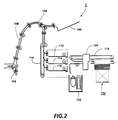
- the output path 57 here transports the printed copy sheets directly, one at a time, into the connecting, on-line, modular, finishing station module "F", shown in detail in Fig. 2.
- the completed precollated copy sets may be finished by stapling, stitching, gluing, binding, and/or offset stacking. Suitable details are further described hereinbelow with reference to Fig. 2.
- Copy sets can be forwarded out of the finisher on to additonal finishing stations if desired. For example, to a hole puncher, ring binder, GBC binder, or the like.
- Finishing station F receives fused copies from the copier (Fig.1), compiles and finishes copy sets, and delivers them to the output sheet stacking apparatus, indicated generally by the reference 102. Alternatively, it delivers copies to the top output tray 100.
- Sets of copy sheets delivered to output sheet stacking apparatus 102 are normally collated, but may be uncollated, and may be finished or unfinished. Unfinished sets may be offset. Finished sets may be stitched with one or two stiches. Finishing station F can also glue-bind sets and deliver stacks of bound sets to stacking apparatus 102.
- the sheet path of finishing station F includes an inverter 104 driven by a reversible motor.
- the inverter has a solenoid-actuated diverter gate that diverts sheets into the inverter, and a tri-roll nip that is used to drive sheets into and out of the inverter. It also has a compression spring which assists in reversing the direction of the sheets and assists in driving them out of the inverter.
- Registration transport 106 is used to transport sheets from inverter 104 to output transport 108.
- Two cross-roll registration nips are used to side register the sheets.
- the cross-roll registration nips are driven by the sheet path drive motor.
- the output transport 108 is also driven by the sheet path drive motor. It transports sheets from the registration transport to a top tray gate where the sheets are diverted to either vacuum transport 110 or out into top tray 100.
- Vacuum transport 110 is used to transport sheets from transport 108 to any selected one of three bins 112, 114 or 116. Bins 112, 114 and 116 are all used to compile and register sheets into completed copy sets. A separate gate (set of stripping fingers) is associated with each bin, as illustrated, to deflect each sheet selectively on the transport 110 into a selected bin 112, 114 or 116. An in-bin scuffer wheel system may be provided as illustrated to maintain stacking registration. The set of compiler bins 112, 114, 116 are driven up and down as a "bindexer" unit (note the illustrated dashed-line positons) by a bidirectional bin drive motor adapted to position the proper bin at the bin unloading position.
- a bidirectional bin drive motor adapted to position the proper bin at the bin unloading position.
- a set unloading transport 118 may have, for example, a pair of set clamps mounted on two air cylinders and driven by four air valve solenoids. Two of the air valves are used for positioning the set transport, and two are used for the retract function.
- the set transport 118 is used to transport sets from the bins to the stitcher 120, or binder 122, and to the sheet stacking apparatus 102. The stitched, bound, or unfinished sets are delivered to the stacking apparatus 102 where they are stacked for delivery to the operator.
- Each bin preferably has a registration gate or pair of vertical stops at the unload side thereof which is automatically pivoted out of the way after the set clamp of the unloading transport 118 has grasped that set, so as to allow the set removal from the bin by horizontal movement of the unloading transport 118.
- bin un loading desirably occurs at only one vertical position or level of the bins, to simplify set retrieval and finishing.
- the bin set indexes up and down so as to place the bin containing the next completed set to be removed adjacent this unloading position, aligned with set unloading transport 118.
- bin loading can be done into any bin, in any position of the bins, and simultaneously with bin unloading.
- the controller inhibits loading of a bin in the process of being unloaded, or a bin already containing a completed copy set.
- sheets can enter bins either above or below the set ejecting level, and on either the up or down movements of the bins, even though the bin entrance speeds of the sheets will vary depending on the bin movement relative to transport 110..
- bin unloading of compiled sets is from a single vertically-fixed position adjacent the downstream sides of the bins.
- Each bin has its own independent gate, for variable loading.
- Incoming sheets are on the vertical sheet transport 110, moving by the copier sides of all the bins and their respective gates.
- the copy set handling and input-output technology (IOT) described in this example is closely related to the finisher architecture.
- the disclosed finisher “F” has a "through the bins” architecture, and a small number of bins architecture, rather than a "9900" duplicator-like architecture, (see, e.g., US-A-4,361,393, supra ) in which there is a large number of bins, and the copy sets must be removed from the same side of the bins from which the copies are fed into the bins, so that these two functions interfere with one another and prevent bidirectional movement of the bins relative to the set removal means.
- a dual-flash operating system can provide full productivity, without any copier pitch skips, for multiple simplex finished copy sets of three or more page documents sets. It was discovered that three compiler bins was the minimum number required to support full system productivity with dual-flashed three-pitch sets. While the first of one pair of copy sets is being finished, the other set of that pair of copy sets can remain waiting to be finished in a bin, yet meanwhile the next pair of copy sets can be made and loaded into the two bins which are now empty. Then the second completed set can be removed and finished while the next pair of copy sets is being completed. Then one of the next pair of copy sets can be removed and finished while a third pair is started, and so on.
- sequences of feeding into and compiling copy sheets in said compiler bins and removing compiled collated copy sheet sets from said compiler bins and said compiler system desirably comprises sequences substantially as follows; where " A ",” B “ and “ C “ are designations for the respective first, second and third compiler bins, where " N " is the designation of the first copy sheet to be fed into a compiler bin a total of N copy sheets in a collated copy sheet set to be compiled therein, where " 1 " is the last-fed copy sheet of that copy set, where "---” represents the repetition and continuation of the associated sequence " N " to " 1 " between said first and last copy sheets of that sequence for that copy set, and where " ⁇ EJECT ⁇ " represents the removing of that completed compiled collated copy set from the respective compiler bin by the removal means:
- bins are referred to as A, B and C, rather than 112, 114, and 116, in order to emphasize that the sequence is not limited to that physical order.
- Each bin has its own integral gate, solenoid-operable in any order programmed by the controller. Since the gates move with their bins, the maintain interdigitation with the transport 110 belts, sheets can be loaded into bins in any bin position, and while the bins are moving.
- a typical bin LOADING order or sequence is A,B;B,A;A,B;B...etc., to completion of two sets, then C,B;B,C;C,B...etc. for the next two sets, as shown above, etc..
- a typical repeating bin UNLOADING or eject order is B,A;B,C...etc., as shown above, or it could be A,B;C,B;A,B;C,B...etc.
- the first sheet of the next set enters a bin on the second pitch of an eject cycle.
- the bin entry order is altered if required for the last pages so that the last pages of the two sets land in B then A if the unload order is to be B,A. They land in B then C if the unload order is to be B then C.
- the first bin load order with the first two sheets is not important, but can be chosen for consistency. This key to productivity is that the first bin scheduled to be unloaded is loaded with the first one of the last two sheets of the two sets being completed. This enables an unload to start one pitch sooner.
- a four-bin design was developed as an alternative (although the three-bin concept is more compact, simpler, and less costly, and is preferred).
- the four-bin concept has some unique advantages, such as allowing even number of copy jobs to close out with a quad flash sequence. However, its primary virtue is in better productivity with bound sets wherein a hot melt glue/tape finishing cycle is utilized which has a very long (such as about 30 pitches) finishing cycle compared to a stapling or stitching finishing cycle (e.g., three pitches). This allows the last pair of copies to be flashed and fed to two bins with two compiled but unremoved sets still in the other two bins waiting to be removed and bound or otherwise finished.
- a four-bin system also supports a three-flash closeout of odd run length jobs (an odd number of copy sets) in the same basic manner as a three-bin system.
- a four-bin finisher can also operate to provide a four-flash (four-sheet, four-bin) closeout of even copy jobs (an even number of selected copy sets) on a final document set circulation to avoid another RDH circulation.
- the normal bin loading and unloading sequence for copy pairs may (similarly to three bins) be: A,B;B,A;A,B;...(or, alternatively, A,B;A,B;A,B;...) until completion of the first two copy sets, then during the unloading and finishing of these first two copy sets, starting with the unloading of the first one completed (in A or B as the case may be), the next two copy sets may be made and loaded in the sequence C,D;D,C;C,D;....
- Important features of the disclosed system include those whereby the desired dual-flash is combined with a three- (or four-) bin finisher to allow the finisher to support a high-speed, high-volume, copier, e.g., a more than 100 cpm system, at full productivity for even three-sheet sets, while operating the staplers or stitchers at the same cyclic rate as a much slower system, such as for a precollation copier of half that speed.
- the RDH need only handle and recirculate documents at a document per minute repeat rate which is only one-half the full copier rate in order to support the system. This has the very desirable provision of correspondingly increased available document acquisition and exchange times.
- Copy sets or books are compiled (accumulated, stacked or "staged") into the three bins, entering from one side of the bins and exiting another side (here the opposite sides in the processor paper movement direction).
- the finishing repeat rate may be reduced to once every three pitches for three-sheet sets, or four pitches for four or more sheets.
- a key feature of this system which enables this productivity is the sequential use of different pairs of the three compiler bins in coordination with finishing, so that while the second of one pair of copy sheet sets is being removed from a bin and finished, the first two sheets of the next sequence or set are entering two other now-empty and available bins, in a continuous enter one side/exit the other side sequential operation.
- copier duplex tray to accumulate and stage multiple dual side one's (pairs of half-finished duplex copy pair buffer sets) in the duplex tray.
- This sytem utilizes a modification of the system for plural single flash buffer sets disclosed in US-A-4,278,344 supra .
- the plural pairs buffer set system here (a) some inversions of duplex originals are avoided; and (b) small duplex document sets, which otherwise could not repeat or recirculate through the RDH at the full rate of the copier without skipped pitches, are flashed at the full rate.
- the documents are recirculated around the RDH loop path as if simplex copies were being made (i.e., without inversion) until a desired number of sets of side one's are accumulated in the duplex tray appropriate to its desired (e.g. 100 sheets) or maximum total sheet capacity.
- a desired number of sets of side one's are accumulated in the duplex tray appropriate to its desired (e.g. 100 sheets) or maximum total sheet capacity.
- copy sheets with odd document pages on one side are accumulated in the duplex buffer tray in the sequence N, N; N-2, N-2;...3,3;1,1 repeated several times up to a maximum number of such buffer sheets desired, or a corresponding even page sequence, depending on the desired output inversion.
- the number of such plural buffer sets made consecutively will vary with the number of documents in the document set since that determines the size of each buffer set.
- the duplex buffer tray may be loaded with buffer sets of N,N,N;N-2,N-2,N-2;...3,3,3;1,1,1, providing the total number of buffer copies made this way does not exceed the maximum number desired there, in which case single-flash closeout is made automatically.
- the duplex documents are then inverted so that in subsequent circulations their side two's are copied, by repeating dual-flashes, onto the other sides of the buffer sets from the duplex tray.
- the RDH has done only one inversion of the originals.
- Side one sets in the duplex tray are fed out and imaged on their other sides with dual side two image sets repeatedly until the duplex tray is emptied, and then the process can repeat, by a number of times depending on the number of copies required for the job.
- the staging of multiple sets in the duplex tray is no longer applicable.
- This above plural paired buffer system allows duplex-to-duplex operation with multiple copies of even document sets as small as three sheets, at the full rate of the copier despite an RDH inversion cycle rate for recirculation with inversion of such small document sets which would otherwise limit the output rate to 6/7ths of the full rate if dual copy sets were merely flashed in pairs with side one's immediately following side two's i.e., with the duplex documents being inverted in each circulation.
- Another important feature is that dual-flash is replaced by triple flash on closeout of a job with an odd copy count.
- This added but compatible system avoids an extra single-flash sequence which would have to be performed at half rate.
- This special case algorithm is actuated automatically by operator selection of an odd number of copies only for the final copying circulation of the set of originals. It avoids one entire RDH circulation in the case of an odd number of copies, and avoids the RDH rate of less than the copier rate from limiting productivity to the RDH rate, which it would if a single-flash closeout were required for odd numbers of copy sets.
- Another feature relates to the loading and feeding of inserts or special copy sheets, such as tabbed sheets, transparencies, chapter separators, covers, etc.
- inserts or special copy sheets such as tabbed sheets, transparencies, chapter separators, covers, etc.
- these special copy sheets are normally loaded in pairs into a paper-feed tray different from the paper-feed tray being used for regular copy sheets, and programmed to be fed alternatively to be copied in the appropriate positions in the copy sets. If these special sheet inserts differ from one another, they are preferably loaded into their selected paper tray 46 or 47 in collated order.
- the controller "C" knows from its operator input when such special inserts are being used, and can inhibit what would otherwise be run as a triple-flash closeout, which would not feed the paired special sheets properly. If an odd number of copies has been selected, a single-flash closeout can be used by purging one of the two special sheets into the tray 100 for example, rather than inserting it into a compiler bin.
- the entire module or set may have to be purged for job recovery to avoid getting the feeding of special sheets into the subsequent sets out of order.
- the size of the copy set is estimated in advance of copying by (a) the operator input of whether the originals are simplex or duplex and (b), an estimate of the document set size from the height of the document stack, which is estimated by a stack height sensor (e.g. US-A-4,589,645).
- the copy set and the duplex buffer set sizes correspond directly to the number of document pages (the sheet count for single documents, and twice the sheet count for duplex documents).
- the controller can estimate in advance from the document stack height if the desired duplex buffer tray maximum capacity could be exceeded by dual-flashing the documents, and automatically switch to single-flash copying in that case.
- An additional set recombination algorithm can be used for copy sets too large to fit individually into the bins, e.g., sets of more than 125 copy sheets.
- the bins can be loaded only up to their capacity, and the partial sets then removed but not finished.
- the remaining or overload sheets from the uncompleted sets can be loaded into another bin, removed, and combined with the first parts of the sets to form complete copy sets (of up to 250 sheets in this example) which can then be finished and delivered.
- the CHM duplex tray 60 capacity is 100 sheets
- the RDH tray 21 capacity is also 100 sheets
- the RDH set seperator operating at the beginning of a job, can detect the approximate number of document sheets in the RDH tray.
- the operator selects this mode and programs the number of copy sets. If the operator knows beforehand that there are more than 50 duplex originals in the stack, she/he may be given the option of either selecting single-flash mode, which will run the job automatically but at half productivity, or she/he can manually separate the document stack into smaller than 50 sheet stacks and run the job in several parts using the more-productive dual-flash mode. However, at the completion of the dual-flash copy mode cycle, the stacked partial sets may need to be manually collated.
- duplex copying jobs with more than 50 originals would exceed the assumed 100 sheet duplex tray capacity. Note that a single-flash mode makes one copy for each two copier cycles or pitches, whereas a dual- or triple-flash mode has no skipped pitches, except for certain special situations.
- the machine can tell the operator ( via the display) to run the job in smaller groups of sheets. If it senses fewer originals than that, it checks to see how many copy sets were required. If only one copy set was required, this job simply runs in single-flash mode. If three duplex copy sets are required, it first checks to see if there are 33 or fewer originals. If there are, it runs the job in triple-flash mode.
- a system and algorithms for paper flow in copies providing unlimited collated output with an RDH. It enables normally making two copies at a time at the maximum copying speed of a high speed copier from each original circulating in the RDH at a maximum original recirculation rate of one half that copying speed, thus maintaining full productivity of both the copier and the RDH.
- the copies are variably shunted into the bins of a three-bin compiler of a finisher in such a way that one bin or another is available for copy set removal and finishing without interfering with continued copy sheet loading into the other two bins.
- the algorithms are extended to handle duplex efficiently and to handle odd-number copy counts.
- the three trays or bins of the finisher unit are NOT normally functioning as sorter or collator or stacker bins.
- the copy sheets already leave the copier and enter the finisher unit precollated, in a page sequential order, albeit normally in interleaved adjacent pairs thereof, because of the RDH copying.
- two of the bins function to stack two precollated pairs at a time separately as they emerge from the copier during the same time period as the other, third, bin serves as a waiting station holding a previously-stacked completed copy set which is awaiting removal and finishing, and meanwhile another previously-stacked and removed set is being finished in a single finisher. Normally all of this occurs continuously and repeated without any delay or pause in copying at the full copying rate of the copier.
Landscapes
- Physics & Mathematics (AREA)
- General Physics & Mathematics (AREA)
- Collation Of Sheets And Webs (AREA)
- Control Or Security For Electrophotography (AREA)
Applications Claiming Priority (2)
| Application Number | Priority Date | Filing Date | Title |
|---|---|---|---|
| US98096 | 1987-09-17 | ||
| US07/098,096 US4782363A (en) | 1987-09-17 | 1987-09-17 | Copying system for on-line finishing |
Publications (3)
| Publication Number | Publication Date |
|---|---|
| EP0308047A2 true EP0308047A2 (de) | 1989-03-22 |
| EP0308047A3 EP0308047A3 (en) | 1990-03-14 |
| EP0308047B1 EP0308047B1 (de) | 1993-10-20 |
Family
ID=22267042
Family Applications (1)
| Application Number | Title | Priority Date | Filing Date |
|---|---|---|---|
| EP88306619A Expired - Lifetime EP0308047B1 (de) | 1987-09-17 | 1988-07-20 | Kopiersystem |
Country Status (4)
| Country | Link |
|---|---|
| US (1) | US4782363A (de) |
| EP (1) | EP0308047B1 (de) |
| CA (1) | CA1301823C (de) |
| DE (1) | DE3885050T2 (de) |
Cited By (4)
| Publication number | Priority date | Publication date | Assignee | Title |
|---|---|---|---|---|
| EP0477946A3 (en) * | 1990-09-28 | 1992-04-15 | Sharp Kabushiki Kaisha | Automatic document feeder |
| EP0446889A3 (en) * | 1990-03-13 | 1992-11-19 | Sharp Kabushiki Kaisha | Sheet feeding apparatus |
| US6971809B1 (en) | 2000-10-23 | 2005-12-06 | Eastman Kodak Company | Directing pages to a selected output destination of a printing system |
| US20210303477A1 (en) * | 2020-12-26 | 2021-09-30 | Intel Corporation | Management of distributed shared memory |
Families Citing this family (47)
| Publication number | Priority date | Publication date | Assignee | Title |
|---|---|---|---|---|
| US4878656A (en) * | 1987-03-20 | 1989-11-07 | Canon Kabushiki Kaisha | Sheet finisher |
| JP2643166B2 (ja) * | 1987-08-20 | 1997-08-20 | 富士ゼロックス株式会社 | 後処理装置 |
| JPH0699070B2 (ja) * | 1987-11-10 | 1994-12-07 | キヤノン株式会社 | シート取扱い装置 |
| US5382016A (en) * | 1988-03-11 | 1995-01-17 | Canon Kabushiki Kaisha | Sheet sorter with a stapler having a controlled sheet aligning member |
| NL8800659A (nl) * | 1988-03-17 | 1989-10-16 | Oce Nederland Bv | Werkwijze en kopieerapparaat voor het op volgorde op beide zijden van ontvangstbladen kopieren van originelen. |
| US5133539A (en) * | 1988-08-27 | 1992-07-28 | Minolta Camera Kabushiki Kaisha | Sorter-finisher provided for an image forming apparatus |
| US4926220A (en) * | 1988-10-17 | 1990-05-15 | Xerox Corporation | Dual mode set delivery apparatus |
| US4974034A (en) * | 1989-12-05 | 1990-11-27 | Xerox Corporation | Post-collation duplex copying system |
| US4961092A (en) * | 1989-12-06 | 1990-10-02 | Xerox Corporation | Pre-programmed pauses post-collation copying system |
| US5005821A (en) * | 1990-05-02 | 1991-04-09 | Xerox Corporation | Loose element sheet stacking assistance system |
| JP2507680B2 (ja) * | 1990-07-02 | 1996-06-12 | 三田工業株式会社 | ソ―タ―制御装置 |
| US5045881A (en) * | 1990-08-30 | 1991-09-03 | Xerox Corporation | System for segregating purge sheets and continued printing |
| US5095369A (en) * | 1990-09-28 | 1992-03-10 | Xerox Corporation | Method and apparatus for improved job stream printing in an electronic printer with various finishing function |
| US5095342A (en) * | 1990-09-28 | 1992-03-10 | Xerox Corporation | Methods for sheet scheduling in an imaging system having an endless duplex paper path loop |
| US5172162A (en) * | 1990-12-10 | 1992-12-15 | Fuji Xerox, Co., Ltd. | Apparatus for connecting an image recording device to a sheet processor |
| US5098074A (en) * | 1991-01-25 | 1992-03-24 | Xerox Corporation | Finishing apparatus |
| US5317377A (en) * | 1991-09-27 | 1994-05-31 | Xerox Corporation | Inverter apparatus capable of inverting A3 or 11×17" sheets |
| US5142016A (en) * | 1991-09-30 | 1992-08-25 | Xerox Corporation | Sheet handling scuffer paddle wheel made of polyether urethane |
| US5213317A (en) * | 1992-01-27 | 1993-05-25 | Xerox Corporation | Modular binding apparatus with rotating transport |
| US5569012A (en) * | 1993-07-30 | 1996-10-29 | Canon Kabushiki Kaisha | Book binding apparatus |
| US5452068A (en) * | 1994-05-31 | 1995-09-19 | Xerox Corporation | Apparatus and method for reducing productivity losses in a marking engine |
| US5547176A (en) * | 1994-12-15 | 1996-08-20 | Xerox Corporation | Apparatus and method for binding pseudo-signatures into a booklet |
| US5685529A (en) * | 1996-04-08 | 1997-11-11 | Xerox Corporation | Dual action printed sets transport |
| US6241234B1 (en) * | 1996-12-27 | 2001-06-05 | Canon Kabushiki Kaisha | Sheet processing apparatus and image forming apparatus using same |
| JPH1165328A (ja) * | 1997-06-05 | 1999-03-05 | Xerox Corp | 転写支援装置及び方法 |
| US6702282B2 (en) | 1997-10-24 | 2004-03-09 | Fargo Electronics, Inc. | Card transport mechanism roller support |
| US6685312B2 (en) | 1997-10-24 | 2004-02-03 | Fargo Electronics, Inc. | Ink jet card printer |
| US6470156B1 (en) | 1998-09-17 | 2002-10-22 | Ravi B. Sahay | Method of printing variable image requirements |
| US6832866B2 (en) * | 1999-01-25 | 2004-12-21 | Fargo Electronics, Inc. | Printer or laminator supply |
| US7154519B2 (en) * | 1999-01-25 | 2006-12-26 | Fargo Electronics, Inc. | Printer and ribbon cartridge |
| US7344325B2 (en) | 1999-01-25 | 2008-03-18 | Fargo Electronics, Inc. | Identification card printer having ribbon cartridge with cleaner roller |
| US7018117B2 (en) * | 1999-01-25 | 2006-03-28 | Fargo Electronics, Inc. | Identification card printer ribbon cartridge |
| US6694884B2 (en) | 1999-01-25 | 2004-02-24 | Fargo Electronics, Inc. | Method and apparatus for communicating between printer and card supply |
| NL1012924C2 (nl) * | 1999-08-27 | 2001-02-28 | Ocu Technologies B V | Werkwijze en inrichting voor het selectief afleggen van bedrukte vellen op boven elkaar gelegen dragers. |
| US6758616B2 (en) | 2000-01-21 | 2004-07-06 | Fargo Electronics, Inc. | Identification card printer |
| US20020131075A1 (en) * | 2000-05-17 | 2002-09-19 | Heidelberg Digital L.L.C.. | Tab modification system for a printing machine |
| US20010043365A1 (en) * | 2000-05-17 | 2001-11-22 | Heidelberg Digital L.L.C. | Late binding of tab image contents to ordered tab stock |
| US6628121B1 (en) | 2000-10-13 | 2003-09-30 | Heidelberger Druckmaschinen Ag | Tools for measuring electrometer dispenser response |
| US20020048041A1 (en) * | 2000-10-23 | 2002-04-25 | Housel Edward M. | Directing pages to a selected output destination of a printing system |
| US6539181B2 (en) | 2001-01-29 | 2003-03-25 | Heidelberger Druckmaschinen Ag | Jam recovery when using ordered media |
| US20020101607A1 (en) * | 2001-01-29 | 2002-08-01 | Heidelberg Digital, L.L.C. | Method and apparatus of disposing of unused ordered media within a print job |
| US6985167B2 (en) * | 2002-03-01 | 2006-01-10 | Fargo Electronics, Inc. | Card cleaner roller assembly |
| US20030197056A1 (en) * | 2002-04-19 | 2003-10-23 | Dunham Matthew K. | Identification card printer data encoder module |
| US7878505B2 (en) | 2003-08-19 | 2011-02-01 | Hid Global Corporation | Credential substrate rotator and processing module |
| US7254355B2 (en) * | 2005-05-20 | 2007-08-07 | Ravi B. Sahay | Apparatus and method to improve printer productivity |
| US7500669B2 (en) * | 2006-04-13 | 2009-03-10 | Xerox Corporation | Registration of tab media |
| US8646770B2 (en) | 2009-09-18 | 2014-02-11 | Hid Global Corporation | Card substrate rotator with lift mechanism |
Family Cites Families (25)
| Publication number | Priority date | Publication date | Assignee | Title |
|---|---|---|---|---|
| US3788640A (en) * | 1972-12-29 | 1974-01-29 | Xerox Corp | Moving bin sorting apparatus |
| US3848868A (en) * | 1973-03-09 | 1974-11-19 | Xerox Corp | Sheet sorting apparatus |
| US3944207A (en) * | 1973-12-27 | 1976-03-16 | Xerox Corporation | Limitless sorter |
| US3997263A (en) * | 1975-09-22 | 1976-12-14 | Xerox Corporation | Bi-directional copier output |
| US4145037A (en) * | 1977-04-25 | 1979-03-20 | Pitney Bowes, Inc. | Vertical collator-sorter |
| US4156133A (en) * | 1977-08-30 | 1979-05-22 | Xerox Corporation | Reproduction machine with paper path detection diagnostics |
| US4285591A (en) * | 1977-10-13 | 1981-08-25 | International Business Machines Corporation | Computer-controlled copy production machine having job separation capabilities |
| US4212457A (en) * | 1978-03-27 | 1980-07-15 | Xerox Corporation | Pre/post-collation copying system |
| US4361320A (en) * | 1978-12-21 | 1982-11-30 | Ricoh Company, Ltd. | Sheet distribution method and apparatus |
| US4248525A (en) * | 1979-05-03 | 1981-02-03 | Eastman Kodak Company | Apparatus for producing sets of collated copies |
| US4355880A (en) * | 1980-06-02 | 1982-10-26 | Xerox Corporation | Forward order document copying method |
| US4278344A (en) * | 1979-08-31 | 1981-07-14 | Xerox Corporation | Recirculating duplex documents copier |
| US4411515A (en) * | 1980-08-21 | 1983-10-25 | Xerox Corporation | Very high speed duplicator with limitless finishing function |
| US4385827A (en) * | 1981-04-15 | 1983-05-31 | Xerox Corporation | High speed duplicator with finishing function |
| US4361393A (en) * | 1981-04-15 | 1982-11-30 | Xerox Corporation | Very high speed duplicator with finishing function |
| US4473425A (en) * | 1982-05-24 | 1984-09-25 | Eastman Kodak Company | Binding apparatus and method |
| US4468114A (en) * | 1982-09-21 | 1984-08-28 | Xerox Corporation | Higher productivity recirculative document copying |
| DE3276199D1 (en) * | 1982-09-21 | 1987-06-04 | Xerox Corp | Higher productivity recirculative document copying |
| US4561772A (en) * | 1983-05-25 | 1985-12-31 | Xerox Corporation | Recirculative document duplex copying |
| US4568172A (en) * | 1983-10-13 | 1986-02-04 | Xerox Corporation | Small document set recirculative copying |
| US4558942A (en) * | 1983-12-22 | 1985-12-17 | Xerox Corporation | Very high speed duplicator with finishing function for duplex copying doing immediate inversion of copy sheets |
| US4566782A (en) * | 1983-12-22 | 1986-01-28 | Xerox Corporation | Very high speed duplicator with finishing function using dual copy set transports |
| US4586640A (en) * | 1984-08-21 | 1986-05-06 | Xerox Corporation | Printing machine finishing station |
| US4564185A (en) * | 1984-12-21 | 1986-01-14 | Xerox Corporation | Copying apparatus with finisher having stapler and adhesive binder stations |
| US4639126A (en) * | 1985-11-07 | 1987-01-27 | International Business Machines Corporation | Method for producing duplex copy sets from a duplex original set |
-
1987
- 1987-09-17 US US07/098,096 patent/US4782363A/en not_active Expired - Lifetime
-
1988
- 1988-05-16 CA CA000566854A patent/CA1301823C/en not_active Expired - Fee Related
- 1988-07-20 EP EP88306619A patent/EP0308047B1/de not_active Expired - Lifetime
- 1988-07-20 DE DE88306619T patent/DE3885050T2/de not_active Expired - Fee Related
Cited By (6)
| Publication number | Priority date | Publication date | Assignee | Title |
|---|---|---|---|---|
| EP0446889A3 (en) * | 1990-03-13 | 1992-11-19 | Sharp Kabushiki Kaisha | Sheet feeding apparatus |
| EP0477946A3 (en) * | 1990-09-28 | 1992-04-15 | Sharp Kabushiki Kaisha | Automatic document feeder |
| US5183240A (en) * | 1990-09-28 | 1993-02-02 | Sharp Kabushiki Kaisha | Automatic document feeder |
| US6971809B1 (en) | 2000-10-23 | 2005-12-06 | Eastman Kodak Company | Directing pages to a selected output destination of a printing system |
| US20210303477A1 (en) * | 2020-12-26 | 2021-09-30 | Intel Corporation | Management of distributed shared memory |
| US12314178B2 (en) * | 2020-12-26 | 2025-05-27 | Intel Corporation | Management of distributed shared memory |
Also Published As
| Publication number | Publication date |
|---|---|
| DE3885050T2 (de) | 1994-05-05 |
| CA1301823C (en) | 1992-05-26 |
| DE3885050D1 (de) | 1993-11-25 |
| US4782363A (en) | 1988-11-01 |
| EP0308047A3 (en) | 1990-03-14 |
| EP0308047B1 (de) | 1993-10-20 |
Similar Documents
| Publication | Publication Date | Title |
|---|---|---|
| EP0308047B1 (de) | Kopiersystem | |
| US4727402A (en) | Automatic copier signature set production | |
| US4834360A (en) | Job batching system for high capacity copier with RDH | |
| EP0147140B1 (de) | Sehr schnelles Vervielfältigungsgerät mit Endbearbeitungsfunktion | |
| US5710968A (en) | Bypass transport loop sheet insertion system | |
| US4568172A (en) | Small document set recirculative copying | |
| CA1140171A (en) | Recirculating document handler configuration | |
| US4974035A (en) | Automatic duplex copying with interleaved tabs | |
| EP0029646B1 (de) | Umlauf-Dokumentenzuführvorrichtung | |
| US4814822A (en) | Method and apparatus for automatic "two-up" copying with intermediate latent image copiers | |
| GB2048834A (en) | Method and apparatus for producing sets of collated copies | |
| US4925176A (en) | Signature job copying system | |
| JPS61156063A (ja) | 仕上げ装置 | |
| JPH0658549B2 (ja) | 原稿自動取扱装置を備えた複写機 | |
| US5457524A (en) | Dual path sheet feeder | |
| US5422705A (en) | System for selectively variable set delivery output in an electrostatographic printing machine | |
| JPH08245047A (ja) | タブ紙挿入可能な画像形成装置 | |
| EP0147141B1 (de) | Sehr schnelles Vervielfältigungsgerät mit Endbearbeitungsfunktion | |
| EP0899619B1 (de) | Verfahren zu unprogrammierten Ausgabe von Blattsätzen in einer Endverarbeitungsvorrichtung | |
| US4684241A (en) | Plural image document set copying | |
| US5260758A (en) | Signature job copying system and method | |
| JP2621937B2 (ja) | 複写装置 | |
| JPH06199468A (ja) | 複写装置 | |
| JPH10194608A (ja) | 原稿仕分け装置 | |
| JPH028169A (ja) | 複写方法および複写装置 |
Legal Events
| Date | Code | Title | Description |
|---|---|---|---|
| PUAI | Public reference made under article 153(3) epc to a published international application that has entered the european phase |
Free format text: ORIGINAL CODE: 0009012 |
|
| AK | Designated contracting states |
Kind code of ref document: A2 Designated state(s): DE FR GB IT |
|
| PUAL | Search report despatched |
Free format text: ORIGINAL CODE: 0009013 |
|
| AK | Designated contracting states |
Kind code of ref document: A3 Designated state(s): DE FR GB IT |
|
| 17P | Request for examination filed |
Effective date: 19900911 |
|
| 17Q | First examination report despatched |
Effective date: 19920428 |
|
| GRAA | (expected) grant |
Free format text: ORIGINAL CODE: 0009210 |
|
| AK | Designated contracting states |
Kind code of ref document: B1 Designated state(s): DE FR GB IT |
|
| REF | Corresponds to: |
Ref document number: 3885050 Country of ref document: DE Date of ref document: 19931125 |
|
| ET | Fr: translation filed | ||
| ITF | It: translation for a ep patent filed | ||
| PLBE | No opposition filed within time limit |
Free format text: ORIGINAL CODE: 0009261 |
|
| STAA | Information on the status of an ep patent application or granted ep patent |
Free format text: STATUS: NO OPPOSITION FILED WITHIN TIME LIMIT |
|
| 26N | No opposition filed | ||
| REG | Reference to a national code |
Ref country code: GB Ref legal event code: IF02 |
|
| PGFP | Annual fee paid to national office [announced via postgrant information from national office to epo] |
Ref country code: FR Payment date: 20030711 Year of fee payment: 16 |
|
| PGFP | Annual fee paid to national office [announced via postgrant information from national office to epo] |
Ref country code: GB Payment date: 20030716 Year of fee payment: 16 |
|
| PGFP | Annual fee paid to national office [announced via postgrant information from national office to epo] |
Ref country code: DE Payment date: 20030731 Year of fee payment: 16 |
|
| PG25 | Lapsed in a contracting state [announced via postgrant information from national office to epo] |
Ref country code: GB Free format text: LAPSE BECAUSE OF NON-PAYMENT OF DUE FEES Effective date: 20040720 |
|
| PG25 | Lapsed in a contracting state [announced via postgrant information from national office to epo] |
Ref country code: DE Free format text: LAPSE BECAUSE OF NON-PAYMENT OF DUE FEES Effective date: 20050201 |
|
| GBPC | Gb: european patent ceased through non-payment of renewal fee |
Effective date: 20040720 |
|
| PG25 | Lapsed in a contracting state [announced via postgrant information from national office to epo] |
Ref country code: FR Free format text: LAPSE BECAUSE OF NON-PAYMENT OF DUE FEES Effective date: 20050331 |
|
| REG | Reference to a national code |
Ref country code: FR Ref legal event code: ST |
|
| PG25 | Lapsed in a contracting state [announced via postgrant information from national office to epo] |
Ref country code: IT Free format text: LAPSE BECAUSE OF NON-PAYMENT OF DUE FEES Effective date: 20050720 |