EP0305333A2 - Neue herbizide Wirkstoffe - Google Patents
Neue herbizide Wirkstoffe Download PDFInfo
- Publication number
- EP0305333A2 EP0305333A2 EP88810564A EP88810564A EP0305333A2 EP 0305333 A2 EP0305333 A2 EP 0305333A2 EP 88810564 A EP88810564 A EP 88810564A EP 88810564 A EP88810564 A EP 88810564A EP 0305333 A2 EP0305333 A2 EP 0305333A2
- Authority
- EP
- European Patent Office
- Prior art keywords
- alkyl
- hydrogen
- formula
- alkoxy
- halogen
- Prior art date
- Legal status (The legal status is an assumption and is not a legal conclusion. Google has not performed a legal analysis and makes no representation as to the accuracy of the status listed.)
- Withdrawn
Links
- 239000004009 herbicide Substances 0.000 title abstract description 3
- -1 hydroxy, 1,3-dioxolan-2-yl Chemical group 0.000 claims abstract description 113
- UFHFLCQGNIYNRP-UHFFFAOYSA-N Hydrogen Chemical compound [H][H] UFHFLCQGNIYNRP-UHFFFAOYSA-N 0.000 claims abstract description 110
- 229910052739 hydrogen Inorganic materials 0.000 claims abstract description 85
- 239000001257 hydrogen Substances 0.000 claims abstract description 85
- 150000001875 compounds Chemical class 0.000 claims abstract description 82
- 125000004178 (C1-C4) alkyl group Chemical group 0.000 claims abstract description 67
- 229910052736 halogen Inorganic materials 0.000 claims abstract description 58
- 150000002367 halogens Chemical class 0.000 claims abstract description 52
- 125000004209 (C1-C8) alkyl group Chemical group 0.000 claims abstract description 49
- 125000001997 phenyl group Chemical group [H]C1=C([H])C([H])=C(*)C([H])=C1[H] 0.000 claims abstract description 45
- 125000000229 (C1-C4)alkoxy group Chemical group 0.000 claims abstract description 33
- 125000006272 (C3-C7) cycloalkyl group Chemical group 0.000 claims abstract description 30
- PXGOKWXKJXAPGV-UHFFFAOYSA-N Fluorine Chemical compound FF PXGOKWXKJXAPGV-UHFFFAOYSA-N 0.000 claims abstract description 25
- 125000004093 cyano group Chemical group *C#N 0.000 claims abstract description 25
- 125000000449 nitro group Chemical group [O-][N+](*)=O 0.000 claims abstract description 18
- 229910052731 fluorine Inorganic materials 0.000 claims abstract description 17
- 239000011737 fluorine Substances 0.000 claims abstract description 17
- CIUQDSCDWFSTQR-UHFFFAOYSA-N [C]1=CC=CC=C1 Chemical group [C]1=CC=CC=C1 CIUQDSCDWFSTQR-UHFFFAOYSA-N 0.000 claims abstract description 15
- 238000002360 preparation method Methods 0.000 claims abstract description 13
- 125000004765 (C1-C4) haloalkyl group Chemical group 0.000 claims abstract description 12
- 230000002363 herbicidal effect Effects 0.000 claims abstract description 12
- 125000006501 nitrophenyl group Chemical group 0.000 claims abstract description 10
- 125000002924 primary amino group Chemical group [H]N([H])* 0.000 claims abstract description 10
- 239000013543 active substance Substances 0.000 claims abstract description 8
- 125000001797 benzyl group Chemical group [H]C1=C([H])C([H])=C(C([H])=C1[H])C([H])([H])* 0.000 claims abstract description 8
- 125000005059 halophenyl group Chemical group 0.000 claims abstract description 8
- 244000038559 crop plants Species 0.000 claims abstract description 7
- 125000002490 anilino group Chemical group [H]N(*)C1=C([H])C([H])=C([H])C([H])=C1[H] 0.000 claims abstract description 6
- 125000004802 cyanophenyl group Chemical group 0.000 claims abstract description 6
- WCZBUQIZTSIQFE-UHFFFAOYSA-N furan;thiophene Chemical compound C=1C=COC=1.C=1C=CSC=1 WCZBUQIZTSIQFE-UHFFFAOYSA-N 0.000 claims abstract description 5
- 230000012010 growth Effects 0.000 claims abstract description 5
- 230000008635 plant growth Effects 0.000 claims abstract 5
- 238000000034 method Methods 0.000 claims description 30
- 125000000217 alkyl group Chemical group 0.000 claims description 28
- XTKDAFGWCDAMPY-UHFFFAOYSA-N azaperone Chemical compound C1=CC(F)=CC=C1C(=O)CCCN1CCN(C=2N=CC=CC=2)CC1 XTKDAFGWCDAMPY-UHFFFAOYSA-N 0.000 claims description 28
- 238000006243 chemical reaction Methods 0.000 claims description 23
- 239000000203 mixture Substances 0.000 claims description 22
- XLYOFNOQVPJJNP-UHFFFAOYSA-N water Substances O XLYOFNOQVPJJNP-UHFFFAOYSA-N 0.000 claims description 21
- 125000003342 alkenyl group Chemical group 0.000 claims description 20
- 125000003282 alkyl amino group Chemical group 0.000 claims description 19
- ZAMOUSCENKQFHK-UHFFFAOYSA-N Chlorine atom Chemical compound [Cl] ZAMOUSCENKQFHK-UHFFFAOYSA-N 0.000 claims description 17
- 125000002496 methyl group Chemical group [H]C([H])([H])* 0.000 claims description 17
- 229910052801 chlorine Inorganic materials 0.000 claims description 13
- 239000000460 chlorine Substances 0.000 claims description 13
- 125000003545 alkoxy group Chemical group 0.000 claims description 11
- 125000004414 alkyl thio group Chemical group 0.000 claims description 10
- 230000008030 elimination Effects 0.000 claims description 10
- 238000003379 elimination reaction Methods 0.000 claims description 10
- 239000003795 chemical substances by application Substances 0.000 claims description 9
- 229910052740 iodine Inorganic materials 0.000 claims description 9
- PAYRUJLWNCNPSJ-UHFFFAOYSA-N Aniline Chemical compound NC1=CC=CC=C1 PAYRUJLWNCNPSJ-UHFFFAOYSA-N 0.000 claims description 7
- WKBOTKDWSSQWDR-UHFFFAOYSA-N Bromine atom Chemical compound [Br] WKBOTKDWSSQWDR-UHFFFAOYSA-N 0.000 claims description 7
- 125000005036 alkoxyphenyl group Chemical group 0.000 claims description 7
- 125000005037 alkyl phenyl group Chemical group 0.000 claims description 7
- 125000000304 alkynyl group Chemical group 0.000 claims description 7
- GDTBXPJZTBHREO-UHFFFAOYSA-N bromine Substances BrBr GDTBXPJZTBHREO-UHFFFAOYSA-N 0.000 claims description 6
- 229910052794 bromium Inorganic materials 0.000 claims description 6
- 239000007818 Grignard reagent Substances 0.000 claims description 5
- 239000000969 carrier Substances 0.000 claims description 5
- 150000004795 grignard reagents Chemical class 0.000 claims description 5
- 125000006485 halo alkoxy phenyl group Chemical group 0.000 claims description 5
- ISWSIDIOOBJBQZ-UHFFFAOYSA-N Phenol Chemical compound OC1=CC=CC=C1 ISWSIDIOOBJBQZ-UHFFFAOYSA-N 0.000 claims description 4
- 239000002253 acid Substances 0.000 claims description 4
- 125000003302 alkenyloxy group Chemical group 0.000 claims description 4
- 125000005108 alkenylthio group Chemical group 0.000 claims description 4
- 125000005133 alkynyloxy group Chemical group 0.000 claims description 4
- 125000005109 alkynylthio group Chemical group 0.000 claims description 4
- 125000000753 cycloalkyl group Chemical group 0.000 claims description 4
- 125000001188 haloalkyl group Chemical group 0.000 claims description 4
- YAYVBOVGNZFFKX-UHFFFAOYSA-N 2-chloro-2h-furan-5-one Chemical compound ClC1OC(=O)C=C1 YAYVBOVGNZFFKX-UHFFFAOYSA-N 0.000 claims description 3
- ZCYVEMRRCGMTRW-UHFFFAOYSA-N 7553-56-2 Chemical compound [I] ZCYVEMRRCGMTRW-UHFFFAOYSA-N 0.000 claims description 3
- 229920000742 Cotton Polymers 0.000 claims description 3
- 230000010933 acylation Effects 0.000 claims description 3
- 238000005917 acylation reaction Methods 0.000 claims description 3
- 230000029936 alkylation Effects 0.000 claims description 3
- 238000005804 alkylation reaction Methods 0.000 claims description 3
- 230000035613 defoliation Effects 0.000 claims description 3
- 150000002431 hydrogen Chemical class 0.000 claims description 3
- 239000011630 iodine Substances 0.000 claims description 3
- 125000004650 C1-C8 alkynyl group Chemical group 0.000 claims description 2
- 101000939500 Homo sapiens UBX domain-containing protein 11 Proteins 0.000 claims 1
- 102100029645 UBX domain-containing protein 11 Human genes 0.000 claims 1
- 230000001276 controlling effect Effects 0.000 claims 1
- 230000001105 regulatory effect Effects 0.000 claims 1
- 125000001424 substituent group Chemical group 0.000 abstract description 13
- 239000003630 growth substance Substances 0.000 abstract description 6
- 239000000543 intermediate Substances 0.000 abstract description 5
- 239000004480 active ingredient Substances 0.000 description 26
- 241000196324 Embryophyta Species 0.000 description 24
- LYCAIKOWRPUZTN-UHFFFAOYSA-N Ethylene glycol Chemical compound OCCO LYCAIKOWRPUZTN-UHFFFAOYSA-N 0.000 description 13
- 150000003254 radicals Chemical class 0.000 description 13
- YMWUJEATGCHHMB-UHFFFAOYSA-N Dichloromethane Chemical compound ClCCl YMWUJEATGCHHMB-UHFFFAOYSA-N 0.000 description 12
- RTZKZFJDLAIYFH-UHFFFAOYSA-N Diethyl ether Chemical compound CCOCC RTZKZFJDLAIYFH-UHFFFAOYSA-N 0.000 description 12
- 125000004432 carbon atom Chemical group C* 0.000 description 10
- 239000004094 surface-active agent Substances 0.000 description 10
- 239000007787 solid Substances 0.000 description 7
- IGFHQQFPSIBGKE-UHFFFAOYSA-N 4-nonylphenol Chemical compound CCCCCCCCCC1=CC=C(O)C=C1 IGFHQQFPSIBGKE-UHFFFAOYSA-N 0.000 description 6
- OKKJLVBELUTLKV-UHFFFAOYSA-N Methanol Chemical compound OC OKKJLVBELUTLKV-UHFFFAOYSA-N 0.000 description 6
- ZMXDDKWLCZADIW-UHFFFAOYSA-N N,N-Dimethylformamide Chemical compound CN(C)C=O ZMXDDKWLCZADIW-UHFFFAOYSA-N 0.000 description 6
- 239000000654 additive Substances 0.000 description 6
- 235000019441 ethanol Nutrition 0.000 description 6
- 238000009472 formulation Methods 0.000 description 6
- 239000008187 granular material Substances 0.000 description 6
- ZWEHNKRNPOVVGH-UHFFFAOYSA-N 2-Butanone Chemical compound CCC(C)=O ZWEHNKRNPOVVGH-UHFFFAOYSA-N 0.000 description 5
- 125000001494 2-propynyl group Chemical group [H]C#CC([H])([H])* 0.000 description 5
- 150000001298 alcohols Chemical class 0.000 description 5
- 239000013078 crystal Substances 0.000 description 5
- 235000014113 dietary fatty acids Nutrition 0.000 description 5
- 239000000839 emulsion Substances 0.000 description 5
- 239000000194 fatty acid Substances 0.000 description 5
- 229930195729 fatty acid Natural products 0.000 description 5
- 238000003306 harvesting Methods 0.000 description 5
- 239000000463 material Substances 0.000 description 5
- 125000000956 methoxy group Chemical group [H]C([H])([H])O* 0.000 description 5
- 239000000047 product Substances 0.000 description 5
- 150000003839 salts Chemical class 0.000 description 5
- 239000011734 sodium Substances 0.000 description 5
- 239000000126 substance Substances 0.000 description 5
- 238000012360 testing method Methods 0.000 description 5
- 239000005995 Aluminium silicate Substances 0.000 description 4
- IAZDPXIOMUYVGZ-UHFFFAOYSA-N Dimethylsulphoxide Chemical compound CS(C)=O IAZDPXIOMUYVGZ-UHFFFAOYSA-N 0.000 description 4
- 238000003747 Grignard reaction Methods 0.000 description 4
- 240000007594 Oryza sativa Species 0.000 description 4
- 239000002202 Polyethylene glycol Substances 0.000 description 4
- 235000012211 aluminium silicate Nutrition 0.000 description 4
- 239000011575 calcium Substances 0.000 description 4
- 229910052799 carbon Inorganic materials 0.000 description 4
- 235000013399 edible fruits Nutrition 0.000 description 4
- 230000000694 effects Effects 0.000 description 4
- 150000002170 ethers Chemical class 0.000 description 4
- 150000004665 fatty acids Chemical class 0.000 description 4
- 125000001449 isopropyl group Chemical group [H]C([H])([H])C([H])(*)C([H])([H])[H] 0.000 description 4
- NLYAJNPCOHFWQQ-UHFFFAOYSA-N kaolin Chemical compound O.O.O=[Al]O[Si](=O)O[Si](=O)O[Al]=O NLYAJNPCOHFWQQ-UHFFFAOYSA-N 0.000 description 4
- 239000002736 nonionic surfactant Substances 0.000 description 4
- 229920001223 polyethylene glycol Polymers 0.000 description 4
- 239000000843 powder Substances 0.000 description 4
- 238000000926 separation method Methods 0.000 description 4
- 229910052708 sodium Inorganic materials 0.000 description 4
- 239000002904 solvent Substances 0.000 description 4
- VZGDMQKNWNREIO-UHFFFAOYSA-N tetrachloromethane Chemical compound ClC(Cl)(Cl)Cl VZGDMQKNWNREIO-UHFFFAOYSA-N 0.000 description 4
- JOXIMZWYDAKGHI-UHFFFAOYSA-N toluene-4-sulfonic acid Chemical compound CC1=CC=C(S(O)(=O)=O)C=C1 JOXIMZWYDAKGHI-UHFFFAOYSA-N 0.000 description 4
- 125000003903 2-propenyl group Chemical group [H]C([*])([H])C([H])=C([H])[H] 0.000 description 3
- CSCPPACGZOOCGX-UHFFFAOYSA-N Acetone Chemical compound CC(C)=O CSCPPACGZOOCGX-UHFFFAOYSA-N 0.000 description 3
- WEVYAHXRMPXWCK-UHFFFAOYSA-N Acetonitrile Chemical compound CC#N WEVYAHXRMPXWCK-UHFFFAOYSA-N 0.000 description 3
- UHOVQNZJYSORNB-UHFFFAOYSA-N Benzene Chemical compound C1=CC=CC=C1 UHOVQNZJYSORNB-UHFFFAOYSA-N 0.000 description 3
- LFQSCWFLJHTTHZ-UHFFFAOYSA-N Ethanol Chemical compound CCO LFQSCWFLJHTTHZ-UHFFFAOYSA-N 0.000 description 3
- XEKOWRVHYACXOJ-UHFFFAOYSA-N Ethyl acetate Chemical compound CCOC(C)=O XEKOWRVHYACXOJ-UHFFFAOYSA-N 0.000 description 3
- YLQBMQCUIZJEEH-UHFFFAOYSA-N Furan Chemical compound C=1C=COC=1 YLQBMQCUIZJEEH-UHFFFAOYSA-N 0.000 description 3
- 235000007164 Oryza sativa Nutrition 0.000 description 3
- VYPSYNLAJGMNEJ-UHFFFAOYSA-N Silicium dioxide Chemical compound O=[Si]=O VYPSYNLAJGMNEJ-UHFFFAOYSA-N 0.000 description 3
- QAOWNCQODCNURD-UHFFFAOYSA-N Sulfuric acid Chemical compound OS(O)(=O)=O QAOWNCQODCNURD-UHFFFAOYSA-N 0.000 description 3
- YXFVVABEGXRONW-UHFFFAOYSA-N Toluene Chemical compound CC1=CC=CC=C1 YXFVVABEGXRONW-UHFFFAOYSA-N 0.000 description 3
- ZMANZCXQSJIPKH-UHFFFAOYSA-N Triethylamine Chemical compound CCN(CC)CC ZMANZCXQSJIPKH-UHFFFAOYSA-N 0.000 description 3
- 239000003513 alkali Substances 0.000 description 3
- 239000002585 base Substances 0.000 description 3
- 238000001816 cooling Methods 0.000 description 3
- 239000007788 liquid Substances 0.000 description 3
- 238000004519 manufacturing process Methods 0.000 description 3
- 235000009566 rice Nutrition 0.000 description 3
- 229920006395 saturated elastomer Polymers 0.000 description 3
- 238000009331 sowing Methods 0.000 description 3
- 238000006467 substitution reaction Methods 0.000 description 3
- 239000004546 suspension concentrate Substances 0.000 description 3
- 125000006273 (C1-C3) alkyl group Chemical group 0.000 description 2
- 125000006704 (C5-C6) cycloalkyl group Chemical group 0.000 description 2
- 125000001340 2-chloroethyl group Chemical group [H]C([H])(Cl)C([H])([H])* 0.000 description 2
- 0 CC=CN*(*)OC Chemical compound CC=CN*(*)OC 0.000 description 2
- 229910021532 Calcite Inorganic materials 0.000 description 2
- 229920002134 Carboxymethyl cellulose Polymers 0.000 description 2
- VEXZGXHMUGYJMC-UHFFFAOYSA-N Hydrochloric acid Chemical compound Cl VEXZGXHMUGYJMC-UHFFFAOYSA-N 0.000 description 2
- DGAQECJNVWCQMB-PUAWFVPOSA-M Ilexoside XXIX Chemical compound C[C@@H]1CC[C@@]2(CC[C@@]3(C(=CC[C@H]4[C@]3(CC[C@@H]5[C@@]4(CC[C@@H](C5(C)C)OS(=O)(=O)[O-])C)C)[C@@H]2[C@]1(C)O)C)C(=O)O[C@H]6[C@@H]([C@H]([C@@H]([C@H](O6)CO)O)O)O.[Na+] DGAQECJNVWCQMB-PUAWFVPOSA-M 0.000 description 2
- 229920001732 Lignosulfonate Polymers 0.000 description 2
- FYYHWMGAXLPEAU-UHFFFAOYSA-N Magnesium Chemical compound [Mg] FYYHWMGAXLPEAU-UHFFFAOYSA-N 0.000 description 2
- CTQNGGLPUBDAKN-UHFFFAOYSA-N O-Xylene Chemical compound CC1=CC=CC=C1C CTQNGGLPUBDAKN-UHFFFAOYSA-N 0.000 description 2
- 229920003171 Poly (ethylene oxide) Polymers 0.000 description 2
- 229920001214 Polysorbate 60 Polymers 0.000 description 2
- JUJWROOIHBZHMG-UHFFFAOYSA-N Pyridine Chemical compound C1=CC=NC=C1 JUJWROOIHBZHMG-UHFFFAOYSA-N 0.000 description 2
- WYURNTSHIVDZCO-UHFFFAOYSA-N Tetrahydrofuran Chemical compound C1CCOC1 WYURNTSHIVDZCO-UHFFFAOYSA-N 0.000 description 2
- 125000004183 alkoxy alkyl group Chemical group 0.000 description 2
- 150000008055 alkyl aryl sulfonates Chemical class 0.000 description 2
- 150000001412 amines Chemical class 0.000 description 2
- 150000003863 ammonium salts Chemical class 0.000 description 2
- 239000003945 anionic surfactant Substances 0.000 description 2
- 125000003785 benzimidazolyl group Chemical class N1=C(NC2=C1C=CC=C2)* 0.000 description 2
- 229910052791 calcium Inorganic materials 0.000 description 2
- 239000001768 carboxy methyl cellulose Substances 0.000 description 2
- 235000010948 carboxy methyl cellulose Nutrition 0.000 description 2
- 239000008112 carboxymethyl-cellulose Substances 0.000 description 2
- 239000003093 cationic surfactant Substances 0.000 description 2
- 239000007795 chemical reaction product Substances 0.000 description 2
- 125000001309 chloro group Chemical group Cl* 0.000 description 2
- 125000004218 chloromethyl group Chemical group [H]C([H])(Cl)* 0.000 description 2
- 238000004587 chromatography analysis Methods 0.000 description 2
- 239000011248 coating agent Substances 0.000 description 2
- 238000000576 coating method Methods 0.000 description 2
- 239000003240 coconut oil Substances 0.000 description 2
- 239000012141 concentrate Substances 0.000 description 2
- 235000008504 concentrate Nutrition 0.000 description 2
- 125000000113 cyclohexyl group Chemical group [H]C1([H])C([H])([H])C([H])([H])C([H])(*)C([H])([H])C1([H])[H] 0.000 description 2
- 125000001511 cyclopentyl group Chemical group [H]C1([H])C([H])([H])C([H])([H])C([H])(*)C1([H])[H] 0.000 description 2
- 125000001559 cyclopropyl group Chemical group [H]C1([H])C([H])([H])C1([H])* 0.000 description 2
- MTHSVFCYNBDYFN-UHFFFAOYSA-N diethylene glycol Chemical group OCCOCCO MTHSVFCYNBDYFN-UHFFFAOYSA-N 0.000 description 2
- 238000010790 dilution Methods 0.000 description 2
- 239000012895 dilution Substances 0.000 description 2
- 125000002147 dimethylamino group Chemical group [H]C([H])([H])N(*)C([H])([H])[H] 0.000 description 2
- 238000005516 engineering process Methods 0.000 description 2
- 150000002148 esters Chemical class 0.000 description 2
- 125000003754 ethoxycarbonyl group Chemical group C(=O)(OCC)* 0.000 description 2
- 125000001495 ethyl group Chemical group [H]C([H])([H])C([H])([H])* 0.000 description 2
- 229930195733 hydrocarbon Natural products 0.000 description 2
- WGCNASOHLSPBMP-UHFFFAOYSA-N hydroxyacetaldehyde Natural products OCC=O WGCNASOHLSPBMP-UHFFFAOYSA-N 0.000 description 2
- 239000012442 inert solvent Substances 0.000 description 2
- PNDPGZBMCMUPRI-UHFFFAOYSA-N iodine Chemical compound II PNDPGZBMCMUPRI-UHFFFAOYSA-N 0.000 description 2
- 229910052749 magnesium Inorganic materials 0.000 description 2
- 239000011777 magnesium Substances 0.000 description 2
- 125000001160 methoxycarbonyl group Chemical group [H]C([H])([H])OC(*)=O 0.000 description 2
- 125000002816 methylsulfanyl group Chemical group [H]C([H])([H])S[*] 0.000 description 2
- 238000002156 mixing Methods 0.000 description 2
- 150000002989 phenols Chemical class 0.000 description 2
- 229920000151 polyglycol Polymers 0.000 description 2
- 239000010695 polyglycol Substances 0.000 description 2
- CHKVPAROMQMJNQ-UHFFFAOYSA-M potassium bisulfate Chemical compound [K+].OS([O-])(=O)=O CHKVPAROMQMJNQ-UHFFFAOYSA-M 0.000 description 2
- 229910000343 potassium bisulfate Inorganic materials 0.000 description 2
- BWHMMNNQKKPAPP-UHFFFAOYSA-L potassium carbonate Chemical compound [K+].[K+].[O-]C([O-])=O BWHMMNNQKKPAPP-UHFFFAOYSA-L 0.000 description 2
- KWYUFKZDYYNOTN-UHFFFAOYSA-M potassium hydroxide Inorganic materials [OH-].[K+] KWYUFKZDYYNOTN-UHFFFAOYSA-M 0.000 description 2
- 239000011541 reaction mixture Substances 0.000 description 2
- 239000000344 soap Substances 0.000 description 2
- HEMHJVSKTPXQMS-UHFFFAOYSA-M sodium hydroxide Inorganic materials [OH-].[Na+] HEMHJVSKTPXQMS-UHFFFAOYSA-M 0.000 description 2
- 239000000243 solution Substances 0.000 description 2
- 238000005507 spraying Methods 0.000 description 2
- 125000001273 sulfonato group Chemical class [O-]S(*)(=O)=O 0.000 description 2
- 150000003467 sulfuric acid derivatives Chemical class 0.000 description 2
- 239000000725 suspension Substances 0.000 description 2
- 125000002023 trifluoromethyl group Chemical group FC(F)(F)* 0.000 description 2
- 239000008096 xylene Substances 0.000 description 2
- WRIDQFICGBMAFQ-UHFFFAOYSA-N (E)-8-Octadecenoic acid Natural products CCCCCCCCCC=CCCCCCCC(O)=O WRIDQFICGBMAFQ-UHFFFAOYSA-N 0.000 description 1
- RYHBNJHYFVUHQT-UHFFFAOYSA-N 1,4-Dioxane Chemical compound C1COCCO1 RYHBNJHYFVUHQT-UHFFFAOYSA-N 0.000 description 1
- JQCSUVJDBHJKNG-UHFFFAOYSA-N 1-methoxy-ethyl Chemical group C[CH]OC JQCSUVJDBHJKNG-UHFFFAOYSA-N 0.000 description 1
- 125000004797 2,2,2-trichloroethoxy group Chemical group ClC(CO*)(Cl)Cl 0.000 description 1
- 125000000453 2,2,2-trichloroethyl group Chemical group [H]C([H])(*)C(Cl)(Cl)Cl 0.000 description 1
- 125000004206 2,2,2-trifluoroethyl group Chemical group [H]C([H])(*)C(F)(F)F 0.000 description 1
- SURCGQGDUADKBL-UHFFFAOYSA-N 2-(2-hydroxyethylamino)-5-nitrobenzo[de]isoquinoline-1,3-dione Chemical compound [O-][N+](=O)C1=CC(C(N(NCCO)C2=O)=O)=C3C2=CC=CC3=C1 SURCGQGDUADKBL-UHFFFAOYSA-N 0.000 description 1
- XNWFRZJHXBZDAG-UHFFFAOYSA-N 2-METHOXYETHANOL Chemical group COCCO XNWFRZJHXBZDAG-UHFFFAOYSA-N 0.000 description 1
- JDSQBDGCMUXRBM-UHFFFAOYSA-N 2-[2-(2-butoxypropoxy)propoxy]propan-1-ol Chemical group CCCCOC(C)COC(C)COC(C)CO JDSQBDGCMUXRBM-UHFFFAOYSA-N 0.000 description 1
- 125000004974 2-butenyl group Chemical group C(C=CC)* 0.000 description 1
- 125000000069 2-butynyl group Chemical group [H]C([H])([H])C#CC([H])([H])* 0.000 description 1
- 125000001731 2-cyanoethyl group Chemical group [H]C([H])(*)C([H])([H])C#N 0.000 description 1
- WBIQQQGBSDOWNP-UHFFFAOYSA-N 2-dodecylbenzenesulfonic acid Chemical class CCCCCCCCCCCCC1=CC=CC=C1S(O)(=O)=O WBIQQQGBSDOWNP-UHFFFAOYSA-N 0.000 description 1
- 125000004777 2-fluoroethyl group Chemical group [H]C([H])(F)C([H])([H])* 0.000 description 1
- 125000004200 2-methoxyethyl group Chemical group [H]C([H])([H])OC([H])([H])C([H])([H])* 0.000 description 1
- RMGHERXMTMUMMV-UHFFFAOYSA-N 2-methoxypropane Chemical compound COC(C)C RMGHERXMTMUMMV-UHFFFAOYSA-N 0.000 description 1
- LQJBNNIYVWPHFW-UHFFFAOYSA-N 20:1omega9c fatty acid Natural products CCCCCCCCCCC=CCCCCCCCC(O)=O LQJBNNIYVWPHFW-UHFFFAOYSA-N 0.000 description 1
- VHMICKWLTGFITH-UHFFFAOYSA-N 2H-isoindole Chemical compound C1=CC=CC2=CNC=C21 VHMICKWLTGFITH-UHFFFAOYSA-N 0.000 description 1
- 125000004975 3-butenyl group Chemical group C(CC=C)* 0.000 description 1
- QSBYPNXLFMSGKH-UHFFFAOYSA-N 9-Heptadecensaeure Natural products CCCCCCCC=CCCCCCCCC(O)=O QSBYPNXLFMSGKH-UHFFFAOYSA-N 0.000 description 1
- 235000007319 Avena orientalis Nutrition 0.000 description 1
- 244000075850 Avena orientalis Species 0.000 description 1
- LSNNMFCWUKXFEE-UHFFFAOYSA-M Bisulfite Chemical compound OS([O-])=O LSNNMFCWUKXFEE-UHFFFAOYSA-M 0.000 description 1
- OYPRJOBELJOOCE-UHFFFAOYSA-N Calcium Chemical compound [Ca] OYPRJOBELJOOCE-UHFFFAOYSA-N 0.000 description 1
- 239000004215 Carbon black (E152) Substances 0.000 description 1
- HEDRZPFGACZZDS-UHFFFAOYSA-N Chloroform Chemical compound ClC(Cl)Cl HEDRZPFGACZZDS-UHFFFAOYSA-N 0.000 description 1
- 244000060011 Cocos nucifera Species 0.000 description 1
- 235000013162 Cocos nucifera Nutrition 0.000 description 1
- FKLJPTJMIBLJAV-UHFFFAOYSA-N Compound IV Chemical compound O1N=C(C)C=C1CCCCCCCOC1=CC=C(C=2OCCN=2)C=C1 FKLJPTJMIBLJAV-UHFFFAOYSA-N 0.000 description 1
- XDTMQSROBMDMFD-UHFFFAOYSA-N Cyclohexane Chemical compound C1CCCCC1 XDTMQSROBMDMFD-UHFFFAOYSA-N 0.000 description 1
- MQIUGAXCHLFZKX-UHFFFAOYSA-N Di-n-octyl phthalate Natural products CCCCCCCCOC(=O)C1=CC=CC=C1C(=O)OCCCCCCCC MQIUGAXCHLFZKX-UHFFFAOYSA-N 0.000 description 1
- XTHFKEDIFFGKHM-UHFFFAOYSA-N Dimethoxyethane Chemical compound COCCOC XTHFKEDIFFGKHM-UHFFFAOYSA-N 0.000 description 1
- 244000058871 Echinochloa crus-galli Species 0.000 description 1
- 241001113556 Elodea Species 0.000 description 1
- VGGSQFUCUMXWEO-UHFFFAOYSA-N Ethene Chemical compound C=C VGGSQFUCUMXWEO-UHFFFAOYSA-N 0.000 description 1
- 239000005977 Ethylene Substances 0.000 description 1
- IAYPIBMASNFSPL-UHFFFAOYSA-N Ethylene oxide Chemical compound C1CO1 IAYPIBMASNFSPL-UHFFFAOYSA-N 0.000 description 1
- 239000004606 Fillers/Extenders Substances 0.000 description 1
- WSFSSNUMVMOOMR-UHFFFAOYSA-N Formaldehyde Chemical compound O=C WSFSSNUMVMOOMR-UHFFFAOYSA-N 0.000 description 1
- 244000182067 Fraxinus ornus Species 0.000 description 1
- 235000010469 Glycine max Nutrition 0.000 description 1
- 241000219146 Gossypium Species 0.000 description 1
- 240000005979 Hordeum vulgare Species 0.000 description 1
- 235000007340 Hordeum vulgare Nutrition 0.000 description 1
- 241000209510 Liliopsida Species 0.000 description 1
- SECXISVLQFMRJM-UHFFFAOYSA-N N-Methylpyrrolidone Chemical compound CN1CCCC1=O SECXISVLQFMRJM-UHFFFAOYSA-N 0.000 description 1
- 239000005642 Oleic acid Substances 0.000 description 1
- ZQPPMHVWECSIRJ-UHFFFAOYSA-N Oleic acid Natural products CCCCCCCCC=CCCCCCCCC(O)=O ZQPPMHVWECSIRJ-UHFFFAOYSA-N 0.000 description 1
- 229910019142 PO4 Inorganic materials 0.000 description 1
- 235000011999 Panicum crusgalli Nutrition 0.000 description 1
- ZLMJMSJWJFRBEC-UHFFFAOYSA-N Potassium Chemical compound [K] ZLMJMSJWJFRBEC-UHFFFAOYSA-N 0.000 description 1
- DNIAPMSPPWPWGF-UHFFFAOYSA-N Propylene glycol Chemical group CC(O)CO DNIAPMSPPWPWGF-UHFFFAOYSA-N 0.000 description 1
- 244000082988 Secale cereale Species 0.000 description 1
- 235000007238 Secale cereale Nutrition 0.000 description 1
- 239000004113 Sepiolite Substances 0.000 description 1
- PRXRUNOAOLTIEF-ADSICKODSA-N Sorbitan trioleate Chemical compound CCCCCCCC\C=C/CCCCCCCC(=O)OC[C@@H](OC(=O)CCCCCCC\C=C/CCCCCCCC)[C@H]1OC[C@H](O)[C@H]1OC(=O)CCCCCCC\C=C/CCCCCCCC PRXRUNOAOLTIEF-ADSICKODSA-N 0.000 description 1
- 239000004147 Sorbitan trioleate Substances 0.000 description 1
- 244000062793 Sorghum vulgare Species 0.000 description 1
- 235000021355 Stearic acid Nutrition 0.000 description 1
- VBIIFPGSPJYLRR-UHFFFAOYSA-M Stearyltrimethylammonium chloride Chemical compound [Cl-].CCCCCCCCCCCCCCCCCC[N+](C)(C)C VBIIFPGSPJYLRR-UHFFFAOYSA-M 0.000 description 1
- YTPLMLYBLZKORZ-UHFFFAOYSA-N Thiophene Chemical compound C=1C=CSC=1 YTPLMLYBLZKORZ-UHFFFAOYSA-N 0.000 description 1
- GSEJCLTVZPLZKY-UHFFFAOYSA-N Triethanolamine Chemical class OCCN(CCO)CCO GSEJCLTVZPLZKY-UHFFFAOYSA-N 0.000 description 1
- 235000021307 Triticum Nutrition 0.000 description 1
- 244000098338 Triticum aestivum Species 0.000 description 1
- 240000008042 Zea mays Species 0.000 description 1
- 235000005824 Zea mays ssp. parviglumis Nutrition 0.000 description 1
- 235000002017 Zea mays subsp mays Nutrition 0.000 description 1
- 239000002250 absorbent Substances 0.000 description 1
- 230000002745 absorbent Effects 0.000 description 1
- 150000007513 acids Chemical class 0.000 description 1
- 230000000996 additive effect Effects 0.000 description 1
- 239000000853 adhesive Substances 0.000 description 1
- 230000001070 adhesive effect Effects 0.000 description 1
- 230000000274 adsorptive effect Effects 0.000 description 1
- 125000001931 aliphatic group Chemical group 0.000 description 1
- 150000001338 aliphatic hydrocarbons Chemical class 0.000 description 1
- 229910052783 alkali metal Inorganic materials 0.000 description 1
- 150000001340 alkali metals Chemical class 0.000 description 1
- 229910052784 alkaline earth metal Inorganic materials 0.000 description 1
- 150000001342 alkaline earth metals Chemical class 0.000 description 1
- 125000005083 alkoxyalkoxy group Chemical group 0.000 description 1
- 125000004453 alkoxycarbonyl group Chemical group 0.000 description 1
- 150000001408 amides Chemical class 0.000 description 1
- 125000004103 aminoalkyl group Chemical group 0.000 description 1
- 150000001448 anilines Chemical class 0.000 description 1
- 150000004945 aromatic hydrocarbons Chemical class 0.000 description 1
- 229960000892 attapulgite Drugs 0.000 description 1
- 239000000440 bentonite Substances 0.000 description 1
- 229910000278 bentonite Inorganic materials 0.000 description 1
- SVPXDRXYRYOSEX-UHFFFAOYSA-N bentoquatam Chemical compound O.O=[Si]=O.O=[Al]O[Al]=O SVPXDRXYRYOSEX-UHFFFAOYSA-N 0.000 description 1
- 125000003236 benzoyl group Chemical group [H]C1=C([H])C([H])=C(C([H])=C1[H])C(*)=O 0.000 description 1
- BCOZLGOHQFNXBI-UHFFFAOYSA-M benzyl-bis(2-chloroethyl)-ethylazanium;bromide Chemical compound [Br-].ClCC[N+](CC)(CCCl)CC1=CC=CC=C1 BCOZLGOHQFNXBI-UHFFFAOYSA-M 0.000 description 1
- 239000011230 binding agent Substances 0.000 description 1
- BJQHLKABXJIVAM-UHFFFAOYSA-N bis(2-ethylhexyl) phthalate Chemical compound CCCCC(CC)COC(=O)C1=CC=CC=C1C(=O)OCC(CC)CCCC BJQHLKABXJIVAM-UHFFFAOYSA-N 0.000 description 1
- 238000009835 boiling Methods 0.000 description 1
- 239000011449 brick Substances 0.000 description 1
- CODNYICXDISAEA-UHFFFAOYSA-N bromine monochloride Chemical compound BrCl CODNYICXDISAEA-UHFFFAOYSA-N 0.000 description 1
- AXCZMVOFGPJBDE-UHFFFAOYSA-L calcium dihydroxide Chemical compound [OH-].[OH-].[Ca+2] AXCZMVOFGPJBDE-UHFFFAOYSA-L 0.000 description 1
- 239000000920 calcium hydroxide Substances 0.000 description 1
- 229910001861 calcium hydroxide Inorganic materials 0.000 description 1
- 125000002837 carbocyclic group Chemical group 0.000 description 1
- 150000004649 carbonic acid derivatives Chemical class 0.000 description 1
- 239000012876 carrier material Substances 0.000 description 1
- 239000004359 castor oil Substances 0.000 description 1
- 235000019438 castor oil Nutrition 0.000 description 1
- 125000002091 cationic group Chemical group 0.000 description 1
- 150000008280 chlorinated hydrocarbons Chemical class 0.000 description 1
- 229960001701 chloroform Drugs 0.000 description 1
- 125000000068 chlorophenyl group Chemical group 0.000 description 1
- 235000019864 coconut oil Nutrition 0.000 description 1
- 229940125890 compound Ia Drugs 0.000 description 1
- 239000007859 condensation product Substances 0.000 description 1
- 235000005822 corn Nutrition 0.000 description 1
- 238000002425 crystallisation Methods 0.000 description 1
- 230000008025 crystallization Effects 0.000 description 1
- 238000005520 cutting process Methods 0.000 description 1
- 125000004966 cyanoalkyl group Chemical group 0.000 description 1
- 150000004292 cyclic ethers Chemical class 0.000 description 1
- 125000001995 cyclobutyl group Chemical group [H]C1([H])C([H])([H])C([H])(*)C1([H])[H] 0.000 description 1
- 125000000582 cycloheptyl group Chemical group [H]C1([H])C([H])([H])C([H])([H])C([H])([H])C([H])(*)C([H])([H])C1([H])[H] 0.000 description 1
- JHIVVAPYMSGYDF-UHFFFAOYSA-N cyclohexanone Chemical compound O=C1CCCCC1 JHIVVAPYMSGYDF-UHFFFAOYSA-N 0.000 description 1
- 230000003247 decreasing effect Effects 0.000 description 1
- 238000001212 derivatisation Methods 0.000 description 1
- 239000003599 detergent Substances 0.000 description 1
- 238000011161 development Methods 0.000 description 1
- GUJOJGAPFQRJSV-UHFFFAOYSA-N dialuminum;dioxosilane;oxygen(2-);hydrate Chemical compound O.[O-2].[O-2].[O-2].[Al+3].[Al+3].O=[Si]=O.O=[Si]=O.O=[Si]=O.O=[Si]=O GUJOJGAPFQRJSV-UHFFFAOYSA-N 0.000 description 1
- 239000012973 diazabicyclooctane Substances 0.000 description 1
- DOIRQSBPFJWKBE-UHFFFAOYSA-N dibutyl phthalate Chemical group CCCCOC(=O)C1=CC=CC=C1C(=O)OCCCC DOIRQSBPFJWKBE-UHFFFAOYSA-N 0.000 description 1
- 125000004772 dichloromethyl group Chemical group [H]C(Cl)(Cl)* 0.000 description 1
- 125000001664 diethylamino group Chemical group [H]C([H])([H])C([H])([H])N(*)C([H])([H])C([H])([H])[H] 0.000 description 1
- 125000001028 difluoromethyl group Chemical group [H]C(F)(F)* 0.000 description 1
- SBZXBUIDTXKZTM-UHFFFAOYSA-N diglyme Chemical compound COCCOCCOC SBZXBUIDTXKZTM-UHFFFAOYSA-N 0.000 description 1
- 125000005805 dimethoxy phenyl group Chemical group 0.000 description 1
- 239000006185 dispersion Substances 0.000 description 1
- 229940060296 dodecylbenzenesulfonic acid Drugs 0.000 description 1
- 239000010459 dolomite Substances 0.000 description 1
- 229910000514 dolomite Inorganic materials 0.000 description 1
- 238000010410 dusting Methods 0.000 description 1
- 239000004495 emulsifiable concentrate Substances 0.000 description 1
- 239000003995 emulsifying agent Substances 0.000 description 1
- 230000001804 emulsifying effect Effects 0.000 description 1
- 238000005538 encapsulation Methods 0.000 description 1
- 125000001301 ethoxy group Chemical group [H]C([H])([H])C([H])([H])O* 0.000 description 1
- 125000006232 ethoxy propyl group Chemical group [H]C([H])([H])C([H])([H])OC([H])([H])C([H])([H])C([H])([H])* 0.000 description 1
- 125000005448 ethoxyethyl group Chemical group [H]C([H])([H])C([H])([H])OC([H])([H])C([H])([H])* 0.000 description 1
- 125000005745 ethoxymethyl group Chemical group [H]C([H])([H])C([H])([H])OC([H])([H])* 0.000 description 1
- 150000005452 ethyl sulfates Chemical class 0.000 description 1
- 241001233957 eudicotyledons Species 0.000 description 1
- 238000011156 evaluation Methods 0.000 description 1
- 238000002474 experimental method Methods 0.000 description 1
- 239000000284 extract Substances 0.000 description 1
- 238000000605 extraction Methods 0.000 description 1
- 239000003337 fertilizer Substances 0.000 description 1
- 239000000706 filtrate Substances 0.000 description 1
- 235000013312 flour Nutrition 0.000 description 1
- 125000001153 fluoro group Chemical group F* 0.000 description 1
- 125000004785 fluoromethoxy group Chemical group [H]C([H])(F)O* 0.000 description 1
- 125000004216 fluoromethyl group Chemical group [H]C([H])(F)* 0.000 description 1
- 125000001207 fluorophenyl group Chemical group 0.000 description 1
- 239000008098 formaldehyde solution Substances 0.000 description 1
- NVVZQXQBYZPMLJ-UHFFFAOYSA-N formaldehyde;naphthalene-1-sulfonic acid Chemical compound O=C.C1=CC=C2C(S(=O)(=O)O)=CC=CC2=C1 NVVZQXQBYZPMLJ-UHFFFAOYSA-N 0.000 description 1
- 238000001640 fractional crystallisation Methods 0.000 description 1
- ZEMPKEQAKRGZGQ-XOQCFJPHSA-N glycerol triricinoleate Natural products CCCCCC[C@@H](O)CC=CCCCCCCCC(=O)OC[C@@H](COC(=O)CCCCCCCC=CC[C@@H](O)CCCCCC)OC(=O)CCCCCCCC=CC[C@H](O)CCCCCC ZEMPKEQAKRGZGQ-XOQCFJPHSA-N 0.000 description 1
- 150000002334 glycols Chemical class 0.000 description 1
- 238000000227 grinding Methods 0.000 description 1
- 150000004820 halides Chemical class 0.000 description 1
- 125000004438 haloalkoxy group Chemical group 0.000 description 1
- 125000005843 halogen group Chemical group 0.000 description 1
- 125000000623 heterocyclic group Chemical group 0.000 description 1
- 150000004678 hydrides Chemical class 0.000 description 1
- 150000002430 hydrocarbons Chemical class 0.000 description 1
- 150000003949 imides Chemical class 0.000 description 1
- INQOMBQAUSQDDS-UHFFFAOYSA-N iodomethane Chemical compound IC INQOMBQAUSQDDS-UHFFFAOYSA-N 0.000 description 1
- 125000000959 isobutyl group Chemical group [H]C([H])([H])C([H])(C([H])([H])[H])C([H])([H])* 0.000 description 1
- QXJSBBXBKPUZAA-UHFFFAOYSA-N isooleic acid Natural products CCCCCCCC=CCCCCCCCCC(O)=O QXJSBBXBKPUZAA-UHFFFAOYSA-N 0.000 description 1
- 125000000468 ketone group Chemical group 0.000 description 1
- 150000002576 ketones Chemical class 0.000 description 1
- 229920005610 lignin Polymers 0.000 description 1
- VXWPONVCMVLXBW-UHFFFAOYSA-M magnesium;carbanide;iodide Chemical compound [CH3-].[Mg+2].[I-] VXWPONVCMVLXBW-UHFFFAOYSA-M 0.000 description 1
- 230000004060 metabolic process Effects 0.000 description 1
- 125000004184 methoxymethyl group Chemical group [H]C([H])([H])OC([H])([H])* 0.000 description 1
- 150000005451 methyl sulfates Chemical class 0.000 description 1
- 125000000325 methylidene group Chemical group [H]C([H])=* 0.000 description 1
- 235000019713 millet Nutrition 0.000 description 1
- 239000002808 molecular sieve Substances 0.000 description 1
- 229910052901 montmorillonite Inorganic materials 0.000 description 1
- 125000004108 n-butyl group Chemical group [H]C([H])([H])C([H])([H])C([H])([H])C([H])([H])* 0.000 description 1
- 125000006257 n-butyloxycarbonyl group Chemical group [H]C([H])([H])C([H])([H])C([H])([H])C([H])([H])OC(*)=O 0.000 description 1
- 125000000740 n-pentyl group Chemical group [H]C([H])([H])C([H])([H])C([H])([H])C([H])([H])C([H])([H])* 0.000 description 1
- 125000004123 n-propyl group Chemical group [H]C([H])([H])C([H])([H])C([H])([H])* 0.000 description 1
- 150000002790 naphthalenes Chemical class 0.000 description 1
- QIQXTHQIDYTFRH-UHFFFAOYSA-N octadecanoic acid Chemical class CCCCCCCCCCCCCCCCCC(O)=O QIQXTHQIDYTFRH-UHFFFAOYSA-N 0.000 description 1
- OQCDKBAXFALNLD-UHFFFAOYSA-N octadecanoic acid Chemical class CCCCCCCC(C)CCCCCCCCC(O)=O OQCDKBAXFALNLD-UHFFFAOYSA-N 0.000 description 1
- UYDLBVPAAFVANX-UHFFFAOYSA-N octylphenoxy polyethoxyethanol Chemical compound CC(C)(C)CC(C)(C)C1=CC=C(OCCOCCOCCOCCO)C=C1 UYDLBVPAAFVANX-UHFFFAOYSA-N 0.000 description 1
- 150000002888 oleic acid derivatives Chemical class 0.000 description 1
- 125000002734 organomagnesium group Chemical group 0.000 description 1
- 229910052625 palygorskite Inorganic materials 0.000 description 1
- 238000003408 phase transfer catalysis Methods 0.000 description 1
- 235000021317 phosphate Nutrition 0.000 description 1
- 150000003904 phospholipids Chemical class 0.000 description 1
- 150000003013 phosphoric acid derivatives Chemical class 0.000 description 1
- 150000003014 phosphoric acid esters Chemical class 0.000 description 1
- 230000000704 physical effect Effects 0.000 description 1
- 239000005648 plant growth regulator Substances 0.000 description 1
- 239000004033 plastic Substances 0.000 description 1
- 229920003023 plastic Polymers 0.000 description 1
- 239000002798 polar solvent Substances 0.000 description 1
- 229920000642 polymer Polymers 0.000 description 1
- 229920001451 polypropylene glycol Polymers 0.000 description 1
- 229910052700 potassium Inorganic materials 0.000 description 1
- 229910000027 potassium carbonate Inorganic materials 0.000 description 1
- 239000002244 precipitate Substances 0.000 description 1
- 230000002028 premature Effects 0.000 description 1
- YORCIIVHUBAYBQ-UHFFFAOYSA-N propargyl bromide Chemical compound BrCC#C YORCIIVHUBAYBQ-UHFFFAOYSA-N 0.000 description 1
- 239000008262 pumice Substances 0.000 description 1
- UMJSCPRVCHMLSP-UHFFFAOYSA-N pyridine Natural products COC1=CC=CN=C1 UMJSCPRVCHMLSP-UHFFFAOYSA-N 0.000 description 1
- 150000003242 quaternary ammonium salts Chemical class 0.000 description 1
- 238000010992 reflux Methods 0.000 description 1
- 239000011435 rock Substances 0.000 description 1
- 239000004576 sand Substances 0.000 description 1
- 150000004671 saturated fatty acids Chemical class 0.000 description 1
- 235000003441 saturated fatty acids Nutrition 0.000 description 1
- 125000002914 sec-butyl group Chemical group [H]C([H])([H])C([H])([H])C([H])(*)C([H])([H])[H] 0.000 description 1
- 125000003548 sec-pentyl group Chemical group [H]C([H])([H])C([H])([H])C([H])([H])C([H])(*)C([H])([H])[H] 0.000 description 1
- 229910052624 sepiolite Inorganic materials 0.000 description 1
- 235000019355 sepiolite Nutrition 0.000 description 1
- 239000000377 silicon dioxide Substances 0.000 description 1
- 229920002545 silicone oil Polymers 0.000 description 1
- URGAHOPLAPQHLN-UHFFFAOYSA-N sodium aluminosilicate Chemical compound [Na+].[Al+3].[O-][Si]([O-])=O.[O-][Si]([O-])=O URGAHOPLAPQHLN-UHFFFAOYSA-N 0.000 description 1
- 235000019337 sorbitan trioleate Nutrition 0.000 description 1
- 229960000391 sorbitan trioleate Drugs 0.000 description 1
- 239000003549 soybean oil Substances 0.000 description 1
- 235000012424 soybean oil Nutrition 0.000 description 1
- 239000007921 spray Substances 0.000 description 1
- 235000020354 squash Nutrition 0.000 description 1
- 239000003381 stabilizer Substances 0.000 description 1
- 239000007858 starting material Substances 0.000 description 1
- 239000008117 stearic acid Chemical class 0.000 description 1
- 238000003756 stirring Methods 0.000 description 1
- 150000003460 sulfonic acids Chemical class 0.000 description 1
- 150000003462 sulfoxides Chemical class 0.000 description 1
- 238000003786 synthesis reaction Methods 0.000 description 1
- 239000000454 talc Substances 0.000 description 1
- 229910052623 talc Inorganic materials 0.000 description 1
- 239000003760 tallow Substances 0.000 description 1
- 125000000999 tert-butyl group Chemical group [H]C([H])([H])C(*)(C([H])([H])[H])C([H])([H])[H] 0.000 description 1
- 125000003944 tolyl group Chemical group 0.000 description 1
- 238000012546 transfer Methods 0.000 description 1
- 238000006276 transfer reaction Methods 0.000 description 1
- 230000005068 transpiration Effects 0.000 description 1
- 125000003866 trichloromethyl group Chemical group ClC(Cl)(Cl)* 0.000 description 1
- IMNIMPAHZVJRPE-UHFFFAOYSA-N triethylenediamine Chemical compound C1CN2CCN1CC2 IMNIMPAHZVJRPE-UHFFFAOYSA-N 0.000 description 1
- 125000000876 trifluoromethoxy group Chemical group FC(F)(F)O* 0.000 description 1
- 150000004670 unsaturated fatty acids Chemical class 0.000 description 1
- 235000021122 unsaturated fatty acids Nutrition 0.000 description 1
- 235000015112 vegetable and seed oil Nutrition 0.000 description 1
- 239000008158 vegetable oil Substances 0.000 description 1
- 238000009369 viticulture Methods 0.000 description 1
- 239000004563 wettable powder Substances 0.000 description 1
- 238000009736 wetting Methods 0.000 description 1
Classifications
-
- C—CHEMISTRY; METALLURGY
- C07—ORGANIC CHEMISTRY
- C07D—HETEROCYCLIC COMPOUNDS
- C07D207/00—Heterocyclic compounds containing five-membered rings not condensed with other rings, with one nitrogen atom as the only ring hetero atom
- C07D207/02—Heterocyclic compounds containing five-membered rings not condensed with other rings, with one nitrogen atom as the only ring hetero atom with only hydrogen or carbon atoms directly attached to the ring nitrogen atom
- C07D207/44—Heterocyclic compounds containing five-membered rings not condensed with other rings, with one nitrogen atom as the only ring hetero atom with only hydrogen or carbon atoms directly attached to the ring nitrogen atom having three double bonds between ring members or between ring members and non-ring members
-
- A—HUMAN NECESSITIES
- A01—AGRICULTURE; FORESTRY; ANIMAL HUSBANDRY; HUNTING; TRAPPING; FISHING
- A01N—PRESERVATION OF BODIES OF HUMANS OR ANIMALS OR PLANTS OR PARTS THEREOF; BIOCIDES, e.g. AS DISINFECTANTS, AS PESTICIDES OR AS HERBICIDES; PEST REPELLANTS OR ATTRACTANTS; PLANT GROWTH REGULATORS
- A01N43/00—Biocides, pest repellants or attractants, or plant growth regulators containing heterocyclic compounds
- A01N43/34—Biocides, pest repellants or attractants, or plant growth regulators containing heterocyclic compounds having rings with one nitrogen atom as the only ring hetero atom
- A01N43/36—Biocides, pest repellants or attractants, or plant growth regulators containing heterocyclic compounds having rings with one nitrogen atom as the only ring hetero atom five-membered rings
-
- A—HUMAN NECESSITIES
- A01—AGRICULTURE; FORESTRY; ANIMAL HUSBANDRY; HUNTING; TRAPPING; FISHING
- A01N—PRESERVATION OF BODIES OF HUMANS OR ANIMALS OR PLANTS OR PARTS THEREOF; BIOCIDES, e.g. AS DISINFECTANTS, AS PESTICIDES OR AS HERBICIDES; PEST REPELLANTS OR ATTRACTANTS; PLANT GROWTH REGULATORS
- A01N43/00—Biocides, pest repellants or attractants, or plant growth regulators containing heterocyclic compounds
- A01N43/34—Biocides, pest repellants or attractants, or plant growth regulators containing heterocyclic compounds having rings with one nitrogen atom as the only ring hetero atom
- A01N43/36—Biocides, pest repellants or attractants, or plant growth regulators containing heterocyclic compounds having rings with one nitrogen atom as the only ring hetero atom five-membered rings
- A01N43/38—Biocides, pest repellants or attractants, or plant growth regulators containing heterocyclic compounds having rings with one nitrogen atom as the only ring hetero atom five-membered rings condensed with carbocyclic rings
-
- C—CHEMISTRY; METALLURGY
- C07—ORGANIC CHEMISTRY
- C07D—HETEROCYCLIC COMPOUNDS
- C07D207/00—Heterocyclic compounds containing five-membered rings not condensed with other rings, with one nitrogen atom as the only ring hetero atom
- C07D207/02—Heterocyclic compounds containing five-membered rings not condensed with other rings, with one nitrogen atom as the only ring hetero atom with only hydrogen or carbon atoms directly attached to the ring nitrogen atom
- C07D207/44—Heterocyclic compounds containing five-membered rings not condensed with other rings, with one nitrogen atom as the only ring hetero atom with only hydrogen or carbon atoms directly attached to the ring nitrogen atom having three double bonds between ring members or between ring members and non-ring members
- C07D207/444—Heterocyclic compounds containing five-membered rings not condensed with other rings, with one nitrogen atom as the only ring hetero atom with only hydrogen or carbon atoms directly attached to the ring nitrogen atom having three double bonds between ring members or between ring members and non-ring members having two doubly-bound oxygen atoms directly attached in positions 2 and 5
- C07D207/448—Heterocyclic compounds containing five-membered rings not condensed with other rings, with one nitrogen atom as the only ring hetero atom with only hydrogen or carbon atoms directly attached to the ring nitrogen atom having three double bonds between ring members or between ring members and non-ring members having two doubly-bound oxygen atoms directly attached in positions 2 and 5 with only hydrogen atoms or radicals containing only hydrogen and carbon atoms directly attached to other ring carbon atoms, e.g. maleimide
- C07D207/452—Heterocyclic compounds containing five-membered rings not condensed with other rings, with one nitrogen atom as the only ring hetero atom with only hydrogen or carbon atoms directly attached to the ring nitrogen atom having three double bonds between ring members or between ring members and non-ring members having two doubly-bound oxygen atoms directly attached in positions 2 and 5 with only hydrogen atoms or radicals containing only hydrogen and carbon atoms directly attached to other ring carbon atoms, e.g. maleimide with hydrocarbon radicals, substituted by hetero atoms, directly attached to the ring nitrogen atom
-
- C—CHEMISTRY; METALLURGY
- C07—ORGANIC CHEMISTRY
- C07D—HETEROCYCLIC COMPOUNDS
- C07D209/00—Heterocyclic compounds containing five-membered rings, condensed with other rings, with one nitrogen atom as the only ring hetero atom
- C07D209/02—Heterocyclic compounds containing five-membered rings, condensed with other rings, with one nitrogen atom as the only ring hetero atom condensed with one carbocyclic ring
- C07D209/44—Iso-indoles; Hydrogenated iso-indoles
- C07D209/46—Iso-indoles; Hydrogenated iso-indoles with an oxygen atom in position 1
-
- C—CHEMISTRY; METALLURGY
- C07—ORGANIC CHEMISTRY
- C07D—HETEROCYCLIC COMPOUNDS
- C07D209/00—Heterocyclic compounds containing five-membered rings, condensed with other rings, with one nitrogen atom as the only ring hetero atom
- C07D209/02—Heterocyclic compounds containing five-membered rings, condensed with other rings, with one nitrogen atom as the only ring hetero atom condensed with one carbocyclic ring
- C07D209/44—Iso-indoles; Hydrogenated iso-indoles
- C07D209/48—Iso-indoles; Hydrogenated iso-indoles with oxygen atoms in positions 1 and 3, e.g. phthalimide
Definitions
- the invention relates to novel herbicidally active 1-phenyl-substituted 5-exo-methylene-pyrrolidin-2-one and 2-phenyl-substituted 3-exo-methylene-4,5,6,7-tetrahydroisoindole- (2H) 1-one of the formula process their preparation, herbicidal compositions and their use and new intermediates.
- Fluorine, chlorine, bromine and iodine preferably fluorine, chlorine and bromine.
- Methylamino dimethylamino, ethylamino or diethylamino.
- Cyclopropyl, cyclobutyl, cyclopentyl, cyclohexyl or cycloheptyl are preferred. Cyclopropyl, cyclopentyl or cyclohexyl are preferred.
- Phenyl also as part of a larger substituent such as phenoxy, phenylthio, phenoxycarbonyl, phenylaminocarbonyl, benzyl or benzoyl, can generally be unsubstituted or substituted by further substituents.
- the substituents can then be in the ortho, meta or para position.
- Preferred substituent positions are the ortho and para positions to the ring linking point.
- Preferred substituents are halogen atoms.
- R 3 is hydrogen and R 4 is an optionally substituted phenyl radical
- phenyl radicals which favor the lipophilicity of the entire molecule such as the isomeric chlorophenyl, fluorophenyl, methylphenyl, etc., are generally preferred in addition to the unsubstituted phenyl radical.
- substituents R 3 and R 4 together represent a - (CH 2 ) n bridge, together with the carbon atom to which they are attached they form a carbocyclic 3 to 7 ring. 3, 5 and 6 rings are preferred.
- This carbocycle can in turn be substituted by up to three (Ci-C4) alkyl groups.
- the compounds of the formula can have one or more centers of asymmetry.
- the invention encompasses both the racemate and the optically pure isomers and the mixtures enriched with one or more optically active formula.
- Process variant b) can be carried out analogously to processes known from the literature (R. Scheffold and P. Dabs, Helv.Chim.Acta. 50 (1967) 798 and the literature cited therein).
- the Grignard reagent of the formula IV can react with both keto groups of the imide III, which leads to two different products in the case of an unsymmetrical substitution of III (R 1 ⁇ R 2 ).
- the Grignard reagent will attack from the sterically least hindered side (kinetically controlled reaction).
- the desired product can be obtained in enriched or pure form by separation processes (extraction, chromatography, crystallization, etc.) from the mixture of primary products formed in the case of asymmetrical substitution. These separation processes can be carried out both at the stage of the primary adduct V and at the stage of the exo-methylene compound Ia.
- the mixture I / I 'or la / la' can be worked up and using conventional separation processes (see above) be separated into the pure or enriched components I and I 'or la and la'.
- Inert solvents are hydrocarbons, such as benzene, toluene or xylene; Ethers such as diethyl ether, methyl isopropyl ether, glyme, diglyme; cyclic ethers such as tetrahydrofuran and dioxane; Ketones such as acetone, methyl ethyl ketone; Amides such as dimethylformamide, N-methylpyrrolidone; Sulfoxides such as dimethyl sulfoxide; or chlorinated hydrocarbons, such as dichloromethane, trichloromethane, carbon tetrachloride or carbon tetrachloride.
- hydrocarbons such as benzene, toluene or xylene
- Ethers such as diethyl ether, methyl isopropyl ether, glyme, diglyme
- cyclic ethers such as tetrahydrofuran and dioxane
- the reaction temperature can be varied within wide limits. Suitable reaction temperatures are, for example, between -20 ° C and the reflux temperature of the reaction mixture. The reaction is preferably carried out at a temperature between 0 ° C. and 100 ° C.
- Suitable bases include Sodium, potassium and calcium hydroxide, alkali and alkaline earth carbonates, amines such as triethylamine or heterocycles such as pyridine, DABCO and alkali hydrides.
- the reaction a) can also advantageously be carried out under phase transfer conditions in two-phase systems.
- Such reactions are familiar to the person skilled in the art (e.g. described in Dehmlow and Dehmlow, Phase Transfer Catalysis, Verlag Chemie, Weinheim 1983; W.E. Keller, Phase Transfer Reactions Vol. 1 and Vol. 2, G. Thieme Verlag, Stuttgart 1986, 1987).
- the direct process product of the Grignard reaction c) are the alcohols IV, which only give the exo-methylene compounds of the formula I according to the invention by elimination of water.
- the elimination of water can be effected by methods known per se using protonic acids, such as p-toluenesulfonic acid, hydrohalic acid, sulfuric acid etc.
- the action of potassium hydrogen sulfate at elevated temperature has proven to be a further advantageous measure.
- the alcohols of the formula V are valuable intermediates for the preparation of the exo-methylene compounds Ia according to the invention.
- the compounds of the formula I are highly active plant active compounds which, at suitable application rates, are outstandingly suitable as selective herbicides for controlling weeds in crops of useful plants. This means that at these application rates, the active ingredients of Formula 1 are distinguished by good selective-hebicidal properties against weeds. Cultivated plants such as rye, barley, oats, wheat, corn, millet, rice, cotton and soy remain practically undamaged at low application rates. With increased application rates, the crops are only slightly influenced in their growth. If very high application rates are applied, the substances of the formula I develop total herbicidal properties.
- the active substances according to the invention intervene in the metabolism of the plants and can therefore also be used as growth regulators.
- the number of leaves in the plants can be controlled in such a way that the plants are defoliated at a desired point in time.
- Such defoliation plays a major role in the mechanical harvesting of cotton, but is also used in other crops such as of interest in viticulture to facilitate harvesting.
- Defoliation of the plants can also be carried out in order to reduce the transpiration of the plants before transplanting.
- the crop fall can also be controlled with growth regulators. On the one hand, premature fruit fall can be prevented. On the other hand, the fall of fruit or even the falling of the flowers can be promoted to a desired mass ("thinning") in order to break the alternation. Alternance is the peculiarity of some types of fruit, which endogenously produce very different yields from year to year. Finally, it is possible to use growth regulators at the time of harvest to reduce the forces required to detach the fruit in order to enable mechanical harvesting or to facilitate manual harvesting.
- the selective herbicidal activity of the compounds according to the invention is determined both in the preemergent and in the postemergent use. These active ingredients can therefore be used with great success both in the pre-emergence process and in the post-emergence process for selective weed control.
- the invention also relates to herbicidal and growth-regulating compositions which contain a new active ingredient of the formula I, and to processes for pre- and post-emeralient weed control.
- the active substances or agents according to the invention can also be applied to the propagation material of the crop.
- Seed dressing is particularly worth mentioning here.
- Propagation material is seeds, cuttings or other parts of the plant from which the crop can be grown.
- the propagation material treated with an effective amount of a compound of the formula is also a subject of the invention.
- the compounds of the formula are used in unchanged form or, preferably, as agents together with the auxiliaries customary in formulation technology and are therefore, for example, to emulsion concentrates, directly sprayable or dilutable solutions, diluted emulsions, wettable powders, soluble powders, dusts, granules, also encapsulations in e.g. polymeric materials processed in a known manner.
- the application methods such as spraying, atomizing, dusting, scattering or pouring, are selected in the same way as the type of agent, in accordance with the desired objectives and the given conditions.
- formulations ie the agents, preparations or compositions comprising the active ingredient of the formula I and, if appropriate, a solid or liquid additive, are prepared in a known manner, for example by intimately mixing and / or grinding the active ingredients with extenders, for example with solvents, solid carriers, and optionally surface-active compounds (surfactants).
- extenders for example with solvents, solid carriers, and optionally surface-active compounds (surfactants).
- Possible solvents are: aromatic hydrocarbons, preferably the fractions C 8 to C 12 , such as xylene mixtures or substituted naphthalenes, phthalic esters such as dibutyl or dioctyl phthalate, aliphatic hydrocarbons such as cyclohexane or paraffins, alcohols and glycols and their ethers and esters, such as Ethanol, ethylene glycol, ethylene glycol monomethyl or ethyl ether ketones such as cyclohexa non, strongly polar solvents such as N-methyl-2-pyrrolido.n, dimethyl sulfoxide or dimethylformamide, and optionally epoxidized vegetable oils such as epoxidized coconut oil or soybean oil or water.
- aromatic hydrocarbons preferably the fractions C 8 to C 12 , such as xylene mixtures or substituted naphthalenes, phthalic esters such as dibutyl or dioctyl phthalate,
- Natural rock flours such as calcite, talc, kaolin, montmorillonite or attapulgite, are generally used as solid carriers, for example for dusts and dispersible powders.
- highly disperse silica or highly disperse absorbent polymers can also be added.
- Porous types such as pumice, broken brick, sepiolite or bentonite can be used as granular, adsorptive granulate carriers, and non-sorptive carrier materials, such as calcite or sand.
- a large number of pregranulated materials of inorganic or organic nature such as, in particular, dolomite or comminuted plant residues can be used.
- suitable surface-active compounds are nonionic, cationic and / or anionic surfactants with good emulsifying, dispersing and wetting properties.
- surfactants are also to be understood as mixtures of surfactants.
- Suitable anionic surfactants can be both so-called water-soluble soaps and water-soluble synthetic surface-active compounds.
- the soaps are the alkali metal, alkaline earth metal or optionally substituted ammonium salts of higher fatty acids (C 10 -C 22 ), such as the Na or K salts of oleic or stearic acid, or of natural fatty acid mixtures, for example from coconut or Tallow oil can be obtained.
- the fatty acid methyl taurine salts should also be mentioned.
- the fatty sulfonates or sulfates are usually present as alkali, alkaline earth or optionally substituted ammonium salts and have an alkyl radical with 8 to 22 carbon atoms, alkyl also including the alkyl part of acyl radicals, e.g. the Na or Ca salt of lignin sulfonic acid, dodecylsulfuric acid ester or a fatty alcohol sulfate mixture made from natural fatty acids.
- This subheading also includes the salts of sulfuric acid esters and sulfonic acids from fatty alcohol-ethylene oxide adducts.
- the sulfonated benzimidazole derivatives preferably contain 2-sulfonic acid groups and a fatty acid residue with 8 to 22 carbon atoms.
- Alkylarylsulfonates are e.g. the sodium, calcium or triethanolamine salts of dodecylbenzenesulfonic acid, dibutylnaphthalenesulfonic acid or a naphthalenesulfonic acid-formaldehyde condensation product.
- Corresponding phosphates such as e.g. Salts of the phosphoric acid ester of a p-nonylphenol (4-14) ethylene oxide adduct or phospholipids in question.
- Suitable nonionic surfactants are primarily polyglycol ether derivatives of aliphatic or cycloaliphatic alcohols, saturated or unsaturated fatty acids and alkylphenols, which can contain 3 to 10 glycol ether groups and 8 to 20 carbon atoms in the (aliphatic) hydrocarbon radical and 6 to 18 carbon atoms in the alkyl radical of the alkylphenols .
- nonionic surfactants are the water-soluble polyethylene oxide adducts containing 20 to 250 ethylene glycol ether groups and 10 to 100 propylene glycol ether groups on polypropylene glycol, ethylene diaminopolypropylene glycol and alkylpolypropylene glycol with 1 to 10 carbon atoms in the alkyl chain, the compounds mentioned usually contain 1 to 5 ethylene glycol units per propylene glycol unit.
- nonionic surfactants are nonylphenol polyethoxyethanols, castor oil polyglycol ethers, polypropylene-polyethylene oxide adducts, tributylphenoxypolyethoxyethanol, polyethylene glycol and octylphenoxypolyethoxyethanol.
- Fatty acid esters of polyoxyethylene sorbitan such as polyoxyethylene sorbitan trioleate, are also suitable.
- the cationic surfactants are primarily quaternary ammonium salts which contain at least one alkyl radical having 8 to 22 carbon atoms as N substituents and have low, optionally halogenated alkyl, benzyl or low hydroxyalkyl radicals as further substituents.
- the salts are preferably in the form of halides, methyl sulfates or ethyl sulfates, e.g. the stearyltrimethylammonium chloride or the benzyldi (2-chloroethyl) ethylammonium bromide.
- the active substance preparations generally contain 0.1 to 95%, in particular 0.1 to 80% of active substance of the formula 1.1 to 99.9% of one or more solid or liquid additives and 0 to 25% of a surfactant.
- Emulsifiable concentrates are:
- the use forms can be diluted down to 0.001% of active ingredient.
- the application rates are generally 0.001 to 4 kg of AS / ha, preferably 0.005 to 1 kg of AS / ha.
- the agents can also contain other additives such as stabilizers, defoamers, viscosity regulators, binders, adhesives and fertilizers or other active ingredients to achieve special effects.
- additives such as stabilizers, defoamers, viscosity regulators, binders, adhesives and fertilizers or other active ingredients to achieve special effects.
- the following examples illustrate the invention.
- the compounds of Tables 1 to 11 can be prepared analogously to the above production processes.
- Example F 1 Formulation examples for active compounds of the formula I.
- Emulsions of any desired concentration can be prepared from such concentrates by dilution with water.
- the solutions are suitable for use in the form of tiny drops.
- the active ingredient is dissolved, sprayed onto the carrier and the solvent is then evaporated off in vacuo.
- Ready-to-use dusts are obtained by intimately mixing the carrier substances with the active ingredient.
- the active ingredient is mixed well with the additives and ground well in a suitable mill.
- Spray powder is obtained which can be diluted with water to give a suspension of any desired concentration.
- the active ingredient is mixed with the additives, ground and moistened with water. This mixture is extruded and then dried in an air stream.
- the finely ground active ingredient is applied evenly in a mixer to the kaolin moistened with polyethylene glycol. In this way, dust-free coating granules are obtained.
- Active ingredient according to Tables 1 to 5 400/0 ethylene glycol 10% nonylphenol polyethylene glycol ether (15 mol EO) 6% Na lignin sulfonate 10% carboxymethyl cellulose 1% 37% aqueous formaldehyde solution 0.2% silicone oil in the form of a 75% aqueous emulsion 0. 80 / o water 32%
- the finely ground active ingredient is intimately mixed with the additives. This gives a suspension concentrate from which suspensions of any desired concentration can be prepared by dilution with water.
- a number of weeds, both monocot and dicot, are sprayed onto the plants after emergence (in the 4- to 6-leaf stage) with an aqueous active ingredient dispersion in a dosage of 60 g to 1 kg of active ingredient per hectare, and these at 24 ° -26 ° C and 45-60% relative humidity.
- the test is evaluated 15 days after the treatment. In this experiment too, the compounds according to Tables 1 to 5 show strong to very strong herbicidal activity.
- Example B 2 Herbicidal action for water rice (paddy)
- the water weeds Echinochloa crus galli and Monocharia vag. are sown in plastic beakers (60 cm 2 surface, 500 ml volume). After sowing, water is added to the surface of the earth. 3 days after sowing, the water level is raised to slightly above the earth's surface (3-5 mm). The application takes place 3 days after sowing with an aqueous emulsion of the test substances by spraying onto the vessels at a rate of 60 to 250 g ai per hectare. The plant cups are then placed in the greenhouse under optimal growth conditions for the rice weeds, ie at 25 ° -30 ° C. and high air humidity. The evaluation of the tests takes place 3 weeks after application. The compounds according to Tables 1 to 5 damage the weeds, but not the rice.
- connection no. 1.4 One finds for connection no. 1.4. the following test results:
Landscapes
- Chemical & Material Sciences (AREA)
- Organic Chemistry (AREA)
- Life Sciences & Earth Sciences (AREA)
- Dentistry (AREA)
- Wood Science & Technology (AREA)
- Plant Pathology (AREA)
- Health & Medical Sciences (AREA)
- Engineering & Computer Science (AREA)
- Agronomy & Crop Science (AREA)
- General Health & Medical Sciences (AREA)
- Pest Control & Pesticides (AREA)
- Zoology (AREA)
- Environmental Sciences (AREA)
- Agricultural Chemicals And Associated Chemicals (AREA)
- Indole Compounds (AREA)
- Pyrrole Compounds (AREA)
- Plural Heterocyclic Compounds (AREA)
Abstract
Die Verbindungen der Formel I <IMAGE> worin R¹ Wasserstoff; (C1-C8)-Alkyl; R² Wasserstoff; (C1-C8)-Alkyl; oder R¹ und R² gemeinsam eine gegebenenfalls bis zu zweifach durch (C¹-C<4>)-Alkyl substituierte -(CH2)4-Brücke; R³ und R<4> unabhängig voneinander Wasserstoff; oder (C1-C4)-Alkyl; oder einer der Reste R³ oder R<4> Wasserstoff und der andere ein gegebenenfalls bis zu dreifach gleich oder verschieden durch Halogen, (C1-C4)-Alky oder (C1-C4)-Alkoxy substituierter Phenylrest; oder R³ und R<4> zusammen eine -(CH2)n-Brücke, mit n = 2, 3, 4, 5 oder 6, die gewünschtenfalls bis zu dreifach durch (C1-C4)-Alky substituiert sein kann; R<5> Wasserstoff; oder Fluor; R<6> Halogen; R<7> Wasserstoff; (C1-C8)-Alkyl; (C3-C8)-Alkenyl; (C3-C8)-Alkinyl; (C3-C7)-Cycloalkyl; (C1-C4)-Alkyl, einfach substituiert durch: (C1-C4)-Alkoxy, (C1-C4)-Alkylthio, mono-(C1-C4)-Alkylamino, di-(C1-C4)-Alkylamino, Cyano, (C3-C7)-Cycloalkyl, Phenyl, Halogenphenyl, (C1-C4)-Alkylphenyl, (C1-C4)-Alkoxyphenyl, (C1-C4)-Halogenalkyl phenyl, (C1-C4)-Halogenalkoxyphenyl, Nitrophenyl, Cyanophenyl, Hydroxy, 1,3-Dioxolan-2-yl, 1,3-Dioxan-2-yl oder CO-R<8>; (C1-C8)-Alkyl, (C3-C8)-Alkenyl oder (C3-C7)-Cycloalkyl, welche ein oder mehrfach durch Halogen substituiert sind; oder CO-R<8>. R<8> (C1-C8)-Alkyl; (C3-C8)-Alkenyl; Benzyl, gegebenenfalls am Phenylring einfach substituiert durch Halogen, (C1-C4)-Alkyl, (C1-C4)-Alkoxy, (C1-C4)-Halogenalkyl, Nitro oder Cyano; (C3-C7)-Cycloalkyl; Phenyl, gegebenenfalls bis zu dreifach substituiert durch Halogen, (C1-C8)-Alkyl, (C1-C4)-Alkoxy, (C1-C4)-Halogenalkyl oder einfach substituiert durch Cyano oder Nitro; Furan; Thiophen; (C1-C8)-Alkoxy; (C1-C4)-Alkoxy-(C1-C4)-alkoxy; (C3-C8)-Alkenyloxy; (C3-C8)-Alkinyloxy; (C1-C8)-Alkylthio; (C3-C8)-Alkenylthio; (C3-C8)-Alkinylthio; Amino; mono(C1-C4)-Alkylamino; di-(C1-C4)-Alkylamino; Phenylamino, gegebenenfalls bis zu dreifach substituiert durch Halogen, (C1-C4)-Alkyl, (C1-C4)-Alkoxy oder (C1-C4)-Halogenalkyl oder einfach substituiert durch Cyano oder Nitro; bedeutet, sind herbizide Wirkstoffe. Gegenstand der Erfinding sind Verbindungen der Formel I, Verfahren zu deren Herstellung, neue Zwischenprodukte und neue herbizide und wuchsregulatorische Mittel sowie deren Verwendung zur Bekämpfung unerwünschten Pflanzenwuchses oder zur Beeinflussung des Wachstums von Kulturpflanzen.
Description
- Die Erfindung betrifft neue herbizid wirksame 1-phenylsubstituierte 5-exo-Methylen-pyrrolidin-2-one und 2-phenylsubstituierte 3-exo-Methylen-4,5,6,7-tetrahydroisoindol-(2H)1-one der Formel Verfahren zu deren Herstellung, herbizide Mittel und deren Verwendung sowie neue Zwischenverbindungen.
- Aus der US-Patentschrift US 3,992,189 sind herbizid wirksame 3-exo-Methylen-4,5,6,7-tetrahydroisoindol-(2H)1-one bekannt geworden, welche in Position 2 des Isoindolsystems einen bis zu dreifach in ortho- und para-Stellung substituierten Phenylrest tragen. Diese aus dem Stand der Technik bekannten Wirkstoffe befriedigen nicht immer im Hinblick auf Wirkung und Selektivität.
- Demgegenüber betrifft die Erfindung Verbindungen der Formel I
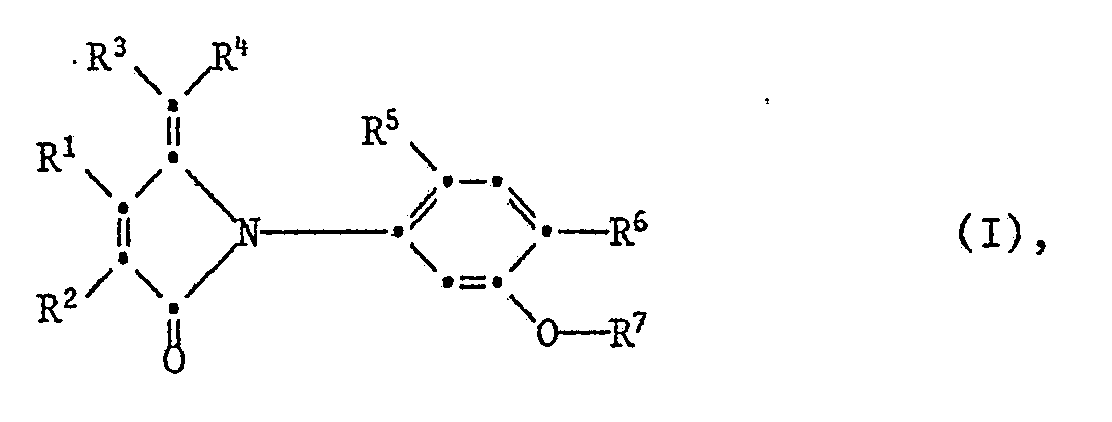
worin - R1 Wasserstoff; (C1-C8)-Alkyl;
- R2 Wasserstoff; (C1-C8)-Alkyl; oder
- R1 und R2 gemeinsam eine gegebenenfalls bis zu zweifach durch (C1-C4)-Alkyl substituierte -(CH2)4-Brücke;
- R3 und R4 unabhängig voneinander Wasserstoff; oder (C1-C4)-Alkyl; oder einer der Reste R3 oder R4 Wasserstoff und der andere ein gegebenenfalls bis zu dreifach gleich oder verschieden durch Halogen, (C1-C4)-Alkyl oder (C1-C4)-Alkoxy substituierter Phenylrest; oder
- R3 und R4 zusammen eine -(CH2)n-Brücke, mit n = 2, 3, 4, 5 oder 6, die gewünschtenfalls bis zu dreifach durch (C1-C4)-Alkyl substituiert sein kann;
- R5 Wasserstoff; oder Fluor;
- R6 Halogen;
- R7 Wasserstoff; (C1-C8)-Alkyl; (C3-C8)-Alkenyl; (C1-C8)-Alkinyl; (C3-C7)-Cycloalkyl; (C1-C4)-Alkyl, einfach substituiert durch: (C1-C4)-Alkoxy, (C1-C4)-Alkylthio, mono-(C1-C4)-Alkylamino, di-(C1-C4)-Alkylamino, Cyano, (C3-C7)-Cycloalkyl, Phenyl, Halogenphenyl, (C1-C4)-Alkylphenyl, (C1-C4)-Alkoxyphenyl, (C1-C4)-Halogenalkylphenyl, (C1-C4)-Halogenalkoxyphenyl, Nitrophenyl, Cyanophenyl, Hydroxy, 1,3-Dioxolan-2-yl, 1,3-Dioxan-2-yl oder CO-R8; (C1-C8)-Alkyl, (C3-C8)-Alkenyl oder (C3-C7)-Cycloalkyl, welche ein oder mehrfach durch Halogen substituiert sind; oder CO-R8.
- R8 (C1-C8)-Alkyl; (C3-C8)-Alkenyl; Benzyl, gegebenenfalls am Phenylring einfach substituiert durch Halogen, (C1-C4)-Alkyl, (C1-C4)-Alkoxy, (C1-C4)-Halogenalkyl, Nitro oder Cyano; (C3-C7)-Cycloalkyl; Phenyl, gegebenenfalls bis zu dreifach substituiert durch Halogen, (C1-C8)-Alkyl, (C1-C4)-Alkoxy, (C1-C4)-Halogenalkyl oder einfach substituiert durch Cyano oder Nitro; Furan; Thiophen; (C1-Ca)-Alkoxy; (C1-C4)-Alkoxy-(C1-C4)-Alkoxy; (C3-C8)-Alkenyloxy; (C3-C8)-Alkinyloxy; (C1-C8)-Alkylthio; (C3-C8)-Alkenylthio; (C3-C8)-Alkinylthio; Amino; mono(C1-C4)-Alkylamino; di-(C1-C4)-Alkylamino; Phenylamino, gegebenenfalls bis zu dreifach substituiert durch Halogen, (C1-C4)-Alkyl, (C1-C4)-Alkoxy oder (C1-C4)-Halogenalkyl oder einfach substituiert durch Cyano oder Nitro;
- bedeutet.
- In der obigen Definition umfassen die angegebenen generischen Begriffe, sowie die durch Kombination einzelner Unterbegriffe erhältlichen Substituenten, beispielsweise die folgenden spezifischen Einzelsubstituenten, wobei diese Aufzählung keine Einschränkung der Erfindung darstellt:
- Methyl, Ethyl, n-Propyl, i-Propyl, n-Butyl, i-Butyl, s-Butyl, t-Butyl, n-Pentyl und sec-Pentyl, vorzugsweise Methyl, Ethyl und Isopropyl.
- Fluor, Chlor, Brom und Jod, vorzugsweise Fluor, Chlor und Brom.
- Methoxy, Ethoxy, Propyloxy, i-Propyloxy, n-Butyloxy, i-Butyloxy, s-Butyloxy und t-Butyloxy, vorzugsweise Methoxy oder Ethoxy.
- Fluormethyl, Difluormethyl, Trifluormethyl, Chlormethyl, Dichlormethyl, Trichlormethyl, 2,2,2-Trifluorethyl, 2-Fluorethyl, 2-Chlorethyl und 2,2,2-Trichlorethyl, vorzugsweise Chlormethyl, 2-Chlorethyl und Trifluormethyl.
- Fluormethoxy, Difluormethoxy, Trifluormethoxy, 2,2,2-Trifluorethoxy, 1,1,2,2-Tetrafluorethoxy, 2-Fluorethoxy, 2-Chlorethoxy und 2,2,2-Trichlorethoxy, vorzugsweise Difluormethoxy, 2-Chlorethoxy und Trifluormethoxy.
- Methoxycarbonyl, Ethoxycarbonyl, 4-Propyloxycarbonyl, i-Propyloxycarbonyl und n-Butyloxycarbonyl, vorzugsweise Methoxycarbonyl und Ethoxycarbonyl.
- Methoxymethyl, Ethoxymethyl, Propyloxymethyl, 2-Methoxyethyl, 1-Methoxyethyl, Ethoxyethyl, Propyloxyethyl, Methoxypropyl, Aethoxypropyl oder Propyloxypropyl.
- Methylthio, Ethylthio, Propylthio, Isopropylthio, (n)-Butylthio, (i)-Butylthio, (s)-Butylthio oder (t)-Butylthio.
- Methylamino, Dimethylamino, Ethylamino oder Diethylamino.
- Cyanomethyl, Cyanoethyl oder Cyanopropyl.
- Cyclopropyl, Cyclobutyl, Cyclopentyl, Cyclohexyl oder Cycloheptyl. Bevorzugt sind Cyclopropyl, Cyclopentyl oder Cyclohexyl.
- 2,2-Dichlorcyclopropyl oder Pentachlorcyclohexyl.
- sind insbesondere die über ein gesättigtes Kohlenstoffatom gebundenen Allyl-, 2-Butenyl-, 3-Butenyl- oder Methallylreste.
- sind insbesondere die über ein gesättigtes Kohlenstoffatom gebundenen Propargyl-, 2-Butinyl- oder 3-Butinylreste.
- Cyclopentyloxycarbonyl oder Cyclohexyloxycarbonyl.
- Phenyl, auch als Teil eines grösseren Substituenten wie Phenoxy, Phenylthio, Phenoxycarbonyl, Phenylaminocarbonyl, Benzyl oder Benzoyl, kann im allgemeinen unsubstituiert oder durch weitere Substituenten substituiert vorliegen. Die Substituenten können dann in ortho-, meta- oder para-Stellung stehen. Bevorzugte Substituentenstellungen sind die ortho- und para-Position zur Ringverknüpfungsstelle. Bevorzugte Substituenten sind Halogenatome.
- In den Fällen, in denen R3 für Wasserstoff und R4 für einen gegebenenfalls substituierten Phenylrest steht, sind neben dem unsubstituierten Phenylrest im allgemeinen Phenylreste bevorzugt, welche die Lipophilie des Gesamtmoleküls begünstigen, wie etwa die isomeren Chlorphenyl-, Fluorphenyl-, Methylphenyl-, Dimethylphenyl-, Trimethylphenyl-, Methoxyphenyl- oder Dimethoxyphenylreste.
- Wenn die Substituenten R3 und R4 gemeinsam für eine -(CH2)n-Brücke stehen, bilden sie zusammen mit dem Kohlenstoffatom, an welches sie gebunden sind, einen carbocyclischen 3 bis 7-Ring. Bevorzugt sind 3, 5 und 6-Ringe. Dieser Carbocyclus kann seinerseits wieder durch bis zu drei (Ci-C4)-Alkylgruppen substituiert sein.
- In den weiteren Substituenten, welche aus mehreren Grundelementen zusammengesetzt sind, haben die Teilelemente die oben an Beispielen erläuterten Bedeutungen. Diese Aufzählungen bedeuten auch in diesen Fällen keine Einschränkdung der Erfindung: sie haben illustrierenden Charakter.
- Bei bestimmter Substitution können die Verbindungen der Formel ein oder mehrere Asymmetriezentren aufweisen. Die Erfindung umfasst sowohl das Racemat, wie auch die optisch reinen Isomeren und die mit einer oder mehreren optisch aktiven Formel angereicherten Gemische.
- Die Isomeren können im allgemeinen nach bekannten Verfahren, wie fraktionierte Kristallisation oder Auftrennung mittels besonderer Chromatographieverfahren hergestellt werden. Darüber hinaus kann in vielen Fällen das gewünschte enantiomere Produkt durch die Verwendung chiraler Edukte hergestellt werden. Bevorzugt sind Verbindungen der Formel I,
worin - R1 Wasserstoff; (C1-C4)-Alkyl;
- R2 Wasserstoff; (Ci-C4)-Alkyl; oder
- R1 und R2 gemeinsam eine gegebenenfalls einfach durch (Ci-C4)-Alkyl substituierte -(CH2)4-Brücke; R3 und R4 unabhängig voneinander Wasserstoff; oder (Ci-C4)-Alkyl; oder
- einer der Reste R3 oder R4 Wasserstoff und der andere ein gegebenenfalls bis zu dreifach durch Fluor, Chlor, Methyl oder Methoxy substituierter Phenylrest; oder
- R3 und R4 zusammen eine -(CH2)n-Brücke, mit n = 2, 4 oder 5, die gewünschtenfalls bis zu dreifach durch (C1-C4)-Alkyl substituiert sein kann;
- R5 Wasserstoff; oder Fluor;
- R6 Fluor; Chlor; oder Brom;
- R7 Wasserstoff; (C1-C5)-Alkyl; (C3-C5)-Alkenyl; (C3-C5)-Alkinyl; (C5-C6)-Cycloalkyl, (C1-C4)-Alkyl, einfach substituiert durch: (C1-C4)-Alkoxy, (C1-C4)-Alkylthio, mono-(C1-C4)-Alkylamino, di- (Ci-C4)-Alkylamino, Cyano, Cyclohexyl, Phenyl, oder CO-R8; (C1-C4)-Alkyl oder (C3-C5)-Alkenyl, welche ein oder mehrfach durch Halogen substituiert sind; oder CO-R8.
- R8 (C1-C4)-Alkyl; Phenyl; (C1-C4)-Alkylthio; (C1-C4)-Alkoxy; Amino; oder di-(C1-C4)-Alkylamino; bedeutet.
- Insbesondere betrifft die Erfindung Verbindungen der Formel I, worin
- R1 Wasserstoff; (Ci-C4)-Alkyl;
- R2 Wasserstoff; (C1-C4)-Alkyl; oder
- R1 und R2 gemeinsam eine gegebenenfalls einfach durch Methyl substituierte -(CH2)4-Brücke;
- R3 und R4 unabhängig voneinander Wasserstoff; oder (Ci-C4)-Alkyl; oder
- einer der Reste R3 oder R4 Wasserstoff und der andere ein unsubstituierter oder einfach durch Fluor oder Chlor, oder bis zu dreifach durch Methyl oder Methoxy substituierter Phenylrest; oder
- R3 und R4 zusammen eine -(CH2)n-Brücke, mit n = 2, 4 oder 5,
- R5 Wasserstoff; oder Fluor;
- R6 Fluor; Chlor; oder Chlor;
- R7 Wasserstoff; (C1-C5)-Alkyl; Propargyl; Allyl; (C1-C3)-Alkyl, einfach substituiert durch Chlor, Cyano, Hydroxy, Methoxy, Cyclohexyl, (Ci-C3)-Alkylthio, Dimethylamino, Phenyl oder CO-R8; Chlorallyl; oder CO-Ra; R8 (C1-C4)-Alkoxy; Methyl; Phenyl; Methylthio; Amino; oder Dimethylamino;
- bedeutet.
- Im Hinblick auf ihre herbizide Wirkung sind nachstehend genannte Gruppen hervorzuheben:
- A: Verbindungen der Formel l, worin R1 und R2 unabhängig voneinander (C1-C4)-Alkyl bedeuten.
- B: Verbindungen der Formel I, worin R1 und R2 gemeinsam eine gegebenenfalls einfach durch Methyl substituierte -(CH2)4-Brücke bedeutet.
- C: Verbindungen der Formel, l, worin R3 und R4 Wasserstoff bedeutet.
- D: Verbindungen der Formel I, worin R3 Wasserstoff und R4 (C1-C4)-Alkyl bedeutet.
- E: Verbindungen der Formel I, worin R4 Wasserstoff und R3 (C1-C4)-Alkyl bedeutet.
- F: Verbindungen der Formel l,worin R3 und R4 zusammen eine -(CH2)n-Brücke, mit n = 2,3,4,5 oder 6, die gewünschtenfalls bis zu dreifach durch (C1-C4)-Alkyl substituiert sein kann, bedeutet.
- G: Verbindungen der Formel I, worin R3 und R4 zusammen eine -(CH2)n-Brücke, mit n = 2, 4 oder 5, bedeutet.
- H: Verbindungen der Formel I, worin R1 und R2 jeweils die gleiche Bedeutung haben.
- l: Verbindungen der Formel I, worin R3 und R4 unabhängig voneinander (C1-C4)-Alkyl bedeuten.
- J: Verbindungen der Formel I, worin R5 Fluor und R6 Chlor bedeutet.
- K: Verbindungen der Formel I, worin R7 einen über ein sekundäres Kohlenstoffatom gebundenen (C1-C5)-Alkylrest bedeutet.
- L: Verbindungen der Formel I, worin R7 Isopropyl bedeutet.
- M: Verbindungen der Formel worin R7 einen gegebenenfalls durch Chlor substituierten (C3-C5)-Alkenylrest bedeutet.
- N: Verbindungen der Formel I, worin R7 Propargyl bedeutet und
- O: Verbindungen der Formel I, worin R7 ein durch COR8 substituierten (C1-C4)-Alkylrest bedeutet.
- Namentlich zu nennen sind:
- 2-(4-Chlor-2-fluor-5-isopropyloxyphenyl)-3-methylen-4,5,6,7-tetrahydroisoindol-(2H)1-on,
- 2-(4-Chlor-2-fluor-5-propargyloxyphenyl)-3-methylen-4,5,6,7-tetrahydroisoindol-(2H)1-on,
- 2-[4-Chlor-2-fluor-5-(2-methylpropyloxy)phenyl]-3-methylen-4,5,6,7-tetrahydroisoindol-(2H)1-on,
- 2-[4-Chlor-2-fluor-5-(2-chlorprop-2-enyloxy)-phenyl]-4,5,6,7-tetrahydroisoindol-(2H)1-on,
- 2-[4-Chlor-2-fluor-5-(1-methoxycarbonylethoxy)phenyl]-4,5,6,7-tetrahydroisoindol-(2H)1-on,
- 2-[4-Chlor-2-fluor-5-(3-chlorprop-2-enyloxy)-phenyl]-4,5,6,7-tetrahydroisoindol-(2H)1-on,
- 2-[4-Chlor-2-fluor-5-(prop-2-inyloxy)-phenyl]-4,5,6,7-tetrahydroisoindol-(2H)1-on,
- 1-(4-Chlor-2-fluor-5-isopropyloxyphenyl)-3,4-dimethyl-5-methylenpyrrol-(1H)2-on,
- 2-(4-Chlor-2-fluor-5-isopropyloxyphenyl)-3-(1,1-dimethylmethylen)-4,5,6,7-tetrahydroisoindol-(2H)1-on,
- 2-(4-Chlor-2-fluor-5-isopropyloxyphenyl)-3-ethyliden-4,5,6,7-tetrahydroisoindol-(2H)1-on,
- 5-Benzyliden-1-(4-chlor-2-fluor-5-isopropyloxy-phenyl)-3,4-dimethylpyrrol-(1H)2-on oder
- 5-(o-Chlorbenzyliden)-1-(4-chlor-2-fluor-5-propargyloxy-phenyl)-3,5-dimethyl-pyrrol-(1H)2-on.
- Die Verbindungen der Formel I können hergestellt werden
- a) durch die Alkylierung oder Acylierung eines Phenols der Formel la,

worin die Reste R1 bis R6 wie zuvor definiert sind, mit einer Verbindung der Formel II, worin R7 wie zuvor definiert ist, jedoch nicht für Wasserstoff und X für eine unter der Reaktionsbedingungen abspaltbare Gruppe steht, unter Basenzusatz umsetzt, wobei X vorzugsweise Halogen, wie Chlor, Brom oder Jod oder einen gewünschtenfalls im Phenylkern alkylierten oder halogenierten Phenylsulfonylrest, ein Radikal der Formel R7OSO2-O oder wenn R7 für

- b) durch Umsetzung eines 5-Chlor-2,5-dihydrofuran-2-ons der Formel VIII, worin die Reste R1 bis R4 wie zuvor definiert sind mit einem Anilin der Formel VII, worin die Reste R5 bis R7 wie zuvor definiert sind

zu einem Primäraddukt der Formel V und anschliessender Wasserabspaltung zu I. - Nach einem weiteren generell anwendbaren Verfahren herstellbar sind die Verbindungen der Formel la

worin - R1 Wasserstoff; (C1-C8)-Alkyl;
- R2 Wasserstoff; (C1-C8)-Alkyl; oder
- R1 und R2 gemeinsam eine gegebenenfalls bis zu zweifach durch (Ci-C4)-Alkyl substituierte -(CH2)4-Brücke; R3 und R4 unabhängig voneinander Wasserstoff; oder (C1-C4)-Alkyl; oder
- einer der Reste R3 oder R4 Wasserstoff und der andere ein gegebenenfalls bis zu dreifach gleich oder verschieden durch Halogen, (Ci-C4)-Alkyl oder (C1-C4)-Alkoxy substituierter Phenylrest; oder
- R3 und R4 zusammen eine -(CH2)n-Brücke, mit n = 2, 3, 4, 5 oder 6, die gewünschtenfalls bis zu dreifach durch (C1-C4)-Alkyl substituiert sein kann;
- R5 Wasserstoff; oder Fluor;
- R6 Halogen;
- R7 Wasserstoff; (C1-C8)-Alkyl; (C3-C8)-Alkenyl; (C3-C8)-Alkinyl; (Ca-C7)-Cycloalkyl; (Ci-C4)-Alkyl, einfach substituiert durch: (Ci-C4)-Alkoxy, (Ci-C4)-Alkylthio, mono-(C1-C4)-Alkylamino, di-(C1-C4)-Alkylamino, (C3-C7)-Cyeloalkyl, Phenyl, Halogenphenyl, (C1-C4)-Alkylphenyl, (C1-C4)-Alkoxyphenyl, (Ci-C4)-Halogenalky-Iphenyl, (C1-C4)-Halogenalkoxyphenyl, Nitrophenyl, Hydroxy, 1,3-Dioxolan-2-yl oder 1,3-Dioxan-2-yl; (C1-C8)-Alkyl, (C3-C8)-Alkenyl oder (C3-C7)-Cycloalkyl, welche ein oder mehrfach durch Halogen substituiert sind;
- bedeutet,
- c) durch die Umsetzung einer Verbindung der Formel III

worin Rl, R2, R5, R6 und R7 wie zuvor definiert sind, mit einem Grignard-Reagenz der Formel IV
worin R3 und R4 unabhängig voneinander Wasserstoff; oder (C1-C4)-Alkyl; R3 Wasserstoff und R4 einen gegebenenfalls bis zu dreifach gleich oder verschieden durch Halogen, (Ci-C4)-Alkyl oder (Ci-C4)-Alkoxy substituierten Phenylrest; oder R3 und R4 zusammen eine -(CH2)n-Brücke, mit n = 2, 3, 4, 5 oder 6, die gewünschtenfalls bis zu dreifach durch (Ci-C4)-Alkyl substituiert sein kann; bedeutet, zu einer Verbindung der Formel V
worin die Reste R1 bis R7 wie zuvor definiert sind, und anschliessender Wasserabspaltung zu la. - Die Verfahrensvariante b) kann analog zu literaturbekannten Verfahren (R. Scheffold und P. Dabs, Helv.Chim.Acta. 50 (1967) 798 sowie die dort angegebene Literatur) durchgeführt werden.
- Bei der Grignard Reaktion c) kann das Grignard-Reagenz der Formel IV mit beiden Ketogruppen des Imids III reagieren, was im Falle einer unsymmetrischen Substitution von III (R1 ≠ R2) zu zwei verschiedenen Produkten führt.
- Im allgemeinen wird das Grignard-Reagenz von der sterisch am wenigsten gehinderten Seite aus angreifen (kinetisch kontrollierte Reaktion). Aus dem, bei unsymmetrischer Substitution, entstehenden Gemisch der Primärprodukte kann durch Trennverfahren (Extraktion, Chromatographie, Kristallisation etc.) das gewünschte Produkt in angereicherter oder reiner Form erhalten werden. Diese Trennverfahren sind sowohl auf der Stufe des Primäraddukts V, wie auch auf der Stufe der exo-Methylenverbindung la durchführbar.
- In den Fällen, in denen in Formel I oder la die Reste R3 und R4 unterschiedliche Bedeutung haben, entsteht bei der Wasserabspaltung aus V ebenfalls ein Gemisch isomerer Verbindungen gemäss nachstehender Gleichung:
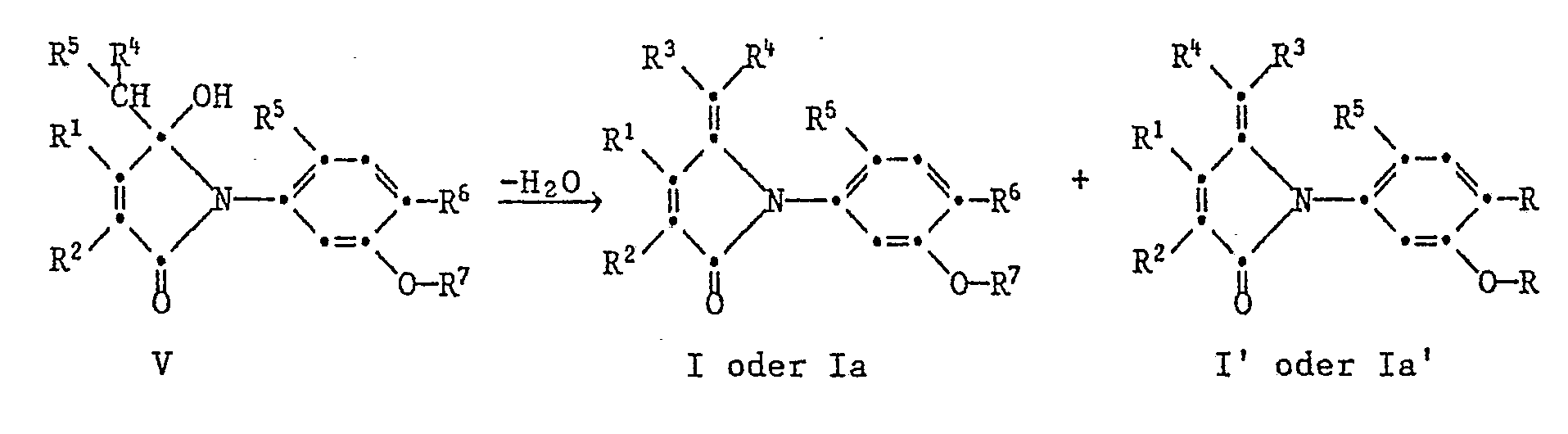
- Das Gemisch I/I' oder la/la' kann mittels allgemein üblicher Trennverfahren (siehe oben) aufgearbeitet und in die reinen oder angereicherten Komponenten I und I' oder la und la' aufgetrennt werden.
- Obwohl die als Reaktionen a) und b) skizzierten Synthesen der Verbindungen der Formel I Verfahren beschreiben, mit welchen prinzipiell sämtliche von Formel 1 umfasste Verbindungen herstellbar sind, kann es aus ökonomischen oder verfahrenstechnischen Gründen sinnvoll sein, bestimmte Verbindungen der Formel in andere, ebenfalls von Formel 1 umfasste Derivate, zu überführen. Beispiel für derartige Umwandlungen sind, neben der Reaktion a) selbst, zum Beispiel Verfahren, bei denen R7 für ein Halogenalkyl bzw. Halogenalkoxyradikal steht. Diese können etwa durch Reaktion mit Alkoholen oder Aminen in Alkoxyalkyl-, Alkoxyalkoxy-, Aminoalkyl- oder Aminoalkoxyreste überführt werden. Derartige Derivatisierungsreaktionen sind dem Fachmann geläufig.
- Mit Vorteil führt man die obigen Umsetzungen in einem reaktionsinerten Lösungsmittel aus. Dabei kommen als inerte Lösungsmittel, insbesondere für Reaktion a) und b), Kohlenwasserstoffe, wie Benzol, Toluol oder Xylol; Ether, wie Diethylether, Methylisopropylether, Glyme, Diglyme; cyclische Ether, wie Tetrahydrofuran und Dioxan; Ketone, wie Aceton, Methylethylketon; Amide, wie Dimethylformamid, N-Methylpyrrolidon; Sulfoxide, wie Dimethylsulfoxid; oder chlorierte Kohlenwasserstoffe, wie Dichlormethan, Trichlormethan, Tetrachlormethan oder Tetrachlorethan in Betracht.
- Die Reaktionstemperatur kann in weiten Grenzen variiert werden. Geeignete Reaktionstemperaturen Liegen beispielsweise zwischen -20°C und der Rückflusstemperatur des Reaktionsgemisches. Vorzugsweise wird die Umsetzung bei einer Temperatur zwischen 0°C und 100°C durchgeführt.
- Im Fall der Reaktion a) ist es vorteilhaft unter Basenzusatz zu arbeiten. Geeignete Basen sind u.a. Natrium-, Kalium- und Calciumhydroxid, Alkali-und Erdalkalicarbonate, Amine, wie etwa Triethylamin oder Heterocyclen, wie Pyridin, DABCO sowie Alkalihydride.
- Die Reaktion a) können auch vorteilhaft unter Phasentransfer-Bedingungen in Zweiphasensystemen durchgeführt werden. Derartige Reaktionen sind dem Fachmann geläufig (z.B. beschrieben in Dehmlow und Dehmlow, Phase Transfer Catalysis, Verlag Chemie, Weinheim 1983; W.E. Keller, Phase Transfer Reactions Vol. 1 und Vol. 2, G. Thieme Verlag, Stuttgart 1986, 1987).
- Die in Verfahrensvariante c) beschriebene organomagnesium Addition ist als Grignard-Reaktion bekannt (US-P-3 992 189 und Krauch Kunz; Reaktionen der Organischen Chemie, A. Hüthig Verlag, Heidelberg; 5.Aufl. 1976, S. 572-4; sowie die dort genannten Referenzen).
- Die für Grignard-Reaktionen an sich vorteilhaften Reaktionsbedingungen (Verfahrensschritte, Lösungsmittel, Temperaturen etc.) sind dem Fachmann geläufig und brauchen hier nicht weiter erläutert zu werden. Die Verbindungen der Formel I umfassen auch (für R7) Substituenten, wie Cyano oder -CORB, welche ihrerseits mit der Grignard-Verbindung IV reagieren. Daher ist Verfahren c) nur in dem auf die Formel la beschränkten Umfang zur Herstellung der erfindungsgemässen Endprodukte I geeignet.
- Besonders hervorzuheben sind hier die Phenole der Formel la (mit R7 = H), welche neben ihrer herbiziden Wirkung auch wertvolle Zwischenprodukte zur Herstellung der Endprodukte gemäss Verfahren a) sind. Direktes Verfahrensprodukt der Grignard-Reaktion c) sind die Alkohole IV, welche durch Wasserabspaltung erst die erfindungsgemässen exo-Methylenverbindungen der Formel I liefern. Die Wasserabspaltung kann nach an sich bekannten Verfahren durch Protonensäuren, wie p-Toluolsulfonsäure, Halogenwasserstoffsäure, Schwefelsäure etc. bewirkt werden. Als weitere vorteilhafte Massnahme hat sich die Einwirkung von Kaliumhydrogensulfat bei erhöhter Temperatur erwiesen.
- Die Alkohole der Formel V sind wertvolle Zwischenprodukte zur Herstellung der erfindungsgemässen exo-Methylenverbindungen la.
- Die Verbindungen der Formel III sind bereits bekannt oder können analog zu bekannten Verfahren hergestellt werden durch

- Umsetzung der Furandione VI mit den Anilinen VII, wobei die Reste R1 bis R7 wie unter Formel la definiert sind. Einige Verbindungen der Formel VIII sind bekannt, wie etwa die Verbindungen VIII, in denen R3 und R4 Wasserstoff und die Reste Ri und R2 Wasserstoff oder Methyl bedeuten. Die Verbindungen der Formel VIII können gemäss nachstehendem Reaktionsschema analog zur vorgenannten Literaturstelle Scheffold und Dabs hergestellt werden.

- Die Verbindungen der Formel VIII, in denen R3 und R4 Wasserstoff und die Reste R1 und R2 Wasserstoff, Methyl oder -(CH2)4- bedeuten, sind ebenfalls literaturbekannt.
- Die neuen Verbindungen der Formel XII und VIII sind als wertvolle Zwischenprodukte ebenfalls Gegenstand vorliegender Erfindung.
- Die Verbindungen der Formel I sind hochaktive Pflanzenwirkstoffe, welche sich bei geeigneten Aufwandmengen hervorragend als Selektivherbizide zur Unkrautbekämpfung in Nutzpflanzenkulturen eignen. Das heisst, bei diesen Aufwandmengen zeichnen sich die Wirkstoffe der Formel 1 durch gute selektiv-hebizide Eigenschaft gegen Unkräuter aus. Kulturpflanzen wie Roggen, Gerste, Hafer, Weizen, Mais, Hirse, Reis, Baumwolle und Soja bleiben bei niedrigen Aufwandmengen praktisch ungeschädigt. Bei gesteigerten Aufwandmengen werden die Kulturpflanzen nur geringfügig in ihrem Wachstum beeinflusst. Werden sehr hohe Aufwandmengen appliziert, entfalten die Substanzen der Formel I totalherbizide Eigenschaften. Die erfindungsgemässen Wirkstoffe greifen in den Metabolismus der Pflanzen ein und können deshalb auch als Wachstumsregulatoren eingesetzt werden.
- Für die Wirkungsweise von Pflanzenwachstumsregulatoren gilt nach der bisherigen Erfahrung, dass ein Wirkstoff auch mehrere verschiedenartige Wirkungen auf Pflanzen ausüben kann. Die Wirkungen der Stoffe hängen im wesentlichen ab von dem Zeitpunkt der Anwendung bezogen auf das Entwicklungsstadium der Pflanze sowie von den auf die Pflanzen oder ihre Umgebung ausgebrachten Wirkstoffmengen und von der Art der Applikation. In jedem Fall sollen Wachstumsregulatoren die Kulturpflanzen in bestimmter gewünschter Weise beeinflussen.
- Unter dem Einfluss von Wachstumsregulatoren kann der Blattbestand der Pflanzen so gesteuert werden, dass ein Entblättern der Pflanzen zu einem gewünschten Zeitpunkt erreicht wird. Eine derartige Entlaubung spielt bei der mechanischen Beerntung der Bauwolle eine grosse Rolle ist aber auch in anderen Kulturen wie z.B. im Weinbau zur Erleichterung der Ernte von Interesse. Eine Entlaubung der Pflanzen kann auch vorgenommen werden, um die Transpiration der Pflanzen vor dem Verpflanzen herabzusetzen.
- Ebenso lässt sich mit Wachstumsregulatoren der Fruchtfall steuern. Einerseits kann ein vorzeitiger Fruchtfall verhindert werden. Andererseits kann aber auch der Fruchtfall oder sogar das Abfallen der Blüten bis zu einem gewünschten Masse gefördert werden ("Ausdünnung"), um die Alternanz zu brechen. Unter Alternanz versteht man die Eigenart einiger Obstarten, endogen bedingt von Jahr zu Jahr sehr unterschiedliche Erträge zu bringen. Schliesslich ist es möglich, mit Wachstumsregulatoren zum Zeitpunkt der Ernte die zum Ablösen der Früchte erforderlichen Kräfte zu reduzierten, um eine mechanische Beerntung zu ermöglichen oder eine manuelle Beerntung zu erleichtern.
- Die selektiv-herbizide Wirkung der erfindungsgemässen Verbindungen wird sowohl bei der preemergenten als auch der postemergenten Anwendung festgestellt. Diese Wirkstoffe können daher im Vorauflaufverfahren und im Nachauflaufverfahren zur selektiven Unkrautbekämpfung gleichermassen mit gutem Erfolg verwendet werden.
- Die Erfindung betrifft auch herbizide und wuchsregulatorische Mittel, welche einen neuen Wirkstoff der Formel I enthalten, sowie Verfahren zur pre- und postemergenten Unkrautbekämpfung.
- In vorteilhafter Weise können die erfindungsgemässen Wirkstoffe oder Mittel auch auf das Vermehrungsgut der Kulturpflanze aufgebracht werden. Besonders zu erwähnen ist hier die Samenbeizung. Vermehrungsgut sind Samen, Stecklinge oder sonstige Teile der Pflanze, aus denen die Kulturpflanze gezogen werden kann. Das mit einer wirksamen Menge einer Verbindung der Formel behandelte Vermehrungsgut ist ebenfalls Gegenstand der Erfindung.
- Die Verbindungen der Formel werden in unveränderter Form oder vorzugsweise als Mittel zusammen mit den in der Formulierungstechnik üblichen Hilfsmitteln eingesetzt und werden daher z.B. zu Emulsionskonzentraten, direkt versprühbaren oder verdünnbaren Lösungen, verdünnten Emulsionen, Spritzpulvern, löslichen Pulvern, Stäubemitteln, Granulaten, auch Verkapselungen in z.B. polymeren Stoffen in bekannter Weise verarbeitet. Die Anwendungsverfahren wie Versprühen, Vernebeln, Verstäuben, Verstreuen oder Giessen werden gleich wie die Art der Mittel den angestrebten Zielen und den gegebenen Verhältnissen entsprechend gewählt.
- Die Formulierungen, d.h. die den Wirkstoff der Formel I und gegebenenfalls einen festen oder flüssigen Zusatzstoff enthaltenden Mittel, Zubereitungen oder Zusammensetzungen werden in bekannter Weise hergestellt, z.B. durch inniges Vermischen und/oder Vermahlen der Wirkstoffe mit Streckmitteln, wie z.B. mit Lösungsmitteln, festen Trägerstoffen, und gegebenenfalls oberflächenaktiven Verbindungen (Tensiden). Als Lösungsmittel können in Frage kommen: Aromatische Kohlenwasserstoffe, bevorzugt die Fraktionen C8 bis C12, wie z.B. Xylolgemische oder substituierte Naphthaline, Phthalsäureester wie Dibutyl- oder Dioctylphthalat, aliphatische Kohlenwasserstoffe wie Cyclohexan oder Paraffine, Alkohole und Glykole sowie deren Ether und Ester, wie Ethanol, Ethylenglykol, Ethylenglykolmonomethyl- oder -ethylether Ketone wie Cyclohexa non, stark polare Lösungsmittel wie N-Methyl-2-pyrrolido.n, Dimethylsulfoxid oder Dimethylformamid, sowie gegebenenfalls epoxidierte Pflanzenöle, wie epoxidiertes Kokosnussöl oder Sojaöl oder Wasser. Als feste Trägerstoffe, z.B. für Stäubemittel und dispergierbare Pulver, werden in der Regel natürliche Gesteinsmehle verwendet, wie Calcit, Talkum, Kaolin, Montmorillonit oder Attapulgit. Zur Verbesserung der physikalischen Eigenschaften können auch hochdisperse Kieselsäure oder hochdisperse saugfähige Polymerisate zugesetzt werden. Als gekörnte, adsorptive Granulatträger kommen poröse Typen wie z.B. Bimsstein, Ziegelbruch, Sepiolit oder Bentonit, als nicht sorptive Trägermaterialien z.B. Calcit oder Sand in Frage. Darüberhinaus kann eine Vielzahl von vorgranulierten Materialien anorganischer oder organischer Natur wie insbesondere Dolomit oder zerkleinerte Pflanzenrückstände verwendet werden.
- Als oberflächenaktive Verbindungen kommen je nach der Art des zu formulierenden Wirkstoffes der Formel I nichtionogene, kation-und/oder anionaktive Tenside mit guten Emulgier-, Dispergier- und Netzeigenschaften in Betracht. Unter Tensiden sind auch Tensidgemische zu verstehen.
- Geeignete anionische Tenside können sowohl sog. wasserlösliche Seifen als auch wasserlösliche synthetische oberflächenaktive Verbindungen sein.
- Als Seifen seien die Alkali-, Erdalkali- oder gegebenenfalls substituierte Ammoniumsalze von höheren Fettsäuren (C10-C22), wie z.B. die Na-oder K-Salze der Oel- oder Stearinsäure, oder von natürlichen Fettsäuregemischen, die z.B. aus Kokosnuss- oder Talgöl gewonnen werden können, genannt. Ferner sind auch die Fettsäuremethyl-taurinsalze zu erwähnen.
- Häufiger werden jedoch sogenannte synthetische Tenside verwendet, insbesondere Fettsulfonate, Fettsulfate, sulfonierte Benzimidazolderivate oder Alkylarylsulfonate.
- Die Fettsulfonate oder -sulfate liegen in der Regel als Alkali-, Erdalkali- oder gegebenenfalls substituierte Ammoniumsalze vor und weisen einen Alkylrest mit 8 bis 22 C-Atomen auf, wobei Alkyl auch den Alkylteil von Acylresten einschliesst, z.B. das Na- oder Ca-Salz der Ligninsulfonsäure, des Dodecylschwefelsäureesters oder eines aus natürlichen Fettsäuren hergestellten Fettalkoholsulfatgemisches.
- Hierher gehören auch die Salze der Schwefelsäureester und Sulfonsäuren von Fettalkohol-Ethylenoxid-Addukten. Die sulfonierten Benzimidazolderivate enthalten vorzugsweise 2-Sulfonsäuregruppen und einen Fettsäurerest mit 8 bis 22 C-Atomen. Alkylarylsulfonate sind z.B. die Na-, Ca- oder Triethanolaminsalze der Dodecylbenzolsulfonsäure, der Dibutylnaphthalinsulfonsäure oder eines Naphthalinsulfonsäure-Formaldehydkondensationsproduktes.
- Ferner kommen auch entsprechende Phosphate wie z.B. Salze des Phosphorsäureesters eines p-Nonylphenol-(4-14)-Ethylenoxid-Adduktes oder Phospholipide in Frage.
- Als nicht ionische Tenside kommen in erster Linie Polyglykoletherderivate von aliphatischen oder cycloaliphatischen Alkoholen, gesättigten oder ungesättigten Fettsäuren und Alkylphenolen in Frage, die 3 bis 10 Glykolethergruppen und 8 bis 20 Kohlenstoffatome im (aliphatischen) Kohlenwasserstoffrest und 6 bis 18 Kohlenstoffatome im Alkylrest der Alkylphenole enthalten können.
- Weitere geeignete nichtionische Tenside sind die wasserlöslichen, 20 bis 250 Ethylenglykolethergruppen und 10 bis 100 Propylenglykolethergruppen enthaltenden Polyethylenoxidaddukte an Polypropylenglykol, Ethylendiaminopolypropylenglykol und Alkylpolypropylenglykol mit 1 bis 10 Kohlenstoffatomen in der Alkylkette, die genannten Verbindungen enthalten üblicherweise pro Propylenglykol-Einheit 1 bis 5 Ethylenglykoleinheiten.
- Als Beispiel nichtionischer Tenside seien Nonylphenolpolyethoxyethanole, Ricinusölpolyglykolether, Polypropylen-Polyethylenoxidaddukte, Tributylphenoxypolyethoxyethanol, Polyethylenglykol und Octylphenoxypolyethoxyethanol erwähnt.
- Ferner kommen auch Fettsäureester von Polyoxyethylensorbitan wie das Polyoxyethylensorbitan-trioleat in Betracht.
- Bei den kationischen Tensiden handelt es sich vor allem um quaternäre Ammoniumsalze, welche als N-Substituenten mindestens einen Alkylrest mit 8 bis 22 C-Atomen enthalten und als weitere Substituenten niedrige, gegebenenfalls halogenierte Alkyl-, Benzyl- oder niedrige Hydroxyalkylreste aufweisen. Die Salze liegen vorzugsweise als Halogenide, Methylsulfate oder Ethylsulfate vor, z.B. das Stearyltrimethylammoniumchlorid oder das Benzyldi(2-chlorethyl)-ethylammoniumbromid.
- Die in der Formulierungstechnik gebräuchlichen Tenside sind u.a. in folgenden Publikationen beschrieben: "1986 International Mc Cutcheon's Emulsifiers & Detergents" Glen Rock, N.J., USA, 1986; H. Stache, "Tensid-Taschenbuch", 2. Auflage., C. Hanser Verlag, München, Wien, 1981; M. and J. Ash. "Encyclopedia of Surfactants", Vol. 1-111, Chemical Publishing Co., New York,1980-1981.
- Die Wirkstoffzubereitungen enthalten in der Regel 0,1 bis 95 %, insbesondere 0,1 bis 80 % Wirkstoff der Formel 1,1 bis 99,9 % eines oder mehrerer fester oder flüssiger Zusatzstoffe und 0 bis 25 % eines Tensides. Insbesondere setzen sich bevorzugte Formulierungen folgendermassen zusammen: (% = Gewichtsprozent).
-
- Aktiver Wirkstoff: 1 bis 20%, bevorzugt 5 bis 10 %
- oberflächenaktive Mittel: 5 bis 30 %, vorzugsweise 10 bis 20 %
- flüssige Trägermittel: 50 bis 94 o/o, vorzugsweise 70 bis 85%
-
- Aktiver Wirkstoff: 0,1 bis 10 %, vorzugsweise 0,1 bis 1 %
- festes Trägermittel: 99,9 bis 90%, vorzugsweise 99,9 bis 99 %
-
- Aktiver Wirkstoff: 5 bis 75%, vorzugsweise 10 bis 50 %
- Wasser: 94 bis 25%, vorzugsweise 88 bis 30 %
- oberflächenaktives Mittel: 1 bis 40%, vorzugsweise 2 bis 30 %
-
- Aktiver Wirkstoff: 0,5 bis 90 %, vorzugsweise 1 bis 80 %
- oberflächenaktives Mittel: 0,5 bis 20%, vorzugsweise 1 bis 15 %
- festes Trägermittel: 5 bis 95 %, vorzugsweise 15 bis 90 %
-
- Aktiver Wirkstoff: 0,5 bis 30 %, vorzugsweise 3 bis 15 %
- festes Trägermittel: 99,5 bis 70%, vorzugsweise 97 bis 85 %
- Während als Handelsware konzentrierte Mittel bevorzugt werden, verwendet der Endverbraucher in der Regel verdünnte Mittel, Die Anwendungsformen können bis hinab zu 0,001 % an Wirkstoff verdünnt werden. Die Aufwandmengen betragen in der Regel 0,001 bis 4 kg AS/ha, vorzugsweise 0,005 bis 1 kg AS/ha.
- Die Mittel können auch weitere Zusätze wie Stabilisatoren, Entschäumer, Viskositätsregulatoren, Bindemittel, Haftmittel sowie Dünger oder andere Wirkstoffe zur Erzielung spezieller Effekte enthalten. Die nachfolgenden Beispiel erläutern die Erfindung.
- Zu 4,0 g Magnesiumspäne in 100 ml wasserfreiem Diethylether werden 80 g Methyljodid so zugetropft, dass der Ether siedet. Nachdem das gesamte Magnesium in Lösung gegangen ist, werden 34,0 g 2-(4-Chlor-2-fluor-5-isopropyloxyphenyl)-4,5,6,7-tetrahydro isoindol-(2H)1,3-dion, gelöst in Diethylether, zugetropft. Es wird dann eine Stunde zum Sieden erhitzt. Nach dem Abkühlen wird das Reaktionsgemisch auf Eis/Wasser gegossen und mit so viel 2N-Salzsäure versetzt, bis sich der zunächst gebildete Niederschlag löst. Danach wird dreimal mit Essigester extrahiert, die Extrakte getrocknet, eingeengt und aus Acetonitril umkristallisiert. Man isoliert 21 g der Titelverbindung der Formel

als Kristalle vom Fp. 167°C. - Analog zu Herstellungsbeispiel H 1.1. erhält man aus Methylmagnesiumiodid und 2-(4-Chlor-2-f!uor-5-hydroxyphenyl)-4,5,6,7-tetrahydroisoindol-2H(1,3)-dion die Titelverbindung der Formel
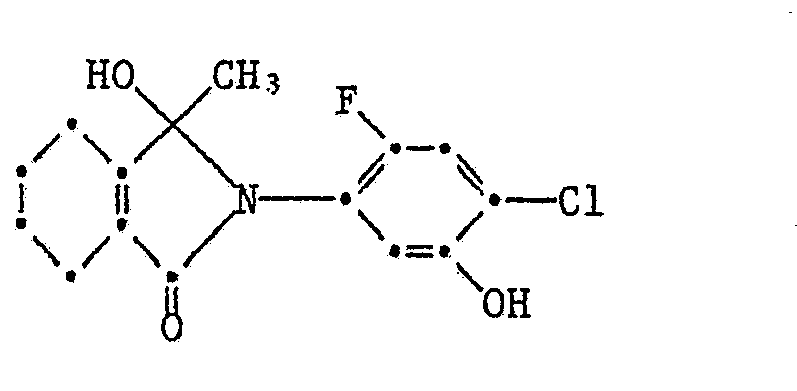
als Kristalle vom Fp. 219-220° C. - Eine Mischung aus 6 g 2-[N-(4-Chlor-2-fluor-5-isopropyloxyphenyl)j-2,3,4,5,6,7-hexahydro-3-hydroxy-3-methyl-isoindol-(1H)1-on und 0,2 g Kaliumhydrogensulfat werden unter gutem Rühren für 30 Minuten bei einer Badtemperatur von 140°C erhitzt. Nach dem Abkühlen wird in Methylenchlorid aufgenommen, von anorganischen Teilen abfiltriert und eingedampft. Der Rückstand wird zweimal aus Methanol umkristallisiert. Man isoliert 2,1 g der Titelverbindung der Formel
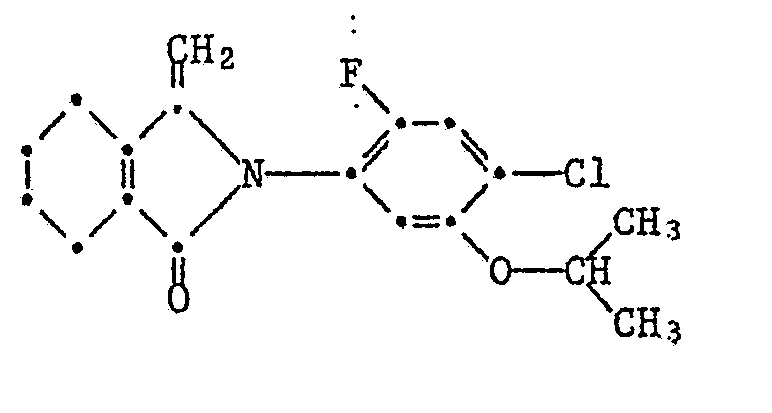
als Kristalle vom Fp. 102-103°C (Verb.No. 1.4). - 105 g 2-(4-Chlor-2-fluor-5-hydroxyphenyl)-3-hydroxy-3-methylen-2,3,4,5,6,7-hexahydroisoindol-(lH)1-on werden zusammen mit 10 g p-Toluolsulfonsäure und 30 g eines Molekularsiebes (3 A) in 1000 ml Dichlormethan 12 Stunden auf 50° C erwärmt. Nach dem Abkühlen wird abfiltriert und das Methylenchlorid im Vakuum abdestilliert. Der Rückstand wird aus Methanol umkristallisiert. Man isolierrt 45,1 g der Titelverbindung der Formel

als Kristalle vom Fp. 195-198°C (Verb.No. 1.49). - 5,8 g 2-(4-Chlor-2-fluor-S-hydroxyphenyl)-3-methylen-4,5,6,7-tetrahydroisoindol-(2H)1-on, 5,0 g Kaliumcarbonat und 2,4 g Propargylbromid werden in 100 ml Butan-2-on für 12 Stunden auf 80°C erwärmt. Nach dem Abfiltrieren vom Ungelöstem wird das Filtrat im Vakuum eingeengt.
- Man isoliert 5,4 g der Titelverbindung der Formel

als Kristalle vom Fp. 110-111°C (Verb.No. 1.15). - Analog zu den vorstehenden Herstellungsverfahren können die Verbindungen der Tabellen 1 bis 11 hergestellt werden.
-


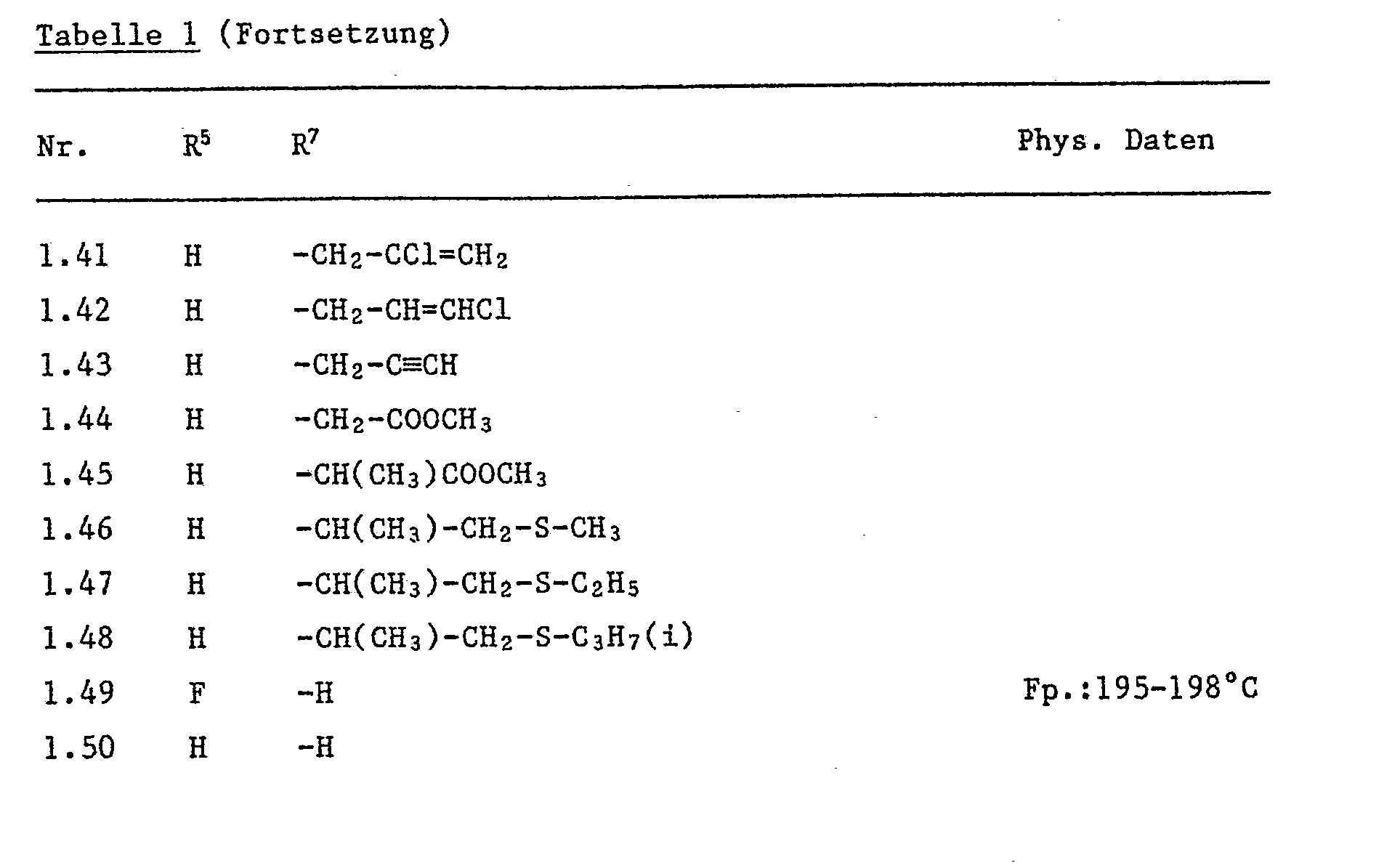
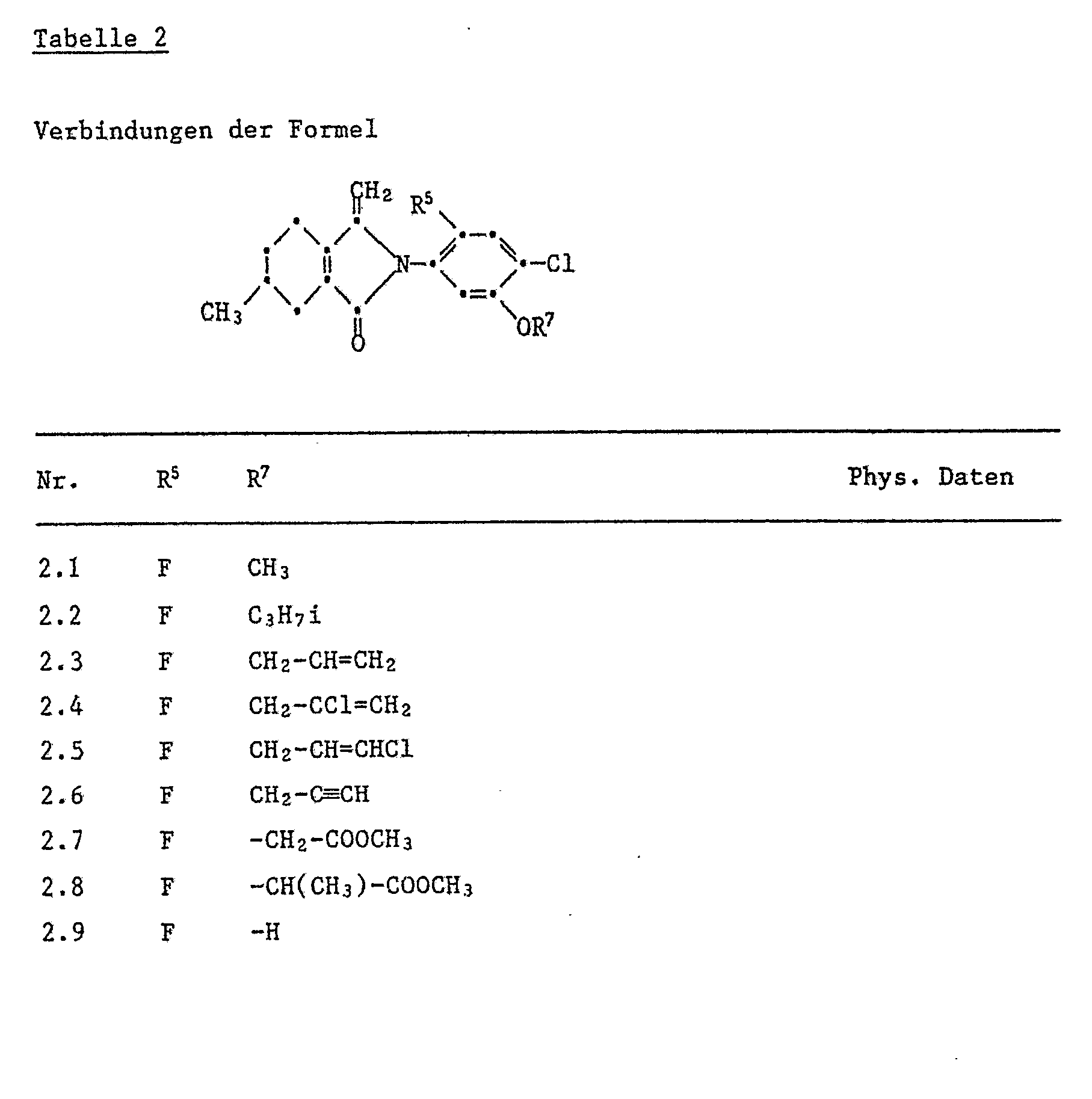

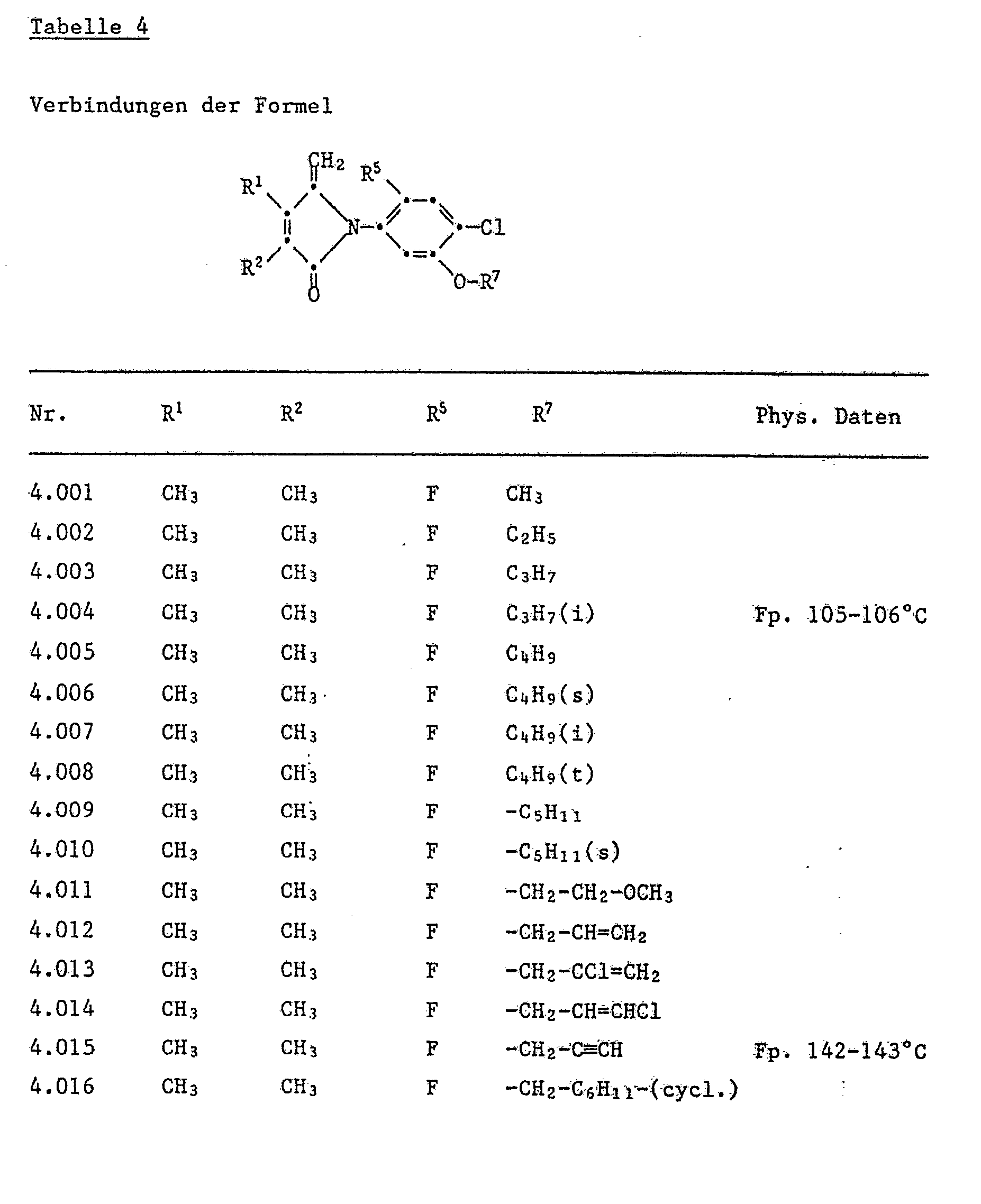
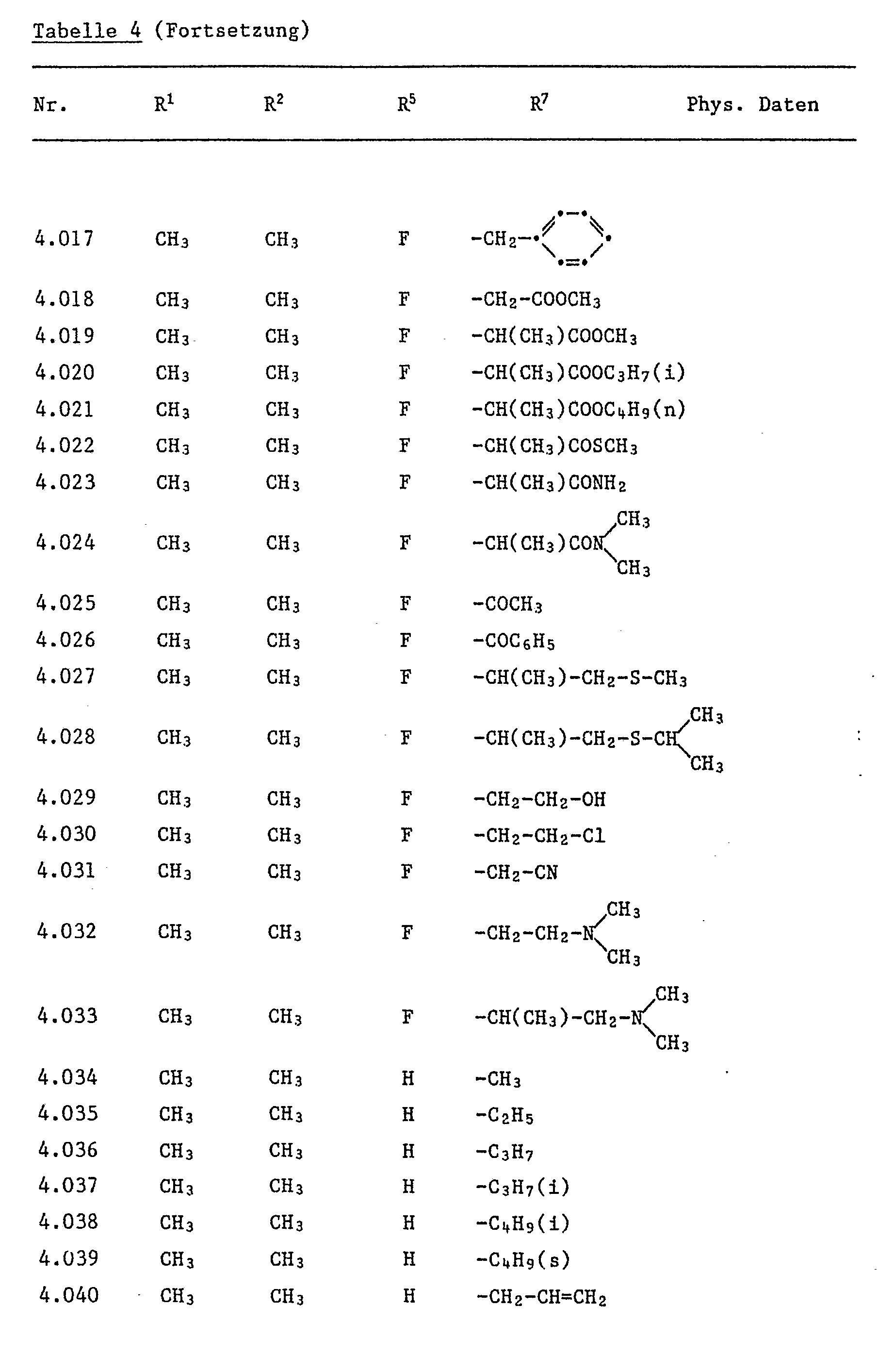

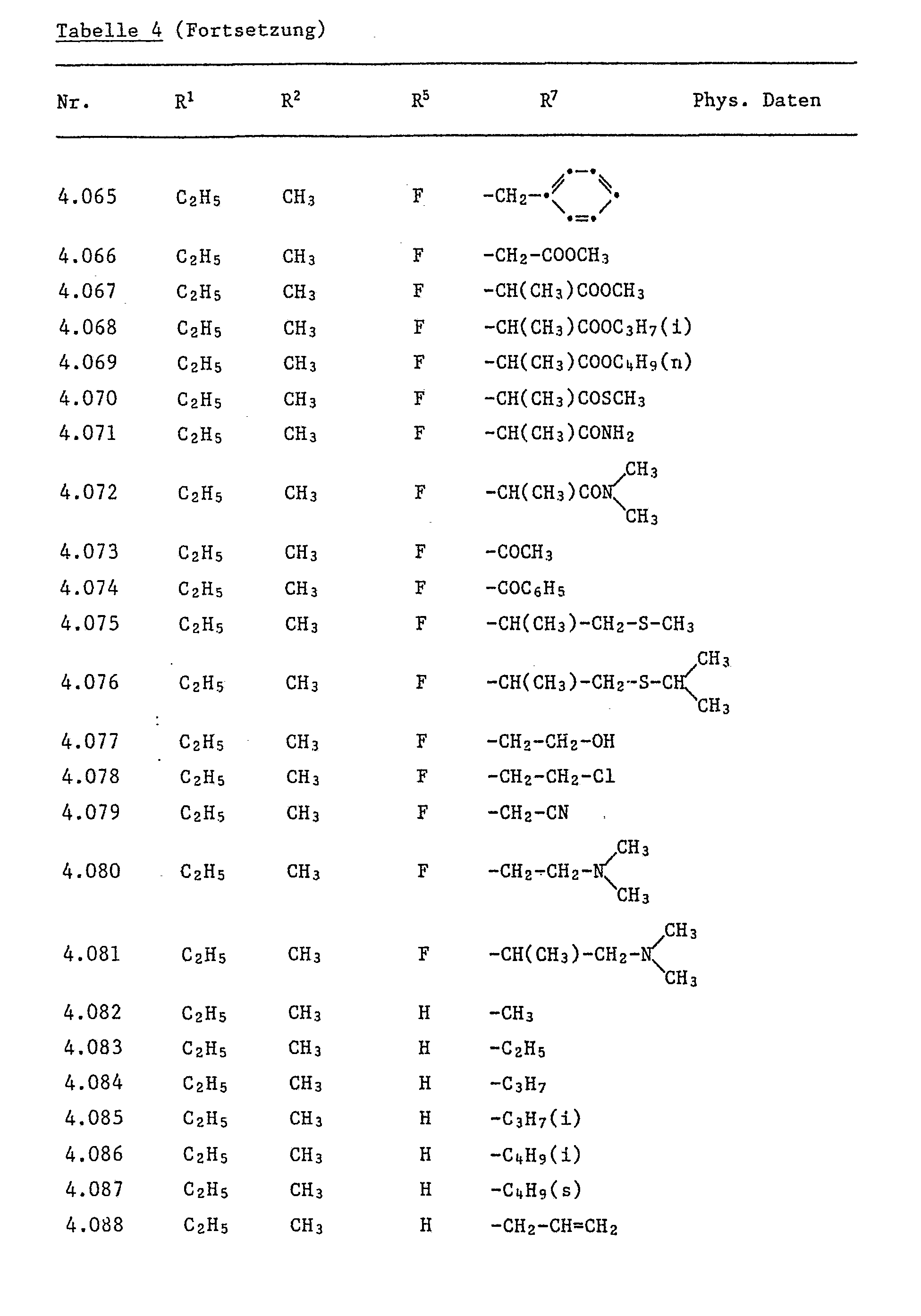
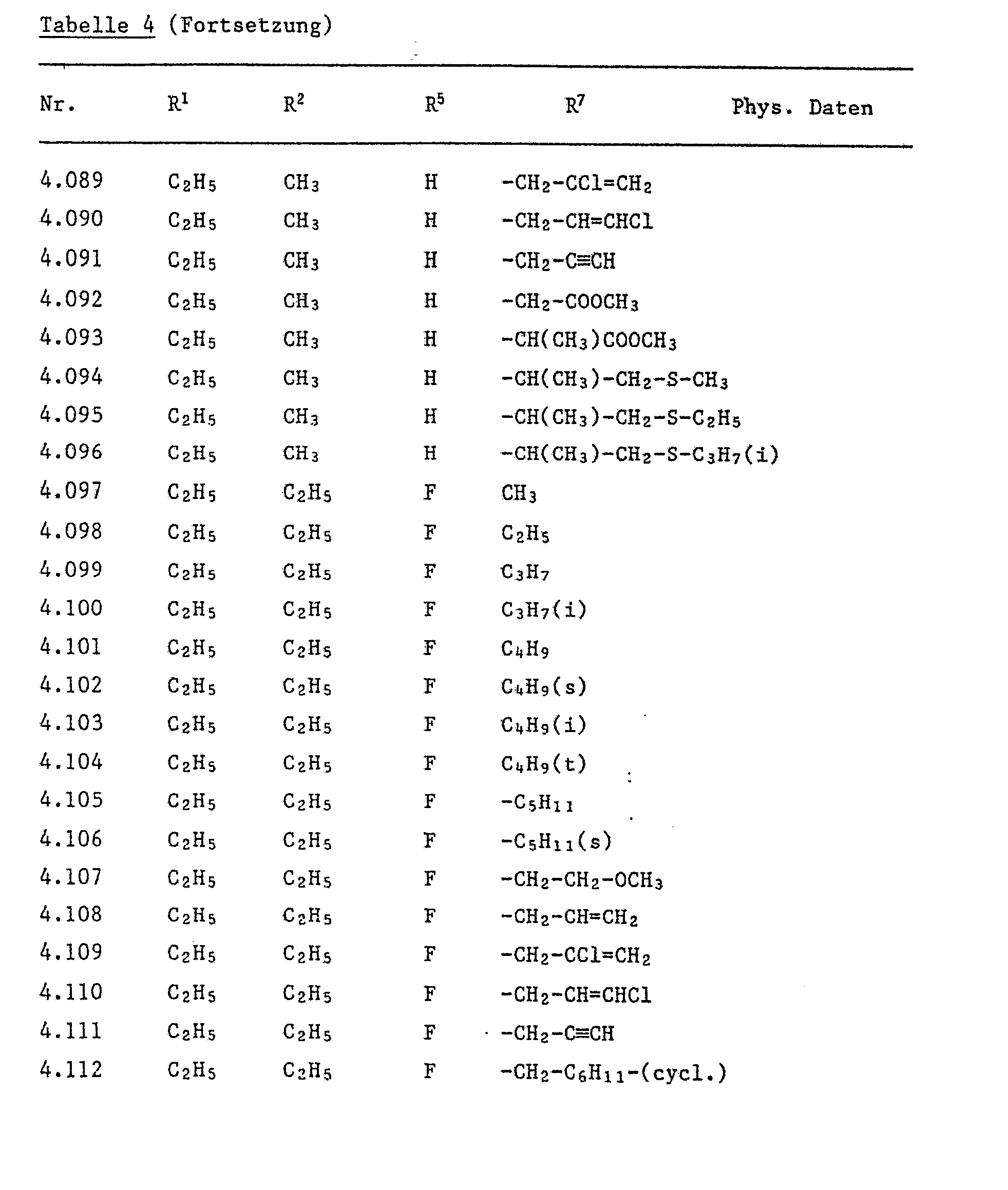


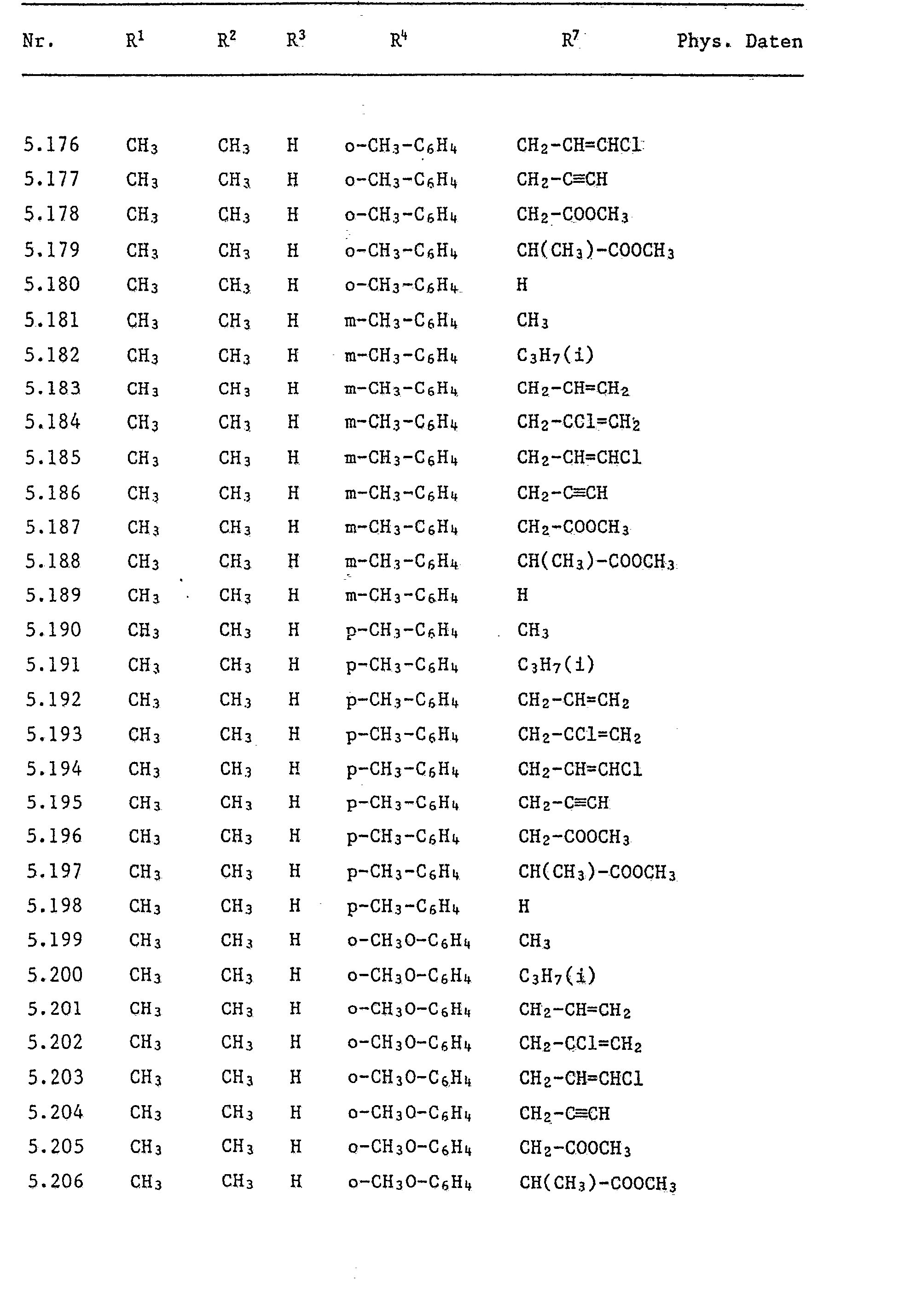


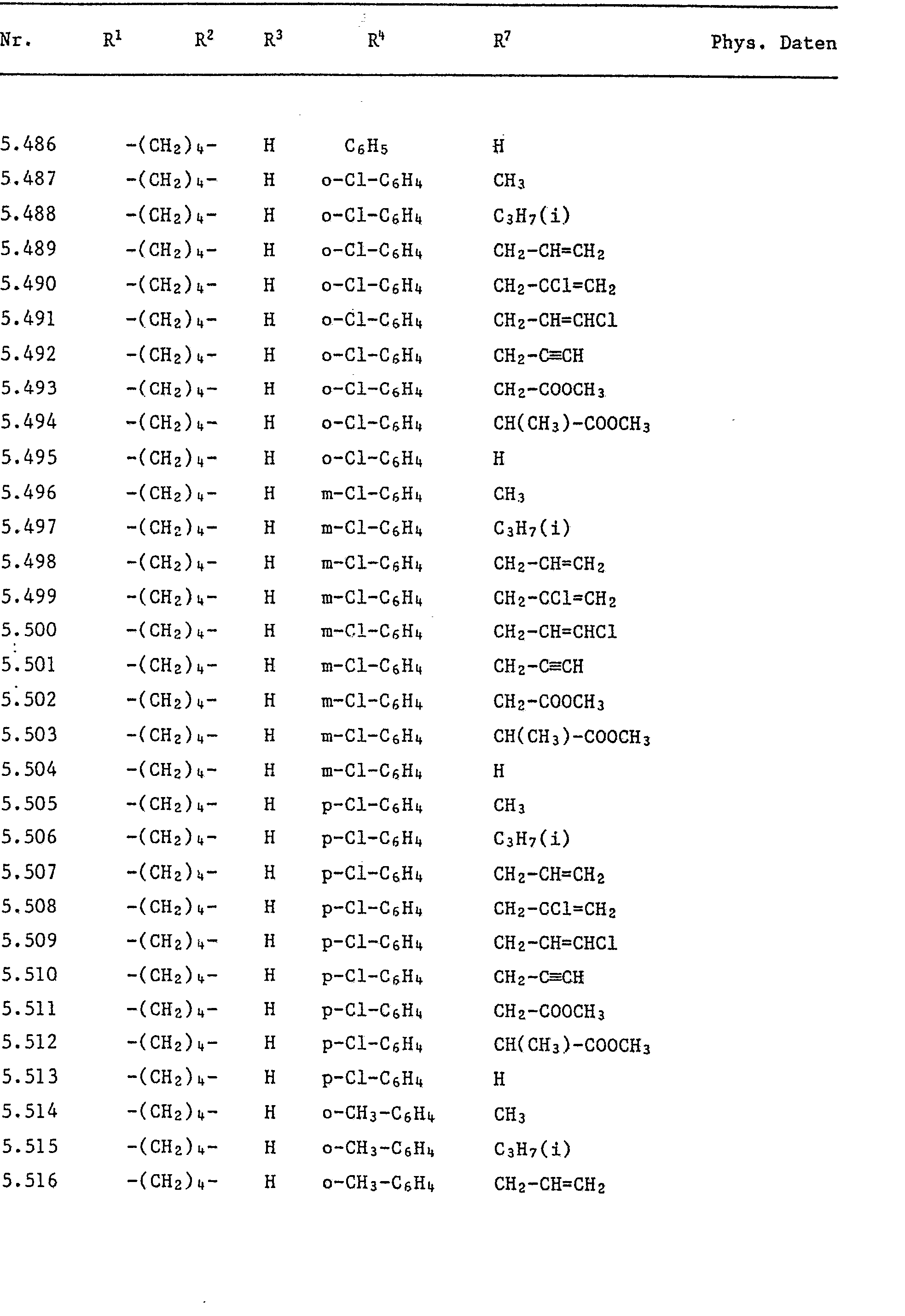
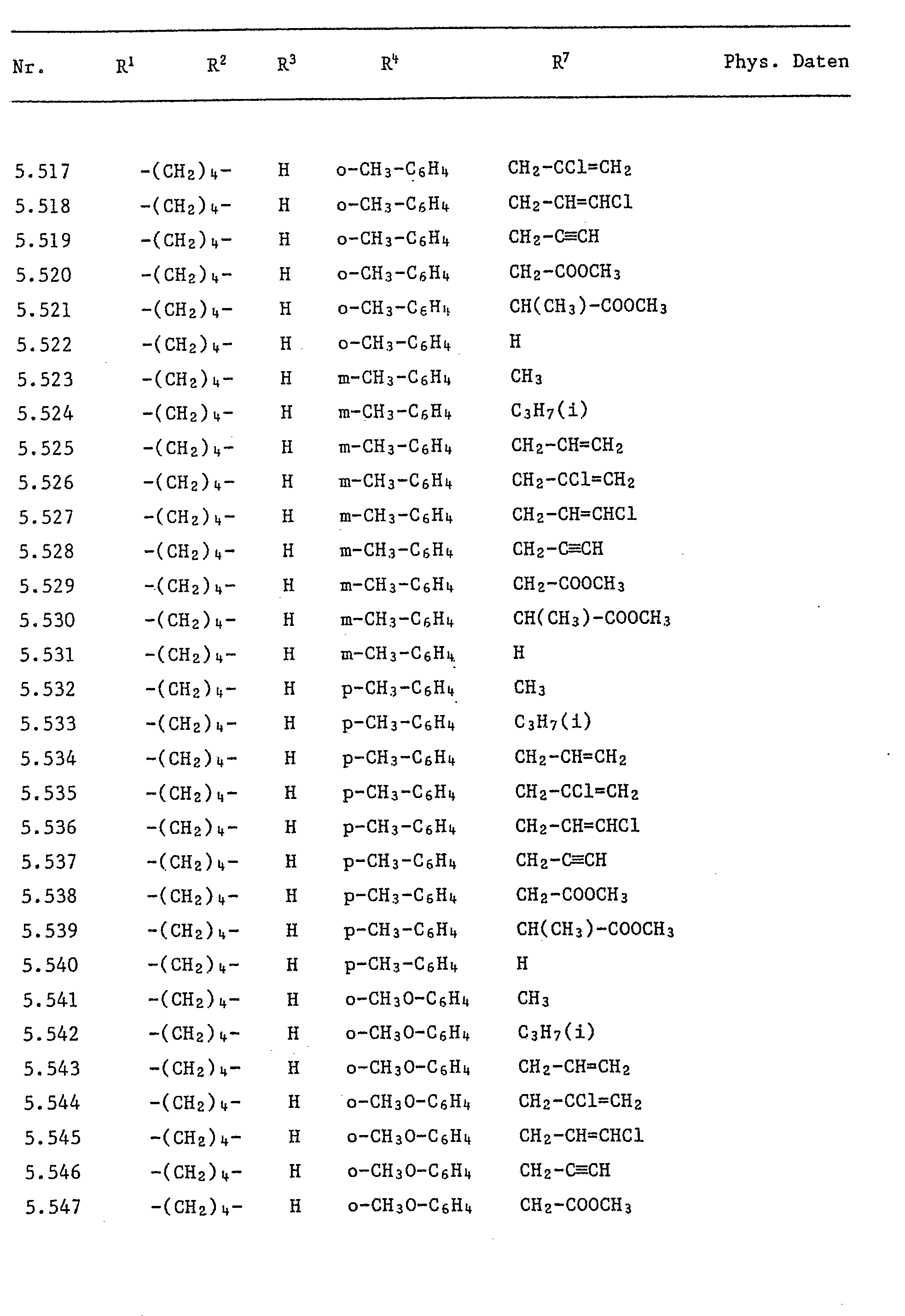


-

- Aus solchen Konzentraten können durch Verdünnen mit Wasser Emulsionen jeder gewünschten Konzentration hergestellt werden.

- Die Lösungen sind zur Anwendung in Form kleinster Tropfen geeignet.

- Der Wirkstoff wird gelöst, auf den Träger aufgesprüht und das Lösungsmittel anschliessend im Vakuum abgedampft.

- Durch inniges Vermischen der Trägerstoffe mit dem Wirkstoff erhält man gebrauchsfertiges Stäubemittel.

- Der Wirkstoff wird mit den Zusatzstoffen gut vermischt und in einer geeigneten Mühle gut vermahlen. Man erhält Spritzpulver, die sich mit Wasser zur Suspension jeder gewünschten Konzentration verdünnen lassen.
- Wirkstoff gemäss Tabelle 1 bis 5 100/0 Na-Ligninsulfonat 2% Carboxymethylcellulose 1 % Kaolin 87%
- Der Wirkstoff wird mit den Zusatzstoffen vermischt, vermahlen und mit Wasser angefeuchtet. Dieses Gemisch wird extrudiert und anschliessend im Luftstrom getrocknet.
- Wirkstoff gemäss Tabelle 1 bis 5 3% Polyethylenglykol (MG 200) 3% Kaolin 94%
- Der fein gemahlene Wirkstoff wird in einem Mischer auf das mit Polyäthylenglykol angefeuchtete Kaolin gleichmässig aufgetragen. Auf diese Weise erhält man staubfreie Umhüllungs-Granulate.
- Wirkstoff gemäss Tabelle 1 bis 5 400/0 Ethylenglykol 10% Nonylphenolpolyethylenglykolether (15 Mol EO) 6% Na-Ligninsulfonat 10% Carboxymethylcellulose 1 % 37 %ige wässrige Formaldehyd-Lösung 0,2% Silikonöl in Form einer 75 %igen wässrigen Emulsion 0,80/o Wasser 32%
- Der fein gemahlene Wirkstoff wird mit den Zusatzstoffen innig vermischt. Man erhält so ein Suspensions-Konzentrat, aus welchem durch Verdünnen mit Wasser Suspensionen jeder gewünschten Konzentration hergestellt werden können.
- Eine Anzahl Unkräuter, sowohl monokotyle wir dikotyle, werden nach dem Auflaufen (im 4- bis 6-Blattstadium) mit einer wässrigen Wirkstoffdispersion in einer Dosierung von 60 g bis 1 kg Wirksubstanz pro Hektar auf die Pflanzen gespritzt und diese bei 24°-26°C und 45-60% relativer Luftfeuchtigkeit gehalten. 15 Tage nach der Behandlung wird der Versuch ausgewertet. Auch in diesem Versuch zeigen die Verbindungen nach Tabellen 1 bis 5 starke bis sehr starke Herbizidwirkung.
- Der Zustand der Pflanzen wird dabei gemäss folgender Bewertungsskala bonitiert:
- 1 Pflanze abgestorben oder hat nicht gekeimt
- 2-8 abnehmende Schadstufen
- 9 keine Schädigung, die Pflanze gedeiht wie unbehandelte Kontrollpflanzen.
- Man findet z.B. für Verbindung No 1.7. nachstehende Testergebnisse:
-

- Die Wasserunkräuter Echinochloa crus galli und Monocharia vag. werden in Plastikbechern (60 cm2 Oberfläche, 500 ml Volumen) ausgesät. Nach der Saat wird bis zur Erdoberfläche mit Wasser aufgefüllt. 3 Tage nach der Saat wird der Wasserspiegel bis leicht über die Erdoberfläche erhöht (3-5 mm). Die Applikation erfolgt 3 Tage nach der Saat mit einer wässrigen Emulsion der Prüfsubstanzen durch eine Spritzung auf die Gefässe mit einer Aufwandmenge von 60 bis 250 g AS pro Hektar. Die Pflanzenbecher werden dann im Gewächshaus unter optimalen Wachstumsbedingungen für die Reisunkräuter aufgestellt, d.h. bei 25°-30°C und hoher Luftfeuchtigkeit. Die Auswertung der Versuche findet 3 Wochen nach Applikation statt. Die Verbindungen gemäss Tabelle 1 bis 5 schädigen dabei die Unkräuter, nicht aber den Reis.
- Man findet z.B. für Verbindung No. 1.4. nachstehende Testergebnisse:

Claims (21)
1. Verbindungen der Formel I

worin
bedeutet.
worin
R1 Wasserstoff; (C1-C8)-Alkyl;
R2 Wasserstoff; (C1-C8)-Alkyl; oder
R1 und R2 gemeinsam eine gegebenenfalls bis zu zweifach durch (C1-C4)-Alkyl substituierte -(CH2)4-Brücke; R3 und R4 unabhängig voneinander Wasserstoff; oder (Ci-C4)-Alkyl; oder
einer der Reste R3 oder R4 Wasserstoff und der andere ein gegebenenfalls bis zu dreifach gleich oder verschieden durch Halogen, (Ci-C4)-Alky oder (Ci-C4)-Alkoxy substituierter Phenylrest; oder
R3 und R4 zusammen eine -(CH2)n-Brücke, mit n = 2, 3, 4, 5 oder 6, die gewünschtenfalls bis zu dreifach durch (C1-C4)-Alky substituiert sein kann;
R5 Wasserstoff; oder Fluor;
R6 Halogen;
R7 Wasserstoff; (C1-C8)-Alkyl; (C3-C8)-Alkenyl; (C3-C8)-Alkinyl; (C3-C7)-Cycloalkyl; (C1-C4)-Alkyl, einfach substituiert durch: (Ci-C4)-Alkoxy, (C1-C4)-Alkylthio, mono-(C1-C4)-Alkylamino, di-(C1-C4)-Alkylamino, Cyano, (C3-C7)-Cycloalkyl, Phenyl, Halogenphenyl, (C1-C4)-Alkylphenyl, (C1-C4)-Alkoxyphenyl, (C1-C4)-Halogenalkylphenyl, (C1-C4)-Halogenalkoxyphenyl, Nitrophenyl, Cyanophenyl, Hydroxy, 1,3-Dioxolan-2-yl, 1,3-Dioxan-2-yl oder CO-R8; (Ci-Ca)-Alkyl, (C3-C8)-Alkenyl oder (C3-C7)-Cycloalkyl, welche ein oder mehrfach durch Halogen substituiert sind; oder CO-R8.
R8 (C1-C8)-Alkyl; (C3-C8)-Alkenyl; Benzyl, gegebenenfalls am Phenylring einfach substituiert durch Halogen, (C1-C4)-Alkyl, (Ci-C4)-Alkoxy, (C1-C4)-Halogenalkyl, Nitro oder Cyano; (Ca-C7)-Cycloalkyl; Phenyl, gegebenenfalls bis zu dreifach substituiert durch Halogen, (C1-C8)-Alkyl, (C1-C4)-Alkoxy, (Ci-C4)-Halogenalkyl oder einfach substituiert durch Cyano oder Nitro; Furan; Thiophen; (C1-C8)-Alkoxy; (C1-C4)-Alkoxy-(Ci-C4)-alkoxy; (C3-C8)-Alkenyloxy; (C3-C8)-Alkinyloxy; (C1-C8)-Alkylthio; (C3-C8)-Alkenylthio; (C3-C8)-Alkinylthio; Amino; mono(C1-C4)-Alkylamino; di-(Ci-C4)-Alkylamino; Phenylamino, gegebenenfalls bis zu dreifach substituiert durch Halogen, (C1-C4)-Alkyl, (Ci-C4)-Alkoxy oder (C1-C4)-Halogenalkyl oder einfach substituiert durch Cyano oder Nitro;
bedeutet.
2. 2-(4-Chlor-2-fluor-5-isopropyloxyphenyl)-3-methylen-4,5,6,7-tetrahydroisoindol-(2H)1-on,
2-(4-Chlor-2-fluor-5-propargyloxyphenyl)-3-methylen-4,5,6,7-tetrahydroisoindol-(2H)1-on,
2-[4-Chlor-2-fluor-5-(2-methylpropyloxy)phenyl]-3-methylen-4,5,6,7-tetrahydroisoindol-(2H)1-on,
2-[4-Chlor-2-fluor-5-(2-chlorprop-2-enyloxy)-phenyl]-4,5,6,7-tetrahydroisoindol-(2H)1-on,
2-[4-Chlor-2-fluor-5-(1-methoxycarbonylethoxy)phenyl]-4,5,6,7-tetrahydroisoindol-(2H)1-on,
2-[4-Chlor-2-fluor-5-(3-chlorprop-2-enyloxy)-phenyl]-4,5,6,7-tetrahydroisoindol-(2H)1-on,
2-[4-Chlor-2-fluor-5-(prop-2-inyloxy)-phenyl]-4,5,6,7-tetrahydroisoindol-(2H)1-on,
1-(4-Chlor-2-fluor-5-isopropyloxyphenyl)-3,4-dimethyl-5-methylenpyrrol-(1 H)2-on,
2-(4-Chlor-2-fluor-5-isopropyloxyphenyl)-3-(1,1-dimethylmethylen)-4,5,6,7-tetrahydroisoindol-(2H)1-on,
2-(4-Chlor-2-fluor-5-isopropyloxyphenyl)-3-ethyliden-4,5,6,7-tetrahydroisoindol-(2H)1-on,
5-Benzyliden-1-(4-chlor-2-fluor-5-isopropyloxy-phenyl)-3,4-dimethylpyrrol-(1H)2-on oder
5-(o-Chlorbenzyliden)-1-(4-chlor-2-fluor-5-propargyloxy-phenyl)-3,5-dimethyl-pyrrol-(1H)2-on als Verbindung
der Formel I gemäss Anspruch 1.
3. Verfahren zur Herstellung von Verbindungen der Formel gemäss Anspruch 1, gekennzeichnet
a) durch die Alkylierung oder Acylierung eines Phenols der Formel la,

worin die Reste R1 bis R6 wie zuvor definiert sind, mit einer Verbindung der Formel II, worin R7 wie zuvor definiert ist, jedoch nicht für Wasserstoff und X für eine unter der Reaktionsbedingungen abspaltbare Gruppe steht, unter Basenzusatz umsetzt, wobei X vorzugsweise Halogen, wie Chlor, Brom oder Jod oder einen gewünschtenfalls im Phenylkern alkylierten oder halogenierten Phenylsulfonylrest, ein Radikal der Formel R7OSO2-O oder wenn R7 für 
steht auch eine Gruppe
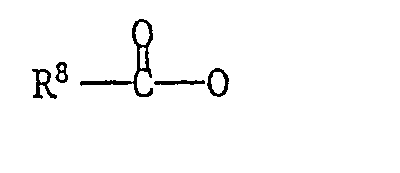
bedeutet oder
worin die Reste R1 bis R6 wie zuvor definiert sind, mit einer Verbindung der Formel II, worin R7 wie zuvor definiert ist, jedoch nicht für Wasserstoff und X für eine unter der Reaktionsbedingungen abspaltbare Gruppe steht, unter Basenzusatz umsetzt, wobei X vorzugsweise Halogen, wie Chlor, Brom oder Jod oder einen gewünschtenfalls im Phenylkern alkylierten oder halogenierten Phenylsulfonylrest, ein Radikal der Formel R7OSO2-O oder wenn R7 für
bedeutet oder
b) durch Umsetzung eines 5-Chlor-2,5-dihydrofuran-2-ons der Formel Vlll, worin die Reste R1 bis R4 wie zuvor definiert sind mit einem Anilin der Formel VII, worin die Reste R5 bis R7 wie zuvor definiert sind

zu einem Primäraddukt der Formel V und anschliessender Wasserabspaltung zu I.
zu einem Primäraddukt der Formel V und anschliessender Wasserabspaltung zu I.
4. Verfahren zur Herstellung von Verbindungen der Formel la.

worin
bedeutet, gekennzeichnet durch die Umsetzung einer Verbindung der Formel III 
worin R1, R2, R5, R6 und R7 wie zuvor definiert sind, mit einem Grignard-Reagenz der Formel IV 
worin R3 und R4 unabhängig voneinander Wasserstoff; oder (C1-C4)-Alkyl; R3 Wasserstoff und R4 einen gegebenenfalls bis zu dreifach gleich oder verschieden durch Halogen, (Ci-C4)-Alkyl oder (Ci-C4)-Alkoxy substituierten Phenylrest; oder R3 und R4 zusammen eine -(CH2)n-Brücke, mit n = 2, 3, 4, 5 oder 6, die gewünschtenfalls bis zu dreifach durch (C1-C4)-Alkyl substituiert sein kann; bedeutet, zu einer Verbindung der Formel V 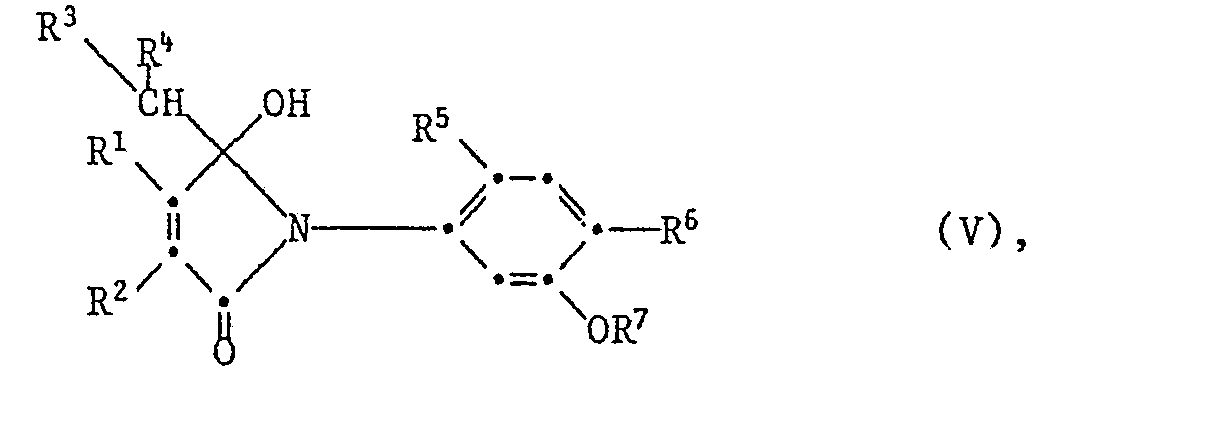
worin die Reste R1 bis R7 wie zuvor definiert sind, und anschliessender Wasserabspaltung zu la.
worin
R1 Wasserstoff; (C1-C8)-Alkyl;
R2 Wasserstoff; (C1-C8)-Alkyl; oder
R1 und R2 gemeinsam eine gegebenenfalls bis zu zweifach durch (C1-C4)-Alkyl substituierte -(CH2)4-Brücke; R3 und R4 unabhängig voneinander Wasserstoff; oder (Ci-C4)-Alkyl; oder
einer der Reste R3 oder R4 Wasserstoff und der andere ein gegebenenfalls bis zu dreifach gleich oder verschieden durch Halogen, (C1-C4)-Alkyl oder (C1-C4)-Alkoxy substituierter Phenylrest; oder
R3 und R4 zusammen eine -(CH2)n-Brücke, mit n = 2, 3, 4, 5 oder 6, die gewünschtenfalls bis zu dreifach durch (Ci-C4)-Alkyl substituiert sein kann;
R5 Wasserstoff; oder Fluor;
R6 Halogen;
R7 Wasserstoff; (C1-C8)-Alkyl; (C3-C8)-Alkenyf; (C3-C8)-Alkinyl; (C3-C7)-Cycloalkyl; (C1-C4)-Alkyl, einfach substituiert durch: (C1-C4)-Alkoxy, (C1-C4)-Alkylthio, mono-(C1-C4)-Alkylamino, di-(Ci-C4)-Alkylamino, (C3-C7)-Cycloalkyl, Phenyl, Halogenphenyl, (C1-C4)-Alkylphenyl, (Ci-C4)-Alkoxyphenyl, (Ci-C4)-Halogenalky-Iphenyl, (C1-C4)-Halogenalkoxyphenyl, Nitrophenyl, Hydroxy, 1,3-Dioxolan-2-yl oder 1,3-Dioxan-2-yl; (C1-C8)-Alkyl, (C3-C8)-Alkenyl oder (C3-C7)-Cycloalkyl, welche ein oder mehrfach durch Halogen substituiert sind;
bedeutet, gekennzeichnet durch die Umsetzung einer Verbindung der Formel III
worin R1, R2, R5, R6 und R7 wie zuvor definiert sind, mit einem Grignard-Reagenz der Formel IV
worin R3 und R4 unabhängig voneinander Wasserstoff; oder (C1-C4)-Alkyl; R3 Wasserstoff und R4 einen gegebenenfalls bis zu dreifach gleich oder verschieden durch Halogen, (Ci-C4)-Alkyl oder (Ci-C4)-Alkoxy substituierten Phenylrest; oder R3 und R4 zusammen eine -(CH2)n-Brücke, mit n = 2, 3, 4, 5 oder 6, die gewünschtenfalls bis zu dreifach durch (C1-C4)-Alkyl substituiert sein kann; bedeutet, zu einer Verbindung der Formel V
worin die Reste R1 bis R7 wie zuvor definiert sind, und anschliessender Wasserabspaltung zu la.
5. Verbindungen der Formel VIII

worin die Reste R1 bis R4 wie im Anspruch 1 definiert sind, mit der Massgabe, dass R1 und R2 nicht für Wasserstoff oder Methyl steht, wenn R3 und R4 Wasserstoff bedeutet.
worin die Reste R1 bis R4 wie im Anspruch 1 definiert sind, mit der Massgabe, dass R1 und R2 nicht für Wasserstoff oder Methyl steht, wenn R3 und R4 Wasserstoff bedeutet.
6. Verbindungen der Formel XII

worin die Reste R1 bis R4 wie in Anspruch 1 definiert sind, mit der Massgabe, dass R1 und R2 nicht für Wasserstoff und Methyl oder Ri und R2 nicht gemeinsam für eine unsubstituierte -(CH2)4-Brücke stehen, wenn R3 und R4 Wasserstoff bedeuten.
worin die Reste R1 bis R4 wie in Anspruch 1 definiert sind, mit der Massgabe, dass R1 und R2 nicht für Wasserstoff und Methyl oder Ri und R2 nicht gemeinsam für eine unsubstituierte -(CH2)4-Brücke stehen, wenn R3 und R4 Wasserstoff bedeuten.
7. Verbindungen der Formel V
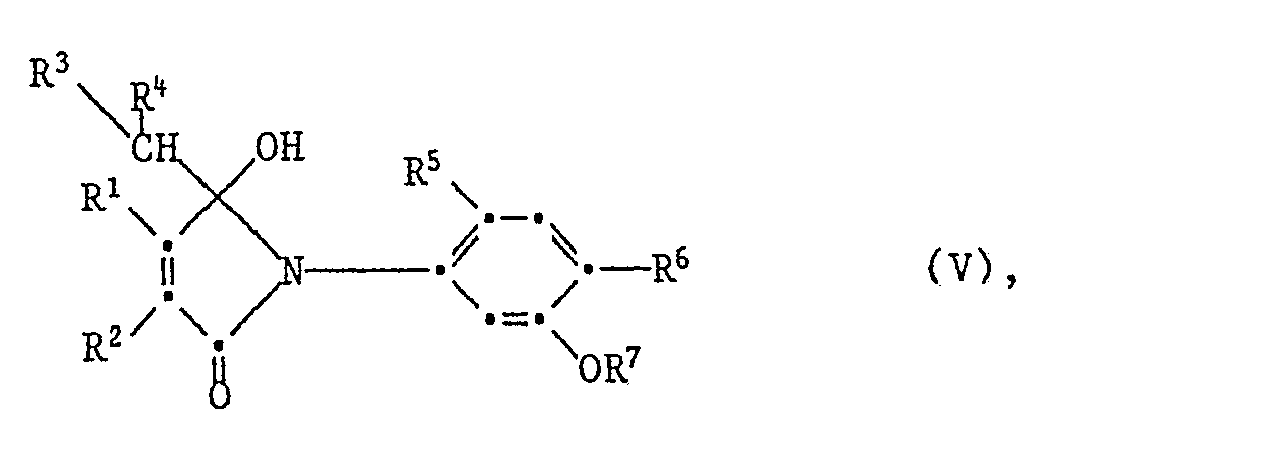
worin die Reste R1, R2, R3, R4, R5, R6 und R7 wie in Anspruch 1 definiert sind.
worin die Reste R1, R2, R3, R4, R5, R6 und R7 wie in Anspruch 1 definiert sind.
8. Herbizides Mittel, enthaltend eine Verbindung der Formel I gemäss einem der Ansprüche 1 oder 2 neben weiteren Hilfs- und/oder Trägerstoffen.
9. Verwendung von Verbindungen der Formel I gemäss einem der Ansprüche 1 oder 2 zur Bekämpfung unerwünschten Pflanzenwuchses.
10. Verfahren zur Bekämpfung unerwünschten Pflanzenwuchses, dadurch gekennzeichnet, dass man eine Verbindung der Formel I gemäss Anspruch 1 oder 2 oder ein Mittel gemäss Anspruch 8 auf den Lebensraum der zu bekämpfenden Pflanze oder auf die zu bekämpfende Pflanze einwirken lässt.
11. Saatgut gekennzeichnet durch einen herbizid oder wuchsregulatorisch wirksamen Gehalt an einer Verbindung der Formel I gemäss einem der Ansprüche 1 oder 2.
12. Pflanzenwuchsregulatorisches Mittel enthaltend als Aktivsubstanz eine Verbindung der Formel I gemäss einem der Ansprüche 1 oder 2 neben weiteren Hilfs- und Trägerstoffen.
13. Verfahren zur Beeinflussung des Wachstums von Kulturpflanzen, dadurch gekennzeichnet, dass man eine wuchsregulatorisch wirksame Menge einer Verbindung der Formel I gemäss einem der Ansprüche 1 oder 2 oder eines Mittels gemäss Anspruch 12 auf die Kulturpflanze oder deren Lebensraum einwirken lässt.
Patenansprüche für den folgenden Vertragsstaat ES:
1. Verfahren zur Hestellung von Verbindungen der Formel I

worin
bedeutet, gekennzeichnet
worin
Ri Wasserstoff; (C1-C8)-Alkyl;
R2 Wasserstoff; (C1-C8)-Alkyl; oder
R1 und R2 gemeinsam eine gegebenenfalls bis zu zweifach durch (C1-C4)-Alkyl substituierte -(CHz)4-Brücke; R3 und R4 unabhängig voneinander Wasserstoff; oder (Ci-C4)-Alkyl; oder
einer der Reste R3 oder R4 Wasserstoff und der andere ein gegebenenfalls bis zu dreifach gleich oder verschieden durch Halogen, (Ci-C4)-Alky oder (C1-C4)-Alkoxy substituierter Phenylrest; oder
R3 und R4 zusammen eine -(CH2)n-Brücke, mit n = 2, 3, 4, 5 oder 6, die gewünschtenfalls bis zu dreifach durch (C1-C4)-Alky substituiert sein kann;
R5 Wasserstoff; oder Fluor;
R6 Halogen;
R7 Wasserstoff; (C1-C8)-Alkyl; (C3-C8)-Alkenyl; (C3-C8)-Alkinyl; (C3-C7)-Cycloalkyl; (Ci-C4)-Alkyl, einfach substituiert durch: (Ci-C4)-Alkoxy, (Ci-C4)-Alkylthio, mono-(C1-C4)-Alkylamino, di-(Ci-C4)-Alkylamino, Cyano, (C3-C7)-Cycloalkyl, Phenyl, Halogenphenyl, (C1-C4)-Alkylphenyl, (C1-C4)-Alkoxyphenyl, (C1-C4)-Halogenalkylphenyl, (C1-C4)-Halogenalkoxyphenyl, Nitrophenyl, Cyanophenyl, Hydroxy, 1,3-Dioxolan-2-yl, 1,3-Dioxan-2-yl oder CO-R8; (C1-C8)-Alkyl, (C3-C8)-Alkenyl oder (C3-C7)-Cycloalkyl, welche ein oder mehrfach durch Halogen substituiert sind; oder CO-R8.
R8 (C1-C8)-Alkyl; (C3-Ca)-Alkenyl; Benzyl, gegebenenfalls am Phenylring einfach substituiert durch Halogen, (Ci-C4)-Alkyl, (Ci-C4)-Alkoxy, (C1-C4)-Halogenalkyl, Nitro oder Cyano; (C3-C7)-Cycloalkyl; Phenyl, gegebenenfalls bis zu dreifach substituiert durch Halogen, (C1-C8)-Alkyl, (Ci-C4)-Alkoxy, (C1-C4)-Halogenalkyl oder einfach substituiert durch Cyano oder Nitro; Furan; Thiophen; (C1-Ca)-Alkoxy; (Ci-C4)-Alkoxy-(C1-C4)-alkoxy; (C3-C8)-Alkenyloxy; (C3-C8)-Alkinyloxy; (C1-C8)-Alkylthio; (C3-C8)-Alkenylthio; (C3-C8)-Alkinylthio; Amino; mono(Ci-C4)-Alkylamino; di-(C1-C4)-Alkylamino; Phenylamino, gegebenenfalls bis zu dreifach substituiert durch Halogen, (C1-C4)-Alkyl, (C1-C4)-Alkoxy oder (C1-C4)-Halogenalkyl oder einfach substituiert durch Cyano oder Nitro;
bedeutet, gekennzeichnet
a) durch die Alkylierung oder Acylierung eines Phenols der Formel Ia,

worin die Reste R1 bis R6 wie zuvor definiert sind, mit einer Verbindung der Formel II, worin R7 wie zuvor definiert ist, jedoch nicht für Wasserstoff und X für eine unter der Reaktionsbedingungen abspaltbare Gruppe steht, unter Basenzusatz umsetzt, wobei X vorzugsweise Halogen, wie Chlor, Brom oder Jod oder einen gewünschtenfalls im Phenylkern alkylierten oder halogenierten Phenylsulfonylrest, ein Radikal der Formel R70S02-0 oder wenn R7 für 
steht auch eine Gruppe

bedeutet oder
worin die Reste R1 bis R6 wie zuvor definiert sind, mit einer Verbindung der Formel II, worin R7 wie zuvor definiert ist, jedoch nicht für Wasserstoff und X für eine unter der Reaktionsbedingungen abspaltbare Gruppe steht, unter Basenzusatz umsetzt, wobei X vorzugsweise Halogen, wie Chlor, Brom oder Jod oder einen gewünschtenfalls im Phenylkern alkylierten oder halogenierten Phenylsulfonylrest, ein Radikal der Formel R70S02-0 oder wenn R7 für
bedeutet oder
b) durch Umsetzung eines 5-Chlor-2,5-dihydrofuran-2-ons der Formel VIII, worin die Reste R1 bis R4 wie zuvor definiert sind mit einem Anilin der Formel VII, worin die Reste R5 bis R7 wie zuvor definiert sind

zu einem Primäraddukt der Formel V und anschliessender Wasserabspaltung zu I.
zu einem Primäraddukt der Formel V und anschliessender Wasserabspaltung zu I.
2. Verfahren zur Herstellung von Verbindungen der Formel la.

worin
worin
R1 Wasserstoff; (C1-C8)-Alkyl;
R2 Wasserstoff; (C1-C8)-Alkyl; oder
R1 und R2 gemeinsam eine gegebenenfalls bis zu zweifach durch (Ci-C4)-Alkyl substituierte -(CH2)4-Brücke; R3 und R4 unabhängig voneinander Wasserstoff; oder (C1-C4)-Alkyl; oder
einer der Reste R3 oder R4 Wasserstoff und der andere ein gegebenenfalls bis zu dreifach gleich oder verschieden durch Halogen, (C1-C4)-Alkyl oder (Ci-C4)-Alkoxy substituierter Phenylrest; oder
R3 und R4 zusammen eine -(CH2)n-Brücke, mit n = 2, 3, 4, 5 oder 6, die gewünschtenfalls bis zu dreifach durch (Ci-C4)-Alkyl substituiert sein kann;
R5 Wasserstoff; oder Fluor;
R6 Halogen;
R7 Wasserstoff; (Ci-C8)-Alkyl; (C3-C8)-Alkenyl; (C3-C8)-Alkinyl; (C3-C7)-Cycloalkyl; (Ci-C4)-Alkyl, einfach substituiert durch: (Ci-C4)-Alkoxy, (Ci-C4)-Alkylthio, mono-(Ci-C4)-Alkylamino, di-(C1-C4)-Alkylamino, (C3-C7)-Cycloalkyl, Phenyl, Halogenphenyl, (C1-C4)-Alkylphenyl, (Ci-C4)-Alkoxyphenyl, (C1-C4)-Halogenalky-Iphenyl, (Ci-C4)-Halogenalkoxyphenyl, Nitrophenyl, Hydroxy, 1,3-Dioxo lan-2-yl oder 1,3-Dioxan-2-yl; (C1-Ca)-Alkyl, (C3-C8)-Alkenyl oder (Ca-C7)-Cycloalkyl, welche ein oder mehrfach durch Halogen substi tuiert sind;
bedeutet, gekennzeichnet durch die Umsetzung einer Verbindung der Formel III

worin R1, R2, R5, R6 und R7 wie zuvor definiert sind, mit einem Grignard-Reagenz der Formel IV 
worin R3 und R4 unabhängig voneinander Wasserstoff; oder (Ci-C4)-Alkyl; R3 Wasserstoff und R4 einen gegebenenfalls bis zu dreifach gleich oder verschieden durch Halogen, (C1-C4)-Alkyl oder (C1-C4)-Alkoxy substituierten Phenylrest; oder R3 und R4 zusammen eine -(CH2)n-Brücke, mit n = 2, 3, 4, 5 oder 6, die gewünschtenfalls bis zu dreifach durch (Ci-C4)-Alkyl substituiert sein kann; bedeutet, zu einer Verbindung der Formel V 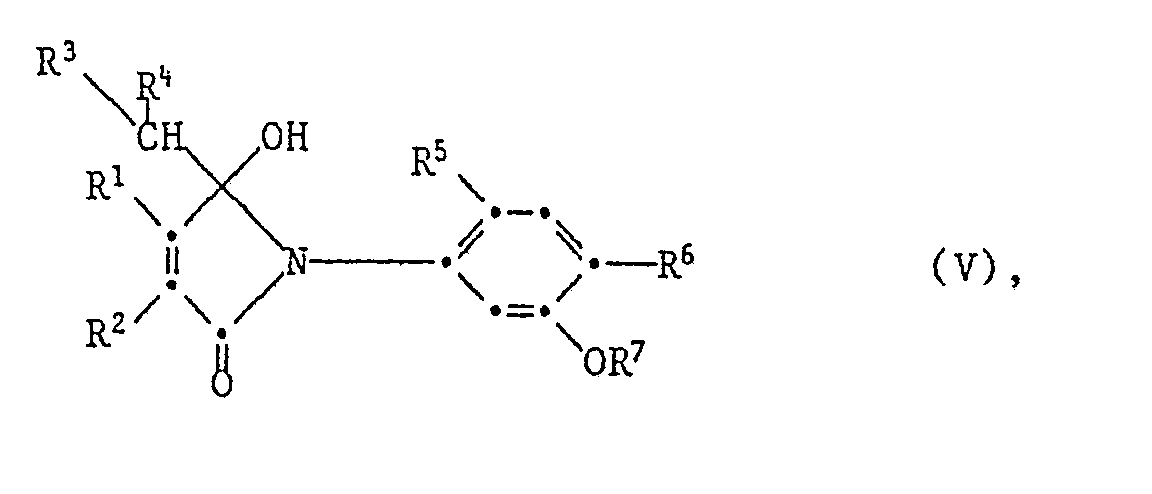
worin die Reste R1 bis R7 wie zuvor definiert sind, und anschliessender Wasserabspaltung zu la.
worin R1, R2, R5, R6 und R7 wie zuvor definiert sind, mit einem Grignard-Reagenz der Formel IV
worin R3 und R4 unabhängig voneinander Wasserstoff; oder (Ci-C4)-Alkyl; R3 Wasserstoff und R4 einen gegebenenfalls bis zu dreifach gleich oder verschieden durch Halogen, (C1-C4)-Alkyl oder (C1-C4)-Alkoxy substituierten Phenylrest; oder R3 und R4 zusammen eine -(CH2)n-Brücke, mit n = 2, 3, 4, 5 oder 6, die gewünschtenfalls bis zu dreifach durch (Ci-C4)-Alkyl substituiert sein kann; bedeutet, zu einer Verbindung der Formel V
worin die Reste R1 bis R7 wie zuvor definiert sind, und anschliessender Wasserabspaltung zu la.
3. Verfahren zur Herstellung von Verbindungen der Formel VIII

worin die Reste R1 bis R4 wie im Anspruch 1 definiert sind, mit der Massgabe, dass R1 und R2 nicht für Wasserstoff oder Methyl steht, wenn R3 und R4 Wasserstoff bedeutet, dadurch gekennzeichnet, dass man eine Verbindung der Formel XII 
worin die Reste R1 bis R4 wie in Anspruch 1 definiert sind, mit SOCI2 chloriert.
worin die Reste R1 bis R4 wie im Anspruch 1 definiert sind, mit der Massgabe, dass R1 und R2 nicht für Wasserstoff oder Methyl steht, wenn R3 und R4 Wasserstoff bedeutet, dadurch gekennzeichnet, dass man eine Verbindung der Formel XII
worin die Reste R1 bis R4 wie in Anspruch 1 definiert sind, mit SOCI2 chloriert.
4. Verfahren zur Herstellung von Verbindungen der Formel XII

worin die Reste R1 bis R4 wie im Anspruch 1 definiert sind, mit der Massgabe, dass R1 und R2 nicht für Wasserstoff und Methyl oder R1 und R2 nicht gemeinsam für eine unsubstituierte -(CH2)4-Brücke stehen, wenn R3 und R4 Wasserstoff bedeuten, dadurch gekennzeichnet, dass man eine Ketocarbonsäure XI 
worin R1 bis R4 wie zuvor definiert sind, unter Wasserabspaltung cyclisiert.
worin die Reste R1 bis R4 wie im Anspruch 1 definiert sind, mit der Massgabe, dass R1 und R2 nicht für Wasserstoff und Methyl oder R1 und R2 nicht gemeinsam für eine unsubstituierte -(CH2)4-Brücke stehen, wenn R3 und R4 Wasserstoff bedeuten, dadurch gekennzeichnet, dass man eine Ketocarbonsäure XI
worin R1 bis R4 wie zuvor definiert sind, unter Wasserabspaltung cyclisiert.
5. Verfahren zur Bekämpfung unerwünschten Pflanzenwuchses, dadurch gekennzeichnet, dass man eine Verbindung der Formel I

worin
worin
R1 Wasserstoff; (C1-C8)-Alkyl;
R2 Wasserstoff; (C1-C8)-Alkyl; oder
R1 und R2 gemeinsam eine gegebenenfalls bis zu zweifach durch (Ci-C4)-Alkyl substituierte -(CH2)4-Brücke; R3 und R4 unabhängig voneinander Wasserstoff; oder (Ci-C4)-Alkyl; oder
einer der Reste R3 oder R4 Wasserstoff und der andere ein gegebenenfalls bis zu dreifach gleich oder verschieden durch Halogen, (C1-C4)-Alky oder (Ci-C4)-Alkoxy substituierter Phenylrest; oder
R3 und R4 zusammen eine -(CH2)n-Brücke, mit n = 2, 3, 4, 5 oder 6, die gewünschtenfalls bis zu dreifach durch (C1-C4)-Alky substituiert sein kann;
R5 Wasserstoff; oder Fluor;
R6 Halogen;
R7 Wasserstoff; (C1-C8)-Alkyl; (C3-C8)-Alkenyl; (C1-C8)-Alkinyl; (C3-C7)-Cycloalkyl; (Ci-C4)-Alkyl, einfach substituiert durch: (Ci-C4)-Alkoxy, (Ci-C4)-Alkylthio, mono-(C1-C4)-Alkylamino, di-(Ci-C4)-Alkylamino, Cyano, (C3-C7)-Cycloalkyl, Phenyl, Halogenphenyl, (Ci-C4)-Alkylphenyl, (Ci-C4)-Alkoxyphenyl, (Ci-C4)-Halogenalkylphenyl, (Ci-C4)-Halogenalkoxyphenyl, Nitrophenyl, Cyanophenyl, Hydroxy, 1,3-Dioxolan-2-yl, 1,3-Dioxan-2-yl oder CO-R8; (C1-C8)-Alkyl, (C3-C8)-Alkenyl oder (C3-C7)-Cycloalkyl, welche ein oder mehrfach durch Halogen substituiert sind; oder CO-R8.
R8 (C1-C8)-Alkyl; (C3-C8)-Alkenyl; Benzyl, gegebenenfalls am Phenylring einfach substituiert durch Halogen, (C1-C4)-Alkyl, (C1-C4)-Alkoxy, (C1-C4)-Halogenalkyl, Nitro oder Cyano; (C3-C7)-Cycloalkyl; Phenyl, gegebenenfalls bis zu dreifach substituiert durch Halogen, (C1-C8)-Alkyl, (Ci-C4)-Alkoxy, (Ci-C4)-Halogenalkyl oder einfach substituiert durch Cyano oder Nitro; Furan; Thiophen; (C1-C8)-Alkoxy; (Ci-C4)-Alkoxy-(Ci-C4)-alkoxy; (C3-C8)-Alkenyloxy; (C3-C8)-Alkinyloxy; (C1-C8)-Alkylthio; (C3-C8)-Alkenylthio; (C3-C8)-Alkinylthio; Amino; mono(C1-C4)-Alkylamino; di-(Ci-C4)-Alkylamino; Phenylamino, gegebenenfalls bis zu dreifach substituiert durch Halogen, (C1-C4)-Alkyl, (C1-C4)-Alkoxy oder (Ci-C4)-Halogenalkyl oder einfach substituiert durch Cyano oder Nitro;
bedeutet auf die Pflanze oder deren Lebensraum einwirken lässt.
6. Verfahren zur Beeinflussung des Wachstums von Kulturpflanzen, dadurch gekennzeichnet, dass man eine wuchsregulatorisch wirksame Menge einer Verbindung der Formel I, gemäss Anspruch 5, auf die Kulturpflanze oder deren Lebensraum einwirken lässt.
7. Verfahren nach Anspruch 6 zur Defoliation von Baumwolle.
Applications Claiming Priority (2)
| Application Number | Priority Date | Filing Date | Title |
|---|---|---|---|
| CH328687 | 1987-08-27 | ||
| CH3286/87 | 1987-08-27 |
Publications (1)
| Publication Number | Publication Date |
|---|---|
| EP0305333A2 true EP0305333A2 (de) | 1989-03-01 |
Family
ID=4252696
Family Applications (1)
| Application Number | Title | Priority Date | Filing Date |
|---|---|---|---|
| EP88810564A Withdrawn EP0305333A2 (de) | 1987-08-27 | 1988-08-18 | Neue herbizide Wirkstoffe |
Country Status (7)
| Country | Link |
|---|---|
| EP (1) | EP0305333A2 (de) |
| JP (1) | JPS6471855A (de) |
| KR (1) | KR890003687A (de) |
| AU (1) | AU2157688A (de) |
| BR (1) | BR8804379A (de) |
| HU (1) | HU203081B (de) |
| ZA (1) | ZA886359B (de) |
Cited By (3)
| Publication number | Priority date | Publication date | Assignee | Title |
|---|---|---|---|---|
| EP0403891A1 (de) * | 1989-06-21 | 1990-12-27 | Bayer Ag | N-Aryl-Stickstoffheterocyclen |
| EP0420810A3 (en) * | 1989-09-28 | 1992-01-15 | Ciba-Geigy Ag | Herbicidal agents |
| WO1993024456A1 (de) * | 1992-05-23 | 1993-12-09 | Basf Aktiengesellschaft | Substituierte isoindolone |
-
1988
- 1988-08-18 EP EP88810564A patent/EP0305333A2/de not_active Withdrawn
- 1988-08-26 ZA ZA886359A patent/ZA886359B/xx unknown
- 1988-08-26 AU AU21576/88A patent/AU2157688A/en not_active Abandoned
- 1988-08-26 HU HU884468A patent/HU203081B/hu unknown
- 1988-08-26 BR BR8804379A patent/BR8804379A/pt unknown
- 1988-08-27 JP JP63213518A patent/JPS6471855A/ja active Pending
- 1988-08-27 KR KR1019880010977A patent/KR890003687A/ko not_active Withdrawn
Cited By (5)
| Publication number | Priority date | Publication date | Assignee | Title |
|---|---|---|---|---|
| EP0403891A1 (de) * | 1989-06-21 | 1990-12-27 | Bayer Ag | N-Aryl-Stickstoffheterocyclen |
| US5045108A (en) * | 1989-06-21 | 1991-09-03 | Bayer Aktiengesellschaft | Herbicidal and plant growth-regulating N-aryl-pyrrol-L-one and isoindol-2-one compounds |
| EP0420810A3 (en) * | 1989-09-28 | 1992-01-15 | Ciba-Geigy Ag | Herbicidal agents |
| WO1993024456A1 (de) * | 1992-05-23 | 1993-12-09 | Basf Aktiengesellschaft | Substituierte isoindolone |
| US5602074A (en) * | 1992-05-23 | 1997-02-11 | Basf Aktiengesellschaft | Substituted isoindolones useful as plant growth regulators |
Also Published As
| Publication number | Publication date |
|---|---|
| ZA886359B (en) | 1989-05-30 |
| BR8804379A (pt) | 1989-03-21 |
| JPS6471855A (en) | 1989-03-16 |
| HUT47540A (en) | 1989-03-28 |
| HU203081B (en) | 1991-05-28 |
| AU2157688A (en) | 1989-03-02 |
| KR890003687A (ko) | 1989-04-17 |
Similar Documents
| Publication | Publication Date | Title |
|---|---|---|
| DE68928688T2 (de) | 3-(Substituierte Phenyl)-pyrazol-Derivate, deren Salze, deren Herbizide und Verfahren zur Herstellung dieser Derivate oder Salze | |
| EP0337943A2 (de) | N-Phenyl-N-pyrimidin-2-yl-Harnstoffe mit herbiziden und pflanzenwuchsregulierender Wirkung | |
| DE2648008B2 (de) | Acetanilide | |
| EP0353187A2 (de) | Neue Herbizide | |
| EP0207894B1 (de) | Herbizid wirkende Derivate des N-Phenyl-3,4,5,6-tetrahydrophthalsäureimides | |
| EP0144748A2 (de) | Imidazolinone, Verfahren zur ihrer Herstellung und ihre Verwendung im Pflanzenschutz | |
| EP0248968A1 (de) | (R)-2-[4-(5-Chlor-3-fluorpyridin-2-yloxy)-phenoxy]-propionsäure-propinylester mit herbizider Wirkung | |
| EP0332009B1 (de) | N-Aryltetrahydrophthalimidverbindungen | |
| EP0303573B1 (de) | Pyrrolidin-2,5-dione und 4,5,6,7-Tetrahydroisoindol-1,3-dione | |
| EP0103537A2 (de) | N-Arylsulfonyl-N'-triazolylharnstoffe | |
| EP0401168A2 (de) | Neue Herbizide | |
| EP0260228A2 (de) | N-Phenyl-maleinimide und N-Phenyl-succinimide mit herbizider und pflanzenwuchsregulierender Wirkung | |
| DD204607A5 (de) | Herbizide und wachstumsregulierende mittel | |
| EP0305332A2 (de) | Imidazol-Derivate | |
| EP0259265B1 (de) | 3-Methylphthalimide | |
| EP0010249A2 (de) | Herbizide Mittel, Verfahren zu ihrer Herstellung und ihre Verwendung zur Bekämpfung von Unkräutern | |
| EP0305333A2 (de) | Neue herbizide Wirkstoffe | |
| EP0259264A1 (de) | Neue 4-Methylphthalimide | |
| EP0057367B1 (de) | 2-Pyridyloxyacetanilid-Verbindungen, Verfahren zu ihrer Herstellung und ihre Verwendung | |
| EP1034166B1 (de) | Substituierte 2-phenyl-3(2h)-pyridazinone | |
| EP0227045B1 (de) | Heterocyclische Phenyläther, Verfahren zu deren Herstellung und diese enthaltende herbizide Mittel | |
| EP0001804B1 (de) | Beta-Naphthyl- und Beta-Tetrahydronaphthyl-phenyläther, Verfahren zu ihrer Herstellung und ihre Verwendung als herbizide Mittel | |
| DE3784893T2 (de) | Benzothiazolone, ihre herstellung und ihre anwendung. | |
| EP0796856B1 (de) | Herbizid werksame (Dihydro-)Benzofuranyl substituierte Verbindungen | |
| EP0133162A2 (de) | Phosphonoxid-Derivate und ihre Verwendung als Herbizide und pflanzenwuchsregulierende Mittel |
Legal Events
| Date | Code | Title | Description |
|---|---|---|---|
| PUAI | Public reference made under article 153(3) epc to a published international application that has entered the european phase |
Free format text: ORIGINAL CODE: 0009012 |
|
| 17P | Request for examination filed |
Effective date: 19880820 |
|
| AK | Designated contracting states |
Kind code of ref document: A2 Designated state(s): AT BE CH DE ES FR GB GR IT LI LU NL SE |
|
| STAA | Information on the status of an ep patent application or granted ep patent |
Free format text: STATUS: THE APPLICATION HAS BEEN WITHDRAWN |
|
| 18W | Application withdrawn |
Withdrawal date: 19910617 |
|
| R18W | Application withdrawn (corrected) |
Effective date: 19910617 |