EP0144748A2 - Imidazolinone, Verfahren zur ihrer Herstellung und ihre Verwendung im Pflanzenschutz - Google Patents
Imidazolinone, Verfahren zur ihrer Herstellung und ihre Verwendung im Pflanzenschutz Download PDFInfo
- Publication number
- EP0144748A2 EP0144748A2 EP84113259A EP84113259A EP0144748A2 EP 0144748 A2 EP0144748 A2 EP 0144748A2 EP 84113259 A EP84113259 A EP 84113259A EP 84113259 A EP84113259 A EP 84113259A EP 0144748 A2 EP0144748 A2 EP 0144748A2
- Authority
- EP
- European Patent Office
- Prior art keywords
- alkyl
- halogen
- formula
- phenyl
- substituted
- Prior art date
- Legal status (The legal status is an assumption and is not a legal conclusion. Google has not performed a legal analysis and makes no representation as to the accuracy of the status listed.)
- Withdrawn
Links
- 0 CC(C)(/C=C1)/C(/*)=C(\*)/C(/*)=N/C1(C)C(N*(*)*(*)CC=CC)=O Chemical compound CC(C)(/C=C1)/C(/*)=C(\*)/C(/*)=N/C1(C)C(N*(*)*(*)CC=CC)=O 0.000 description 2
Classifications
-
- C—CHEMISTRY; METALLURGY
- C07—ORGANIC CHEMISTRY
- C07D—HETEROCYCLIC COMPOUNDS
- C07D235/00—Heterocyclic compounds containing 1,3-diazole or hydrogenated 1,3-diazole rings, condensed with other rings
- C07D235/02—Heterocyclic compounds containing 1,3-diazole or hydrogenated 1,3-diazole rings, condensed with other rings condensed with carbocyclic rings or ring systems
-
- C—CHEMISTRY; METALLURGY
- C07—ORGANIC CHEMISTRY
- C07D—HETEROCYCLIC COMPOUNDS
- C07D233/00—Heterocyclic compounds containing 1,3-diazole or hydrogenated 1,3-diazole rings, not condensed with other rings
- C07D233/54—Heterocyclic compounds containing 1,3-diazole or hydrogenated 1,3-diazole rings, not condensed with other rings having two double bonds between ring members or between ring members and non-ring members
- C07D233/66—Heterocyclic compounds containing 1,3-diazole or hydrogenated 1,3-diazole rings, not condensed with other rings having two double bonds between ring members or between ring members and non-ring members with hetero atoms or with carbon atoms having three bonds to hetero atoms with at the most one bond to halogen, e.g. ester or nitrile radicals, directly attached to ring carbon atoms
- C07D233/70—One oxygen atom
-
- C—CHEMISTRY; METALLURGY
- C07—ORGANIC CHEMISTRY
- C07D—HETEROCYCLIC COMPOUNDS
- C07D401/00—Heterocyclic compounds containing two or more hetero rings, having nitrogen atoms as the only ring hetero atoms, at least one ring being a six-membered ring with only one nitrogen atom
- C07D401/02—Heterocyclic compounds containing two or more hetero rings, having nitrogen atoms as the only ring hetero atoms, at least one ring being a six-membered ring with only one nitrogen atom containing two hetero rings
- C07D401/04—Heterocyclic compounds containing two or more hetero rings, having nitrogen atoms as the only ring hetero atoms, at least one ring being a six-membered ring with only one nitrogen atom containing two hetero rings directly linked by a ring-member-to-ring-member bond
Definitions
- the cyclization of the amides (II) can e.g. with phosphorus pentachloride, advantageously in the presence of a solvent which is inert under the reaction conditions.
- a solvent which is inert under the reaction conditions. Examples of the latter are: toluene, xylene, chloroform or phosphorus oxychloride.
- the reaction temperature is not critical and can be varied between -10 ° C and + 150 ° C. Reaction temperatures between 0 and 100 ° C. are particularly advantageous.
- the hydrochlorides of the imidazolinones (I) are primarily obtained. According to usual methods, e.g. by reaction with sodium carbonate or sodium hydrogen carbonate, the free bases can be produced therefrom.
- the cyclization can also take place in the presence of strong organic or inorganic acids, such as sulfuric acid or p-toluenesulfonic acid, with simultaneous removal of the water formed at temperatures from 0 ° C. to 150 ° C.
- the reaction can be carried out particularly advantageously in such a way that the water formed is separated off by azeotropic distillation with a solvent such as toluene, xylene or chloroform. After neutralization, the products can be isolated using customary methods.
- the compounds according to the invention are tautomeric, so that they can be in one of the two forms (I a) / (I b) or as a mixture of (I a) and (I b). These isomers also occur in the derivatives with Z ⁇ H.
- Both the acid addition salts and the N-oxides of the compounds of the formula (I) are readily accessible in a generally known manner, the latter, for example, by reaction with peroxides or H 2 O 2 .
- the amides of the formula (II) can easily be obtained from the aminoamides (III) and the correspondingly substituted carboxylic acid derivatives (IV).
- the present compounds according to the invention have excellent herbicidal activity against a broad spectrum of economically important mono- and dicotyledonous harmful plants. Perennial root weeds that are difficult to control are also well captured by the active ingredients. It does not matter whether the substances are applied in pre-sowing, pre-emergence or post-emergence spraying. If the compounds according to the invention are applied to the earth's surface before germination, the emergence of the seedlings is not completely prevented. The weeds grow to the cotyledon stage, but then stop growing and eventually die completely after 3 weeks.
- the active ingredients When the active ingredients are applied to the green parts of the plant in the post-emergence process, there is also a drastic growth stop very quickly after the treatment and the weed plants remain in the growth stage at the time of application or die completely after a certain time, so that one for the crop plants U harmful nkrautkonkurrenz very early and can be permanently eliminated through the use of new compositions of the invention.
- the compounds according to the invention have excellent herbicidal activity against monocotyledonous and dicotyledon weeds, crop plants of economically important crops such as, for. B. wheat, barley, rye, rice, maize, sugar beet, cotton and soy only insignificantly or even not harmed.
- the substances according to the invention thus have excellent selectivity in crop plants and, for these reasons, are very suitable for controlling unwanted vegetation in agricultural crops.
- the present invention therefore also relates to herbicidal and growth-regulating compositions which comprise the active compound of the formula (I) in addition to customary formulation auxiliaries.
- the agents according to the invention can be used as wettable powders, emulsifiable concentrates, sprayable solutions, dusts, mordants, dispersions, granules or microgranules in the usual preparations.
- Wettable powders are preparations which are uniformly dispersible in water and which, in addition to the active ingredient, in addition to, if appropriate, a diluent or inert substance, are also wetting agents, for.
- ligninsulfonic acid sodium 2,2'-di-naphthylmethane-6,6'-disulfonic acid sodium, dibutylnaphthalenesulfonic acid sodium or oleoylmethyl tauric acid sodium.
- the production takes place in the usual way, for. B. by grinding and mixing the components.
- Emulsifiable concentrates can e.g. B. by dissolving the active ingredient in an inert organic solvent, e.g. Example butanol, cyclohexanone, dimethylformamide, xylene or else higher-boiling aromatics or K ohlenwasserstof- fen with addition of one or more emulsifiers her.- are provided.
- an inert organic solvent e.g. Example butanol, cyclohexanone, dimethylformamide, xylene or else higher-boiling aromatics or K ohlenwasserstof- fen with addition of one or more emulsifiers her.- are provided.
- the solvent content can also be omitted entirely or in part.
- alkyl-arylsulfonic acid calcium salts such as Ca-dodecylbenzenesulfonate or nonionic emulsifiers
- alkyl-arylsulfonic acid calcium salts such as Ca-dodecylbenzenesulfonate or nonionic emulsifiers
- fatty acid polyglycol esters alkyl aryl polyglycol ethers, fatty alcohol polyglycol ethers, propylene oxide-ethylene oxide condensation products, fatty alcohol propylene oxide or ethylene oxide polyorbityl ester polyorbityl acid fatty acid products, ethylene oxide polyorbityl ester fatty acid products, ethylene oxide polyorbityl ester fatty acid products, ethylene oxide polyorbityl ester fatty acid products, ethylene oxide polyorbityl ester fatty acid products, ethylene oxide polyorbityl ester fatty acid products, ethylene oxide polyorbityl ester fatty acid products, ethylene oxide
- Dusts can be obtained by grinding the active ingredient with finely divided, solid substances, e.g. B. talc, natural clays such as kaolin, bentonite, pyrophillite or diatomaceous earth.
- finely divided, solid substances e.g. B. talc, natural clays such as kaolin, bentonite, pyrophillite or diatomaceous earth.
- Granules can either be produced by spraying the active ingredient onto adsorbable, granulated inert material or by applying active ingredient concentrates by means of binders, e.g. As polyvinyl alcohol, sodium polyacrylic acid or mineral oils on the surface of carriers such as sand, kaolinite or granulated inert material. Suitable active ingredients can also be granulated in the manner customary for the production of fertilizer granules, if desired in a mixture with fertilizers.
- binders e.g. As polyvinyl alcohol, sodium polyacrylic acid or mineral oils on the surface of carriers such as sand, kaolinite or granulated inert material.
- Suitable active ingredients can also be granulated in the manner customary for the production of fertilizer granules, if desired in a mixture with fertilizers.
- the active ingredient concentration in wettable powders is e.g. B. about 10 to 90 wt .-%, the rest of 100 wt .-% consists of conventional formulation components. In the case of emulsifiable concentrates, the active substance concentration can be approximately 10 to 80% by weight. Dust-like formulations usually contain 5 to 20 wt .-% of active ingredient, sprayable solutions about 2 to 20 wt .-%. In the case of granules, the active ingredient content depends in part on whether the active compound is in liquid or solid form and which granulation aids, fillers, etc. are used.
- the active ingredient formulations mentioned optionally contain the customary adhesives, wetting agents, dispersants, emulsifiers, penetrants, solvents, fillers or carriers.
- the concentrates present in the commercial form are optionally diluted in a conventional manner, for. B. with wettable powders, emulsifiable concentrates, dispersions and sometimes also with microgranules using water. Dusty and granular Preparations and sprayable solutions are usually no longer diluted with other inert substances before use.
- the application rates of active ingredient of the formula (I) vary, depending on the indication, between 0.01 and 10 kg of active ingredient / ha.
- a wettable powder which is readily dispersible in water is obtained by mixing 25 parts by weight of active compound, 64 parts by weight of kaolin-containing quartz as an inert substance, 10 parts by weight of lignosulfonic acid potassium and 1 part by weight of oleoylmethyl tauric acid sodium as wetting and dispersing agent and grinding in a pin mill.
- a dispersion concentrate which is readily dispersible in water is obtained by mixing 20 parts by weight of active compound with 6 parts by weight of alkylphenol polyglycol ether (for example (R) Triton X 207 from Rohm & Haas Co.), 3 parts by weight.
- alkylphenol polyglycol ether for example (R) Triton X 207 from Rohm & Haas Co.
- An emulsifiable concentrate is obtained from 15 parts by weight of active ingredient, 75 parts by weight of cyclohexanone as a solvent and 10 parts by weight of ethylated nonylphenol (10 AeO) as an emulsifier.
- Seeds or rhizome pieces of mono- and dicotyledon weeds were placed in clay soil in plastic pots (0 9 cm) and covered with soil.
- the mulsionskonzentrate as wettable powders or as E formulated compounds of the invention were applied as aqueous suspensions or emulsions on the surface.
- the amount of water applied per pot corresponded to the equivalent of 600 1 / ha.
- the test pots were placed in the greenhouse and the test plants were cultivated under good growth conditions (temperature: 23 ⁇ 1 ° C; relative humidity 60-80%). After approximately 3 weeks, the damage to the plants was assessed visually. Untreated controls served as a comparison.
Landscapes
- Chemical & Material Sciences (AREA)
- Organic Chemistry (AREA)
- Agricultural Chemicals And Associated Chemicals (AREA)
- Nitrogen Condensed Heterocyclic Rings (AREA)
- Plural Heterocyclic Compounds (AREA)
- Nitrogen And Oxygen Or Sulfur-Condensed Heterocyclic Ring Systems (AREA)
Abstract
Description
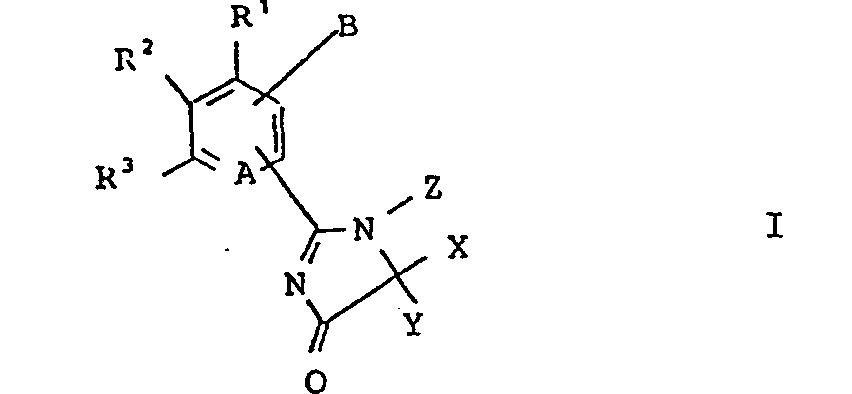
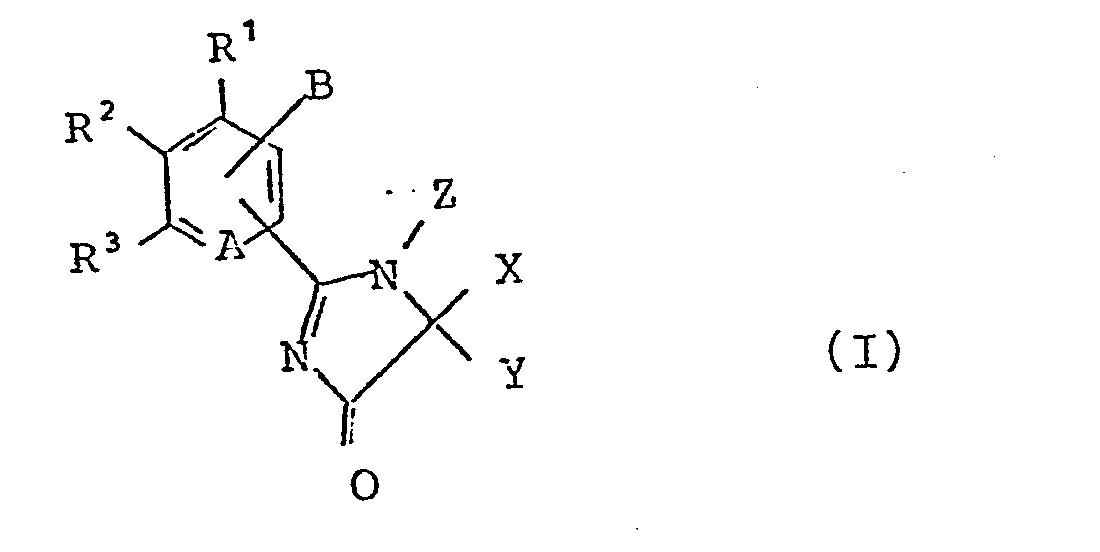
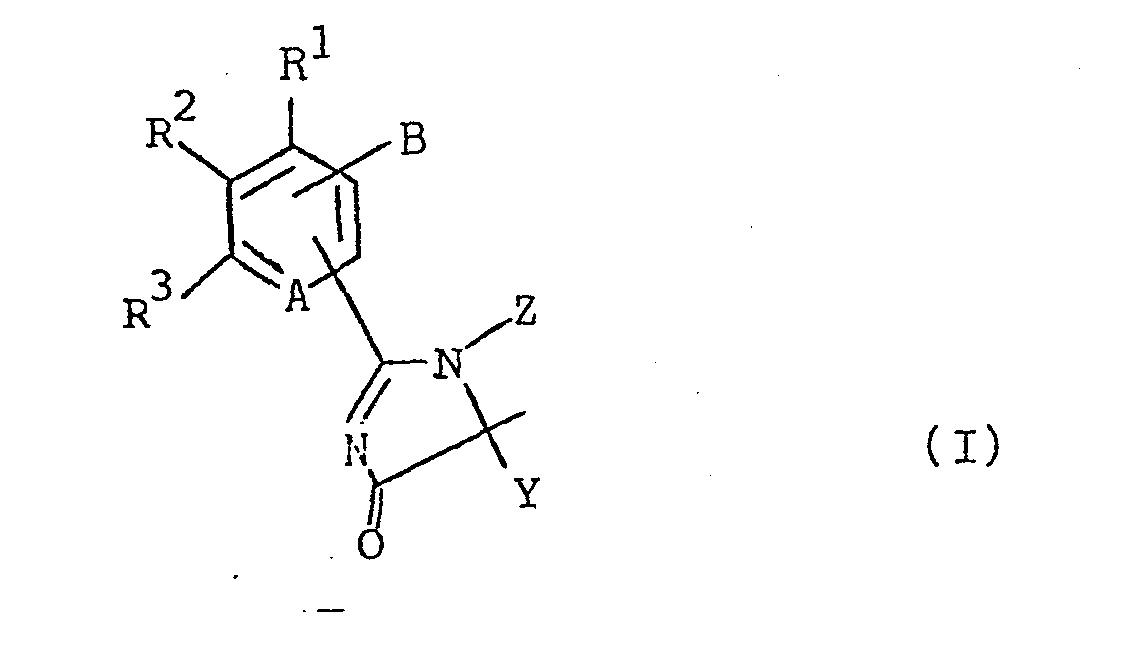
- Die'vorliegende Erfindung betrifft neue, herbizid wirksame Imidazolinone der Formel (I)

- A N oder C-R4;
- B Halogen-(C1-C2)alkyl wobei unter Halogen Fluor, Chlor und Brom, vorzugsweise Fluor und Chlor zu verstehen sind, (C1-C4) Alkoxymethyl, Cyanmethyl und Thiocyanatomethyl;
- X (C1-C4)Alkyl;
- Y (C1- C6)Alkyl, Cyclo(C3-C6)alkyl, (C2-C4) Alkenyl , (C2-C4)Alkinyl, Phenyl oder Benzyl;
- X und Y zusammen mit dem Kohlenstoffatom, an das sie gebunden sind, eine gegebenenfalls durch -CH3 substituierte Spirocyclo(C3-C6)alkylgruppe;
- Z Wasserstoff, (C1-C4)Alkyl, welches durch (C1-C4)Alkoxycarbonyl substituiert sein kann, (C3-C4)Alkenyl, Propargyl, -CO-R5 oder -SO2-R6 ;
- R1, R2, R3 und R4 unabhängig voneinander Wasserstoff, Halogen, (C1-C4)Alkyl, (C1-C6)Alkoxy, (C1-C6) Alkoxycarbonyl, Halogen-(C1-C2)alkyl, Nitro, Cyano, Phenoxy und Phenyl, das gegebenenfalls mit (C1-C4)Alkyl, (C1-C4)Alkoxy oder Halogen substituiert sein kann, wobei jeweils zwei o-ständige Reste R1, R2, R 3 oder R4 auch gemeinsam die Gruppierung -CH=CH-CH=CH bilden können;
- R5 (C1-C12)Alkyl, das gegebenenfalls mit bis zu zwei (C1-C4)Alkoxygruppen oder mit bis zu drei Halogen substituiert ist; Phenyl, das mit bis zu zwei Halogenatomen, einer Methyl-, einer Nitro- oder einer Methoxygruppe substituiert sein kann; Cyclo(C3-C7)alkyl, (C1-C4)Alkoxy, (C1-C4)Alkoxycarbonyl, Benzyloxy, Phenoxy oder -NR7R8, insbesondere (C1-C12) Alkyl ;
- R6 (C1-C4)Alkyl, CF3, CCl3, Phenyl, Chlorphenyl oder Methylphenyl;
- R 7 Wasserstoff oder (C1-C4)Alkyl; und
- R8 (C1-C4)Alkyl, Phenyl, Chlorphenyl, Methylphenyl, Amino, Mono-oder Di(C1-C4)alkylamino, bedeuten, sowie deren optischen Isomere (falls X ‡.Y), ihre Säureadditionssalze und N-Oxide (für den Fall, daß A für N steht).
- Man erhält die erfindungsgemäßen Verbindungen, indem man die Amide der Formel (II)
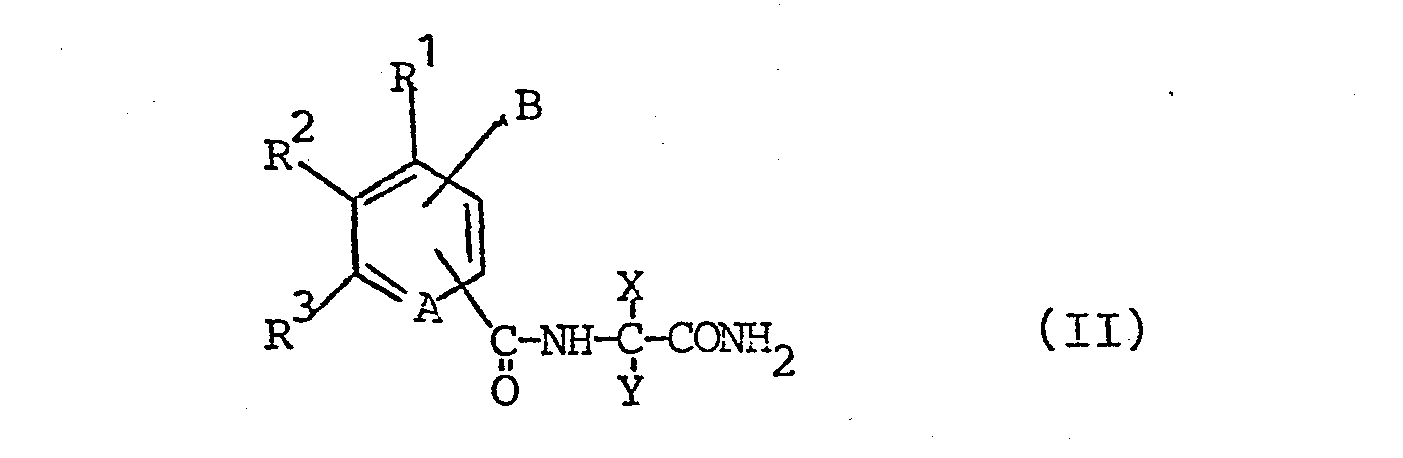
- Die Cyclisierung der Amide (II) kann z.B. mit Phosphorpentachlorid, vorteilhaft in Gegenwart eines unter den Reaktionsbedingungen inerten Lösemittels erfolgen. Als Beispiele für letztere seien genannt: Toluol, Xylol, Chloroform oder Phosphoroxychlorid. Die Reaktionstemperatur ist unkritisch und kann zwischen -10°C und +150°C variiert werden. Besonders vorteilhaft sind Reaktionstemperaturen zwischen 0 und 100°C. Man erhält dabei primär die Hydrochloride der Imidazolinone (I). Nach üblichen Methoden, z.B. durch.Umsetzung mit Natriumcarbonat oder Natriumhydrogencarbonat, lassen sich daraus die freien Basen herstellen.
- Die Cyclisierung kann ebenfalls in Gegenwart starker organischer oder anorganischer Säuren, wie Schwefelsäure oder p-Toluolsulfonsäure, unter gleichzeitiger Abtrennung des gebildeten Wassers bei Temperaturen von 0°C bis 150°C erfolgen. Besonders vorteilhaft läßt sich die Reaktion so führen, daß das gebildete Wasser durch Azeotropdestillation mit einem Lösemittel, wie Toluol, Xylol oder Chloroform, abgetrennt wird. Nach Neutralisation können die Produkte nach üblichen Methoden isoliert werden.
- Die Imidazolinone der Formel (I) (Z = Wasserstoff) werden dabei im allgemeinen in guten Ausbeuten erhalten. Dies war für die halogenalkylsubstituierten Vertreter (B = Halogenalkyl) überraschend, da vielmehr angenommen werden mußte, daß sich die Imidazolinone (I), auf Grund der sterisch sehr günstigen Anordnung der Halogenalkylgruppe, zum basischen Imidazolinstickstoff unter Halogenwasserstoff abspaltung zersetzen würden. Die Cyclisierungsprodukte der Formel (I) mit Z = Wasserstoff können in einfacher Weise nach an sich bekannten Verfahren mit Alkylierungsmitteln, (Methyljodid, Dimethylsulfat) oder Acylierungsmitt-eln (wie Säurechloriden) in Gegenwart von Basen, oder mit Isocyanaten umgesetzt werden.
- Die erfindungsgemäßen Verbindungen sind, wenn Z für Wasserstoff steht, tautomer, so daß sie in einer der beiden Formen (I a)/(I b) oder als Gemisch von (I a) und (I b) vorliegen können. Diese Isomeren treten auch bei den Derivaten mit Z ‡ H auf.

- Die Definitionen der Formel (I) umfassen stets beide isomeren Strukturen der Formel (I a) und (I b).
- Sowohl die Säureadditionssalze, als auch die N-Oxide der Verbindungen der Formel (I) sind auf allgemein bekanntem Weg gut zugänglich, letztere z.B. durch Umsetzung mit Peroxiden oder H2O2.
- Die Amide der Formel (II) lassen sich leicht aus den Aminoamiden (III) und den entsprechend substituierten Carbonsäurederivaten (IV) erhalten. Als Derivate geeignet sind z.B. Säurechloride oder Kohlensäurealkylester (R9 = Cl, -O-COO-Alkyl).

- Die vorliegenden erfindungsgemäßen Verbindungen weisen eine ausgezeichnete herbizide Wirksamkeit gegen ein breites Spektrum wirtschaftlich wichtiger mono- und dikotyler Schadpflanzen auf. Auch schwer bekämpfbare perennierende Wurzelunkräuter werden durch die Wirkstoffe gut erfaßt. Dabei ist es gleichgültig, ob die Substanzen in Vorsaat-, Vorauflauf- oder Nachauflaufspritzung ausge-bracht werden. Werden die erfindungsgemäßen Verbindungen vor dem Keimen auf die Erdoberfläche appliziert, so wird das Auflaufen der Keimlinge nicht vollständig verhindert. Die Unkräuter wachsen bis zum Keimblattstadium heran, stellen jedoch dann ihr Wachstum ein und sterben schließlich nach 3 Wochen vollkommen ab.
- Bei Applikation der Wirkstoffe auf die grünen Pflanzenteile im Nachauflaufverfahren tritt ebenfalls sehr rasch nach der Behandlung ein drastischer Wachstumsstop ein und die Unkrautpflanzen bleiben in dem zum Applikationszeitpunkt vorhandenen Wachstumsstadium stehen oder sterben nach einer gewissen Zeit ganz ab, so daß auf diese Weise eine für die Kulturpflanzen schädliche Unkrautkonkurrenz sehr früh und nachhaltig durch den Einsatz der neuen erfindungsgemäßen Mittel beseitigt werden kann. Obgleich die erfindungsgemäßen Verbindungen eine ausgezeichnete herbizide Aktivität gegenüber mono- und dikotylen Unkräutern aufweisen, werden Kulturpflanzen wirtschaftlich bedeutender Kulturen wie z. B. Weizen, Gerste, Roggen, Reis, Mais, Zuckerrübe, Baumwolle und Soja nur unwesentlich oder gar nicht geschädigt. Die erfindungsgemäßen Substanzen besitzen somit ausgezeichnete Selektivität bei Kulturpflanzen und eignen sich aus diesen Gründen sehr gut zur Bekämpfung von unerwünschtem Pflanzenwuchs in landwirtschaftlichen Nutzungspflanzungen..
- Darüberhinaus weisen sie wachstumsregulatorische Eigenschaften bei Kulturpflanzen auf. Sie greifen regulierend in den pflanzene-igenen Stoffwechsel ein und können damit zur Ernteerleichterung wie z.B. durch Auslösen von Desikkation, Abzession und Wuchsstauchung eingesetzt werden. Desweiteren eignen sich auch zur generellen Steuerung und Hemmung von unerwünschtem vegetativen Wachstum, ohne dabei die Pflanzen abzutöten. Eine Hemmung des vegetativen Wachstums spielt bei vielen mono-und dikolylen Kulturen eine große Rolle, da das Lagern hierdurch verringert oder völlig verhindert werden kann. Gegenstand der vorliegenden Erfindung sind daher auch herbizide und wachstumsregulatorische Mittel, welche den Wirkstoff der Formel (I) neben üblichen Formulierungshilfsmitteln enthalten.
- Die erfindungsgemäßen Mittel können als Spritzpulver, emulgierbare Konzentrate, versprühbare Lösungen, Stäubemittel, Beizmittel, Dispersionen, Granulate oder Mikrogranulate in den üblichen Zubereitungen angewendet werden. Spritzpulver sind in Wasser gleichmäßig dispergierbare Präparate, die neben dem Wirkstoff außer gegebenenfalls einem Verdünnungs- oder Inertstoff noch Netzmittel, z. B. polyoxethylierte Alkylphenole, polyoxethylierte Fettalkohole, Alkyl- oder Alkylphenylsulfonate und Dispergiermittel, z. B. ligninsulfonsaures Natrium, 2,2'-di- naphthylmethan-6,6'-disulfonsaures Natrium, dibutylnaphthalinsulfonsaures Natrium oder auch oleoylmethyltaurinsaures Natrium enthalten. Die Herstellung erfolgt in üblicher Weise, z. B. durch Mahlen und Vermischen der Komponenten.
- Emulgierbare Konzentrate können z. B. durch Auflösen des Wirkstoffes in einem inerten organischen Lösungsmittel, z. B. Butanol, Cyclohexanon, Dimethylformamid, Xylol oder auch höhersiedenden Aromaten oder Kohlenwasserstof- fen unter Zusatz von einem oder mehreren Emulgatoren her.- gestellt werden. Bei flüssigen Wirkstoffen kann der Lösungsmittelanteil auch ganz oder teilweise entfallen. Als Emulgatoren können beispielsweise verwendet werden: Alkyl-arylsulfonsaure Calciumsalze wie Ca-dodecylbenzolsulfonat oder nichtionische Emulgatoren wie Fettsäurepolyglykolester, Alkyl-arylpolyglykolether, Fettalkoholpolyglykolether, Propylenoxid-Ethylenoxid-Kondensationsprodukte, Fettalkohol-Propylenoxid-Ethylenoxid-Kondensationsprodukte, Alkylpolyglykolether, Sorbitanfettsäureester, Polyoxethylensorbitanfettsäureester oder Polyoxethylensorbitester.
- Stäubemittel kann man durch Vermahlen des Wirkstoffes mit fein verteilten, festen Stoffen, z. B. Talkum, natürlichen Tonen wie Kaolin, Bentonit, Pyrophillit oder Diatomeenerde erhalten.
- Granulate können entweder durch Verdüsen des Wirkstoffes auf adsorptionsfähiges, granuliertes Inertmaterial hergestellt werden oder durch Aufbringen von Wirkstoffkonzentraten mittels Bindemitteln, z. B. Polyvinylalkohol, polyacrylsaurem Natrium oder auch Mineralölen auf die Oberfläche von Trägerstoffen wie Sand, Kaolinite oder von granuliertem Inertmaterial.Auch können geeignete Wirkstoffe in der für die Herstellung von Düngemittelgranulaten üblichen Weise, gewünschtenfalls in Mischung mit Düngemitteln, granuliert werden.
- In Spritzpulvern beträgt die Wirkstoffkonzentration z. B. etwa 10 bis 90 Gew.-%, der Rest zu 100 Gew.-% besteht aus üblichen Formulierungsbestandteilen. Bei emulgierbaren Konzentraten kann die Wirkstoffkonzentration etwa 10 bis 80 Gew.-% betragen. Staubförmige Formulierungen enthalten meistens 5 bis 20 Gew.-% an Wirkstoff, versprühbare Lösungen etwa 2 bis 20 Gew.-%. Bei Granulaten hängt der Wirkstoffgehalt zum Teil davon ab, ob die wirksame Verbindung flüssig oder fest vorliegt und welche Granulierhilfsmittel, Füllstoffe usw. verwendet werden.
- Daneben enthalten die genannten Wirkstofformulierungen gegebenenfalls die jeweils üblichen Haft-, Netz-, Dispergier-, Emulgier-, Penetrations-, Lösungsmittel, Füll- oder Trägerstoffe.
- Zur Anwendung werden die in handelsüblicher Form vorliegenden Konzentrate gegebenenfalls in üblicher Weise verdünnt, z. B. bei Spritzpulvern, emulgierbaren Konzentraten, Dispersionen und teilweise auch bei Mikrogranulaten mittels Wasser. Staubförmige und granulierte Zubereitungen sowie versprühbare Lösungen werden vor der Anwendung üblicherweise nicht mehr mit weiteren inerten Stoffen verdünnt.
- Die Aufandmengen an Wirkstoff der Formel (I)variieren je nach Indikation zwischen 0,01 und 10 kg Wirkstoff/ha.
- Auch Mischungen oder Mischformulierungen mit anderen Wirkstoffen, wie z. B. Insektiziden, Akariziden, Herbiziden, Düngemitteln, Wachstumsregulatoren oder Fungiziden sind gegebenenfalls möglich.
- Nachstehend seien einige Formulierungsbeispiele aufgeführt:
- Ein Stäubemittel wird erhalten, indem man 10 Gewichtsteile Wirkstoff und 90 Gewichtsteile Talkum oder Inertstoff mischt und in einer Schlagmühle zerkleinert.
- Ein in Wasser leicht dispergierbares, benetzbares Pulver wird erhalten, indem man 25 Gewichtsteile Wirkstoff, 64 Gewichtsteile kaolinhaltigen Quarz als Inertstoff, 10 Gewichtsteile ligninsulfonsaures Kalium und 1 Gewichtsteil oleoylmethyltaurinsaures Natrium als Netz- und Dispergiermittel mischt und in einer Stiftmühle mahlt.
- Ein in Wasser leicht dispergierbares Dispersionskonzentrat wird erhalten, indem man 20 Gewichtsteile Wirkstoff mit 6 Gewichtsteilen Alkylphenolpolyglykolether (z.B. (R)Triton X 207 der Rohm & Haas Co.), 3 Gew.-Tl. Isotridecanol polyglykolether (8 AeO) und 71 Gewichtsteilen paraffinischem Mineralöl (Siedebereich z. B. ca. 255 bis über 377 °C) mischt und in einer Reibkugelmühle auf eine Feinheit von unter 5 Mikron vermahlt.
- Ein emulgierbares Konzentrat wird erhalten aus 15 Gewichtsteilen Wirkstoff, 75 Gewichtsteilen Cyclohexanon als Lösungsmittel und 10 Gewichtsteilen oxethyliertes Nonylphenol (10 AeO) als Emulgator.
- Die folgenden Beispiele dienen der weiteren Erläuterung der Erfindung:
- A. Herstellungsbeispiele
- Zu einer Lösung aus 10,3g(0,079 mol) 2-Methylvalinamid und 8,7 g (0,086 mol) Triethylamin in 50 ml abs. Methylenchlorid tropft man bei 0 - 5°C 15 g (0,072 mol) 2-Trifluormethylbenzoylchlorid zu. Nach 1 h Reaktionszeit bei Raumtemperatur wird auf 500 ml 0,5 n Natriumhydrogencarbonatlösung gegossen, nachgerührt und abgesaugt. Nach dem Trocknen erhält man 18,3 g (85 % der Theorie) 2-Trifluormethylbenzoesäure-N-2-(2-carbamoyl-3-methyl)-butylamid als farbloser Feststoff vom Fp. 124 bis 126°C.
- 18,3 g (0,060 mol) 2-Trifluormethylbenzoesäure-N-2-(2- carbamoyl-3-methyl)-butylamid werden in 100 ml Phosphoroxychlorid gelöst und bei Raumtemperatur portionsweise mit 14,0 g (0,067 mol) Phosphorpentachlorid versetzt. Nach 5 h bei Raumtemperatur wird im Vakuum eingedampft, mit Eis hydrolysiert, mit Natriumhydrogencarbonat neutralisiert und die Lösung 2mal mit je 100 ml Essigester extrahiert. Nach dem Trocknen über Natriumsulfat und Eindampfen erhält man 15,5 g (91 % der Theorie) 5-Isopropyl-5-methyl-4-oxo-2-(2-trifluormethylphenyl)-2-imidazolin als farblosen Feststoff vom Fp. 109 bis 110°C.
- Zu 4,5 g (0,015 mol) 2-(2-Dichlormethylphenyl)-5-5-diethyl-4-oxo-2-imidazolin in 30 ml abs. Pyridin gibt man bei 0 - 5°C 3,2 g (0,017 mol) 4-Toluolsulfonsäurechlorid zu, läßt 1 d bei Raumtemperatur stehen, gießt auf 500 ml Wasser, extrahiert 2mal mit je 100 ml Toluol, wäscht die org. Phase lmal mit 2 n Natronlauge und 1mal mit Wasser. Nach dem Trocknen (Natriumsulfat) und Ein-Eindampfen wird der Rückstand chromatographisch (Kieselgel, LM Petrolether-Essigester 7 : 3) gereinigt. Man erhält 4,4 g (66 % der Theorie) 2-(2-Dichlormethylphenyl) -5-diethyl-4-oxo-1-(4-toluolsulfonyl)-2-imidazolin als farbloser Feststoff vom Fp. 139 - 140°C.
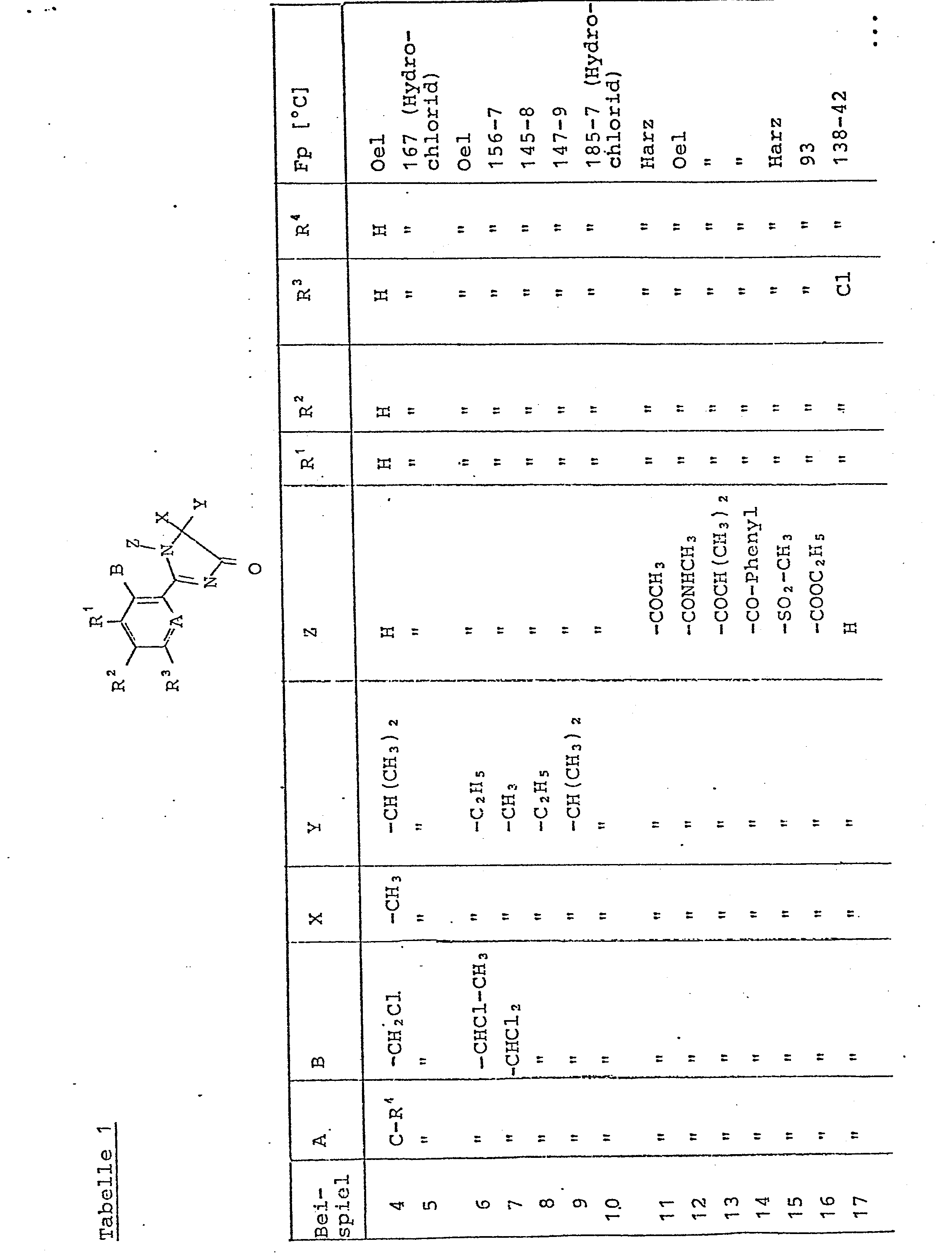

- Die Schädigung der Unkrautpflanzen bzw. die Kulturpflanzenverträglichkeit wurde in einem Schlüssel von 0 - 5 bonitiert. Dabei bedeutet
- 0 = ohne Wirkung (Schaden)
- 1 = 0 - 20 % Wirkung
- 2 = 20 - 40 % Wirkung
- 3 = 40 - 60 % Wirkung
- 4 = 60 - 80 % Wirkung
- 5 = 80 - 100 % Wirkung
- Samen bzw. Rhizomstücke mono- und dikotyler Unkräuter wurden in Lehmerde in Plastiktöpfen (0 9 cm) ausgelegt und mit Erde abgedeckt. Die als benetzbare Pulver bzw. als Emulsionskonzentrate formulierten erfindungsgemäßen Verbindungen wurden in Form wäßriger Suspensionen bzw. Emulsionen auf die Erdoberfläche appliziert. Die Wasseraufwandmenge pro Topf entsprach dabei umgerechnet 600 1/ha. Nach der Behandlung wurden die Versuchstöpfe im Gewächshaus aufgestellt und die Versuchspflanzen unter guten Wachstumsbedingungen (Temperatur: 23 ± 1 °C; rel. Luftfeuchte 60 - 80 %) kultiviert. Nach ca. 3 Wochen wurde die Pflanzenschädigung visuell bonitiert. Als Vergleich dienten dabei unbeharidelte Kontrollen.
- Wie aus den Werten der Tabelle 2 hervorgeht, weisen die erfindungsgemäßen Verbindungen im Vorauflaufverfahren eine zum Teil ausgezeichnete herbizide Wirksamkeit gegen wirtschaftlich bedeutende mono-und dikotyle Schadpflanzen auf.
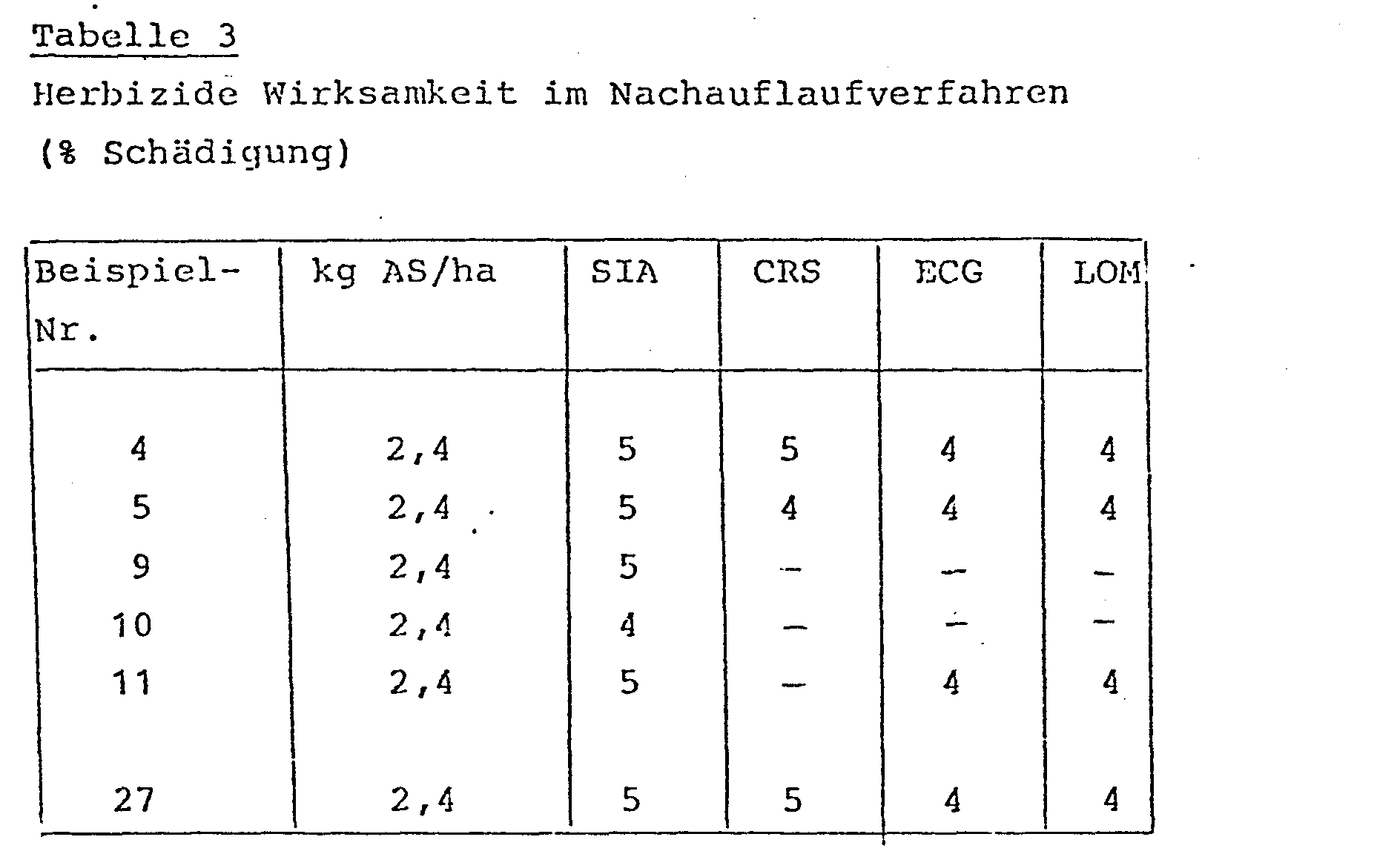
- In ähnlicher Weise wurden verschiedene Unkräuter in Töpfen im Gewächshaus bis zum 3-6-Blattstadium herangezogen und dann im Nachauflauf verfahren mit den erfindungsgemäßen Verbindungen (formuliert als Spritzpulver) behandelt. 4 Wochen später wurden die Versuchspflanzen im Vergleich zu unbehandelten Kontrollpflanzen visuell bonitiert, indem die Schädigung geschätzt wurde.
- Die Ergebnisse des Versuchs (Tabelle 3) belegen die guten herbiziden Eigenschaften der Verbindungen.



- In Schalenversuchen im Gewächshaus wurden junge Getreidepflanzen (Weizen, Gerste und Roggen) im 3-Blattstadium mit den zu prüfenden Verbindungen in den in Tabelle 4 angegebenen Wirkstoffkonzentrationen (kg/ha) tropfnaß gespritzt. Nachdem die unbehandelten Kontrollpflanzen eine Wuchshöhe von etwa 55 cm erreicht hatten, wurde bei allen Pflanzen der Zuwachs gemessen und die Wuchshemmung in % des Zuwachses der Kontrollpflanzen berechnet. Es wurde außerdem die phytotoxische Wirkung der Verbindungen beobachtet. Die Ergebnisse sind in Tabelle 4 zusammengefaßt. Bei der Angabe der Wuchshemmung bedeuten 100 % den Stillstand des Wachstums und 0 % ein Wachstum entsprechend dem der unbehandelten Kontrollpflanzen.

- 10 - 15 cm Buschbohnen wurden mit den Wirkstoffzubereitungen tropfnaß bespritzt. Nach 2 Wochen wird der Zuwachs gemessen und die Wuchshemmung in % des Zuwachses der Kontrollpflanzen berechnet. Die Ergeb- nisse sind in Tabelle 5 zusammengefaßt.

Claims (9)


Applications Claiming Priority (2)
| Application Number | Priority Date | Filing Date | Title |
|---|---|---|---|
| DE19833340595 DE3340595A1 (de) | 1983-11-10 | 1983-11-10 | Imidazolinone, verfahren zu ihrer herstellung und ihre verwendung im pflanzenschutz |
| DE3340595 | 1983-11-10 |
Publications (2)
| Publication Number | Publication Date |
|---|---|
| EP0144748A2 true EP0144748A2 (de) | 1985-06-19 |
| EP0144748A3 EP0144748A3 (de) | 1985-07-03 |
Family
ID=6213909
Family Applications (1)
| Application Number | Title | Priority Date | Filing Date |
|---|---|---|---|
| EP84113259A Withdrawn EP0144748A3 (de) | 1983-11-10 | 1984-11-03 | Imidazolinone, Verfahren zur ihrer Herstellung und ihre Verwendung im Pflanzenschutz |
Country Status (14)
| Country | Link |
|---|---|
| US (1) | US4614535A (de) |
| EP (1) | EP0144748A3 (de) |
| JP (1) | JPS60123475A (de) |
| KR (1) | KR850003722A (de) |
| CN (1) | CN85101424A (de) |
| AU (1) | AU3528884A (de) |
| BR (1) | BR8405750A (de) |
| DD (1) | DD231481A5 (de) |
| DE (1) | DE3340595A1 (de) |
| ES (1) | ES8600248A1 (de) |
| HU (1) | HUT36341A (de) |
| IL (1) | IL73470A0 (de) |
| PH (1) | PH20098A (de) |
| ZA (1) | ZA848760B (de) |
Cited By (6)
| Publication number | Priority date | Publication date | Assignee | Title |
|---|---|---|---|---|
| GB2174395A (en) * | 1986-05-09 | 1986-11-05 | American Cyanimid Co | Herbicidal 2-(2-imidazolin-2-yl)pyridine derivatives |
| EP0270760A1 (de) * | 1986-10-14 | 1988-06-15 | Bayer Ag | 2-(5-Oxo-2-imidazolin-2-yl)-pyridin-Derivate |
| WO1991014679A1 (fr) * | 1990-03-20 | 1991-10-03 | Sanofi | Derives heterocycliques n-substitues, leur preparation, les compostions pharmaceutiques en contenant |
| EP0519831A1 (de) * | 1991-06-21 | 1992-12-23 | Sanofi | N-Substituierte heterozyklische Derivate, Verfahren zu deren Herstellung und diese enthaltende pharmazeutische Zusammenstellungen |
| AP405A (en) * | 1991-12-20 | 1995-09-03 | Bayer Sas | Fungicidal 2-imidazolin-5-one and 2-imidazoline-5-thione derivatives. |
| RU2388753C2 (ru) * | 2004-08-23 | 2010-05-10 | Бристол-Маерс Сквибб Компани | Способ получения промежуточного продукта, участвующего в синтезе ирбесартана |
Families Citing this family (13)
| Publication number | Priority date | Publication date | Assignee | Title |
|---|---|---|---|---|
| US4798619A (en) * | 1980-06-02 | 1989-01-17 | American Cyanamid Co. | 2-(2-imidazolin-2-yl)-pyridines and quinolines and use of said compounds as herbicidal agents |
| GR861747B (en) * | 1985-07-25 | 1986-09-23 | Nissan Chemical Ind Ltd | Pyridine derivatives process for their production and herbicidal compositions |
| CN86106435A (zh) * | 1985-09-24 | 1987-05-27 | 舍林股份公司 | 咪唑啉基衍生物,其制备方法和含有这类化合物的具有除草作用的制剂 |
| EP0261705A1 (de) * | 1986-08-25 | 1988-03-30 | Shell Internationale Researchmaatschappij B.V. | Herbizide Imidazolinylbenzoesäuren und Derivate |
| EP0303863A3 (de) * | 1987-08-17 | 1991-10-23 | American Cyanamid Company | Benzolsulfonylcarboxamid-Verbindungen, Zwischenprodukte und Verfahren zu ihrer Herstellung und die Verwendung dieser Verbindungen und Zwischenprodukte als Herbizide |
| US5034532A (en) * | 1988-01-27 | 1991-07-23 | American Cyanamid Company | Method for the preparation of quinolyl and pyridyl substituted imidazolinones |
| US5062881A (en) * | 1989-12-20 | 1991-11-05 | American Cyanamid Company | 2-(1-substituted-2-imidazolin-2-yl)benzoic and nicotinic acids and a method for their preparation |
| US5270317A (en) * | 1990-03-20 | 1993-12-14 | Elf Sanofi | N-substituted heterocyclic derivatives, their preparation and the pharmaceutical compositions in which they are present |
| US5076832A (en) * | 1990-07-20 | 1991-12-31 | Ici Americas Inc. | Certain 3-(substituted phenyl)-5-(substituted phenyl)-1-ethylimidazolidine-4-ones as herbicides |
| US5108485A (en) * | 1990-08-31 | 1992-04-28 | American Cyanamid Company | Herbicidal 2-(2-imidazolin-2-yl)-benzazoles |
| US6002016A (en) * | 1991-12-20 | 1999-12-14 | Rhone-Poulenc Agrochimie | Fungicidal 2-imidazolin-5-ones and 2-imidazoline-5-thiones |
| FR2706456B1 (fr) | 1993-06-18 | 1996-06-28 | Rhone Poulenc Agrochimie | Dérivés optiquement actifs de 2-imidazoline-5-ones et 2-imidazoline-5-thiones fongicides. |
| US6008370A (en) * | 1992-11-25 | 1999-12-28 | Rhone-Poulenc Agrochimie | Fungicidal-2-alkoxy/haloalkoxy-1-(mono- or disubstituted)amino-4,4-disubstituted-2-imidazolin-5-ones |
Family Cites Families (4)
| Publication number | Priority date | Publication date | Assignee | Title |
|---|---|---|---|---|
| US4125727A (en) * | 1976-10-18 | 1978-11-14 | American Cyanamid Company | Method of preparing imidazoisoindolediones |
| US4188487A (en) * | 1977-08-08 | 1980-02-12 | American Cyanamid Company | Imidazolinyl benzoic acids, esters and salts and their use as herbicidal agents |
| IL55064A (en) * | 1977-08-08 | 1983-06-15 | American Cyanamid Co | 5,5-disubstituted-4-oxo-2-imidazolin-2-yl benzoic acid esters,their preparation and herbicidal compositions comprising them |
| IL55854A0 (en) * | 1978-01-09 | 1979-01-31 | American Cyanamid Co | Method for controlling the growth of plants by using imidazole derivatives |
-
1983
- 1983-11-10 DE DE19833340595 patent/DE3340595A1/de not_active Withdrawn
-
1984
- 1984-11-02 HU HU844076A patent/HUT36341A/hu unknown
- 1984-11-03 EP EP84113259A patent/EP0144748A3/de not_active Withdrawn
- 1984-11-08 ES ES537502A patent/ES8600248A1/es not_active Expired
- 1984-11-08 PH PH31423A patent/PH20098A/en unknown
- 1984-11-08 US US06/669,620 patent/US4614535A/en not_active Expired - Fee Related
- 1984-11-08 DD DD84269265A patent/DD231481A5/de unknown
- 1984-11-09 BR BR8405750A patent/BR8405750A/pt unknown
- 1984-11-09 AU AU35288/84A patent/AU3528884A/en not_active Abandoned
- 1984-11-09 ZA ZA848760A patent/ZA848760B/xx unknown
- 1984-11-09 JP JP59235343A patent/JPS60123475A/ja active Pending
- 1984-11-09 KR KR1019840007012A patent/KR850003722A/ko not_active Withdrawn
- 1984-11-09 IL IL73470A patent/IL73470A0/xx unknown
-
1985
- 1985-04-01 CN CN198585101424A patent/CN85101424A/zh active Pending
Cited By (8)
| Publication number | Priority date | Publication date | Assignee | Title |
|---|---|---|---|---|
| GB2174395A (en) * | 1986-05-09 | 1986-11-05 | American Cyanimid Co | Herbicidal 2-(2-imidazolin-2-yl)pyridine derivatives |
| EP0270760A1 (de) * | 1986-10-14 | 1988-06-15 | Bayer Ag | 2-(5-Oxo-2-imidazolin-2-yl)-pyridin-Derivate |
| WO1991014679A1 (fr) * | 1990-03-20 | 1991-10-03 | Sanofi | Derives heterocycliques n-substitues, leur preparation, les compostions pharmaceutiques en contenant |
| EP0454511A1 (de) * | 1990-03-20 | 1991-10-30 | Sanofi | N-substituierte heterozyklische Derivate, Verfahren zu deren Herstellung, diese enthaltende Zusammensetzungen |
| EP0519831A1 (de) * | 1991-06-21 | 1992-12-23 | Sanofi | N-Substituierte heterozyklische Derivate, Verfahren zu deren Herstellung und diese enthaltende pharmazeutische Zusammenstellungen |
| FR2677984A1 (fr) * | 1991-06-21 | 1992-12-24 | Sanofi Elf | Derives d'imidazoline n-substitues, leur preparation, les compositions pharmaceutiques en contenant. |
| AP405A (en) * | 1991-12-20 | 1995-09-03 | Bayer Sas | Fungicidal 2-imidazolin-5-one and 2-imidazoline-5-thione derivatives. |
| RU2388753C2 (ru) * | 2004-08-23 | 2010-05-10 | Бристол-Маерс Сквибб Компани | Способ получения промежуточного продукта, участвующего в синтезе ирбесартана |
Also Published As
| Publication number | Publication date |
|---|---|
| AU3528884A (en) | 1985-05-16 |
| BR8405750A (pt) | 1985-09-17 |
| HUT36341A (en) | 1985-09-30 |
| DD231481A5 (de) | 1986-01-02 |
| ES537502A0 (es) | 1985-10-16 |
| CN85101424A (zh) | 1987-01-17 |
| KR850003722A (ko) | 1985-06-26 |
| JPS60123475A (ja) | 1985-07-02 |
| DE3340595A1 (de) | 1985-05-23 |
| EP0144748A3 (de) | 1985-07-03 |
| US4614535A (en) | 1986-09-30 |
| ES8600248A1 (es) | 1985-10-16 |
| PH20098A (en) | 1986-09-24 |
| IL73470A0 (en) | 1985-02-28 |
| ZA848760B (en) | 1985-06-26 |
Similar Documents
| Publication | Publication Date | Title |
|---|---|---|
| EP0131258B1 (de) | Neue N-Alkoxy- N-Alkylsulfonylaminosulfonylharnstoffe, und neue (Pyrimido) Triazino-thiatriazinoxide als Vorprodukte | |
| EP0126254B1 (de) | N-(2-Nitrophenyl)-4-aminopyrimidin-Derivate als Mikrobizide | |
| DD231481A5 (de) | Herbizide und wachstumsregulierende mittel | |
| EP0137868B1 (de) | 1-Substituierte Imidazol-5-carbonsäurederivate, ihre Herstellung sowie ihre Verwendung als Biozide | |
| DE69126836T2 (de) | Herbizide | |
| DD264844A5 (de) | Herbizide mittel | |
| DD272069A5 (de) | Herstellung von (r)-2-[4-(5-chlor-3-flourpyridin-2-yloxy)-phenoxyl]-propionsaeurepropinylester mit herbizider wirkung | |
| EP0264865A2 (de) | Alpha-Iminocarbonsäureanilide enthaltende herbizide Mittel sowie neue Alpha-Iminocarbonsäureanilide und Verfahren zu ihrer Herstellung | |
| EP0075840B1 (de) | Heterocyclische Phenyläther, Verfahren zu deren Herstellung und diese enthaltende herbizide Mittel | |
| DD261084A5 (de) | 1,2-disubstituierte piperidine, verfahren zu ihrer herstellung sowie ihre verwendung im pflanzenschutz | |
| DD273436A5 (de) | Verfahren zur herstellung substituierter tetrahydrophtholimide und ihre verwendung der herbezide | |
| EP0216243A2 (de) | N-Substituierte 3,4,5,6-Tetrahydrophthalimide, Verfahren zu ihrer Herstellung sowie ihre Verwendung im Pflanzenschutz | |
| EP0151744B1 (de) | 1-Acylimidazolinone, Verfahren zu ihrer Herstellung und ihre Verwendung in der Landwirtschaft | |
| EP0071572B1 (de) | Derivate der 2-Nitro-4- oder 5-Pyridyloxy-phenylphosphonsäure, Verfahren zu ihrer Herstellung, ihre Verwendung als Herbizide und/oder Pflanzenwachstumsregulatoren und/oder Mikrobizide, sowie zur Herstellung der Derivate verwendete Zwischenprodukte, Verfahren zu deren Herstellung und deren Verwendung als Herbizide | |
| EP0391849B1 (de) | Pyridyl-methylenamino-1,2,4-triazinone | |
| EP0227045B1 (de) | Heterocyclische Phenyläther, Verfahren zu deren Herstellung und diese enthaltende herbizide Mittel | |
| DE3408403A1 (de) | Substituierte 2-arylimidazolinone, verfahren zu ihrer herstellung und ihre verwendung als pflanzenbehandlungsmittel | |
| EP0144749A2 (de) | 2-acrlsubstituierte Imidazolinone, Verfahren zu ihrer Herstellung und ihre Verwendung im Pflanzenschutz | |
| DE3403730A1 (de) | Isoindole, verfahren zu ihrer herstellung und ihre verwendung in der landwirtschaft | |
| EP0009555A1 (de) | Herbizide Mittel auf der Basis eines Thiolcarbamats, die Halogenacylamide als Antagonisten enthalten, und ihre Verwendung in einem Verfahren zur selektiven Bekämpfung von unerwünschtem Pflanzenwuchs | |
| EP0133162A2 (de) | Phosphonoxid-Derivate und ihre Verwendung als Herbizide und pflanzenwuchsregulierende Mittel | |
| DE3502629A1 (de) | Phenoxybenzoesaeurederivate, verfahren zu ihrer herstellung sowie ihre verwendung im pflanzenschutz | |
| DD219656A5 (de) | Herbizide und/oder fungizide zusammensetzung | |
| EP0144001A1 (de) | Substituierte Phenoxypropionyl-isoharnstoffderivate, Verfahren zu ihrer Herstellung und ihre Verwendung im Pflanzenschutz | |
| EP0221439A1 (de) | Herbizide Mittel, die stickstoffhaltige Heterocyclen mit Arylcarbamoyl-Resten enthalten, sowie neue heterocyclische Derivate mit Arylcarbamoyl-Resten |
Legal Events
| Date | Code | Title | Description |
|---|---|---|---|
| PUAI | Public reference made under article 153(3) epc to a published international application that has entered the european phase |
Free format text: ORIGINAL CODE: 0009012 |
|
| PUAL | Search report despatched |
Free format text: ORIGINAL CODE: 0009013 |
|
| AK | Designated contracting states |
Designated state(s): AT BE CH DE FR GB IT LI NL SE |
|
| AK | Designated contracting states |
Designated state(s): AT BE CH DE FR GB IT LI NL SE |
|
| RTI1 | Title (correction) | ||
| 17P | Request for examination filed |
Effective date: 19851115 |
|
| STAA | Information on the status of an ep patent application or granted ep patent |
Free format text: STATUS: THE APPLICATION HAS BEEN WITHDRAWN |
|
| 18W | Application withdrawn |
Withdrawal date: 19860829 |
|
| RIN1 | Information on inventor provided before grant (corrected) |
Inventor name: MILDENBERGER, HILMAR, DR. Inventor name: BIERINGER, HERMANN, DR. Inventor name: BUERSTELL, HELMUT, DR. Inventor name: SCHMIERER, ROLAND, DR. Inventor name: LIEBL, RAINER, DR. Inventor name: BAUER, KLAUS, DR. Inventor name: HANDTE, REINHARD, DR. |