EP0302332A2 - Verfahren zur Reinigung von Polyoxibutylenpolyoxialkylenglykolen - Google Patents
Verfahren zur Reinigung von Polyoxibutylenpolyoxialkylenglykolen Download PDFInfo
- Publication number
- EP0302332A2 EP0302332A2 EP88111910A EP88111910A EP0302332A2 EP 0302332 A2 EP0302332 A2 EP 0302332A2 EP 88111910 A EP88111910 A EP 88111910A EP 88111910 A EP88111910 A EP 88111910A EP 0302332 A2 EP0302332 A2 EP 0302332A2
- Authority
- EP
- European Patent Office
- Prior art keywords
- weight
- tetrahydrofuran
- ethylene oxide
- hydrogenation
- polyoxibutylene
- Prior art date
- Legal status (The legal status is an assumption and is not a legal conclusion. Google has not performed a legal analysis and makes no representation as to the accuracy of the status listed.)
- Withdrawn
Links
Images
Classifications
-
- C—CHEMISTRY; METALLURGY
- C08—ORGANIC MACROMOLECULAR COMPOUNDS; THEIR PREPARATION OR CHEMICAL WORKING-UP; COMPOSITIONS BASED THEREON
- C08G—MACROMOLECULAR COMPOUNDS OBTAINED OTHERWISE THAN BY REACTIONS ONLY INVOLVING UNSATURATED CARBON-TO-CARBON BONDS
- C08G65/00—Macromolecular compounds obtained by reactions forming an ether link in the main chain of the macromolecule
- C08G65/34—Macromolecular compounds obtained by reactions forming an ether link in the main chain of the macromolecule from hydroxy compounds or their metallic derivatives
- C08G65/46—Post-polymerisation treatment, e.g. recovery, purification, drying
-
- C—CHEMISTRY; METALLURGY
- C08—ORGANIC MACROMOLECULAR COMPOUNDS; THEIR PREPARATION OR CHEMICAL WORKING-UP; COMPOSITIONS BASED THEREON
- C08G—MACROMOLECULAR COMPOUNDS OBTAINED OTHERWISE THAN BY REACTIONS ONLY INVOLVING UNSATURATED CARBON-TO-CARBON BONDS
- C08G65/00—Macromolecular compounds obtained by reactions forming an ether link in the main chain of the macromolecule
- C08G65/02—Macromolecular compounds obtained by reactions forming an ether link in the main chain of the macromolecule from cyclic ethers by opening of the heterocyclic ring
- C08G65/32—Polymers modified by chemical after-treatment
- C08G65/321—Polymers modified by chemical after-treatment with inorganic compounds
- C08G65/322—Polymers modified by chemical after-treatment with inorganic compounds containing hydrogen
-
- C—CHEMISTRY; METALLURGY
- C08—ORGANIC MACROMOLECULAR COMPOUNDS; THEIR PREPARATION OR CHEMICAL WORKING-UP; COMPOSITIONS BASED THEREON
- C08G—MACROMOLECULAR COMPOUNDS OBTAINED OTHERWISE THAN BY REACTIONS ONLY INVOLVING UNSATURATED CARBON-TO-CARBON BONDS
- C08G65/00—Macromolecular compounds obtained by reactions forming an ether link in the main chain of the macromolecule
- C08G65/02—Macromolecular compounds obtained by reactions forming an ether link in the main chain of the macromolecule from cyclic ethers by opening of the heterocyclic ring
- C08G65/04—Macromolecular compounds obtained by reactions forming an ether link in the main chain of the macromolecule from cyclic ethers by opening of the heterocyclic ring from cyclic ethers only
- C08G65/06—Cyclic ethers having no atoms other than carbon and hydrogen outside the ring
- C08G65/16—Cyclic ethers having four or more ring atoms
- C08G65/20—Tetrahydrofuran
-
- C—CHEMISTRY; METALLURGY
- C08—ORGANIC MACROMOLECULAR COMPOUNDS; THEIR PREPARATION OR CHEMICAL WORKING-UP; COMPOSITIONS BASED THEREON
- C08G—MACROMOLECULAR COMPOUNDS OBTAINED OTHERWISE THAN BY REACTIONS ONLY INVOLVING UNSATURATED CARBON-TO-CARBON BONDS
- C08G65/00—Macromolecular compounds obtained by reactions forming an ether link in the main chain of the macromolecule
- C08G65/02—Macromolecular compounds obtained by reactions forming an ether link in the main chain of the macromolecule from cyclic ethers by opening of the heterocyclic ring
- C08G65/30—Post-polymerisation treatment, e.g. recovery, purification, drying
Definitions
- This invention relates to a process for the purification of polyoxibutylene polyoxyalkylene glycols obtained by cationically catalyzed copolymerization of tetrahydrofuran and alkylene oxides.
- Polyoxibutylene polyoxyalkylene glycols are obtained by copolymerization of tetrahydrofuran (THF) and alkylene oxides using cationic catalysts e.g. obtained by the methods described in GB-PS 854 958 or US Pat. Nos. 4,139,567, 4,153,786 and 4,329,445.
- the copolymers are e.g. important starting materials for the production of polyurethanes, polyethers and polyether polyamides.
- the copolymers obtainable by copolymerizing THF and alkylene oxides on cationic catalysts contain production-related impurities, such as oligomeric cyclic ethers, which are composed of THF and alkylene oxide units. They also contain small amounts of dioxane, 2-methyldioxolane-1,3 and carbonyl compounds, traces of alkylene oxide used, as well as coloring impurities with an unknown structure and minor components that increase the acid number of the polymers. The latter have a particularly harmful effect on the properties of the end products made from the copolyether glycols. Without it being possible to assign the color of the end products to certain defined impurities in the copolyether glycols, it must be assumed that such relationships exist.
- Copolymers which contain a cyclic ether content of about 7 to 10% by weight are used for less demanding purposes such as for the production of polyurethanes (US Pat. Nos. 3,425,999 and 4,071,492). They cause a drop in the mechanical level of the polyurethanes, which is not observed in those polyurethanes which are obtained from THF homopolymers without a content of oligomeric cyclic ethers. The decrease in properties in the polyurethanes manifests itself as if it contained an excess of plasticizers.
- the low molecular weight cyclic ethers evaporate slowly at a higher temperature or are leached out by water and organic solvents. The result is weight loss and a change in the dimensions of the shaped bodies.
- the formation of cyclic oligomeric ethers in the copolymerization of alkylene oxides and THF is suppressed by less than 2% by weight by continuously polymerizing in a reactor and less than 30% by weight of the circulating reaction mixture .% of fresh feed from THF and 1,2-alkylene oxide.
- the disadvantage is that the resulting polymers are very polydisperse.
- the heterogeneity quotient M w / M n is over 4.
- the object of this invention was to remove the by-products contained in the copolymers of THF and alkylene oxide as far as possible.
- the alkylene oxides contained in traces in the copolyether glycols, which belong to a class of substances that have been shown to be carcinogenic, should also be removed safely and completely. Since an increased acid number of the copolymers has an undesirable effect on their reactivity when reacting with isocyanates and the minimum amount of discoloration required for some uses should be fulfilled, it was also desirable that the by-products responsible for the adverse effects, the nature of which is not known are to be removed as much as possible.
- This goal was achieved by catalytically hydrogenating the polyoxibutylene polyoxyalkylene glycols obtained by copolymerizing THF and a 1,2-alkylene oxide at temperatures up to 250.degree.
- the cleaning process of this invention surprisingly removes the various by-products in the THF-alkylene oxide copolymers to such an extent that it is not necessary to apply the customary aftertreatment methods to the products obtained for the purpose of reducing the proportion of oligomeric cyclic ethers or for decolorization.
- polyoxibutylene polyoxyalkylene glycols are purified, which, according to methods known per se, by copolymerizing THF with a 1,2-alkylene oxide, such as 1,2-butylene oxide, 2,3-butylene oxide, styrene oxide, epichlorohydrin, in particular ethylene oxide and 1,2 -Propylene oxide, on a cationic catalyst such as fluorosulfonic acid, boron fluoride etherate, bleaching earth or zeolite.
- a 1,2-alkylene oxide such as 1,2-butylene oxide, 2,3-butylene oxide, styrene oxide, epichlorohydrin, in particular ethylene oxide and 1,2 -Propylene oxide
- a cationic catalyst such as fluorosulfonic acid, boron fluoride etherate, bleaching earth or zeolite.
- hydrogen is hydrogenated at temperatures up to 250 ° C, preferably at 50 to 250 ° C, and under normal pressure or elevated pressure, such as at 1 to 300 bar. Since the additional pressure application has only relatively minor advantages over the unpressurized mode of operation, hydrogen is preferably hydrogenated at pressures between 10 and 100 bar.
- Examples of hydrogenation catalysts are the metals of subgroup 8, in particular nickel, cobalt, iron, and the noble metals ruthenium, palladium or platinum, and also copper.
- the metals can be in pure form e.g. as Raney metals, as mixtures or e.g. be used as reduced oxides.
- Catalysts which have the hydrogenation metals on suitable supports, such as aluminum oxide, silicon oxide, pumice stone, bentonite or e.g. Magnesium silicate included.
- the catalysts, which contain base metals such as iron, cobalt, nickel and copper, are advantageously converted into the active form by reduction with hydrogen before use. In most cases, such an operation is not necessary when using precious metal catalysts.
- the catalytic hydrogenation is carried out in a conventional manner.
- One works in the liquid phase e.g. according to the technique of fixed bed catalysis, in which the trickle or sump method is used.
- hydrogenation can also be carried out with suspended catalyst with very good success.
- the polyoxibutylene polyoxyalkylene glycols are hydrogenated at temperatures of 20 to 150 ° C. with 0.2 to 5 parts by weight, preferably 20 to 50 ° C. with 0.2 to 5, preferably 0.5 to 3, before the hydrogenation Parts by weight of oxygen treated per 1000 parts by weight of polyoxibutylene polyoxyalkylene glycol.
- the crude solutions of the copolymer containing THF mentioned above are also used for this pretreatment.
- oxygen-containing gas mixtures such as air, can also be used.
- the pretreatment with oxygen makes it possible to significantly shorten the hydrogenation time required for successful cleaning.
- the cleaning process according to the invention removes the impurities contained in the copolymer, which are disadvantageous for further processing. In some cases where colored during the copolymerization Products are produced, they are also decolored. In most cases, the copolymers which are prepared by cationic polymerization are already colorless products which, however, have an acid number which is too high. The treatment according to the invention keeps them colorless, while the acid number drops to zero. This important result was unpredictable. The same also applies to the change in the copolymer with regard to further processing properties and the reduction in the content of cyclic oligomeric ethers. A scientifically sound explanation for this behavior cannot be given.
- the crude copolymers can be successfully cleaned under unexpectedly mild conditions.
- the amount of hydrogen consumed during cleaning is negligible.
- Another advantage of the process according to the invention is that the copolymerization of THF and alkylene oxide can now be carried out at a higher temperature than usual.
- the impurities in the crude copolymers depend, among other things, on the polymerization temperature chosen. The higher the temperature chosen, the higher the concentration of undesirable impurities in the polymer. However, a higher polymerization temperature also results in a higher reaction rate and the narrowing of the molecular weight distribution in the copolymers.
- the parts mentioned in the examples are parts by weight; they relate to parts by volume like kilograms to liters.
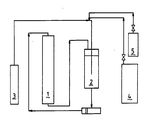
- the polymerization was carried out in an apparatus, the principle of which is shown in the figure.
- the dried extrusions were placed in a reaction tube (1) provided with a thermostatted cooling jacket and containing 5000 parts by volume and a ratio of diameter to length of approximately 1:10.
- the storage vessel (2) with a useful volume of 7000 parts by volume was charged with 5000 parts of the purified tetrahydrofuran, 43 parts of water and 20.3 parts of ethylene oxide. Tetrahydrofuran (4), water (5) and ethylene oxide (3) were removed from the storage containers provided for this purpose.
- This mixture of the starting compounds was added to the catalyst bed (1), the temperature of which was kept at 47 to 49 ° C.
- the reaction mixture was circulated at a pump output of 12,000 parts by volume / h, which was kept constant for the entire duration of the experiment, from the storage vessel (2) over the catalyst (1).
- the ethylene oxide concentration in the feed mixture had then dropped to 0% by weight.
- the total amount of ethylene oxide used and converted was 355.6 parts.
- reaction mixture 5350 parts of the reaction mixture were removed from the storage vessel (2) by emptying. This first reaction mixture was discarded. The storage vessel was then again charged with 5500 parts of fresh feed consisting of 98.7% tetrahydrofuran, 0.9% water and 0.4% ethylene oxide. This mixture was then circulated through the catalyst bed (1) at a pump output of 12,000 parts by volume per hour. At the same time, 35 parts of ethylene oxide were gassed into the storage vessel (2) every hour, which made it possible to keep the concentration of ethylene oxide in the storage vessel at 0.4%. After 9 hours, the ethylene oxide feed was stopped. The reaction mixture was still 4 hours with an hourly performance pumped in circles by 12,000 parts by volume per hour.
- reaction product in the storage vessel (2) was drained and the storage vessel was again charged with the mixture of tetrahydrofuran, water and ethylene oxide in the manner described above. Then the polymerization was carried out as described above for a further 4 hours for the post-reaction for 9 hours.
- the reaction mixture obtained in this way hardly differed from the discharges which were obtained in 100 further polymerization batches of this type.
- the crude copolymer solution thus obtained was colorless (color number ⁇ 5 APHA) and had an acid number of 0.2 mg KOH / g. It had a polyoxibutylene polyoxyalkylene glycol content (of molecular weight 1260) of about 45% by weight and a THF content of about 55% by weight. It contained 0.038% by weight of unreacted ethylene oxide. Since the ethylene oxide could not be exactly determined by the usual measurement analysis method, the concentration was determined by gas chromatography. The copolymerized ethylene oxide content of the copolymer was 15% by weight.
- the crude polyoxibutylene polyoxyalkylene glycol solution obtained in this way was hydrogenated for 10 hours at 80 ° C. and 150 bar of hydrogen in the presence of 3% by weight of Raney nickel in a stirred stirred autoclave. After the hydrogenation and separation of the catalyst by filtration, a crude polymer solution with the color number 5 APHA and the acid number 0.2 mg KOH / g was obtained. This acid number and color number also showed the copolymer freed of THF by vacuum distillation. The acid number was caused by a non-volatile substance.
- Casting elastomers were produced from the copolymer after-hydrogenated after this example in a known manner by reaction with diphenylmethane-pp'-diisocyanate (MDI) and the chain extender, with a molar ratio of copolymer to MDI to 1,4-butanediol of 1: 1.85: 0.77 was observed.
- MDI diphenylmethane-pp'-diisocyanate
- the cast elastomers obtained in this way gave the values "color DIN 1: 2: 1" in the color coding in the DIN color system.
- the crude solution of the copolymer obtained according to Example 1 was evaporated without hydrogenating aftertreatment at normal pressure and in vacuo to 1 mbar at 200 ° C. in a film evaporator.
- the distillate obtained was 98% THF. It contained approximately 2% by weight of low molecular weight copolymer with an average molecular weight of 250 (cryoscopic or vapor pressure osmometric determination) and a hydroxyl number of 220 mg KOH / g. Since a glycol with a molecular weight of 250 has a theoretical hydroxyl number of 448.8 mg KOH / g, it can be deduced that the distilled oligomers are composed in approximately equal parts of cyclic oligomeric ethers and glycols.
- the distilled tetrahydrofuran contained approximately 0.09% ethylene oxide, 0.06% 1,4-dioxane and 0.07% 2-methyldioxolane-1,3.
- about 1.8% by weight of low molecular weight copolymer with the average molecular weight 260 (cryoscopic or vapor pressure osmometric determination) and the hydroxyl number of 510 mg KOH / g was found in the distilled tetrahydrofuran from the crude discharge hydrogenated according to Example 1.
- the dioxane and dioxolane content was ⁇ 0.01%. Ethylene oxide was undetectable.
- Casting elastomers were produced from the copolymer obtained according to this example, as described in the last paragraph of Example 1, which had a deeper color and gave the values "colors DIN 1: 5: 1" in the color coding in the DIN color system.
- the crude THF-containing polyoxibutylene polyoxyalkylene glycol solution obtained according to Example 1 was subjected to the hydrogenation treatment in a continuous manner.
- 700 parts by volume of a catalyst were used, which consisted of 24% by weight nickel oxide, 8% by weight copper oxide and 68% by weight silicon dioxide in the non-activated form.
- the catalyst which was in the form of cylindrical tablets of 3 mm in height and 3 mm in diameter, was activated before use by conventional treatment with hydrogen at 200 ° C. and 50 bar of hydrogen pressure.
- the catalyst was in a shaft furnace, the length of which was 58: 1 in diameter.
- the crude solution of the copolymer was subjected to the hydrogenation treatment in a bottoms procedure at 150 ° C.
- the average residence time of the polymer solution on the catalyst was 4 hours.
- the copolymer freed of THF after the hydrogenation by vacuum distillation had the same properties as the product obtained according to Example 1, as long as the catalyst was not less than 4 hours in length.
- catalyst (a) which was prepared according to Example 21 of DE-OS 2 726 710 and had approximately the composition CuO ⁇ 1/2 Co2O3 ⁇ 2 SiO2 or if ( b) a catalyst was used which contained 0.5% by weight of palladium on 3 mm silica gel strands and the hydrogenating treatment was carried out at 110 ° C. and 100 bar hydrogen pressure.
- the crude THF-containing solution of the copolymer from Example 1 was treated with 5 parts by volume of air per kg of copolymer before the hydrogenation at 45 ° C.
- the air was gassed under the surface of the polymer solution with vigorous stirring.
- the solution pretreated in this way was subjected to the hydrogenation purification at 150 ° C. and 250 bar on the copper / nickel catalyst on silica gel as described in Example 3. Complete cleaning has now been achieved with an average residence time on the catalyst of only 1 hour.
Landscapes
- Chemical & Material Sciences (AREA)
- Health & Medical Sciences (AREA)
- Chemical Kinetics & Catalysis (AREA)
- Medicinal Chemistry (AREA)
- Polymers & Plastics (AREA)
- Organic Chemistry (AREA)
- Inorganic Chemistry (AREA)
- General Chemical & Material Sciences (AREA)
- Polyethers (AREA)
Abstract
Description
- Diese Erfindung betrifft ein Verfahren zur Reinigung von Polyoxibutylenpolyoxialkylenglykolen, die durch kationisch katalysierte Copolymerisation von Tetrahydrofuran und Alkylenoxiden erhalten wurden.
- Polyoxibutylenpolyoxialkylenglykole werden durch Copolymerisation von Tetrahydrofuran (THF) und Alkylenoxiden mit Hilfe kationischer Katalysatoren z.B. nach den in der GB-PS 854 958 oder den US-Patentschriften 4 139 567, 4 153 786 und 4 329 445 beschriebenen Verfahren erhalten. Die Copolymeren sind z.B. wichtige Ausgangsstoffe für die Herstellung von Polyurethanen, Polyethern und Polyetherpolyamiden.
- Die durch Copolymerisation von THF und Alkylenoxiden an kationischen Katalysatoren erhältlichen Copolymerisate enthalten herstellungsbedingte Verunreinigungen, wie oligomere cyclische Ether, die aus THF- und Alkylenoxid-Einheiten aufgebaut sind. Außerdem enthalten sie geringe Mengen an Dioxan, 2-Methyldioxolan-1,3 und Carbonylverbindungen, Spuren an eingesetztem Alkylenoxid, sowie färbende Verunreinigungen mit unbekannter Struktur und die Säurezahl der Polymeren erhöhende Nebenbestandteile. Letztere wirken sich besonders schädlich auf die Eigenschaften der aus den Copolyetherglykolen hergestellten Endprodukte aus. Ohne daß es bisher möglich war, die Farbe der Endprodukte bestimmten definierten Verunreinigungen in den Copolyetherglykolen zuzuordnen, muß angenommen werden, daß solche Zusammenhänge existieren. Sie können allerdings auch durch mehrere Verunreinigungen, die auch in kombinierter Weise wirksam werden können, verursacht werden. Copolymerisate, die einen Gehalt an cyclischen Ethern von etwa 7 bis 10 Gew.% enthalten, werden für weniger anspruchsvolle Zwecke wie für die Herstellung von Polyurethanen verwendet (U.S. 3 425 999 und 4 071 492). Sie bewirken dabei einen Abfall des mechanischen Niveaus der Polyurethane, der bei solchen Polyurethanen nicht beobachtet wird, die aus THF-Homopolymerisaten ohne einen Gehalt an oligomeren cyclischen Ethern, erhalten werden. Der Abfall der Eigenschaften in den Polyurethanen manifestiert sich dergestalt, als würden sie einen Überschuß an Weichmachern enthalten. Die niedrigmolekularen cyclischen Ether verdampfen langsam bei höherer Temperatur oder werden durch Wasser und organische Lösungsmittel ausgelaugt. Es resultiert ein Gewichtsverlust und eine Veränderung der Dimensionen der Formkörper.
- Man hat für die Verminderung des Anteils der oligomeren cyclischen Ether in den Copolymerisaten schon verschiedene Verfahren vorgeschlagen. So werden die Copolymerisate nach den Angaben der EP-A 6 107 bei höherer Temperatur mit einem aktivierten Montmorillonit behandelt. Bei diesem Verfahren, bei dem die oligomeren cyclischen Ether einer aufwendigen Depolymerisation in Gegenwart der erwünschten Polymerisate unterworfen werden, wird eine quantitative Entfernung der cyclischen Ether nicht erreicht. In der US-PS 4 127 513 wird empfohlen, die Copolymerisation von THF und Alkylenoxid an einem säureaktivierten Montmorillonit vorzunehmen. Nachteilig sind bei diesem Verfahren die hohe Farbzahl der Polymerisate, eine verhältnismäßig geringe Polymerisationsgeschwindigkeit und ein Anteil an oligomeren cyclischen Ethern, der immer noch 5 bis 6 Gew.% beträgt. Führt man die Polymerisation von Alkylenoxiden mit THF unter dem katalytischen Einfluß von aktivierter Bleicherde durch (US-PS 4 228 272), so sollen Produkte mit verbesserter Farbzahl bei erhöhter Polymerisationsgeschwindigkeit erhalten werden. In der Praxis sind die erzielbaren Ergebnisse aber noch nicht befriedigend. Bei weiteren Verfahren werden die cyclischen Ether durch Extraktion der Polymerisate mit Kohlenwasserstoffen, Wasser oder überkritischen Gasen (US-PS 4 500 705, 4 251 654 und 4 306 058) entfernt.
- Nach dem in der DE-OS 3 346 136 beschriebenen Verfahren wird die Bildung cyclischer oligomerer Ether bei der Copolymerisation von Alkylenoxiden und THF dadurch unter 2 Gew.% zurückgedrängt, daß man kontinuierlich in einem Reaktor polymerisiert und dem im Kreis geführten Reaktionsgemisch weniger als 30 Gew.% an Frischzulauf aus THF und 1,2-Alkylenoxid zuführt. Von Nachteil ist, daß die entstehenden Polymerisate sehr polydispers sind. Der Heterogenitätsquotient Mw/Mn liegt bei über 4.
- Aufgabe dieser Erfindung war es, die in den Copolymerisaten aus THF und Alkylenoxid enthaltenen Nebenprodukte möglichst weitgehend zu entfernen. Dabei sollten auch die in den Copolyetherglykolen in Spuren enthaltenen Alkylenoxiden, die zu einer Klasse von Stoffen gehören, die sich als krebserzeugend erwiesen haben, sicher und vollständig entfernt werden. Da sich eine erhöhte Säurezahl der Copolymerisate in unerwünschter Weise auf deren Reaktivität bei der Umsetzung mit Isocyanaten auswirkt und das für manche Verwendungszwecke erforderte Mindestmaß an Verfärbung erfüllt werden sollte, war es gleichfalls wünschenswert, die auch für die nachteiligen Effekte verantwortlichen Nebenprodukte, deren Natur nicht bekannt sind, so weitgehend wie möglich zu entfernen.
- Dieses Ziel wurde dadurch erreicht, daß man die durch Copolymerisation von THF und einem 1,2-Alkylenoxid erhaltenen Polyoxibutylenpolyoxialkylenglykole bei Temperaturen bis 250°C katalytisch hydriert.
- Durch das Reinigungsverfahren dieser Erfindung werden die so verschiedenartigen Nebenprodukte in den THF-Alkylenoxid-Copolymerisaten überraschenderweise so weitgehend entfernt, daß es nicht erforderlich ist, auf die erhaltenen Produkte die gebräuchlichen Nachbehandlungsmethoden zum Zwecke der Verminderung des Anteils oligomerer cyclischer Ether oder zur Entfärbung anzuwenden.
- Man hat schon andere Polymerisate einer hydrierenden Behandlung unterzogen. So werden nach den Angaben in den japanischen Offenlegungsschriften 78/46906 und 78/46905 Polymerisate aus Epoxiden und daraus durch Umsetzung mit organischen Halogenverbindungen in Gegenwart von Alkalilauge hergestellte Folgeprodukte katalytisch hydriert. Aus der britischen Patentschrift 710 842 ist bekannt, daß man durch anionische Polymerisation entstehende Polyglykolether katalytisch hydrieren kann. Da davon auszugehen ist, daß aus den farblosen Monomeren bei der anionischen Polymerisation Verunreinigungen von anderer Beschaffenheit gebildet werden als sie bei der kationischen Copolymerisation von THF und Alkylenoxid entstehen, konnte von diesen bekannten Verfahren nicht auf das vorteilhafte Ergebnis des Verfahrens dieser Erfindung geschlossen werden. Ebensowenig war von den Angaben in der EP-PS 61 668 über eine farbliche Aufhellung bei der hydrierenden Behandlung von Polytetramethylenetherglykol, das durch Homopolymerisation von THF erhalten wird, auf das erfindungsgemäße Verfahren zu schließen, da bei der erfindungsgemäßen Hydrierung die Farbe der Copolymeren nicht verändert wird. So haben die erfindungsgemäß zu behandelnden Copolymeren vor und nach der Hydrierung eine niedrige Farbzahl von < 5 - 10 APHA.
- Nach dem Verfahren der Erfindung werden Polyoxibutylenpolyoxialkylenglykolen gereinigt, die nach an sich bekannten Methoden durch Copolymerisation von THF mit einem 1,2-Alkylenoxid, wie 1,2-Butylenoxid, 2,3-Butylenoxid, Styroloxid, Epichlorhydrin, insbesondere Ethylenoxid und 1,2-Propylenoxid, an einem kationischen Katalysator, wie Fluorsulfonsäure, Borfluoridetherat, Bleicherde oder Zeolith erhalten wurden. Da man bei diesen Copolymerisationen in der Regel rohe Lösungen erhält, die 40 bis 75 Gew.% THF und 60 bis 25 Gew.% Polyoxibutylenpolyoxialkylenglykol enthalten, werden diese Lösungen bevorzugt für die erfindungsgemäße Hydrierung verwendet. Besonders gute Ergebnisse werden erzielt, wenn man für die katalytische Hydrierung solche rohen Lösungen heranzieht, die 45 bis 70 Gew.% Tetrahydrofuran und 30 bis 55 Gew.% Polyoxibutylenpolyoxialkylenglykol enthalten und die man durch diskontinuierliche Copolymerisation von Tetrahydrofuran mit Ethylenoxid and einem Bleicherde- oder Zeolith-Katalysator erhalten hat, wobei das Ethylenoxid dem Reaktionsgemisch so zugeleitet wurde, daß die Konzentration des Ethylenoxids im Reaktionsgemisch während der Polymerisation 2 Gew.% nicht überschritten hat.
- Erfindungsgemäß wird bei Temperaturen bis 250°C, vorzugsweise bei 50 bis 250°C, und unter Normaldruck oder erhöhtem Druck, wie bei 1 bis 300 bar hydriert. Da die zusätzliche Druckanwendung gegenüber der drucklosen Arbeitsweise nur verhältnismäßig geringe Vorteile bringt, wird vorzugsweise bei Drücken zwischen 10 und 100 bar Wasserstoff hydriert.
- Als Hydrierkatalysatoren kommen z.B. die Metalle der 8. Nebengruppe, insbesondere Nickel, Kobalt, Eisen sowie die Edelmetalle Ruthenium, Palladium oder Platin, ferner Kupfer in Betracht. Die Metalle können in reiner Form z.B. als Raney-Metalle, als Mischungen oder z.B. als reduzierte Oxide angewendet werden. Bewährt haben sich auch Katalysatoren, die die Hydriermetalle auf geeigneten Trägern, wie Aluminiumoxid, Siliciumoxid, Bimsstein, Bentonit oder z.B. Magnesiumsilikat enthalten. Die Katalysatoren, welche unedle Metalle, wie Eisen, Kobalt, Nickel und Kupfer enthalten, werden zweckmäßig vor der Anwendung durch Reduktion mit Wasserstoff in die aktive Form überführt. Bei der Anwendung von Edelmetall-Katalysatoren erübrigt sich in den meisten Fällen eine solche Operation.
- Die katalytische Hydrierung wird auf an sich übliche Weise durchgeführt. Man arbeitet in der flüssigen Phase, z.B. nach der Technik der Festbettkatalyse, bei der die Riesel- oder Sumpfmethode zur Anwendung kommt. Mit sehr gutem Erfolg kann aber auch mit suspendiertem Katalysator hydriert werden.
- Nach einer besonders vorteilhaften Ausführungsform des Verfahrens dieser Erfindung werden die Polyoxibutylenpolyoxialkylenglykole vor der Hydrierung bei Temperaturen von 20 bis 150°C mit 0,2 bis 5 Gewichtsteilen, vorzugsweise 20 bis 50°C mit 0,2 bis 5, vorzugsweise 0,5 bis 3 Gewichtsteilen Sauerstoff pro 1000 Gewichtsteile Polyoxibutylenpolyoxialkylenglykol behandelt. Zweckmäßigerweise zieht man auch für diese Vorbehandlung die obengenannten THF enthaltenden rohen Lösungen des Copolymerisates heran. Anstelle von Sauerstoff kann man auch Sauerstoff enthaltende Gasgemische, wie Luft verwenden. Durch die Vorbehandlung mit Sauerstoff gelingt es, die für eine erfolgreiche Reinigung erforderliche Hydrierzeit wesentlich abzukürzen.
- Durch das erfindungsgemäße Reinigungsverfahren werden die im Copolymerisat enthaltenen, für die weitere Verarbeitung nachteiligen Verunreinigungen entfernt. In manchen Fällen, in denen bei der Copolymerisation gefärbte Produkte anfallen, werden diese auch entfärbt. In den meisten Fällen sind die Copolymerisate, die durch kationische Polymerisation hergestellt werden, bereits farblose Produkte, die aber eine zu hohe Säurezahl besitzen. Durch die erfindungsgemäße Behandlung behalten diese ihre Farblosigkeit, während die Säurezahl auf Null zurückgeht. Dieses wichtige Ergebnis war unvorhersehbar. Gleiches gilt auch für die Veränderung des Copolymerisates im Hinblick auf Weiterverarbeitungseigenschaften sowie die Reduzierung des Gehaltes an cyclischen oligomeren Ethern. Eine wissenschaftlich stichhhaltige Erklärung für dieses Verhalten kann nicht gegeben werden.
- Es ist auch vorteilhaft, daß die erfindungsgemäße Reinigung der Roh-Copolymerisate unter unerwartet milden Bedingungen mit Erfolg durchgeführt werden kann. Die bei der Reinigung verbrauchte Wasserstoffmenge ist verschwindend gering. Ein weiterer Vorzug des erfindungsgemäßen Verfahrens ist der, daß die Copolymerisation von THF und Alkylenoxid nunmehr bei höherer Temperatur als sonst üblich durchgeführt werden kann. Die Verunreinigungen in den Roh-Copolymerisaten hängen nämlich unter anderem auch von der gewählten Polymerisationstemperatur ab. Je höher die Temperatur gewählt wird, desto höher ist die Konzentration an unerwünschten Verunreinigungen im Polymerisat. Eine höhere Polymerisationstemperatur bewirkt aber auch eine höhere Reaktionsgeschwindigkeit und die Verengung der Molekulargewichtsverteilung in den Copolymerisaten. Da es aber für die erfindungsgemäße Reinigung unerheblich ist, ob man ein mehr oder weniger verunreinigtes Polymerisat der hydrierenden Behandlung unterwirft, eröffnet das erfindungsgemäße Verfahren weitere vorteilhafte technische Möglichkeiten. Daß man besonders vorteilhafte Ergebnisse erhält, wenn man die zu hydrierenden Copolymerisate mit Sauerstoff vorbehandelt, war nicht zu erwarten, da Polytetrahydrofuran sowie Polytetrahydrofuran-Copolymere als sehr oxidationsempfindlich gelten. So wird z.B. in "Die makromolekulare Chemie" 81 (1965), Seiten 38 bis 50 der thermische Abbau von Polytetrahydrofuran bei verschiedenen Temperaturen beschrieben, der in Gegenwart von Luft-Sauerstoff sehr begünstigt wird.
- Die in den Beispielen genannten Teile sind Gewichtsteile, sie verhalten sich zu Volumenteilen wie Kilogramm zu Liter.
- Marktgängiges technisches THF wurde nach Beispiel 1 der EP-PS 3 112 gereinigt. Aus Bleicherde, die im Handel unter der Bezeichnung ®Tonsil Optimum FF der Süd-Chemie AG, München, erhältlich ist, wurden Strangpreßlinge mit einem Durchmesser von 2 bis 3 mm und einer durchschnittlichen Länge von 4 mm hergestellt und 4 Stunden bei 200°C und 40 mbar getrocknet. Der Wassergehalt nach Fischer betrug danach 0,03 %.
- Die Polymerisation wurde in einer Apparatur durchgeführt, deren Prinzip in der Abbildung wiedergegeben ist. Die getrockneten Strangpreßlinge wurden in ein mit einem thermostatisierten Kühlmantel versehenes Reaktionsrohr (1) mit einem Inhalt von 5000 Volumenteilen und einem Verhältnis von Durchmesser zu Länge von ungefähr 1 : 10 eingefüllt. Das Vorratsgefäß (2) mit einem Nutzvolumen von 7000 Volumenteilen wurde mit 5000 Teilen des gereinigten Tetrahydrofurans, 43 Teilen Wasser und 20,3 Teilen Ethylenoxid beschickt. Dabei wurden Tetrahydrofuran (4), Wasser (5) und Ethylenoxid (3) den dafür vorgesehenen Vorratsbehältern entnommen. Diese Mischung der Ausgangsverbindungen wurde auf das Katalysatorbett (1), dessen Temperatur auf 47 bis 49°C gehalten wurde, gegeben. Sobald das Katalysatorbett mit Frischzulauf gefüllt war, wurde im Vorratsgefäß noch einmal dieselbe Menge Frischzulauf hergestellt und diese nun fortlaufend über das Katalysatorbett geführt. Der Überlauf gelangte in das Vorratsgefäß (2) zurück. Durch kontinuierliches Eingasen von Ethylenoxid aus dem Vorratsgefäß (3) in die Zulaufmischung im Vorratsgefäß (2) wurde dafür gesorgt, daß die Ethylenoxid-Konzentration im Vorratsgefäß (2) konstant bei 0,4 Gew.% gehalten wurde. Durch die Eingasmenge von 35 Teilen Ethylenoxid in der Stunde gelang es, diese Konzentration in der Zulaufmischung aufrecht zu erhalten. Nach 9 Stunden Reaktionszeit waren 315 Teile Ethylenoxid in die Reaktionsmischung eingetragen. Man ließ das Reaktionsgemisch nun noch 4 Stunden bei Reaktionstemperatur nachreagieren. Dabei wurde das Reaktionsgemisch bei der Pumpenleistung von 12.000 Volumenteilen/h, die bei der gesamten Versuchsdauer konstant gehalten wurde, aus dem Vorratsgefäß (2) im Kreise über den Katalysator (1) geführt. Danach war die Ethylenoxid-Konzentration in der Zulaufmischung auf 0 Gew% abgesunken. Die insgesamt ein- und umgesetzte Ethylenoxid-Menge betrug 355,6 Teile.
- Dem Vorratsgefäß (2) wurden durch Entleerung 5350 Teile Reaktionsmischung entnommen. Dieses erste Reaktionsgemisch wurde verworfen. Das Vorratsgefäß wurde anschließend erneut mit 5500 Teilen Frischzulauf beschickt, der aus 98,7 % Tetrahydrofuran, 0,9 % Wasser und 0,4 % Ethylenoxid bestand. Diese Mischung wurde nun mit einer Pumpenleistung von 12000 Volumenteilen pro Stunde durch das Katalysatorbett (1) im Kreis geführt. Gleichzeitig wurden in das Vorratsgefäß (2) 35 Teile Ethylenoxid stündlich eingegast, wodurch es gelang, die Konzentration an Ethylenoxid im Vorratsgefäß bei 0,4 % zu halten. Nach 9 Stunden wurde die Ethylenoxid-Zufuhr unterbrochen. Das Reaktionsgemisch wurde noch 4 Stunden mit einer stündlichen Leistung von 12000 Volumenteilen pro Stunde im Kreise gepumpt. Das Reaktionsprodukt im Vorratsgefäß (2) wurde abgelassen und das Vorratsgefäß in der oben beschriebenen Weise erneut mit der Mischung aus Tetrahydrofuran, Wasser und Ethylenoxid beschickt. Dann wurde die Polymerisation wie oben beschrieben 9 Stunden lang bei weiteren 4 Stunden für die Nachreaktion ausgeführt. Das dabei erhaltene Reaktionsgemisch unterschied sich kaum noch von den Austrägen, die in 100 weiteren Polymerisationsansätzen dieser Art erhalten wurden.
- Die so erhaltenen rohe Copolymerisatlösung war farblos (Farbzahl < 5 APHA) und wies eine Säurezahl von 0,2 mg KOH/g auf. Sie hatte einen Gehalt an Polyoxibutylenpolyoxialkylenglykol (vom Molekulargewicht 1260) von etwa 45 Gew.% und einen THF-Gehalt von etwa 55 Gew.%. Sie enthielt 0,038 Gew.% nicht umgesetztes Ethylenoxid. Da das Ethylenoxid durch die übliche maßanalytische Bestimmungsmethode nicht genau feststellbar war, erfolgte die Konzentrationsbestimmung gaschromatographisch. Der Gehalt des Copolymerisates an einpolymerisiertem Ethylenoxid betrug 15 Gew.%.
- In einem Hubrührautoklaven wurde die so erhaltene rohe Polyoxibutylenpolyoxialkylenglykol-Lösung bei 80°C und 150 bar Wasserstoff in Gegenwart von 3 Gew.% Raney-Nickel 10 Stunden hydriert. Nach der Hydrierung und Abtrennung des Katalysators durch Filtration wurde eine Roh-Polymerisat-Lösung mit der Farbzahl 5 APHA und der Säurezahl 0,2 mg KOH/g erhalten. Diese Säurezahl und Farbzahl wies auch das durch Vakuumdestillation von THF befreite Copolymere auf. Die Säurezahl wurde also durch eine nichtflüchtige Substanz verursacht.
- Bei einer Verkürzung der Hydrierdauer auf die Hälfte wurde ein Copolymerisat mit einer Säurezahl von 0,04 erhalten. Die Säurezahl von 0 wurde bei der halbierten Reduktionszeit erhalten, wenn die rohe THF-haltige Lösung des Copolymerisates vor der Hydrierung bei 45°C mit 3 Volumenteilen Luft pro Kilogramm Copolymerisat behandelt wurde.
- Aus dem nach diesem Beispiel hydrierend nachbehandelten Copolymerisat wurden auf bekannte Weise durch Umsetzung mit Diphenylmethan-pp′-diisocyanat (MDI) und dem Kettenverlängerer Butandiol-1,4 Gießelastomere hergestellt, wobei ein Molverhältnis Copolymerisat zu MDI zu Butandiol-1,4 von 1 : 1,85 : 0,77 eingehalten wurde. Die dabei erhaltenen Gießelastomere ergaben bei der Farbkennzeichnung im DIN-Farbensystem die Werte "Farbe DIN 1 : 2 : 1".
- Die nach Beispiel 1 erhaltene Roh-Lösung des Copolymeren wude ohne hydrierende Nachbehandlung bei Normaldruck und im Vakuum bis 1 mbar bei 200°C im Filmverdampfer eingedampft. Das erhaltene Destillat bestand zu 98 % aus THF. Es enthielt ca. 2 Gew.% niedermolekulares Copolymerisat mit dem mittleren Molekulargewicht von 250 (kryoskopische bzw. dampfdruckosmometrische Bestimmung) und der Hydroxylzahl von 220 mg KOH/g. Da ein Glykol mit dem Molekulargewicht 250 eine theoretische Hydroxylzahl von 448,8 mg KOH/g besitzt, läßt sich ableiten, daß die abdestillierten Oligomeren etwa zu gleichen Teilenb aus cyclischen oligomeren Ethern und Glykolen zusammengesetzt sind. Durch Kapillargaschromatographie wurde nachgewiesen, daß in dem abdestillierten Tetrahydrofuran ca. 0,09 % Ethylenoxid, 0,06 % 1,4-Dioxan und 0,07 % 2-Methyldioxolan-1,3 enthalten waren. Dagegen wurde in dem abdestillierten Tetrahydrofuran aus dem nach Beispiel 1 hydrierten Roh-Austrag etwa 1,8 Gew.% niedermolekulares Copolymerisat mit dem mittleren Molekulargewicht 260 (kryoskopische bzw. dampfdruckosmometrische Bestimmung) und der Hydroxylzahl von 510 mg KOH/g gefunden. Der Gehalt an Dioxan und Dioxolan lag bei < 0,01 %. Ethylenoxid war nicht nachweisbar.
- Aus dem nach diesem Beispiel erhaltenen Copolymerisat wurden, wie im letzten Absatz von Beispiel 1 beschrieben, Gießelastomere hergestellt, die tiefer gefärbt waren und bei der Farbkennzeichnung im DIN-Farbsystem die Werte "Farben DIN 1 : 5 : 1 ergaben.
- Die nach Beispiel 1 erhaltene rohe THF-haltige Polyoxibutylenpolyoxialkylenglykol-Lösung wurde in kontinuierlicher Fahrweise der hydrierenden Behandlung unterworfen. Dazu wurden 700 Volumenteile eines Katalysators verwendet, der in der nicht aktivierten Form aus 24 Gew.% Nickeloxid, 8 Gew.% Kupferoxid und 68 Gew.% aus Siliciumdioxid bestand. Der Katalysator, der in Form zylinderförmiger Tabletten von 3 mm Höhe und 3 mm Durchmesser vorlag, wurde vor Verwendung durch übliche Behandlung mit Wasserstoff bei 200°C und 50 bar Wasserstoffdruck aktiviert. Der Katalysator befand sich in einem Schachtofen, dessen Länge sich zum Durchmesser wie 58 : 1 verhielt. Die Roh-Lösung des Copolymeren wurde in Sumpffahrweise bei 150°C und 250 bar Gesamtdruck der hydrierenden Behandlung unterworfen. Die mittlere Verweildauer der Polymerisatlösung am Katalysator betrug 4 Stunden. Das nach der Hydrierung durch Vakuumdestillation von THF befreite Copolymere hatte dieselben Eigenschaften wie das nach Beispiel 1 erhaltene Produkt solange die Verweildauer von 4 Stunden am Katalysator nicht unterschritten wurde.
- Ähnliche Ergebnisse wurden erhalten, wenn als Katalysator (a) ein Kupfer/Kobalt-Katalysator eingesetzt wurde, der nach Beispiel 21 der DE-OS 2 726 710 hergestellt wurde und etwa die Zusammensetzung CuO·1/2 Co₂O₃·2 SiO₂ aufwies oder wenn (b) ein Katalysator verwendet wurde, der 0,5 Gew.% Palladium auf 3 mm-Kieselgelsträngen enthielt und die hydrierende Behandlung bei 110°C und 100 bar Wasserstoffdruck durchgeführt wurde.
- Die rohe THF-haltige Lösung des Copolymerisates aus Beispiel 1 wurde vor der Hydrierung bei 45°C mit 5 Volumenteilen Luft pro kg Copolymerisat behandelt. Dazu wurde die Luft unter kräftigem Rühren unter die Oberfläche der Polymerisatlösung eingegast. Die so vorbehandelte Lösung wurde wie in Beispiel 3 beschrieben an dem Kupfer/Nickelkatalysator auf Kieselgel der hydrierenden Reinigung bei 150°C und 250 bar unterworfen. Eine vollständige Reinigung wurde nun bereits bei einer mittleren Verweildauer am Katalysator von nur 1 Stunde erzielt.
Claims (6)
Applications Claiming Priority (2)
| Application Number | Priority Date | Filing Date | Title |
|---|---|---|---|
| DE3725577A DE3725577A1 (de) | 1987-08-01 | 1987-08-01 | Verfahren zur reinigung von polyoxybutylenpolyoxyalkylenglykolen |
| DE3725577 | 1987-08-01 |
Publications (2)
| Publication Number | Publication Date |
|---|---|
| EP0302332A2 true EP0302332A2 (de) | 1989-02-08 |
| EP0302332A3 EP0302332A3 (de) | 1991-03-13 |
Family
ID=6332885
Family Applications (1)
| Application Number | Title | Priority Date | Filing Date |
|---|---|---|---|
| EP19880111910 Withdrawn EP0302332A3 (de) | 1987-08-01 | 1988-07-23 | Verfahren zur Reinigung von Polyoxibutylenpolyoxialkylenglykolen |
Country Status (5)
| Country | Link |
|---|---|
| US (1) | US4952673A (de) |
| EP (1) | EP0302332A3 (de) |
| JP (1) | JPS6462323A (de) |
| KR (1) | KR890003834A (de) |
| DE (1) | DE3725577A1 (de) |
Cited By (5)
| Publication number | Priority date | Publication date | Assignee | Title |
|---|---|---|---|---|
| EP0424791A3 (en) * | 1989-10-27 | 1991-10-16 | Basf Aktiengesellschaft | Process for the preparation of high purity tetrahydrofuron polymers |
| WO1994026803A1 (de) * | 1993-05-14 | 1994-11-24 | Basf Aktiengesellschaft | Verfahren zur herstellung von polytetrahydrofuran |
| WO1995015991A1 (fr) * | 1993-12-09 | 1995-06-15 | Centre National De La Recherche Scientifique | Procede de preparation d'un terpolymere du type poly(oxyalkylene) par hydrogenation |
| WO1995019383A1 (en) * | 1994-01-18 | 1995-07-20 | Eastman Chemical Company | Polyether glycols and alcohols derived from 3,4-epoxy-1-butene |
| WO2002014405A1 (de) * | 2000-08-16 | 2002-02-21 | Basf Aktiengesellschaft | Verbessertes verfahren zur herstellung von polytetrahydrofuran mit niedriger farbzahl |
Families Citing this family (6)
| Publication number | Priority date | Publication date | Assignee | Title |
|---|---|---|---|---|
| US5342541A (en) * | 1989-03-29 | 1994-08-30 | The Dow Chemical Company | Purified hydroxy-functional polyether compounds |
| DE19715831A1 (de) * | 1997-04-16 | 1998-10-22 | Basf Ag | Verfahren zur Entfärbung von Polymerisaten oder Copolymerisaten des Tetrahydrofurans |
| US20040211729A1 (en) * | 2003-04-25 | 2004-10-28 | Sunkara Hari Babu | Processes for recovering oligomers of glycols and polymerization catalysts from waste streams |
| ES2465519T3 (es) * | 2009-04-15 | 2014-06-06 | Invista Technologies S.À.R.L. | Procedimiento de fabricación de copoliéter glicol |
| US8372946B2 (en) * | 2009-04-15 | 2013-02-12 | Invista North America S.A R.L. | Copolyether glycol manufacturing process |
| JP4838380B1 (ja) * | 2010-10-11 | 2011-12-14 | 秀哉 横井 | 裾はみ出し防止具 |
Family Cites Families (14)
| Publication number | Priority date | Publication date | Assignee | Title |
|---|---|---|---|---|
| GB710842A (en) * | 1951-10-27 | 1954-06-16 | Basf Ag | Improvements in the production of pure polyglycol ethers or pure derivatives of mono-, di- and poly-glycol ethers |
| GB1019166A (en) * | 1962-03-20 | 1966-02-02 | Olin Mathieson | Purification of polyalkylene ethers |
| JPS5346905A (en) * | 1976-10-08 | 1978-04-27 | Kuraray Co Ltd | Preparation of etherified polyoxyalkylene compounds of high quality |
| JPS5346906A (en) * | 1976-10-08 | 1978-04-27 | Kuraray Co Ltd | Preparation of etherified polyoxyalylene compounds of high quality |
| US4127513A (en) * | 1977-11-09 | 1978-11-28 | E. I. Du Pont De Nemours And Company | Method for preparing polyether glycols |
| GB1566770A (en) * | 1977-12-28 | 1980-05-08 | Kuraray Co | Etherification of polyocyalkylene compounds |
| US4192943A (en) * | 1978-06-13 | 1980-03-11 | E. I. Du Pont De Nemours And Company | Method for reducing oligomeric cyclic ether content of a polymerizate |
| US4228272A (en) * | 1979-03-27 | 1980-10-14 | E. I. Du Pont De Nemours And Company | Method of catalytically preparing tetrahydrofuran/alkylene oxide polymerizates using a montmorillonite clay as the catalyst |
| US4251654A (en) * | 1979-08-14 | 1981-02-17 | E. I. Du Pont De Nemours And Company | Copolyether glycols of tetrahydrofuran and alkylene oxides having low oligomeric cyclic ether content |
| US4306058A (en) * | 1980-11-19 | 1981-12-15 | E. I. Du Pont De Nemours And Company | Method for reducing oligomeric cyclic ether content of a polymerizate |
| DE3112065A1 (de) * | 1981-03-27 | 1982-10-07 | Basf Ag, 6700 Ludwigshafen | Verfahren zur herstellung von polytetramethylenether-glykol oder -glykoldiester mit niedriger farbzahl |
| DE3346136A1 (de) * | 1983-12-21 | 1985-07-04 | Basf Ag, 6700 Ludwigshafen | Verfahren zur kontinuierlichen herstellung von polyoxibutylenpolyoxialkylenglykolen |
| US4500705A (en) * | 1984-01-09 | 1985-02-19 | E. I. Du Pont De Nemours And Company | Method for reducing oligomeric cyclic ether content of a polymerizate |
| US4585592A (en) * | 1985-02-28 | 1986-04-29 | Basf Aktiengesellschaft | Reducing the content of oligomeric cyclic ethers in polyoxybutylene polyoxyalkylene glycols |
-
1987
- 1987-08-01 DE DE3725577A patent/DE3725577A1/de not_active Withdrawn
-
1988
- 1988-07-23 EP EP19880111910 patent/EP0302332A3/de not_active Withdrawn
- 1988-08-01 KR KR1019880009850A patent/KR890003834A/ko not_active Withdrawn
- 1988-08-01 JP JP63190746A patent/JPS6462323A/ja active Pending
- 1988-08-01 US US07/226,688 patent/US4952673A/en not_active Expired - Fee Related
Cited By (8)
| Publication number | Priority date | Publication date | Assignee | Title |
|---|---|---|---|---|
| EP0424791A3 (en) * | 1989-10-27 | 1991-10-16 | Basf Aktiengesellschaft | Process for the preparation of high purity tetrahydrofuron polymers |
| WO1994026803A1 (de) * | 1993-05-14 | 1994-11-24 | Basf Aktiengesellschaft | Verfahren zur herstellung von polytetrahydrofuran |
| WO1995015991A1 (fr) * | 1993-12-09 | 1995-06-15 | Centre National De La Recherche Scientifique | Procede de preparation d'un terpolymere du type poly(oxyalkylene) par hydrogenation |
| FR2713646A1 (fr) * | 1993-12-09 | 1995-06-16 | Centre Nat Rech Scient | Procédé de préparation d'un terpolymère du type poly(oxyalkylène) par hydrogénation. |
| WO1995019383A1 (en) * | 1994-01-18 | 1995-07-20 | Eastman Chemical Company | Polyether glycols and alcohols derived from 3,4-epoxy-1-butene |
| CN1056628C (zh) * | 1994-01-18 | 2000-09-20 | 伊斯特曼化学公司 | 从3,4-环氧-1-丁烯衍生的聚醚二元醇和醇 |
| WO2002014405A1 (de) * | 2000-08-16 | 2002-02-21 | Basf Aktiengesellschaft | Verbessertes verfahren zur herstellung von polytetrahydrofuran mit niedriger farbzahl |
| US6852869B2 (en) | 2000-08-16 | 2005-02-08 | Basf Aktiengesellschaft | Method for the production of polytetrahydrofuran with low color index |
Also Published As
| Publication number | Publication date |
|---|---|
| JPS6462323A (en) | 1989-03-08 |
| US4952673A (en) | 1990-08-28 |
| KR890003834A (ko) | 1989-04-18 |
| EP0302332A3 (de) | 1991-03-13 |
| DE3725577A1 (de) | 1989-02-09 |
Similar Documents
| Publication | Publication Date | Title |
|---|---|---|
| EP0239787B1 (de) | Verfahren zur Herstellung von Polyoxibutylenpolyoxialkylenglykolen mit enger Molekulargewichtsverteilung und vermindertem Gehalt an oligomeren cyclischen Ethern | |
| EP0061668B1 (de) | Verfahren zur Herstellung von Polytetramethylenether-glykol oder -glykoldiester mit niedriger Farbzahl | |
| EP0149143B1 (de) | Verfahren zur kontinuierlichen Herstellung von Polyoxibutylen- polyoxialkylenglykolen | |
| EP0302332A2 (de) | Verfahren zur Reinigung von Polyoxibutylenpolyoxialkylenglykolen | |
| EP0807139B1 (de) | Verfahren zur herstellung von tetrahydrofuranpolymeren | |
| EP1015509B1 (de) | Verbessertes verfahren zur herstellung von polytetrahydrofuran | |
| EP0698050B1 (de) | Verfahren zur herstellung von polytetrahydrofuran | |
| US6197979B1 (en) | Method for producing polytetrahydrofuran with low color index | |
| DE10237954A1 (de) | Verfahren zur Herstellung von Tetrahydrofuran | |
| DE3613106A1 (de) | Verfahren zur herstellung von polytetramethylenetherglykoldiestern mit niedriger farbzahl | |
| EP0202487A2 (de) | Verfahren zur Verminderung des Anteils von cyclischen oligomeren Ethern in Polytetramethylenetherglykolen oder Polyoxibutylen-polyoxialkylenglykolen | |
| EP0424791B1 (de) | Vefahren zur Herstellung von hochreinen Polymerisaten des Tetrahydrofurans | |
| DE69505270T2 (de) | Polyätherglycole und alkohole aus 3,4-epoxy-1-burne, tetrahydrofuran und ein initiator | |
| EP0104609B1 (de) | Verfahren zur Herstellung von Polyoxybutylen-polyoxyalkylenglykolcarbonsäurediester | |
| EP0158060B1 (de) | Verfahren zur Verminderung des Gehaltes an oligomeren cyclischen Ethern in Polyoxibutylen-polyoxialkylenglykolen | |
| DE19881631B4 (de) | Verfahren zur Reinigung von Tetrahydrofuranen, die als Ausgangsmaterial für Polyetherpolyole verwendet werden | |
| EP0636638A1 (de) | Verfahren zur Herstellung von Polytetrahydrofuran oder Tetrahydrofuran-Alkylenoxid-Copolymeren | |
| EP1123340B1 (de) | Verfahren zur herstellung von tetrahydrofuranpolymeren | |
| EP0226759B1 (de) | Verfahren zur Depolymerisation von Polyoxibutylenpolyoxialkylenglykolen und Polyoxibutylenpolyoxialkylenethern | |
| DE10259136A1 (de) | Verfahren zur Herstellung von Tetrahydrofuran-Copolymeren | |
| DE19502970A1 (de) | Verfahren zur Herstellung von Polyoxibutylenpolyoxialkylenglykolen | |
| DE10359810A1 (de) | Verfahren zur Herstellung von Mono- und Diestern des Polytetrahydrofurans oder der Tetrahydrofuran-Copolymere | |
| DE19521602A1 (de) | Verfahren zur Herstellung von Polyoxibutylenpolyoxialkylenglykolen | |
| WO2003076493A1 (de) | Verfahren zur verminderung des anteils an cyclischen oligomeren ethern in polytetrahydrofuran oder copolymeren aus tetrahydrofuran |
Legal Events
| Date | Code | Title | Description |
|---|---|---|---|
| PUAI | Public reference made under article 153(3) epc to a published international application that has entered the european phase |
Free format text: ORIGINAL CODE: 0009012 |
|
| AK | Designated contracting states |
Kind code of ref document: A2 Designated state(s): BE DE ES FR GB IT NL |
|
| PUAL | Search report despatched |
Free format text: ORIGINAL CODE: 0009013 |
|
| 17P | Request for examination filed |
Effective date: 19901227 |
|
| AK | Designated contracting states |
Kind code of ref document: A3 Designated state(s): BE DE ES FR GB IT NL |
|
| 17Q | First examination report despatched |
Effective date: 19930304 |
|
| STAA | Information on the status of an ep patent application or granted ep patent |
Free format text: STATUS: THE APPLICATION HAS BEEN WITHDRAWN |
|
| 18W | Application withdrawn |
Withdrawal date: 19940301 |