EP0302242B1 - Verfahren zur Herstellung eines Polyolefins mit einer breiten Molmassenverteilung - Google Patents
Verfahren zur Herstellung eines Polyolefins mit einer breiten Molmassenverteilung Download PDFInfo
- Publication number
- EP0302242B1 EP0302242B1 EP88110674A EP88110674A EP0302242B1 EP 0302242 B1 EP0302242 B1 EP 0302242B1 EP 88110674 A EP88110674 A EP 88110674A EP 88110674 A EP88110674 A EP 88110674A EP 0302242 B1 EP0302242 B1 EP 0302242B1
- Authority
- EP
- European Patent Office
- Prior art keywords
- polymerization
- stage
- component
- carbon atoms
- ethylene
- Prior art date
- Legal status (The legal status is an assumption and is not a legal conclusion. Google has not performed a legal analysis and makes no representation as to the accuracy of the status listed.)
- Expired - Lifetime
Links
- 229920000098 polyolefin Polymers 0.000 title claims description 13
- 238000004519 manufacturing process Methods 0.000 title description 6
- 238000009826 distribution Methods 0.000 title description 5
- 239000003054 catalyst Substances 0.000 claims description 42
- 239000010936 titanium Substances 0.000 claims description 37
- 238000006116 polymerization reaction Methods 0.000 claims description 33
- VGGSQFUCUMXWEO-UHFFFAOYSA-N Ethene Chemical compound C=C VGGSQFUCUMXWEO-UHFFFAOYSA-N 0.000 claims description 27
- 239000005977 Ethylene Substances 0.000 claims description 27
- 239000000725 suspension Substances 0.000 claims description 27
- 239000011777 magnesium Substances 0.000 claims description 26
- 238000000034 method Methods 0.000 claims description 23
- 238000006243 chemical reaction Methods 0.000 claims description 22
- 239000001257 hydrogen Substances 0.000 claims description 20
- 229910052739 hydrogen Inorganic materials 0.000 claims description 20
- 230000008569 process Effects 0.000 claims description 20
- UFHFLCQGNIYNRP-UHFFFAOYSA-N Hydrogen Chemical compound [H][H] UFHFLCQGNIYNRP-UHFFFAOYSA-N 0.000 claims description 18
- 229910052782 aluminium Inorganic materials 0.000 claims description 18
- 229910052719 titanium Inorganic materials 0.000 claims description 16
- 125000004432 carbon atom Chemical group C* 0.000 claims description 15
- 150000001875 compounds Chemical class 0.000 claims description 15
- FYYHWMGAXLPEAU-UHFFFAOYSA-N Magnesium Chemical compound [Mg] FYYHWMGAXLPEAU-UHFFFAOYSA-N 0.000 claims description 14
- 229910052749 magnesium Inorganic materials 0.000 claims description 14
- 239000007789 gas Substances 0.000 claims description 13
- 150000003609 titanium compounds Chemical class 0.000 claims description 12
- 239000002270 dispersing agent Substances 0.000 claims description 10
- RTAQQCXQSZGOHL-UHFFFAOYSA-N Titanium Chemical compound [Ti] RTAQQCXQSZGOHL-UHFFFAOYSA-N 0.000 claims description 9
- XAGFODPZIPBFFR-UHFFFAOYSA-N aluminium Chemical compound [Al] XAGFODPZIPBFFR-UHFFFAOYSA-N 0.000 claims description 7
- 239000007795 chemical reaction product Substances 0.000 claims description 7
- 125000005843 halogen group Chemical group 0.000 claims description 6
- 238000002360 preparation method Methods 0.000 claims description 6
- 229910052723 transition metal Inorganic materials 0.000 claims description 5
- 150000003624 transition metals Chemical class 0.000 claims description 5
- 239000000178 monomer Substances 0.000 claims description 3
- 150000002431 hydrogen Chemical class 0.000 claims description 2
- 229920002959 polymer blend Polymers 0.000 claims description 2
- 230000001105 regulatory effect Effects 0.000 claims 1
- 125000000391 vinyl group Chemical group [H]C([*])=C([H])[H] 0.000 claims 1
- 239000000460 chlorine Substances 0.000 description 29
- 229920000642 polymer Polymers 0.000 description 18
- VLKZOEOYAKHREP-UHFFFAOYSA-N n-Hexane Chemical compound CCCCCC VLKZOEOYAKHREP-UHFFFAOYSA-N 0.000 description 15
- 229910052801 chlorine Inorganic materials 0.000 description 14
- 239000000243 solution Substances 0.000 description 12
- -1 polyethylene Polymers 0.000 description 11
- 229920000573 polyethylene Polymers 0.000 description 10
- 239000000047 product Substances 0.000 description 10
- 239000008187 granular material Substances 0.000 description 9
- 239000002994 raw material Substances 0.000 description 9
- 239000004698 Polyethylene Substances 0.000 description 8
- 230000000052 comparative effect Effects 0.000 description 8
- 239000000843 powder Substances 0.000 description 8
- 229910052736 halogen Inorganic materials 0.000 description 7
- 150000002367 halogens Chemical class 0.000 description 7
- 239000000203 mixture Substances 0.000 description 7
- 238000003756 stirring Methods 0.000 description 7
- VXNZUUAINFGPBY-UHFFFAOYSA-N 1-Butene Chemical compound CCC=C VXNZUUAINFGPBY-UHFFFAOYSA-N 0.000 description 6
- XKRFYHLGVUSROY-UHFFFAOYSA-N Argon Chemical compound [Ar] XKRFYHLGVUSROY-UHFFFAOYSA-N 0.000 description 6
- 239000002283 diesel fuel Substances 0.000 description 5
- NNBZCPXTIHJBJL-UHFFFAOYSA-N decalin Chemical compound C1CCCC2CCCCC21 NNBZCPXTIHJBJL-UHFFFAOYSA-N 0.000 description 4
- 238000001914 filtration Methods 0.000 description 4
- 239000002244 precipitate Substances 0.000 description 4
- LIKMAJRDDDTEIG-UHFFFAOYSA-N 1-hexene Chemical compound CCCCC=C LIKMAJRDDDTEIG-UHFFFAOYSA-N 0.000 description 3
- UHOVQNZJYSORNB-UHFFFAOYSA-N Benzene Chemical compound C1=CC=CC=C1 UHOVQNZJYSORNB-UHFFFAOYSA-N 0.000 description 3
- XDTMQSROBMDMFD-UHFFFAOYSA-N Cyclohexane Chemical compound C1CCCCC1 XDTMQSROBMDMFD-UHFFFAOYSA-N 0.000 description 3
- 229910000831 Steel Inorganic materials 0.000 description 3
- 229910052786 argon Inorganic materials 0.000 description 3
- QVGXLLKOCUKJST-UHFFFAOYSA-N atomic oxygen Chemical compound [O] QVGXLLKOCUKJST-UHFFFAOYSA-N 0.000 description 3
- 230000008901 benefit Effects 0.000 description 3
- 230000002902 bimodal effect Effects 0.000 description 3
- 238000009835 boiling Methods 0.000 description 3
- 238000001035 drying Methods 0.000 description 3
- 230000007717 exclusion Effects 0.000 description 3
- 238000005469 granulation Methods 0.000 description 3
- 230000003179 granulation Effects 0.000 description 3
- OFBQJSOFQDEBGM-UHFFFAOYSA-N n-pentane Natural products CCCCC OFBQJSOFQDEBGM-UHFFFAOYSA-N 0.000 description 3
- 239000001301 oxygen Substances 0.000 description 3
- 229910052760 oxygen Inorganic materials 0.000 description 3
- 239000007787 solid Substances 0.000 description 3
- 239000010959 steel Substances 0.000 description 3
- VOITXYVAKOUIBA-UHFFFAOYSA-N triethylaluminium Chemical compound CC[Al](CC)CC VOITXYVAKOUIBA-UHFFFAOYSA-N 0.000 description 3
- KWKAKUADMBZCLK-UHFFFAOYSA-N 1-octene Chemical compound CCCCCCC=C KWKAKUADMBZCLK-UHFFFAOYSA-N 0.000 description 2
- ZAMOUSCENKQFHK-UHFFFAOYSA-N Chlorine atom Chemical compound [Cl] ZAMOUSCENKQFHK-UHFFFAOYSA-N 0.000 description 2
- RRHGJUQNOFWUDK-UHFFFAOYSA-N Isoprene Chemical compound CC(=C)C=C RRHGJUQNOFWUDK-UHFFFAOYSA-N 0.000 description 2
- IMNFDUFMRHMDMM-UHFFFAOYSA-N N-Heptane Chemical compound CCCCCCC IMNFDUFMRHMDMM-UHFFFAOYSA-N 0.000 description 2
- 239000002253 acid Substances 0.000 description 2
- IAQRGUVFOMOMEM-UHFFFAOYSA-N butene Natural products CC=CC IAQRGUVFOMOMEM-UHFFFAOYSA-N 0.000 description 2
- 230000000694 effects Effects 0.000 description 2
- 238000001125 extrusion Methods 0.000 description 2
- 238000010096 film blowing Methods 0.000 description 2
- 229920006262 high density polyethylene film Polymers 0.000 description 2
- 229930195733 hydrocarbon Natural products 0.000 description 2
- 150000002430 hydrocarbons Chemical class 0.000 description 2
- 239000012442 inert solvent Substances 0.000 description 2
- 239000000463 material Substances 0.000 description 2
- UAEPNZWRGJTJPN-UHFFFAOYSA-N methylcyclohexane Chemical compound CC1CCCCC1 UAEPNZWRGJTJPN-UHFFFAOYSA-N 0.000 description 2
- YWAKXRMUMFPDSH-UHFFFAOYSA-N pentene Chemical compound CCCC=C YWAKXRMUMFPDSH-UHFFFAOYSA-N 0.000 description 2
- 230000000704 physical effect Effects 0.000 description 2
- QQONPFPTGQHPMA-UHFFFAOYSA-N propylene Natural products CC=C QQONPFPTGQHPMA-UHFFFAOYSA-N 0.000 description 2
- 125000004805 propylene group Chemical group [H]C([H])([H])C([H])([*:1])C([H])([H])[*:2] 0.000 description 2
- 239000002904 solvent Substances 0.000 description 2
- 230000006641 stabilisation Effects 0.000 description 2
- 238000011105 stabilization Methods 0.000 description 2
- 238000013022 venting Methods 0.000 description 2
- 238000005406 washing Methods 0.000 description 2
- WSSSPWUEQFSQQG-UHFFFAOYSA-N 4-methyl-1-pentene Chemical compound CC(C)CC=C WSSSPWUEQFSQQG-UHFFFAOYSA-N 0.000 description 1
- 239000004215 Carbon black (E152) Substances 0.000 description 1
- OTMSDBZUPAUEDD-UHFFFAOYSA-N Ethane Chemical compound CC OTMSDBZUPAUEDD-UHFFFAOYSA-N 0.000 description 1
- NHTMVDHEPJAVLT-UHFFFAOYSA-N Isooctane Chemical compound CC(C)CC(C)(C)C NHTMVDHEPJAVLT-UHFFFAOYSA-N 0.000 description 1
- 229910019438 Mg(OC2H5)2 Inorganic materials 0.000 description 1
- CTQNGGLPUBDAKN-UHFFFAOYSA-N O-Xylene Chemical compound CC1=CC=CC=C1C CTQNGGLPUBDAKN-UHFFFAOYSA-N 0.000 description 1
- XBDQKXXYIPTUBI-UHFFFAOYSA-M Propionate Chemical compound CCC([O-])=O XBDQKXXYIPTUBI-UHFFFAOYSA-M 0.000 description 1
- 239000012190 activator Substances 0.000 description 1
- 125000001931 aliphatic group Chemical group 0.000 description 1
- 150000004945 aromatic hydrocarbons Chemical class 0.000 description 1
- TZCXTZWJZNENPQ-UHFFFAOYSA-L barium sulfate Chemical compound [Ba+2].[O-]S([O-])(=O)=O TZCXTZWJZNENPQ-UHFFFAOYSA-L 0.000 description 1
- 230000033228 biological regulation Effects 0.000 description 1
- 230000015572 biosynthetic process Effects 0.000 description 1
- 239000001273 butane Substances 0.000 description 1
- 238000005260 corrosion Methods 0.000 description 1
- 230000007797 corrosion Effects 0.000 description 1
- JVSWJIKNEAIKJW-UHFFFAOYSA-N dimethyl-hexane Natural products CCCCCC(C)C JVSWJIKNEAIKJW-UHFFFAOYSA-N 0.000 description 1
- 150000002148 esters Chemical class 0.000 description 1
- 229920001038 ethylene copolymer Polymers 0.000 description 1
- 238000011049 filling Methods 0.000 description 1
- 239000010419 fine particle Substances 0.000 description 1
- 150000004678 hydrides Chemical class 0.000 description 1
- 238000011065 in-situ storage Methods 0.000 description 1
- XDKQUSKHRIUJEO-UHFFFAOYSA-N magnesium;ethanolate Chemical compound [Mg+2].CC[O-].CC[O-] XDKQUSKHRIUJEO-UHFFFAOYSA-N 0.000 description 1
- CRGZYKWWYNQGEC-UHFFFAOYSA-N magnesium;methanolate Chemical compound [Mg+2].[O-]C.[O-]C CRGZYKWWYNQGEC-UHFFFAOYSA-N 0.000 description 1
- 239000000155 melt Substances 0.000 description 1
- GYNNXHKOJHMOHS-UHFFFAOYSA-N methyl-cycloheptane Natural products CC1CCCCCC1 GYNNXHKOJHMOHS-UHFFFAOYSA-N 0.000 description 1
- 238000000465 moulding Methods 0.000 description 1
- TVMXDCGIABBOFY-UHFFFAOYSA-N n-Octanol Natural products CCCCCCCC TVMXDCGIABBOFY-UHFFFAOYSA-N 0.000 description 1
- IJDNQMDRQITEOD-UHFFFAOYSA-N n-butane Chemical compound CCCC IJDNQMDRQITEOD-UHFFFAOYSA-N 0.000 description 1
- QIQXTHQIDYTFRH-UHFFFAOYSA-N octadecanoic acid Chemical compound CCCCCCCCCCCCCCCCCC(O)=O QIQXTHQIDYTFRH-UHFFFAOYSA-N 0.000 description 1
- 150000002901 organomagnesium compounds Chemical class 0.000 description 1
- 239000002516 radical scavenger Substances 0.000 description 1
- 239000000376 reactant Substances 0.000 description 1
- 230000009467 reduction Effects 0.000 description 1
- 230000004044 response Effects 0.000 description 1
- LMHHRCOWPQNFTF-UHFFFAOYSA-N s-propan-2-yl azepane-1-carbothioate Chemical compound CC(C)SC(=O)N1CCCCCC1 LMHHRCOWPQNFTF-UHFFFAOYSA-N 0.000 description 1
- 150000003464 sulfur compounds Chemical class 0.000 description 1
- 239000013589 supplement Substances 0.000 description 1
- 238000010557 suspension polymerization reaction Methods 0.000 description 1
- 150000003623 transition metal compounds Chemical class 0.000 description 1
- MCULRUJILOGHCJ-UHFFFAOYSA-N triisobutylaluminium Chemical compound CC(C)C[Al](CC(C)C)CC(C)C MCULRUJILOGHCJ-UHFFFAOYSA-N 0.000 description 1
- 239000002351 wastewater Substances 0.000 description 1
- 239000008096 xylene Substances 0.000 description 1
- 239000004711 α-olefin Substances 0.000 description 1
Classifications
-
- C—CHEMISTRY; METALLURGY
- C08—ORGANIC MACROMOLECULAR COMPOUNDS; THEIR PREPARATION OR CHEMICAL WORKING-UP; COMPOSITIONS BASED THEREON
- C08F—MACROMOLECULAR COMPOUNDS OBTAINED BY REACTIONS ONLY INVOLVING CARBON-TO-CARBON UNSATURATED BONDS
- C08F10/00—Homopolymers and copolymers of unsaturated aliphatic hydrocarbons having only one carbon-to-carbon double bond
- C08F10/02—Ethene
-
- C—CHEMISTRY; METALLURGY
- C08—ORGANIC MACROMOLECULAR COMPOUNDS; THEIR PREPARATION OR CHEMICAL WORKING-UP; COMPOSITIONS BASED THEREON
- C08F—MACROMOLECULAR COMPOUNDS OBTAINED BY REACTIONS ONLY INVOLVING CARBON-TO-CARBON UNSATURATED BONDS
- C08F210/00—Copolymers of unsaturated aliphatic hydrocarbons having only one carbon-to-carbon double bond
- C08F210/16—Copolymers of ethene with alpha-alkenes, e.g. EP rubbers
-
- Y—GENERAL TAGGING OF NEW TECHNOLOGICAL DEVELOPMENTS; GENERAL TAGGING OF CROSS-SECTIONAL TECHNOLOGIES SPANNING OVER SEVERAL SECTIONS OF THE IPC; TECHNICAL SUBJECTS COVERED BY FORMER USPC CROSS-REFERENCE ART COLLECTIONS [XRACs] AND DIGESTS
- Y10—TECHNICAL SUBJECTS COVERED BY FORMER USPC
- Y10S—TECHNICAL SUBJECTS COVERED BY FORMER USPC CROSS-REFERENCE ART COLLECTIONS [XRACs] AND DIGESTS
- Y10S526/00—Synthetic resins or natural rubbers -- part of the class 520 series
- Y10S526/905—Polymerization in presence of transition metal containing catalyst in presence of hydrogen
Definitions
- the present invention relates to a method for producing a polyolefin with an extremely wide molecular weight distribution by means of a two-stage polymerization.
- bimodal i.e. polyethylene with two molar masses has improved properties compared to monomodal polyethylene. This concerns the flowability and the stress crack resistance.
- a process is also known for the production of olefin polymers by a two-stage polymerization, a high-molecular polymer being used in the first stage at a low H 2 / C 2 H 4 ratio and in the second stage at a high H 2 / C 2 H 4 - Ratio a low molecular weight polymer is produced (see. EP-A 57352).
- a halogen-containing organoaluminum compound serves as the catalyst together with the reaction product between an oxygen-containing organomagnesium compound and an oxygen-containing organotitanium compound, both of which are in solution, and an aluminum halide.
- the titanium compound is the reaction product of a titanium acid ester with the product of the reaction of a magnesium alcoholate and a halogen-containing aluminum alkyl compound.
- a conversion of only 30%, based on the ethylene used is achieved.
- the task was therefore to find a process in which polyolefins with good processability, good physical properties and versatile usability are obtained and which is easy to carry out.
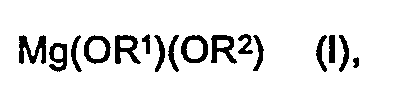
- R 1 and R 2 are identical or different and are an alkyl radical having 1 to 6, preferably 2 to 4, carbon atoms.
- Examples are Mg (OCH 3 ) 2 , Mg (OC 2 H 5 ) 2 , Mg (OiC 3 H 7 ) 2 , Mg (0-nC 3 H 7 ) 2 , Mg (OnC 4 H 9 ) 2 , Mg (OCH 3 ) (OC 2 H 5 ), Mg (OC 2 H 5 ) (OnC 3 H 7 ).
- the simple magnesium alcoholates M 9 (OC 2 H 5 ) 2 , Mg (0-nC 3 H 7 ) 2 and Mg (OiC 4 H 9 ) 2 are preferably used.
- the magnesium alcoholate is in an inert dispersant with a tetravalent titanium compound of the formula (II) wherein R 3 is an alkyl radical having 1 to 6, preferably 1 to 3 carbon atoms and X is a halogen atom, preferably chlorine, and m is zero to 4, preferably 2 to 4.
- Examples include TiCl 4 , Ti (OC 2 H 5 ) Cl 3 , TI (OC 2 H 5 ) 2 Cl 2 , Ti (OC 2 H 5 ) 3 Cl, Ti (OiC 3 H 7 ) 3 Cl, Ti (OiC 3H7 ) 2C12 , Ti (OiC 3 H 7 ) 3 Cl, Ti (OnC 4 H 9 ) 3 Cl, Ti (OnC 4 H 9 ) 2 Cl 2 , Ti (OnC 4 H 9 ) 3 Cl, Ti (OiC 4 H 9 ) 3 Cl, Ti (0-iC 4 H 9 ) 2 Cl 2 , Ti (OiC 4 H 9 ) 3 Cl, Ti (0-nC 4H9 ) 4 , Ti (0-nC 3H7 ) 4 .
- TiCl 4 and Ti (OnC 4 H 9 ) 2 Cl 2 are preferably used.
- the reaction of the magnesium alcoholate with the titanium compound usually takes place at a temperature of 0 to 150 ° C, preferably at 50 to 120 ° C.
- the titanium compound is usually brought together with the magnesium alcoholate within 0.5 to 20, preferably within 3 to 10 hours, preferably by adding a solution of the titanium compound to a suspension of the magnesium alcoholate.
- halogen-containing organoaluminum compound of the formula (III) wherein R 4 and R 5 are the same or different and represent an alkyl radical having 1 to 12, preferably 1 to 4 carbon atoms, X is a halogen atom, preferably chlorine, and n is a number from zero to 2, preferably 1 to 2, and p is a number from zero to 1, preferably 0 to 0.5.
- Suitable organoaluminum compounds are Al (C 2 H 5 ) 2 Cl, Al (C 2 H 5 ) 2 Cl, Al (C 2 H 6 ) Cl 2 , Al (nC 3 H 7 ) 2 Cl, Al (nC 3 H 7 ) Cl 2 , Al (nC 4 H 9 ) Cl 2 , Al (iC 4 H 9 ) 2 Cl, Al (iC 4 H 9 ) Cl 2 , Al (C 2 H 5 ) Cl 2 , Al (nC 4 H 9 ) 2 Cl, Al (nC 4 H 9 ) (OC 2 H 5 ) Cl and equimolar mixtures of the mono- and dihalides, the so-called aluminum alkyl sesquihalides or mixtures of mono- and dihalides of different compositions. From this group, Al (C 2 H 5 ) Cl 2 and Al 2 (C 2 H 5 ) 3 Cl 3 are preferably used.
- the reaction usually takes place at a temperature of 0 to 150 ° C, preferably at 50 to 120 ° C, the reactants usually being brought together within 0.5 to 20, preferably within 2 to 8, hours.
- Inert dispersants for the aforementioned reactions are aliphatic or cycloaliphatic hydrocarbons such as butane, pentane, hexane, heptane, cyclohexane, methylcyclohexane, isooctane and aromatic hydrocarbons such as benzene, xylene.
- Gasoline and hydrogenated diesel oil fractions that have been carefully cleaned of oxygen, sulfur compounds and moisture can also be used.
- Magnesium alcoholate, tetravalent titanium compound and organoaluminum compound are usually used in the Mg: Ti: Al ratio as 1: 0.05 to 2: 0.3 to 5, preferably 1: 0.2 to 1.0: 0.4 to 1.5 .
- the suspension of catalyst component (a) thus produced is used directly for the polymerization.
- An aluminum trialkyl with 1 to 12 carbon atoms in the alkyl radicals for example Al (C 2 H 5 ) 3 , Al (iC 4 H 9 ) 3 , Al (iC 8 H 17 ) 3 , or the as "Aluminum isoprenyl" known reaction product of an aluminum trialkyl or dialkyl hydride with isoprene used.
- A) (C 2 H s ) 3 is preferred.
- the polymerization is carried out in two stages, preferably as a suspension polymerization in an inert dispersant.
- the same solvents are suitable as dispersing agents as described for the production of the catalyst component (a).
- polymerization in the gas phase is also possible.
- the reaction temperature in both reaction stages is 20 to 120 ° C, preferably 70 to 90 ° C.
- the pressure is in the range from 2 to 60, preferably 4 to 20 bar.
- the catalyst component (a) is continuously introduced exclusively into the first reaction stage.
- the catalyst component (b) is also continuously introduced into the first stage, optionally additionally into the second stage.
- the ratio of component (a) to component (b), based on titanium and aluminum, is 1: 1 to 1: 500, preferably 1: 5 to 1: 100.
- polyolefins with different average molecular weights are formed by the molar ratio of hydrogen to ethylene in the gas space of the two reaction zones by supplying ethylene and hydrogen to values of 1: 0.01 to 1: 0.5 in one stage and 1: 0.1 to 1: 8 is set in the other stage.
- the quantitative ratio of the polyolefins formed in each of reaction stages 1 and 2 is in the range from 30:70 to 70:30, the polymer formed in reaction stage 1 being continuously transferred to stage 2.
- the final polymer mixture is continuously withdrawn from stage 2.
- polymer in the first reaction stage, polymer can be formed which has a higher or a lower average molecular weight than the product formed in the second stage. If it has a higher average molecular weight, its viscosity number is in the range from 1400 to 200 cm 3 / g (measured in 0.1% decahydronaphthalene solution at 135 ° C.), otherwise in the range from 40 to 150 cm 3 / g.
- the viscosity number of the product of the second reaction stage is in the range from 200 to 500 cm 3 / g.
- the in-situ mixture of two components with very different average molecular weights results in a total polymer with an extremely broad bimodal molecular weight distribution.
- ethylene or ethylene with up to 10% by weight, based on the total amount of monomers, of a 1-olefin of the formula R s - CH CH 2 , in which R 6 is a straight-chain or branched alkyl radical with 1 to 12, preferably 1 to 10 carbon atoms, polymerized.
- R 6 is a straight-chain or branched alkyl radical with 1 to 12, preferably 1 to 10 carbon atoms, polymerized.
- Examples are propylene, 1-butene, 1-pentene, 1-hexene, 4-methylpentene-1, 1-octene, preferably propylene, butene and hexene are used.
- the comonomer is preferably introduced into the stage in which a polymer with the higher molecular weight is produced.
- the entire polymer from the second polymerization stage is separated from the dispersant in a known manner and dried.
- An advantage of the catalyst system to be used according to the invention is that it hydrogenates significantly less in the presence of hydrogen than comparable known catalyst systems. In the process according to the invention, this leads to a reduction in ethane formation and thus to an increase in ethylene conversion.
- Another advantage of this catalyst system is the very good hydrogen response, which is especially necessary for the implementation of this process.
- a very low molecular weight polyethylene has to be produced in one of the two stages, which can normally only be achieved with a very high hydrogen concentration in the gas phase.
- products with a very low molecular weight can be achieved even at significantly lower hydrogen concentrations than with the catalyst systems used hitherto.
- this allows higher ethylene partial pressures and thus higher contact yields and, on the other hand, lower hydrogen consumption.
- the catalyst activity drops less at high hydrogen concentrations in the gas space of the reactor than in known catalysts.
- Another decisive advantage of the process according to the invention is the very simple preparation of the transition metal component of the catalyst. This is obtained by simply bringing the individual components together under the appropriate reaction conditions. In most cases, an inert hydrocarbon wash is not necessary. This also means that no wash liquor is formed, which has to be decomposed again in further process steps and worked up with waste water.
- the process according to the invention provides ethylene polymers for extrusion and blow extrusion with a wide to very wide molar mass distribution.
- the polymers are characterized by excellent processing and finished part properties.
- film raw materials, pipe raw materials, ribbon raw materials, monofilament raw materials and small hollow body raw materials with very good and balanced properties can be produced by adapting the process parameters.
- the film raw materials are characterized by their good processability on almost all HDPE film systems with low pressure build-up and high bubble stability and good production properties such as low specks, good film structure and high toughness.
- the pipe raw materials have an excellent toughness and density-stress crack ratio with good processability.
- the ribbon and monofilament raw materials can be safely processed on ribbon and monofilament lines.
- the small hollow body raw materials result in moldings with very good stress crack behavior.
- the titanium content of the catalysts was determined colorimetrically. A single-stage test polymerization was first carried out with each catalyst.
- the melt index MFI 190/5, MFI 190/15 and MFI 190 / 21.6 were determined according to DIN 53 735.
- the MFR (21.6 / 5) is calculated from the quotient of the MFI 190 / 21.6 to MFI 190/5, the MFR (1515) is calculated from the quotient of the MFI 190/15 to MFI 19015.
- the viscosity VZ was determined in accordance with DIN 53 728 sheet 4 using an Ubbelohde viscometer in decahydronaphthalene as the solvent.
- the density was determined in accordance with DIN 53 479, method A, and the bulk density in accordance with DIN 53 368.
- the tear resistance along and across was determined according to ISO 6383/2.
- the stress crack resistance was determined in accordance with DIN 55 457, Part 2, Supplement 1.
- the dart drop values were measured in accordance with ASTM D 1709-67 method A.
- the pipe creep was determined according to DIN 8075, Section 2.3, Tab. 1.
- the powder was mixed with 0.2% by weight of Ca stearate and 0.1% by weight of octadecyl-3- (3,5-di-t-butyl-4-hydroxyphenyl) - stabilized propionate and granulated on a twin-screw granulating machine with a throughput of 75 kg / h.
- the granules had an MFI 190/5 of 0.45 g / 10 min, an MFR (21.6 / 5) of 28.3, a density of 0.945 g / cm 3 and a VZ of 330 cm3 / g.
- the granulate could be processed on a tube extruder to a tube (0 32 mm) with a very smooth tube surface with high output.
- the tube had excellent durability ( ⁇ 5 ⁇ 6400 h) in the creep test.
- the polymerization was carried out as described in Example 1 using the same catalyst system.
- the polymerization and product parameters are summarized in Table 1.
- the catalyst component (a) produced in DE-AS 1 795197, example 1 was used, which was produced as follows: 11 g of Mg (OC 2 H 5 ) 2 were in 50 cm 3 of diesel oil (boiling range 130 to 160 ° C) suspended and mixed with 200 cm 3 of a 1 molar TiCl 2 (OiC 3 H 7 ) 2 solution in cyclohexane. The suspension was refluxed for 7 hours. The precipitate was then washed by decanting and stirring 6 times with 150 cm 3 of cyclohexane. The volume of the suspension was made up to 250 cm 3 . 10 cm 3 of the suspension contained 2.9 mmol of titanium compound.
- the granules from Examples 12 and 13 were processed into tapes on a ribbon system. There were no problems with either material. The tapes showed a very high tear resistance. The granules from Comparative Example C were very difficult to process on the same ribbon line because of many tears.
- Example 15 The granules from Example 15 were processed to monofilament on a monofilament system without any problems; the stretchability of the product was excellent.
- Example 14 The granules from Example 14 were processed into bottles on a small hollow body machine.
- the fla showed a smooth, speckless surface.
- the product had excellent stress crack resistance .
- the product from Comparative Example D could also be processed into bottles, but the surface was stuck.
- the a k23 ° C value was significantly lower at 12 mJ / mm and the stress crack resistance was worse.
- a powder was obtained with an MFI 190/5 of 0.40 g / 10 min, an MFR (21.6 / 5) of 10 and a density of 0.96 g / cm 3.
- the material could not be processed into a usable film on the blown film line. The film showed a very rough surface.
Landscapes
- Chemical & Material Sciences (AREA)
- Health & Medical Sciences (AREA)
- Chemical Kinetics & Catalysis (AREA)
- Medicinal Chemistry (AREA)
- Polymers & Plastics (AREA)
- Organic Chemistry (AREA)
- Transition And Organic Metals Composition Catalysts For Addition Polymerization (AREA)
- Compositions Of Macromolecular Compounds (AREA)
- Polymerisation Methods In General (AREA)
- Addition Polymer Or Copolymer, Post-Treatments, Or Chemical Modifications (AREA)
Description
- Die vorliegende Erfindung bezieht sich auf ein Verfahren zur Herstellung eines Polyolefins mit einer extrem breiten Molmassenverteilung durch eine zweistufige Polymerisation.
- Es ist bekannt, daß bimodales, d.h. zwei Molmassen besitzendes Polyethylen gegenüber dem monomodalen Polyethylen verbesserte Eigenschaften besitzt. Dies betrifft die Fließfähigkeit und die Spannungsrißbeständigkeit.
- Bekannt ist ein Verfahren zur Herstellung von polymodalen Ethylenpolymerisaten, bei welchem Ethylen in zwei Stufen in Gegenwart einer halogenhaltigen aluminiumorganischen Verbindung, einer Übergangsmetallverbindung und verschiedenen Mengen Wasserstoff in jeder Stufe polymerisiert wird (vgl. DE-OS 18 00 695 = GB-PS 1 233 599).
- Weiterhin ist ein Verfahren bekannt zur Herstellung von Olefinpolymerisaten durch eine zweistufige Polymerisation, wobei in der ersten Stufe bei einem niedrigen H2/C2H4-Verhältnis ein hochmolekulares Polymerisat und in der zweiten Stufe bei einem hohen H2/C2H4-Verhältnis ein niedermolekulares Polymerisat hergestellt wird (vgl. EP-A 57352). Als Katalysator dient unter anderem eine halogenhaltige Organoaluminiumverbindung zusammen mit dem Reaktionsprodukt zwischen einer Sauerstoff enthaltenden Organomagnesiumverbindung und einer Sauerstoff enthaltenden Organotitanverbindung, welche sich beide in Lösung befinden, und einem Aluminiumhalogenid.
- Beide bekannten Verfahren liefern Polyolefine mit guter Verarbeitbarkeit und guten physikalischen Eigenschaften. Aus diesen Polyolefinen hergestellte Folien zeigen nur wenige Stippen. Jedoch muß bei beiden Verfahren die das Übergangsmetall enthaltende Katalysatorkomponente nach ihrer Herstellung durch Waschen mit einem inerten Lösemittel von überschüssigen Reaktionsprodukten befreit werden. Die entstehenden Waschlaugen müssen aufgearbeitet werden, was sehr aufwendig, teuer und umweltbelastend ist. Außerdem werden gemäß EP-A 57352 halogenhaltige Aluminiumalkyle als Aktivatoren verwendet. Dies führt zu einem höheren Halogengehalt im Polymerisat. Eine Folge davon ist eine höhere Korrosivität und demzufolge eine größere Menge Säurefänger im Polymerisat, um Korrosionen an Maschinenteilen zu verhindern.
- Bekannt ist auch ein Verfahren zur Homo- und Mischpolymerisation von Ethylen bei einer Temperatur von 150 bis 350°C und einem Druck von 300 bis 3500 bar in Gegenwart eines Katalysators aus eineraluminiumorganischen Verbindung und einer Titanverbindung (vgl. EP-A 136 623). Die Titanverbindung ist das Umsetzungsprodukt eines Titansäureesters mit dem Produkt der Reaktion eines Magnesiumalkoholats und einer Halogen enthaltenden Aluminiumalkylverbindung. Bei diesem Verfahren wird jedoch ein Umsatz von nur 30%, bezogen auf das eingesetzte Ethylen, erzielt. Außerdem entsteht kein bimodales Polyethylen.
- Schließlich ist ein Verfahren zur Polymerisation von alpha-Olefinen bekannt, bei welchem ein Katalysator verwendet wird, dessen Übergangsmetallkomponente durch Umsetzung eines Magnesiumalkoholats mit einer vierwertigen, halogenhaltigen Titanverbindung und Waschen des festen Reaktionsproduktes mit einem inerten Lösemittel entstanden ist (vgl. DE-AS 17 95 197 = US-PS 3 664 318). In diesem Verfahren werden jedoch nur Polyolefine mit sehr enger Molmassenverteilung erhalten, die nicht für alle Anwendungen geeignet sind.
- Es bestand somit die Aufgabe, ein Verfahren zu finden, in welchem Polyolefine mit guter Verarbeitbarkeit, guten physikalischen Eigenschaften und vielseitiger Verwendbarkeit erhalten werden und welches einfach durchzuführen ist.
- Es wurde gefunden, daß die Aufgabe mit einem zweistufigen Verfahren unter Verwendung eines modifizierten Trägerkatalysators gelöst werden kann.
- Gegenstand der Erfindung ist somit ein Verfahren zur Herstellung eines Polyolefins durch zweistufige Polymerisation von Ethylen mit 0 bis 10 Gew.-%, bezogen auf die Gesamtmenge der Monomeren, eines 1-Olefins der Formel R6-CH=CH2, worin R6 einen geradkettigen oder verzweigten Alkylrest mit 1 bis 12 C-Atomen bedeutet, in Suspension oder in der Gasphase, bei einer Temperatur von 20 bis 120°C und einem Druck von 2 bis 60 bar, in Gegenwart eines Mischkatalysators, bestehend aus einer Übergangsmetallkomponente (Komponente (a)), welche das Reaktionsprodukt eines Magnesiumalkoholats mit einer Titanverbindung und einer aluminiumorganischen Verbindung ist, und einer aluminiumorganischen Verbindung, unter Regelung der mittleren Molmasse durch Wasserstoff, dadurch gekennzeichnet, daß die Polymerisation in Gegenwart eines Mischkatalysators durchgeführt wird, dessen Komponente (a) durch Umsetzung eines in einem inerten Dispergiermittel suspendierten Magnesiumalkoholats der Formel (I)


- Zur Herstellung des erfindungsgemäß zu verwendenden Mischkatalysators wird ein Magnesiumalkoholat der Formel (I)

- Das Magnesiumalkoholat wird in einem inerten Dispergiermittel mit einer vierwertigen Titanverbindung der Formel (II)

- Beispielsweise seien genannt TiCl4, Ti(OC2H5)Cl3, TI(OC2H5)2Cl2, Ti(OC2H5)3Cl, Ti(O-i-C3H7)3Cl, Ti(O-i-C3H7)2C12, Ti(O-i-C3H7)3Cl, Ti(O-n-C4H9)3Cl, Ti(O-n-C4H9)2Cl2, Ti(O-n-C4H9)3Cl, Ti(O-i-C4H9)3Cl, Ti(0-i-C4H9)2Cl2, Ti(O-i-C4H9)3Cl, Ti(0-n-C4H9)4, Ti(0-n-C3H7)4. Vorzugsweise werden TiCl4 und Ti(O-n-C4H9)2Cl2 verwendet.
- Die Umsetzung des Magnesiumalkoholats mit der Titanverbindung erfolgt üblicherweise bei einer Temperatur von 0 bis 150°C, vorzugsweise bei 50 bis 120°C. Die Titanverbindung wird üblicherweise innerhalb 0,5 bis 20, vorzugsweise innerhalb 3 bis 10 h mit dem Magnesiumalkoholat zusammengebracht, vorzugsweise durch Zugabe einer Lösung der Titanverbindung zu einer Suspension des Magnesiumalkoholats.
- Der entstandene Feststoff wird sodann umgesetzt mit einer halogenhaltigen aluminiumorganischen Verbindung der Formel (III)

- Die Umsetzung erfolgt üblicherweise bei einerTemperaturvon 0 bis 150°C, vorzugsweise bei 50 bis 120°C, wobei die Reaktionspartner üblicherweise innerhalb 0,5 bis 20, vorzugsweise innerhalb 2 bis 8 h zusammengebracht werden.
- Als inerte Dispergiermittel für die vorgenannten Umsetzungen eignen sich aliphatische oder cycloaliphatische Kohlenwasserstoffe wie Butan, Pentan, Hexan, Heptan, Cyclohexan, Methylcyclohexan, Isooctan sowie aromatische Kohlenwasserstoffe wie Benzol, Xylol. Auch Benzin- und hydrierte Dieselölfraktionen, die sorgfältig von Sauerstoff, Schwefelverbindungen und Feuchtigkeit befreit worden sind, können eingesetzt werden.
- Magnesiumalkoholat, vierwertige Titanverbindung und aluminiumorganische Verbindung werden im Verhältnis Mg : Ti : AI üblicherweise wie 1 : 0,05 bis 2 : 0,3 bis 5, vorzugsweise 1 : 0,2 bis 1,0 : 0,4 bis 1,5 eingesetzt.
- Die so hergestellte Suspension der Katalysatorkomponente (a) wird direkt zur Polymerisation verwendet.
- Als Katalysatorkomponente (b) wird ein Aluminiumtrialkyl mit 1 bis 12 C-Atomen in den Alkylresten, beispielsweise Al(C2H5)3, AI(i-C4H9)3, Al(i-C8H17)3, oder das als "Aluminiumisoprenyl" bekannte Umsetzungsprodukt eines Aluminiumtrialkyls oder -dialkylhydrids mit Isopren verwendet. Bevorzugt ist A)(C2Hs)3.
- Die Polymerisation wird zweistufig, vorzugsweise als Suspensionspolymerisation in einem inerten Dispergiermittel durchgeführt. Als Dispergiermittel sind die gleichen Lösemittel geeignet, wie sie zur Herstellung der Katalysatorkomponente (a) beschrieben wurden. Möglich ist jedoch auch eine Polymerisation in der Gasphase.
- Die Reaktionstemperatur in beiden Reaktionsstufen beträgt 20 bis 120°C, vorzugsweise 70 bis 90°C. Der Druck liegt im Bereich von 2 bis 60, vorzugsweise 4 bis 20 bar.
- Die Katalysatorkomponente (a) wird kontinuierlich ausschließlich in die erste Reaktionsstufe eingeführt. Die Katalysatorkomponente (b) wird ebenfalls kontinuierlich in die erste Stufe, gegebenenfalls zusätzlich in die zweite Stufe eingebracht. Das Verhältnis von Komponente (a) zu Komponente (b), bezogen auf Titan und Aluminium, beträgt 1 : 1 bis 1 : 500, vorzugsweise 1 : 5 bis 1 : 100.
- In beiden Reaktionsstufen werden Polyolefine mit unterschiedlichen mittleren Molmassen gebildet, indem das Molverhältnis von Wasserstoff zu Ethylen im Gasraum der beiden Reaktionszonen durch Zufuhr von Ethylen und Wasserstoff auf Werte von 1 : 0,01 bis 1 : 0,5 in der einen Stufe und 1 : 0,1 bis 1 : 8 in der anderen Stufe eingestellt wird.
- Das Mengenverhältnis der in den Reaktionsstufen 1 und 2 jeweils gebildeten Polyolefine liegt im Bereich von 30 : 70 bis 70 : 30, wobei das in der Reaktionsstufe 1 gebildete Polymere kontinuierlich in die Stufe 2 überführt wird. Das endgültige Polymergemisch wird kontinuierlich aus Stufe 2 abgezogen.
- In der ersten Reaktionsstufe kann Polymeres gebildet werden, welches eine höhere oder eine niedrigere mittlere Molmasse besitzt als das in der zweiten Stufe gebildete Produkt. Hat es eine höhere mittlere Molmasse, so liegt seine Viskositätszahl im Bereich von 1400 bis 200 cm3/g (gemessen in 0,1%iger Dekahydronaphthalinlösung bei 135°C), andernfalls im Bereich von 40 bis 150 cm3/g. Die Viskositätszahl des Produktes der zweiten Reaktionsstufe liegt im Bereich von 200 bis 500 cm3/g. Die in-situ-Mischung zweier Komponenten mit stark unterschiedlicher mittlerer Molmasse ergibt ein Gesamtoplymerisat mit extrem breiter bimodaler Molmassenverteilung.
- Mit dem erfindungsgemäß zu verwendenden Katalysatorsystem wird Ethylen oder Ethylen mit bis zu 10 Gew.-%, bezogen auf die Gesamtmenge der Monomeren, eines 1-Olefins der Formel Rs-CH=CH2, worin R6 einen geradkettigen oder verzweigten Alkylrest mit 1 bis 12, vorzugsweise 1 bis 10 C-Atomen bedeutet, polymerisiert. Beispiele sind Propylen, 1-Buten, 1-Penten, 1-Hexen, 4-Methylpenten-1 , 1-Octen, vorzugsweise werden Propylen, Buten und Hexen eingesetzt. Dabei wird das Comonomere vorzugsweise in die Stufe, in welcher ein Polymerisat mit der höheren Molmasse erzeugt wird, eingeführt.
- Das Gesamtpolymerisat aus der zweiten Polymerisationsstufe wird in bekannter Weise vom Dispergiermittel abgetrennt und getrocknet.
- Ein Vorteil des erfindungsgemäß zu verwendenden Katalysatorsystems besteht darin, daß es in Anwesenheit von Wasserstoff wesentlich weniger hydriert als vergleichbare bekannte Katalysatorsysteme. Das führt in dem erfindungsgemäßen Verfahren zu einer Verringerung der Ethanbildung und damit zur Erhöhung des Ethylenumsatzes.
- Ein weiterer Vorteil dieses Katalysatorsystems ist die sehr gute Wasserstoffansprechbarkeit, die speziell für die Durchführung dieses Verfahrens notwendig ist. In diesem Verfahren muß in einer der beiden Stufen ein sehr niedermolekulares Polyethylen hergestellt werden, was normalerweise nur mit einer sehr hohen Wasserstoffkonzentration in der Gasphase erreichbar ist. Mit dem erfindungsgemäßen Katalysatorsystem können Produkte mit sehr niedrigem Molekulargewicht bereits bei deutlich niedrigeren Wasserstoffkonzentrationen als mit den bisher eingesetzten Katalysatorsystemen erreicht werden. Dadurch können einerseits höhere Ethylenpartialdrücke und damit höhere Kontaktausbeuten und andererseits ein geringerer Wasserstoffverbrauch erzielt werden. Außerdem sinkt die Katalysatoraktivität auch bei hohen Wasserstoffkonzentrationen im Gasraum des Reaktors weniger ab als bei bekannten Katalysatoren.
- Ein weiterer entscheidender Vorteil des erfindungsgemäßen Verfahrens ist die sehr einfache Herstellung der Übergangsmetallkomponente des Katalysators. Diese wird durch einfaches Zusammenbringen der Einzelkomponenten unter den entsprechenden Reaktionsbedingungen erhalten. Eine in den meisten Fällen übliche Wäsche mit einem inerten Kohlenwasserstoff entfällt. Dadurch entsteht auch keine Waschlauge, die in weiteren Prozeß-Schritten erst wieder zersetzt und unter Anfall von Abwasser aufgearbeitet werden muß.
- Weiterhin treten auch bei längerem kontinuierlichen Betrieb keine Polymerablagerungen an den Kesselwandungen und den Verbindungsleitungen auf.
- Das erfindungsgemäße Verfahren liefert Ethylenpolymere für die Extrusion und Blasextrusion mit breiter bis sehr breiter Molmassenverteilung. Die Polymeren zeichnen sich durch exzellente Verarbeitungs- und Fertigteil-Eigenschaften aus. Man kann in diesem Verfahren durch Anpassung der Verfahrensparameter Folienrohstoffe, Rohrrohstoffe, Bändchenrohstoffe, Monofilrohstoffe und Kleinhohlkörperrohstoffe mit sehr guten und ausgewogenen Eigenschaften herstellen.
- Die Folienrohstoffe zeichnen sich durch ihre gute Verarbeitbarkeit auf fast allen HDPE-Folienanlagen aus bei niedrigem Druckaufbau und hoher Blasenstabilität und guten Produktionseigenschaften wie Stippenarmut, guter Folienstruktur und hoher Zähigkeit.
- Die Rohrrohstoffe besitzen bei guter Verarbeitbarkeit eine ausgezeichnete Zähigkeit- und Dichte-Spannungsrißrelation.
- Die Bändchen- und Monofil-Rohstoffe sind auf Bändchen-und Monofilanlagen sicher verarbeitbar.
- Die Kleinhohlkörperrohstoffe ergeben Formkörper mit sehr gutem Spannungsrißverhalten.
- Bei den nachfolgenden Beispielen wurde zur Herstellung der Katalysatorkomponente (a) und zur Polymerisation eine hydrierte Benzinfraktion mit einem Siedebereich von 120 bis 140°C verwendet.
- Der Titangehalt der Katalysatoren wurde kolorimetrisch bestimmt. Mit jedem Katalysator wurde zunächst eine einstufige Testpolymerisation durchgeführt.
- Die Schmelzindices MFI 190/5, MFI 190/15 und MFI 190/21,6 wurden nach DIN 53 735 bestimmt. Der MFR (21,6/5) berechnet sich aus dem Quotienten des MFI 190/21,6 zu MFI 190/5, der MFR (1515) berechnet sich aus dem Quotienten des MFI 190/15 zu MFI 19015.
- Die Viskosität VZ wurde nach DIN 53 728 Blatt 4 mit einem Ubbelohde-Viskosimeter in Dekahydronaphthalin als Lösungsmittel bestimmt.
- Die Bestimmung der Dichte erfolgte nach DIN 53 479, Verfahren A, die der Schüttdichte nach DIN 53 368.
- Die Bestimmung der ak23°C Werte erfolgte nach DIN 53 453.
- Die Bestimmung der Weiterreißfestigkeit längs bzw. quer (WFR(1) ; WRF(q)) erfolgte nach ISO 6383/2.
- Die Bestimmung der Spannungsrißbeständigkeit erfolgte nach DIN 55 457, Teil 2, Beiblatt 1.
- Die Messung der Dart drop-werte erfolgte nach ASTM D 1709-67 Methode A
- Der Rohrzeitstand wurde nach DIN 8075, Abschnitt 2.3, Tab. 1 bestimmt.
- In einem 4 dm3 Rührgefäß wurden unter Ausschluß von Luft und Feuchtigkeit 57 g (= 500 mmol) Magnesiummethylat und 500 cm3 einer hydrierten Benzinfraktion vorgelegt. Unter Rühren und Argonüberlagerung wurden bei einer Temperatur von 100°C innerhalb von 2 h 500 cm3 einer 0,2 molaren Lösung von TiCl4 in der Benzinfraktion zugegeben.
- In die erhaltene Suspension wurde unter Rühren bei der gleichen Temperatur 500 mmol AlCl2(C2H5) in 1000 cm3 der Benzinfraktion getropft, Zutropfdauer 2 h. Danach wurde weitere 2 h bei 100°C gerührt. Es entstand ein rötlichbrauner Niederschlag. Durch Bestimmung des Ti3+-Gehaltes und des Gesamt-Titangehaltes wurde der vollständige Umsatz des Titans in die dreiwertige Stufe festgestellt. Die Suspension enthielt 0,065 mol Tildm3. Ein Teil dieser Suspension wurde mit der Benzinfraktion auf eine Ti-Konzentration von 0,01 mol/dm3 verdünnt.
- In einem 2 dm3-Stahlautoklaven, der mit 750 cm3 einer Benzinfraktion beschickt wurde, wurden bei 85°C unter N2-Überlagerung 1,5 cm3 einer 1-molaren Triethylaluminium-Lösung und 1 cm3 der nach 1.1 hergestellten Suspension (0,01 mmol/dm3 bezogen auf Ti) gegeben. Danach wurden 3 bar Wasserstoff vorgelegt und 4 bar Ethylen aufgedrückt. Der Gesamtdruck von 7 bar wurde über 2 h gehalten, indem das verbrauchte Ethylen nachdosiert wurde. Die Polymerisation wurde durch Entspannen der Gase abgebrochen und das Polymere durch Filtration und Trocknung vom Dispergiermittel abgetrennt. Es wurden 225 g Polyethylen mit einem MFI 190/5 von 24 g/10 min und einem MFR (15/5) von 4,8 gebildet. Dies entspricht einer KZAred von 2810 g/mmol · Ti . bar. h. Das Pulver hatte eine Schüttdichte von 0,39 g/cm3 und einen Feinkornanteil < 100 µm von 2,1 Gew.-%.
- In den ersten von zwei hintereinandergeschalteten 600 1-Rührkesseln wurden bei einer Temperatur von 83°C kontinuierlich 72 dm3/h Hexan 24 kg/h Ethylen, 1 mmol/h Katalysatorkomponente (a), hergestellt nach 1.1, und 36 mmol/h Triethylaluminium eingebracht. Wasserstoff wurde so zudosiert, daß sich ein Wasserstoffpartialdruck von 7,2 bar und ein Ethylenpartialdruck von 2 bar einstellte. Die entstehende Polymersuspension wurde über ein Tauchrohr mit einem Ventil, das mit einer Standhaltung des ersten Kessels verbunden war, in den zweiten Kessel überführt. In den zweiten Kessel wurden bei einer Temperatur von 80°C 24 kg/h Ethylen, 96 dm3/h Hexan, 48 mmollh Aluminiumtriethyl und 3 dm3/h Buten-1 eingegeben. Im Gasraum des zweiten Kessels wurde durch Entfernen einer bestimmten Gasmenge ein Wasserstoff/Ethylen-Verhältnis von 0,18 eingestellt. Das Polymerisat aus dem zweiten Reaktor wurde in einer Zentrifuge weitgehend vom Hexan abgetrennt und im N2-Strom getrocknet. Es entstanden 48 kg/h Ethylencopolymerisat mit einem MFl 190/5 von 0,64 g/10 min, einem MFR (21,6/5) von 26,5, einer Dichte von 0,944 g/cm3 und einer VZ von 340 cm3/g. Das Polymerisat aus der ersten Stufe besaß eine VZ von 40 cm3/g. Die KA betrug 48 kg/mmoi Ti. Das Pulver wurde mit 0,2 Gew.-% Ca-Stearatund 0,1 Gew.-% Octadecyl-3-(3,5-di-t-butyl-4-hydroxyphenyl)-propionat stabilisiert und auf einer Zweischnecken-Granuliermaschine mit einem Durchsatz von 75 kg/h granuliert. Das Granulat hatte einen MFI 190/5 von 0,45 g/10 min, einem MFR (21,6/5) von 28,3, eine Dichte von 0,945 g/cm3 und eine VZ von 330 cm3/g.
- Das Granulat ließ sich auf einem Rohrextruder zu einem Rohr (0 32 mm) mit sehr glatter Rohroberfläche bei hohem Ausstoß verarbeiten. Das Rohr besaß neben einer sehr guten Zähigkeit (ak23°C = 17,5 mJ/mm2) eine ausgezeichnete Haltbarkeit (σ5 ≧ 6400 h) im Zeitstandversuch.
- Die Polymerisation wurde, wie in Beispiel 1 beschrieben, mit dem gleichen Katalysatorsystem durchgeführt. Die Polymerisations- und Produktparameter sind in Tabelle 1 zusammengefaßt.
- Nach Stabilisierung und Granulierung der Pulver auf dem oben beschriebenen Zweischnecken-Extruder erhielt man Granulate, aus denen sich auf einer HDPE-Folienblasanlage 20 µm-Folien mit ausgezeichneten Eigenschaften herstellen ließen (Tabelle 2).
- In einem 4 dm3 Rührgefäß wurden unter Ausschluß von Luft und Feuchtigkeit 71 g (= 500 mmol) Magnesiumisopropylat und 500 cm3 einer hydrierten, sauerstofffreien Benzinfraktion vorgelegt. Unter Rühren und Argonüberlagerung wurden bei einer Temperatur von 90°C innerhalb von 5 h 16,5 cm3 TiCl4 (= 150 mmol), gelöst in 400 cm3 der Benzinfraktion zugegeben. Zu der erhaltenen Suspension wurden innerhalb von 2 h unter Rühren bei der gleichen Temperatur 400 mmol Al2Cl3(C2H5)3 in 1000 cm3 der Benzinfraktion getropft. Danach wurde zwei Stunden bei 120°C gerührt. Es entstand ein dunkelbrauner Niederschlag. Die Suspension enthielt 0,076 mol Tildm3. Der Ti3+-Gehalt betrug 99 Gew.-%. Ein Teil dieser Suspension wurde mit der Benzinfraktion auf eine Ti-Konzentration von 0,01 mol/dm3 verdünnt.
- In einem 2 dm3 Stahlautoklaven, der mit 750 cm3 einer hydrierten Benzinfraktion beschickt war, wurden bei 85°C unter N2 1,5 cm3 einer 1 molaren Triisobutylaluminium-Lösung und 1,5 cm3 der nach 6.1 hergestellten Suspension (0,015 mmolldm3, bezogen auf Ti) gegeben. Danach wurden 3 bar Wasserstoff vorgelegt und 4 bar Ethylen aufgedrückt. Der Gesamtdruck von 7 bar wurde über 2 h gehalten, indem das verbrauchte Ethylen nachdosiert wurde. Das Polymerisat wurde durch Filtration und Trocknung vom Dispergiermittel abgetrennt. Es wurden 196 g Polyethylen mit einem MFl 19015 von 19 g/10 min und einem MFR (15/5) von 5,0 gebildet. Dies entspricht einer KZAred von 1630 glmmol Ti bar h. Das Pulver hatte eine Schüttdichte von 0,38 g/cm3 und einen Feinkornanteil < 100 µm von 6,5 Gew.-%.
- Unter den in Beispiel 1.3 beschriebenen Bedingungen wurden kontinuierliche Zweistufenpolymerisationen durchgeführt, wobei für die erfindungsgemäßen Beispiele die Katalysatorkomponente (a) gemäß Beispiel 6.1 verwendet wurde.
- Für die Vergleichsbeispiele wurde die Katalysatorkomponente (a) gemäß Beispiel 5 der DE-AS 1 795 197 eingesetzt, welcher folgendermaßen hergestellt wurde :
- 11 g Mg(OC2H5)2 wurden in 50 cm3 Dieselöl (Siedebereich 130 bis 160°C) suspendiert und mit 200 cm3 einer 1-molaren TiCl4-Lösung in Dieselöl versetzt. Die Suspension wurde 15 Stunden unter Rückfluß gekocht. Anschließend wusch man den Niederschlag durch Dekantieren und Verrühren 6mal mit 150 cm3 Dieselöl. Das Volumen der Suspension wurde auf 250 cm3 aufgefüllt 10 cm3 Suspension enthielten 2,1 mmol Titanverbindung.
- Nach Stabilisierung und Granulierung der Pulver auf dem bereits beschriebenen Zweischneckenextruder erhielt man Granulate, deren Eigenschaften in Tabelle 2 zusammengestellt sind. Auf einer Folienblasanlage wurden 20 µm-Folien mit den in der Tabelle 2 angegebenenen Eigenschaften erhalten.
- In einem 4 dm3-Rührgefäß wurden unter Ausschluß von Luft und Feuchtigkeit 57 g (= 500 mmol) Magnesiumethylat und 500 cm3 einer hydrierten Benzinfraktion vorgelegt. Unter Rühren und Argonüberlagerung wurden bei einer Temperatur von 90°C innerhalb von 5 h 600 cm3 einer 0,2 molaren TiCl3(OiC3H7)-Lösung in der Benzinfraktion zugetropft. In die erhaltene Suspension wurden anschließend bei 100°C innerhalb von 2 h 1000 cm3 einer 0,5-molaren Al2Cl3(C2H5)3-Lösung in der Benzinfraktion zugetropft und der Ansatz weitere 2 Stunden bei dieser Temperatur gerührt. Der erhaltene Katalysatorfeststoff enthielt alles Titan in der dreiwertigen Form. Die Suspension enthielt 0,056 mol Ti/dm3.
- Ein Teil dieser Suspension wurde mit der Benzinfraktion auf eine Ti-Konzentration von 0,01 molldm3 verdünnt.
- In einem 2 dm3-Stahlautoklaven, der mit 750 cm3 der Benzinfraktion beschickt war, wurden bei 85°C unter N2 1,5 cm3 einer 1-molaren Triethylaluminium-Lösung und 1 cm3 der nach 11.1 hergestellten Suspension (0,01 mmolldm3, bezogen auf Ti) gegeben. Danach wurden 3 bar Wasserstoff vorgelegt und 4 bar Ethylen aufgedrückt. Der Gesamtdruck von 7 bar wurde über 2 h aufrechterhalten, indem das verbrauchte Ethylen nachdosiert wurde. Die Polymerisation wurde durch Entspannen der Gase abgebrochen und das Polymere durch Filtration und Trocknung vom Dispergiermittel abgetrennt. Es wurden 195 g Polyethylen mit einem MFI 190/5 von 28 g/10 min und einem MFR (15/5) von 4,6 gebildet. Dies entspricht einer KZAred von 2440 g/mmol Ti bar h. Das Pulver hatte eine Schüttdichte von 0,41 g/cm3 und einem Feinkomanteil < 100 µm von 1,6 Gew.-%.
- Die Polymerisation wurde, wie im Beispiel 1.3 beschrieben, jedoch bei den erfindungsgemäßen Beispielen mit dem unter 11.1 beschriebenen Katalysatorsystem durchgeführt Die Polymerisations- und Produktparameter sind in Tabelle 3 zusammengefaßt.
- Für die Vergleichsbeispiele wurde die in DE-AS 1 795197, Beispiel 1, hergestellte Katalysatorkomponente (a) eingesetzt, welche wie folgt hergestellt wurde : 11 g Mg(OC2H5)2 wurden in 50 cm3 Dieselöl (Siedebereich 130 bis 160°C) suspendiert und mit 200 cm3 einer 1-molaren TiCl2(OiC3H7)2 Lösung in Cyclohexan versetzt. Die Suspension wurde 7 Stunden unter Rückfluß gekocht Anschließend wusch man den Niederschlag durch Dekantieren und Verrühren 6mal mit 150 cm3 Cyclohexan. Das Volumen der Suspension wurde auf 250 cm3 aufgefüllt. 10 cm3 der Suspension enthielten 2,9 mmol Titanverbindung.
- Nach Stabilisierung und Granulierung der Pulver auf dem bereits beschriebenen Zweischneckenextruder erhielt man die in Tabelle 2 zusammengefaßten Granulate.
- Das Granulat aus Beispiel 12 und 13 wurde auf einer Bändchenanlage zu Bändchen verarbeitet. Es traten bei beiden Materialien keine Probleme auf. Die Bändchen zeigten eine sehr hohe Reißfestigkeit. Das Granulat aus Vergleichsbeispiel C ließ sich auf der gleichen Bändchenanlage wegen vieler Abrisse nur sehr schwer verarbeiten.
- Das Granulat aus Beispiel 15 wurde auf einer Monofilanlage ohne Probleme zu Monofilware verarbeitet, die Verstreckbarkeit des Produktes war ausgezeichnet.
- Das Granulat aus Beispiel 14 wurde auf einer Kleinhohlkörpermaschine zu Flaschen verarbeitet. Die Flaschen zeigten eine glatte, stippenarme Oberfläche. Das Produkt besaß neben einem ak23°C-Wert von 16 mJ/mm2 eine ausgezeichnete Spannungsrißbeständigkeit.
- Das Produkt aus Vergleichsbeispiel D ließ sich zwar ebenfalls zu Flaschen verarbeiten, die Oberfläche war jedoch verstippt. Der ak23°C-wert lag mit 12 mJ/mm deutlich niedriger und die Spannungsrißbeständigkeit war schlechter.
- Außerdem kann man aus den Vergleichsbeispielen A bis D erkennen, daß das erfindungsgemäße Katalysatorsystem eine wesentlich höhere Kontaktaktivität besitzt. Die mit dem erfindungsgemäßen Katalysatorsystem hergestellten Produkte besitzen daher einen wesentlich niedrigeren Restkatalysatorgehalt.
- Mit 1,0 mmol/h der Katalysatorkomponente (a) aus Beispiel 11.1, 24 kg/h Ethylen, 72 dm3/h Hexan, 36 mmoi/h TEA und 0,1 dm3/h Buten wurde ein 600 dm3-Kessel bei 80°C kontinuierlich beschickt. Der Wasserstoff wurde so zudosiert, daß sich im Gasraum ein H2/C2H4-Verhältnis von 0,38 einstellte. Die Polymersuspension wurde kontinuierlich ausgetragen, so daß sich im Kessel ein konstantes Füllvolumen von 480 dm3 einstellte. Das Polyethylen wurde durch Filtration abgetrennt und im N2-Strom getrocknet. Es entstand ein Pulver mit einem MFI 190/5 von 0,40 g/10 min, einem MFR (21,6/5) von 10 und einer Dichte von 0,956 g/cm3 Durch Granulierung auf dem Zweischneckenextruder erhielt man ein Granulat mit einem MFl 190/5 von 0,28 g/10 min, einem MFR 21,615) von 9,8 und einer Dichte von 0,956 g/cm3. Das Material ließ sich auf der Blasfolienanlage nicht zu einer brauchbaren Folie verarbeiten. Die Folie zeigte eine sehr rauhe Oberfläche.


Claims (1)


Applications Claiming Priority (2)
| Application Number | Priority Date | Filing Date | Title |
|---|---|---|---|
| DE19873723526 DE3723526A1 (de) | 1987-07-16 | 1987-07-16 | Verfahren zur herstellung eines polyolefins mit einer breiten molmassenverteilung |
| DE3723526 | 1987-07-16 |
Publications (3)
| Publication Number | Publication Date |
|---|---|
| EP0302242A1 EP0302242A1 (de) | 1989-02-08 |
| EP0302242B1 true EP0302242B1 (de) | 1991-07-24 |
| EP0302242B2 EP0302242B2 (de) | 1998-03-25 |
Family
ID=6331701
Family Applications (1)
| Application Number | Title | Priority Date | Filing Date |
|---|---|---|---|
| EP88110674A Expired - Lifetime EP0302242B2 (de) | 1987-07-16 | 1988-07-05 | Verfahren zur Herstellung eines Polyolefins mit einer breiten Molmassenverteilung |
Country Status (10)
| Country | Link |
|---|---|
| US (1) | US4859749A (de) |
| EP (1) | EP0302242B2 (de) |
| JP (1) | JP2732857B2 (de) |
| AU (1) | AU610905B2 (de) |
| BR (1) | BR8803596A (de) |
| CA (1) | CA1308856C (de) |
| DE (2) | DE3723526A1 (de) |
| ES (1) | ES2025250T5 (de) |
| IN (1) | IN171663B (de) |
| ZA (1) | ZA885128B (de) |
Cited By (2)
| Publication number | Priority date | Publication date | Assignee | Title |
|---|---|---|---|---|
| US6201078B1 (en) | 1995-04-28 | 2001-03-13 | Solvay Polyolefins Europe-Belgium | Ethylene polymer and processes for obtaining it |
| US7714072B2 (en) | 2003-05-12 | 2010-05-11 | Dow Global Technologies Inc | Polymer composition and process to manufacture high molecular weight-high density polyethylene and film therefrom |
Families Citing this family (27)
| Publication number | Priority date | Publication date | Assignee | Title |
|---|---|---|---|---|
| US5047468A (en) * | 1988-11-16 | 1991-09-10 | Union Carbide Chemicals And Plastics Technology Corporation | Process for the in situ blending of polymers |
| EP0398167A3 (de) * | 1989-05-17 | 1991-10-16 | Hoechst Aktiengesellschaft | Verfahren zur Herstellung von Ethylen(co-)polymeren |
| DE3916029A1 (de) * | 1989-05-17 | 1990-11-22 | Hoechst Ag | Verfahren zur herstellung von ethylen(co-)polymeren |
| JPH0717710B2 (ja) * | 1989-05-19 | 1995-03-01 | 出光石油化学株式会社 | エチレン系重合体組成物の製造方法 |
| DE4009169A1 (de) * | 1990-03-22 | 1991-09-26 | Hoechst Ag | Verfahren zur herstellung einer polypropylen-formmasse |
| US5338589A (en) * | 1991-06-05 | 1994-08-16 | Hoechst Aktiengesellschaft | Polyethylene molding composition |
| DE4126093A1 (de) * | 1991-08-07 | 1993-02-11 | Hoechst Ag | Verfahren zur herstellung von ethylen(co)polymeren |
| JPH05339319A (ja) * | 1992-06-15 | 1993-12-21 | Mitsubishi Petrochem Co Ltd | ポリエチレンの製造法 |
| FI945991L (fi) * | 1992-06-22 | 1994-12-21 | Borealis Polymers Oy | Prosessi valmistaa prokatalyyttikoostumus imeyttämällä kantaja magnesiumalkoksidi-, titanioksidi- ja alkoholiliuoksella |
| BE1006439A3 (fr) * | 1992-12-21 | 1994-08-30 | Solvay Societe Annonyme | Procede de preparation d'une composition de polymeres d'ethylene, composition de polymeres d'ethylene et son utilisation. |
| FI92405C (fi) * | 1992-12-22 | 1994-11-10 | Borealis Holding As | Uusi olefiinipolymerointikatalyytti, menetelmä sen valmistamiseksi ja sen käyttö olefiinien polymerointiin |
| US5371145A (en) * | 1993-06-08 | 1994-12-06 | Union Carbide Chemicals & Plastics Technology Corporation | High density, high molecular weight polyethylene |
| US5350807A (en) * | 1993-06-25 | 1994-09-27 | Phillips Petroleum Company | Ethylene polymers |
| WO1995011264A1 (en) † | 1993-10-21 | 1995-04-27 | Mobil Oil Corporation | Polyolefin blends of bimodal molecular weight distribution |
| FI101546B (fi) * | 1994-12-16 | 1998-07-15 | Borealis Polymers Oy | Polyeteenikompositio |
| KR100458708B1 (ko) * | 1995-12-07 | 2005-01-31 | 닛뽕폴리올레핀가부시키가이샤 | 폴리에틸렌수지및이를사용한파이프및파이프용이음재 |
| FI973050L (fi) * | 1997-07-18 | 1999-01-19 | Borealis As | Menetelmä sellaisten olefiinipolymeerien valmistamiseksi joilla on haluttu molekyylipainojakauma |
| FI981034A7 (fi) | 1998-05-08 | 1999-11-09 | Borealis Polymers Oy | HD-polyeteenikoostumukset ja menetelmä niiden valmistamiseksi |
| GB9919718D0 (en) | 1999-08-19 | 1999-10-20 | Borealis As | Process |
| WO2001018075A1 (en) * | 1999-09-08 | 2001-03-15 | Japan Polychem Corporation | PROCESS FOR PRODUCING α-OLEFIN POLYMER |
| CA2457430C (en) | 2001-08-31 | 2011-10-18 | Dow Global Technologies Inc. | Multimodal polyethylene material |
| US8202936B2 (en) † | 2004-07-07 | 2012-06-19 | Dow Global Technologies Llc | Multistage process for producing ethylene polymer compositions |
| GB0425444D0 (en) † | 2004-11-18 | 2004-12-22 | Solvay | Multimodal composition for tapes, fibres and filaments |
| DE102005009896A1 (de) * | 2005-03-01 | 2006-09-07 | Basell Polyolefine Gmbh | Polyethylen Formmasse zum Herstellen von Blasfolien mit verbesserten mechanischen Eigenschaften |
| EP1999168B1 (de) | 2006-03-30 | 2012-01-25 | Total Petrochemicals Research Feluy | Verfahren zur herstellung von ethylenpolymeren unter verwendung einer reihe von hintereinander angeordneten reaktoren |
| EP3059261B1 (de) | 2015-02-23 | 2018-10-03 | Indian Oil Corporation Limited | Verfahren zur herstellung eines katalysators zur olefinpolymerisierung und polymerisation |
| BR102016009378B1 (pt) | 2016-04-27 | 2021-04-20 | Braskem S.A. | Catalisador heterogêneo de múltiplos sítios, e, processos de preparação do catalisador heterogêneo de múltiplos sítios e de obtenção de poliolefin |
Family Cites Families (8)
| Publication number | Priority date | Publication date | Assignee | Title |
|---|---|---|---|---|
| GB1233599A (de) * | 1966-04-04 | 1971-05-26 | ||
| US3644318A (en) * | 1968-08-21 | 1972-02-22 | Hoechst Ag | Process for the polymerization of olefins |
| JPS5632507A (en) * | 1979-08-23 | 1981-04-02 | Chisso Corp | Production of polyethylene by continuous multistage polymerization |
| DE3272056D1 (en) * | 1981-02-05 | 1986-08-28 | Mitsubishi Chem Ind | Process for producing polyolefin |
| JPS5840307A (ja) * | 1981-09-04 | 1983-03-09 | Asahi Chem Ind Co Ltd | 共重合体の製法 |
| JPS59179508A (ja) * | 1983-03-29 | 1984-10-12 | Toa Nenryo Kogyo Kk | エチレン共重合体の製造法 |
| DE3335823A1 (de) * | 1983-10-01 | 1985-04-18 | Ruhrchemie Ag, 4200 Oberhausen | Verfahren zur homo- und mischpolymerisation von ethylen |
| JPS61246209A (ja) * | 1985-04-24 | 1986-11-01 | Mitsubishi Chem Ind Ltd | 射出成形用ポリエチレンの製造方法 |
-
1987
- 1987-07-16 DE DE19873723526 patent/DE3723526A1/de not_active Withdrawn
-
1988
- 1988-06-16 IN IN410/MAS/88A patent/IN171663B/en unknown
- 1988-07-05 EP EP88110674A patent/EP0302242B2/de not_active Expired - Lifetime
- 1988-07-05 ES ES88110674T patent/ES2025250T5/es not_active Expired - Lifetime
- 1988-07-05 DE DE8888110674T patent/DE3863865D1/de not_active Expired - Lifetime
- 1988-07-13 US US07/218,655 patent/US4859749A/en not_active Expired - Lifetime
- 1988-07-15 CA CA000572246A patent/CA1308856C/en not_active Expired - Fee Related
- 1988-07-15 JP JP63175301A patent/JP2732857B2/ja not_active Expired - Fee Related
- 1988-07-15 AU AU19081/88A patent/AU610905B2/en not_active Ceased
- 1988-07-15 ZA ZA885128A patent/ZA885128B/xx unknown
- 1988-07-18 BR BR8803596A patent/BR8803596A/pt not_active IP Right Cessation
Cited By (2)
| Publication number | Priority date | Publication date | Assignee | Title |
|---|---|---|---|---|
| US6201078B1 (en) | 1995-04-28 | 2001-03-13 | Solvay Polyolefins Europe-Belgium | Ethylene polymer and processes for obtaining it |
| US7714072B2 (en) | 2003-05-12 | 2010-05-11 | Dow Global Technologies Inc | Polymer composition and process to manufacture high molecular weight-high density polyethylene and film therefrom |
Also Published As
| Publication number | Publication date |
|---|---|
| CA1308856C (en) | 1992-10-13 |
| DE3863865D1 (de) | 1991-08-29 |
| ES2025250B3 (es) | 1992-03-16 |
| AU1908188A (en) | 1989-01-19 |
| DE3723526A1 (de) | 1989-01-26 |
| IN171663B (de) | 1992-12-05 |
| EP0302242A1 (de) | 1989-02-08 |
| US4859749A (en) | 1989-08-22 |
| JPS6436607A (en) | 1989-02-07 |
| ES2025250T5 (es) | 1998-08-01 |
| AU610905B2 (en) | 1991-05-30 |
| BR8803596A (pt) | 1989-02-08 |
| EP0302242B2 (de) | 1998-03-25 |
| ZA885128B (en) | 1989-03-29 |
| JP2732857B2 (ja) | 1998-03-30 |
Similar Documents
| Publication | Publication Date | Title |
|---|---|---|
| EP0302242B1 (de) | Verfahren zur Herstellung eines Polyolefins mit einer breiten Molmassenverteilung | |
| EP0526891B1 (de) | Verfahren zur Herstellung von Ethylen(co)polymeren | |
| EP0069951B1 (de) | Verfahren zur Herstellung von Polyolefinen | |
| DE69913346T2 (de) | Verfahren zur herstellung eines homogenen polyethylenmaterials in gegenwart eines katalysators | |
| DE2952579C2 (de) | ||
| DE3028759C2 (de) | ||
| EP0068257B1 (de) | Verfahren zur Herstellung eines Polymerisations Katalysators und seine Verwendung zur Polymerisation von 1-Olefinen | |
| DE2615390B2 (de) | Verfahren zur Polymerisation von Äthylen, allein oder zusammen mit a -Olefinen mit 3 - 20 C-Atomen oder mit Diolefinen | |
| EP0645403A1 (de) | Verfahren zur Herstellung von ultrahochmolekularem Polyethylen mit hoher Schüttdichte | |
| DE10122111A1 (de) | Verfahren zur Herstellung von Olefinpolymeren, sowie ausgewählte Katalysatoren | |
| EP0401776B1 (de) | Verfahren zur Herstellung eines poly-1-olefins | |
| DE69908477T2 (de) | Wärmebehandlung von Ziegler-Katalysatoren zur Erhöhung der Aktivität im Polymerisationslösungsprozess | |
| DE69910692T2 (de) | Titan-Vanadium Mischkatalysatoren zur Ethylenlösungspolymerisation | |
| EP0531838B1 (de) | Verfahren zur Herstellung von Ziegler-Natta-Katalysatorsystemen | |
| EP0068256B1 (de) | Verfahren zur Herstellung eines Polyolefins und Katalysator hierfür | |
| EP0383099B1 (de) | Verfahren zur Herstellung von Propylen-Ethylen-Copolymerisaten | |
| EP0613909B1 (de) | Verfahren zur Herstellung eines Poly-1-olefins | |
| EP0652236B1 (de) | Verfahren zur Herstellung eines Poly-1-olefins | |
| DE69912661T2 (de) | Ziegler-Natta Katalysatoren für die Lösungspolymerisation mit niedrigem Aluminium- und Magnesiumgehalt | |
| EP0655466B1 (de) | Katalysatorsysteme vom Typ der Ziegler-Natta-Katalysatoren | |
| EP0068255B1 (de) | Verfahren zur Herstellung eines Polyolefins und Katalysator hierfür | |
| DE102005007186A1 (de) | Verfahren zum Herstellen von 1-Olefin(co)polymeren | |
| DE69912343T2 (de) | Wärmebehandlung von Ziegler-Katalysatoren zur Erhöhung des Polymermolekulargewichts in der Polymerisationslösung | |
| DE2700163A1 (de) | Katalysator und verfahren zur herstellung von polyolefinen | |
| EP0022250B1 (de) | Verfahren zur Polymerisation von alpha-Olefinen |
Legal Events
| Date | Code | Title | Description |
|---|---|---|---|
| PUAI | Public reference made under article 153(3) epc to a published international application that has entered the european phase |
Free format text: ORIGINAL CODE: 0009012 |
|
| AK | Designated contracting states |
Kind code of ref document: A1 Designated state(s): BE DE ES FR GB IT NL SE |
|
| 17P | Request for examination filed |
Effective date: 19890302 |
|
| 17Q | First examination report despatched |
Effective date: 19900418 |
|
| GRAA | (expected) grant |
Free format text: ORIGINAL CODE: 0009210 |
|
| AK | Designated contracting states |
Kind code of ref document: B1 Designated state(s): BE DE ES FR GB IT NL SE |
|
| ITF | It: translation for a ep patent filed | ||
| REF | Corresponds to: |
Ref document number: 3863865 Country of ref document: DE Date of ref document: 19910829 |
|
| ET | Fr: translation filed | ||
| GBT | Gb: translation of ep patent filed (gb section 77(6)(a)/1977) | ||
| REG | Reference to a national code |
Ref country code: ES Ref legal event code: FG2A Ref document number: 2025250 Country of ref document: ES Kind code of ref document: B3 |
|
| PLBI | Opposition filed |
Free format text: ORIGINAL CODE: 0009260 |
|
| 26 | Opposition filed |
Opponent name: HUELS AKTIENGESELLSCHAFT Effective date: 19920417 |
|
| NLR1 | Nl: opposition has been filed with the epo |
Opponent name: HUELS AG |
|
| PLAB | Opposition data, opponent's data or that of the opponent's representative modified |
Free format text: ORIGINAL CODE: 0009299OPPO |
|
| R26 | Opposition filed (corrected) |
Opponent name: VESTOLEN GMBH Effective date: 19920417 |
|
| NLXE | Nl: other communications concerning ep-patents (part 3 heading xe) |
Free format text: PAT.BUL.16/92 CORR.:VESTOLEN GMBH. |
|
| EAL | Se: european patent in force in sweden |
Ref document number: 88110674.4 |
|
| PLBQ | Unpublished change to opponent data |
Free format text: ORIGINAL CODE: EPIDOS OPPO |
|
| PLAB | Opposition data, opponent's data or that of the opponent's representative modified |
Free format text: ORIGINAL CODE: 0009299OPPO |
|
| R26 | Opposition filed (corrected) |
Opponent name: VESTOLEN GMBH Effective date: 19920417 |
|
| NLR1 | Nl: opposition has been filed with the epo |
Opponent name: VESTOLEN GMBH |
|
| PLAW | Interlocutory decision in opposition |
Free format text: ORIGINAL CODE: EPIDOS IDOP |
|
| PLAW | Interlocutory decision in opposition |
Free format text: ORIGINAL CODE: EPIDOS IDOP |
|
| PUAH | Patent maintained in amended form |
Free format text: ORIGINAL CODE: 0009272 |
|
| STAA | Information on the status of an ep patent application or granted ep patent |
Free format text: STATUS: PATENT MAINTAINED AS AMENDED |
|
| 27A | Patent maintained in amended form |
Effective date: 19980325 |
|
| AK | Designated contracting states |
Kind code of ref document: B2 Designated state(s): BE DE ES FR GB IT NL SE |
|
| ITF | It: translation for a ep patent filed | ||
| NLR2 | Nl: decision of opposition | ||
| GBTA | Gb: translation of amended ep patent filed (gb section 77(6)(b)/1977) | ||
| ET3 | Fr: translation filed ** decision concerning opposition | ||
| REG | Reference to a national code |
Ref country code: ES Ref legal event code: DC2A Kind code of ref document: T5 Effective date: 19980624 |
|
| NLR3 | Nl: receipt of modified translations in the netherlands language after an opposition procedure | ||
| PGFP | Annual fee paid to national office [announced via postgrant information from national office to epo] |
Ref country code: SE Payment date: 20010703 Year of fee payment: 14 |
|
| REG | Reference to a national code |
Ref country code: GB Ref legal event code: IF02 |
|
| PG25 | Lapsed in a contracting state [announced via postgrant information from national office to epo] |
Ref country code: SE Free format text: LAPSE BECAUSE OF NON-PAYMENT OF DUE FEES Effective date: 20020706 |
|
| EUG | Se: european patent has lapsed | ||
| PGFP | Annual fee paid to national office [announced via postgrant information from national office to epo] |
Ref country code: GB Payment date: 20050629 Year of fee payment: 18 |
|
| NLS | Nl: assignments of ep-patents |
Owner name: HOECHST GMBH Effective date: 20060214 Owner name: BASELL POLYOLEFINE GMBH Effective date: 20060214 |
|
| REG | Reference to a national code |
Ref country code: FR Ref legal event code: TP Ref country code: FR Ref legal event code: CD |
|
| PG25 | Lapsed in a contracting state [announced via postgrant information from national office to epo] |
Ref country code: GB Free format text: LAPSE BECAUSE OF NON-PAYMENT OF DUE FEES Effective date: 20060705 |
|
| PGFP | Annual fee paid to national office [announced via postgrant information from national office to epo] |
Ref country code: FR Payment date: 20060717 Year of fee payment: 19 |
|
| PGFP | Annual fee paid to national office [announced via postgrant information from national office to epo] |
Ref country code: NL Payment date: 20060724 Year of fee payment: 19 |
|
| PGFP | Annual fee paid to national office [announced via postgrant information from national office to epo] |
Ref country code: DE Payment date: 20060725 Year of fee payment: 19 |
|
| PGFP | Annual fee paid to national office [announced via postgrant information from national office to epo] |
Ref country code: ES Payment date: 20060726 Year of fee payment: 19 |
|
| PGFP | Annual fee paid to national office [announced via postgrant information from national office to epo] |
Ref country code: IT Payment date: 20060731 Year of fee payment: 19 |
|
| PGFP | Annual fee paid to national office [announced via postgrant information from national office to epo] |
Ref country code: BE Payment date: 20060828 Year of fee payment: 19 |
|
| GBPC | Gb: european patent ceased through non-payment of renewal fee |
Effective date: 20060705 |
|
| BECH | Be: change of holder |
Owner name: *BASELL POLYOLEFINE G.M.B.H. Effective date: 20060406 |
|
| BERE | Be: lapsed |
Owner name: *BASELL POLYOLEFINE G.M.B.H. Effective date: 20070731 |
|
| NLV4 | Nl: lapsed or anulled due to non-payment of the annual fee |
Effective date: 20080201 |
|
| PG25 | Lapsed in a contracting state [announced via postgrant information from national office to epo] |
Ref country code: NL Free format text: LAPSE BECAUSE OF NON-PAYMENT OF DUE FEES Effective date: 20080201 Ref country code: DE Free format text: LAPSE BECAUSE OF NON-PAYMENT OF DUE FEES Effective date: 20080201 |
|
| REG | Reference to a national code |
Ref country code: FR Ref legal event code: ST Effective date: 20080331 |
|
| PG25 | Lapsed in a contracting state [announced via postgrant information from national office to epo] |
Ref country code: BE Free format text: LAPSE BECAUSE OF NON-PAYMENT OF DUE FEES Effective date: 20070731 |
|
| PG25 | Lapsed in a contracting state [announced via postgrant information from national office to epo] |
Ref country code: FR Free format text: LAPSE BECAUSE OF NON-PAYMENT OF DUE FEES Effective date: 20070731 |
|
| REG | Reference to a national code |
Ref country code: ES Ref legal event code: FD2A Effective date: 20070706 |
|
| PG25 | Lapsed in a contracting state [announced via postgrant information from national office to epo] |
Ref country code: ES Free format text: LAPSE BECAUSE OF NON-PAYMENT OF DUE FEES Effective date: 20070706 |
|
| PG25 | Lapsed in a contracting state [announced via postgrant information from national office to epo] |
Ref country code: IT Free format text: LAPSE BECAUSE OF NON-PAYMENT OF DUE FEES Effective date: 20070705 |