EP0301908B1 - 1-(3,5-Di-0-benzoyl-2-deoxy-beta-D-threo-pentofuranosyl)Thymine und Verfahren zu deren Herstellung - Google Patents
1-(3,5-Di-0-benzoyl-2-deoxy-beta-D-threo-pentofuranosyl)Thymine und Verfahren zu deren Herstellung Download PDFInfo
- Publication number
- EP0301908B1 EP0301908B1 EP19880307060 EP88307060A EP0301908B1 EP 0301908 B1 EP0301908 B1 EP 0301908B1 EP 19880307060 EP19880307060 EP 19880307060 EP 88307060 A EP88307060 A EP 88307060A EP 0301908 B1 EP0301908 B1 EP 0301908B1
- Authority
- EP
- European Patent Office
- Prior art keywords
- formula
- thymine
- benzoyl
- deoxy
- compound
- Prior art date
- Legal status (The legal status is an assumption and is not a legal conclusion. Google has not performed a legal analysis and makes no representation as to the accuracy of the status listed.)
- Expired - Lifetime
Links
- RWQNBRDOKXIBIV-UHFFFAOYSA-N thymine Chemical compound CC1=CNC(=O)NC1=O RWQNBRDOKXIBIV-UHFFFAOYSA-N 0.000 title claims description 11
- 238000000034 method Methods 0.000 title claims description 10
- 229940113082 thymine Drugs 0.000 title claims description 5
- WEVYAHXRMPXWCK-UHFFFAOYSA-N Acetonitrile Chemical compound CC#N WEVYAHXRMPXWCK-UHFFFAOYSA-N 0.000 claims description 36
- 150000001875 compounds Chemical class 0.000 claims description 21
- YXFVVABEGXRONW-UHFFFAOYSA-N Toluene Chemical compound CC1=CC=CC=C1 YXFVVABEGXRONW-UHFFFAOYSA-N 0.000 claims description 18
- QAOWNCQODCNURD-UHFFFAOYSA-N sulfuric acid Substances OS(O)(=O)=O QAOWNCQODCNURD-UHFFFAOYSA-N 0.000 claims description 18
- QTBSBXVTEAMEQO-UHFFFAOYSA-N Acetic acid Chemical compound CC(O)=O QTBSBXVTEAMEQO-UHFFFAOYSA-N 0.000 claims description 12
- WFDIJRYMOXRFFG-UHFFFAOYSA-N Acetic anhydride Chemical compound CC(=O)OC(C)=O WFDIJRYMOXRFFG-UHFFFAOYSA-N 0.000 claims description 12
- 239000000203 mixture Substances 0.000 claims description 12
- 238000002360 preparation method Methods 0.000 claims description 10
- FYSNRJHAOHDILO-UHFFFAOYSA-N thionyl chloride Chemical compound ClS(Cl)=O FYSNRJHAOHDILO-UHFFFAOYSA-N 0.000 claims description 10
- XLYOFNOQVPJJNP-UHFFFAOYSA-N water Substances O XLYOFNOQVPJJNP-UHFFFAOYSA-N 0.000 claims description 10
- UHOVQNZJYSORNB-UHFFFAOYSA-N Benzene Chemical compound C1=CC=CC=C1 UHOVQNZJYSORNB-UHFFFAOYSA-N 0.000 claims description 9
- YMWUJEATGCHHMB-UHFFFAOYSA-N Dichloromethane Chemical compound ClCCl YMWUJEATGCHHMB-UHFFFAOYSA-N 0.000 claims description 9
- JUJWROOIHBZHMG-UHFFFAOYSA-N Pyridine Chemical compound C1=CC=NC=C1 JUJWROOIHBZHMG-UHFFFAOYSA-N 0.000 claims description 8
- 239000002904 solvent Substances 0.000 claims description 8
- DBGVGMSCBYYSLD-UHFFFAOYSA-N tributylstannane Chemical compound CCCC[SnH](CCCC)CCCC DBGVGMSCBYYSLD-UHFFFAOYSA-N 0.000 claims description 5
- JAUQZVBVVJJRKM-XZBKPIIZSA-N (3ar,5r,6s,6ar)-5-(hydroxymethyl)-2,2-dimethyl-3a,5,6,6a-tetrahydrofuro[2,3-d][1,3]dioxol-6-ol Chemical compound O1[C@H](CO)[C@H](O)[C@H]2OC(C)(C)O[C@H]21 JAUQZVBVVJJRKM-XZBKPIIZSA-N 0.000 claims description 4
- WSLDOOZREJYCGB-UHFFFAOYSA-N 1,2-Dichloroethane Chemical compound ClCCCl WSLDOOZREJYCGB-UHFFFAOYSA-N 0.000 claims description 4
- IQFYYKKMVGJFEH-BWZBUEFSSA-N 1-[(2r,4r,5r)-4-hydroxy-5-(hydroxymethyl)oxolan-2-yl]-5-methylpyrimidine-2,4-dione Chemical compound O=C1NC(=O)C(C)=CN1[C@@H]1O[C@H](CO)[C@H](O)C1 IQFYYKKMVGJFEH-BWZBUEFSSA-N 0.000 claims description 4
- 229910021627 Tin(IV) chloride Inorganic materials 0.000 claims description 4
- SNKWLBSAKXIYKF-VAMGGRTRSA-N [(2r,3r,5r)-3-benzoyloxy-5-(5-methyl-2,4-dioxopyrimidin-1-yl)oxolan-2-yl]methyl benzoate Chemical compound O=C1NC(=O)C(C)=CN1[C@@H]1O[C@H](COC(=O)C=2C=CC=CC=2)[C@H](OC(=O)C=2C=CC=CC=2)C1 SNKWLBSAKXIYKF-VAMGGRTRSA-N 0.000 claims description 4
- PASDCCFISLVPSO-UHFFFAOYSA-N benzoyl chloride Chemical compound ClC(=O)C1=CC=CC=C1 PASDCCFISLVPSO-UHFFFAOYSA-N 0.000 claims description 4
- 239000003054 catalyst Substances 0.000 claims description 4
- 238000000746 purification Methods 0.000 claims description 4
- UMJSCPRVCHMLSP-UHFFFAOYSA-N pyridine Natural products COC1=CC=CN=C1 UMJSCPRVCHMLSP-UHFFFAOYSA-N 0.000 claims description 4
- HPGGPRDJHPYFRM-UHFFFAOYSA-J tin(iv) chloride Chemical compound Cl[Sn](Cl)(Cl)Cl HPGGPRDJHPYFRM-UHFFFAOYSA-J 0.000 claims description 4
- 239000003960 organic solvent Substances 0.000 claims description 3
- RBBIMNFXSLFWPO-WERVVEIQSA-N [(2r,3r,4r,5r)-3-benzoyloxy-4-hydroxy-5-(5-methyl-2,4-dioxopyrimidin-1-yl)oxolan-2-yl]methyl benzoate Chemical compound O=C1NC(=O)C(C)=CN1[C@H]1[C@H](O)[C@@H](OC(=O)C=2C=CC=CC=2)[C@@H](COC(=O)C=2C=CC=CC=2)O1 RBBIMNFXSLFWPO-WERVVEIQSA-N 0.000 claims description 2
- 238000010992 reflux Methods 0.000 claims 1
- NNHVPBRRYNBXDP-UHFFFAOYSA-N trimethyl-[(5-methyl-2-trimethylsilyloxy-1h-pyrimidin-2-yl)oxy]silane Chemical compound CC1=CNC(O[Si](C)(C)C)(O[Si](C)(C)C)N=C1 NNHVPBRRYNBXDP-UHFFFAOYSA-N 0.000 claims 1
- 238000006243 chemical reaction Methods 0.000 description 20
- UIIMBOGNXHQVGW-UHFFFAOYSA-M Sodium bicarbonate Chemical compound [Na+].OC([O-])=O UIIMBOGNXHQVGW-UHFFFAOYSA-M 0.000 description 16
- 239000000243 solution Substances 0.000 description 11
- IQFYYKKMVGJFEH-XLPZGREQSA-N Thymidine Chemical class O=C1NC(=O)C(C)=CN1[C@@H]1O[C@H](CO)[C@@H](O)C1 IQFYYKKMVGJFEH-XLPZGREQSA-N 0.000 description 10
- LFQSCWFLJHTTHZ-UHFFFAOYSA-N Ethanol Chemical compound CCO LFQSCWFLJHTTHZ-UHFFFAOYSA-N 0.000 description 9
- XEKOWRVHYACXOJ-UHFFFAOYSA-N Ethyl acetate Chemical compound CCOC(C)=O XEKOWRVHYACXOJ-UHFFFAOYSA-N 0.000 description 9
- OKKJLVBELUTLKV-UHFFFAOYSA-N Methanol Chemical compound OC OKKJLVBELUTLKV-UHFFFAOYSA-N 0.000 description 9
- HEDRZPFGACZZDS-UHFFFAOYSA-N Chloroform Chemical compound ClC(Cl)Cl HEDRZPFGACZZDS-UHFFFAOYSA-N 0.000 description 8
- 239000000047 product Substances 0.000 description 8
- 235000017557 sodium bicarbonate Nutrition 0.000 description 8
- 229910000030 sodium bicarbonate Inorganic materials 0.000 description 8
- 239000000543 intermediate Substances 0.000 description 7
- RTZKZFJDLAIYFH-UHFFFAOYSA-N Diethyl ether Chemical compound CCOCC RTZKZFJDLAIYFH-UHFFFAOYSA-N 0.000 description 6
- HBOMLICNUCNMMY-XLPZGREQSA-N zidovudine Chemical compound O=C1NC(=O)C(C)=CN1[C@@H]1O[C@H](CO)[C@@H](N=[N+]=[N-])C1 HBOMLICNUCNMMY-XLPZGREQSA-N 0.000 description 6
- PMZURENOXWZQFD-UHFFFAOYSA-L Sodium Sulfate Chemical compound [Na+].[Na+].[O-]S([O-])(=O)=O PMZURENOXWZQFD-UHFFFAOYSA-L 0.000 description 5
- 239000003208 petroleum Substances 0.000 description 5
- 229910052938 sodium sulfate Inorganic materials 0.000 description 5
- 235000011152 sodium sulphate Nutrition 0.000 description 5
- IQFYYKKMVGJFEH-BIIVOSGPSA-N 2'-deoxythymidine Natural products O=C1NC(=O)C(C)=CN1[C@@H]1O[C@@H](CO)[C@@H](O)C1 IQFYYKKMVGJFEH-BIIVOSGPSA-N 0.000 description 4
- FAPWRFPIFSIZLT-UHFFFAOYSA-M Sodium chloride Chemical compound [Na+].[Cl-] FAPWRFPIFSIZLT-UHFFFAOYSA-M 0.000 description 4
- WQDUMFSSJAZKTM-UHFFFAOYSA-N Sodium methoxide Chemical compound [Na+].[O-]C WQDUMFSSJAZKTM-UHFFFAOYSA-N 0.000 description 4
- DRTQHJPVMGBUCF-XVFCMESISA-N Uridine Chemical compound O[C@@H]1[C@H](O)[C@@H](CO)O[C@H]1N1C(=O)NC(=O)C=C1 DRTQHJPVMGBUCF-XVFCMESISA-N 0.000 description 4
- 239000002253 acid Substances 0.000 description 4
- SRBFZHDQGSBBOR-UHFFFAOYSA-N beta-D-Pyranose-Lyxose Natural products OC1COC(O)C(O)C1O SRBFZHDQGSBBOR-UHFFFAOYSA-N 0.000 description 4
- IQFYYKKMVGJFEH-UHFFFAOYSA-N beta-L-thymidine Natural products O=C1NC(=O)C(C)=CN1C1OC(CO)C(O)C1 IQFYYKKMVGJFEH-UHFFFAOYSA-N 0.000 description 4
- 238000009833 condensation Methods 0.000 description 4
- 230000005494 condensation Effects 0.000 description 4
- 239000000706 filtrate Substances 0.000 description 4
- 125000002887 hydroxy group Chemical group [H]O* 0.000 description 4
- 239000002777 nucleoside Substances 0.000 description 4
- 150000003833 nucleoside derivatives Chemical class 0.000 description 4
- 239000012047 saturated solution Substances 0.000 description 4
- 239000007858 starting material Substances 0.000 description 4
- USVZHTBPMMSRHY-UHFFFAOYSA-N 8-[(6-bromo-1,3-benzodioxol-5-yl)sulfanyl]-9-[2-(2-chlorophenyl)ethyl]purin-6-amine Chemical compound C=1C=2OCOC=2C=C(Br)C=1SC1=NC=2C(N)=NC=NC=2N1CCC1=CC=CC=C1Cl USVZHTBPMMSRHY-UHFFFAOYSA-N 0.000 description 3
- CSCPPACGZOOCGX-UHFFFAOYSA-N Acetone Chemical compound CC(C)=O CSCPPACGZOOCGX-UHFFFAOYSA-N 0.000 description 3
- SRBFZHDQGSBBOR-IOVATXLUSA-N D-xylopyranose Chemical compound O[C@@H]1COC(O)[C@H](O)[C@H]1O SRBFZHDQGSBBOR-IOVATXLUSA-N 0.000 description 3
- 229910052500 inorganic mineral Inorganic materials 0.000 description 3
- 239000000463 material Substances 0.000 description 3
- 235000010755 mineral Nutrition 0.000 description 3
- 239000011707 mineral Substances 0.000 description 3
- 239000011541 reaction mixture Substances 0.000 description 3
- 238000003756 stirring Methods 0.000 description 3
- FCSKOFQQCWLGMV-UHFFFAOYSA-N 5-{5-[2-chloro-4-(4,5-dihydro-1,3-oxazol-2-yl)phenoxy]pentyl}-3-methylisoxazole Chemical compound O1N=C(C)C=C1CCCCCOC1=CC=C(C=2OCCN=2)C=C1Cl FCSKOFQQCWLGMV-UHFFFAOYSA-N 0.000 description 2
- DWRXFEITVBNRMK-UHFFFAOYSA-N Beta-D-1-Arabinofuranosylthymine Natural products O=C1NC(=O)C(C)=CN1C1C(O)C(O)C(CO)O1 DWRXFEITVBNRMK-UHFFFAOYSA-N 0.000 description 2
- CURLTUGMZLYLDI-UHFFFAOYSA-N Carbon dioxide Chemical compound O=C=O CURLTUGMZLYLDI-UHFFFAOYSA-N 0.000 description 2
- VYPSYNLAJGMNEJ-UHFFFAOYSA-N Silicium dioxide Chemical compound O=[Si]=O VYPSYNLAJGMNEJ-UHFFFAOYSA-N 0.000 description 2
- PYMYPHUHKUWMLA-LMVFSUKVSA-N aldehydo-D-ribose Chemical compound OC[C@@H](O)[C@@H](O)[C@@H](O)C=O PYMYPHUHKUWMLA-LMVFSUKVSA-N 0.000 description 2
- 239000007864 aqueous solution Substances 0.000 description 2
- DRTQHJPVMGBUCF-PSQAKQOGSA-N beta-L-uridine Natural products O[C@H]1[C@@H](O)[C@H](CO)O[C@@H]1N1C(=O)NC(=O)C=C1 DRTQHJPVMGBUCF-PSQAKQOGSA-N 0.000 description 2
- 238000009835 boiling Methods 0.000 description 2
- 239000003153 chemical reaction reagent Substances 0.000 description 2
- IJOOHPMOJXWVHK-UHFFFAOYSA-N chlorotrimethylsilane Chemical compound C[Si](C)(C)Cl IJOOHPMOJXWVHK-UHFFFAOYSA-N 0.000 description 2
- 239000003814 drug Substances 0.000 description 2
- 229940079593 drug Drugs 0.000 description 2
- 238000001035 drying Methods 0.000 description 2
- NLFBCYMMUAKCPC-KQQUZDAGSA-N ethyl (e)-3-[3-amino-2-cyano-1-[(e)-3-ethoxy-3-oxoprop-1-enyl]sulfanyl-3-oxoprop-1-enyl]sulfanylprop-2-enoate Chemical compound CCOC(=O)\C=C\SC(=C(C#N)C(N)=O)S\C=C\C(=O)OCC NLFBCYMMUAKCPC-KQQUZDAGSA-N 0.000 description 2
- 238000001704 evaporation Methods 0.000 description 2
- 230000008020 evaporation Effects 0.000 description 2
- 239000000284 extract Substances 0.000 description 2
- 238000001914 filtration Methods 0.000 description 2
- FFUAGWLWBBFQJT-UHFFFAOYSA-N hexamethyldisilazane Chemical compound C[Si](C)(C)N[Si](C)(C)C FFUAGWLWBBFQJT-UHFFFAOYSA-N 0.000 description 2
- 238000004519 manufacturing process Methods 0.000 description 2
- 230000011987 methylation Effects 0.000 description 2
- 238000007069 methylation reaction Methods 0.000 description 2
- 239000012074 organic phase Substances 0.000 description 2
- DWRXFEITVBNRMK-JXOAFFINSA-N ribothymidine Chemical compound O=C1NC(=O)C(C)=CN1[C@H]1[C@H](O)[C@H](O)[C@@H](CO)O1 DWRXFEITVBNRMK-JXOAFFINSA-N 0.000 description 2
- 239000011780 sodium chloride Substances 0.000 description 2
- 239000007787 solid Substances 0.000 description 2
- DRNUNECHVNIYHQ-UHFFFAOYSA-N trimethyl-(5-methyl-2-trimethylsilyloxypyrimidin-4-yl)oxysilane Chemical compound CC1=CN=C(O[Si](C)(C)C)N=C1O[Si](C)(C)C DRNUNECHVNIYHQ-UHFFFAOYSA-N 0.000 description 2
- DRTQHJPVMGBUCF-UHFFFAOYSA-N uracil arabinoside Natural products OC1C(O)C(CO)OC1N1C(=O)NC(=O)C=C1 DRTQHJPVMGBUCF-UHFFFAOYSA-N 0.000 description 2
- 229940045145 uridine Drugs 0.000 description 2
- NKZDPBSWYPINNF-BZNPZCIMSA-N (3ar,4ar,8as,8br)-2,2,7,7-tetramethyl-4a,5,8a,8b-tetrahydro-3ah-[1,3]dioxolo[3,4]furo[1,3-d][1,3]dioxine Chemical compound C([C@H]1O2)OC(C)(C)O[C@@H]1[C@@H]1[C@H]2OC(C)(C)O1 NKZDPBSWYPINNF-BZNPZCIMSA-N 0.000 description 1
- RYHBNJHYFVUHQT-UHFFFAOYSA-N 1,4-Dioxane Chemical compound C1COCCO1 RYHBNJHYFVUHQT-UHFFFAOYSA-N 0.000 description 1
- HTSGKJQDMSTCGS-UHFFFAOYSA-N 1,4-bis(4-chlorophenyl)-2-(4-methylphenyl)sulfonylbutane-1,4-dione Chemical compound C1=CC(C)=CC=C1S(=O)(=O)C(C(=O)C=1C=CC(Cl)=CC=1)CC(=O)C1=CC=C(Cl)C=C1 HTSGKJQDMSTCGS-UHFFFAOYSA-N 0.000 description 1
- DWRXFEITVBNRMK-JVZYCSMKSA-N 1-[(2r,3r,4r,5r)-3,4-dihydroxy-5-(hydroxymethyl)oxolan-2-yl]-5-methylpyrimidine-2,4-dione Chemical class O=C1NC(=O)C(C)=CN1[C@H]1[C@H](O)[C@@H](O)[C@@H](CO)O1 DWRXFEITVBNRMK-JVZYCSMKSA-N 0.000 description 1
- WQMQACLYZYXSDZ-JXOAFFINSA-N 1-[(2r,3r,4r,5r)-3-chloro-4-hydroxy-5-(hydroxymethyl)oxolan-2-yl]-5-methylpyrimidine-2,4-dione Chemical compound O=C1NC(=O)C(C)=CN1[C@H]1[C@H](Cl)[C@H](O)[C@@H](CO)O1 WQMQACLYZYXSDZ-JXOAFFINSA-N 0.000 description 1
- MXHRCPNRJAMMIM-ULQXZJNLSA-N 1-[(2r,4s,5r)-4-hydroxy-5-(hydroxymethyl)oxolan-2-yl]-5-tritiopyrimidine-2,4-dione Chemical compound O=C1NC(=O)C([3H])=CN1[C@@H]1O[C@H](CO)[C@@H](O)C1 MXHRCPNRJAMMIM-ULQXZJNLSA-N 0.000 description 1
- MXHRCPNRJAMMIM-SHYZEUOFSA-N 2'-deoxyuridine Chemical compound C1[C@H](O)[C@@H](CO)O[C@H]1N1C(=O)NC(=O)C=C1 MXHRCPNRJAMMIM-SHYZEUOFSA-N 0.000 description 1
- FLJRCPRZKNSMKG-YPAWHYETSA-N 5-methyl-1-[(2r,4r,5r)-4-phenylmethoxy-5-(phenylmethoxymethyl)oxolan-2-yl]pyrimidine-2,4-dione Chemical compound O=C1NC(=O)C(C)=CN1[C@@H]1O[C@H](COCC=2C=CC=CC=2)[C@H](OCC=2C=CC=CC=2)C1 FLJRCPRZKNSMKG-YPAWHYETSA-N 0.000 description 1
- 208000030507 AIDS Diseases 0.000 description 1
- FKLJPTJMIBLJAV-UHFFFAOYSA-N Compound IV Chemical compound O1N=C(C)C=C1CCCCCCCOC1=CC=C(C=2OCCN=2)C=C1 FKLJPTJMIBLJAV-UHFFFAOYSA-N 0.000 description 1
- NYHBQMYGNKIUIF-UUOKFMHZSA-N Guanosine Chemical class C1=NC=2C(=O)NC(N)=NC=2N1[C@@H]1O[C@H](CO)[C@@H](O)[C@H]1O NYHBQMYGNKIUIF-UUOKFMHZSA-N 0.000 description 1
- 239000012359 Methanesulfonyl chloride Substances 0.000 description 1
- GCTFWCDSFPMHHS-UHFFFAOYSA-M Tributyltin chloride Chemical compound CCCC[Sn](Cl)(CCCC)CCCC GCTFWCDSFPMHHS-UHFFFAOYSA-M 0.000 description 1
- IBBWABGIQGRNBK-MLJUJGDHSA-N [(2r,3s,4r)-4,5-diacetyloxy-3-benzoyloxyoxolan-2-yl]methyl benzoate Chemical compound C([C@H]1OC([C@@H]([C@H]1OC(=O)C=1C=CC=CC=1)OC(C)=O)OC(=O)C)OC(=O)C1=CC=CC=C1 IBBWABGIQGRNBK-MLJUJGDHSA-N 0.000 description 1
- OFDLZVHLWRJPSV-JFRCYRBUSA-N [(3r,4r,5r)-3,4-dihydroxy-5-(hydroxymethyl)oxolan-2-yl] acetate Chemical class CC(=O)OC1O[C@H](CO)[C@H](O)[C@H]1O OFDLZVHLWRJPSV-JFRCYRBUSA-N 0.000 description 1
- 238000005852 acetolysis reaction Methods 0.000 description 1
- 238000005903 acid hydrolysis reaction Methods 0.000 description 1
- 239000003513 alkali Substances 0.000 description 1
- 238000013459 approach Methods 0.000 description 1
- 239000006286 aqueous extract Substances 0.000 description 1
- PYMYPHUHKUWMLA-UHFFFAOYSA-N arabinose Natural products OCC(O)C(O)C(O)C=O PYMYPHUHKUWMLA-UHFFFAOYSA-N 0.000 description 1
- 239000002585 base Substances 0.000 description 1
- 125000003236 benzoyl group Chemical group [H]C1=C([H])C([H])=C(C([H])=C1[H])C(*)=O 0.000 description 1
- 238000006480 benzoylation reaction Methods 0.000 description 1
- 244000309464 bull Species 0.000 description 1
- 239000001569 carbon dioxide Substances 0.000 description 1
- 229910002092 carbon dioxide Inorganic materials 0.000 description 1
- 238000009903 catalytic hydrogenation reaction Methods 0.000 description 1
- 239000007795 chemical reaction product Substances 0.000 description 1
- 239000003638 chemical reducing agent Substances 0.000 description 1
- 238000001816 cooling Methods 0.000 description 1
- 239000012043 crude product Substances 0.000 description 1
- 238000002425 crystallisation Methods 0.000 description 1
- 230000008025 crystallization Effects 0.000 description 1
- 238000005695 dehalogenation reaction Methods 0.000 description 1
- MXHRCPNRJAMMIM-UHFFFAOYSA-N desoxyuridine Natural products C1C(O)C(CO)OC1N1C(=O)NC(=O)C=C1 MXHRCPNRJAMMIM-UHFFFAOYSA-N 0.000 description 1
- 238000004090 dissolution Methods 0.000 description 1
- 238000004821 distillation Methods 0.000 description 1
- 230000007071 enzymatic hydrolysis Effects 0.000 description 1
- 238000006047 enzymatic hydrolysis reaction Methods 0.000 description 1
- 238000010438 heat treatment Methods 0.000 description 1
- 230000007062 hydrolysis Effects 0.000 description 1
- 238000006460 hydrolysis reaction Methods 0.000 description 1
- LRDFRRGEGBBSRN-UHFFFAOYSA-N isobutyronitrile Chemical compound CC(C)C#N LRDFRRGEGBBSRN-UHFFFAOYSA-N 0.000 description 1
- 239000012280 lithium aluminium hydride Substances 0.000 description 1
- QARBMVPHQWIHKH-UHFFFAOYSA-N methanesulfonyl chloride Chemical compound CS(Cl)(=O)=O QARBMVPHQWIHKH-UHFFFAOYSA-N 0.000 description 1
- 238000006140 methanolysis reaction Methods 0.000 description 1
- 229930014626 natural product Natural products 0.000 description 1
- 150000007523 nucleic acids Chemical class 0.000 description 1
- 102000039446 nucleic acids Human genes 0.000 description 1
- 108020004707 nucleic acids Proteins 0.000 description 1
- 239000002244 precipitate Substances 0.000 description 1
- 229940064914 retrovir Drugs 0.000 description 1
- 150000003839 salts Chemical class 0.000 description 1
- 239000000741 silica gel Substances 0.000 description 1
- 229910002027 silica gel Inorganic materials 0.000 description 1
- 230000000707 stereoselective effect Effects 0.000 description 1
- -1 tetryhydrofuran Chemical compound 0.000 description 1
- 238000004809 thin layer chromatography Methods 0.000 description 1
- 230000009466 transformation Effects 0.000 description 1
- 238000000844 transformation Methods 0.000 description 1
Classifications
-
- C—CHEMISTRY; METALLURGY
- C07—ORGANIC CHEMISTRY
- C07H—SUGARS; DERIVATIVES THEREOF; NUCLEOSIDES; NUCLEOTIDES; NUCLEIC ACIDS
- C07H19/00—Compounds containing a hetero ring sharing one ring hetero atom with a saccharide radical; Nucleosides; Mononucleotides; Anhydro-derivatives thereof
- C07H19/02—Compounds containing a hetero ring sharing one ring hetero atom with a saccharide radical; Nucleosides; Mononucleotides; Anhydro-derivatives thereof sharing nitrogen
- C07H19/04—Heterocyclic radicals containing only nitrogen atoms as ring hetero atom
- C07H19/06—Pyrimidine radicals
Definitions
- This invention relates to 1-(3,5-di-O-benzoyl-2-deoxy- ⁇ -D-threo-pentofuranosyl)thymine of the formula I and the method of manufacturing the same.
- 1-(2-Deoxy- ⁇ -D-threo-pentofuranosyl)thymine represents a key intermediate in manufacturing 3'-azido-2',3'-dideoxythymidine (AZT, Retrovir®, Zidovudin®) which is used as drug for treatment of AIDS patients.
- the hitherto existing methods of preparing this compound start from specifically protected 2'-deoxythymidine derivatives and consist in epimerisation of the 3'-hydroxyl group in this compound, e.g. by treatment with methanesulfonyl chloride and then with aqueous alkali (J.P. Horwitz, J. Chua, M. Noel: J. Qrg. Chem. 29 , 2076 (1964); J.S.
- the starting compound, 2'-deoxythymidine is a natural compound obtained by enzymatic hydrolysis of nucleic acids. Because of low content of DNA in the natural sources and thelr limited availability, the amount of 2'-deoxythymidine prepared from DNA is limited and cannot satisfy the existing great demand. Synthetic approaches to 2'-deoxythymidine are based either on methylation of 2'-deoxyuridine (e.g. A. Holy: Collection Czechoslov. Chem. Commun.
- the required 5-methyluridine can be prepared by methylation of uridine (K.H. Scheit: Tetrahedron Letters 1965 , 1031) or by ribosylation of thymine or its derivatives (M. Prystas, F. Sorm: Collection Csechoslov. Chem. Commun. 31 , 1035 (1966); A. Holy, D. Cech: ibid. 39 , 3157 (1974)).
- all these methods require expensive starting compounds (2'-deoxyuridine, uridine, D-ribose).
- an improved method for the preparation of 1-(3,5-di-O-benzyl-2-deoxy- ⁇ -D-threopentofuranosyl) thymine of the formula I characterized in that 1,2-O-isopropylidene- ⁇ -D-xylofuranose of the formula II is reacted with 2.5 to 3 molar equivalents of benzoyl chloride in pyridine at 0°C to 20°C and then with 4.5 to 5 equivalents of acetic anhydride in acetic acid in the presence of concentrated sulfuric acid at 0°C, and the obtained intermediate of the formula III is reacted with 1 to 1.2 molar equivalents of 2,4--bis(trimethylsilyloxy)-5-methylpyrimidine of the formula IV in dichloromethane, 1,2-dichloroethane or acetonitrile in the presence of tin tetrachloride as catalyst, and the resulting crude intermediate of the formula V is treated with sulfuric
- the preparation of the new compound I according to this invention is based on the original method of preparation of the 2′-deoxy-2′-chloro derivative VII, starting from the 1-( ⁇ -D-xylofuranosyl)thymine derivative VI, specifically protected with benzoyl groups in positions 3′ and 5′.
- the remaining free hydroxyl group in compound VI is transformed by simple heating with thionyl chloride in acetonitrile.
- this reaction was already used in transformations of the primary hydroxyl group in position 5′ in 5′-chloro-5′-deoxy derivatives in the ribonucleoside series (Czechoslovak Authors' Certificate No 199 949), its use for the conversion of an isolated secondary hydroxyl group represents a new application of the mentioned principle.
- the specifically protected 3′,5′-di-O-benzoyl derivative of the formula VI is prepared in high yield by condensation of a thymine derivative with a suitably protected derivative of 1-O-acetyl-D-xylofuranose that bears in the position 2 an O-acyl group ensuring the stereospecific reaction course using tin tetrachloride as a catalyst for this reaction.
- the compound of choice is 2,4-bis(trimethylsilyloxy)-5-methylpyrimidine of the formula IV, easily accessible by reaction of thymine with chlorotrimethylsilane in the presence of a tertiary base, or still better, with hexamethyldisilazane, (U. Niedballa, H. Vorbrüggen: J. Org. Chem. 39 , 3668 (1974)).
- Another important aspect of this invention is the choice of suitable sugar component in the mentioned nucleoside condensation: the required conditions are completely fulfilled by 1,2-di-O-acetyl-3,5-di-O-benzoyl--D-xylofuranose, accessible in high yield from 1,2-O-isopropylidene- ⁇ -D-xylofuranose of the formula II, which in turn is prepared by partial hydrolysis of 1,2:3,5-di-O-isopropylidene-D-xylofuranose (e.g. according to A. Holy: Collection Czechoslov. Chem. Commun. 42 , 902 (1977)) and which can be distilled in vacuo.
- 1,2-di-O-acetyl-3,5-di-O-benzoyl--D-xylofuranose accessible in high yield from 1,2-O-isopropylidene- ⁇ -D-xylofuranose of the formula II, which in turn is prepared by partial hydrolysis
- the starting diisopropylidene derivative is readily obtainable by reaction of D-xylose with acetone in the presence of a mineral acid (P.A. Levene, A.L. Raymond: J. Biol. Chem. 102 , 317 (1933)).
- the sugar synthon is prepared from the compound of the formula II by benzoylation of the hydroxyl groups in positions 3 and 5 with benzoyl chloride in pyridine (a slight excess of the reagent is sufficient but even a larger excess is tolerated), followed by acetolysis of the 1,2-O-isopropylidene group in a mixture of acetic anhydride and acetic acid in the presence of a mineral acid (preferably sulfuric acid).
- the reaction sequence is carried out without purification of the intermediates obtained in the individual steps and affords in high yield the protected synthon of the formula III, which in the crude state is sufficiently pure for the nucleoside condensation.
- the reaction mixture After performing the nucleoside condensation with the compound of the formula IV under the above-described conditions (preferably in 1,2-dichloroethane but also in dichloromethane or acetonitrile) the reaction mixture is decomposed with 5% aqueous solution of sodium hydrogen carbonate and the separated inorganic salts are removed by filtration.
- the reaction product of the formula V remains in the organic phase and after evaporation and drying is sufficiently pure for the next reaction step which consists in specific acid-catalyzed hydrolysis of the 2'-acetyl group by boiling the compound of the formula V with dilute solution of a mineral acid (e.g.
- the obtained chloro derivative of the formula VII is reduced.
- This reaction of the C-Cl bond can be performed by catalytic hydrogenation but this method is not suitable because the thymidine ring might be hydrogenated.
- the reduction of compound VII can be accomplished using tri-n-butyltin hydride, obtainable by reaction of tri-n-butyltin chloride with lithium aluminium hydride.
- the reaction is carried out preferably in the presence of a radical catalyst, e.g. azabis(isobutyronitrile), in boiling benzene or toluene. An excess of the reducing agent, though tolerable, is usually not necessary.
- the reaction mixture deposits directly the crystalline 1-(3,5-di-O-benzoyl-2-deoxy- ⁇ -D-threo-pentofuranosyl)thymine of the formula I in high yield and high purity.
- This material can be directly used in the preparation of the free nucleoside by methanolysis (in methanol in the presence of sodium methoxide) under usual conditions.
- Example 1 Benzoyl chloride (450 g) is added in the course of 1 hour to an ice-cooled and stirred solution of 1,2-O-isopropylidene- ⁇ -D-xylofuranose (244 g; b.p. 150°C/130 Pa) in pyridine (1 litre). The solution is set aside at room temperature for 16 - 20 hours, concentrated at 40°C/2 kPa to 0.5 l, diluted with chloroform (3.5 l) and washed successively with water (0.7 l), 5% sulfuric acid (to acid reaction of the extract), saturated solution of sodium hydrogen carbonate (0.5 l), dried over sodium sulfate, filtered and the solvent is evaporated at 40°C/2 kPa.
- a solution of this product in a mixture of acetonitrile (4 l) and 1 mol.l ⁇ 1 sulfuric acid (600 ml) is heated to 75°C for 16 h, neutralised with solid sodium hydrogen carbonate, filtered and the solid is washed with acetonitrile (250 ml).
- the combined filtrates are taken down at 40°C/2 kPa to about 600 ml, diluted with ethyl acetate (4 l) and the solution is washed with 5% solution of sodium hydrogen carbonate (200 ml), water (200 ml) and dried over sodium sulfate.
- Example 2 Compound of the formula I (258 g) is stirred with 0.1 mol.l ⁇ 1 methanolic sodium methoxide (2.75 l). After dissolution (about 4 h) the mixture is set aside at room temperature overnight and then neutralized with a cation-exchanger (H+-form), prewashed with methanol. The ion-exchanger is filtered off, washed with methanol (1 litre) and the combined filtrates are taken down at 40°C/2 kPa. The residue is mixed with ether (0.75 l), the crystalline product is collected on filter, washed with ether and dried.
- H+-form cation-exchanger
Landscapes
- Chemical & Material Sciences (AREA)
- Organic Chemistry (AREA)
- Health & Medical Sciences (AREA)
- Life Sciences & Earth Sciences (AREA)
- Engineering & Computer Science (AREA)
- Biochemistry (AREA)
- Biotechnology (AREA)
- General Health & Medical Sciences (AREA)
- Genetics & Genomics (AREA)
- Molecular Biology (AREA)
- Saccharide Compounds (AREA)
- Pharmaceuticals Containing Other Organic And Inorganic Compounds (AREA)
Claims (2)
- Verfahren zur Herstellung von
1-(3,5-Di-O-benzoyl-2-desoxy-β-D-threo-pentofuranosyl)-thymin mit der Formel I: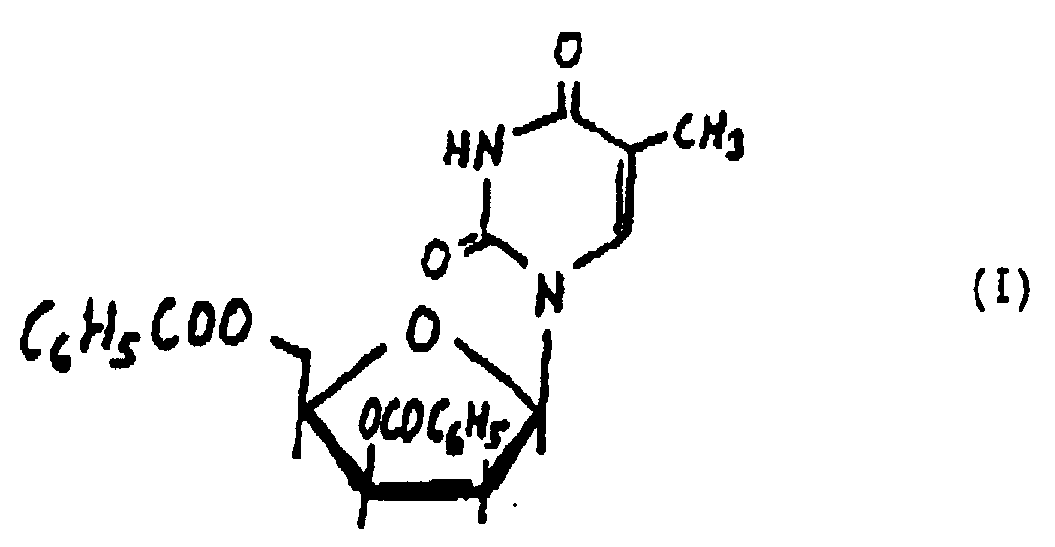


- Verwendung der Verbindung nach Formel I bei der Darstellung von 1-(2-Desoxy-β-D-threo-pentofuranosyl)thymin.
Applications Claiming Priority (2)
| Application Number | Priority Date | Filing Date | Title |
|---|---|---|---|
| CS875688A CS265967B1 (en) | 1987-07-29 | 1987-07-29 | 1-(3,5-di-0-benzoyl-2-deoxy-beta-d-threo-pentafuranosile)thymine and method of its preparation |
| CS5688/87 | 1987-07-29 |
Publications (3)
| Publication Number | Publication Date |
|---|---|
| EP0301908A2 EP0301908A2 (de) | 1989-02-01 |
| EP0301908A3 EP0301908A3 (en) | 1990-11-28 |
| EP0301908B1 true EP0301908B1 (de) | 1994-02-09 |
Family
ID=5402210
Family Applications (1)
| Application Number | Title | Priority Date | Filing Date |
|---|---|---|---|
| EP19880307060 Expired - Lifetime EP0301908B1 (de) | 1987-07-29 | 1988-07-29 | 1-(3,5-Di-0-benzoyl-2-deoxy-beta-D-threo-pentofuranosyl)Thymine und Verfahren zu deren Herstellung |
Country Status (3)
| Country | Link |
|---|---|
| EP (1) | EP0301908B1 (de) |
| CS (1) | CS265967B1 (de) |
| DE (1) | DE3887710T2 (de) |
Cited By (2)
| Publication number | Priority date | Publication date | Assignee | Title |
|---|---|---|---|---|
| RU2102399C1 (ru) * | 1994-09-26 | 1998-01-20 | Институт органической химии Уфимского научного центра РАН | Способ получения 3'-азидо-2',3'-дидезокситимидина |
| RU2108339C1 (ru) * | 1994-09-27 | 1998-04-10 | Закрытое акционерное общество Производственно-коммерческая ассоциация "АЗТ" | Способ получения 2'-дезоксиксилотимидина, производные d-ксилофуранозы, производные ксилотимидина |
Families Citing this family (1)
| Publication number | Priority date | Publication date | Assignee | Title |
|---|---|---|---|---|
| CN104710490B (zh) * | 2013-12-13 | 2019-05-03 | 安徽贝克联合制药有限公司 | 一种齐多夫定的制备方法 |
-
1987
- 1987-07-29 CS CS875688A patent/CS265967B1/cs not_active IP Right Cessation
-
1988
- 1988-07-29 DE DE19883887710 patent/DE3887710T2/de not_active Expired - Fee Related
- 1988-07-29 EP EP19880307060 patent/EP0301908B1/de not_active Expired - Lifetime
Cited By (2)
| Publication number | Priority date | Publication date | Assignee | Title |
|---|---|---|---|---|
| RU2102399C1 (ru) * | 1994-09-26 | 1998-01-20 | Институт органической химии Уфимского научного центра РАН | Способ получения 3'-азидо-2',3'-дидезокситимидина |
| RU2108339C1 (ru) * | 1994-09-27 | 1998-04-10 | Закрытое акционерное общество Производственно-коммерческая ассоциация "АЗТ" | Способ получения 2'-дезоксиксилотимидина, производные d-ксилофуранозы, производные ксилотимидина |
Also Published As
| Publication number | Publication date |
|---|---|
| DE3887710T2 (de) | 1994-08-04 |
| EP0301908A2 (de) | 1989-02-01 |
| CS568887A1 (en) | 1989-03-14 |
| EP0301908A3 (en) | 1990-11-28 |
| CS265967B1 (en) | 1989-11-14 |
| DE3887710D1 (de) | 1994-03-24 |
Similar Documents
| Publication | Publication Date | Title |
|---|---|---|
| SK545290A3 (en) | Method of preparation of 2'3'-dideoxy-2'-fluoronucleosides and 2'3'-dideoxy-2'3'-didehydro-2'-fluoronucleosides | |
| WO1991016333A1 (en) | 2',3'-dideoxy-4'-thioribonucleosides as antiviral agents | |
| Takaku et al. | Synthesis of oligoribonucleotides using 4-methoxybenzyl group as a new protecting group of the 2′-hydroxyl group of adenosine | |
| Tong et al. | Synthesis of some 3'-O-methylpurine ribonucleosides | |
| Sakata et al. | Synthesis and reactions of glycosyl methyl-and benzyl-xanthates: A facile synthesis of 1-thioglycosides | |
| WO1984000759A1 (fr) | Derives de desoxyuridine, leurs procedes de preparation et leur utilisation comme produits pharmaceutiques | |
| DK148060B (da) | Fremgangsmaade til fremstilling af 5'-deoxy-5-fluoruridin | |
| CA1211373A (en) | Pharmaceutical compositions based on xylosides and lyxosides of purine and pyrimidine bases | |
| KR100910791B1 (ko) | 2'-할로-β-L-아라비노퓨라노실 뉴클레오사이드의 제조방법 | |
| EP0301908B1 (de) | 1-(3,5-Di-0-benzoyl-2-deoxy-beta-D-threo-pentofuranosyl)Thymine und Verfahren zu deren Herstellung | |
| US5466793A (en) | Process for preparing 2', 3'- dideoxyinosine | |
| AU2002303187A1 (en) | Process for the preparation of 2'-HALO-Beta-L-arabinofuranosyl nucleosides | |
| US5290927A (en) | Process for preparing 2',3'-dideoxyadenosine | |
| Nesnow et al. | Pyridine nucleosides related to 5-fluorouracil and thymine | |
| JPH01224390A (ja) | ヌクレオシド誘導体の製造方法 | |
| US5817639A (en) | Purine 4'-thioarabinonucleosides | |
| SU937459A1 (ru) | Способ получени 2 @ ,3 @ -дидезоксинуклеозидов | |
| US3491085A (en) | 2' - and 3'-deto nucleosides and process for preparing same | |
| EP0493602A1 (de) | Verfahren zur herstellung von 2',3'-dideoxy-2',3'-didehydronucleosid | |
| CS274511B1 (en) | Method of 1-(3,5-di-o-benzoyl-2-chloro-2-deoxy-beta-d-threo-pentafuranosile)thymine preparation | |
| CS276874B6 (cs) | l-(3-azido-2,3-dideoxy-Beta-D-allokofuranosylJthymin, způsob jeho přípravy a použití | |
| Krečmerová et al. | Synthesis of 5-phenylcytosine nucleoside derivatives | |
| Joshi et al. | Some reactions of (5 R)-2-methylene-5-(thymin-1-yl)-2, 5-dihydrofuran | |
| JPH0390096A (ja) | ヌクレオシド誘導体の製造方法 | |
| JPWO1992002516A1 (ja) | 2′,3′―ジデオキシ―2′,3′―ジデヒドロヌクレオシド類の製造方法 |
Legal Events
| Date | Code | Title | Description |
|---|---|---|---|
| PUAI | Public reference made under article 153(3) epc to a published international application that has entered the european phase |
Free format text: ORIGINAL CODE: 0009012 |
|
| AK | Designated contracting states |
Kind code of ref document: A2 Designated state(s): CH DE FR GB LI |
|
| PUAL | Search report despatched |
Free format text: ORIGINAL CODE: 0009013 |
|
| AK | Designated contracting states |
Kind code of ref document: A3 Designated state(s): CH DE FR GB LI |
|
| 17P | Request for examination filed |
Effective date: 19910102 |
|
| 17Q | First examination report despatched |
Effective date: 19920729 |
|
| GRAA | (expected) grant |
Free format text: ORIGINAL CODE: 0009210 |
|
| AK | Designated contracting states |
Kind code of ref document: B1 Designated state(s): CH DE FR GB LI |
|
| PG25 | Lapsed in a contracting state [announced via postgrant information from national office to epo] |
Ref country code: LI Effective date: 19940209 Ref country code: CH Effective date: 19940209 |
|
| REF | Corresponds to: |
Ref document number: 3887710 Country of ref document: DE Date of ref document: 19940324 |
|
| REG | Reference to a national code |
Ref country code: CH Ref legal event code: PL |
|
| ET | Fr: translation filed | ||
| PG25 | Lapsed in a contracting state [announced via postgrant information from national office to epo] |
Ref country code: GB Effective date: 19940729 |
|
| PLBE | No opposition filed within time limit |
Free format text: ORIGINAL CODE: 0009261 |
|
| STAA | Information on the status of an ep patent application or granted ep patent |
Free format text: STATUS: NO OPPOSITION FILED WITHIN TIME LIMIT |
|
| 26N | No opposition filed | ||
| GBPC | Gb: european patent ceased through non-payment of renewal fee |
Effective date: 19940729 |
|
| PGFP | Annual fee paid to national office [announced via postgrant information from national office to epo] |
Ref country code: FR Payment date: 20030711 Year of fee payment: 16 |
|
| PGFP | Annual fee paid to national office [announced via postgrant information from national office to epo] |
Ref country code: DE Payment date: 20030807 Year of fee payment: 16 |
|
| PG25 | Lapsed in a contracting state [announced via postgrant information from national office to epo] |
Ref country code: DE Free format text: LAPSE BECAUSE OF NON-PAYMENT OF DUE FEES Effective date: 20050201 |
|
| PG25 | Lapsed in a contracting state [announced via postgrant information from national office to epo] |
Ref country code: FR Free format text: LAPSE BECAUSE OF NON-PAYMENT OF DUE FEES Effective date: 20050331 |
|
| REG | Reference to a national code |
Ref country code: FR Ref legal event code: ST |