EP0289705A2 - Bei hoher Temperatur entladbares galvanisches Primärelement mit alkalischem Elektrolyten - Google Patents
Bei hoher Temperatur entladbares galvanisches Primärelement mit alkalischem Elektrolyten Download PDFInfo
- Publication number
- EP0289705A2 EP0289705A2 EP88101576A EP88101576A EP0289705A2 EP 0289705 A2 EP0289705 A2 EP 0289705A2 EP 88101576 A EP88101576 A EP 88101576A EP 88101576 A EP88101576 A EP 88101576A EP 0289705 A2 EP0289705 A2 EP 0289705A2
- Authority
- EP
- European Patent Office
- Prior art keywords
- primary element
- electrode
- element according
- cadmium
- cell
- Prior art date
- Legal status (The legal status is an assumption and is not a legal conclusion. Google has not performed a legal analysis and makes no representation as to the accuracy of the status listed.)
- Granted
Links
Images
Classifications
-
- H—ELECTRICITY
- H01—ELECTRIC ELEMENTS
- H01M—PROCESSES OR MEANS, e.g. BATTERIES, FOR THE DIRECT CONVERSION OF CHEMICAL ENERGY INTO ELECTRICAL ENERGY
- H01M6/00—Primary cells; Manufacture thereof
- H01M6/04—Cells with aqueous electrolyte
- H01M6/06—Dry cells, i.e. cells wherein the electrolyte is rendered non-fluid
-
- H—ELECTRICITY
- H01—ELECTRIC ELEMENTS
- H01M—PROCESSES OR MEANS, e.g. BATTERIES, FOR THE DIRECT CONVERSION OF CHEMICAL ENERGY INTO ELECTRICAL ENERGY
- H01M50/00—Constructional details or processes of manufacture of the non-active parts of electrochemical cells other than fuel cells, e.g. hybrid cells
- H01M50/40—Separators; Membranes; Diaphragms; Spacing elements inside cells
- H01M50/409—Separators, membranes or diaphragms characterised by the material
- H01M50/411—Organic material
- H01M50/414—Synthetic resins, e.g. thermoplastics or thermosetting resins
- H01M50/417—Polyolefins
-
- H—ELECTRICITY
- H01—ELECTRIC ELEMENTS
- H01M—PROCESSES OR MEANS, e.g. BATTERIES, FOR THE DIRECT CONVERSION OF CHEMICAL ENERGY INTO ELECTRICAL ENERGY
- H01M50/00—Constructional details or processes of manufacture of the non-active parts of electrochemical cells other than fuel cells, e.g. hybrid cells
- H01M50/40—Separators; Membranes; Diaphragms; Spacing elements inside cells
- H01M50/409—Separators, membranes or diaphragms characterised by the material
- H01M50/411—Organic material
- H01M50/414—Synthetic resins, e.g. thermoplastics or thermosetting resins
- H01M50/426—Fluorocarbon polymers
-
- H—ELECTRICITY
- H01—ELECTRIC ELEMENTS
- H01M—PROCESSES OR MEANS, e.g. BATTERIES, FOR THE DIRECT CONVERSION OF CHEMICAL ENERGY INTO ELECTRICAL ENERGY
- H01M50/00—Constructional details or processes of manufacture of the non-active parts of electrochemical cells other than fuel cells, e.g. hybrid cells
- H01M50/40—Separators; Membranes; Diaphragms; Spacing elements inside cells
- H01M50/409—Separators, membranes or diaphragms characterised by the material
- H01M50/449—Separators, membranes or diaphragms characterised by the material having a layered structure
-
- H—ELECTRICITY
- H01—ELECTRIC ELEMENTS
- H01M—PROCESSES OR MEANS, e.g. BATTERIES, FOR THE DIRECT CONVERSION OF CHEMICAL ENERGY INTO ELECTRICAL ENERGY
- H01M2300/00—Electrolytes
- H01M2300/0002—Aqueous electrolytes
- H01M2300/0014—Alkaline electrolytes
Definitions
- the invention relates to a primary element that can be discharged at high temperature with alkaline electrolyte in a metal housing of the round cell type.
- Such a primary element is e.g. known from DE-OS 33 37 570.
- Round cells of this type preferably based on the powerful alkaline silver oxide / zinc system, are required in particular for probes and auxiliary devices in the exploration of mineral resources. Since ever deeper layers of the earth have to be tapped to find and promote them, the temperature prevailing there becomes the most important stress factor that decides on the possibilities of using a battery.
- a good prerequisite for ensuring that, for example, manganese dioxide cells remain sufficiently functional even at temperatures above 100 ° C. has already been created by the introduction of the potassium hydroxide solution instead of the leclanché electrolyte in the conventional primary elements.
- the invention is therefore based on the object of modifying an alkaline primary element based on the otherwise proven design principle of the round cell with an externally arranged positive electrode so that its reliable use is also possible in the temperature range mentioned and without the dangerous tendency towards gassing.
- a concentric electrode configuration which consists of an outer ring cylinder, which forms the positive electrode and is composed of silver oxide or brown stone powder compacts, and the interior of which is filled with a cadmium electrode in the form of a round winding with the interposition of a separator .
- a cadmium electrode is used with particular advantage, which can be obtained by cathodic metal deposition from cadmium salt solutions on a carrier metal strip by a process known from DE-OS 28 22 821 and which is therefore also referred to as an electrode deposit electrode.
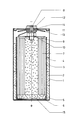
- the figure shows the overall structure of the primary element according to the invention.
- the cathode rings 2 made of pressed silver oxide and / or brown stone powder, which may contain conductive material such as e.g. Contains carbon, pressed in tubularly.
- a single-layer or multi-layer separator made of thin foils and / or nonwoven layers rests on the cathode rings, but preferably consists of an external PTFE grid and an inner ion exchange membrane 4 shaped as a sleeve, the bottom of the sleeve being reinforced by an insulating layer 5 made of PTFE is.
- RAI Research Corp. has become an ion exchange membrane under the trade name "PERMION".
- available films based on radiation-cross-linked polyethylene have proven particularly successful.
- other separators can also be used, provided they meet the current high temperature requirements.
- a further insulating disk 6 separates the cell internals from the metallic bottom of the housing cup 1.
- the interior of the cell is essentially taken up by the cadmium electrode 7, which is designed as a round winding, the carrier metal strip on which the winding is based consists of nickel, a nickel steel, silver or also copper.
- a pin 8 preferably made of stainless steel, serves as a negative arrester, which is screwed to a contact disk 9 by means of a nut 10, possibly also welded or riveted.
- the contact disk 9 is welded to the round winding 7.
- the arrester 8 leads through the opening of the metallic cover 11 and forms the negative cell pole on the upper side thereof together with the rivet ring 12. So that he does not get in contact with the end cover, there is a sealing (13) or insulating washer 14 below and above the end cover 11, preferably made of PTFE or another alkali and high temperature resistant plastic, e.g. Polyether ketone.
- An aqueous potassium hydroxide solution serves as electrolyte 15.
- the end cover 11 is hermetically sealed to the housing cup 1 by laser welding.
- Such a primary element according to the invention can be used even at extremely high temperatures (up to 200 ° C. and above) and does the job because its negative electrode does not develop hydrogen under the conditions mentioned.
- the internal pressure of the cell is essentially determined by the vapor pressure of the electrolyte (approx. 6 bar at 200 ° C).
Landscapes
- Chemical & Material Sciences (AREA)
- Chemical Kinetics & Catalysis (AREA)
- Electrochemistry (AREA)
- General Chemical & Material Sciences (AREA)
- Engineering & Computer Science (AREA)
- Manufacturing & Machinery (AREA)
- Battery Electrode And Active Subsutance (AREA)
- Primary Cells (AREA)
- Secondary Cells (AREA)
- Cell Separators (AREA)
- Conductive Materials (AREA)
- Electrolytic Production Of Non-Metals, Compounds, Apparatuses Therefor (AREA)
Abstract
Description
- Die Erfindung betrifft ein bei hoher Temperatur entladbares Primärelement mit alkalischem Elektrolyten in einem Metallgehäuse vom Rundzellentyp.
- Ein solches Primärelement ist z.B. aus der DE-OS 33 37 570 bekannt. Derartige Rundzellen, vorzugsweise auf der Grundlage des leistungsstarken alkalischen Silberoxid/Zink-Systems, werden insbesondere für Sonden und Hilfseinrichtungen bei der Exploration von Bodenschätzen benötigt. Da zu deren Suche und Förderung immer tiefere Erdschichten erschlossen werden müssen, wird die dort herrschende Temperatur zum wichtigsten Belastungsfaktor, der über Möglichkeiten eines Batterieeinsatzes entscheidet. Eine gute Voraussetzung dafür, daß beispielsweise Braunstein-Zellen auch noch bei Temperaturen oberhalb 100°C hinreichend funktionsfähig bleiben, wurde bereits durch die Einführung der Kalilauge anstelle des Leclanché-Elektrolyten bei den konventionellen Primärelementen geschaffen. Ein weiterer Schritt mit dem Ziel, den mit der hohen Temperatur wiederum einhergehenden korrosiven Angriff des Laugeelektrolyten auf die Innenbestandteile der Zelle abzuschwächen, konzentrierte sich gemäß der erwähnten DE-OS auf die Auswahl von widerstandsfähigeren Materialien für den Separator, wobei sich eine Kombination zwischen einem Keramikpapier und einer Ionenaustauschermembran als sehr zweckmäßig herausgestellt hat.
- Indessen stoßen sowohl Alkali-Mangan- als auch Silberoxid-Rundzellen mit negativen Zinkelektroden trotz Ausstattung mit weitgehend inerten Scheidern bei etwa 160°C an eine Grenze ihrer Einsatzfähigkeit. Der Grund liegt jedoch weniger in Qualitätsmängeln bei den elektrochemisch inaktiven Zellkomponenten, sondern er wurde aufgrund von Explosionen, von denen eine Anzahl Zellen während eines Lagerungstests bei 160°C bereits am 3. Tag betroffen war, in einer starken Gasentwicklung der Zinkelektroden erkannt, welche daher rührt, daß die Wasserstoffüberspannung am Zink durch steigende Temperatur vermindert wird, was sich in einer exponentiell ansteigenden Gasungsrate äußert.
- Der Erfindung liegt somit die Aufgabe zugrunde, ein alkalisches Primärelement unter Anknüpfung an das sonst bewährte Konstruktionsprinzip der Rundzelle mit außen angeordneter positiver Elektrode so zu modifizieren, daß sein zuverlässiger Gebrauch auch noch in dem erwähnten Temperaturgebiet und ohne die gefährliche Gasungsneigung möglich ist.
- Die Aufgabe wird erfindungsgemäß mit den im kennzeichnenden Teil des Anspruchs 1 angegebenen Mitteln gelöst. Danach hat sich eine konzentrische Elektrodenkonfiguration als günstig herausgestellt, die aus einem äußeren Ringzylinder besteht, welcher die positiv Elektrode bildet und aus Silberoxid- oder Braunstein-Pulverpreßlingen zusammengesetzt ist, und deren Innenraum unter Zwischenlage eines Separators von einer Cadmiumelektrode in der Form eines Rundwickels ausgefüllt ist.
- Mit besonderem Vorteil wird erfindungsgemäß eine Cadmiumelektrode verwendet, die man nach einem aus der DE-OS 28 22 821 bekannten Verfahren durch kathodische Metallabscheidung aus Cadmiumsalzlösungen auf einem Trägermetallband erhalten kann und die deshalb auch als Elektrodeposit-Elektrode bezeichnet wird.
- Die Figur zeigt den Gesamtaufbau des erfindungsgemäßen Primärelements. In den Metallgehäusebecher 1 sind als positive Elektrode die Kathodenringe 2 aus gepreßtem Silberoxid- und/oder Braunsteinpulver, welches gegebenenfalls Leitmaterial wie z.B. Kohlenstoff enthält, röhrenförmig eingepreßt. An den Kathodenringen liegt ein ein- oder mehrlagiger Separator aus dünnen Folien und/oder Vliesschichten an, der vorzugsweise jedoch aus einem außenliegenden PTFE-Gitter und einer innenliegenden als Hülse geformten Ionenaustauschermembran 4 besteht, wobei der Boden der Hülse durch eine Isolierienlage 5 aus PTFE verstärkt ist.
- Als Ionenaustauschermembran haben sich unter dem Handelsnamen "PERMION" der RAI Research Corp. erhältliche Filme auf der Grundlage von strahlenvernetztem Polyäthylen besonders bewährt. Es können jedoch auch andere Separatoren eingesetzt werden, sofern sie den hier aktuellen hohen Temperaturanforderungen genügen.
- Eine weitere Isolierscheibe 6 separiert die Zelleneinbauten insgesamt von dem metallischen Boden des Gehäusebechers 1. Das Zelleninnere wird im wesentlichen von der als Rundwickel ausgebildeten Cadmiumelektrode 7 eingenommen, wobei das dem Wickel zugrundeliegende Trägermetallband aus Nickel, einem Nickelstahl, Silber oder auch Kupfer besteht.
- Als negativer Ableiter dient ein Stift 8, vorzugsweise aus Edelstahl, der mit einer Kontaktscheibe 9 mittels Mutter 10 verschraubt, ggfs. auch verschweißt oder vernietet ist. Die Kontaktscheibe 9 ist andererseits mit dem Rundwickel 7 verschweißt. Der Ableiter 8 führt durch die Öffnung des metallischen Abschlußdeckels 11 und bildet auf dessen Oberseite zusammen mit dem Nietring 12 den negativen Zellenpol. Damit er jedoch zum Abschlußdeckel keinen Kontakt bekommt, ist unter- und oberhalb des Abschlußdeckels 11 jeweils eine Dichtungs- (13) bzw. Isolierscheibe 14, vorzugsweise aus PTFE oder einem anderen lauge- und hochtemperaturbeständigen Kunststoff, z.B. Polyetherketon, gelegt.
- Als Elektrolyt 15 dient eine wässrige Kalilauge. Der Abschlußdeckel 11 ist mit dem Gehäusebecher 1 durch Laserverschweißung hermetisch dicht verbunden.
- Ein solches Primärelement gemäß der Erfindung kann selbst bei extrem hohen Temperaturen (bis 200°C und darüber) eingesetzt werden und erfüllt die gestellte Aufgabe, weil seine negative Elektrode unter den genannten Bedingungen keinen Wasserstoff entwickelt. Der Innendruck der Zelle wird im wesentlichen durch den Dampfdruck des Elektrolyten (ca. 6 bar bei 200°C) bestimmt.
- Der Vorteil dieser Zelle im Vergleich zu herkömmlichen alkalischen Rundzellen der Systeme Ag₂O/Zn oder MnO₂/Zn liegt somit auf der Hand.
- In Lagerungstests hat sich gezeigt, daß erfindungsgemäße Zellen Lagerzeiten bei 200°C über 6 Wochen hinaus ohne Verlust ihrer Funktionsfähigkeit überstehen. Dagegen muß bei handelsüblichen alkalischen Hochtemperaturzellen vom Ag₂O/Zn-Typ bereits nach einem 5tägigen Einsatz bei nur 163°C mit einem Bersten gerechnet werden, weil die entwickelte Wasserstoffmenge dann ein unzuträgliches Ausmaß erreicht.
Claims (6)
Applications Claiming Priority (2)
| Application Number | Priority Date | Filing Date | Title |
|---|---|---|---|
| DE19873714654 DE3714654A1 (de) | 1987-05-02 | 1987-05-02 | Bei hoher temperatur entladbares galvanisches primaerelement mit alkalischem elektrolyten |
| DE3714654 | 1987-05-02 |
Publications (3)
| Publication Number | Publication Date |
|---|---|
| EP0289705A2 true EP0289705A2 (de) | 1988-11-09 |
| EP0289705A3 EP0289705A3 (en) | 1989-03-22 |
| EP0289705B1 EP0289705B1 (de) | 1992-06-24 |
Family
ID=6326703
Family Applications (1)
| Application Number | Title | Priority Date | Filing Date |
|---|---|---|---|
| EP88101576A Expired - Lifetime EP0289705B1 (de) | 1987-05-02 | 1988-02-04 | Bei hoher Temperatur entladbares galvanisches Primärelement mit alkalischem Elektrolyten |
Country Status (13)
| Country | Link |
|---|---|
| US (1) | US4897323A (de) |
| EP (1) | EP0289705B1 (de) |
| JP (1) | JP2683027B2 (de) |
| BR (1) | BR8802079A (de) |
| CA (1) | CA1290394C (de) |
| DE (2) | DE3714654A1 (de) |
| ES (1) | ES2032878T3 (de) |
| GR (1) | GR3005452T3 (de) |
| HK (1) | HK34493A (de) |
| IL (1) | IL85815A (de) |
| MX (1) | MX167570B (de) |
| NO (1) | NO171877C (de) |
| SG (1) | SG126492G (de) |
Families Citing this family (6)
| Publication number | Priority date | Publication date | Assignee | Title |
|---|---|---|---|---|
| EP0354966B1 (de) * | 1988-01-22 | 1996-06-12 | Japan Storage Battery Company Limited | Alkalische batterien und verfahren zur herstellung |
| US5427872A (en) * | 1993-11-17 | 1995-06-27 | The United States Of America As Represented By The Administrator Of The National Aeronautics And Space Administration | Dendrite preventing separator for secondary lithium batteries |
| KR100274889B1 (ko) * | 1998-05-08 | 2001-02-01 | 김순택 | 각형 이차전지의 캡 어셈블리 |
| RU2153029C1 (ru) * | 1999-11-01 | 2000-07-20 | Открытое акционерное общество "Интеграл" | Электролит кадмирования |
| US7479349B2 (en) | 2002-12-31 | 2009-01-20 | Cardiac Pacemakers, Inc. | Batteries including a flat plate design |
| US7926243B2 (en) * | 2009-01-06 | 2011-04-19 | Graham Packaging Company, L.P. | Method and system for handling containers |
Family Cites Families (9)
| Publication number | Priority date | Publication date | Assignee | Title |
|---|---|---|---|---|
| NL82738C (de) * | 1951-09-15 | |||
| US2970180A (en) * | 1959-06-17 | 1961-01-31 | Union Carbide Corp | Alkaline deferred action cell |
| FR1284552A (fr) * | 1960-11-23 | 1962-02-16 | Yardney International Corp | Générateur électro-chimique étanche |
| US3945847A (en) * | 1971-12-28 | 1976-03-23 | Union Carbide Corporation | Coherent manganese dioxide electrodes, process for their production, and electrochemical cells utilizing them |
| FR2392502A1 (fr) * | 1977-05-24 | 1978-12-22 | Wonder | Procede et dispositif pour fabriquer des electrodes negatives, notamment en cadmium ou en zinc, pour generateurs electrochimiques et electrodes negatives ainsi obtenues |
| CA1128121A (en) * | 1978-03-30 | 1982-07-20 | Union Carbide Corporation | Cadium compound additive for cells using divalent silver oxide |
| US4185144A (en) * | 1978-09-05 | 1980-01-22 | Polaroid Corporation | Electrochemical cell with a cadmium patch electrode |
| JPS58209067A (ja) * | 1982-05-28 | 1983-12-05 | Toshiba Corp | 電池 |
| DE3337570C2 (de) * | 1983-10-15 | 1986-03-13 | Varta Batterie Ag, 3000 Hannover | Bei hoher Temperatur entladbares galvanisches Primärelement |
-
1987
- 1987-05-02 DE DE19873714654 patent/DE3714654A1/de not_active Withdrawn
-
1988
- 1988-02-04 ES ES198888101576T patent/ES2032878T3/es not_active Expired - Lifetime
- 1988-02-04 DE DE8888101576T patent/DE3872299D1/de not_active Expired - Lifetime
- 1988-02-04 EP EP88101576A patent/EP0289705B1/de not_active Expired - Lifetime
- 1988-03-02 NO NO880924A patent/NO171877C/no unknown
- 1988-03-22 IL IL85815A patent/IL85815A/xx not_active IP Right Cessation
- 1988-03-30 US US07/175,221 patent/US4897323A/en not_active Expired - Fee Related
- 1988-04-25 CA CA000564960A patent/CA1290394C/en not_active Expired - Lifetime
- 1988-04-27 JP JP63102833A patent/JP2683027B2/ja not_active Expired - Lifetime
- 1988-04-29 BR BR8802079A patent/BR8802079A/pt not_active IP Right Cessation
- 1988-04-29 MX MX011315A patent/MX167570B/es unknown
-
1992
- 1992-08-20 GR GR920401269T patent/GR3005452T3/el unknown
- 1992-12-10 SG SG1264/92A patent/SG126492G/en unknown
-
1993
- 1993-04-08 HK HK344/93A patent/HK34493A/xx not_active IP Right Cessation
Also Published As
| Publication number | Publication date |
|---|---|
| NO880924D0 (no) | 1988-03-02 |
| NO171877B (no) | 1993-02-01 |
| CA1290394C (en) | 1991-10-08 |
| JPS63284762A (ja) | 1988-11-22 |
| HK34493A (en) | 1993-04-16 |
| MX167570B (es) | 1993-03-30 |
| SG126492G (en) | 1993-02-19 |
| EP0289705B1 (de) | 1992-06-24 |
| EP0289705A3 (en) | 1989-03-22 |
| JP2683027B2 (ja) | 1997-11-26 |
| IL85815A (en) | 1991-06-30 |
| DE3872299D1 (de) | 1992-07-30 |
| BR8802079A (pt) | 1988-11-29 |
| IL85815A0 (en) | 1988-09-30 |
| GR3005452T3 (de) | 1993-05-24 |
| DE3714654A1 (de) | 1988-11-10 |
| NO880924L (no) | 1988-11-03 |
| US4897323A (en) | 1990-01-30 |
| ES2032878T3 (es) | 1993-03-01 |
| NO171877C (no) | 1993-05-12 |
Similar Documents
| Publication | Publication Date | Title |
|---|---|---|
| DE69120434T2 (de) | Hohe Energiedichte aufweisende Lithiumzelle mit nicht-wässrigem Elektrolyt, die über einen weiten Temeperaturbereich einsatzbereit ist | |
| DE3838575A1 (de) | Elektrische zelle | |
| DE19936063A1 (de) | Elektrochemische Sekundärzelle | |
| EP4158711B1 (de) | Elektrochemische zelle | |
| DE69226439T2 (de) | Batterie mit elektrochemischer prüfvorrichtung | |
| WO2008058685A1 (de) | Wiederaufladbare elektrochemische batteriezelle | |
| DE2448370B2 (de) | Anordnung von Knopfzellen in einem mehrteiligen Gehäuse | |
| DE102012213100A1 (de) | Batterie mit Thermoschalter | |
| DE2829031B2 (de) | Galvanische Zelle mit einem festen Elektrolyten aus Lithiumjodid | |
| EP3284119B1 (de) | Batterie mit prismatischem metallgehäuse | |
| CH624244A5 (de) | ||
| DE202021100473U1 (de) | Elektrochemische Zelle mit Kontaktfahne | |
| DE2754651A1 (de) | Galvanisches lagerelement | |
| DE2613901A1 (de) | Sekundaerbatterie | |
| DE2420144C3 (de) | Abgeschlossenes Silber-Zink-Element für niedere Entladungsrate | |
| EP0289705B1 (de) | Bei hoher Temperatur entladbares galvanisches Primärelement mit alkalischem Elektrolyten | |
| DE3436115C2 (de) | Gasdichte Blei-Akkumulatorzelle | |
| WO2002025752A1 (de) | Gehäuse für elektrochemische zellen | |
| DE2262660B2 (de) | Nichtwäßriges galvanisches Element | |
| WO2000044061A1 (de) | Nichtwässrige elektrochemische zelle | |
| DE2819583C2 (de) | Elektrochemische Speicherzelle | |
| DE102015207069A1 (de) | Batterie mit prismatischem Metallgehäuse | |
| DE102014201539A1 (de) | Batteriegehäuse und Batterie aufweisend ein Batteriegehäuse | |
| DE68906071T2 (de) | Methode zur Herstellung einer gasdicht verschlossenen elektrochemischen Zelle. | |
| EP3742514A1 (de) | Verfahren zur herstellung einer batterie und gemäss dem verfahren hergestellte batterie |
Legal Events
| Date | Code | Title | Description |
|---|---|---|---|
| PUAI | Public reference made under article 153(3) epc to a published international application that has entered the european phase |
Free format text: ORIGINAL CODE: 0009012 |
|
| AK | Designated contracting states |
Kind code of ref document: A2 Designated state(s): BE CH DE ES FR GB GR IT LI SE |
|
| PUAL | Search report despatched |
Free format text: ORIGINAL CODE: 0009013 |
|
| AK | Designated contracting states |
Kind code of ref document: A3 Designated state(s): BE CH DE ES FR GB GR IT LI SE |
|
| 17P | Request for examination filed |
Effective date: 19890310 |
|
| 17Q | First examination report despatched |
Effective date: 19910325 |
|
| GRAA | (expected) grant |
Free format text: ORIGINAL CODE: 0009210 |
|
| ITF | It: translation for a ep patent filed | ||
| AK | Designated contracting states |
Kind code of ref document: B1 Designated state(s): BE CH DE ES FR GB GR IT LI SE |
|
| GBT | Gb: translation of ep patent filed (gb section 77(6)(a)/1977) | ||
| REF | Corresponds to: |
Ref document number: 3872299 Country of ref document: DE Date of ref document: 19920730 |
|
| ET | Fr: translation filed | ||
| REG | Reference to a national code |
Ref country code: GR Ref legal event code: FG4A Free format text: 3005452 |
|
| REG | Reference to a national code |
Ref country code: ES Ref legal event code: FG2A Ref document number: 2032878 Country of ref document: ES Kind code of ref document: T3 |
|
| PLBE | No opposition filed within time limit |
Free format text: ORIGINAL CODE: 0009261 |
|
| STAA | Information on the status of an ep patent application or granted ep patent |
Free format text: STATUS: NO OPPOSITION FILED WITHIN TIME LIMIT |
|
| 26N | No opposition filed | ||
| EAL | Se: european patent in force in sweden |
Ref document number: 88101576.2 |
|
| PGFP | Annual fee paid to national office [announced via postgrant information from national office to epo] |
Ref country code: BE Payment date: 19971125 Year of fee payment: 11 |
|
| PGFP | Annual fee paid to national office [announced via postgrant information from national office to epo] |
Ref country code: GR Payment date: 19971212 Year of fee payment: 11 |
|
| PGFP | Annual fee paid to national office [announced via postgrant information from national office to epo] |
Ref country code: FR Payment date: 19971230 Year of fee payment: 11 |
|
| PGFP | Annual fee paid to national office [announced via postgrant information from national office to epo] |
Ref country code: SE Payment date: 19980105 Year of fee payment: 11 |
|
| PGFP | Annual fee paid to national office [announced via postgrant information from national office to epo] |
Ref country code: DE Payment date: 19980106 Year of fee payment: 11 |
|
| PGFP | Annual fee paid to national office [announced via postgrant information from national office to epo] |
Ref country code: GB Payment date: 19980126 Year of fee payment: 11 |
|
| PGFP | Annual fee paid to national office [announced via postgrant information from national office to epo] |
Ref country code: ES Payment date: 19980205 Year of fee payment: 11 |
|
| PGFP | Annual fee paid to national office [announced via postgrant information from national office to epo] |
Ref country code: CH Payment date: 19980216 Year of fee payment: 11 |
|
| PG25 | Lapsed in a contracting state [announced via postgrant information from national office to epo] |
Ref country code: GB Free format text: LAPSE BECAUSE OF NON-PAYMENT OF DUE FEES Effective date: 19990204 |
|
| PG25 | Lapsed in a contracting state [announced via postgrant information from national office to epo] |
Ref country code: SE Free format text: LAPSE BECAUSE OF NON-PAYMENT OF DUE FEES Effective date: 19990205 Ref country code: ES Free format text: LAPSE BECAUSE OF EXPIRATION OF PROTECTION Effective date: 19990205 |
|
| PG25 | Lapsed in a contracting state [announced via postgrant information from national office to epo] |
Ref country code: LI Free format text: LAPSE BECAUSE OF NON-PAYMENT OF DUE FEES Effective date: 19990228 Ref country code: GR Free format text: LAPSE BECAUSE OF NON-PAYMENT OF DUE FEES Effective date: 19990228 Ref country code: CH Free format text: LAPSE BECAUSE OF NON-PAYMENT OF DUE FEES Effective date: 19990228 Ref country code: BE Free format text: LAPSE BECAUSE OF NON-PAYMENT OF DUE FEES Effective date: 19990228 |
|
| BERE | Be: lapsed |
Owner name: VARTA BATTERIE A.G. Effective date: 19990228 |
|
| GBPC | Gb: european patent ceased through non-payment of renewal fee |
Effective date: 19990204 |
|
| REG | Reference to a national code |
Ref country code: CH Ref legal event code: PL |
|
| PG25 | Lapsed in a contracting state [announced via postgrant information from national office to epo] |
Ref country code: FR Free format text: LAPSE BECAUSE OF NON-PAYMENT OF DUE FEES Effective date: 19991029 |
|
| EUG | Se: european patent has lapsed |
Ref document number: 88101576.2 |
|
| PG25 | Lapsed in a contracting state [announced via postgrant information from national office to epo] |
Ref country code: DE Free format text: LAPSE BECAUSE OF NON-PAYMENT OF DUE FEES Effective date: 19991201 |
|
| REG | Reference to a national code |
Ref country code: FR Ref legal event code: ST |
|
| REG | Reference to a national code |
Ref country code: ES Ref legal event code: FD2A Effective date: 20010601 |
|
| PG25 | Lapsed in a contracting state [announced via postgrant information from national office to epo] |
Ref country code: IT Free format text: LAPSE BECAUSE OF NON-PAYMENT OF DUE FEES;WARNING: LAPSES OF ITALIAN PATENTS WITH EFFECTIVE DATE BEFORE 2007 MAY HAVE OCCURRED AT ANY TIME BEFORE 2007. THE CORRECT EFFECTIVE DATE MAY BE DIFFERENT FROM THE ONE RECORDED. Effective date: 20050204 |