EP0282016A2 - Thixotropisches Additiv, Verfahren zu seiner Herstellung und seine Benützung - Google Patents
Thixotropisches Additiv, Verfahren zu seiner Herstellung und seine Benützung Download PDFInfo
- Publication number
- EP0282016A2 EP0282016A2 EP88103656A EP88103656A EP0282016A2 EP 0282016 A2 EP0282016 A2 EP 0282016A2 EP 88103656 A EP88103656 A EP 88103656A EP 88103656 A EP88103656 A EP 88103656A EP 0282016 A2 EP0282016 A2 EP 0282016A2
- Authority
- EP
- European Patent Office
- Prior art keywords
- microns
- calcium silicate
- xonotlite
- particle size
- micronized
- Prior art date
- Legal status (The legal status is an assumption and is not a legal conclusion. Google has not performed a legal analysis and makes no representation as to the accuracy of the status listed.)
- Granted
Links
Images
Classifications
-
- C—CHEMISTRY; METALLURGY
- C04—CEMENTS; CONCRETE; ARTIFICIAL STONE; CERAMICS; REFRACTORIES
- C04B—LIME, MAGNESIA; SLAG; CEMENTS; COMPOSITIONS THEREOF, e.g. MORTARS, CONCRETE OR LIKE BUILDING MATERIALS; ARTIFICIAL STONE; CERAMICS; REFRACTORIES; TREATMENT OF NATURAL STONE
- C04B14/00—Use of inorganic materials as fillers, e.g. pigments, for mortars, concrete or artificial stone; Treatment of inorganic materials specially adapted to enhance their filling properties in mortars, concrete or artificial stone
- C04B14/02—Granular materials, e.g. microballoons
- C04B14/04—Silica-rich materials; Silicates
-
- C—CHEMISTRY; METALLURGY
- C08—ORGANIC MACROMOLECULAR COMPOUNDS; THEIR PREPARATION OR CHEMICAL WORKING-UP; COMPOSITIONS BASED THEREON
- C08K—Use of inorganic or non-macromolecular organic substances as compounding ingredients
- C08K3/00—Use of inorganic substances as compounding ingredients
- C08K3/34—Silicon-containing compounds
-
- C—CHEMISTRY; METALLURGY
- C04—CEMENTS; CONCRETE; ARTIFICIAL STONE; CERAMICS; REFRACTORIES
- C04B—LIME, MAGNESIA; SLAG; CEMENTS; COMPOSITIONS THEREOF, e.g. MORTARS, CONCRETE OR LIKE BUILDING MATERIALS; ARTIFICIAL STONE; CERAMICS; REFRACTORIES; TREATMENT OF NATURAL STONE
- C04B2111/00—Mortars, concrete or artificial stone or mixtures to prepare them, characterised by specific function, property or use
- C04B2111/00034—Physico-chemical characteristics of the mixtures
- C04B2111/0012—Thixotropic mixtures
Definitions
- the present invention relates to a thixotropic additive based on crystalline calcium silicates, a process for preparing same and the use thereof as a rheological and thixotropic additive in liquid resin systems.
- Asbestos-based products are well known and still used as thixotropic and thickening products for liquid resin systems based on epoxy, polyester and polyurethane resins. Although the performance of these products is very satisfactory, the use and application of these fibrous materials have disadvantages. The main drawback is that the exposure to these materials can be detrimental to health.
- fibrous thickening and thixotropic agents for example synthetic fibers made of polyethylene. These materials have the disadvantage that they can be used only up to a limited temperature, i.e. about 130 °C. Furthermore, the average fiber length may be up to 200 microns or more, which gives a rough surface to the cured resin. For some applications there is even a requirement to use only inorganic thixotropic additives.
- organic rheological derivatives such as castor oil derivatives are widely used.
- These rheological additives have the disadvantage that, in order to be effective, they have to be processed within a specific temperature range above ambient temperature depending on the polarity of the solvent or resin used. It may also be required that they are pre-gellified in an organic solvent or plasticizer to obtain a paste. The temperature increase during processing must be obtained by a temperature-depending shear step, for example using a dissolver mixer. If the above conditions are not exactly fulfilled, these organic thixotropic additives will not be effective.
- an inorganic rheological and thixotropic additive based on small special aggregates of calcium silicate crystals, which additive does not contain any asbestos and can be easily processed at ambient temperature using standard equipment.
- These calcium silicate particles have a particle size of from about 0.5 to 50 microns and an average particle size d50 of from about 5 to 25 microns (measured by means of a laser beam as the diameter of spherical particles 50% of which each are larger or smaller than the measured value).
- These particles of calcium silicate crystals are obtainable from approximately spherical interlocked crystal aggregates based on xonotlite, tobermorite or other synthetic calcium silicate hydrates and having a diameter of from more than 10 microns up to 150 microns.
- the synthesis is effected, for example, by a hydrothermal reaction of finely divided SiO2, hydrated or quick lime and water at high temperature and with stirring, whereby different calcium silicate hydrates can be obtained, depending on the ratio of the starting materials and the hydrothermal conditions.
- the starting material for the preparation of the calcium silicate particles of the invention there can be used approximately spherical xonotlite aggregates having the formula Ca6Si6O17(OH)2. These are marketed, for example, by the Company PROMAT, Ratingen, Federal Republic of Germany, under the trade name of Promaxon®.
- the average particle size of the starting material is high, namely about 90 microns, which renders the product unsuitable for use in thin layer applications and coatings such as paints and lacquers, in airless-spray applications, sealants and other intended uses.
- this product shows a poor thixotropic stability upon curing of an epoxy resin, upon prolonged storage of the thixotropized resin or in curing at high temperatures. This results in a breakdown of structure viscosity and thixotropy, and the applied coatings or sealants or others sag down after application.
- a thixotropic additive which, if required, yields a stable thixotropy upon curing of the resin or on prolonged storage periods.
- Smaller xonotlite aggregates are available in the market, such as "Xonotlite 20” or “Xonotlite 40” (Rheinische Kalksteinwerke - Wülfrath), which are based on lath-like crystal aggregates and offered in the form of a dried finely ground flour with particles having an average particle size of from 1 to 2 microns.
- a similar product is "Xonotlite VB 633” (Quarzwerke Frechen). Although these particles have a small particle size, they have a bulk density of about 120 g/l to 250 g/l, probably due to their dense aggregate structure and grinding to a fine dust. The use thereof as a sedimentation inhibitor has been described in the EP-A-0 038 292.
- the object of the invention to develop a thixotropic additive, can be attained by micronizing (controlled most finely powdering) the known, approximately spherical crystal aggregates of calcium silicate hydrate crystals having a particle size of more than 10 microns and up to 150 microns.
- This micronizing can be done with an equipment such as a jet micronizer (Mikro Malltechnik), an air mill (Wedco), a spiral jet mill (Alpine), an energy mill (Sturtevant) and the like, where the micronizing process is accomplished by high velocity streams of compressed air, gas or steam, bringing the spherical xonotlite particles into rotation in the grinding chamber of the micronizer. Due to mutual collisions between the xonotlite particles, these spherical particles undergo controlled impact reduction in such a way that small open aggregates of crystal needles are formed.
- these jet mills also work as an air-classifier wherein the greater particles return to the periphery of the grinding chamber until the selected size has been obtained, whereafter the fines are collected.
- Another method to prepare these fines is using a micronizer of the type using opposite jet airstreams and a fluidized bed (Alpine) in which the spherical xonotlite particles are transported into a fluidized bed stream where a size reduction occurs only by impact between the xonotlite particles.
- a micronizer of the type using opposite jet airstreams and a fluidized bed (Alpine) in which the spherical xonotlite particles are transported into a fluidized bed stream where a size reduction occurs only by impact between the xonotlite particles.
- the particles obtained by the process mentioned above are uniform from batch to batch.
- the fines obtained according to the present invention have a particle size of from 0.5 to 50 microns and an average particle size d50 of from 5 microns to 25 microns, and preferably of between 7 and 15 microns.
- the thixotropic additive consists of particles with a loose structure of calcium silicate crystals. Due to the micronizing process, the bulk density of the resulting powder decreases to about 40 g/l to about 90 g/l, compared to the bulk density of the starting material of about 70 g/l to about 130 g/l.
- the calcium silicate particles consisting of intergrown flocculent particles of needle-like crystals and obtained according to the present invention are particularly well suited as a thickening and thixotropic additive in liquid resin systems, including pure as well as filled resin systems.
- such a mixture contains about 0.1 to about 30% by weight of the thixotropic additive.
- Preferred compositions can be easily determined by routine experiments by anyone skilled in the art.
- such a mixture contains from about 5 to 99.9% by weight of the liquid components, from about 95 to 0% by weight of the fillers and from about 0.1 to 30% by weight of the thixotropic additive of the present invention.
- the liquid component preferably consists of an organic polymerizable resin, liquid reaction components of such a resin or other liquid additives.
- organic polymerizable resin such as reaction products of epichlorohydrin and bisphenol A and the like, modified epoxy resins or combinations with phenolic or formaldehyde resins; tar-epoxy combinations; hardeners for epoxy resins such as acids or alkaline compounds, for example amines or amides and their derivatives; BF3 and its complexes with organic compounds, acids and their anhydrides and other combinations which are well known by those working in the field; unsaturated polyester-prepolymers, unsaturated monomers and a source of free radicals; polyurethanes and their proper hardener systems; alkyd and oil-based alkyd resins; unsaturated polyimides, polysilicones, methacrylate and acrylate resins, phenolic resins such as phenol-formaldehyde or alkyl derivatives and the like; melamine-form
- reaction accelerators there may be used reaction accelerators, initiators, catalysts, diluents, UV-stabilizers, plasticizers, antioxidants, flame retardants, air-release additives and others.
- filler materials such as amorphous silica or crystalline quartz, sulfates, carbonates, silicates, clays, oxides, carbon and others.
- hydrophobic small-sized calcium silicate aggregates achieving an improved thickening and thixotropic effect superior to that of the hydrophobic spherical starting particles and which, in addition, give also a stable thixotropy and structure viscosity during the hardening process of cross-linkable more polar resins, for example of epoxides.
- this hydrophobic micronized synthetic calcium silicate provides a better thickening effect than the untreated micronized calcium silicates of the present invention, more specifically in medium-polar to polar resin systems like epoxy, polyester or polyurethane systems.
- the untreated micronized calcium silicate gives a better thickening and thixotropic effect than the hydrophobic one.
- hydrophobic version has the advantage that, where it is necessary, the user can work with a system which has a more constant rheological and thixotropic behaviour until the hardening process has sufficiently progressed.
- the hydrophobic, approximately spherical aggregates of the synthetic calcium silicate, preferably based on xonotlite, are obtained by a treatment of the calcium silicate with a modified organosilicone compound, and preferably a hydroxyl-organofunctional polysiloxane which can react with the surface groups of the xonotlite crystals.
- the polysilicone may be added as an aqueous dispersion to the xonotlite slurry which is subsequently dried, or it may be added to the dry powder by means of conventional coating technique as known to the artisan.
- the amount varies between about 3% up to 10% by weight, and preferably between about 4 and 7% by weight. Basically it is also possible to effect the hydrophobization even after the micronizing step.
- hydrophobic small-size calcium silicate particles described in the present invention can be used in liquid resin systems with or without filler materials as described in the list above, which is not intended to be limiting but is presented for illustration only.
- compositions can be readily determined by routine experiments by anyone skilled in the art.
- the resin mixture preferably contains from about 5 to 99.9% by weight of the liquid components, resin, reaction components or additives, from about 95 to 0% by weight of the fillers and from about 0.1 to 30% by weight of the hydrophobic synthetic calcium silicate hydrate according to the present invention.
- the invention is further illustrated by, but not limited to, the following examples.
- the amount of calcium silicate added is given in parts per 100 parts of complete resin formulation, excluding said calcium silicate.
- the example illustrates the preparation of approximately spherical xonotlite aggregates which are subsequently micronized to produce the material of the present invention.
- the product obtained has the following properties: - Morphology: Spherical particles comprising three-dimensionally randomly interlocked primary crystals, bound together by hydrothermal crystal growth process: - Diameter: 10 to 150 microns - d50: 50 microns (the d50 value is determined by means of a laser beam as the diameter of spherical particles, 50% of which each are larger or smaller than the measured value) - Apparent particle volume: 5.6 cm3/g - Specific surface area (BET): 60 m2/g - Surface structure: statistic net work of fine interlocked crystals.
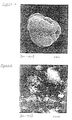
- a typical particle is shown in the photograph of the attached Fig. 1.
- the xonotlite particles obtained in Reference Example 1 are coated with an aqueous non-ionic dispersion of 60% by weight of a hydroxyl-functional polysiloxane.
- the polysilicone dispersion is sprayed at a level of 8.5% w/w on the xonotlite powder which is heated up to 120 °C.
- the coated xonotlite is then further heated to 150-160 °C for 15 minutes and then cooled down.
- Dry xonotlite powder prepared according to reference example 1 is injected under pressure into a jet micronizer with a constant feeding rate of 150 g/min.
- the jet micronizer has a diameter of 200 mm and works at a pressure of 7 bars at 20 °C.
- the resulting product has the following characteristics: - Particle size: 2 microns to 50 microns - d50: 12 microns (the d50 value is determined by means of a laser beam as the diameter of spherical particles, 50% of which each are larger or smaller than the measured value) - Apparent density: 55 g/l - Morphology: Loose aggregate structure of three-dimensionally interlocked primary calcium silicate crystals.
- micronized calcium silicate particles A typical example of the micronized calcium silicate particles is shown in the photograph of the attached Fig. 2.
- Dry hydrophobic xonotlite powder prepared according to Reference Example 2 is micronized under the same conditions as described in EXAMPLE 1.
- a product having the following characteristics is obtained: - Particle size: 1 micron to 50 microns - d50: 9 microns - Apparent density: 80 g/l
- reaction-hardening two-component-epoxy resin coating containing about 50% of filler materials is thixotropized with the same xonotlite powders as described in EXAMPLE 3.
- xonotlite powder 80 Parts by weight of the epoxy component are mixed using a stirrer with 20 parts by weight of the hardener component. To this mixture the xonotlite powder is added in such an amount that a coating of 1 mm thickness can be applied at ambient temperature with no sagging down. The following amounts of xonotlite powder were required to establish the non-sag condition.
- Thixotropized mixture of a two-component polyurethane for floorings based on branched polyols and aromatic polyisocyanates:
- component A containing 50% of filler materials are mixed using a simple paint stirrer with 17 parts of the component B.
- the hydrophobic xonotlite-based thixotrope is added in such an amount that a coating of 1 mm in thickness can be applied and cured in a vertical position at ambient temperature without sagging down.
- Thixotropized two-component system showing a stable structure viscosity and thixotropy upon curing.
- the hydrophobic xonotlite powders described in EXAMPLE 2 und Reference Example 2 are admixed in such amounts that a coating of 1 mm in thickness can be cured at ambient temperature in a vertical position without sagging down.
- a coating of 1 mm in thickness can be cured at ambient temperature in a vertical position without sagging down.
- the micronized hydrophobic xonotlite 2.75 parts are needed per 100 parts of resin to meet the non-sag condition.
- the hydrophobic spherical xonotlite there are needed 4.20 parts or 53% more.
- a two-component epoxy resin mixture was thixotropized with the hydrophobic micronized xonotlite of EXAMPLE 2. Then the thixotropy index of the resin mixture was measured with a Brookfield viscosimeter during the curing reaction at ambient temperature until the end of the potlife (45 minutes).
- the results show a strong decrease of the thixotropy of about 40% as the thixotropy index as compared to the initial value.
- Brookfield viscosity at 1 min ⁇ 1 there was found after 5 minutes curing 80 Pa.s and after 45 minutes curing 36 Pa.s or a strong decrease of 55%.
- a highly filled epoxy mortar composition contains, by weight, 80 parts of a low-viscosity modified epoxy resin having a viscosity of about 3000 mPa.s, 48 parts of a modified cycloaliphatic polyamine, 75 parts of quartz flour, 130 parts of quartz sand of from 0.1 to 0.3 mm and 160 parts of quartz sand of from 0.6 to 1 mm.
- micronized calcium silicates of the present invention were determined which are needed to apply a layer of the epoxy mortar of 1 cm in thickness without sagging down.
- 3 parts are needed, based on the total formulation, whereas 2 parts of the micronized hydrophobic xonotlite of EXAMPLE 2 are needed to attain the non-sag condition.
- mixtures consisting of the epoxy component, the quartz filler and the above-mentioned amounts of the thixotropic calcium silicate. These mixtures were stored at ambient temperature. After regular periods the epoxy component was mixed with the hardener component, and the mixture was cured as a mortar layer of 1 cm thickness.
Landscapes
- Chemical & Material Sciences (AREA)
- Engineering & Computer Science (AREA)
- Organic Chemistry (AREA)
- Ceramic Engineering (AREA)
- Polymers & Plastics (AREA)
- Health & Medical Sciences (AREA)
- Medicinal Chemistry (AREA)
- Civil Engineering (AREA)
- Chemical Kinetics & Catalysis (AREA)
- Materials Engineering (AREA)
- Structural Engineering (AREA)
- Compositions Of Macromolecular Compounds (AREA)
- Silicates, Zeolites, And Molecular Sieves (AREA)
- Sealing Material Composition (AREA)
- Colloid Chemistry (AREA)
- Paints Or Removers (AREA)
- Organic Low-Molecular-Weight Compounds And Preparation Thereof (AREA)
Priority Applications (1)
| Application Number | Priority Date | Filing Date | Title |
|---|---|---|---|
| AT88103656T ATE98607T1 (de) | 1987-03-13 | 1988-03-09 | Thixotropisches additiv, verfahren zu seiner herstellung und seine benuetzung. |
Applications Claiming Priority (2)
| Application Number | Priority Date | Filing Date | Title |
|---|---|---|---|
| DE3708084 | 1987-03-13 | ||
| DE3708084 | 1987-03-13 |
Publications (3)
| Publication Number | Publication Date |
|---|---|
| EP0282016A2 true EP0282016A2 (de) | 1988-09-14 |
| EP0282016A3 EP0282016A3 (de) | 1991-04-03 |
| EP0282016B1 EP0282016B1 (de) | 1993-12-15 |
Family
ID=6322935
Family Applications (1)
| Application Number | Title | Priority Date | Filing Date |
|---|---|---|---|
| EP88103656A Expired - Lifetime EP0282016B1 (de) | 1987-03-13 | 1988-03-09 | Thixotropisches Additiv, Verfahren zu seiner Herstellung und seine Benützung |
Country Status (5)
| Country | Link |
|---|---|
| US (1) | US5120775A (de) |
| EP (1) | EP0282016B1 (de) |
| JP (1) | JPS63314250A (de) |
| AT (1) | ATE98607T1 (de) |
| DE (1) | DE3886239D1 (de) |
Cited By (3)
| Publication number | Priority date | Publication date | Assignee | Title |
|---|---|---|---|---|
| WO2000021901A1 (en) * | 1998-10-14 | 2000-04-20 | James Hardie Research Pty Limited | Cement formulation |
| AT508314B1 (de) * | 2009-05-18 | 2015-09-15 | Invicon Chemical Solutions Gmbh | Aushärtbares material |
| EP3689929A1 (de) | 2019-02-01 | 2020-08-05 | Henkel AG & Co. KGaA | Haftzusammensetzung mit einem thixotropiermittel |
Families Citing this family (10)
| Publication number | Priority date | Publication date | Assignee | Title |
|---|---|---|---|---|
| EP0633286A1 (de) * | 1993-07-09 | 1995-01-11 | Ciba-Geigy Ag | Härtbare, Füllstoffe enthaltende Epoxidharzzusammensetzung |
| US6710105B1 (en) | 1993-07-09 | 2004-03-23 | Jens Awe | Curable epoxy resin composition comprising fillers |
| US5516549A (en) * | 1994-10-31 | 1996-05-14 | Morton International, Inc. | Method of applying a striated coating |
| US5623013A (en) * | 1994-12-16 | 1997-04-22 | Ube Industries, Ltd. | Xonotlite-reinforced organic polymer composition |
| DE19917228B4 (de) * | 1999-04-16 | 2006-02-02 | E.I. Du Pont De Nemours And Co., Wilmington | Mattierungs- und Strukturmittel enthaltende Pasten und diese enthaltende Beschichtungsmittel |
| US9248447B2 (en) | 2005-08-10 | 2016-02-02 | The Regents Of The University Of California | Polymers for use in centrifugal separation of liquids |
| KR101295204B1 (ko) * | 2009-01-08 | 2013-08-09 | 하이리성 파마수티컬 컴퍼니 리미티드 | 개질된 소듐-몬모릴로나이트, 그의 제조 방법 및 용도 |
| CN102947218B (zh) | 2010-04-23 | 2016-05-11 | 皮瑟莱根特科技有限责任公司 | 纳米晶体的合成、盖帽和分散 |
| WO2012058271A2 (en) | 2010-10-27 | 2012-05-03 | Pixelligent Technologies, Llc | Synthesis, capping and dispersion of nanocrystals |
| US9359689B2 (en) | 2011-10-26 | 2016-06-07 | Pixelligent Technologies, Llc | Synthesis, capping and dispersion of nanocrystals |
Family Cites Families (9)
| Publication number | Priority date | Publication date | Assignee | Title |
|---|---|---|---|---|
| US2888377A (en) * | 1954-03-25 | 1959-05-26 | Columbia Southern Chem Corp | Calcium silicate and method of producing same |
| JPS5622812B2 (de) * | 1971-05-08 | 1981-05-27 | ||
| JPS55109217A (en) * | 1979-02-09 | 1980-08-22 | Osaka Packing Seizosho:Kk | Calcium silicate and preparing the same |
| CA1154895A (en) * | 1980-02-21 | 1983-10-04 | Dieter Skudelny | Flowable mixture and use of synthetic calcium silicate |
| DE3175558D1 (en) * | 1980-02-21 | 1986-12-11 | Ciba Geigy Ag | Mixture with filler in suspended form and use of synthetic crystalline calcium silicate |
| US4458051A (en) * | 1980-07-15 | 1984-07-03 | Ciba-Geigy Corporation | Pourable solid mixture |
| DE3445238A1 (de) * | 1984-12-12 | 1986-06-12 | Promat Gesellschaft für moderne Werkstoffe mbH, 4030 Ratingen | Mittel zur reduzierung des spezifischen gewichts und verfahren zur herstellung derselben |
| JPS61170326A (ja) * | 1985-01-25 | 1986-08-01 | 古河機械金属株式会社 | 土壌の給排水及び給気方法 |
| JPS6336715A (ja) * | 1986-07-31 | 1988-02-17 | 有限会社 イデアリサ−チ | 植物栽培方法 |
-
1988
- 1988-03-09 AT AT88103656T patent/ATE98607T1/de not_active IP Right Cessation
- 1988-03-09 EP EP88103656A patent/EP0282016B1/de not_active Expired - Lifetime
- 1988-03-09 DE DE88103656T patent/DE3886239D1/de not_active Expired - Lifetime
- 1988-03-14 JP JP63060170A patent/JPS63314250A/ja active Pending
-
1991
- 1991-07-05 US US07/727,288 patent/US5120775A/en not_active Expired - Fee Related
Cited By (4)
| Publication number | Priority date | Publication date | Assignee | Title |
|---|---|---|---|---|
| WO2000021901A1 (en) * | 1998-10-14 | 2000-04-20 | James Hardie Research Pty Limited | Cement formulation |
| AT508314B1 (de) * | 2009-05-18 | 2015-09-15 | Invicon Chemical Solutions Gmbh | Aushärtbares material |
| EP3689929A1 (de) | 2019-02-01 | 2020-08-05 | Henkel AG & Co. KGaA | Haftzusammensetzung mit einem thixotropiermittel |
| WO2020156789A1 (en) | 2019-02-01 | 2020-08-06 | Henkel Ag & Co. Kgaa | Adhesive composition comprising a thixotropic agent |
Also Published As
| Publication number | Publication date |
|---|---|
| EP0282016B1 (de) | 1993-12-15 |
| US5120775A (en) | 1992-06-09 |
| EP0282016A3 (de) | 1991-04-03 |
| ATE98607T1 (de) | 1994-01-15 |
| DE3886239D1 (de) | 1994-01-27 |
| JPS63314250A (ja) | 1988-12-22 |
Similar Documents
| Publication | Publication Date | Title |
|---|---|---|
| EP0282016B1 (de) | Thixotropisches Additiv, Verfahren zu seiner Herstellung und seine Benützung | |
| JP5583032B2 (ja) | シリカおよびエポキシ樹脂 | |
| US3977894A (en) | Rheological agent for non-aqueous fluid systems | |
| KR100713596B1 (ko) | 틱소트로피성 부여재 및 페이스트형 수지 조성물 | |
| JPS62155B2 (de) | ||
| CA2270005A1 (en) | Surface-modified fillers, process for their preparation and their use | |
| JP5559143B2 (ja) | 疎水化された二酸化ケイ素粒子を含有する分散液 | |
| KR20010015772A (ko) | 소수성으로 개질된 폴리(아세탈-또는 케탈-폴리에테르),폴리우레탄 및 폴리아크릴레이트의 유동화 중합체 현탁액 | |
| KR102018634B1 (ko) | 표면처리 탄산칼슘 필러 및 이 필러를 함유하는 경화형 수지 조성물 | |
| JP5541864B2 (ja) | 変性ナノ粒子 | |
| EP0228234A2 (de) | Organophile Zusammensetzungen | |
| EP1713725A1 (de) | Natürliches teilchenförmiges carbonat | |
| JP3650381B2 (ja) | 表面処理炭酸カルシウム填料、その製造方法、並びに該填料を配合してなる樹脂組成物 | |
| CN110248992B (zh) | 粉末颗粒状二酰胺-聚烯烃蜡混合物 | |
| CN109575736B (zh) | 一种基于柔性聚合物修饰的氧化石墨烯阻尼涂料及其制备方法 | |
| JP3734349B2 (ja) | 表面処理炭酸カルシウム粉体、その製造方法並びに該粉体を配合してなる樹脂組成物 | |
| WO2019241501A1 (en) | Defoamer active, manufacturing method thereof, and defoaming formuation | |
| KR102710220B1 (ko) | 상승작용적 조성물 | |
| JPH0238309A (ja) | 湿気硬化一液型シーリング材用炭酸カルシウム及びそれを含有したシーリング材組成物 | |
| US3300326A (en) | Kaolin clay coated with neutralized monomeric nu, nu-diallylmelamine and polyester resins containing the same | |
| WO1984001953A1 (en) | Viscosity increasing additive for non-aqueous fluid systems | |
| JPH08269424A (ja) | 溶剤型接着剤 | |
| SU407935A1 (ru) | Эпоксидная порошковая композиция | |
| JP2026514160A (ja) | 高分散フュームドシリカ及びその製造方法 | |
| JPS6311051B2 (de) |
Legal Events
| Date | Code | Title | Description |
|---|---|---|---|
| PUAI | Public reference made under article 153(3) epc to a published international application that has entered the european phase |
Free format text: ORIGINAL CODE: 0009012 |
|
| AK | Designated contracting states |
Kind code of ref document: A2 Designated state(s): AT BE CH DE ES FR GB GR IT LI LU NL SE |
|
| PUAL | Search report despatched |
Free format text: ORIGINAL CODE: 0009013 |
|
| AK | Designated contracting states |
Kind code of ref document: A3 Designated state(s): AT BE CH DE ES FR GB GR IT LI LU NL SE |
|
| 17P | Request for examination filed |
Effective date: 19910814 |
|
| 17Q | First examination report despatched |
Effective date: 19920204 |
|
| GRAA | (expected) grant |
Free format text: ORIGINAL CODE: 0009210 |
|
| AK | Designated contracting states |
Kind code of ref document: B1 Designated state(s): AT BE CH DE ES FR GB GR IT LI LU NL SE |
|
| PG25 | Lapsed in a contracting state [announced via postgrant information from national office to epo] |
Ref country code: IT Free format text: LAPSE BECAUSE OF FAILURE TO SUBMIT A TRANSLATION OF THE DESCRIPTION OR TO PAY THE FEE WITHIN THE PRE;WARNING: LAPSES OF ITALIAN PATENTS WITH EFFECTIVE DATE BEFORE 2007 MAY HAVE OCCURRED AT ANY TIME BEFORE 2007. THE CORRECT EFFECTIVE DATE MAY BE DIFFERENT FROM THE ONE RECORDED.SCRIBED TIME-LIMIT Effective date: 19931215 Ref country code: ES Free format text: THE PATENT HAS BEEN ANNULLED BY A DECISION OF A NATIONAL AUTHORITY Effective date: 19931215 Ref country code: GR Free format text: LAPSE BECAUSE OF FAILURE TO SUBMIT A TRANSLATION OF THE DESCRIPTION OR TO PAY THE FEE WITHIN THE PRESCRIBED TIME-LIMIT Effective date: 19931215 Ref country code: BE Effective date: 19931215 Ref country code: AT Effective date: 19931215 Ref country code: CH Effective date: 19931215 Ref country code: FR Effective date: 19931215 Ref country code: SE Effective date: 19931215 Ref country code: LI Effective date: 19931215 Ref country code: DE Effective date: 19931215 Ref country code: NL Effective date: 19931215 |
|
| REF | Corresponds to: |
Ref document number: 98607 Country of ref document: AT Date of ref document: 19940115 Kind code of ref document: T |
|
| REF | Corresponds to: |
Ref document number: 3886239 Country of ref document: DE Date of ref document: 19940127 |
|
| PG25 | Lapsed in a contracting state [announced via postgrant information from national office to epo] |
Ref country code: GB Effective date: 19940315 |
|
| PG25 | Lapsed in a contracting state [announced via postgrant information from national office to epo] |
Ref country code: LU Free format text: LAPSE BECAUSE OF NON-PAYMENT OF DUE FEES Effective date: 19940331 |
|
| REG | Reference to a national code |
Ref country code: CH Ref legal event code: PL |
|
| EN | Fr: translation not filed | ||
| NLV1 | Nl: lapsed or annulled due to failure to fulfill the requirements of art. 29p and 29m of the patents act | ||
| PLBE | No opposition filed within time limit |
Free format text: ORIGINAL CODE: 0009261 |
|
| STAA | Information on the status of an ep patent application or granted ep patent |
Free format text: STATUS: NO OPPOSITION FILED WITHIN TIME LIMIT |
|
| GBPC | Gb: european patent ceased through non-payment of renewal fee |
Effective date: 19940315 |
|
| 26N | No opposition filed |