EP0273433A2 - Photoelektrischer Schalter vom Reflektionstyp - Google Patents
Photoelektrischer Schalter vom Reflektionstyp Download PDFInfo
- Publication number
- EP0273433A2 EP0273433A2 EP87119277A EP87119277A EP0273433A2 EP 0273433 A2 EP0273433 A2 EP 0273433A2 EP 87119277 A EP87119277 A EP 87119277A EP 87119277 A EP87119277 A EP 87119277A EP 0273433 A2 EP0273433 A2 EP 0273433A2
- Authority
- EP
- European Patent Office
- Prior art keywords
- photoelectric switch
- light emitting
- wavelengths
- light
- rays
- Prior art date
- Legal status (The legal status is an assumption and is not a legal conclusion. Google has not performed a legal analysis and makes no representation as to the accuracy of the status listed.)
- Granted
Links
Images



Classifications
-
- G—PHYSICS
- G01—MEASURING; TESTING
- G01V—GEOPHYSICS; GRAVITATIONAL MEASUREMENTS; DETECTING MASSES OR OBJECTS; TAGS
- G01V8/00—Prospecting or detecting by optical means
- G01V8/10—Detecting, e.g. by using light barriers
- G01V8/12—Detecting, e.g. by using light barriers using one transmitter and one receiver
Definitions
- This invention relates to a reflection type photoelectric switch including a light projecting member for projecting a light beam to a revolving type reflector and a light receiving member for receiving a reflected light beam from the reflector to produce a light path, whereby an object is detected when it blocks the light path, and more particularly to an improved photoelectric switch which can precisely detect even the object having a mirror surface.
- a reflection type photoelectric switch housing light projecting and receiving members is well known in which the light projecting member projects a light beam to a revolving type reflector and the receiving member receives a reflected light beam from the reflector whereby a detection signal is obtained when the projected light beam is blocked by an object to be detected.
- Such a conventional photoelectric switch has a disadvantage that an object having a metalic or mirror surface cannot be detected thereby because the light beam projected from the projecting member is reflected on the mirror surface to be received by the receiving member.
- a photoelectric switch in which a pair of light projecting members respectively project different wavelength lights to a revolving type reflector and only one of the projected lights is reflected by the reflector so that the discrimination of the reflector and an object to be detected by the switch is performed by the comparison between the levels of the respective reflected lights.
- This conventional switch needs two pairs of projecting and receiving members, so that the number of optical components is unnecessarily increased.
- the respective optical axes of the respective projecting members are slightly shifted, so that a detection signal is erroneously produced when only one of the pair of optical axes is blocked by the object.
- Is is a further object of this invention to provide a reflection type photoelectric switch employing a pair of projecting and receiving members to provide a single optical axis utilizing different waveform lights.
- a reflection type photoelectric switch including a light emitting member for emitting rays having first and second different wavelengths, a reflector for reflecting the emitted rays at different reflection rates with respect to the first and second wavelengths, a light receiving member for sensing rays at the first and second wavelengths, and member for analyzing outputs generated from the light receiving member at the first and second wavelengths to generate an output representing the existence of an object to be detected by the photoelectric switch.
- one projecting member projects two lights respectively having first and second different wavelengths towards the revolving type reflector on a single optical axis.
- the reflector is designed to reflect only one of the two different wavelength lights while the light receiving element housed within the swtich is so designed to sense the reflected lights at both wavelengths, so that the object passing the light path between the photelectric switch and the revolving type reflector is by the comparison between the levels of the respective reflected lights.
- Neither lights at the respective wavelengths are received by the receiving member when an object having no mirror surface blocks the light path, while both lights at the two wavelengths are received by the receiving member when an object having a mirror surface blocks the light path to reflect the lights at the wavelengths toward the receiving element, whereby the objects with and without a mirror surface is precisely detected by the comparison of the levels of the reflected lights.
- the switch includes a housing 1, a printed circuit board 2 carrying a light emitting element 3 such as a light emitting diode and a light receiving element 4 such as a photodiode which are mounted on the board 2.
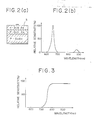
- the light emitting element 3 may employ a single light emitting diode having a Ga Al As hetero conjunction shown in Fig. 2(a) and a spectrum characteristic wherein different wavelength lights are emitted as shown in Fig. 2(b).
- a pair of light emitting diodes respectively emitting different wavelength rays closely mounted on a single base may be employed instead of the single chip of Fig. 2(a) so as to project a substantially single light beam through a single lens.
- the light emitting diode may be the diode which simultaneously emits a strong red radiation at 660 nm and a weak infrared radiation at 880 nm as a substantially single light beam.
- a pair of converging lenses 5 and 6 are respectively disposed corresponding to the light emitting and receiving elements 3 and 4.
- the converging lens 5 guides the radiation emitted from the emitting element 3 to a revolving type reflector 6 positioned apart from the main body of the photoelectric switch by a predetermined interval.
- the reflector 6 is designed to absorb only one of the radiations, e.g. red light, and reflect only another radiation, e.g. infrared, or vice versa.
- the reflector 7 in this embodiment employs a single mold consisting of combination of corner cubes made of acrylic resins mixed with dyes which absorbs red light and passes infrared rays, and is designed to have spectrum characteristics wherein red rays at 700 nm are reflected at a substantially zero rate but infrared rays at wavelengths longer than 800 nm are reflected at 90% or higher rate as shown in Fig. 3.
- the converging lens 6 disposed on a front wall of the photoelectric switch converges the reflected rays from the reflector to the light receiving element 4.
- the light receiving element 4 employs a color sensor separating rays having different wavelengths to generate signals.
- the sensor is constructed to have a pair of photo diodes each having different conjunction depth in a single chip as shown in Fig. 4(a) to discriminate color by utilizing the difference between the respective spectrum characteristics of the diodes.
- the diodes are represented by an equivalent circuit having a pair of photodiodes PD-a and PD-b as shown in Fig. 4(b) which respectively response curves PD-a and PD-b shown in Fig. 4(c).
- the outputs of the pair of photodiodes PD-a and PD-b are applied to non-reversible amplifiers 10 and 11 which respectively amplify the outputs from the photodiodes at the same amplifying rate.
- the output from the amplifier 10 is applied to an adder 12 connected to a voltage source 13.
- the adder 12 sums a minute voltage level V off of the source 13 and the output from the amplifier 10, and its output is applied to a reversible input terminal of an operational amplifier representing a comparator 14.
- the output from the amplifier 11 is applied to non-reversible input terminals of the respective operation amplifiers representing comparators 14 and 15 as comparing means.
- the comparator 14 compares the output from the amplifier 10 added by the minute voltage V off with the output from the amplifier 11, and the voltage source 13 is disposed to fix a comparison output to a low "L" level when both outputs from amplifiers 10 and 11 are equal.
- the comparator 15 at its reversible input terminal is connected with a reference voltage source 16 providing a reference voltage V ref to compare the voltage V ref with an input voltage thereof.
- the outputs from comparators 14 and 15 are applied to AND circuit 17 to apply their logic product to output circuit 18 which is designed to produce a object detection singal when its output is a low "L" level.
- the light emitting diode employed in the light emitting element 3 generates the spectrums represented by the graph of Fig. 2(b), that is, color rays and infrared rays, which are radiated through the lens 5 to the revolving-type reflector 7 remote from the main body of the photoelectric switch.
- the reflector 7 absorbs red rays and reflects only infrared rays in a same direction. Accordingly, only infrared rays are applied to the light receiving element 4 through converging lens 6.
- Table 1 The operation states at the respective portions of the photoelectric switch are represented by the following Table 1:
- the photodiode PD-a When there is no object to block the light path (I), the photodiode PD-a produces a relatively low level photo-current while the photodiode PD-b produces a high level photo-current since the photodiodes PD-a and PD-b of the light receiving element 4 have the response curves shown in Fig. 4(c).
- the Table 1 expresses the respective relative values of photo-currents as "1" and "5" when there is no object.
- the signals corresponding to such photo-currents are amplified by non-reversible amplifiers 10 and 11 for application to the comparators 14 and 15. In this occasion, the output of amplifier 11 is large, so that comparator 14 is a high "H” level.
- the comparator 15 also produces a high "H” level since a singal larger than a determined threshold level V ref .
- AND circuit 17 produces a high "H” level and output circuit 18 does not produce any object detection signal.
- the rays having spectrums shown in Fig. 2(b) are applied to the light receiving element 4 through converging lens 6 as they are.
- the respective photodiodes PD-a and PD-b of the element 4 have spectrum characteristics shown in Fig. 4(c), so that the relative values of photocurrents of the photodiodes PD-a and PD-b are exemplarily expressed as "2" and "1" shown in Table 1.
- These photocurrents are amplified as they are to be compared one after another by the comparators 14 and 15.
- the comparator 14 is "L” because the output from the diode PD-a is large, while the comparator 15 becomes “H” because the input to the non-reversible input terminal of comparator 15 is higher than the reference voltage V ref .
- the logic product from AND circuit 18 becomes “L”, and an object detection signal is produced.
- the adder 12 and the AND circuit 17 are employed in this embodiment, but detection signals may be produced by only one of them whether or not the object to be detected has any mirror surface.
- a light receiving element modified from the element 4 of the above-mentioned first embodiment.
- the light receiving element is constructed to have a pair of photodiodes PD-a and PD-b disposed in a single chip at different light receiving areas.
- thin interference filters 21a and 21b having different characteristics are disposed on the respective light receiving areas so as to provide different spectrum characteristics.
- the equivalent circuit of the element of Fig. 6(a) is represented by the circuit of Fig 6(b) likewise Fig. 2(b), and the respective spectrum characteristics follow the transparency characteristics of the filters 21a and 21b shown by the curves PD-a and PD-b of Fig. 6(c).
- the receiving element of this embodiment is applied to the element 4 and the photoelectric switch of the first embodiment, any object can be detected whether or not the object has a mirror surface as described in the first embodiment.
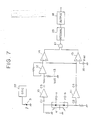
- FIG. 7 there is shown a circuit diagram of a photoelectric switch as a second embodiment of this invention, in which a light emitting element 3 emits light pulses to avoid affection by external light and improve the detection efficiency though the light emitting diode 3 continuously emits light in the first embodiment.
- the light emitting element 3 emits pulsating rays by signals from an oscillation circuit 22.
- Capacitors C1 and C2 are respectively connected between photodiodes PD-a and PD-b and amplifiers 10 and 11, so that only a.c. components of the outputs from the diode Pd-a and PD-b are applied to the amplifiers 10 and 11 and further applied to comparators 14 and 15 through capacitor C3 including adder 12 or capacitor C4.
- output from AND circuit 17 is applied to integral circuit 23 to apply its output to output circuit 18 after holding it for a predetermined interval.
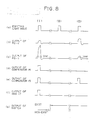
- Fig. 8(a) when there is no object to be detected (I)
- an ordinary object 8 blocks the light path (II) or an object 8 having a mirror surface blocks the light path (III)
- the respective photodiodes PD-a and PD-b of the light receiving element 4 produce outputs shown in Figs. 8(b) and 8(c) which are amplified by amplifiers 10 and 11 as photo-converted electric signals to be compared by comparators 14 and 15, so that output signals shown in Figs.
- the revolving-type reflector 7 in the first embodiment is constituted with combination of corner cubes made of acrylic resins absorbing red light
- the reflector 7 may be replaced with a reflector in which an infrared filter 25 passing infrared rays only but blocking red light is applied on a front wall of a unit 24 of combination with transparent corner cubes, if desired, as shown in Fig. 9.
Landscapes
- Physics & Mathematics (AREA)
- Life Sciences & Earth Sciences (AREA)
- General Life Sciences & Earth Sciences (AREA)
- General Physics & Mathematics (AREA)
- Geophysics (AREA)
- Switches Operated By Changes In Physical Conditions (AREA)
- Electronic Switches (AREA)
- Geophysics And Detection Of Objects (AREA)
Priority Applications (1)
| Application Number | Priority Date | Filing Date | Title |
|---|---|---|---|
| AT87119277T ATE80475T1 (de) | 1986-12-26 | 1987-12-28 | Photoelektrischer schalter vom reflektionstyp. |
Applications Claiming Priority (2)
| Application Number | Priority Date | Filing Date | Title |
|---|---|---|---|
| JP61312456A JP2574780B2 (ja) | 1986-12-26 | 1986-12-26 | 反射型光電スイッチ |
| JP312456/86 | 1986-12-26 |
Publications (3)
| Publication Number | Publication Date |
|---|---|
| EP0273433A2 true EP0273433A2 (de) | 1988-07-06 |
| EP0273433A3 EP0273433A3 (en) | 1989-11-15 |
| EP0273433B1 EP0273433B1 (de) | 1992-09-09 |
Family
ID=18029408
Family Applications (1)
| Application Number | Title | Priority Date | Filing Date |
|---|---|---|---|
| EP87119277A Expired - Lifetime EP0273433B1 (de) | 1986-12-26 | 1987-12-28 | Photoelektrischer Schalter vom Reflektionstyp |
Country Status (6)
| Country | Link |
|---|---|
| US (1) | US5004908A (de) |
| EP (1) | EP0273433B1 (de) |
| JP (1) | JP2574780B2 (de) |
| AT (1) | ATE80475T1 (de) |
| DE (1) | DE3781657T2 (de) |
| ES (1) | ES2035028T3 (de) |
Cited By (4)
| Publication number | Priority date | Publication date | Assignee | Title |
|---|---|---|---|---|
| EP0329083A3 (en) * | 1988-02-15 | 1990-02-14 | Omron Tateisi Electronics Co. | Photoelectric switching apparatus of reflection type |
| DE19627083A1 (de) * | 1996-07-05 | 1998-01-08 | Leuze Electronic Gmbh & Co | Reflexionslichtschranke |
| GB2342989A (en) * | 1998-10-23 | 2000-04-26 | Integrated Design Limited | Detection system |
| EP0822566A4 (de) * | 1996-02-21 | 2001-02-07 | Idec Izumi Corp | Photoelektrische schaltvorrichtung und schaltverfahren |
Families Citing this family (16)
| Publication number | Priority date | Publication date | Assignee | Title |
|---|---|---|---|---|
| DE4029766A1 (de) * | 1990-09-20 | 1992-04-02 | Leuze Electronic Gmbh & Co | Reflexionslichtschranke |
| US5442168A (en) * | 1991-10-15 | 1995-08-15 | Interactive Light, Inc. | Dynamically-activated optical instrument for producing control signals having a self-calibration means |
| US5313508A (en) * | 1991-12-23 | 1994-05-17 | Batching Systems, Inc. | Method of and apparatus for detecting and counting articles |
| US5508511A (en) * | 1994-05-24 | 1996-04-16 | Interactive Light, Inc. | Arrangement for and method of detecting an object in an area subject to environmental variations |
| US5734343A (en) * | 1996-07-18 | 1998-03-31 | Motorola, Inc. | One-way optical highway communication system |
| DE19644278A1 (de) * | 1996-10-24 | 1998-05-07 | Ines Elektronik Systementwickl | Optische Schranke sowie daraus aufgebaute Überwachungseinrichtung |
| JP2005241340A (ja) * | 2004-02-25 | 2005-09-08 | Sharp Corp | マルチ測距装置 |
| DE102005060399A1 (de) * | 2005-12-16 | 2007-06-21 | Sick Ag | Optoelektronische Vorrichtung und Verfahren zum Betreiben einer optoelektronischen Vorrichtung |
| JP2009177721A (ja) * | 2008-01-28 | 2009-08-06 | Sharp Corp | 物体検出回路及びそれを備えた物体検出装置 |
| KR101352117B1 (ko) * | 2009-10-22 | 2014-01-14 | 엘지디스플레이 주식회사 | 터치 패널을 갖는 표시 장치 및 이의 터치 감지 방법 |
| DE102010012712A1 (de) * | 2010-03-25 | 2011-09-29 | Osram Opto Semiconductors Gmbh | Licht emittierendes Halbleiterbauteil |
| US9046964B2 (en) * | 2011-10-27 | 2015-06-02 | Beijing Irtouch Systems Co., Ltd | Frame component for infrared touch screen and infrared touch screen |
| WO2016187345A1 (en) | 2015-05-18 | 2016-11-24 | Lasermotive, Inc. | Light curtain safety system |
| DE102015111379A1 (de) * | 2015-07-14 | 2017-01-19 | Sick Ag | Optoelektronischer Sensor |
| US10393918B2 (en) * | 2017-03-28 | 2019-08-27 | Banner Engineering Corp. | Retro-reflective sensor with multiple detectors |
| JP6985329B2 (ja) * | 2019-05-15 | 2021-12-22 | 矢崎総業株式会社 | 発光装置 |
Family Cites Families (12)
| Publication number | Priority date | Publication date | Assignee | Title |
|---|---|---|---|---|
| US3944818A (en) * | 1972-03-28 | 1976-03-16 | Visomat-Gerate Gmbh | Photoelectric guard |
| FR2442457A1 (fr) * | 1978-11-27 | 1980-06-20 | Optel | Dispositif photoelectrique a double faisceau et systeme reflechissant selectif |
| DE2941739C2 (de) * | 1979-10-16 | 1982-02-18 | Krohne Meßtechnik GmbH & Co KG, 4100 Duisburg | Lichtgitter |
| US4433328A (en) * | 1980-01-16 | 1984-02-21 | Saphir Marc E | Motion sensing energy controller |
| JPS57178535A (en) * | 1981-04-29 | 1982-11-02 | Mitsubishi Electric Corp | Process signal input equipment |
| DE3237035C1 (de) * | 1982-10-06 | 1984-01-26 | Erwin Sick Gmbh Optik-Elektronik, 7808 Waldkirch | Reflexionslichtschranke |
| JPS59119628A (ja) * | 1982-12-25 | 1984-07-10 | オムロン株式会社 | 反射形光電スイツチ |
| JPS6196626A (ja) * | 1984-10-16 | 1986-05-15 | オムロン株式会社 | 反射形光電スイツチ |
| FR2574200B1 (fr) * | 1984-11-30 | 1987-01-23 | Labo Electronique Physique | Dispositif de detection d'intrus muni d'un dispositif d'antimasquage |
| DE3447131A1 (de) * | 1984-12-22 | 1986-06-26 | Telenot Electronic GmbH, 7080 Aalen | Raumschutzanlage |
| US4564085A (en) * | 1985-01-22 | 1986-01-14 | Towmotor Corporation | Controlling arrangement |
| US4658147A (en) * | 1985-04-03 | 1987-04-14 | Baird Corporation | Remote optically readable system and method |
-
1986
- 1986-12-26 JP JP61312456A patent/JP2574780B2/ja not_active Expired - Lifetime
-
1987
- 1987-12-28 EP EP87119277A patent/EP0273433B1/de not_active Expired - Lifetime
- 1987-12-28 AT AT87119277T patent/ATE80475T1/de active
- 1987-12-28 US US07/138,052 patent/US5004908A/en not_active Expired - Fee Related
- 1987-12-28 DE DE8787119277T patent/DE3781657T2/de not_active Expired - Fee Related
- 1987-12-28 ES ES198787119277T patent/ES2035028T3/es not_active Expired - Lifetime
Cited By (7)
| Publication number | Priority date | Publication date | Assignee | Title |
|---|---|---|---|---|
| EP0329083A3 (en) * | 1988-02-15 | 1990-02-14 | Omron Tateisi Electronics Co. | Photoelectric switching apparatus of reflection type |
| EP0822566A4 (de) * | 1996-02-21 | 2001-02-07 | Idec Izumi Corp | Photoelektrische schaltvorrichtung und schaltverfahren |
| USRE37926E1 (en) | 1996-02-21 | 2002-12-10 | Idec Izumi Corporation | Apparatus and method for detecting transparent substances |
| DE19627083A1 (de) * | 1996-07-05 | 1998-01-08 | Leuze Electronic Gmbh & Co | Reflexionslichtschranke |
| DE19627083C2 (de) * | 1996-07-05 | 2003-04-17 | Leuze Electronic Gmbh & Co | Reflexionslichtschranke |
| GB2342989A (en) * | 1998-10-23 | 2000-04-26 | Integrated Design Limited | Detection system |
| GB2361312B (en) * | 1998-10-23 | 2003-10-08 | Integrated Design Ltd | Detection systems |
Also Published As
| Publication number | Publication date |
|---|---|
| US5004908A (en) | 1991-04-02 |
| EP0273433B1 (de) | 1992-09-09 |
| DE3781657T2 (de) | 1993-03-18 |
| JPS63166118A (ja) | 1988-07-09 |
| ES2035028T3 (es) | 1993-04-16 |
| EP0273433A3 (en) | 1989-11-15 |
| DE3781657D1 (de) | 1992-10-15 |
| JP2574780B2 (ja) | 1997-01-22 |
| ATE80475T1 (de) | 1992-09-15 |
Similar Documents
| Publication | Publication Date | Title |
|---|---|---|
| EP0273433A2 (de) | Photoelektrischer Schalter vom Reflektionstyp | |
| JPH062348Y2 (ja) | 反射型光電スイッチ | |
| DE59711621D1 (de) | Optischer Rauchmelder | |
| US6414773B1 (en) | Optical digital communication apparatus | |
| FR2442457A1 (fr) | Dispositif photoelectrique a double faisceau et systeme reflechissant selectif | |
| US4156816A (en) | Optical fire-detector | |
| CN105897237B (zh) | 一种回归反射光电开关 | |
| CN214623250U (zh) | 一种三维相机及3d探测设备 | |
| JPH04260197A (ja) | 光電式煙感知器 | |
| JPS57158508A (en) | Distance detecting device | |
| JPH0335603B2 (de) | ||
| JPH08265130A (ja) | 回帰反射板を備えた反射形光電スイッチ | |
| JPS60210718A (ja) | 光検出方式 | |
| JPS59119628A (ja) | 反射形光電スイツチ | |
| JPH0531584Y2 (de) | ||
| JPS63309881A (ja) | 車両用障害物検出装置 | |
| SU1305793A1 (ru) | Фотореле | |
| JPH02112783A (ja) | 光センサ | |
| SU922836A1 (ru) | Дымовой извещатель 1 | |
| JPH05274967A (ja) | 光電スイッチ | |
| JPH0227632A (ja) | 回帰反射型光電スイッチ | |
| JPH03131790A (ja) | 車両用障害物検知装置 | |
| JPS57204482A (en) | Reflection type photoelectric switch | |
| JPH02213220A (ja) | 反射型光電スイッチ | |
| CN119156785A (zh) | 机动车辆的包括用于接收光束的模块的检测和/或通信系统 |
Legal Events
| Date | Code | Title | Description |
|---|---|---|---|
| PUAI | Public reference made under article 153(3) epc to a published international application that has entered the european phase |
Free format text: ORIGINAL CODE: 0009012 |
|
| 17P | Request for examination filed |
Effective date: 19871228 |
|
| AK | Designated contracting states |
Kind code of ref document: A2 Designated state(s): AT BE CH DE ES FR GB GR IT LI LU NL SE |
|
| PUAL | Search report despatched |
Free format text: ORIGINAL CODE: 0009013 |
|
| AK | Designated contracting states |
Kind code of ref document: A3 Designated state(s): AT BE CH DE ES FR GB GR IT LI LU NL SE |
|
| 17Q | First examination report despatched |
Effective date: 19910321 |
|
| GRAA | (expected) grant |
Free format text: ORIGINAL CODE: 0009210 |
|
| AK | Designated contracting states |
Kind code of ref document: B1 Designated state(s): AT BE CH DE ES FR GB GR IT LI LU NL SE |
|
| PG25 | Lapsed in a contracting state [announced via postgrant information from national office to epo] |
Ref country code: SE Effective date: 19920909 Ref country code: GR Free format text: LAPSE BECAUSE OF FAILURE TO SUBMIT A TRANSLATION OF THE DESCRIPTION OR TO PAY THE FEE WITHIN THE PRESCRIBED TIME-LIMIT Effective date: 19920909 |
|
| REF | Corresponds to: |
Ref document number: 80475 Country of ref document: AT Date of ref document: 19920915 Kind code of ref document: T |
|
| ITF | It: translation for a ep patent filed | ||
| REF | Corresponds to: |
Ref document number: 3781657 Country of ref document: DE Date of ref document: 19921015 |
|
| ET | Fr: translation filed | ||
| PG25 | Lapsed in a contracting state [announced via postgrant information from national office to epo] |
Ref country code: LU Free format text: LAPSE BECAUSE OF NON-PAYMENT OF DUE FEES Effective date: 19921231 |
|
| REG | Reference to a national code |
Ref country code: ES Ref legal event code: FG2A Ref document number: 2035028 Country of ref document: ES Kind code of ref document: T3 |
|
| PLBE | No opposition filed within time limit |
Free format text: ORIGINAL CODE: 0009261 |
|
| STAA | Information on the status of an ep patent application or granted ep patent |
Free format text: STATUS: NO OPPOSITION FILED WITHIN TIME LIMIT |
|
| 26N | No opposition filed | ||
| PGFP | Annual fee paid to national office [announced via postgrant information from national office to epo] |
Ref country code: ES Payment date: 19951213 Year of fee payment: 9 |
|
| PGFP | Annual fee paid to national office [announced via postgrant information from national office to epo] |
Ref country code: NL Payment date: 19951219 Year of fee payment: 9 Ref country code: CH Payment date: 19951219 Year of fee payment: 9 Ref country code: AT Payment date: 19951219 Year of fee payment: 9 |
|
| PGFP | Annual fee paid to national office [announced via postgrant information from national office to epo] |
Ref country code: BE Payment date: 19960109 Year of fee payment: 9 |
|
| PG25 | Lapsed in a contracting state [announced via postgrant information from national office to epo] |
Ref country code: AT Effective date: 19961228 |
|
| PG25 | Lapsed in a contracting state [announced via postgrant information from national office to epo] |
Ref country code: ES Free format text: LAPSE BECAUSE OF NON-PAYMENT OF DUE FEES Effective date: 19961230 |
|
| PG25 | Lapsed in a contracting state [announced via postgrant information from national office to epo] |
Ref country code: LI Effective date: 19961231 Ref country code: CH Effective date: 19961231 Ref country code: BE Effective date: 19961231 |
|
| BERE | Be: lapsed |
Owner name: OMRON TATEISI ELECTRONICS CO. Effective date: 19961231 |
|
| PG25 | Lapsed in a contracting state [announced via postgrant information from national office to epo] |
Ref country code: NL Effective date: 19970701 |
|
| REG | Reference to a national code |
Ref country code: CH Ref legal event code: PL |
|
| NLV4 | Nl: lapsed or anulled due to non-payment of the annual fee |
Effective date: 19970701 |
|
| PGFP | Annual fee paid to national office [announced via postgrant information from national office to epo] |
Ref country code: GB Payment date: 19981118 Year of fee payment: 12 |
|
| PGFP | Annual fee paid to national office [announced via postgrant information from national office to epo] |
Ref country code: FR Payment date: 19981222 Year of fee payment: 12 |
|
| PGFP | Annual fee paid to national office [announced via postgrant information from national office to epo] |
Ref country code: DE Payment date: 19981231 Year of fee payment: 12 |
|
| PG25 | Lapsed in a contracting state [announced via postgrant information from national office to epo] |
Ref country code: GB Free format text: LAPSE BECAUSE OF NON-PAYMENT OF DUE FEES Effective date: 19991228 |
|
| GBPC | Gb: european patent ceased through non-payment of renewal fee |
Effective date: 19991228 |
|
| PG25 | Lapsed in a contracting state [announced via postgrant information from national office to epo] |
Ref country code: FR Free format text: LAPSE BECAUSE OF NON-PAYMENT OF DUE FEES Effective date: 20000831 |
|
| PG25 | Lapsed in a contracting state [announced via postgrant information from national office to epo] |
Ref country code: DE Free format text: LAPSE BECAUSE OF NON-PAYMENT OF DUE FEES Effective date: 20001003 |
|
| REG | Reference to a national code |
Ref country code: FR Ref legal event code: ST |
|
| REG | Reference to a national code |
Ref country code: ES Ref legal event code: FD2A Effective date: 19980113 |
|
| PG25 | Lapsed in a contracting state [announced via postgrant information from national office to epo] |
Ref country code: IT Free format text: LAPSE BECAUSE OF NON-PAYMENT OF DUE FEES;WARNING: LAPSES OF ITALIAN PATENTS WITH EFFECTIVE DATE BEFORE 2007 MAY HAVE OCCURRED AT ANY TIME BEFORE 2007. THE CORRECT EFFECTIVE DATE MAY BE DIFFERENT FROM THE ONE RECORDED. Effective date: 20051228 |