EP0268409A2 - Multiplexer für Taktsignale - Google Patents
Multiplexer für Taktsignale Download PDFInfo
- Publication number
- EP0268409A2 EP0268409A2 EP87309813A EP87309813A EP0268409A2 EP 0268409 A2 EP0268409 A2 EP 0268409A2 EP 87309813 A EP87309813 A EP 87309813A EP 87309813 A EP87309813 A EP 87309813A EP 0268409 A2 EP0268409 A2 EP 0268409A2
- Authority
- EP
- European Patent Office
- Prior art keywords
- signal
- clock
- input
- signals
- clock signal
- Prior art date
- Legal status (The legal status is an assumption and is not a legal conclusion. Google has not performed a legal analysis and makes no representation as to the accuracy of the status listed.)
- Granted
Links
Images



Classifications
-
- G—PHYSICS
- G06—COMPUTING OR CALCULATING; COUNTING
- G06F—ELECTRIC DIGITAL DATA PROCESSING
- G06F1/00—Details not covered by groups G06F3/00 - G06F13/00 and G06F21/00
- G06F1/04—Generating or distributing clock signals or signals derived directly therefrom
- G06F1/10—Distribution of clock signals, e.g. skew
Definitions
- This invention relates to clock signal multiplexers.
- a clock signal multiplxer for combining a plurality n of input clock signals of the same frequency but differing phases into a single channel, by selectively passing one of said n input clock signals to an output of the multiplexer to the exclusion of the other n-1 input clock signals, the multiplexer being characterized by: n input circuits to each of which a respective one of said n input clock signals is supplied together with a respective clock enable signal; a logic circuit coupling said input circuits to a signal synchronizer, said logic circuit operating to enable said signal synchronizer in respect of the input clock signal corresponding to that one of said n clock enable signals which is in a select condition,.
- the first embodiment of clock signal multiplexer to be described is to be used to multiplex four input clock signals A, B, C and D which are all of the same frequency, but which may vary in phase relative to each other.
- the input clock signals A to D may, for example, be respectively derived from four reproduced signals supplied by four heads of a digital video tape recorder; it being required that any selected one of the input clock signals A to D be supplied to an output, for example to control a data store, such as a field store, and that the output clock signal should be continuous, should only contain complete clock cycles, and should be glitch-free even when switching from one of the input clock signals A to D to another.
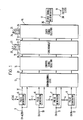
- the clock signal multiplexer comprises four input terminals 1 to 4 to which the input clock signals A to D respectively are supplied, and which are respectively connected to the clock terminals of four pulse generators 5 to 8. To the pulse generators 5 to 8 are also respectively connected four further input terminals 9 to 12 to which are respectively supplied clock enable signals A to D which, as explained below, control selection of which of the input clock signals A to D is to form the output clock signal of the clock signal multiplexer. Where some plurality of clock signals other than four are to be multiplexed, then the elements of the clock signal multiplexer so far mentioned are each provided that plurality of times.
- the outputs of the pulse generators 5 to 8 are connected to a combinational logic circuit 13, to which are also supplied the clock enable signals A to D from the input terminals 9 to 12.
- the logic circuit 13 supplies four outputs to a control signal selector 14, which supplies four outputs to a synchronizer 15, which in turn supplies four outputs to a clock signal selector 16, which supplies an output to a clock signal regenerator 17 from which the required output clock signal is derived and supplied to an output terminal 18.
- To the synchronizer 15 are also supplied inverted input clock signals A to 5 via respective input terminals 19 to 22, and to the clock signal selector 16 are also supplied the four input clock signals A to D via respective input terminals 23 to 26.
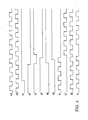
- the pulse generator 5 receives as inputs the clock signal A ( Figure 2A) and the clock enable signal A ( Figure 2B) which is active low.
- the output of the pulse generator 5 is a clock enable pulse ( Figure 2C).
- the output of the pulse generator 5 is normally low, and it produces a high pulse ( Figure 2C) on the negative edge of the input clock enable signal A.
- the pulse duration is one clock cycle of the system.
- the pulse generators 6 to 8 operate similarly for the input clock signals B to D.
- the required function of each of the pulse generators 5 to 8 can, for example be realised using flip-flop circuits and NOR gates.
- the logic circuit 13 receives as inputs the clock enable signals A to D (for example Figure 2B) which are active low, and the clock enable pules (for example Figure 2C) from the pulse generators 5 to 8.
- the output signal is a control signal pulse ( Figure 2D).
- the logic circuit 13 supplies one output signal for each input clock enable signal A to D.
- Each output signal is normally high, but a low control signal pulse ( Figure 2D) is produced on a given one of the four outputs in response to a high pulse on the respective clock enable pulse input, provided that all the input clock enable signals (A to D) not relating to the given output are high.
- the required function of the logic circuit 13 can, for example, be realised using NAND gates.
- the control signal selector 14 receives as inputs the control signal pulses ( Figure 2D) from the logic circuit 13, corresponding to the input clock signals A to D, and it supplies output control signals (for example Figure 2G), there being one for each of the input clock signal A to D.
- the control signal selector 14 produces a low control signal (for example Figure 2E) on the respective output in response to low on the respective input. At the same time, it causes all the other output control signals to go high.
- the required function of the control signal selector 14 can, for example, be realised using flip-flop circuits and AND gates.
- The-synchronizer 15 receives as inputs the four control signals (for example Figure 2E) from the control signal selector 14 and also be four inverted input clock signals ⁇ to D .
- the outputs are four synchronized control signals (for example Figure 2F).
- the synchronzer 15 thus synchronizes the input control signal to the falling edge of the respective input clock signal A to D.
- the required function of the synchronizer 15 can, for example, be realised using flip-flop circuits.
- the clock signal selector 16 is basically a multiplexer and receives as inputs the four synchronized control signals (for example Figure 2F) from the synchronizer 15 and the input clock signals A to D. The output is an intermediate output clock signal ( Figure 2G). Thus the clock signal selector 16 combines the input clock signals A to D according to the input synchronized control signals (for example Figure 2F).
- the required function of the clock signal selector 16 can, for example, be realised using AND gates and OR gates.
- the clock signal regenerator 17 receives as an input the intermediate output clock signal (Figure 2G) from the clock signal selector 16, and supplies as an output the output clock signal ( Figure 2H).
- the clock signal regenerator 17 maintains the required mark/space ratio of the output clock signal and removes glitches.
- the output clock signal is thus continuous and always contains complete clock cycles even when there is a transition from one input clock signal to another. This latter point will be more fully described in relation to the second embodiment, which is shown in Figure 3 and which will now be described.
- the individual circuits of the clock signal multiplexer are shown in more detail, but it is emphasized that this is only by way of example as the required functions can be realised in other ways.
- the second embodiment of clock signal multiplexer comprises four input terminals 31 to 34 to which the input clock signals A to D respectively are supplied, and which are respectively connected to the clock terminals of four D-type flip-flop circuits 35 to 38.
- To the D input terminals of the flip-flop circuits 35 to 38 are respectively connected four further input terminals 39 to 42 to which are respectively supplied clock enable signals A to D which, as explained below, control selection of which of the input clock signals A to D is to form the output clock signal of the clock signal multiplexer.
- Respectively associated with the flip-flop circuits 35 to 38 are four two-input NOR gates 43 to 46 and four four-input NAND gates 47 to 50.
- the 5 output terminals of the flip-flop circuits 35 to 38 are respectively connected to one input of the associated one of the NOR gates 46 to 46, the outputs of which are respectively connected to one input of the associated one of the NAND gates 47 to 50.
- the further input terminals 39 to 42 are also respectively connected to the other input terminal of the associated one of the NOR gates 43 to 46, and to a respective one of the input terminals of each of the three non-associated NAND-gates 47 to 50.
- the flip-flop circuit 35 and the NOR gate 43 for example, form a pulse generator, and the NAND gates 47 to 50 form a combinational logic circuit.
- the output of the NAND gate 47 is connected to the set terminal of a D-type flip-flop circuit 51, the Q output terminal of which is connected to the D input terminal of a D-type flip-flop circuit 55, the Q output terminal of which is connected to one input of a two-input AND gate 59.
- the outputs of the NAND gates 48, 49 and 50 are similarly connected to similarly-connected D-type flip-flop circuits and two-input AND gates 52, 56 and 60; 53, 57 and 61; and 54, 58 and 62, respectively.
- Four three-input AND gates 63 to 66 have their outputs connected to the clear terminals of the flip-flop circuits 51 to 54, respectively.
- the outputs of the NAND gates 47 to 50 are also connected to the respective inputs of the AND gates 64, 65 and 66; 65, 66 and 63; 66, 63 and 64; and 63, 64 and 65, respectivley.
- the input terminals 31 to 35 are respectively connected to the other input terminals of the AND gates 59 to 62.
- Four further input terminals 67 to 70 to which inverted input clock signals A to 6 respectively are supplied, are respectively connected to the clock terminals of the flip-flop circuits 55 to 58.
- the outputs of the AND gates 59 to 62 are respectively connected to the four inputs of an OR gate 71, the output of which is connected by way of a clock signal regenerator 72 to an output terminal 73.
- the flip-flop circuits 51 to 54 are the AND gates 63 to 66'form a control signal selector, the flip-flop circuits 55 to 58 form a synchronizer, and the AND gates 59 to 62 and the OR gate 71 form a clock signal selector.
- the two input clock signals A and B are supplied to the input terminals 31 and 32 respectively, and are of the same frequency but differ in phase.
- Associated with each of the four input clock signals A to D is a respective one of four clock enable signals A to D which are independent of each other, and are active when low. That is, any or none of the clock enable signals' A to D may be low at any given time, and at any given time the one of the clock enable signals A to D which has most recently gone low designates the one of the input clock signals A to D which is required to form the output of the multiplexer.
- the clock enable signals A and B ( Figures 4C and 4D) are supplied to the further input terminals 39 and 40 respectively.
- the clock enable signal B ( Figure 4D) goes low, signalling a request for a transition to the input clock signal B ( Figure 4B).
- the flip-flop circuit 36 operates as a latch circuit and in cooperation with the NOR gate 44 causes a single positive pulse, with a duration of one input clock signal B ( Figure 4B) cycle long, to be generated following the negative edge of the clock enable signal B ( Figure 4D). This pulse will pass through the NAND gate 48 and become a single negative pulse 4E.
- the effect of the pulse 4E is two-fold. Firstly, via the AND gate 63 it will cause the flip-flop circuit 51 to be cleared. The output of the flip-flop circuit 51 will go low and the flip-flop circuit 55 will then be clocked by a negative edge of the inverted input clock signal 1 to cause the output signal 4F of the flip-flop circuit 55 to go low. Since this signal 4F and the input clock signal A ( Figure 4A) are gated together by the AND gate 59, the result of the signal 4F going low is to de-select the input clock signal A ( Figure 4A) and take the signal 41 supplied by the AND gate 59 to the OR gate 71 low. Secondly, this signal 4E sets the flip-flop circuit 52 so that the output signal 4G goes high.
- the next negative edge of the inverted input clock signal E will cause the output signal 4H of the flip-flop circuit 56 also to go high.
- the signal 4H enables the AND gate 60 to supply the input clock signal B ( Figure 4B) to the OR gate 71 as the signal 4J.
- the input clock signal A ( Figure 4A) will have been de-selected and the input clock signal B ( Figure 4B) will have been selected, so that the output signal 4K from the OR gate 71 will have changed from the input clock signal A ( Figure 4A) to the input clock signal B ( Figure 4B).
- the result of the input clock signals A and B ( Figures 4A and 4B) being out of phase is that the signal 4K contains a reduced space period. As this could well cause a problem in subsequent circuitry, the signal 4K is supplied to the clock signal regenerator 72 which operates to maintain the mark/space ratio of the output signal 4L within predetermined bounds.
- the multiplexer operates in the case of a transition from the input clock signal A to the input clock signal B, but it will also be readily apparent how transitions can occur from any one of the input clocks A to D to any other one of the input clock signals A to D.
- the selection of the previously-selected input clock signal A to D is relinquished by the corresponding clock enable signal A to D going high, and a new input clock signal A to D is selected by the corresponding clock enable signal A to D going low.
- the clock signal regenerator 72 comprises D-type flip-flop circuits 81 and 82 and a delay line 83 which produces a total delay of 30 nanoseconds with an intermediate tap at 15 nanoseconds.
- the output of the OR gate 71 ( Figure 3) is connected to an input terminal 84, which is connected to the clock terminal of the flip-flop circuit 81.
- the Q output terminal of the flip-flop circuit 81 is connected to the input of the delay line 83 and also to the set terminal of the flip-flop circuit 82.
- the output tap of the delay line 83 is connected to the set terminal of the flip-flop circuit 81, and the intermediate tap of the delay line 83 is connected to the clock terminal of the flip-flop circuit 82.
- the Q output terminal of the flip-flop circuit 82 is connected to the output terminal 73 of the clock signal multiplexer ( Figure 3).
- the Q output terminal of the flip-flop circuit 82 can be used to supply the output, or indeed both the Q and the Zi output terminals may be used if required.
- a pulse signal 6A is supplied by the OR gate 71 ( Figure 3) to the terminal 84 and in consequence the flip-flop circuit 81 supplies a pulse 6B, the leading edge of which is delayed by say 6 nanoseconds relative to the positive edge of the pulse signal 6A, due to the delay inherent in the flip-flop circuit 81.
- the negative edge of a pulse 6C supplied from the intermediate tap of the delay line 83 to the flip-flop circuit 82 is delayed by a further 15 nanoseconds, while the negative edge of a pulse 6D which sets the flip-flop circuit 81 is delayed by 30 nanoseconds relative to the negative edge of the pulse 6B.
- the positive edge of the output pulse 6E is set by the negative edge of the pulse 6B, and the negative edge of the output pulse 6E is set by the positive edge of the pulse 6C.
- the mark period is therefore the interval between the above two times, that is:
- the mark/space ratio of the output clock signal is determined exclusively by the clock signal regenerator circuit 72, and not by the pulse signal 6A.
Landscapes
- Engineering & Computer Science (AREA)
- Theoretical Computer Science (AREA)
- Physics & Mathematics (AREA)
- General Engineering & Computer Science (AREA)
- General Physics & Mathematics (AREA)
- Electronic Switches (AREA)
- Manipulation Of Pulses (AREA)
- Signal Processing For Digital Recording And Reproducing (AREA)
Applications Claiming Priority (2)
| Application Number | Priority Date | Filing Date | Title |
|---|---|---|---|
| GB8627793 | 1986-11-20 | ||
| GB8627793A GB2198012B (en) | 1986-11-20 | 1986-11-20 | Clock signal multiplexers |
Publications (3)
| Publication Number | Publication Date |
|---|---|
| EP0268409A2 true EP0268409A2 (de) | 1988-05-25 |
| EP0268409A3 EP0268409A3 (en) | 1990-05-02 |
| EP0268409B1 EP0268409B1 (de) | 1994-01-12 |
Family
ID=10607668
Family Applications (1)
| Application Number | Title | Priority Date | Filing Date |
|---|---|---|---|
| EP87309813A Expired - Lifetime EP0268409B1 (de) | 1986-11-20 | 1987-11-05 | Multiplexer für Taktsignale |
Country Status (5)
| Country | Link |
|---|---|
| US (1) | US4820992A (de) |
| EP (1) | EP0268409B1 (de) |
| JP (1) | JPS63139415A (de) |
| DE (1) | DE3788783T2 (de) |
| GB (1) | GB2198012B (de) |
Families Citing this family (12)
| Publication number | Priority date | Publication date | Assignee | Title |
|---|---|---|---|---|
| JP2739964B2 (ja) * | 1988-09-28 | 1998-04-15 | 株式会社東芝 | クロック切替回路 |
| US5015871A (en) * | 1989-11-03 | 1991-05-14 | Harris Corporation | Multiple external asynchronous triggers circuit |
| KR930003343Y1 (ko) * | 1991-05-31 | 1993-06-09 | 삼성전자 주식회사 | 멀티 플렉서의 출력 제어장치 |
| EP0522720B1 (de) * | 1991-06-18 | 1999-08-18 | Nokia Mobile Phones Ltd. | Einstellung der Taktfrequenz einer elektrischen Schaltung |
| KR930003576A (ko) * | 1991-07-09 | 1993-02-24 | 강진구 | 멀티 플렉서 제어용 디코더 |
| US5630100A (en) * | 1994-10-17 | 1997-05-13 | Advanced Micro Devices, Inc. | Simulating multi-phase clock designs using a single clock edge based system |
| US5604452A (en) * | 1995-04-03 | 1997-02-18 | Exar Corporation | Clock generator using a state machine to switch between two offset clocks |
| JP3293743B2 (ja) * | 1996-07-10 | 2002-06-17 | 富士通株式会社 | 時分割信号交換システム |
| US6791977B1 (en) | 2000-10-17 | 2004-09-14 | Gennum Corporation | Reclocker circuit and router cell |
| US6960942B2 (en) * | 2001-05-18 | 2005-11-01 | Exar Corporation | High speed phase selector |
| DE10137373B4 (de) | 2001-07-31 | 2004-01-29 | Infineon Technologies Ag | Verfahren zum Ansteuern von zu steuernden Schaltungseinheiten und entsprechende Steuersignalerzeugungsvorrichtung |
| US8085082B2 (en) * | 2007-05-30 | 2011-12-27 | Broadcom Corporation | High speed multiplexer |
Family Cites Families (6)
| Publication number | Priority date | Publication date | Assignee | Title |
|---|---|---|---|---|
| US3061815A (en) * | 1957-06-19 | 1962-10-30 | Rca Corp | Signal translating system |
| US4214213A (en) * | 1977-10-25 | 1980-07-22 | Rca Corporation | Signal selecting system |
| US4229699A (en) * | 1978-05-22 | 1980-10-21 | Data General Corporation | Multiple clock selection system |
| US4308598A (en) * | 1979-07-09 | 1981-12-29 | The Anaconda Company | Simplified roll along switching |
| US4521810A (en) * | 1983-05-03 | 1985-06-04 | Rca Corporation | Video source selector |
| US4651103A (en) * | 1985-12-30 | 1987-03-17 | At&T Company | Phase adjustment system |
-
1986
- 1986-11-20 GB GB8627793A patent/GB2198012B/en not_active Expired - Lifetime
-
1987
- 1987-11-05 DE DE3788783T patent/DE3788783T2/de not_active Expired - Fee Related
- 1987-11-05 EP EP87309813A patent/EP0268409B1/de not_active Expired - Lifetime
- 1987-11-10 US US07/119,392 patent/US4820992A/en not_active Expired - Lifetime
- 1987-11-20 JP JP62294787A patent/JPS63139415A/ja active Pending
Also Published As
| Publication number | Publication date |
|---|---|
| DE3788783D1 (de) | 1994-02-24 |
| GB2198012A (en) | 1988-06-02 |
| DE3788783T2 (de) | 1994-05-19 |
| EP0268409A3 (en) | 1990-05-02 |
| GB8627793D0 (en) | 1986-12-17 |
| US4820992A (en) | 1989-04-11 |
| GB2198012B (en) | 1990-07-04 |
| EP0268409B1 (de) | 1994-01-12 |
| JPS63139415A (ja) | 1988-06-11 |
Similar Documents
| Publication | Publication Date | Title |
|---|---|---|
| US4970405A (en) | Clock selection circuit for selecting one of a plurality of clock pulse signals | |
| EP0268409B1 (de) | Multiplexer für Taktsignale | |
| US4151373A (en) | Data transmission system | |
| US5757871A (en) | Jitter suppression circuit for clock signals used for sending data from a synchronous transmission network to an asynchronous transmission network | |
| JPH0773219B2 (ja) | 並直列変換装置 | |
| CA1177967A (en) | Serial-to-parallel converter | |
| EP0969350A2 (de) | Schaltung zur Umschaltung von Taktsignalen | |
| US5510742A (en) | Multiplexer receiving at its input a plurality of identical, but out of phase, signals | |
| CA1317379C (en) | Pulse insertion circuit | |
| US4754456A (en) | Multiplex system for replacing a faulty multiplexer output with an alternating pattern signal | |
| US4771441A (en) | Synchronizing unit | |
| US5117443A (en) | Method and apparatus for operating at fractional speeds in synchronous systems | |
| EP0379772A2 (de) | Programmierbare Zeitsteuerung der Datenübertragung | |
| US6535048B1 (en) | Secure asynchronous clock multiplexer | |
| US5757807A (en) | Method of and apparatus for extracting or inserting a signal in a time division multiplex communication system | |
| US4300232A (en) | Self synchronized multiplexer/demultiplexer | |
| US4644568A (en) | Timing signal distribution arrangement | |
| EP0468479B1 (de) | Rahmensynchronisierungseinrichtung mit einem seriell-zu-parallel-Umsetzer | |
| KR20010029434A (ko) | 클럭 선택을 위한 디지탈 스위칭 이행 시의 타임-워킹방지 방법 및 시스템 | |
| JPH0616277B2 (ja) | 事象配分・結合装置 | |
| KR100238208B1 (ko) | 동기식 직렬 입출력 회로 | |
| GB2181025A (en) | Clock signal multiplexers | |
| US5099501A (en) | Arrangement for switching a clock to a clock having the same frequency but a lagging clock phase | |
| KR19980050372A (ko) | 데이타 전송 동기용 클럭 발생장치 | |
| KR890001202B1 (ko) | 디지탈 교환기의 톤 제너레이터(tone generator) |
Legal Events
| Date | Code | Title | Description |
|---|---|---|---|
| PUAI | Public reference made under article 153(3) epc to a published international application that has entered the european phase |
Free format text: ORIGINAL CODE: 0009012 |
|
| AK | Designated contracting states |
Kind code of ref document: A2 Designated state(s): DE FR GB NL |
|
| PUAL | Search report despatched |
Free format text: ORIGINAL CODE: 0009013 |
|
| AK | Designated contracting states |
Kind code of ref document: A3 Designated state(s): DE FR GB NL |
|
| 17P | Request for examination filed |
Effective date: 19900919 |
|
| 17Q | First examination report despatched |
Effective date: 19930225 |
|
| GRAA | (expected) grant |
Free format text: ORIGINAL CODE: 0009210 |
|
| AK | Designated contracting states |
Kind code of ref document: B1 Designated state(s): DE FR GB NL |
|
| REF | Corresponds to: |
Ref document number: 3788783 Country of ref document: DE Date of ref document: 19940224 |
|
| ET | Fr: translation filed | ||
| PLBE | No opposition filed within time limit |
Free format text: ORIGINAL CODE: 0009261 |
|
| STAA | Information on the status of an ep patent application or granted ep patent |
Free format text: STATUS: NO OPPOSITION FILED WITHIN TIME LIMIT |
|
| 26N | No opposition filed | ||
| REG | Reference to a national code |
Ref country code: GB Ref legal event code: IF02 |
|
| PGFP | Annual fee paid to national office [announced via postgrant information from national office to epo] |
Ref country code: GB Payment date: 20051102 Year of fee payment: 19 |
|
| PGFP | Annual fee paid to national office [announced via postgrant information from national office to epo] |
Ref country code: DE Payment date: 20051103 Year of fee payment: 19 |
|
| PGFP | Annual fee paid to national office [announced via postgrant information from national office to epo] |
Ref country code: NL Payment date: 20051106 Year of fee payment: 19 |
|
| PGFP | Annual fee paid to national office [announced via postgrant information from national office to epo] |
Ref country code: FR Payment date: 20051108 Year of fee payment: 19 |
|
| PG25 | Lapsed in a contracting state [announced via postgrant information from national office to epo] |
Ref country code: DE Free format text: LAPSE BECAUSE OF NON-PAYMENT OF DUE FEES Effective date: 20070601 Ref country code: NL Free format text: LAPSE BECAUSE OF NON-PAYMENT OF DUE FEES Effective date: 20070601 |
|
| GBPC | Gb: european patent ceased through non-payment of renewal fee |
Effective date: 20061105 |
|
| NLV4 | Nl: lapsed or anulled due to non-payment of the annual fee |
Effective date: 20070601 |
|
| REG | Reference to a national code |
Ref country code: FR Ref legal event code: ST Effective date: 20070731 |
|
| PG25 | Lapsed in a contracting state [announced via postgrant information from national office to epo] |
Ref country code: GB Free format text: LAPSE BECAUSE OF NON-PAYMENT OF DUE FEES Effective date: 20061105 |
|
| PG25 | Lapsed in a contracting state [announced via postgrant information from national office to epo] |
Ref country code: FR Free format text: LAPSE BECAUSE OF NON-PAYMENT OF DUE FEES Effective date: 20061130 |