EP0261409A1 - Verfarhen zur herstellung von Alkoxysilanterminierten, feuchtigkeitsärtenden Polyurethanen sowie ihre Verwendung für Klebe- und Dichtungsmassen - Google Patents
Verfarhen zur herstellung von Alkoxysilanterminierten, feuchtigkeitsärtenden Polyurethanen sowie ihre Verwendung für Klebe- und Dichtungsmassen Download PDFInfo
- Publication number
- EP0261409A1 EP0261409A1 EP87112188A EP87112188A EP0261409A1 EP 0261409 A1 EP0261409 A1 EP 0261409A1 EP 87112188 A EP87112188 A EP 87112188A EP 87112188 A EP87112188 A EP 87112188A EP 0261409 A1 EP0261409 A1 EP 0261409A1
- Authority
- EP
- European Patent Office
- Prior art keywords
- nco
- terminated
- polyurethanes
- triols
- number average
- Prior art date
- Legal status (The legal status is an assumption and is not a legal conclusion. Google has not performed a legal analysis and makes no representation as to the accuracy of the status listed.)
- Granted
Links
- 229920002635 polyurethane Polymers 0.000 title claims abstract description 49
- 239000004814 polyurethane Substances 0.000 title claims abstract description 47
- 238000000034 method Methods 0.000 title claims description 10
- 238000002360 preparation method Methods 0.000 title claims description 5
- 239000013466 adhesive and sealant Substances 0.000 title description 3
- 150000004072 triols Chemical class 0.000 claims abstract description 17
- 150000002009 diols Chemical class 0.000 claims abstract description 14
- 239000000203 mixture Substances 0.000 claims abstract description 12
- -1 aliphatic alcohols Chemical class 0.000 claims abstract description 11
- 238000006243 chemical reaction Methods 0.000 claims abstract description 10
- 125000005442 diisocyanate group Chemical group 0.000 claims abstract description 10
- 238000013008 moisture curing Methods 0.000 claims abstract description 9
- 239000000853 adhesive Substances 0.000 claims abstract 2
- 230000001070 adhesive effect Effects 0.000 claims abstract 2
- 125000004432 carbon atom Chemical group C* 0.000 claims description 16
- 150000001298 alcohols Chemical class 0.000 claims description 12
- LYCAIKOWRPUZTN-UHFFFAOYSA-N Ethylene glycol Chemical compound OCCO LYCAIKOWRPUZTN-UHFFFAOYSA-N 0.000 claims description 9
- PEDCQBHIVMGVHV-UHFFFAOYSA-N Glycerine Chemical compound OCC(O)CO PEDCQBHIVMGVHV-UHFFFAOYSA-N 0.000 claims description 9
- 238000001723 curing Methods 0.000 claims description 9
- MTHSVFCYNBDYFN-UHFFFAOYSA-N diethylene glycol Chemical compound OCCOCCO MTHSVFCYNBDYFN-UHFFFAOYSA-N 0.000 claims description 9
- 239000004721 Polyphenylene oxide Substances 0.000 claims description 7
- 229920000570 polyether Polymers 0.000 claims description 7
- 239000003054 catalyst Substances 0.000 claims description 5
- 150000001875 compounds Chemical class 0.000 claims description 5
- ZJCCRDAZUWHFQH-UHFFFAOYSA-N Trimethylolpropane Chemical compound CCC(CO)(CO)CO ZJCCRDAZUWHFQH-UHFFFAOYSA-N 0.000 claims description 4
- 125000001931 aliphatic group Chemical group 0.000 claims description 4
- 239000000945 filler Substances 0.000 claims description 4
- CDQSJQSWAWPGKG-UHFFFAOYSA-N butane-1,1-diol Chemical class CCCC(O)O CDQSJQSWAWPGKG-UHFFFAOYSA-N 0.000 claims description 3
- SZXQTJUDPRGNJN-UHFFFAOYSA-N dipropylene glycol Chemical compound OCCCOCCCO SZXQTJUDPRGNJN-UHFFFAOYSA-N 0.000 claims description 3
- 238000007046 ethoxylation reaction Methods 0.000 claims description 3
- ACCCMOQWYVYDOT-UHFFFAOYSA-N hexane-1,1-diol Chemical class CCCCCC(O)O ACCCMOQWYVYDOT-UHFFFAOYSA-N 0.000 claims description 3
- KHLCTMQBMINUNT-UHFFFAOYSA-N octadecane-1,12-diol Chemical compound CCCCCCC(O)CCCCCCCCCCCO KHLCTMQBMINUNT-UHFFFAOYSA-N 0.000 claims description 3
- ZIBGPFATKBEMQZ-UHFFFAOYSA-N triethylene glycol Chemical compound OCCOCCOCCO ZIBGPFATKBEMQZ-UHFFFAOYSA-N 0.000 claims description 3
- DNIAPMSPPWPWGF-UHFFFAOYSA-N Propylene glycol Chemical compound CC(O)CO DNIAPMSPPWPWGF-UHFFFAOYSA-N 0.000 claims description 2
- 239000012963 UV stabilizer Substances 0.000 claims description 2
- 239000000654 additive Substances 0.000 claims description 2
- 239000000049 pigment Substances 0.000 claims description 2
- 238000007789 sealing Methods 0.000 claims description 2
- YPFDHNVEDLHUCE-UHFFFAOYSA-N propane-1,3-diol Chemical compound OCCCO YPFDHNVEDLHUCE-UHFFFAOYSA-N 0.000 claims 4
- 239000000565 sealant Substances 0.000 abstract description 3
- 125000004103 aminoalkyl group Chemical group 0.000 abstract 1
- 125000005358 mercaptoalkyl group Chemical group 0.000 abstract 1
- UKLDJPRMSDWDSL-UHFFFAOYSA-L [dibutyl(dodecanoyloxy)stannyl] dodecanoate Chemical compound CCCCCCCCCCCC(=O)O[Sn](CCCC)(CCCC)OC(=O)CCCCCCCCCCC UKLDJPRMSDWDSL-UHFFFAOYSA-L 0.000 description 7
- 239000012975 dibutyltin dilaurate Substances 0.000 description 7
- UUEWCQRISZBELL-UHFFFAOYSA-N 3-trimethoxysilylpropane-1-thiol Chemical compound CO[Si](OC)(OC)CCCS UUEWCQRISZBELL-UHFFFAOYSA-N 0.000 description 4
- LRHPLDYGYMQRHN-UHFFFAOYSA-N N-Butanol Chemical class CCCCO LRHPLDYGYMQRHN-UHFFFAOYSA-N 0.000 description 4
- 229920001451 polypropylene glycol Polymers 0.000 description 4
- 239000000047 product Substances 0.000 description 4
- UPMLOUAZCHDJJD-UHFFFAOYSA-N 4,4'-Diphenylmethane Diisocyanate Chemical compound C1=CC(N=C=O)=CC=C1CC1=CC=C(N=C=O)C=C1 UPMLOUAZCHDJJD-UHFFFAOYSA-N 0.000 description 3
- OKKJLVBELUTLKV-UHFFFAOYSA-N Methanol Chemical compound OC OKKJLVBELUTLKV-UHFFFAOYSA-N 0.000 description 3
- 239000007795 chemical reaction product Substances 0.000 description 3
- 230000000052 comparative effect Effects 0.000 description 3
- 238000004132 cross linking Methods 0.000 description 3
- 239000012948 isocyanate Substances 0.000 description 3
- KBPLFHHGFOOTCA-UHFFFAOYSA-N 1-Octanol Chemical compound CCCCCCCCO KBPLFHHGFOOTCA-UHFFFAOYSA-N 0.000 description 2
- IJGRMHOSHXDMSA-UHFFFAOYSA-N Atomic nitrogen Chemical compound N#N IJGRMHOSHXDMSA-UHFFFAOYSA-N 0.000 description 2
- CURLTUGMZLYLDI-UHFFFAOYSA-N Carbon dioxide Chemical compound O=C=O CURLTUGMZLYLDI-UHFFFAOYSA-N 0.000 description 2
- LFQSCWFLJHTTHZ-UHFFFAOYSA-N Ethanol Chemical compound CCO LFQSCWFLJHTTHZ-UHFFFAOYSA-N 0.000 description 2
- 229920001730 Moisture cure polyurethane Polymers 0.000 description 2
- KKEYFWRCBNTPAC-UHFFFAOYSA-N Terephthalic acid Chemical compound OC(=O)C1=CC=C(C(O)=O)C=C1 KKEYFWRCBNTPAC-UHFFFAOYSA-N 0.000 description 2
- KXJLGCBCRCSXQF-UHFFFAOYSA-N [diacetyloxy(ethyl)silyl] acetate Chemical compound CC(=O)O[Si](CC)(OC(C)=O)OC(C)=O KXJLGCBCRCSXQF-UHFFFAOYSA-N 0.000 description 2
- WNLRTRBMVRJNCN-UHFFFAOYSA-N adipic acid Chemical compound OC(=O)CCCCC(O)=O WNLRTRBMVRJNCN-UHFFFAOYSA-N 0.000 description 2
- 239000004305 biphenyl Substances 0.000 description 2
- MWKFXSUHUHTGQN-UHFFFAOYSA-N decan-1-ol Chemical compound CCCCCCCCCCO MWKFXSUHUHTGQN-UHFFFAOYSA-N 0.000 description 2
- 235000014113 dietary fatty acids Nutrition 0.000 description 2
- LQZZUXJYWNFBMV-UHFFFAOYSA-N dodecan-1-ol Chemical compound CCCCCCCCCCCCO LQZZUXJYWNFBMV-UHFFFAOYSA-N 0.000 description 2
- 239000000194 fatty acid Substances 0.000 description 2
- 229930195729 fatty acid Natural products 0.000 description 2
- ZSIAUFGUXNUGDI-UHFFFAOYSA-N hexan-1-ol Chemical class CCCCCCO ZSIAUFGUXNUGDI-UHFFFAOYSA-N 0.000 description 2
- 230000002209 hydrophobic effect Effects 0.000 description 2
- 229910010272 inorganic material Inorganic materials 0.000 description 2
- 150000002513 isocyanates Chemical class 0.000 description 2
- QQVIHTHCMHWDBS-UHFFFAOYSA-N isophthalic acid Chemical compound OC(=O)C1=CC=CC(C(O)=O)=C1 QQVIHTHCMHWDBS-UHFFFAOYSA-N 0.000 description 2
- 239000000463 material Substances 0.000 description 2
- 239000003973 paint Substances 0.000 description 2
- XNGIFLGASWRNHJ-UHFFFAOYSA-N phthalic acid Chemical compound OC(=O)C1=CC=CC=C1C(O)=O XNGIFLGASWRNHJ-UHFFFAOYSA-N 0.000 description 2
- DNIAPMSPPWPWGF-GSVOUGTGSA-N (R)-(-)-Propylene glycol Chemical compound C[C@@H](O)CO DNIAPMSPPWPWGF-GSVOUGTGSA-N 0.000 description 1
- FKTHNVSLHLHISI-UHFFFAOYSA-N 1,2-bis(isocyanatomethyl)benzene Chemical compound O=C=NCC1=CC=CC=C1CN=C=O FKTHNVSLHLHISI-UHFFFAOYSA-N 0.000 description 1
- ALQLPWJFHRMHIU-UHFFFAOYSA-N 1,4-diisocyanatobenzene Chemical compound O=C=NC1=CC=C(N=C=O)C=C1 ALQLPWJFHRMHIU-UHFFFAOYSA-N 0.000 description 1
- SBJCUZQNHOLYMD-UHFFFAOYSA-N 1,5-Naphthalene diisocyanate Chemical compound C1=CC=C2C(N=C=O)=CC=CC2=C1N=C=O SBJCUZQNHOLYMD-UHFFFAOYSA-N 0.000 description 1
- ATOUXIOKEJWULN-UHFFFAOYSA-N 1,6-diisocyanato-2,2,4-trimethylhexane Chemical compound O=C=NCCC(C)CC(C)(C)CN=C=O ATOUXIOKEJWULN-UHFFFAOYSA-N 0.000 description 1
- 229940008841 1,6-hexamethylene diisocyanate Drugs 0.000 description 1
- POAOYUHQDCAZBD-UHFFFAOYSA-N 2-butoxyethanol Chemical compound CCCCOCCO POAOYUHQDCAZBD-UHFFFAOYSA-N 0.000 description 1
- BSJQMNIJQVVJPX-UHFFFAOYSA-N 2-methylhexane-1,2-diol Chemical compound CCCCC(C)(O)CO BSJQMNIJQVVJPX-UHFFFAOYSA-N 0.000 description 1
- XYPMNUUXJRUXCM-UHFFFAOYSA-N 2-oxohexadecanal Chemical compound CCCCCCCCCCCCCCC(=O)C=O XYPMNUUXJRUXCM-UHFFFAOYSA-N 0.000 description 1
- OQSZOVAFDREXFA-UHFFFAOYSA-N 2-oxotetradecanal Chemical compound CCCCCCCCCCCCC(=O)C=O OQSZOVAFDREXFA-UHFFFAOYSA-N 0.000 description 1
- 235000008733 Citrus aurantifolia Nutrition 0.000 description 1
- IAYPIBMASNFSPL-UHFFFAOYSA-N Ethylene oxide Chemical compound C1CO1 IAYPIBMASNFSPL-UHFFFAOYSA-N 0.000 description 1
- 239000005058 Isophorone diisocyanate Substances 0.000 description 1
- 239000004839 Moisture curing adhesive Substances 0.000 description 1
- GOOHAUXETOMSMM-UHFFFAOYSA-N Propylene oxide Chemical compound CC1CO1 GOOHAUXETOMSMM-UHFFFAOYSA-N 0.000 description 1
- BLRPTPMANUNPDV-UHFFFAOYSA-N Silane Chemical compound [SiH4] BLRPTPMANUNPDV-UHFFFAOYSA-N 0.000 description 1
- XUIMIQQOPSSXEZ-UHFFFAOYSA-N Silicon Chemical compound [Si] XUIMIQQOPSSXEZ-UHFFFAOYSA-N 0.000 description 1
- 235000011941 Tilia x europaea Nutrition 0.000 description 1
- KXBFLNPZHXDQLV-UHFFFAOYSA-N [cyclohexyl(diisocyanato)methyl]cyclohexane Chemical compound C1CCCCC1C(N=C=O)(N=C=O)C1CCCCC1 KXBFLNPZHXDQLV-UHFFFAOYSA-N 0.000 description 1
- 239000001361 adipic acid Substances 0.000 description 1
- 235000011037 adipic acid Nutrition 0.000 description 1
- 125000000217 alkyl group Chemical group 0.000 description 1
- 150000001412 amines Chemical class 0.000 description 1
- 125000003118 aryl group Chemical group 0.000 description 1
- 235000012216 bentonite Nutrition 0.000 description 1
- 239000001569 carbon dioxide Substances 0.000 description 1
- 229910002092 carbon dioxide Inorganic materials 0.000 description 1
- 239000003795 chemical substances by application Substances 0.000 description 1
- 239000003431 cross linking reagent Substances 0.000 description 1
- UOQACRNTVQWTFF-UHFFFAOYSA-N decane-1,10-dithiol Chemical compound SCCCCCCCCCCS UOQACRNTVQWTFF-UHFFFAOYSA-N 0.000 description 1
- 150000001991 dicarboxylic acids Chemical class 0.000 description 1
- 239000000539 dimer Substances 0.000 description 1
- 150000004665 fatty acids Chemical class 0.000 description 1
- 239000000835 fiber Substances 0.000 description 1
- 239000011888 foil Substances 0.000 description 1
- 229910021485 fumed silica Inorganic materials 0.000 description 1
- RRAMGCGOFNQTLD-UHFFFAOYSA-N hexamethylene diisocyanate Chemical compound O=C=NCCCCCCN=C=O RRAMGCGOFNQTLD-UHFFFAOYSA-N 0.000 description 1
- 150000002433 hydrophilic molecules Chemical class 0.000 description 1
- 150000007529 inorganic bases Chemical class 0.000 description 1
- 150000002484 inorganic compounds Chemical class 0.000 description 1
- 239000011256 inorganic filler Substances 0.000 description 1
- 229910003475 inorganic filler Inorganic materials 0.000 description 1
- 239000011147 inorganic material Substances 0.000 description 1
- 229910052500 inorganic mineral Inorganic materials 0.000 description 1
- IQPQWNKOIGAROB-UHFFFAOYSA-N isocyanate group Chemical group [N-]=C=O IQPQWNKOIGAROB-UHFFFAOYSA-N 0.000 description 1
- NIMLQBUJDJZYEJ-UHFFFAOYSA-N isophorone diisocyanate Chemical compound CC1(C)CC(N=C=O)CC(C)(CN=C=O)C1 NIMLQBUJDJZYEJ-UHFFFAOYSA-N 0.000 description 1
- 239000004571 lime Substances 0.000 description 1
- 229920002521 macromolecule Polymers 0.000 description 1
- 239000011707 mineral Substances 0.000 description 1
- 229910052757 nitrogen Inorganic materials 0.000 description 1
- 239000012299 nitrogen atmosphere Substances 0.000 description 1
- 239000012766 organic filler Substances 0.000 description 1
- DGTNSSLYPYDJGL-UHFFFAOYSA-N phenyl isocyanate Chemical compound O=C=NC1=CC=CC=C1 DGTNSSLYPYDJGL-UHFFFAOYSA-N 0.000 description 1
- 229920003023 plastic Polymers 0.000 description 1
- 239000004033 plastic Substances 0.000 description 1
- 229920000728 polyester Polymers 0.000 description 1
- 229920000642 polymer Polymers 0.000 description 1
- 229920005862 polyol Polymers 0.000 description 1
- 150000003077 polyols Chemical class 0.000 description 1
- 239000000843 powder Substances 0.000 description 1
- 150000003138 primary alcohols Chemical class 0.000 description 1
- BDERNNFJNOPAEC-UHFFFAOYSA-N propan-1-ol Chemical class CCCO BDERNNFJNOPAEC-UHFFFAOYSA-N 0.000 description 1
- 235000013772 propylene glycol Nutrition 0.000 description 1
- 229910052710 silicon Inorganic materials 0.000 description 1
- 239000010703 silicon Substances 0.000 description 1
- 238000003756 stirring Methods 0.000 description 1
- RSPCKAHMRANGJZ-UHFFFAOYSA-N thiohydroxylamine Chemical compound SN RSPCKAHMRANGJZ-UHFFFAOYSA-N 0.000 description 1
- RUELTTOHQODFPA-UHFFFAOYSA-N toluene 2,6-diisocyanate Chemical compound CC1=C(N=C=O)C=CC=C1N=C=O RUELTTOHQODFPA-UHFFFAOYSA-N 0.000 description 1
- 239000010457 zeolite Substances 0.000 description 1
Classifications
-
- C—CHEMISTRY; METALLURGY
- C09—DYES; PAINTS; POLISHES; NATURAL RESINS; ADHESIVES; COMPOSITIONS NOT OTHERWISE PROVIDED FOR; APPLICATIONS OF MATERIALS NOT OTHERWISE PROVIDED FOR
- C09J—ADHESIVES; NON-MECHANICAL ASPECTS OF ADHESIVE PROCESSES IN GENERAL; ADHESIVE PROCESSES NOT PROVIDED FOR ELSEWHERE; USE OF MATERIALS AS ADHESIVES
- C09J175/00—Adhesives based on polyureas or polyurethanes; Adhesives based on derivatives of such polymers
- C09J175/04—Polyurethanes
-
- C—CHEMISTRY; METALLURGY
- C08—ORGANIC MACROMOLECULAR COMPOUNDS; THEIR PREPARATION OR CHEMICAL WORKING-UP; COMPOSITIONS BASED THEREON
- C08G—MACROMOLECULAR COMPOUNDS OBTAINED OTHERWISE THAN BY REACTIONS ONLY INVOLVING UNSATURATED CARBON-TO-CARBON BONDS
- C08G18/00—Polymeric products of isocyanates or isothiocyanates
- C08G18/06—Polymeric products of isocyanates or isothiocyanates with compounds having active hydrogen
- C08G18/08—Processes
- C08G18/10—Prepolymer processes involving reaction of isocyanates or isothiocyanates with compounds having active hydrogen in a first reaction step
-
- C—CHEMISTRY; METALLURGY
- C08—ORGANIC MACROMOLECULAR COMPOUNDS; THEIR PREPARATION OR CHEMICAL WORKING-UP; COMPOSITIONS BASED THEREON
- C08G—MACROMOLECULAR COMPOUNDS OBTAINED OTHERWISE THAN BY REACTIONS ONLY INVOLVING UNSATURATED CARBON-TO-CARBON BONDS
- C08G18/00—Polymeric products of isocyanates or isothiocyanates
- C08G18/06—Polymeric products of isocyanates or isothiocyanates with compounds having active hydrogen
- C08G18/70—Polymeric products of isocyanates or isothiocyanates with compounds having active hydrogen characterised by the isocyanates or isothiocyanates used
- C08G18/71—Monoisocyanates or monoisothiocyanates
-
- C—CHEMISTRY; METALLURGY
- C08—ORGANIC MACROMOLECULAR COMPOUNDS; THEIR PREPARATION OR CHEMICAL WORKING-UP; COMPOSITIONS BASED THEREON
- C08G—MACROMOLECULAR COMPOUNDS OBTAINED OTHERWISE THAN BY REACTIONS ONLY INVOLVING UNSATURATED CARBON-TO-CARBON BONDS
- C08G18/00—Polymeric products of isocyanates or isothiocyanates
- C08G18/06—Polymeric products of isocyanates or isothiocyanates with compounds having active hydrogen
- C08G18/83—Chemically modified polymers
- C08G18/831—Chemically modified polymers by oxygen-containing compounds inclusive of carbonic acid halogenides, carboxylic acid halogenides and epoxy halides
- C08G18/832—Chemically modified polymers by oxygen-containing compounds inclusive of carbonic acid halogenides, carboxylic acid halogenides and epoxy halides by water acting as hydrolizing agent
-
- C—CHEMISTRY; METALLURGY
- C08—ORGANIC MACROMOLECULAR COMPOUNDS; THEIR PREPARATION OR CHEMICAL WORKING-UP; COMPOSITIONS BASED THEREON
- C08G—MACROMOLECULAR COMPOUNDS OBTAINED OTHERWISE THAN BY REACTIONS ONLY INVOLVING UNSATURATED CARBON-TO-CARBON BONDS
- C08G2190/00—Compositions for sealing or packing joints
Definitions
- the invention relates to alkoxysilane-terminated, moisture-curing polyurethanes, processes for their preparation and their use in adhesives and sealants.
- Moisture-curing one-component polyurethane systems with free NCO groups are known as the basis for paints, adhesives and sealants.
- Systems are also known in which some of the NCO groups of a polyurethane prepolymer are reacted with those alkoxysilanes in which an alkyl group on silicon bears an isocyanate-reactive group (for example mercapto, amine) (see US Pat. No. 3,627 722). This measure is intended to improve the adhesion to various inorganic surfaces.
- curing crosslinking always takes place with the participation of unconverted, free NCO groups.
- Polyurethanes reacted with organofunctional alkoxysilanes are also part of many primers on inorganic materials. Here, too, they bring about Si (OR) 3 groups an improvement in adhesion between the inorganic base material and the actual paint. Furthermore, DE-OS 25 51 275 describes an automotive sealant which cure only via alkoxysilane end groups. Extremely hard masses with, for example, a Shore A hardness of 63 are obtained.
- One-component polyurethane systems which essentially cure via isocyanate end groups, occasionally develop small bubbles in the cured mass due to the carbon dioxide which is partially released during the crosslinking.
- curing via Si (OR) 3 groups is in principle bubble-free.
- polyurethane systems with Si (OR) 3 end groups usually form hard and brittle masses of low elasticity in the hardened state. In this form, they are therefore not suitable as the basis for sealing compounds. This is because flexible materials with good resilience are required for many areas of application. Systems of this type with better elasticity than, for example, the polymer systems described in the aforementioned DE-OS 25 51 275 would therefore be desirable.
- the invention is directed to Si (OR) 3-terminated polyurethane prepolymers which cure without bubbles in the presence of atmospheric moisture and have better elasticity than the bubble-free curing compositions known from the prior art.
- the linear diols or triols to be used according to the invention have number average molecular weights of preferably 300 to 6500, in particular 500 to 3000.
- Preferred representatives are alkoxylation, especially ethoxylation and / or propoxylation products of di- or trifunctional alcohols, selected from those of ethylene glycol, diethylene glycol, triethylene glycol, 1,2-propanediol, dipropylene glycol, the butanediols, hexanediols, octanediols, technical mixtures of hydroxy fatty alcohols with 14 to 22 carbon atoms, especially hydroxystearyl alcohol, trimethylolpropane and glycerol.
- the basic molecule can be given a more hydrophobic or hydrophilic character. It is possible to obtain a predominantly hydrophobic molecule by predominantly adding propylene oxide to polyfunctional alcohols, while the addition or exclusive oxyalkylation with ethylene oxide gives more hydrophilic molecules. This also affects the macromolecule formed after the final crosslinking.
- polyesters from low molecular weight dicarboxylic acids such as adipic acid, Isophthalic acid, terephthalic acid and phthalic acid can be used with an excess of the above polyols.
- Typical representatives for the aromatic diisocyanates are: 2,4- and 2,6-toluenediisocyanate, in particular as a technical mixture; p-phenylene diisocyanate, 4,4 ⁇ -diphenyl diisocyanate, 1,5-naphthalene diisocyanate, 4,4 ⁇ -diphenylmethane diisocyanate, 3,3 ⁇ -dimethoxy-4,4 ⁇ -diphenyl diisocyanate, xylylene diisocyanate.
- aliphatic diisocyanates are, in particular, 1,4-tetramethylene diisocyanate, 1,6-hexamethylene diisocyanate, decane-1, 10-diisocyanate, 2,2,4-trimethylhexamethylene diisocyanate, dicyclohexylmethane diisocyanate and isophorone diisocyanate. and finally the technical isocyanates which can be obtained from the amines in the phosphogenation and which are obtained by hydrogenating dimer fatty acid nitriles.
- aromatic ones such as phenyl isocyanate, olyl isoscyanate and naphthylene isocyanate are particularly noteworthy.
- Linear or branched aliphatic alcohols which can be used according to the invention are, in particular, methanol, ethanol, the isomers of propanol, butanol and hexanol and the primary alcohols which can be obtained by reducing fatty acids and have 8 to 18 carbon atoms, such as octanol, decanol, dodecanol, tetradeconal, hexadeconal and octadeconal , in particular in the form of technical mixtures thereof.
- Monoalcohols with 4 to 18 carbon atoms are preferred because the lower alcohols are difficult to produce anhydrous.
- Monoalkyl polyether alcohols of different molecular weights can also be used, with a number average the molecular weight between 1000 and 2000 is preferred.
- a preferred representative is, for example, monobutylpropylene glycol.
- the number average of the NCO functionality of the NCO-terminated polyurethanes is therefore expediently between 1.8 and 1.2.
- alkoxysilanes of the general formula given above are commercially available compounds. A representation of these compounds and their mode of action can be found in the monograph "Silan Cuppling Agents" by Plueddemann, Plenum Press, New York (1982).
- the free NCO groups of the polyurethanes are preferably reacted with the alkoxysilanes according to the general formula above in the presence of catalysts, as described, for example, are known from US Pat. No. 3,627,722.
- catalysts as described, for example, are known from US Pat. No. 3,627,722.
- the use of dibutyltin dilaurate as a catalyst is preferred.
- the invention further relates to moisture-curing adhesives and sealants containing the abovementioned alkoxysilane-terminated polyurethanes according to the preceding description and, if appropriate, conventional additives such as pigments, fillers, curing catalysts and UV stabilizers.
- Suitable fillers are inorganic compounds which are inert to isocyanates, e.g. Chalk or lime powder, precipitated and / or pyrogenic silica, zeolites, bentonites, ground minerals and other inorganic fillers known to the person skilled in the art.
- Organic fillers can also be used, in particular fiber short cuts and the like.
- fillers are preferred which impart thixotropy to the preparations, e.g. swellable plastics such as PVC.
- a typical curing catalyst is the aforementioned dibutyltin dilaurate; crosslinking agents which act as curing accelerators, such as ethyltriacetoxysilane, are preferably added to the compositions.
- the NCO content measured after this is less than 0.03%.
- the viscosity of the product was 540,000 mPa ⁇ s according to Brookfield at 25 ° C.
- the described alkoxysilane-terminated prepolymers from Examples 1, 2 and 3 were each mixed with 7.5% by weight of ethyltriacetoxysilane and 1.5% by weight of dibutyltin dilaurate and cured in atmospheric humidity.
- the mechanical properties of the cured products were tested according to DIN 53504 on approximately 2mm thick foils.
- the table shows that the alkoxysilane-terminated polyurethanes of the invention have a significantly higher elongation at break after curing in air.
Landscapes
- Chemical & Material Sciences (AREA)
- Organic Chemistry (AREA)
- Chemical Kinetics & Catalysis (AREA)
- Health & Medical Sciences (AREA)
- Medicinal Chemistry (AREA)
- Polymers & Plastics (AREA)
- General Chemical & Material Sciences (AREA)
- Polyurethanes Or Polyureas (AREA)
- Sealing Material Composition (AREA)
- Adhesives Or Adhesive Processes (AREA)
- Paints Or Removers (AREA)
- Agricultural Chemicals And Associated Chemicals (AREA)
- Compositions Of Macromolecular Compounds (AREA)
Abstract
Description
- Die Erfindung betrifft alkoxysilanterminierte, feuchtigkeitshärtende Polyurethane, Verfahren zu ihrer Herstellung und ihre Verwendung in Klebe- und Dichtungsmassen.
- Feuchtigkeitshärtende Einkomponenten-Polyurethansysteme mit freien NCO-Gruppen sind als Basis für Anstrichstoffe, Klebstoffe und Dichtungsmassen bekannt. Es sind auch Systeme bekannt, bei denen ein Teil der NCO-Gruppen eines Polyurethan-Prepolymeren mit solchen Alkoxysilanen umgesetzt sind, bei denen eine Alkylgruppe an Silizium eine gegenüber Isocyanat reaktive Gruppe (z.B. Mercapto, Amin) trägt (vergl. US-PS 3 627 722). Durch diese Maßnahme soll die Haftung auf verschiedenen anorganischen Oberflächen verbessert werden. Die Aushärtung (Vernetzung) erfolgt jedoch stets unter Beteiligung nicht umgesetzter, freier NCO-Gruppen.
- Mit organofunktionellen Alkoxysilanen umgesetzte Polyurethane sind auch Bestandteil vieler Voranstriche (Primer) auf anorganischen Materialien. Auch hier bewirken die Si(OR)₃-Gruppen eine Haftungsverbesserung zwischen anorganischem Grundmaterial und eigentlichen Anstrich. Weiterhin ist in der DE-OS 25 51 275 eine Automobildichtungsmasse beschrieben, die ausschließlich über Alkoxysilan-Endgruppen aushärten. Dabei werden ausgesprochen harte Massen mit beispielsweise einer Shore A-Härte von 63 erhalten.
- Einkomponenten-Polyurethansysteme, die im wesentlichen über Isocyanat-Endgruppen aushärten, entwickeln durch das während der Vernetzung teilweise freigesetzte Kohlendioxid gelegentlich kleine Blasen in der ausgehärteten Masse. Eine Aushärtung über Si(OR)₃-Gruppen ist dagegen prinzipiell blasenfrei.
- Polyurethansysteme mit Si(OR)₃-Endgruppen bilden jedoch im ausgehärteten Zustand meist harte und spröde Massen geringer Elastizität. Daher sind sie in dieser Form als Basis von Dichtungsmassen nicht geeignet. Denn hier werden für viele Anwendungsbereiche weichelastische Massen mit gutem Rückstellvermögen gefordert. Derartige Systeme mit einem besseren Dehnvermögen als beispielsweise di der erwähnten DE-OS 25 51 275 beschriebenen Polymersysteme wären daher erwünscht.
- Demgemäß ist die Erfindung auf Si(OR)₃-terminierte Polyurethan-Prepolymere gerichtet, die in Gegenwart von Luftfeuchtigkeit blasenfrei aushärten und gegenüber den aus dem Stand der Technik bekannten, blasenfrei aushärtenden Massen ein besseres Dehnvermögen aufweisen.
- Diese Aufgabe wird erfindungsgemäß durch alkoxysilanterminierte, feuchtigkeitshärtende Polyurethane gelöst, die folgendermaßen erhältlich sind:
- a) Umsetzung von OH-terminierten linearen Di- und/oder Triolen mit Diisocyanaten zu NCO-terminierten Polyurethanen mit einem Zahlenmittel der NCO-Funktionalität von mindestens 2 und Umsetzung eines Teils der NCO-Gruppen mit linearen oder verzweigten aliphatischen Alkoholen mit 1 bis 18 C-Atomen oder Monoalkylpolyetheralkoholen zu einem Polyurethan mit einem Zahlenmittel der NCO-Funktionalität von mindestens 1 und weniger als 2, oder
- aʹ) Umsetzung der OH-terminierten linearen Di- oder Triole mit einem Gemisch von Mono- und Diisocyanaten zu NCO-terminierten Polyurethanen mit einem Zahlenmittel der NCO-Funktionalität von mindestens 1 und weniger als 2 und
- b) Umsetzung im wesentlichen sämtlicher freien NCO-Gruppen der erhaltenen Polyurethane mit Alkoxysilanen der nachstehenden allgemeinen Formel

R = -CH₃, -CH₂-CH₃, -OR¹ und
R¹ = -(CH₂-CH₂-O) m-R³ und
R² = H oder ein gegebenenfalls substituierter aliphatischer und/oder cycloaliphatischer oder aromatischer Kohlenwasserstoffrest mit 1 - 10 C-Atomen und
R³ = ein gegebenenfalls substituierter Alkylrest mit 1 - 10 C-Atomen und
R⁴ = ein Alkylrest mit 1 - 4 C-Atomen und
n = 1 - 8, m = 1- 30, p = ≧ 1 sowie q+p ≦αµρ¨ 2 bedeuten können. - Die erfindungsgemäß einzusetzenden linearen Di- oder Triole weisen Zahlenmittel der Molekulargewichte von vorzugsweise 300 bis 6500, insbesondere 500 bis 3000, auf. Bevorzugte Vertreter sind Alkoxylierungs-, insbesondere Ethoxylierungs- und/oder Propoxylierungsprodukte di- oder trifunktioneller Alkohole, ausgewählt aus der von Ethylenglykol, Diethylenglykol, Triethylenglykol, 1,2-Propandiol, Dipropylenglykol, den Butandiolen, Hexandiolen, Octandiolen, technische Gemische von Hydroxyfettalkoholen mit 14 bis 22 C-Atomen, insbesondere Hydroxystearylalkohol, Trimethylolpropan und Glycerin gebildeten Gruppe. Dabei kann man dem Grundmolekül einen mehr hydrophoben oder hydrophilen Charakter geben. Es ist möglich, durch überwiegende Addition von Propylenoxid an mehrfunktionelle Alkohole ein überwiegend hydrophobes Molekül zu erhalten, während man bei der Zudosierung bzw. ausschließlicher Oxalkylierung mit Ethylenoxid hydrophilere Moleküle erhält. Dies wirkt sich auch auf das nach der endgültigen Vernetzung gebildete Makromolekül aus.
- Weiterhin können als Polyhydroxylverbindungen Polyester aus niedermolekularen Dicarbonsäuren wie Adipinsäure, Isophtalsäure, Terephthalsäure und Phthalsäure mit einem überschuß der obengenannten Polyole eingesetzt werden.
- Als typische Vertreter für die aromatischen Diisocyanate sind: 2,4- und 2,6-Toluoldiisocyanat, insbesondere als technisches Gemisch; p-Phenylendiisocyanat, 4,4ʹ-Diphenyldiisocyanat, 1,5-Naphthalindiisocyanat, 4,4ʹ-Diphenylmethandiisocyanat, 3,3ʹ-Dimethoxy-4,4ʹ-diphenyldiisocyanat, Xylylendiisocyanat.
- Vertreter aliphatischer Diisocyanate sind insbesondere 1,4-Tetramethylendiisocyanat, 1,6-Hexamethylendiisocyanat, Decan-1, 10-diisocyanat, 2,2,4-Trimethylhexamethylendiisocyanat, Dicyclohexylmethandiisocyanat und Isophorondiisocyanat. sowie schließlich die technischen Isocyanate, welche bei der Phosphogenierung aus den Aminen erhältlich sind, die durch Hydrieren von Dimerfettsäurenitrilen anfallen.
- Als Vertreter der Monoisocyanate sind in erster Linie aromatische wie Phenylisocyana olylisoscyanat und Naphthylenisocyanat erwähnenswert.
- Als erfindungsgemäß verwendbare lineare oder verzweigte aliphatische Alkohole sind insbesondere Methanol, Ethanol, die Isomeren des Propanols, Butanols und Hexanols sowie die durch Reduktion von Fettsäuren erhältlichen primären Alkohole mit 8 bis 18 C-Atomen wie Octanol, Decanol, Dodecanol, Tetradeconal, Hexadeconal und Octadeconal, insbesondere in Form technischer Gemische derselben, zu nennen. Monoalkohole mit 4 bis 18 C-Atomen sind bevorzugt, da sich die niedrigen Alkohole nur schwer wasserfrei herstellen lasen.
- Weiterhin einsetzbar sind Monoalkylpolyetheralkohole unterschiedlichen Molekulargewichts, wobei ein Zahlenmittel des Molekulargewichts zwischen 1000 und 2000 bevorzugt ist. Ein bevorzugter Vertreter ist z.B. Monobutylpropylenglykol.
- Je kleiner die NCO-Functionalität der NCO-terminierten Polyurethane ist, desto weicher lassen sich die ausgehärteten silanisierten Endprodukte einstellen. Zweckmäßigerweise beträgt daher das Zahlenmittel der NCO-Funktionalität der NCO-terminierten Polyurethane zwischen 1,8 und 1,2.
- Die Alkoxysilane der vorstehend wiedergegebenen allgemeinen Formel sind handelsübliche Verbindungen. Eine Darstellung dieser Verbindungen sowie ihre Wirkungsweise findet sich in der Monografie "Silan Cuppling Agents" von Plueddemann, Plenum Press, New York (1982).
- Vorzugsweise erfolgt die Umsetzung der freien NCO-Gruppen der Polyurethane mit den Alkoxysilanen nach der vorstehenden allgemeinen Formel in Gegenwart von Katalysatoren, wie sie z.B. aus der US-PS 3 627 722 bekannt sind. Die Verwendung von Dibutylzinndilaurat als Katalysator ist bevorzugt.
- Die Erfindung betrifft weiterhin ein Verfahren zur Herstellung von alkoxysilanterminierten, feuchtigkeitshärtenden Polyurethanen, das dadurch gekennzeichnet ist, daß man
- a) OH-terminierte lineare Di- und/oder Triole mit Diisocyanaten zu NCO-terminierten Polyurethanen mit einem Zahlenmittel der NCO-Funktionalität von mindestens 2 umsetzt und einen Teil der NCO-Gruppen mit linearen oder verzweigten aliphatischen Alkoholen mit 1 bis 18 C-Atomen oder Monoalkylpolyetheralkoholen zu einem Polyurethan mit einem Zahlenmittel der NCO-Funktionalität von mindestens 1 und weniger als 2 umsetzt, oder
- aʹ) die OH-terminierten linearen Di- oder Triole mit einem Gemisch von Mono- und Diisocyanaten zu NCO-terminierten Polyurethanen mit einem Zahlenmittel der NCO-Funktionalität von mindestens 1 und weniger als 2 umsetzt und
- b) im wesentlichen sämtliche freien NCO-Funktionen der erhaltenen Polyurethane mit Alkoxysilanen der nachstehenden allgemeinen Formel
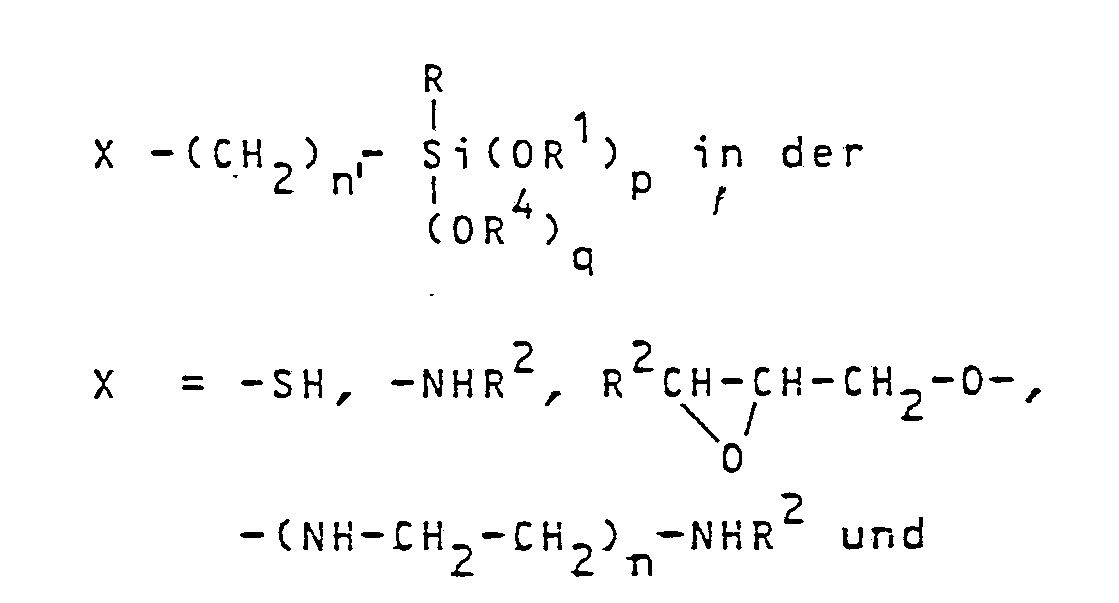
R = -CH₃, -CH₂-CH₃, -OR¹ und
R¹ = -(CH₂-CH₂-O) m-R³ und
R² = H oder ein gegebenenfalls substituierter aliphatischer und/oder cycloaliphatischer oder aromatischer Kohlenwasserstoffrest mit 1 - 10 C-Atomen und
R³ = ein gegebenenfalls substituierter Alkylrest mit 1 - 10 C-Atomen und
R⁴ = ein Alkylrest mit 1 - 4 C-Atomen und
n = 1 - 8, m = 1- 30, p = ≧ 1 sowie q+p ≦αµρ¨ 2 - Bevorzugte Verfahrensmerkmale ergeben sich aus der obigen Beschriebung.
- Die Erfindung betrifft weiterhin feuchtigkeitshärtende Klebemassen und Dichtungsmassen, enthaltend die obengenannten alkoxysilanterminierten Polyurethane gemäß der vorangegangenen Beschreibung sowie gegebenenfalls übliche Zusatzstoffe wie Pigmente, Füllstoffe, Härtungskatalysatoren und UV-Stabilisatoren. Als Füllstoffe geeignet sind gegenüber Isocyanaten inerte anorganische Verbindungen, z.B. Kreide oder Kalkmehl, gefällte und/oder pyrogene Kieselsäure, Zeolithe, Bentonite, gemahlene Mineralstoffe sowie andere dem Fachmann geläufige anorganische Füllstoffe. Weiterhin können auch organische Füllstoffe eingesetzt werden, insbesondere Faserkurzschnitte und dergleichen. Fü nche Anwendungen sind Füllstoffe bevorzugt, die den Zubereitungen Thixotropie verleihen, z.B. quellbare Kunststoffe wie PVC.
- Ein typischer Härtungskatalysator ist das bereits erwähnte Dibutylzinndilaurat; vorzugsweise werden den Massen noch als Härtungsbeschleuniger wirkende Vernetzer wie Ethyltriacetoxysilan zugesetzt.
- Die Erfindung wird im folgenden anhand von bevorzugten Ausführungsbeispielen und Vergleichsversuchen näher erläutert.
- In einem beheizbaren Rührkessel werden unter N₂-Atmosphäre 800 Teile (= 0,8 Äquivalente) Polypropylenglykol des Molgewichts 2025 und 150 Teile (= 1,2 Äquivalente) 4,4ʹ--Diphenylmethandiisocyanat (MDI) bei 80°C unter Rühren umgesetzt. Nach ca. 5 Stunden ist der theoretische Wert von 1,77 % NCO-Gruppen erreicht. Danach werden 150 Teile (= 0,2 Äquivalente) Polypropylenglykolmonobutylether (MG 750) zugegeben und bis zum theoretischen NCO-Gehalt von 0,76 % weiterreagieren gelassen. Nach Erreichen dieses Wertes werden 39,2 Teile (= 0,2 Äquivalente) Mercaptopropyltrimethoxysilan und 0,23 Teile Dibutylzinndilaurat zugegeben und weitere 2 Stunden gerührt. Alle Umsetzungen wurden bei 80°C vorgenommen. Der danach gemessene NCO-Gehalt ist kleiner als 0,03 %. Die Viskosität des Endproduktes betrug bei 25°C 200 000 mPa·s nach Brookfield.
- Unter den Bedingungen aus Beispiel 1 wird aus 800 Teilen (= 0,8 Äquivalente) Polypropylenglykol des Molgewichts 2025 und 150 Teilen (= 1,2 Äquivalente) MDI ein NCO-terminiertes Prepolymer hergestellt. Dieses wird in einer zweiten Reaktionsstufe mit 78,4 g (= 0,4 Äquivalente) Mercaptopropyltrimethoxysilan und 0,21 Teilen Dibutylzinndilaurat vollständig umgesetzt. Die Viskosität des Endproduktes betrug bei 25°C 240 000 mPa·s nach Brookfield.
- Unter den Bedingungen von Beispiel 1 werden 900 Teile (= 0,9 Äquivalente) Polypropylenglykol des Molgewichts 2025, 4,5 Teile (= 0,1 Äquivalente) Trimethylolpropan und 212,5 Teile (= 1,7 Äquivalente) MDI zu einem NCO-terminierten Prepolymeren umgesetzt (NCO = 2,6 %). Dazu werden 26,25 g (0,35 Äquivalente) Butanol gegeben und nach Erreichen des theor. NCO-Gehaltes von 1,2 % nochmals 68,6 Teile (= 0,35 Äquivalente) Mercaptopropyltrimethoxysilan und 0,2 Teile Dibutylzinndilaurat gegeben. Alle Reaktionen wurden unter trocknem Stickstoff bei 80°C durchgeführt. Der danach gemessene NCO-Gehalt ist kleiner als 0,03 %. Die Viskosität des Produktes betrug bei 25°C 430 000 mPa·s nach Brookfield.
- Das NCO-terminierte Zwischenprodukt aus Beispiel 2 wird mit 137,2 Teilen (= 0,7 Äquivalente) Mercaptopropyltrimethoxysilan und 0,2 Teilen Dibutylzinndilaurat umgesetzt. Der danach gemessene NCO-Gehalt ist kleiner als 0,03 %. Die Viskosität des Produktes betrug bei 25°C 540 000 mPa·s nach Brookfield.
- Die beschriebenen alkoxysilanterminierten Prepolymere aus Beispiel 1, 2 und 3 wurden mit jeweils 7,5 Gew.-% Ethyltriacetoxysilan und 1,5 Gew.-% Dibutylzinndilaurat gemischt und an der Luftfeuchtigkeit gehärtet. Die mechanischen Eigenschaften der ausgehärteten Produkte wurden nach DIN 53504 an ca. 2mm dicken Folien geprüft.
- Aus der Tabelle ergibt sich, daß die alkoxysilanterminierten Polyurethane der Erfindung nach dem Aushärten an der Luft eine erhebliche höhere Reißdehnung aufweisen.

Claims (13)

R = -CH₃, -CH₂-CH₃, -OR¹ und
R¹ = -(CH₂-CH₂-O) m-R³ und
R² = H oder ein gegebenenfalls substituierter aliphatischer und/oder cycloaliphatischer oder aromatischer Kohlenwasserstoffrest mit 1 - 10 C-Atomen und
R³ = ein gegebenenfalls substituierter Alkylrest mit 1 -10 C-Atomen und
R⁴ = ein Alkylrest mit 1 - 4 C-Atomen und
n = 1 - 8, m = 1- 30, p = ≧ 1 sowie q+p ≦αµρ¨ 2 bedeuten können.

R = -CH₃, -CH₂-CH₃, -OR¹ und
R¹ = -(CH₂-CH₂-O) m-R³ und
R² = H oder ein gegebenenfalls substituierter aliphatischer und/oder cycloaliphatischer oder aromatischer Kohlenwasserstoffrest mit 1 - -Atomen
und
R³ = ein gegebenenfalls substituierter Alkylrest mit 1 -10 C-Atomen und
R⁴ = ein Alkylrest mit 1 - 4 C-Atomen und
n = 1 - 8, m = 1- 30, p = ≧ 1 sowie q+p ≦αµρ¨ 2 bedeuten können, umsetzt.
Priority Applications (1)
| Application Number | Priority Date | Filing Date | Title |
|---|---|---|---|
| AT87112188T ATE71118T1 (de) | 1986-08-28 | 1987-08-21 | Verfarhen zur herstellung von alkoxysilanterminierten, feuchtigkeitsaertenden polyurethanen sowie ihre verwendung fuer klebeund dichtungsmassen. |
Applications Claiming Priority (2)
| Application Number | Priority Date | Filing Date | Title |
|---|---|---|---|
| DE3629237 | 1986-08-28 | ||
| DE19863629237 DE3629237A1 (de) | 1986-08-28 | 1986-08-28 | Alkoxysilanterminierte, feuchtigkeitshaertende polyurethane sowie ihre verwendung fuer klebe- und dichtungsmassen |
Publications (2)
| Publication Number | Publication Date |
|---|---|
| EP0261409A1 true EP0261409A1 (de) | 1988-03-30 |
| EP0261409B1 EP0261409B1 (de) | 1992-01-02 |
Family
ID=6308354
Family Applications (1)
| Application Number | Title | Priority Date | Filing Date |
|---|---|---|---|
| EP87112188A Expired - Lifetime EP0261409B1 (de) | 1986-08-28 | 1987-08-21 | Verfarhen zur herstellung von Alkoxysilanterminierten, feuchtigkeitsärtenden Polyurethanen sowie ihre Verwendung für Klebe- und Dichtungsmassen |
Country Status (11)
| Country | Link |
|---|---|
| US (1) | US4857623A (de) |
| EP (1) | EP0261409B1 (de) |
| JP (1) | JP2609253B2 (de) |
| AT (1) | ATE71118T1 (de) |
| BR (1) | BR8704421A (de) |
| DE (2) | DE3629237A1 (de) |
| ES (1) | ES2038142T3 (de) |
| FI (1) | FI873719L (de) |
| GR (1) | GR3003719T3 (de) |
| NO (1) | NO873621L (de) |
| ZA (1) | ZA876410B (de) |
Cited By (17)
| Publication number | Priority date | Publication date | Assignee | Title |
|---|---|---|---|---|
| EP0371370A1 (de) * | 1988-11-29 | 1990-06-06 | Henkel Kommanditgesellschaft auf Aktien | Verfahren zur Herstellung und Applikation von unter Feuchtigkeitseinwirkung nachvernetzenden Schmelzklebermassen |
| EP0443144A3 (en) * | 1990-02-23 | 1992-02-26 | Bayer Ag | Use of urethane group containing isocyanates as drying agent and a process for the preparation of a coating |
| WO1992005212A1 (de) * | 1990-09-18 | 1992-04-02 | Henkel Kommanditgesellschaft Auf Aktien | Feuchtigkeitshärtende, alkoxysilanterminierte polyurethane |
| WO1992005227A1 (de) * | 1990-09-18 | 1992-04-02 | Henkel Kommanditgesellschaft Auf Aktien | Dichtungs- und klebemasse auf basis von polyurethanen mit speziellen weichmachern |
| WO1995033800A1 (de) * | 1994-06-09 | 1995-12-14 | Henkel Kommanditgesellschaft Auf Aktien | Einkomponentiger reaktionsklebstoff |
| US5525654A (en) * | 1990-09-18 | 1996-06-11 | Henkel Kommanditgesellschaft Auf Aktien | Polyurethane-based sealing and adhesive compositions containing special diurethane plasticizers |
| US6329488B1 (en) | 1998-11-10 | 2001-12-11 | C. R. Bard, Inc. | Silane copolymer coatings |
| WO2004046218A1 (de) * | 2002-11-15 | 2004-06-03 | Henkel Kommanditgesellschaft Auf Aktien | Silylgruppen enthaltende präpolymere, deren herstellung und verwendung in montageschäumen |
| WO2005000931A1 (de) * | 2003-06-26 | 2005-01-06 | Consortium für elektrochemische Industrie GmbH | Alkoxysilanterminierte prepolymere |
| US6884852B1 (en) | 1998-03-25 | 2005-04-26 | Henkel Kommanditgesellschaft Auf Aktien | Polyurethane and preparation containing polyurethane |
| DE10345718A1 (de) * | 2003-10-01 | 2005-05-04 | Henkel Kgaa | Kohäsionsverminderte Bindemittel, deren Herstellung und Verwendung in ablösbaren Montageklebern |
| WO2005042605A1 (en) * | 2003-10-22 | 2005-05-12 | Bayer Materialscience Llc | Moisture-curable, polyether urethanes with reactive silane groups and their use as sealants, adhesives and coatings |
| DE10353663A1 (de) * | 2003-11-17 | 2005-06-16 | Henkel Kgaa | Polyurethanzusammensetzungen mit NCO- und Silylreaktivität |
| WO2005061622A3 (en) * | 2003-12-19 | 2006-02-23 | Bayer Materialscience Llc | Silane terminated polyurethane |
| WO2006118766A1 (en) * | 2005-04-29 | 2006-11-09 | General Electric Company | Silylated polymer derived from butadiene and solvent-resistant pressure sensitive adhesive composition containing same |
| DE19727029B4 (de) * | 1997-06-25 | 2006-11-09 | Henkel Kgaa | Einkomponentige Reaktivsystem-Zusammensetzung, Verfahren zu ihrer Herstellung und ihre Verwendung |
| CN101184785B (zh) * | 2005-04-29 | 2011-07-27 | 莫门蒂夫功能性材料公司 | 衍生自丁二烯的甲硅烷基化的聚合物和包含其的耐溶剂性压敏粘合剂组合物 |
Families Citing this family (53)
| Publication number | Priority date | Publication date | Assignee | Title |
|---|---|---|---|---|
| DE3636974A1 (de) * | 1986-10-30 | 1988-05-05 | Bayer Ag | Poly-(ether-urethan-harnstoff)polyadditionsprodukte, ihre herstellung, abmischung enthaltend diese sowie ihre verwendung als abformmassen |
| JP2772002B2 (ja) * | 1988-11-28 | 1998-07-02 | サンスター技研株式会社 | プライマー組成物 |
| US5075407A (en) * | 1989-04-10 | 1991-12-24 | Rheox, Inc. | Foamable thermosetting polyurethane structural adhesive compositions and processes for producing the same |
| JP2657257B2 (ja) * | 1989-10-13 | 1997-09-24 | 信越化学工業 株式会社 | 低着色性のプライマー組成物 |
| DE3943090A1 (de) * | 1989-12-27 | 1991-07-04 | Henkel Kgaa | Feuchtigkeitshaertende polyurethandichtungsmassen mit verbesserten eigenschaften |
| AU628146B2 (en) * | 1990-03-29 | 1992-09-10 | Basf Corporation | Room-temperature, moisture-curable, primerless, polyurethane-based adhesive composition and method |
| FI920502L (fi) * | 1991-02-08 | 1992-08-09 | Sherwin Williams Co | Foertjockningsmedel foer belaeggningar. |
| AU2877792A (en) * | 1991-10-22 | 1993-05-21 | Dap Products Inc. | Moisture curable silicone-urethane copolymer sealants |
| DE19619538A1 (de) * | 1996-05-15 | 1997-11-20 | Bayer Ag | Alkoxysilan- und Hydantoingruppen aufweisende Polyurethanprepolymere, ein Verfahren zu ihrer Herstellung sowie ihre Verwendung zur Herstellung von Dichtstoffen |
| US5866651A (en) * | 1996-10-31 | 1999-02-02 | Minnesota Mining And Manufacturing Company | Hydroxycarbamoylalkoxysilane-based poly(ether-urethane) sealants having improved paint adhesion and laminates prepared therefrom |
| US6001935A (en) | 1997-11-10 | 1999-12-14 | Stephan Company | Durable hydrophilic polymer coatings |
| IT1290179B1 (it) * | 1996-12-31 | 1998-10-19 | N P T New Polyurethane Technol | Polimero di poliaddizione di michael silano terminato |
| US7208560B1 (en) | 1997-06-17 | 2007-04-24 | Konishi Co., Ltd. | Process for the preparation of urethane resins and urethane resin compositions |
| DE19730424A1 (de) | 1997-07-16 | 1999-01-21 | Henkel Teroson Gmbh | Vorrichtung zum Lagern und Auspressen von fließfähigen Zusammensetzungen |
| US6369188B1 (en) | 1998-03-27 | 2002-04-09 | Polymeright, Inc. | Polyfunctional urethane- or urea-containing oligomers and polymers prepared therefrom |
| US6596401B1 (en) | 1998-11-10 | 2003-07-22 | C. R. Bard Inc. | Silane copolymer compositions containing active agents |
| US6162938A (en) * | 1998-11-19 | 2000-12-19 | 3M Innovative Properties Company | Secondary amine-functional silanes, silane-functional polymers therefrom, and resulting cured polymers |
| US6451438B1 (en) | 2000-11-30 | 2002-09-17 | Mearthane Products Corporation | Copolymerization of reactive silicone and urethane precursors for use in conductive, soft urethane rollers |
| DE10204523A1 (de) * | 2002-02-05 | 2003-08-07 | Bayer Ag | Alkoxysilan- und OH-Endgruppen aufweisende Polyurethanprepolymere mit erniedrigter Funktionalität, ein Verfahren zu ihrer Herstellung sowie ihre Verwendung |
| ITMI20020654A1 (it) * | 2002-03-28 | 2003-09-29 | N P T S R L | Polimeri di poliaddizionali di michael a base di acido solfidrico silano terminati |
| US6750309B1 (en) | 2002-05-17 | 2004-06-15 | Henkel Corporation | Methacrylated polyurethane copolymers with silicone segments containing alkoxysilyl groups |
| US6809170B2 (en) * | 2002-05-31 | 2004-10-26 | Bayer Materialscience Llc | Moisture-curable, polyether urethanes with reactive silane groups and their use as sealants, adhesive and coatings |
| US7115696B2 (en) * | 2002-05-31 | 2006-10-03 | Bayer Materialscience Llc | Moisture-curable, polyether urethanes with reactive silane groups and their use as sealants, adhesives and coatings |
| US6887964B2 (en) * | 2002-05-31 | 2005-05-03 | Bayer Materialscience Llc | Moisture-curable, polyether urethanes with reactive silane groups and their use as sealants, adhesives and coatings |
| US6844413B2 (en) * | 2002-06-18 | 2005-01-18 | Bayer Materialscience Llc | Moisture-curable, polyether urethanes with reactive silane groups and their use as sealants, adhesives and coatings |
| US6998459B2 (en) * | 2002-06-18 | 2006-02-14 | Bayer Materialscience Llc | Polyether urethanes containing one reactive silane group and their use in moisture-curable polyether urethanes |
| US20030232950A1 (en) * | 2002-06-18 | 2003-12-18 | Roesler Richard R. | Moisture-curable, polyether urethanes with reactive silane groups and their use as sealants, adhesives and coatings |
| US20040143055A1 (en) * | 2002-07-16 | 2004-07-22 | Sunstar Giken Kabushiki Kaisha, A Corporation Of Japan | Moisture-curing one-pack urethane adhesive compositions |
| DE10244693A1 (de) | 2002-09-24 | 2004-04-01 | Heraeus Kulzer Gmbh & Co. Kg | Zweikomponentige Zubereitung |
| US6872767B1 (en) | 2002-11-14 | 2005-03-29 | Rust Bullett, Llc | Method of protecting surfaces with aluminum flaked composition |
| US6809150B1 (en) | 2002-11-14 | 2004-10-26 | Rust Bullet, Llc | Method of protecting surfaces from corrosion |
| JP2006511663A (ja) * | 2002-12-20 | 2006-04-06 | バイエル・マテリアルサイエンス・リミテッド・ライアビリティ・カンパニー | 環状ウレア/反応性シラン末端基を有する湿分硬化性ポリエーテルウレタン並びにシーラント、接着剤および塗料としてのこれらの使用 |
| US20040122200A1 (en) * | 2002-12-20 | 2004-06-24 | Roesler Richard R. | Process for the preparation of moisture-curable, polyether urethanes with terminal cyclic urea/reactive silane groups |
| US6989429B2 (en) * | 2003-10-02 | 2006-01-24 | Tremco Incorporated | Prepolymer compositions and sealants made therefrom |
| US7060750B2 (en) * | 2004-04-28 | 2006-06-13 | Bayer Materialscience Llc | Moisture-curable, polyether urethanes and their use in sealant, adhesive and coating compositions |
| US20060251902A1 (en) * | 2005-05-09 | 2006-11-09 | Chemque, Inc. | Silylated polyurethane moisture cured doming resins |
| MX2007015077A (es) * | 2005-05-31 | 2008-01-18 | Dow Global Technologies Inc | Composiciones selladoras de poliuretano que tienen propiedades de pintura y vidrio sin imprimador. |
| DE102005041953A1 (de) * | 2005-09-03 | 2007-03-08 | Bayer Materialscience Ag | Niedrigviskose alkoxysilangruppenaufweisende Prepolymere, ein Verfahren zu ihrer Herstellung sowie ihre Verwendung |
| US7365145B2 (en) * | 2005-09-14 | 2008-04-29 | Momentive Performance Materials Inc. | Moisture curable silylated polymer containing free polyols for coating, adhesive and sealant application |
| US7732554B2 (en) * | 2006-09-21 | 2010-06-08 | Momentive Performance Materials Inc. | Process for preparing a curable silylated polyurethane resin |
| DE102006048041A1 (de) * | 2006-10-09 | 2008-04-10 | Henkel Kgaa | Zusammensetzungen aus teilweise silylterminierten Polymeren |
| JP4888779B2 (ja) * | 2007-06-25 | 2012-02-29 | 並木精密宝石株式会社 | 光ファイバ結合装置 |
| EP2207830B1 (de) * | 2007-11-07 | 2018-12-26 | Dow Global Technologies LLC | Polyurethan-haftstoffzusammensetzungen mit hohen füllstoffanteilen |
| KR20110036730A (ko) * | 2008-07-28 | 2011-04-08 | 아사히 가라스 가부시키가이샤 | 점착체, 점착 시트 및 그 용도 |
| WO2010063740A1 (de) | 2008-12-05 | 2010-06-10 | Basf Se | Cyclohexanpolycarbonsäure-derivate als weichmacher für kleb- und dichtstoffe |
| WO2010074768A1 (en) * | 2008-12-23 | 2010-07-01 | Dow Global Technologies Inc | Adhesive useful for installing vehicle windows providing rapid drive away time |
| US8222341B2 (en) | 2009-03-17 | 2012-07-17 | Mearthane Products Corporation | Semi-conductive silicone polymers |
| US20120225983A1 (en) | 2009-11-05 | 2012-09-06 | Jochen Wagner | Adhesives and sealants comprising esters based on 2-propylheptanol |
| JP5769929B2 (ja) | 2010-03-17 | 2015-08-26 | サンスター技研株式会社 | ポリウレタン樹脂 |
| EP2582765B1 (de) | 2010-06-21 | 2014-10-15 | Basf Se | 2-ethylhexyl-methyl-terephthalat als weichmacher in kleb- und dichtstoffen |
| US8791185B2 (en) | 2010-06-21 | 2014-07-29 | Basf Se | 2-ethylhexyl methyl terephthalate as plasticizer in adhesives and sealants |
| EP2588246A1 (de) | 2010-06-29 | 2013-05-08 | Construction Research & Technology GmbH | Verfahren zur herstellung eines thixotropiermittels und dessen verwendung |
| JP5972910B2 (ja) | 2011-02-17 | 2016-08-17 | ダウ グローバル テクノロジーズ エルエルシー | カルシウムカーボネートを含有するアルコキシシラン含有ポリウレタン接着剤組成物 |
Citations (1)
| Publication number | Priority date | Publication date | Assignee | Title |
|---|---|---|---|---|
| EP0170865A1 (de) * | 1984-07-21 | 1986-02-12 | Schering Aktiengesellschaft | Verfahren zur Herstellung von unter Feuchtigkeitsausschluss lagerstabilen Kunstharzmassen und deren Verwendung |
Family Cites Families (7)
| Publication number | Priority date | Publication date | Assignee | Title |
|---|---|---|---|---|
| FR1115758A (fr) * | 1954-12-03 | 1956-04-30 | Perfectionnements apportés aux appareils hydrocopiants différentiels | |
| US3627722A (en) * | 1970-05-28 | 1971-12-14 | Minnesota Mining & Mfg | Polyurethane sealant containing trialkyloxysilane end groups |
| US3979344A (en) * | 1974-11-19 | 1976-09-07 | Inmont Corporation | Vulcanizable silicon terminated polyurethane polymer composition having improved cure speed |
| JPS6055022A (ja) * | 1983-09-07 | 1985-03-29 | Sunstar Giken Kk | ポリウレタン樹脂組成物 |
| US4582873A (en) * | 1984-05-21 | 1986-04-15 | Ppg Industries, Inc. | Process for producing aqueous dispersions, internally silylated and dispersed polyurethane resins, and surfaces containing same |
| US4567228A (en) * | 1984-05-21 | 1986-01-28 | Ppg Industries, Inc. | Aqueous dispersion, internally silylated and dispersed polyurethane resins, and surfaces containing same |
| JP2926476B2 (ja) * | 1996-06-21 | 1999-07-28 | 卓生 行本 | 緑化工法及び緑化ブロック |
-
1986
- 1986-08-28 DE DE19863629237 patent/DE3629237A1/de not_active Withdrawn
-
1987
- 1987-08-21 AT AT87112188T patent/ATE71118T1/de not_active IP Right Cessation
- 1987-08-21 DE DE8787112188T patent/DE3775676D1/de not_active Expired - Lifetime
- 1987-08-21 EP EP87112188A patent/EP0261409B1/de not_active Expired - Lifetime
- 1987-08-21 ES ES198787112188T patent/ES2038142T3/es not_active Expired - Lifetime
- 1987-08-25 US US07/089,383 patent/US4857623A/en not_active Expired - Fee Related
- 1987-08-27 BR BR8704421A patent/BR8704421A/pt unknown
- 1987-08-27 ZA ZA876410A patent/ZA876410B/xx unknown
- 1987-08-27 FI FI873719A patent/FI873719L/fi not_active IP Right Cessation
- 1987-08-27 JP JP62211519A patent/JP2609253B2/ja not_active Expired - Lifetime
- 1987-08-27 NO NO873621A patent/NO873621L/no unknown
-
1992
- 1992-02-04 GR GR920400155T patent/GR3003719T3/el unknown
Patent Citations (1)
| Publication number | Priority date | Publication date | Assignee | Title |
|---|---|---|---|---|
| EP0170865A1 (de) * | 1984-07-21 | 1986-02-12 | Schering Aktiengesellschaft | Verfahren zur Herstellung von unter Feuchtigkeitsausschluss lagerstabilen Kunstharzmassen und deren Verwendung |
Non-Patent Citations (1)
| Title |
|---|
| PATENT ABSTRACTS Of JAPAN, Unexamined Applications, Field C, Vol. 9, Nr. 175, 19. Juli 1985 The Patent Office Japanese Government seite 115 C 292 * Kokai-Nr. 60-47 014 (Daishin Asoshieitsu K.K) * * |
Cited By (21)
| Publication number | Priority date | Publication date | Assignee | Title |
|---|---|---|---|---|
| EP0371370A1 (de) * | 1988-11-29 | 1990-06-06 | Henkel Kommanditgesellschaft auf Aktien | Verfahren zur Herstellung und Applikation von unter Feuchtigkeitseinwirkung nachvernetzenden Schmelzklebermassen |
| WO1990006332A1 (de) * | 1988-11-29 | 1990-06-14 | Henkel Kommanditgesellschaft Auf Aktien | Verfahren zur herstellung und applikation von unter feuchtigkeitseinwirkung nachvernetzenden schmelzkleber- und/oder dichtmassen |
| EP0443144A3 (en) * | 1990-02-23 | 1992-02-26 | Bayer Ag | Use of urethane group containing isocyanates as drying agent and a process for the preparation of a coating |
| US5525654A (en) * | 1990-09-18 | 1996-06-11 | Henkel Kommanditgesellschaft Auf Aktien | Polyurethane-based sealing and adhesive compositions containing special diurethane plasticizers |
| WO1992005227A1 (de) * | 1990-09-18 | 1992-04-02 | Henkel Kommanditgesellschaft Auf Aktien | Dichtungs- und klebemasse auf basis von polyurethanen mit speziellen weichmachern |
| US5554709A (en) * | 1990-09-18 | 1996-09-10 | Henkel Kommanditgesellschaft Auf Aktien | Moisture-curing alkoxysilane-terminated polyurethanes |
| WO1992005212A1 (de) * | 1990-09-18 | 1992-04-02 | Henkel Kommanditgesellschaft Auf Aktien | Feuchtigkeitshärtende, alkoxysilanterminierte polyurethane |
| WO1995033800A1 (de) * | 1994-06-09 | 1995-12-14 | Henkel Kommanditgesellschaft Auf Aktien | Einkomponentiger reaktionsklebstoff |
| US5744543A (en) * | 1994-06-09 | 1998-04-28 | Henkel Kommanditgesellschaft Auf Aktien | One-component reactive adhesive |
| DE19727029B4 (de) * | 1997-06-25 | 2006-11-09 | Henkel Kgaa | Einkomponentige Reaktivsystem-Zusammensetzung, Verfahren zu ihrer Herstellung und ihre Verwendung |
| US6884852B1 (en) | 1998-03-25 | 2005-04-26 | Henkel Kommanditgesellschaft Auf Aktien | Polyurethane and preparation containing polyurethane |
| US6908681B2 (en) | 1998-11-10 | 2005-06-21 | C.R. Bard, Inc. | Silane copolymer coatings |
| US6329488B1 (en) | 1998-11-10 | 2001-12-11 | C. R. Bard, Inc. | Silane copolymer coatings |
| WO2004046218A1 (de) * | 2002-11-15 | 2004-06-03 | Henkel Kommanditgesellschaft Auf Aktien | Silylgruppen enthaltende präpolymere, deren herstellung und verwendung in montageschäumen |
| WO2005000931A1 (de) * | 2003-06-26 | 2005-01-06 | Consortium für elektrochemische Industrie GmbH | Alkoxysilanterminierte prepolymere |
| DE10345718A1 (de) * | 2003-10-01 | 2005-05-04 | Henkel Kgaa | Kohäsionsverminderte Bindemittel, deren Herstellung und Verwendung in ablösbaren Montageklebern |
| WO2005042605A1 (en) * | 2003-10-22 | 2005-05-12 | Bayer Materialscience Llc | Moisture-curable, polyether urethanes with reactive silane groups and their use as sealants, adhesives and coatings |
| DE10353663A1 (de) * | 2003-11-17 | 2005-06-16 | Henkel Kgaa | Polyurethanzusammensetzungen mit NCO- und Silylreaktivität |
| WO2005061622A3 (en) * | 2003-12-19 | 2006-02-23 | Bayer Materialscience Llc | Silane terminated polyurethane |
| WO2006118766A1 (en) * | 2005-04-29 | 2006-11-09 | General Electric Company | Silylated polymer derived from butadiene and solvent-resistant pressure sensitive adhesive composition containing same |
| CN101184785B (zh) * | 2005-04-29 | 2011-07-27 | 莫门蒂夫功能性材料公司 | 衍生自丁二烯的甲硅烷基化的聚合物和包含其的耐溶剂性压敏粘合剂组合物 |
Also Published As
| Publication number | Publication date |
|---|---|
| ZA876410B (en) | 1988-02-29 |
| FI873719A7 (fi) | 1988-02-29 |
| ATE71118T1 (de) | 1992-01-15 |
| GR3003719T3 (de) | 1993-03-16 |
| JP2609253B2 (ja) | 1997-05-14 |
| FI873719A0 (fi) | 1987-08-27 |
| DE3629237A1 (de) | 1988-03-03 |
| NO873621L (no) | 1988-02-29 |
| FI873719L (fi) | 1988-02-29 |
| ES2038142T3 (es) | 1993-07-16 |
| NO873621D0 (no) | 1987-08-27 |
| JPS6368625A (ja) | 1988-03-28 |
| EP0261409B1 (de) | 1992-01-02 |
| US4857623A (en) | 1989-08-15 |
| DE3775676D1 (de) | 1992-02-13 |
| BR8704421A (pt) | 1988-04-19 |
Similar Documents
| Publication | Publication Date | Title |
|---|---|---|
| EP0261409B1 (de) | Verfarhen zur herstellung von Alkoxysilanterminierten, feuchtigkeitsärtenden Polyurethanen sowie ihre Verwendung für Klebe- und Dichtungsmassen | |
| EP0549626B1 (de) | Feuchtigkeitshärtende, alkoxysilanterminierte polyurethane | |
| EP0549627B1 (de) | Dichtungs- und klebemasse auf basis von polyurethanen mit speziellen weichmachern | |
| EP2268650B1 (de) | Härtbare zusammensetzungen enthaltend silylierte polyurethane | |
| DE69920986T2 (de) | Verfahren zur Herstellung von Präpolymeren, die zu verbesserten Dichtungsmassen aushärten und daraus hergestellte Produkte | |
| EP1124872B1 (de) | Alkoxysilan-endgruppen aufweisende polyurethanprepolymere, ein verfahren zu ihrer herstellung sowie ihre verwendung zur herstellung von dichtstoffen | |
| EP2271691B1 (de) | Härtbare zusammensetzungen enthaltend silylierte polyurethane auf basis von polyetherblockpolymeren | |
| DE3407031C2 (de) | ||
| EP2271687B1 (de) | Härtbare zusammensetzungen auf basis silylierter polyurethane | |
| EP1196469B1 (de) | Spezielle aminosilane enthaltende, kondensationsvernetzende polyurethanmassen, ein verfahren zu ihrer herstellung sowie ihre verwendung | |
| EP1678254B1 (de) | Festigkeitsoptimierte polymere mit gemischten oxyalkyleneiheiten | |
| EP1877459B2 (de) | Feuchtigkeitshärtende zusammensetzung mit erhöhter dehnbarkeit | |
| DE102007058483A1 (de) | Härtbare Zusammensetzungen enthaltend silylierte Polyurethane | |
| EP1619215A1 (de) | Niedrigviskose Polyurethan-Prepolymere auf Basis von 2,4'-MDI | |
| EP2274354B1 (de) | Härtbare zusammensetzungen enthaltend weichelastische silylierte polyurethane | |
| EP1397406A1 (de) | Klebstoff, gefüllt mit oberflächenbehandelter kreide und russ | |
| DE102007058344A1 (de) | Härtbare Zusammensetzungen enthaltend silylierte Polyurethane | |
| DE69902719T2 (de) | Einkomponent thixotropische Polyurethanharzzusammensetzung | |
| DE19929011A1 (de) | Spezielle Aminosilane enthaltende, kondensationsvernetzende Polyurethanmassen, ein Verfahren zu ihrer Herstellung sowie ihre Verwendung | |
| DE19727029B4 (de) | Einkomponentige Reaktivsystem-Zusammensetzung, Verfahren zu ihrer Herstellung und ihre Verwendung | |
| EP1576031B1 (de) | 3-(n-silylalkyl)-amino-propenoat-gruppen enthaltendes polymer und dessen verwendung | |
| DE102024206479A1 (de) | Vernetzbare Massen auf Basis von organyloxysilanterminierten Polymeren |
Legal Events
| Date | Code | Title | Description |
|---|---|---|---|
| PUAI | Public reference made under article 153(3) epc to a published international application that has entered the european phase |
Free format text: ORIGINAL CODE: 0009012 |
|
| AK | Designated contracting states |
Kind code of ref document: A1 Designated state(s): AT BE CH DE ES FR GB GR IT LI LU NL SE |
|
| 17P | Request for examination filed |
Effective date: 19880912 |
|
| 17Q | First examination report despatched |
Effective date: 19891106 |
|
| GRAA | (expected) grant |
Free format text: ORIGINAL CODE: 0009210 |
|
| AK | Designated contracting states |
Kind code of ref document: B1 Designated state(s): AT BE CH DE ES FR GB GR IT LI LU NL SE |
|
| REF | Corresponds to: |
Ref document number: 71118 Country of ref document: AT Date of ref document: 19920115 Kind code of ref document: T |
|
| ET | Fr: translation filed | ||
| GBT | Gb: translation of ep patent filed (gb section 77(6)(a)/1977) | ||
| REF | Corresponds to: |
Ref document number: 3775676 Country of ref document: DE Date of ref document: 19920213 |
|
| ITF | It: translation for a ep patent filed | ||
| PLBE | No opposition filed within time limit |
Free format text: ORIGINAL CODE: 0009261 |
|
| STAA | Information on the status of an ep patent application or granted ep patent |
Free format text: STATUS: NO OPPOSITION FILED WITHIN TIME LIMIT |
|
| REG | Reference to a national code |
Ref country code: GR Ref legal event code: FG4A Free format text: 3003719 |
|
| 26N | No opposition filed | ||
| REG | Reference to a national code |
Ref country code: ES Ref legal event code: FG2A Ref document number: 2038142 Country of ref document: ES Kind code of ref document: T3 |
|
| EPTA | Lu: last paid annual fee | ||
| EAL | Se: european patent in force in sweden |
Ref document number: 87112188.5 |
|
| REG | Reference to a national code |
Ref country code: GB Ref legal event code: IF02 |
|
| PGFP | Annual fee paid to national office [announced via postgrant information from national office to epo] |
Ref country code: ES Payment date: 20050927 Year of fee payment: 19 |
|
| PGFP | Annual fee paid to national office [announced via postgrant information from national office to epo] |
Ref country code: GR Payment date: 20060714 Year of fee payment: 20 |
|
| PGFP | Annual fee paid to national office [announced via postgrant information from national office to epo] |
Ref country code: NL Payment date: 20060803 Year of fee payment: 20 |
|
| PGFP | Annual fee paid to national office [announced via postgrant information from national office to epo] |
Ref country code: FR Payment date: 20060808 Year of fee payment: 20 |
|
| PGFP | Annual fee paid to national office [announced via postgrant information from national office to epo] |
Ref country code: AT Payment date: 20060811 Year of fee payment: 20 |
|
| PGFP | Annual fee paid to national office [announced via postgrant information from national office to epo] |
Ref country code: GB Payment date: 20060816 Year of fee payment: 20 |
|
| PGFP | Annual fee paid to national office [announced via postgrant information from national office to epo] |
Ref country code: DE Payment date: 20060817 Year of fee payment: 20 |
|
| PGFP | Annual fee paid to national office [announced via postgrant information from national office to epo] |
Ref country code: CH Payment date: 20060830 Year of fee payment: 20 Ref country code: LU Payment date: 20060830 Year of fee payment: 20 |
|
| PGFP | Annual fee paid to national office [announced via postgrant information from national office to epo] |
Ref country code: IT Payment date: 20060831 Year of fee payment: 20 |
|
| PGFP | Annual fee paid to national office [announced via postgrant information from national office to epo] |
Ref country code: BE Payment date: 20061013 Year of fee payment: 20 |
|
| REG | Reference to a national code |
Ref country code: GB Ref legal event code: PE20 |
|
| REG | Reference to a national code |
Ref country code: CH Ref legal event code: PL |
|
| EUG | Se: european patent has lapsed | ||
| NLV7 | Nl: ceased due to reaching the maximum lifetime of a patent |
Effective date: 20070821 |
|
| REG | Reference to a national code |
Ref country code: ES Ref legal event code: FD2A Effective date: 20070822 |
|
| PG25 | Lapsed in a contracting state [announced via postgrant information from national office to epo] |
Ref country code: GB Free format text: LAPSE BECAUSE OF EXPIRATION OF PROTECTION Effective date: 20070820 |
|
| BE20 | Be: patent expired |
Owner name: *HENKEL K.G.A.A. Effective date: 20070821 |
|
| PG25 | Lapsed in a contracting state [announced via postgrant information from national office to epo] |
Ref country code: NL Free format text: LAPSE BECAUSE OF EXPIRATION OF PROTECTION Effective date: 20070821 Ref country code: ES Free format text: LAPSE BECAUSE OF EXPIRATION OF PROTECTION Effective date: 20070822 |
|
| PGFP | Annual fee paid to national office [announced via postgrant information from national office to epo] |
Ref country code: SE Payment date: 20060804 Year of fee payment: 20 |