EP0259721B1 - Schistiefel - Google Patents
Schistiefel Download PDFInfo
- Publication number
- EP0259721B1 EP0259721B1 EP87112532A EP87112532A EP0259721B1 EP 0259721 B1 EP0259721 B1 EP 0259721B1 EP 87112532 A EP87112532 A EP 87112532A EP 87112532 A EP87112532 A EP 87112532A EP 0259721 B1 EP0259721 B1 EP 0259721B1
- Authority
- EP
- European Patent Office
- Prior art keywords
- slot
- spoiler
- boot according
- quarter
- boot
- Prior art date
- Legal status (The legal status is an assumption and is not a legal conclusion. Google has not performed a legal analysis and makes no representation as to the accuracy of the status listed.)
- Expired - Lifetime
Links
Images

Classifications
-
- A—HUMAN NECESSITIES
- A43—FOOTWEAR
- A43B—CHARACTERISTIC FEATURES OF FOOTWEAR; PARTS OF FOOTWEAR
- A43B5/00—Footwear for sporting purposes
- A43B5/04—Ski or like boots
- A43B5/0427—Ski or like boots characterised by type or construction details
- A43B5/0452—Adjustment of the forward inclination of the boot leg
-
- A—HUMAN NECESSITIES
- A43—FOOTWEAR
- A43B—CHARACTERISTIC FEATURES OF FOOTWEAR; PARTS OF FOOTWEAR
- A43B5/00—Footwear for sporting purposes
- A43B5/04—Ski or like boots
- A43B5/0427—Ski or like boots characterised by type or construction details
- A43B5/048—Rear-entry skiboots
Definitions
- the present invention relates to a ski boot, particularly of the rear-entry type.
- ski boots are known, for example from EP-A-182 778 and FR-A-2 480 575, which are provided on the front quarter, at the foot instep region, with a transverse slot whereto are associated one or more movable sliders: this slot allows the front quarter to bend during the flexing phase, but the tibia rests on said quarter in a region which, during this phase, is reduced to a point, since the rotation of said quarter does not coincide with the natural rotation of the leg.
- the aim of the present invention is therefore to eliminate the disadvantages described above in known types, by devising a ski boot which ensures the resting and the constant adaptation of the tibia during all the phases of skiing and in particular during its forward flexing.
- an important object is to obtain a ski boot which adds to the preceding characteristic that of absorbing the impact of the tibia during the flexing phase, ensuring an elastic return thereof during the extension phase.
- Another important object is to provide a ski boot which associates with the preceding characteristics that of avoiding points of concentrated pressure for the tibia during the various phases of skiing, said boot furthermore allowing the natural rotation of the leg during flexing.
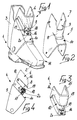
- the ski boot 1 is provided with a shell 2 whereto are articulated a rear quarter 3 and a front quarter 4.
- the front quarter 4 is advantageously composed of a first spoiler 5 articulated to the shell 2, and of a second spoiler 6 which embraces and is associated with said first spoiler 5 at and laterally to the upper end 7 of the latter.
- the second spoiler 6 is made of materials having greater elastic characteristics than those of the first spoiler 5.
- the former is advantageously provided, at its front region 8, with an opening 9 adapted to allow the tibia to interact with the second spoiler 6.
- a slot 12 is provided which affects both the front wall 13 and the lateral walls 14 and 15.
- the slot 12 is inclined by an acute angle with respect to the longitudinal axis of the shell 2, while at the front wall 13 it is arranged approximately transversely to said shell.
- That inclined configuration with respect to the base plane of the boot 1, ensures a constant resting surface for the tibia at the wall 13 of the second spoiler 6 during the flexing phase, since the slot 12 deformates elastically and absorbs the impact of the tibia thereon.
- the span of said slot 12 is constant in this particular embodiment, but it can vary according to the specific requirements.
- Means are furthermore associated with the second spoiler 6 which are adapted to limit its deformation during the flexing phase, said means consisting of a threaded stem 16 slideably accommodated within a set 17 provided perpendicularly on said second spoiler 6 at its end adjacent to the front region 8 of the first spoiler 5 and overlying the planar surface 10 thereof.
- Said stem 16 protrudes at the slot 12, with its end there being rigidly associated a small plate 18 arranged parallel to, and interacting with, at least the overlying one of the perimetral borders 19 defined by said slot.
- Said stem 16 is rotatably associated with a complementarily threaded ring 20 accommodated in an adapted seat provided on the second spoiler 6 and partially protruding therefrom in the direction of the tip 11 of the boot 1.
- the skier By acting on the ring 20 the skier can continuously vary the span of the slot 12 at the front region 8 of the first spoiler 5, thus varying the deformation which can be imparted to said second spoiler 6.
- the second spoiler 6 performs a rotation by elastic deformation which has a smaller radius than that of the first spoiler 5, this allowing not only the natural rotation of the leg during flexing but also allowing to keep the tibial pressure essentially constant during said flexing phase.
- the tibia furthermore rests on a wide surface constituted by the front wall 13 of the second spoile 6.
- the invention achieves the aim and the objects intended, ensuring the support and the constant adaptation of the tibia during all the phases of skiing, including the extension phase wherein the return of the second spoiler 6 accompanies and facilitates the movement of said tibia.
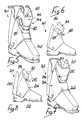
- Figures 5 and 6 illustrate a boot 101 substantially identical to the boot 1, the only difference being that the means for determining the deformation of the front quarter 104 consist of sliders 121 movable in the slot 112 provided in the second spoiler 106.
- the sliders 121 are preferably two, one for each lateral wall 114 and 115 of the upper spoiler 106, and by moving them along the lateral flaps of the slot 112 they limit the working span of said slot in the front region.
- Figures 7 and 8 illustrate a different embodiment of the front quarter 204 of a boot 201.
- the front quarter 204 is made of one piece and a slot 212 is provided at its upper portion 207 and is arranged, at the lateral walls 214 and 215 of the front quarter 204, along an axis which is inclined with respect to the longitudinal axis of the shell 202.
- Means for determining the deformation of the front quarter 204 are provided at the slot 112 which can be completely similar to the means, such as the sliders 121 or plate 18, as described previously.
- Figures 9-12 illustrate the front quarter 303 of a boot according to yet another aspect of the invention, provided with means for limiting the deformation of the quarter which consist of a small block 301 which accommodates in the slot 302 provided transversely with respect to the front quarter 303 of a ski boot proximate to its upper portion.
- the small block 301 is slideable inside the slot 302 and is configured so as to remain firmly coupled to the border of said slot.
- the latter is preferably shaped so that the span between the small block 301 and the upper border 302a of the slot is, with the block in position A, approximately equal to the span of the opposite free end of the slot 302 which corresponds to the position C of fig. 9.
- the slot 302 and the block 301 are covered by a plate 304, fixed to the quarter 303 by means of rivets or other coupling elements.
- An opening 305 is provided in the plate 304, and a slider 306, rigidly associated with the small block 301, protrudes from said opening.
- the function of the slider is to facilitate the grip and the movement of the block 301 on the part of the user.
- the plate 304 has both an aesthetical function and a protective one.
- the engagement of the block 301 to the front quarter 303 is achieved with known snap-together means or with other solutions, for example such as the one illustrated in figures 11 and 12 wherein a guide 308, for a tooth 309 which protruding from the block, is provided in said quarter.
- the small block 301 can be provided with a lug 307 which engages in seats provided on the inner side of the plate 304, such as in the embodiment illustrated in fig. 12.
- the seats wherein the lug engages could also be provided in the quarter 303, for example at the guide 308.
- the number of the seats naturally determines the number of possible positions for the small block 302 with respect to the slot.
- the slot can be provided at any convenient position at the upper end of the quarter 303 according to the type of boot and of material used.
- the operation of the device is very simple: by acting on the slider 306 the small block 301 is moved from position A to position B, which is located proximate to the middle line for a symmetrical flexing, progressively limiting the flexing stroke.
- the ski boot according to the invention achieves the intended aims since it allows a correct forward flexing of the leg, furthermore allowing an adjustment of the tibial resting.
- the materials employed, as well as the dimensions, may be any according to the requirements and to the state of the art.
Landscapes
- Health & Medical Sciences (AREA)
- General Health & Medical Sciences (AREA)
- Physical Education & Sports Medicine (AREA)
- Footwear And Its Accessory, Manufacturing Method And Apparatuses (AREA)
Claims (14)
- Skischuh (1, 101, 201), enthaltend wenigstens einen vorderen Schaftteil (4, 104, 204, 304), der mit einer Schale (2, 102, 202) verbunden ist, wobei dieser vordere Schaftteil mit wenigstens einem Schlitz (12, 112, 212, 302) versehen ist, der sich zur Längsachse der Schale erstreckt, ferner enthaltend Einrichtungen (18, 121, 301), die zur Bestimmung der Neigung des vorderen Schaftteiles in bezug auf die Schale und zur Bestimmung der Arbeitsweite des Schlitzes angepaßt sind, wobei diese Arbeitsweite den Grad der Verformbarkeit des vorderen Schaftteiles am Schlitz bestimmt, dadurch gekennzeichnet, daß der genannte Schlitz am oberen Ende des vorderen Schaftteiles vorgesehen ist und dieser Schlitz sowohl auf die Vorderwand (13) als auch auf die Seitenwände (14, 15, 114, 115) davon einwirkt, wobei dieser Schlitz (12, 112) an diesen Seitenwänden (14, 15, 114, 115) in bezug auf die Längsachse der Schale (2, 102) unter einem spitzen Winkel geneigt ist, dieser Schlitz in der Vorderwand (13) dagegen etwa quer dazu angeordnet ist.
- Schuh nach Anspruch 1, dadurch gekennzeichnet, daß der vordere Schaftteil (4, 104) aus einem ersten Spoiler (5), der an der Schale (2, 102) angelenkt ist, und aus einem zweiten Spoiler (6, 106) besteht, der den ersten Spoiler umgibt und mit diesem ersten Spoiler am und seitlich zum oberen Ende (7) dieses ersten Spoilers verbunden ist.
- Schuh nach Anspruch 2, dadurch gekennzeichnet, daß der erste Spoiler (5) in seinem vorderen Bereich (8) mit einer Öffnung (9) versehen ist, die angepaßt ist, um es dem Schienbein zu erlauben, mit dem zweiten Spoiler (6, 106) zusammenzuwirken.
- Schuh nach Anspruch 3, dadurch gekennzeichnet, daß der zweite Spoiler (6, 106) auf einer angepaßten abgeflachten Oberfläche (10) ruht, die am ersten Spoiler (5) vorgesehen ist und vom genannten vorderen Bereich (8) in Richtung auf die Spitze (11) des Schuhes (1, 101) vorspringt.
- Schuh nach einem oder mehreren vorhergehenden Ansprüchen, dadurch gekennzeichnet, daß die genannten Einrichtungen zur Bestimmung der Neigung eine Gewindestange (16) enthält, die gleitbeweglich in einem Sitz (17) ist, der am unteren Rand (19) des Schlitzes (12) im zweiten Spoiler (6) vorgesehen ist, wobei die Gewindestange (16) in bezug auf den unteren Rand (19) bewegbar ist und senkrecht zum oberen Rand (19) dieses Schlitzes (12) liegt.
- Schuh nach Anspruch 5, dadurch gekennzeichnet, daß die Gewindestange (6) mit einem Ende versehen ist, das an der Weite des Schlitzes (12) herausragt, wobei dieses Ende starr mit einer kleinen Platte (18) verbunden ist, die parallel zum oberen Rand (19) des Schlitzes (12) liegt und damit zusammenwirkt.
- Schuh nach den Ansprüchen 5 oder 6, dadurch gekennzeichnet, daß die genannte Gewindestange (16) drehbeweglich mit einem komplementär mit Gewinde versehenen Ring (20) verbunden ist, der in einem angepaßten Sitz aufgenommen ist, der am zweiten Spoiler (6) am unteren Rand (19) vorgesehen ist, wobei dieser Ring (20) für eine manuelle Betätigung wenigstens teilweise nach außen vorsteht.
- Schuh nach Anspruch 2, dadurch gekennzeichnet, daß der zweite Spoiler (6, 106) aus Materialien hergestellt ist, die mit Bezug auf die Materialien, die für den ersten Spoiler (5) verwendet werden, unterschiedliche elastische Eigenschaften aufweisen.
- Schuh nach einem oder mehreren der vorhergehenden Ansprüche, dadurch gekennzeichnet, daß die die Neigung bestimmenden Einrichtungen aus einem oder mehreren gleitbeweglich mit dem Schlitz (112) verbundenen Schiebern (121) bestehen.
- Schuh nach Anspruch 1, dadurch gekennzeichnet, daß der vordere Schaftteil (204) monolithisch hergestellt ist, wobei an diesem vorderen Schaftteil (204) in der Nähe seines oberen Teiles (207) ein Schlitz (212) vorgesehen ist, der am vorderen Teil dieses oberen Teiles mit Bezug auf die Schale (202) etwa quer angeordnet und an den Seitenwänden (214, 215) dieses Schaftteiles (204) mit Bezug auf die Längsachse dieser Schale (202) unter einem spitzen Winkel geneigt ist.
- Schuh nach Anspruch 1, dadurch gekennzeichnet, daß die die Neigung bestimmenden Einrichtungen einen kleinen Block (301) enthalten, der gleitbeweglich mit einem ersten Rand des Schlitzes (302) verbunden ist, wobei dieser kleine Block mit einem Gegenrand versehen ist, der mit einem zweiten Rand (302a) des Schlitzes zusammenwirkt, wobei dieser Schlitz so geformt ist, daß der Abstand zwischen diesem Gegenrand des Blockes und dem genannten zweiten Rand des Schlitzes, wenn sich der Block an einem ersten Ende (A) dieses Schlitzes befindet, gleich dem Abstand zwischen den ersten und den zweiten Rändern (19) an einem zweiten Ende (C) des Schlitzes (302) ist.
- Schuh nach Anspruch 11, dadurch gekennzeichnet, daß er eine Platte (302) enthält, die am vorderen Schaftteil (303) befestigt ist und wenigstens teilweise den genannten Schlitz (302) und den kleinen Block (301) abdeckt, wobei diese Platte (304) mit einer Öffnung (305) versehen ist, aus der ein Schieber (306) herausragt, der starr mit dem genannten kleinen Block (301) verbunden ist.
- Schuh nach den Ansprüchen 11 oder 12, dadurch gekennzeichnet, daß Zusammenschnapp-Eingriffsitze an der Innenseite der genannten Platte (304) für einen Ansatz (307) vorgesehen sind, der starr mit dem kleinen Block (301) verbunden ist.
- Schuh nach Anspruch 11, dadurch gekennzeichnet, daß eine Führung (308), die parallel zu dem genannten Schlitz (302) liegt und mit einem von dem kleinen Block (301) vorstehenden Zahn (309) in Eingriff bringbar ist, an der Innenseite dieses Schaftteiles (303) vorgesehen ist.
Priority Applications (1)
| Application Number | Priority Date | Filing Date | Title |
|---|---|---|---|
| AT87112532T ATE93690T1 (de) | 1986-09-08 | 1987-08-28 | Schistiefel. |
Applications Claiming Priority (4)
| Application Number | Priority Date | Filing Date | Title |
|---|---|---|---|
| IT5943486U | 1986-09-08 | ||
| IT5943486U IT209285Z2 (it) | 1986-09-08 | 1986-09-08 | Dispositivo limitatore della corsa di flessione o di adattamento dell'appoggio tibiale, particolarmente per scarponi da sci. |
| IT8252687 | 1987-03-20 | ||
| IT8782526A IT1210436B (it) | 1987-03-20 | 1987-03-20 | Scarpone da sci. |
Publications (3)
| Publication Number | Publication Date |
|---|---|
| EP0259721A2 EP0259721A2 (de) | 1988-03-16 |
| EP0259721A3 EP0259721A3 (en) | 1989-11-02 |
| EP0259721B1 true EP0259721B1 (de) | 1993-09-01 |
Family
ID=26329621
Family Applications (1)
| Application Number | Title | Priority Date | Filing Date |
|---|---|---|---|
| EP87112532A Expired - Lifetime EP0259721B1 (de) | 1986-09-08 | 1987-08-28 | Schistiefel |
Country Status (3)
| Country | Link |
|---|---|
| US (1) | US4809448A (de) |
| EP (1) | EP0259721B1 (de) |
| DE (1) | DE3787238T2 (de) |
Families Citing this family (11)
| Publication number | Priority date | Publication date | Assignee | Title |
|---|---|---|---|---|
| CH678591A5 (de) * | 1988-08-01 | 1991-10-15 | Dynafit Skischuh Gmbh | |
| CH678385A5 (de) * | 1989-01-27 | 1991-09-13 | Lange Int Sa | |
| CH678590A5 (de) * | 1989-02-01 | 1991-10-15 | Lange Int Sa | |
| AT397193B (de) * | 1989-04-11 | 1994-02-25 | Dynafit Skischuh Gmbh | Skischuh |
| US5193294A (en) * | 1990-05-04 | 1993-03-16 | Nordica S.P.A. | Ski boot with quarters having multiple sections |
| US5175948A (en) * | 1990-07-06 | 1993-01-05 | Nordica S.P.A. | Rear support adjustment device, particularly for ski boots |
| FR2669515B1 (fr) * | 1990-11-22 | 1993-01-08 | Salomon Sa | Chaussure de ski alpin a chaussage par l'arriere. |
| JPH05184402A (ja) * | 1991-07-05 | 1993-07-27 | Nordica Spa | スキーブーツ |
| FR2691332A1 (fr) * | 1992-05-25 | 1993-11-26 | Salomon Sa | Dispositif à curseur pour le contrôle de la flexion de la tige d'une chaussure de ski. |
| FR2740011B1 (fr) * | 1995-10-20 | 1997-12-12 | Salomon Sa | Chaussure a tige ajustable |
| ITUD20060176A1 (it) * | 2006-07-14 | 2008-01-15 | Calzaturificio Dal Bello Spa | Calzatura sportiva,quale uno scarpone da sci, da snowboard, a trekking, o simile |
Family Cites Families (8)
| Publication number | Priority date | Publication date | Assignee | Title |
|---|---|---|---|---|
| CH645000A5 (fr) * | 1980-04-17 | 1984-09-14 | Salomon Sa | Chaussure de ski. |
| FR2480575A1 (fr) * | 1980-04-17 | 1981-10-23 | Salomon & Fils F | Dispositif de reglage de la flexion de la tige d'une chaussure de ski |
| CH656292A5 (fr) * | 1983-05-30 | 1986-06-30 | Salomon Sa | Chaussure de ski. |
| FR2557776A1 (fr) * | 1984-01-05 | 1985-07-12 | Articles Sport Cie Fse | Chaussure de ski a amortisseur. |
| AT393938B (de) * | 1984-08-01 | 1992-01-10 | Koeflach Sportgeraete Gmbh | Skischuh |
| AT395514B (de) * | 1984-11-23 | 1993-01-25 | Koeflach Sportgeraete Gmbh | Skischuh |
| CH665758A5 (fr) * | 1985-10-03 | 1988-06-15 | Lange Int Sa | Chaussure de ski. |
| US4653205A (en) * | 1986-02-19 | 1987-03-31 | Heierling Of Switzerland, Ltd. | Ski boot with adjustable flex control |
-
1987
- 1987-08-28 EP EP87112532A patent/EP0259721B1/de not_active Expired - Lifetime
- 1987-08-28 US US07/090,883 patent/US4809448A/en not_active Expired - Fee Related
- 1987-08-28 DE DE87112532T patent/DE3787238T2/de not_active Expired - Fee Related
Also Published As
| Publication number | Publication date |
|---|---|
| EP0259721A2 (de) | 1988-03-16 |
| DE3787238T2 (de) | 1993-12-16 |
| EP0259721A3 (en) | 1989-11-02 |
| DE3787238D1 (de) | 1993-10-07 |
| US4809448A (en) | 1989-03-07 |
Similar Documents
| Publication | Publication Date | Title |
|---|---|---|
| US4455768A (en) | Ski boot with flex control | |
| US5417128A (en) | Assembly consisting of a safety cycle pedal and a cycling shoe, safety cycle pedal and cycling shoe | |
| US4406073A (en) | Sport shoe with a dynamic tongue assembly | |
| EP0259721B1 (de) | Schistiefel | |
| US4907354A (en) | Alpine ski boots | |
| EP1803363B1 (de) | Innenschuh, insbesondere für Sportschuh | |
| US4261114A (en) | Ski boot and sole plate | |
| US5033210A (en) | Ski boot | |
| US4602443A (en) | Ski boot | |
| EP0467142B1 (de) | Hintere einstellbare Stützvorrichtung, insbesondere für Skischuhe | |
| EP0623294A1 (de) | Sportschuh, insbesondere Skischuh | |
| EP0307745B1 (de) | Schischuh mit Fersenhalterung | |
| US5381613A (en) | Ski boot | |
| US4647064A (en) | Ski binding for use in cross-country or mountaineer skiing | |
| EP0073989B1 (de) | Einstellvorrichtung für den Halt in Skischuhen | |
| EP0342463B1 (de) | Skistiefel mit verbessertem Sitz | |
| EP0253306A2 (de) | Schischuh | |
| EP0374728B1 (de) | Fersenfestlegungsvorrichtung, insbesondere für Schischuhe | |
| US5046269A (en) | Device for adjusting the flexibility in a ski boot | |
| US5177885A (en) | Device for closing and for clamping a ski boot and ski boot thus equipped | |
| US5001850A (en) | Ski boot with slope adjustment | |
| US5063693A (en) | Alpine ski boot having a supporting flexion element | |
| EP0252417A2 (de) | Schistiefel mit Ferseneinstieg | |
| EP0647414A1 (de) | Skischuh mit Vorrichtung zum Erleichtern des Anziehens | |
| US6671982B2 (en) | Shell, particularly for a ski boot |
Legal Events
| Date | Code | Title | Description |
|---|---|---|---|
| PUAI | Public reference made under article 153(3) epc to a published international application that has entered the european phase |
Free format text: ORIGINAL CODE: 0009012 |
|
| AK | Designated contracting states |
Kind code of ref document: A2 Designated state(s): AT CH DE FR IT LI |
|
| PUAL | Search report despatched |
Free format text: ORIGINAL CODE: 0009013 |
|
| AK | Designated contracting states |
Kind code of ref document: A3 Designated state(s): AT CH DE FR IT LI |
|
| 17P | Request for examination filed |
Effective date: 19891116 |
|
| RAP1 | Party data changed (applicant data changed or rights of an application transferred) |
Owner name: NORDICA S.P.A. |
|
| 17Q | First examination report despatched |
Effective date: 19910502 |
|
| GRAA | (expected) grant |
Free format text: ORIGINAL CODE: 0009210 |
|
| AK | Designated contracting states |
Kind code of ref document: B1 Designated state(s): AT CH DE FR IT LI |
|
| REF | Corresponds to: |
Ref document number: 93690 Country of ref document: AT Date of ref document: 19930915 Kind code of ref document: T |
|
| REF | Corresponds to: |
Ref document number: 3787238 Country of ref document: DE Date of ref document: 19931007 |
|
| ITF | It: translation for a ep patent filed | ||
| ET | Fr: translation filed | ||
| PLBE | No opposition filed within time limit |
Free format text: ORIGINAL CODE: 0009261 |
|
| 26N | No opposition filed | ||
| PGFP | Annual fee paid to national office [announced via postgrant information from national office to epo] |
Ref country code: FR Payment date: 19950817 Year of fee payment: 9 |
|
| PGFP | Annual fee paid to national office [announced via postgrant information from national office to epo] |
Ref country code: AT Payment date: 19950824 Year of fee payment: 9 |
|
| PGFP | Annual fee paid to national office [announced via postgrant information from national office to epo] |
Ref country code: CH Payment date: 19950825 Year of fee payment: 9 |
|
| PGFP | Annual fee paid to national office [announced via postgrant information from national office to epo] |
Ref country code: DE Payment date: 19951024 Year of fee payment: 9 |
|
| PG25 | Lapsed in a contracting state [announced via postgrant information from national office to epo] |
Ref country code: AT Effective date: 19960828 |
|
| PG25 | Lapsed in a contracting state [announced via postgrant information from national office to epo] |
Ref country code: LI Effective date: 19960831 Ref country code: CH Effective date: 19960831 |
|
| REG | Reference to a national code |
Ref country code: CH Ref legal event code: PL |
|
| PG25 | Lapsed in a contracting state [announced via postgrant information from national office to epo] |
Ref country code: FR Effective date: 19970430 |
|
| PG25 | Lapsed in a contracting state [announced via postgrant information from national office to epo] |
Ref country code: DE Effective date: 19970501 |
|
| REG | Reference to a national code |
Ref country code: FR Ref legal event code: ST |
|
| PG25 | Lapsed in a contracting state [announced via postgrant information from national office to epo] |
Ref country code: IT Free format text: LAPSE BECAUSE OF NON-PAYMENT OF DUE FEES;WARNING: LAPSES OF ITALIAN PATENTS WITH EFFECTIVE DATE BEFORE 2007 MAY HAVE OCCURRED AT ANY TIME BEFORE 2007. THE CORRECT EFFECTIVE DATE MAY BE DIFFERENT FROM THE ONE RECORDED. Effective date: 20050828 |