EP0249530A2 - Procédé de préparation de monoacétals du glyoxal - Google Patents
Procédé de préparation de monoacétals du glyoxal Download PDFInfo
- Publication number
- EP0249530A2 EP0249530A2 EP87401227A EP87401227A EP0249530A2 EP 0249530 A2 EP0249530 A2 EP 0249530A2 EP 87401227 A EP87401227 A EP 87401227A EP 87401227 A EP87401227 A EP 87401227A EP 0249530 A2 EP0249530 A2 EP 0249530A2
- Authority
- EP
- European Patent Office
- Prior art keywords
- general formula
- glyoxal
- alcohol
- represent
- iii
- Prior art date
- Legal status (The legal status is an assumption and is not a legal conclusion. Google has not performed a legal analysis and makes no representation as to the accuracy of the status listed.)
- Granted
Links
- LEQAOMBKQFMDFZ-UHFFFAOYSA-N glyoxal Chemical compound O=CC=O LEQAOMBKQFMDFZ-UHFFFAOYSA-N 0.000 title claims abstract description 66
- 229940015043 glyoxal Drugs 0.000 title claims abstract description 33
- 238000000034 method Methods 0.000 title claims abstract description 21
- 238000002360 preparation method Methods 0.000 title description 7
- 239000012429 reaction media Substances 0.000 claims abstract description 18
- LFQSCWFLJHTTHZ-UHFFFAOYSA-N Ethanol Chemical compound CCO LFQSCWFLJHTTHZ-UHFFFAOYSA-N 0.000 claims abstract description 15
- 238000006243 chemical reaction Methods 0.000 claims abstract description 10
- 239000003377 acid catalyst Substances 0.000 claims abstract description 9
- 125000003342 alkenyl group Chemical group 0.000 claims abstract description 6
- 125000000217 alkyl group Chemical group 0.000 claims abstract description 6
- 230000007423 decrease Effects 0.000 claims abstract description 4
- 125000003710 aryl alkyl group Chemical group 0.000 claims abstract description 3
- 125000004435 hydrogen atom Chemical group [H]* 0.000 claims abstract 2
- OKKJLVBELUTLKV-UHFFFAOYSA-N Methanol Chemical compound OC OKKJLVBELUTLKV-UHFFFAOYSA-N 0.000 claims description 9
- KFZMGEQAYNKOFK-UHFFFAOYSA-N Isopropanol Chemical compound CC(C)O KFZMGEQAYNKOFK-UHFFFAOYSA-N 0.000 claims description 7
- XXROGKLTLUQVRX-UHFFFAOYSA-N allyl alcohol Chemical compound OCC=C XXROGKLTLUQVRX-UHFFFAOYSA-N 0.000 claims description 6
- ZXAUZSQITFJWPS-UHFFFAOYSA-J zirconium(4+);disulfate Chemical group [Zr+4].[O-]S([O-])(=O)=O.[O-]S([O-])(=O)=O ZXAUZSQITFJWPS-UHFFFAOYSA-J 0.000 claims description 6
- 239000002253 acid Substances 0.000 claims description 5
- LRHPLDYGYMQRHN-UHFFFAOYSA-N N-Butanol Chemical compound CCCCO LRHPLDYGYMQRHN-UHFFFAOYSA-N 0.000 claims description 3
- 239000011347 resin Substances 0.000 claims description 3
- 229920005989 resin Polymers 0.000 claims description 3
- 239000001257 hydrogen Substances 0.000 claims description 2
- 229910052739 hydrogen Inorganic materials 0.000 claims description 2
- 125000004429 atom Chemical group 0.000 claims 1
- 238000005342 ion exchange Methods 0.000 claims 1
- IKHGUXGNUITLKF-UHFFFAOYSA-N Acetaldehyde Chemical compound CC=O IKHGUXGNUITLKF-UHFFFAOYSA-N 0.000 abstract description 8
- XLYOFNOQVPJJNP-UHFFFAOYSA-N water Substances O XLYOFNOQVPJJNP-UHFFFAOYSA-N 0.000 description 12
- HEDRZPFGACZZDS-MICDWDOJSA-N Trichloro(2H)methane Chemical compound [2H]C(Cl)(Cl)Cl HEDRZPFGACZZDS-MICDWDOJSA-N 0.000 description 10
- 239000007787 solid Substances 0.000 description 9
- OTMSDBZUPAUEDD-UHFFFAOYSA-N Ethane Chemical compound CC OTMSDBZUPAUEDD-UHFFFAOYSA-N 0.000 description 8
- 239000007864 aqueous solution Substances 0.000 description 8
- 150000001241 acetals Chemical class 0.000 description 7
- UHOVQNZJYSORNB-UHFFFAOYSA-N Benzene Chemical compound C1=CC=CC=C1 UHOVQNZJYSORNB-UHFFFAOYSA-N 0.000 description 6
- 238000001914 filtration Methods 0.000 description 6
- VLKZOEOYAKHREP-UHFFFAOYSA-N n-Hexane Chemical compound CCCCCC VLKZOEOYAKHREP-UHFFFAOYSA-N 0.000 description 6
- 239000002904 solvent Substances 0.000 description 6
- RTZKZFJDLAIYFH-UHFFFAOYSA-N Diethyl ether Chemical compound CCOCC RTZKZFJDLAIYFH-UHFFFAOYSA-N 0.000 description 5
- -1 atom hydrogen Chemical class 0.000 description 5
- 238000010533 azeotropic distillation Methods 0.000 description 5
- 239000000203 mixture Substances 0.000 description 5
- UIIMBOGNXHQVGW-UHFFFAOYSA-M Sodium bicarbonate Chemical compound [Na+].OC([O-])=O UIIMBOGNXHQVGW-UHFFFAOYSA-M 0.000 description 4
- DHKHKXVYLBGOIT-UHFFFAOYSA-N acetaldehyde Diethyl Acetal Natural products CCOC(C)OCC DHKHKXVYLBGOIT-UHFFFAOYSA-N 0.000 description 4
- 150000001298 alcohols Chemical class 0.000 description 4
- 238000009835 boiling Methods 0.000 description 4
- 229910052500 inorganic mineral Inorganic materials 0.000 description 4
- 239000011707 mineral Substances 0.000 description 4
- 235000010755 mineral Nutrition 0.000 description 4
- 239000000047 product Substances 0.000 description 4
- 238000004064 recycling Methods 0.000 description 4
- 150000003839 salts Chemical class 0.000 description 4
- 239000000243 solution Substances 0.000 description 4
- JOXIMZWYDAKGHI-UHFFFAOYSA-N toluene-4-sulfonic acid Chemical compound CC1=CC=C(S(O)(=O)=O)C=C1 JOXIMZWYDAKGHI-UHFFFAOYSA-N 0.000 description 4
- MNMCMGAHBKAMJM-UHFFFAOYSA-N 2,2-dibutoxyacetaldehyde Chemical compound CCCCOC(C=O)OCCCC MNMCMGAHBKAMJM-UHFFFAOYSA-N 0.000 description 3
- YMWUJEATGCHHMB-UHFFFAOYSA-N Dichloromethane Chemical compound ClCCl YMWUJEATGCHHMB-UHFFFAOYSA-N 0.000 description 3
- LYCAIKOWRPUZTN-UHFFFAOYSA-N Ethylene glycol Chemical compound OCCO LYCAIKOWRPUZTN-UHFFFAOYSA-N 0.000 description 3
- YXFVVABEGXRONW-UHFFFAOYSA-N Toluene Chemical compound CC1=CC=CC=C1 YXFVVABEGXRONW-UHFFFAOYSA-N 0.000 description 3
- 238000004458 analytical method Methods 0.000 description 3
- 239000003054 catalyst Substances 0.000 description 3
- 238000004821 distillation Methods 0.000 description 3
- 238000001704 evaporation Methods 0.000 description 3
- 230000008020 evaporation Effects 0.000 description 3
- ZXEKIIBDNHEJCQ-UHFFFAOYSA-N isobutanol Chemical compound CC(C)CO ZXEKIIBDNHEJCQ-UHFFFAOYSA-N 0.000 description 3
- 239000007788 liquid Substances 0.000 description 3
- 239000003960 organic solvent Substances 0.000 description 3
- 229910000350 zirconium(IV) sulfate Inorganic materials 0.000 description 3
- VWEJCEMCBLGJQT-UHFFFAOYSA-N 2,2-di(propan-2-yloxy)acetaldehyde Chemical compound CC(C)OC(C=O)OC(C)C VWEJCEMCBLGJQT-UHFFFAOYSA-N 0.000 description 2
- OGFKTAMJLKHRAZ-UHFFFAOYSA-N 2,2-dimethoxyacetaldehyde Chemical compound COC(OC)C=O OGFKTAMJLKHRAZ-UHFFFAOYSA-N 0.000 description 2
- WRMNZCZEMHIOCP-UHFFFAOYSA-N 2-phenylethanol Chemical compound OCCC1=CC=CC=C1 WRMNZCZEMHIOCP-UHFFFAOYSA-N 0.000 description 2
- MOIRUADWXSWMQT-UHFFFAOYSA-N 5,5-dimethyl-1,3-dioxane-2-carbaldehyde Chemical compound CC1(C)COC(C=O)OC1 MOIRUADWXSWMQT-UHFFFAOYSA-N 0.000 description 2
- HGINCPLSRVDWNT-UHFFFAOYSA-N Acrolein Chemical compound C=CC=O HGINCPLSRVDWNT-UHFFFAOYSA-N 0.000 description 2
- HEDRZPFGACZZDS-UHFFFAOYSA-N Chloroform Chemical compound ClC(Cl)Cl HEDRZPFGACZZDS-UHFFFAOYSA-N 0.000 description 2
- QAOWNCQODCNURD-UHFFFAOYSA-N Sulfuric acid Chemical compound OS(O)(=O)=O QAOWNCQODCNURD-UHFFFAOYSA-N 0.000 description 2
- 230000015572 biosynthetic process Effects 0.000 description 2
- 239000000706 filtrate Substances 0.000 description 2
- 239000003456 ion exchange resin Substances 0.000 description 2
- 229920003303 ion-exchange polymer Polymers 0.000 description 2
- 238000004519 manufacturing process Methods 0.000 description 2
- 238000006386 neutralization reaction Methods 0.000 description 2
- 238000003822 preparative gas chromatography Methods 0.000 description 2
- 235000017557 sodium bicarbonate Nutrition 0.000 description 2
- 229910000030 sodium bicarbonate Inorganic materials 0.000 description 2
- 239000000126 substance Substances 0.000 description 2
- 239000013638 trimer Substances 0.000 description 2
- WCBAMINRPFYGDT-UHFFFAOYSA-N 2,2-bis(2-methylpropoxy)acetaldehyde Chemical compound CC(C)COC(C=O)OCC(C)C WCBAMINRPFYGDT-UHFFFAOYSA-N 0.000 description 1
- IFYTUUDFOJDWBQ-UHFFFAOYSA-N 2,2-diethoxyacetaldehyde Chemical compound CCOC(C=O)OCC IFYTUUDFOJDWBQ-UHFFFAOYSA-N 0.000 description 1
- BVKZGUZCCUSVTD-UHFFFAOYSA-M Bicarbonate Chemical compound OC([O-])=O BVKZGUZCCUSVTD-UHFFFAOYSA-M 0.000 description 1
- 102100021935 C-C motif chemokine 26 Human genes 0.000 description 1
- 238000005705 Cannizzaro reaction Methods 0.000 description 1
- XDTMQSROBMDMFD-UHFFFAOYSA-N Cyclohexane Chemical compound C1CCCCC1 XDTMQSROBMDMFD-UHFFFAOYSA-N 0.000 description 1
- WSFSSNUMVMOOMR-UHFFFAOYSA-N Formaldehyde Chemical compound O=C WSFSSNUMVMOOMR-UHFFFAOYSA-N 0.000 description 1
- 101000897493 Homo sapiens C-C motif chemokine 26 Proteins 0.000 description 1
- VEXZGXHMUGYJMC-UHFFFAOYSA-N Hydrochloric acid Chemical compound Cl VEXZGXHMUGYJMC-UHFFFAOYSA-N 0.000 description 1
- CSNNHWWHGAXBCP-UHFFFAOYSA-L Magnesium sulfate Chemical compound [Mg+2].[O-][S+2]([O-])([O-])[O-] CSNNHWWHGAXBCP-UHFFFAOYSA-L 0.000 description 1
- UIIMBOGNXHQVGW-DEQYMQKBSA-M Sodium bicarbonate-14C Chemical compound [Na+].O[14C]([O-])=O UIIMBOGNXHQVGW-DEQYMQKBSA-M 0.000 description 1
- 238000006359 acetalization reaction Methods 0.000 description 1
- 229910052783 alkali metal Inorganic materials 0.000 description 1
- 150000001340 alkali metals Chemical class 0.000 description 1
- 238000003556 assay Methods 0.000 description 1
- 239000002585 base Substances 0.000 description 1
- 244000309464 bull Species 0.000 description 1
- 239000001273 butane Substances 0.000 description 1
- 238000009833 condensation Methods 0.000 description 1
- 230000005494 condensation Effects 0.000 description 1
- 238000007796 conventional method Methods 0.000 description 1
- 238000001816 cooling Methods 0.000 description 1
- 230000008025 crystallization Effects 0.000 description 1
- 230000001627 detrimental effect Effects 0.000 description 1
- 150000002009 diols Chemical group 0.000 description 1
- 230000008034 disappearance Effects 0.000 description 1
- 238000010494 dissociation reaction Methods 0.000 description 1
- 230000005593 dissociations Effects 0.000 description 1
- 238000004090 dissolution Methods 0.000 description 1
- 238000001035 drying Methods 0.000 description 1
- 230000008030 elimination Effects 0.000 description 1
- 238000003379 elimination reaction Methods 0.000 description 1
- 238000007701 flash-distillation Methods 0.000 description 1
- 239000012530 fluid Substances 0.000 description 1
- 235000019256 formaldehyde Nutrition 0.000 description 1
- 238000001640 fractional crystallisation Methods 0.000 description 1
- 238000004508 fractional distillation Methods 0.000 description 1
- 238000004817 gas chromatography Methods 0.000 description 1
- 238000010438 heat treatment Methods 0.000 description 1
- 125000000623 heterocyclic group Chemical group 0.000 description 1
- 229910000041 hydrogen chloride Inorganic materials 0.000 description 1
- IXCSERBJSXMMFS-UHFFFAOYSA-N hydrogen chloride Substances Cl.Cl IXCSERBJSXMMFS-UHFFFAOYSA-N 0.000 description 1
- 229940035429 isobutyl alcohol Drugs 0.000 description 1
- 238000002386 leaching Methods 0.000 description 1
- 230000004048 modification Effects 0.000 description 1
- 238000012986 modification Methods 0.000 description 1
- IJDNQMDRQITEOD-UHFFFAOYSA-N n-butane Chemical compound CCCC IJDNQMDRQITEOD-UHFFFAOYSA-N 0.000 description 1
- OFBQJSOFQDEBGM-UHFFFAOYSA-N n-pentane Natural products CCCCC OFBQJSOFQDEBGM-UHFFFAOYSA-N 0.000 description 1
- SLCVBVWXLSEKPL-UHFFFAOYSA-N neopentyl glycol Chemical compound OCC(C)(C)CO SLCVBVWXLSEKPL-UHFFFAOYSA-N 0.000 description 1
- 230000003472 neutralizing effect Effects 0.000 description 1
- 238000010534 nucleophilic substitution reaction Methods 0.000 description 1
- 238000007248 oxidative elimination reaction Methods 0.000 description 1
- 238000005949 ozonolysis reaction Methods 0.000 description 1
- 229940067107 phenylethyl alcohol Drugs 0.000 description 1
- 150000003138 primary alcohols Chemical class 0.000 description 1
- BDERNNFJNOPAEC-UHFFFAOYSA-N propan-1-ol Chemical compound CCCO BDERNNFJNOPAEC-UHFFFAOYSA-N 0.000 description 1
- YPFDHNVEDLHUCE-UHFFFAOYSA-N propane-1,3-diol Chemical compound OCCCO YPFDHNVEDLHUCE-UHFFFAOYSA-N 0.000 description 1
- 230000035484 reaction time Effects 0.000 description 1
- 238000010992 reflux Methods 0.000 description 1
- 150000003333 secondary alcohols Chemical class 0.000 description 1
- 229940023144 sodium glycolate Drugs 0.000 description 1
- UIIMBOGNXHQVGW-UHFFFAOYSA-N sodium;hydron;carbonate Chemical compound [Na+].OC(O)=O UIIMBOGNXHQVGW-UHFFFAOYSA-N 0.000 description 1
- 238000003786 synthesis reaction Methods 0.000 description 1
- 230000009466 transformation Effects 0.000 description 1
- JEJAMASKDTUEBZ-UHFFFAOYSA-N tris(1,1,3-tribromo-2,2-dimethylpropyl) phosphate Chemical compound BrCC(C)(C)C(Br)(Br)OP(=O)(OC(Br)(Br)C(C)(C)CBr)OC(Br)(Br)C(C)(C)CBr JEJAMASKDTUEBZ-UHFFFAOYSA-N 0.000 description 1
Classifications
-
- C—CHEMISTRY; METALLURGY
- C07—ORGANIC CHEMISTRY
- C07D—HETEROCYCLIC COMPOUNDS
- C07D319/00—Heterocyclic compounds containing six-membered rings having two oxygen atoms as the only ring hetero atoms
- C07D319/04—1,3-Dioxanes; Hydrogenated 1,3-dioxanes
- C07D319/06—1,3-Dioxanes; Hydrogenated 1,3-dioxanes not condensed with other rings
-
- C—CHEMISTRY; METALLURGY
- C07—ORGANIC CHEMISTRY
- C07C—ACYCLIC OR CARBOCYCLIC COMPOUNDS
- C07C45/00—Preparation of compounds having >C = O groups bound only to carbon or hydrogen atoms; Preparation of chelates of such compounds
- C07C45/61—Preparation of compounds having >C = O groups bound only to carbon or hydrogen atoms; Preparation of chelates of such compounds by reactions not involving the formation of >C = O groups
- C07C45/67—Preparation of compounds having >C = O groups bound only to carbon or hydrogen atoms; Preparation of chelates of such compounds by reactions not involving the formation of >C = O groups by isomerisation; by change of size of the carbon skeleton
- C07C45/68—Preparation of compounds having >C = O groups bound only to carbon or hydrogen atoms; Preparation of chelates of such compounds by reactions not involving the formation of >C = O groups by isomerisation; by change of size of the carbon skeleton by increase in the number of carbon atoms
- C07C45/70—Preparation of compounds having >C = O groups bound only to carbon or hydrogen atoms; Preparation of chelates of such compounds by reactions not involving the formation of >C = O groups by isomerisation; by change of size of the carbon skeleton by increase in the number of carbon atoms by reaction with functional groups containing oxygen only in singly bound form
- C07C45/71—Preparation of compounds having >C = O groups bound only to carbon or hydrogen atoms; Preparation of chelates of such compounds by reactions not involving the formation of >C = O groups by isomerisation; by change of size of the carbon skeleton by increase in the number of carbon atoms by reaction with functional groups containing oxygen only in singly bound form being hydroxy groups
-
- C—CHEMISTRY; METALLURGY
- C07—ORGANIC CHEMISTRY
- C07C—ACYCLIC OR CARBOCYCLIC COMPOUNDS
- C07C47/00—Compounds having —CHO groups
- C07C47/02—Saturated compounds having —CHO groups bound to acyclic carbon atoms or to hydrogen
- C07C47/198—Saturated compounds having —CHO groups bound to acyclic carbon atoms or to hydrogen containing ether groups, groups, groups, or groups
-
- C—CHEMISTRY; METALLURGY
- C07—ORGANIC CHEMISTRY
- C07C—ACYCLIC OR CARBOCYCLIC COMPOUNDS
- C07C47/00—Compounds having —CHO groups
- C07C47/20—Unsaturated compounds having —CHO groups bound to acyclic carbon atoms
- C07C47/277—Unsaturated compounds having —CHO groups bound to acyclic carbon atoms containing ether groups, groups, groups, or groups
Definitions
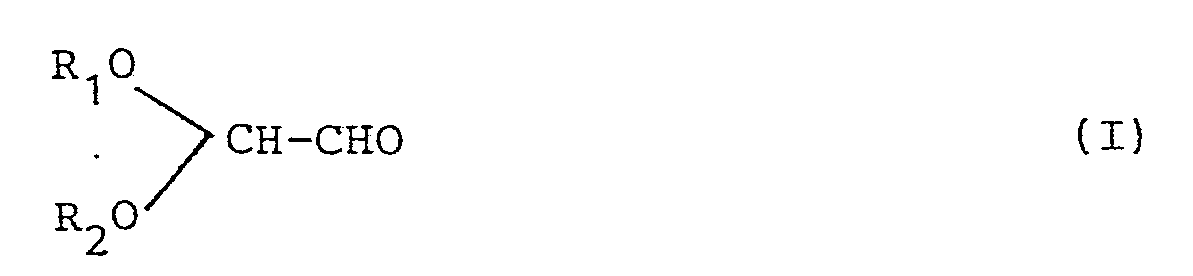
- the present invention relates to a process for preparing monoacetalized glyoxal.
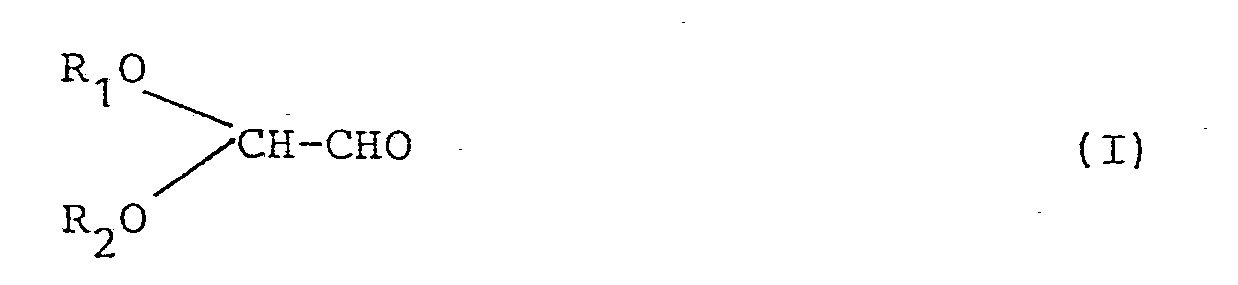
- the present invention relates to a process for preparing monoacetalized glyoxal of general formula I: in which either R1 and R2, identical, represent a group -CHRR3 in which R and R3, identical or different represent an alkyl, alkenyl or aralkyl group, or R1 and R2, identical, represent a group -CH2R in which R represents an atom hydrogen, an alkyl, alkenyl or aralkyl radical, or R1 and R2 together form a radical -CH2- (CRR) n -CHR- in which n represents 0 or 1 and R retains the meaning given above.
- radical -CH2- (CRR) n -CHR- mention may be made of ethylene, propylene, trimethylene, dimethyl-2,2-propane-1,3-diyl, etc.
- This process consists in reacting glyoxal in the presence of an acid catalyst with an excess of the corresponding alcohol of one of the general formulas (II) RR3CHOH, (III) RCH2OH or (IV) HOCH2- (CRR) n - CHROH, in which R, R3 and n retain the meaning given above, then stopping the reaction as soon as the concentration of monoacetal sought of general formula (I) decreases in the reaction medium in favor of bisacetal.
- the Applicant has in fact noticed that glyoxal, even in aqueous solution, reacts quickly with the alcohols of general formula (III) or (IV) to give the monoacetal of general formula (I), which then turns less quickly into bisacetal.
- the secondary alcohols of general formula (II) are much less reactive than the primary alcohols or the primary or primary-secondary diols of general formula (III) or (IV), they can, by increasing reaction times, react with a satisfactory yield with glyoxal to obtain the mono acetal of the corresponding glyoxal sought.
- the disappearance of glyoxal is followed on the one hand and the formation of acetals on the other hand by the analysis of samples taken regularly from the reaction medium.
- glyoxal is followed, for example, by determining the soda necessary for its transformation into sodium glycolate according to the Cannizzaro reaction.
- mono- and bis acetals they are advantageously dosed by gas chromatography after determination of the response coefficients by the conventional method of internal calibration.
- the process according to the invention is carried out in the presence of an acid catalyst.
- acid catalysts include hydrogen chloride, sulfuric acid, paratoluenesulfonic acid, zirconium (IV) sulfate, sulfonic ion exchange resins in acid form.
- zirconium (IV) sulphate or sulphonic ion exchange resins in acid form.
- Usually 50 ⁇ 25 mmol of the acid catalyst is used per mole of glyoxal used.
- this acid catalyst is rapidly eliminated from the reaction medium by means known per se, such as by filtration, neutralization by means of an appropriate base, etc.
- the reaction is carried out with an excess of alcohol relative to the glyoxal. This excess can vary widely, but usually 12 ⁇ 5 moles of alcohol are used per mole of glyoxal. If necessary, it is possible to operate within an inert organic solvent compatible with this type of acid-catalyzed nucleophilic substitution reaction such as hexane, cyclohexane, benzene, toluene, chlorinated solvents: chloroform, dichloromethane.
- the starting glyoxal is either solid like its trimer crystallized with two molecules of water, or in aqueous solution. In the latter case, part of the water of dissolution can be removed by prior azeotropic distillation.
- alcohols used in the process according to the invention include methanol, ethanol, propanol, butanol-1, isobutyl alcohol, phenylethyl alcohol, allyl alcohol, ethylene glycol , propanediol-1,2, propanediol-1,3, dimethyl-2,2-propanediol-1,3, etc.
- the reaction is usually carried out at the boiling point of the reaction medium, but it can be carried out at temperatures higher or lower than this.
- azeotropic distillation of the water present and / or formed in the reaction medium with recycling of the dehydrated distillate by means known in themselves such as leaching through a drying substance such as anhydrous magnesium sulfate.
- the reaction is generally carried out at atmospheric pressure although higher or lower pressure is not detrimental to the process.
- the monoacetal of the glyoxal sought is isolated from the reaction medium by means known in themselves such as fractional distillation or crystallization.
- the monoacetals of glyoxal are very useful olefinoformylation synthons in organic synthesis and they are commonly used to access in particular certain heterocycles (D. Soerens et al, J. Org. Chem. 1979, 44 , 535).
- the cooled reaction medium is then filtered (which makes it possible to recover most of the catalyst used), then the filtrate is treated with 10 g (12 mmol) of dry sodium hydrogen carbonate.
- the oily residue obtained is treated with 5 volumes of diethyl oxide in order to remove the last traces of mineral salts.
- the residual oil is subjected to flash distillation under a vacuum of 10 mbar.
- a second distillation on a rotary column distillation apparatus allows 80 g (0.61 mole) of 2,2-ethanalediethoxy to be distilled at 43 ⁇ 2 ° C under 11 mbar.
- the mixture is heated for 5 hours at boiling point, with elimination of the water present and formed in the reaction medium by azeotropic distillation and recycling of the solvents, a mixture of: - 145 g (1 mole) of glyoxal in aqueous solution at 40% by weight, - 740 g (10 moles) of butanol-1, - 100 g (100 meq.) Of sulfonic resin in acid form, IMAC C16P, sold by the company AKZO (cf. Kirk-Othmer, 3rd edition, volume 13 , 696), - 860 g of hexane.
- the solution is heated to reflux for t hours with azeotropic distillation of water and recycling of the organic solvent using a Dean-Stark apparatus.
- - 1 mole of glyoxal in aqueous solution at 40% by weight - 50 mmol of catalyst C (or 50 meq. Acid of a sulfonic resin), - 10 moles of allyl alcohol, - 1600 cm3 of a solvent S giving an azeotrope with water.
- the reaction medium is cooled and then the catalyst is removed by filtration and / or by neutralization with an acid carbonate of an alkali metal followed by filtration and then the reaction medium is distilled.
- a mixture of: 200 minutes is heated to the boil - 81.7 g of glyoxal in aqueous solution at 71% by weight, ie 1 mole, - 14.5 g of zirconium (IV) sulfate, - 400 g (12.5 moles) of methanol.
- a solution consisting of: - 76 g of glyoxal in aqueous solution at 76.31% by weight, ie 1 mole, - 420.7 g of 2-propanol, i.e. 7 moles, - 19 g (0.1 mole) of paratoluenesulfonic acid crystallized with one mole of water, then after cooling the reaction solution, neutralizing the parato luenesulfonic acid present with sodium bicarbonate, the mineral salts are then filtered and the unprocessed isopropyl alcohol is removed under vacuum. The residual oil is then distilled under vacuum. Is thus isolated 2,2-diisopropoxy ethanal distilling under a vacuum of 1 mbar at 32 ⁇ 3 ° C.
- Diisopropoxy-2,2-ethanal is, at room temperature, a colorless liquid, very fluid, soluble in water and the usual organic solvents.
Landscapes
- Chemical & Material Sciences (AREA)
- Organic Chemistry (AREA)
- Chemical Kinetics & Catalysis (AREA)
- Organic Low-Molecular-Weight Compounds And Preparation Thereof (AREA)
- Low-Molecular Organic Synthesis Reactions Using Catalysts (AREA)
- Catalysts (AREA)
Abstract

diallyloxy-2,2 éthanal.
Description
- La présente invention concerne un procédé de préparation de glyoxal monoacétalisé.
- La présente invention concerne un procédé de préparation de glyoxal monoacétalisé de formule générale I:
- Comme exemples de radical -CH₂-(CRR) n-CHR-, on peut citer les groupes éthylène, propylène, triméthylène, diméthyl-2,2-propane-1,3-diyl, etc.
- Les réactions du glyoxal avec les alcools ont été très étudiées et elles permettent d'accéder facilement au glyoxal bis acétal correspondant (brevet US N o 2.194.405 ; brevet GB N o 559.362 ; brevets français N o 1.280.792 et 2.284.584 ; H. Fischer et al, Chem. Ber., 1926, 59, 851 ; D. H. Grangaard et al, J. Amer. Chem. Soc. 1939, 61, 428 et 755 ; M. Sprung et al, J. Amer. Chem. Soc., 1951, 73, 1884 ; H. Fiesselmann et al, Chem. Ber., 1954, 87, 906 ; U. Faas et al, Chem. Ber., 1954, 87, 1343 ; J. M. Kliegman et al, J. Org. Chem., 1972, 37, 1276 ; ibid 1973, 38, 556 ; ibid 1974, 39, 1172 ; F. Chastrette et al, Bull. Soc. Chim. France, 1976, 601 et 613).
- Ces méthodes directes n'ont pas permis d'accéder aux monoacétals du glyoxal, si bien que pour les obtenir, on a eu recours à des méthodes indirectes telles que l'ozonolyse de l'acétal correspondant de l'acroléine ou la coupure oxydante d'un acétal α, βdyhydroxylé comme le dihydroxy-2,3-tétraéthoxy-1,1,4,4 butane (C. Harries, Chem. Ber., 1903, 36, 1933 ; H. Fischer et al, Helv. Chim. Acta., 1939, 18, 514 ; L. Yanovkaya et al, Izvest, Akad. Nauk SSR, Otdel Khim. Nauk, 1963, 857 ; J. Hine et al, J. Amer. Chem. Soc.. 1972, 94, 6998 ; P. Noire, Chemical Abstracts, 1978, 89, référence 215108).
- Ces procédés sont longs, onéreux et même parfois dangereux lorsqu'ils sont mis en oeuvre sur des quantités importantes (cf. brevet de la R.F.A. N o 3.346.266).
- Or la Demanderesse a découvert avec étonnement un nouveau procédé pour accéder rapidement et avec de bons rendements aux produits de formule I ci-dessus.
- Ce procédé consiste à faire réagir du glyoxal en présence d'un catalyseur acide avec un excès de l'alcool correspondant de l'une des formules générale (II) RR₃CHOH, (III) RCH₂OH ou (IV) HOCH₂-(CRR) n-CHROH, dans lesquelles R, R₃ et n conservent la signification donnée précédemment, puis à arrêter la réaction dès que la concentration en monoacétal cherché de formule générale (I) décroît dans le milieu réactionnel au profit du bisacétal. La Demanderesse s'est en effet aperçue que le glyoxal, même en solution aqueuse, réagissait rapidement avec les alcools de formule générale (III) ou (IV) pour donner le monoacétal de formule générale (I), qui se transformait ensuite moins rapidement en bisacétal.
- Quoique les alcools secondaires de formule générale (II) soient beaucoup moins réactifs que les alcools primaires ou les diols biprimaires ou primaires-secondaires de formule générale (III) ou (IV), on peut, en augmentant des durées réactionnelles, les faire réagir avec un rendement satisfaisant avec le glyoxal pour obtenir le mono acétal du glyoxal correspondant cherché.
- Dans les très nombreux travaux consacrés à la condensation des alcools avec le glyoxal, jamais cette dissociation dans la formation du mono- et du bisacétal du glyoxal n'avait été prévue, entrevue, signalée ou obtenue. Si bien que la simplicité du procédé selon l'invention permet d'accéder aisément non seulement aux monoacétals du glyoxal précédemment décrits mais également à de nouveaux acétals tels que le diallyloxy-2,2 éthanal, qui ne peut être préparé par les méthodes connues.
- Selon le procédé de l'invention, on suit d'une part la disparition du glyoxal et d'autre part la formation des acétals par l'analyse d'échantillons prélevés régulièrement dans le milieu réactionnel.
- La consommation du glyoxal est suivie, par exemple, par détermination de la soude nécessaire à sa transformation en glycolate de sodium selon la réaction de Cannizzaro. Quant aux mono- et bis acétals, ils sont dosés avantageusement par chromatographie en phase gazeuse après détermination des coefficients de réponse par la méthode classique d'étalonnage interne.
- Comme toutes les réactions d'acétalisation, le procédé selon l'invention est effectué en présence d'un catalyseur acide. Parmi ces catalyseurs acides, on peut citer le chlorure d'hydrogène, l'acide sulfurique, l'acide paratoluènesulfonique, le sulfate de zirconium (IV), les résines sulfoniques échangeuses d'ions sous forme acide. Avantageusement, on utilise le sulfate de zirconium (IV) ou les résines sulfoniques échangeuses d'ions sous forme acide. On emploie habituellement 50 ± 25 mmoles du catalyseur acide par mole de glyoxal engagée. En fin de réaction, ce catalyseur acide est rapidement éliminé du milieu réactionnel par des moyens connus en eux-mêmes, comme par filtration, neutralisation au moyen d'une base appropriée, etc.
- La réaction est mise en oeuvre avec un excès d'alcool par rapport au glyoxal. Cet excès peut varier dans de grandes proportions mais habituellement on emploie 12 ± 5 moles d'alcool par mole de glyoxal. Si nécessaire, on peut opérer au sein d'un solvant organique inerte compatible avec ce type de réaction de substitution nucléophile acido-catalysée tel que l'hexane, le cyclohexane, le benzène, le toluene, les solvants chlorés : chloroforme, dichlorométhane.
- Le glyoxal de départ est soit solide comme son trimère cristallisé avec deux molécules d'eau, soit en solution aqueuse. Dans ce dernier cas, on peut éliminer une partie de l'eau de dissolution par distillation azéotropique préalable.
- Comme exemples d'alcools utilisés dans le procédé selon l'invention, on peut citer le méthanol, l'éthanol, le propanol, le butanol-1, l'alcool isobutylique, l'alcool phényléthylique, l'alcool allylique, l'éthylèneglycol, le propanediol-1,2, le propanediol-1,3, le diméthyl-2,2-propanediol-1,3, etc.
- On conduit habituellement la réaction à la température d'ébullition du milieu réactionnel mais on peut la conduire à des températures supérieures ou inférieures à celle-ci. On travaille habituellement avec distillation azéotropique de l'eau présente et/ou formée dans le milieu réactionnel avec recyclage du distillat déshydraté par des moyens connus en eux-mêmes tels que la lixiviation à travers une substance desséchante comme le sulfate de magnésium anhydre.
- La réaction est généralement conduite à pression atmosphérique bien qu'une pression supérieure ou inférieure ne soient pas nuisibles au procédé.
- En fin de réaction, le monoacétal du glyoxal cherché est isolé du milieu réactionnel par des moyens connus en eux-mêmes tels que la distillation fractionnée ou la cristallisation.
- Les monoacétals du glyoxal sont des synthons d'oléfinoformylation très intéressants en synthèse organique et ils sont couramment employés pour accéder notamment à certains hétérocycles (D. Soerens et al, J.Org. Chem. 1979, 44, 535).
- Les exemples suivants illustren t l'invention sans toutefois la limiter.
- On chauffe 90 minutes à l'ebullition un mélange de
- 81,7 g de glyoxal en solution aqueuse à 71 % en poids, soit 1 mole,
-14,5 g (40 mmoles) de sulfate de zirconium (IV) à 98 % cristallisé avec 4 moles d'eau,
- 400 g (8, 7 moles) d'éthanol. - Le milieu réactionnel refroidi est ensuite filtré (ce qui permet de récupérer la majeure partie du catalyseur utilisé) puis le filtrat est traité avec 10 g (12 mmoles) d'hydrogénocarbonate de sodium sec. Après filtration des sels minéraux et évaporation sous vide de l'éthanol excédentaire, le résidu huileux obtenu est traité avec 5 volumes d'oxyde de diéthyle afin d'éliminer les dernières traces de sels minéraux. Après filtration et évaporation sous vide de l'oxyde de diéthyle introduit, l'huile résiduelle est soumise à une distillation éclair sous un vide de 10 mbar. On recueille ainsi 122 g d'un liquide distillant entre 35 et 60°C dont l'analyse en chromatographie phase vapeur révèle la présence de 70 % environ de diéthoxy-2,2 éthanal et 30 % de tétraéthoxy-1,1,2,2 éthane.
- Une deuxième distillation sur un appareil à distiller à colonne à bande tournante permet d'isoler 80 g (0,61 mole) de diéthoxy-2,2 éthanal distillant à 43 ± 2°C sous 11 mbar.
- On chauffe 5 heures à l'ébullition, avec élimination de l'eau présente et formée dans le milieu réactionnel par distillation azéotropique et recyclage des solvants, un mélange de :
- 145 g (1 mole) de glyoxal en solution aqueuse à 40 % en poids,
- 740 g (10 moles) de butanol-1,
- 100 g (100 méq.) de résine sulfonique sous forme acide, IMAC C16P, commercialisée par la société AKZO (cf. Kirk-Othmer, 3ème édition, volume 13, 696),
- 860 g d'hexane. - A ce stade, une analyse par chromatographie en phase vapeur d'un échantillon du milieu réactionnel révèle la présence de 0,1 mole de glyoxal non transformé, 0,85 mole de dibutoxy-2,2 éthanal et de 0,05 mole de tétrabutoxy-1,1,2,2 éthane.
- Le milieu réactionnel est refroidi, filtré puis le filtrat est traité avec 50 g (0,6 mole) d'hydrogénocarbonate de sodium. Après filtration des sels minéraux et évaporation sous vide des solvants, on obtient 250 g d'un liquide jaune clair qui est distillé sous un vide de 2 mbar. On recueille la fraction distillant à 71 ± 3°C. On obtient ainsi 122 g de dibutoxy-2,2 éthanal soit un rendement de 65 % de la théorie calculée par rapport au glyoxal engagé. En poursuivant la distillation, on recueille 9,6 g (30 mmoles) de tétrabutoxy-1,1,2,2 éthane distillant à 120 ± 5°C (Fiesselmann et al, Chem. Ber., 1954, 87, 911, Eb₁₀ = 160 ± 1°C).
- RMN¹H (CDCl₃)
1 ppm (massif, 6H, CH₃)
1,4 ppm (massif, 8H, CH₂-CH₂)
3,6 ppm (massif, 4H, -CH₂-O)
4,55 ppm (doublet, 1H, J = 2 Hz,CH-C-
9,4 ppm (doublet, 1H, J = 2 Hz, CHO). - A la connaissance de la Demanderesse, ce produit n'est pas décrit dans la littérature.
- On chauffe au reflux pendant t heures avec distillation azéotropique de l'eau et recyclage du solvant organique à l'aide d'une appareil Dean-Stark une solution de :
- 1 mole de glyoxal en solution aqueuse à 40 % en poids,
- 50 mmoles d'un catalyseur C (ou 50 méq. acide d'une résine sulfonique),
- 10 moles d'alcool allylique,
- 1600 cm³ d'un solvant S donnant un azéotrope avec l'eau. - Lorsque les dosages de diallyloxy-2,2 éthanal et de tétraallyloxy-1,1,2,2 ethane effectués périodiquement au cours du chauffage indiquent une décroissance de la concentration en diallyloxy-2,2 ethanal au profit du tétraallyloxy-1,1,2,2 ethane, on refroidit le milieu réactionnel puis on élimine le catalyseur par filtration et/ou par neutralisation avec un carbonate acide d'un métal alcalin suivie d'une filtration et ensuite on distille le milieu réactionnel. Après élimination des solvants, on recueille une première fraction distillant à 62 ± 2°C sous 6 mbar de p moles constituée par le produit attendu puis une deuxième fraction distillant à 100 ± 5°C sous 5 mbar de q moles constituée par le tétraallyloxy-1,1,2,2 éthane.
- Le tableau I ci-après résume les essais effectués.

- RMN¹H (CDCl₃)
4,2 ppm (doublet, 4H, - OCH₂)
4,7 ppm (doublet, 1H, J = 2 Hz,CH-C)
5,2 ppm (massif,4H, CH₂)
5,8 ppm (massif, 2H, =CH-)
9,5 ppm (doublet, 1H, J = 2 Hz, CHO) - A la connaissance de la Demanderesse, ce produit n'est pas décrit dans la littérature.
- On chauffe 200 minutes à l'ébullition un mélange de :
- 81,7 g de glyoxal en solution aqueuse à 71 % en poids, soit 1 mole,
- 14,5 g de sulfate de zirconium (IV),
- 400 g (12,5 moles) de méthanol. - Puis le milieu réactionnel est traité comme dans l'exemple 1. On obtient ainsi 73 g (0,7 mole) de diméthoxy-2,2 éthanal distillant sous 40 mbar à 59 ± 3°C (L.A. Yanovskaya et al, Izvest. Akad. Nauk SSR, Otdel. Khim. Nauk, 1963, 857, Eb₃₉ = 59 ± 1°C) et 30 g (0,2 mole) de tétraméthoxy-1,1,2,2 éthane distillant sous 12 mbar à 53 ± 2°C.
- On chauffe à l'ébullition pendant 4 heures un mélange de :
- 70 g de glyoxal cristallisé commercial (trimère cristallisé avec 2 moles d'eau, F = 140-150°C), soit 1 mole de glyoxal monomère,
- 14,5 g (40 mmoles) de sulfate de zirconium à 98 % cristallisé avec 4 moles d'eau,
- 740 g (10 moles) de méthyl-2 propanol-1,
puis on traite le milieu réactionnel comme dans l'exemple 1. On isole ainsi 113 g (0,6 mole) de diisobutoxy-2,2 éthanal distillant à 52°C sous 6 mbar et 95 g (0,3 mole) de tétraisobutoxy-1,1,2,2 éthane distillant à 94-99°C sous 5 mbar. - RMN¹H (CDCl₃)
0,94 ppm (doublet, 12H, CH₃)
1,9 ppm (massif, 2H, CH)
3,4 ppm (massif, 4H, CH₂O)
4,5 ppm (doublet, 1H, J = 2 Hz)
9,5 ppm (doublet, 1H, J = 2 Hz, CHO) - On chauffe 4 heures à l'ébullition, avec distillation azéotropique de l'eau présente et formée dans le milieu réactionnel et recyclage des solvants, une solution de :
- 145 g (1 mole) de glyoxal en solution aqueuse 35 à 40 %,
- 104 g (1 mole) de diméthyl-2,2 propanediol-1,3,
-3,8 g (0,02 mole) d'acide paratoluènesulfonique,
- 440 g de benzène. - Puis on traite le milieu réactionnel comme dans l'exemple 2.
- On recueille ainsi 72,2 g (0,5 mole) de formyl-2 diméthyl-5,5 dioxanne-1,3 distillant à 81 ± 2°C sous 30 mbar.
- RMN¹H (CDCl₃)
0,6 ppm (singulet, 3H, CH₃)
1 ppm (singulet, 3H CH₃)
3,5 ppm (massif, 4H, CH₂)
4,5 ppm (doublet, 1H, J = 52 Hz, CH)
9,3 ppm (doublet, 1H, J = 2 Hz, CHO) - On chauffe 8 heures à l'ébullition une solution constituée par :
- 76 g de glyoxal en solution aqueuse à 76,31 % en poids, soit 1 mole,
- 420,7 g de 2-propanol, soit 7 moles,
- 19 g (0,1 mole) d'acide paratoluènesulfonique cristallisé avec une mole d'eau,
puis après refroidissement de la solution réactionnelle, on neutralise l'acide parato luènesulfonique présent avec du bicarbonate de sodium, on filtre ensuite les sels minéraux et on élimine sous vide l'alcool isopropylique non transformé. L'huile résiduelle est ensuite distillée sous vide. On isole ainsi le diisopropoxy-2,2 éthanal distillant sous un vide de 1 mbar à 32 ± 3°C. - Le diisopropoxy-2,2 éthanal est, à la température ambiante, un liquide incolore, très fluide, soluble dans l'eau et les solvants organiques usuels.
- RMN¹H (CDCl₃) à 200 MHz
9,36 ppm (d, 1H, J = 2,9 Hz, CHO)
4,61 ppm (d, 1H, J = 2,9 Hz, CH)
3,94 ppm (heptuplets, 2H, CH(Me)₂ J = 6 Hz)
1,27 ppm (d, 6H, Me, J = 6 Hz)
1,20 ppm (d, 6H, Me, J = 6 Hz) - Il va de soi que la présente invention n'a été décrite qu'à titre purement explicatif et nullement limitatif et que toute modification, notamment au niveau des équivalences techniques, pourra y être apportée sans sortir de son cadre.
Claims (8)
Priority Applications (1)
| Application Number | Priority Date | Filing Date | Title |
|---|---|---|---|
| AT87401227T ATE55978T1 (de) | 1986-06-03 | 1987-06-02 | Verfahren zur herstellung von glyoxalmonoacetalen. |
Applications Claiming Priority (4)
| Application Number | Priority Date | Filing Date | Title |
|---|---|---|---|
| FR8607957 | 1986-06-03 | ||
| FR8607957A FR2599362B1 (fr) | 1986-06-03 | 1986-06-03 | Procede de preparation de monoacetals du glyoxal |
| FR8706106 | 1987-04-29 | ||
| FR8706106A FR2614616B2 (fr) | 1987-04-29 | 1987-04-29 | Procede de preparation de monoacetals du glyoxal |
Related Child Applications (1)
| Application Number | Title | Priority Date | Filing Date |
|---|---|---|---|
| EP89122806.6 Division-Into | 1987-06-02 |
Publications (3)
| Publication Number | Publication Date |
|---|---|
| EP0249530A2 true EP0249530A2 (fr) | 1987-12-16 |
| EP0249530A3 EP0249530A3 (en) | 1988-05-18 |
| EP0249530B1 EP0249530B1 (fr) | 1990-08-29 |
Family
ID=26225283
Family Applications (2)
| Application Number | Title | Priority Date | Filing Date |
|---|---|---|---|
| EP89122806A Expired - Lifetime EP0368363B1 (fr) | 1986-06-03 | 1987-06-02 | Nouveau monoacétal du glyoxal |
| EP87401227A Expired - Lifetime EP0249530B1 (fr) | 1986-06-03 | 1987-06-02 | Procédé de préparation de monoacétals du glyoxal |
Family Applications Before (1)
| Application Number | Title | Priority Date | Filing Date |
|---|---|---|---|
| EP89122806A Expired - Lifetime EP0368363B1 (fr) | 1986-06-03 | 1987-06-02 | Nouveau monoacétal du glyoxal |
Country Status (7)
| Country | Link |
|---|---|
| US (1) | US4835320A (fr) |
| EP (2) | EP0368363B1 (fr) |
| JP (1) | JP2515548B2 (fr) |
| CA (1) | CA1268773A (fr) |
| DE (2) | DE3764544D1 (fr) |
| ES (1) | ES2017506B3 (fr) |
| GR (2) | GR3001053T3 (fr) |
Cited By (9)
| Publication number | Priority date | Publication date | Assignee | Title |
|---|---|---|---|---|
| EP0316672A1 (fr) * | 1987-11-13 | 1989-05-24 | BASF Aktiengesellschaft | Procédé de préparation de glyoxalmonoacétals |
| FR2642430A1 (fr) * | 1989-01-10 | 1990-08-03 | Hoechst France | Nouvelles resines aminoplastes destinees a l'ennoblissement des fibres cellulosiques et leur application |
| FR2700535A1 (fr) * | 1993-01-19 | 1994-07-22 | Hoechst France | Procédé continu de fabrication industrielle du diméthoxyéthanal. |
| FR2717474A1 (fr) * | 1994-03-15 | 1995-09-22 | Hoechst France | Procédé de préparation d'acétals du formyl-2 imidazole. |
| WO1998001439A1 (fr) * | 1993-09-22 | 1998-01-15 | Basf Aktiengesellschaft | Procede de preparation de but-2-ene-1,4-dial-4-acetals 2-substitues et nouveaux hemi-acetals de glyoxalmonoacetals |
| EP0847976A1 (fr) * | 1996-12-11 | 1998-06-17 | Basf Aktiengesellschaft | Procédé pour la préparation de glyoxalmonoacétals |
| CN1078894C (zh) * | 1994-12-07 | 2002-02-06 | 法国赫彻斯特公司 | 含有胺多元醇反应产物的粘合剂组合物 |
| EP1652868A1 (fr) | 2004-10-29 | 2006-05-03 | Clariant (France) | Composition de résine aminoplaste |
| IT202300003888A1 (it) | 2023-03-03 | 2024-09-03 | Dipharma Francis Srl | Processo di preparazione di un farmaco usato per trattare la dipendenza da nicotina |
Families Citing this family (8)
| Publication number | Priority date | Publication date | Assignee | Title |
|---|---|---|---|---|
| US5252663A (en) * | 1991-05-22 | 1993-10-12 | National Starch And Chemical Investment Holding Corporation | Formaldehyde-free crosslinking emulsion polymer systems based on vinyl ester dialkoxyhydroxyethyl acrylamide co- and terpolymers |
| US5576449A (en) * | 1993-09-30 | 1996-11-19 | Basf Aktiengesellschaft | Preparation of 2-substituted but-2-ene-1,4-dial-4-acetals and novel hemiacetals of glyoxal monoacetals |
| US5539077A (en) * | 1994-12-07 | 1996-07-23 | Sequa Chemicals, Inc. | Resin composition |
| US5739260A (en) * | 1996-08-05 | 1998-04-14 | Sequa Chemicals, Inc. | Hydrophobically modified resin composition for graphics applications |
| US6201095B1 (en) | 1999-06-22 | 2001-03-13 | Omnova Solutions Inc. | Color improvement of DME-melamine resins |
| JP4786088B2 (ja) * | 2001-09-13 | 2011-10-05 | 株式会社日本ファインケム | グルタルアルデヒドモノアセタールの製造方法 |
| DE10149063A1 (de) * | 2001-10-05 | 2003-04-17 | Basf Ag | Verfahren zur Herstellung von Diacetalen des Glyoxals |
| FR2855171B1 (fr) * | 2003-05-22 | 2005-08-05 | Clariant | Procede de separation d'un diacetal du glyoxal d'un melange brut le contenant par extraction liquide-liquide a contre-courant |
Family Cites Families (4)
| Publication number | Priority date | Publication date | Assignee | Title |
|---|---|---|---|---|
| US2116016A (en) * | 1935-03-02 | 1938-05-03 | Fischer Hermann | Glyoxal-semi-acetals |
| DE2514001A1 (de) * | 1975-03-29 | 1976-10-07 | Basf Ag | Verfahren zur herstellung von glyoxalmonoacetalen |
| DE2515001C2 (de) * | 1975-04-04 | 1986-10-02 | Schering AG, 1000 Berlin und 4709 Bergkamen | Prostaglandin enthaltende gefriergetrocknete Pulver |
| DE3346266A1 (de) * | 1983-12-21 | 1985-07-11 | Lentia Gmbh | Verfahren zur herstelung von glyoxal, alkylglyoxalen und von deren acetalen |
-
1987
- 1987-06-01 US US07/061,015 patent/US4835320A/en not_active Expired - Lifetime
- 1987-06-02 DE DE8787401227T patent/DE3764544D1/de not_active Expired - Lifetime
- 1987-06-02 DE DE8989122806T patent/DE3782664T2/de not_active Expired - Fee Related
- 1987-06-02 EP EP89122806A patent/EP0368363B1/fr not_active Expired - Lifetime
- 1987-06-02 EP EP87401227A patent/EP0249530B1/fr not_active Expired - Lifetime
- 1987-06-02 ES ES87401227T patent/ES2017506B3/es not_active Expired - Lifetime
- 1987-06-02 JP JP62138848A patent/JP2515548B2/ja not_active Expired - Lifetime
- 1987-06-03 CA CA000538740A patent/CA1268773A/fr not_active Expired
-
1990
- 1990-11-06 GR GR90400872T patent/GR3001053T3/el unknown
-
1992
- 1992-11-19 GR GR920402645T patent/GR3006286T3/el unknown
Cited By (16)
| Publication number | Priority date | Publication date | Assignee | Title |
|---|---|---|---|---|
| EP0316672A1 (fr) * | 1987-11-13 | 1989-05-24 | BASF Aktiengesellschaft | Procédé de préparation de glyoxalmonoacétals |
| FR2642430A1 (fr) * | 1989-01-10 | 1990-08-03 | Hoechst France | Nouvelles resines aminoplastes destinees a l'ennoblissement des fibres cellulosiques et leur application |
| EP0381905A1 (fr) * | 1989-01-10 | 1990-08-16 | Societe Francaise Hoechst | Résines aminoplastes destinées à l'ennoblissement des fibres cellulosiques et leur application |
| US4968774A (en) * | 1989-01-10 | 1990-11-06 | Societe Francaise Hoechst | Amino-plastic resins intended for the improvement of cellulosed fibres and their application |
| FR2700535A1 (fr) * | 1993-01-19 | 1994-07-22 | Hoechst France | Procédé continu de fabrication industrielle du diméthoxyéthanal. |
| EP0607722A1 (fr) * | 1993-01-19 | 1994-07-27 | SOCIETE FRANCAISE HOECHST Société anonyme dite: | Procédé continu de fabrication industrielle du diméthoxyéthanal |
| US5426239A (en) * | 1993-01-19 | 1995-06-20 | Societe Francaise Hoechst | Continuous process for the industrial manufacture of dimethoxyethanal |
| WO1998001439A1 (fr) * | 1993-09-22 | 1998-01-15 | Basf Aktiengesellschaft | Procede de preparation de but-2-ene-1,4-dial-4-acetals 2-substitues et nouveaux hemi-acetals de glyoxalmonoacetals |
| US5550250A (en) * | 1994-03-15 | 1996-08-27 | Societe Francaise Hoechst | Preparation process for 2 formyl imidazole acetals |
| FR2717474A1 (fr) * | 1994-03-15 | 1995-09-22 | Hoechst France | Procédé de préparation d'acétals du formyl-2 imidazole. |
| CN1078894C (zh) * | 1994-12-07 | 2002-02-06 | 法国赫彻斯特公司 | 含有胺多元醇反应产物的粘合剂组合物 |
| EP0847976A1 (fr) * | 1996-12-11 | 1998-06-17 | Basf Aktiengesellschaft | Procédé pour la préparation de glyoxalmonoacétals |
| US6013842A (en) * | 1996-12-11 | 2000-01-11 | Basf Aktiengesellschaft | Preparation of glyoxal monoacetals |
| CN1094921C (zh) * | 1996-12-11 | 2002-11-27 | 巴斯福股份公司 | 乙二醛单缩醛的制备 |
| EP1652868A1 (fr) | 2004-10-29 | 2006-05-03 | Clariant (France) | Composition de résine aminoplaste |
| IT202300003888A1 (it) | 2023-03-03 | 2024-09-03 | Dipharma Francis Srl | Processo di preparazione di un farmaco usato per trattare la dipendenza da nicotina |
Also Published As
| Publication number | Publication date |
|---|---|
| CA1268773A (fr) | 1990-05-08 |
| GR3006286T3 (fr) | 1993-06-21 |
| EP0368363B1 (fr) | 1992-11-11 |
| DE3782664T2 (de) | 1993-03-25 |
| US4835320A (en) | 1989-05-30 |
| ES2017506B3 (es) | 1991-02-16 |
| DE3782664D1 (en) | 1992-12-17 |
| JP2515548B2 (ja) | 1996-07-10 |
| JPS62294632A (ja) | 1987-12-22 |
| DE3764544D1 (de) | 1990-10-04 |
| EP0249530A3 (en) | 1988-05-18 |
| EP0368363A1 (fr) | 1990-05-16 |
| GR3001053T3 (en) | 1992-03-20 |
| EP0249530B1 (fr) | 1990-08-29 |
Similar Documents
| Publication | Publication Date | Title |
|---|---|---|
| EP0249530B1 (fr) | Procédé de préparation de monoacétals du glyoxal | |
| CA1152105B (fr) | Procede d'hydroformylation des olefines | |
| EP0092463A1 (fr) | Procédé de fabrication de monoéther de monoéthylèneglycol par hydrogénolyse d'acétals cycliques | |
| FR2855171A1 (fr) | Procede de separation d'un diacetal du glyoxal d'un melange brut le contenant par extraction liquide-liquide a contre-courant | |
| EP0344043B1 (fr) | Procédé de préparation du citral | |
| FR2460972A1 (fr) | Procede de preparation de polymethylene polyphenyl polycarbamates | |
| EP0708759B1 (fr) | Procede pour la preparation de pyrazines substituees | |
| CA2112869C (fr) | Procede continu de fabrication industrielle du dimethoxyethanal | |
| FR2599362A1 (fr) | Procede de preparation de monoacetals du glyoxal | |
| EP0189448B1 (fr) | Agent de fluoration de composes organiques notamment de composes acetyleniques, leur procede de preparation et leur utilisation dans les reactions d'addition ou de substitution nucleophile | |
| EP0005654B1 (fr) | Procédé d'isomérisation des dérivés de la vinyl-3 pipéridine | |
| EP0127536B1 (fr) | Procédé de préparation de composés carbonyles alpha-delta-diéthyléniques | |
| CH624089A5 (fr) | ||
| FR2555180A1 (fr) | Acides dialcoxy-4,5 dioxolanne-1,3 carboxylique-2, leurs derives, leur procede de preparation et leur application | |
| EP0145554A2 (fr) | Procédé de préparation de dérivés éthyléniques chlorés | |
| FR2533918A1 (fr) | Procede de production d'ethers de dinitrophenyle | |
| EP0019531B1 (fr) | Paraformylphénolate de sodium cristallisé, son procédé de préparation et son application | |
| EP0032713B1 (fr) | Nouveaux sels de phosphonium, procédé pour leur préparation et leur utilisation à titre de produits de départ pour la préparation de composés bicycliques insaturés | |
| EP0927176B1 (fr) | Derives de 1,3-dioxane, procede de synthese et compositions aromatiques les contenant | |
| CA2031249A1 (fr) | Procede de preparation d'halogenoacetals a partir d'enamines | |
| FR2555164A1 (fr) | Procede de preparation de derives acetyleniques, nouveaux derives obtenus et leur emploi | |
| CH409906A (fr) | Procédé de préparation des acétals du y-cyano-butyraldéhyde | |
| FR2515173A1 (fr) | Nouveaux derives du benzaldehyde 3-4-diethere et leur procede de preparation | |
| FR2545086A1 (fr) | Procede de preparation d'acides alkanoiques | |
| CH325837A (fr) | Procédé de préparation de 1 : 1 :3-trialcoyloxyprop-2-ènes |
Legal Events
| Date | Code | Title | Description |
|---|---|---|---|
| PUAI | Public reference made under article 153(3) epc to a published international application that has entered the european phase |
Free format text: ORIGINAL CODE: 0009012 |
|
| AK | Designated contracting states |
Kind code of ref document: A2 Designated state(s): AT BE CH DE ES FR GB GR IT LI LU NL SE |
|
| PUAL | Search report despatched |
Free format text: ORIGINAL CODE: 0009013 |
|
| 17P | Request for examination filed |
Effective date: 19880129 |
|
| RHK1 | Main classification (correction) |
Ipc: C07C 45/71 |
|
| AK | Designated contracting states |
Kind code of ref document: A3 Designated state(s): AT BE CH DE ES FR GB GR IT LI LU NL SE |
|
| 17Q | First examination report despatched |
Effective date: 19890705 |
|
| GRAA | (expected) grant |
Free format text: ORIGINAL CODE: 0009210 |
|
| AK | Designated contracting states |
Kind code of ref document: B1 Designated state(s): AT BE CH DE ES FR GB GR IT LI LU NL SE |
|
| REF | Corresponds to: |
Ref document number: 55978 Country of ref document: AT Date of ref document: 19900915 Kind code of ref document: T |
|
| XX | Miscellaneous (additional remarks) |
Free format text: TEILANMELDUNG 89122806.6 EINGEREICHT AM 02/06/87. |
|
| GBT | Gb: translation of ep patent filed (gb section 77(6)(a)/1977) | ||
| REF | Corresponds to: |
Ref document number: 3764544 Country of ref document: DE Date of ref document: 19901004 |
|
| ITF | It: translation for a ep patent filed | ||
| REG | Reference to a national code |
Ref country code: GR Ref legal event code: FG4A Free format text: 3001053 |
|
| PGFP | Annual fee paid to national office [announced via postgrant information from national office to epo] |
Ref country code: FR Payment date: 19910627 Year of fee payment: 5 |
|
| PLBE | No opposition filed within time limit |
Free format text: ORIGINAL CODE: 0009261 |
|
| STAA | Information on the status of an ep patent application or granted ep patent |
Free format text: STATUS: NO OPPOSITION FILED WITHIN TIME LIMIT |
|
| 26N | No opposition filed | ||
| ITTA | It: last paid annual fee | ||
| PG25 | Lapsed in a contracting state [announced via postgrant information from national office to epo] |
Ref country code: FR Effective date: 19930226 |
|
| REG | Reference to a national code |
Ref country code: FR Ref legal event code: ST |
|
| PGFP | Annual fee paid to national office [announced via postgrant information from national office to epo] |
Ref country code: GR Payment date: 19940610 Year of fee payment: 8 |
|
| PGFP | Annual fee paid to national office [announced via postgrant information from national office to epo] |
Ref country code: ES Payment date: 19940617 Year of fee payment: 8 |
|
| PGFP | Annual fee paid to national office [announced via postgrant information from national office to epo] |
Ref country code: BE Payment date: 19940713 Year of fee payment: 8 |
|
| PGFP | Annual fee paid to national office [announced via postgrant information from national office to epo] |
Ref country code: LU Payment date: 19940731 Year of fee payment: 8 |
|
| EPTA | Lu: last paid annual fee | ||
| EAL | Se: european patent in force in sweden |
Ref document number: 87401227.1 |
|
| PG25 | Lapsed in a contracting state [announced via postgrant information from national office to epo] |
Ref country code: LU Free format text: LAPSE BECAUSE OF NON-PAYMENT OF DUE FEES Effective date: 19950602 |
|
| PG25 | Lapsed in a contracting state [announced via postgrant information from national office to epo] |
Ref country code: ES Free format text: LAPSE BECAUSE OF EXPIRATION OF PROTECTION Effective date: 19950603 |
|
| PG25 | Lapsed in a contracting state [announced via postgrant information from national office to epo] |
Ref country code: BE Effective date: 19950630 |
|
| BERE | Be: lapsed |
Owner name: SOC. FRANCAISE HOECHST Effective date: 19950630 |
|
| PG25 | Lapsed in a contracting state [announced via postgrant information from national office to epo] |
Ref country code: GR Free format text: THE PATENT HAS BEEN ANNULLED BY A DECISION OF A NATIONAL AUTHORITY Effective date: 19951231 |
|
| REG | Reference to a national code |
Ref country code: GR Ref legal event code: MM2A Free format text: 3001053 |
|
| PGFP | Annual fee paid to national office [announced via postgrant information from national office to epo] |
Ref country code: AT Payment date: 19980520 Year of fee payment: 12 |
|
| PGFP | Annual fee paid to national office [announced via postgrant information from national office to epo] |
Ref country code: SE Payment date: 19980617 Year of fee payment: 12 |
|
| REG | Reference to a national code |
Ref country code: FR Ref legal event code: TP Ref country code: FR Ref legal event code: CD |
|
| PG25 | Lapsed in a contracting state [announced via postgrant information from national office to epo] |
Ref country code: AT Free format text: LAPSE BECAUSE OF NON-PAYMENT OF DUE FEES Effective date: 19990602 |
|
| PG25 | Lapsed in a contracting state [announced via postgrant information from national office to epo] |
Ref country code: SE Free format text: THE PATENT HAS BEEN ANNULLED BY A DECISION OF A NATIONAL AUTHORITY Effective date: 19990629 |
|
| REG | Reference to a national code |
Ref country code: ES Ref legal event code: FD2A Effective date: 19990601 |
|
| EUG | Se: european patent has lapsed |
Ref document number: 87401227.1 |
|
| REG | Reference to a national code |
Ref country code: GB Ref legal event code: IF02 |
|
| PG25 | Lapsed in a contracting state [announced via postgrant information from national office to epo] |
Ref country code: IT Free format text: LAPSE BECAUSE OF NON-PAYMENT OF DUE FEES;WARNING: LAPSES OF ITALIAN PATENTS WITH EFFECTIVE DATE BEFORE 2007 MAY HAVE OCCURRED AT ANY TIME BEFORE 2007. THE CORRECT EFFECTIVE DATE MAY BE DIFFERENT FROM THE ONE RECORDED. Effective date: 20050602 |
|
| PGFP | Annual fee paid to national office [announced via postgrant information from national office to epo] |
Ref country code: GB Payment date: 20060515 Year of fee payment: 20 |
|
| PGFP | Annual fee paid to national office [announced via postgrant information from national office to epo] |
Ref country code: DE Payment date: 20060607 Year of fee payment: 20 |
|
| PGFP | Annual fee paid to national office [announced via postgrant information from national office to epo] |
Ref country code: CH Payment date: 20060609 Year of fee payment: 20 |
|
| PGFP | Annual fee paid to national office [announced via postgrant information from national office to epo] |
Ref country code: NL Payment date: 20060626 Year of fee payment: 20 |
|
| PG25 | Lapsed in a contracting state [announced via postgrant information from national office to epo] |
Ref country code: NL Free format text: LAPSE BECAUSE OF EXPIRATION OF PROTECTION Effective date: 20070602 |
|
| REG | Reference to a national code |
Ref country code: GB Ref legal event code: PE20 |
|
| REG | Reference to a national code |
Ref country code: CH Ref legal event code: PL |
|
| NLV7 | Nl: ceased due to reaching the maximum lifetime of a patent |
Effective date: 20070602 |
|
| PG25 | Lapsed in a contracting state [announced via postgrant information from national office to epo] |
Ref country code: GB Free format text: LAPSE BECAUSE OF EXPIRATION OF PROTECTION Effective date: 20070601 |