EP0249017A1 - Bodenstartgerät für Flugkörper - Google Patents
Bodenstartgerät für Flugkörper Download PDFInfo
- Publication number
- EP0249017A1 EP0249017A1 EP87105964A EP87105964A EP0249017A1 EP 0249017 A1 EP0249017 A1 EP 0249017A1 EP 87105964 A EP87105964 A EP 87105964A EP 87105964 A EP87105964 A EP 87105964A EP 0249017 A1 EP0249017 A1 EP 0249017A1
- Authority
- EP
- European Patent Office
- Prior art keywords
- baffle plate
- jet
- starting device
- ground
- missile
- Prior art date
- Legal status (The legal status is an assumption and is not a legal conclusion. Google has not performed a legal analysis and makes no representation as to the accuracy of the status listed.)
- Granted
Links
- 235000015842 Hesperis Nutrition 0.000 claims abstract description 4
- 235000012633 Iberis amara Nutrition 0.000 claims abstract description 4
- 239000003380 propellant Substances 0.000 claims description 31
- 239000003779 heat-resistant material Substances 0.000 claims description 5
- 238000007654 immersion Methods 0.000 description 2
- 230000001771 impaired effect Effects 0.000 description 2
- 238000012423 maintenance Methods 0.000 description 2
- 238000000034 method Methods 0.000 description 2
- 125000006850 spacer group Chemical group 0.000 description 2
- 239000000956 alloy Substances 0.000 description 1
- 229910045601 alloy Inorganic materials 0.000 description 1
- 230000005540 biological transmission Effects 0.000 description 1
- 229910010293 ceramic material Inorganic materials 0.000 description 1
- 238000013016 damping Methods 0.000 description 1
- 230000000694 effects Effects 0.000 description 1
- 230000002349 favourable effect Effects 0.000 description 1
- 230000024703 flight behavior Effects 0.000 description 1
- 239000000463 material Substances 0.000 description 1
- 230000002028 premature Effects 0.000 description 1
- 230000001360 synchronised effect Effects 0.000 description 1
Images



Classifications
-
- F—MECHANICAL ENGINEERING; LIGHTING; HEATING; WEAPONS; BLASTING
- F41—WEAPONS
- F41F—APPARATUS FOR LAUNCHING PROJECTILES OR MISSILES FROM BARRELS, e.g. CANNONS; LAUNCHERS FOR ROCKETS OR TORPEDOES; HARPOON GUNS
- F41F3/00—Rocket or torpedo launchers
- F41F3/04—Rocket or torpedo launchers for rockets
- F41F3/0413—Means for exhaust gas disposal, e.g. exhaust deflectors, gas evacuation systems
Definitions
- the invention relates to a ground launcher for missiles, such as rockets or the like, with a gun carriage carrying the missile.
- ground launch devices are used, which are either mounted directly on the ground or on emergency vehicles. These ground starting devices consist of a substructure and a carriage mounted on it. The missiles are used in pickups (launcher), which are provided on the gun carriage. The missile's trajectory can be adjusted to the target. At the start there is occasionally a so-called "hang fire”, in which the missile gets stuck and the rocket engine burns at full power. In such a "hang fire”, the carriage and its substructure are considerably stressed longer than during a normal start, which affects the stability of the carriage and can result in damage, so that the carriage may be put out of action.
- the invention is therefore based on the object of providing a ground starting device in which the loads acting on the mount during a "hang fire" be reduced and in particular the stability of the carriage is not impaired.
- baffle plate which is movable in the propellant jet of the missile is mounted on the mount and can be moved into an active position which extends across its entire cross section when the propellant jet is acted upon.
- the mount is now designed so that, when the missile is inserted, it has a baffle plate directly behind the rocket motor, which is movable into the propellant jet. If the baffle plate is brought into the propellant jet during a "hang fire", it experiences a force in the direction of the propellant jet which is of the same magnitude as the thrust of the rocket motor. This thrust is the reaction force on the baffle plate, which is picked up by the ground starting device. Since the two forces are equal in magnitude but opposite, they cancel each other out. This has the advantage that the carriage is not unilaterally impacted by the thrust of the missile stuck to it and is thereby damaged. The mount is therefore not subjected to excessive stress until the rocket engine burns down completely, and in particular its stability is not impaired.
- the propulsion jet emerges unhindered behind the gun carriage.
- the flapper is only after the ignition process, if necessary. with a time delay behind the rocket engine and into the propulsion jet and thus only acted upon when the missile does not leave the gun carriage.
- the drag is only built up when the thrust of the propellant jet builds up on the carriage itself, while the baffle plate is outside the propellant jet during a normal starting process.
- the baffle plate is flat and in its operative position it is perpendicular to the axis of the driving jet.
- the baffle plate thus experiences a force which, in terms of amount and direction, corresponds exactly to the thrust force. There are therefore no transverse forces that burden the carriage.
- the deflected jet can also be given a different direction by changing the shape and arrangement of the baffle plate.
- the baffle plate is preferably circular, which prevents the baffle plate from being acted upon unevenly and lateral forces being able to form as a result.
- the baffle plate advantageously has a larger diameter than the impinging jet, so that the entire energy of the jet is converted to generate the counterforce.
- the baffle plate is advantageously pivotally mounted on the mount, the pivot axis of the baffle plate preferably being arranged outside the driving jet.
- the pivotability of the baffle plate has the advantage that the counterforce is only built up to the full height with increasing pivoting angle, which can ensure that it is really only effective in the case of a "hang fire”.
- the baffle plate and its storage are only used in such a "hang fire”.
- a preferred embodiment provides that a control plate is connected to the baffle plate which, when the baffle plate is in the rest position outside the propellant jet immersed in the driving jet with shallow depth.
- the control plate can thus perform a pivoting movement about the pivot axis arranged outside the driving jet. It is arranged on the baffle plate in such a way that it dips into the driving jet, swivels under the effect of the impinging driving jet and takes the baffle plate with it until it also dips into the driving jet and is pushed by it into its end position. This has the advantage that no additional drive is required to pivot the baffle plate.
- the control plate preferably has a defined size or immersion depth in the drive jet, which is dimensioned such that it only applies the force for pivoting the baffle plate and only moves the baffle plate into the drive jet when the drive jet is fully developed.
- the control plate can be designed in such a way that it does not significantly influence the propellant jet even when it is constantly immersed, and thus does not impair the flight behavior of the missile during a normal launch.
- a premature immersion of the baffle plate in the driving jet is advantageously prevented by the baffle plate being under a counter force which keeps it at rest, counteracting the force acting on the control plate from the driving baffle. Only when the driving jet is fully developed is the force acting on the control plate large enough to pivot the baffle plate against the opposing force into the driving jet. According to a preferred embodiment, this counterforce is a spring force.
- a rigid connection between the control plate and the baffle plate is made in that they each sit on an arm of an angle lever which is pivotally mounted between the arms and is under the action of the spring.
- control plate immersed in its initial position in the direction of the missile tilted into the driving jet and is pivotable about an angular position of 90 0 to the motive jet in a facing away from the missile location, the baffle plate during which from its rest position outside the driving jet into its operative position moves. If the control plate, which in its starting position is inclined towards the missile, is acted upon by the propulsion jet, it experiences a force in the direction of the propulsion jet. With its component acting vertically on the control plate, this force generates a torque with respect to the pivot axis, against which the spring force is directed.
- the baffle plate is immersed in the driving jet when the control plate has its largest effective area to the driving jet, ie when it is at an angle of 90 ° to the driving jet.
- the pivot axis of the baffle plate is arranged such that the latter first dips into the propellant jet with its leading edge facing the missile when pivoting out of the rest position into the propellant jet, so that a normal force which increases only slowly at the baffle plate is built up, which increasingly pivots it against the spring force into the driving jet.
- the front edge of the baffle plate is immersed in the driving jet when the control plate is approximately perpendicular to the driving jet, ie the normal force acting on the control plate has reached its maximum value.
- the baffle plate and thus the control plate have a defined starting position in that stops are provided for the rest position and the operative position of the baffle plate.
- the control plate has a defined starting position, so that it does not swivel in untimely and guarantees a faultless swiveling in of the baffle plate.
- the force acting on the impact plate from the driving jet is transferred to the carriage via the stops.
- the stop for the active position of the baffle plate is designed as a damper. After entering the baffle plate with its edge facing the missile, it is strongly accelerated into its operative position. The impact of the baffle plate on the stop is thus damped, so that the baffle plate and the stop are protected.
- the damper designed as a stop is preferably adjustable. As a result, they can be adjusted to the respective thrust, if necessary also adjusted.
- At least two stops are provided for the active position of the baffle plate in the driving jet, so that the generally very large force is distributed over several stops and an exact position of the baffle plate in relation to the driving jet is guaranteed in its working position without tipping forces acting on the baffle plate.
- An asymmetrical loading of the baffle plate and thus the pivot axis of the baffle plate is prevented by the stops being arranged point-symmetrically to the driving jet, so that the entire force acting on the baffle plate is transmitted only to the stops.
- baffle plate is fixed to a bracket and the bracket can be mounted as an exchangeable attachment to the mount, these can be easily dismantled and replaced during maintenance work or for repair purposes. This also makes it possible to retrofit mountings.
- the holder consists of arms which are to be fastened to the carriage and extend to the rear and crossbars connecting them at their rear ends, on which the baffle plate for the propellant jet of the two missile receiving angle levers are pivotally mounted.
- the arms and trusses which are advantageously designed as profile parts and via which the reaction force of the baffle plates is transferred to the carriage, ensure, due to their simple structure and their favorable arrangement, that the baffle plates are properly supported and the reaction force is safely introduced into a " hang fire ".
- all components acted upon by the propellant jet consist of a heat-resistant material or are coated with a heat-resistant material. This has the advantage that the service life of the baffle plate and the other components impacted by the propellant jet is significantly increased and the maintenance times are reduced to a minimum.
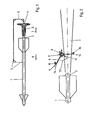
- FIG. 1 shows a missile 1 in a schematic representation, at the rear end of which is the rocket motor 2 from which the propelling jet 3 which generates the thrust for the missile 1 emerges.
- a baffle plate 4 is provided behind the rocket motor 2 and at a distance therefrom, which is acted upon by the propellant jet 3.
- the baffle plate 4 is connected to the mount (not shown) receiving the missile 1 via connecting elements 5.
- the missile 1 itself remains on the carriage, e.g. B. hang in the launchers.
- the elements 5 thus establish a direct connection between the missile 1 and the baffle 4.
- the propelling jet 4 emerging from the rocket motor 2 causes a thrust force in the direction of the arrow 6 on the missile 1 and thus via the connecting elements 5 on the mount. This force is completely or at least almost completely canceled out by a counterforce in the direction of arrow 7, resulting from the impact of the driving jet 3 on the baffle plate 4, since the baffle plate 4 is non-positively connected to the mount via the connecting elements 5.
- FIG. 2 shows an embodiment in which the baffle plate 4 is pivotable about an outside of the driving jet 3 lying axis 8 is formed.
- the baffle plate 4 In its rest position 9, the baffle plate 4 is located outside the propagation cone of the driving jet 3 and rests against a stop 10, where it is preferably held by a spring 11.
- the baffle plate 4 is connected to a control plate 12 which extends partially into the jet cone of the driving jet 3.
- the control plate 12 When the control plate 12 is acted upon by the driving jet 3, it produces a torque about the axis 8, which swings the baffle plate 4 against the spring 11 in the direction of the arrow 13.
- the front edge 14 of the impact plate 4 facing the missile 1 first immerses itself in the propulsion jet 3, whereupon the impact plate 4 itself experiences a torque which pivots it, since it is acted upon by the propulsion jet 3.
- the baffle plate 4 rests against a stop 16 in its operative position 15 and is perpendicular to the axis of the driving jet 3.
- the counterforce acting on the baffle plate 4 is applied to the carriage via the stop 16 and the pivot axis 8 by means of the transmission elements 5 transfer.
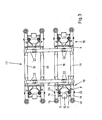
- FIG. 3 shows an attachment 17 to be attached to the mount behind the missile 1, which in this embodiment has four brackets 18 for one baffle plate 4 each.
- Each bracket 18 is formed by two arms 22 and two cross members 19, the cross members 19 each having a bearing 20 for the pivot axis 8 of the baffle plate 4-.
- the baffle plate 4 and the control plate 12 are fastened to the arms 29 and 30 of an angle lever 21 (FIG. 4) which is held in the rest position 9 by a spring 11.
- the stops 16 are designed as dampers 23, which absorb the energy of the impinging baffle plate 4 when pivoted into its active position 15.
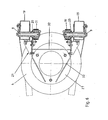
- the attachment 17 is releasably attached to the mount by means of arms 22, which are connected to one another at their rear ends via the cross members 19 (FIGS. 5 and 6).
- the arms 22 each bracket 18 assembled into eyes 25.
- the arms 22 can have a heat-resistant cover in the areas 24 shown in broken lines for protection against the impinging jet 3.
- the baffle plate 4 carrying angle lever 21 (Fig. 6). is composed of several flat bars 32 - and fixed to the crossbar 19 with its bearing 20.
- the baffle plate 4 is fastened via spacers 26 (FIG. 7) and an annular profile 27 to the flat bars 32 of the angle lever 21.
- the spacers 26 are preferably made of a material with poor thermal conductivity, so that the heat given off by the driving jet 3 to the baffle plate 4 is not dissipated into the angle lever 21.
- the oblique position of the control plate 12 shown in FIGS. 2 and 7 has the advantage that when the drive jet 3 strikes it pivots further into the latter, as a result of which the torque which becomes effective increases with an increasing pivot angle.
- the angle of the inclined position is preferably selected such that the front edge 14 (FIG. 1) of the baffle plate 4 facing the missile 1 is immersed in the propellant jet 3 when the control plate 12 is perpendicular to the axis of the propellant jet 3.
- the dampers 23 provided at the end of the traverse 19 can be adjusted in their damping force by means of adjusting elements 28. They are like this at the end of the traverse 19. arranged that the baffle plate 4 pivoted in operative position 15 rests in a point-symmetrical manner, that is to say that the force acting on the baffle plate 4 from the propellant jet 3 is transmitted only via the dampers 23 to the crossmember 19 and thus to the mount, whereby the bearing 20 of the pivot axis 8 is almost completely relieved.
- the damper 23 shown in FIG. 7 supports the baffle plate 4 pivoted in the active position 15 at the point designated by 31 on a line of symmetry of the baffle plate 4.
- the damper 23, the control plate 12 and the baffle plate 4 are made of a heat-resistant material, e.g. B. a heat-resistant alloy, a ceramic material or the like, made or coated with such.
- a synchronization of the pivoting movement of the control plate 12 and thus of the baffle plate 4 with the almost sudden increase in the thrust of the rocket engine 2 after ignition is made possible by a suitable choice of the size of the control plate 12, the spring constant of the spring 11 and the mass moment of inertia of the baffle plate 4 with respect to the pivot axis 8 reached.
- the baffle plate 4 does not yet swivel into the propagation cone of the propellant jet 3, but is caught in good time by the propellant jet 3 during a "hang fire" and pressed against the stop 16, so that the counterforce opposing the thrust force is built up.
Landscapes
- Engineering & Computer Science (AREA)
- General Engineering & Computer Science (AREA)
- Aiming, Guidance, Guns With A Light Source, Armor, Camouflage, And Targets (AREA)
- Soil Conditioners And Soil-Stabilizing Materials (AREA)
- Consolidation Of Soil By Introduction Of Solidifying Substances Into Soil (AREA)
- Continuous Casting (AREA)
Abstract
Description
- Die Erfindung betrifft ein Bodenstartgerät für Flugkörper, wie Raketen oder dergleichen mit einer den Flugkörper tragenden Lafette.
- Für den bodengebundenen Abschuß von Raketen, z. B. Gefechtsfeldraketen, Flugabwehrraketen oder dergleichen werden Bodenstartgeräte eingesetzt, die entweder direkt am Boden oder auf Einsatzfahrzeugen montiert sind. Diese Bodenstartgeräte bestehen aus einem Unterbau und einer darauf montierten Lafette. Die Flugkörper werden in Aufnehmer (Launcher), die an der Lafette vorgesehen sind, eingesetzt. Mit der Lafette läßt sich die Flugbahn der Rakete auf das Ziel einstellen. Beim Start kommt es gelegentlich zu einem sogenannten "hang fire", bei dem der Flugkörper hängenbleibt und der Raketenmotor mit voller Leistung abbrennt. Bei einem solchen "hang fire" werden die Lafette und ihr Unterbau länger als bei einem normalen Start erheblich beansprucht, wodurch die Standfestigkeit der Lafette beeinträchtigt wirdund es zu Beschädigungen kommen kann, so daß die Lafette unter Umständen außer Gefecht gesetzt wird.
- Der Erfindung liegt deshalb die Aufgabe zugrunde, ein Bodenstartgerät bereitzustellen, bei dem die auf die Lafette wirkenden Belastungen während eines "hang fire" vermindert werden und insbesondere die Standfestigkeit der Lafette nicht beeinträchtigt wird.
- Die Aufgabe wird erfindungsgemäß dadurch gelöst, daß an der Lafette eine in den Treibstrahl des Flugkörpers bewegbare Prallplatte montiert ist, die bei Beaufschlagung durch den Treibstrahl in eine dessen gesamten Querschnitt durchgreifende Wirklage beweglich ist.
- Bei einem "hang fire", bei dem der Flugkörper an der Lafette hängenbleibt, d. h. die Launcher nicht verläßt und der Motor mit voller Leistung abbrennt, wird die Schubkraft über den Flugkörper und die Launcher vollständig auf die Lafette übertragen. Die Lafette ist nun so ausgebildet, daß sie bei eingesetztem Flugkörper unmittelbar hinter dem Raketenmotor eine Prallplatte aufweist, die in den Treibstrahl des Flugkörpers bewegbar ist. Wird die Prallplatte bei einem "hang fire" in den Treibstrahl gebracht, so erfährt sie eine Kraft in Richtung des Treibstrahls, die gleichgroß ist wie die Schubkraft des Raketenmotors. Dieser Schubkraft ist die Reaktionskraft an der Prallplatte, die von dem Bodenstartgerät aufgenommen wird, entgegengerichtet. Da die beiden Kräfte betraglich gleich groß aber entgegengerichtet sind, heben sie sich auf. Dies hat den Vorteil, daß die Lafette nicht einseitig von der Schubkraft des an ihr hängenbleibenden Flugkörpers beaufschlagt und dadurch beschädigt wird. Die Lafette erfährt somit bis zum vollständigen Abbrand des Raketenmotors keine übermäßige Beanspruchung, insbesondere wird ihre Standfestigkeit nicht beeinträchtigt.
- In der Startphase, d. h. beim Zünden des Raketenmotors, tritt der Treibstrahl ungehindert hinter der Lafette aus. Die Prallplattewird erst nach dem Zündvorgang, ggfls. mit Zeitverzögerung hinter den Raketenmotor und in den Treibstrahl bewegt und somit nur dann beaufschlagt, wenn der Flugkörper die Lafette nicht verläßt. Die Gegenkraft wird also erst dann aufgebaut, wenn sich die Schubkraft des Treibstrahls an der Lafette selbst aufbaut, während sich die Prallplatte bei einem normal verlaufenden Startvorgang außerhalb des Treibstrahls befindet.
- Gemäß einem bevorzugten Ausführungsbeispiel ist die Prallplatte eben ausgebildet und sie steht in ihrer Wirklage senkrecht zur Achse des Treibstrahls. Damit erfährt die Prallplatte bei eine "hang fire" eine Kraft, die betragsmäßig in Größe und Richtung exakt der Schubkraft entspricht. Es treten somit keine die Lafette belastenden Querkräfte auf. Sofern erwünscht, kann dem abgelenkten Treibstrahl durch andere Form und Anordnung der Prallplatte auch eine abweichende Richtung gegeben werden.
- Da der Treibstrahl den Raketenmotor sich kegelförmig erweiternd verläßt, ist die Prallplatte vorzugsweise kreisförmig ausgebildet, wodurch verhindert wird, daß die Prallplatte ungleichmäßig beaufschlagt wird und sich dadurch Querkräfte bilden können. Mit Vorteil weist die Prallplatte einen größeren Durchmesser als der auftreffende Treibstrahl auf, so daß die gesamte Energie des Treibstrahls zur Erzeugung der Gegenkraft umgesetzt wird.
- Mit Vorteil ist die Prallplatte an der Lafette schwenkbar gelagert, wobei die Schwenkachse der Prallplatte vorzugsweise außerhalb des Treibstrahls angeordnet ist. Die Schwenkbarkeit der Prallplatte hat den Vorteil, daß die Gegenkraft erst mit zunehmendem Schwenkwinkel bis zur vollen Höhe aufgebaut wird, wodurch sichergestellt werden kann, daß sie wirklich nur bei einem "hang fire" wirksam wird. Auch wird die Prallplatte und ihre Lagerung nur bei einem solchen "hang fire" beansprucht.
- Eine bevorzugte Ausführungsform sieht vor, daß mit der Prallplatte eine Steuerplatte verbunden ist, die bei in Ruhelage außerhalb des Treibstrahls befindlicher Prallplatte in den Treibstrahl mit geringer Tiefe eintaucht. Die Steuerplatte kann somit wie die Prallplatte eine Schwenkbewegung um die außerhalb des Treibstrahls angeordnete Schwenkachse ausführen. Sie ist an der Prallplatte so angeordnet, daß sie in den Treibstrahl eintaucht, unter Wirkung des auftreffenden Treibstrahls verschwenkt und die Prallplatte mitnimmt, bis auch diese in den Treibstrahl eintaucht und von diesem bis in ihre Endlage gedrängt wird. Dies hat den Vorteil, daß zum Verschwenken der Prallplatte kein zusätzlicher Antrieb erforderlich ist. Bevorzugt weist die Steuerplatte eine definierte Größe bzw. Eintauchtiefe in den Treibstrahl auf, die so bemessen ist, daß sie die Kraft zum Verschwenken der Prallplatte erst dann aufbringt und die Prallplatte erst dann in den Treibstrahl bewegt, wenn der Treibstrahl voll ausgebildet ist. Die Steuerplatte kann so ausgebildet sein, daß sie auch bei ständigem Eintauchen in den Treibstrahl diesen nicht nennenswert beeinflußt und somit auch das Flugverhalten des Flugkörpers bei einem normalen Start nicht beeinträchtigt.
- Ein vorzeitiges Eintauchen der Prallplatte in den Treibstrahl wird vorteilhaft dadurch verhindert, daß die Prallplatte unter einer sie in Ruhelage haltenden, der vom Treibstr&hl auf die Steuerplatte wirkenden Kraft entgegengerichteten Gegenkraft steht. Erst bei voll ausgebildetem Treibstrahl ist die auf die Steuerplatte wirkende Kraft ausreichend groß, um die Prallplatte entgegen der Gegenkraft in den Treibstrahl zu verschwenken. Gemäß einem bevorzugten Ausführungsbeispiel ist diese Gegenkraft eine Federkraft.
- Eine starre Verbindung zwischen der Steuerplatte und der Prallplatte wird dadurch hergestellt, daß sie je an einem Arm eines Winkelhebels sitzen, der zwischen den Armen schwenkbar gelagert ist und unter Wirkung der Feder steht. Dies hat den Vorteil, daß die vom Treibstrahl ausgeübte, auf die Steuerplatte wirkende Schwenkkraft direkt auf die Prallplatte übertragen wird und somit ein synchrones Verschwenken beider Platten bewirkt.
- Mit Vorteil taucht die Steuerplatte in ihrer Ausgangslage in Richtung zum Flugkörper geneigt in den Treibstrahl ein und ist über eine Winkellage von 90 0 zum Treibstrahl in eine vom Flugkörper abgekehrte Lage schwenkbar, währenddessen sich die Prallplatte aus ihrer Ruhelage außerhalb des Treibstrahls in ihre Wirklage bewegt. Wird die in ihrer Ausgangslage zum Flugkörper hin geneigte Steuerplatte vom Treibstrahl beaufschlagt, so erfährt sie eine Kraft in Richtung des Treibstrahls. Diese Kraft erzeugt mit ihrer senkrecht auf die Steuerplatte wirkenden Komponente ein Drehmoment bezüglich der Schwenkachse, dem die Federkraft entgegengerichtet ist. Verschwenkt die Steuerplatte aus ihrer Ausgangslage, so vergrößert sich die auf sie wirkende Normalkraft und dadurch das Drehmoment, bis schließlich die Prallplatte soweit in den Treibstrahl eintaucht, daß sie ihrerseits vom Treibstrahl erfaßt und in ihre Wirklage bewegt wird, um die der Schubkraft entgegenwirkende Reaktionskraft zu erzeugen. Vorteilhaft taucht die Prallplatte dann in den Treibstrahl ein, wenn die Steuerplatte ihre größte Wirkfläche zum Treibstrahl aufweist, d. h. wenn sie in einer Winkellage von 90 ° zum Treibstrahl steht.
- Gemäß einer Weiterbildung der Erfindung ist vorgesehen, daß die Schwenkachse der Prallplatte so angeordnet ist, daß letztere beim Verschwenken aus der Ruhelage in den Treibstrahl mit ihrer dem Flugkörper zugekehrten Vorderkante zuerst in den Treibstrahl eintaucht, so daß an der Prallplatte eine sich erst langsam erhöhende Normalkraft aufgebaut wird, die sie entgegen der Federkraft zunehmend in den Treibstrahl verschwenkt. Gemäß einer bevorzugten Ausführungsform taucht die Vorderkante der Prallplatte dann in den Treibstrahl ein, wenn die Steuerplatte etwa senkrecht zum Treibstrahl steht, d. h. die auf die Steuerplatte wirkende Normalkraft ihren Höchstwert erreicht hat. Dies hat den Vorteil, daß die Prallplatte mit dem höchsten Drehmoment, das von der Steuerplatte erzeugt wird, in den Treibstrahl eintritt und dann ihrerseits vom Treibstrahl beaufschlagt wird, bis sie in ihre Wirklage gelangt. Kommt es nicht zu einem "hang fire", werden Steuerplatte und "Prallplatte" aufgrund der Federkraft wieder in ihre Ausgangslage geschwenkt.
- Die Prallplatte und somit die Steuerplatte weisen dadurch eine definierte Ausgangslage auf, daß für die Ruhelage und die Wirklage der Prallplatte Anschläge vorgesehen sind. Die Steuerplatte besitzt dadurch eine definierte Ausgangslage, so daß ein unzeitiges Einschwenken verhindert und ein fehlerfreies Einschwenken der Prallplatte garantiert wird. Die in Wirklage vom Treibstrahl auf die Prallplatte wirkende Kraft wird über die Anschläge auf die Lafette übertragen. Gemäß einem bevorzugten Ausführungsbeispiel ist der Anschlag für die Wirklage der Prallplatte als Dämpfer ausgebildet. Nach dem Eintritt der Prallplatte mit ihrer dem Flugkörper zugekehrten Kante wird diese bis in ihre Wirklage stark beschleunigt. Der Aufprall der Prallplatte auf dem Anschlag wird somit gedämpft, so daß die Prallplatte und der Anschlag geschont werden. Bevorzugt ist der als Anschlag ausgebildete Dämpfer einstellbar. Dadurch können sie auf die jeweilige Schubkraft eingestellt, gegebenenfalls auch nachgestellt werden.
- Vorteilhaft sind wenigstens zwei Anschläge für die Wirklage der Prallplatte im Treibstrahl vorgesehen, so daß die im allgemeinen sehr große Kraft auf mehrere Anschläge verteilt und eine exakte Stellung der Prallplatte zum Treibstrahl in ihrer Wirklage garantiert wird, ohne daß Kippkräfte auf die Prallplatte wirksam werden. Eine unsymmetrische Belastung der Prallplatte und damit der Schwenkachse der Prallplatte wird dadurch verhindert, daß die Anschläge punktsymmetrisch zum Treibstrahl angeordnet sind, so daß die gesamte auf die Prallplatte wirkende Kraft nur auf die Anschläge übertragen werden.
- Dadurch, daß die Prallplatte an einer Halterung festgelegt ist und die Halterung als austauschbares Anbauteil an der Lafette montierbar ist, können diese bei Wartungsarbeiten oder zu Reparaturzwecken leicht demontiert und ausgetauscht werden. Auch ist dadurch ein Nachrüsten von Lafetten möglich.
- Bei einer bevorzugten Ausführungsform des Bodenstartgeräts mit wenigstens zwei parallel zueinander aufgenommenen Flugkörpern ist vorteilhaft vorgesehen, daß die Halterung aus an der Lafette zu befestigenden, sich nach hinten erstreckenden Armen und diese an ihren hinteren Enden verbindenden Traversen besteht, an denen die die Prallplatte für den Treibstrahl der beiden Flugkörper aufnehmenden Winkelhebel schwenkbar gelagert sind. Die Arme und Traversen, die vorteilhaft als Profilteile ausgebildet sind und über die die Reaktionskraft der Prallplatten auf die Lafette übertragen wird, gewähren aufgrund ihres einfachen Aufbaus und ihrer günstigen Anordnung eine funktionstüchtige Lagerung der Prallplatten und eine sichere Einleitung der Reaktionskraft in die Lafette bei einem "hang fire".
- Bevorzugt bestehen alle vom Treibstrahl beaufschlagten Bauteile aus einem hitzebeständigen Werkstoff bzw. sind mit einem hitzebeständigen Werkstoff beschichtet. Dies hat den Vorteil, daß die Einsatzdauer der Prallplatte sowie der sonstigen vom Treibstrahl beaufschlagten Bauteile wesentlich erhöht und die Wartungszeiten auf ein Minimum reduziert werden.
- Weitere Einzelheiten und Vorteile der Erfindung ergeben sich aus der nachfolgenden Beschreibung, in der ein Ausführungsbeispiel der Erfindung unter Bezugnahme auf die Zeichnung erläutert ist.
- Dabei zeigen:
- Fig. 1 eine schematische Darstellung des Funktionsprinzips der Prallplatte;
- Fig. 2 eine schematische Darstellung der Funktion der Prallplatte mit Steuerplatte;
- Fig. 3 eine Ansicht auf eine Anordnung von Prallplatten in Richtung des Treibstrahls;
- Fig. 4 eine Draufsicht auf die Anordnung gemäß Fig. 3;
- Fig. 5 eine Seitenansicht der Anordnung gemäß Fig. 3;
- Fig. 6 einen Schnitt VI-VI gemäß Fig. 4 und
- Fig. 7 einen Schnitt VII-VII gemäß Fig. 5.
- Figur 1 zeigt einen Flugkörper 1 in schematischer Darstellung, an dessen hinterem Ende sich der Raketenmotor 2 befindet, aus dem der den Schub für den Flugkörper 1 erzeugende Treibstrahl 3 austritt. Hinter dem Raketenmotor 2 und mit Abstand von diesem ist eine Prallplatte 4 vorgesehen, die vom Treibstrahl 3 beaufschlagt wird. Die Prallplatte 4 ist mit der den Flugkörper 1 aufnehmenden Lafette (nicht dargestellt) über Verbindungselemente 5 verbunden. Bei einem "hang fire" bleibt der Flugkörper 1 selbst an der Lafette, z. B. in den Launchern hängen. Die Elemente 5 stellen somit eine direkte Verbindung zwischen dem Flugkörper 1 und der Prallplatte 4 her. Der aus dem Raketenmotor 2 austretende Treibstrahl 4 bewirkt eine Schubkraft in Richtung des Pfeils 6 auf den Flugkörper 1 und somit über die Verbindungselemente 5 auf die Lafette. Diese Kraft wird von einer Gegenkraft in Richtung des Pfeils 7, herrührend vom Auftreffen des Treibstrahls 3-auf die Prallplatte 4, vollständig oder zumindest nahezu vollständig aufgehoben, da die Prallplatte 4 über die Verbindungselemente 5 kraftschlüssig mit der Lafette verbunden ist.
- Figur 2 zeigt eine Ausführungsform, bei der die Prallplatte 4 schwenkbar um eine außerhalb des Treibstrahls 3 liegende Achse 8 ausgebildet ist. In ihrer Ruhelage 9 befindet sich die Prallplatte 4 außerhalb des Ausbreitungskegels des Treibstrahls 3 und liegt an einem Anschlag 10 an, wo sie vorzugsweise von einer Feder 11 gehalten wird. Die Prallplatte 4 ist mit einer Steuerplatte 12 verbunden, die sich teilweise in den Strahlkegel des Treibstrahls 3 erstreckt. Eine Beaufschlagung der Steuerplatte 12 durch den Treibstrahl 3 bewirkt ein Drehmoment um die Achse 8, das die Prallplatte 4 entgegen der Feder 11 in Richtung des Pfeils 13 verschwenkt. Dabei taucht die vordere, dem Flugkörper 1 zugekehrte Kante 14 der Prallplatte 4 zuerst in den Treibstrahl 3 ein, woraufhin die Prallplatte 4 selbst ein sie verschwenkendes Drehmoment erfährt, da sie vom Treibstrahl 3 beaufschlagt wird. Nach vollständigem .Verschwenken liegt die Prallplatte 4 in ihrer Wirklage 15 an einem .Anschlag 16 an und steht senkrecht zur Achse des Treibstrahls 3. Die an der Prallplatte 4 wirkende Gegenkraft wird über den Anschlag 16 und die Schwenkachse 8 mittels der Obertragungselemente 5 auf die Lafette übertragen.
- In Figur 3 ist ein hinter dem Flugkörper 1 an der Lafette anzubingendes Anbauteil 17 dargestellt, das bei dieser Ausführungsform vier Halterungen 18 für je eine Prallplatte 4 aufweist. Jede Halterung 18 wird von zwei Armen 22 und zwei Traversen 19 gebildet, wobei die Traversen 19 je ein Lager 20 für die Schwenkachse 8 der Prallplatte 4- aufweisen. An den Armen 29 und 30 eines Winkelhebels 21 (Fig. 4), der über eine Feder 11 in Ruhelage 9 gehalten ist, sind die Prallplatte 4 und die Steuerplatte 12 befestigt. An den äußeren Enden der Traversen 19 sind Anschläge 16 - für die Wirklage 15 der Prallplatte 4 erkennbar. Die Anschläge 16 sind als Dämpfer 23 ausgebildet, die die Energie der auftreffenden Prallplatte 4 beim Verschwenken in ihre Wirklage 15 absorbieren. Das Anbauteil 17 ist mittels Armen 22, die an ihren hinteren Enden über die Traversen 19 miteinander verbunden sind, an der Lafette lösbar befestigt (Figuren 5 und 6). Hierzu sind die Arme 22 jeder Halterung 18 zu Augen 25 zusammengefügt. Die Arme 22 können in den in gestrichelter Darstellung wiedergegebenen Bereichen 24 zum Schutz gegen den auftreffenden Treibstrahl 3 einen hitzebeständigen Oberzug aufweisen.
- Der die Prallplatte 4 tragende Winkelhebel 21 (Fig. 6) . ist aus mehreren Flachstäben 32-aufgebaut und mit seinem Lager 20 an der Traverse 19 festgelegt. Die Prallplatte 4 ist über Distanzstücke 26 (Fig. 7) und ein Ringprofil 27 an den Flachstäben 32 des Winkelhebels 21 befestigt. Die Distanzstücke 26 sind bevorzugt aus einem Material mit schlechter Wärmeleitfähigkeit hergestellt, so daß die vom Treibstrahl 3 an die Prallplatte 4 abgegebene Wärme nicht in den Winkelhebel 21 abgeleitet wird.
- Die in Figur 2 und 7 gezeigte Schrägstellung der Steuerplatte 12 hat den Vorteil, daß diese beim Auftreffen des Treibstrahls 3 weiter in diesen verschwenkt, wodurch sich das wirksam werdende Drehmoment mit zunehmendem Schwenkwinkel vergrößert. Vorzugsweise ist der Winkel der Schrägstellung so gewählt, daß die vordere, dem Flugkörper 1 zugekehrte Kante 14 (Fig. 1) der Prallplatte 4 dann in den Treibstrahl 3 eintaucht, wenn die Steuerplatte 12 senkrecht zur Achse des Treibstrahls 3 steht.
- Die am Ende der Traverse 19 vorgesehenen Dämpfer 23 sind mittels Einstellelementen 28 in ihrer Dämpfungskraft einstellbar. Sie sind am Ende der Traverse 19 derart . angeordnet, daß ihnen die in Wirklage 15 verschwenkte Prallplatte 4 punktsymmetrisch anliegt, d. h. daß die vom Treibstrahl 3 auf die Prallplatte 4 wirkende Kraft nur über die Dämpfer 23 auf die Traverse 19 und somit auf die Lafette übertragen wird, wodurch das Lager 20 der Schwenkachse 8 nahezu vollständig entlastet ist. Der in Fig. 7 dargestellte Dämpfer 23 unterstützt die in Wirklage 15 verschwenkte Prallplatte 4 an der mit 31 bezeichneten Stelle einer Symmetrielinie der Prallplatte 4. Vorzugsweise sind der Dämpfer 23, die Steuerplatte 12 und die Prallplatte 4 aus einem wärmebeständigen Material, z. B. einer hitzebeständigen Legierung, einem-Keramikwerkstoff oder dergleichen, gefertigt oder mit einem solchen beschichtet.
- Ein Synchronisieren der Schwenkbewegung der Steuerplatte 12 und damit der Prallplatte 4 mit dem nahezu schlagartigen Anwachsen der Schubkraft des Raketenmotors 2 nach dem Zünden wird durch geeignete Wahl der Größe der Steuerplatte 12, der Federkonstante der Feder 11 und des Massenträgheitsmoments der Prallplatte 4 bezüglich der Schwenkachse 8 erreicht. Vorteilhaft schwenkt bei einem störungsfreien Start des Flugkörpers 1 die Prallplatte 4 gerade noch nicht in den Ausbreitungskegel des Treibstrahls 3 ein, wird aber bei einem "hang fire" rechtzeitig vom Treibstrahl 3 erfaßt und gegen den Anschlag 16 gedrückt, so daß die der Schubkraft entgegengerichtete Gegenkraft aufgebaut wird.
Claims (21)
Priority Applications (1)
| Application Number | Priority Date | Filing Date | Title |
|---|---|---|---|
| AT87105964T ATE44314T1 (de) | 1986-06-07 | 1987-04-23 | Bodenstartgeraet fuer flugkoerper. |
Applications Claiming Priority (2)
| Application Number | Priority Date | Filing Date | Title |
|---|---|---|---|
| DE19863619205 DE3619205A1 (de) | 1986-06-07 | 1986-06-07 | Bodenstartgeraet fuer flugkoerper |
| DE3619205 | 1986-06-07 |
Publications (2)
| Publication Number | Publication Date |
|---|---|
| EP0249017A1 true EP0249017A1 (de) | 1987-12-16 |
| EP0249017B1 EP0249017B1 (de) | 1989-06-28 |
Family
ID=6302514
Family Applications (1)
| Application Number | Title | Priority Date | Filing Date |
|---|---|---|---|
| EP87105964A Expired EP0249017B1 (de) | 1986-06-07 | 1987-04-23 | Bodenstartgerät für Flugkörper |
Country Status (5)
| Country | Link |
|---|---|
| EP (1) | EP0249017B1 (de) |
| AT (1) | ATE44314T1 (de) |
| DE (2) | DE3619205A1 (de) |
| ES (1) | ES2010199B3 (de) |
| GR (1) | GR3000155T3 (de) |
Citations (2)
| Publication number | Priority date | Publication date | Assignee | Title |
|---|---|---|---|---|
| DE727060C (de) * | 1935-03-23 | 1942-10-26 | Donar Ges M B H Fuer Appbau | Startvorrichtung fuer Raketen |
| US4134327A (en) * | 1977-12-12 | 1979-01-16 | General Dynamics Corporation | Rocket launcher tube post-launch rear closure |
-
1986
- 1986-06-07 DE DE19863619205 patent/DE3619205A1/de not_active Withdrawn
-
1987
- 1987-04-23 DE DE8787105964T patent/DE3760286D1/de not_active Expired
- 1987-04-23 AT AT87105964T patent/ATE44314T1/de not_active IP Right Cessation
- 1987-04-23 ES ES87105964T patent/ES2010199B3/es not_active Expired
- 1987-04-23 EP EP87105964A patent/EP0249017B1/de not_active Expired
-
1989
- 1989-09-15 GR GR89400174T patent/GR3000155T3/el unknown
Patent Citations (2)
| Publication number | Priority date | Publication date | Assignee | Title |
|---|---|---|---|---|
| DE727060C (de) * | 1935-03-23 | 1942-10-26 | Donar Ges M B H Fuer Appbau | Startvorrichtung fuer Raketen |
| US4134327A (en) * | 1977-12-12 | 1979-01-16 | General Dynamics Corporation | Rocket launcher tube post-launch rear closure |
Also Published As
| Publication number | Publication date |
|---|---|
| GR3000155T3 (en) | 1990-11-29 |
| ATE44314T1 (de) | 1989-07-15 |
| DE3619205A1 (de) | 1987-12-10 |
| EP0249017B1 (de) | 1989-06-28 |
| ES2010199B3 (es) | 1989-11-01 |
| DE3760286D1 (en) | 1989-08-03 |
Similar Documents
| Publication | Publication Date | Title |
|---|---|---|
| DE3048617C2 (de) | ||
| EP2875305B2 (de) | Waffenplattform, militärisches fahrzeug mit einer waffenplattform und verfahren zum betrieb einer waffenplattform | |
| DE2115501C3 (de) | Schleudersitz, insbesondere fur Hubschrauber | |
| DE2331607A1 (de) | Vorrichtung zur halterung einer ladung | |
| DE3715085A1 (de) | Flugkörper-Spitzenverkleidungsaufbau | |
| DE69422805T2 (de) | Flugbahnumlenkungsvorrichtung und verfahren für einen gefechtskopf | |
| DE3437174A1 (de) | Unbemannter flugkoerper | |
| DE19828645C1 (de) | Flugkörper zur Bekämpfung feststehender und/oder beweglicher Ziele | |
| DE3336847A1 (de) | Luftfahrzeug mit faltbaren und/oder schwenkbaren tragfluegeln | |
| EP0249017B1 (de) | Bodenstartgerät für Flugkörper | |
| EP3637035B1 (de) | Startschiene für einen flugkörper | |
| DE69216590T2 (de) | Bodenverankerungssystem einer abschussvorrichtung für geschosse | |
| DE1078903B (de) | Raketengetriebener Flugkoerper | |
| DE202023101595U1 (de) | Montageplattform, Raketenabschussvorrichtung und Raketenabschusssystem | |
| DE4017167C1 (de) | Panzerschutzmodul mit segmentierter Verdämmung | |
| EP2090859A2 (de) | Werfer mit mindestens einem Startrohr für raketengetriebene Flugkörper | |
| DE69107539T2 (de) | Verfahren und Vorrichtung zum Ausrichten von drallstabilisierten Selbstantriebsgeschossen. | |
| DE69001532T2 (de) | Vorrichtung zum Abbremsen von Bomben nach Abwurf aus einem Flugzeug. | |
| DE2055486A1 (de) | Raketenwerfereinheit | |
| DE102019115463A1 (de) | Rotierender Deorbiting-Motor | |
| DE19806066B4 (de) | Flugkörper gegen Reaktivpanzerung | |
| DE3101729C2 (de) | Abschußvorrichtung für Flugkörper an einem Hubschrauber | |
| DE3206299A1 (de) | Vorrichtung zum auffangen und zurueckhalten eines flugkoerpers | |
| EP0274011A2 (de) | Submunitionskörper mit einer Zielerfassungsvorrichtung | |
| DE3541593C2 (de) | Raketenbetriebener Flugkörper |
Legal Events
| Date | Code | Title | Description |
|---|---|---|---|
| PUAI | Public reference made under article 153(3) epc to a published international application that has entered the european phase |
Free format text: ORIGINAL CODE: 0009012 |
|
| AK | Designated contracting states |
Kind code of ref document: A1 Designated state(s): AT BE CH DE ES FR GB GR IT LI LU NL SE |
|
| 17P | Request for examination filed |
Effective date: 19880329 |
|
| 17Q | First examination report despatched |
Effective date: 19880919 |
|
| GRAA | (expected) grant |
Free format text: ORIGINAL CODE: 0009210 |
|
| AK | Designated contracting states |
Kind code of ref document: B1 Designated state(s): AT BE CH DE ES FR GB GR IT LI LU NL SE |
|
| REF | Corresponds to: |
Ref document number: 44314 Country of ref document: AT Date of ref document: 19890715 Kind code of ref document: T |
|
| REF | Corresponds to: |
Ref document number: 3760286 Country of ref document: DE Date of ref document: 19890803 |
|
| GBT | Gb: translation of ep patent filed (gb section 77(6)(a)/1977) | ||
| ITF | It: translation for a ep patent filed | ||
| ET | Fr: translation filed | ||
| PGFP | Annual fee paid to national office [announced via postgrant information from national office to epo] |
Ref country code: FR Payment date: 19900330 Year of fee payment: 4 |
|
| PGFP | Annual fee paid to national office [announced via postgrant information from national office to epo] |
Ref country code: LU Payment date: 19900404 Year of fee payment: 4 |
|
| PGFP | Annual fee paid to national office [announced via postgrant information from national office to epo] |
Ref country code: BE Payment date: 19900409 Year of fee payment: 4 |
|
| PGFP | Annual fee paid to national office [announced via postgrant information from national office to epo] |
Ref country code: SE Payment date: 19900412 Year of fee payment: 4 Ref country code: AT Payment date: 19900412 Year of fee payment: 4 |
|
| PGFP | Annual fee paid to national office [announced via postgrant information from national office to epo] |
Ref country code: ES Payment date: 19900423 Year of fee payment: 4 |
|
| PGFP | Annual fee paid to national office [announced via postgrant information from national office to epo] |
Ref country code: GR Payment date: 19900427 Year of fee payment: 4 |
|
| PG25 | Lapsed in a contracting state [announced via postgrant information from national office to epo] |
Ref country code: LU Free format text: LAPSE BECAUSE OF NON-PAYMENT OF DUE FEES Effective date: 19900430 |
|
| PGFP | Annual fee paid to national office [announced via postgrant information from national office to epo] |
Ref country code: NL Payment date: 19900430 Year of fee payment: 4 |
|
| PLBE | No opposition filed within time limit |
Free format text: ORIGINAL CODE: 0009261 |
|
| STAA | Information on the status of an ep patent application or granted ep patent |
Free format text: STATUS: NO OPPOSITION FILED WITHIN TIME LIMIT |
|
| PGFP | Annual fee paid to national office [announced via postgrant information from national office to epo] |
Ref country code: DE Payment date: 19900525 Year of fee payment: 4 |
|
| REG | Reference to a national code |
Ref country code: GR Ref legal event code: FG4A Free format text: 3000155 |
|
| 26N | No opposition filed | ||
| PGFP | Annual fee paid to national office [announced via postgrant information from national office to epo] |
Ref country code: CH Payment date: 19900705 Year of fee payment: 4 |
|
| PG25 | Lapsed in a contracting state [announced via postgrant information from national office to epo] |
Ref country code: GB Effective date: 19910423 Ref country code: AT Effective date: 19910423 |
|
| PG25 | Lapsed in a contracting state [announced via postgrant information from national office to epo] |
Ref country code: SE Effective date: 19910424 Ref country code: ES Free format text: LAPSE BECAUSE OF NON-PAYMENT OF DUE FEES Effective date: 19910424 |
|
| ITTA | It: last paid annual fee | ||
| PG25 | Lapsed in a contracting state [announced via postgrant information from national office to epo] |
Ref country code: LI Effective date: 19910430 Ref country code: CH Effective date: 19910430 Ref country code: BE Effective date: 19910430 |
|
| BERE | Be: lapsed |
Owner name: KUKA WEHRTECHNIK G.M.B.H. Effective date: 19910430 |
|
| PG25 | Lapsed in a contracting state [announced via postgrant information from national office to epo] |
Ref country code: GR Free format text: THE PATENT HAS BEEN ANNULLED BY A DECISION OF A NATIONAL AUTHORITY Effective date: 19911031 |
|
| PG25 | Lapsed in a contracting state [announced via postgrant information from national office to epo] |
Ref country code: NL Effective date: 19911101 |
|
| NLV4 | Nl: lapsed or anulled due to non-payment of the annual fee | ||
| GBPC | Gb: european patent ceased through non-payment of renewal fee | ||
| PG25 | Lapsed in a contracting state [announced via postgrant information from national office to epo] |
Ref country code: FR Effective date: 19911230 |
|
| REG | Reference to a national code |
Ref country code: CH Ref legal event code: PL |
|
| PG25 | Lapsed in a contracting state [announced via postgrant information from national office to epo] |
Ref country code: DE Effective date: 19920201 |
|
| REG | Reference to a national code |
Ref country code: FR Ref legal event code: ST |
|
| REG | Reference to a national code |
Ref country code: GR Ref legal event code: MM2A Free format text: 3000155 |
|
| EUG | Se: european patent has lapsed |
Ref document number: 87105964.8 Effective date: 19911108 |
|
| REG | Reference to a national code |
Ref country code: ES Ref legal event code: FD2A Effective date: 19990201 |
|
| PG25 | Lapsed in a contracting state [announced via postgrant information from national office to epo] |
Ref country code: IT Free format text: LAPSE BECAUSE OF NON-PAYMENT OF DUE FEES;WARNING: LAPSES OF ITALIAN PATENTS WITH EFFECTIVE DATE BEFORE 2007 MAY HAVE OCCURRED AT ANY TIME BEFORE 2007. THE CORRECT EFFECTIVE DATE MAY BE DIFFERENT FROM THE ONE RECORDED. Effective date: 20050423 |