EP0248414B1 - Aralkylimidazolderivate - Google Patents
Aralkylimidazolderivate Download PDFInfo
- Publication number
- EP0248414B1 EP0248414B1 EP87108017A EP87108017A EP0248414B1 EP 0248414 B1 EP0248414 B1 EP 0248414B1 EP 87108017 A EP87108017 A EP 87108017A EP 87108017 A EP87108017 A EP 87108017A EP 0248414 B1 EP0248414 B1 EP 0248414B1
- Authority
- EP
- European Patent Office
- Prior art keywords
- carbamoyl
- hydrogen
- imidazole
- formula
- c7alkyl
- Prior art date
- Legal status (The legal status is an assumption and is not a legal conclusion. Google has not performed a legal analysis and makes no representation as to the accuracy of the status listed.)
- Expired - Lifetime
Links
- -1 Aralkyl imidazole derivatives Chemical class 0.000 title claims description 48
- 229940079865 intestinal antiinfectives imidazole derivative Drugs 0.000 title 1
- 150000001875 compounds Chemical class 0.000 claims description 83
- 125000003917 carbamoyl group Chemical group [H]N([H])C(*)=O 0.000 claims description 71
- 239000001257 hydrogen Substances 0.000 claims description 66
- 229910052739 hydrogen Inorganic materials 0.000 claims description 66
- 125000004435 hydrogen atom Chemical group [H]* 0.000 claims description 65
- 238000000034 method Methods 0.000 claims description 35
- 239000000203 mixture Substances 0.000 claims description 32
- 150000002367 halogens Chemical class 0.000 claims description 25
- 229910052736 halogen Inorganic materials 0.000 claims description 22
- 125000000325 methylidene group Chemical group [H]C([H])=* 0.000 claims description 16
- 150000003839 salts Chemical class 0.000 claims description 13
- 125000004178 (C1-C4) alkyl group Chemical group 0.000 claims description 10
- 239000000825 pharmaceutical preparation Substances 0.000 claims description 9
- 125000001424 substituent group Chemical group 0.000 claims description 8
- 125000001997 phenyl group Chemical group [H]C1=C([H])C([H])=C(*)C([H])=C1[H] 0.000 claims description 7
- 241001465754 Metazoa Species 0.000 claims description 6
- 238000004519 manufacturing process Methods 0.000 claims description 5
- 230000001225 therapeutic effect Effects 0.000 claims description 5
- 150000002527 isonitriles Chemical class 0.000 claims description 3
- OIWXXUVXKRAJGN-UHFFFAOYSA-N 1-[(2,6-difluorophenyl)methyl]-2-methylimidazole-4-carboxamide Chemical compound CC1=NC(C(N)=O)=CN1CC1=C(F)C=CC=C1F OIWXXUVXKRAJGN-UHFFFAOYSA-N 0.000 claims description 2
- MBSOYZNJABULLX-UHFFFAOYSA-N 1-[(2-fluorophenyl)methyl]imidazole-4-carboxamide Chemical compound C1=NC(C(=O)N)=CN1CC1=CC=CC=C1F MBSOYZNJABULLX-UHFFFAOYSA-N 0.000 claims description 2
- ABEBJGKCUBCJNO-UHFFFAOYSA-N 1-[1-(2,6-difluorophenyl)ethyl]imidazole-4-carboxamide Chemical compound C1=NC(C(N)=O)=CN1C(C)C1=C(F)C=CC=C1F ABEBJGKCUBCJNO-UHFFFAOYSA-N 0.000 claims description 2
- HBAQYPYDRFILMT-UHFFFAOYSA-N 8-[3-(1-cyclopropylpyrazol-4-yl)-1H-pyrazolo[4,3-d]pyrimidin-5-yl]-3-methyl-3,8-diazabicyclo[3.2.1]octan-2-one Chemical class C1(CC1)N1N=CC(=C1)C1=NNC2=C1N=C(N=C2)N1C2C(N(CC1CC2)C)=O HBAQYPYDRFILMT-UHFFFAOYSA-N 0.000 claims description 2
- 206010015037 epilepsy Diseases 0.000 claims description 2
- 150000003857 carboxamides Chemical class 0.000 claims 6
- GFSZKAUEXBWJTK-UHFFFAOYSA-N 1-[(2,6-difluorophenyl)methyl]imidazole-4,5-dicarboxamide Chemical compound NC(=O)C1=C(C(=O)N)N=CN1CC1=C(F)C=CC=C1F GFSZKAUEXBWJTK-UHFFFAOYSA-N 0.000 claims 1
- KOVPOLQWEFBFPK-UHFFFAOYSA-N 1-[(2,6-difluorophenyl)methyl]imidazole-4-carboxamide Chemical compound C1=NC(C(=O)N)=CN1CC1=C(F)C=CC=C1F KOVPOLQWEFBFPK-UHFFFAOYSA-N 0.000 claims 1
- KFEZQNSQEFQGFG-UHFFFAOYSA-N 1-[(2-chlorophenyl)methyl]imidazole-4-carboxamide Chemical compound C1=NC(C(=O)N)=CN1CC1=CC=CC=C1Cl KFEZQNSQEFQGFG-UHFFFAOYSA-N 0.000 claims 1
- WBGNOVMZEIMZSO-UHFFFAOYSA-N 1-[(2-methylphenyl)methyl]imidazole-4-carboxamide Chemical compound CC1=CC=CC=C1CN1C=C(C(N)=O)N=C1 WBGNOVMZEIMZSO-UHFFFAOYSA-N 0.000 claims 1
- QUBVHWDCOGXCHL-UHFFFAOYSA-N 3-[(2,5-difluorophenyl)methyl]imidazole-4-carboxamide Chemical compound NC(=O)C1=CN=CN1CC1=CC(F)=CC=C1F QUBVHWDCOGXCHL-UHFFFAOYSA-N 0.000 claims 1
- JDTLWNBXRORHHI-UHFFFAOYSA-N 3-[(2,6-difluorophenyl)methyl]imidazole-4-carboxamide Chemical compound NC(=O)C1=CN=CN1CC1=C(F)C=CC=C1F JDTLWNBXRORHHI-UHFFFAOYSA-N 0.000 claims 1
- WVAJTXUEMDAZLR-UHFFFAOYSA-N 3-[1-(2,6-difluorophenyl)ethyl]imidazole-4-carboxamide Chemical compound C1=NC=C(C(N)=O)N1C(C)C1=C(F)C=CC=C1F WVAJTXUEMDAZLR-UHFFFAOYSA-N 0.000 claims 1
- LFQSCWFLJHTTHZ-UHFFFAOYSA-N Ethanol Chemical compound CCO LFQSCWFLJHTTHZ-UHFFFAOYSA-N 0.000 description 65
- XEKOWRVHYACXOJ-UHFFFAOYSA-N Ethyl acetate Chemical compound CCOC(C)=O XEKOWRVHYACXOJ-UHFFFAOYSA-N 0.000 description 52
- VLKZOEOYAKHREP-UHFFFAOYSA-N n-Hexane Chemical compound CCCCCC VLKZOEOYAKHREP-UHFFFAOYSA-N 0.000 description 40
- YXFVVABEGXRONW-UHFFFAOYSA-N Toluene Chemical compound CC1=CC=CC=C1 YXFVVABEGXRONW-UHFFFAOYSA-N 0.000 description 38
- 229910052757 nitrogen Inorganic materials 0.000 description 28
- QGZKDVFQNNGYKY-UHFFFAOYSA-N Ammonia Chemical compound N QGZKDVFQNNGYKY-UHFFFAOYSA-N 0.000 description 26
- RTZKZFJDLAIYFH-UHFFFAOYSA-N Diethyl ether Chemical compound CCOCC RTZKZFJDLAIYFH-UHFFFAOYSA-N 0.000 description 26
- YMWUJEATGCHHMB-UHFFFAOYSA-N Dichloromethane Chemical compound ClCCl YMWUJEATGCHHMB-UHFFFAOYSA-N 0.000 description 25
- OKKJLVBELUTLKV-UHFFFAOYSA-N Methanol Chemical compound OC OKKJLVBELUTLKV-UHFFFAOYSA-N 0.000 description 21
- 125000006701 (C1-C7) alkyl group Chemical group 0.000 description 20
- 238000006243 chemical reaction Methods 0.000 description 19
- XLYOFNOQVPJJNP-UHFFFAOYSA-N water Substances O XLYOFNOQVPJJNP-UHFFFAOYSA-N 0.000 description 19
- CSNNHWWHGAXBCP-UHFFFAOYSA-L Magnesium sulfate Chemical compound [Mg+2].[O-][S+2]([O-])([O-])[O-] CSNNHWWHGAXBCP-UHFFFAOYSA-L 0.000 description 18
- 125000003178 carboxy group Chemical group [H]OC(*)=O 0.000 description 18
- VYPSYNLAJGMNEJ-UHFFFAOYSA-N Silicium dioxide Chemical compound O=[Si]=O VYPSYNLAJGMNEJ-UHFFFAOYSA-N 0.000 description 16
- 239000000243 solution Substances 0.000 description 15
- 239000007858 starting material Substances 0.000 description 14
- 229910021529 ammonia Inorganic materials 0.000 description 13
- KFZMGEQAYNKOFK-UHFFFAOYSA-N Isopropanol Chemical compound CC(C)O KFZMGEQAYNKOFK-UHFFFAOYSA-N 0.000 description 12
- HEMHJVSKTPXQMS-UHFFFAOYSA-M Sodium hydroxide Chemical compound [OH-].[Na+] HEMHJVSKTPXQMS-UHFFFAOYSA-M 0.000 description 11
- 239000003795 chemical substances by application Substances 0.000 description 11
- VEXZGXHMUGYJMC-UHFFFAOYSA-N Hydrochloric acid Chemical compound Cl VEXZGXHMUGYJMC-UHFFFAOYSA-N 0.000 description 9
- 238000002360 preparation method Methods 0.000 description 9
- 125000006508 2,6-difluorobenzyl group Chemical group [H]C1=C([H])C(F)=C(C(F)=C1[H])C([H])([H])* 0.000 description 8
- DGAQECJNVWCQMB-PUAWFVPOSA-M Ilexoside XXIX Chemical compound C[C@@H]1CC[C@@]2(CC[C@@]3(C(=CC[C@H]4[C@]3(CC[C@@H]5[C@@]4(CC[C@@H](C5(C)C)OS(=O)(=O)[O-])C)C)[C@@H]2[C@]1(C)O)C)C(=O)O[C@H]6[C@@H]([C@H]([C@@H]([C@H](O6)CO)O)O)O.[Na+] DGAQECJNVWCQMB-PUAWFVPOSA-M 0.000 description 8
- ZMXDDKWLCZADIW-UHFFFAOYSA-N N,N-Dimethylformamide Chemical compound CN(C)C=O ZMXDDKWLCZADIW-UHFFFAOYSA-N 0.000 description 8
- QAOWNCQODCNURD-UHFFFAOYSA-N Sulfuric acid Chemical compound OS(O)(=O)=O QAOWNCQODCNURD-UHFFFAOYSA-N 0.000 description 8
- 239000000741 silica gel Substances 0.000 description 8
- 229910002027 silica gel Inorganic materials 0.000 description 8
- 238000003756 stirring Methods 0.000 description 8
- 125000003739 carbamimidoyl group Chemical group C(N)(=N)* 0.000 description 7
- 125000004093 cyano group Chemical group *C#N 0.000 description 7
- 229910052943 magnesium sulfate Inorganic materials 0.000 description 7
- 235000019341 magnesium sulphate Nutrition 0.000 description 7
- 238000010992 reflux Methods 0.000 description 7
- 239000011734 sodium Substances 0.000 description 7
- 229910052708 sodium Inorganic materials 0.000 description 7
- QTBSBXVTEAMEQO-UHFFFAOYSA-N Acetic acid Chemical compound CC(O)=O QTBSBXVTEAMEQO-UHFFFAOYSA-N 0.000 description 6
- UHOVQNZJYSORNB-UHFFFAOYSA-N Benzene Chemical compound C1=CC=CC=C1 UHOVQNZJYSORNB-UHFFFAOYSA-N 0.000 description 6
- BAVYZALUXZFZLV-UHFFFAOYSA-N Methylamine Chemical compound NC BAVYZALUXZFZLV-UHFFFAOYSA-N 0.000 description 6
- ATHHXGZTWNVVOU-UHFFFAOYSA-N N-methylformamide Chemical compound CNC=O ATHHXGZTWNVVOU-UHFFFAOYSA-N 0.000 description 6
- JUJWROOIHBZHMG-UHFFFAOYSA-N Pyridine Chemical compound C1=CC=NC=C1 JUJWROOIHBZHMG-UHFFFAOYSA-N 0.000 description 6
- WYURNTSHIVDZCO-UHFFFAOYSA-N Tetrahydrofuran Chemical compound C1CCOC1 WYURNTSHIVDZCO-UHFFFAOYSA-N 0.000 description 6
- ZMANZCXQSJIPKH-UHFFFAOYSA-N Triethylamine Chemical compound CCN(CC)CC ZMANZCXQSJIPKH-UHFFFAOYSA-N 0.000 description 6
- 239000002253 acid Substances 0.000 description 6
- 239000000460 chlorine Substances 0.000 description 6
- 229910052801 chlorine Inorganic materials 0.000 description 6
- 230000007062 hydrolysis Effects 0.000 description 6
- 238000006460 hydrolysis reaction Methods 0.000 description 6
- 125000002496 methyl group Chemical group [H]C([H])([H])* 0.000 description 6
- 239000012071 phase Substances 0.000 description 6
- WKBOTKDWSSQWDR-UHFFFAOYSA-N Bromine atom Chemical compound [Br] WKBOTKDWSSQWDR-UHFFFAOYSA-N 0.000 description 5
- ZAMOUSCENKQFHK-UHFFFAOYSA-N Chlorine atom Chemical compound [Cl] ZAMOUSCENKQFHK-UHFFFAOYSA-N 0.000 description 5
- GUBGYTABKSRVRQ-QKKXKWKRSA-N Lactose Natural products OC[C@H]1O[C@@H](O[C@H]2[C@H](O)[C@@H](O)C(O)O[C@@H]2CO)[C@H](O)[C@@H](O)[C@H]1O GUBGYTABKSRVRQ-QKKXKWKRSA-N 0.000 description 5
- KWYUFKZDYYNOTN-UHFFFAOYSA-M Potassium hydroxide Chemical compound [OH-].[K+] KWYUFKZDYYNOTN-UHFFFAOYSA-M 0.000 description 5
- KEAYESYHFKHZAL-UHFFFAOYSA-N Sodium Chemical compound [Na] KEAYESYHFKHZAL-UHFFFAOYSA-N 0.000 description 5
- 239000004480 active ingredient Substances 0.000 description 5
- 239000013543 active substance Substances 0.000 description 5
- 239000008346 aqueous phase Substances 0.000 description 5
- 239000002585 base Substances 0.000 description 5
- GDTBXPJZTBHREO-UHFFFAOYSA-N bromine Substances BrBr GDTBXPJZTBHREO-UHFFFAOYSA-N 0.000 description 5
- 229910052794 bromium Inorganic materials 0.000 description 5
- 125000001495 ethyl group Chemical group [H]C([H])([H])C([H])([H])* 0.000 description 5
- 238000010438 heat treatment Methods 0.000 description 5
- 239000000543 intermediate Substances 0.000 description 5
- 239000008101 lactose Substances 0.000 description 5
- HQKMJHAJHXVSDF-UHFFFAOYSA-L magnesium stearate Substances [Mg+2].CCCCCCCCCCCCCCCCCC([O-])=O.CCCCCCCCCCCCCCCCCC([O-])=O HQKMJHAJHXVSDF-UHFFFAOYSA-L 0.000 description 5
- 239000002904 solvent Substances 0.000 description 5
- RYHBNJHYFVUHQT-UHFFFAOYSA-N 1,4-Dioxane Chemical compound C1COCCO1 RYHBNJHYFVUHQT-UHFFFAOYSA-N 0.000 description 4
- 229920002261 Corn starch Polymers 0.000 description 4
- ROSDSFDQCJNGOL-UHFFFAOYSA-N Dimethylamine Chemical compound CNC ROSDSFDQCJNGOL-UHFFFAOYSA-N 0.000 description 4
- 125000000217 alkyl group Chemical group 0.000 description 4
- 150000008064 anhydrides Chemical group 0.000 description 4
- 239000008120 corn starch Substances 0.000 description 4
- 229940099112 cornstarch Drugs 0.000 description 4
- 239000003085 diluting agent Substances 0.000 description 4
- 238000001704 evaporation Methods 0.000 description 4
- 230000008020 evaporation Effects 0.000 description 4
- 239000012442 inert solvent Substances 0.000 description 4
- 229910052500 inorganic mineral Inorganic materials 0.000 description 4
- VNWKTOKETHGBQD-UHFFFAOYSA-N methane Chemical compound C VNWKTOKETHGBQD-UHFFFAOYSA-N 0.000 description 4
- 235000010755 mineral Nutrition 0.000 description 4
- 239000011707 mineral Substances 0.000 description 4
- 239000011541 reaction mixture Substances 0.000 description 4
- FYSNRJHAOHDILO-UHFFFAOYSA-N thionyl chloride Chemical compound ClS(Cl)=O FYSNRJHAOHDILO-UHFFFAOYSA-N 0.000 description 4
- ZCYVEMRRCGMTRW-UHFFFAOYSA-N 7553-56-2 Chemical compound [I] ZCYVEMRRCGMTRW-UHFFFAOYSA-N 0.000 description 3
- 0 C*(C)(*c1ccccc1)C=C Chemical compound C*(C)(*c1ccccc1)C=C 0.000 description 3
- HEDRZPFGACZZDS-UHFFFAOYSA-N Chloroform Chemical compound ClC(Cl)Cl HEDRZPFGACZZDS-UHFFFAOYSA-N 0.000 description 3
- 108010010803 Gelatin Proteins 0.000 description 3
- MHAJPDPJQMAIIY-UHFFFAOYSA-N Hydrogen peroxide Chemical compound OO MHAJPDPJQMAIIY-UHFFFAOYSA-N 0.000 description 3
- 229920002472 Starch Polymers 0.000 description 3
- 229910052784 alkaline earth metal Inorganic materials 0.000 description 3
- 125000004453 alkoxycarbonyl group Chemical group 0.000 description 3
- 238000007098 aminolysis reaction Methods 0.000 description 3
- 239000001961 anticonvulsive agent Substances 0.000 description 3
- 238000009835 boiling Methods 0.000 description 3
- 125000000484 butyl group Chemical group [H]C([*])([H])C([H])([H])C([H])([H])C([H])([H])[H] 0.000 description 3
- CJZGTCYPCWQAJB-UHFFFAOYSA-L calcium stearate Chemical compound [Ca+2].CCCCCCCCCCCCCCCCCC([O-])=O.CCCCCCCCCCCCCCCCCC([O-])=O CJZGTCYPCWQAJB-UHFFFAOYSA-L 0.000 description 3
- 239000008116 calcium stearate Substances 0.000 description 3
- 235000013539 calcium stearate Nutrition 0.000 description 3
- 125000004432 carbon atom Chemical group C* 0.000 description 3
- 238000004587 chromatography analysis Methods 0.000 description 3
- 125000005265 dialkylamine group Chemical group 0.000 description 3
- NQKKUSLBNWTXQI-UHFFFAOYSA-N diethyl 1h-imidazole-4,5-dicarboxylate Chemical compound CCOC(=O)C=1N=CNC=1C(=O)OCC NQKKUSLBNWTXQI-UHFFFAOYSA-N 0.000 description 3
- 239000000284 extract Substances 0.000 description 3
- 229910052731 fluorine Inorganic materials 0.000 description 3
- 239000011737 fluorine Substances 0.000 description 3
- 239000008273 gelatin Substances 0.000 description 3
- 229920000159 gelatin Polymers 0.000 description 3
- 235000019322 gelatine Nutrition 0.000 description 3
- 235000011852 gelatine desserts Nutrition 0.000 description 3
- 125000004997 halocarbonyl group Chemical group 0.000 description 3
- 125000002887 hydroxy group Chemical group [H]O* 0.000 description 3
- 239000011630 iodine Substances 0.000 description 3
- 229910052740 iodine Inorganic materials 0.000 description 3
- 235000019359 magnesium stearate Nutrition 0.000 description 3
- 229920001592 potato starch Polymers 0.000 description 3
- UMJSCPRVCHMLSP-UHFFFAOYSA-N pyridine Natural products COC1=CC=CN=C1 UMJSCPRVCHMLSP-UHFFFAOYSA-N 0.000 description 3
- 239000000377 silicon dioxide Substances 0.000 description 3
- 235000019698 starch Nutrition 0.000 description 3
- 239000000454 talc Substances 0.000 description 3
- 229910052623 talc Inorganic materials 0.000 description 3
- YLQBMQCUIZJEEH-UHFFFAOYSA-N tetrahydrofuran Natural products C=1C=COC=1 YLQBMQCUIZJEEH-UHFFFAOYSA-N 0.000 description 3
- KWGRBVOPPLSCSI-WPRPVWTQSA-N (-)-ephedrine Chemical compound CN[C@@H](C)[C@H](O)C1=CC=CC=C1 KWGRBVOPPLSCSI-WPRPVWTQSA-N 0.000 description 2
- LVICICZQETYOGS-UHFFFAOYSA-N (2,6-difluorophenyl)methanol Chemical compound OCC1=C(F)C=CC=C1F LVICICZQETYOGS-UHFFFAOYSA-N 0.000 description 2
- FTBSGSZZESQDBM-UHFFFAOYSA-N 1-(bromomethyl)-2,3-difluorobenzene Chemical compound FC1=CC=CC(CBr)=C1F FTBSGSZZESQDBM-UHFFFAOYSA-N 0.000 description 2
- NKZGDSHDEGLKGS-UHFFFAOYSA-N 1-[(2-methylphenyl)methyl]imidazole-4,5-dicarbonitrile Chemical compound CC1=CC=CC=C1CN1C(C#N)=C(C#N)N=C1 NKZGDSHDEGLKGS-UHFFFAOYSA-N 0.000 description 2
- ZBNZAJFNDPPMDT-UHFFFAOYSA-N 1h-imidazole-5-carboxamide Chemical compound NC(=O)C1=CNC=N1 ZBNZAJFNDPPMDT-UHFFFAOYSA-N 0.000 description 2
- LSXJPJGBWSZHTM-UHFFFAOYSA-N 2-(bromomethyl)-1,3-difluorobenzene Chemical compound FC1=CC=CC(F)=C1CBr LSXJPJGBWSZHTM-UHFFFAOYSA-N 0.000 description 2
- BMYNFMYTOJXKLE-UHFFFAOYSA-N 3-azaniumyl-2-hydroxypropanoate Chemical compound NCC(O)C(O)=O BMYNFMYTOJXKLE-UHFFFAOYSA-N 0.000 description 2
- IJGRMHOSHXDMSA-UHFFFAOYSA-N Atomic nitrogen Chemical compound N#N IJGRMHOSHXDMSA-UHFFFAOYSA-N 0.000 description 2
- LSNNMFCWUKXFEE-UHFFFAOYSA-M Bisulfite Chemical compound OS([O-])=O LSNNMFCWUKXFEE-UHFFFAOYSA-M 0.000 description 2
- 101000623895 Bos taurus Mucin-15 Proteins 0.000 description 2
- 206010010904 Convulsion Diseases 0.000 description 2
- FBPFZTCFMRRESA-KVTDHHQDSA-N D-Mannitol Chemical compound OC[C@@H](O)[C@@H](O)[C@H](O)[C@H](O)CO FBPFZTCFMRRESA-KVTDHHQDSA-N 0.000 description 2
- QOSSAOTZNIDXMA-UHFFFAOYSA-N Dicylcohexylcarbodiimide Chemical compound C1CCCCC1N=C=NC1CCCCC1 QOSSAOTZNIDXMA-UHFFFAOYSA-N 0.000 description 2
- IAZDPXIOMUYVGZ-UHFFFAOYSA-N Dimethylsulphoxide Chemical compound CS(C)=O IAZDPXIOMUYVGZ-UHFFFAOYSA-N 0.000 description 2
- QUSNBJAOOMFDIB-UHFFFAOYSA-N Ethylamine Chemical compound CCN QUSNBJAOOMFDIB-UHFFFAOYSA-N 0.000 description 2
- PXGOKWXKJXAPGV-UHFFFAOYSA-N Fluorine Chemical compound FF PXGOKWXKJXAPGV-UHFFFAOYSA-N 0.000 description 2
- DHMQDGOQFOQNFH-UHFFFAOYSA-N Glycine Chemical compound NCC(O)=O DHMQDGOQFOQNFH-UHFFFAOYSA-N 0.000 description 2
- 229930195725 Mannitol Natural products 0.000 description 2
- CTQNGGLPUBDAKN-UHFFFAOYSA-N O-Xylene Chemical compound CC1=CC=CC=C1C CTQNGGLPUBDAKN-UHFFFAOYSA-N 0.000 description 2
- NBIIXXVUZAFLBC-UHFFFAOYSA-N Phosphoric acid Chemical compound OP(O)(O)=O NBIIXXVUZAFLBC-UHFFFAOYSA-N 0.000 description 2
- LOUPRKONTZGTKE-WZBLMQSHSA-N Quinine Chemical compound C([C@H]([C@H](C1)C=C)C2)C[N@@]1[C@@H]2[C@H](O)C1=CC=NC2=CC=C(OC)C=C21 LOUPRKONTZGTKE-WZBLMQSHSA-N 0.000 description 2
- 229920001800 Shellac Polymers 0.000 description 2
- FAPWRFPIFSIZLT-UHFFFAOYSA-M Sodium chloride Chemical class [Na+].[Cl-] FAPWRFPIFSIZLT-UHFFFAOYSA-M 0.000 description 2
- WQDUMFSSJAZKTM-UHFFFAOYSA-N Sodium methoxide Chemical compound [Na+].[O-]C WQDUMFSSJAZKTM-UHFFFAOYSA-N 0.000 description 2
- DHKHKXVYLBGOIT-UHFFFAOYSA-N acetaldehyde Diethyl Acetal Natural products CCOC(C)OCC DHKHKXVYLBGOIT-UHFFFAOYSA-N 0.000 description 2
- 230000002378 acidificating effect Effects 0.000 description 2
- 150000007513 acids Chemical class 0.000 description 2
- 239000008186 active pharmaceutical agent Substances 0.000 description 2
- 229910052783 alkali metal Inorganic materials 0.000 description 2
- 150000008044 alkali metal hydroxides Chemical class 0.000 description 2
- 150000001340 alkali metals Chemical class 0.000 description 2
- 150000003973 alkyl amines Chemical class 0.000 description 2
- 125000005907 alkyl ester group Chemical group 0.000 description 2
- 125000005237 alkyleneamino group Chemical group 0.000 description 2
- 150000001408 amides Chemical class 0.000 description 2
- 150000003863 ammonium salts Chemical group 0.000 description 2
- 238000005915 ammonolysis reaction Methods 0.000 description 2
- 230000001773 anti-convulsant effect Effects 0.000 description 2
- 229960003965 antiepileptics Drugs 0.000 description 2
- 125000003118 aryl group Chemical group 0.000 description 2
- 125000000477 aza group Chemical group 0.000 description 2
- 230000003197 catalytic effect Effects 0.000 description 2
- 239000007795 chemical reaction product Substances 0.000 description 2
- 229960001701 chloroform Drugs 0.000 description 2
- LOUPRKONTZGTKE-UHFFFAOYSA-N cinchonine Natural products C1C(C(C2)C=C)CCN2C1C(O)C1=CC=NC2=CC=C(OC)C=C21 LOUPRKONTZGTKE-UHFFFAOYSA-N 0.000 description 2
- 230000036461 convulsion Effects 0.000 description 2
- 238000001816 cooling Methods 0.000 description 2
- 238000002425 crystallisation Methods 0.000 description 2
- 230000008025 crystallization Effects 0.000 description 2
- 125000002147 dimethylamino group Chemical group [H]C([H])([H])N(*)C([H])([H])[H] 0.000 description 2
- 239000008187 granular material Substances 0.000 description 2
- 239000001866 hydroxypropyl methyl cellulose Substances 0.000 description 2
- 235000010979 hydroxypropyl methyl cellulose Nutrition 0.000 description 2
- 229920003088 hydroxypropyl methyl cellulose Polymers 0.000 description 2
- UFVKGYZPFZQRLF-UHFFFAOYSA-N hydroxypropyl methyl cellulose Chemical compound OC1C(O)C(OC)OC(CO)C1OC1C(O)C(O)C(OC2C(C(O)C(OC3C(C(O)C(O)C(CO)O3)O)C(CO)O2)O)C(CO)O1 UFVKGYZPFZQRLF-UHFFFAOYSA-N 0.000 description 2
- 239000005457 ice water Substances 0.000 description 2
- ZCSHNCUQKCANBX-UHFFFAOYSA-N lithium diisopropylamide Chemical compound [Li+].CC(C)[N-]C(C)C ZCSHNCUQKCANBX-UHFFFAOYSA-N 0.000 description 2
- 239000000594 mannitol Substances 0.000 description 2
- 235000010355 mannitol Nutrition 0.000 description 2
- 229910052751 metal Inorganic materials 0.000 description 2
- 239000002184 metal Substances 0.000 description 2
- QARBMVPHQWIHKH-UHFFFAOYSA-N methanesulfonyl chloride Chemical compound CS(Cl)(=O)=O QARBMVPHQWIHKH-UHFFFAOYSA-N 0.000 description 2
- BDAGIHXWWSANSR-UHFFFAOYSA-N methanoic acid Natural products OC=O BDAGIHXWWSANSR-UHFFFAOYSA-N 0.000 description 2
- 125000004573 morpholin-4-yl group Chemical group N1(CCOCC1)* 0.000 description 2
- 150000002825 nitriles Chemical class 0.000 description 2
- 239000003921 oil Substances 0.000 description 2
- 230000003287 optical effect Effects 0.000 description 2
- 239000012074 organic phase Substances 0.000 description 2
- 239000003208 petroleum Substances 0.000 description 2
- XHXFXVLFKHQFAL-UHFFFAOYSA-N phosphoryl trichloride Chemical compound ClP(Cl)(Cl)=O XHXFXVLFKHQFAL-UHFFFAOYSA-N 0.000 description 2
- 125000000587 piperidin-1-yl group Chemical group [H]C1([H])N(*)C([H])([H])C([H])([H])C([H])([H])C1([H])[H] 0.000 description 2
- 239000000047 product Substances 0.000 description 2
- 230000001681 protective effect Effects 0.000 description 2
- 125000002112 pyrrolidino group Chemical group [*]N1C([H])([H])C([H])([H])C([H])([H])C1([H])[H] 0.000 description 2
- LOUPRKONTZGTKE-LHHVKLHASA-N quinidine Chemical compound C([C@H]([C@H](C1)C=C)C2)C[N@@]1[C@H]2[C@@H](O)C1=CC=NC2=CC=C(OC)C=C21 LOUPRKONTZGTKE-LHHVKLHASA-N 0.000 description 2
- 238000001953 recrystallisation Methods 0.000 description 2
- 230000001105 regulatory effect Effects 0.000 description 2
- 239000004208 shellac Substances 0.000 description 2
- ZLGIYFNHBLSMPS-ATJNOEHPSA-N shellac Chemical compound OCCCCCC(O)C(O)CCCCCCCC(O)=O.C1C23[C@H](C(O)=O)CCC2[C@](C)(CO)[C@@H]1C(C(O)=O)=C[C@@H]3O ZLGIYFNHBLSMPS-ATJNOEHPSA-N 0.000 description 2
- 235000013874 shellac Nutrition 0.000 description 2
- 229940113147 shellac Drugs 0.000 description 2
- 235000012239 silicon dioxide Nutrition 0.000 description 2
- ODZPKZBBUMBTMG-UHFFFAOYSA-N sodium amide Chemical compound [NH2-].[Na+] ODZPKZBBUMBTMG-UHFFFAOYSA-N 0.000 description 2
- 238000003797 solvolysis reaction Methods 0.000 description 2
- 125000005505 thiomorpholino group Chemical group 0.000 description 2
- 239000008096 xylene Substances 0.000 description 2
- PQCUDKMMPTXMAL-UHFFFAOYSA-N (2,6-difluorophenyl)methanamine Chemical compound NCC1=C(F)C=CC=C1F PQCUDKMMPTXMAL-UHFFFAOYSA-N 0.000 description 1
- LRFWYBZWRQWZIM-UHFFFAOYSA-N (2-fluorophenyl)methanamine Chemical compound NCC1=CC=CC=C1F LRFWYBZWRQWZIM-UHFFFAOYSA-N 0.000 description 1
- 125000006273 (C1-C3) alkyl group Chemical group 0.000 description 1
- SIYWDKQSSDBLOA-UHFFFAOYSA-N 1-(2,6-difluorophenyl)ethanol Chemical compound CC(O)C1=C(F)C=CC=C1F SIYWDKQSSDBLOA-UHFFFAOYSA-N 0.000 description 1
- VQRBXYBBGHOGFT-UHFFFAOYSA-N 1-(chloromethyl)-2-methylbenzene Chemical compound CC1=CC=CC=C1CCl VQRBXYBBGHOGFT-UHFFFAOYSA-N 0.000 description 1
- NBPUFUJCEASHRK-UHFFFAOYSA-N 1-[(2,3-difluorophenyl)methyl]imidazole-4-carboxamide Chemical compound C1=NC(C(=O)N)=CN1CC1=CC=CC(F)=C1F NBPUFUJCEASHRK-UHFFFAOYSA-N 0.000 description 1
- PLZVGAMHXSCVLM-UHFFFAOYSA-N 1-[(2,6-difluorophenyl)methyl]-2-methylimidazole-4,5-dicarboxamide Chemical compound CC1=NC(C(N)=O)=C(C(N)=O)N1CC1=C(F)C=CC=C1F PLZVGAMHXSCVLM-UHFFFAOYSA-N 0.000 description 1
- LDVKEMFMHYGQDY-UHFFFAOYSA-N 1-[(2,6-difluorophenyl)methyl]-5-methylimidazole-4-carboxamide Chemical compound CC1=C(C(N)=O)N=CN1CC1=C(F)C=CC=C1F LDVKEMFMHYGQDY-UHFFFAOYSA-N 0.000 description 1
- WVERCBGSDYOVGX-UHFFFAOYSA-N 1-[(2-chlorophenyl)methyl]-5-methylimidazole-4-carboxamide Chemical compound CC1=C(C(N)=O)N=CN1CC1=CC=CC=C1Cl WVERCBGSDYOVGX-UHFFFAOYSA-N 0.000 description 1
- IXPNQXFRVYWDDI-UHFFFAOYSA-N 1-methyl-2,4-dioxo-1,3-diazinane-5-carboximidamide Chemical compound CN1CC(C(N)=N)C(=O)NC1=O IXPNQXFRVYWDDI-UHFFFAOYSA-N 0.000 description 1
- RQEUFEKYXDPUSK-UHFFFAOYSA-N 1-phenylethylamine Chemical compound CC(N)C1=CC=CC=C1 RQEUFEKYXDPUSK-UHFFFAOYSA-N 0.000 description 1
- XGDRLCRGKUCBQL-UHFFFAOYSA-N 1h-imidazole-4,5-dicarbonitrile Chemical compound N#CC=1N=CNC=1C#N XGDRLCRGKUCBQL-UHFFFAOYSA-N 0.000 description 1
- ZEVWQFWTGHFIDH-UHFFFAOYSA-N 1h-imidazole-4,5-dicarboxylic acid Chemical compound OC(=O)C=1N=CNC=1C(O)=O ZEVWQFWTGHFIDH-UHFFFAOYSA-N 0.000 description 1
- 125000004215 2,4-difluorophenyl group Chemical group [H]C1=C([H])C(*)=C(F)C([H])=C1F 0.000 description 1
- JRZQOIUKCTVPSW-UHFFFAOYSA-N 2-(1-bromoethyl)-1,3-difluorobenzene Chemical compound CC(Br)C1=C(F)C=CC=C1F JRZQOIUKCTVPSW-UHFFFAOYSA-N 0.000 description 1
- 125000006282 2-chlorobenzyl group Chemical group [H]C1=C([H])C(Cl)=C(C([H])=C1[H])C([H])([H])* 0.000 description 1
- 125000004182 2-chlorophenyl group Chemical group [H]C1=C([H])C(Cl)=C(*)C([H])=C1[H] 0.000 description 1
- 125000004198 2-fluorophenyl group Chemical group [H]C1=C([H])C(F)=C(*)C([H])=C1[H] 0.000 description 1
- CFCNTIFLYGKEIO-UHFFFAOYSA-N 2-isocyanoacetic acid Chemical compound OC(=O)C[N+]#[C-] CFCNTIFLYGKEIO-UHFFFAOYSA-N 0.000 description 1
- LXWBANOLBXHNMZ-UHFFFAOYSA-N 3-(dimethylamino)-2-isocyano-n,n-dimethylprop-2-enamide Chemical compound CN(C)C=C([N+]#[C-])C(=O)N(C)C LXWBANOLBXHNMZ-UHFFFAOYSA-N 0.000 description 1
- JKNAUTZSWIMLNX-UHFFFAOYSA-N 3-[(2,6-difluorophenyl)methyl]-5-methylimidazole-4-carboxamide Chemical compound NC(=O)C1=C(C)N=CN1CC1=C(F)C=CC=C1F JKNAUTZSWIMLNX-UHFFFAOYSA-N 0.000 description 1
- CCJKJWSWONDOHU-UHFFFAOYSA-N 3-[(2-chlorophenyl)methyl]-5-methylimidazole-4-carboxamide Chemical compound NC(=O)C1=C(C)N=CN1CC1=CC=CC=C1Cl CCJKJWSWONDOHU-UHFFFAOYSA-N 0.000 description 1
- OSWFIVFLDKOXQC-UHFFFAOYSA-N 4-(3-methoxyphenyl)aniline Chemical compound COC1=CC=CC(C=2C=CC(N)=CC=2)=C1 OSWFIVFLDKOXQC-UHFFFAOYSA-N 0.000 description 1
- RBMUAGDCCJDQLE-UHFFFAOYSA-N 5-methyl-2-propan-2-ylcyclohexan-1-amine Chemical compound CC(C)C1CCC(C)CC1N RBMUAGDCCJDQLE-UHFFFAOYSA-N 0.000 description 1
- 229920001817 Agar Polymers 0.000 description 1
- GUBGYTABKSRVRQ-XLOQQCSPSA-N Alpha-Lactose Chemical compound O[C@@H]1[C@@H](O)[C@@H](O)[C@@H](CO)O[C@H]1O[C@@H]1[C@@H](CO)O[C@H](O)[C@H](O)[C@H]1O GUBGYTABKSRVRQ-XLOQQCSPSA-N 0.000 description 1
- 241000416162 Astragalus gummifer Species 0.000 description 1
- CPELXLSAUQHCOX-UHFFFAOYSA-M Bromide Chemical compound [Br-] CPELXLSAUQHCOX-UHFFFAOYSA-M 0.000 description 1
- 239000004215 Carbon black (E152) Substances 0.000 description 1
- 229920002134 Carboxymethyl cellulose Polymers 0.000 description 1
- 235000001258 Cinchona calisaya Nutrition 0.000 description 1
- XFXPMWWXUTWYJX-UHFFFAOYSA-N Cyanide Chemical compound N#[C-] XFXPMWWXUTWYJX-UHFFFAOYSA-N 0.000 description 1
- FBPFZTCFMRRESA-FSIIMWSLSA-N D-Glucitol Natural products OC[C@H](O)[C@H](O)[C@@H](O)[C@H](O)CO FBPFZTCFMRRESA-FSIIMWSLSA-N 0.000 description 1
- FBPFZTCFMRRESA-JGWLITMVSA-N D-glucitol Chemical compound OC[C@H](O)[C@@H](O)[C@H](O)[C@H](O)CO FBPFZTCFMRRESA-JGWLITMVSA-N 0.000 description 1
- OTMSDBZUPAUEDD-UHFFFAOYSA-N Ethane Chemical compound CC OTMSDBZUPAUEDD-UHFFFAOYSA-N 0.000 description 1
- 230000005526 G1 to G0 transition Effects 0.000 description 1
- WQZGKKKJIJFFOK-GASJEMHNSA-N Glucose Natural products OC[C@H]1OC(O)[C@H](O)[C@@H](O)[C@@H]1O WQZGKKKJIJFFOK-GASJEMHNSA-N 0.000 description 1
- 239000004471 Glycine Substances 0.000 description 1
- UFHFLCQGNIYNRP-UHFFFAOYSA-N Hydrogen Chemical compound [H][H] UFHFLCQGNIYNRP-UHFFFAOYSA-N 0.000 description 1
- FYYHWMGAXLPEAU-UHFFFAOYSA-N Magnesium Chemical compound [Mg] FYYHWMGAXLPEAU-UHFFFAOYSA-N 0.000 description 1
- 244000151018 Maranta arundinacea Species 0.000 description 1
- 235000010804 Maranta arundinacea Nutrition 0.000 description 1
- AFVFQIVMOAPDHO-UHFFFAOYSA-N Methanesulfonic acid Chemical compound CS(O)(=O)=O AFVFQIVMOAPDHO-UHFFFAOYSA-N 0.000 description 1
- 239000012359 Methanesulfonyl chloride Substances 0.000 description 1
- LSDPWZHWYPCBBB-UHFFFAOYSA-N Methanethiol Chemical compound SC LSDPWZHWYPCBBB-UHFFFAOYSA-N 0.000 description 1
- 241000699666 Mus <mouse, genus> Species 0.000 description 1
- 241000699670 Mus sp. Species 0.000 description 1
- ZSXGLVDWWRXATF-UHFFFAOYSA-N N,N-dimethylformamide dimethyl acetal Chemical compound COC(OC)N(C)C ZSXGLVDWWRXATF-UHFFFAOYSA-N 0.000 description 1
- QMGVPVSNSZLJIA-UHFFFAOYSA-N Nux Vomica Natural products C1C2C3C4N(C=5C6=CC=CC=5)C(=O)CC3OCC=C2CN2C1C46CC2 QMGVPVSNSZLJIA-UHFFFAOYSA-N 0.000 description 1
- 240000007594 Oryza sativa Species 0.000 description 1
- 235000007164 Oryza sativa Nutrition 0.000 description 1
- CWRVKFFCRWGWCS-UHFFFAOYSA-N Pentrazole Chemical compound C1CCCCC2=NN=NN21 CWRVKFFCRWGWCS-UHFFFAOYSA-N 0.000 description 1
- 239000002202 Polyethylene glycol Substances 0.000 description 1
- 241000700159 Rattus Species 0.000 description 1
- PMZURENOXWZQFD-UHFFFAOYSA-L Sodium Sulfate Chemical compound [Na+].[Na+].[O-]S([O-])(=O)=O PMZURENOXWZQFD-UHFFFAOYSA-L 0.000 description 1
- 235000021355 Stearic acid Nutrition 0.000 description 1
- CZMRCDWAGMRECN-UGDNZRGBSA-N Sucrose Chemical compound O[C@H]1[C@H](O)[C@@H](CO)O[C@@]1(CO)O[C@@H]1[C@H](O)[C@@H](O)[C@H](O)[C@@H](CO)O1 CZMRCDWAGMRECN-UGDNZRGBSA-N 0.000 description 1
- 229930006000 Sucrose Natural products 0.000 description 1
- FEWJPZIEWOKRBE-UHFFFAOYSA-N Tartaric Acid Chemical compound [H+].[H+].[O-]C(=O)C(O)C(O)C([O-])=O FEWJPZIEWOKRBE-UHFFFAOYSA-N 0.000 description 1
- 235000012419 Thalia geniculata Nutrition 0.000 description 1
- 229920001615 Tragacanth Polymers 0.000 description 1
- 241000209140 Triticum Species 0.000 description 1
- 235000021307 Triticum Nutrition 0.000 description 1
- 240000008042 Zea mays Species 0.000 description 1
- 235000005824 Zea mays ssp. parviglumis Nutrition 0.000 description 1
- 235000002017 Zea mays subsp mays Nutrition 0.000 description 1
- CIUQDSCDWFSTQR-UHFFFAOYSA-N [C]1=CC=CC=C1 Chemical compound [C]1=CC=CC=C1 CIUQDSCDWFSTQR-UHFFFAOYSA-N 0.000 description 1
- WETWJCDKMRHUPV-UHFFFAOYSA-N acetyl chloride Chemical compound CC(Cl)=O WETWJCDKMRHUPV-UHFFFAOYSA-N 0.000 description 1
- 239000012346 acetyl chloride Substances 0.000 description 1
- 150000008065 acid anhydrides Chemical class 0.000 description 1
- 239000003377 acid catalyst Substances 0.000 description 1
- 239000003463 adsorbent Substances 0.000 description 1
- 239000008272 agar Substances 0.000 description 1
- 235000010419 agar Nutrition 0.000 description 1
- 230000001476 alcoholic effect Effects 0.000 description 1
- 150000001298 alcohols Chemical class 0.000 description 1
- 235000010443 alginic acid Nutrition 0.000 description 1
- 239000000783 alginic acid Substances 0.000 description 1
- 229920000615 alginic acid Polymers 0.000 description 1
- 229960001126 alginic acid Drugs 0.000 description 1
- 150000004781 alginic acids Chemical class 0.000 description 1
- 125000001931 aliphatic group Chemical group 0.000 description 1
- 239000003513 alkali Substances 0.000 description 1
- 150000001342 alkaline earth metals Chemical class 0.000 description 1
- 229930013930 alkaloid Natural products 0.000 description 1
- 125000003545 alkoxy group Chemical group 0.000 description 1
- 125000003282 alkyl amino group Chemical group 0.000 description 1
- 125000005360 alkyl sulfoxide group Chemical group 0.000 description 1
- 125000004691 alkyl thio carbonyl group Chemical group 0.000 description 1
- 229910000147 aluminium phosphate Inorganic materials 0.000 description 1
- SNAAJJQQZSMGQD-UHFFFAOYSA-N aluminum magnesium Chemical compound [Mg].[Al] SNAAJJQQZSMGQD-UHFFFAOYSA-N 0.000 description 1
- 125000003368 amide group Chemical group 0.000 description 1
- 150000001409 amidines Chemical class 0.000 description 1
- 150000001412 amines Chemical class 0.000 description 1
- 125000003277 amino group Chemical group 0.000 description 1
- 230000003042 antagnostic effect Effects 0.000 description 1
- 230000008485 antagonism Effects 0.000 description 1
- 230000003556 anti-epileptic effect Effects 0.000 description 1
- 239000007864 aqueous solution Substances 0.000 description 1
- 239000007900 aqueous suspension Substances 0.000 description 1
- KXHPPCXNWTUNSB-UHFFFAOYSA-M benzyl(trimethyl)azanium;chloride Chemical compound [Cl-].C[N+](C)(C)CC1=CC=CC=C1 KXHPPCXNWTUNSB-UHFFFAOYSA-M 0.000 description 1
- WQZGKKKJIJFFOK-VFUOTHLCSA-N beta-D-glucose Chemical compound OC[C@H]1O[C@@H](O)[C@H](O)[C@@H](O)[C@@H]1O WQZGKKKJIJFFOK-VFUOTHLCSA-N 0.000 description 1
- 239000011230 binding agent Substances 0.000 description 1
- 230000015572 biosynthetic process Effects 0.000 description 1
- RRKTZKIUPZVBMF-IBTVXLQLSA-N brucine Chemical compound O([C@@H]1[C@H]([C@H]2C3)[C@@H]4N(C(C1)=O)C=1C=C(C(=CC=11)OC)OC)CC=C2CN2[C@@H]3[C@]41CC2 RRKTZKIUPZVBMF-IBTVXLQLSA-N 0.000 description 1
- RRKTZKIUPZVBMF-UHFFFAOYSA-N brucine Natural products C1=2C=C(OC)C(OC)=CC=2N(C(C2)=O)C3C(C4C5)C2OCC=C4CN2C5C31CC2 RRKTZKIUPZVBMF-UHFFFAOYSA-N 0.000 description 1
- 239000000872 buffer Substances 0.000 description 1
- 150000001718 carbodiimides Chemical class 0.000 description 1
- 150000004649 carbonic acid derivatives Chemical class 0.000 description 1
- 150000001732 carboxylic acid derivatives Chemical class 0.000 description 1
- 150000001735 carboxylic acids Chemical class 0.000 description 1
- 239000012876 carrier material Substances 0.000 description 1
- 239000003054 catalyst Substances 0.000 description 1
- 239000001913 cellulose Substances 0.000 description 1
- 229920002678 cellulose Polymers 0.000 description 1
- 150000001805 chlorine compounds Chemical class 0.000 description 1
- 125000001309 chloro group Chemical group Cl* 0.000 description 1
- 239000011248 coating agent Substances 0.000 description 1
- 238000000576 coating method Methods 0.000 description 1
- 239000003086 colorant Substances 0.000 description 1
- 235000005822 corn Nutrition 0.000 description 1
- 239000012043 crude product Substances 0.000 description 1
- KWGRBVOPPLSCSI-UHFFFAOYSA-N d-ephedrine Natural products CNC(C)C(O)C1=CC=CC=C1 KWGRBVOPPLSCSI-UHFFFAOYSA-N 0.000 description 1
- 239000008121 dextrose Substances 0.000 description 1
- 150000001991 dicarboxylic acids Chemical class 0.000 description 1
- QEKBMCAEZYLNGK-UHFFFAOYSA-N diethyl 1-[(2,6-difluorophenyl)methyl]imidazole-4,5-dicarboxylate Chemical compound CCOC(=O)C1=C(C(=O)OCC)N=CN1CC1=C(F)C=CC=C1F QEKBMCAEZYLNGK-UHFFFAOYSA-N 0.000 description 1
- 125000004177 diethyl group Chemical group [H]C([H])([H])C([H])([H])* 0.000 description 1
- SBZXBUIDTXKZTM-UHFFFAOYSA-N diglyme Chemical compound COCCOCCOC SBZXBUIDTXKZTM-UHFFFAOYSA-N 0.000 description 1
- VAYGXNSJCAHWJZ-UHFFFAOYSA-N dimethyl sulfate Chemical compound COS(=O)(=O)OC VAYGXNSJCAHWJZ-UHFFFAOYSA-N 0.000 description 1
- YWEUIGNSBFLMFL-UHFFFAOYSA-N diphosphonate Chemical compound O=P(=O)OP(=O)=O YWEUIGNSBFLMFL-UHFFFAOYSA-N 0.000 description 1
- 239000007884 disintegrant Substances 0.000 description 1
- 238000001035 drying Methods 0.000 description 1
- 230000000694 effects Effects 0.000 description 1
- 239000003480 eluent Substances 0.000 description 1
- 239000003995 emulsifying agent Substances 0.000 description 1
- 229960002179 ephedrine Drugs 0.000 description 1
- 150000002148 esters Chemical class 0.000 description 1
- NLFBCYMMUAKCPC-KQQUZDAGSA-N ethyl (e)-3-[3-amino-2-cyano-1-[(e)-3-ethoxy-3-oxoprop-1-enyl]sulfanyl-3-oxoprop-1-enyl]sulfanylprop-2-enoate Chemical compound CCOC(=O)\C=C\SC(=C(C#N)C(N)=O)S\C=C\C(=O)OCC NLFBCYMMUAKCPC-KQQUZDAGSA-N 0.000 description 1
- QMFUFOBIQVDJSY-UHFFFAOYSA-N ethyl 1-[(2,3-difluorophenyl)methyl]imidazole-4-carboxylate Chemical compound C1=NC(C(=O)OCC)=CN1CC1=CC=CC(F)=C1F QMFUFOBIQVDJSY-UHFFFAOYSA-N 0.000 description 1
- AJKPBPHSYGDCFG-UHFFFAOYSA-N ethyl 1-[(2,4-difluorophenyl)methyl]imidazole-4-carboxylate Chemical compound C1=NC(C(=O)OCC)=CN1CC1=CC=C(F)C=C1F AJKPBPHSYGDCFG-UHFFFAOYSA-N 0.000 description 1
- SZYOEGFFKQMKNB-UHFFFAOYSA-N ethyl 1-[(2,5-difluorophenyl)methyl]imidazole-4-carboxylate Chemical compound C1=NC(C(=O)OCC)=CN1CC1=CC(F)=CC=C1F SZYOEGFFKQMKNB-UHFFFAOYSA-N 0.000 description 1
- ZLYIDEMNAKXOIL-UHFFFAOYSA-N ethyl 1-[(2,6-difluorophenyl)methyl]-5-methylimidazole-4-carboxylate Chemical compound CC1=C(C(=O)OCC)N=CN1CC1=C(F)C=CC=C1F ZLYIDEMNAKXOIL-UHFFFAOYSA-N 0.000 description 1
- PVCOIMHUWZALDO-UHFFFAOYSA-N ethyl 1-[(2,6-difluorophenyl)methyl]imidazole-4-carboxylate Chemical compound C1=NC(C(=O)OCC)=CN1CC1=C(F)C=CC=C1F PVCOIMHUWZALDO-UHFFFAOYSA-N 0.000 description 1
- NVGCHPCQBTXGQB-UHFFFAOYSA-N ethyl 1-[(2-chlorophenyl)methyl]-5-methylimidazole-4-carboxylate Chemical compound CC1=C(C(=O)OCC)N=CN1CC1=CC=CC=C1Cl NVGCHPCQBTXGQB-UHFFFAOYSA-N 0.000 description 1
- UULGHKAHGMFKJD-UHFFFAOYSA-N ethyl 1-[1-(2,6-difluorophenyl)ethyl]imidazole-4-carboxylate Chemical compound C1=NC(C(=O)OCC)=CN1C(C)C1=C(F)C=CC=C1F UULGHKAHGMFKJD-UHFFFAOYSA-N 0.000 description 1
- KLWYPRNPRNPORS-UHFFFAOYSA-N ethyl 1h-imidazole-5-carboxylate Chemical compound CCOC(=O)C1=CN=CN1 KLWYPRNPRNPORS-UHFFFAOYSA-N 0.000 description 1
- ZEPLUGDOMFALTO-UHFFFAOYSA-N ethyl 3-[(2,3-difluorophenyl)methyl]imidazole-4-carboxylate Chemical compound CCOC(=O)C1=CN=CN1CC1=CC=CC(F)=C1F ZEPLUGDOMFALTO-UHFFFAOYSA-N 0.000 description 1
- OARVGYSWGXZAAP-UHFFFAOYSA-N ethyl 3-[(2,4-difluorophenyl)methyl]imidazole-4-carboxylate Chemical compound CCOC(=O)C1=CN=CN1CC1=CC=C(F)C=C1F OARVGYSWGXZAAP-UHFFFAOYSA-N 0.000 description 1
- NMQYDTPUTCTFLJ-UHFFFAOYSA-N ethyl 3-[(2,5-difluorophenyl)methyl]imidazole-4-carboxylate Chemical compound CCOC(=O)C1=CN=CN1CC1=CC(F)=CC=C1F NMQYDTPUTCTFLJ-UHFFFAOYSA-N 0.000 description 1
- FSUHIEGWODZACR-UHFFFAOYSA-N ethyl 3-[(2-chlorophenyl)methyl]-5-methylimidazole-4-carboxylate Chemical compound CCOC(=O)C1=C(C)N=CN1CC1=CC=CC=C1Cl FSUHIEGWODZACR-UHFFFAOYSA-N 0.000 description 1
- CWOJNLRFJLDDDP-UHFFFAOYSA-N ethyl 3-[1-(2,6-difluorophenyl)ethyl]imidazole-4-carboxylate Chemical compound CCOC(=O)C1=CN=CN1C(C)C1=C(F)C=CC=C1F CWOJNLRFJLDDDP-UHFFFAOYSA-N 0.000 description 1
- 125000000219 ethylidene group Chemical group [H]C(=[*])C([H])([H])[H] 0.000 description 1
- 239000000796 flavoring agent Substances 0.000 description 1
- 235000019634 flavors Nutrition 0.000 description 1
- 125000001153 fluoro group Chemical group F* 0.000 description 1
- 235000003599 food sweetener Nutrition 0.000 description 1
- ZHNUHDYFZUAESO-UHFFFAOYSA-N formamide Substances NC=O ZHNUHDYFZUAESO-UHFFFAOYSA-N 0.000 description 1
- 235000019253 formic acid Nutrition 0.000 description 1
- 238000001640 fractional crystallisation Methods 0.000 description 1
- 239000007789 gas Substances 0.000 description 1
- 239000007903 gelatin capsule Substances 0.000 description 1
- 150000004820 halides Chemical group 0.000 description 1
- 125000003187 heptyl group Chemical group [H]C([*])([H])C([H])([H])C([H])([H])C([H])([H])C([H])([H])C([H])([H])C([H])([H])[H] 0.000 description 1
- 230000002363 herbicidal effect Effects 0.000 description 1
- 125000001072 heteroaryl group Chemical group 0.000 description 1
- GNOIPBMMFNIUFM-UHFFFAOYSA-N hexamethylphosphoric triamide Chemical compound CN(C)P(=O)(N(C)C)N(C)C GNOIPBMMFNIUFM-UHFFFAOYSA-N 0.000 description 1
- 125000004051 hexyl group Chemical group [H]C([H])([H])C([H])([H])C([H])([H])C([H])([H])C([H])([H])C([H])([H])* 0.000 description 1
- 229930195733 hydrocarbon Natural products 0.000 description 1
- 150000002430 hydrocarbons Chemical class 0.000 description 1
- XMBWDFGMSWQBCA-UHFFFAOYSA-N hydrogen iodide Chemical compound I XMBWDFGMSWQBCA-UHFFFAOYSA-N 0.000 description 1
- 230000001077 hypotensive effect Effects 0.000 description 1
- 239000003978 infusion fluid Substances 0.000 description 1
- 125000000959 isobutyl group Chemical group [H]C([H])([H])C([H])(C([H])([H])[H])C([H])([H])* 0.000 description 1
- 238000002955 isolation Methods 0.000 description 1
- 125000001449 isopropyl group Chemical group [H]C([H])([H])C([H])(*)C([H])([H])[H] 0.000 description 1
- 239000007788 liquid Substances 0.000 description 1
- 239000012280 lithium aluminium hydride Substances 0.000 description 1
- 239000000314 lubricant Substances 0.000 description 1
- 229910052749 magnesium Inorganic materials 0.000 description 1
- 229910052987 metal hydride Inorganic materials 0.000 description 1
- 150000004681 metal hydrides Chemical class 0.000 description 1
- FCDFVYRHLNRRBY-UHFFFAOYSA-N methyl 1-[(2,6-difluorophenyl)methyl]imidazole-4-carboxylate Chemical compound C1=NC(C(=O)OC)=CN1CC1=C(F)C=CC=C1F FCDFVYRHLNRRBY-UHFFFAOYSA-N 0.000 description 1
- JVEKVEXWUAAWCZ-UHFFFAOYSA-N methyl 1-[(2-chlorophenyl)methyl]imidazole-4-carboxylate Chemical compound C1=NC(C(=O)OC)=CN1CC1=CC=CC=C1Cl JVEKVEXWUAAWCZ-UHFFFAOYSA-N 0.000 description 1
- QWDGZUJLJFKKHY-UHFFFAOYSA-N methyl 1-[(2-fluorophenyl)methyl]imidazole-4-carboxylate Chemical compound C1=NC(C(=O)OC)=CN1CC1=CC=CC=C1F QWDGZUJLJFKKHY-UHFFFAOYSA-N 0.000 description 1
- SQAPBRGGPFAYCB-UHFFFAOYSA-N methyl 1-[(2-methylphenyl)methyl]imidazole-4-carboxylate Chemical compound C1=NC(C(=O)OC)=CN1CC1=CC=CC=C1C SQAPBRGGPFAYCB-UHFFFAOYSA-N 0.000 description 1
- BGGCBOMFPOCGMB-UHFFFAOYSA-N methyl 1-[(3,4-difluorophenyl)methyl]imidazole-4-carboxylate Chemical compound C1=NC(C(=O)OC)=CN1CC1=CC=C(F)C(F)=C1 BGGCBOMFPOCGMB-UHFFFAOYSA-N 0.000 description 1
- FREGRQYTSPAJDX-UHFFFAOYSA-N methyl 3-(dimethylamino)-2-isocyanoprop-2-enoate Chemical compound COC(=O)C([N+]#[C-])=CN(C)C FREGRQYTSPAJDX-UHFFFAOYSA-N 0.000 description 1
- 229920000609 methyl cellulose Polymers 0.000 description 1
- 239000001923 methylcellulose Substances 0.000 description 1
- 235000010981 methylcellulose Nutrition 0.000 description 1
- 244000005700 microbiome Species 0.000 description 1
- 238000002156 mixing Methods 0.000 description 1
- SYSQUGFVNFXIIT-UHFFFAOYSA-N n-[4-(1,3-benzoxazol-2-yl)phenyl]-4-nitrobenzenesulfonamide Chemical class C1=CC([N+](=O)[O-])=CC=C1S(=O)(=O)NC1=CC=C(C=2OC3=CC=CC=C3N=2)C=C1 SYSQUGFVNFXIIT-UHFFFAOYSA-N 0.000 description 1
- ODUCDPQEXGNKDN-UHFFFAOYSA-N nitroxyl Chemical compound O=N ODUCDPQEXGNKDN-UHFFFAOYSA-N 0.000 description 1
- QIQXTHQIDYTFRH-UHFFFAOYSA-N octadecanoic acid Chemical compound CCCCCCCCCCCCCCCCCC(O)=O QIQXTHQIDYTFRH-UHFFFAOYSA-N 0.000 description 1
- OQCDKBAXFALNLD-UHFFFAOYSA-N octadecanoic acid Natural products CCCCCCCC(C)CCCCCCCCC(O)=O OQCDKBAXFALNLD-UHFFFAOYSA-N 0.000 description 1
- 125000000962 organic group Chemical group 0.000 description 1
- 125000001477 organic nitrogen group Chemical group 0.000 description 1
- 239000003960 organic solvent Substances 0.000 description 1
- 230000003204 osmotic effect Effects 0.000 description 1
- 238000007911 parenteral administration Methods 0.000 description 1
- 125000001147 pentyl group Chemical group C(CCCC)* 0.000 description 1
- 239000000546 pharmaceutical excipient Substances 0.000 description 1
- 230000000144 pharmacologic effect Effects 0.000 description 1
- 239000003444 phase transfer catalyst Substances 0.000 description 1
- 150000002989 phenols Chemical class 0.000 description 1
- WVDDGKGOMKODPV-ZQBYOMGUSA-N phenyl(114C)methanol Chemical compound O[14CH2]C1=CC=CC=C1 WVDDGKGOMKODPV-ZQBYOMGUSA-N 0.000 description 1
- UHZYTMXLRWXGPK-UHFFFAOYSA-N phosphorus pentachloride Chemical compound ClP(Cl)(Cl)(Cl)Cl UHZYTMXLRWXGPK-UHFFFAOYSA-N 0.000 description 1
- DLYUQMMRRRQYAE-UHFFFAOYSA-N phosphorus pentoxide Inorganic materials O1P(O2)(=O)OP3(=O)OP1(=O)OP2(=O)O3 DLYUQMMRRRQYAE-UHFFFAOYSA-N 0.000 description 1
- 229920001223 polyethylene glycol Polymers 0.000 description 1
- 239000001267 polyvinylpyrrolidone Substances 0.000 description 1
- 235000013855 polyvinylpyrrolidone Nutrition 0.000 description 1
- 229920000036 polyvinylpyrrolidone Polymers 0.000 description 1
- LPNYRYFBWFDTMA-UHFFFAOYSA-N potassium tert-butoxide Chemical compound [K+].CC(C)(C)[O-] LPNYRYFBWFDTMA-UHFFFAOYSA-N 0.000 description 1
- 239000002243 precursor Substances 0.000 description 1
- 239000003755 preservative agent Substances 0.000 description 1
- 125000001436 propyl group Chemical group [H]C([*])([H])C([H])([H])C([H])([H])[H] 0.000 description 1
- 229960001404 quinidine Drugs 0.000 description 1
- 229960000948 quinine Drugs 0.000 description 1
- 235000009566 rice Nutrition 0.000 description 1
- 238000000926 separation method Methods 0.000 description 1
- 235000015424 sodium Nutrition 0.000 description 1
- 235000010413 sodium alginate Nutrition 0.000 description 1
- 239000000661 sodium alginate Substances 0.000 description 1
- 229940005550 sodium alginate Drugs 0.000 description 1
- 229910000033 sodium borohydride Inorganic materials 0.000 description 1
- 239000012279 sodium borohydride Substances 0.000 description 1
- QDRKDTQENPPHOJ-UHFFFAOYSA-N sodium ethoxide Chemical compound [Na+].CC[O-] QDRKDTQENPPHOJ-UHFFFAOYSA-N 0.000 description 1
- 239000012312 sodium hydride Substances 0.000 description 1
- 229910000104 sodium hydride Inorganic materials 0.000 description 1
- 229910052938 sodium sulfate Inorganic materials 0.000 description 1
- 235000011152 sodium sulphate Nutrition 0.000 description 1
- 239000007787 solid Substances 0.000 description 1
- 239000000600 sorbitol Substances 0.000 description 1
- 241000894007 species Species 0.000 description 1
- 239000003381 stabilizer Substances 0.000 description 1
- 239000008107 starch Substances 0.000 description 1
- 239000008117 stearic acid Substances 0.000 description 1
- 239000000126 substance Substances 0.000 description 1
- 239000005720 sucrose Substances 0.000 description 1
- 239000003765 sweetening agent Substances 0.000 description 1
- JRMUNVKIHCOMHV-UHFFFAOYSA-M tetrabutylammonium bromide Chemical compound [Br-].CCCC[N+](CCCC)(CCCC)CCCC JRMUNVKIHCOMHV-UHFFFAOYSA-M 0.000 description 1
- 235000010487 tragacanth Nutrition 0.000 description 1
- 239000000196 tragacanth Substances 0.000 description 1
- 229940116362 tragacanth Drugs 0.000 description 1
- 238000005406 washing Methods 0.000 description 1
- 238000005303 weighing Methods 0.000 description 1
- 239000000080 wetting agent Substances 0.000 description 1
Classifications
-
- C—CHEMISTRY; METALLURGY
- C07—ORGANIC CHEMISTRY
- C07D—HETEROCYCLIC COMPOUNDS
- C07D233/00—Heterocyclic compounds containing 1,3-diazole or hydrogenated 1,3-diazole rings, not condensed with other rings
- C07D233/54—Heterocyclic compounds containing 1,3-diazole or hydrogenated 1,3-diazole rings, not condensed with other rings having two double bonds between ring members or between ring members and non-ring members
-
- C—CHEMISTRY; METALLURGY
- C07—ORGANIC CHEMISTRY
- C07D—HETEROCYCLIC COMPOUNDS
- C07D233/00—Heterocyclic compounds containing 1,3-diazole or hydrogenated 1,3-diazole rings, not condensed with other rings
- C07D233/54—Heterocyclic compounds containing 1,3-diazole or hydrogenated 1,3-diazole rings, not condensed with other rings having two double bonds between ring members or between ring members and non-ring members
- C07D233/66—Heterocyclic compounds containing 1,3-diazole or hydrogenated 1,3-diazole rings, not condensed with other rings having two double bonds between ring members or between ring members and non-ring members with hetero atoms or with carbon atoms having three bonds to hetero atoms with at the most one bond to halogen, e.g. ester or nitrile radicals, directly attached to ring carbon atoms
- C07D233/90—Carbon atoms having three bonds to hetero atoms with at the most one bond to halogen, e.g. ester or nitrile radicals
Definitions
- the invention relates to new aralkylimidazole derivatives, ie compounds of the formula wherein Ph is C1-C7-alkyl and / or halogen with an atomic number up to and including 35 mono-, di- or trisubstituted phenyl, alk is C1-C4-alkylidene, one of the radicals R1 and R2 for optionally one or two times by C1-C7-alkyl substituted carbamoyl and the other is hydrogen, C1-C7-alkyl or optionally mono- or disubstituted by C1-C7-alkyl, and R3 is hydrogen or C1-C7-alkyl, with the proviso that in Compounds of formula I wherein Ph-alk is monohalogen-phenyl-C1-C2-alkyl, R3 is hydrogen when one of R1 and R2 is carbamoyl and the other is hydrogen for use in a method for the therapeutic treatment of humans or animal body, pharmaceutical preparations
- the phenyl radical Ph contains up to and with 3, in particular 1 or 2, of the substituents mentioned, preferably 1 C1-C7-alkyl or Halogen substituents or 2 halogen substituents, also 1 C1-C7-alkyl and 1 halogen substituents, preferably at least one of the substituents mentioned being bonded in an o-position.
- substituents mentioned preferably 1 C1-C7-alkyl or Halogen substituents or 2 halogen substituents, also 1 C1-C7-alkyl and 1 halogen substituents, preferably at least one of the substituents mentioned being bonded in an o-position.
- Examples include: o-halophenyl, 2,6-, also 2,5-, 2,3- and 2,4-dihalophenyl and o-C1-C7-alkylphenyl, especially 2,6-difluorophenyl.
- C1-C7-alkyl carbamoyl R2 and optionally R1 is, for example, carbamoyl or N-C1-C7-alkyl or N, N-di-C1-C7-alkyl-carbamoyl.
- lower organic groups and compounds are to be understood as meaning those which contain 1 to and with 7, in particular 1 to and with 4, carbon atoms (carbon atoms).
- C1-C7-alkyl is for example C1-C4-alkyl, such as methyl, ethyl, propyl, isopropyl or butyl, furthermore secondary butyl, isobutyl or tertiary butyl, but can also be a C5-C7-alkyl, such as pentyl, hexyl or heptyl group be.
- Halogen is halogen with an atomic number up to 35, i.e. Fluorine, chlorine or secondarily bromine.
- C1-C4-alkylidene is especially C1-C4-alk-1-ylidene, such as methylene, furthermore ethylidene, prop-1-ylidene or but-1-ylidene, but can also be C3-C4-alk-2-ylidene, i.e. Prop-2-ylidene (isopropylidene) or but-2-ylidene.
- N-C1-C7-alkylcarbamoyl is especially N-C1-C4-alkylcarbamoyl, such as N-methyl or N-ethylcarbamoyl.
- N, N-di-C1-C7-alkylcarbamoyl is, for example, N, N-di-C1-C4-alkylcarbamoyl, such as N, N-dimethylcarbamoyl, furthermore N, N-diethyl- or N, N-di- (n-propyl ) carbamoyl.
- the compounds of the formula I have valuable pharmacological properties, in particular a pronounced anticonvulsant activity, which can be seen, for example, in the mouse on the basis of a clear metrazole antagonism in the dose range from about 10 mg / kg p.o. as well as on mice and rats with a pronounced protective effect against convulsions caused by electroshock in the dose range from approximately 3.5 mg / kg po.o. Shows. Accordingly, the compounds of the formula I are particularly suitable for the treatment of convulsions of various origins, for example for the treatment of epilepsy. Accordingly, they can be used as anticonvulsant, for example antiepileptic, active pharmaceutical ingredients.
- the invention relates primarily to compounds of formula I, wherein, taking into account the two above-mentioned requirements, Ph means by C1-C7-alkyl and / or halogen with an atomic number up to and including 35 mono-, di- or tri-substituted phenyl, alk Represents C1-C4-alkylidene, one of the radicals R1 and R2 carbamoyl, N-C1-C7-alkylcarbamoyl or N, N-di-C1-C4-alkylcarbamoyl and the other is hydrogen, C1-C7-alkyl, carbamoyl, N- C1-C7-alkylcarbamoyl or N, N-di-C1-C4-alkylcarbamoyl and R3 is hydrogen or C1-C7-alkyl, preferably those in which, taking into account the two above-mentioned requirements, at least one of the mentioned substituents
- the invention relates especially to compounds of formula I, wherein, taking into account the second of the above-mentioned requirements, Ph monosubstituted by C1-C4-alkyl or by halogen with an atomic number up to and including 35 or halogen with an atomic number up to and including 35 and C1 -C4-alkyl means disubstituted phenyl, where C1-C4-alkyl, for example represents methyl and halogen e.g.
- alk represents fluorine or secondarily chlorine
- alk represents C1-C4-alk-1-ylidene, such as methylene or ethylidene, or C3-C4-alk-2-ylidene
- one of the radicals R1 and R2 carbamoyl or N-C1- C4-alkyl- or N, N-di-C1-C4-alkylcarbamoyl, such as N-methyl or N, N-dimethylcarbamoyl
- the other is hydrogen, carbamoyl or N-C1-C4-alkyl- or N, N- Di-C1-C4-alkylcarbamoyl, such as N-methyl or N, N-dimethylcarbamoyl
- R3 is hydrogen or, secondly, C1-C4-alkyl, such as methyl, preferably those in which, taking into account the second of the above-mentioned requirements, at least one of the said substitu
- the invention preferably relates to compounds of the formula I in which Ph is o-C1-C4-alkylphenyl, o-halophenyl or 2,6-, and furthermore 2,5-dihalophenyl, where C1-C4-alkyl is, for example, methyl and halogen in each case Has atomic number up to and with 35 and independently of one another is fluorine or, secondly, chlorine or bromine, alk is C1-C4-alk-1-ylidene, such as methylene, one of the radicals R1 and R2 carbamoyl, N-C1-C4-alkylcarbamoyl , such as N-methylcarbamoyl or N, N-di-C1-C4-alkylcarbamoyl, such as N, N-dimethylcarbamoyl, and the other hydrogen, carbamoyl, N-C1-C4-alkylcarbamoyl, such as N-
- the invention particularly relates on the one hand to compounds of the formula I in which Ph o-C1-C4-alkylphenyl, such as o-methylphenyl, o-halophenyl, such as o-chloro- or o-fluorophenyl, or 2,6-dihalophenyl, such as 2,6 -Difluorophenyl, where halogen can each have an atomic number up to and with 35, alk is methylene, R1 is hydrogen, R2 carbamoyl, N-C1-C4-alkylcarbamoyl, such as N-methylcarbamoyl, or N, N-di-C1 -C4-alkylcarbamoyl, such as N, N-dimethylcarbamoyl, means and R3 is hydrogen, preferably those in which R2 is carbamoyl.
- the invention particularly relates, on the other hand, to compounds of the formula I in which Ph is 2,6-dihalophenyl, such as 2,6-difluorophenyl, where halogen can each have an atomic number up to and including 35, alk is methylene, R1 carbamoyl, N-C1 -C4-alkylcarbamoyl, such as N-methylcarbamoyl, or N, N-di-C1-C4-alkylcarbamoyl, such as N, N-dimethylcarbamoyl, means R2 is hydrogen, C1-C4-alkyl, such as methyl, carbamoyl or N identical to R1 -C1-C4-alkylcarbamoyl, such as N-methylcarbamoyl, or N, N-di-C1-C4-alkylcarbamoyl, such as N, N-dimethylcarbamoyl, and R3
- the invention relates primarily to compounds of the formula I in which Ph o-C1-C C-alkylphenyl, such as o-methylphenyl, o-halophenyl, such as o-fluoro- or o-chlorophenyl, or 2,6-dihalophenyl, such as 2, 6-difluorophenyl, also 2,4-dihalophenyl, such as 2,4-difluorophenyl, or 2,5-dihalophenyl, such as 2,5-difluoro or 2-fluoro-5-chlorophenyl, means that halogen can each have an atomic number up to and including 35, alk is methylene, R1 is hydrogen, R2 is carbamoyl and R3 is hydrogen.
- the invention preferably relates to the compounds of the formula I mentioned in the examples.
- the rest of the formula Ph-alk- in compounds II according to process variant a) is introduced, for example, by reaction with a compound of the formula Ph-alk-X4 (VI), in which X4 is reactive esterified hydroxy, preferably with a mineral acid or an organic sulfonic acid, as with a hydrohalic acid or an aliphatic or aromatic sulfonic acid, esterified hydroxy, for example chlorine, bromine, iodine or methane, ethane, benzene or p-toluenesulfonyloxy.
- X4 is reactive esterified hydroxy, preferably with a mineral acid or an organic sulfonic acid, as with a hydrohalic acid or an aliphatic or aromatic sulfonic acid, esterified hydroxy, for example chlorine, bromine, iodine or methane, ethane, benzene or p-toluenesulfonyloxy.
- the reaction takes place, for example, under basic conditions, such as in the presence of a basic condensing agent, or by using component II as a salt, if necessary with heating, preferably in a solvent or diluent.
- Basic condensing agents are, for example, salt-forming basic condensing agents such as alkali metal alcoholates, e.g. Sodium methoxide, potassium tert-butoxide or sodium ethanolate, or alkali metal or alkaline earth metal amides, e.g. Sodium amide or lithium diisopropyl amide.
- the conversion of component II into one of its salts is advantageously carried out in advance, e.g. by reaction with one of the bases mentioned.
- Solvents are preferably the corresponding alcohols when carrying out the reaction in the presence of an alcoholate and, for example, when carrying out in the presence of a metal amide, aprotic organic solvents such as N-lower alkylalkanoic acid amides, phosphoric acid lower alkylamides or di-lower alkyl sulfoxides, e.g. N, N-dimethylformamide, hexamethylphosphoric triamide or dimethyl sulfoxide.
- the reaction is preferably carried out under heat, e.g. in the temperature range from about 20-150 ° C, preferably from about 25-100 ° C.
- Process variant a) is therefore particularly suitable for the preparation of compounds in which R1 and R2 are identical, optionally mono- or dialkylated, carbamoyl groups.
- Starting materials II can be prepared, for example, by using a compound of the formula wherein one of the radicals R1 'and R2' is a halocarbonyl or lower alkoxycarbonyl group and the other is hydrogen, C1-C7-alkyl or a halocarbonyl or lower alkoxycarbonyl group, the halocarbonyl or lower alkoxycarbonyl group (s) R1 'and / or R2' by reaction converted with ammonia or a mono- or dialkylamine into optionally mono- or dialkylated carbamoyl R1 and / or R2.
- Compounds VII in turn can be prepared by adding imidazole-4,5-dicarboxylic acid, if necessary in the presence of catalytic amounts of N, N-dimethylformamide or pyridine, with thionyl chloride to give 4,5-dicarboxylic acid chloride or in the presence of catalytic amounts of mineral acids, for example hydrochloric acid or sulfuric acid, with a lower alkanol to give a 4,5-dicarboxylic acid lower alkyl ester.
- catalytic amounts of mineral acids for example hydrochloric acid or sulfuric acid
- groups X which can be converted into mono- or dialkylated carbamoyl radicals are, for example, free, esterified or in a salt or anhydride form carboxy groups, the cyano group or optionally alkylated amidino groups.
- Esterified carboxy groups are, for example, carboxy groups esterified with a lower alkanol or a lower alkyl mercaptan, i.e. Lower alkoxy or lower alkylthiocarbonyl groups, but can also be combined with any other alcohol or mercaptan, e.g. with an optionally substituted phenol.
- Carboxy groups present in salt form are, for example, carboxy groups present in ammonium salt form derived from ammonia or a mono- or di-lower alkylamine, furthermore in metal, e.g. Alkali or alkaline earth metal salt form present carboxy groups.
- Carboxy groups present in anhydride form are, for example, carboxy groups present in a halide form, such as chlorocarbonyl, but can also be anhydrideized with a reactive carboxylic acid and mean, for example, alkoxycarbonyloxycarbonyl or trifluoroacetoxycarbonyl.
- alkylated amidino groups are, for example, unsubstituted or N-alkylated or N, N-dialkylated amidino groups.
- the conversion of the group (s) X into optionally substituted carbamoyl R1 and / or R2 takes place in a conventional manner, e.g. by solvolysis, i.e. Hydrolysis or ammonolysis or aminolysis (reaction with water or ammonia or a mono- or dialkylamine).
- solvolysis i.e. Hydrolysis or ammonolysis or aminolysis (reaction with water or ammonia or a mono- or dialkylamine).
- Hydrolysis can, for example, unsubstituted or N-mono- or N, N-dialkylated amidino groups X in optionally alkylated Converted carbamoyl groups or Cyano X into carbamoyl.
- the hydrolysis of the amidino groups mentioned takes place, for example, under acidic conditions, for example in the presence of mineral acids, for example hydrochloric or sulfuric acid.
- the hydrolysis of cyano is carried out, for example, in the presence of a basic hydrolysis agent, such as an alkali metal hydroxide, for example sodium hydroxide solution or potassium hydroxide solution.
- the hydrolysis can be facilitated by peroxo compounds, for example hydrogen peroxide, and is carried out, for example, in a lower alkanol, for example in ethanol, as a diluent.
- Ammonolysis or aminolysis can be used, for example, to convert free or esterified carboxy groups X or those present in a salt or anhydride form into unsubstituted or alkylated carbamoyl. If necessary, the process is carried out in the presence of a condensing agent, advantageously in an inert solvent.
- Condensing agents are, for example, basic condensing agents, above all ammonia or an excess of amines used for the aminolysis, starting from compounds III, in which X is carboxy in anhydride form, furthermore alkali metal hydroxides or carbonates, or tertiary organic nitrogen bases, such as tri-lower alkyl amines or tertiary heteroaromatic nitrogen bases, e.g.
- Triethylamine or pyridine Triethylamine or pyridine.
- Toluene for example, is particularly suitable as an inert solvent, and ethanol is also particularly suitable for the solvolysis of esterified carboxy groups.
- Free carboxy groups can be dehydrated by the intermediate ammonium salts, e.g. by heating or exposure to dehydrating agents such as acid anhydrides e.g. of phosphorus pentoxide, acetyl chloride and the like, or of carbodiimides, e.g. of N, N'-dicyclohexylcarbodiimide, are converted into optionally alkylated carbamoyl.
- the starting materials of the formula III can be prepared in a customary manner, for example by reacting a compound of the formula with a compound of the formula Ph-alk-X4 (VI), wherein X4 is reactive esterified hydroxy, for example chlorine, bromine, iodine or methane or p-toluenesulfonyloxy.
- X4 is reactive esterified hydroxy, for example chlorine, bromine, iodine or methane or p-toluenesulfonyloxy.
- the reaction of compounds XI and VI takes place in particular in an analogous manner to that described under process variant a).
- a mineral acid for example with hydrochloric or hydrobromic acid or sulfuric acid
- an alcohol for example a lower alkanol or benzyl alcohol
- nucleofugic leaving groups X3 for example disubstituted amino groups, such as di-lower alkylamino, for example dimethylamino, or 5- to 7-membered alkylene amino, for example pyrrolidino or piperidino, or aza, oxa- or thiaalkyleneamino, for example N'-methylpiperazino , Morpholino or thiomorpholino.
- disubstituted amino groups such as di-lower alkylamino, for example dimethylamino, or 5- to 7-membered alkylene amino, for example pyrrolidino or piperidino, or aza, oxa- or thiaalkyleneamino, for example N'-methylpiperazino , Morpholino or thiomorpholino.
- Compounds IV and V are reacted in a conventional manner, for example by heating in an inert solvent such as an aromatic or araliphatic hydrocarbon, e.g. in benzene, toluene or xylene, in the temperature range from about 80 to 180 ° C, preferably from about 110-150 ° C.
- an inert solvent such as an aromatic or araliphatic hydrocarbon, e.g. in benzene, toluene or xylene
- Starting materials V are obtained, for example, by treating a 2-isocyanoacetic acid lower alkyl ester by treatment with an N, N-di-C1-C4-alkylamine in the corresponding 2-isocyano-N, N-di-C1-C4-alkylacetamide and converting it with a N, N-disubstituted formamide acetal, for example with an N, N-di-lower alkyl or a 5- to 7-membered N, N-alkylene or N, N-aza, N, N-oxa or N, N-thiaalkylene-formamide lower alkyl acetal, for example with N, N-dimethylformamide dimethyl acetal.
- Suitable groups X3 are, for example, the dimethylamino or 5- to 7-membered alkylene amino given for process variant c), e.g. Pyrrolidino or piperidino or aza-, oxa- or thiaalkyleneamino, e.g. N'-methylpiperazino, morpholino or thiomorpholino. It is preferred to work with heating, e.g. in the temperature range of about 80-180 ° C, e.g. in the boiling heat.
- the compound I can be in the form of a pure optical isomer (enantiomer or diastereomer) or as a mixture thereof (racemate, mixture of diastereoisomers or mixture of racemates).
- Obtained isomer mixtures of imidazole-4 (5) -carboxamides and their derivatives C1-C7-alkylated at the amido group as well as diastereomer mixtures and racemate mixtures obtainable according to the process can be separated into the pure positional isomers, diastereomers and racemates in a known manner due to the physico-chemical differences between the components be, for example by chromatography and / or fractional crystallization.
- Enantiomeric mixtures obtained, e.g. Racemates can also be broken down into the optical antipodes by known methods, for example by recrystallization from an optically active solvent, with the aid of microorganisms or by reaction of an acidic precursor, e.g.
- Suitable optically active bases are, for example, corresponding alkaloids, such as brucine, strychnine, ephedrine, quinine, quinidine or andronine, and also menthylamine or ⁇ -phenylethylamine.
- the invention also relates to those embodiments of the process according to which a compound obtainable as an intermediate at any stage of the process is assumed and carries out the missing steps or uses a starting material in the form of a salt or forms in particular under the reaction conditions.
- tablets or gelatin capsules which contain the active ingredient together with diluents, for example lactose, dextrose, sucrose, mannitol, sorbitol, cellulose and / or glycine, and / or lubricants, for example silica, talc, stearic acid or salts thereof, such as magnesium or Calcium stearate, and / or polyethylene glycol.
- diluents for example lactose, dextrose, sucrose, mannitol, sorbitol, cellulose and / or glycine
- lubricants for example silica, talc, stearic acid or salts thereof, such as magnesium or Calcium stearate, and / or polyethylene glycol.
- Tablets can also contain binders, e.g.
- magnesium aluminum silicate starches such as corn, wheat, rice or arrowroot starch, gelatin, tragacanth, methyl cellulose, sodium carboxylmethyl cellulose and / or polyvinylpyrrolidone, and, if desired, disintegrants, e.g. starches, agar, alginic acid or a salt of which, such as sodium alginate, and / or effervescent mixtures, or have adsorbents, colorants, flavors and sweeteners.
- disintegrants e.g. starches, agar, alginic acid or a salt of which, such as sodium alginate, and / or effervescent mixtures, or have adsorbents, colorants, flavors and sweeteners.
- the compounds of the formula I can also be used in the form of parenterally administrable preparations or infusion solutions.
- Such solutions are preferably isotonic aqueous solutions or suspensions, these being able to be prepared before use, for example in the case of lyophilized preparations which contain the active substance alone or together with a carrier material, for example mannitol.
- the pharmaceutical preparations can be sterilized and / or auxiliaries, for example preservatives, stabilizers, wetting agents and / or emulsifiers, solubilizers, salts for regulating the osmotic pressure and / or buffers.
- the present pharmaceutical preparations which, if desired, can contain further pharmacologically active substances, are produced in a manner known per se, for example by means of conventional mixing, granulating, coating, dissolving or lyophilizing processes, and contain about 0.1% up to 100%, in particular from about 1% to about 50%, lyophilisates up to 100% of the active substance.
- the invention also relates to the use of all the compounds of the formula I mentioned above, with the exception of those in which Ph-alk monohalophenyl-C1-C2-alkyl, R3 C1-C7-alkyl, one of the radicals R1 and R2 carbamoyl and the other of the radicals R1 and R2 is hydrogen, preferably in the form of pharmaceutical preparations.
- the dosage can depend on various factors, such as the mode of administration, species, age and / or individual condition.
- the daily doses for oral administration are between approximately 5 and approximately 50 mg / kg and for warm-blooded animals weighing approximately 70 kg, preferably between approximately 0.5 g and approximately 5.0 g.
- Example 1 5.34 g of ethyl 1- (2,3-difluorobenzyl) imidazole-4-carboxylate are dissolved in 80 ml of methanol and transferred to an autoclave. 20.0 g of ammonia are pressed in and heated to 100 ° for 19 hours. After the excess ammonia has been blown off, the precipitated product is filtered off and recrystallized from ethanol. 1- (2,3-difluorobenzyl) imidazole-4-carboxamide of mp 221-222 ° is obtained.
- Example 2 By reacting ethyl 1- (2,6-difluorobenzyl) imidazole-4-carboxylate with the corresponding amount of methylamine or dimethylamine in an analogous manner to that described in Example 1, 1- (2,6-difluorobenzyl) imidazole-4 is obtained - (N-methyl) carboxamide, mp. 155-157 ° (from ethyl acetate), and 1- (2,6-difluorobenzyl) imidazole-4- (N, N-dimethyl) carboxamide, mp.
- Example 3 4.0 g of methyl 1- (o-fluorobenzyl) imidazole-4-carboxylate are dissolved in 80 ml of methanol and transferred to an autoclave. 20.0 g of ammonia are pressed in and heated to 100 ° for 19 hours. After the excess ammonia has been blown off, the precipitated product is filtered off and recrystallized from ethanol. 1- (o-Fluorobenzyl) imidazole-4-carboxamide of mp. 204-205 ° is obtained.
- the starting materials can be produced as follows, for example: 8 g of o-fluorobenzylamine and 6.6 g of 2-isocyano-3-dimethylamino-acrylic acid methyl ester are dissolved in 66 ml of xylene and heated to reflux with stirring for 3 hours. After cooling to room temperature, the mixture is diluted with ethyl acetate and extracted twice with 50 ml of 2N hydrochloric acid and then with water. The aqueous phases are washed twice with 50 ml of ethyl acetate each time. All aqueous phases are combined, alkaline with concentrated ammonia provided and extracted three times with 100 ml of dichloromethane.
- Example 4 15.7 g of 2,6-difluorobenzylamine and 11.2 g of 2-isocyano-3-dimethylamino-acrylic acid (N, N-dimethyl) amide are dissolved in 150 ml of toluene and heated to reflux with stirring for 3 hours. After cooling to room temperature, the mixture is diluted with ethyl acetate and extracted twice with 50 ml of 2N hydrochloric acid and then with water. The aqueous phases are washed twice with 50 ml of ethyl acetate each time. All aqueous phases are combined, made alkaline with ammonia and extracted three times with 100 ml of trichloromethane (chloroform).
- chloroform 2-isocyano-3-dimethylamino-acrylic acid
- Example 5 0.29 g of sodium are dissolved in 30 ml of ethanol. 1.9 g of imidazole-4,5-di (N-methylcarboxamide) and 2.4 g of 2,6-difluorobenzyl bromide are added and the mixture is heated under reflux with stirring for 5 hours. The reaction mixture is evaporated to dryness Residue taken up in methylene chloride, shaken out with water, dried over magnesium sulfate and evaporated. The evaporation residue is dissolved in toluene / ethyl acetate (1: 1), filtered through silica gel, evaporated again and recrystallized from ethyl acetate.
- the starting materials can be produced, for example, as follows: 6.36 g of diethyl imidazole-4,5-dicarboxylate are dissolved in 140 ml of ethanol and transferred to an autoclave. 45 g of dimethylamine are pressed in and heated to 100 ° for 45 hours and to 110 ° for 30 hours. The reaction mixture is evaporated to dryness, purified chromatographically on silica gel with ethyl acetate / methanol (2: 1) and crystallized from ethyl acetate. Imidazole-4,5-di (N, N-dimethylcarboxamide) of mp. 108-110 ° is obtained, analogously using methylamine also imidazole-4,5-di (N-methylcarboxamide).
- Example 6 76 mg of sodium are dissolved in 3 ml of ethanol. 333 mg of imidazole-4-carboxamide are added, the mixture is stirred for 30 minutes at room temperature, 64 mg of 2,6-difluorobenzyl bromide, dissolved in 2 ml of ethanol, are added and the mixture is stirred for a further 3 hours at room temperature. The reaction mixture is evaporated to dryness.
- a mixture of 1- (2,6-difluorobenzyl) imidazole-4 and -5-carboxamide is obtained, which by chromatography on silica gel with ethyl acetate / isopropanol (7: 2) as the eluent into the components, 1- (2,6- Difluorobenzyl) imidazole-4-carboxamide, mp. 227-229 ° (from ethanol). and 1- (2,6-difluorobenzyl) imidazole-5-carboxamide, mp. 184-185 ° (from methanol).
- Example 7 25 ml of 30% hydrogen peroxide solution are added dropwise at 40-50 ° to a solution of 10.0 g of 1- (o-methylbenzyl) imidazole-4,5-dinitrile in 300 ml of ethanol and 25 ml of 5N sodium hydroxide solution. The mixture is stirred at 40-50 ° for 2 hours, diluted with 500 ml of water and suction filtered. After washing with water and recrystallization from dioxane, 1- (o-methylbenzyl) imidazole-4,5-dicarboxamide of mp 219-221 ° is obtained.
- the starting material can be produced as follows, for example: 3.70 g of sodium are dissolved in 375 ml of ethanol, 14.6 g of imidazole-4,5-dinitrile and 16.5 ml of o-methylbenzyl chloride are added and the mixture is heated under reflux for 8 hours. It is evaporated to dryness under reduced pressure, taken up in dichloromethane, washed successively with water and with saturated sodium chloride solution, dried over sodium sulfate and evaporated to dryness. The crude product is purified chromatographically on silica gel using toluene / ethyl acetate (5: 1) and crystallized from ethyl acetate / hexane. 1- (o-Methylbenzyl) imidazole-4,5-dinitrile of mp 80-81 ° is obtained.
- Example 8 Tablets containing 50 mg each of 1- (2,6-difluorobenzyl) imidazole-4-carboxamide can be prepared as follows. Composition (10000 tablets) Active ingredient 500.0 g Lactose 500.0 g Potato starch 352.0 g gelatin 8.0 g Talk 60.0 g Magnesium stearate 10.0 g Silicon dioxide (highly disperse) 20.0 g Ethanol qs
- the active ingredient is mixed with the lactose and 292 g of potato starch, the mixture is moistened with an alcoholic solution of the gelatin and granulated through a sieve. After drying, the rest of the potato starch, the talc, the magnesium stearate and the highly disperse silicon dioxide are mixed in and the mixture is pressed into tablets each having a weight of 145.0 mg and an active substance content of 50.0 mg, which, if desired, provide partial notches for finer adjustment of the dosage could be.
- Example 9 Coated tablets containing 100 mg each of 1- (2,6-difluorobenzyl) imidazole-4-carboxamide can be produced as follows: Composition (10000 tablets) Active ingredient 100.00 g Lactose 100.00 g Cornstarch 70.00 g Talk 8.50 g Calcium stearate 1.50 g Hydroxypropyl methyl cellulose 2.36 g shellac 0.64 g water qs Methylene chloride qs
- the active ingredient, the lactose and 40 g of the corn starch are mixed and moistened with a paste made from 15 g of corn starch and water (with heating) and granulated.
- the granules are dried, the rest of the corn starch, the talc and the calcium stearate are added and mixed with the granules.
- the mixture is pressed into tablets (weight: 280 mg) and these are coated with a solution of the hydroxypropylmethylcellulose and shellac in methylene chloride; Final weight of the coated tablet: 283 mg.
- Example 10 Tablets or coated tablets containing another compound according to one of Examples 1 to 7 can also be prepared in an analogous manner to that described in Examples 8 and 9.
Landscapes
- Chemical & Material Sciences (AREA)
- Organic Chemistry (AREA)
- Pharmaceuticals Containing Other Organic And Inorganic Compounds (AREA)
- Plural Heterocyclic Compounds (AREA)
- Organic Low-Molecular-Weight Compounds And Preparation Thereof (AREA)
Description
- Die Erfindung betrifft neue Aralkylimidazolderivate, d.h. Verbindungen der Formel

worin Ph durch C₁-C₇-Alkyl und/oder Halogen mit einer Atomnummer bis und mit 35 mono-, di- oder trisubstituiertes Phenyl bedeutet, alk C₁-C₄-Alkyliden darstellt, einer der Reste R₁ und R₂ für gegebenenfalls ein- oder zweifach durch C₁-C₇-Alkyl substituiertes Carbamoyl und der andere für Wasserstoff, C₁-C₇-Alkyl oder gegebenenfalls ein- oder zweifach durch C₁-C₇-Alkyl substituiertes Carbamoyl steht und R₃ Wasserstoff oder C₁-C₇-Alkyl darstellt, mit der Maßgabe, daß in Verbindungen der Formel I, worin Ph-alk Monohalogen-phenyl-C₁-C₂-alkyl ist, R₃ für Wasserstoff steht, wenn einer der Reste R₁ und R₂ Carbamoyl ist und der andere Wasserstoff ist, zur Anwendung in einem Verfahren zur therapeutischen Behandlung des menschlichen oder tierischen Körpers, diese enthaltende pharmazeutische Präparate und ihre Verwendung als Arzneimittelwirkstoffe sowie die Verbindungen selbst mit der weiteren Maßgabe, daß in Verbindungen der Formel I, in denen R₁ und R₂ gleich sind und jeweils für Carbamoyl oder N-Methylcarbamoyl stehen, mindestens ein Substituent von Ph in einer o-Stellung gebunden ist, wenn R₃ Wasserstoff darstellt, und ein Verfahren zu ihrer Herstellung. - Der Phenylrest Ph enthält bis und mit 3, insbesondere 1 oder 2, der genannten Substituenten, vorzugsweise 1 C₁-C₇-Alkyl- oder Halogensubstituenten oder 2 Halogensubstituenten, ferner 1 C₁-C₇-Alkyl- und 1 Halogensubstituenten, wobei vorzugsweise mindestens einer der genannten Substituenten in einer o-Stellung gebunden ist. Als Beispiele seien genannt: o-Halogenphenyl, 2,6-, ferner 2,5-, 2,3- und 2,4-Dihalogenphenyl sowie o-C₁-C₇-Alkylphenyl, insbesondere 2,6-Difluorphenyl.
- Gegebenenfalls ein- oder zweifach durch C₁-C₇-Alkyl substituiertes Carbamoyl R₂ und gegebenenfalls R₁ ist beispielsweise Carbamoyl oder N-C₁-C₇-Alkyl- oder N,N-Di-C₁-C₇-alkyl-carbamoyl.
- Nachstehend sind unter "niederen" organischen Gruppen und Verbindungen solche zu verstehen, die 1 bis und mit 7, insbesondere 1 bis und mit 4, Kohlenstoffatome (C-Atome) enthalten.
- C₁-C₇-Alkyl ist beispielsweise C₁-C₄-Alkyl, wie Methyl, Ethyl, Propyl, Isopropyl oder Butyl, ferner Sekundärbutyl, Isobutyl oder Tertiärbutyl, kann aber auch eine C₅-C₇-Alkyl-, wie Pentyl-, Hexyl- oder Heptylgruppe sein.
- Halogen ist Halogen mit einer Atomnummer bis und mit 35, d.h. Fluor, Chlor oder in zweiter Linie Brom.
- C₁-C₄-Alkyliden ist insbesondere C₁-C₄-Alk-1-yliden, wie Methylen, ferner Ethyliden, Prop-1-yliden oder But-1-yliden, kann aber auch C₃-C₄-Alk-2-yliden, d.h. Prop-2-yliden (Isopropyliden) oder But-2-yliden, sein.
- N-C₁-C₇-Alkylcarbamoyl ist insbesondere N-C₁-C₄-Alkylcarbamoyl, wie N-Methyl- oder N-Ethylcarbamoyl.
- N,N-Di-C₁-C₇-alkylcarbamoyl ist beispielsweise N,N-Di-C₁-C₄-alkylcarbamoyl, wie N,N-Dimethylcarbamoyl, ferner N,N-Diethyl- oder N,N-Di-(n-propyl)-carbamoyl.
- Die Verbindungen der Formel I besitzen wertvolle pharmakologische Eigenschaften, insbesondere eine ausgeprägte antikonvulsive Wirksamkeit, die sich beispielsweise an der Maus anhand eines deutlichen Metrazol-Antagonismus im Dosisbereich ab etwa 10 mg/kg p.o. sowie an Maus und Ratte anhand einer ausgeprägten Schutzwirkung gegen durch Elektroschock ausgelöste Konvulsionen im Dosisbereich ab etwa 3,5 mg/kg p.o. Zeigen läßt. Die Verbindungen der Formel I sind dementsprechend vorzüglich geeignet zur Behandlung von Konvulsionen verschiedenartiger Genese, beispielsweise zur Behandlung der Epilepsie. Sie können dementsprechend als antikonvulsive, beispielsweise antiepileptische, Arzneimittelwirkstoffe verwendet werden.
- In der europäischen patentanmeldung Nr. 28,833 werden unter anderem bereits 2-alkylsubstituierte 1-Monohalogenphenyl-C₁-C₂-alkylimidazol-(4- oder 5-)carboxamide mit Angiotensin-II-antagonistischer und hypotensiver Wirksamkeit generisch offenbart, welche durch die erste der beiden vorstehend erwähnten Maßgaben aus dem Umfang der vorliegenden Erfindung herausgenommen werden. Weiterhin sind aus FR-A-2,382,443 eine Reihe von spezifisch substituierten 1-Phenylalkylimidazol-4,5-dicarboxamid-Derivaten mit herbizider Wirksamkeit bekannt, welche durch die zweite der beiden vorstehend erwähnten Maßgaben aus dem Umfang der vorliegenden Erfindung herausgenommen werden.
- Die Erfindung betrifft in erster Linie Verbindungen der Formel I, worin, unter Berücksichtigung der beiden vorstehend erwähnten Maßgaben, Ph durch C₁-C₇-Alkyl und/oder Halogen mit einer Atomnummer bis und mit 35 mono-, di- oder trisubstituiertes Phenyl bedeutet, alk C₁-C₄-Alkyliden darstellt, einer der Reste R₁ und R₂ Carbamoyl, N-C₁-C₇-AlkylcarbamoYl oder N,N-Di-C₁-C₄-alkylcarbamoyl bedeutet und der andere Wasserstoff, C₁-C₇-Alkyl, Carbamoyl, N-C₁-C₇-Alkylcarbamoyl oder N,N-Di-C₁-C₄-alkylcarbamoyl darstellt und R₃ für Wasserstoff oder C₁-C₇-Alkyl steht, vorzugsweise solche, in denen, unter Berücksichtigung der beiden vorstehend erwähnten Maßgaben, mindestens einer der genannten Substituenten von Ph in o-Stellung gebunden ist und/oder alk Methylen, R₁ Wasserstoff oder Carbamoyl und R₂ Carbamoyl darstellt.
- Die Erfindung betrifft vor allem Verbindungen der Formel I, worin, unter Berücksichtigung der zweiten der vorstehend erwähnten Maßgaben, Ph durch C₁-C₄-Alkyl monosubstituiertes oder durch Halogen mit einer Atomnummer bis und mit 35 oder Halogen mit einer Atomnummer bis und mit 35 sowie C₁-C₄-Alkyl disubstituiertes Phenyl bedeutet, wobei C₁-C₄-Alkyl z.B. für Methyl steht und Halogen z.B. für Fluor oder in zweiter Linie für Chlor steht, alk C₁-C₄-Alk-1-yliden, wie Methylen oder Ethyliden, oder C₃-C₄-Alk-2-yliden darstellt, einer der Reste R₁ und R₂ Carbamoyl oder N-C₁-C₄-Alkyl- oder N,N-Di-C₁-C₄-alkylcarbamoyl, wie N-Methyl- oder N,N-Dimethylcarbamoyl, darstellt und der andere Wasserstoff, Carbamoyl oder N-C₁-C₄-Alkyl- oder N,N-Di-C₁-C₄-alkylcarbamoyl, wie N-Methyl- oder N,N-Dimethylcarbamoyl, bedeutet und R₃ für Wasserstoff oder in zweiter Linie für C₁-C₄-Alkyl, wie Methyl, steht, vorzugsweise solche, in denen, unter Berücksichtigung der zweiten der vorstehend erwähnten Maßgaben, mindestens einer der genannten Substituenten von Ph in o-Stellung gebunden ist und/oder alk Methylen, R₁ Wasserstoff oder Carbamoyl und R₂ Carbamoyl darstellt.
- Die Erfindung betrifft vorzugsweise Verbindungen der Formel I, worin Ph o-C₁-C₄-Alkylphenyl, o-Halogenphenyl oder 2,6-, ferner 2,5-Dihalogenphenyl bedeutet, wobei C₁-C₄-Alkyl z.B. für Methyl steht und Halogen jeweils eine Atomnummer bis und mit 35 aufweist und unabhängig voneinander Fluor oder in zweiter Linie Chlor oder Brom bedeutet, alk C₁-C₄-Alk-1-yliden, wie Methylen, darstellt, einer der Reste R₁ und R₂ Carbamoyl, N-C₁-C₄-Alkylcarbamoyl, wie N-Methylcarbamoyl oder N,N-Di-C₁-C₄-alkylcarbamoyl, wie N,N-Dimethylcarbamoyl, und der andere Wasserstoff, Carbamoyl, N-C₁-C₄-Alkylcarbamoyl, wie N-Methyl- oder N-Ethylcarbamoyl, oder N,N-Di-C₁-C₄-alkylcarbamoyl, wie N,N-Dimethylcarbamoyl, bedeutet und R₃ für Wasserstoff steht, vorzugsweise solche, in denen alk Methylen, R₁ Wasserstoff oder Carbamoyl und R₂ Carbamoyl darstellt und ganz besonders solche, in denen alk Methylen, R₁ Wasserstoff und R₂ Carbamoyl darstellt.
- Die Erfindung betrifft insbesondere einerseits Verbindungen der Formel I, worin Ph o-C₁-C₄-Alkylphenyl, wie o-Methylphenyl, o-Halogenphenyl, wie o-Chlor- oder o-Fluorphenyl, oder 2,6-Dihalogenphenyl, wie 2,6-Difluorphenyl, bedeutet, wobei Halogen jeweils eine Atomnummer bis und mit 35 aufweisen kann, alk für Methylen steht, R₁ Wasserstoff bedeutet, R₂ Carbamoyl, N-C₁-C₄-Alkylcarbamoyl, wie N-Methylcarbamoyl, oder N,N-Di-C₁-C₄-alkylcarbamoyl, wie N,N-Dimethylcarbamoyl, bedeutet und R₃ für Wasserstoff steht, vorzugsweise solche, in denen R₂ Carbamoyl darstellt.
- Die Erfindung betrifft insbesondere andererseits Verbindungen der Formel I, worin Ph 2,6-Dihalogenphenyl, wie 2,6-Difluorphenyl, bedeutet, wobei Halogen jeweils eine Atomnummer bis und mit 35 aufweisen kann, alk für Methylen steht, R₁ Carbamoyl, N-C₁-C₄-Alkylcarbamoyl, wie N-Methylcarbamoyl, oder N,N-Di-C₁-C₄-alkylcarbamoyl, wie N,N-Dimethylcarbamoyl, bedeutet, R₂ Wasserstoff, C₁-C₄-Alkyl, wie Methyl, Carbamoyl oder mit R₁ identisches N-C₁-C₄-Alkylcarbamoyl, wie N-Methylcarbamoyl, oder N,N-Di-C₁-C₄-alkylcarbamoyl, wie N,N-Dimethylcarbamoyl, darstellt und R₃ für Wasserstoff steht, vorzugsweise solche, in denen entweder R₁ und R₂ beide für Carbamoyl stehen, oder R₁ Wasserstoff und R₂ Carbamoyl, N-C₁-C₄-Alkylcarbamoyl oder N,N-Di-C₁-C₄-alkylcarbamoyl bedeutet oder R₁ für Carbamoyl oder N-C₁-C₄-Alkylcarbamoyl steht und R₂ Wasserstoff ist.
- Die Erfindung betrifft in allererster Linie Verbindungen der Formel I, worin Ph o-C₁-C₄-Alkylphenyl, wie o-Methylphenyl, o-Halogenphenyl, wie o-Fluor- oder o-Chlorphenyl, oder 2,6-Dihalogenphenyl, wie 2,6-Difluorphenyl, ferner 2,4-Dihalogenphenyl, wie 2,4-Difluorphenyl, oder 2,5-Dihalogenphenyl, wie 2,5-Difluor- oder
2-Fluor-5-chlor-phenyl, bedeutet, wobei Halogen jeweils eine Atomnummer bis und mit 35 aufweisen kann, alk Methylen darstellt, R₁ Wasserstoff bedeutet, R₂ für Carbamoyl steht und R₃ Wasserstoff darstellt. - Die Erfindung betrifft vorzugsweise die in den Beispielen genannten Verbindungen der Formel I.
- Das erfindungsgemässe Verfahren zur Herstellung der Verbindungen der Formel I beruht auf an sich bekannten Verfahrensweisen. Es ist dadurch gekennzeichnet, dass man
- a) in eine Verbindung der Formel

- b) in einer Verbindung der Formel

- c) zur Herstellung von Verbindungen der Formel I, worin R₂ di-C₁-C₄-alkyliertes Carbamoyl und R₃ Waserstoff darstellt, eine Verbindung der Formel
Ph-alk-NH₂ (IV)
mit einem Isonitril der Formel
- Die Durchführung der verfahrensgemässen Reaktionen sowie die Herstellung neuer Ausgangsstoffe bzw. Zwischenprodukte erfolgt in Analogie zur Reaktions- und Bildungsweise bekannter Ausgangsstoffe bzw. Zwischenprodukte. Dabei werden, auch wenn nachstehend nicht ausdrücklich erwähnt, die jeweils üblichen Hilfsmittel, wie Katalysatoren, Kondensationsmittel, Solvolysemittel und/oder Lösungs- bzw. Verdünnungsmittel, und Reaktions-, wie Temperatur- und Druckbedingungen, sowie gegebenenfalls Schutzgase angewendet.
- Die Einführung des Restes der Formel Ph-alk- in Verbindungen II gemäss Verfahrensvariante a) erfolgt beispielsweise durch Umsetzung mit einer Verbindung der Formel Ph-alk-X₄ (VI), worin X₄ reaktionsfähiges verestertes Hydroxy, vorzugsweise mit einer Mineralsäure oder einer organischen Sulfonsäure, wie mit einer Halogenwasserstoffsäure oder einer aliphatischen oder aromatischen Sulfonsäure,verestertes Hydroxy, z.B. Chlor, Brom, Iod oder Methan-, Aethan-, Benzol- oder p-Toluolsulfonyloxy, ist.
- Die Umsetzung erfolgt beispielsweise unter basischen Bedingungen, wie in Gegenwart eines basischen Kondensationsmitttels,oder indem man die Komponente II als Salz einsetzt, erforderlichenfalls unter Erwärmen, vorzugsweise in einem Lösungs- oder Verdünnungsmittel. Basische Kondensationsmittel sind beispielsweise mit der Komponente II salzbildende basische Kondensationsmittel, wie Alkalimetallalkoholate, z.B. Natriummethanolat, Kaliumtertiärbutanolat oder Natriumäthanolat, oder Alkalimetall- oder Erdalkalimetallamide, z.B. Natriumamid oder Lithiumdiisopropylamid. Die Ueberführung der Komponente II in eines ihrer Salze wird vorteilhaft vorab durchgeführt, z.B. durch Umsetzung mit einer der genannten Basen. Lösungsmittel sind bei der Durchführung der Umsetzung in Gegenwart eines Alkoholates vorzugsweise die entsprechenden Alkohole und bei der Durchführung in Gegenwart eines Metallamides beispielsweise aprotische organische Lösungsmittel, wie N-Niederalkylalkansäureamide, Phosphorsäureniederalkylamide oder Diniederalkylsulfoxide, z.B. N,N-Dimethylformamid, Hexamethylphosphorsäuretriamid oder Dimethylsulfoxid. Die Reaktion verläuft vorzugsweise in der Wärme, z.B. im Temperaturbereich von etwa 20-150°C, vorzugsweise von etwa 25-100°C.
- Ausgehend von Verbindungen II, worin R₁ und R₂ verschieden sind, können Gemische der beiden möglichen Isomeren erhalten werden, die zur Isolierung nur eines Isomeren aufgetrennt werden müssen.
- Die Verfahrensvariante a) eignet sich deshalb insbesondere für die Herstellung von Verbindungen, worin R₁ und R₂ identische,gegebenenfalls mono- oder dialkylierte, Carbamoylgruppen bedeuten.
- Ausgangsstoffe II können beispielsweise hergestellt werden, indem man in einer Verbindung der Formel

worin einer der Reste R₁' und R₂' eine Halogencarbonyl- oder Niederalkoxycarbonylgruppe und der andere Wasserstoff, C₁-C₇-Alkyl oder eine Halogencarbonyl- oder Niederalkoxycarbonylgrupe bedeutet, die Halogencarbonyl- bzw. Niederalkoxycarbonylgruppe(n)R₁' und/oder R₂' durch Umsetzung mit Ammoniak oder einem Mono- oder Dialkylamin in gegebenenfalls mono- oder dialkyliertes Carbamoyl R₁ und/oder R₂ überführt. - Verbindungen VII ihrerseits können hergestellt werden, indem man Imidazol-4,5-dicarbonsäure , erforderlichenfalls in Gegenwart katalytischer Mengen von N,N-Dimethylformamid oder Pyridin, mit Thionylchlorid zum 4,5-Dicarbonsäurechlorid oder in Gegenwart katalytischer Mengen von Mineralsäuren, z.B. von Chlorwasserstoffsäure oder Schwefelsäure, mit einem Niederalkanol zu einem 4,5-Dicarbonsäureniederalkylester umsetzt.
- Gemäss der Verfahrensvariante b) in gegebenenfalls mono- oder dialkylierte Carbamoylreste überführbare Gruppen X sind beispielsweise freie, veresterte oder in einer Salz- oder Anhydridform vorliegende Carboxygruppen, die Cyanogruppe oder gegebenenfalls alkylierte Amidinogruppen.
- Veresterte Carboxygruppen sind beispielsweise mit einem Niederalkanol oder einem Niederalkylmercaptan veresterte Carboxygruppen, d.h. Niederalkoxy- oder Niederalkylthiocarbonylgruppen, können aber auch mit einem beliebigen anderen Alkohol oder Mercaptan, z.B. mit einem gegebenenfalls substituierten Phenol, verestert sein.
- In Salzform vorliegende Carboxygruppen sind beispielsweise in einer von Ammoniak oder einem Mono- oder Diniederalkylamin abgeleiteten Ammoniumsalzform vorliegende Carboxygruppen, ferner in Metall-, z.B. Alkali- oder Erdalkalimetallsalzform vorliegende Carboxygruppen.
- In Anhydridform vorliegende Carboxygruppen sind beispielsweise in einer Halogenidform vorliegende Carboxygruppen, wie Chlorcarbonyl, können aber auch mit einer reaktiven Carbonsäure anhydridisiert sein und beispielsweise Alkoxycarbonyloxycarbonyl oder Trifluoracetoxycarbonyl bedeuten.
- Gegebenenfalls alkylierte Amidinogruppen sind beispielsweise unsubstituierte oder N-alkylierte oder N,N-dialkylierte Amidinogruppen.
- Die Ueberführung der Gruppe(n) X in gegebenenfalls wie angegeben substituiertes Carbamoyl R₁ und/oder R₂ erfolgt in üblicher Weise, z.B. durch Solvolyse, d.h. Hydrolyse oder Ammono- bzw. Aminolyse (Umsetzung mit Wasser oder Ammoniak bzw. einem Mono- oder Dialkylamin).
- Durch Hydrolyse kann man beispielsweise unsubstituierte oder N-mono- oder N,N-dialkylierte Amidinogruppen X in gegebenenfalls alkylierte lierte Carbamoylgruppen bzw. Cyano X in Carbamoyl überführen. Die Hydrolyse der genannten Amidinogruppen erfolgt beispielsweise unter sauren Bedingungen, z.B. in Gegenwart von Mineralsäuren, z.B. von Salz- oder Schwefelsäure. Die Hydrolyse von Cyano wird beispielsweise in Gegenwart eines basischen Hydrolysemittels, wie eines Alkalimetallhydroxides, z.B. von Natronlauge oder Kalilauge,durchgeführt. Die Hydrolyse kann durch Peroxoverbindungen, z.B. Wasserstoffperoxid,erleichtert werden und erfolgt beispielsweise in einem Niederalkanol, z.B. in Aethanol, als Verdünnungsmittel.
- Durch Ammono- bzw. Aminolyse kann man beispielsweise freie oder veresterte oder in einer Salz- oder Anhydridform vorliegende Carboxygruppen X in unsubstituiertes oder alkyliertes Carbamoyl überführen. Dabei arbeitet man erforderlichenfalls in Gegenwart eines Kondensationsmittels,vorteilhaft in einem inerten Lösungsmittel. Kondensationsmittel sind beispielsweise basische Kondensationsmittel, vor allem Ammoniak bzw. für die Aminolyse verwendete Amine im Ueberschuss,ausgehend von Verbindungen III, worin X in Anhydridform vorliegendes Carboxy bedeutet, ferner Alkalimetallhydroxide oder -carbonate, oder tertiäre organische Stickstoffbasen, wie Triniederalkylamine oder tertiäre heteroaromatische Stickstoffbasen, z.B. Triäthylamin oder Pyridin. Als inertes Lösungsmitel ist beispielsweise Toluol, bei der Solvolyse von veresterten Carboxygruppen ferner Aethanol,besonders geeignet. Freie Carboxygruppen können unter Dehydratisierung der intermediär gebildeten Ammoniumsalze, z.B. durch Erhitzen oder Einwirkung wasserentziehender Mittel, wie von Säureanhydriden, z.B. von Phosphorpentoxid, Acetylchlorid und dergleichen, oder von Carbodiimiden, z.B. von N,N'-Dicyclohexylcarbodiimid, in gegebenenfalls alkyliertes Carbamoyl überführt werden.
- Die Ausgangsstoffe der Formel III können, soweit sie nicht bekannt sind, in üblicher Weise hergestellt werden, beispielsweise durch Umsetzung einer Verbindung der Formel

mit einer Verbindung der Formel Ph-alk-X₄ (VI), worin X₄ reaktionsfähiges verestertes Hydroxy, z.B. Chlor, Brom, Iod oder Methan- oder p-Toluolsulfonyloxy, bedeutet. Die Umsetzung von Verbindungen XI und VI erfolgt insbesondere in analoger Weise wie unter der Verfahrensvariante a) beschrieben. Verfahrensgemäss erhältliche Verbindungen III, worin R₁' und/oder R₂' verestertes Carboxy oder Cyano bedeuten, können nachfolgend, z.B. durch Behandeln mit Natrium- oder Kaliumhydroxid in wässrig-äthanolischer Lösung, zu den entsprechenden Carbonsäuren (III; R₁' und/oder R₂' = Carboxy) hydrolysiert werden, die in einem weiteren Reaktionsschritt, z.B. mittels Thionylchlorid in Toluol/Pyridin oder Phosphorpentachlorid in Tetrahydrofuran bzw. mittels Phosphoroxychlorid, in die Säurechloride (III; R₁' und/oder R₂' = Chlorcarbonyl) überführt werden können. Primär erhaltene Nitrile (III; R₁' und/oder R₂' = Cyano) können auch durch Umsetzung mit einer Mineralsäure, z.B. mit Chlor- oder Bromwasserstoffsäure oder Schwefelsäure und einem Alkohol, z.B. einem Niederalkanol oder Benzylalkohol,und Weiterumsetzung des gebildeten Iminoäthers mit Ammoniak oder einem Mono-oder Dialkylamin in die entsprechenden Amidine (III; R₁' und/oder R₂' = gebenenfalls alkyliertes Amidino) umgewandelt werden. - Gemäss einer alternativen Verfahrensweise erhält man Verbindungen III, indem man eine Verbindung der Formel Ph-C(=O)-R (VIII), worin R Wasserstoff oder C₁-C₃-Alkyl ist, z.B. in Gegenwart von Schwefelsäure in siedendem Aethanol oder Tetrahydrofuran, mit einer Verbindung der Formel H₂N-C(R₁')=C(R₂')-NH₂ (IX) umsetzt, in dem Reaktionsprodukt der Formel H₂N-C(R₁')=C(R₂')-N=C(R)-Ph (X) bzw. H₂N-C(R₂')=C(R₁')-N=C(R)-Ph (IIIe) die C-N-Doppelbindung, z.B. mit Natriumborhydrid in Methanol/Tetrahydrofuran, zur Einfachbindung reduziert und das Reaktionsprodukt, z.B. in siedendem Diäthylenglykoldimethyläther, mit Ameisensäure oder in Gegenwart eines sauren Katalysators mit einem Orthoameisensäureester, z.B. bei etwa 80-100°C mit Orthoameisensäuretriäthylester, kondensiert. Diese Verfahrensweise eignet sich besonders zur Herstellung von Dinitrilen (III, R₁'=R₂'=Cyano), die gewünschtenfalls wie vorstehend beschrieben zu entsprechenden Dicarbonsäuren (III; R₁'=R₂'=Carboxy) hydrolysiert und gegebenenfalls nachfolgend verestert oder anhydridisiert bzw. in ein entsprechendes Bis-Amidin III, worin R₁' und R₂' jeweils für eine gegebenenfalls N-mono- oder N,N-dialkylierte Amidinogruppe stehen, überführt werden können.
- In Ausgangsstoffen V für die Verfahrensvariante c) sind nukleofuge Abgangsgruppen X₃ beispielsweise disubstituierte Aminogruppen, wie Diniederalkylamino, z.B. Dimethylamino, oder 5- bis 7-gliedriges Alkylenamino, z.B. Pyrrolidino oder Piperidino, bzw. Aza, Oxa- oder Thiaalkylenamino, z.B. N'-Methylpiperazino, Morpholino oder Thiomorpholino.
- Die Umsetzung von Verbindungen IV und V erfolgt in üblicher Weise, beispielsweise durch Erwärmen in einem inerten Lösungsmittel, wie einem aromatischen oder araliphatischen Kohlenwasserstoff, z.B. in Benzol, Toluol oder Xylol, im Temperaturbereich von etwa 80 bis 180°C, vorzugsweise von etwa 110-150°C.
- Ausgangsstoffe IV können beispielsweise durch Umsetzung von Verbindungen der Formel Ph-alk-X₄ (VI; X₄ = Chlor, Brom oder Iod) mit Ammoniak unter basischen Bedingungen oder durch Reduktion entsprechender Nitrile der Formel Ph-CN (XIII), beispielsweise mittels eines Dileichtmetallhydrides, z.B. mittels Lithiumaluminiumhydrid, hergestellt werden.
- Ausgangsstoffe V werden beispielsweise erhalten, indem man einen 2-Isocyanoessigsäureniederalkylester durch Behandeln mit einem N,N-Di-C₁-C₄-alkylamin in das entsprechende 2-Isocyano-N,N-di-C₁-C₄-alkylacetamid überführt und dieses mit einem N,N-disubstituierten Formamidacetal, beispielsweise mit einem N,N-Diniederalkyl- oder einem 5- bis 7-gliedrigen N,N-Alkylen- bzw. N,N-Aza-, N,N-Oxa- oder N,N-Thiaalkylen-formamiddiniederalkylacetal, z.B. mit N,N-Dimethylformamiddimethylacetal, umsetzt.
- Einem besonders eleganten Verfahren zur Herstellung von Verbindungen I, worin R₁ Wasserstoff oder Niederalkyl und R₃ Wasserstoff bedeutet, zufolge setzt man eine Verbindung der Formel Ph-alk-NH₂ (IV) in einem inerten Lösungsmittel mit einem entsprechenden Isonitril der Formel CN-C(R₂')=C(R₁)-X₃ (XII), worin R₂' N,N-Di-C₁-C₄-alkylcarbamoyl oder verestertes Carboxy bedeutet, zu einer Verbindung I, worin R₁ Wasserstoff oder Niederalkyl, R₂ N,N-Di-C₁-C₄-alkylcarbamoyl und R₃ Wasserstoff ist, bzw. zu einer Verbindung III, worin R₁' Wasserstoff oder Niederalkyl, R₂' verestertes Carboxy und R₃ Wasserstoff ist, um. Letztere wird anschließend durch Umsetzung mit Ammoniak oder einem N-C₁-C₇-Alkylamin gemäß Verfahrensvariante b) in die entsprechende Verbindung I, worin R₂ Carbamoyl oder N-C₁-C₇-Alkylcarbamoyl ist, überführt. Geeignete Gruppen X₃ sind beispielsweise die für die Verfahrensvariante c) angegebenen Dimethylamino oder 5- bis 7-gliedriges Alkylenamino, z.B. Pyrrolidino oder Piperidino, bzw. Aza-, Oxa- oder Thiaalkylenamino, z.B. N'-Methylpiperazino, Morpholino oder Thiomorpholino. Vorzugsweise arbeitet man unter Erwärmen, z.B. im Temperaturbereich von etwa 80-180°C, z.B. in der Siedehitze.
- Verfahrensgemäß erhältliche Verbindungen I können in andere Verbindungen der Formel I überführt werden, indem man eine oder mehrere Variablen der allgemeinen Formel I in andere überführt.
- So kann man unsubstituiertes Carbamoyl R₂ und gegebenenfalls R₁ in N-Mono- oder N,N-Di-C₁-C₇-alkylcarbamoyl, ebenso N-Mono-C₁-C₇-alkylcarbamoyl R₂ und gegebenenfalls R₁ in N,N-Di-C₁-C₇-alkylcarbamoyl überführen, beispielsweise durch Behandeln mit einem reaktiven Ester eines C₁-C₇-Alkanols, wie einem C₁-C₇-Alkylhalogenid, z.B. -bromid oder -iodid, C₁-C₇-Alkansulfonat, z.B. -methansulfonat, oder einem Di-C₁-C₇-alkylsulfat, z.B. Dimethylsulfat, vorzugsweise unter basischen Bedingungen,
wie in Gegenwart
von Natriumamid oder Natriumhydrid oder von Natronlauge oder Kalilauge und eines Phasentransfer-Katalysators, wie von Tetrabutylammoniumbromid oder Benzyltrimethylammoniumchlorid. - Die Verbindung I kann,je nach der Anzahl der asymmetrischen Kohlenstoffatome,in Form eines reinen optischen Isomeren (Enantiomeren oder Diastereomeren) oder als Gemisch derselben (Racemat, Diastereoisomerengemisch oder Racematgemisch ) vorliegen.
- Erhaltene Isomerengemische von Imidazol-4(5)-carboxamiden und ihrer an der Amidogruppe C₁-C₇-alkylierten Derivate sowie verfahrensgemäss erhältliche Diastereomerengemische und Racematgemische können auf Grund der physikalisch-chemischen Unterschiede der Bestandteile in bekannter Weise in die reinen Stellungsisomeren, Diastereomeren und Racemate aufgetrennt werden, beispielsweise durch Chromatographie und/oder fraktionierte Kristallisation. Erhaltene Enantiomerengemische, z.B. Racemate, lassen sich ferner nach bekannten Methoden in die optischen Antipoden zerlegen, beispielsweise durch Umkristallisation aus einem optisch aktiven Lösungsmittel, mit Hilfe von Mikroorganismen oder durch Umsetzung eines sauren Vorproduktes, z.B. der Formel III (X = Carboxy), mit einer mit der racemischen Säure Salze bildenden optisch aktiven Base und Trennung der auf diese Weise erhaltenen diastereomeren Salze, z.B. auf Grund ihrer verschiedenen Löslichkeiten, in die Diastereromeren, aus denen die Antipoden durch Einwirkung geeigneter Mittel freigesetzt werden können . Geeignete optisch aktive Basen sind beispielsweise entsprechende Alkaloide, wie Brucin, Strychnin, Ephedrin, Chinin, Chinidin oder Andronin, ebenso Menthylamin oder α-Phenyläthylamin.
- Die Erfindung betrifft auch diejenigen Ausführungsformen des Verfahrens, nach denen man von einer auf irgendeiner Stufe des Verfahrens als Zwischenprodukt erhältlichen Verbindung ausgeht und die fehlenden Schritte durchführt oder einen Ausgangsstoff in Form eines Salzes verwendet oder insbesondere unter den Reaktionsbedingungen bildet.
- Neue Ausgangsstoffe, die speziell für die Herstellung der erfindungsgemässen Verbindungen entwickelt wurden, insbesondere die zu den eingangs als bevorzugt gekennzeichneten Verbindungen der Formel I führende Ausgangsstoffauswahl, die Verfahren zu ihrer Herstellung sowie ihre Verwendung als Zwischenprodukte bilden ebenfalls einen Gegenstand der Erfindung.
- Alle vorstehend erwähnten Verbindungen der Formel I, mit Ausnahme derjenigen, in denen Ph-alk Monohalogenphenyl-C₁-C₂-alkyl, R₃ C₁-C₇-Alkyl, einer der Reste R₁ und R₂ Carbamoyl und der andere der Reste R₁ und R₂ Wasserstoff ist, können z.B. in Form pharmazeutischer Präparate Verwendung finden, welche eine therapeutisch wirksame Menge der Aktivsubstanz, gegebenenfalls zusammen mit anorganischen oder organischen, festen oder flüssigen, pharmazeutisch verwendbaren Trägerstoffen,enthalten, die sich zur enteralen, z.B. oralen, oder parenteralen Verabreichung eignen. So verwendet man Tabletten oder Gelatinekapseln, welche den Wirkstoff zusammen mit Verdünnungsmitteln, z.B. Laktose, Dextrose, Saccharose, Mannitol, Sorbitol, Cellulose und/oder Glycin, und/oder Schmiermitteln,z.B. Kieselerde, Talk, Stearinsäure oder Salzen davon, wie Magnesium- oder Calciumstearat, und/oder Polyäthylenglykol, aufweisen. Tabletten können ebenfalls Bindemittel, z.B. Magnesiumaluminiumsilikat, Stärken, wie Mais-, Weizen-, Reis- oder Pfeilwurzstärke, Gelatine, Traganth, Methylcellulose, Natriumcarboxylmethylcellulose und/oder Polyvinylpyrrolidon, und, wenn erwünscht, Sprengmittel, z.B. Stärken, Agar, Alginsäure oder ein Salz davon, wie Natriumalginat, und/oder Brausemischungen, oder Adsorptionsmittel, Farbstoffe, Geschmackstoffe und Süssmittel aufweisen. Ferner kann man die Verbindungen der Formel I in Form von parenteral verabreichbaren Präparaten oder von Infusionslösungen verwenden. Solche Lösungen sind vorzugsweise isotonische wässrige Lösungen oder Suspensionen, wobei diese z.B. bei lyophilisierten Präparaten, welche die Wirksubstanz allein oder zusammen mit einem Trägermaterial, z.B. Mannit, enthalten, vor Gebrauch hergestellt werden können. Die pharmazeutischen Präparate können sterilisiert sein und/oder Hilfsstoffe, z.B. Konservier-, Stabilisier-, Netz- und/oder Emulgiermittel, Löslichkeitsvermittler, Salze zur Regulierung des osmotischen Druckes und/oder Puffer, enthalten. Die vorliegenden pharmazeutischen Präparate, die, wenn erwünscht, weitere pharmakologisch wirksame Stoffe enthalten können, werden in an sich bekannter Weise, z.B. mittels konventioneller Misch-, Granulier-, Dragier-, Lösungs- oder Lyophilisierungsverfahren, hergestellt und enthalten von etwa 0,1 % bis 100 %, insbesondere von etwa 1 % bis etwa 50 %, Lyophilisate bis zu 100 %, des Aktivstoffes.
- Die Erfindung betrifft ebenfalls die Verwendung aller vorstehend erwähnten Verbindungen der Formel I, mit Ausnahme derjenigen, in denen Ph-alk Monohalogenphenyl-C₁-C₂-alkyl, R₃ C₁-C₇-Alkyl, einer der Reste R₁ und R₂ Carbamoyl und der andere der Reste R₁ und R₂ Wasserstoff ist, vorzugsweise in Form von pharmazeutischen Präparaten. Die Dosierung kann von verschiedenen Faktoren, wie Applikationsweise, Spezies, Alter und/oder individuellem Zustand, abhängen. Die täglich zu verabreichenden Dosen liegen bei oraler Applikation zwischen etwa 5 und etwa 50 mg/kg und für Warmblüter mit einem Gewicht von etwa 70 kg vorzugsweise zwischen etwa 0,5 g und etwa 5,0 g.
- Die folgenden Beispiele dienen zur Illustration der Erfindung; Temperaturen werden in Celsiusgraden angegeben.
- Beispiel 1: 5,34 g 1-(2,3-Difluorbenzyl)imidazol-4-carbonsäureäthylester werden in 80 ml Methanol gelöst und in einen Autoklaven überführt. Man presst 20,0 g Ammoniak auf und erhitzt 19 Stunden auf 100°. Nach Abblasen des überschüssigen Ammoniaks wird das ausgefallene Produkt abfiltriert und aus Aethanol umkristallisiert. Man erhält 1-(2,3-Difluorbenzyl)imidazol-4-carboxamid vom Smp. 221-222°.
- In analoger Weise erhält man
1-(2,4-Difluorbenzyl)imidazol-4-carboxamid, Smp. 220-221°;
1-(2,5-Difluorbenzyl)imidazol-4-carboxamid, Smp. 214-215° (aus Dioxan);
1-(2,6-Difluorbenzyl)imidazol-4-carboxamid, Smp. 227-229° (aus Aethanol);
1-(2,3-Difluorbenzyl)imidazol-5-carboxamid, Smp. 199-200° (aus Isopropanol);
1-(2,4-Difluorbenzyl)imidazol-5-carboxamid, Smp. 207-208° (aus Isopropanol);
1-(2,5-Difluorbenzyl)imidazol-5-carboxamid, Smp. 211-212° (aus Isopropanol);
1-(2,6-Difluorbenzyl)imidazol-5-carboxamid, Smp. 184-185° (aus Methanol);
1-(2,6-Difluorbenzyl)imidazol-4,5-dicarboxamid, Smp. 218-220° (aus Dioxan/Aether);
1-(o-Chlorbenzyl)imidazol-4,5-dicarboxamid, Smp. 237-238° (aus Essigsäure/Wasser);
1-(o-Methylbenzyl)imidazol-4,5-dicarboxamid, Smp. 219-221° (aus Dioxan);
1-(2,6-Difluorbenzyl)-2-methyl-imidazol-4,5-dicarboxamid, Smp. über 300° (aus Essigsäure/Wasser);
1-(2,6-Difluorbenzyl)-4-methyl-imidazol-5-carboxamid, Smp. 233-235°;
1-(o-Chlorbenzyl)-4-methyl-imidazol-5-carboxamid, Smp. 252-254°;
1-(2,6-Difluorbenzyl)-5-methyl-imidazol-4-carboxamid, Smp. 235-236°;
1-(o-Chlorbenzyl)-5-methyl-imidazol-4-carboxamid, Smp. 193-195°;
1-(2,6-Difluorbenzyl)-2-methyl-imidazol-4-carboxamid, Smp. 266-267°;
1-[1-(2,6-Difluorphenyl)äthyl]imidazol-4-carboxamid, Smp. 220°, und
1-[1-(2,6-Difluorphenyl)äthyl]imidazol-5-carboxamid, Smp. 163-165°. - Die Ausgangsstoffe können z.B. folgendermassen hergestellt werden:
- a) 1,32 g Natrium werden in 150 ml Aethanol gelöst. Man gibt 6,72 g Imidazol-4-carbonsäureäthylester und 9,9 g 2,3-Difluorbenzylbromid hinzu und erhitzt 3,5 Stunden unter Rühren zum Rückfluss. Das Reaktionsgemisch wird unter vermindertem Druck eingedampft, der Eindampfrückstand mit Eiswasser verrührt und dreimal mit je 50 ml Essigsäureäthylester ausgeschüttelt. Die Auszüge werden vereinigt, mit Wasser und mit gesättigter Kochsalzlösung gewaschen, über Magnesiumsulfat getrocknet und unter vermindertem Druck zur Trockne eingedampft. Man erhält 1-(2,3-Difluorbenzyl)imidazol-4(5)-carbonsäureäthylester als Isomerengemisch, das durch Chromatographie an Kieselgel als stationärer und Toluol/Isopropanol (9:1) als mobiler Phase in die Komponenten, 1-(2,3-Difluorbenzyl)-imidazol-4-carbonsäureäthylester, Smp. 95-100° (aus Toluol/Hexan),und 1-(2,3-Difluorbenzyl)imidazol-5-carbonsäureäthylester (Oel), aufgetrennt werden kann.
- b) 13,0 g 2,6-Difluorbenzylalkohol und 8,4 g Methansulfonylchlorid werden in 90 ml Methylenchlorid gelöst und unter Rühren im Eisbad tropfenweise mit 17,6 ml Triäthylamin in 18 ml Methylenchlorid versetzt. Die Eintropfgeschwindigkeit wird so einreguliert, dass die Innentemperatur 10° nicht überschreitet. Man lässt 40 Minuten im Eisbad nachrühren, versetzt mit 90 ml Eiswasser und lässt weitere 60 Minuten rühren. Die organische Phase wird abgetrennt, über Magnesiumsulfat getrocknet und mit 21 g des Mononatriumsalzes von Imidazol-4,5-dicarbonsäurediäthylester (erhältlich z.B. durch Umsetzung von Imidazol-4,5-dicarbonsäurediäthylester mit 2,53 g Natrium, gelöst in 60 ml Aethanol) versetzt. Man lässt 3 Stunden bei Raumtemperatur rühren, wäscht dreimal mit Wasser, trocknet über Magnesiumsulfat, dampft zur Trockne ein, löst in Toluol/Essigester (1:1), filtriert über Kieselgel, dampft erneut zur Trockne ein und kristallisiert aus Aether/Petroläther um. Man erhält den 1-(2,6-Difluorbenzyl)imidazol-4,5-dicarbonsäurediäthylester vom Smp. 68-70°.
In analoger Weise erhält man:
1-(2,4-Difluorbenzyl)imidazol-4-carbonsäureäthylester, Smp. 89-90°, und 1-(2,4-Difluorbenzyl)imidazol-5-carbonsäureäthylester, Smp. 70-72°;
1-(2,5-Difluorbenzyl)imidazol-4-carbonsäureäthylester, Smp. 138-139°, und 1-(2,5-Difluorbenzyl)imidazol-5-carbonsäureäthylester, Smp. 74-75°;
1-(2,6-Difluorbenzyl)imidazol-4-carbonsäureäthylester, Smp. 114-115°, und 1-(2,6-Difluorbenzyl)imidazol-5-carbonsäureäthylester` Smp. 63-64°;
ausgehend von 4-Methylimidazol-5-carbonsäureäthylester 1-(2,6-Difluorbenzyl)4-methyl-imidazol-5-carbonsäureäthylester, Smp. 59-61° (aus Hexan) und 1-(2,6-Difluorbenzyl)-5-methyl-imidazol-4-carbonsäureäthylester` Smp. 107-108° (aus Toluol/Aether); 1-(o-Chlorbenzyl)-4-methyl-imidazol-5-carbonsäureäthylester, Smp. 74-76°, und 1-(o-Chlorbenzyl)-5-methyl-imidazol-4-carbonsäureäthylester, Smp. 100-104°;
ausgehend von Imidazol-4,5-dicarbonsäurediäthylester 1-(2,6-Difluorbenzyl)imidazol-4,5-dicarbonsäurediäthylester, Smp. 71-73° (aus Petroläther), 1-(o-Chlorbenzyl)imidazol-4,5-dicarbonsäurediäthylester, Smp. 69-10° (aus Aether/Hexan), und 1-(o-Methylbenzyl)imidazol-4,5-dicarbonsäurediäthylester (Oel);
sowie ausgehend von 2-Methylimidazol-4,5-dicarbonsäurediäthylester 1-(2,6-Difluorbenzyl)-2-methyl-imidazol-4,5-dicarbonsäurediäthylester, Smp. 63-64° (aus Aether/Hexan). - c) 16,37 g 1-(2,6-Difluorphenyl)äthanol werden in 74 ml Hexan gelöst, mit 74 ml 48%iger Bromwasserstoffsäure versetzt und 90 Minuten unter Rühren zum Rückfluss erhitzt. Man lässt abkühlen, trennt die organische Phase ab und schüttelt die wässrige Phase 3-mal mit Hexan aus. Die vereinigten Hexanphasen werden über Magnesiumsulfat getrocknet und filtriert. Die erhaltene Lösung von 1-(2,6-Difluorphenyl)äthylbromid wird zu einer zuvor mit einer Lösung von 2,39 g Natrium in 50 ml Aethanol versetzter Lösung von 14,5 g Imidazol-4(5)-carbonsäureäthylester in 100 ml Aethanol hinzugegeben. Man destilliert das Hexan ab, erwärmt anschliessend 3 Stunden zum Rückfluss und erhält nach Aufarbeitung analog zu 1a) 1-[1-(2,6-Difluorphenyl)äthyl]imidazol-4-carbonsäureäthylester, Smp. 96-97°, sowie 1-[1-(2,6-Difluorphenyl)äthyl]-imidazol-5-carbonsäureäthylester, Smp. 106-107°.
- Beispiel 2: Durch Umsetzung von 1-(2,6-Difluorbenzyl)imidazol-4-carbonsäureäthylester mit der entsprechenden Menge Methylamin bzw. Dimethylamin in analoger Weise wie in Beispiel 1 beschrieben erhält man 1-(2,6-Difluorbenzyl)imidazol-4-(N-methyl)carboxamid, Smp. 155-157° (aus Essigester),und 1-(2,6-Difluorbenzyl)imidazol-4-(N,N-dimethyl)carboxamid, Smp. 113-115° (aus Essigester/Hexan), ferner durch Umsetzung von 1-(2,6-Difluorbenzyl)imidazol-4-carbonsäureäthylester mit der entsprechenden Menge Aethylamin 1-(2,6-Difluorbenzyl)imidazol-4-(N-äthyl)carboxamid, Smp. 112-114°, sowie durch Umsetzung von 1-(2,6-Difluorbenzyl)imidazol-5-carbonsäureäthylester mit Methylamin 1-(2,6-Difluorbenzyl)imidazol-5-(N-methyl)carboxamid, Smp. 128-130°.
- Beispiel 3: 4,0 g 1-(o-Fluorbenzyl)imidazol-4-carbonsäuremethylester werden in 80 ml Methanol gelöst und in einen Autoklaven überführt. Man presst 20,0 g Ammoniak auf und erhitzt 19 Stunden auf 100°. Nach Abblasen des überschüssigen Ammoniaks wird das ausgefallene Produkt abfiltriert und aus Aethanol umkristallisiert. Man erhält 1-(o-Fluorbenzyl)imidazol-4-carboxamid vom Smp. 204-205°.
- In analoger Weise erhält man:
1-(2,6-Difluorbenzyl)imidazol-4-carboxamid, Smp. 227-229° (Methanol);
1-(o-Chlorbenzyl)imidazol-4-carboxamid, Smp. 238-239°;
1-(o-Methylbenzyl)imidazol-4-carboxamid, Smp. 245-245,5°,und
1-(3,4-Difluorbenzyl)imidazol-4-carboxamid, Smp. 184-185°. - Die Ausgangsstoffe können z.B. folgendermassen hergestellt werden:
8 g o-Fluorbenzylamin und 6,6 g 2-Isocyano-3-dimethylamino-acrylsäuremethylester werden in 66 ml Xylol gelöst und 3 Stunden unter Rühren zum Rückfluss erhitzt. Nach Abkühlen auf Raumtemperatur wird mit Essigester verdünnt und zweimal mit je 50 ml 2n-Salzsäure und anschliessend mit Wasser ausgeschüttelt. Die wässrigen Phasen werden zweimal mit je 50 ml Essigester gewaschen. Sämtliche wässrigen Phasen werden vereinigt, mit konzentriertem Ammoniak alkalisch gestellt und dreimal mit je 100 ml Dichlormethan ausgeschüttelt. Die Auszüge werden vereinigt, zweimal mit Wasser gewaschen, über Magnesiumsulfat getrocknet und zur Trockne eingedampft. Der Eindampfrückstand wird in Essigester gelöst, über Kieselgel filtriert, eingeengt und durch Hinzufügen von Diäthyläther zur Kristallisation gebracht. Man erhält 1-(o-Fluorbenzyl)imidazol-4-carbonsäuremethylester vom Smp. 87-89°. - In analoger Weise erhält man:
1-(2,6-Difluorbenzyl)imidazol-4-carbonsäuremethylester, Smp. 107-109°;
1-(o-Chlorbenzyl)imidazol-4-carbonsäuremethylester, Smp. 82-83°;
1-(o-Methylbenzyl)imidazol-4-carbonsäuremethylester, Smp. 89-90°, und
1-(3,4-Difluorbenzyl)imidazol-4-carbonsäuremethylester, Smp. 139-141°. - Beispiel 4: 15,7 g 2,6-Difluorbenzylamin und 11,2 g 2-Isocyano-3-dimethylamino-acrylsäure(N,N-dimethyl)amid werden in 150 ml Toluol gelöst und 3 Stunden unter Rühren zum Rückfluss erhitzt. Nach Abkühlen auf Raumtemperatur wird mit Essigester verdünnt und zweimal mit je 50 ml 2n-Salzsäure und anschliessend mit Wasser ausgeschüttelt. Die wässrigen Phasen werden zweimal mit je 50 ml Essigester gewaschen. Sämtliche wässrigen Phasen werden vereinigt, mit Ammoniak alkalisch gestellt und dreimal mit je 100 ml Trichlormethan (Chloroform) ausgeschüttelt. Die Auszüge werden vereinigt, zweimal mit Wasser gewaschen, über Magnesiumsulfat getrocknet und zur Trockne eingedampft. Der Eindampfrückstand wird in Essigester gelöst, über Kieselgel filtriert, eingeengt und durch Hinzufügen von Diäthyläther zur Kristallisation gebracht. Man erhält 1-(2,6-Difluorbenzyl)imidazol-4-(N,N-dimethyl)carboxamid vom Smp. 113-115° (aus Aether/Hexan).
- Beispiel 5: 0,29 g Natrium werden in 30 ml Aethanol gelöst. Man fügt 1,9 g Imidazol-4,5-di(N-methylcarboxamid) und 2,4 g 2,6-Difluorbenzylbromid hinzu und erhitzt 5 Stunden unter Rühren zum Rückfluss. Das Reaktionsgemisch wird zur Trockene eingedampft, der Rückstand in Methylenchlorid aufgenommen, mit Wasser ausgeschüttelt, über Magnesiumsulfat getrocknet und eingedampft. Der Eindampfrückstand wird in Toluol/Essigester (1:1) gelöst, über Kieselgel filtriert, erneut eingedampft und aus Essigester umkristallisiert. Man erhält 1-(2,6-Difluorbenzyl)-imidazol-4,5-di(N-methylcarboxamid) vom Smp. 112-113°. In analoger Weise erhält man auch 1-(2,6-Difluorbenzyl)imidazol-4,5-di(N,N-dimethylcarboxamid) vom Smp. 184-185°.
- Die Ausgangsmaterialien können beispielsweise folgendermassen hergestellt werden:
6,36 g Imidazol-4,5-dicarbonsäurediäthylester werden in 140 ml Aethanol gelöst und in einen Autoklaven überführt. Man presst 45 g Dimethylamin auf und erwärmt 45 Stunden auf 100° sowie 30 Stunden auf 110°. Das Reaktionsgemisch wird zur Trockne eingedampft, an Kieselgel mit Essigester/Methanol (2:1) chromatographisch gereinigt und aus Essigester kristallisiert. Man erhält Imidazol-4,5-di(N,N-dimethylcarboxamid) vom Smp. 108-110°, analog unter Verwendung von Methylamin auch Imidazol-4,5-di(N-methylcarboxamid). - Beispiel 6: 76 mg Natrium werden in 3 ml Aethanol gelöst. Man fügt 333 mg Imidazol-4-carboxamid hinzu, lässt 30 Minuten bei Raumtemperatur rühren, gibt 64 mg 2,6-Difluorbenzylbromid, gelöst in 2 ml Aethanol, hinzu und lässt weitere 3 Stunden bei Raumtemperatur rühren. Das Reaktionsgemisch wird zur Trockne eingedampft. Man erhält ein Gemisch von 1-(2,6-Difluorbenzyl)imidazol-4 und -5-carboxamid, das durch Chromatographie an Kieselgel mit Essigester/Isopropanol (7:2) als Laufmittel in die Komponenten, 1-(2,6-Difluorbenzyl)imidazol-4-carboxamid, Smp. 227-229° (aus Aethanol). und 1-(2,6-Difluorbenzyl)imidazol-5-carboxamid, Smp. 184-185° (aus Methanol), aufgetrennt werden kann.
- Beispiel 7: Zu einer Lösung von 10,0 g 1-(o-Methylbenzyl)imidazol-4,5-dinitril in 300 ml Aethanol und 25 ml 5n-Natronlauge werden bei 40-50° 25 ml 30%ige Wasserstoffperoxidlösung zugetropft. Man lässt 2 Stunden bei 40-50° rühren, verdünnt mit 500 ml Wasser und saugt ab. Nach Waschen mit Wasser und Umkristallisieren aus Dioxan erhält man 1-(o-Methylbenzyl)imidazol-4,5-dicarboxamid vom Smp. 219-221°.
- Das Ausgangsmaterial kann man z.B. folgendermassen herstellen:
3,70 g Natrium werden in 375 ml Aethanol gelöst, mit 14,6 g Imidazol-4,5-dinitril und 16,5 ml o-Methylbenzylchlorid versetzt und 8 Stunden zum Rückfluss erhitzt. Man dampft unter vermindertem Druck zur Trockne ein, nimmt in Dichlormethan auf, wäscht nacheinander mit Wasser und mit gesättigter Kochsalzlösung, trocknet über Natriumsulfat und dampft zur Trockne ein. Das Rohprodukt wird an Kieselgel mit Toluol/Essigester (5:1) chromatographisch gereinigt und aus Essigester/Hexan kristallisiert. Man erhält 1-(o-Methylbenzyl)imidazol-4,5-dinitril vom Smp. 80-81°. - Beispiel 8: Tabletten, enthaltend je 50 mg 1-(2,6-Difluorbenzyl)imidazol-4-carboxamid, können wie folgt hergestellt werden.
Zusammensetzung (10000 Tabletten) Wirkstoff 500.0 g Lactose 500.0 g Kartoffelstärke 352.0 g Gelatine 8.0 g Talk 60.0 g Magnesiumstearat 10.0 g Siliciumdioxid (hochdispers) 20.0 g Aethanol q.s. - Der Wirkstoff wird mit der Lactose und 292 g Kartoffelstärke vermischt, die Mischung mit einer alkoholischen Lösung der Gelatine befeuchtet und durch ein Sieb granuliert. Nach dem Trocknen mischt man den Rest der Kartoffelstärke, den Talk, das Magnesiumstearat und das hochdisperse Siliciumdioxid zu und presst das Gemisch zu Tabletten von je 145,0 mg Gewicht und 50,0 mg Wirkstoffgehalt, die gewünschtenfalls mit Teilkerben zur feineren Anpassung der Dosierung versehen sein können.
- Beispiel 9 : Lacktabletten, enthaltend je 100 mg 1-(2,6-Difluorbenzyl)imidazol-4-carboxamid, können wie folgt hergestellt werden:
Zusammensetzung (10000 Tabletten) Wirkstoff 100.00 g Lactose 100.00 g Maisstärke 70.00 g Talk 8.50 g Calciumstearat 1.50 g Hydroxypropyl-methylcellulose 2.36 g Schellack 0.64 g Wasser q.s. Methylenchlorid q.s. - Der Wirkstoff, die Lactose und 40 g der Maisstärke werden gemischt und mit einem Kleister, hergestellt aus 15 g Maisstärke und Wasser (unter Erwärmen),befeuchtet und granuliert. Das Granulat wird getrocknet, der Rest der Maisstärke, der Talk und das Calciumstearat werden zugegeben und mit dem Granulat vermischt. Das Gemisch wird zu Tabletten (Gewicht: 280 mg) verpresst und diese werden mit einer Lösung der Hydroxypropylmethylcellulose und des Schellacks in Methylenchlorid lackiert; Endgewicht der Lacktablette: 283 mg.
- Beispiel 10: In analoger Weise wie in den Beispielen 8 und 9 beschrieben können auch Tabletten bzw. Lacktabletten,enthaltend eine andere Verbindung gemäss einem der Beispiele 1 bis 7, hergestellt werden.
Claims (29)
- Verbindungen der Formel

- Verbindungen gemäss Anspruch 1, worin Ph durch C₁-C₇-Alkyl und/oder Halogen mit einer Atomnummer bis und mit 35 mono-, di- oder trisubstituiertes Phenyl bedeutet, alk C₁-C₄-Alkyliden darstellt, einer der Reste R₁ und R₂ Carbamoyl, N-C₁-C₇-Alkylcarbamoyl oder N,N-Di-C₁-C₄-alkylcarbamoyl bedeutet und der andere Wasserstoff, C₁-C₇-Alkyl, Carbamoyl, N-C₁-C₇-Alkylcarbamoyl oder N,N-Di-C₁-C₄-alkylcarbamoyl darstellt und R₃ für Wasserstoff oder C₁-C₇-Alkyl steht.
- Verbindungen gemäss Anspruch 1, worin Ph durch C₁-C₄-Alkyl monosubstituiertes oder durch Halogen mit einer Atomnummer bis und mit 35 oder Halogen mit einer Atomnummer bis und mit 35 sowie C₁-C₄-Alkyl disubstituiertes Phenyl bedeutet, alk C₁-C₄-Alk-1-yliden oder C₃-C₄-Alk-2-yliden darstellt, einer der Reste R₁ und R₂ Carbamoyl oder N-C₁-C₄-Alkyl- oder N,N-Di-C₁-C₄-Alkylcarbamoyl darstellt und der andere Wasserstoff, Carbamoyl oder N-C₁-C₄-Alkyl- oder N,N-Di-C₁-C₄-Alkylcarbamoyl bedeutet und R₃ für Wasserstoff oder C₁-C₄-Alkyl steht.
- Verbindungen gemäss einem der Ansprüche 1-3, in denen mindestens einer der genannten Substituenten von Ph in o-Stellung gebunden ist.
- Verbindungen gemäss Anspruch 1, worin Ph o-C₁-C₄-Alkylphenyl, o-Halogenphenyl oder 2,6-, ferner 2,5-Dihalogenphenyl bedeutet, wobei Halogen jeweils eine Atomnummer bis und mit 35 aufweisen kann, alk C₁-C₄-Alk-1-yliden darstellt, einer der Reste R₁ und R₂ Carbamoyl, N-C₁-C₄-Alkylcarbamoyl oder N,N-Di-C₁-C₄-Alkylcarbamoyl und der andere Wasserstoff, Carbamoyl, N-C₁-C₄-Alkylcarbamoyl oder N,N-Di-C₁-C₄-Alkylcarbamoyl bedeutet und R₃ für Wasserstoff steht.
- Verbindungen gemäss einem der Ansprüche 1-5, in denen alk Methylen, R₁ Wasserstoff oder Carbamoyl und R₂ Carbamoyl darstellt.
- Verbindungen gemäss einem der Ansprüche 1-5, in denen alk Methylen, R₁ Wasserstoff und R₂ Carbamoyl darstellt.
- Verbindungen gemäss Anspruch 1, worin Ph o-C₁-C₄-Alkylphenyl, o-Halogenphenyl oder 2,6-Dihalogenphenyl bedeutet, wobei Halogen jeweils eine Atomnummer bis und mit 35 aufweisen kann, alk für Methylen steht, R₁ Wasserstoff bedeutet, R₂ Carbamoyl, N-C₁-C₄-Alkylcarbamoyl oder N,N-Di-C₁-C₄-Alkylcarbamoyl bedeutet und R₃ Wasserstoff darstellt.
- Verbindungen gemäss Anspruch 1, worin Ph 2,6-Dihalogenphenyl bedeutet, wobei Halogen jeweils eine Atomnummer bis und mit 35 aufweisen kann, alk für Methylen steht, R₁ Carbamoyl, N-C₁-C₄-Alkylcarbamoyl oder N,N-Di-C₁-C₄-Alkylcarbamoyl bedeutet, R₂ Wasserstoff, C₁-C₄-Alkyl, Carbamoyl oder mit R₁ identisches N-C₁-C₄-Alkylcarbamoyl oder N,N-Di-C₁-C₄-Alkylcarbamoyl bedeutet und R₃ Wasserstoff darstellt.
- Verbindungen gemäss Anspruch 1, worin Ph 2,6-Dihalogenphenyl bedeutet, wobei Halogen jeweils eine Atomnummer bis und mit 35 aufweisen kann, alk für Methylen steht und R₃ Wasserstoff darstellt und worin entweder R₁ Wasserstoff und R₂ Carbamoyl, N-C₁-C₄-Alkylcarbamoyl oder N,N-Di-C₁-C₄-Alkylcarbamoyl bedeutet oder R₁ für Carbamoyl oder N-C₁-C₄-Alkylcarbamoyl und R₂ für Wasserstoff steht oder R₁ und R₂ beide Carbamoyl darstellen.
- Verbindungen gemäss Anspruch 1, worin Ph o-C₁-C₄-Alkylphenyl, o-Halogenphenyl oder 2,6-Dihalogenphenyl bedeutet, wobei Halogen jeweils eine Atomnummer bis und mit 35 aufweisen kann, alk Methylen darstellt, R₁ Wasserstoff bedeutet, R₂ für Carbamoyl steht und R₃ Wasserstoff darstellt.
- 1-(2,6-Difluorbenzyl)imidazol-4-carboxamid gemäss Anspruch 1.
- 1-(o-Chlorbenzyl)imidazol-4-carboxamid gemäss Anspruch 1.
- 1-(2,6-Difluorbenzyl)imidazol-4-(N-methyl)carboxamid gemäss Anspruch 1.
- 1-(o-Fluorbenzyl)imidazol-4-carboxamid gemäss Anspruch 1.
- 1-(2,6-Difluorbenzyl)imidazol-4-(N,N-dimethyl)carboxamid gemäss Anspruch 1.
- 1-(2,6-Difluorbenzyl)imidazol-5-carboxamid gemäss Anspruch 1.
- 1-(2,6-Difluorbenzyl)imidazol-4,5-dicarboxamid, 1-(2,5-Difluorbenzyl)imidazol-5-carboxamid, 1-(2,6-Difluorbenzyl)-5-methyl-imidazol-4-carboxamid, 1-(2,6-Difluorbenzyl)-2-methyl-imidazol-4-carboxamid, 1-(o-Methylbenzyl)imidazol-4-carboxamid, 1-[1-(2,6-Difluorphenyl)äthyl]imidazol-4-carboxamid oder 1-(2,6-Difluorbenzyl)imidazol-4-(N-acetyl)carboxamid gemäss Anspruch 1.
- 1-(2,6-Difluorbenzyl)imidazol-4-(N-äthyl)carboxamid oder 1-(2,6-Difluorbenzyl)imidazol-5-(N-methyl)carboxamid gemäss Anspruch 1.
- 1-(2,6-Difluorbenzyl)imidazol-4,5-di(N,N-dimethyl)carboxamid oder 1-[1-(2,6-Difluorphenyl)äthyl]imidazol-5-carboxamid gemäss Anspruch 1.
- Verbindungen der Formel

- Verbindungen gemäss einem der Ansprüche 1-6 und 11-18 zur Anwendung in einem Verfahren zur therapeutischen Behandlung des menschlichen oder tierischen Körpers.
- Verbindungen gemäss einem der Ansprüche 8, 9 und 19 zur Anwendung in einem Verfahren zur therapeutischen Behandlung des menschlichen oder tierischen Körpers.
- Verbindungen gemäss einem der Ansprüche 7, 10 und 20 zur Anwendung in einem Verfahren zur therapeutischen Behandlung des menschlichen oder tierischen Körpers.
- Pharmazeutische Präparate enthaltend eine Verbindung gemäss einem der Ansprüche 1-6, 11-18, 21 und 22 neben üblichen pharmazeutischen Hilfsstoffen.
- Pharmazeutische Präparate enthaltend eine Verbindung gemäss einem der Ansprüche 8, 9, 19 und 23 neben üblichen pharmazeutischen Hilfsstoffen.
- Pharmazeutische Präparate enthaltend eine Verbindung gemäss einem der Ansprüche 7, 10, 20 und 24 neben üblichen pharmazeutischen Hilfsstoffen.
- Verfahren zur Herstellung von Verbindungen der Formel
 a) in eine Verbindung der Formel
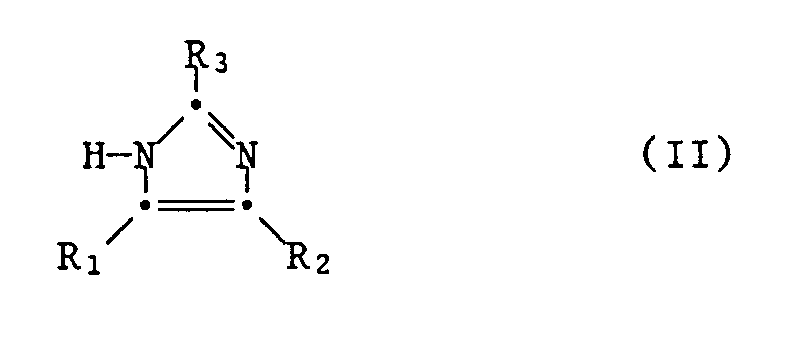 b) in einer Verbindung der Formel
 c) zur Herstellung von Verbindungen der Formel I, worin R₃ Wasserstoff und R₂ di-C₁-C₄-alkyliertes Carbamoyl darstellt, eine Verbindung der Formel
Ph-alk-NH₂ (IV)
mit einem Isonitril der Formel
- Verwendung einer Verbindung gemäss einem der Ansprüche 1-24 zur Herstellung von zur Behandlung von Epilepsie bestimmten pharmazeutischen Präparaten.
Priority Applications (1)
| Application Number | Priority Date | Filing Date | Title |
|---|---|---|---|
| AT87108017T ATE80876T1 (de) | 1986-06-06 | 1987-06-03 | Aralkylimidazolderivate. |
Applications Claiming Priority (4)
| Application Number | Priority Date | Filing Date | Title |
|---|---|---|---|
| CH229486 | 1986-06-06 | ||
| CH2294/86 | 1986-06-06 | ||
| CH403486 | 1986-10-09 | ||
| CH4034/86 | 1986-10-09 |
Publications (3)
| Publication Number | Publication Date |
|---|---|
| EP0248414A2 EP0248414A2 (de) | 1987-12-09 |
| EP0248414A3 EP0248414A3 (en) | 1988-01-27 |
| EP0248414B1 true EP0248414B1 (de) | 1992-09-23 |
Family
ID=25690041
Family Applications (1)
| Application Number | Title | Priority Date | Filing Date |
|---|---|---|---|
| EP87108017A Expired - Lifetime EP0248414B1 (de) | 1986-06-06 | 1987-06-03 | Aralkylimidazolderivate |
Country Status (14)
| Country | Link |
|---|---|
| US (1) | US4851424A (de) |
| EP (1) | EP0248414B1 (de) |
| KR (1) | KR880000402A (de) |
| AU (1) | AU610501B2 (de) |
| DE (1) | DE3781831D1 (de) |
| DK (1) | DK289287A (de) |
| FI (1) | FI872489A7 (de) |
| HU (1) | HU207050B (de) |
| IL (1) | IL82726A (de) |
| MY (1) | MY100938A (de) |
| NO (1) | NO168103C (de) |
| NZ (1) | NZ220588A (de) |
| PH (1) | PH27465A (de) |
| PT (1) | PT84998B (de) |
Families Citing this family (7)
| Publication number | Priority date | Publication date | Assignee | Title |
|---|---|---|---|---|
| IL84093A (en) * | 1986-10-09 | 1992-09-06 | Ciba Geigy Ag | Aralkyl-4h-1,2,4-triazole derivatives,their preparation and pharmaceutical compositions containing them |
| US4957931A (en) * | 1987-07-08 | 1990-09-18 | Ciba-Geigy Corporation | Certain 1,2-benzisoxazole and 1,2-benzisothiazole derivatives |
| NL1015313C2 (nl) | 2000-05-26 | 2001-11-27 | Dsm Nv | Werkwijze voor de bereiding van enantiomeer verrijkte esters en alcoholen. |
| US7189859B2 (en) * | 2003-08-06 | 2007-03-13 | Ilse Zolle | Radiolabelled phenylethyl imidazole carboxylic acid ester derivatives |
| PE20150974A1 (es) | 2012-11-14 | 2015-07-04 | Teijin Pharma Ltd | Derivados de piridina |
| CN106692138B (zh) * | 2015-12-29 | 2020-08-04 | 广州英赛特生物技术有限公司 | N-苄基咪酰胺衍生物作为多粘菌素类抗生素协同增效剂的应用 |
| WO2025195256A1 (zh) * | 2024-03-22 | 2025-09-25 | 四川科伦药物研究院有限公司 | 羧酸酯类化合物及其制备方法和用途 |
Family Cites Families (9)
| Publication number | Priority date | Publication date | Assignee | Title |
|---|---|---|---|---|
| US2897205A (en) * | 1958-06-27 | 1959-07-28 | Merck & Co Inc | 1-etherified oxyalkyl imidazole-4,5-dicarboxamides, intermediates and process |
| GB1044933A (en) * | 1964-04-16 | 1966-10-05 | Janssen Pharmaceutica Nv | Improved method for the preparation of 1-(1-phenyl-ethyl)-5-[(r) (ar) n-co]-imidazoles and compounds produced thereby |
| US3691178A (en) * | 1970-03-16 | 1972-09-12 | Merck & Co Inc | Substituted imidazoles |
| US3991072A (en) * | 1975-03-10 | 1976-11-09 | Janssen Pharmaceutica N.V. | Racemization of lower alkyl imidazole carboxylates |
| GB1599032A (en) * | 1977-03-04 | 1981-09-30 | May & Baker Ltd | Imidazole derivatives having herbicidal activity |
| FR2382443A1 (fr) * | 1978-03-02 | 1978-09-29 | May Et Baker | Derives herbicides de benzylimidazoles |
| JPS5671073A (en) * | 1979-11-12 | 1981-06-13 | Takeda Chem Ind Ltd | Imidazole derivative |
| US4346097A (en) * | 1980-09-30 | 1982-08-24 | Warner-Lambert Company | Method for treating convulsions with pyrazole-4-carboxamide derivatives |
| CA1334092C (en) * | 1986-07-11 | 1995-01-24 | David John Carini | Angiotensin ii receptor blocking imidazoles |
-
1987
- 1987-05-26 US US07/053,913 patent/US4851424A/en not_active Expired - Fee Related
- 1987-05-26 MY MYPI87000725A patent/MY100938A/en unknown
- 1987-06-01 IL IL82726A patent/IL82726A/xx unknown
- 1987-06-03 PT PT84998A patent/PT84998B/pt not_active IP Right Cessation
- 1987-06-03 FI FI872489A patent/FI872489A7/fi not_active Application Discontinuation
- 1987-06-03 EP EP87108017A patent/EP0248414B1/de not_active Expired - Lifetime
- 1987-06-03 DE DE8787108017T patent/DE3781831D1/de not_active Expired - Lifetime
- 1987-06-03 PH PH35340A patent/PH27465A/en unknown
- 1987-06-04 DK DK289287A patent/DK289287A/da not_active Application Discontinuation
- 1987-06-05 HU HU872588A patent/HU207050B/hu not_active IP Right Cessation
- 1987-06-05 NO NO872393A patent/NO168103C/no unknown
- 1987-06-05 KR KR870005712A patent/KR880000402A/ko not_active Ceased
- 1987-06-05 NZ NZ220588A patent/NZ220588A/xx unknown
- 1987-06-05 AU AU73896/87A patent/AU610501B2/en not_active Ceased
Also Published As
| Publication number | Publication date |
|---|---|
| PT84998B (pt) | 1990-03-08 |
| EP0248414A3 (en) | 1988-01-27 |
| DK289287A (da) | 1987-12-07 |
| IL82726A (en) | 1991-12-15 |
| AU7389687A (en) | 1987-12-10 |
| NO872393D0 (no) | 1987-06-05 |
| MY100938A (en) | 1991-05-31 |
| NO168103C (no) | 1992-01-15 |
| HU207050B (en) | 1993-03-01 |
| NO168103B (no) | 1991-10-07 |
| DE3781831D1 (de) | 1992-10-29 |
| NO872393L (no) | 1987-12-07 |
| PT84998A (en) | 1987-07-01 |
| KR880000402A (ko) | 1988-03-25 |
| FI872489A0 (fi) | 1987-06-03 |
| FI872489L (fi) | 1987-12-07 |
| FI872489A7 (fi) | 1987-12-07 |
| NZ220588A (en) | 1989-11-28 |
| IL82726A0 (en) | 1987-12-20 |
| PH27465A (en) | 1993-07-09 |
| DK289287D0 (da) | 1987-06-04 |
| US4851424A (en) | 1989-07-25 |
| HUT45509A (en) | 1988-07-28 |
| EP0248414A2 (de) | 1987-12-09 |
| AU610501B2 (en) | 1991-05-23 |
Similar Documents
| Publication | Publication Date | Title |
|---|---|---|
| EP1202969B1 (de) | Biphenylderivate, ihre herstellung und ihre verwendung als mtp-inhibitor | |
| EP0483667B1 (de) | Cyclische Iminoderivate, diese Verbindungen enthaltende Arzneimittel und Verfahren zu ihrer Herstellung | |
| EP0344519A1 (de) | Substituierte 4-(Chinolin-2-yl-methoxy)phenyl-essigsäure-Derivate | |
| DE3241102A1 (de) | Imidazolylalkylthienyl-tetrahydropyridazine und verfahren zu ihrer herstellung | |
| EP0611767A1 (de) | Heterocyclisch substituierte Phenyl-cyclohexan-carbonsäurederivate als Angiotensin II Antagonisten | |
| EP0199262B1 (de) | Fluorierte Benzyltriazolverbindungen | |
| EP0252005B1 (de) | Hydrierte 1-Benzooxacycloalkyl-pyridincarbonsäureverbindungen | |
| WO1999062893A2 (de) | Neue neurokininantagonisten, verfahren zu ihrer herstellung und diese verbindungen enthaltende pharmazeutische zusammensetzungen | |
| EP0719763A1 (de) | 4-(Chinolin-2-yl-methoxy)-phenyl-essigsäurederivate mit antiatherosklerotischer Wirkung | |
| EP0192255B1 (de) | Bi-2H-pyrroli(di)ndione | |
| EP0282502A1 (de) | Imidazol-derivate. | |
| EP0248414A2 (de) | Aralkylimidazolderivate | |
| WO2001021604A1 (de) | Substituierte piperazinderivate, ihre herstellung und ihre verwendung als inhibitoren des mikrosomalen triglyzerid-transferproteins (mtp) | |
| EP0617035B1 (de) | Hetero-tricyclisch-substituierte Phenyl-cyclohexan-carbonsäurederivate | |
| DE68903263T2 (de) | Substituierte aromatische verbindungen mit zentraler nervensystem-wirkung. | |
| DE68925173T2 (de) | 4-Methyl und 4-Ethyl substituierte Pyrrolidin-2-one | |
| EP0114347A2 (de) | Aralkyltriazolverbindungen | |
| DE10132686A1 (de) | Heteroarylcarbonsäureamide, ihre Herstellung und ihre Verwendung als Arzneimittel | |
| EP0267147B1 (de) | Aralkyl-4H-1,2,4-triazolderivate | |
| DE4220983A1 (de) | Imidazolyl-substituierte Phenylpropion- und -zimtsäurederivate | |
| EP0266308B1 (de) | Indolo-pyrazino-benzodiazepin-Derivate | |
| EP0581003B1 (de) | Imidazolyl-substituierte Cyclohexanderivate | |
| DD260928A5 (de) | Verfahren zur herstellung neuer aralkylimidizolderivate | |
| EP0338435A1 (de) | 3.4-Dihydroxypyrrolidin-2-on-Derivate, Verfahren zu ihrer Herstellung, diese enthaltende Mittel und ihre Verwendung sowie die bei der Herstellung anfallenden Zwischenprodukte | |
| EP0187619A2 (de) | 1,3-disubstituierte Tetrahydropyridine |
Legal Events
| Date | Code | Title | Description |
|---|---|---|---|
| PUAI | Public reference made under article 153(3) epc to a published international application that has entered the european phase |
Free format text: ORIGINAL CODE: 0009012 |
|
| PUAL | Search report despatched |
Free format text: ORIGINAL CODE: 0009013 |
|
| 17P | Request for examination filed |
Effective date: 19870603 |
|
| AK | Designated contracting states |
Kind code of ref document: A2 Designated state(s): AT BE CH DE ES FR GB GR IT LI LU NL SE |
|
| AK | Designated contracting states |
Kind code of ref document: A3 Designated state(s): AT BE CH DE ES FR GB GR IT LI LU NL SE |
|
| 17Q | First examination report despatched |
Effective date: 19900530 |
|
| GRAA | (expected) grant |
Free format text: ORIGINAL CODE: 0009210 |
|
| AK | Designated contracting states |
Kind code of ref document: B1 Designated state(s): AT BE CH DE ES FR GB GR IT LI LU NL SE |
|
| PG25 | Lapsed in a contracting state [announced via postgrant information from national office to epo] |
Ref country code: IT Free format text: LAPSE BECAUSE OF FAILURE TO SUBMIT A TRANSLATION OF THE DESCRIPTION OR TO PAY THE FEE WITHIN THE PRE;WARNING: LAPSES OF ITALIAN PATENTS WITH EFFECTIVE DATE BEFORE 2007 MAY HAVE OCCURRED AT ANY TIME BEFORE 2007. THE CORRECT EFFECTIVE DATE MAY BE DIFFERENT FROM THE ONE RECORDED.SCRIBED TIME-LIMIT Effective date: 19920923 Ref country code: BE Effective date: 19920923 Ref country code: SE Effective date: 19920923 Ref country code: FR Effective date: 19920923 Ref country code: GB Effective date: 19920923 Ref country code: NL Effective date: 19920923 Ref country code: GR Free format text: LAPSE BECAUSE OF FAILURE TO SUBMIT A TRANSLATION OF THE DESCRIPTION OR TO PAY THE FEE WITHIN THE PRESCRIBED TIME-LIMIT Effective date: 19920923 |
|
| REF | Corresponds to: |
Ref document number: 80876 Country of ref document: AT Date of ref document: 19921015 Kind code of ref document: T |
|
| REF | Corresponds to: |
Ref document number: 3781831 Country of ref document: DE Date of ref document: 19921029 |
|
| PG25 | Lapsed in a contracting state [announced via postgrant information from national office to epo] |
Ref country code: ES Free format text: LAPSE BECAUSE OF FAILURE TO SUBMIT A TRANSLATION OF THE DESCRIPTION OR TO PAY THE FEE WITHIN THE PRESCRIBED TIME-LIMIT Effective date: 19930103 |
|
| EN | Fr: translation not filed | ||
| NLV1 | Nl: lapsed or annulled due to failure to fulfill the requirements of art. 29p and 29m of the patents act | ||
| GBV | Gb: ep patent (uk) treated as always having been void in accordance with gb section 77(7)/1977 [no translation filed] |
Effective date: 19920923 |
|
| PG25 | Lapsed in a contracting state [announced via postgrant information from national office to epo] |
Ref country code: AT Effective date: 19930603 |
|
| PG25 | Lapsed in a contracting state [announced via postgrant information from national office to epo] |
Ref country code: CH Effective date: 19930630 Ref country code: LU Free format text: LAPSE BECAUSE OF NON-PAYMENT OF DUE FEES Effective date: 19930630 Ref country code: LI Effective date: 19930630 |
|
| PLBE | No opposition filed within time limit |
Free format text: ORIGINAL CODE: 0009261 |
|
| STAA | Information on the status of an ep patent application or granted ep patent |
Free format text: STATUS: NO OPPOSITION FILED WITHIN TIME LIMIT |
|
| 26N | No opposition filed | ||
| REG | Reference to a national code |
Ref country code: CH Ref legal event code: PL |
|
| PG25 | Lapsed in a contracting state [announced via postgrant information from national office to epo] |
Ref country code: DE Effective date: 19940301 |