EP0247951B1 - Verfahren und Vorrichtung zur Zersetzung einer Natriumaluminatlauge bei der Herstellung von Aluminiumoxid - Google Patents
Verfahren und Vorrichtung zur Zersetzung einer Natriumaluminatlauge bei der Herstellung von Aluminiumoxid Download PDFInfo
- Publication number
- EP0247951B1 EP0247951B1 EP87420125A EP87420125A EP0247951B1 EP 0247951 B1 EP0247951 B1 EP 0247951B1 EP 87420125 A EP87420125 A EP 87420125A EP 87420125 A EP87420125 A EP 87420125A EP 0247951 B1 EP0247951 B1 EP 0247951B1
- Authority
- EP
- European Patent Office
- Prior art keywords
- zone
- suspension
- flow
- decomposer
- grading
- Prior art date
- Legal status (The legal status is an assumption and is not a legal conclusion. Google has not performed a legal analysis and makes no representation as to the accuracy of the status listed.)
- Expired - Lifetime
Links
- 238000004519 manufacturing process Methods 0.000 title claims abstract description 46
- 238000000034 method Methods 0.000 title claims abstract description 31
- 230000008569 process Effects 0.000 title claims abstract description 25
- ANBBXQWFNXMHLD-UHFFFAOYSA-N aluminum;sodium;oxygen(2-) Chemical compound [O-2].[O-2].[Na+].[Al+3] ANBBXQWFNXMHLD-UHFFFAOYSA-N 0.000 title claims abstract description 17
- 238000000354 decomposition reaction Methods 0.000 title claims description 37
- PNEYBMLMFCGWSK-UHFFFAOYSA-N aluminium oxide Inorganic materials [O-2].[O-2].[O-2].[Al+3].[Al+3] PNEYBMLMFCGWSK-UHFFFAOYSA-N 0.000 title claims description 27
- 229910001388 sodium aluminate Inorganic materials 0.000 title claims description 14
- 239000000725 suspension Substances 0.000 claims abstract description 97
- 238000004064 recycling Methods 0.000 claims abstract description 37
- WNROFYMDJYEPJX-UHFFFAOYSA-K aluminium hydroxide Chemical compound [OH-].[OH-].[OH-].[Al+3] WNROFYMDJYEPJX-UHFFFAOYSA-K 0.000 claims abstract description 7
- 239000002245 particle Substances 0.000 claims description 67
- 239000007787 solid Substances 0.000 claims description 48
- KKCBUQHMOMHUOY-UHFFFAOYSA-N Na2O Inorganic materials [O-2].[Na+].[Na+] KKCBUQHMOMHUOY-UHFFFAOYSA-N 0.000 claims description 6
- 229910052593 corundum Inorganic materials 0.000 claims description 5
- 229910001845 yogo sapphire Inorganic materials 0.000 claims description 5
- 229910001570 bauxite Inorganic materials 0.000 claims description 4
- 238000004131 Bayer process Methods 0.000 claims description 3
- 230000001105 regulatory effect Effects 0.000 claims description 3
- 239000003518 caustics Substances 0.000 claims description 2
- 239000003795 chemical substances by application Substances 0.000 claims description 2
- 238000007599 discharging Methods 0.000 claims description 2
- 238000010899 nucleation Methods 0.000 claims description 2
- 230000003068 static effect Effects 0.000 claims description 2
- 230000001351 cycling effect Effects 0.000 claims 1
- 238000000605 extraction Methods 0.000 abstract description 3
- 230000033228 biological regulation Effects 0.000 abstract description 2
- 239000012071 phase Substances 0.000 description 39
- 230000004907 flux Effects 0.000 description 27
- MXRIRQGCELJRSN-UHFFFAOYSA-N O.O.O.[Al] Chemical compound O.O.O.[Al] MXRIRQGCELJRSN-UHFFFAOYSA-N 0.000 description 16
- 235000020094 liqueur Nutrition 0.000 description 15
- 238000001556 precipitation Methods 0.000 description 13
- 238000005054 agglomeration Methods 0.000 description 12
- 230000002776 aggregation Effects 0.000 description 12
- 230000014759 maintenance of location Effects 0.000 description 11
- HEMHJVSKTPXQMS-UHFFFAOYSA-M Sodium hydroxide Chemical compound [OH-].[Na+] HEMHJVSKTPXQMS-UHFFFAOYSA-M 0.000 description 10
- 238000009826 distribution Methods 0.000 description 9
- 238000013019 agitation Methods 0.000 description 8
- 239000000243 solution Substances 0.000 description 8
- 239000012530 fluid Substances 0.000 description 7
- 150000004645 aluminates Chemical class 0.000 description 6
- 239000010419 fine particle Substances 0.000 description 5
- 239000007788 liquid Substances 0.000 description 5
- 239000012452 mother liquor Substances 0.000 description 5
- 239000000203 mixture Substances 0.000 description 4
- 239000000047 product Substances 0.000 description 4
- 238000003860 storage Methods 0.000 description 4
- 240000008042 Zea mays Species 0.000 description 3
- 238000009825 accumulation Methods 0.000 description 3
- XAGFODPZIPBFFR-UHFFFAOYSA-N aluminium Chemical compound [Al] XAGFODPZIPBFFR-UHFFFAOYSA-N 0.000 description 3
- 229910052782 aluminium Inorganic materials 0.000 description 3
- 238000007596 consolidation process Methods 0.000 description 3
- 239000012429 reaction media Substances 0.000 description 3
- 235000011121 sodium hydroxide Nutrition 0.000 description 3
- 230000008719 thickening Effects 0.000 description 3
- 241001644893 Entandrophragma utile Species 0.000 description 2
- 239000004411 aluminium Substances 0.000 description 2
- 230000001174 ascending effect Effects 0.000 description 2
- 230000015572 biosynthetic process Effects 0.000 description 2
- 238000006243 chemical reaction Methods 0.000 description 2
- 238000010276 construction Methods 0.000 description 2
- 230000001276 controlling effect Effects 0.000 description 2
- 238000010586 diagram Methods 0.000 description 2
- 230000000694 effects Effects 0.000 description 2
- 238000005516 engineering process Methods 0.000 description 2
- 238000007654 immersion Methods 0.000 description 2
- 238000009434 installation Methods 0.000 description 2
- 238000001228 spectrum Methods 0.000 description 2
- 230000006641 stabilisation Effects 0.000 description 2
- 238000011105 stabilization Methods 0.000 description 2
- DGAQECJNVWCQMB-PUAWFVPOSA-M Ilexoside XXIX Chemical compound C[C@@H]1CC[C@@]2(CC[C@@]3(C(=CC[C@H]4[C@]3(CC[C@@H]5[C@@]4(CC[C@@H](C5(C)C)OS(=O)(=O)[O-])C)C)[C@@H]2[C@]1(C)O)C)C(=O)O[C@H]6[C@@H]([C@H]([C@@H]([C@H](O6)CO)O)O)O.[Na+] DGAQECJNVWCQMB-PUAWFVPOSA-M 0.000 description 1
- 241000861223 Issus Species 0.000 description 1
- 206010038743 Restlessness Diseases 0.000 description 1
- 241001080024 Telles Species 0.000 description 1
- HIGRAKVNKLCVCA-UHFFFAOYSA-N alumine Chemical compound C1=CC=[Al]C=C1 HIGRAKVNKLCVCA-UHFFFAOYSA-N 0.000 description 1
- 239000007864 aqueous solution Substances 0.000 description 1
- 238000005255 carburizing Methods 0.000 description 1
- 238000002144 chemical decomposition reaction Methods 0.000 description 1
- 230000000295 complement effect Effects 0.000 description 1
- 239000012141 concentrate Substances 0.000 description 1
- 230000003750 conditioning effect Effects 0.000 description 1
- 239000000470 constituent Substances 0.000 description 1
- 239000013078 crystal Substances 0.000 description 1
- 238000010908 decantation Methods 0.000 description 1
- 238000005868 electrolysis reaction Methods 0.000 description 1
- 239000000839 emulsion Substances 0.000 description 1
- 238000005265 energy consumption Methods 0.000 description 1
- 230000002349 favourable effect Effects 0.000 description 1
- 230000005021 gait Effects 0.000 description 1
- 229920002681 hypalon Polymers 0.000 description 1
- 238000009776 industrial production Methods 0.000 description 1
- 230000000977 initiatory effect Effects 0.000 description 1
- 238000002347 injection Methods 0.000 description 1
- 239000007924 injection Substances 0.000 description 1
- 239000011344 liquid material Substances 0.000 description 1
- 239000000463 material Substances 0.000 description 1
- 239000003607 modifier Substances 0.000 description 1
- 239000010413 mother solution Substances 0.000 description 1
- 230000006911 nucleation Effects 0.000 description 1
- 239000008188 pellet Substances 0.000 description 1
- 230000002028 premature Effects 0.000 description 1
- 238000005086 pumping Methods 0.000 description 1
- 230000000717 retained effect Effects 0.000 description 1
- 230000000630 rising effect Effects 0.000 description 1
- 239000012047 saturated solution Substances 0.000 description 1
- 238000007789 sealing Methods 0.000 description 1
- 238000000926 separation method Methods 0.000 description 1
- 229910052708 sodium Inorganic materials 0.000 description 1
- 239000011734 sodium Substances 0.000 description 1
- 239000007790 solid phase Substances 0.000 description 1
- 230000007928 solubilization Effects 0.000 description 1
- 238000005063 solubilization Methods 0.000 description 1
- 238000003756 stirring Methods 0.000 description 1
- 239000013589 supplement Substances 0.000 description 1
- 230000008685 targeting Effects 0.000 description 1
- 230000002936 tranquilizing effect Effects 0.000 description 1
- 238000005406 washing Methods 0.000 description 1
Images


Classifications
-
- B—PERFORMING OPERATIONS; TRANSPORTING
- B22—CASTING; POWDER METALLURGY
- B22D—CASTING OF METALS; CASTING OF OTHER SUBSTANCES BY THE SAME PROCESSES OR DEVICES
- B22D11/00—Continuous casting of metals, i.e. casting in indefinite lengths
- B22D11/06—Continuous casting of metals, i.e. casting in indefinite lengths into moulds with travelling walls, e.g. with rolls, plates, belts, caterpillars
- B22D11/0605—Continuous casting of metals, i.e. casting in indefinite lengths into moulds with travelling walls, e.g. with rolls, plates, belts, caterpillars formed by two belts, e.g. Hazelett-process
-
- B—PERFORMING OPERATIONS; TRANSPORTING
- B61—RAILWAYS
- B61B—RAILWAY SYSTEMS; EQUIPMENT THEREFOR NOT OTHERWISE PROVIDED FOR
- B61B13/00—Other railway systems
- B61B13/12—Systems with propulsion devices between or alongside the rails, e.g. pneumatic systems
-
- B—PERFORMING OPERATIONS; TRANSPORTING
- B22—CASTING; POWDER METALLURGY
- B22D—CASTING OF METALS; CASTING OF OTHER SUBSTANCES BY THE SAME PROCESSES OR DEVICES
- B22D11/00—Continuous casting of metals, i.e. casting in indefinite lengths
- B22D11/06—Continuous casting of metals, i.e. casting in indefinite lengths into moulds with travelling walls, e.g. with rolls, plates, belts, caterpillars
- B22D11/0637—Accessories therefor
- B22D11/068—Accessories therefor for cooling the cast product during its passage through the mould surfaces
- B22D11/0685—Accessories therefor for cooling the cast product during its passage through the mould surfaces by cooling the casting belts
-
- B—PERFORMING OPERATIONS; TRANSPORTING
- B22—CASTING; POWDER METALLURGY
- B22D—CASTING OF METALS; CASTING OF OTHER SUBSTANCES BY THE SAME PROCESSES OR DEVICES
- B22D41/00—Casting melt-holding vessels, e.g. ladles, tundishes, cups or the like
- B22D41/14—Closures
- B22D41/22—Closures sliding-gate type, i.e. having a fixed plate and a movable plate in sliding contact with each other for selective registry of their openings
- B22D41/28—Plates therefor
- B22D41/34—Supporting, fixing or centering means therefor
-
- B—PERFORMING OPERATIONS; TRANSPORTING
- B25—HAND TOOLS; PORTABLE POWER-DRIVEN TOOLS; MANIPULATORS
- B25C—HAND-HELD NAILING OR STAPLING TOOLS; MANUALLY OPERATED PORTABLE STAPLING TOOLS
- B25C5/00—Manually operated portable stapling tools; Hand-held power-operated stapling tools; Staple feeding devices therefor
- B25C5/02—Manually operated portable stapling tools; Hand-held power-operated stapling tools; Staple feeding devices therefor with provision for bending the ends of the staples on to the work
- B25C5/0285—Hand-held stapling tools, e.g. manually operated, i.e. not resting on a working surface during operation
- B25C5/0292—Hand-held stapling tools, e.g. manually operated, i.e. not resting on a working surface during operation with the objects to be stapled together introduced perpendicularly to the longitudinal axis of the tool in an opening formed by an anvil and a plunger
-
- B—PERFORMING OPERATIONS; TRANSPORTING
- B27—WORKING OR PRESERVING WOOD OR SIMILAR MATERIAL; NAILING OR STAPLING MACHINES IN GENERAL
- B27K—PROCESSES, APPARATUS OR SELECTION OF SUBSTANCES FOR IMPREGNATING, STAINING, DYEING, BLEACHING OF WOOD OR SIMILAR MATERIALS, OR TREATING OF WOOD OR SIMILAR MATERIALS WITH PERMEANT LIQUIDS, NOT OTHERWISE PROVIDED FOR; CHEMICAL OR PHYSICAL TREATMENT OF CORK, CANE, REED, STRAW OR SIMILAR MATERIALS
- B27K3/00—Impregnating wood, e.g. impregnation pretreatment, for example puncturing; Wood impregnation aids not directly involved in the impregnation process
- B27K3/02—Processes; Apparatus
- B27K3/0278—Processes; Apparatus involving an additional treatment during or after impregnation
- B27K3/0292—Processes; Apparatus involving an additional treatment during or after impregnation for improving fixation
-
- B—PERFORMING OPERATIONS; TRANSPORTING
- B27—WORKING OR PRESERVING WOOD OR SIMILAR MATERIAL; NAILING OR STAPLING MACHINES IN GENERAL
- B27K—PROCESSES, APPARATUS OR SELECTION OF SUBSTANCES FOR IMPREGNATING, STAINING, DYEING, BLEACHING OF WOOD OR SIMILAR MATERIALS, OR TREATING OF WOOD OR SIMILAR MATERIALS WITH PERMEANT LIQUIDS, NOT OTHERWISE PROVIDED FOR; CHEMICAL OR PHYSICAL TREATMENT OF CORK, CANE, REED, STRAW OR SIMILAR MATERIALS
- B27K3/00—Impregnating wood, e.g. impregnation pretreatment, for example puncturing; Wood impregnation aids not directly involved in the impregnation process
- B27K3/02—Processes; Apparatus
- B27K3/08—Impregnating by pressure, e.g. vacuum impregnation
-
- B—PERFORMING OPERATIONS; TRANSPORTING
- B27—WORKING OR PRESERVING WOOD OR SIMILAR MATERIAL; NAILING OR STAPLING MACHINES IN GENERAL
- B27K—PROCESSES, APPARATUS OR SELECTION OF SUBSTANCES FOR IMPREGNATING, STAINING, DYEING, BLEACHING OF WOOD OR SIMILAR MATERIALS, OR TREATING OF WOOD OR SIMILAR MATERIALS WITH PERMEANT LIQUIDS, NOT OTHERWISE PROVIDED FOR; CHEMICAL OR PHYSICAL TREATMENT OF CORK, CANE, REED, STRAW OR SIMILAR MATERIALS
- B27K3/00—Impregnating wood, e.g. impregnation pretreatment, for example puncturing; Wood impregnation aids not directly involved in the impregnation process
- B27K3/16—Inorganic impregnating agents
- B27K3/22—Compounds of zinc or copper
-
- B—PERFORMING OPERATIONS; TRANSPORTING
- B27—WORKING OR PRESERVING WOOD OR SIMILAR MATERIAL; NAILING OR STAPLING MACHINES IN GENERAL
- B27K—PROCESSES, APPARATUS OR SELECTION OF SUBSTANCES FOR IMPREGNATING, STAINING, DYEING, BLEACHING OF WOOD OR SIMILAR MATERIALS, OR TREATING OF WOOD OR SIMILAR MATERIALS WITH PERMEANT LIQUIDS, NOT OTHERWISE PROVIDED FOR; CHEMICAL OR PHYSICAL TREATMENT OF CORK, CANE, REED, STRAW OR SIMILAR MATERIALS
- B27K3/00—Impregnating wood, e.g. impregnation pretreatment, for example puncturing; Wood impregnation aids not directly involved in the impregnation process
- B27K3/34—Organic impregnating agents
-
- B—PERFORMING OPERATIONS; TRANSPORTING
- B27—WORKING OR PRESERVING WOOD OR SIMILAR MATERIAL; NAILING OR STAPLING MACHINES IN GENERAL
- B27K—PROCESSES, APPARATUS OR SELECTION OF SUBSTANCES FOR IMPREGNATING, STAINING, DYEING, BLEACHING OF WOOD OR SIMILAR MATERIALS, OR TREATING OF WOOD OR SIMILAR MATERIALS WITH PERMEANT LIQUIDS, NOT OTHERWISE PROVIDED FOR; CHEMICAL OR PHYSICAL TREATMENT OF CORK, CANE, REED, STRAW OR SIMILAR MATERIALS
- B27K3/00—Impregnating wood, e.g. impregnation pretreatment, for example puncturing; Wood impregnation aids not directly involved in the impregnation process
- B27K3/52—Impregnating agents containing mixtures of inorganic and organic compounds
-
- B—PERFORMING OPERATIONS; TRANSPORTING
- B27—WORKING OR PRESERVING WOOD OR SIMILAR MATERIAL; NAILING OR STAPLING MACHINES IN GENERAL
- B27K—PROCESSES, APPARATUS OR SELECTION OF SUBSTANCES FOR IMPREGNATING, STAINING, DYEING, BLEACHING OF WOOD OR SIMILAR MATERIALS, OR TREATING OF WOOD OR SIMILAR MATERIALS WITH PERMEANT LIQUIDS, NOT OTHERWISE PROVIDED FOR; CHEMICAL OR PHYSICAL TREATMENT OF CORK, CANE, REED, STRAW OR SIMILAR MATERIALS
- B27K5/00—Treating of wood not provided for in groups B27K1/00, B27K3/00
- B27K5/001—Heating
-
- B—PERFORMING OPERATIONS; TRANSPORTING
- B29—WORKING OF PLASTICS; WORKING OF SUBSTANCES IN A PLASTIC STATE IN GENERAL
- B29C—SHAPING OR JOINING OF PLASTICS; SHAPING OF MATERIAL IN A PLASTIC STATE, NOT OTHERWISE PROVIDED FOR; AFTER-TREATMENT OF THE SHAPED PRODUCTS, e.g. REPAIRING
- B29C48/00—Extrusion moulding, i.e. expressing the moulding material through a die or nozzle which imparts the desired form; Apparatus therefor
- B29C48/16—Articles comprising two or more components, e.g. co-extruded layers
- B29C48/18—Articles comprising two or more components, e.g. co-extruded layers the components being layers
- B29C48/21—Articles comprising two or more components, e.g. co-extruded layers the components being layers the layers being joined at their surfaces
-
- B—PERFORMING OPERATIONS; TRANSPORTING
- B29—WORKING OF PLASTICS; WORKING OF SUBSTANCES IN A PLASTIC STATE IN GENERAL
- B29C—SHAPING OR JOINING OF PLASTICS; SHAPING OF MATERIAL IN A PLASTIC STATE, NOT OTHERWISE PROVIDED FOR; AFTER-TREATMENT OF THE SHAPED PRODUCTS, e.g. REPAIRING
- B29C48/00—Extrusion moulding, i.e. expressing the moulding material through a die or nozzle which imparts the desired form; Apparatus therefor
- B29C48/25—Component parts, details or accessories; Auxiliary operations
- B29C48/30—Extrusion nozzles or dies
- B29C48/305—Extrusion nozzles or dies having a wide opening, e.g. for forming sheets
- B29C48/307—Extrusion nozzles or dies having a wide opening, e.g. for forming sheets specially adapted for bringing together components, e.g. melts within the die
-
- B—PERFORMING OPERATIONS; TRANSPORTING
- B32—LAYERED PRODUCTS
- B32B—LAYERED PRODUCTS, i.e. PRODUCTS BUILT-UP OF STRATA OF FLAT OR NON-FLAT, e.g. CELLULAR OR HONEYCOMB, FORM
- B32B27/00—Layered products comprising a layer of synthetic resin
- B32B27/30—Layered products comprising a layer of synthetic resin comprising vinyl (co)polymers; comprising acrylic (co)polymers
-
- B—PERFORMING OPERATIONS; TRANSPORTING
- B41—PRINTING; LINING MACHINES; TYPEWRITERS; STAMPS
- B41F—PRINTING MACHINES OR PRESSES
- B41F13/00—Common details of rotary presses or machines
- B41F13/08—Cylinders
- B41F13/10—Forme cylinders
- B41F13/12—Registering devices
- B41F13/14—Registering devices with means for displacing the cylinders
-
- B—PERFORMING OPERATIONS; TRANSPORTING
- B41—PRINTING; LINING MACHINES; TYPEWRITERS; STAMPS
- B41F—PRINTING MACHINES OR PRESSES
- B41F13/00—Common details of rotary presses or machines
- B41F13/08—Cylinders
- B41F13/10—Forme cylinders
- B41F13/12—Registering devices
- B41F13/16—Registering devices with means for displacing the printing formes on the cylinders
-
- B—PERFORMING OPERATIONS; TRANSPORTING
- B60—VEHICLES IN GENERAL
- B60B—VEHICLE WHEELS; CASTORS; AXLES FOR WHEELS OR CASTORS; INCREASING WHEEL ADHESION
- B60B39/00—Increasing wheel adhesion
- B60B39/003—Vehicle mounted non-skid chains actuated by centrifugal force
- B60B39/006—Vehicle mounted non-skid chains actuated by centrifugal force characterised by a control system for the actuation of the rotating chain wheel
-
- B—PERFORMING OPERATIONS; TRANSPORTING
- B60—VEHICLES IN GENERAL
- B60M—POWER SUPPLY LINES, AND DEVICES ALONG RAILS, FOR ELECTRICALLY- PROPELLED VEHICLES
- B60M3/00—Feeding power to supply lines in contact with collector on vehicles; Arrangements for consuming regenerative power
- B60M3/04—Arrangements for cutting in and out of individual track sections
-
- B—PERFORMING OPERATIONS; TRANSPORTING
- B60—VEHICLES IN GENERAL
- B60W—CONJOINT CONTROL OF VEHICLE SUB-UNITS OF DIFFERENT TYPE OR DIFFERENT FUNCTION; CONTROL SYSTEMS SPECIALLY ADAPTED FOR HYBRID VEHICLES; ROAD VEHICLE DRIVE CONTROL SYSTEMS FOR PURPOSES NOT RELATED TO THE CONTROL OF A PARTICULAR SUB-UNIT
- B60W10/00—Conjoint control of vehicle sub-units of different type or different function
- B60W10/02—Conjoint control of vehicle sub-units of different type or different function including control of driveline clutches
-
- B—PERFORMING OPERATIONS; TRANSPORTING
- B60—VEHICLES IN GENERAL
- B60W—CONJOINT CONTROL OF VEHICLE SUB-UNITS OF DIFFERENT TYPE OR DIFFERENT FUNCTION; CONTROL SYSTEMS SPECIALLY ADAPTED FOR HYBRID VEHICLES; ROAD VEHICLE DRIVE CONTROL SYSTEMS FOR PURPOSES NOT RELATED TO THE CONTROL OF A PARTICULAR SUB-UNIT
- B60W10/00—Conjoint control of vehicle sub-units of different type or different function
- B60W10/04—Conjoint control of vehicle sub-units of different type or different function including control of propulsion units
- B60W10/06—Conjoint control of vehicle sub-units of different type or different function including control of propulsion units including control of combustion engines
-
- B—PERFORMING OPERATIONS; TRANSPORTING
- B60—VEHICLES IN GENERAL
- B60W—CONJOINT CONTROL OF VEHICLE SUB-UNITS OF DIFFERENT TYPE OR DIFFERENT FUNCTION; CONTROL SYSTEMS SPECIALLY ADAPTED FOR HYBRID VEHICLES; ROAD VEHICLE DRIVE CONTROL SYSTEMS FOR PURPOSES NOT RELATED TO THE CONTROL OF A PARTICULAR SUB-UNIT
- B60W10/00—Conjoint control of vehicle sub-units of different type or different function
- B60W10/10—Conjoint control of vehicle sub-units of different type or different function including control of change-speed gearings
-
- B—PERFORMING OPERATIONS; TRANSPORTING
- B60—VEHICLES IN GENERAL
- B60W—CONJOINT CONTROL OF VEHICLE SUB-UNITS OF DIFFERENT TYPE OR DIFFERENT FUNCTION; CONTROL SYSTEMS SPECIALLY ADAPTED FOR HYBRID VEHICLES; ROAD VEHICLE DRIVE CONTROL SYSTEMS FOR PURPOSES NOT RELATED TO THE CONTROL OF A PARTICULAR SUB-UNIT
- B60W10/00—Conjoint control of vehicle sub-units of different type or different function
- B60W10/10—Conjoint control of vehicle sub-units of different type or different function including control of change-speed gearings
- B60W10/11—Stepped gearings
-
- B—PERFORMING OPERATIONS; TRANSPORTING
- B60—VEHICLES IN GENERAL
- B60W—CONJOINT CONTROL OF VEHICLE SUB-UNITS OF DIFFERENT TYPE OR DIFFERENT FUNCTION; CONTROL SYSTEMS SPECIALLY ADAPTED FOR HYBRID VEHICLES; ROAD VEHICLE DRIVE CONTROL SYSTEMS FOR PURPOSES NOT RELATED TO THE CONTROL OF A PARTICULAR SUB-UNIT
- B60W30/00—Purposes of road vehicle drive control systems not related to the control of a particular sub-unit, e.g. of systems using conjoint control of vehicle sub-units
- B60W30/18—Propelling the vehicle
-
- B—PERFORMING OPERATIONS; TRANSPORTING
- B61—RAILWAYS
- B61B—RAILWAY SYSTEMS; EQUIPMENT THEREFOR NOT OTHERWISE PROVIDED FOR
- B61B13/00—Other railway systems
- B61B13/08—Sliding or levitation systems
-
- B—PERFORMING OPERATIONS; TRANSPORTING
- B65—CONVEYING; PACKING; STORING; HANDLING THIN OR FILAMENTARY MATERIAL
- B65B—MACHINES, APPARATUS OR DEVICES FOR, OR METHODS OF, PACKAGING ARTICLES OR MATERIALS; UNPACKING
- B65B55/00—Preserving, protecting or purifying packages or package contents in association with packaging
- B65B55/02—Sterilising, e.g. of complete packages
- B65B55/022—Sterilising, e.g. of complete packages of flexible containers having a filling and dispensing spout, e.g. containers of the "bag-in-box"-type
-
- B—PERFORMING OPERATIONS; TRANSPORTING
- B65—CONVEYING; PACKING; STORING; HANDLING THIN OR FILAMENTARY MATERIAL
- B65B—MACHINES, APPARATUS OR DEVICES FOR, OR METHODS OF, PACKAGING ARTICLES OR MATERIALS; UNPACKING
- B65B7/00—Closing containers or receptacles after filling
- B65B7/02—Closing containers or receptacles deformed by, or taking-up shape, of, contents, e.g. bags, sacks
-
- B—PERFORMING OPERATIONS; TRANSPORTING
- B65—CONVEYING; PACKING; STORING; HANDLING THIN OR FILAMENTARY MATERIAL
- B65D—CONTAINERS FOR STORAGE OR TRANSPORT OF ARTICLES OR MATERIALS, e.g. BAGS, BARRELS, BOTTLES, BOXES, CANS, CARTONS, CRATES, DRUMS, JARS, TANKS, HOPPERS, FORWARDING CONTAINERS; ACCESSORIES, CLOSURES, OR FITTINGS THEREFOR; PACKAGING ELEMENTS; PACKAGES
- B65D33/00—Details of, or accessories for, sacks or bags
- B65D33/16—End- or aperture-closing arrangements or devices
-
- B—PERFORMING OPERATIONS; TRANSPORTING
- B65—CONVEYING; PACKING; STORING; HANDLING THIN OR FILAMENTARY MATERIAL
- B65D—CONTAINERS FOR STORAGE OR TRANSPORT OF ARTICLES OR MATERIALS, e.g. BAGS, BARRELS, BOTTLES, BOXES, CANS, CARTONS, CRATES, DRUMS, JARS, TANKS, HOPPERS, FORWARDING CONTAINERS; ACCESSORIES, CLOSURES, OR FITTINGS THEREFOR; PACKAGING ELEMENTS; PACKAGES
- B65D75/00—Packages comprising articles or materials partially or wholly enclosed in strips, sheets, blanks, tubes or webs of flexible sheet material, e.g. in folded wrappers
- B65D75/52—Details
- B65D75/58—Opening or contents-removing devices added or incorporated during package manufacture
- B65D75/5861—Spouts
- B65D75/5872—Non-integral spouts
- B65D75/5877—Non-integral spouts connected to a planar surface of the package wall
-
- B—PERFORMING OPERATIONS; TRANSPORTING
- B65—CONVEYING; PACKING; STORING; HANDLING THIN OR FILAMENTARY MATERIAL
- B65D—CONTAINERS FOR STORAGE OR TRANSPORT OF ARTICLES OR MATERIALS, e.g. BAGS, BARRELS, BOTTLES, BOXES, CANS, CARTONS, CRATES, DRUMS, JARS, TANKS, HOPPERS, FORWARDING CONTAINERS; ACCESSORIES, CLOSURES, OR FITTINGS THEREFOR; PACKAGING ELEMENTS; PACKAGES
- B65D83/00—Containers or packages with special means for dispensing contents
- B65D83/14—Containers for dispensing liquid or semi-liquid contents by internal gaseous pressure, i.e. aerosol containers comprising propellant
- B65D83/70—Pressure relief devices
-
- B—PERFORMING OPERATIONS; TRANSPORTING
- B65—CONVEYING; PACKING; STORING; HANDLING THIN OR FILAMENTARY MATERIAL
- B65G—TRANSPORT OR STORAGE DEVICES, e.g. CONVEYORS FOR LOADING OR TIPPING, SHOP CONVEYOR SYSTEMS OR PNEUMATIC TUBE CONVEYORS
- B65G47/00—Article or material-handling devices associated with conveyors; Methods employing such devices
- B65G47/52—Devices for transferring articles or materials between conveyors i.e. discharging or feeding devices
- B65G47/60—Devices for transferring articles or materials between conveyors i.e. discharging or feeding devices to or from conveyors of the suspended, e.g. trolley, type
- B65G47/61—Devices for transferring articles or materials between conveyors i.e. discharging or feeding devices to or from conveyors of the suspended, e.g. trolley, type for articles
-
- C—CHEMISTRY; METALLURGY
- C01—INORGANIC CHEMISTRY
- C01B—NON-METALLIC ELEMENTS; COMPOUNDS THEREOF; METALLOIDS OR COMPOUNDS THEREOF NOT COVERED BY SUBCLASS C01C
- C01B25/00—Phosphorus; Compounds thereof
- C01B25/003—Phosphorus
-
- C—CHEMISTRY; METALLURGY
- C01—INORGANIC CHEMISTRY
- C01B—NON-METALLIC ELEMENTS; COMPOUNDS THEREOF; METALLOIDS OR COMPOUNDS THEREOF NOT COVERED BY SUBCLASS C01C
- C01B25/00—Phosphorus; Compounds thereof
- C01B25/02—Preparation of phosphorus
- C01B25/027—Preparation of phosphorus of yellow phosphorus
-
- C—CHEMISTRY; METALLURGY
- C01—INORGANIC CHEMISTRY
- C01B—NON-METALLIC ELEMENTS; COMPOUNDS THEREOF; METALLOIDS OR COMPOUNDS THEREOF NOT COVERED BY SUBCLASS C01C
- C01B25/00—Phosphorus; Compounds thereof
- C01B25/16—Oxyacids of phosphorus; Salts thereof
- C01B25/18—Phosphoric acid
- C01B25/20—Preparation from elemental phosphorus or phosphoric anhydride
-
- C—CHEMISTRY; METALLURGY
- C01—INORGANIC CHEMISTRY
- C01F—COMPOUNDS OF THE METALS BERYLLIUM, MAGNESIUM, ALUMINIUM, CALCIUM, STRONTIUM, BARIUM, RADIUM, THORIUM, OR OF THE RARE-EARTH METALS
- C01F7/00—Compounds of aluminium
- C01F7/02—Aluminium oxide; Aluminium hydroxide; Aluminates
- C01F7/04—Preparation of alkali metal aluminates; Aluminium oxide or hydroxide therefrom
- C01F7/14—Aluminium oxide or hydroxide from alkali metal aluminates
- C01F7/144—Aluminium oxide or hydroxide from alkali metal aluminates from aqueous aluminate solutions by precipitation due to cooling, e.g. as part of the Bayer process
-
- C—CHEMISTRY; METALLURGY
- C01—INORGANIC CHEMISTRY
- C01F—COMPOUNDS OF THE METALS BERYLLIUM, MAGNESIUM, ALUMINIUM, CALCIUM, STRONTIUM, BARIUM, RADIUM, THORIUM, OR OF THE RARE-EARTH METALS
- C01F7/00—Compounds of aluminium
- C01F7/02—Aluminium oxide; Aluminium hydroxide; Aluminates
- C01F7/04—Preparation of alkali metal aluminates; Aluminium oxide or hydroxide therefrom
- C01F7/14—Aluminium oxide or hydroxide from alkali metal aluminates
- C01F7/144—Aluminium oxide or hydroxide from alkali metal aluminates from aqueous aluminate solutions by precipitation due to cooling, e.g. as part of the Bayer process
- C01F7/147—Apparatus for precipitation
-
- F—MECHANICAL ENGINEERING; LIGHTING; HEATING; WEAPONS; BLASTING
- F16—ENGINEERING ELEMENTS AND UNITS; GENERAL MEASURES FOR PRODUCING AND MAINTAINING EFFECTIVE FUNCTIONING OF MACHINES OR INSTALLATIONS; THERMAL INSULATION IN GENERAL
- F16H—GEARING
- F16H61/00—Control functions within control units of change-speed- or reversing-gearings for conveying rotary motion ; Control of exclusively fluid gearing, friction gearing, gearings with endless flexible members or other particular types of gearing
- F16H61/12—Detecting malfunction or potential malfunction, e.g. fail safe ; Circumventing or fixing failures
-
- F—MECHANICAL ENGINEERING; LIGHTING; HEATING; WEAPONS; BLASTING
- F16—ENGINEERING ELEMENTS AND UNITS; GENERAL MEASURES FOR PRODUCING AND MAINTAINING EFFECTIVE FUNCTIONING OF MACHINES OR INSTALLATIONS; THERMAL INSULATION IN GENERAL
- F16K—VALVES; TAPS; COCKS; ACTUATING-FLOATS; DEVICES FOR VENTING OR AERATING
- F16K17/00—Safety valves; Equalising valves, e.g. pressure relief valves
- F16K17/02—Safety valves; Equalising valves, e.g. pressure relief valves opening on surplus pressure on one side; closing on insufficient pressure on one side
- F16K17/14—Safety valves; Equalising valves, e.g. pressure relief valves opening on surplus pressure on one side; closing on insufficient pressure on one side with fracturing member
- F16K17/16—Safety valves; Equalising valves, e.g. pressure relief valves opening on surplus pressure on one side; closing on insufficient pressure on one side with fracturing member with fracturing diaphragm ; Rupture discs
- F16K17/162—Safety valves; Equalising valves, e.g. pressure relief valves opening on surplus pressure on one side; closing on insufficient pressure on one side with fracturing member with fracturing diaphragm ; Rupture discs of the non reverse-buckling-type
-
- H—ELECTRICITY
- H01—ELECTRIC ELEMENTS
- H01G—CAPACITORS; CAPACITORS, RECTIFIERS, DETECTORS, SWITCHING DEVICES, LIGHT-SENSITIVE OR TEMPERATURE-SENSITIVE DEVICES OF THE ELECTROLYTIC TYPE
- H01G9/00—Electrolytic capacitors, rectifiers, detectors, switching devices, light-sensitive or temperature-sensitive devices; Processes of their manufacture
- H01G9/004—Details
- H01G9/08—Housing; Encapsulation
- H01G9/12—Vents or other means allowing expansion
-
- H—ELECTRICITY
- H01—ELECTRIC ELEMENTS
- H01M—PROCESSES OR MEANS, e.g. BATTERIES, FOR THE DIRECT CONVERSION OF CHEMICAL ENERGY INTO ELECTRICAL ENERGY
- H01M50/00—Constructional details or processes of manufacture of the non-active parts of electrochemical cells other than fuel cells, e.g. hybrid cells
- H01M50/30—Arrangements for facilitating escape of gases
- H01M50/342—Non-re-sealable arrangements
- H01M50/3425—Non-re-sealable arrangements in the form of rupturable membranes or weakened parts, e.g. pierced with the aid of a sharp member
-
- B—PERFORMING OPERATIONS; TRANSPORTING
- B27—WORKING OR PRESERVING WOOD OR SIMILAR MATERIAL; NAILING OR STAPLING MACHINES IN GENERAL
- B27K—PROCESSES, APPARATUS OR SELECTION OF SUBSTANCES FOR IMPREGNATING, STAINING, DYEING, BLEACHING OF WOOD OR SIMILAR MATERIALS, OR TREATING OF WOOD OR SIMILAR MATERIALS WITH PERMEANT LIQUIDS, NOT OTHERWISE PROVIDED FOR; CHEMICAL OR PHYSICAL TREATMENT OF CORK, CANE, REED, STRAW OR SIMILAR MATERIALS
- B27K2240/00—Purpose of the treatment
- B27K2240/30—Fireproofing
-
- B—PERFORMING OPERATIONS; TRANSPORTING
- B29—WORKING OF PLASTICS; WORKING OF SUBSTANCES IN A PLASTIC STATE IN GENERAL
- B29C—SHAPING OR JOINING OF PLASTICS; SHAPING OF MATERIAL IN A PLASTIC STATE, NOT OTHERWISE PROVIDED FOR; AFTER-TREATMENT OF THE SHAPED PRODUCTS, e.g. REPAIRING
- B29C48/00—Extrusion moulding, i.e. expressing the moulding material through a die or nozzle which imparts the desired form; Apparatus therefor
- B29C48/03—Extrusion moulding, i.e. expressing the moulding material through a die or nozzle which imparts the desired form; Apparatus therefor characterised by the shape of the extruded material at extrusion
- B29C48/07—Flat, e.g. panels
-
- B—PERFORMING OPERATIONS; TRANSPORTING
- B29—WORKING OF PLASTICS; WORKING OF SUBSTANCES IN A PLASTIC STATE IN GENERAL
- B29C—SHAPING OR JOINING OF PLASTICS; SHAPING OF MATERIAL IN A PLASTIC STATE, NOT OTHERWISE PROVIDED FOR; AFTER-TREATMENT OF THE SHAPED PRODUCTS, e.g. REPAIRING
- B29C48/00—Extrusion moulding, i.e. expressing the moulding material through a die or nozzle which imparts the desired form; Apparatus therefor
- B29C48/03—Extrusion moulding, i.e. expressing the moulding material through a die or nozzle which imparts the desired form; Apparatus therefor characterised by the shape of the extruded material at extrusion
- B29C48/07—Flat, e.g. panels
- B29C48/08—Flat, e.g. panels flexible, e.g. films
-
- B—PERFORMING OPERATIONS; TRANSPORTING
- B29—WORKING OF PLASTICS; WORKING OF SUBSTANCES IN A PLASTIC STATE IN GENERAL
- B29K—INDEXING SCHEME ASSOCIATED WITH SUBCLASSES B29B, B29C OR B29D, RELATING TO MOULDING MATERIALS OR TO MATERIALS FOR MOULDS, REINFORCEMENTS, FILLERS OR PREFORMED PARTS, e.g. INSERTS
- B29K2033/00—Use of polymers of unsaturated acids or derivatives thereof as moulding material
-
- B—PERFORMING OPERATIONS; TRANSPORTING
- B29—WORKING OF PLASTICS; WORKING OF SUBSTANCES IN A PLASTIC STATE IN GENERAL
- B29K—INDEXING SCHEME ASSOCIATED WITH SUBCLASSES B29B, B29C OR B29D, RELATING TO MOULDING MATERIALS OR TO MATERIALS FOR MOULDS, REINFORCEMENTS, FILLERS OR PREFORMED PARTS, e.g. INSERTS
- B29K2055/00—Use of specific polymers obtained by polymerisation reactions only involving carbon-to-carbon unsaturated bonds, not provided for in a single one of main groups B29K2023/00 - B29K2049/00, e.g. having a vinyl group, as moulding material
- B29K2055/02—ABS polymers, i.e. acrylonitrile-butadiene-styrene polymers
-
- B—PERFORMING OPERATIONS; TRANSPORTING
- B29—WORKING OF PLASTICS; WORKING OF SUBSTANCES IN A PLASTIC STATE IN GENERAL
- B29L—INDEXING SCHEME ASSOCIATED WITH SUBCLASS B29C, RELATING TO PARTICULAR ARTICLES
- B29L2031/00—Other particular articles
- B29L2031/769—Sanitary equipment
- B29L2031/7692—Baths
-
- B—PERFORMING OPERATIONS; TRANSPORTING
- B60—VEHICLES IN GENERAL
- B60W—CONJOINT CONTROL OF VEHICLE SUB-UNITS OF DIFFERENT TYPE OR DIFFERENT FUNCTION; CONTROL SYSTEMS SPECIALLY ADAPTED FOR HYBRID VEHICLES; ROAD VEHICLE DRIVE CONTROL SYSTEMS FOR PURPOSES NOT RELATED TO THE CONTROL OF A PARTICULAR SUB-UNIT
- B60W50/00—Details of control systems for road vehicle drive control not related to the control of a particular sub-unit, e.g. process diagnostic or vehicle driver interfaces
- B60W50/02—Ensuring safety in case of control system failures, e.g. by diagnosing, circumventing or fixing failures
- B60W50/0205—Diagnosing or detecting failures; Failure detection models
- B60W2050/021—Means for detecting failure or malfunction
-
- B—PERFORMING OPERATIONS; TRANSPORTING
- B60—VEHICLES IN GENERAL
- B60W—CONJOINT CONTROL OF VEHICLE SUB-UNITS OF DIFFERENT TYPE OR DIFFERENT FUNCTION; CONTROL SYSTEMS SPECIALLY ADAPTED FOR HYBRID VEHICLES; ROAD VEHICLE DRIVE CONTROL SYSTEMS FOR PURPOSES NOT RELATED TO THE CONTROL OF A PARTICULAR SUB-UNIT
- B60W2510/00—Input parameters relating to a particular sub-units
- B60W2510/06—Combustion engines, Gas turbines
- B60W2510/0638—Engine speed
-
- B—PERFORMING OPERATIONS; TRANSPORTING
- B60—VEHICLES IN GENERAL
- B60W—CONJOINT CONTROL OF VEHICLE SUB-UNITS OF DIFFERENT TYPE OR DIFFERENT FUNCTION; CONTROL SYSTEMS SPECIALLY ADAPTED FOR HYBRID VEHICLES; ROAD VEHICLE DRIVE CONTROL SYSTEMS FOR PURPOSES NOT RELATED TO THE CONTROL OF A PARTICULAR SUB-UNIT
- B60W2510/00—Input parameters relating to a particular sub-units
- B60W2510/10—Change speed gearings
- B60W2510/1015—Input shaft speed, e.g. turbine speed
- B60W2510/102—Input speed change rate
-
- B—PERFORMING OPERATIONS; TRANSPORTING
- B60—VEHICLES IN GENERAL
- B60W—CONJOINT CONTROL OF VEHICLE SUB-UNITS OF DIFFERENT TYPE OR DIFFERENT FUNCTION; CONTROL SYSTEMS SPECIALLY ADAPTED FOR HYBRID VEHICLES; ROAD VEHICLE DRIVE CONTROL SYSTEMS FOR PURPOSES NOT RELATED TO THE CONTROL OF A PARTICULAR SUB-UNIT
- B60W2510/00—Input parameters relating to a particular sub-units
- B60W2510/10—Change speed gearings
- B60W2510/104—Output speed
-
- B—PERFORMING OPERATIONS; TRANSPORTING
- B60—VEHICLES IN GENERAL
- B60W—CONJOINT CONTROL OF VEHICLE SUB-UNITS OF DIFFERENT TYPE OR DIFFERENT FUNCTION; CONTROL SYSTEMS SPECIALLY ADAPTED FOR HYBRID VEHICLES; ROAD VEHICLE DRIVE CONTROL SYSTEMS FOR PURPOSES NOT RELATED TO THE CONTROL OF A PARTICULAR SUB-UNIT
- B60W2540/00—Input parameters relating to occupants
- B60W2540/12—Brake pedal position
-
- C—CHEMISTRY; METALLURGY
- C01—INORGANIC CHEMISTRY
- C01P—INDEXING SCHEME RELATING TO STRUCTURAL AND PHYSICAL ASPECTS OF SOLID INORGANIC COMPOUNDS
- C01P2004/00—Particle morphology
- C01P2004/50—Agglomerated particles
-
- C—CHEMISTRY; METALLURGY
- C01—INORGANIC CHEMISTRY
- C01P—INDEXING SCHEME RELATING TO STRUCTURAL AND PHYSICAL ASPECTS OF SOLID INORGANIC COMPOUNDS
- C01P2004/00—Particle morphology
- C01P2004/60—Particles characterised by their size
- C01P2004/61—Micrometer sized, i.e. from 1-100 micrometer
-
- F—MECHANICAL ENGINEERING; LIGHTING; HEATING; WEAPONS; BLASTING
- F16—ENGINEERING ELEMENTS AND UNITS; GENERAL MEASURES FOR PRODUCING AND MAINTAINING EFFECTIVE FUNCTIONING OF MACHINES OR INSTALLATIONS; THERMAL INSULATION IN GENERAL
- F16H—GEARING
- F16H61/00—Control functions within control units of change-speed- or reversing-gearings for conveying rotary motion ; Control of exclusively fluid gearing, friction gearing, gearings with endless flexible members or other particular types of gearing
- F16H61/12—Detecting malfunction or potential malfunction, e.g. fail safe ; Circumventing or fixing failures
- F16H2061/1208—Detecting malfunction or potential malfunction, e.g. fail safe ; Circumventing or fixing failures with diagnostic check cycles; Monitoring of failures
-
- F—MECHANICAL ENGINEERING; LIGHTING; HEATING; WEAPONS; BLASTING
- F16—ENGINEERING ELEMENTS AND UNITS; GENERAL MEASURES FOR PRODUCING AND MAINTAINING EFFECTIVE FUNCTIONING OF MACHINES OR INSTALLATIONS; THERMAL INSULATION IN GENERAL
- F16H—GEARING
- F16H61/00—Control functions within control units of change-speed- or reversing-gearings for conveying rotary motion ; Control of exclusively fluid gearing, friction gearing, gearings with endless flexible members or other particular types of gearing
- F16H61/12—Detecting malfunction or potential malfunction, e.g. fail safe ; Circumventing or fixing failures
- F16H2061/122—Avoiding failures by using redundant parts
-
- F—MECHANICAL ENGINEERING; LIGHTING; HEATING; WEAPONS; BLASTING
- F16—ENGINEERING ELEMENTS AND UNITS; GENERAL MEASURES FOR PRODUCING AND MAINTAINING EFFECTIVE FUNCTIONING OF MACHINES OR INSTALLATIONS; THERMAL INSULATION IN GENERAL
- F16H—GEARING
- F16H61/00—Control functions within control units of change-speed- or reversing-gearings for conveying rotary motion ; Control of exclusively fluid gearing, friction gearing, gearings with endless flexible members or other particular types of gearing
- F16H61/12—Detecting malfunction or potential malfunction, e.g. fail safe ; Circumventing or fixing failures
- F16H2061/1256—Detecting malfunction or potential malfunction, e.g. fail safe ; Circumventing or fixing failures characterised by the parts or units where malfunctioning was assumed or detected
- F16H2061/1284—Detecting malfunction or potential malfunction, e.g. fail safe ; Circumventing or fixing failures characterised by the parts or units where malfunctioning was assumed or detected the failing part is a sensor
-
- F—MECHANICAL ENGINEERING; LIGHTING; HEATING; WEAPONS; BLASTING
- F16—ENGINEERING ELEMENTS AND UNITS; GENERAL MEASURES FOR PRODUCING AND MAINTAINING EFFECTIVE FUNCTIONING OF MACHINES OR INSTALLATIONS; THERMAL INSULATION IN GENERAL
- F16H—GEARING
- F16H59/00—Control inputs to control units of change-speed- or reversing-gearings for conveying rotary motion
- F16H59/36—Inputs being a function of speed
-
- F—MECHANICAL ENGINEERING; LIGHTING; HEATING; WEAPONS; BLASTING
- F16—ENGINEERING ELEMENTS AND UNITS; GENERAL MEASURES FOR PRODUCING AND MAINTAINING EFFECTIVE FUNCTIONING OF MACHINES OR INSTALLATIONS; THERMAL INSULATION IN GENERAL
- F16H—GEARING
- F16H59/00—Control inputs to control units of change-speed- or reversing-gearings for conveying rotary motion
- F16H59/36—Inputs being a function of speed
- F16H59/38—Inputs being a function of speed of gearing elements
- F16H59/40—Output shaft speed
-
- F—MECHANICAL ENGINEERING; LIGHTING; HEATING; WEAPONS; BLASTING
- F16—ENGINEERING ELEMENTS AND UNITS; GENERAL MEASURES FOR PRODUCING AND MAINTAINING EFFECTIVE FUNCTIONING OF MACHINES OR INSTALLATIONS; THERMAL INSULATION IN GENERAL
- F16H—GEARING
- F16H59/00—Control inputs to control units of change-speed- or reversing-gearings for conveying rotary motion
- F16H59/36—Inputs being a function of speed
- F16H59/38—Inputs being a function of speed of gearing elements
- F16H59/42—Input shaft speed
-
- Y—GENERAL TAGGING OF NEW TECHNOLOGICAL DEVELOPMENTS; GENERAL TAGGING OF CROSS-SECTIONAL TECHNOLOGIES SPANNING OVER SEVERAL SECTIONS OF THE IPC; TECHNICAL SUBJECTS COVERED BY FORMER USPC CROSS-REFERENCE ART COLLECTIONS [XRACs] AND DIGESTS
- Y02—TECHNOLOGIES OR APPLICATIONS FOR MITIGATION OR ADAPTATION AGAINST CLIMATE CHANGE
- Y02E—REDUCTION OF GREENHOUSE GAS [GHG] EMISSIONS, RELATED TO ENERGY GENERATION, TRANSMISSION OR DISTRIBUTION
- Y02E60/00—Enabling technologies; Technologies with a potential or indirect contribution to GHG emissions mitigation
- Y02E60/10—Energy storage using batteries
-
- Y—GENERAL TAGGING OF NEW TECHNOLOGICAL DEVELOPMENTS; GENERAL TAGGING OF CROSS-SECTIONAL TECHNOLOGIES SPANNING OVER SEVERAL SECTIONS OF THE IPC; TECHNICAL SUBJECTS COVERED BY FORMER USPC CROSS-REFERENCE ART COLLECTIONS [XRACs] AND DIGESTS
- Y02—TECHNOLOGIES OR APPLICATIONS FOR MITIGATION OR ADAPTATION AGAINST CLIMATE CHANGE
- Y02T—CLIMATE CHANGE MITIGATION TECHNOLOGIES RELATED TO TRANSPORTATION
- Y02T10/00—Road transport of goods or passengers
- Y02T10/60—Other road transportation technologies with climate change mitigation effect
- Y02T10/70—Energy storage systems for electromobility, e.g. batteries
-
- Y—GENERAL TAGGING OF NEW TECHNOLOGICAL DEVELOPMENTS; GENERAL TAGGING OF CROSS-SECTIONAL TECHNOLOGIES SPANNING OVER SEVERAL SECTIONS OF THE IPC; TECHNICAL SUBJECTS COVERED BY FORMER USPC CROSS-REFERENCE ART COLLECTIONS [XRACs] AND DIGESTS
- Y10—TECHNICAL SUBJECTS COVERED BY FORMER USPC
- Y10S—TECHNICAL SUBJECTS COVERED BY FORMER USPC CROSS-REFERENCE ART COLLECTIONS [XRACs] AND DIGESTS
- Y10S101/00—Printing
- Y10S101/36—Means for registering or alignment of print plates on print press structure
-
- Y—GENERAL TAGGING OF NEW TECHNOLOGICAL DEVELOPMENTS; GENERAL TAGGING OF CROSS-SECTIONAL TECHNOLOGIES SPANNING OVER SEVERAL SECTIONS OF THE IPC; TECHNICAL SUBJECTS COVERED BY FORMER USPC CROSS-REFERENCE ART COLLECTIONS [XRACs] AND DIGESTS
- Y10—TECHNICAL SUBJECTS COVERED BY FORMER USPC
- Y10S—TECHNICAL SUBJECTS COVERED BY FORMER USPC CROSS-REFERENCE ART COLLECTIONS [XRACs] AND DIGESTS
- Y10S477/00—Interrelated power delivery controls, including engine control
- Y10S477/906—Means detecting or ameliorating the effects of malfunction or potential malfunction
-
- Y—GENERAL TAGGING OF NEW TECHNOLOGICAL DEVELOPMENTS; GENERAL TAGGING OF CROSS-SECTIONAL TECHNOLOGIES SPANNING OVER SEVERAL SECTIONS OF THE IPC; TECHNICAL SUBJECTS COVERED BY FORMER USPC CROSS-REFERENCE ART COLLECTIONS [XRACs] AND DIGESTS
- Y10—TECHNICAL SUBJECTS COVERED BY FORMER USPC
- Y10T—TECHNICAL SUBJECTS COVERED BY FORMER US CLASSIFICATION
- Y10T428/00—Stock material or miscellaneous articles
- Y10T428/4935—Impregnated naturally solid product [e.g., leather, stone, etc.]
- Y10T428/662—Wood timber product [e.g., piling, post, veneer, etc.]
Definitions
- the present invention relates to a process and a device for the decomposition without agitation of supersaturated liquors of sodium aluminate for the production of alumina by the BAYER process, which constitutes the essential technique of production of alumina mainly intended to be transformed into aluminum by igneous electrolysis.
- bauxite is treated hot with an aqueous solution of sodium hydroxide, at an appropriate concentration, causing the solubilization of the alumina and obtaining a supersaturated solution of sodium aluminate.
- the supersaturated solution of sodium aluminate is seeded with aluminum trihydroxide acting as a primer in order to cause the precipitation of aluminum trihydroxide .
- composition is generally carried out in several successive stages which are distinguished in particular by the temperature, the particle size and the quantity of primer introduced, the flow diagram of the liquors in successive bins and possible recycling.
- Certain methods of precipitation of alumina by decomposition of a supersaturated solution of sodium aluminate in the presence of primer recommend a magnification step by increasing the residence time of the primer particles in the decomposer, in contact with the renewed mother liquor.
- a magnification step by increasing the residence time of the primer particles in the decomposer, in contact with the renewed mother liquor.
- the particles accumulated at the base of each decomposer and on which the precipitation of the liquor is uniformly carried out are therefore discontinuous and constitute the production, after an essential cycloning to remove the finest particles which are recycled with the partially exhausted liquor to the first compartment of each decomposer.
- the US Pat. No. 4,364,919 decomposes the sodium aluminate liquor in 2 distinct stages.
- the first agglomeration step is carried out in a stirred tank in the presence of a small quantity of classified primer.
- the second stage of feeding and enlarging the agglomerates is carried out in lightly agitated tanks where the residence time of the solid is clearly greater than that of the exhausted mother liquor which is evacuated by overflow.
- the concentration of solid particles can reach from 400 g / l to 1500 g / l.
- US 4,511,542 performs after a first nucleation and agglomeration phase of the aluminum trihydroxide particles in the presence of a small quantity of classified primer, a solid thickening of the suspension by accumulation in a series of decomposers with precipitation of alumina.
- the residence times of the aluminum trihydroxide particles vary from 30 to 90 hours and their concentration from 250 to 700 g / liter.
- the suspension with a high concentration of dry matter leaving the last decomposer is classified in its entirety to provide the production and the fine primer recycled after washing.
- the process FR 1 187 352 which describes a technique of precipitation in a fluid bed seems to solve this problem. It consists in maintaining a suspension of crystals or solid particles in equilibrium in an ascending liquid. In such a bed, the dimensions and concentrations of the solid particles decrease from the bottom to the top and the height of the fluid bed is a function of the ascending speed of the liquid. It is then possible to precisely adjust the particle retention threshold according to their diameter and consequently their residence time in the reactor by acting only on the rising speed of the liquid, the characteristics of which must remain constant. If the liquid itself constitutes the reaction medium where a transfer of solid liquid material takes place, it must be constantly renewed.
- the suspension resulting from the first decomposition step is injected into the lower part of an unstirred decomposer, the low speed of circulation of the liquor allows large agglomerates to remain in the injection zone of the suspension, to grow with the precipitation of alumina, finally decant to be eliminated continuously at the base of the decomposer and directly constitute the production.
- the fraction of fine particles which are not agglomerated or insufficiently agglomerated is quickly entrained with the liquor not exhausted, by overflow.
- the latter is in a third and final stage, exhausted by precipitation in the presence of a contribution of recycled fine primer.
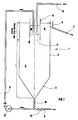
- the classifying decomposer is a cylindrical-conical tank (1), comprising a cylindrical upper part (2) and a conical bottom (3). It is equipped with an overflow (4) and a central chimney (5) plunging into the suspension of aluminum hydroxide.
- the tank is isolated by interrupting the production flow (9) by a sealing means (15), and the recycling pump (12), FIG. 1, or the propeller pump (13 ) Figure 2, ensures a sufficient flow to maintain the homogeneity of solids concentration in the area of the floor (C), and thus prevents any risk of deposit and clogging.
- Second example (second gait regime) Lifting speed of the suspension in the overflow zone: 1.75 m / h Flow speed of the suspension in the storage area: 5.8 m / h Magnification of the particle size spectrum: 6% drop from 48 ⁇ m.
- phase 1 of agglomeration one can use, depending on the capacity of the decomposers, one or more classifying decomposers mounted in series and / or in parallel.
- phase 1 194 m3h of aluminate liquor with the same characteristics as in Example 3, with 7.5 t / h of aluminum trihydroxide primer so as to obtain a suspension at 38 g / l concentration of solid particles, 40% by weight of which is less than 48 microns.
- the suspension remains for 10 hours in this first agglomeration phase to reach 60 g / l of solid concentration.
- the classified production extracted continuously and containing less than 8% by weight of particles of dimension less than 48 microns is washed while the overflow of the classifier decomposer still containing 20 g / l of solid particles feeds phase 3 which receives the complement.
- Examples 3 and 4 show that a productivity close to 85 kg of Al2O3 is obtained per cubic meter of aluminate liquor for an overall duration of decomposition of the liquor of less than 50 hours and that the large quantity of fine primer with 40% by weight of particles less than 48 microns does not hinder the direct production of a production containing less than 10% by weight of particles less than 48 microns. No other industrial process for the production of alumina makes it possible to achieve this result without using an always expensive specific classification system at the end of decomposition.
- the classifying decomposer is implemented in a 2-phase process according to which the first agglomeration phase remains unchanged while the carburizing phases with product outlet and depletion are carried out in one and the same step.
- This suspension is then introduced into a stage consisting of 3 classifying decomposers identical to that described in examples 1 and 2 and mounted in series, the overflow flows from the 1st and 2nd classifying decomposers constituting respectively the supply flows from the 2nd and 3rd decomposers .
- the suspension maintained at 65 ° C. stays in total 42 hours in the 3 decomposers and allows, after cementation and consolidation of the aluminum hydroxide particles, to extract directly from each decomposer a suspension at least 600 g / liter of particles solids constituting the production with less than 6% by weight of particles less than 48 micrometers.
- a total of 110 m3 / h of suspension are thus drawn off, while the overflow flow from the last classifying decomposer consisting of 440 m3 / h of suspension to 150 g of dry matter per liter is filtered.
Landscapes
- Engineering & Computer Science (AREA)
- Mechanical Engineering (AREA)
- Chemical & Material Sciences (AREA)
- Life Sciences & Earth Sciences (AREA)
- Organic Chemistry (AREA)
- Inorganic Chemistry (AREA)
- Combustion & Propulsion (AREA)
- Transportation (AREA)
- Wood Science & Technology (AREA)
- Forests & Forestry (AREA)
- General Engineering & Computer Science (AREA)
- Power Engineering (AREA)
- Automation & Control Theory (AREA)
- Geology (AREA)
- Dispersion Chemistry (AREA)
- Microelectronics & Electronic Packaging (AREA)
- Chemical Kinetics & Catalysis (AREA)
- Electrochemistry (AREA)
- General Chemical & Material Sciences (AREA)
- Manufacturing & Machinery (AREA)
- Compounds Of Alkaline-Earth Elements, Aluminum Or Rare-Earth Metals (AREA)
- Silicon Compounds (AREA)
- Inorganic Compounds Of Heavy Metals (AREA)
- Silicates, Zeolites, And Molecular Sieves (AREA)
Claims (15)
- Verfahren zur kontinuierlichen Zersetzung einer an Aluminiumoxid übersättigten Natriumaluminatlösung, die aus dem alkalischen Aufschluß von Bauxit nach dem Bayer-Verfahren stammt und eine Suspension in Gegenwart eines Aluminiumtrihydroxidimpfmittels bildet,
gekennzeichnet durch folgende Schritte:
a) Einführung dieser, den Zufuhrstrom bildenden Suspension am oberen Teil eines nicht gerührten Klassier-Zersetzers in eine Beruhigungszone, in der dieser Zufuhrstrom bei einer Temperatur von 50 bis 75 °C mit einer Fraktion einer Suspension mit hoher Konzentration an festen Teilchen, die den Rückführstrom bildet und die am unteren Teil des Klassier-Zersetzers in einer sog. Ablaufzone entnommen wird, in Kontakt gebracht wird;b) gleichzeitiges Abziehen einer anderen Suspensionsfraktion mit hoher Konzentration an festen Teilchen, die direkt den Produktionsstrom bildet, in der Ablaufzone des nicht gerührten Klassier-Zersetzers;c) Abführung der Suspension mit geringer Konzentration an festen Teilchen, die den Überlaufstrom bildet, am oberen Teil des Klassier-Zersetzers;d) Regelung des Durchsatzes des Rückführstroms, um einen vorher festgelegten Durchsatz des Zufuhrstroms zu erhalten, auf die Weise, daß:- der Rückführdurchsatz ein Zwei- bis Siebenfaches des Zufuhrdurchsatzes beträgt,- die Strömungsgeschwindigkeit der Suspension in der Ablaufzone 1 bis 10 m/h beträgt,- die Anstiegsgeschwindigkeit der Suspension in der Überlaufzone 0,5 bis 5 m/h beträgt. - Verfahren nach Anspruch 1, dadurch gekennzeichnet, daß die Konzentration des Zufuhrstroms an Feststoffen, in Form von Aluminiumtrihydroxid, kleiner als 200 g/l ist.
- Verfahren nach Anspruch 2, dadurch gekennzeichnet, daß die Konzentration des Zufuhrstroms an Feststoffen, in Form von Aluminiumtrihydroxid, 110 bis 180 g/l beträgt.
- Verfahren nach den Ansprüchen 1 bis 3, dadurch gekennzeichnet, daß das Gewichtsverhältnis Rp der Konzentrationen Al₂O₃ (löslich) / Na₂O (kaustisch) in der zu zersetzenden Lösung 0,5 bis 1,2 beträgt.
- Verfahren nach Anspruch 1, dadurch gekennzeichnet, daß die Konzentration des Rückführstroms an Feststoffen, in Form von Aluminiumtrihydroxid, 300 bis 900 g/l beträgt.
- Verfahren nach Anspruch 1, dadurch gekennzeichnet, daß der Rückführstrom vorzugsweise ein 2 bis 3,5-faches des Zufuhrstroms beträgt.
- Verfahren nach Anspruch 1, dadurch gekennzeichnet, daß die Strömungsgeschwindigkeit des Suspensionsstroms in der Ablaufzone des Klassier-Zersetzers vorzugsweise 3 bis 8 m/h beträgt.
- Verfahren nach Anspruch 1, dadurch gekennzeichnet, daß die Geschwindigkeit des Überlaufstroms in der Überlaufzone des Klassier-Zersetzers vorzugsweise 1 bis 3 m/h beträgt.
- Klassier-Zersetzer genannte Vorrichtung zur Durchführung des Zersetzungsverfahrens nach einem der Ansprüche 1 bis 8, die einen zylindrisch-konischen Behälter (1) enthält, dessen unterer konischer Teil (3) sich in einer sog. Ablaufzone (C) befindet und mit einem Abflußröhrensystem (11) und Mitteln zur Kreisführung der Suspension der Ablaufzone (C) bis zum oberen Teil (2) des Behälters (1) ausgestattet ist, dadurch gekennzeichnet, daß dieser obere zylindrische Teil (2) mit einem Überlauf (4) mit einer Zufuhr- und Beruhigungszone (B) ausgestattet ist.
- Klassier-Zersetzer nach Anspruch 9, dadurch gekennzeichnet, daß die Zufuhr- und Beruhigungszone (B) aus einem zentralen Kamin (5) besteht, der teilweise in die zu behandelnde Suspension eingetaucht ist und in dessen Inneren das Röhrensystem des Zufuhrstroms (6) und das Röhrensystem des Rückführstroms (8) einmünden.
- Klassier-Zersetzer nach den Ansprüchen 9 und 10, dadurch gekennzeichnet, daß er eine horizontale Platte (11) oder jede andere statische Dispergiervorrichtung enthält, die in die Zufuhr- und Beruhigungszone (B) im Inneren des zentralen Kamins (5) unterhalb der Einmündungsröhrenysteme der Zufuhr- (6) und der Rückführströme (8), die gleichmäßig eingetaucht sind, eintaucht.
- Klassier-Zersetzer nach den Ansprüchen 9 bis 11, dadurch gekennzeichnet, daß das Verhältnis der Volumina der Überlaufzonen (A) und der Ablaufzonen (C) 0,1 bis 0,5 beträgt.
- Klassier-Zersetzer nach Anspruch 9, dadurch gekennzeichnet, daß die Fördermittel der in der Ablaufzone (C) entnommenen Suspension außerhalb des Klassier-Zersetzers sind und aus einer Kreiselpumpe (12) gebildet werden, die an das Abflußröhrensystem (10) angeschlossen ist und in die Zufuhr- und Beruhigungszone (B) durch das Zwischenstück des Röhrensystems des Rückführstroms (8) fördert.
- Klassier-Zersetzer nach Anspruch 9, dadurch gekennzeichnet, daß die Fördermittel der in der Ablaufzone (C) entnommenen Suspension innerhalb des Klassier-Abscheiders sind und aus einer Schneckenpumpe (13) gebildet werden, die die Suspension in der Ablaufzone (C) am Boden des Zersetzers ansaugt und in die Zufuhr- und Beruhigungszone (B) durch das Zwischenstück des Röhrensystems des Rückführstroms (8) fördert.
- Klassier-Zersetzer nach Anspruch 9, dadurch gekennzeichnet, daß das Röhrensystem des Ausgangs des Produktionsstroms (9) mit einem Verschlußmittel (15) ausgestattet ist.
Priority Applications (1)
| Application Number | Priority Date | Filing Date | Title |
|---|---|---|---|
| AT87420125T ATE65477T1 (de) | 1986-05-15 | 1987-05-12 | Verfahren und vorrichtung zur zersetzung einer natriumaluminatlauge bei der herstellung von aluminiumoxid. |
Applications Claiming Priority (2)
| Application Number | Priority Date | Filing Date | Title |
|---|---|---|---|
| FR8607149 | 1986-05-15 | ||
| FR8607149A FR2598701B1 (fr) | 1986-05-15 | 1986-05-15 | Procede et dispositif de decomposition de liqueur d'aluminate de sodium pour la production d'alumine |
Publications (2)
| Publication Number | Publication Date |
|---|---|
| EP0247951A1 EP0247951A1 (de) | 1987-12-02 |
| EP0247951B1 true EP0247951B1 (de) | 1991-07-24 |
Family
ID=9335375
Family Applications (1)
| Application Number | Title | Priority Date | Filing Date |
|---|---|---|---|
| EP87420125A Expired - Lifetime EP0247951B1 (de) | 1986-05-15 | 1987-05-12 | Verfahren und Vorrichtung zur Zersetzung einer Natriumaluminatlauge bei der Herstellung von Aluminiumoxid |
Country Status (15)
| Country | Link |
|---|---|
| US (2) | US4818499A (de) |
| EP (1) | EP0247951B1 (de) |
| CN (1) | CN1007516B (de) |
| AT (1) | ATE65477T1 (de) |
| AU (1) | AU587330B2 (de) |
| BR (1) | BR8702478A (de) |
| CA (1) | CA1310471C (de) |
| DE (1) | DE3771580D1 (de) |
| ES (1) | ES2023931B3 (de) |
| FR (1) | FR2598701B1 (de) |
| GR (1) | GR3002355T3 (de) |
| IE (1) | IE59932B1 (de) |
| IN (1) | IN168223B (de) |
| OA (1) | OA08597A (de) |
| YU (2) | YU44626B (de) |
Families Citing this family (13)
| Publication number | Priority date | Publication date | Assignee | Title |
|---|---|---|---|---|
| US5104229A (en) * | 1989-02-01 | 1992-04-14 | Fuller Company | Method and apparatus for blending and withdrawing solid particulate material from a vessel |
| US5039227A (en) * | 1989-11-24 | 1991-08-13 | Alberta Energy Company Ltd. | Mixer circuit for oil sand |
| US5074670A (en) * | 1990-05-11 | 1991-12-24 | Fuller Company | Blender with feed rate control |
| US5403382A (en) * | 1993-03-16 | 1995-04-04 | Fairbanks; Robert L. | Method and apparatus for copper processing |
| FR2782710B1 (fr) | 1998-09-02 | 2000-10-06 | Pechiney Aluminium | Procede de controle granulometrique dans une chaine de decomposition du circuit bayer, incluant une phase d'agglomeration |
| US6217622B1 (en) | 1998-10-22 | 2001-04-17 | Alcan International Limited | Method and apparatus for precipitating and classifying solids in high concentrations |
| RU2175951C2 (ru) * | 2000-02-25 | 2001-11-20 | ОАО "Бокситогорский глинозем" | Способ получения активного гидроксида алюминия |
| RU2226175C1 (ru) * | 2002-08-30 | 2004-03-27 | Открытое акционерное общество "Всероссийский алюминиево-магниевый институт" | Аппарат для карбонизации алюминатных растворов |
| AU2003288990A1 (en) * | 2002-12-05 | 2004-06-23 | Showa Denko K.K. | Aluminum hydroxide and method for production thereof |
| RU2327641C2 (ru) * | 2006-08-03 | 2008-06-27 | Открытое акционерное общество "РУСАЛ ВСЕРОССИЙСКИЙ АЛЮМИНИЕВО-МАГНИЕВЫЙ ИНСТИТУТ" (ОАО "РУСАЛ ВАМИ") | Аппарат для декомпозиции алюминатных растворов |
| KR101235123B1 (ko) * | 2011-07-15 | 2013-02-20 | 주식회사제오빌더 | 다공성 알루미나의 제조방법 |
| WO2015021524A1 (en) | 2013-08-15 | 2015-02-19 | Hatch Ltd. | Multi-compartment reactor and method for controlling retention time in a multi-compartment reactor |
| RU2756211C1 (ru) * | 2020-12-01 | 2021-09-28 | Федеральное государственное бюджетное образовательное учреждение высшего образования "Красноярский государственный аграрный университет" | Карбонизатор |
Family Cites Families (17)
| Publication number | Priority date | Publication date | Assignee | Title |
|---|---|---|---|---|
| FR451593A (de) * | 1912-11-22 | 1900-01-01 | ||
| US1251296A (en) * | 1913-07-16 | 1917-12-25 | Aluminum Co Of America | Method of precipitating aluminum hydrate. |
| US1404709A (en) * | 1915-06-28 | 1922-01-24 | William B Allbright | Hydrogenating apparatus |
| US2536603A (en) * | 1945-04-30 | 1951-01-02 | Nordiske Fabriker De | Hydrogenation reactor |
| US3271117A (en) * | 1963-05-22 | 1966-09-06 | Harbison Walker Refractories | Apparatus for recovery of magnesium values |
| US3917457A (en) * | 1967-01-06 | 1975-11-04 | Whiting Corp | Phosphoric acid reactor |
| US3607113A (en) * | 1969-02-24 | 1971-09-21 | Reynolds Metals Co | Continuous precipitation of alumina hydrate |
| US3649184A (en) * | 1969-05-29 | 1972-03-14 | Reynolds Metals Co | Precipitation of alumina hydrate |
| US3893659A (en) * | 1972-09-05 | 1975-07-08 | Dravo Corp | Precipitator for removing copper from solution using iron mini-pellets |
| GB1597825A (en) * | 1976-12-23 | 1981-09-09 | Planer Ltd G V | Chemical synthesis apparatus |
| US4530699A (en) * | 1979-01-18 | 1985-07-23 | Aluminum Company Of America | Dense phase precipitation |
| BG30243A1 (en) * | 1979-08-16 | 1981-05-15 | Kirchev | Method and apparatus for extraction of fruit and vegetable pressings and other plant raw materals |
| JPS57140316A (en) * | 1981-02-20 | 1982-08-30 | Sumitomo Alum Smelt Co Ltd | Manufacture of coarse granular aluminum hydroxide |
| US4511542A (en) * | 1984-05-24 | 1985-04-16 | Kaiser Aluminum & Chemical Corporation | Bayer process production of alumina hydrate |
| US4617175A (en) * | 1984-08-13 | 1986-10-14 | Standard Oil Company (Indiana) | Nitrogen oxide, sulfur oxide, and particulate removal system |
| FR2573414B1 (fr) * | 1984-11-22 | 1989-12-01 | Pechiney Aluminium | Procede de mise en oeuvre d'un amorcage en deux temps pour l'obtention d'alumine a gros grains |
| FR2579194B1 (fr) * | 1985-03-20 | 1990-01-05 | Pechiney Aluminium | Procede et dispositif de decomposition sans agitation de liqueurs d'aluminate de sodium pour la production d'alumine |
-
1986
- 1986-05-15 FR FR8607149A patent/FR2598701B1/fr not_active Expired
-
1987
- 1987-04-21 IN IN311/CAL/87A patent/IN168223B/en unknown
- 1987-05-12 US US07/048,883 patent/US4818499A/en not_active Expired - Fee Related
- 1987-05-12 EP EP87420125A patent/EP0247951B1/de not_active Expired - Lifetime
- 1987-05-12 AT AT87420125T patent/ATE65477T1/de active
- 1987-05-12 ES ES87420125T patent/ES2023931B3/es not_active Expired - Lifetime
- 1987-05-12 DE DE8787420125T patent/DE3771580D1/de not_active Expired - Lifetime
- 1987-05-13 YU YU854/87A patent/YU44626B/xx unknown
- 1987-05-14 OA OA59120A patent/OA08597A/xx unknown
- 1987-05-14 BR BR8702478A patent/BR8702478A/pt not_active IP Right Cessation
- 1987-05-14 AU AU72928/87A patent/AU587330B2/en not_active Expired
- 1987-05-14 IE IE125487A patent/IE59932B1/en not_active IP Right Cessation
- 1987-05-14 CA CA000537110A patent/CA1310471C/fr not_active Expired - Lifetime
- 1987-05-14 CN CN87105401A patent/CN1007516B/zh not_active Expired
- 1987-08-28 US US07/090,706 patent/US4865825A/en not_active Expired - Fee Related
-
1988
- 1988-06-28 YU YU1254/88A patent/YU45060B/xx unknown
-
1991
- 1991-07-25 GR GR90401141T patent/GR3002355T3/el unknown
Also Published As
| Publication number | Publication date |
|---|---|
| IE871254L (en) | 1987-11-15 |
| YU85487A (en) | 1988-10-31 |
| BR8702478A (pt) | 1988-02-23 |
| OA08597A (fr) | 1988-11-30 |
| AU587330B2 (en) | 1989-08-10 |
| FR2598701B1 (fr) | 1988-08-05 |
| CN87103497A (zh) | 1987-12-02 |
| CA1310471C (fr) | 1992-11-24 |
| FR2598701A1 (fr) | 1987-11-20 |
| YU44626B (en) | 1990-10-31 |
| CN1007516B (zh) | 1990-04-11 |
| EP0247951A1 (de) | 1987-12-02 |
| AU7292887A (en) | 1987-11-19 |
| YU125488A (en) | 1989-08-31 |
| GR3002355T3 (en) | 1992-12-30 |
| ATE65477T1 (de) | 1991-08-15 |
| ES2023931B3 (es) | 1992-02-16 |
| IE59932B1 (en) | 1994-05-04 |
| DE3771580D1 (de) | 1991-08-29 |
| IN168223B (de) | 1991-02-23 |
| US4818499A (en) | 1989-04-04 |
| US4865825A (en) | 1989-09-12 |
| YU45060B (en) | 1991-06-30 |
Similar Documents
| Publication | Publication Date | Title |
|---|---|---|
| EP0195732B1 (de) | Verfahren und Einrichtung zur Zerlegung von Natriumaluminatlösungen ohne Rühren zur Herstellung von Aluminiumoxid | |
| CA1310471C (fr) | Procede et dispositif de decomposition de liqueur d'aluminate de sodium pour la production d'alumine | |
| EP0184526B2 (de) | Verfahren zur Verwendung einer zweistufigen Impfung zur Gewinnung von grosskörnigem Aluminiumoxid | |
| EP0680933A1 (de) | Verfahren und Anlage zur Behandlung eines Rohdurchflusses durch einfaches Absetzen nach Zugabe von feinem Sand | |
| CA2015115C (fr) | Bicarbonate de sodium et procede pour la cristallisation de bicarbonate de sodium | |
| EP0352847B1 (de) | Verfahren und Vorrichtung zum Kristallisieren eines Minerals | |
| EP0054996B1 (de) | Verfahren und Anlage zur Herstellung konzentrierter wässriger Alkalimetallhypochloritlösungen | |
| CA1326348C (fr) | Procede de fabrication de pastilles combustibles nucleaires comportant la production et l'utilisation de poudres coulantes et frittables obtenues directement par precipitation de peroxydes | |
| EP0083275B1 (de) | Verfahren zur Herstellung von sehr reinen Aluminiumoxyden aus unreinen Lösungen von Aluminiumchlorid | |
| CA1252606A (fr) | Procede de production d'un trihydroxyde d'aluminium de granulometrie grosse et reguliere | |
| WO1984001568A1 (fr) | Procede d'obtention de trihydroxyde d'aluminium de diametre median regle a la demande dans l'intervalle de 2 a 100 microns | |
| CA2742732C (fr) | Procede de preparation de concentres d'uranium par precipitation en lit fluidise, et preparation d'uo3 et d'u3o8 par sechage/calcination desdits concentres | |
| CA2310128C (fr) | Production de trihydrate d'alumine avec controle separe de la teneur en sodium et de la granulometrie | |
| US2853363A (en) | Manufacture of potassium silicofluoride | |
| EP2897903A1 (de) | Verfahren zur herstellung eines kristallinen ammoniumsulfatproduktes | |
| JPS62103050A (ja) | Edta廃液からのedtaの回収方法 | |
| EP0073085A1 (de) | Verfahren und Anlage zur Herstellung von Natriumkarbonatmonohydrat | |
| CN1152017C (zh) | 催化剂循环的己内酰胺加氢精制方法 | |
| CN101668699B (zh) | 高浓度的低盐的次氯酸钠漂白剂的制造 | |
| Chan et al. | A laboratory continuous crystallization system for aluminium hydroxide precipitation studies | |
| FR2706440A1 (fr) | Procédé pour la cristallisation de chlorate de sodium et masse solide granulaire à base de chlorate de sodium. | |
| FR2881360A1 (fr) | Procede et dispositif de cristallisation | |
| FR2487809A1 (fr) | Procede de purification de particules de chlorure de potassium | |
| FR2471350A1 (fr) | Procede et installation pour la production d'une saumure d'halogenure metallique au depart d'une masse d'halogenure metallique contenant des impuretes solubles | |
| JPH0975705A (ja) | 分散媒置換方法及びその装置 |
Legal Events
| Date | Code | Title | Description |
|---|---|---|---|
| PUAI | Public reference made under article 153(3) epc to a published international application that has entered the european phase |
Free format text: ORIGINAL CODE: 0009012 |
|
| AK | Designated contracting states |
Kind code of ref document: A1 Designated state(s): AT BE CH DE ES GB GR IT LI LU NL SE |
|
| 17P | Request for examination filed |
Effective date: 19871215 |
|
| 17Q | First examination report despatched |
Effective date: 19900219 |
|
| RAP1 | Party data changed (applicant data changed or rights of an application transferred) |
Owner name: ALUMINIUM PECHINEY |
|
| GRAA | (expected) grant |
Free format text: ORIGINAL CODE: 0009210 |
|
| AK | Designated contracting states |
Kind code of ref document: B1 Designated state(s): AT BE CH DE ES GB GR IT LI LU NL SE |
|
| REF | Corresponds to: |
Ref document number: 65477 Country of ref document: AT Date of ref document: 19910815 Kind code of ref document: T |
|
| ITF | It: translation for a ep patent filed | ||
| GBT | Gb: translation of ep patent filed (gb section 77(6)(a)/1977) | ||
| REF | Corresponds to: |
Ref document number: 3771580 Country of ref document: DE Date of ref document: 19910829 |
|
| REG | Reference to a national code |
Ref country code: ES Ref legal event code: FG2A Ref document number: 2023931 Country of ref document: ES Kind code of ref document: B3 |
|
| PGFP | Annual fee paid to national office [announced via postgrant information from national office to epo] |
Ref country code: CH Payment date: 19920410 Year of fee payment: 6 |
|
| PGFP | Annual fee paid to national office [announced via postgrant information from national office to epo] |
Ref country code: SE Payment date: 19920414 Year of fee payment: 6 Ref country code: AT Payment date: 19920414 Year of fee payment: 6 |
|
| PGFP | Annual fee paid to national office [announced via postgrant information from national office to epo] |
Ref country code: LU Payment date: 19920524 Year of fee payment: 6 |
|
| PGFP | Annual fee paid to national office [announced via postgrant information from national office to epo] |
Ref country code: BE Payment date: 19920526 Year of fee payment: 6 |
|
| PLBE | No opposition filed within time limit |
Free format text: ORIGINAL CODE: 0009261 |
|
| STAA | Information on the status of an ep patent application or granted ep patent |
Free format text: STATUS: NO OPPOSITION FILED WITHIN TIME LIMIT |
|
| PGFP | Annual fee paid to national office [announced via postgrant information from national office to epo] |
Ref country code: NL Payment date: 19920531 Year of fee payment: 6 |
|
| 26N | No opposition filed | ||
| REG | Reference to a national code |
Ref country code: GR Ref legal event code: FG4A Free format text: 3002355 |
|
| EPTA | Lu: last paid annual fee | ||
| PG25 | Lapsed in a contracting state [announced via postgrant information from national office to epo] |
Ref country code: LU Free format text: LAPSE BECAUSE OF NON-PAYMENT OF DUE FEES Effective date: 19930512 Ref country code: AT Effective date: 19930512 |
|
| PG25 | Lapsed in a contracting state [announced via postgrant information from national office to epo] |
Ref country code: SE Effective date: 19930513 |
|
| PG25 | Lapsed in a contracting state [announced via postgrant information from national office to epo] |
Ref country code: LI Effective date: 19930531 Ref country code: CH Effective date: 19930531 Ref country code: BE Effective date: 19930531 |
|
| BERE | Be: lapsed |
Owner name: ALUMINIUM PECHINEY Effective date: 19930531 |
|
| PG25 | Lapsed in a contracting state [announced via postgrant information from national office to epo] |
Ref country code: NL Effective date: 19931201 |
|
| NLV4 | Nl: lapsed or anulled due to non-payment of the annual fee | ||
| REG | Reference to a national code |
Ref country code: CH Ref legal event code: PL |
|
| EUG | Se: european patent has lapsed |
Ref document number: 87420125.4 Effective date: 19931210 |
|
| PGFP | Annual fee paid to national office [announced via postgrant information from national office to epo] |
Ref country code: GB Payment date: 19990423 Year of fee payment: 13 |
|
| PG25 | Lapsed in a contracting state [announced via postgrant information from national office to epo] |
Ref country code: GB Free format text: LAPSE BECAUSE OF NON-PAYMENT OF DUE FEES Effective date: 20000512 |
|
| GBPC | Gb: european patent ceased through non-payment of renewal fee |
Effective date: 20000512 |
|
| PG25 | Lapsed in a contracting state [announced via postgrant information from national office to epo] |
Ref country code: IT Free format text: LAPSE BECAUSE OF NON-PAYMENT OF DUE FEES;WARNING: LAPSES OF ITALIAN PATENTS WITH EFFECTIVE DATE BEFORE 2007 MAY HAVE OCCURRED AT ANY TIME BEFORE 2007. THE CORRECT EFFECTIVE DATE MAY BE DIFFERENT FROM THE ONE RECORDED. Effective date: 20050512 |
|
| PGFP | Annual fee paid to national office [announced via postgrant information from national office to epo] |
Ref country code: DE Payment date: 20060418 Year of fee payment: 20 |
|
| PGFP | Annual fee paid to national office [announced via postgrant information from national office to epo] |
Ref country code: GR Payment date: 20060427 Year of fee payment: 20 |
|
| PGFP | Annual fee paid to national office [announced via postgrant information from national office to epo] |
Ref country code: ES Payment date: 20060512 Year of fee payment: 20 |
|
| PG25 | Lapsed in a contracting state [announced via postgrant information from national office to epo] |
Ref country code: ES Free format text: LAPSE BECAUSE OF EXPIRATION OF PROTECTION Effective date: 20070514 |
|
| REG | Reference to a national code |
Ref country code: ES Ref legal event code: FD2A Effective date: 20070514 |