EP0247539B1 - Nichtgewebte Celluloseprodukte erhöhter Wasser- und/oder Lösungsmittel-Beständigkeit durch Vorbehandlung der Cellulosefasern - Google Patents
Nichtgewebte Celluloseprodukte erhöhter Wasser- und/oder Lösungsmittel-Beständigkeit durch Vorbehandlung der Cellulosefasern Download PDFInfo
- Publication number
- EP0247539B1 EP0247539B1 EP19870107498 EP87107498A EP0247539B1 EP 0247539 B1 EP0247539 B1 EP 0247539B1 EP 19870107498 EP19870107498 EP 19870107498 EP 87107498 A EP87107498 A EP 87107498A EP 0247539 B1 EP0247539 B1 EP 0247539B1
- Authority
- EP
- European Patent Office
- Prior art keywords
- less
- copolymer
- cellulosic fibers
- binder
- copolymers
- Prior art date
- Legal status (The legal status is an assumption and is not a legal conclusion. Google has not performed a legal analysis and makes no representation as to the accuracy of the status listed.)
- Expired - Lifetime
Links
- 239000000835 fiber Substances 0.000 title claims description 69
- XLYOFNOQVPJJNP-UHFFFAOYSA-N water Substances O XLYOFNOQVPJJNP-UHFFFAOYSA-N 0.000 title claims description 20
- 239000002904 solvent Substances 0.000 title description 13
- 239000011230 binding agent Substances 0.000 claims description 67
- 229920001577 copolymer Polymers 0.000 claims description 42
- 238000000034 method Methods 0.000 claims description 36
- 239000003795 chemical substances by application Substances 0.000 claims description 28
- 229920000642 polymer Polymers 0.000 claims description 26
- -1 poly(aminoamide) Polymers 0.000 claims description 25
- 229920000298 Cellophane Polymers 0.000 claims description 21
- 238000012360 testing method Methods 0.000 claims description 17
- 238000000151 deposition Methods 0.000 claims description 14
- 150000001875 compounds Chemical class 0.000 claims description 11
- 229920005989 resin Polymers 0.000 claims description 10
- 239000011347 resin Substances 0.000 claims description 10
- 229920002873 Polyethylenimine Polymers 0.000 claims description 9
- 238000009835 boiling Methods 0.000 claims description 8
- 230000001737 promoting effect Effects 0.000 claims description 8
- 229920006243 acrylic copolymer Polymers 0.000 claims description 6
- 229920002678 cellulose Polymers 0.000 claims description 6
- 239000001913 cellulose Substances 0.000 claims description 6
- 229920006242 ethylene acrylic acid copolymer Polymers 0.000 claims description 5
- 229920002554 vinyl polymer Polymers 0.000 claims description 5
- 238000001035 drying Methods 0.000 claims description 4
- 229920005670 poly(ethylene-vinyl chloride) Polymers 0.000 claims description 3
- 229920002635 polyurethane Polymers 0.000 claims description 3
- 239000004814 polyurethane Substances 0.000 claims description 3
- 125000000391 vinyl group Chemical group [H]C([*])=C([H])[H] 0.000 claims description 3
- 229920013646 Hycar Polymers 0.000 claims description 2
- 229920000459 Nitrile rubber Polymers 0.000 claims description 2
- 229920001328 Polyvinylidene chloride Polymers 0.000 claims description 2
- 150000001541 aziridines Chemical class 0.000 claims description 2
- NTXGQCSETZTARF-UHFFFAOYSA-N buta-1,3-diene;prop-2-enenitrile Chemical compound C=CC=C.C=CC#N NTXGQCSETZTARF-UHFFFAOYSA-N 0.000 claims description 2
- VXDFUWRSSPEMJK-UHFFFAOYSA-N ethenyl acetate;ethyl prop-2-enoate;2-methylprop-2-enoic acid Chemical compound CC(=O)OC=C.CC(=C)C(O)=O.CCOC(=O)C=C VXDFUWRSSPEMJK-UHFFFAOYSA-N 0.000 claims description 2
- 229920003145 methacrylic acid copolymer Polymers 0.000 claims description 2
- 229920002401 polyacrylamide Polymers 0.000 claims description 2
- 239000005033 polyvinylidene chloride Substances 0.000 claims description 2
- 229920000333 poly(propyleneimine) Polymers 0.000 claims 1
- ZWEHNKRNPOVVGH-UHFFFAOYSA-N 2-Butanone Chemical compound CCC(C)=O ZWEHNKRNPOVVGH-UHFFFAOYSA-N 0.000 description 33
- 239000000047 product Substances 0.000 description 17
- WSFSSNUMVMOOMR-UHFFFAOYSA-N Formaldehyde Chemical compound O=C WSFSSNUMVMOOMR-UHFFFAOYSA-N 0.000 description 15
- 239000000839 emulsion Substances 0.000 description 11
- 239000000463 material Substances 0.000 description 8
- 239000000126 substance Substances 0.000 description 7
- 229920003043 Cellulose fiber Polymers 0.000 description 6
- 230000008901 benefit Effects 0.000 description 5
- 230000002452 interceptive effect Effects 0.000 description 5
- 229920005596 polymer binder Polymers 0.000 description 5
- 239000002491 polymer binding agent Substances 0.000 description 5
- 238000002203 pretreatment Methods 0.000 description 5
- CNCOEDDPFOAUMB-UHFFFAOYSA-N N-Methylolacrylamide Chemical compound OCNC(=O)C=C CNCOEDDPFOAUMB-UHFFFAOYSA-N 0.000 description 4
- 238000006243 chemical reaction Methods 0.000 description 4
- 239000002002 slurry Substances 0.000 description 4
- 239000004952 Polyamide Substances 0.000 description 3
- HEMHJVSKTPXQMS-UHFFFAOYSA-M Sodium hydroxide Chemical compound [OH-].[Na+] HEMHJVSKTPXQMS-UHFFFAOYSA-M 0.000 description 3
- KAPCRJOPWXUMSQ-UHFFFAOYSA-N [2,2-bis[3-(aziridin-1-yl)propanoyloxymethyl]-3-hydroxypropyl] 3-(aziridin-1-yl)propanoate Chemical compound C1CN1CCC(=O)OCC(COC(=O)CCN1CC1)(CO)COC(=O)CCN1CC1 KAPCRJOPWXUMSQ-UHFFFAOYSA-N 0.000 description 3
- 239000000853 adhesive Substances 0.000 description 3
- 230000001070 adhesive effect Effects 0.000 description 3
- 230000008021 deposition Effects 0.000 description 3
- 239000004745 nonwoven fabric Substances 0.000 description 3
- 229920002647 polyamide Polymers 0.000 description 3
- 229920000728 polyester Polymers 0.000 description 3
- 230000002195 synergetic effect Effects 0.000 description 3
- ROSDSFDQCJNGOL-UHFFFAOYSA-N Dimethylamine Chemical compound CNC ROSDSFDQCJNGOL-UHFFFAOYSA-N 0.000 description 2
- BRLQWZUYTZBJKN-UHFFFAOYSA-N Epichlorohydrin Chemical compound ClCC1CO1 BRLQWZUYTZBJKN-UHFFFAOYSA-N 0.000 description 2
- 229920001131 Pulp (paper) Polymers 0.000 description 2
- 229920000297 Rayon Polymers 0.000 description 2
- 230000002745 absorbent Effects 0.000 description 2
- 239000002250 absorbent Substances 0.000 description 2
- 239000007864 aqueous solution Substances 0.000 description 2
- 238000006664 bond formation reaction Methods 0.000 description 2
- 238000009960 carding Methods 0.000 description 2
- 125000002091 cationic group Chemical group 0.000 description 2
- 238000004132 cross linking Methods 0.000 description 2
- 229920006228 ethylene acrylate copolymer Polymers 0.000 description 2
- 239000004744 fabric Substances 0.000 description 2
- 125000002887 hydroxy group Chemical group [H]O* 0.000 description 2
- 238000004519 manufacturing process Methods 0.000 description 2
- 239000000203 mixture Substances 0.000 description 2
- 229920000915 polyvinyl chloride Polymers 0.000 description 2
- 239000004800 polyvinyl chloride Substances 0.000 description 2
- 238000007639 printing Methods 0.000 description 2
- 230000001681 protective effect Effects 0.000 description 2
- 239000002964 rayon Substances 0.000 description 2
- 238000009738 saturating Methods 0.000 description 2
- 238000005507 spraying Methods 0.000 description 2
- 229920002994 synthetic fiber Polymers 0.000 description 2
- 239000002759 woven fabric Substances 0.000 description 2
- HRPVXLWXLXDGHG-UHFFFAOYSA-N Acrylamide Chemical compound NC(=O)C=C HRPVXLWXLXDGHG-UHFFFAOYSA-N 0.000 description 1
- 244000025254 Cannabis sativa Species 0.000 description 1
- 235000012766 Cannabis sativa ssp. sativa var. sativa Nutrition 0.000 description 1
- 235000012765 Cannabis sativa ssp. sativa var. spontanea Nutrition 0.000 description 1
- 240000000491 Corchorus aestuans Species 0.000 description 1
- 235000011777 Corchorus aestuans Nutrition 0.000 description 1
- 235000010862 Corchorus capsularis Nutrition 0.000 description 1
- 229920000742 Cotton Polymers 0.000 description 1
- VGGSQFUCUMXWEO-UHFFFAOYSA-N Ethene Chemical compound C=C VGGSQFUCUMXWEO-UHFFFAOYSA-N 0.000 description 1
- 239000005977 Ethylene Substances 0.000 description 1
- 239000004677 Nylon Substances 0.000 description 1
- 239000004698 Polyethylene Substances 0.000 description 1
- 239000004743 Polypropylene Substances 0.000 description 1
- 239000004372 Polyvinyl alcohol Substances 0.000 description 1
- 229920002125 Sokalan® Polymers 0.000 description 1
- 239000002174 Styrene-butadiene Substances 0.000 description 1
- XTXRWKRVRITETP-UHFFFAOYSA-N Vinyl acetate Chemical compound CC(=O)OC=C XTXRWKRVRITETP-UHFFFAOYSA-N 0.000 description 1
- 239000002253 acid Substances 0.000 description 1
- 229920006397 acrylic thermoplastic Polymers 0.000 description 1
- 238000004026 adhesive bonding Methods 0.000 description 1
- 125000003368 amide group Chemical group 0.000 description 1
- 150000001408 amides Chemical class 0.000 description 1
- 150000001412 amines Chemical class 0.000 description 1
- 230000015572 biosynthetic process Effects 0.000 description 1
- MTAZNLWOLGHBHU-UHFFFAOYSA-N butadiene-styrene rubber Chemical compound C=CC=C.C=CC1=CC=CC=C1 MTAZNLWOLGHBHU-UHFFFAOYSA-N 0.000 description 1
- 235000009120 camo Nutrition 0.000 description 1
- 229920002301 cellulose acetate Polymers 0.000 description 1
- 235000005607 chanvre indien Nutrition 0.000 description 1
- 239000007795 chemical reaction product Substances 0.000 description 1
- 239000011248 coating agent Substances 0.000 description 1
- 238000000576 coating method Methods 0.000 description 1
- 238000007796 conventional method Methods 0.000 description 1
- 230000001419 dependent effect Effects 0.000 description 1
- ORXJMBXYSGGCHG-UHFFFAOYSA-N dimethyl 2-methoxypropanedioate Chemical compound COC(=O)C(OC)C(=O)OC ORXJMBXYSGGCHG-UHFFFAOYSA-N 0.000 description 1
- 230000000694 effects Effects 0.000 description 1
- 238000005516 engineering process Methods 0.000 description 1
- 229920006226 ethylene-acrylic acid Polymers 0.000 description 1
- 239000002657 fibrous material Substances 0.000 description 1
- 239000011487 hemp Substances 0.000 description 1
- 230000002209 hydrophobic effect Effects 0.000 description 1
- 230000001771 impaired effect Effects 0.000 description 1
- 238000005470 impregnation Methods 0.000 description 1
- 238000005259 measurement Methods 0.000 description 1
- 239000000178 monomer Substances 0.000 description 1
- 229920001778 nylon Polymers 0.000 description 1
- 230000010399 physical interaction Effects 0.000 description 1
- 229920003229 poly(methyl methacrylate) Polymers 0.000 description 1
- 229920000058 polyacrylate Polymers 0.000 description 1
- 229920000867 polyelectrolyte Polymers 0.000 description 1
- 229920000573 polyethylene Polymers 0.000 description 1
- 229920006254 polymer film Polymers 0.000 description 1
- 239000002861 polymer material Substances 0.000 description 1
- 229920000098 polyolefin Polymers 0.000 description 1
- 229920001155 polypropylene Polymers 0.000 description 1
- 229920002451 polyvinyl alcohol Polymers 0.000 description 1
- 125000002924 primary amino group Chemical group [H]N([H])* 0.000 description 1
- 238000012545 processing Methods 0.000 description 1
- 125000001453 quaternary ammonium group Chemical group 0.000 description 1
- 239000004627 regenerated cellulose Substances 0.000 description 1
- 239000000243 solution Substances 0.000 description 1
- 239000011115 styrene butadiene Substances 0.000 description 1
- 229920003048 styrene butadiene rubber Polymers 0.000 description 1
- 239000000758 substrate Substances 0.000 description 1
- 239000012209 synthetic fiber Substances 0.000 description 1
- ISXSCDLOGDJUNJ-UHFFFAOYSA-N tert-butyl prop-2-enoate Chemical compound CC(C)(C)OC(=O)C=C ISXSCDLOGDJUNJ-UHFFFAOYSA-N 0.000 description 1
- 238000005303 weighing Methods 0.000 description 1
- 238000009736 wetting Methods 0.000 description 1
- 210000002268 wool Anatomy 0.000 description 1
Images
Classifications
-
- D—TEXTILES; PAPER
- D04—BRAIDING; LACE-MAKING; KNITTING; TRIMMINGS; NON-WOVEN FABRICS
- D04H—MAKING TEXTILE FABRICS, e.g. FROM FIBRES OR FILAMENTARY MATERIAL; FABRICS MADE BY SUCH PROCESSES OR APPARATUS, e.g. FELTS, NON-WOVEN FABRICS; COTTON-WOOL; WADDING ; NON-WOVEN FABRICS FROM STAPLE FIBRES, FILAMENTS OR YARNS, BONDED WITH AT LEAST ONE WEB-LIKE MATERIAL DURING THEIR CONSOLIDATION
- D04H1/00—Non-woven fabrics formed wholly or mainly of staple fibres or like relatively short fibres
- D04H1/40—Non-woven fabrics formed wholly or mainly of staple fibres or like relatively short fibres from fleeces or layers composed of fibres without existing or potential cohesive properties
- D04H1/58—Non-woven fabrics formed wholly or mainly of staple fibres or like relatively short fibres from fleeces or layers composed of fibres without existing or potential cohesive properties by applying, incorporating or activating chemical or thermoplastic bonding agents, e.g. adhesives
- D04H1/64—Non-woven fabrics formed wholly or mainly of staple fibres or like relatively short fibres from fleeces or layers composed of fibres without existing or potential cohesive properties by applying, incorporating or activating chemical or thermoplastic bonding agents, e.g. adhesives the bonding agent being applied in wet state, e.g. chemical agents in dispersions or solutions
-
- D—TEXTILES; PAPER
- D04—BRAIDING; LACE-MAKING; KNITTING; TRIMMINGS; NON-WOVEN FABRICS
- D04H—MAKING TEXTILE FABRICS, e.g. FROM FIBRES OR FILAMENTARY MATERIAL; FABRICS MADE BY SUCH PROCESSES OR APPARATUS, e.g. FELTS, NON-WOVEN FABRICS; COTTON-WOOL; WADDING ; NON-WOVEN FABRICS FROM STAPLE FIBRES, FILAMENTS OR YARNS, BONDED WITH AT LEAST ONE WEB-LIKE MATERIAL DURING THEIR CONSOLIDATION
- D04H1/00—Non-woven fabrics formed wholly or mainly of staple fibres or like relatively short fibres
- D04H1/40—Non-woven fabrics formed wholly or mainly of staple fibres or like relatively short fibres from fleeces or layers composed of fibres without existing or potential cohesive properties
- D04H1/58—Non-woven fabrics formed wholly or mainly of staple fibres or like relatively short fibres from fleeces or layers composed of fibres without existing or potential cohesive properties by applying, incorporating or activating chemical or thermoplastic bonding agents, e.g. adhesives
- D04H1/587—Non-woven fabrics formed wholly or mainly of staple fibres or like relatively short fibres from fleeces or layers composed of fibres without existing or potential cohesive properties by applying, incorporating or activating chemical or thermoplastic bonding agents, e.g. adhesives characterised by the bonding agents used
-
- Y—GENERAL TAGGING OF NEW TECHNOLOGICAL DEVELOPMENTS; GENERAL TAGGING OF CROSS-SECTIONAL TECHNOLOGIES SPANNING OVER SEVERAL SECTIONS OF THE IPC; TECHNICAL SUBJECTS COVERED BY FORMER USPC CROSS-REFERENCE ART COLLECTIONS [XRACs] AND DIGESTS
- Y10—TECHNICAL SUBJECTS COVERED BY FORMER USPC
- Y10S—TECHNICAL SUBJECTS COVERED BY FORMER USPC CROSS-REFERENCE ART COLLECTIONS [XRACs] AND DIGESTS
- Y10S2/00—Apparel
- Y10S2/901—Antibacterial, antitoxin, or clean room
-
- Y—GENERAL TAGGING OF NEW TECHNOLOGICAL DEVELOPMENTS; GENERAL TAGGING OF CROSS-SECTIONAL TECHNOLOGIES SPANNING OVER SEVERAL SECTIONS OF THE IPC; TECHNICAL SUBJECTS COVERED BY FORMER USPC CROSS-REFERENCE ART COLLECTIONS [XRACs] AND DIGESTS
- Y10—TECHNICAL SUBJECTS COVERED BY FORMER USPC
- Y10T—TECHNICAL SUBJECTS COVERED BY FORMER US CLASSIFICATION
- Y10T442/00—Fabric [woven, knitted, or nonwoven textile or cloth, etc.]
- Y10T442/60—Nonwoven fabric [i.e., nonwoven strand or fiber material]
Definitions
- This invention related to nonwoven products comprising cellulosic fibers bonded together with a binder resin.
- Nonwoven products comprise loosely assembled webs or masses of fibers bound together with an adhesive binder.
- Adequately bonded nonwoven fabrics have advantages over woven fabrics for a large variety of uses. It is known to form bonded woven fabrics by impregnating, printing or otherwise depositing an adhesive bonding composition on a base web of fibers. These fibers may be of cellulosic or polymer materials such as wood pulp, polyesters, polyamides, polyacrylates and the like.
- the base web of nonwoven fibers to which the binder is applied can be produced by carding, garnetting, air-laying, wet-laying, paper making procedures, or other known operations.
- the polymeric binder must imbue the bonded nonwoven product with acceptable dry and wet tensile strengths and solvent resistance for the intended application.
- One of the more successful copolymer binder compositions for nonwoven products comprises a vinyl acetate/ethylene/N-methylolacrylamide copolymer. (See U.S. 3,380,851). However, such N-methylolacrylamide (NMA) containing copolymers liberate formaldehyde during cure and subsequent use of the nonwoven.
- NMA N-methylolacrylamide
- the nonwovens industry seeks binders yielding ever increasing improvements in water and solvent resistance. In many instances, the nonwoven manufacturer is also demanding that these binders be free of formaldehyde. There are few products that meet both of these requirements.
- the chemist normally resorts to increasing crosslink density.
- the crosslinking monomers most commonly employed contain formaldehyde.
- the fomaldehyde-free crosslinking systems do not offer the high degree of chemical resistance that those containing formaldehyde do.
- U.S. 4,505,775 discloses a fibrous, cationic cellulose pulp product and the method for preparing it.
- a cationic cellulose is made by reaction, under mildly alkaline aqueous conditions, of cellulose fibers with one of a group of condensates based on the reaction product of epichlorohydrin and dimethylamine.
- US-A-3,594,210 disclosed a process for the manufacture of absorbent fibrous materials in which an emulsion polymerised resin is applied to an absorbent material which is wet with a solution of a polyelectrolyte polymer.
- FR-A-2,045,860 discloses a similar wet process in which fibers are treated with a quaternary ammonium polymer and a linear polymer.
- the invention provides an improvement in the method for bonding a nonwoven web of cellulosic fibers by depositing a polymeric binder on the web.
- the improved method comprises
- the invention provides a nonwoven product comprising a nonwoven web of cellulosic fibers bonded together with a binder adhesive, the cellulosic fibers having as a first coat up to 10 wt% of an adhesion promoting compound which demonstrates adhesion of at least 200g to cellulosic fibers as measured by the cellophane laminate test and upon such first coat a sufficient amount, preferably 3 to 100 wt%, especially 5-50 wt%, of an overcoat binder polymer to afford a self-sustaining nonwoven web.
- the invention provides a cellulosic nonwoven product having surprisingly greater water and/or solvent resistance from the use of a particular binder, in many instances doing so without the potential for liberating formaldehyde.
- Products whose performance can be improved through the use of this invention include paper towels, industrial wipes, protective garments, medical/surgical materials and the like.
- the method of the invention can be applied to any nonwoven bonding process currently using a binder where there exists a suitable method of pretreating the cellulosic fibers.
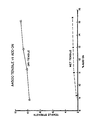
- the sole drawing is a graphic presentation of the wet and dry tensile strengths of an emulsion copolymer at several add-on amounts.
- the invention comprises depositing a pretreatment, adhesion promoting agent on cellulosic fibers that compose the nonwoven web in a bonded nonwoven product.
- This deposition can be most conveniently performed in an aqueous cellulosic fiber slurry prior to formation of the web; for example, the pulp fiber supplier to the nonwovens manufacture could perform the pretreatment.
- the deposition may also be performed on a cellulosic fibrous web or sheet by saturating with the pretreatment agent. If the treated cellulosic fibers are not already in the form of a consolidated sheet, this can be achieved, for example, using wet-laid or air-laid papermaking technology.
- the binder polymer is then applied to the treated cellulosic fibers as currently practiced in the air-laid and wet-laid papermaking processes.
- fiber pretreatments are common in industry, they are normally used with low surface energy, hydrophobic fibers, such as polyesters, polyamides, and polypropylene, to improve wetting and processing.
- the present invention uses a pretreatment for cellulosic fibers, which have a high surface energy, and, specifically, a pretreatment to enhance nonwoven binder efficiency.
- the method comprises
- suitable pretreatment agents are polyethylenimines, polypropylenimines, polyfunctional aziridine compounds, poly(aminoamide) epichlorohydrin resins, polydiallylamines, vinyl acetate-ethylene-N-methylolacrylamide (VAE/NMA) copolymers, polydimethylaminoethylmethacrylate, Rhoplex HA-8 acrylic copolymer.
- VAE/NMA vinyl acetate-ethylene-N-methylolacrylamide
- Rhoplex HA-8 acrylic copolymer Rhoplex HA-8 acrylic copolymer.
- Hycar 2600X347 acrylic copolymer polyvinylamine and Fibrabon 33 and Fibrabon 35 wet strength agents.
- Other suitable materials would include compounds, for example oligomeric or polymeric compounds, containing amine, amide, hydroxyl or other polar functionality.
- Such pretreatment agents can be used at up to about 10 wt%, preferably 0.1 to 5 wt%, based on cellulosic fibers. At above about 10 wt% of pretreating agent the nonwoven product may become undesirably stiff.
- overcoat binders that can be applied to the pretreated cellulosic fibers are ethylene-vinyl chloride-acrylamide polymers, ethylene-acrylic acid copolymers, vinylidene chloride copolymers, ethylacrylate-vinyl acetate-methacrylic acid copolymers and vinyl chloride-butylacrylate copolymers.
- suitable materials would include polyneoprenes, butadiene-acrylonitrile copolymers, polyurethanes, styrene-acrylate copolymers, vinyl acetate-acrylate copolymers and vinyl chloride-acrylate copolymers.
- the binder would constitute 3 to 100 wt%, preferably 5 to 50 wt%, based on fiber weight, of the nonwoven product.
- the method by which the pretreatment agent is applied to the cellulosic fibers is not critical. It can be accomplished by adding the pretreatment agent, possibly in aqueous solution, to an aqueous slurry of the cellulosic fibers or the preformed loosely assembled web of fibers can be impregnated with the pretreatment agent by spraying, saturation, or other methods common to the art.
- the starting fiber layer or mass for the nonwoven product can be formed by any one of the conventional techniques for depositing or arranging fibers in a web or layer. These techniques include carding, garnetting, air-laying, wet-laying and the like. Individual webs or thin layers formed by one or more of these techniques can also be laminated to provide a thicker layer for conversion into a fabric. Typically, the fibers extend in a plurality of diverse directions in general alignment with the major plane of the fabric, overlapping, intersecting and supporting one another to form an open, porous structure.
- the fibers to be used in the starting layer are the natural cellulose fibers such as wood pulp, cotton and hemp and the synthetic cellulose fibers such as rayon and regenerated cellulose.
- the fiber starting layer contains at least 50% cellulose fibers whether they be natural or synthetic, or a combination thereof.
- the starting layer may comprise minor amounts of natural fibers such as wool, jute; artificial fibers such as cellulose acetate; synthetic fibers such as polyvinyl alcohol, polyamides, nylon, polyesters, acrylics, polyolefins, i.e. polyethylene, polyvinyl chloride, polyurethane, and the like, alone or in combination with one another.
- the starting layer of pretreated fibers is subjected to at least one of the several types of bonding operations to anchor the individual fibers together to form a self-sustaining web.
- Some of the better known methods of bonding are overall impregnation, spraying, or printing the web with intermittent or continuous straight or wavy lines or areas of binder extending generally transversely or diagonally across the web and additionally, if desired, along the web.
- the amount of binder, calculated on a dry basis, applied to the starting web of pretreated fibers is that amount which is at least sufficient to bind the fibers together to form a self-sustaining web and suitably ranges from about 3 to about 100% or more by weight of the starting web, preferably from about 5 to about 50 wt% of the starting web.
- the impregnated web is then dried. Curing is not necessary to achieve the improved water and solvent resistance afforded by the invention.
- the nonwoven product is suitably dried by passing it through an air oven or the like and, optionally, then through a curing oven.
- Typical laboratory conditions would be drying at 150 to 200°F (66-93°C) for 4 to 6 minutes, followed optionally by curing at 300-310°F (149-154°C) for 3 to 5 minutes or more.
- other time-temperature relationships can be employed as is well known in the art, shorter times at higher temperatures or longer times at lower temperatures being used.
- the method for determining the adhesion of the various compounds and polymers to the cellulose fibers is a cellophane laminate test described as follows: The compound or polymer is applied as either an aqueous solution or emulsion to plasticized cellophane film (Dupont K140204) in an amount of about 1 mil using a wire wound rod. A second sheet of cellophane is then laminated to this while the coating is still wet. The laminate is allowed to dry at room temperature.
- unplasticized cellophane (Dupont 134PUDO) may be used, particularly when the material to be tested does not dry between plasticized cellophane films.
- the unplasticized cellophane has the advantage of allowing the laminate to dry more rapidly, but impairs the bond strength measurement because it is very brittle.
- the dried cellophane laminate is cut into 1x4 inch strips and a 180° peel test is performed at 0.5 in/min on an Instron tester.
- Acceptable pretreatment agents yield bond strengths of greater than 200g on plasticized cellophane, desirably greater than 400g. The values may vary considerably for unplasticized cellophane.
- the criteria for choosing a suitable overcoat binder are (1) good chemical resistance and (2) relatively poor adhesion to cellulose. Chemical resistance is tested in water and MEK. Polymer films approximately 1/8 inch in thickness are submerged in boiling water for one hour. The sample is removed and excess water blotted off before weighing. After drying to constant weight, the percent water absorbed is calculated as follows:
- Acceptable overcoat binders have a wet tensile strength on Whatman #4 filter paper at 10% add-on (using TAPPI Useful Method 656) of less than 3 pli and a boiling water swell of less than 100% or an MEK tensile strength on Whatman #4 paper of less than 4 pli and an MEK swell index of less than 5.
- This Example (Runs 1-30) demonstrates the use of various pretreatment agent/polymer binder combinations to obtain enhanced wet tensile strength.
- the pretreatment agent was applied by saturating Whatman #4 filter paper.
- the polymer emulsion binder was then applied by saturation of the dried, pretreated paper. Even though this method is inefficient due to poor fiber coverage by the pretreatment and its redissolution during binder application, wet strength improvements of 50 to 300% and over 1000% in Runs 17 and 18 (Table I) were achieved over the values obtained with the binder alone. It is believed that deposition of the pretreatment agent via an aqueous slurry of the fiber would yield better fiber coverage and higher efficiency.
- percent improvement was determined in a very conservative manner by comparing the strength of the binder/pretreatment system with that of the individual binder and the pretreatment agent. Since the web itself makes no contribution to tensile strength, percent improvement in the presence of the pretreatment was calculated by subtracting the sum of the individual pretreatment agent and binder tensile strengths from the tensile strength when the combination is used and dividing by the binder tensile strength.
- Figure 1 shows graphically the wet and dry tensile strengths of Airflex 4500 ethylene-vinyl chloride emulsion copolymer at add-on amounts ranging from about 9% to about 15%.
- the increase in tensile strengths is small compared to the approximately 60% increase in copolymer binder amount over the range.
- Runs 32 and 33 demonstrate the need to use an interactive (synergistic) binder/pretreatment agent system according to the invention.
- An interactive system is a pretreating agent which demonstrates good adhesion to the cellulosic fibers (adhesion of at least 200g in the cellophane laminate test) and an overcoat binder which demonstrates relatively weak adhesion to the cellulosic fibers but good chemical resistance.
- Non-synergistic systems are binder/pretreatment agent systems in which both components demonstrate good adhesion to the cellulosic fibers, combinations in which the pretreatment agent has relatively weak adhesion to the cellulosic fibers, or combinations in which the binder has poor chemical (water and solvent) resistance.
- Table IV shows cellophane laminate test data for a number of materials.
- XAMA-7 polyfunctional aziridine compound and Kymene 557 poly(aminoamide)-epichlorohydrin resin did not dry when sandwiched between plasticized cellophane films. Between unplasticized cellophane films the materials dried out and, when tested, demonstrated such a strong adhesion that the cellophane films tore.
- Table V shows binder criteria data which indicates that Acrysol ASE 108 acrylic copolymer, Airflex 4500 ethylene-vinyl chloride copolymer, acrylate copolymer and ethylene-acrylic acid polymer are suitable as overcoat polymer binders.
- Airflex 4500 emulsion copolymer and the acrylate copolymer have good water resistance, as measured by the boiling water swell test, their wet tensile strength does improve with the use of pretreatments (see Runs 11 and 16). Accordingly a binder/pretreatment combination may be non-interactive with respect to water resistance but interactive with respect to solvent resistance or vice versa.
- Airflex 105 VAE/NMA copolymer and Airflex 4500 EVCl copolymer can covalently bond through the reaction of the N-methylolacrylamide in the former with the acrylamide in the latter.
- the Airflex 105 copolymer pretreatment was made alkaline with sodium hydroxide. It can be seen from the data in Table VIII that under these conditions (Runs 43 and 44), performance was not impaired, implying that covalent bond formation is not a necessary condition for obtaining this synergistic effect.
- Table X shows the solvent resistance for the binder/pretreatment systems of Runs 48 and 49 according to the invention. It is evident from Table X that the present invention may be employed to obtain a nonwoven product demonstrating improved solvent resistance.
- Cellulosic nonwoven products such as paper towels, industrial wipes, protective garments, medical/surgical materials, filters and the like, of enhanced wet and/or solvent strength can be obtained using the binder/pretreatment agent process of the invention.
Landscapes
- Engineering & Computer Science (AREA)
- Textile Engineering (AREA)
- Chemical & Material Sciences (AREA)
- Chemical Kinetics & Catalysis (AREA)
- Dispersion Chemistry (AREA)
- General Chemical & Material Sciences (AREA)
- Paper (AREA)
- Nonwoven Fabrics (AREA)
- Treatments For Attaching Organic Compounds To Fibrous Goods (AREA)
Claims (10)
- Verfahren zum verbinden eines Faserfließgewebes aus Zellulosefasern durch Auftragen eines polymeren Bindemittels auf das Gewebe, wobei die verbesserung umfaßt:(1) vorbehandlung der Zellulosefasern durch Auftragen einer die Adhäsion fördernden verbindung bis zu etwa 10 Gew-%, die eine Adhäsion an Zellulose von mindestens 200g zeigt, gemessen durch den weichmacherhaltigen Zellophanlaminatversuch,(2) Formen der Fasern zu einem Faserfließgewebe, wenn sie nicht bereits in dieser Form vorliegen, und Trocknen dieses Gewebes, und(3) Auftragen einer Menge des Polymerbindemittels auf das trockene Faserfließgewebe der vorbehandelten Zellulosefasern, die ausreichend ist, um ein gebundenes selbsthaltendes Gewebe zu schaffen, wobei das Polymerbindemittel auf Whatman-Filterpapier No. 4 bei 10% Zusatz (TAPPI praktisches Verfahren 656) eine Naßzerreißfestigkeit von weniger als 3 pli und einen Quellwert von weniger als 100%, wobei der Siedewasserversuch angewendet wird, oder auf Whatman-Filterpapier No. 4 bei 10% Zusatz (TAPPI praktisches verfahren 656) eine MEK-Zerreißfestigkeit von weniger als 4 pli und einen MEK-Quellindex von weniger als 5 aufweist.
- Verfahren nach Anspruch 1, worin auf den Zellulosefasern 0,1 bis 5 Gew-% einer die Adhäsion fördernden Verbindung aufgetragen werden.
- Verfahren nach Anspruch 1, worin die die Adhäsion fördernde Verbindung eine Adhäsion an Zellulosefasern von mindestens 400g aufweist.
- Verfahren nach Anspruch 1, worin auf den vorbehandelten Zellulosefasern 3 bis 100 Gew-% des Polymerbindemittels aufgetragen werden.
- Verfahren nach Anspruch 1, worin auf den vorbehandelten Zellulosefasern 5 bis 50 Gew-% des Polymerbindemittels aufgetragen werden.
- Verfahren nach Anspruch 1, worin die die Adhäsion fördernde Verbindung aus der Gruppe ausgewählt ist, die aus Polyethyleniminen, Polypropyleniminen, mehrwertigen Aziridinverbindungen, Poly(aminoamid)-Epichlorhydrinharzen, Polydiallylaminen, Vinylacetat-Ethylen-N-Methylolacrylamid (VAE/NMA)-Copolymeren, Polydimethylaminoethylmethacrylat, Rhoplex HA-8-Acrylsäure-Copolymer, Hycar 2600X347-Acrylsäure-Copolymer, Polyvinylamin und Fibrabon 33- und Fibrabon 35-Naßfestigkeitsmitteln besteht.
- Verfahren nach Anspruch 1, worin das Polymerbindemittel aus der Gruppe ausgewählt ist, die aus Ethylen-Vinylchlorid-Acrylamid-Polymeren, Ethylen-Acrylsäure-Copolymeren, Vinylidenchloridcopolymeren, Ethylacrylat-Vinylacetat-Methacrylsäure-Copolymeren, Vinylchlorid-Butylacrylat-Copolymeren, Polyneoprenen, Butadien-Acrylnitril-Copolymeren, Polyurethanen, Styrol-Acrylat-Copolymeren, Vinylacetat-Acrylat-Copolymeren und Vinylchlorid-Acrylat-Copolymeren besteht.
- Verfahren nach Anspruch 1, worin das Polymerbindemittel eine Naßzerreißfestigkeit von weniger als 2,5 pli und einen Quellwertindex von weniger als 50%, wobei der Siedewasserversuch angewendet wird, oder eine MEK-Zerreißfestigkeit von weniger als 3 pli und einen MEK-Quellindex von weniger als 3 aufweist.
- Verfahren nach Anspruch 3, worin das Polymerbindemittel eine Naßzerreißfestigkeit von weniger als 2,5 pli und einen Quellwertindex von weniger als 50%, wobei der Siedewasserversuch angewendet wird, oder eine MEK-Zerreißfestigkeit von weniger als 3 pli und einen MEK-Quellindex von weniger als 3 aufweist.
- Verfahren nach Anspruch 1, worin die Kombinationen von Polymerbindemittel/die Adhäsion fördernde Verbindung aus der Gruppe ausgewählt sind, die aus Ethylen-Vinylchlorid-Copolymer/Polyethylenimin, Ethylen-Acrylsäure-Copolymer/mehrwertige Aziridinverbindung, Polyvinylidenchloridcopolymer/Polyethylenimin, Ethylen-Vinylchlorid-Copolymer/Polypropylenimin, Acrylatcopolymer/mehrwertige Aziridinverbindung, Acrylsäurecopolymer/Poly(aminoamid)-Epichlorhydrinharz, Butylacrylat-Vinylidenchlorid-Copolymer/Poly(aminoamid)-Epichlorhydrinharz, Butylacrylat-Vinylidenchlorid-Copolymer/Polyethylenimin und Acrylatcopolymer/Vinylacetat-Ethylen-N-Methylolacrylamid-Copolymer besteht.
Applications Claiming Priority (2)
| Application Number | Priority Date | Filing Date | Title |
|---|---|---|---|
| US869141 | 1986-05-29 | ||
| US06/869,141 US4859527A (en) | 1986-05-29 | 1986-05-29 | Cellulosic nonwoven products of enhanced water and/or solvent resistance by pretreatment of the cellulosic fibers |
Publications (2)
| Publication Number | Publication Date |
|---|---|
| EP0247539A1 EP0247539A1 (de) | 1987-12-02 |
| EP0247539B1 true EP0247539B1 (de) | 1991-07-03 |
Family
ID=25353000
Family Applications (1)
| Application Number | Title | Priority Date | Filing Date |
|---|---|---|---|
| EP19870107498 Expired - Lifetime EP0247539B1 (de) | 1986-05-29 | 1987-05-22 | Nichtgewebte Celluloseprodukte erhöhter Wasser- und/oder Lösungsmittel-Beständigkeit durch Vorbehandlung der Cellulosefasern |
Country Status (5)
| Country | Link |
|---|---|
| US (1) | US4859527A (de) |
| EP (1) | EP0247539B1 (de) |
| JP (1) | JPH07113184B2 (de) |
| CA (1) | CA1303435C (de) |
| DE (1) | DE3771126D1 (de) |
Cited By (1)
| Publication number | Priority date | Publication date | Assignee | Title |
|---|---|---|---|---|
| US6270893B1 (en) | 1989-03-20 | 2001-08-07 | Weyerhaeuser Company | Coated fiber product with adhered super absorbent particles |
Families Citing this family (37)
| Publication number | Priority date | Publication date | Assignee | Title |
|---|---|---|---|---|
| CA2012524A1 (en) * | 1989-03-20 | 1990-09-20 | Amar N. Neogi | Natural fiber product coated with a thermoplastic binder material |
| CA2012526A1 (en) * | 1989-03-20 | 1990-09-20 | Amar N. Neogi | Natural fiber product coated with a thermoset binder material |
| US5360420A (en) * | 1990-01-23 | 1994-11-01 | The Procter & Gamble Company | Absorbent structures containing stiffened fibers and superabsorbent material |
| US5074316A (en) * | 1990-03-12 | 1991-12-24 | Baxter International Inc. | Brachial angiography surgical drape |
| FR2679573B1 (fr) * | 1991-07-25 | 1993-09-24 | Perfojet Sa | Procede pour la fabrication d'une nappe non tissee lavable a base de coton, et nappe ainsi obtenue. |
| US5391426A (en) * | 1992-03-11 | 1995-02-21 | W. L. Gore & Associates, Inc. | Polyalkyleneimine coated material |
| DE4228975C2 (de) * | 1992-08-31 | 2002-01-31 | Gore W L & Ass Gmbh | Oleophob und/oder permanente hydrophob ausgerüstete Fasern, textile Materialien und Membranen, Verfahren zur Herstellung der Fasern, textilen Materialien und Membranen |
| US5706038A (en) * | 1994-10-28 | 1998-01-06 | Hewlett-Packard Company | Wet wiping system for inkjet printheads |
| US5562980A (en) * | 1994-11-02 | 1996-10-08 | Cartons St-Laurent Inc. | Multi-layer wrapper construction |
| US5695486A (en) * | 1995-09-19 | 1997-12-09 | Buckeye Cellulose Corporation | Light-weight, low density absorbent structure and method of making the structure |
| US5993604A (en) * | 1995-12-05 | 1999-11-30 | The Dow Chemical Company | Internally sized articles and method for making same |
| EP0941157B1 (de) * | 1996-12-06 | 2004-02-04 | Weyerhaeuser Company | Einteiliger verbundschichtstoff |
| US6096152A (en) * | 1997-04-30 | 2000-08-01 | Kimberly-Clark Worldwide, Inc. | Creped tissue product having a low friction surface and improved wet strength |
| US6103364A (en) * | 1997-06-30 | 2000-08-15 | Kimberly-Clark Worldwide, Inc. | Ink jet printable, washable saturated cellulosic substrate |
| US6153207A (en) * | 1998-03-05 | 2000-11-28 | Pugliese; Peter T. | Anti-cellulite pantyhose |
| KR100358412B1 (ko) * | 1998-12-22 | 2002-10-25 | 니혼 캠브리지 필터 가부시키가이샤 | 에어필터용 여과재와 그 제조방법 |
| AR024696A1 (es) | 1999-07-08 | 2002-10-23 | Armstrong World Ind Inc | Compuestos para impartir propiedades deseadas a los materiales |
| US7344607B2 (en) * | 1999-07-08 | 2008-03-18 | Ge Betz, Inc. | Non-chromate conversion coating treatment for metals |
| DE10022464A1 (de) | 2000-05-09 | 2001-11-22 | Sca Hygiene Prod Gmbh | Flächiges Erzeugnis mit mehreren adhäsiv verbundenen faserhaltigen Lagen |
| US7317053B1 (en) | 2000-07-10 | 2008-01-08 | Hercules Incorporated | Compositions for imparting desired properties to materials |
| US6464830B1 (en) | 2000-11-07 | 2002-10-15 | Kimberly-Clark Worldwide, Inc. | Method for forming a multi-layered paper web |
| JP4777542B2 (ja) * | 2001-06-19 | 2011-09-21 | 日東電工株式会社 | 貼付剤および貼付製剤、ならびにそれらの製造方法 |
| US6835413B2 (en) * | 2002-09-17 | 2004-12-28 | Owens Corning Fiberglas Technology, Inc. | Surface coating for insulation pack |
| JP2004107839A (ja) * | 2002-09-20 | 2004-04-08 | Dainippon Ink & Chem Inc | パルプ不織布 |
| US7189307B2 (en) * | 2003-09-02 | 2007-03-13 | Kimberly-Clark Worldwide, Inc. | Low odor binders curable at room temperature |
| US20050045293A1 (en) * | 2003-09-02 | 2005-03-03 | Hermans Michael Alan | Paper sheet having high absorbent capacity and delayed wet-out |
| WO2005021646A2 (en) | 2003-09-02 | 2005-03-10 | Kimberly-Clark Worldwide, Inc. | Low odor binders curable at room temperature |
| AU2005223685B2 (en) * | 2004-03-19 | 2010-03-04 | Commonwealth Scientific And Industrial Research Organisation | Activation method |
| WO2005089480A2 (en) | 2004-03-19 | 2005-09-29 | Stuart Arthur Bateman | Activation method |
| US7297231B2 (en) | 2004-07-15 | 2007-11-20 | Kimberly-Clark Worldwide, Inc. | Binders curable at room temperature with low blocking |
| US20060042726A1 (en) * | 2004-09-02 | 2006-03-02 | General Electric Company | Non-chrome passivation of steel |
| US7491274B2 (en) * | 2004-10-29 | 2009-02-17 | Chemetall Corp. | Non-chrome metal treatment composition |
| US20060144541A1 (en) * | 2004-12-30 | 2006-07-06 | Deborah Joy Nickel | Softening agent pre-treated fibers |
| JP5563195B2 (ja) | 2005-01-21 | 2014-07-30 | コモンウェルス サイエンティフィック アンドインダストリアル リサーチ オーガナイゼーション | 改質物質を用いる活性化方法 |
| EP2749680A1 (de) * | 2009-06-09 | 2014-07-02 | Buckeye Technologies Inc. | Gefärbtes Zellulosefaserblatt, gefärbtes Vliesmaterial und Prozesse zu deren Herstellung |
| DE102013000333A1 (de) * | 2013-01-11 | 2014-07-17 | Carl Freudenberg Kg | Beschichtungssystem |
| US11214684B2 (en) * | 2015-12-09 | 2022-01-04 | Celanese International Corporation | Carboxylated vinyl acetate/ethylene copolymer dispersions and uses therof |
Family Cites Families (18)
| Publication number | Priority date | Publication date | Assignee | Title |
|---|---|---|---|---|
| US3049469A (en) * | 1957-11-07 | 1962-08-14 | Hercules Powder Co Ltd | Application of coating or impregnating materials to fibrous material |
| US2601597A (en) * | 1946-09-06 | 1952-06-24 | American Cyanamid Co | Application of dispersed coating materials to cellulosic fibers |
| FR1306296A (fr) * | 1961-11-09 | 1962-10-13 | Feldmuehle Ag | Procédé de fabrication de papiers minces ayant une résistance améliorée à l'humidité |
| DE1270943B (de) * | 1964-01-15 | 1968-06-20 | Eastman Kodak Co | Verfahren zur Herstellung von nassfesten, formaldehydfreien Papieren |
| US3380851A (en) * | 1965-03-31 | 1968-04-30 | Air Reduction | Nonwoven fabric with vinyl acetateethylene-n-methylol acrylamide interpolymer as binder |
| GB1163843A (en) * | 1965-09-27 | 1969-09-10 | Mead Corp | Apparatus for Incorporating Additives in Paper and the like |
| DE1771903B1 (de) * | 1968-07-27 | 1972-04-27 | Roehm Gmbh | Verfahren zur Herstellung von Papieren,Pappen und Faservliesstoffen mit verminderter Spaltbarkeit |
| US3594210A (en) * | 1969-04-17 | 1971-07-20 | Johnson & Johnson | Method of controlling resin deposition on absorbent materials |
| DE2026241A1 (de) * | 1969-06-05 | 1970-12-10 | Rohm and Haas Company, Philadelphia, Pa. (V.St.A.) | Verfahren zur Aufbringung von Polymeren auf faserartigen Substraten |
| US4291087A (en) * | 1979-06-12 | 1981-09-22 | Rohm And Haas Company | Non-woven fabrics bonded by radiation-curable, hazard-free binders |
| JPS56140152A (en) * | 1980-03-28 | 1981-11-02 | Kuraray Co | Fiber bider |
| DE3044631A1 (de) * | 1980-11-27 | 1982-06-03 | Fa. Carl Freudenberg, 6940 Weinheim | Vliesstoff mit dochtwirkung |
| US4332850A (en) * | 1981-05-26 | 1982-06-01 | Air Products And Chemicals, Inc. | Vinyl acetate-ethylene emulsions for nonwoven goods |
| EP0071392A1 (de) * | 1981-07-28 | 1983-02-09 | Bip Chemicals Limited | Papierherstellung |
| US4600462A (en) * | 1981-09-29 | 1986-07-15 | James River/Dixie-Northern, Inc. | Incorporation of a hydrophile in fibrous webs to enhance absorbency |
| US4505775A (en) * | 1983-06-24 | 1985-03-19 | Weyerhaeuser Company | Method for preparation of cationic cellulose |
| US4481250A (en) * | 1983-07-29 | 1984-11-06 | Air Products And Chemicals, Inc. | Vinyl acetate-ethylene binder composition having good wet tensile strength and low heat seal temperature for nonwoven products |
| US4605589A (en) * | 1984-10-25 | 1986-08-12 | Air Products And Chemicals, Inc. | Vinyl acetate-ethylene copolymer binder emulsions for medical-surgical nonwoven fabrics |
-
1986
- 1986-05-29 US US06/869,141 patent/US4859527A/en not_active Expired - Lifetime
-
1987
- 1987-05-22 CA CA 537740 patent/CA1303435C/en not_active Expired - Lifetime
- 1987-05-22 EP EP19870107498 patent/EP0247539B1/de not_active Expired - Lifetime
- 1987-05-22 DE DE8787107498T patent/DE3771126D1/de not_active Expired - Lifetime
- 1987-05-29 JP JP13193287A patent/JPH07113184B2/ja not_active Expired - Lifetime
Cited By (1)
| Publication number | Priority date | Publication date | Assignee | Title |
|---|---|---|---|---|
| US6270893B1 (en) | 1989-03-20 | 2001-08-07 | Weyerhaeuser Company | Coated fiber product with adhered super absorbent particles |
Also Published As
| Publication number | Publication date |
|---|---|
| DE3771126D1 (de) | 1991-08-08 |
| US4859527A (en) | 1989-08-22 |
| EP0247539A1 (de) | 1987-12-02 |
| CA1303435C (en) | 1992-06-16 |
| JPH07113184B2 (ja) | 1995-12-06 |
| JPS62299556A (ja) | 1987-12-26 |
Similar Documents
| Publication | Publication Date | Title |
|---|---|---|
| EP0247539B1 (de) | Nichtgewebte Celluloseprodukte erhöhter Wasser- und/oder Lösungsmittel-Beständigkeit durch Vorbehandlung der Cellulosefasern | |
| US3228790A (en) | Nonwoven fabric containing polyolefin fibers bonded together with a mixture of polyolefin and acrylic resins | |
| US5071681A (en) | Water absorbent fiber web | |
| CA1325585C (en) | Tearable nonwoven webs and products employing same | |
| US5030507A (en) | Formaldehyde-free nonwoven binder composition | |
| US3770562A (en) | Composite nonwoven fabrics | |
| CA1251592A (en) | Vinyl acetate-ethylene binder composition having good wet tensile strength and low heat seal temperature for nonwoven products | |
| US20030018311A1 (en) | Unitary absorbent layer | |
| JP3324155B2 (ja) | 繊維が接着された基質及びその製造方法並びに該基質にて補強された包装材 | |
| AU643014B2 (en) | Elastomeric saturated nonwoven material | |
| US3093502A (en) | Nonwoven fabrics and methods of manufacturing the same | |
| EP0211165B1 (de) | Basismaterial für eine Wabenkernstruktur und Verfahren zu seiner Herstellung | |
| US4460643A (en) | Nonwoven fibrous backing for vinyl wallcover | |
| CA1321439C (en) | Heat resistant binders | |
| JPH0796745B2 (ja) | 不織布積層材 | |
| US4840840A (en) | Composite material | |
| US3390034A (en) | Method for attaching sliced aligned filaments to a backing | |
| US2410884A (en) | Composite fabric | |
| JP2009185396A (ja) | エアーフィルター用補強材 | |
| US3122447A (en) | Bonded nonwoven fabrics and methods of making the same | |
| US3039913A (en) | Reinforced resin sheet | |
| US3004868A (en) | Resilient non-woven textile materials | |
| US3288631A (en) | Production of non-woven fiber webs stable to water | |
| JP2909826B2 (ja) | セルロース系嵩高性加工シート | |
| JPH0134733Y2 (de) |
Legal Events
| Date | Code | Title | Description |
|---|---|---|---|
| PUAI | Public reference made under article 153(3) epc to a published international application that has entered the european phase |
Free format text: ORIGINAL CODE: 0009012 |
|
| AK | Designated contracting states |
Kind code of ref document: A1 Designated state(s): BE DE FR GB IT NL SE |
|
| 17P | Request for examination filed |
Effective date: 19880126 |
|
| 17Q | First examination report despatched |
Effective date: 19890613 |
|
| GRAA | (expected) grant |
Free format text: ORIGINAL CODE: 0009210 |
|
| AK | Designated contracting states |
Kind code of ref document: B1 Designated state(s): BE DE FR GB IT NL SE |
|
| REF | Corresponds to: |
Ref document number: 3771126 Country of ref document: DE Date of ref document: 19910808 |
|
| ET | Fr: translation filed | ||
| ITF | It: translation for a ep patent filed | ||
| PLBE | No opposition filed within time limit |
Free format text: ORIGINAL CODE: 0009261 |
|
| STAA | Information on the status of an ep patent application or granted ep patent |
Free format text: STATUS: NO OPPOSITION FILED WITHIN TIME LIMIT |
|
| PG25 | Lapsed in a contracting state [announced via postgrant information from national office to epo] |
Ref country code: GB Effective date: 19920522 |
|
| PG25 | Lapsed in a contracting state [announced via postgrant information from national office to epo] |
Ref country code: SE Effective date: 19920523 |
|
| PG25 | Lapsed in a contracting state [announced via postgrant information from national office to epo] |
Ref country code: BE Effective date: 19920531 |
|
| 26N | No opposition filed | ||
| BERE | Be: lapsed |
Owner name: AIR PRODUCTS AND CHEMICALS INC. Effective date: 19920531 |
|
| PG25 | Lapsed in a contracting state [announced via postgrant information from national office to epo] |
Ref country code: NL Effective date: 19921201 |
|
| NLV4 | Nl: lapsed or anulled due to non-payment of the annual fee | ||
| GBPC | Gb: european patent ceased through non-payment of renewal fee |
Effective date: 19920522 |
|
| PG25 | Lapsed in a contracting state [announced via postgrant information from national office to epo] |
Ref country code: FR Effective date: 19930129 |
|
| PG25 | Lapsed in a contracting state [announced via postgrant information from national office to epo] |
Ref country code: DE Effective date: 19930202 |
|
| REG | Reference to a national code |
Ref country code: FR Ref legal event code: ST |
|
| EUG | Se: european patent has lapsed |
Ref document number: 87107498.5 Effective date: 19921204 |
|
| PG25 | Lapsed in a contracting state [announced via postgrant information from national office to epo] |
Ref country code: IT Free format text: LAPSE BECAUSE OF NON-PAYMENT OF DUE FEES;WARNING: LAPSES OF ITALIAN PATENTS WITH EFFECTIVE DATE BEFORE 2007 MAY HAVE OCCURRED AT ANY TIME BEFORE 2007. THE CORRECT EFFECTIVE DATE MAY BE DIFFERENT FROM THE ONE RECORDED. Effective date: 20050522 |