EP0246825A2 - Quaternary salt solution electrolyte for electrolytic capacitors - Google Patents
Quaternary salt solution electrolyte for electrolytic capacitors Download PDFInfo
- Publication number
- EP0246825A2 EP0246825A2 EP87304335A EP87304335A EP0246825A2 EP 0246825 A2 EP0246825 A2 EP 0246825A2 EP 87304335 A EP87304335 A EP 87304335A EP 87304335 A EP87304335 A EP 87304335A EP 0246825 A2 EP0246825 A2 EP 0246825A2
- Authority
- EP
- European Patent Office
- Prior art keywords
- acid
- electrolyte
- solvent
- butyrolactone
- quaternary phosphonium
- Prior art date
- Legal status (The legal status is an assumption and is not a legal conclusion. Google has not performed a legal analysis and makes no representation as to the accuracy of the status listed.)
- Granted
Links
Images
Classifications
-
- H—ELECTRICITY
- H01—ELECTRIC ELEMENTS
- H01G—CAPACITORS; CAPACITORS, RECTIFIERS, DETECTORS, SWITCHING DEVICES, LIGHT-SENSITIVE OR TEMPERATURE-SENSITIVE DEVICES OF THE ELECTROLYTIC TYPE
- H01G9/00—Electrolytic capacitors, rectifiers, detectors, switching devices, light-sensitive or temperature-sensitive devices; Processes of their manufacture
- H01G9/004—Details
- H01G9/022—Electrolytes; Absorbents
-
- H—ELECTRICITY
- H01—ELECTRIC ELEMENTS
- H01G—CAPACITORS; CAPACITORS, RECTIFIERS, DETECTORS, SWITCHING DEVICES, LIGHT-SENSITIVE OR TEMPERATURE-SENSITIVE DEVICES OF THE ELECTROLYTIC TYPE
- H01G11/00—Hybrid capacitors, i.e. capacitors having different positive and negative electrodes; Electric double-layer [EDL] capacitors; Processes for the manufacture thereof or of parts thereof
- H01G11/54—Electrolytes
- H01G11/58—Liquid electrolytes
- H01G11/62—Liquid electrolytes characterised by the solute, e.g. salts, anions or cations therein
-
- H—ELECTRICITY
- H01—ELECTRIC ELEMENTS
- H01G—CAPACITORS; CAPACITORS, RECTIFIERS, DETECTORS, SWITCHING DEVICES, LIGHT-SENSITIVE OR TEMPERATURE-SENSITIVE DEVICES OF THE ELECTROLYTIC TYPE
- H01G9/00—Electrolytic capacitors, rectifiers, detectors, switching devices, light-sensitive or temperature-sensitive devices; Processes of their manufacture
- H01G9/004—Details
- H01G9/022—Electrolytes; Absorbents
- H01G9/035—Liquid electrolytes, e.g. impregnating materials
-
- Y—GENERAL TAGGING OF NEW TECHNOLOGICAL DEVELOPMENTS; GENERAL TAGGING OF CROSS-SECTIONAL TECHNOLOGIES SPANNING OVER SEVERAL SECTIONS OF THE IPC; TECHNICAL SUBJECTS COVERED BY FORMER USPC CROSS-REFERENCE ART COLLECTIONS [XRACs] AND DIGESTS
- Y02—TECHNOLOGIES OR APPLICATIONS FOR MITIGATION OR ADAPTATION AGAINST CLIMATE CHANGE
- Y02E—REDUCTION OF GREENHOUSE GAS [GHG] EMISSIONS, RELATED TO ENERGY GENERATION, TRANSMISSION OR DISTRIBUTION
- Y02E60/00—Enabling technologies; Technologies with a potential or indirect contribution to GHG emissions mitigation
- Y02E60/13—Energy storage using capacitors
Definitions
- the present invention relates to an electrolyte for an aluminum electrolytic capacitor, and more particularly to an electrolyte which can reduce internal resistance of an electrolytic capacitor and broaden the temperature range over which the capacitor can be used, through the use of an electrolyte containing quaternary phosphonium salts as solute dissolved in aprotic solvents.
- Conventional electrolytes for aluminum electrolytic capacitors generally comprise some type of ionizable compound dissolved in a solvent.
- the chemical or electric properties of the electrolyte such as electric conductivity and scintillation voltage become main factors for determining the electric properties of the electrolytic capacitors.
- a solution of boric acid or ammonium borate in ethylene glycol which has low electric conductivity and high scintillation voltage, has been used for aluminum electrolytic capacitors operating of 200 V or higher (U.S. Patent 1,891,207).
- the maximum operating temperature for such an electrolyte system is less than 100°C and normally 85°C because a large amount of water formed during the rapid esterification of glycol and borate species at higher temperature impairs the electric properties of the electrolytic capacitors.
- the minimum operating temperature in such a system is above -20°C since glycol freezes at -17°C.
- electrolytes which have high electric conductivity over the wider temperature range are desirable for imparting lower equivalent series resistance (ESR) and lower impedance at high frequencies to the electrolytic capacitor containing them.
- an electrolyte containing a quaternary phosphonium salt dissoved in an aprotic solvent shows higher electric conductivity than those of conventional electrolyte systems and have succeeded in accomplishing this invention.
- U.S. Patent 3,325,697 refers to quaternary phosphonium salts as one of cations having a reducible group such as nitro groups, etc. which are used for sealed capacitors with non-gas producing electrolyte but there are neither practical illustrations nor examples about this case in the aforesaid patent. Also, we have not yet found any other patents using quaternary phosphonium salts for such electrolyte systems.
- an aluminum electrolytic capacitor utilizing an electrolyte containing a quaternary phosphonium salt as solute dissolved in an aprotic solvent.
- This electrolyte can reduce the internal resistance of the electrolytic capacitor and broaden the temperature range over which the electrolytic capacitor can be used.
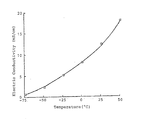
- the drawing is a graph showing the relation between the electric conductivity of the electrolyte obtained in Example 1 and temperature.
- the electrolyte of this invention is a solution of a quaternary phosphonium salt as solute dissolved in an aprotic solvent.
- the cation component of the solute preferred in this invention is a quaternary phosphonium ion represented by the following general formula (I): wherein R1, R2, R3 and R4 each represents a hydrocarbon group having from 1 to 20 carbon atoms, and preferably an alkyl group having from 1 to 10 carbon atoms or an aryl group, said adjoining alkyl groups may combine with each other to form a ring.
- R1, R2, R3 and R4 each represents a hydrocarbon group having from 1 to 20 carbon atoms, and preferably an alkyl group having from 1 to 10 carbon atoms or an aryl group, said adjoining alkyl groups may combine with each other to form a ring.
- alkyl group or aromatic group for R1, R2, R3 and R4 in the general formula (I) described above are a methyl group, an ethyl group, a propyl group, a butyl group, a phenyl group and a benzyl group.
- quaternary phosphonium ion shown by the general formula (I) described above are tetramethylphosphonium, tetraethylphosphonium, tetrapropylphosphonium, tetrabutylphosphonium, methyltriethylphosphonium, methyltripropylphosphonium, methyltributylphosphonium, dimethyldiethylphosphonium, dimethyldipropylphosphonium, dimethyldibutylphosphonium, trimethylethylphosphonium, trimethylpropylphosphonium, trimethylbutylphosphonium, ethyltripropylphosphonium, ethyltributylphosphonium, diethyldipropylphosphonium, diethyldibutylphosphonium, triethylpro pylphosphonium, triethylbutylphosphonium, propyltributy
- examples of the quaternary phosphonium ion shown by the general formula (I) described above wherein the adjoining alkyl groups combine with each other to form a ring are alicyclic phosphonium ions represented by the following general formula (II) or (III): wherein, R1 and R2 each represents an alkyl group of an aryl group as defined above about the general formula (I) and l and m each represents an integer of from 4 to 6.
- Examples of the alicyclic phosphonium ions shown by the general formula (II) or (III) described above are 1,1-dimethylphosphoranium, 1-methyl-1-ethylphosphoranium, 1,1-diethylphsphoranium, 1,1-dimethylphosphorinanium, 1-methyl-1-ethylphosphorinanium, 1,1-diethylphosphorinanium, 1,1-pentamethylenephosphorinanium, etc.
- a quaternary phosphonium ion having a low molecular weight e.g., having up to 10 carbon atoms in the total alkyl and/or aryl groups
- a quaternary phosphonium ion having a high molecular weight such as, for example a tetrabutylphosphonium ion or a tetrahexylphosphonium ion,is preferred.
- the anion component of the solute for use in this invention is a conjugate base of an organic or inorganic acid and examples of the acid are:
- the anions selected from the organic or inorganic weak acids are preferred since they are excellent in the anodic oxidation film-forming faculty on aluminum and, in particular, dicarboxylic acids having the total carbon atom number of at least 10 and boric acid are good "film-forming anions", having high scintillation voltage, and hence can be used for medium to high voltage capacitors.
- the anions of the strong acids are apt to corrode the oxidation film because of their high acidity and hence are used for capacitors for low voltage of up to 100 volts.
- the anions of the acids containing halogen atom liberate a halogen ion unpreferably for aluminum and hence are used for capacitors for low voltage of up to 10 volts only.
- Suitable carboxylic acids for the quaternary phosphonium salts of carboxylic acids are aliphatic and aromatic monovalent or polyvalent carboxylic acids having 1 to 30 total carbon atoms.
- carboxylic acids are aliphatic monocarboxylic acids such as formic acid, acetic acid, propionic acid, butyric acid, valeric acid, caproic acid, enanthic acid, caprylic acid, pelargonic acid, capric acid, undecylic acid, lauric acid, tridecylic acid, myristic acid, pentadecylic acid, palmitic acid, heptadecylic acid, stearic acid, nonadecylic acid, arachidinic acid, isobutyric acid, isovaleric acid, isocaproic acid, ethylbutyric acid, methylvaleric acid, isocaprylic acid, propylvaleric acid, ethylcaproic acid, isocaprylic acid, tuberculostearic acid, pivalic acid, 2,2-dimethylbutanoic acid, 2,2-dimethylpentanoic acid, 2,2-dimethylhexanoi
- phenols in the quaternary phosphonium salts of phenols for use in this invention are phenol, catechol, resorcinol, hydroquinone, phloroglucinol, pyrogallol, 1,2,4-trihydroxybenzene, o-nitrophenol, m-nitrophenol, p-nitrophenol, 2,4-dinitrophenol, 2,5-dinitrophenol, 2,6-dinitrophenol, 3,4-dinitrophenol, 4-nitrocatechol, 2-nitroresorcinol, etc.
- Picric acid which is an organic strong acid is a strong acid having pKa of -0.2.
- Sulfonic acid which is also an organic strong acid is an aliphatic or aromatic mono valent or polyvalent sulfonic acid.
- the total carbon atom number of the sulfonic acid for use in this invention is in the range of from 1 to 30.
- sulfonic acid examples include methanesulfonic acid, ethanesulfonic acid, propanesulfonic acid, butanesulfonic acid, pentanesulfonic acid, hexanesulfonic acid, heptanesulfonic acid, octanesulfonic acid, nonanesulfonic acid, decanesulfonic acid, vinylsulfonic acid, allylsulfonic acid, 1,2-ethanedisulfonic acid, 1,4-butanedisulfonic acid, benzenesulfonic acid, p-toluenesulfonic acid, p-ethylbenzenesulfonic acid, xylenesulfonic acid, naphthalenesulfonic acid, phenolsolfonic acid, nitrobenzenesulfonic acid, 2,4-dinitrobenzenesulfonic acid, picrylsulfonic acid, pyridine
- the inorganic weak acids and the derivatives thereof for use in this invention are, for example, boric acid, boric acid derivatives represented by the general formula (V) described below, phosphoric acid, phosphoric acid esters represented by the general formula (VI) described below, phosphorous acid, phosphorous acid derivatives represented by the general formula (VII), hypophosphorous acid, hypophosphorous acid derivatives represented by the general formula (VIII), carbonic acid, carbonic acid monoesters represented by the general formula (IX), silic acid, etc.
- R5, R6, R7 and R8 each represents an alkyl group having from 1 to 10 carbon atoms or an aryl group and also R6 or R7 may be a hydrogen atom.
- boric acid derivatives shown by the general formula (V) described above are methane boric acid, ethane boric acid, phenyl boric acid, etc.
- phosphoric acid derivatives shown by the general formula (VI) described above are phosphoric acid monomethyl ester, phosphoric acid dimethyl ester, phosphoric acid monophenyl ester, etc.
- phosphorous acid derivatives shown by the general formula (VII) described above are phosphorous acid monomethyl ester, methylphosphonic acid, methylphosphonic acid methyl ester, etc.
- hypophosphorous acid derivatives shown by the general formula (VIII) described above are methylphosphinic acid, dimethylphosphinic acid, phenylphosphinic acid, etc.
- carbonic acid monoesters shown by the general formula (IX) described above are carbonic acid monomethyl ester, carbonic acid monophenyl ester, etc.
- the inorganic strong acids and the derivatives thereof for use in this invention are, for example, nitric acid, sulfuric acid, sulfuric acid monoesters shown by the general formula (X) described below, sulfurous acid, sulfurous acid monoesters shown by the general formula (XI) described below, and thiocyanic acid.
- R9 and R10 each represents an alkyl group having from 1 to 10 carbon atoms or an aryl group.
- the acid containing halogen atom is an acid showing a very strong acidicity owing to the halogen atom having high electronegativity contained therein.
- amide solvents such as N-methylformamide, N-ethylformamide, N,N-dimethylformamide, N,N-diethylformamide, N-methylacetamide, N-ethylacetamide, N,N-dimethylacetamide, N,N-diethylacetamide, N-methylpyrrolidinone, N-methyloxazolidinone, N,N ⁇ -dimethylimidazolidinone, etc.; lactone solvents such as ⁇ -butyrolactone, ⁇ -valerolactone, ⁇ -valerolactone, etc.; carbonate solvents such as ethylene carbonate, propylene carbonate, butylene carbonate, etc.; nitrile solvents such as 3-meth oxypropionitrile, etc.; and phosphoric acid ester solvents such as trimethyl phosphate, etc.
- amide solvents such as N-methylformamide, N-ethylformamide, N,N-di
- solvents composed mainly of aprotic solvents such as amides and lactones are preferred, and particularly solvents composed mainly of ⁇ -butyrolactone are preferred by the following reasons.
- ⁇ -butyrolactone has a broad freezing point-boiling point range and is less toxic. ⁇ -butyrolactone also does not attack the sealing gaskets compared with amide solvents, and electrolytic capacitor using this solvent is hardly suffered serious damage from halogen ion generated from the washing agent for solder flux which will be transmitted through a closure.
- the amount of the quaternary phosphonium salt to be dissolved in the aforesaid solvent depends upon the desired electric conductivity and scintillation voltage but is generally less than the saturated concentration, preferably from 0.1 to 40% by weight, and more preferably from 5 to 30% by weight for low voltage capacitors and from 1 to 20% by weight for medium to high voltage capacitors, based on the weight of the electrolyte.
- the electrolyte of this invention is substantially composed of the quaternary phosphonium salt and the aprotic solvent but may further contain a small amount of an auxiliary solute for various purposes such as the prevention of electrolytic corrosion, the reduction of leakage current, etc.
- An electrolyte was obtained by dissolving monotetraethylphosphonium maleate in an amount of 20% by weight based on a weight of an electrolyte in ⁇ -butyrolactone as the solvent.
- the electric conductivity of the electrolyte at 25°C was 12.1 mS/cm and the scintillation voltage was 93 V when a constant electric current of 4 mA/cm2 was applied to one set of plus and minus smooth aluminum foils in the electrolyte.
- the result of measuring the change of the electric conductivity of the electrolyte by the change of temperature is shown in the accompanying drawing.
- An electrolyte was obtained by the same way as in Example 1 except for using monotetramethylphosphonium maleate in place of monotetraethylphosphonium maleate.
- the electric conductivity at 25°C and the scintillation voltage of the electrolyte were 10.7 mS/cm and 88 V, respectively.
- An electrolyte was obtained by the same way as in Example 1 except for using monotetrabtylphosphonium maleate in place of monotetraethylphosphonium maleate.
- the electric conductivity at 25°C and scintillation voltage of the electrolyte were 6.6 mS/cm and 103 V, respectively.
- An electrolyte was obtained by dissolving monotriethylammonium maleate in an amount of 20% by weight based on a weight of an electrolyte in ⁇ -butyrolactone as the solvent.
- the electric conductivity of the electrolyte at 25°C was 4.2 mS/cm.
- Electrolytes were obtained by the same way as in Example 1 except for using tetraethylphosphonium formate (Example 4), tetraethylphosphonium stearate (Example 5), monotetraethylphosphonium adipate (Example 6), monotetraethylphosphonium sebacate (Example 7), monotetraethylphosphonium eicosanedioate (Example 8), monotetraethylphosphonium dimethylmalonate (Example 9), monotetraethylphoshponium 6-ethyl-1,16-hexadecanedicarboxylate (Example 10), monotetraethylphosphonium cyclopentylmalonate (Example 11), tetraethylphosphonium benzoate (Example 12), and monotetraethylphosphonium phthalate,
- Electrolytes were obtained by the same ways as in Examples 1, 4 and 6 to 13 except for using N,N-dimethylformamide as a solvent in place of ⁇ -butyrolactone.
- the electric conductivities and scintillation voltages of the electrolytes are shown in Table 2 below.
- Electrolytes were obtained by the same ways as in Examples 1 and 4 to 13 except for using propylene carbonate as a solvent in place of ⁇ -butyrolactone.
- the electric conductivities and scintillation voltages of the electrolytes are shown in Table 3 below.
- Electrolytes were obtained by the same ways as in Examples 1, 4, 6, 7 and 9 to 13 except for using trimethyl phosphate as a solvent in place of ⁇ -butyrolactone.
- the electric conductivities and scintillation voltages of the electrolytes are shown in Table 4 below.
- GBL ⁇ -Butyrolactone DMF: N,N-Dimethylformamide
- PC Propylene Carbonate
- TMP Trimethyl Phosphate
- An electrolyte was obtained by dissolving tetrabutylphosphonium phenolate in an amount of 20% by weight based on a weight of an electrolyte in ⁇ -butyrolactone as the solvent.
- the electric conductivity of the electrolyte at 25°C was 5.0 mS/cm and the scintillation voltage of the electrolyte was 105 V when a constant electric current of 4 mA/cm2 was applied to one set of plus and minus smooth aluminum foils in the electrolyte.
- An electrolyte was obtained by dissolving triethylammonium phenolate in an amount of 20% by weight based on a weight of an electrolyte in ⁇ -butyrolactone as the solvent.
- the electric conductivity of the electrolyte at 25°C was 0.4 mS/cm.
- An electrolyte was obtained by dissolving tetrabutylphosphonium methanesulfonate in an amount of 20% by weight based on a weight of an electrolyte in ⁇ -butyrolactone as the solvent.
- the electric conductivity of the electrolyte at 25°C was 5.8 mS/cm and the highest voltage attained was 17 V.
- An electrolyte was obtained by dissolving triethylammonium methanesulfonate in an amount of 20% by weight based on a weight of an electrolyte in ⁇ -butyrolactone as the solvent.
- the electric conductivity of the electrolyte at 25°C was 3.1 mS/cm.
- An electrolyte was obtained by dissolving a tetraethylphosphonium salt of boric acid in an amount of 20% by weight based on a weight of an electrolyte in ⁇ -butyrolactone as the solvent.
- the electric conductivity of the electrolyte at 25°C was 2.8 mS/cm and the scintillation voltage was 420 V when a constant electric current of 4 mA/cm2 was applied to one set of plus and minus smooth aluminum foils in the electrolyte.
- An electrolyte was obtained by the same way as in Example 46 except for using a tetrabutylphosphonium salt of boric acid in place of the tetraethylphosphonium salt of boric acid.
- the electric conductivity at 25°C and the scintilltion voltage of the electrolyte were 0.9 mS/cm and 520 V, respectively.
- An electrolyte was obtained by the same way an in Example 46 except for using a tetraethylphosphonium salt of metaneboric acid in place of the tetraethylphosphonium borate.
- the electric conductivity at 25°C and the scintillation voltage of the electrolyte were 4.6 mS/cm and 210 V, respectively.
- An electrolyte was obtained by dissolving tetrabutylphosphonium salt of phosphoric acid in an amount of 20% by weight based on a weight of an electrolyte in ⁇ -butyrolactone as the solvent.
- the electric conductivity of the electrolyte at 25°C was 6.5 mS/cm.
- An electrolyte was prepared by the same way as in Example 49 except for using N,N-dimethylformamide as the solvent in place of ⁇ -butyrolactone.
- the electric conductivity of the electrolyte at 25°C was 7.6 mS/cm.
- An electrolyte was prepared by the same way as in Example 49 except for using propylene carbonate as the solvent in place of ⁇ -butyrolactone.
- the electric conductivity of the electrolyte at 25°C was 6.5 mS/cm.
- An electrolyte was obtained by dissolving tetra ethylphosphonium salt of phosphorous acid in an amount of 20% by weight based on a weight of an electrolyte in ⁇ -butyrolactone as the solvent.
- the electric conductivity of the electrolyte at 25°C was 8.2 mS/cm and the highest voltage attained was 170 V when a constant electric current of 5 mA/cm2 was applied to one set of plus and minus smooth aluminum foils in the electrolyte.
- An electrolyte was obtained by dissolving tetraethylphosphonium salt of carbonic acid in an amount of 20% by weight based on a weight of an electrolyte in ⁇ -butyrolactone as the solvent.
- the electric conductivity of the electrolyte at 25°C was 8.3 mS/cm and the scintillation voltage thereof was 208 V when a constant electric current of 4 mA/cm2 was applied to one set of plus and minus smooth aluminum foils in the electrolyte.
- An electrolyte was prepared by the same way as in Example 53 except for using N,N-dimethylformamide as the solvent in place of ⁇ -butyrolactone.
- An electrolyte was prepared by the same way as in Example 53 except for using a tetrabutylphosphonium salt of carbonic acid in place of the tetraethylphosphonium salt of carbonic acid.
- An electrolyte was prepared by the same way as in Example 55 except for using propylene carbonate as the solvent in place of ⁇ -butyrolactone.
- An electrolyte was obtained by dissolving methyltributylphosphonium methyl carbonate in an amount of 20% by weight based on a weight of an electrolyte in ⁇ -butyrolactone as the solvent.
- the electric conductivity of the electrolyte at 25°C was 3.6 mS/cm and the scintillation voltage of the electrolyte was 180 V when a constant electric current of 5 mA/cm2 was applied to one set of plus and minus smooth aluminum foils in the electrolyte.
- An electrolyte was obtained by dissolving a tetrabutylphosphonium salt of silic acid in an amount of 20% by weight based on a weight of an electrolyte in ⁇ -butyrolactone as the solvent.
- the electric conductivity of the electrolyte at 25°C was 4.5 mS/cm and the scintillation voltage of the electrolyte was 410 V when a constant electric current of 4 mA/cm2 was applied to one set of plus and minus smooth aluminum foils in the electrolyte.
- An electrolyte was obtained by the same way as in Example 58 except for using N,N-dimethylformamide as the solvent in place of ⁇ -butyrolactone.
- the electric conductivity at 25°C and the scintillation voltage of the electrolyte were 6.1 mS/cm and 500 V, respectively.
- An electrolyte was obtained by the same way as in Example 58 except for using propylene carbonate as the solvent in place of ⁇ -butyrolactone.
- the electric conductivity at 25°C and the scintillation voltage of the electrolyte were 4.7 mS/cm and 500 V, respectively.
- An electrolyte was obtained by dissolving tetraethylphosphonium nitrate in an amount of 20% by weight based on a weight of an electrolyte in ⁇ -butyrolactone as the solvent.
- the electric conductivity of the electrolyte at 25°C was 15.3 mS/cm.
- An electrolyte was prepared by the same way as in Example 61 except for using N,N-dimethylformamide as the solvent in place of ⁇ -butyrolactone.
- the electric conductivity of the electrolyte at 25°C was 20.6 mS/cm.
- An electrolyte was obtained by the same way as in Example 61 except for using monotetraethylphosphonium salt of sulfurous acid in place of tetraethylphosphonium nitrate.
- the electric conductivity at 25°C and the highest voltage attained of the electrolyte were 11.7 mS/cm and 100 V, respectively.
- An electrolyte was obtained by dissolving a tetraethylphosphonium thiocyanate in an amount of 20% by weight based on a weight of an electrolyte in ⁇ -butyrolactone as the solvent.
- the electric conductivity of the electrolyte at 25°C was 15.8 mS/cm.
- An electrolyte was obtained by the same way as in Example 64 except for using N,N-dimethylformamide as the solvent in place of ⁇ -butyrolactone.
- the electric conduc tivity of the electrolyte at 25°C was 21.0 mS/cm.
- An electrolyte was obtained by dissolving tetraethylphosphonium tetrafluoroborate in an amount of 20% by weight based on a weight of an electrolyte in ⁇ -butyrolactone as the solvent.
- the electric conductivity of the electrolyte at 25°C was 17.7 mS/cm.
- an oxide film was formed on the aluminum anode. The highest voltage attained in this case was 85 V.
- Electrolytes were prepared by the same way as in Example 66 except for using tetramethylphosphonium tetrafluoroborate (Example 67) and tetrabutylphosphonium tetrafluoroborate (Example 68) in place of tetraethylphosphonium tetrafluoroborate.
- the electric conductivities of the electrolytes are shown in Table 6 below.
- Electrolytes were prepared by the same way as in Example 66 except for using N,N-dimethylformamide (Example 69) and propylene carbonate (Example 70) as the solvent in place of ⁇ -butyrolactone.
- the electric conductivities of the electrolytes obtained are shown in Table 6 below.
- An electrolyte was obtained by dissolving tetraethylphosphonium hexafluoroantimonate in an amount of 20% by weight based on a weight of an electrolyte in ⁇ -butyrolactone as the solvent.
- the electric conductivity of the electrolyte at 25°C was 12.0 mS/cm.
- an oxide film was formed on the aluminum anode. The highest voltage attained in this case was 270 V.
- Electrolytes were prepared by the same way as in Example 71 except for using tetraethylphosphonium hexafluorophosphate (Example 72), tetraethylphosphonium perchlorate (Example 73), and tetraethylphosphonium trifluoromethanesulfonate (Example 74) in place of tetraethylphosphonium hexa fluoroantimonate.
- the electric conductivities of the electrolytes are shown in Table 7 below.
- Electrolytes were prepared in the same way as in Example 74 except for using N,N-dimethylformamide (Example 75) and propylene carbonate (Example 76) as the solvent in place of ⁇ -butyrolactone, the electric conductivities of the electrolytes are shown in Table 7 below.
Landscapes
- Engineering & Computer Science (AREA)
- Power Engineering (AREA)
- Chemical & Material Sciences (AREA)
- Chemical Kinetics & Catalysis (AREA)
- Electrochemistry (AREA)
- Microelectronics & Electronic Packaging (AREA)
- Secondary Cells (AREA)
- Electric Double-Layer Capacitors Or The Like (AREA)
Abstract
Description
- The present invention relates to an electrolyte for an aluminum electrolytic capacitor, and more particularly to an electrolyte which can reduce internal resistance of an electrolytic capacitor and broaden the temperature range over which the capacitor can be used, through the use of an electrolyte containing quaternary phosphonium salts as solute dissolved in aprotic solvents.
- Conventional electrolytes for aluminum electrolytic capacitors generally comprise some type of ionizable compound dissolved in a solvent.
- The chemical or electric properties of the electrolyte, such as electric conductivity and scintillation voltage become main factors for determining the electric properties of the electrolytic capacitors.
- For example, a solution of boric acid or ammonium borate in ethylene glycol, which has low electric conductivity and high scintillation voltage, has been used for aluminum electrolytic capacitors operating of 200 V or higher (U.S. Patent 1,891,207). The maximum operating temperature for such an electrolyte system is less than 100°C and normally 85°C because a large amount of water formed during the rapid esterification of glycol and borate species at higher temperature impairs the electric properties of the electrolytic capacitors. The minimum operating temperature in such a system is above -20°C since glycol freezes at -17°C.
- On the other hand, a solution of an amine or an quaternary ammonium salt of carboxylic acid in an aprotic solvent such as N,N-dimethylformamide or γ-butyrolactone is used for low voltage electrolytic capacitors, which have good low temperature characteristics (U.S. Patents 3,812,039 and 4,473,864).
- However, electrolytes which have high electric conductivity over the wider temperature range are desirable for imparting lower equivalent series resistance (ESR) and lower impedance at high frequencies to the electrolytic capacitor containing them.
- As the result of various investigations on discovering electrolyte systems having higher electric conductivity, the inventors have discovered that an electrolyte containing a quaternary phosphonium salt dissoved in an aprotic solvent shows higher electric conductivity than those of conventional electrolyte systems and have succeeded in accomplishing this invention.
- As to electrolytes using quaternary phosphonium salts, U.S. Patent 3,325,697 refers to quaternary phosphonium salts as one of cations having a reducible group such as nitro groups, etc. which are used for sealed capacitors with non-gas producing electrolyte but there are neither practical illustrations nor examples about this case in the aforesaid patent. Also, we have not yet found any other patents using quaternary phosphonium salts for such electrolyte systems.
- Thus, it is a feature of this invention to provide an aluminum electrolytic capacitor utilizing an electrolyte containing a quaternary phosphonium salt as solute dissolved in an aprotic solvent. This electrolyte can reduce the internal resistance of the electrolytic capacitor and broaden the temperature range over which the electrolytic capacitor can be used.
- The drawing is a graph showing the relation between the electric conductivity of the electrolyte obtained in Example 1 and temperature.
- The electrolyte of this invention is a solution of a quaternary phosphonium salt as solute dissolved in an aprotic solvent.
- The cation component of the solute preferred in this invention is a quaternary phosphonium ion represented by the following general formula (I):

- Specific examples of the alkyl group or aromatic group for R₁, R₂, R₃ and R₄ in the general formula (I) described above are a methyl group, an ethyl group, a propyl group, a butyl group, a phenyl group and a benzyl group.
- Also, specific examples of the quaternary phosphonium ion shown by the general formula (I) described above are tetramethylphosphonium, tetraethylphosphonium, tetrapropylphosphonium, tetrabutylphosphonium, methyltriethylphosphonium, methyltripropylphosphonium, methyltributylphosphonium, dimethyldiethylphosphonium, dimethyldipropylphosphonium, dimethyldibutylphosphonium, trimethylethylphosphonium, trimethylpropylphosphonium, trimethylbutylphosphonium, ethyltripropylphosphonium, ethyltributylphosphonium, diethyldipropylphosphonium, diethyldibutylphosphonium, triethylpro pylphosphonium, triethylbutylphosphonium, propyltributylphosphonium, dipropyldibutylphosphonium, tripropylbutylphosphonium, trimethyldecylphosphonium, trimethylphenylphosphonium, triethylphenylphosphonium, tripropylphenylphosphonium, tributylphenylphosphonium, methyltriphenylphosphonium, ethyltriphenylphosphonium, propyltriphenylphosphonium, butyltriphenylphosphonium, tetraphenylphosphonium and trimethylbenzylphosphonium.
- Also, examples of the quaternary phosphonium ion shown by the general formula (I) described above wherein the adjoining alkyl groups combine with each other to form a ring are alicyclic phosphonium ions represented by the following general formula (II) or (III):

- Examples of the alicyclic phosphonium ions shown by the general formula (II) or (III) described above are 1,1-dimethylphosphoranium, 1-methyl-1-ethylphosphoranium, 1,1-diethylphsphoranium, 1,1-dimethylphosphorinanium, 1-methyl-1-ethylphosphorinanium, 1,1-diethylphosphorinanium, 1,1-pentamethylenephosphorinanium, etc.
- Furthermore, polycations shown by the general formula (IV) described below can be also effectively used as the quaternary phosphonium ions:

- In order to provide an electrolyte having higher electric conductivity, a quaternary phosphonium ion having a low molecular weight (e.g., having up to 10 carbon atoms in the total alkyl and/or aryl groups), such as, for example, a tetraethylphosphonium ion or a methyltriethylphosphonium ion is preferred, while in order to obtain an electrolyte having high scintillation voltage, a quaternary phosphonium ion having a high molecular weight, such as, for example a tetrabutylphosphonium ion or a tetrahexylphosphonium ion,is preferred.
- The anion component of the solute for use in this invention is a conjugate base of an organic or inorganic acid and examples of the acid are:
- (1) organic carboxylic acids and organic weak acids such as phenols having pKa of at least 1, etc.;
- (2) organic strong acids such as picric acid, sulfonic acid, etc.;
- (3) inorganic weak acids having pKa of at least 1, such as boric acid, phosphoric acid, phosphorous acid, hypophosphorous acid, carbonic acid, silic acid, etc., and the alkyl or aryl derivatives thereof;
- (4) inorganic strong acids such as nitric acid, sulfuric acid, sulfurous acid, thiocyanic acid, etc., and the derivatives thereof; and
- (5) very strong acids having pKa of up to 0 (i.e., 0 or a negative value) containing halogen atom.
- The anions selected from the organic or inorganic weak acids are preferred since they are excellent in the anodic oxidation film-forming faculty on aluminum and, in particular, dicarboxylic acids having the total carbon atom number of at least 10 and boric acid are good "film-forming anions", having high scintillation voltage, and hence can be used for medium to high voltage capacitors.
- The anions of the strong acids are apt to corrode the oxidation film because of their high acidity and hence are used for capacitors for low voltage of up to 100 volts.
- Also, the anions of the acids containing halogen atom liberate a halogen ion unpreferably for aluminum and hence are used for capacitors for low voltage of up to 10 volts only.
- Suitable carboxylic acids for the quaternary phosphonium salts of carboxylic acids, which are used in this invention, are aliphatic and aromatic monovalent or polyvalent carboxylic acids having 1 to 30 total carbon atoms.
- Specific examples of these carboxylic acids are aliphatic monocarboxylic acids such as formic acid, acetic acid, propionic acid, butyric acid, valeric acid, caproic acid, enanthic acid, caprylic acid, pelargonic acid, capric acid, undecylic acid, lauric acid, tridecylic acid, myristic acid, pentadecylic acid, palmitic acid, heptadecylic acid, stearic acid, nonadecylic acid, arachidinic acid, isobutyric acid, isovaleric acid, isocaproic acid, ethylbutyric acid, methylvaleric acid, isocaprylic acid, propylvaleric acid, ethylcaproic acid, isocaprylic acid, tuberculostearic acid, pivalic acid, 2,2-dimethylbutanoic acid, 2,2-dimethylpentanoic acid, 2,2-dimethylhexanoic acid, 2,2-dimethylheptanoic acid, 2,2-dimethyloctanoic acid, 2-methyl-2-ethylbutanoic acid, 2-methyl-2-ethylpentanoic acid, 2-methyl-2-ethylhexanoic acid, 2-methyl-2-ethyl-heptanoic acid, 2-methyl-2-propylpentanoic acid, 2-methyl-2-propylhexanoic acid, 2-methyl-2-propylheptanoic acid, acrylic acid, crotonic acid, isocrotonic acid, 3-butenoic acid, pentenoic acid, hexenoic acid, heptenoic acid, octenoic acid, nonenoic acid, decenoic acid, undecenoic acid, dodecenoic acid, tudzuic acid, physeteric acid, goshuyuic acid, palmitoleic acid, petroselinic acid, oleic acid, elaidic acid, vaccenic acid, gadoleic acid, methacrylic acid, 3-methylcrotonic acid, tiglic acid, methylpentenoic acid, cyclopentanecarboxylic acid, cyclohexanecarboxylic acid, etc.; aliphatic dicarboxylic acids such as oxalic acid, malonic acid, succinic acid, glutaric acid, adipic acid, pimelic acid, suberic acid, azelaic acid, sebacic acid, undecanedioic acid, dodecanedioic acid, tridecanedioic acid, tetradecanodioic acid, pentadecanedioic acid, hexadecanedioic acid, heptadecanedioic acid, octadecanedioic acid, nonadecanedioic acid, eicosanedioic acid, methylmalonic acid, ethylmalonic acid, propylmalonic acid, butylmalonic acid, pentylmalonic acid, hexylmalonic acid, dimethylmalonic acid, methylethylmalonic acid, diethylmalonic acid, methylpropylmalonic acid, methylbutylmalonic acid, ethylpropylmalonic acid, dipropylmalonic acid, ethylbutylmalonic acid, propylbutylmalonic acid, dibutylmalonic acid, methylsuccinic acid, ethyl succinic acid, 2,2-dimethylsuccinic acid, 2,3-dimethylsuccinic acid, 2-methylglutaric acid, 3-methylglutaric acid, 3-methyl-3-ethylglutaric acid, 3,3-diethylglutaric acid, maleic acid, citranconic acid, 1,5-octanedicarboxylic acid, 5,6-decanedicarboxylic acid, 1,7-decanedicarboxylic acid, 4,6-dimethyl-4-nonene-1,2-dicarboxylic acid, 4,6-dimethyl-1,2-nonanedicarboxylic acid, 1,7-dodecanedicarboxylic acid, 5-ethyl-1,10-decanedicarboxylic acid, 6-methyl-6-dodecene-1,12-dicarboxylic acid, 6-methyl-1,12-dodecanedicarboxylic acid, 6-ethylene-1,12-dodecanedicarboxylic acid, 6-ethyl-1,12-dodecanedicarboxylic acid, 7-methyl-7-tetradecene-1,14-dicarboxylic acid, 7-methyl-1,14-tetradecanedicarboxylic acid, 3-hexyl-4-decene-1,2-dicarboxylic acid, 3-hexyl-1,2-decanedicarboxylic acid, 6-ethylene-9-hexadecene-1,16-dicarboxylic acid, 6-ethyl-1,16-dexadecanedicarboxylic acid, 6-phenyl-1,12-dodecanedicarboxylic acid, 7,12-dimethyl-7,11-octadecadiene-1,18-dicarboxylic acid, 7,12-dimethyl-1,18-octadecanedicarboxylic acid, 6,8-diphenyl-1,14-tetradecanedicarboxylic acid, 1,1-cyclopentanedicarboxylic acid, 1,2-cyclopentanedicarboxylic acid, 1,1-cyclohexanedicarboxylic acid, 1,2-cyclohexanedicarboxylic acid, 4-cyclohexene-1,2-dicarboxylic acid, 5-norbornene-2,3-dicarboxylic acid, etc.; aromatic monocarboxylic acids (including o, m, p-isomers thereof) such as benzoic acid, toluic acid, ethylbenzoic acid, propylbenzoic acid, isopropylbenzoic acid, butylbenzo ic acid, isobutylbenzoic acid, sec-butylbenzoic acid, tert-butylbenzoic acid, hydroxybenzoic acid, anisic acid, ethoxybenzoic acid, propoxybenzoic acid, isopropoxybenzoic acid, butoxybenzoic acid, isobutoxybenzoic acid, sec-butoxybenzoic acid, tert-butoxybenzoic acid, aminobenzoic acid, N-methyl-aminobenzoic acid, N-ethylaminobenzoic acid, N-propylaminobenzoic acid, N-isopropylaminobenzoic acid, N-butylaminobenzoic acid, N-isobutylaminobenzoic acid, N-secbutylaminobenzoic acid, N-tert-butylaminobenzoic acid, N,N-dimethylaminobenzoic acid, N,N-diethylaminobenzoic acid, nitrobenzoic acid, resorcyclic acid, etc.; and aromatic polyvalent carboxylic acids such as phthalic acid, isophthalic acid, terephthalic acid, 3-nitrophthalic acid, 4-nitrophthalic acid, trimellitic acid, hemimellitic acid, trimesic acid, pyromellitic acid, etc.
- Also, specific examples of phenols in the quaternary phosphonium salts of phenols for use in this invention are phenol, catechol, resorcinol, hydroquinone, phloroglucinol, pyrogallol, 1,2,4-trihydroxybenzene, o-nitrophenol, m-nitrophenol, p-nitrophenol, 2,4-dinitrophenol, 2,5-dinitrophenol, 2,6-dinitrophenol, 3,4-dinitrophenol, 4-nitrocatechol, 2-nitroresorcinol, etc.
- Picric acid which is an organic strong acid is a strong acid having pKa of -0.2. Sulfonic acid which is also an organic strong acid is an aliphatic or aromatic mono valent or polyvalent sulfonic acid. The total carbon atom number of the sulfonic acid for use in this invention is in the range of from 1 to 30.
- Specific examples of the sulfonic acid are methanesulfonic acid, ethanesulfonic acid, propanesulfonic acid, butanesulfonic acid, pentanesulfonic acid, hexanesulfonic acid, heptanesulfonic acid, octanesulfonic acid, nonanesulfonic acid, decanesulfonic acid, vinylsulfonic acid, allylsulfonic acid, 1,2-ethanedisulfonic acid, 1,4-butanedisulfonic acid, benzenesulfonic acid, p-toluenesulfonic acid, p-ethylbenzenesulfonic acid, xylenesulfonic acid, naphthalenesulfonic acid, phenolsolfonic acid, nitrobenzenesulfonic acid, 2,4-dinitrobenzenesulfonic acid, picrylsulfonic acid, pyridine-3-sulfonic acid, m-benzenedisulfonic acid, toluene-3,4-disulfonic acid, etc.
- The inorganic weak acids and the derivatives thereof for use in this invention are, for example, boric acid, boric acid derivatives represented by the general formula (V) described below, phosphoric acid, phosphoric acid esters represented by the general formula (VI) described below, phosphorous acid, phosphorous acid derivatives represented by the general formula (VII), hypophosphorous acid, hypophosphorous acid derivatives represented by the general formula (VIII), carbonic acid, carbonic acid monoesters represented by the general formula (IX), silic acid, etc.

- Specific examples of the boric acid derivatives shown by the general formula (V) described above are methane boric acid, ethane boric acid, phenyl boric acid, etc.
- Specific examples of the phosphoric acid derivatives shown by the general formula (VI) described above are phosphoric acid monomethyl ester, phosphoric acid dimethyl ester, phosphoric acid monophenyl ester, etc.
- Specific examples of the phosphorous acid derivatives shown by the general formula (VII) described above are phosphorous acid monomethyl ester, methylphosphonic acid, methylphosphonic acid methyl ester, etc.
- Specific examples of the hypophosphorous acid derivatives shown by the general formula (VIII) described above are methylphosphinic acid, dimethylphosphinic acid, phenylphosphinic acid, etc.
- Also, specific examples of the carbonic acid monoesters shown by the general formula (IX) described above are carbonic acid monomethyl ester, carbonic acid monophenyl ester, etc.
- The inorganic strong acids and the derivatives thereof for use in this invention are, for example, nitric acid, sulfuric acid, sulfuric acid monoesters shown by the general formula (X) described below, sulfurous acid, sulfurous acid monoesters shown by the general formula (XI) described below, and thiocyanic acid.

- Also, the acid containing halogen atom is an acid showing a very strong acidicity owing to the halogen atom having high electronegativity contained therein. Specific examples of such an acid are HBF₄ (pKa = -5), HPF₆ (pKa = -20), HAsF₆, HSbF₆, CF₃SO₃H (pKA = -13), CF₃COOH (pKa = 0), C₄F₉SO₃H, C₄F₉CO₂H, HCℓO₄ (pKa = -5), etc.
- As the aprotic solvent for dissolving the quaternary phosphonium salts in this invention, there are amide solvents such as N-methylformamide, N-ethylformamide, N,N-dimethylformamide, N,N-diethylformamide, N-methylacetamide, N-ethylacetamide, N,N-dimethylacetamide, N,N-diethylacetamide, N-methylpyrrolidinone, N-methyloxazolidinone, N,Nʹ-dimethylimidazolidinone, etc.; lactone solvents such as γ-butyrolactone, γ-valerolactone, δ-valerolactone, etc.; carbonate solvents such as ethylene carbonate, propylene carbonate, butylene carbonate, etc.; nitrile solvents such as 3-meth oxypropionitrile, etc.; and phosphoric acid ester solvents such as trimethyl phosphate, etc. These solvents can be used singly or as a mixture thereof.
- Among these, solvents composed mainly of aprotic solvents such as amides and lactones are preferred, and particularly solvents composed mainly of γ-butyrolactone are preferred by the following reasons.
- γ-butyrolactone has a broad freezing point-boiling point range and is less toxic. γ-butyrolactone also does not attack the sealing gaskets compared with amide solvents, and electrolytic capacitor using this solvent is hardly suffered serious damage from halogen ion generated from the washing agent for solder flux which will be transmitted through a closure.
- The amount of the quaternary phosphonium salt to be dissolved in the aforesaid solvent depends upon the desired electric conductivity and scintillation voltage but is generally less than the saturated concentration, preferably from 0.1 to 40% by weight, and more preferably from 5 to 30% by weight for low voltage capacitors and from 1 to 20% by weight for medium to high voltage capacitors, based on the weight of the electrolyte.
- The electrolyte of this invention is substantially composed of the quaternary phosphonium salt and the aprotic solvent but may further contain a small amount of an auxiliary solute for various purposes such as the prevention of electrolytic corrosion, the reduction of leakage current, etc.
- Now the invention will be explained in greater detail with reference to the following examples and comparison examples, but the invention is not limited thereto.
- An electrolyte was obtained by dissolving monotetraethylphosphonium maleate in an amount of 20% by weight based on a weight of an electrolyte in γ-butyrolactone as the solvent. The electric conductivity of the electrolyte at 25°C was 12.1 mS/cm and the scintillation voltage was 93 V when a constant electric current of 4 mA/cm² was applied to one set of plus and minus smooth aluminum foils in the electrolyte. In addition, the result of measuring the change of the electric conductivity of the electrolyte by the change of temperature is shown in the accompanying drawing.
- An electrolyte was obtained by the same way as in Example 1 except for using monotetramethylphosphonium maleate in place of monotetraethylphosphonium maleate. The electric conductivity at 25°C and the scintillation voltage of the electrolyte were 10.7 mS/cm and 88 V, respectively.
- An electrolyte was obtained by the same way as in Example 1 except for using monotetrabtylphosphonium maleate in place of monotetraethylphosphonium maleate. The electric conductivity at 25°C and scintillation voltage of the electrolyte were 6.6 mS/cm and 103 V, respectively.
- An electrolyte was obtained by dissolving monotriethylammonium maleate in an amount of 20% by weight based on a weight of an electrolyte in γ-butyrolactone as the solvent. The electric conductivity of the electrolyte at 25°C was 4.2 mS/cm.
- Electrolytes were obtained by the same way as in Example 1 except for using tetraethylphosphonium formate (Example 4), tetraethylphosphonium stearate (Example 5), monotetraethylphosphonium adipate (Example 6), monotetraethylphosphonium sebacate (Example 7), monotetraethylphosphonium eicosanedioate (Example 8), monotetraethylphosphonium dimethylmalonate (Example 9), monotetraethylphoshponium 6-ethyl-1,16-hexadecanedicarboxylate (Example 10), monotetraethylphosphonium cyclopentylmalonate (Example 11), tetraethylphosphonium benzoate (Example 12), and monotetraethylphosphonium phthalate, respectively, in place of monotetraethylphosphonium maleate. The electric conductivities and scintillation voltages of these electrolytes are shown in Table 1 below.
- Electrolytes were obtained by the same ways as in Examples 1, 4 and 6 to 13 except for using N,N-dimethylformamide as a solvent in place of γ-butyrolactone. The electric conductivities and scintillation voltages of the electrolytes are shown in Table 2 below.
- Electrolytes were obtained by the same ways as in Examples 1 and 4 to 13 except for using propylene carbonate as a solvent in place of γ-butyrolactone. The electric conductivities and scintillation voltages of the electrolytes are shown in Table 3 below.
- Electrolytes were obtained by the same ways as in Examples 1, 4, 6, 7 and 9 to 13 except for using trimethyl phosphate as a solvent in place of γ-butyrolactone. The electric conductivities and scintillation voltages of the electrolytes are shown in Table 4 below.
- In addition, the figures in the parentheses in the following tables are the highest voltages attained since spark was not generated.
- Also, in the following tables, the following abbreviations were used.
GBL: γ-Butyrolactone
DMF: N,N-Dimethylformamide
PC: Propylene Carbonate
TMP: Trimethyl Phosphate


- An electrolyte was obtained by dissolving tetrabutylphosphonium phenolate in an amount of 20% by weight based on a weight of an electrolyte in γ-butyrolactone as the solvent. The electric conductivity of the electrolyte at 25°C was 5.0 mS/cm and the scintillation voltage of the electrolyte was 105 V when a constant electric current of 4 mA/cm² was applied to one set of plus and minus smooth aluminum foils in the electrolyte.
- An electrolyte was obtained by dissolving triethylammonium phenolate in an amount of 20% by weight based on a weight of an electrolyte in γ-butyrolactone as the solvent. The electric conductivity of the electrolyte at 25°C was 0.4 mS/cm.
- An electrolyte was obtained by dissolving tetrabutylphosphonium methanesulfonate in an amount of 20% by weight based on a weight of an electrolyte in γ-butyrolactone as the solvent. The electric conductivity of the electrolyte at 25°C was 5.8 mS/cm and the highest voltage attained was 17 V.
- An electrolyte was obtained by dissolving triethylammonium methanesulfonate in an amount of 20% by weight based on a weight of an electrolyte in γ-butyrolactone as the solvent. The electric conductivity of the electrolyte at 25°C was 3.1 mS/cm.
- An electrolyte was obtained by dissolving a tetraethylphosphonium salt of boric acid in an amount of 20% by weight based on a weight of an electrolyte in γ-butyrolactone as the solvent. The electric conductivity of the electrolyte at 25°C was 2.8 mS/cm and the scintillation voltage was 420 V when a constant electric current of 4 mA/cm² was applied to one set of plus and minus smooth aluminum foils in the electrolyte.
- An electrolyte was obtained by the same way as in Example 46 except for using a tetrabutylphosphonium salt of boric acid in place of the tetraethylphosphonium salt of boric acid. The electric conductivity at 25°C and the scintilltion voltage of the electrolyte were 0.9 mS/cm and 520 V, respectively.
- When the conventional ammonium borate was added in an amount of 10% by weight based on a weight of an electrolyte to γ-butyrolactone as the solvent and the mixture was heated, the ammonium salt was not dissolved and hence the mixture was unsuitable for electrolyte.
- An electrolyte was obtained by the same way an in Example 46 except for using a tetraethylphosphonium salt of metaneboric acid in place of the tetraethylphosphonium borate. The electric conductivity at 25°C and the scintillation voltage of the electrolyte were 4.6 mS/cm and 210 V, respectively.
- An electrolyte was obtained by dissolving tetrabutylphosphonium salt of phosphoric acid in an amount of 20% by weight based on a weight of an electrolyte in γ-butyrolactone as the solvent. The electric conductivity of the electrolyte at 25°C was 6.5 mS/cm.
- An electrolyte was prepared by the same way as in Example 49 except for using N,N-dimethylformamide as the solvent in place of γ-butyrolactone. The electric conductivity of the electrolyte at 25°C was 7.6 mS/cm.
- An electrolyte was prepared by the same way as in Example 49 except for using propylene carbonate as the solvent in place of γ-butyrolactone. The electric conductivity of the electrolyte at 25°C was 6.5 mS/cm.
- An electrolyte was obtained by dissolving tetra ethylphosphonium salt of phosphorous acid in an amount of 20% by weight based on a weight of an electrolyte in γ-butyrolactone as the solvent. The electric conductivity of the electrolyte at 25°C was 8.2 mS/cm and the highest voltage attained was 170 V when a constant electric current of 5 mA/cm² was applied to one set of plus and minus smooth aluminum foils in the electrolyte.
- An electrolyte was obtained by dissolving tetraethylphosphonium salt of carbonic acid in an amount of 20% by weight based on a weight of an electrolyte in γ-butyrolactone as the solvent. The electric conductivity of the electrolyte at 25°C was 8.3 mS/cm and the scintillation voltage thereof was 208 V when a constant electric current of 4 mA/cm² was applied to one set of plus and minus smooth aluminum foils in the electrolyte.
- An electrolyte was prepared by the same way as in Example 53 except for using N,N-dimethylformamide as the solvent in place of γ-butyrolactone.
- An electrolyte was prepared by the same way as in Example 53 except for using a tetrabutylphosphonium salt of carbonic acid in place of the tetraethylphosphonium salt of carbonic acid.
- An electrolyte was prepared by the same way as in Example 55 except for using propylene carbonate as the solvent in place of γ-butyrolactone.
- The electric conductivities and scintilation voltages of these electrolytes are shown in Table 5 below.

- An electrolyte was obtained by dissolving methyltributylphosphonium methyl carbonate in an amount of 20% by weight based on a weight of an electrolyte in γ-butyrolactone as the solvent. The electric conductivity of the electrolyte at 25°C was 3.6 mS/cm and the scintillation voltage of the electrolyte was 180 V when a constant electric current of 5 mA/cm² was applied to one set of plus and minus smooth aluminum foils in the electrolyte.
- An electrolyte was obtained by dissolving a tetrabutylphosphonium salt of silic acid in an amount of 20% by weight based on a weight of an electrolyte in γ-butyrolactone as the solvent. The electric conductivity of the electrolyte at 25°C was 4.5 mS/cm and the scintillation voltage of the electrolyte was 410 V when a constant electric current of 4 mA/cm² was applied to one set of plus and minus smooth aluminum foils in the electrolyte.
- An electrolyte was obtained by the same way as in Example 58 except for using N,N-dimethylformamide as the solvent in place of γ-butyrolactone. The electric conductivity at 25°C and the scintillation voltage of the electrolyte were 6.1 mS/cm and 500 V, respectively.
- An electrolyte was obtained by the same way as in Example 58 except for using propylene carbonate as the solvent in place of γ-butyrolactone. The electric conductivity at 25°C and the scintillation voltage of the electrolyte were 4.7 mS/cm and 500 V, respectively.
- An electrolyte was obtained by dissolving tetraethylphosphonium nitrate in an amount of 20% by weight based on a weight of an electrolyte in γ-butyrolactone as the solvent. The electric conductivity of the electrolyte at 25°C was 15.3 mS/cm.
- An electrolyte was prepared by the same way as in Example 61 except for using N,N-dimethylformamide as the solvent in place of γ-butyrolactone. The electric conductivity of the electrolyte at 25°C was 20.6 mS/cm.
- An electrolyte was obtained by the same way as in Example 61 except for using monotetraethylphosphonium salt of sulfurous acid in place of tetraethylphosphonium nitrate. The electric conductivity at 25°C and the highest voltage attained of the electrolyte were 11.7 mS/cm and 100 V, respectively.
- An electrolyte was obtained by dissolving a tetraethylphosphonium thiocyanate in an amount of 20% by weight based on a weight of an electrolyte in γ-butyrolactone as the solvent. The electric conductivity of the electrolyte at 25°C was 15.8 mS/cm.
- An electrolyte was obtained by the same way as in Example 64 except for using N,N-dimethylformamide as the solvent in place of γ-butyrolactone. The electric conduc tivity of the electrolyte at 25°C was 21.0 mS/cm.
- An electrolyte was obtained by dissolving tetraethylphosphonium tetrafluoroborate in an amount of 20% by weight based on a weight of an electrolyte in γ-butyrolactone as the solvent. The electric conductivity of the electrolyte at 25°C was 17.7 mS/cm. Also, by immersing one set of plus and minus smooth aluminum foils in the electrolyte and applying thereto a constant electric current of 4 mA/cm², an oxide film was formed on the aluminum anode. The highest voltage attained in this case was 85 V.
- Electrolytes were prepared by the same way as in Example 66 except for using tetramethylphosphonium tetrafluoroborate (Example 67) and tetrabutylphosphonium tetrafluoroborate (Example 68) in place of tetraethylphosphonium tetrafluoroborate. The electric conductivities of the electrolytes are shown in Table 6 below.
- Electrolytes were prepared by the same way as in Example 66 except for using N,N-dimethylformamide (Example 69) and propylene carbonate (Example 70) as the solvent in place of γ-butyrolactone. The electric conductivities of the electrolytes obtained are shown in Table 6 below.

- An electrolyte was obtained by dissolving tetraethylphosphonium hexafluoroantimonate in an amount of 20% by weight based on a weight of an electrolyte in γ-butyrolactone as the solvent. The electric conductivity of the electrolyte at 25°C was 12.0 mS/cm. Also, by immersing one set of plus and minus smooth aluminum foils in the electrolyte and applying a constant electric current of 4 mA/cm² to the aluminum foils, an oxide film was formed on the aluminum anode. The highest voltage attained in this case was 270 V.
- Electrolytes were prepared by the same way as in Example 71 except for using tetraethylphosphonium hexafluorophosphate (Example 72), tetraethylphosphonium perchlorate (Example 73), and tetraethylphosphonium trifluoromethanesulfonate (Example 74) in place of tetraethylphosphonium hexa fluoroantimonate. The electric conductivities of the electrolytes are shown in Table 7 below.
- Electrolytes were prepared in the same way as in Example 74 except for using N,N-dimethylformamide (Example 75) and propylene carbonate (Example 76) as the solvent in place of γ-butyrolactone, the electric conductivities of the electrolytes are shown in Table 7 below.

Claims (7)

Applications Claiming Priority (28)
| Application Number | Priority Date | Filing Date | Title |
|---|---|---|---|
| JP115619/86 | 1986-05-20 | ||
| JP11561986A JPS62272513A (en) | 1986-05-20 | 1986-05-20 | Electrolyte for electrolytic capacitor |
| JP61115618A JPH0722083B2 (en) | 1986-05-20 | 1986-05-20 | Electrolytic solution for electrolytic capacitors |
| JP11561686A JPS62272510A (en) | 1986-05-20 | 1986-05-20 | Electrolyte for electrolytic capacitors |
| JP115616/86 | 1986-05-20 | ||
| JP115618/86 | 1986-05-20 | ||
| JP14458586A JPS631018A (en) | 1986-06-20 | 1986-06-20 | Electrolyte for capacitor |
| JP144583/86 | 1986-06-20 | ||
| JP14458386A JPS631016A (en) | 1986-06-20 | 1986-06-20 | Electrolyte for capacitor |
| JP144581/86 | 1986-06-20 | ||
| JP144585/86 | 1986-06-20 | ||
| JP14458186A JPS631014A (en) | 1986-06-20 | 1986-06-20 | Electrolyte for capacitor |
| JP144587/86 | 1986-06-20 | ||
| JP14458786A JPS631020A (en) | 1986-06-20 | 1986-06-20 | Electrolyte for capacitor |
| JP14869886A JPS635509A (en) | 1986-06-25 | 1986-06-25 | Electrolyte for capacitors |
| JP14869786A JPS635508A (en) | 1986-06-25 | 1986-06-25 | Electrolyte for capacitor |
| JP148698/86 | 1986-06-25 | ||
| JP148697/86 | 1986-06-25 | ||
| JP15732786A JPS6313321A (en) | 1986-07-04 | 1986-07-04 | Electrolyte for capacitor |
| JP157327/86 | 1986-07-04 | ||
| JP158963/86 | 1986-07-07 | ||
| JP15896286A JPS6314416A (en) | 1986-07-07 | 1986-07-07 | Electrolyte for capacitor |
| JP15896386A JPS6314417A (en) | 1986-07-07 | 1986-07-07 | Electrolyte for capacitors |
| JP158962/86 | 1986-07-07 | ||
| JP16516086A JPS6320818A (en) | 1986-07-14 | 1986-07-14 | Electrolyte for capacitor |
| JP165160/86 | 1986-07-14 | ||
| JP208886/86 | 1986-09-05 | ||
| JP20888686A JPS6365615A (en) | 1986-09-05 | 1986-09-05 | Capacitor electrolyte |
Publications (3)
| Publication Number | Publication Date |
|---|---|
| EP0246825A2 true EP0246825A2 (en) | 1987-11-25 |
| EP0246825A3 EP0246825A3 (en) | 1989-02-08 |
| EP0246825B1 EP0246825B1 (en) | 1991-02-27 |
Family
ID=27584887
Family Applications (1)
| Application Number | Title | Priority Date | Filing Date |
|---|---|---|---|
| EP87304335A Expired - Lifetime EP0246825B1 (en) | 1986-05-20 | 1987-05-15 | Quaternary salt solution electrolyte for electrolytic capacitors |
Country Status (3)
| Country | Link |
|---|---|
| US (1) | US4774011A (en) |
| EP (1) | EP0246825B1 (en) |
| DE (1) | DE3768141D1 (en) |
Cited By (7)
| Publication number | Priority date | Publication date | Assignee | Title |
|---|---|---|---|---|
| EP0230907A3 (en) * | 1986-01-17 | 1989-05-31 | Asahi Glass Company Ltd. | Electric double layer capacitor having high capacity |
| US5124022A (en) * | 1989-08-23 | 1992-06-23 | Aluminum Company Of America | Electrolytic capacitor and method of making same |
| EP0562666A1 (en) * | 1992-03-24 | 1993-09-29 | Koninklijke Philips Electronics N.V. | Electrolyte containing a novel depolarizer and an electrolytic capacitor containing said electrolyte |
| EP0897950A3 (en) * | 1997-07-23 | 2000-05-10 | General Electric Company | Anti-static resin composition |
| USRE38530E1 (en) * | 1997-07-23 | 2004-06-08 | General Electric Company | Anti-static resin composition containing fluorinated phosphonium sulfonates |
| US20140168855A1 (en) * | 2011-08-04 | 2014-06-19 | Universite Francois Rabelais | Novel ionic liquids that can be used as part of the electrolyte composition for energy storage devices |
| EP2929587A4 (en) * | 2012-12-05 | 2016-07-20 | Esionic Corp | Phosphonium ionic liquids, salts, compositions, methods of making and devices formed there from |
Families Citing this family (23)
| Publication number | Priority date | Publication date | Assignee | Title |
|---|---|---|---|---|
| US4911854A (en) * | 1985-12-19 | 1990-03-27 | Nippon Chemi-Con Corporation | Electrolyte for an electrolytic condenser |
| CA1289635C (en) * | 1987-07-17 | 1991-09-24 | Takeshi Morimoto | Electrolytic capacitor |
| US4835660A (en) * | 1988-08-15 | 1989-05-30 | North American Philips Corporation | Use of choline as the cation in capacitor for electrolytes |
| DE69016239T2 (en) * | 1989-04-04 | 1995-05-24 | Matsushita Electric Ind Co Ltd | Electrolyte for electrolytic capacitors and capacitor containing them. |
| US4885660A (en) * | 1989-05-01 | 1989-12-05 | North American Philips Corporation | Electrolytic capacitor for use in a wide temperature range and high voltages |
| US5687057A (en) * | 1993-10-06 | 1997-11-11 | Philips Electronics North America Corporation | Longer life electrolytic capacitors and electrolyte therefor |
| US5519567A (en) * | 1993-10-06 | 1996-05-21 | Philips Electronics North America Corporation | Longer life electrolytic capacitors |
| DE69531901T2 (en) * | 1994-07-07 | 2004-08-05 | Mitsui Chemicals, Inc. | Non-aqueous electrolyte solutions and cells containing these electrolyte solutions |
| US5830600A (en) * | 1996-05-24 | 1998-11-03 | Sri International | Nonflammable/self-extinguishing electrolytes for batteries |
| US6746794B2 (en) | 2001-06-12 | 2004-06-08 | Tech Drive, Inc | Thermal runaway inhibitors |
| US6687117B2 (en) | 2002-01-31 | 2004-02-03 | Wilson Greatbatch Technologies, Inc. | Electrolytes for capacitors |
| US7211690B2 (en) | 2004-04-13 | 2007-05-01 | General Electric Company | Methods of making an antistatic agent |
| US7511943B2 (en) | 2006-03-09 | 2009-03-31 | Avx Corporation | Wet electrolytic capacitor containing a cathode coating |
| US7480130B2 (en) | 2006-03-09 | 2009-01-20 | Avx Corporation | Wet electrolytic capacitor |
| JP4396675B2 (en) * | 2006-06-16 | 2010-01-13 | ソニー株式会社 | Nonaqueous electrolyte secondary battery |
| US7460356B2 (en) | 2007-03-20 | 2008-12-02 | Avx Corporation | Neutral electrolyte for a wet electrolytic capacitor |
| US7554792B2 (en) | 2007-03-20 | 2009-06-30 | Avx Corporation | Cathode coating for a wet electrolytic capacitor |
| US7649730B2 (en) | 2007-03-20 | 2010-01-19 | Avx Corporation | Wet electrolytic capacitor containing a plurality of thin powder-formed anodes |
| US20080232032A1 (en) * | 2007-03-20 | 2008-09-25 | Avx Corporation | Anode for use in electrolytic capacitors |
| US8223473B2 (en) | 2009-03-23 | 2012-07-17 | Avx Corporation | Electrolytic capacitor containing a liquid electrolyte |
| WO2013106122A2 (en) | 2011-12-19 | 2013-07-18 | Arizona Board Of Regents For And On Behalf Of Arizona State University | Aluminum-based metal-air batteries |
| CN107675228B (en) * | 2017-10-24 | 2019-04-23 | 中泽电气科技有限公司 | A kind of colouring method of power distribution cabinet radiating shell |
| WO2019113210A1 (en) | 2017-12-05 | 2019-06-13 | Anthos Partners, Lp | Phosphonium-based ionic drug conjugates |
Family Cites Families (7)
| Publication number | Priority date | Publication date | Assignee | Title |
|---|---|---|---|---|
| GB933937A (en) * | 1961-01-04 | 1963-08-14 | Telegraph Condenser Co Ltd | Improvements in or relating to electrolytic capacitors and to electrolytes for use therein |
| US3223639A (en) * | 1962-07-10 | 1965-12-14 | Union Carbide Corp | Solion electrolyte |
| US3325697A (en) * | 1963-06-07 | 1967-06-13 | Sprague Electric Co | Sealed capacitor with non-gas producing electrolyte |
| US3547423A (en) * | 1968-04-12 | 1970-12-15 | Gen Electric | Electrolytic capacitor and electrolyte material therefor |
| US4031436A (en) * | 1975-05-09 | 1977-06-21 | United Chemi-Con, Inc. | Electrolyte capacitors |
| JPS585583B2 (en) * | 1977-06-24 | 1983-01-31 | 富士電機株式会社 | superconducting rotating machine |
| EP0230907A3 (en) * | 1986-01-17 | 1989-05-31 | Asahi Glass Company Ltd. | Electric double layer capacitor having high capacity |
-
1987
- 1987-05-15 EP EP87304335A patent/EP0246825B1/en not_active Expired - Lifetime
- 1987-05-15 DE DE8787304335T patent/DE3768141D1/en not_active Expired - Lifetime
- 1987-05-18 US US07/050,574 patent/US4774011A/en not_active Expired - Fee Related
Cited By (10)
| Publication number | Priority date | Publication date | Assignee | Title |
|---|---|---|---|---|
| EP0230907A3 (en) * | 1986-01-17 | 1989-05-31 | Asahi Glass Company Ltd. | Electric double layer capacitor having high capacity |
| US5124022A (en) * | 1989-08-23 | 1992-06-23 | Aluminum Company Of America | Electrolytic capacitor and method of making same |
| EP0562666A1 (en) * | 1992-03-24 | 1993-09-29 | Koninklijke Philips Electronics N.V. | Electrolyte containing a novel depolarizer and an electrolytic capacitor containing said electrolyte |
| EP0897950A3 (en) * | 1997-07-23 | 2000-05-10 | General Electric Company | Anti-static resin composition |
| US6194497B1 (en) | 1997-07-23 | 2001-02-27 | General Electric Company | Anti-static resin composition containing fluorinated phosphonium sulfonates |
| USRE38530E1 (en) * | 1997-07-23 | 2004-06-08 | General Electric Company | Anti-static resin composition containing fluorinated phosphonium sulfonates |
| US20140168855A1 (en) * | 2011-08-04 | 2014-06-19 | Universite Francois Rabelais | Novel ionic liquids that can be used as part of the electrolyte composition for energy storage devices |
| US9396884B2 (en) | 2011-08-04 | 2016-07-19 | Commissariat à l'énergie atomique et aux énergies alternatives | Ionic liquids that can be used as part of the electrolyte composition for energy storage devices |
| EP2740133B1 (en) * | 2011-08-04 | 2018-09-05 | Commissariat à l'Énergie Atomique et aux Énergies Alternatives | Ionic liquids usable for electrolyte composition in energy storage device |
| EP2929587A4 (en) * | 2012-12-05 | 2016-07-20 | Esionic Corp | Phosphonium ionic liquids, salts, compositions, methods of making and devices formed there from |
Also Published As
| Publication number | Publication date |
|---|---|
| EP0246825B1 (en) | 1991-02-27 |
| DE3768141D1 (en) | 1991-04-04 |
| EP0246825A3 (en) | 1989-02-08 |
| US4774011A (en) | 1988-09-27 |
Similar Documents
| Publication | Publication Date | Title |
|---|---|---|
| EP0246825A2 (en) | Quaternary salt solution electrolyte for electrolytic capacitors | |
| US4715976A (en) | Electrolyte solution for electrolytic capacitor | |
| US4786429A (en) | Electrolyte for aluminum electrolytic capacitor | |
| TW201419334A (en) | Electrolyte for aluminum electrolytic capacitor and aluminum electrolytic capacitor | |
| JPH038092B2 (en) | ||
| US6942819B2 (en) | Capacitor having corrosion inhibitor | |
| JPH036646B2 (en) | ||
| KR940010192B1 (en) | Electrolytic solution for electrolytic capacitor | |
| JPS62272512A (en) | Electrolyte for electrolytic capacitor | |
| JPH01194313A (en) | Electrolyte for electrolytic capacitors | |
| JPH0797541B2 (en) | Electrolytic solution for electrolytic capacitors | |
| JPH0556846B2 (en) | ||
| JPH01287915A (en) | Electrolytic capacitor | |
| KR100215385B1 (en) | An electrolyte for al electrolytic condenser | |
| JPS62254415A (en) | Electrolyte for electrolytic capacitors | |
| JPH02156620A (en) | Electrolyte for driving electrolytic capacitor | |
| JPS63181413A (en) | Electrolyte for electrolytic capacitors | |
| JP3037704B2 (en) | Electrolyte for electrolytic capacitors | |
| JP4019230B2 (en) | Electrolytic solution for electrolytic capacitors | |
| JP2877846B2 (en) | Electrolyte for electrolytic capacitors | |
| JPH01293610A (en) | Electrolytic solution for driving electrolytic capacitor | |
| JPH06333784A (en) | Electrolytic solution for electrolytic capacitors | |
| JPH0436901A (en) | Ion conductive solid electrolyte | |
| JPS62272513A (en) | Electrolyte for electrolytic capacitor | |
| JPS6365615A (en) | Capacitor electrolyte |
Legal Events
| Date | Code | Title | Description |
|---|---|---|---|
| PUAI | Public reference made under article 153(3) epc to a published international application that has entered the european phase |
Free format text: ORIGINAL CODE: 0009012 |
|
| AK | Designated contracting states |
Kind code of ref document: A2 Designated state(s): DE FR GB NL |
|
| PUAL | Search report despatched |
Free format text: ORIGINAL CODE: 0009013 |
|
| AK | Designated contracting states |
Kind code of ref document: A3 Designated state(s): DE FR GB NL |
|
| 17P | Request for examination filed |
Effective date: 19890806 |
|
| 17Q | First examination report despatched |
Effective date: 19891206 |
|
| GRAA | (expected) grant |
Free format text: ORIGINAL CODE: 0009210 |
|
| AK | Designated contracting states |
Kind code of ref document: B1 Designated state(s): DE FR GB NL |
|
| ET | Fr: translation filed | ||
| REF | Corresponds to: |
Ref document number: 3768141 Country of ref document: DE Date of ref document: 19910404 |
|
| PLBE | No opposition filed within time limit |
Free format text: ORIGINAL CODE: 0009261 |
|
| STAA | Information on the status of an ep patent application or granted ep patent |
Free format text: STATUS: NO OPPOSITION FILED WITHIN TIME LIMIT |
|
| 26N | No opposition filed | ||
| PGFP | Annual fee paid to national office [announced via postgrant information from national office to epo] |
Ref country code: FR Payment date: 19990511 Year of fee payment: 13 |
|
| PGFP | Annual fee paid to national office [announced via postgrant information from national office to epo] |
Ref country code: GB Payment date: 19990512 Year of fee payment: 13 |
|
| PGFP | Annual fee paid to national office [announced via postgrant information from national office to epo] |
Ref country code: DE Payment date: 19990514 Year of fee payment: 13 |
|
| PGFP | Annual fee paid to national office [announced via postgrant information from national office to epo] |
Ref country code: NL Payment date: 19990531 Year of fee payment: 13 |
|
| PG25 | Lapsed in a contracting state [announced via postgrant information from national office to epo] |
Ref country code: GB Free format text: LAPSE BECAUSE OF NON-PAYMENT OF DUE FEES Effective date: 20000515 |
|
| PG25 | Lapsed in a contracting state [announced via postgrant information from national office to epo] |
Ref country code: NL Free format text: LAPSE BECAUSE OF NON-PAYMENT OF DUE FEES Effective date: 20001201 |
|
| GBPC | Gb: european patent ceased through non-payment of renewal fee |
Effective date: 20000515 |
|
| PG25 | Lapsed in a contracting state [announced via postgrant information from national office to epo] |
Ref country code: FR Free format text: LAPSE BECAUSE OF NON-PAYMENT OF DUE FEES Effective date: 20010131 |
|
| NLV4 | Nl: lapsed or anulled due to non-payment of the annual fee |
Effective date: 20001201 |
|
| PG25 | Lapsed in a contracting state [announced via postgrant information from national office to epo] |
Ref country code: DE Free format text: LAPSE BECAUSE OF NON-PAYMENT OF DUE FEES Effective date: 20010301 |
|
| REG | Reference to a national code |
Ref country code: FR Ref legal event code: ST |