EP0246098A2 - Transportsystem vom Typ mit schwebendem Träger - Google Patents
Transportsystem vom Typ mit schwebendem Träger Download PDFInfo
- Publication number
- EP0246098A2 EP0246098A2 EP87304290A EP87304290A EP0246098A2 EP 0246098 A2 EP0246098 A2 EP 0246098A2 EP 87304290 A EP87304290 A EP 87304290A EP 87304290 A EP87304290 A EP 87304290A EP 0246098 A2 EP0246098 A2 EP 0246098A2
- Authority
- EP
- European Patent Office
- Prior art keywords
- carrier
- power control
- zero power
- exciting current
- rail
- Prior art date
- Legal status (The legal status is an assumption and is not a legal conclusion. Google has not performed a legal analysis and makes no representation as to the accuracy of the status listed.)
- Granted
Links
- 230000005291 magnetic effect Effects 0.000 claims abstract description 64
- 230000004044 response Effects 0.000 claims abstract description 6
- 230000001133 acceleration Effects 0.000 claims description 4
- 239000003302 ferromagnetic material Substances 0.000 claims description 4
- 230000003287 optical effect Effects 0.000 claims description 4
- 230000008859 change Effects 0.000 claims description 3
- 238000000034 method Methods 0.000 description 23
- 238000010586 diagram Methods 0.000 description 17
- 230000004907 flux Effects 0.000 description 7
- 230000002093 peripheral effect Effects 0.000 description 7
- 239000003990 capacitor Substances 0.000 description 5
- 239000000428 dust Substances 0.000 description 5
- 239000011159 matrix material Substances 0.000 description 5
- 238000001514 detection method Methods 0.000 description 4
- 230000000694 effects Effects 0.000 description 4
- 230000005484 gravity Effects 0.000 description 3
- 230000006698 induction Effects 0.000 description 3
- 230000033001 locomotion Effects 0.000 description 3
- 230000008901 benefit Effects 0.000 description 2
- 230000007246 mechanism Effects 0.000 description 2
- 230000007704 transition Effects 0.000 description 2
- 230000002411 adverse Effects 0.000 description 1
- 230000005540 biological transmission Effects 0.000 description 1
- 238000006243 chemical reaction Methods 0.000 description 1
- 230000006378 damage Effects 0.000 description 1
- 230000003247 decreasing effect Effects 0.000 description 1
- 238000009434 installation Methods 0.000 description 1
- 239000000463 material Substances 0.000 description 1
- 238000005259 measurement Methods 0.000 description 1
- 238000010422 painting Methods 0.000 description 1
- 230000035699 permeability Effects 0.000 description 1
- 230000001141 propulsive effect Effects 0.000 description 1
- 238000009877 rendering Methods 0.000 description 1
- 238000005096 rolling process Methods 0.000 description 1
- 230000006641 stabilisation Effects 0.000 description 1
- 238000011105 stabilization Methods 0.000 description 1
- 238000006467 substitution reaction Methods 0.000 description 1
Images




Classifications
-
- H—ELECTRICITY
- H02—GENERATION; CONVERSION OR DISTRIBUTION OF ELECTRIC POWER
- H02N—ELECTRIC MACHINES NOT OTHERWISE PROVIDED FOR
- H02N15/00—Holding or levitation devices using magnetic attraction or repulsion, not otherwise provided for
-
- B—PERFORMING OPERATIONS; TRANSPORTING
- B65—CONVEYING; PACKING; STORING; HANDLING THIN OR FILAMENTARY MATERIAL
- B65G—TRANSPORT OR STORAGE DEVICES, e.g. CONVEYORS FOR LOADING OR TIPPING, SHOP CONVEYOR SYSTEMS OR PNEUMATIC TUBE CONVEYORS
- B65G54/00—Non-mechanical conveyors not otherwise provided for
- B65G54/02—Non-mechanical conveyors not otherwise provided for electrostatic, electric, or magnetic
-
- B—PERFORMING OPERATIONS; TRANSPORTING
- B60—VEHICLES IN GENERAL
- B60L—PROPULSION OF ELECTRICALLY-PROPELLED VEHICLES; SUPPLYING ELECTRIC POWER FOR AUXILIARY EQUIPMENT OF ELECTRICALLY-PROPELLED VEHICLES; ELECTRODYNAMIC BRAKE SYSTEMS FOR VEHICLES IN GENERAL; MAGNETIC SUSPENSION OR LEVITATION FOR VEHICLES; MONITORING OPERATING VARIABLES OF ELECTRICALLY-PROPELLED VEHICLES; ELECTRIC SAFETY DEVICES FOR ELECTRICALLY-PROPELLED VEHICLES
- B60L13/00—Electric propulsion for monorail vehicles, suspension vehicles or rack railways; Magnetic suspension or levitation for vehicles
- B60L13/04—Magnetic suspension or levitation for vehicles
- B60L13/06—Means to sense or control vehicle position or attitude with respect to railway
-
- B—PERFORMING OPERATIONS; TRANSPORTING
- B60—VEHICLES IN GENERAL
- B60L—PROPULSION OF ELECTRICALLY-PROPELLED VEHICLES; SUPPLYING ELECTRIC POWER FOR AUXILIARY EQUIPMENT OF ELECTRICALLY-PROPELLED VEHICLES; ELECTRODYNAMIC BRAKE SYSTEMS FOR VEHICLES IN GENERAL; MAGNETIC SUSPENSION OR LEVITATION FOR VEHICLES; MONITORING OPERATING VARIABLES OF ELECTRICALLY-PROPELLED VEHICLES; ELECTRIC SAFETY DEVICES FOR ELECTRICALLY-PROPELLED VEHICLES
- B60L13/00—Electric propulsion for monorail vehicles, suspension vehicles or rack railways; Magnetic suspension or levitation for vehicles
- B60L13/10—Combination of electric propulsion and magnetic suspension or levitation
-
- B—PERFORMING OPERATIONS; TRANSPORTING
- B61—RAILWAYS
- B61C—LOCOMOTIVES; MOTOR RAILCARS
- B61C11/00—Locomotives or motor railcars characterised by the type of means applying the tractive effort; Arrangement or disposition of running gear other than normal driving wheel
-
- B—PERFORMING OPERATIONS; TRANSPORTING
- B60—VEHICLES IN GENERAL
- B60L—PROPULSION OF ELECTRICALLY-PROPELLED VEHICLES; SUPPLYING ELECTRIC POWER FOR AUXILIARY EQUIPMENT OF ELECTRICALLY-PROPELLED VEHICLES; ELECTRODYNAMIC BRAKE SYSTEMS FOR VEHICLES IN GENERAL; MAGNETIC SUSPENSION OR LEVITATION FOR VEHICLES; MONITORING OPERATING VARIABLES OF ELECTRICALLY-PROPELLED VEHICLES; ELECTRIC SAFETY DEVICES FOR ELECTRICALLY-PROPELLED VEHICLES
- B60L2200/00—Type of vehicles
- B60L2200/26—Rail vehicles
Definitions
- the present invention relates to a transporting system of floated carrier type for transporting small cargo and, more particularly, to a transporting system of floated carrier type capable of reducing an impact acting on a carrier itself or cargo loaded thereon when the carrier is ceased to be floated.
- a carrier system As one method of office automation, a carrier system has been recently widely used to transport slips, documents, cash, materials, and the like between a plurality of stations in a building.
- a carrier system used for such an application must be able to transport cargo rapidly without noise. For this reason, in a carrier system of this type, a carrier is generally suspended under and transported along guide rails in a noncontacting manner.
- a system of magnetically suspending or floating a carrier in a noncontacting manner has advantages such as a good following property with respect to guide rails and an effect of preventing noise and dust.
- a stopper may be provided at a station to fix the carrier so that the floating carrier is not shaken.
- such a stopper must not contact the carrier when the carrier simply passes through the station, thereby rendering a mechanism around the station complex in structure.
- the carrier may be attracted to be fixed on the guide rails or land on auxiliary rails during the loading/unloading operation.
- an exciting current supplied to a magnetic unit is controlled to be normally zero. Therefore, unlike a conventional magnetic floating control without a zero power feed-back loop, even if a target value of a gap length between the guide rails and the electromagnets is varied, an actual gap length cannot be varied because it is uniquely determined by the weights of the carrier and the cargo. For this reason, in order to, e.g., attract the carrier on the guide rails, power sources of the electromagnets and a control circuit must be turned off during magnetic floating.
- the carrier can not be fixed to the guide rail or released from the guide rail without the large impact between the guide or auxiliary rails and the carrier when the landing or floating of carrier is started, thereby undesirably destroying the cargo or the carrier or generating dust.
- a transporting system of floated carrier type capable of reducing an impact acting on a transporting carrier when the carrier is landed on guide rails or is started to be floated thereby protecting the cargo and the carrier and preventing generation of dust.
- a transporting system for transporting cargo to a predetermined position comprising:
- reference numeral 11 denotes a guide frame having an inverted U-shaped cross section and so disposed as to avoid obstacles in an office space and the like.
- Two guide rails 12a and 12b are disposed parallel to each other on the lower surface of an upper wall of frame 11, and emergency rails 13a and 13b each having a U-shaped cross section are disposed on the inner surfaces of side walls of frame 11. Open sides of rails 13a and 13b oppose each other.
- Carrier 15 is disposed below rails 12a and 12b so as to run along rails 12a and 12b.
- stator 16 of a linear induction motor is disposed on the lower surface of the upper wall of frame 11 and between rails 12a and 12b.
- Stator 16 is disposed along rails 12a and 12b and spaced apart therefrom by a predetermined distance.
- Each of rails 12a and 12b is obtained by painting plate-like member 21 made of a ferromagnetic material in white so as to improve reflection of a light beam from gap sensor 34, and has a split structure for facilitating installation in an office. Joint portion A of member 21 is subjected to predetermined joint processing.
- An arrangement of carrier 15 will now be described below. That is, plate-like base 25 is disposed to oppose the lower surfaces of rails 12a and 12b.
- Base 25 is constituted by split plates 26a and 26b disposed along the running direction, and connecting mechanism 27 for connecting plates 26a and 26b so that plates 26a and 26b can swing in a plane perpendicular to the running direction, i.e., about the running direction.
- Magnetic floating units 31 are disposed at the four corners of the upper surface of base 25, respectively. Each unit 31 is mounted on the upper surface of base 25 by bolt 32 and seat 33. Optical gap sensor 34 is mounted on unit 31 to detect a gap length between unit 31 and the lower surfaces of rails 12a and 12b.
- vessels 37 and 38 for accommodating cargo are mounted on the lower surfaces of plates 26a and 26b through connecting members 35a and 35b, and 36a and 35b, respectively.
- Each of vessels 37 and 38 has two control units 41 for controlling four units 31, two regulators or constant-voltage generators 42, and two small-capacity power sources 43 for supplying electric power to units 41 and generators 42.
- first to seventh phototransistors 46 are disposed at predetermined positions on the upper surface of base 25 to transmit a command from the guide rails to a control system mounted on carrier 15. Phototransistors 46 are so disposed as to oppose 7 LEDs (Light-Emitting Diodes) 47 mounted on the guide frame at a station in a predetermined position.
- base 25 also serves as a reaction plate as an operation element of the above-mentioned linear induction motor. When the system is in operation, base 25 is so disposed as to oppose stator 16 through a slight gap and supplied with a propulsive force therefrom.
- Each unit 31 is constituted by two electromagnets 51 and 52 and permanent magnet 53, as shown in Fig. 4.
- Electromagnets 51 and 52 are disposed along a direction perpendicular to the running direction of carrier 15 so as to oppose the lower end portions of rails 12a and 12b.
- Permanent magnet 53 is interposed between the lower side surfaces of electromagnets 51 and 52, and has a U shape as a whole.
- Each of electromagnets 51 and 52 is constituted by yoke 55 made of a ferromagnetic material, and coil 56 wound around yoke 55. Coils 56 of electromagnets 51 and 52 are connected in series with each other in a direction along which magnetic fluxes generated by electromagnets 51 and 52 are added with each other.
- Magnetic reluctance Rm of the magnetic circuit is represented by the followina eauation (1): where o is vacuum permeability; S, a cross-sectional area of the magnetic circuit; z, a gap length; ⁇ s, nonpermeability of portions excluding the gap; and l, a magnetic circuit length excluding the gap.
- total attractive force F acting between rails 12a and 12b and yokes 55 is represented by the following equation (3): Assuming that a direction represented by z is a gravity direction as shown in Fig. 4, an equation of motion is obtained as follows: where m is a total mass of a load acting on the magnetic floating portion and the magnetic floating portion; g, acceleration of gravity; and Um, an external force acting on the carrier.
- interlinked magnetic flux number ⁇ N of coils 56 connected in series with each other is:
- equation (9) is represented by following equation (10):
- a linear system represented by equation (9) is generally an unstable system.
- the system can be stabilized.
- C is an output matrix (in this case, a unit matrix)
- voltage E is represented by following equation (11):
- units 31 are subjected to the feed-back control so as to set the steady deviation of current to be zero regardless of the presence/absence of step-like external force Um.
- the following control methods had been proposed in U.S. Serial No. 726, 975, filed April, 25, 1985:
- Method 3 is used in an example described hereinafter to explain a method of varying the steady deviation of the gap length and a method of finally fixing the carrier.
- Fig. 6 is a block diagram of the magnetic floating system adopting method 3. That is, according to the above method, the system includes, in addition to compensator C 2 , integrating compensator C 3 , target value generators C 4 and C 5 , and a means for arbitrarily disabling compensator C 3 .
- Characteristic roots of functions G(s), H(s), P(s), and Q(s) can be obtained when A 4 (s) given by equation (24) is O, and the magnetic floating system of Fig. 6 can be stabilized by determining Fi, F 2 , F 3 , and F 4 .
- control is performed such that exciting current target value r 3 is gradually varied from zero to a predetermined value only when the floating carrier is to be fixed on the guide rails. In this case, soft landing of the carrier can be realized without abruptly stopping zero power feed-back.
- the above method is not used when the carrier fixed on the guide rails is to be softly floated.
- the control unit 41 is operated as if a counter force with respect to carrier 15 from rails 12a and 12b or rails 13a and 13b is an external force acting on carrier 15, thereby disabling start of floating of carrier 15.
- an operation of the zero power feed-back loop is stopped, and carrier 15 is gradually floated by gradually varying gap length target value Z D or added voltage eo from a predetermined value to another value as described above. Immediately after that, the operation of the zero power feed-back loop may be started.
- Unit 41 is constituted by sensor section 61 for detecting a magnetomotive force and magnetic reluctance generated in the magnetic circuit by units 31, and changes in motion of carrier 15, operation circuit 62 for calculating electric power to be supplies to coils 56 in accordance with a signal from section 61, and power amplifier 63 for supplying electric power to coils 56 in accordance with a signal from circuit 62.
- Electric power from source 43 is supplied to amplifier 63 through main switch 64 and switch 65.
- Electric power from source 43 is also supplied to circuit 62 and section 61 through switch 64, generator 42, and switch 66.
- Generator 42 is constituted by reference voltage generator 42a and current amplifier 42b, and outputs a constant voltage.
- the constant voltage from generator 42 is also supplied to actuator 67. Outputs from actuator 67 are supplied as command signals to switched 65 and 66, and circuit 62.
- Sensor section 61 is constituted by modulating circuit 68 for modulating a signal from sensor 34 so as to suppress an effect of external noise, and current detector 69 for detecting a current value of coils 56.
- Operation circuit 62 realizes the feed-back magmetic floating system in Fig. 6.
- gap length set value Z D from generator 70 is subtracted from a gap length detected by sensor 34 by subtracter 71.
- Outputs from subtracter 71 are supplied to feed-back gain compensators 73 and 74 directly and through differentiator 72, respectively.
- a current detection signal from detector 69 is supplied to fed-back gain compensator 75.
- Compensated outputs from compensators 73 to 75 are added by adder 76 and the sum is then supplied to one input terminal of subtracter 77.
- the current detection signal is compared with a current target value ("0" in a floating control state) from target value generator 79 in subtracter 78.
- a comparison result is supplied to integrating compensator 81 through switch unit 80, integration-compensated therein, and then supplied to the other input terminal of subtracter 77. Then, the output from subtracter 77 is used for gain adjustment of amplifier 63. Therefore, zero power feed-back loop L consisting of subtracter 78, compensator 81 and subtracter 77 is constituted.
- switch unit 80 serves to selectively stop function of compensator 81 in accordance with a command from actuator 67.
- unit 80 may be arranged such that capacitor C, connected between the input and output terminals of operation amplifier 82 constituting compensator 81, is short-circuited in accordance with an output from actuator 67.
- gain K 3 -1/RC of compensator 81 becomes 0 in accordance with the output from actuator 67, and the output from amplifier 82 also becomes 0.
- generators 70 and 79 vary their target values in accordance with the output from actuator 67.
- Generators 70 and 79 may be constituted as shown in Figs. 9A and 9B, respectively. That is, generator 70 is constituted such that switch 86 is provided between the input and output terminals of a filter constituting a primary delay system consisting of amplifier 84, resistor Rb, and capacitor Cb.
- Generator 79 is similarly constituted such that switch 85 is provided between the input and output terminals of a filter constituting a primary delay system consisting of amplifier 83, resistor Ra, and capacitor Ca. Switches 85 and 86 are opened/closed in accordance with the output from actuator 67.
- Generators 70 and 79 receive predetermined input values When switches 85 and 86 are switched from closed to open states, generators 70 and 79 output target values gradually varying from the predetermined value to other values.
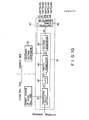
- Actuator 67 is constituted by external command converter 91 and switching signal generator 92, as shown in Fig. 10.
- Converter 91 is constituted by energizing circuit 93 for supplying an exciting current to the seven LEDs 47 in a guide rail side to drive LEDs 47 mounted on frame 11 in accordance with the external command, LEDs 47 mounted on frame 11, seven phototransistors 46 connected to constant-voltage generator 42 and mounted in positions corresponding to LEDs 47 of carrier 15 at a station, and voltage generator 94 for outputting a binary-value voltage in accordance with outputs from central five phototransistors 46.
- generator 92 connected to constant-voltage generator 42 converts a 5-bit output from converter 91 into switching signals for opening/closing switched 65, 66, 80, 85, and 86, and supplies them to the corresponding switches, thereby controlling open/closed states of the switches.
- the output from the remaining two phototransistors 46 arranged at both sides serve to detect whether LEDs 47 and phototransistors 46 properly oppose each other. Only when these two phototransistors 46 receive light beams from LEDs 47 at the same time, the external command is transmitted from the guide rails to the carrier. For this reason, erroneous transmission of the external command caused when the carrier does not stop at a correct position can be prevented.
- unit 41 causes electromagnets 51 and 52 to generate a magnetic flux in a direction opposite to that of the magnetic flux generated by magnet 53, and controls a current to be flowed through coils 56 so as to generate a predetermined gap between units 31 and rails 12a and 12b. Therefore, as shown in Fig.
- a magnetic circuit formed by a loop of magnet 53, yoke 55, gap P, rails 12a and 12b, gap P, yoke 55, and magnet 53, so that carrier 15 softly starts floating.
- loop L starts operation, and the magnetic circuit maintains predetermined gap length zo so that carrier 15 obtaines a magnetic attractive force not requiring the magnetic flux generated by electromagnets 51 and 52 at all in a steady state wherein no external force acts on carrier 15.
- sensor 34 detects this and transmits a detection signal to circuit 62 through circuit 68.
- Circuit 62 subtracts gap length target value x D from the detection signal by subtracter 71, thereby calculating gap length deviation signal Az-Azo.
- Signal Az-Azo is input to compensator 73, and converted into speed deviation signal Az by differentiator 72, which is input to compensator 74.
- current deviation signal Ai is obtained by a measurement signal of detector 69, and input to compensator 75.
- Signal Ai is compared with a zero level as an output from generator 79 by subtracter 78, and its difference signal is input to compensator 81.
- stator 16 Assuming that carrier 15 is placed immediately below stator 16 of the linear induction motor and stator 16 is energized, base 25 is subjected to an electromagnetic force from stator 16, and carrier 15 starts running along rails 12a and 12b while maintaining a magnetic floating state. If stator 16 is arranged before a position at which carrier 15 is completely stopped by an effect of air resistance and the like, carrier 15 is energized again to continuously move along rails 12a and 12b. This movement continues to a destination. Thus, carrier 15 can be moved to a destination in a noncontacting state.
- actuator 67 and generators 70 and 79 are so arranged as to adopt a method in which current deviation Ai is integrated by an integrating compensator, multiplied with a proper gain, and then fed back.
- they may have an arrangement suitable for the other methods described above.
- Fig. 11 shows an embodiment in which compensator 81 of Fig. 7 is replaced with filter 95 having a primary transfer function.
- a time constant of fitter 95 is Tf
- its transfer function is defined as follows:
- the output signal from detector 69 is supplied as an input to subtracter 78.
- the output from subtracter 71 is supplied.
- Filter 95 is constituted such that capacitor Cc and resistor Re are connected in parallel with each other between the input and output terminals of operation amplifier 96, as shown in Fig. 12. Also in this case, when both ends of capacitor Cc and resistor Re are short-circuited by switch 80, zero power feed-back loop L is deenergized.
- F feed-back gain
- P [-F 1 ,O,O]
- r [r 1 ,O,O] T
- its block diagram is shown in Fig. 13.
- Figs. 14A and 14B show a control method using state observer 101.
- observer 101 receives output signals from subtracter 71 and detector 69, detects speed Az corresponding to the output signal from differentiator 72 in the above-mentioned embodiment and a steady component of external force Um acting on carrier 15, and outputs a gap length deviation signal, a speed signal, a current deviation signal, and an external steady component signal to compensators 73, 74, 75, and 102.
- Four compensators 73 to 75 and 102 multiply the inputs by gains Fi, F 2 , Fs, and F 4 , respectively, and output the products.
- Fig. 15 is a block diagram of this control system, in which observer 101 is denoted by C 7 .
- peripheral elements of compensator 102 are arranged such that, as shown in Fig. 16, ON/OFF control of contactless relay 105 is performed in accordance with a signal from actuator 67 so as to short-circuit resistor Rd connected between the input and output terminals of operation amplifier 106, and when actuator 67 outputs a signal for turning on relay 105, loop L is deenergized.
- a subtractor 181 is connected between switch 80 and state observer 101, a target value generator 79 is connected between subtractor 181 and actuator 67 and a target value generator 180 for generating a zero target value is connected to subtractor 180.
- the circuit shown in Fig. 14B is operated in a similar manner as that of Fig. 14A and also has an advantage same as that of Fig. 14B. According to this embodiment, since speed ⁇ can be observed without using a differentiator, an adverse effect of an external electrical noise froating carrier 15 is reduced.
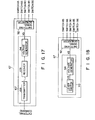
- actuator 67 of the present invention is not limited to the arrangement shown in Fig. 10 but may have arrangements as shown in Figs. 17 and 18. That is, in the arrangement shown in Fig. 17, external command converter 107 is constituted by transmitter 108 and receiver 109 for transmitting/receiving radio waves, and voltage generator 94. As compared with the above-mentioned case wherein optical signals are transmitted/received, mounting positions of transmitting and receiving sections need not be so strictly adjusted.
- external command converter 110 is constituted by five lever switches 111 mounted on carrier 15, and generator 94 interlocked with ON/OFF operations of switches 111 to output open/close signals of the switches, resulting in a simple arrangement of the system.
- the present invention can be modified within the spirit and scope of the invention regardless of analog or digital arrangement as long as the control system includes a zero power feed-back control system.
- the zero power feed-back loop is deenergized and the target value is gradually varied in the soft landing or starting mode, the steady deviation of the gap length can be gradually varied.
- the carrier can be softly fixed on the guide rails or softly started to flow from the guide rails, thereby preventing destruction of the carrier or cargo, or generation of dust.
Landscapes
- Engineering & Computer Science (AREA)
- Transportation (AREA)
- Mechanical Engineering (AREA)
- Physics & Mathematics (AREA)
- Electromagnetism (AREA)
- Power Engineering (AREA)
- Chemical & Material Sciences (AREA)
- Combustion & Propulsion (AREA)
- Control Of Vehicles With Linear Motors And Vehicles That Are Magnetically Levitated (AREA)
Applications Claiming Priority (2)
| Application Number | Priority Date | Filing Date | Title |
|---|---|---|---|
| JP61109915A JP2732562B2 (ja) | 1986-05-14 | 1986-05-14 | 浮上式搬送装置 |
| JP109915/86 | 1986-05-14 |
Publications (3)
| Publication Number | Publication Date |
|---|---|
| EP0246098A2 true EP0246098A2 (de) | 1987-11-19 |
| EP0246098A3 EP0246098A3 (en) | 1989-10-04 |
| EP0246098B1 EP0246098B1 (de) | 1991-11-13 |
Family
ID=14522365
Family Applications (1)
| Application Number | Title | Priority Date | Filing Date |
|---|---|---|---|
| EP87304290A Expired - Lifetime EP0246098B1 (de) | 1986-05-14 | 1987-05-14 | Transportsystem vom Typ mit schwebendem Träger |
Country Status (5)
| Country | Link |
|---|---|
| US (1) | US4838172A (de) |
| EP (1) | EP0246098B1 (de) |
| JP (1) | JP2732562B2 (de) |
| KR (1) | KR910003999B1 (de) |
| DE (1) | DE3774486D1 (de) |
Cited By (10)
| Publication number | Priority date | Publication date | Assignee | Title |
|---|---|---|---|---|
| US4882999A (en) * | 1986-12-19 | 1989-11-28 | Kabushiki Kaisha Toshiba | Transportation system of a floated-carrier type |
| EP0335719A3 (de) * | 1988-03-30 | 1991-06-12 | Kabushiki Kaisha Toshiba | Magnetische Tragevorrichtung vom Anziehungstyp |
| US5156093A (en) * | 1986-12-19 | 1992-10-20 | Kabushiki Kaisha Toshiba | Transportation system of floated-carrier type |
| EP0580107A1 (de) * | 1992-07-20 | 1994-01-26 | Daifuku Co., Ltd. | Magnetschwebetransportsystem |
| EP0584790A1 (de) * | 1992-08-26 | 1994-03-02 | Ebara Corporation | Einrichtung zur Beseitigung von Schwingungen des Typs "Null-Kraft Regelung" |
| DE102004037622A1 (de) * | 2004-08-02 | 2006-02-23 | Leybold Optics Gmbh | Prozesssystem sowie Vorrichtung zum Transport von Substraten |
| EP2746201A1 (de) * | 2012-12-21 | 2014-06-25 | Robert Bosch Gmbh | Vorrichtung und Verfahren zur Förderung von Trägern in einer Maschine |
| WO2015162182A1 (de) * | 2014-04-25 | 2015-10-29 | Weber Maschinenbau Gmbh Breidenbach | Autonom elektromagnetischer transportträger von lebensmittelportionen |
| US12415684B2 (en) | 2021-03-03 | 2025-09-16 | Provisur Technologies, Inc. | Belt conveyor for conveying foodstuff products |
| US12466100B2 (en) | 2021-03-03 | 2025-11-11 | Provisur Technologies, Inc. | Food-processing system |
Families Citing this family (16)
| Publication number | Priority date | Publication date | Assignee | Title |
|---|---|---|---|---|
| JPH0817524B2 (ja) * | 1987-11-06 | 1996-02-21 | 住友電気工業株式会社 | 磁気浮上搬送車 |
| US4924778A (en) * | 1988-03-30 | 1990-05-15 | Kabushiki Kaisha Toshiba | Attraction type magnetic levitating apparatus |
| JPH02294203A (ja) * | 1989-05-09 | 1990-12-05 | Yaskawa Electric Mfg Co Ltd | 磁気浮上制御方法 |
| JP4270657B2 (ja) | 1999-07-06 | 2009-06-03 | 東芝エレベータ株式会社 | エレベータ案内装置 |
| JP4097848B2 (ja) | 1999-07-06 | 2008-06-11 | 東芝エレベータ株式会社 | エレベータ案内装置 |
| AU2003238307A1 (en) * | 2003-06-20 | 2005-02-04 | Otis Elevator Company | Elevator active suspension utilizing repulsive magnetic force |
| JP4986400B2 (ja) * | 2005-01-05 | 2012-07-25 | 東芝エレベータ株式会社 | エレベータ |
| JP4614091B2 (ja) * | 2005-08-16 | 2011-01-19 | 株式会社ダイフク | フローティングユニット及び物品支持装置 |
| JP5099629B2 (ja) * | 2007-10-23 | 2012-12-19 | 東芝エレベータ株式会社 | 磁気浮上装置 |
| JP2012514162A (ja) * | 2009-01-21 | 2012-06-21 | 福州市規劃設計研究院 | 磁気浮上型防振構造体 |
| DE102009038756A1 (de) | 2009-05-28 | 2010-12-09 | Semilev Gmbh | Vorrichtung zur partikelfreien Handhabung von Substraten |
| CN110304092B (zh) * | 2018-03-27 | 2020-08-04 | 中车唐山机车车辆有限公司 | 一种磁悬浮转向架及列车 |
| DE102018118814B4 (de) | 2018-08-02 | 2024-07-18 | Beckhoff Automation Gmbh | Verfahren zum Identifizieren eines Schlittens eines linearen Transportsystems |
| CN109094422B (zh) * | 2018-08-06 | 2020-04-07 | 江西理工大学 | 悬挂式轨道交通设备以及其中的磁电混合悬浮轨系统 |
| CN109292464A (zh) * | 2018-10-24 | 2019-02-01 | 西南交通大学 | 一种电动悬浮管道货物运输系统 |
| CN112848914B (zh) * | 2021-03-27 | 2022-09-16 | 湖南凌翔磁浮科技有限责任公司 | 高速磁悬浮控制器及控制系统 |
Family Cites Families (10)
| Publication number | Priority date | Publication date | Assignee | Title |
|---|---|---|---|---|
| US3377616A (en) * | 1964-04-27 | 1968-04-09 | Gen Signal Corp | Vehicle identification system |
| BE788486Q (fr) * | 1971-04-19 | 1973-01-02 | Rohr Industries Inc | Systeme magnetique de suspension et de propulsion |
| US3736880A (en) * | 1971-04-19 | 1973-06-05 | Rohr Industries Inc | Feedback control circuit for magnetic suspension and propulsion system |
| US3937148A (en) * | 1973-01-02 | 1976-02-10 | Cambridge Thermionic Corporation | Virtually zero power linear magnetic bearing |
| US3899979A (en) * | 1973-02-22 | 1975-08-19 | Buryan Associates | Magnetic suspension systems for vehicles |
| JPS51100515A (ja) * | 1975-02-28 | 1976-09-04 | Tokyo Shibaura Electric Co | Jodendojikifujosha |
| JPS5288913A (en) * | 1976-01-21 | 1977-07-26 | Hitachi Ltd | Float-up height control system |
| DE3117971C2 (de) * | 1981-05-07 | 1984-06-07 | Messerschmitt-Bölkow-Blohm GmbH, 8012 Ottobrunn | Regelung zum leistungsoptimalen Anpassen des Luftspaltes von elektromagnetischen Schwebefahrzeugen |
| DE3578860D1 (de) * | 1984-10-23 | 1990-08-30 | Toshiba Kawasaki Kk | Transportsystem vom typ mit schwebendem traeger. |
| JPH0624405B2 (ja) * | 1985-07-03 | 1994-03-30 | 株式会社東芝 | 浮上式搬送装置 |
-
1986
- 1986-05-14 JP JP61109915A patent/JP2732562B2/ja not_active Expired - Lifetime
-
1987
- 1987-05-13 US US07/049,346 patent/US4838172A/en not_active Expired - Fee Related
- 1987-05-14 KR KR1019870004753A patent/KR910003999B1/ko not_active Expired
- 1987-05-14 DE DE8787304290T patent/DE3774486D1/de not_active Expired - Lifetime
- 1987-05-14 EP EP87304290A patent/EP0246098B1/de not_active Expired - Lifetime
Cited By (17)
| Publication number | Priority date | Publication date | Assignee | Title |
|---|---|---|---|---|
| US4882999A (en) * | 1986-12-19 | 1989-11-28 | Kabushiki Kaisha Toshiba | Transportation system of a floated-carrier type |
| US4934279A (en) * | 1986-12-19 | 1990-06-19 | Kabushiki Kaisha Toshiba | Transportation system of a floated-carrier type |
| US5156093A (en) * | 1986-12-19 | 1992-10-20 | Kabushiki Kaisha Toshiba | Transportation system of floated-carrier type |
| EP0335719A3 (de) * | 1988-03-30 | 1991-06-12 | Kabushiki Kaisha Toshiba | Magnetische Tragevorrichtung vom Anziehungstyp |
| EP0580107A1 (de) * | 1992-07-20 | 1994-01-26 | Daifuku Co., Ltd. | Magnetschwebetransportsystem |
| US5467718A (en) * | 1992-07-20 | 1995-11-21 | Daifuku Co., Ltd. | Magnetic levitation transport system with non-contact inductive power supply and battery charging |
| EP0584790A1 (de) * | 1992-08-26 | 1994-03-02 | Ebara Corporation | Einrichtung zur Beseitigung von Schwingungen des Typs "Null-Kraft Regelung" |
| US5449985A (en) * | 1992-08-26 | 1995-09-12 | Ebara Corporation | Zero-power control type vibration eliminating apparatus |
| DE102004037622A1 (de) * | 2004-08-02 | 2006-02-23 | Leybold Optics Gmbh | Prozesssystem sowie Vorrichtung zum Transport von Substraten |
| EP2746201A1 (de) * | 2012-12-21 | 2014-06-25 | Robert Bosch Gmbh | Vorrichtung und Verfahren zur Förderung von Trägern in einer Maschine |
| WO2015162182A1 (de) * | 2014-04-25 | 2015-10-29 | Weber Maschinenbau Gmbh Breidenbach | Autonom elektromagnetischer transportträger von lebensmittelportionen |
| CN106455591A (zh) * | 2014-04-25 | 2017-02-22 | 韦伯机械制造有限公司布雷登巴赫 | 食物部件的自动电磁运输载体 |
| CN106455591B (zh) * | 2014-04-25 | 2020-06-19 | 韦伯机械制造有限公司布雷登巴赫 | 食物部件的自动电磁运输载体 |
| US10737403B2 (en) | 2014-04-25 | 2020-08-11 | Weber Maschinenbau Gmbh Breidenbach | Autonomously electromagnetic transport carrier of food portions |
| EP4714874A3 (de) * | 2014-04-25 | 2026-06-24 | Weber Food Technology SE & Co. KG | Autonom elektromagnetischer transportträger von lebensmittelportionen |
| US12415684B2 (en) | 2021-03-03 | 2025-09-16 | Provisur Technologies, Inc. | Belt conveyor for conveying foodstuff products |
| US12466100B2 (en) | 2021-03-03 | 2025-11-11 | Provisur Technologies, Inc. | Food-processing system |
Also Published As
| Publication number | Publication date |
|---|---|
| JPS62268306A (ja) | 1987-11-20 |
| DE3774486D1 (de) | 1991-12-19 |
| JP2732562B2 (ja) | 1998-03-30 |
| EP0246098B1 (de) | 1991-11-13 |
| KR910003999B1 (ko) | 1991-06-20 |
| KR870011738A (ko) | 1987-12-26 |
| EP0246098A3 (en) | 1989-10-04 |
| US4838172A (en) | 1989-06-13 |
Similar Documents
| Publication | Publication Date | Title |
|---|---|---|
| EP0246098B1 (de) | Transportsystem vom Typ mit schwebendem Träger | |
| EP0216452B1 (de) | Transportsystem mit schwebenden Transporteinheiten | |
| US4690066A (en) | Electromagnetically floated carrier system with stopping unit | |
| US5067415A (en) | Transporting system of floated carrier type with zero power control at varying load weights | |
| US4882999A (en) | Transportation system of a floated-carrier type | |
| US5156093A (en) | Transportation system of floated-carrier type | |
| US4742778A (en) | Floating carrier type transporting system | |
| US4811667A (en) | Transportation system of a floated-carrier type | |
| US5058505A (en) | Carrying apparatus driven by linear motor with weight calculation to control driving force of motor | |
| JPS61102105A (ja) | 浮上式搬送装置 | |
| JP2793240B2 (ja) | 浮上式搬送装置 | |
| EP4164913A1 (de) | System zur übertragung elektrischer energie an ein fahrzeug über die luft | |
| EP0487744B1 (de) | Lineare unterwassertransportvorrichtung | |
| KR900006247B1 (ko) | 부상식(浮上式) 반송장치 | |
| JPH0669244B2 (ja) | 磁気浮上搬送方式 | |
| EP0239231B1 (de) | Gerät zum Stoppen eines Wagens an einer programmierten Haltestelle | |
| JPH0345106A (ja) | 磁気浮上式搬送装置 | |
| JPH06171754A (ja) | 搬送装置 | |
| JPS61132005A (ja) | 浮上式搬送装置 | |
| JPS63274309A (ja) | 磁気浮上式搬送装置 | |
| JPH03159503A (ja) | 磁気浮上式搬送装置 | |
| JPS62281703A (ja) | 搬送装置 | |
| JPH0847112A (ja) | 浮上式搬送装置 | |
| JP2593485B2 (ja) | 磁気浮上式搬送システム | |
| JP2760495B2 (ja) | 浮上式搬送装置 |
Legal Events
| Date | Code | Title | Description |
|---|---|---|---|
| PUAI | Public reference made under article 153(3) epc to a published international application that has entered the european phase |
Free format text: ORIGINAL CODE: 0009012 |
|
| AK | Designated contracting states |
Kind code of ref document: A2 Designated state(s): DE FR GB |
|
| 17P | Request for examination filed |
Effective date: 19880204 |
|
| PUAL | Search report despatched |
Free format text: ORIGINAL CODE: 0009013 |
|
| AK | Designated contracting states |
Kind code of ref document: A3 Designated state(s): DE FR GB |
|
| 17Q | First examination report despatched |
Effective date: 19910226 |
|
| GRAA | (expected) grant |
Free format text: ORIGINAL CODE: 0009210 |
|
| AK | Designated contracting states |
Kind code of ref document: B1 Designated state(s): DE FR GB |
|
| REF | Corresponds to: |
Ref document number: 3774486 Country of ref document: DE Date of ref document: 19911219 |
|
| ET | Fr: translation filed | ||
| PLBE | No opposition filed within time limit |
Free format text: ORIGINAL CODE: 0009261 |
|
| STAA | Information on the status of an ep patent application or granted ep patent |
Free format text: STATUS: NO OPPOSITION FILED WITHIN TIME LIMIT |
|
| 26N | No opposition filed | ||
| PGFP | Annual fee paid to national office [announced via postgrant information from national office to epo] |
Ref country code: GB Payment date: 19980505 Year of fee payment: 12 |
|
| PGFP | Annual fee paid to national office [announced via postgrant information from national office to epo] |
Ref country code: FR Payment date: 19980511 Year of fee payment: 12 |
|
| PGFP | Annual fee paid to national office [announced via postgrant information from national office to epo] |
Ref country code: DE Payment date: 19980522 Year of fee payment: 12 |
|
| PG25 | Lapsed in a contracting state [announced via postgrant information from national office to epo] |
Ref country code: GB Free format text: LAPSE BECAUSE OF NON-PAYMENT OF DUE FEES Effective date: 19990514 |
|
| GBPC | Gb: european patent ceased through non-payment of renewal fee |
Effective date: 19990514 |
|
| PG25 | Lapsed in a contracting state [announced via postgrant information from national office to epo] |
Ref country code: FR Free format text: LAPSE BECAUSE OF NON-PAYMENT OF DUE FEES Effective date: 20000131 |
|
| PG25 | Lapsed in a contracting state [announced via postgrant information from national office to epo] |
Ref country code: DE Free format text: LAPSE BECAUSE OF NON-PAYMENT OF DUE FEES Effective date: 20000301 |
|
| REG | Reference to a national code |
Ref country code: FR Ref legal event code: ST |