EP0246049B1 - Transformant einer tierischen Zelle, Verfahren zur Herstellung des Transformanten und dessen Verwendung zur Präparation eines gewünschten Fremdgenproduktes - Google Patents
Transformant einer tierischen Zelle, Verfahren zur Herstellung des Transformanten und dessen Verwendung zur Präparation eines gewünschten Fremdgenproduktes Download PDFInfo
- Publication number
- EP0246049B1 EP0246049B1 EP87304152A EP87304152A EP0246049B1 EP 0246049 B1 EP0246049 B1 EP 0246049B1 EP 87304152 A EP87304152 A EP 87304152A EP 87304152 A EP87304152 A EP 87304152A EP 0246049 B1 EP0246049 B1 EP 0246049B1
- Authority
- EP
- European Patent Office
- Prior art keywords
- wild
- transformant
- gene
- type
- cell
- Prior art date
- Legal status (The legal status is an assumption and is not a legal conclusion. Google has not performed a legal analysis and makes no representation as to the accuracy of the status listed.)
- Expired - Lifetime
Links
Images
Classifications
-
- C—CHEMISTRY; METALLURGY
- C12—BIOCHEMISTRY; BEER; SPIRITS; WINE; VINEGAR; MICROBIOLOGY; ENZYMOLOGY; MUTATION OR GENETIC ENGINEERING
- C12N—MICROORGANISMS OR ENZYMES; COMPOSITIONS THEREOF; PROPAGATING, PRESERVING, OR MAINTAINING MICROORGANISMS; MUTATION OR GENETIC ENGINEERING; CULTURE MEDIA
- C12N9/00—Enzymes; Proenzymes; Compositions thereof; Processes for preparing, activating, inhibiting, separating or purifying enzymes
- C12N9/14—Hydrolases (3)
- C12N9/48—Hydrolases (3) acting on peptide bonds (3.4)
- C12N9/50—Proteinases, e.g. Endopeptidases (3.4.21-3.4.25)
- C12N9/64—Proteinases, e.g. Endopeptidases (3.4.21-3.4.25) derived from animal tissue
- C12N9/6421—Proteinases, e.g. Endopeptidases (3.4.21-3.4.25) derived from animal tissue from mammals
- C12N9/6424—Serine endopeptidases (3.4.21)
- C12N9/6456—Plasminogen activators
- C12N9/6459—Plasminogen activators t-plasminogen activator (3.4.21.68), i.e. tPA
-
- C—CHEMISTRY; METALLURGY
- C12—BIOCHEMISTRY; BEER; SPIRITS; WINE; VINEGAR; MICROBIOLOGY; ENZYMOLOGY; MUTATION OR GENETIC ENGINEERING
- C12N—MICROORGANISMS OR ENZYMES; COMPOSITIONS THEREOF; PROPAGATING, PRESERVING, OR MAINTAINING MICROORGANISMS; MUTATION OR GENETIC ENGINEERING; CULTURE MEDIA
- C12N15/00—Mutation or genetic engineering; DNA or RNA concerning genetic engineering, vectors, e.g. plasmids, or their isolation, preparation or purification; Use of hosts therefor
- C12N15/09—Recombinant DNA-technology
- C12N15/63—Introduction of foreign genetic material using vectors; Vectors; Use of hosts therefor; Regulation of expression
- C12N15/79—Vectors or expression systems specially adapted for eukaryotic hosts
- C12N15/85—Vectors or expression systems specially adapted for eukaryotic hosts for animal cells
-
- C—CHEMISTRY; METALLURGY
- C12—BIOCHEMISTRY; BEER; SPIRITS; WINE; VINEGAR; MICROBIOLOGY; ENZYMOLOGY; MUTATION OR GENETIC ENGINEERING
- C12Y—ENZYMES
- C12Y304/00—Hydrolases acting on peptide bonds, i.e. peptidases (3.4)
- C12Y304/21—Serine endopeptidases (3.4.21)
- C12Y304/21069—Protein C activated (3.4.21.69)
-
- A—HUMAN NECESSITIES
- A61—MEDICAL OR VETERINARY SCIENCE; HYGIENE
- A61K—PREPARATIONS FOR MEDICAL, DENTAL OR TOILETRY PURPOSES
- A61K38/00—Medicinal preparations containing peptides
Definitions
- This invention relates to a technique for introducing a wild-type DHFR gene, which codes for dihydrofolate reductase, as a dominant selective marker into wild-type animal cells to obtain a transformant and then culturing the transformant in an amplification medium containing a DHFR inhibitor to obtain an amplified transformant having amplified productivity of a useful substance.
- This invention can be used effectively as a technique for the production of tissue plasminogen activator (hereinafter abbreviated as "t-PA").
- An object of this invention features is to obtain an amplified transformant from a transformant, which itself contains a desired gene, by a specific method. It is a feature of this invention that the amplified transformant contains a foreign wild-type DHFR gene.
- a DHFR gene codes for dihydrofolate reductase, which takes part in the biosynthesis of DNA and RNA, and the gene can be amplified within cells resistant to methotrexate (MTX) which is known as a carcinostatic agent.
- MTX methotrexate
- Co-amplification of the DHFR gene and the desired foreign gene is performed by culturing a transformant, which contains the DHFR gene and the foreign gene, in a fresh medium with a higher concentration of MTX and screening a strain resistant to the higher MTX concentration by using the DHFR gene as a marker. This operation may be repeated in a much higher concentration of MTX.
- DHFR gene sources there are both wild-type and mutant-type.
- a wild-type DHFR gene is chosen, a DHFR-deficient strain is generally used as a host.
- European Patent Publication No. 117059-A discloses a technique for obtaining t-PA producing transformants by using a mutant DHFR gene as a dominant selective marker gene for wild-type cells to give MTX (methotrexate) resistance to the cells, selecting the transformant which was co-transfected with a human t-PA gene and then culturing the thus-obtained transformant in the presence of MTX at higher concentration so as to increase both of the DHFR and t-PA genes.
- MTX metalhotrexate
- the mutant DHFR gene yields due to its mutation a genetic product in which the 22th amino acid has been changed from leucine to arginine. Possible adverse affects such as malignant growth, which such a mutant DHFR gene or its genetic product may cause on the wild-type cells employed as a host, have not been fully investigated.
- the use of the mutant DHFR gene is still considered to involve unsolved problems.
- the mutant DHFR gene is different in its binding affinity to MTX from wild-type DHFR genes and the binding affinity of the former gene is as weak as one two hundred seventieth of the binding affinity of the latter.
- the MTX concentration required for the culture of the amplified transformants is much higher than that employed when wild-type DHFR genes are used. Since such a high MTX concentration is harmful to cells, a resistant strain obtained in the presence of MTX at such a high concentration is itself unstable. Under the current technology, the above-described selection method in which a high MTX concentration was employed to obtain amplified transformants has not yet resulted in any reproducible and practical technique.
- the method for forming a high t-PA producing transformant by use of a mutant DHFR gene is still believed to be incomplete as a technique to be used for the production of pharmaceutical products.
- Wild-type cells capable of expressing their DHFR gene are usually chosen as host animal cells, because mutant cells are not easily established in the cause of animal cells and therefore the mutant cells are not advantageous for industrial production.
- a transformant may not always be obtained stably when a wild-type DHFR gene is used as a dominant selective marker gene for such wild-type cells. Even if a transformant could be obtained, the expression of the characters by the transformant is unexceptionally unstable. Difficulties are therefore encountered in many instances upon screening a transformant by this method.
- no stable t-PA producing strain was obtained when a wild-type DHFR gene was used for wild-type Chinese hamster cells (European Patent Publication No. 117060-A).
- a wild-type DHFR gene could be used as a selective marker gene if a DHFR-deficient strain can be established from wild-type cells. This approach is however not easy, because the establishment of such a DHFR-deficient strain per se is complex and time-consuming. [For details, reference may be had to Urlanb, G., & Chasin, L.A., Proc. Natl. Acad. Sci. U.S.A., 77 , 4216 (1980).]
- the present inventors found that the drawbacks from the use of a mutant DHFR gene can be overcome and that an extremely advantageous method, which can realize a stable production of a useful foreign gene product such as human t-PA with good reproducibility, can be provided, when a wild-type DHFR gene can be introduced as a dominant selective marker for wild-type animal cells which are suitable for industrial production. A further extensive investigation has then been carried out on the method.
- the present inventors selected animal cells, which are advantageous for industrial production, as host cells and have studied various conditions and various combinations of animal cells and wild-type DHFR genes to obtain stable MTX resistant transformants. As a result, the present inventors have unexpectedly succeeded in obtaining a stable transformant in the present of MTX at the effective concentration, leading to completion of the present invention.
- An object of this invention is therefore to solve the above-described various problems of the prior art and to obtain a higher transformant having stable and high productivity of a useful substance.
- Another object of this invention is to provide a method for producing a useful substance efficiently by using a transformant which retains stable and high productivity of the useful substance.
- a method for producing a transformant which comprises transforming a wild-type animal cell with a vector comprising a heterologous wild-type DHFR gene which is operably linked to Simian Virus 40 (SV40) regulatory DNA sequences comprising the SV40 polyadenylation signal and a structural gene, wherein said animal cell to which the vector is introduced is first cultured in a selective medium containing methotrexate at a concentration of 0.25 to 1 ⁇ M so as to select the transformant thus obtained, and thereafter culturing the transformant in an amplification medium containing methotrexate at a concentration of 0.25 to 50 ⁇ M thereby amplifying both the wild-type DHFR gene and the structural gene.
- SV40 Simian Virus 40
- drug resistance is introduced into industrially-useful wild-type animal cells, thereby making it possible to screen cells transformed simultaneously by a vector containing a desired foreign gene such as the human t-PA gene. Further, an amplified transformant is also obtained to permit the production of a useful substance stably in a high yield.
- the amplification of the genes is conducted on a transformant in the presence of MTX at a concentration lower than that employed in the prior art (for example, at 0.25 ⁇ M). It is therefore possible to obtain a transformant having stable and high productivity of a useful substance.
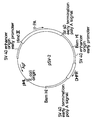
- FIGURE 1 shows the structure of plasmid pSV-2 to be expressed, which was used in Example of this invention.
- either separate vectors or the same vector containing a desired foreign gene and a wild-type DHFR gene is introduced into wild-type animal cells.
- a selective medium containing MTX at an effective concentration transformants are screened.
- Transformants that express the desired foreign gene are screened from the MTX resistant transformants.
- an amplifying operation for the selective marker gene is conducted in the presence of an increased concentration of MTX at a concentration of 50 ⁇ M or lower so as to obtain a transformant which expresses the desired foreign gene with high productivity.
- the product of the desired foreign gene is also co-amplified by the operation.
- any one of various genes corresponding to target products can be used.
- t-PA is an enzyme included in a fibrinolytic system. Since the lysis of fibrin clots, thrombus constituents, begins upon activation by t-PA, t-PA is useful as a novel therapeutic drug for thrombosis.
- human t-PA it is possible to use as a human t-PA gene that available as cDNA obtained from mRNA of cancer cells (Bowes melanoma strain) [Goeddel, D.V., et al., UK Patent Application No.
- regulatory DNA sequence means sequences of promoters, termination and polyadenylation signals, enhancers and other expression-controlling sequences. One or more of these sequences can be employed as required. Effective sequences are chosen to give optimal expression in the specific animal cells employed as host cells. The stronger action of regulatory DNA sequences will give better results.
- the SV40 (Simian Virus 40) DNA sequences may cause satisfactory results.
- the regulatory DNA sequences are however not limited to the above example but any regulatory DNA sequences may be employed equally so long as it can give high expression in Chinese hamster cells.
- Regulatory DNA sequences to be employed in the present invention may further include, for example, human metallothionein promoter [Karin, M., et al., Nature 308 , 513 (1984)], mouse metallothionein promoter [Pavlakis, G.N. and Hamer, D.H., Proc. Natl. Acad. Sci. U.S.A., 80 , 397 (1983)], mouse MuLV-LTR promoter (Anson, D.S., et al., Nature, 315 , 683 (1985)], heat shock promoter [Peter Bromley and Richard Voellmy, European Patent Publication No.
- Wild-type DHFR genes can be isolated from wild-type cells as a cDNA clone or a genome DNA clone.
- wild-type DHFR genes for example, mouse wild-type DHFR gene (Lee, F. et al., 1981, Nature, 294 : 228), which is isolated in the form of cDNA clone and which is inserted in a vector, can be easily employed in the present invention.
- folic acid is reduced by DHFR (dihydrofolate reductase) into tetrahydrofolic acid, an active form, and takes part in the synthesis of thymidylic acid.
- DHFR dihydrofolate reductase
- MTX which is an analogue of folic acid, binds to DHFR and inhibits the activity of DHFR.
- MTX Upon inhibition of the activity of DHFR by MTX, cells can no longer survive in a culture medium which does not contain any nucleic acid component.
- regulatory DNA sequences are artificially combined with a DHFR gene to form an expression vector.
- host cells are Chinese hamster cells for instance, the SV40 regulatory DNA sequences can result in a satisfactory expression.
- the effective regulatory DNA sequences are however not limited to those from SV40 but any regulatory DNA sequences which give higher DHFR expression in Chinese hamster cells may be employed.
- host cells are transformed by the vector.
- the desired foreign gene and the wild-type DHFR gene exist separately on separate expression vectors, host cells are transformed by a mixture of both expression vectors in suitable proportions.
- animal cells any cells may be used so long as they are wild-type cells.
- Host cells to be used for industrial production may desirably have tolerance for any kind of stress and desirably their culture is easy, their growth rate is fast, they permit high-density culture, their culture medium has a low serum demand, they have higher expression and secretion ability of foreign gene products potentially, they have the ability to glycosylate foreign gene products, and/or they produce much smaller amounts of endogenous substances related to the desired foreign gene products, etc.
- t-PA gene When human t-PA gene is used as the desired foreign gene in particular and the t-PA gene is not derived from cancer cells, it is desirable to choose a continuous cell line as a host other than that derived from cancer cells because the desired products will not be accompanied with any contamination derived from cancer cells.
- Example 10 cells satisfying the above-mentioned characteristic features to certain extents were discovered from among established Chinese hamster ovary cells (CHO) and lung cells (CHL) and those cells were used as a host. Needless to say, host cells shall not be limited to such illustrative examples.
- a method for introducing a vector DNA into host cells in the present invention it is desirable to employ such a method that permits introduction of the vector DNA in a high yield because the screening of a transformant is undertaken under severe conditions in the subsequent stage. Good results can be obtained, for example, by introducing the vector DNA into the host in accordance with the modified calcium phosphate method including glycerin shock.
- a culture medium with MTX and free of nucleic acid components is used as a selective medium to screen a MTX resistant transformant. It is preferable to use, as a selective medium, a medium inhibiting the survival of host cells but permitting the survival of the transformant.
- the selective medium contains MTX at a concentration of 0.25 ⁇ M - 1 ⁇ M.
- the genetic amplification of the wild-type DHFR gene introduced in the transformant and the accompanying simultaneous amplification of the desired foreign gene may be carried out by a method known per se in the art.
- Reference for amplification of genes may be had, for example, to Schimke, R.T., in Gene Amplification, Edited by Schimke, R.T., Cold Spring Harbor Laboratory, Pl, 1982.
- a strain having high productivity of a desired foreign gene product can be obtained by culturing a transformant resistant to MTX of a certain concentration in the medium containing MTX at a concentration 2 - 4 times higher than the first-mentioned MTX concentration to obtain cells rendered resistant to a much higher concentration of MTX and screening cells having a high production rate of the product of the desired foreign gene from the thus-obtained cells and then repeating the culturing and screening steps in the increasing concentration of MTX.
- the principal characteristic feature of the present invention resides in the use of a wild-type DHFR gene instead of a mutant DHFR gene whose affinity with MTX is very low. This principal characteristic feature has brought about the following advantageous effects.
- the genetic amplification is performed at an MTX concentration of 0.25 ⁇ M - 50 ⁇ M, preferably, 0.25 ⁇ M - 20 ⁇ M (much lower than the MTX concentration (50 ⁇ M - 1,000 ⁇ M) used in the genetic amplification when a mutant DHFR gene is employed).
- an MTX concentration 0.25 ⁇ M - 50 ⁇ M, preferably, 0.25 ⁇ M - 20 ⁇ M (much lower than the MTX concentration (50 ⁇ M - 1,000 ⁇ M) used in the genetic amplification when a mutant DHFR gene is employed).
- the transformant of this invention shows good growth and its ability to product the product of the desired foreign gene remains stable even after its long term cultivation.
- a cDNA gene bank was prepared in accordance with the method proposed by Gubler and Hoffman [Gubler, U. and Hoffman, B.J., Gene, 25 , 263 (1983)].
- Plasmid pSV-2 to be expressed was prepared by joining an enhancer, a replication-origin, promoter, and termination and polyadenylation signals, all derived from SV40, to each of the above-mentioned human t-PA cDNA sequences and mouse DHFR cDNA sequences [Lee, F., et al., Nature 294 , 228 (1981)] and then integrating the thus-joined matter in a DNA fragment containing a bacterial replication origin and ampicillin-resistant marker derived from pML [Lusky, M. and Botchan, M., Nature, 293 , 79 (1981)] in a manner employed in this field.
- CHO Chinese hamster ovary cells
- CHL lung cells
- the Chinese hamster ovary cells (CHO) or lung cells (CHL) were cultured at 37°C in a Dulbecco's modified Eagle's medium (DME) supplemented with 5% fetal calf serum (FCS) in air containing 5% CO2.
- DME Dulbecco's modified Eagle's medium
- FCS fetal calf serum
- Cells were spread in a 60-mm dish at a rate of 5 ⁇ 105 cells per dish.
- pSV-2 DNA 5 ⁇ g or 10 ⁇ g per dish was introduced into the cells by the calcium phosphate method [Graham, F.L. and Van der Eb., A.J., Virology, 52 , 456 (1973)] following glycerol shock [Parker, B.A. and Stark, G.R., Virol, 31 , 360 (1979)].
- the cells were trypsinized and spread in several 35-mm dishes at a reduced cell density of one tenth the above-mentioned rate. They were cultured in DME-10% dialyzed FCS-0.25 ⁇ M MTX (a selective medium).
- the selective medium did not contain any nucleic acid components.
- the culture medium was replaced by a fresh supply of the same culture medium and the cells were cultured for 24 hours. Fifteen milliliters of the culture supernatant were collected and the lytic activity of fibrin-clot was measured by the fibrin plate method [Rijken, D.C., et al., Biochim, Biophys. Acta, 580 , 140 (1979)]. Twelve colonies showed activity (10 - 40 U/ml).
- the amount of t-PA produced by transformants was assayed by the following method.
- the culture medium was removed from a 25-cm2 flask with the grown cells adhered thereon and the inside of the flask was washed with phosphate-buffered saline. Thereafter, a small amount of 0.25% trypsin was added and the cells were separated from the bottom wall of the flask.
- a suitable amount of a culture medium was then added to the flask and the cells were suspended thoroughly therein. The number of the cells was then counted, followed by dilution to prepare a cell suspension of 2 x 10⁵ or 1 x 10⁵ cells/ml. After placing 1 ml of the suspension in the wells of a 12-well dish and then maintaining the cells therein for 24 hours, 15 ⁇ l of the culture supernatant was used to measure the t-PA activity by the above-described fibrin plate method. No significant increase was observed to the number of cells after the 24-hour culture.
- the 0.25 ⁇ M MTX resistant transformant was spread at a density of 103 - 105 cells/dish on a 10-cm dish and then cultured for about 2 weeks in a selective medium containing 1 ⁇ M MTX.
- Colonies that appeared were isolated using cloning rings and transferred to 24-well dishes, and were then allowed to grow to 90% confluent.
- the culture medium was replaced by a fresh supply of the same culture medium and the cells were cultured for 24 hours. Thereafter, 15 ⁇ l of the culture supernatant was collected and its t-PA activity was measured by the fibrin plate method.
- the cells of the thus-obtained high t-PA producing transformant were cultured in the presence of MTX of a much higher concentration. Out of cells rendered resistant to MTX of the much higher concentration, cells having higher t-PA producing rates were then screened. By successively repeating the above procedures, a high t-PA producing transformant was obtained. Some of the results are shown in the following table.
- 0.25 ⁇ M MTX resistant transformants were also obtained similarly to CHO cells when CHL cells were used as a host.
- a high t-PA producing transformant was obtained from the 0.25 ⁇ M MTX resistant transformants of CHL.
- the growth rate of the high t-PA producing transformants in the selective medium was 24 - 40 hours in terms of doubling time of the cells.
- an amplified transformant having high productivity of a foreign gene product can be obtained in accordance with the present invention, namely, by introducing a wild-type DHFR gene as a selective marker into wild-type animal cells to obtain a transformant thereof and then culturing the transformant in an amplification medium containing MTX at a concentration of 50 ⁇ M or lower as a DHFR inhibitor.
Landscapes
- Health & Medical Sciences (AREA)
- Genetics & Genomics (AREA)
- Life Sciences & Earth Sciences (AREA)
- Chemical & Material Sciences (AREA)
- Engineering & Computer Science (AREA)
- Organic Chemistry (AREA)
- Bioinformatics & Cheminformatics (AREA)
- Wood Science & Technology (AREA)
- Zoology (AREA)
- Biomedical Technology (AREA)
- General Engineering & Computer Science (AREA)
- General Health & Medical Sciences (AREA)
- Biotechnology (AREA)
- Biochemistry (AREA)
- Microbiology (AREA)
- Molecular Biology (AREA)
- Medicinal Chemistry (AREA)
- Physics & Mathematics (AREA)
- Biophysics (AREA)
- Plant Pathology (AREA)
- Preparation Of Compounds By Using Micro-Organisms (AREA)
- Micro-Organisms Or Cultivation Processes Thereof (AREA)
- Enzymes And Modification Thereof (AREA)
Claims (12)
- Transformand, erhältlich durch Transformation einer Wildtyp tierischen Zelle mit einem Vektor, der ein heterologes Wildtyp DHFR-Gen, wirksam verbunden mit regulatorischen DNA-Sequenzen des Affenvirus 40 (SV 40), die wiederum das SV 40 Polyadenylierungssignal sowie ein Strukturgen umfassen, enthält, wobei diese tierische Zelle, in die der Vektor eingebracht worden ist, zunächst in einem Selektionsmedium, das Methotrexat in einer Konzentration von 0,25 bis 1 µM enthält, gezüchtet wird, so daß der so erhaltene Transformand selektiert wird, und anschließendes Züchten des Transformanden in einem Amplifikationsmedium, das Methotrexat in einer Konzentration von 0,25 bis 50 µM enthält, so daß sowohl das Wildtyp DHFR-Gen als auch das Strukturgen amplifiziert werden.
- Der Transformand nach Anspruch 1, wobei das Wildtyp DHFR-Gen von einer Maus-Zellinie stammt.
- Der Transformand nach Anspruch 1, wobei das Strukturgen ein menschliches tPA-Gen ist, das von einer normalen Zelle, z.B. von dem MTC-Stamm, stammt.
- Der Transformand nach Anspruch 3, wobei das menschliche tPA-Gen mit den SV 40 regulatorischen DNA-Sequenzen für die Expression, die die Expression des menschlichen tPA regulieren, wirksam verbunden ist.
- Der Transformand nach Anspruch 1, wobei die Wildtyp tierische Zelle eine Wildtyp Säugerzelle, z.B. eine Wildtyp Hamsterzelle (Chinese hamster cell), ist.
- Der Transformand nach Anspruch 5, wobei die Wildtyp Hamsterzelle (Chinese hamster cell) eine Wildtyp Hamster-Ovarienzelle (CHO) oder eine Wildtyp Hamster-Lungenzelle (CHL), ist.
- Verfahren zur Herstellung eines Transformanden, umfassend die Transformation einer Wildtyp tierischen Zelle mit einem Vektor, der ein heterologes Wildtyp DHFR-Gen, wirksam verbunden mit regulatorischen DNA-Sequenzen des Affenvirus 40 (SV 40), die wiederum das SV 40 Polyadenylierungssignal sowie ein Strukturgen umfassen, enthält, wobei diese tierische Zelle, in die der Vektor eingebracht worden ist, zunächst in einem Selektionsmedium, das Methotrexat in einer Konzentration von 0,25 bis 1 µM enthält, gezüchtet wird, so daß der so erhaltene Transformand selektiert wird, und wobei der Transformand anschließend in einem Amplifikationsmedium, das Methotrexat in einer Konzentration von 0,25 bis 50 µM enthält, gezüchtet wird, so daß sowohl das Wildtyp DHFR-Gen als auch das Strukturgen amplifiziert werden.
- Das Verfahren nach Anspruch 7, wobei das Wildtyp DHFR-Gen von einer Maus-Zellinie stammt.
- Das Verfahren nach Anspruch 7, wobei das Strukturgen ein menschliches tPA-Gen ist, das von einer normalen Zelle, z.B. von dem MTC-Stamm, stammt.
- Das Verfahren nach Anspruch 9, wobei das menschliche tPA-Gen mit den Affenvirus 40 (SV 40) regulatorischen DNA-Sequenzen, die die Expression des menschlichen tPA regulieren, wirksam verbunden ist.
- Das Verfahren nach Anspruch 7, wobei die Wildtyp tierische Zelle eine Wildtyp Säugerzelle, z.B. eine Wildtyp Hamsterzelle (Chinese hamster cell), ist.
- Das Verfahren nach Anspruch 11, wobei die Wildtyp Hamsterzelle (Chinese hamster cell) eine Wildtyp Hamster-Ovarienzelle (CHO) oder eine Wildtyp Hamster-Lungenzelle (CHL), ist.
Applications Claiming Priority (2)
| Application Number | Priority Date | Filing Date | Title |
|---|---|---|---|
| JP61105824A JP2585532B2 (ja) | 1986-05-10 | 1986-05-10 | 動物細胞の形質転換体及びそれを得る方法並びにその形質転換体を用いてt−PAを生産する方法 |
| JP105824/86 | 1986-05-10 |
Publications (2)
| Publication Number | Publication Date |
|---|---|
| EP0246049A1 EP0246049A1 (de) | 1987-11-19 |
| EP0246049B1 true EP0246049B1 (de) | 1993-08-18 |
Family
ID=14417809
Family Applications (1)
| Application Number | Title | Priority Date | Filing Date |
|---|---|---|---|
| EP87304152A Expired - Lifetime EP0246049B1 (de) | 1986-05-10 | 1987-05-11 | Transformant einer tierischen Zelle, Verfahren zur Herstellung des Transformanten und dessen Verwendung zur Präparation eines gewünschten Fremdgenproduktes |
Country Status (9)
| Country | Link |
|---|---|
| US (1) | US5219738A (de) |
| EP (1) | EP0246049B1 (de) |
| JP (1) | JP2585532B2 (de) |
| AU (1) | AU599977B2 (de) |
| DE (1) | DE3787044T2 (de) |
| DK (1) | DK235587A (de) |
| FI (1) | FI872013L (de) |
| NO (1) | NO871912L (de) |
| ZA (1) | ZA873211B (de) |
Families Citing this family (8)
| Publication number | Priority date | Publication date | Assignee | Title |
|---|---|---|---|---|
| US5550036A (en) | 1986-04-09 | 1996-08-27 | Eli Lilly And Company | Method for co-amplification of human protein C genes in human cells |
| EP0319206A3 (de) * | 1987-11-30 | 1990-04-18 | Berlex Laboratories, Inc. | Gen-Vermehrung |
| EP0555203B1 (de) * | 1988-12-08 | 1995-10-18 | Abbott Laboratories | Verfahren zur induzierbaren genexpression unter verwendung eines dhfr-gens |
| US8962274B2 (en) | 2009-02-27 | 2015-02-24 | Novartis Ag | Methods for selecting eukaryotic cells expressing a heterologous protein |
| RU2716977C2 (ru) | 2013-07-31 | 2020-03-17 | Новартис Аг | Новые селективные векторы и способы селекции эукариотических клеток-хозяев |
| JP6708548B2 (ja) | 2013-12-20 | 2020-06-10 | ノバルティス アーゲー | 新規真核細胞および目的の生成物を組換え発現させるための方法 |
| EP3083677B1 (de) | 2013-12-20 | 2019-08-28 | Novartis AG | Neuartige eukaryotische zellen und verfahren zur rekombinanten expression eines produkts von interesse |
| JP6245299B2 (ja) * | 2016-04-27 | 2017-12-13 | バクスアルタ ゲーエムベーハー | 組換え安定細胞クローン、その産生およびその使用 |
Citations (1)
| Publication number | Priority date | Publication date | Assignee | Title |
|---|---|---|---|---|
| DE223230C (de) * |
Family Cites Families (9)
| Publication number | Priority date | Publication date | Assignee | Title |
|---|---|---|---|---|
| US4399216A (en) * | 1980-02-25 | 1983-08-16 | The Trustees Of Columbia University | Processes for inserting DNA into eucaryotic cells and for producing proteinaceous materials |
| GR79202B (de) * | 1982-05-05 | 1984-10-22 | Genentech Inc | |
| AU572108B2 (en) * | 1983-01-19 | 1988-05-05 | Genentech Inc. | Human tpa production using vectors coding for dhfr protein |
| US4713339A (en) * | 1983-01-19 | 1987-12-15 | Genentech, Inc. | Polycistronic expression vector construction |
| AU2353384A (en) * | 1983-01-19 | 1984-07-26 | Genentech Inc. | Amplification in eukaryotic host cells |
| US4965199A (en) * | 1984-04-20 | 1990-10-23 | Genentech, Inc. | Preparation of functional human factor VIII in mammalian cells using methotrexate based selection |
| IL71691A (en) * | 1984-04-27 | 1991-04-15 | Yeda Res & Dev | Production of interferon-ypsilon |
| EP0216846B2 (de) * | 1985-04-01 | 1995-04-26 | Celltech Limited | Transformierte myeloma-zell-linie und dieselbe verwendendes verfahren zur expression eines gens, das ein eukaryontisches polypeptid kodiert |
| JPH0714341B2 (ja) * | 1985-11-20 | 1995-02-22 | 鐘淵化学工業株式会社 | 蛋白質の高生産株の取得方法 |
-
1986
- 1986-05-10 JP JP61105824A patent/JP2585532B2/ja not_active Expired - Fee Related
-
1987
- 1987-05-04 US US07/045,512 patent/US5219738A/en not_active Expired - Fee Related
- 1987-05-05 ZA ZA873211A patent/ZA873211B/xx unknown
- 1987-05-06 FI FI872013A patent/FI872013L/fi not_active Application Discontinuation
- 1987-05-08 AU AU72650/87A patent/AU599977B2/en not_active Ceased
- 1987-05-08 DK DK235587A patent/DK235587A/da not_active Application Discontinuation
- 1987-05-08 NO NO871912A patent/NO871912L/no unknown
- 1987-05-11 DE DE87304152T patent/DE3787044T2/de not_active Expired - Fee Related
- 1987-05-11 EP EP87304152A patent/EP0246049B1/de not_active Expired - Lifetime
Patent Citations (1)
| Publication number | Priority date | Publication date | Assignee | Title |
|---|---|---|---|---|
| DE223230C (de) * |
Also Published As
| Publication number | Publication date |
|---|---|
| DK235587D0 (da) | 1987-05-08 |
| EP0246049A1 (de) | 1987-11-19 |
| DE3787044D1 (de) | 1993-09-23 |
| ZA873211B (en) | 1987-10-28 |
| NO871912D0 (no) | 1987-05-08 |
| AU7265087A (en) | 1987-11-12 |
| AU599977B2 (en) | 1990-08-02 |
| US5219738A (en) | 1993-06-15 |
| FI872013A0 (fi) | 1987-05-06 |
| JP2585532B2 (ja) | 1997-02-26 |
| JPS62262988A (ja) | 1987-11-16 |
| NO871912L (no) | 1987-11-11 |
| DE3787044T2 (de) | 1993-12-09 |
| DK235587A (da) | 1987-11-11 |
| FI872013A7 (fi) | 1987-11-11 |
| FI872013L (fi) | 1987-11-11 |
Similar Documents
| Publication | Publication Date | Title |
|---|---|---|
| Kaufman et al. | Coamplification and coexpression of human tissue-type plasminogen activator and murine dihydrofolate reductase sequences in Chinese hamster ovary cells | |
| US5770359A (en) | Recombinant DNA sequences, vectors containing them and method for the use thereof | |
| US4740461A (en) | Vectors and methods for transformation of eucaryotic cells | |
| US5439679A (en) | Peptide plasminogen activators | |
| EP0093619B2 (de) | Plasminogenaktivator für menschliches Gewebe, diesen Aktivator enthaltende pharmazeutische Zusammensetzungen, Verfahren zur Herstellung des Aktivators sowie DNA und transformierte Zellzwischenprodukte hierfür | |
| US4766075A (en) | Human tissue plasminogen activator | |
| US5763253A (en) | Methods of preparing tissue plasiminogen activator derivative composition | |
| US4853330A (en) | Human tissue plasminogen activator | |
| EP0246049B1 (de) | Transformant einer tierischen Zelle, Verfahren zur Herstellung des Transformanten und dessen Verwendung zur Präparation eines gewünschten Fremdgenproduktes | |
| US6274335B1 (en) | Method of treatment using recombinant human tissue plasminogen activator | |
| JP3456992B2 (ja) | 変異型dhfr遺伝子を使用した発現誘導方法 | |
| EP0319206A2 (de) | Gen-Vermehrung | |
| EP0387380A1 (de) | Mutanten von Plasminogenaktivator aus Urin, ihre Herstellung und Verwendung | |
| Reff et al. | Production of proteins by mammalian cells using dominant selectable and amplifiable markers | |
| US5079159A (en) | Method for making tissue plasminogen activator | |
| EP0485504B1 (de) | Zellenzuchtverfahren für die produktion von aktiviertem protein-c | |
| EP0275856A1 (de) | Plasminogenaktivatoren | |
| JP2798659B2 (ja) | ヒトアンチトロンビンiii(atiii)の製造 | |
| EP0225177A2 (de) | Für den menschlichen Gewebeplasminogenaktivator kodierende DNS-Sequenz | |
| Asselbergs et al. | Production of the chimerical plasminogen activator K2tu-PA in CHO cells | |
| Thillet et al. | Transfection of DHFR− and DHFR+ mammalian cells using methotrexate-resistant mutants of mouse dihydrofolate reductase | |
| RU2079553C1 (ru) | Способ получения эукариотического полипептида | |
| GB2237288A (en) | Amplification of a heterologous gene in recombinant eukaryotic host cells | |
| JPS63304982A (ja) | ドロソフィラ細胞における外来性遺伝子の発現 | |
| CA2007364A1 (en) | Gene sequences encoding modified residues situated in the protease domain of tpa |
Legal Events
| Date | Code | Title | Description |
|---|---|---|---|
| PUAI | Public reference made under article 153(3) epc to a published international application that has entered the european phase |
Free format text: ORIGINAL CODE: 0009012 |
|
| AK | Designated contracting states |
Kind code of ref document: A1 Designated state(s): BE CH DE FR GB IT LI NL SE |
|
| 17P | Request for examination filed |
Effective date: 19880426 |
|
| 17Q | First examination report despatched |
Effective date: 19910215 |
|
| GRAA | (expected) grant |
Free format text: ORIGINAL CODE: 0009210 |
|
| AK | Designated contracting states |
Kind code of ref document: B1 Designated state(s): BE CH DE FR GB IT LI NL SE |
|
| PG25 | Lapsed in a contracting state [announced via postgrant information from national office to epo] |
Ref country code: CH Effective date: 19930818 Ref country code: BE Effective date: 19930818 Ref country code: IT Free format text: LAPSE BECAUSE OF FAILURE TO SUBMIT A TRANSLATION OF THE DESCRIPTION OR TO PAY THE FEE WITHIN THE PRE;WARNING: LAPSES OF ITALIAN PATENTS WITH EFFECTIVE DATE BEFORE 2007 MAY HAVE OCCURRED AT ANY TIME BEFORE 2007. THE CORRECT EFFECTIVE DATE MAY BE DIFFERENT FROM THE ONE RECORDED.SCRIBED TIME-LIMIT Effective date: 19930818 Ref country code: LI Effective date: 19930818 Ref country code: SE Effective date: 19930818 Ref country code: NL Effective date: 19930818 |
|
| REF | Corresponds to: |
Ref document number: 3787044 Country of ref document: DE Date of ref document: 19930923 |
|
| ET | Fr: translation filed | ||
| REG | Reference to a national code |
Ref country code: CH Ref legal event code: PL |
|
| NLV1 | Nl: lapsed or annulled due to failure to fulfill the requirements of art. 29p and 29m of the patents act | ||
| PLBE | No opposition filed within time limit |
Free format text: ORIGINAL CODE: 0009261 |
|
| STAA | Information on the status of an ep patent application or granted ep patent |
Free format text: STATUS: NO OPPOSITION FILED WITHIN TIME LIMIT |
|
| 26N | No opposition filed | ||
| PGFP | Annual fee paid to national office [announced via postgrant information from national office to epo] |
Ref country code: GB Payment date: 19970502 Year of fee payment: 11 |
|
| PGFP | Annual fee paid to national office [announced via postgrant information from national office to epo] |
Ref country code: FR Payment date: 19970513 Year of fee payment: 11 |
|
| PGFP | Annual fee paid to national office [announced via postgrant information from national office to epo] |
Ref country code: DE Payment date: 19970516 Year of fee payment: 11 |
|
| PG25 | Lapsed in a contracting state [announced via postgrant information from national office to epo] |
Ref country code: GB Free format text: LAPSE BECAUSE OF NON-PAYMENT OF DUE FEES Effective date: 19980511 |
|
| PG25 | Lapsed in a contracting state [announced via postgrant information from national office to epo] |
Ref country code: FR Free format text: LAPSE BECAUSE OF NON-PAYMENT OF DUE FEES Effective date: 19980531 |
|
| GBPC | Gb: european patent ceased through non-payment of renewal fee |
Effective date: 19980511 |
|
| PG25 | Lapsed in a contracting state [announced via postgrant information from national office to epo] |
Ref country code: DE Free format text: LAPSE BECAUSE OF NON-PAYMENT OF DUE FEES Effective date: 19990302 |
|
| REG | Reference to a national code |
Ref country code: FR Ref legal event code: ST |