EP0243816B1 - Intermetallic compounds, hydrides thereof and process for preparing same - Google Patents
Intermetallic compounds, hydrides thereof and process for preparing same Download PDFInfo
- Publication number
- EP0243816B1 EP0243816B1 EP87105669A EP87105669A EP0243816B1 EP 0243816 B1 EP0243816 B1 EP 0243816B1 EP 87105669 A EP87105669 A EP 87105669A EP 87105669 A EP87105669 A EP 87105669A EP 0243816 B1 EP0243816 B1 EP 0243816B1
- Authority
- EP
- European Patent Office
- Prior art keywords
- compound
- amorphous
- hydride
- magnesium
- crystalline
- Prior art date
- Legal status (The legal status is an assumption and is not a legal conclusion. Google has not performed a legal analysis and makes no representation as to the accuracy of the status listed.)
- Expired - Lifetime
Links
Images
Classifications
-
- B—PERFORMING OPERATIONS; TRANSPORTING
- B01—PHYSICAL OR CHEMICAL PROCESSES OR APPARATUS IN GENERAL
- B01J—CHEMICAL OR PHYSICAL PROCESSES, e.g. CATALYSIS OR COLLOID CHEMISTRY; THEIR RELEVANT APPARATUS
- B01J31/00—Catalysts comprising hydrides, coordination complexes or organic compounds
- B01J31/02—Catalysts comprising hydrides, coordination complexes or organic compounds containing organic compounds or metal hydrides
- B01J31/12—Catalysts comprising hydrides, coordination complexes or organic compounds containing organic compounds or metal hydrides containing organo-metallic compounds or metal hydrides
- B01J31/121—Metal hydrides
-
- B—PERFORMING OPERATIONS; TRANSPORTING
- B22—CASTING; POWDER METALLURGY
- B22F—WORKING METALLIC POWDER; MANUFACTURE OF ARTICLES FROM METALLIC POWDER; MAKING METALLIC POWDER; APPARATUS OR DEVICES SPECIALLY ADAPTED FOR METALLIC POWDER
- B22F9/00—Making metallic powder or suspensions thereof
- B22F9/002—Making metallic powder or suspensions thereof amorphous or microcrystalline
-
- B—PERFORMING OPERATIONS; TRANSPORTING
- B22—CASTING; POWDER METALLURGY
- B22F—WORKING METALLIC POWDER; MANUFACTURE OF ARTICLES FROM METALLIC POWDER; MAKING METALLIC POWDER; APPARATUS OR DEVICES SPECIALLY ADAPTED FOR METALLIC POWDER
- B22F9/00—Making metallic powder or suspensions thereof
- B22F9/16—Making metallic powder or suspensions thereof using chemical processes
- B22F9/18—Making metallic powder or suspensions thereof using chemical processes with reduction of metal compounds
- B22F9/24—Making metallic powder or suspensions thereof using chemical processes with reduction of metal compounds starting from liquid metal compounds, e.g. solutions
-
- C—CHEMISTRY; METALLURGY
- C01—INORGANIC CHEMISTRY
- C01B—NON-METALLIC ELEMENTS; COMPOUNDS THEREOF; METALLOIDS OR COMPOUNDS THEREOF NOT COVERED BY SUBCLASS C01C
- C01B33/00—Silicon; Compounds thereof
-
- C—CHEMISTRY; METALLURGY
- C01—INORGANIC CHEMISTRY
- C01B—NON-METALLIC ELEMENTS; COMPOUNDS THEREOF; METALLOIDS OR COMPOUNDS THEREOF NOT COVERED BY SUBCLASS C01C
- C01B35/00—Boron; Compounds thereof
-
- C—CHEMISTRY; METALLURGY
- C01—INORGANIC CHEMISTRY
- C01B—NON-METALLIC ELEMENTS; COMPOUNDS THEREOF; METALLOIDS OR COMPOUNDS THEREOF NOT COVERED BY SUBCLASS C01C
- C01B6/00—Hydrides of metals including fully or partially hydrided metals, alloys or intermetallic compounds ; Compounds containing at least one metal-hydrogen bond, e.g. (GeH3)2S, SiH GeH; Monoborane or diborane; Addition complexes thereof
- C01B6/24—Hydrides containing at least two metals; Addition complexes thereof
-
- C—CHEMISTRY; METALLURGY
- C01—INORGANIC CHEMISTRY
- C01B—NON-METALLIC ELEMENTS; COMPOUNDS THEREOF; METALLOIDS OR COMPOUNDS THEREOF NOT COVERED BY SUBCLASS C01C
- C01B6/00—Hydrides of metals including fully or partially hydrided metals, alloys or intermetallic compounds ; Compounds containing at least one metal-hydrogen bond, e.g. (GeH3)2S, SiH GeH; Monoborane or diborane; Addition complexes thereof
- C01B6/24—Hydrides containing at least two metals; Addition complexes thereof
- C01B6/246—Hydrides containing at least two metals; Addition complexes thereof also containing non-metals other than hydrogen
-
- C—CHEMISTRY; METALLURGY
- C07—ORGANIC CHEMISTRY
- C07C—ACYCLIC OR CARBOCYCLIC COMPOUNDS
- C07C5/00—Preparation of hydrocarbons from hydrocarbons containing the same number of carbon atoms
- C07C5/02—Preparation of hydrocarbons from hydrocarbons containing the same number of carbon atoms by hydrogenation
- C07C5/03—Preparation of hydrocarbons from hydrocarbons containing the same number of carbon atoms by hydrogenation of non-aromatic carbon-to-carbon double bonds
-
- C—CHEMISTRY; METALLURGY
- C07—ORGANIC CHEMISTRY
- C07C—ACYCLIC OR CARBOCYCLIC COMPOUNDS
- C07C5/00—Preparation of hydrocarbons from hydrocarbons containing the same number of carbon atoms
- C07C5/02—Preparation of hydrocarbons from hydrocarbons containing the same number of carbon atoms by hydrogenation
- C07C5/08—Preparation of hydrocarbons from hydrocarbons containing the same number of carbon atoms by hydrogenation of carbon-to-carbon triple bonds
- C07C5/09—Preparation of hydrocarbons from hydrocarbons containing the same number of carbon atoms by hydrogenation of carbon-to-carbon triple bonds to carbon-to-carbon double bonds
-
- C—CHEMISTRY; METALLURGY
- C22—METALLURGY; FERROUS OR NON-FERROUS ALLOYS; TREATMENT OF ALLOYS OR NON-FERROUS METALS
- C22C—ALLOYS
- C22C1/00—Making non-ferrous alloys
-
- C—CHEMISTRY; METALLURGY
- C22—METALLURGY; FERROUS OR NON-FERROUS ALLOYS; TREATMENT OF ALLOYS OR NON-FERROUS METALS
- C22C—ALLOYS
- C22C1/00—Making non-ferrous alloys
- C22C1/04—Making non-ferrous alloys by powder metallurgy
- C22C1/047—Making non-ferrous alloys by powder metallurgy comprising intermetallic compounds
-
- B—PERFORMING OPERATIONS; TRANSPORTING
- B01—PHYSICAL OR CHEMICAL PROCESSES OR APPARATUS IN GENERAL
- B01J—CHEMICAL OR PHYSICAL PROCESSES, e.g. CATALYSIS OR COLLOID CHEMISTRY; THEIR RELEVANT APPARATUS
- B01J2231/00—Catalytic reactions performed with catalysts classified in B01J31/00
- B01J2231/60—Reduction reactions, e.g. hydrogenation
- B01J2231/64—Reductions in general of organic substrates, e.g. hydride reductions or hydrogenations
- B01J2231/641—Hydrogenation of organic substrates, i.e. H2 or H-transfer hydrogenations, e.g. Fischer-Tropsch processes
- B01J2231/645—Hydrogenation of organic substrates, i.e. H2 or H-transfer hydrogenations, e.g. Fischer-Tropsch processes of C=C or C-C triple bonds
-
- C—CHEMISTRY; METALLURGY
- C07—ORGANIC CHEMISTRY
- C07C—ACYCLIC OR CARBOCYCLIC COMPOUNDS
- C07C2531/00—Catalysts comprising hydrides, coordination complexes or organic compounds
- C07C2531/02—Catalysts comprising hydrides, coordination complexes or organic compounds containing organic compounds or metal hydrides
- C07C2531/12—Catalysts comprising hydrides, coordination complexes or organic compounds containing organic compounds or metal hydrides containing organo-metallic compounds or metal hydrides
-
- Y—GENERAL TAGGING OF NEW TECHNOLOGICAL DEVELOPMENTS; GENERAL TAGGING OF CROSS-SECTIONAL TECHNOLOGIES SPANNING OVER SEVERAL SECTIONS OF THE IPC; TECHNICAL SUBJECTS COVERED BY FORMER USPC CROSS-REFERENCE ART COLLECTIONS [XRACs] AND DIGESTS
- Y02—TECHNOLOGIES OR APPLICATIONS FOR MITIGATION OR ADAPTATION AGAINST CLIMATE CHANGE
- Y02E—REDUCTION OF GREENHOUSE GAS [GHG] EMISSIONS, RELATED TO ENERGY GENERATION, TRANSMISSION OR DISTRIBUTION
- Y02E60/00—Enabling technologies; Technologies with a potential or indirect contribution to GHG emissions mitigation
- Y02E60/30—Hydrogen technology
- Y02E60/32—Hydrogen storage
Definitions
- the present invention relates to a process for preparing intermetallic compounds or the hydrides thereof by means of a non-metallurgical, i.e. wet-chemical, route under extremely mild conditions (e.g. room temperature, normal pressure), whereby the products are obtained in a finely distributed, highly active predominantly amorphous state.
- a non-metallurgical i.e. wet-chemical
- extremely mild conditions e.g. room temperature, normal pressure
- intermetallic compounds or metal alloys are prepared from two or more components by a melt process at a high temperature (cf. H. Buchner, "Energie Eatung in Metyllhydriden", Springer Verlag 1982, page 65).
- Inter-metal compounds of metals of the main groups V and VI of the Periodic Table, on the one hand, with metals of the groups II to IV, on the other hand, such as GaAs, Cdse, SnSe which - such as, e.g., GaAs - are used in semiconductor technology can be prepared by a "non-metallurgical route" by the reaction of organometal compounds of the respective metals [Ga(CH3)3), Al(CH3)3)] with element hydrides (PH3, AsH3) in the gaseous state at high temperatures (of from 500 °C to 700 °C).
- the method has gained technical relevance for the preparation of semiconductor material [P.D. Dapkus, "Metalorganic chemical vapor deposition", Annual Review Material Sciences 12 (1982) 243].
- L.H. Dubois and R.G. Nuzzo (U.S. Patent 4,507,401) claim a process for preparing intermetallic compounds used as catalysts for dehydrogenation of alkanes, which process is characterized in that metals, such as, e.g., finely distributed metallic nickel, fixed to inorganic carriers are reacted with gaseous organometal compounds or metal hydrides, such as, e.g., hexamethyldisilane or Si2H6, at elevated temperature (e.g. 300 °C).
- gaseous organometal compounds or metal hydrides such as, e.g., hexamethyldisilane or Si2H6, at elevated temperature (e.g. 300 °C).
- Intermetallic compounds in amorphous form are commercially produced by quenching melts, in which processes extremely high cooling rates (106 °C/s) are necessary to eliminate any formation of crystallization seeds, which involves high technical expenditure [P. Duwez, Progr. Solid State Chem. 3 (1966) 377].
- intermetallic compounds in an amorphous state may be obtained by the condensation of metal vapors [W. Buckel, R. Hilsch, Z. Physik 138 (1954) 109] or by the diffusion of the metals at temperatures below the crystallization temperature [Au 1-x La x (0,3 ⁇ x ⁇ 0,5), R.B. Schwarz, W.L. Johnson, Phys. Rev. Lett. 51 (1983) 415].
- Ternary hydrides (hydrides of intermetallic binary compounds) have been known to be prepared by subjecting intermetallic compounds, after a so-called activation process (comminution, full heating under a protective gas), to a series of from 5 to 15 hydrogenation-dehydrogenation cycles until the optimum hydrogenation rate and load will have been reached.
- Further methods of the preparation of hydrides of intermetallic compounds comprise the reaction of metal hydrides with metals in the presence of hydrogen at high temperatures [e.g. Eu2RuH6, J.S. Thompson et al ., Inorg. Chem. 14 (1975) 1866; Yb2RhH6, R. Lindsay et al ., Inorg. Chem. 15 (1976) 3050] or the reaction of two metals in a finely distributed state with hydrogen at high temperatures [Mg2FeH6, J.-J. Didisheim et al ., Inorg. Chem. 23 (1984) 1953; Mg2CoH5, P. Zolliker et al ., Inorg. Chem. 24 (1985) 4177].
- Eu2RuH6, J.S. Thompson et al ., Inorg. Chem. 14 (1975) 1866; Yb2RhH6, R. Lindsay et al ., Inorg. Chem. 15 (1976) 3050 or the reaction of two metals in
- Intermetallic hydrides in an amorphous state are obtainable by the hydrogenation of crystalline intermetallic compounds at a temperature below the crystallization temperature of the hydrides [hydrogenation of LaNi2, LaNi3 and La2Ni7: H. Oelaborer, J. Clinton, H. Bittner, Nat. Res. Bull. 11 (1976) 1241; hydrogenation of Zr3Rh: K. Samwer, X.L. Yeh, W.H. Johnson, J. Non-Crystalline Solids 61 , 62 (1984) 631].
- intermetallic compounds or the hydrides thereof may be readily formed from the hydrides of the elements of the main groups I to IV of the Periodic Table (M1H n component), e.g. HMgCl, or magnesium dialkyls in an organic solvent at a temperature of from -100 °C to 100 °C - and preferably at from 0 °C to +50 °C - by the reaction with bisallyl metal compounds of the metals Ni, Pd, Pt or Zn [M2(C3H5)2 component], for example, allyl or homologues thereof such as methallyl, e.g. bis( 3-methallyl)nickel or -palladium.
- M1H n component e.g. HMgCl
- magnesium dialkyls in an organic solvent at a temperature of from -100 °C to 100 °C - and preferably at from 0 °C to +50 °C - by the reaction with bisallyl metal compounds of the metals Ni
- metal hydrides there are preferred to be employed magnesium hydride (European Patent No. 0 003 564) and lithium hydride (U.S. Patent 4,396,589).
- Characteristic for the reaction according to the invention is the partial or complete removal of the allyl group of the M2(C3H5)2 component in the form of propene (equations 1 to 4 hereinbelow) and the precipitation of the intermetallic compounds or of the hydrides thereof in an amorphous state.
- the hydrides of the elements of the main groups I and II of the Periodic Table are preferred in the present invention.
- the elements of the groups I to IV of the Periodic Table may be exemplified by lithium, sodium, potassium, beryllium, magnesium, calcium, strontium, barium, boron and silicon. Among these, lithium, magnesium, calcium, barium, boron and silicon are preferred. Magnesium is most preferred.
- magnesium hydridehalide there may be used magnesium chloridehydride and magnesium bromidehydride, magnesium chloridehydride being preferred.
- the alkyl moieties R preferably have from 1 to 8 carbon atoms.
- metals of the subgroup VIII of the Periodic Table there may be mentioned preferably nickel, palladium or platinum.
- the other metals of the subgroup VIII of the Periodic Table viz. iron, cobalt, nickel, ruthenium, rhodium, osmium and iridium may be employed as well.
- the solvents to be employed in the present invention may be any solvents which are inert to the reactants.
- Preferred solvents are tetrahydrofurane, toluene and ether.
- the reaction may be carried out at conventional temperatures within the range of from -100 °C to +100 °C, and preferably of from 0 °C to +50 °C.
- intermetallic compounds and of the hydrides thereof there may be mentioned the following: Intermetallic compound MgPd in the amorphous state; Intermetallic compound MgNi in the amorphous and in the crystalline states; Crystalline intermetallic compound Mg2Pd and its hydride Mg2PdH2 in the amorphous and in the crystalline states; Intermetallic compound Mg2Pt and its hydride Mg2PtH2; Intermetallic compound MgPt; Intermetallic compounds Li2Ni and LiNi; Intermetallic compounds BaNi and Ba2Ni; Intermetallic compound LiPd in the amorphous state; Intermetallic compound Li2Pt in the amorphous state; and Intermetallic compound Ca2Pd and its hydride.
- the process according to the present invention allows an easy preparation of intermetallic compounds so far unknown as well as of previously known intermetallic compounds or previously known ternary hydrides in an amorphous and particularly reactive state and also in the crystalline state.
- the intermetallic compounds or hydrides thereof as primarily obtained in an amorphous state according to the equations 1 to 4 may be rid of contaminations (organic components) by repeated hydrogenation-dehydrogenation cycles.
- intermetallic compound Mg2Ni may be reversibly hydrogenated to form the intermetallic compound Mg2NiH4 which is one of the best known high-temperature hydrogen storage systems; contrary thereto, the intermetallic compound MgNi2 is not capable of being hydrogenated [J.J. Reilly, R.H. Wiswall, Inorg. Chem. 7 (1968) 2254].
- the product prepared according to the invention may be reversibly hydrogenated already under normal pressure at 200 °C to form Mg2NiH4.
- Active magnesium hydride reacts with bis( ⁇ 3-allyl)palladium according to equation 1 in a molar ratio of 1:1 to form the amorphous intermetallic compound MgPd which may also be obtained from magnesium diethyl and bis( ⁇ 3-allyl)palladium in a molar ratio of 2:1 (equation 4).
- An intermetallic compound MgPd in an amorphous state has so far not been known, in contrast to the known crystalline cubic MgPd (CsCl type) [S.N. Sharma, A. Weiss, J. Less-Common Metals 104 (1984) 45] and the known crystalline tetragonal Pd 1.1 Mg 0.9 (AuCu type) [L. Westin, Acta Chem. Scand. 22 (1968) 2574].
- Catalytically prepared magnesium hydride reacts with bis( ⁇ 3-allyl)platinum in a molar ratio of 2:1 to form the amorphous ternary hydride Mg2PtH2 (equation 2) and in a molar ratio of 1:1 to form the intermetallic compound MgPt (equation 1).
- Active lithium hydride (U.S. Patent No. 4,396,589) reacts with bis( ⁇ 3-allyl)nickel in a molar ratio of 2:1 to form the amorphous Li2Ni (equation 1) and in a molar ratio of 1:1 to form amorphous LiNi.
- nickel-lithium so far no intermetallic phases have been determined [Y. Takeuchi et al ., Metallurgi undtechnik 20 , January 1966, 2].
- nickel is capable of dissolving only 0.4% of lithium at 1200 °C, while a lithium melt at the same temperature is capable of dissolving only 3.5% of nickel.
- the process according to the invention makes it possible to prepare amorphous lithium-nickel intermetallic compounds.
- Barium hydride reacts with bis( ⁇ 3-allyl)nickel in a molar ratio of 2:1 to form the amorphous ternary hydride Ba2NiH2 (equation 2) and in a molar ratio of 1:1 to form the previously unknown amorphous intermetallic compound BaNi (equation 1).
- the present process further enables preparing the known or unknown compounds set forth hereinbelow and/or hydrides thereof, respectively, in addition to the aforementioned compounds.
- Active magnesium hydride reacts with bis(allyl) zinc in a molar ratio of 1:1 to form the so far unknown amorphous hydride MgZn2H2 (equation 3).
- Catalytically prepared lithium hydride reacts with bis( ⁇ 3-allyl)palladium in a molar ratio of 2:1 (equation 3a) to form an amorphous intermetallic compound having the composition Li 1.5 Pd.
- intermetallic compounds or hydrides thereof preparable according to the process of the present invention may be used, inter alia , as reversible hydrogen storage systems, as catalysts, as regeneratable hydrogen donors and acceptors for chemical processes and further for hydrogen separation and purification.
- a further application in the field of intermetallic compounds is the "metallic glasses", i.e. the intermetallic compounds or alloys in an amorphous state.
- Technical applications of magnetic glasses due to their magnetic properties, are contemplated to exist in transformer technology (energy saving in power transformation due to use of metallic glasses as transformer cores) and in application as metallic materials having a particularly high mechanical strength and/or corrosion resistance.
- Metallic glasses are also of interest with view to the properties thereof as superconductors and as catalysts.
- Ni concentration in the solution remained constant at 0.07 mmol of Ni/ml; after 96 h, Ni( ⁇ 3-C3H5)2 was no longer detectable in the solution.
- the batch was stirred at RT for 96 h altogether; then the volatile components were evaporated at RT and 0.27 mbar (0.2 mmHg) and condensed in two cold traps arranged in series (-78 °C and -196 °C). The gases condensed in the trap cooled at -196 °C were evaporated, collected in a gas burette and analyzed by mass spectroscopy; the condensate of the trap cooled at -78 °C was analyzed for diallyl and residual gases by gas chromatography.
- the H2 capacity of the sample in the residual 29 cycles (hydrogenation: 200 °C and 260 °C, 1, 3, 5 and 10 bar, 1 h; dehydrogenation: 334 °C, normal pressure, 1.5 h) remained constant at 2.65% by weight (calc. for Mg2NiH4 3.62% by weight).
- the Mg2Ni thus prepared was capable of being hydrogenated under normal pressure at 200 °C, while in its X-ray powder diagram it was identical with the metallurgical Mg2Ni sample.
- the crystalline Mg2Pd reversibly reacts with H2 under pressure to form the so far unknown crystalline ternary hydride Mg2PdH2 (decomposition temperature at normal pressure 250-255 °C) which is characterized by X-ray powder analysis.
- the amorphous hydride MgZn2H2 upon heating at 300 °C yields the known crystalline intermetallic compound MgZn2 [T. Ohba et al ., Acta Crystallogr. Sect. C: Cryst. Struct. Commun. (1984) C 40, 1] identified by X-ray powder analysis.
- Examples 11 to 22 were carried out and worked up in the same manner as in Example 1.
- the experimental data are set forth in Tables 2 and 2a.
- LiPd in a crystalline form has been known (cubic crystal lattice, CsCl type) [J.H.N. Van Vucht, K.H.J. Buschow, J. Less-Common Metals 48 , (1976) 345; O. Loebich, Ch.J. Raub, J. Less-Common Metals 55 (1977) 67].
- the crystalline Laves phase Li2Pt has been known [W. Bronger et al ., J. Less-Common Metals 43 , (1975) 143; O. Loebich, Ch.J. Raub, J. Less-Common Metals 70 (1980) 47].
- the batch was stirred at room temperature for another 22 h. Then the volatiles were evaporated at 0.27 mbar (0.2 mmHg) and condensed in two cold traps arranged in series (-78 °C and -196 °C). The gases condensed in the trap cooled at -196 °C were evaporated, collected in a gas burette and analyzed by mass spectroscopy; there were detected 12.2% of C2H4, 4.8% of C2H6 and 36.8 % of C3H6, each relative to the calculated amounts. The destillation residue was stirred with 40 ml of fresh THF, the solid was separated from the solution by filtration, washed with THF until colorless and then dried under high vacuum.
- the product had the following composition: cis -hexene-3 96%, trans -hexene-3 2%, trans -hexene-2 0.4%, cis -hexene-2 0.4%, n -hexane 1%.
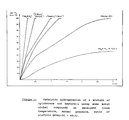
- the amorphous intermetallic nickel compounds Mg2NiH2 (Example 1), NiBC x H y (Example 19), NiB2C x H y (Example 18), NiSiC x H y (Example 21), MgNiC x (Example 3), BaNi (Example 13) and the crystalline compound Mg2NiH4 (after 34 cycles of hydrogenation/dehydrogenation, Example 1), were used as hydrogenation catalysts for the hydrogenation of a mixture of cyclohexene and heptene-1 in a molar ratio of 10:7 (molar ratio Ni : alkene 1:40) and compared to a conventional Raney nickel catalyst.
- Mg2NiH2 has proven to be the best hydrogenation catalyst having an activity of about 12 times that of Raney Ni. Both NiB2C x H y and NiBC x H y are still 6 times as active as Raney Ni is under comparable conditions. Particularly conspicuous are the very large surface areas of 149.9 m2/g and 164.0 m2/g, respectively, of the boron compounds which are supposed to contribute to the high activities of the catalysts.
- NiSiC x H y The activity of NiSiC x H y is nearly identical to that of NiBC x H y . Even the BaNi, in spite of its low surface area, shows considerable activity exceeding that of Raney Ni by a factor of 1.4.
Landscapes
- Chemical & Material Sciences (AREA)
- Organic Chemistry (AREA)
- Inorganic Chemistry (AREA)
- Engineering & Computer Science (AREA)
- Materials Engineering (AREA)
- Chemical Kinetics & Catalysis (AREA)
- Metallurgy (AREA)
- Mechanical Engineering (AREA)
- General Chemical & Material Sciences (AREA)
- Crystallography & Structural Chemistry (AREA)
- Organic Low-Molecular-Weight Compounds And Preparation Thereof (AREA)
- Catalysts (AREA)
- Hydrogen, Water And Hydrids (AREA)
- Manufacture Of Metal Powder And Suspensions Thereof (AREA)
- Solid-Sorbent Or Filter-Aiding Compositions (AREA)
Priority Applications (2)
| Application Number | Priority Date | Filing Date | Title |
|---|---|---|---|
| DE8787105669T DE3780852T2 (de) | 1986-04-22 | 1987-04-16 | Intermetallische verbindungen, deren hydriden und verfahren zu deren herstellung. |
| AT87105669T ATE79091T1 (de) | 1986-04-22 | 1987-04-16 | Intermetallische verbindungen, deren hydriden und verfahren zu deren herstellung. |
Applications Claiming Priority (2)
| Application Number | Priority Date | Filing Date | Title |
|---|---|---|---|
| DE19863613532 DE3613532A1 (de) | 1986-04-22 | 1986-04-22 | Intermetallische verbindungen, deren hydride und verfahren zu ihrer herstellung |
| DE3613532 | 1986-04-22 |
Publications (3)
| Publication Number | Publication Date |
|---|---|
| EP0243816A2 EP0243816A2 (en) | 1987-11-04 |
| EP0243816A3 EP0243816A3 (en) | 1988-08-31 |
| EP0243816B1 true EP0243816B1 (en) | 1992-08-05 |
Family
ID=6299227
Family Applications (1)
| Application Number | Title | Priority Date | Filing Date |
|---|---|---|---|
| EP87105669A Expired - Lifetime EP0243816B1 (en) | 1986-04-22 | 1987-04-16 | Intermetallic compounds, hydrides thereof and process for preparing same |
Country Status (8)
| Country | Link |
|---|---|
| US (2) | US4828606A (es) |
| EP (1) | EP0243816B1 (es) |
| JP (1) | JPS6325202A (es) |
| AT (1) | ATE79091T1 (es) |
| CA (1) | CA1317485C (es) |
| DE (2) | DE3613532A1 (es) |
| DK (1) | DK202787A (es) |
| ES (1) | ES2033255T3 (es) |
Families Citing this family (8)
| Publication number | Priority date | Publication date | Assignee | Title |
|---|---|---|---|---|
| DE4024205A1 (de) * | 1990-07-31 | 1992-02-06 | Studiengesellschaft Kohle Mbh | Metall-magnesium-verbindungen, verfahren zu ihrer herstellung und ihre verwendung zur herstellung feinverteilter metall- und legierungspulver sowie intermetallischer verbindungen |
| DE69806649T2 (de) | 1998-10-07 | 2003-03-13 | Mcgill University, Montreal | Lithiumhaltiger wasserstoffspeicher |
| JP4615240B2 (ja) * | 2004-03-31 | 2011-01-19 | 太平洋セメント株式会社 | 気体精製装置 |
| US20070014683A1 (en) * | 2003-09-30 | 2007-01-18 | General Electric Company | Hydrogen storage composition, and associated article and method |
| US7115247B2 (en) * | 2003-09-30 | 2006-10-03 | General Electric Company | Hydrogen storage compositions and methods of manufacture thereof |
| FR2881731B1 (fr) * | 2005-02-07 | 2009-02-20 | Inst Francais Du Petrole | Nouveaux materiaux pour le stockage de l'hydrogene comprenant un systeme equilibre entre un alliage de magnesium et de palladium et l'hydrure correspondant |
| NO330070B1 (no) * | 2006-01-26 | 2011-02-14 | Inst Energiteknik | Hydrogenlagringssystem, fremgangsmate for reversibel hydrogenlagring og fremstilling av materiale derfor samt anvendelse |
| CN112981155A (zh) * | 2019-12-13 | 2021-06-18 | 中国科学院大连化学物理研究所 | 一种二元金属间化合物的制备方法 |
Family Cites Families (5)
| Publication number | Priority date | Publication date | Assignee | Title |
|---|---|---|---|---|
| US3615270A (en) * | 1962-08-20 | 1971-10-26 | Metal Hydrides Inc | Metal beryllium hydrides and method for preparing the same |
| FR1448362A (fr) * | 1964-08-22 | 1966-08-05 | Metallgesellschaft Ag | Procédé de préparation d'hydrures mixtes de métal et d'aluminium |
| US4554152A (en) * | 1978-02-02 | 1985-11-19 | Studiengesellschaft Kohle Mbh | Method of preparing active magnesium-hydride or magnesium hydrogen-storer systems |
| JPS5946881B2 (ja) * | 1979-05-10 | 1984-11-15 | 精二郎 須田 | 新規な水素吸収剤 |
| DE3139368C1 (de) * | 1981-10-03 | 1983-01-27 | Daimler-Benz Ag, 7000 Stuttgart | Legierung zum Speichern von Wasserstoff |
-
1986
- 1986-04-22 DE DE19863613532 patent/DE3613532A1/de not_active Withdrawn
-
1987
- 1987-04-16 ES ES198787105669T patent/ES2033255T3/es not_active Expired - Lifetime
- 1987-04-16 DE DE8787105669T patent/DE3780852T2/de not_active Expired - Lifetime
- 1987-04-16 US US07/039,495 patent/US4828606A/en not_active Expired - Fee Related
- 1987-04-16 EP EP87105669A patent/EP0243816B1/en not_active Expired - Lifetime
- 1987-04-16 AT AT87105669T patent/ATE79091T1/de active
- 1987-04-21 DK DK202787A patent/DK202787A/da not_active Application Discontinuation
- 1987-04-21 CA CA000535198A patent/CA1317485C/en not_active Expired - Fee Related
- 1987-04-22 JP JP62101099A patent/JPS6325202A/ja active Pending
-
1990
- 1990-07-02 US US07/547,403 patent/US5133929A/en not_active Expired - Fee Related
Also Published As
| Publication number | Publication date |
|---|---|
| DE3613532A1 (de) | 1987-11-05 |
| DK202787D0 (da) | 1987-04-21 |
| US5133929A (en) | 1992-07-28 |
| JPS6325202A (ja) | 1988-02-02 |
| DK202787A (da) | 1987-10-23 |
| DE3780852D1 (es) | 1992-09-10 |
| DE3780852T2 (de) | 1992-12-10 |
| ES2033255T3 (es) | 1993-03-16 |
| EP0243816A2 (en) | 1987-11-04 |
| CA1317485C (en) | 1993-05-11 |
| ATE79091T1 (de) | 1992-08-15 |
| US4828606A (en) | 1989-05-09 |
| EP0243816A3 (en) | 1988-08-31 |
Similar Documents
| Publication | Publication Date | Title |
|---|---|---|
| Lin et al. | Recent advances in metastable alloys for hydrogen storage: a review | |
| EP0840707B1 (de) | Verfahren zur reversiblen speicherung von wasserstoff | |
| US4798718A (en) | Method of preparing active magnesium-hydride of magnesium hydrogen-storer systems | |
| CA2345956A1 (en) | Reversible hydrogen storage composition | |
| EP0243816B1 (en) | Intermetallic compounds, hydrides thereof and process for preparing same | |
| Brixner | π-GMO: Another modification of Gd2 (MoO4) 3 | |
| US6793909B2 (en) | Direct synthesis of catalyzed hydride compounds | |
| US4554152A (en) | Method of preparing active magnesium-hydride or magnesium hydrogen-storer systems | |
| CA1203672A (en) | Room temperature reaction of vanadium-based alloys with hydrogen | |
| US5215710A (en) | Intermetallic compounds | |
| US4325931A (en) | Method of producing ammonia | |
| Xie et al. | Solvothermal route to CoTe2 nanorods | |
| DE69123193T2 (de) | Metall-Magnesium-Verbindungen, ihre Herstellung sowie ihre Anwendung zur Herstellung von feinem Metallpulver, Metallegierungspulver und intermetallischen Verbindungen | |
| US5314676A (en) | Intermetallic compounds hydrides | |
| US5294423A (en) | Process for the preparation of an alkali borohydride such as lithium borohydride | |
| US5162108A (en) | Method of preparing active magnesium-hydride or magnesium hydrogen-storer systems | |
| US6589909B2 (en) | Process for producing catalyst for steam reforming of methanol | |
| US3055949A (en) | Preparation of hydroquinone and quin- | |
| Selvam et al. | X-ray crystallographic and thermal studies on the hydrides of magnesium and its intermetallics | |
| US4372934A (en) | Production of isocyanic acid | |
| CN118083913B (zh) | 一种LiAlH4基复合储氢材料及其固相制备方法 | |
| CA1233157A (en) | Method of preparing active magnesium-hydride or magnesium hydrogen-storer systems | |
| López-Delgado et al. | Nickel basic salts as inorganic precursors in the production of nickel | |
| EP0208405A1 (en) | Rare earth oxyhydrides and processes for their production | |
| JPS6152222B2 (es) |
Legal Events
| Date | Code | Title | Description |
|---|---|---|---|
| PUAI | Public reference made under article 153(3) epc to a published international application that has entered the european phase |
Free format text: ORIGINAL CODE: 0009012 |
|
| AK | Designated contracting states |
Kind code of ref document: A2 Designated state(s): AT BE CH DE ES FR GB IT LI LU NL |
|
| PUAL | Search report despatched |
Free format text: ORIGINAL CODE: 0009013 |
|
| AK | Designated contracting states |
Kind code of ref document: A3 Designated state(s): AT BE CH DE ES FR GB IT LI LU NL |
|
| 17P | Request for examination filed |
Effective date: 19881012 |
|
| 17Q | First examination report despatched |
Effective date: 19900517 |
|
| ITTA | It: last paid annual fee | ||
| GRAA | (expected) grant |
Free format text: ORIGINAL CODE: 0009210 |
|
| AK | Designated contracting states |
Kind code of ref document: B1 Designated state(s): AT BE CH DE ES FR GB IT LI LU NL |
|
| REF | Corresponds to: |
Ref document number: 79091 Country of ref document: AT Date of ref document: 19920815 Kind code of ref document: T |
|
| ET | Fr: translation filed | ||
| ITF | It: translation for a ep patent filed | ||
| REF | Corresponds to: |
Ref document number: 3780852 Country of ref document: DE Date of ref document: 19920910 |
|
| REG | Reference to a national code |
Ref country code: ES Ref legal event code: FG2A Ref document number: 2033255 Country of ref document: ES Kind code of ref document: T3 |
|
| PLBE | No opposition filed within time limit |
Free format text: ORIGINAL CODE: 0009261 |
|
| STAA | Information on the status of an ep patent application or granted ep patent |
Free format text: STATUS: NO OPPOSITION FILED WITHIN TIME LIMIT |
|
| 26N | No opposition filed | ||
| EPTA | Lu: last paid annual fee | ||
| PGFP | Annual fee paid to national office [announced via postgrant information from national office to epo] |
Ref country code: LU Payment date: 19960301 Year of fee payment: 10 |
|
| PGFP | Annual fee paid to national office [announced via postgrant information from national office to epo] |
Ref country code: GB Payment date: 19960313 Year of fee payment: 10 |
|
| PGFP | Annual fee paid to national office [announced via postgrant information from national office to epo] |
Ref country code: DE Payment date: 19960314 Year of fee payment: 10 |
|
| PGFP | Annual fee paid to national office [announced via postgrant information from national office to epo] |
Ref country code: FR Payment date: 19960318 Year of fee payment: 10 Ref country code: BE Payment date: 19960318 Year of fee payment: 10 |
|
| PGFP | Annual fee paid to national office [announced via postgrant information from national office to epo] |
Ref country code: CH Payment date: 19960320 Year of fee payment: 10 |
|
| PGFP | Annual fee paid to national office [announced via postgrant information from national office to epo] |
Ref country code: AT Payment date: 19960322 Year of fee payment: 10 |
|
| PGFP | Annual fee paid to national office [announced via postgrant information from national office to epo] |
Ref country code: NL Payment date: 19960328 Year of fee payment: 10 |
|
| PGFP | Annual fee paid to national office [announced via postgrant information from national office to epo] |
Ref country code: ES Payment date: 19960423 Year of fee payment: 10 |
|
| PG25 | Lapsed in a contracting state [announced via postgrant information from national office to epo] |
Ref country code: LU Free format text: LAPSE BECAUSE OF NON-PAYMENT OF DUE FEES Effective date: 19970416 Ref country code: GB Effective date: 19970416 Ref country code: AT Effective date: 19970416 |
|
| PG25 | Lapsed in a contracting state [announced via postgrant information from national office to epo] |
Ref country code: ES Free format text: LAPSE BECAUSE OF NON-PAYMENT OF DUE FEES Effective date: 19970417 |
|
| PG25 | Lapsed in a contracting state [announced via postgrant information from national office to epo] |
Ref country code: LI Free format text: LAPSE BECAUSE OF NON-PAYMENT OF DUE FEES Effective date: 19970430 Ref country code: CH Free format text: LAPSE BECAUSE OF NON-PAYMENT OF DUE FEES Effective date: 19970430 Ref country code: BE Effective date: 19970430 |
|
| BERE | Be: lapsed |
Owner name: STUDIEN G.- KOHLE M.B.H. Effective date: 19970430 |
|
| PG25 | Lapsed in a contracting state [announced via postgrant information from national office to epo] |
Ref country code: NL Effective date: 19971101 |
|
| GBPC | Gb: european patent ceased through non-payment of renewal fee |
Effective date: 19970416 |
|
| REG | Reference to a national code |
Ref country code: CH Ref legal event code: PL |
|
| PG25 | Lapsed in a contracting state [announced via postgrant information from national office to epo] |
Ref country code: FR Free format text: LAPSE BECAUSE OF NON-PAYMENT OF DUE FEES Effective date: 19971231 |
|
| PG25 | Lapsed in a contracting state [announced via postgrant information from national office to epo] |
Ref country code: DE Free format text: LAPSE BECAUSE OF NON-PAYMENT OF DUE FEES Effective date: 19980101 |
|
| NLV4 | Nl: lapsed or anulled due to non-payment of the annual fee |
Effective date: 19971101 |
|
| REG | Reference to a national code |
Ref country code: FR Ref legal event code: ST |
|
| REG | Reference to a national code |
Ref country code: ES Ref legal event code: FD2A Effective date: 19990301 |
|
| PG25 | Lapsed in a contracting state [announced via postgrant information from national office to epo] |
Ref country code: IT Free format text: LAPSE BECAUSE OF NON-PAYMENT OF DUE FEES;WARNING: LAPSES OF ITALIAN PATENTS WITH EFFECTIVE DATE BEFORE 2007 MAY HAVE OCCURRED AT ANY TIME BEFORE 2007. THE CORRECT EFFECTIVE DATE MAY BE DIFFERENT FROM THE ONE RECORDED. Effective date: 20050416 |