EP0242778A1 - Trennung von Diastereomeren - Google Patents
Trennung von Diastereomeren Download PDFInfo
- Publication number
- EP0242778A1 EP0242778A1 EP87105531A EP87105531A EP0242778A1 EP 0242778 A1 EP0242778 A1 EP 0242778A1 EP 87105531 A EP87105531 A EP 87105531A EP 87105531 A EP87105531 A EP 87105531A EP 0242778 A1 EP0242778 A1 EP 0242778A1
- Authority
- EP
- European Patent Office
- Prior art keywords
- separation
- process according
- auxiliary
- diastereomers
- cis
- Prior art date
- Legal status (The legal status is an assumption and is not a legal conclusion. Google has not performed a legal analysis and makes no representation as to the accuracy of the status listed.)
- Granted
Links
- 238000000926 separation method Methods 0.000 title claims abstract description 42
- 238000000034 method Methods 0.000 claims abstract description 22
- 238000000895 extractive distillation Methods 0.000 claims abstract description 12
- 150000001875 compounds Chemical class 0.000 claims abstract description 11
- 125000004122 cyclic group Chemical group 0.000 claims abstract description 3
- 239000000126 substance Substances 0.000 claims description 13
- HXJUTPCZVOIRIF-UHFFFAOYSA-N sulfolane Chemical compound O=S1(=O)CCCC1 HXJUTPCZVOIRIF-UHFFFAOYSA-N 0.000 claims description 12
- 238000009835 boiling Methods 0.000 claims description 7
- 125000000623 heterocyclic group Chemical group 0.000 claims description 5
- 150000001412 amines Chemical class 0.000 claims description 4
- QJOOIMSFFIUFKX-UHFFFAOYSA-N methyl 3-(2,2-dichloroethenyl)-2,2-dimethylcyclopropane-1-carboxylate Chemical compound COC(=O)C1C(C=C(Cl)Cl)C1(C)C QJOOIMSFFIUFKX-UHFFFAOYSA-N 0.000 claims description 4
- 150000001298 alcohols Chemical class 0.000 claims description 3
- 150000001408 amides Chemical class 0.000 claims description 3
- 238000004458 analytical method Methods 0.000 claims description 3
- SNCZNSNPXMPCGN-UHFFFAOYSA-N butanediamide Chemical compound NC(=O)CCC(N)=O SNCZNSNPXMPCGN-UHFFFAOYSA-N 0.000 claims description 3
- 150000002170 ethers Chemical class 0.000 claims description 2
- 238000005194 fractionation Methods 0.000 claims description 2
- 150000002576 ketones Chemical class 0.000 claims description 2
- 150000002825 nitriles Chemical class 0.000 claims description 2
- 150000003457 sulfones Chemical class 0.000 claims description 2
- 238000012360 testing method Methods 0.000 claims description 2
- 125000002837 carbocyclic group Chemical group 0.000 claims 1
- 150000003462 sulfoxides Chemical class 0.000 claims 1
- 239000000203 mixture Substances 0.000 description 20
- 238000004821 distillation Methods 0.000 description 9
- NOOLISFMXDJSKH-UTLUCORTSA-N (+)-Neomenthol Chemical compound CC(C)[C@@H]1CC[C@@H](C)C[C@@H]1O NOOLISFMXDJSKH-UTLUCORTSA-N 0.000 description 7
- ATHHXGZTWNVVOU-UHFFFAOYSA-N N-methylformamide Chemical compound CNC=O ATHHXGZTWNVVOU-UHFFFAOYSA-N 0.000 description 6
- NOOLISFMXDJSKH-UHFFFAOYSA-N p-menthan-3-ol Chemical class CC(C)C1CCC(C)CC1O NOOLISFMXDJSKH-UHFFFAOYSA-N 0.000 description 6
- SJRJJKPEHAURKC-UHFFFAOYSA-N N-Methylmorpholine Chemical compound CN1CCOCC1 SJRJJKPEHAURKC-UHFFFAOYSA-N 0.000 description 4
- 239000000463 material Substances 0.000 description 4
- 238000010992 reflux Methods 0.000 description 4
- ANNACVSWAGJSRF-UHFFFAOYSA-N 1-methyl-2h-phosphol-3-one Chemical compound CP1CC(=O)C=C1 ANNACVSWAGJSRF-UHFFFAOYSA-N 0.000 description 3
- CSCPPACGZOOCGX-UHFFFAOYSA-N Acetone Chemical compound CC(C)=O CSCPPACGZOOCGX-UHFFFAOYSA-N 0.000 description 3
- WEVYAHXRMPXWCK-UHFFFAOYSA-N Acetonitrile Chemical compound CC#N WEVYAHXRMPXWCK-UHFFFAOYSA-N 0.000 description 3
- PEDCQBHIVMGVHV-UHFFFAOYSA-N Glycerine Chemical compound OCC(O)CO PEDCQBHIVMGVHV-UHFFFAOYSA-N 0.000 description 3
- NOOLISFMXDJSKH-LPEHRKFASA-N Isomenthol Natural products CC(C)[C@@H]1CC[C@H](C)C[C@H]1O NOOLISFMXDJSKH-LPEHRKFASA-N 0.000 description 3
- ZMXDDKWLCZADIW-UHFFFAOYSA-N N,N-Dimethylformamide Chemical compound CN(C)C=O ZMXDDKWLCZADIW-UHFFFAOYSA-N 0.000 description 3
- OHLUUHNLEMFGTQ-UHFFFAOYSA-N N-methylacetamide Chemical compound CNC(C)=O OHLUUHNLEMFGTQ-UHFFFAOYSA-N 0.000 description 3
- 239000002253 acid Substances 0.000 description 3
- 239000003990 capacitor Substances 0.000 description 3
- 150000001934 cyclohexanes Chemical class 0.000 description 3
- -1 for example Chemical class 0.000 description 3
- 238000004508 fractional distillation Methods 0.000 description 3
- ZTOMUSMDRMJOTH-UHFFFAOYSA-N glutaronitrile Chemical compound N#CCCCC#N ZTOMUSMDRMJOTH-UHFFFAOYSA-N 0.000 description 3
- 229940041616 menthol Drugs 0.000 description 3
- IAHFWCOBPZCAEA-UHFFFAOYSA-N succinonitrile Chemical compound N#CCCC#N IAHFWCOBPZCAEA-UHFFFAOYSA-N 0.000 description 3
- ICPWFHKNYYRBSZ-VKHMYHEASA-N (2s)-2-methoxypropanoic acid Chemical compound CO[C@@H](C)C(O)=O ICPWFHKNYYRBSZ-VKHMYHEASA-N 0.000 description 2
- SPEUIVXLLWOEMJ-UHFFFAOYSA-N 1,1-dimethoxyethane Chemical compound COC(C)OC SPEUIVXLLWOEMJ-UHFFFAOYSA-N 0.000 description 2
- MBZRJSQZCBXRGK-UHFFFAOYSA-N 4-tert-Butylcyclohexyl acetate Chemical compound CC(=O)OC1CCC(C(C)(C)C)CC1 MBZRJSQZCBXRGK-UHFFFAOYSA-N 0.000 description 2
- DLFVBJFMPXGRIB-UHFFFAOYSA-N Acetamide Chemical compound CC(N)=O DLFVBJFMPXGRIB-UHFFFAOYSA-N 0.000 description 2
- LVZWSLJZHVFIQJ-UHFFFAOYSA-N Cyclopropane Chemical compound C1CC1 LVZWSLJZHVFIQJ-UHFFFAOYSA-N 0.000 description 2
- IAZDPXIOMUYVGZ-UHFFFAOYSA-N Dimethylsulphoxide Chemical compound CS(C)=O IAZDPXIOMUYVGZ-UHFFFAOYSA-N 0.000 description 2
- ISWSIDIOOBJBQZ-UHFFFAOYSA-N Phenol Chemical compound OC1=CC=CC=C1 ISWSIDIOOBJBQZ-UHFFFAOYSA-N 0.000 description 2
- 150000001930 cyclobutanes Chemical class 0.000 description 2
- 238000000354 decomposition reaction Methods 0.000 description 2
- USIUVYZYUHIAEV-UHFFFAOYSA-N diphenyl ether Chemical compound C=1C=CC=CC=1OC1=CC=CC=C1 USIUVYZYUHIAEV-UHFFFAOYSA-N 0.000 description 2
- 238000005265 energy consumption Methods 0.000 description 2
- 150000002148 esters Chemical class 0.000 description 2
- 125000004494 ethyl ester group Chemical group 0.000 description 2
- 238000001640 fractional crystallisation Methods 0.000 description 2
- HYBBIBNJHNGZAN-UHFFFAOYSA-N furfural Chemical compound O=CC1=CC=CO1 HYBBIBNJHNGZAN-UHFFFAOYSA-N 0.000 description 2
- 230000003993 interaction Effects 0.000 description 2
- 239000007788 liquid Substances 0.000 description 2
- 125000002496 methyl group Chemical group [H]C([H])([H])* 0.000 description 2
- LCEDQNDDFOCWGG-UHFFFAOYSA-N morpholine-4-carbaldehyde Chemical compound O=CN1CCOCC1 LCEDQNDDFOCWGG-UHFFFAOYSA-N 0.000 description 2
- 238000012856 packing Methods 0.000 description 2
- HNJBEVLQSNELDL-UHFFFAOYSA-N pyrrolidin-2-one Chemical compound O=C1CCCN1 HNJBEVLQSNELDL-UHFFFAOYSA-N 0.000 description 2
- 239000002904 solvent Substances 0.000 description 2
- LLMLSUSAKZVFOA-UJURSFKZSA-N (1S,3R)-3-(2,2-dichlorovinyl)-2,2-dimethylcyclopropanecarboxylic acid Chemical class CC1(C)[C@@H](C=C(Cl)Cl)[C@@H]1C(O)=O LLMLSUSAKZVFOA-UJURSFKZSA-N 0.000 description 1
- KHRMFKUYYMUUBM-JGVFFNPUSA-N (1S,3R)-3-but-2-en-2-yl-2,2-dimethylcyclopropane-1-carboxylic acid Chemical class CC1([C@H]([C@@H]1C(=CC)C)C(=O)O)C KHRMFKUYYMUUBM-JGVFFNPUSA-N 0.000 description 1
- SUSAGCZZQKACKE-QWWZWVQMSA-N (1r,2r)-cyclobutane-1,2-dicarboxylic acid Chemical compound OC(=O)[C@@H]1CC[C@H]1C(O)=O SUSAGCZZQKACKE-QWWZWVQMSA-N 0.000 description 1
- JABQQVRVONDPKW-AXDSSHIGSA-N (2S)-2-methoxy-N-(1-phenylethyl)propanamide Chemical class C1(=CC=CC=C1)C(C)NC([C@H](C)OC)=O JABQQVRVONDPKW-AXDSSHIGSA-N 0.000 description 1
- HNVIQLPOGUDBSU-PHDIDXHHSA-N (2r,6r)-2,6-dimethylmorpholine Chemical compound C[C@@H]1CNC[C@@H](C)O1 HNVIQLPOGUDBSU-PHDIDXHHSA-N 0.000 description 1
- HNVIQLPOGUDBSU-OLQVQODUSA-N (2s,6r)-2,6-dimethylmorpholine Chemical compound C[C@H]1CNC[C@@H](C)O1 HNVIQLPOGUDBSU-OLQVQODUSA-N 0.000 description 1
- DSSYKIVIOFKYAU-XCBNKYQSSA-N (R)-camphor Chemical compound C1C[C@@]2(C)C(=O)C[C@@H]1C2(C)C DSSYKIVIOFKYAU-XCBNKYQSSA-N 0.000 description 1
- DYLIWHYUXAJDOJ-OWOJBTEDSA-N (e)-4-(6-aminopurin-9-yl)but-2-en-1-ol Chemical compound NC1=NC=NC2=C1N=CN2C\C=C\CO DYLIWHYUXAJDOJ-OWOJBTEDSA-N 0.000 description 1
- WAPNOHKVXSQRPX-UHFFFAOYSA-N 1-phenylethanol Chemical compound CC(O)C1=CC=CC=C1 WAPNOHKVXSQRPX-UHFFFAOYSA-N 0.000 description 1
- NGNBDVOYPDDBFK-UHFFFAOYSA-N 2-[2,4-di(pentan-2-yl)phenoxy]acetyl chloride Chemical compound CCCC(C)C1=CC=C(OCC(Cl)=O)C(C(C)CCC)=C1 NGNBDVOYPDDBFK-UHFFFAOYSA-N 0.000 description 1
- SMISKVVLRWGLGK-UHFFFAOYSA-N 2-chloro-3,3-dimethyl-4-(2,2,2-trichloroethyl)cyclobutan-1-one Chemical class CC1(C)C(Cl)C(=O)C1CC(Cl)(Cl)Cl SMISKVVLRWGLGK-UHFFFAOYSA-N 0.000 description 1
- LLMLSUSAKZVFOA-UHFFFAOYSA-N 3-(2,2-dichlorovinyl)-2,2-dimethylcyclopropanecarboxylic acid Chemical compound CC1(C)C(C=C(Cl)Cl)C1C(O)=O LLMLSUSAKZVFOA-UHFFFAOYSA-N 0.000 description 1
- ABALMDTULZCSTP-UHFFFAOYSA-N 3-(2-chloro-3,3,3-trifluoroprop-1-enyl)-2,2-dimethylcyclopropane-1-carbonyl chloride Chemical compound CC1(C)C(C=C(Cl)C(F)(F)F)C1C(Cl)=O ABALMDTULZCSTP-UHFFFAOYSA-N 0.000 description 1
- DBZBJLJYSYHKJO-UHFFFAOYSA-N 6-chloro-4-methyl-1,3-benzothiazol-2-amine Chemical compound CC1=CC(Cl)=CC2=C1N=C(N)S2 DBZBJLJYSYHKJO-UHFFFAOYSA-N 0.000 description 1
- HBAQYPYDRFILMT-UHFFFAOYSA-N 8-[3-(1-cyclopropylpyrazol-4-yl)-1H-pyrazolo[4,3-d]pyrimidin-5-yl]-3-methyl-3,8-diazabicyclo[3.2.1]octan-2-one Chemical class C1(CC1)N1N=CC(=C1)C1=NNC2=C1N=C(N=C2)N1C2C(N(CC1CC2)C)=O HBAQYPYDRFILMT-UHFFFAOYSA-N 0.000 description 1
- 241000723346 Cinnamomum camphora Species 0.000 description 1
- PMPVIKIVABFJJI-UHFFFAOYSA-N Cyclobutane Chemical compound C1CCC1 PMPVIKIVABFJJI-UHFFFAOYSA-N 0.000 description 1
- NOOLISFMXDJSKH-OPRDCNLKSA-N Isomenthol Chemical compound CC(C)[C@H]1CC[C@@H](C)C[C@H]1O NOOLISFMXDJSKH-OPRDCNLKSA-N 0.000 description 1
- FXHOOIRPVKKKFG-UHFFFAOYSA-N N,N-Dimethylacetamide Chemical compound CN(C)C(C)=O FXHOOIRPVKKKFG-UHFFFAOYSA-N 0.000 description 1
- SECXISVLQFMRJM-UHFFFAOYSA-N N-Methylpyrrolidone Chemical compound CN1CCCC1=O SECXISVLQFMRJM-UHFFFAOYSA-N 0.000 description 1
- ZWXPDGCFMMFNRW-UHFFFAOYSA-N N-methylcaprolactam Chemical compound CN1CCCCCC1=O ZWXPDGCFMMFNRW-UHFFFAOYSA-N 0.000 description 1
- FINOAUDUYKVGDS-WDEREUQCSA-N [(1r,2r)-2-tert-butylcyclohexyl] acetate Chemical compound CC(=O)O[C@@H]1CCCC[C@@H]1C(C)(C)C FINOAUDUYKVGDS-WDEREUQCSA-N 0.000 description 1
- FINOAUDUYKVGDS-GHMZBOCLSA-N [(1r,2s)-2-tert-butylcyclohexyl] acetate Chemical compound CC(=O)O[C@@H]1CCCC[C@H]1C(C)(C)C FINOAUDUYKVGDS-GHMZBOCLSA-N 0.000 description 1
- 150000007513 acids Chemical class 0.000 description 1
- 239000013543 active substance Substances 0.000 description 1
- 239000002671 adjuvant Substances 0.000 description 1
- 230000004071 biological effect Effects 0.000 description 1
- 230000015572 biosynthetic process Effects 0.000 description 1
- 229960000846 camphor Drugs 0.000 description 1
- 229930008380 camphor Natural products 0.000 description 1
- 150000001717 carbocyclic compounds Chemical class 0.000 description 1
- 150000001805 chlorine compounds Chemical class 0.000 description 1
- 230000000052 comparative effect Effects 0.000 description 1
- 238000002425 crystallisation Methods 0.000 description 1
- 230000008025 crystallization Effects 0.000 description 1
- 150000001923 cyclic compounds Chemical class 0.000 description 1
- 150000001942 cyclopropanes Chemical class 0.000 description 1
- ZBCBWPMODOFKDW-UHFFFAOYSA-N diethanolamine Chemical compound OCCNCCO ZBCBWPMODOFKDW-UHFFFAOYSA-N 0.000 description 1
- 238000007700 distillative separation Methods 0.000 description 1
- 239000003814 drug Substances 0.000 description 1
- 239000000796 flavoring agent Substances 0.000 description 1
- 235000019634 flavors Nutrition 0.000 description 1
- 239000003205 fragrance Substances 0.000 description 1
- 239000000417 fungicide Substances 0.000 description 1
- 238000004817 gas chromatography Methods 0.000 description 1
- 230000002363 herbicidal effect Effects 0.000 description 1
- 150000002391 heterocyclic compounds Chemical class 0.000 description 1
- 230000007062 hydrolysis Effects 0.000 description 1
- 238000006460 hydrolysis reaction Methods 0.000 description 1
- 239000002917 insecticide Substances 0.000 description 1
- 239000000543 intermediate Substances 0.000 description 1
- CUONGYYJJVDODC-UHFFFAOYSA-N malononitrile Chemical compound N#CCC#N CUONGYYJJVDODC-UHFFFAOYSA-N 0.000 description 1
- 238000004519 manufacturing process Methods 0.000 description 1
- 150000004702 methyl esters Chemical class 0.000 description 1
- 229930007461 neoisomenthol Natural products 0.000 description 1
- 238000001558 permutation test Methods 0.000 description 1
- 239000000546 pharmaceutical excipient Substances 0.000 description 1
- WVDDGKGOMKODPV-ZQBYOMGUSA-N phenyl(114C)methanol Chemical compound O[14CH2]C1=CC=CC=C1 WVDDGKGOMKODPV-ZQBYOMGUSA-N 0.000 description 1
- DFOXKPDFWGNLJU-UHFFFAOYSA-N pinacolyl alcohol Chemical compound CC(O)C(C)(C)C DFOXKPDFWGNLJU-UHFFFAOYSA-N 0.000 description 1
- 239000011814 protection agent Substances 0.000 description 1
- JDVPQXZIJDEHAN-UHFFFAOYSA-N succinamic acid Chemical compound NC(=O)CCC(O)=O JDVPQXZIJDEHAN-UHFFFAOYSA-N 0.000 description 1
- 238000003786 synthesis reaction Methods 0.000 description 1
- 239000012808 vapor phase Substances 0.000 description 1
- 238000010626 work up procedure Methods 0.000 description 1
Images

Classifications
-
- C—CHEMISTRY; METALLURGY
- C07—ORGANIC CHEMISTRY
- C07C—ACYCLIC OR CARBOCYCLIC COMPOUNDS
- C07C67/00—Preparation of carboxylic acid esters
- C07C67/48—Separation; Purification; Stabilisation; Use of additives
- C07C67/52—Separation; Purification; Stabilisation; Use of additives by change in the physical state, e.g. crystallisation
- C07C67/54—Separation; Purification; Stabilisation; Use of additives by change in the physical state, e.g. crystallisation by distillation
-
- C—CHEMISTRY; METALLURGY
- C07—ORGANIC CHEMISTRY
- C07B—GENERAL METHODS OF ORGANIC CHEMISTRY; APPARATUS THEREFOR
- C07B57/00—Separation of optically-active compounds
-
- C—CHEMISTRY; METALLURGY
- C07—ORGANIC CHEMISTRY
- C07C—ACYCLIC OR CARBOCYCLIC COMPOUNDS
- C07C69/00—Esters of carboxylic acids; Esters of carbonic or haloformic acids
- C07C69/74—Esters of carboxylic acids having an esterified carboxyl group bound to a carbon atom of a ring other than a six-membered aromatic ring
- C07C69/743—Esters of carboxylic acids having an esterified carboxyl group bound to a carbon atom of a ring other than a six-membered aromatic ring of acids with a three-membered ring and with unsaturation outside the ring
Definitions
- diastereomers can be separated in a good space-time yield with considerably less equipment and energy expenditure.
- the separation is preferably carried out in fractionation columns and preferably under reduced pressure, in particular at pressures from approximately 10 -3 bar to approximately 1 bar.
- the process according to the invention is suitable for the separation of any type of diastereomeric compounds which are stable under the conditions of extractive distillation determined by the apparatus and auxiliary material.
- amides of ⁇ - (S) -methoxy-propionic acid and racemic amines such as, for example, the diastereomeric N- [1- (R, S) -phenyl-ethyl] - ⁇ - (S) -methoxy-propionic acid amides the extractive distillation into the individual stereoisomers.
- the process according to the invention is preferably suitable for the separation of cyclic diastereomeric compounds, in particular carbocyclic and heterocyclic compounds containing 3 to 6 ring members. Diastereomeric compounds of the cyclopropane, cyclobutane and cyclohexane series are particularly preferably separated.
- diastereomeric cyclic compounds to be separated according to the invention are:
- cyclobutane series examples include cis and trans-cyclobutane-1,2-dicarboxylic acid dinitrile and the diasteromeric 2-chloro-3,3-dimethyl-4-trichloroethyl-cyclobutanones.
- Examples of the cyclohexane series include the diastereomeric 2-isopropyl-5-methyl-cyclohexanols menthol, isomenthol, neomenthol and neoisomenthol, as well as cis and trans-2-tert-butylcyclohexyl acetate and cis and trans-4-tert-butylcyclohexyl acetate.
- heterocycles are cis and trans-2,6-dimethyl-morpholine and cis and trans-N- (m-trifluoromethylphenyl) -3-chloro-4-chloromethyl-pyrrolidone-2.
- heterocycles mentioned are examples of compounds which, in the form of a certain diastereomer, lead to highly effective fungicides or have a particularly high herbicidal activity.
- polar substances which have a boiling range from approximately 50 ° C. to approximately 310 ° C.
- auxiliaries are preferably amines, ethers, amides, ketones, alcohols, nitriles, heterocycles, sulfones.
- Suitable substances which may be mentioned by way of example: glycerol, diethanolamine, diphenyl ether, acetamide, N-methylacetamide, N-methylformamide, acetone, furfural, acetonitrile, dimethylformamide, dimethylacetamide, N-methylpyrrolidone t N-formyl morpholine, benzyl alcohol, phenol, dimethyl sulfoxide, sulfolane, glutaronitrile , Succinonitrile, succinic amide, 1-methyloxophospholine and N-methylcaprolactam.
- sulfolane, 4-methylmorpholine, methylformamide, 2-pyrrolidone, N-methylacetamide, glutaric acid dinitrile, succinic acid dinitrile, succinic acid amide and 1-methyloxophospholine are advantageously used as auxiliaries in many cases.
- auxiliaries to be added enable or improve the separation of a given diastereomer mixture by distillation by changing the interactions of the molecules present in the mixture such that one or more types of molecules experience a change in the interaction energy as a result of the presence of the excipient, which led to one or several types of molecules are now more volatile than others.
- the auxiliaries to be used for the separation are preferably selected using the determination method of the vapor space analysis.
- the mixture of substances to be separated (mixture of diastereomers) is poured into a thermostated vessel and the composition of the resulting vapor phase is determined analytically by gas chromatography.
- the separation factor can be exactly determined from the weighed-in liquid, reduced by the amount of vapor produced, and the analytically determined vapor concentration. To determine the influence of the auxiliaries according to the invention, these are introduced together with the substance mixture to be separated in the thermostatted vessels. The separation factor is determined as already described. The preselection of the auxiliaries found according to the invention depends on their boiling point, which should be higher than that of the mixture of substances to be separated, the miscibility with the mixture of substances to be separated and on its distillability, without undesired decomposition occurring.
- a measure of the possibility of separation of a mixture of diastereomers by distillation is the separation factor.
- a separation factor of one means that a mixture cannot be separated by distillation, values greater than one mean increasing separability.
- the separation factor is determined, for example, using the vapor space analysis described above. Further characteristics for the separation by distillation are the number of separation stages and the reflux ratio, which will be briefly defined below.
- the number of stages is the number of countercurrent exchange units in a distillation column. These correspond to the trays of a tray column or a certain packing height for columns with packing.
- the return ratio indicates the distribution of the material flow at the condenser. It is the quotient of the current flowing back into the column and the withdrawal current. Small values of the reflux ratio mean low energy consumption, large values large energy consumption per kg of distillate produced.
- the diastereomer mixture to be separated according to the invention consisting of at least two isomers with stream 1, flows into this column.
- Stream 12 is the auxiliary substance t used in the process according to the invention which causes the mixture with 1 to be separated.
- Stream 4 are one or more isomers separated from the feed mixture.
- the remaining isomers flow with stream 6 into the work-up column 7 with its evaporator 10 and the condenser 8.
- the remaining isomer (s) are removed from the column with stream 9 freed from the auxiliary.
- the purified auxiliary material flows back into the extractive distillation column 2 with stream 12. High-boiling products resulting from thermal or other decomposition are removed with stream 11.
- Sulfolane (tetramethylene sulfone) is used here as an auxiliary for the separation of the two diastereomers.
- a mixture of 243.4 g of cis PSME, 0.5 g of trans PSME and 5.0 g of sulfolane is obtained in the distillate receiver (16), a mixture of 247 g of cis PSME and 228 g of trans PSME in the isomer mixture receiver (19) was entered.
- the distillate receiver (29) a mixture of 3.6 g cis PSME, 227.5 g trans PSME and 2.0 g sulfolane is obtained. 3400 g of sulfolane are added per hour from the sulfolane receiver (23).
- the temperature in the boiling thermostat (18) is 187 ° C, in the evaporator (32) approx. 175 ° C, in the solvent separation column (26) (4 x 4 wire mesh rings, DN 50, 2 x 2000 mm) 170 ° C and in the condenser ( 27) 117 ° C.
- the pressure in the evaporator (32) is 45 mbar and in the condenser (27) 30 mbar.
- the reflux ratio R / E in the condenser (27) 1.5.
- TRC means temperature register control
- auxiliaries can also be used for the separation of the two diastereomers in accordance with the arrangement of Example 1:
- Example 1 According to the experimental setup of Example 1 and using succinic acid diamide as an adjuvant, menthol / iso-menthol can be successfully separated.
- auxiliaries can also be used:
Landscapes
- Chemical & Material Sciences (AREA)
- Organic Chemistry (AREA)
- Crystallography & Structural Chemistry (AREA)
- Organic Low-Molecular-Weight Compounds And Preparation Thereof (AREA)
- Vaporization, Distillation, Condensation, Sublimation, And Cold Traps (AREA)
Abstract
Description
- Die biologischen Eigenschaften chemischer Verbindungen sind häufig mit einer bestimmten sterischen Struktur eines Wirkstoffmoleküls verknüpft. Daher ist man bestrebt, sterisch einheitliche und biologisch hochwirksame Verbindungen herzustellen oder aus Gemischen der verschiedenen Stereoisomeren zu isolieren. Diese Aufgabe ist in Folge der geringen (physikalischen und/oder chemischen) Eigenschaftsunterschiede von Stereoisomeren nur aufwendig zu lösen. Bisher bekannte Verfahren zur Trennung von Diastereomeren sind die fraktionierte Kristallisation und die fraktionierte Destillation. Diastereomere sind alle Stereoisomere, die nicht Enantiomere sind, sich also nicht wie Bild und Spiegelbild verhalten. Die Trennung von Diastereomeren durch fraktionierte Kristallisation kann natur gemäß nur auf kristallisationsfähige Substanzen angewendet werden und führt häufig zu unbefriedigenden Ausbeuten. Die Trennung von Diastereomeren durch Destillation ist auch auf Flüssigkeiten anwendbar, versagt aber häufig völlig. In den wenigen praktisch durchführbaren Fällen ist ein außerordentlich großer apparativer Aufwand wegen der erforderlichen großen Trennstufenzahl notwendig. Damit verbunden ist ein hoher kostspieliger Energieaufwand für die Destillation. Es bestand also ein dringendes Bedürfnis, neue und besser praktikable Verfahren zur Trennung von Diastereomeren zu finden, welche die Nachteile o.g. Trennverfahren nicht aufweisen.
- Es wurde nun gefunden, daß man Diastereomere mit gutem technischen Erfolg mit Hilfe der Extraktivdestillation trennen kann. Das Trennverfahren ist dadurch gekennzeichnet, daß bei der Destillation ein Hilfstoff zugesetzt wird, der den Partialdruck der verschiedenen zu trennenden Diastereomere unterschiedlich verändert und so eine leichtere destillative Trennung der Diastereomeren ermöglicht.
- Überraschenderweise gelingt es mit Hilfe der Extraktivdestillation, mit wesentlich geringerem Apparate- und Energieaufwand Diastereomere in guter Raum-Zeit-Ausbeute zu trennen. Hierbei erfolgt die Auftrennung vorzugsweise in Fraktionierkolonnen und vorzugsweise unter vermindertem Druck, insbesondere bei Drucken von ca. 10-3 bar bis ca. 1 bar.
- Grundsätzlich eignet sich das erfindungsgemäße Verfahren für die Trennung jeder Art von diastereomeren Vebindungen, die unter den von Apparatur und Hilfsstoff bestimmten Bedingungen der Extraktivdestillation stabil sind.
- Nach dem erfindungsgemäßen Verfahren ist es z.B. möglich, diastereomere Ester aus α-(S)-Methoxy-propionsäure und racemischem α-Phenyl-ethanol oder racemischem 1-Chlor-3,3-dimethylbutan-3-ol in die Diastereomeren mit S,S- und S,R-Konfiguration an den chiralen Zentren aufzutrennen. Ebenso gelingt es, Amide aus α-(S)-Methoxy-propionsäure und racemischen Aminen wie z.B. die diastereomeren N-[1-(R,S)-Phenyl-ethyl]-α-(S)-methoxy-propionsäureamide durch die Anwendung der Extraktivdestillation in die individuellen Stereoisomeren aufzutrennen.
- Damit ergibt sich ein einfacher Zugang zu enantiomerenreinen Alkoholen und Aminen, die aus den getrennten Diastereomeren durch Hydrolyse herstellbar sind. Solche Produkte können als Hilfsstoffe für die Synthese von Pharmazeutika verwendet werden oder dienen als Zwischenprodukte zur Herstellung hochwertiger Pflanzenschutzmittel.
- Das erfindungsgemäße Verfahren eignet sich vorzugsweise zur Trennung von cyclischen diastereomeren Verbindungen, insbesondere von carbocyclischen und heterocyclischen, 3 bis 6 Ringglieder enthaltenden Verbindungen. Besonders bevorzugt werden diastereomere Verbindungen der Cyclopropan, Cyclobutan- und Cyclohexanreihe getrennt.
- Als erfindungsgemäß zu trennende diastereomere cyclische Verbindungen seien beispielhaft genannt:
- Aus der Cyclopropanreihe cis- und trans-2,2-Dimethyl-3-(methyl-1-propenyl)-1-cyclopropancarbonsäuren oder die cis- und trans-3-(2,2-Dichlorvinyl)-2,2-dimethyl-l-cy- clopropancarbonsäuren, die Säurechloride dieser Säuren oder ihre Methyl- oder Ethylester sowie das Säurechlorid und die Methyl- und Ethylester der 3-(2,2-Dibromvinyl)-2-2-dimethyl-l-cyclopropancarbonsäure. Weiterhin seien genannt die Methylester der cis- und trans-Caronaldehydsäure und das Dimethylacetal dieser Ester, sowie cis- und trans-2,2-Dimethyl-3-(2,2,2-trichiorethyl)-1-cyclopropan- carbonsäurechlorid und 2$2-Dimethyl-3-(4-chlorphenyl)-cyclopropan-l-carbonsäurechlorid und 3-(2-chlor-3,3,3-trifluor-1-propenyl)-2,2-dimethyl-cyclopropan-1-carbonsäurechlorid.
- Aus der Cyclobutanreihe seien beispielhaft genannt das cis- und trans-Cyclobutan-1,2-dicarbonsäure-dinitril und die diasteromeren 2-Chlor-3,3-dimethyl-4-trichlorethyl- cyclobutanone.
- Aus der Cyclohexanreihe seien beispielhaft genannt die diastereomeren 2-Isopropyl-5-methyl-cyclohexanole Menthol, Isomenthol, Neomenthol und Neoisomenthol, sowie cis- und trans-2-tert.-Butylcyclohexylacetat und cis- und trans-4-tert.-Butylcyclohexylacetat.
- Als beispielhafte Heterocyclen seien genannt cis- und trans-2,6-Dimethyl-morpholin und cis- und trans-N-(m-Trifluor-methylphenyl)-3-chlor-4-chlormethyl-pyrrolidon-2.
- Die genannten Beispiele zeigen die Vielseitigkeit des neuen Trennverfahrens. Bestimmte Stereoisomere der genannten Verbindungen besitzen vorteilhafte Eigenschaften gegenüber ihren Epimeren, so sind bestimmte Derivate der genannten Cyclopropan- und Cyclobutanverbindungen in bestimmten Fällen nur in Form der cis-Verbindungen, in anderen Fällen in der trans-Reihe hochwirksame Insektizide. Die Trennung der genannten Cyclohexanverbindungen führt zu bestimmten Diastereomeren, die wertvollen Riech- und Geschmacksstoffe sind.
- Die genannten Heterocyclen sind Beispiele für Verbindungen, die in Form eines bestimmten Diastereomeren zu hochwirksamen Fungiziden führen bzw. eine besonders hohe herbizide Wirksamkeit besitzen.
- Als bei der Extraktivdestillation zur Vereinfachung der Auftrennung zuzusetzende Hilfsstoffe kommen vorzugsweise polare Substanzen in Frage, welche einen Siedebereich von ca. 50°C bis ca. 310°C besitzen.
- Als geeignete Hilfsstoffe kommen vorzugsweise Amine, Ether, Amide, Ketone, Alkohole, Nitrile, Heterocyclen, Sulfone in Frage.
- Als geeignete Stoffe seien beispielhaft genannt: Glycerin, Diethanolamin, Diphenylether, Acetamid, N-Methylacetamid, N-Methylformamid, Aceton, Furfurol, Acetonitril, Dimethylformamid, Dimethylacetamid, N-Methylpyrrolidont N-Formylmorpholin, Benzylalkohol, Phenol, Dimethylsulfoxid, Sulfolan, Glutarsäuredinitril, Bernsteinsäuredinitril, Bernsteinsäureamid, 1-Methyloxo-phospholin und N-Methylcaprolactam. Insbesondere wird erfindungsgemäß in vielen Fällen vorteilhaft Sulfolan, 4-Methylmorpholin, Methylformamid, 2-Pyrrolidon, N-Methylacetamid, Glutarsäuredinit-ril, Bernsteinsäureredinitril, Bernsteinsäureamid und 1-Methyl-oxo-phospholin als Hilfsstoff eingesetzt.
- Die zuzusetzenden Hilfsstoffe ermöglichen oder verbessern die Trennung eines vorgegebenen Diastereomeren-Gemisches durch Destillation, indem sie die Wechselwirkungen der im Gemisch vorhandenen Moleküle derart verändern, daß eine oder mehrere Molekülsorten durch die Anwesenheit des Hilfsstoffes eine Änderung der Wechselwirkungsenergie erfahren, die dazu führte daß eine oder mehrere Molekülsorten nun flüchtiger werden als andere.
- Die Auswahl der für die Trennung einzusetzenden Hilfsstoffe erfolgt vorzugsweise über die Bestimmungsmethode der Dampfraumanalyse. Bei dieser Methode wird das zu trennende Substanzgemisch (Diastereomerengemisch) in ein thermostatisiertes Gefäß eingefüllt und die Zusammensetzung der entstehenden Dampfphase durch Gaschromatographie analytisch bestimmt.
- Aus den Einwaagen der Flüssigkeit, vermindert um die entstandene Dampfmenge, und der analytisch bestimmten Dampfkonzentration läßt sich der Trennfaktor genau bestimmen. Zur Feststellung des Einflusses der erfindungsgemäßen Hilfsstoffe werden diese zusammen mit dem zu trennenden Substanzgemisch in den thermostatisierten Gefäßen vorgelegt. Die Bestimmung des Trennfaktors erfolgt wie bereits beschrieben. Die Vorauswahl der erfindungsgemäß gefundenen Hilfsstoffe richtet sich nach deren Siedepunkt, der höher sein sollte als derjenige des zu trennenden Substanzgemisches, der Mischbarkeit mit dem zu trennenden Substanzgemisch sowie nach seiner Destillierbarkeit, ohne daß unerwünschte Zersetzung auftritt.
- Ein Maß für die Trennungsmöglichkeit eines Diastereomeren-Gemisches durch Destillation ist der Trennfaktor.
- Ein Trennfaktor von Eins bedeutet, daß ein Gemisch destillativ nicht trennbar ist, Werte größer als Eins bedeuten steigende Trennbarkeit.
- Die Bestimmung des Trennfaktors erfolgt beispielsweise über die vorstehend beschriebene Dampfraumanalyse. Weitere Charakteristika für die destillative Trennung sind die Trennstufenzahl und das Rücklaufverhältnis, die im folgenden kurz definiert werden sollen.
- Trennstufenzahl: Die Trennstufenzahl ist die Anzahl der Gegenstrom-Austauscheinheiten in einer Destillationskolonne. Diese entsprechen den Böden einer Bodenkolonne bzw. einer bestimmten Packungshöhe bei Kolonnen mit Füllkörpern.
- Rücklaufverhältnis: Das Rücklaufverhältnis gibt die Aufteilung des am Kondensator anfallenden Stoffstromes an. Es ist der Quotient aus dem in die Kolonne zurückflie- ßenden Strom und dem Entnahmestrom. Kleine Werte des Rücklaufverhältnisses bedeuten geringen Energieverbrauch, große Werte großen Energieverbrauch pro kg erzeugtem Destillat.
- Die technische Durchführung der Extraktivdestillation ist an sich bekannt, für das erfindungsgemäße Verfahren kommt vorzugsweise die Ausführung nach FIG.1 in Betracht.
- 2 ist die Extraktivdestillationskolonne mit ihrem Kondensator 3 und dem Verdampfer 5. In diese Kolonne fließt das erfindungsgemäß zu trennende Diastereomerengemisch aus mindestens zwei Isomeren mit Strom 1. Strom 12 ist der beim erfindungsgemäßen Verfahren eingesetzte Hilfsstofft der die Trennung des mit 1 zulaufenden Gemisches bewirkt. Strom 4 sind eine oder mehrere vom Zulaufgemisch getrennte Isomeren. Die verbleibenden Isomeren fließen mit Strom 6 in die Aufarbeitungskolonne 7 mit ihrem Verdampfer 10 und dem Kondensator 8. Der oder die verbleibenden Isomeren werden mit Strom 9 vom Hilfsstoff befreite aus der Kolonne entnommen. Der gereinigte Hilfsstoff fließt mit Strom 12 in die Extraktivdestillationskolonne 2 zurück. Durch thermische oder andere Zersetzung entstandene hochsiedende Produkte werden mit Strom 11 entnommen.
- Die überraschende Überlegenheit des erfindungsgemäßen Verfahrens zur Trennung diastereomerer Verbindungen gegenüber einer destillativen Trennung durch fraktionierende Destillation ohne Hilfsstoff zeigen die folgenden Beispiele und Vergleichsbeispiele, wobei zu berücksichtigen ist, daß in vielen Fällen eine Trennung durch eine einfache fraktionierende Destillation mißlingt.
- Trennung von cis/trans Permethrinsäuremethylester (3-(2,2-Dichlorvinyl)-2,2-dimethyl-cyclopropancarbonsäure [3-phenoxy-benzylester].
- Vorgabe: Gemisch enthaltend 60 % cis-Isomeres und 40 % trans-Isomeres
- Ziel: 99 %ige Isomerenreinheit in den Produktströmen 4 und 9 der Figur 1.
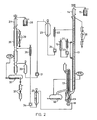
- Die Trennung wurde nach dem Prinzip der Figur 1 durchgeführt. Die genaue Versuchsdurchführung ist aus der Figur 2 unter Angabe der stündlichen Stoffströme und der Versuchsbedingungen zu entnehmen.
- In der Figur 2 bedeutet:
- 13 Extraktivdestillationskolonne
- 14 Kondensator
- 15 Kühlfalle
- 16 Destillatvorlage
- 17 Verdampfer
- 18 Siedethermostat
- 19 Isomerengemischvorlage
- 25 Sumpfvorlage
- 21/22 Zulaufvorwärmer
- 23 Sulfolanvorlage
- 20/24 Zulaufpumpen
- 26 Losungsmittelabtrennungskolonne
- 27 Kondensator
- 28 Kühlfalle
- 29 Destillatvorlage
- 30 Seitenstromkondensator
- 31 Seitenstrompumpe
- 32 Verdampfer
- 33 Sumpfvorlage
- 34 Zulaufpumpe
- 350 Zulaufvorwärmer
- Als Hilfsstoff für die Trennung der beiden Diastereomeren wird hier Sulfolan (Tetramethylensulfon) eingesetzt.
- Aufarbeitung von cis/trans Permethrinsäuremethylester (= PSME) mit Sulfolan: Betriebsbedingungen und stündliche Bilanz.
- Extraktivdestillationskolonne (13):
- 13,5 m (Sulzer BX DN 70)
- Temperatur im unteren Bereich von (13): 165°C,
- Druck im unteren Bereich von (13): 50 mbar,
- Temperatur im Mittelbereich von (13): 140°C,
- Temperatur im Kondensator (14): 114°C,
- Druck im Kondensator (14): 30 mbar
- Menge Rücklauf zu Menge Entnahme (= RIE) im Kondensator (14) = 3:1.
- In der Destillatvorlage (16) erhält man ein Gemisch aus 243,4 g cis PSME 0,5 g trans PSME und 5,0 g Sulfolan, wobei in die Isomerengemischvorlage (19) ein Gemisch bestehen aus 247 g cis PSME und 228 g trans PSME eingegeben wurde. In der Destillatvorlage (29) erhält man ein Gemisch aus 3,6 g cis PSME, 227,5 g trans PSME und 2,0 g Sulfolan. Aus der Sulfolanvorlage (23) werden 3400 g Sulfolan pro Stunde zugegeben.
- Die Temperatur im Siedethermostat (18) beträgt 187°C, im Verdampfer (32) ca. 175°C, in der Lösungsmittelabtrennungskolonne (26) (4 x 4 Maschendrahtringe, DN 50, 2 x 2000 mm) 170°C und im Kondensator (27) 117°C.
- Der Druck im Verdampfer (32) beträgt 45 mbar und im Kondensator (27) 30 mbar. Das Rücklaufverhältnis R/E ist im Kondensator (27) = 1,5.
- In der Sumpfvorlage (33) sind keine hochsiedenden Substanzen angefallen. Vakuum wird in der Apparatur an folgenden Stellen angelegt:
- Kühlfalle (15), Verdampfer (17), Kühlfalle (28).
- TRC bedeutet in der Figur 2 Temperaturregister-Regelung.

- Das Beispiel zeigt also, daß die benötigte Trennstufenzahl von 150 auf 25 und das Rücklaufverhältnis von 12 auf 4 gesenkt werden konnte. Es gelang jeweils 99 % reines cis- bzw. trans-Isomeres zu isolieren.
- Trennung von cis/trans Permethrinsäuremethylester
- An Stelle von Sulfolan können gemäß der Anordnung von Beispiel 1 auch folgende Hilfsstoffe für die Trennung der beiden Diastereomeren eingesetzt werden:
- 4-Methylmorpholin, Methylformamid, 2-Pyrrolidon, N-Methylacetamid, 1-Methyl-oxo-phospholin.
- Trennung von Menthol/iso-Menthol
- Gemäß der Versuchsanordnung des Beispiels 1 und unter Verwendung von Bernsteinsäurediamid als Hilfsstoffs können Menthol/iso-Menthol erfolgreich getrennt werden.
- Ergebnis:

- Bedingungen: 50/50 Zulauf, 1 % Leichtsieder im Sumpf, 10 % Schwersieder im Kopf
- Für die Trennung Menthol-iso-Menthol können weiterhin beispielsweise folgende Hilfsstoffe eingesetzt werden:
- Glutarsäuredinitril, Bernsteinsäuredinitril, Campher, Malonsäuredinitril.
Claims (9)
Applications Claiming Priority (2)
| Application Number | Priority Date | Filing Date | Title |
|---|---|---|---|
| DE3613975 | 1986-04-25 | ||
| DE19863613975 DE3613975A1 (de) | 1986-04-25 | 1986-04-25 | Trennung von diastereomeren |
Publications (2)
| Publication Number | Publication Date |
|---|---|
| EP0242778A1 true EP0242778A1 (de) | 1987-10-28 |
| EP0242778B1 EP0242778B1 (de) | 1989-09-13 |
Family
ID=6299487
Family Applications (1)
| Application Number | Title | Priority Date | Filing Date |
|---|---|---|---|
| EP87105531A Expired EP0242778B1 (de) | 1986-04-25 | 1987-04-14 | Trennung von Diastereomeren |
Country Status (4)
| Country | Link |
|---|---|
| US (1) | US4874473A (de) |
| EP (1) | EP0242778B1 (de) |
| JP (1) | JPS62255437A (de) |
| DE (2) | DE3613975A1 (de) |
Cited By (2)
| Publication number | Priority date | Publication date | Assignee | Title |
|---|---|---|---|---|
| US8318985B2 (en) | 2007-11-30 | 2012-11-27 | Basf Se | Method for producing optically active, racemic menthol |
| US8414744B2 (en) | 2007-09-11 | 2013-04-09 | Basf Se | Continuous process for preparing menthol in pure or enriched form |
Families Citing this family (10)
| Publication number | Priority date | Publication date | Assignee | Title |
|---|---|---|---|---|
| CN1186483A (zh) * | 1995-05-05 | 1998-07-01 | 赫希斯特人造丝公司 | α-芳基丙酸酯非对映体的蒸馏分离 |
| US5840958A (en) * | 1996-10-17 | 1998-11-24 | Fmc Corporation | 1S to 1R Epimerizations of pyrethroid intermediates |
| US6379552B1 (en) * | 1998-07-06 | 2002-04-30 | Toray Industries, Inc. | Method for resolving optical isomers |
| US6019874A (en) * | 1999-01-19 | 2000-02-01 | Berg; Lloyd | Separation of conjugated linoleic acids by azeotropic distillation |
| DE102005013030A1 (de) * | 2005-03-22 | 2006-09-28 | Bayer Technology Services Gmbh | Verfahren zur destillativen Reinigung schwerflüchtiger Fluide |
| JP5094148B2 (ja) * | 2006-02-02 | 2012-12-12 | 昭和電工株式会社 | アリルアルコールの製造方法 |
| EP2450334B1 (de) | 2010-10-21 | 2014-06-11 | LANXESS Deutschland GmbH | Verfahren zur Trennung von isomeren Mentholverbindungen |
| US9024079B2 (en) | 2012-01-11 | 2015-05-05 | Lanxess Deutschland Gmbh | Separation of isomeric menthol compounds |
| JP5888993B2 (ja) * | 2012-01-12 | 2016-03-22 | ランクセス・ドイチュランド・ゲーエムベーハー | メントール化合物異性体の分離 |
| US11103499B2 (en) | 2016-08-26 | 2021-08-31 | EXCIVA (UG) (haftungsbeschränkt) | Compositions and methods thereof |
Citations (2)
| Publication number | Priority date | Publication date | Assignee | Title |
|---|---|---|---|---|
| US3491152A (en) * | 1967-06-22 | 1970-01-20 | Dow Chemical Co | Resolution of optical isomers of propylene glycol and certain ketones |
| FR2176621A1 (en) * | 1972-03-23 | 1973-11-02 | Reant Patrice | Sepn of stereoisomers - by extn and distn with an optically active solvent |
Family Cites Families (8)
| Publication number | Priority date | Publication date | Assignee | Title |
|---|---|---|---|---|
| FR2190782B1 (de) * | 1972-06-30 | 1974-12-27 | Rhone Progil | |
| JPS525738A (en) * | 1975-06-27 | 1977-01-17 | Sumitomo Chem Co Ltd | Process for racemization of optically active 2,2-dimethyl-3-(2,2-dichl orovinyl)-cyclopropanecarboxylic acid and its derivatives |
| DE2713538A1 (de) * | 1977-03-26 | 1978-09-28 | Bayer Ag | Verfahren zur trennung stereoisomerer cyclischer carbonsaeuren |
| DE2716898B2 (de) * | 1977-04-16 | 1979-02-15 | Bayer Ag, 5090 Leverkusen | Verfahren zur Trennung von cis- und trans-Vinylcyclopropancarbonsäuren |
| US4134919A (en) * | 1977-06-14 | 1979-01-16 | Takasago Perfumery Co., Ltd. | Process for producing menthone |
| DE2965745D1 (en) * | 1978-10-27 | 1983-07-28 | Ici Plc | Process of separating cis and trans isomers of cyclopropane carboxylic acids |
| HU188255B (en) * | 1983-02-17 | 1986-03-28 | Chinoin Gyogyszer Es Vegyeszeti Termekek Gyara Rt,Hu | Process for separation of izomers of derivates of cycloprophane carbonic acid |
| US4488937A (en) * | 1984-04-11 | 1984-12-18 | Lloyd Berg | Separation of m-xylene from o-xylene by extractive distillation |
-
1986
- 1986-04-25 DE DE19863613975 patent/DE3613975A1/de not_active Withdrawn
-
1987
- 1987-04-14 DE DE8787105531T patent/DE3760555D1/de not_active Expired
- 1987-04-14 EP EP87105531A patent/EP0242778B1/de not_active Expired
- 1987-04-16 US US07/039,550 patent/US4874473A/en not_active Expired - Fee Related
- 1987-04-20 JP JP62095472A patent/JPS62255437A/ja active Pending
Patent Citations (2)
| Publication number | Priority date | Publication date | Assignee | Title |
|---|---|---|---|---|
| US3491152A (en) * | 1967-06-22 | 1970-01-20 | Dow Chemical Co | Resolution of optical isomers of propylene glycol and certain ketones |
| FR2176621A1 (en) * | 1972-03-23 | 1973-11-02 | Reant Patrice | Sepn of stereoisomers - by extn and distn with an optically active solvent |
Cited By (3)
| Publication number | Priority date | Publication date | Assignee | Title |
|---|---|---|---|---|
| US8414744B2 (en) | 2007-09-11 | 2013-04-09 | Basf Se | Continuous process for preparing menthol in pure or enriched form |
| US8318985B2 (en) | 2007-11-30 | 2012-11-27 | Basf Se | Method for producing optically active, racemic menthol |
| US9988331B2 (en) | 2007-11-30 | 2018-06-05 | Basf Se | Method for producing optically active, racemic menthol |
Also Published As
| Publication number | Publication date |
|---|---|
| DE3613975A1 (de) | 1987-10-29 |
| JPS62255437A (ja) | 1987-11-07 |
| DE3760555D1 (en) | 1989-10-19 |
| EP0242778B1 (de) | 1989-09-13 |
| US4874473A (en) | 1989-10-17 |
Similar Documents
| Publication | Publication Date | Title |
|---|---|---|
| EP0242778A1 (de) | Trennung von Diastereomeren | |
| WO2009033870A1 (de) | Kontinuierliches verfahren zur herstellung von menthol in reiner oder angereicherter form | |
| DE69521230T2 (de) | Herstellung von alpha-beta-ungesättigten C3-C6-Carbonsäuren | |
| WO2004024668A2 (de) | Destillative verfahren zur herstellung von ipda mit einem hohen cis/trans-isomerenverhältnis | |
| EP0775685B1 (de) | Verfahren zur Reindarstellung von trans- und cis-4-Hydroxy-2,2,6-trimethyl-cyclohexan-1-on aus Isomerengemischen | |
| DE3115881C2 (de) | ||
| EP0026311A1 (de) | Verfahren zur Herstellung von sehr reinem epsilon-Caprolacton | |
| EP0022972B1 (de) | Neue Menthylester, Verfahren zu ihrer Herstellung und ihre Verwendung zur Enantiomerentrennung chiraler Carbonsäuren | |
| DE10306948A1 (de) | Verfahren zur Herstellung von desodorisiertem N-Vinyl-2-Pyrrolidon | |
| EP1838405B1 (de) | Verfahren zur herstellung von spezifikationsgerechtem phthalsäureanhydrid | |
| EP0453920B1 (de) | Verfahren zur Reinigung von alpha-Bisabolol | |
| DE69025478T2 (de) | Herstellung von gemischen von cypermethrin- oder cyfluthrinisomeren, die mit einer aktiveren substanz angereichert sind | |
| DE3242042C1 (de) | Gemisch von Dimethyl-tricyclo[5.2.1.0?]decan-Derivaten sowie dessen Herstellung und Verwendung als Riech- und Aromastoff | |
| EP0864556B1 (de) | Verfahren zur Herstellung von hochreinem Cyclopropylmethylketon | |
| WO2001098261A1 (de) | Verfahren zur abtrennung von 6-aminocapronitril aus gemischen, die 6-aminocapronitril, adipodinitril und hexamethylendiamin enthalten | |
| DD278778A5 (de) | Verfahren zur reinigung von 2-(4-isobutylphenyl)-propionsaeure | |
| EP0402744B1 (de) | Verfahren zur Gewinnung von trans-1,1,4,4-tetraalkyl-2-buten-1,4-diolen | |
| DE2727323C2 (de) | ||
| DE2716898A1 (de) | Verfahren zur trennung stereoisomerer vinylcycloprpancarbonsaeuren | |
| EP0001983A1 (de) | Verfahren zur Isolierung bzw. Gewinnung von N,N-Dimethylaminoacetonitril aus N,N-Dimethylaminoacetonitril/Wasser-Gemischen | |
| DE3302127A1 (de) | Verfahren zur gewinnung einer mit terephthalaldehydsaeuremethylester angereicherten fraktion | |
| DE2716898B5 (de) | ||
| DE2545845A1 (de) | Verfahren zur herstellung von essigsaeureaethylester | |
| WO1998034901A1 (de) | Verfahren zur abtrennung von 2-aminomethylcyclopentylamin aus einer mischung enthaltend hexamethylendiamin und 2-aminomethylcyclopentylamin | |
| DE1025858B (de) | Verfahren zur Herstellung von C-Aldehyden durch die Oxosynthese |
Legal Events
| Date | Code | Title | Description |
|---|---|---|---|
| PUAI | Public reference made under article 153(3) epc to a published international application that has entered the european phase |
Free format text: ORIGINAL CODE: 0009012 |
|
| 17P | Request for examination filed |
Effective date: 19870414 |
|
| AK | Designated contracting states |
Kind code of ref document: A1 Designated state(s): CH DE FR GB IT LI |
|
| 17Q | First examination report despatched |
Effective date: 19880622 |
|
| GRAA | (expected) grant |
Free format text: ORIGINAL CODE: 0009210 |
|
| AK | Designated contracting states |
Kind code of ref document: B1 Designated state(s): CH DE FR GB IT LI |
|
| ITF | It: translation for a ep patent filed | ||
| REF | Corresponds to: |
Ref document number: 3760555 Country of ref document: DE Date of ref document: 19891019 |
|
| GBT | Gb: translation of ep patent filed (gb section 77(6)(a)/1977) | ||
| ET | Fr: translation filed | ||
| RIN2 | Information on inventor provided after grant (corrected) |
Free format text: ARLT, DIETER, PROF. DR. * SCHWARTZ, ULRICH, DR. * BRANDT, HANS-WALTER, DR. * ARLT, WOLFGANG, DR. * NICKEL, ANDREAS, DIPL.-ING. |
|
| PLBE | No opposition filed within time limit |
Free format text: ORIGINAL CODE: 0009261 |
|
| STAA | Information on the status of an ep patent application or granted ep patent |
Free format text: STATUS: NO OPPOSITION FILED WITHIN TIME LIMIT |
|
| 26N | No opposition filed | ||
| ITTA | It: last paid annual fee | ||
| PGFP | Annual fee paid to national office [announced via postgrant information from national office to epo] |
Ref country code: DE Payment date: 19930317 Year of fee payment: 7 |
|
| PGFP | Annual fee paid to national office [announced via postgrant information from national office to epo] |
Ref country code: FR Payment date: 19930330 Year of fee payment: 7 |
|
| PGFP | Annual fee paid to national office [announced via postgrant information from national office to epo] |
Ref country code: GB Payment date: 19930331 Year of fee payment: 7 |
|
| PGFP | Annual fee paid to national office [announced via postgrant information from national office to epo] |
Ref country code: CH Payment date: 19930430 Year of fee payment: 7 |
|
| PG25 | Lapsed in a contracting state [announced via postgrant information from national office to epo] |
Ref country code: GB Effective date: 19940414 |
|
| PG25 | Lapsed in a contracting state [announced via postgrant information from national office to epo] |
Ref country code: LI Effective date: 19940430 Ref country code: CH Effective date: 19940430 |
|
| GBPC | Gb: european patent ceased through non-payment of renewal fee |
Effective date: 19940414 |
|
| PG25 | Lapsed in a contracting state [announced via postgrant information from national office to epo] |
Ref country code: FR Effective date: 19941229 |
|
| REG | Reference to a national code |
Ref country code: CH Ref legal event code: PL |
|
| PG25 | Lapsed in a contracting state [announced via postgrant information from national office to epo] |
Ref country code: DE Effective date: 19950103 |
|
| REG | Reference to a national code |
Ref country code: FR Ref legal event code: ST |
|
| PG25 | Lapsed in a contracting state [announced via postgrant information from national office to epo] |
Ref country code: IT Free format text: LAPSE BECAUSE OF NON-PAYMENT OF DUE FEES;WARNING: LAPSES OF ITALIAN PATENTS WITH EFFECTIVE DATE BEFORE 2007 MAY HAVE OCCURRED AT ANY TIME BEFORE 2007. THE CORRECT EFFECTIVE DATE MAY BE DIFFERENT FROM THE ONE RECORDED. Effective date: 20050414 |