EP0241474B1 - Kratzvorrichtung in einem absatzbecken - Google Patents
Kratzvorrichtung in einem absatzbecken Download PDFInfo
- Publication number
- EP0241474B1 EP0241474B1 EP86901161A EP86901161A EP0241474B1 EP 0241474 B1 EP0241474 B1 EP 0241474B1 EP 86901161 A EP86901161 A EP 86901161A EP 86901161 A EP86901161 A EP 86901161A EP 0241474 B1 EP0241474 B1 EP 0241474B1
- Authority
- EP
- European Patent Office
- Prior art keywords
- scraping blade
- scraping
- sledge
- basin
- carrier
- Prior art date
- Legal status (The legal status is an assumption and is not a legal conclusion. Google has not performed a legal analysis and makes no representation as to the accuracy of the status listed.)
- Expired - Lifetime
Links
Images

Classifications
-
- B—PERFORMING OPERATIONS; TRANSPORTING
- B01—PHYSICAL OR CHEMICAL PROCESSES OR APPARATUS IN GENERAL
- B01D—SEPARATION
- B01D21/00—Separation of suspended solid particles from liquids by sedimentation
- B01D21/02—Settling tanks with single outlets for the separated liquid
- B01D21/04—Settling tanks with single outlets for the separated liquid with moving scrapers
-
- B—PERFORMING OPERATIONS; TRANSPORTING
- B01—PHYSICAL OR CHEMICAL PROCESSES OR APPARATUS IN GENERAL
- B01D—SEPARATION
- B01D21/00—Separation of suspended solid particles from liquids by sedimentation
- B01D21/18—Construction of the scrapers or the driving mechanisms for settling tanks
Definitions
- the present invention relates to a scraping device in a settling basin.
- the scraping device removes sediments, which accumulate on the bottom of the basin. It comprises a vehicle and a scraper on the vehicle.
- a cable drive device having a pull cable pulls the vehicle forwards and backwards along the bottom of the basin.
- the scraper assumes, in one of the vehicle's two directions of moment, a working position, in which it is directed towards the bottom of the basin, in order to scrape sediment to an output area, and in the vehicle's opposite direction a passive return position, in which it is elevated from the bottom of the basin.
- Swedish allowed patent application no. 8302563-5 relates to a quite simple scraping device, which includes a vehicle, on which two scraping blades adjacent each other are pivotally disposed. Shoulders, which are arranged at the turning points of the vehicle, turn the scraping blades into their intended positions, either an active scraping position or an elevated passive idle or return position.
- the pull cable is connected partly to the front end of the vehicle and partly to its other end.
- One object of the present invention is to build a scraping device, which is simpler than known scraping devices and comprises few movable parts.
- Another object of the invention is to build a scraping device, which can be connected, in a ready manner, to several scraping devices, which are identical with it and jointly in succession in the direction of movement are capable of removing sediments from the bottom of a settling basin, particularly an extended one.
- the scraping device comprises a sledge on a guide on the bottom of a settling basin as well as a carrier, which is rotatably disposed on the sledge and carries a scraping blade into at first an active working position for sediment scraping towards an output area and then an elevated passive rest or return position, when the scraping device is pulled away from the output area after the working phase.
- the carrier turns the scraping blade into its intended position, because the pull cable is provided with a holder in the carrier.
- the pull cable performs two tasks, partly of pulling the sledge in the working direction and the return direction and partly of lowering the scraping blade at the return points of the scraping device, at first into the working position and then into the return position.
- the pull cable can accomplish this while pulling and at the same time guiding without any such additional mechanical regulatory devices, which known scraping devices employ.
- the sledge which carries the carrier and the scraping blade attached to the carrier comprises a profiled bar. Its cross section or the cross section of sliding shoes, which are inserted into it, has such a shape, that it cannot be elevated from or run off its guide.
- the carrier is rotatably disposed around an axle on the sledge. Said axle is horizontally disposed and its direction is perpendicular to the direction of movement of the scraping device.
- the scraping blade which is attached to the carrier, is carried to its active working position, when the pull cable pulls the carrier towards the output area of the basin and subsequently to its passive rest and return position, when the pull cable pulls the carrier in the opposite direction, in order not to scrape the amount of sediment, which has been fed or scraped towards the output area, away from the output area or scrape newly settled material in the wrong direction.
- the two ends of the scraping blade are provided with wheels, which support the sledge and the advance of the scraping blade along the bottom of the basin.
- the axles of the wheels were extended towards the sledge, they would coincide with the axle of the carrier on the sledge.
- the wheels are always in touch with the bottom of the basin, regardless of what the angle between the scraping blade and the bottom of the basin is.
- the inventor was at first not successful with the concept of employing a carrier for the scraping blade and a holder on the carrierfor the pull cable due to the fact that the scraping blade was not elevated but was instead locked in its working position, when the pull cable pulled the carrier away from the output area and thus, the scraping device left the output area having its scraping blade in the working psoition.
- This problem was solved with a preferred embodiment of the present invention by providing such a large friction between the sledge and the guide, that the scraping blade, by means of its pull cable and carrier, without difficulty, could be brought to its return position without the friction between the sledge and the guide being overcome.
- the required friction can be attained by choosing a suitable material for partly the interior parts of the sledge and partly the guide.
- the sledge is provided with interior sliding shoes at its two ends. The sliding shoes seize the guide in order to keep the sledge on the guide and at the same time they provide such an intimate contact between the sledge and the guide and are made of such a material that the required contact is attained.
- the scraping blade roughly has the same density as the density of the liquid medium in the settling basin.
- the force needed to atfirst lower the scraping blade into its working position and subsequently elevate it into its return position consequently is small and the required least friction between the sledge and its guide correspondingly may be made smaller.
- the pulling force have to be 10 kg subsequenttothe starting of the sledge, provided the scraping blade is substantially weightless in the liquid medium in the basin.
- the pulling force maybe must be 30 kg in order to initiate the movement of the sledge.
- a pulling force of about the same dimension can be used to move the carrier and the scraping blade into their intended working and return position respectively before the start of the scraping device in its working and its return direction respectively.
- the desired density of the scraping blade can be attained according to the present invention by one of the following measures:
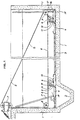
- Fig. 1 shows a longitudinal section of a settling basin 1.
- an output area 2 or a sludge hopper 2 is provided in its left end.
- a scraping sledge 4 is mounted to be moved forwards and backwards by means of a pull cable 5, which is attached to a carrier 6, which is mounted on a scraping sledge 4.
- the pull cable is driven over two separate cable drums in a cable drive device 7, which is mounted above the basin. Cable 5 pulls carrier 6 and scraping sledge 4 via a pulley wheel 8 towards sludge hopper 2 or via pulley wheel 9 towards the opposite end of settling basin 1.
- a scraping blade 10 is firmly attached to carrier 6 and extends from one longitudinal wall to the other in basin 1 in a direction, which is perpendicular to the direction of pull cable 5.
- Carrier 6 is rotatably disposed on the sledge around an axle 12 on the sledge and scraping blade 10 can stay in two terminal positions, partly in one working position, when its longitudinal edge touches the bottom of basin 1 and a sediment scraping of the bottom can be performed, and partly in an elevated position, a rest or return position (the scraping blade being depicted by dotted lines), when scraping blade 10 jointly with carrier 6 on sledge 4 returns to the right end of basin 1.
- a limit actuator 16 on the left end of sledge 4 will contact a limit breaker 17 and drive device 7 change its direction.
- Sledge 4 is provided with a U-shaped sliding shoe 18 at each end, which seizes guide 3 and at the same time cause friction between sledge 4 and guide 3.
- carrier 6 will initially turn to the right and consequently elevates scraping blade 10 into a rest or return position.
- Scraping blade 10 is provided eith a layer 11 of a plastic foam and consequently the density of scraping blade 10, 11 is roughly the same as the density of the liquid medium in the basin and thus, substantially no moment of force is needed to turn scraping blade 10 to the right.
- a second limit breaker 17 is located here and it is actuated by a second limit actuator 16 on the right end of sledge 4, when the sledge wholly has reached its right end position and consequently drive device 7 changes its direction, cable 5 starts pulling carrier 6 and scraping blade 10 with its plastic layer 11 is lowered towards the bottom of basin 1, since the weight of the scraping blade in the liquid medium substantially can be disregarded.
- Fig. 2 shows scraping sledge 4 and its two sliding shoes 18 on guide 3 and axle 12, around which carrier 6 is rotatably disposed.
- Carrier 6 carries scraping blade 10, which as depicted assumes its working position, one of its longitudinal edges being in contact with the bottom of basin 1.
- Two supporting wheels 13 are attached to the two ends of scraping blade 10. If their shafts were to be extended towards axle 12 of the sledge, they would coincide with with the latter. Thus, wheels 13 always are in contact with the bottom of basin 1, regardless of what the angle is between scraping blade 10 and the bottom of the basin.
- Fig. 3 shows in planar view a scraping device 4, 6, 10.
- Scraping blade 10 has the same position, working position, as in fig. 2.
- Fig. 4 is a vertical cross section of an end of scraping sledge 4, which shows a sliding shoe 18 between guide 3 and sledge 4.
- the counter pressure of the sledge, which is needed to guide the scraping blade by means of pull cable 5 is attained by friction between the two sliding shoes (only one shown) and guide 3.
- Fig. 5 shows the position of a sliding shoe 18 on guide 3 and in one end of scraping sledge 4. It is attached to the interior of scraping sledge 4. This figure also shows one of the two limit actuators 16 on this end of the sledge as well as the lower end of a limit breaker 17.
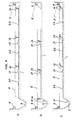
- Fig. 6 shows only schematically three different conditions of an extended scraping construction having three scraping sledges according to the invention, which in succession are connected to a pull cable in the direction of the pull cable.
Landscapes
- Chemical & Material Sciences (AREA)
- Chemical Kinetics & Catalysis (AREA)
- Cleaning In General (AREA)
- Loading Or Unloading Of Vehicles (AREA)
- Pusher Or Impeller Conveyors (AREA)
Claims (5)
Priority Applications (1)
| Application Number | Priority Date | Filing Date | Title |
|---|---|---|---|
| AT86901161T ATE59565T1 (de) | 1985-01-29 | 1986-01-29 | Kratzvorrichtung in einem absatzbecken. |
Applications Claiming Priority (2)
| Application Number | Priority Date | Filing Date | Title |
|---|---|---|---|
| SE8500395 | 1985-01-29 | ||
| SE8500395A SE451181B (sv) | 1985-01-29 | 1985-01-29 | Sett och anordning for skrapning i sedimentationsbasseng |
Publications (2)
| Publication Number | Publication Date |
|---|---|
| EP0241474A1 EP0241474A1 (de) | 1987-10-21 |
| EP0241474B1 true EP0241474B1 (de) | 1991-01-02 |
Family
ID=20358932
Family Applications (1)
| Application Number | Title | Priority Date | Filing Date |
|---|---|---|---|
| EP86901161A Expired - Lifetime EP0241474B1 (de) | 1985-01-29 | 1986-01-29 | Kratzvorrichtung in einem absatzbecken |
Country Status (7)
| Country | Link |
|---|---|
| US (1) | US4724088A (de) |
| EP (1) | EP0241474B1 (de) |
| JP (1) | JPS62501690A (de) |
| AU (1) | AU5398386A (de) |
| DE (1) | DE3676492D1 (de) |
| SE (1) | SE451181B (de) |
| WO (1) | WO1986004256A1 (de) |
Families Citing this family (20)
| Publication number | Priority date | Publication date | Assignee | Title |
|---|---|---|---|---|
| US5413715A (en) * | 1981-03-27 | 1995-05-09 | Basic, Sr.; John N. | Incinerator improvements |
| US5149057A (en) * | 1989-03-09 | 1992-09-22 | Baker Hughes Incorporated | Tape drive with self-expanding coils for sludge collector |
| US4927537A (en) * | 1989-03-09 | 1990-05-22 | Envirotech Corporation | Tape drive with self-expanding coils for sludge collector |
| US4986141A (en) * | 1989-03-09 | 1991-01-22 | Baker Hughes Incorporated | Tape drive with self-expanding coils for sludge collector |
| US4986915A (en) * | 1989-03-09 | 1991-01-22 | Baker Hughes Incorporated | Tape drive with self-expanding coils for sludge collector |
| DE69034199T2 (de) * | 1990-10-15 | 2006-04-20 | Basic sen., John N., Marco Island | Anlage und Verfahren zur Rauchverbrennung |
| SE507592C2 (sv) * | 1991-08-13 | 1998-06-22 | K Z Handels Ab | Transportelement vid en fram- och återgående skraptransportör för förflyttning av slam vid sedimenteringsbassänger och liknande vid vattenreningsverk |
| EP0607447B1 (de) * | 1992-05-14 | 1997-09-03 | FUJIWARA, Michihiro | Kratzerförderer für schlamm |
| US5250199A (en) * | 1992-06-15 | 1993-10-05 | Enviroland, Inc. | Sludge scraper apparatus |
| DE9215420U1 (de) * | 1992-11-12 | 1993-01-28 | Linz, Manfred, 8705 Zellingen | Schrapper zum Ansammeln von Schlamm o.dgl., insbesondere von Klärschlamm in Absetzbecken |
| US5286384A (en) * | 1993-01-14 | 1994-02-15 | Enviroland, Inc. | Sludge scraper apparatus |
| US6199704B1 (en) * | 1998-07-04 | 2001-03-13 | Michihiro Fujiwara | Sludge collecting apparatus |
| US6180013B1 (en) * | 1999-06-17 | 2001-01-30 | Jen-Jui Liu | Method for removing sediments under sewage water in a sewer |
| SG165189A1 (en) * | 2009-03-16 | 2010-10-28 | Unitech Environment Ind Co Ltd | Sludge remover capable of driving scraping blades to change to different angular positions |
| JP6058509B2 (ja) * | 2013-09-09 | 2017-01-11 | 住友重機械エンバイロメント株式会社 | 汚泥掻寄機 |
| JP2015174084A (ja) * | 2014-03-12 | 2015-10-05 | 有限会社フジカ | 汚泥掻寄装置 |
| JP7068104B2 (ja) * | 2018-08-27 | 2022-05-16 | 株式会社日立プラントサービス | 汚泥掻寄機 |
| JP7266504B2 (ja) * | 2019-10-10 | 2023-04-28 | 株式会社日立プラントサービス | 汚泥掻寄機 |
| ES2877803B2 (es) * | 2020-05-14 | 2022-07-07 | Atca Asesoria Proyectos E Instalaciones S L | Sistema barredor de fondo para el arrastre de solidos en tanques de decantacion |
| CN112237764B (zh) * | 2020-09-16 | 2021-11-02 | 深圳市南方水务有限公司 | 一种城市生活污水初步处理设备及其处理工艺 |
Citations (4)
| Publication number | Priority date | Publication date | Assignee | Title |
|---|---|---|---|---|
| GB1504518A (en) * | 1975-04-07 | 1978-03-22 | Simon Eng Dudley Ltd | Apparatus for removing solids from settling tanks |
| SE423968B (sv) * | 1980-10-09 | 1982-06-21 | Svets & Montage I Karlstad Ab | Rensningsanordning for sedimenteringsbassenger |
| EP0076240A1 (de) * | 1981-09-22 | 1983-04-06 | SMAB Svets & Montage i Karlstadt Aktiebolag | Einrichtung für längliche Absetzbecken |
| WO1984004257A1 (en) * | 1983-05-05 | 1984-11-08 | Zander & Ingestroem | Scraping device for sedimentation basins |
Family Cites Families (3)
| Publication number | Priority date | Publication date | Assignee | Title |
|---|---|---|---|---|
| US1918742A (en) * | 1931-06-15 | 1933-07-18 | Henry E Elrod | Settling tank |
| US2160534A (en) * | 1933-12-08 | 1939-05-30 | Jeffrey Mfg Co | Conveyer |
| US4417044A (en) * | 1982-05-25 | 1983-11-22 | General Electric Company | Process for making polyetherimides |
-
1985
- 1985-01-29 SE SE8500395A patent/SE451181B/sv not_active IP Right Cessation
-
1986
- 1986-01-29 DE DE8686901161T patent/DE3676492D1/de not_active Expired - Fee Related
- 1986-01-29 EP EP86901161A patent/EP0241474B1/de not_active Expired - Lifetime
- 1986-01-29 AU AU53983/86A patent/AU5398386A/en not_active Abandoned
- 1986-01-29 JP JP61501050A patent/JPS62501690A/ja active Pending
- 1986-01-29 WO PCT/SE1986/000033 patent/WO1986004256A1/en not_active Ceased
- 1986-01-29 US US06/914,827 patent/US4724088A/en not_active Expired - Fee Related
Patent Citations (4)
| Publication number | Priority date | Publication date | Assignee | Title |
|---|---|---|---|---|
| GB1504518A (en) * | 1975-04-07 | 1978-03-22 | Simon Eng Dudley Ltd | Apparatus for removing solids from settling tanks |
| SE423968B (sv) * | 1980-10-09 | 1982-06-21 | Svets & Montage I Karlstad Ab | Rensningsanordning for sedimenteringsbassenger |
| EP0076240A1 (de) * | 1981-09-22 | 1983-04-06 | SMAB Svets & Montage i Karlstadt Aktiebolag | Einrichtung für längliche Absetzbecken |
| WO1984004257A1 (en) * | 1983-05-05 | 1984-11-08 | Zander & Ingestroem | Scraping device for sedimentation basins |
Also Published As
| Publication number | Publication date |
|---|---|
| US4724088A (en) | 1988-02-09 |
| JPS62501690A (ja) | 1987-07-09 |
| SE8500395L (sv) | 1986-07-30 |
| SE8500395D0 (sv) | 1985-01-29 |
| WO1986004256A1 (en) | 1986-07-31 |
| EP0241474A1 (de) | 1987-10-21 |
| SE451181B (sv) | 1987-09-14 |
| AU5398386A (en) | 1986-08-13 |
| DE3676492D1 (de) | 1991-02-07 |
Similar Documents
| Publication | Publication Date | Title |
|---|---|---|
| WO1986004256A1 (en) | A scraping device in a settling basin | |
| KR100885050B1 (ko) | 사각 침전조의 스컴-슬러지 제거장치 | |
| US4090966A (en) | Sediment collection and removal system for rectangular sedimentation basin | |
| FR2678348B1 (fr) | Procede pour poser un cable ou un tuyau souple dans une gaine utilisee a cet effet. | |
| US3920558A (en) | Mud scraping device | |
| NL7811818A (nl) | Inrichting voor het schoonspoelen van buizen, meer in het bijzonder van draineerbuizen. | |
| CA2064516A1 (en) | Method and apparatus for sludge collection | |
| US5286384A (en) | Sludge scraper apparatus | |
| US5250199A (en) | Sludge scraper apparatus | |
| KR200231624Y1 (ko) | 수중 대차식 로프 견인형 오니 제거 장치 | |
| KR200188808Y1 (ko) | 침전지의 슬러지 수집장치 | |
| JP2000079303A (ja) | 汚泥掻寄装置 | |
| JP2002001012A (ja) | 沈殿池汚泥掻き寄装置 | |
| US4342162A (en) | Device for planing a body of ground material | |
| JPS61130533A (ja) | 下水道内のヘドロ回収装置 | |
| KR960005031Y1 (ko) | 침전지의 부유물 제거장치 | |
| GB1504518A (en) | Apparatus for removing solids from settling tanks | |
| CN2803489Y (zh) | 用于污水沉淀池中的刮泥装置 | |
| KR19990073461A (ko) | 침전지용슬러지제거장치 | |
| CN216865296U (zh) | 一种工作效率高的水利工程用水渠清淤装置 | |
| JP2677049B2 (ja) | 汚泥掻寄装置 | |
| CN117587812B (zh) | 一种可调式打桩机 | |
| CN220788362U (zh) | 一种污染防治用污泥干化机 | |
| KR0116768Y1 (ko) | 침전지의 오니 제거 장치 | |
| JP2000157975A5 (de) |
Legal Events
| Date | Code | Title | Description |
|---|---|---|---|
| PUAI | Public reference made under article 153(3) epc to a published international application that has entered the european phase |
Free format text: ORIGINAL CODE: 0009012 |
|
| 17P | Request for examination filed |
Effective date: 19870713 |
|
| AK | Designated contracting states |
Kind code of ref document: A1 Designated state(s): AT BE CH DE FR GB IT LI NL SE |
|
| 17Q | First examination report despatched |
Effective date: 19890801 |
|
| DIN1 | Information on inventor provided before grant (deleted) | ||
| RAP1 | Party data changed (applicant data changed or rights of an application transferred) |
Owner name: ML ENGINEERING AB |
|
| GRAA | (expected) grant |
Free format text: ORIGINAL CODE: 0009210 |
|
| AK | Designated contracting states |
Kind code of ref document: B1 Designated state(s): AT BE CH DE FR GB IT LI NL SE |
|
| PG25 | Lapsed in a contracting state [announced via postgrant information from national office to epo] |
Ref country code: SE Effective date: 19910102 |
|
| REF | Corresponds to: |
Ref document number: 59565 Country of ref document: AT Date of ref document: 19910115 Kind code of ref document: T |
|
| REF | Corresponds to: |
Ref document number: 3676492 Country of ref document: DE Date of ref document: 19910207 |
|
| ET | Fr: translation filed | ||
| ITF | It: translation for a ep patent filed | ||
| PLBE | No opposition filed within time limit |
Free format text: ORIGINAL CODE: 0009261 |
|
| STAA | Information on the status of an ep patent application or granted ep patent |
Free format text: STATUS: NO OPPOSITION FILED WITHIN TIME LIMIT |
|
| 26N | No opposition filed | ||
| PGFP | Annual fee paid to national office [announced via postgrant information from national office to epo] |
Ref country code: CH Payment date: 19920109 Year of fee payment: 7 |
|
| PGFP | Annual fee paid to national office [announced via postgrant information from national office to epo] |
Ref country code: GB Payment date: 19920115 Year of fee payment: 7 Ref country code: AT Payment date: 19920115 Year of fee payment: 7 |
|
| PGFP | Annual fee paid to national office [announced via postgrant information from national office to epo] |
Ref country code: BE Payment date: 19920120 Year of fee payment: 7 |
|
| PGFP | Annual fee paid to national office [announced via postgrant information from national office to epo] |
Ref country code: NL Payment date: 19920131 Year of fee payment: 7 |
|
| PG25 | Lapsed in a contracting state [announced via postgrant information from national office to epo] |
Ref country code: GB Effective date: 19930129 Ref country code: AT Effective date: 19930129 |
|
| PG25 | Lapsed in a contracting state [announced via postgrant information from national office to epo] |
Ref country code: LI Effective date: 19930131 Ref country code: CH Effective date: 19930131 Ref country code: BE Effective date: 19930131 |
|
| BERE | Be: lapsed |
Owner name: ML ENGINEERING A.B. Effective date: 19930131 |
|
| PG25 | Lapsed in a contracting state [announced via postgrant information from national office to epo] |
Ref country code: NL Effective date: 19930801 |
|
| NLV4 | Nl: lapsed or anulled due to non-payment of the annual fee | ||
| GBPC | Gb: european patent ceased through non-payment of renewal fee |
Effective date: 19930129 |
|
| REG | Reference to a national code |
Ref country code: CH Ref legal event code: PL |
|
| PGFP | Annual fee paid to national office [announced via postgrant information from national office to epo] |
Ref country code: FR Payment date: 19951215 Year of fee payment: 11 |
|
| PGFP | Annual fee paid to national office [announced via postgrant information from national office to epo] |
Ref country code: DE Payment date: 19960323 Year of fee payment: 11 |
|
| PG25 | Lapsed in a contracting state [announced via postgrant information from national office to epo] |
Ref country code: FR Effective date: 19970930 |
|
| PG25 | Lapsed in a contracting state [announced via postgrant information from national office to epo] |
Ref country code: DE Effective date: 19971001 |
|
| REG | Reference to a national code |
Ref country code: FR Ref legal event code: ST |
|
| PG25 | Lapsed in a contracting state [announced via postgrant information from national office to epo] |
Ref country code: IT Free format text: LAPSE BECAUSE OF NON-PAYMENT OF DUE FEES;WARNING: LAPSES OF ITALIAN PATENTS WITH EFFECTIVE DATE BEFORE 2007 MAY HAVE OCCURRED AT ANY TIME BEFORE 2007. THE CORRECT EFFECTIVE DATE MAY BE DIFFERENT FROM THE ONE RECORDED. Effective date: 20050129 |