EP0235084A2 - Heisshärtbare Stoffgemische enthaltend substituierte Bicyclo [2.2.1]hept-5-en-2,3-dicarbonsäureimide und Polymaleinimide - Google Patents
Heisshärtbare Stoffgemische enthaltend substituierte Bicyclo [2.2.1]hept-5-en-2,3-dicarbonsäureimide und Polymaleinimide Download PDFInfo
- Publication number
- EP0235084A2 EP0235084A2 EP87810087A EP87810087A EP0235084A2 EP 0235084 A2 EP0235084 A2 EP 0235084A2 EP 87810087 A EP87810087 A EP 87810087A EP 87810087 A EP87810087 A EP 87810087A EP 0235084 A2 EP0235084 A2 EP 0235084A2
- Authority
- EP
- European Patent Office
- Prior art keywords
- mixture
- hept
- bis
- allyl
- alkenyl
- Prior art date
- Legal status (The legal status is an assumption and is not a legal conclusion. Google has not performed a legal analysis and makes no representation as to the accuracy of the status listed.)
- Granted
Links
Classifications
-
- C—CHEMISTRY; METALLURGY
- C08—ORGANIC MACROMOLECULAR COMPOUNDS; THEIR PREPARATION OR CHEMICAL WORKING-UP; COMPOSITIONS BASED THEREON
- C08F—MACROMOLECULAR COMPOUNDS OBTAINED BY REACTIONS ONLY INVOLVING CARBON-TO-CARBON UNSATURATED BONDS
- C08F226/00—Copolymers of compounds having one or more unsaturated aliphatic radicals, each having only one carbon-to-carbon double bond, and at least one being terminated by a single or double bond to nitrogen or by a heterocyclic ring containing nitrogen
- C08F226/06—Copolymers of compounds having one or more unsaturated aliphatic radicals, each having only one carbon-to-carbon double bond, and at least one being terminated by a single or double bond to nitrogen or by a heterocyclic ring containing nitrogen by a heterocyclic ring containing nitrogen
-
- C—CHEMISTRY; METALLURGY
- C08—ORGANIC MACROMOLECULAR COMPOUNDS; THEIR PREPARATION OR CHEMICAL WORKING-UP; COMPOSITIONS BASED THEREON
- C08F—MACROMOLECULAR COMPOUNDS OBTAINED BY REACTIONS ONLY INVOLVING CARBON-TO-CARBON UNSATURATED BONDS
- C08F222/00—Copolymers of compounds having one or more unsaturated aliphatic radicals, each having only one carbon-to-carbon double bond, and at least one being terminated by a carboxyl radical and containing at least one other carboxyl radical in the molecule; Salts, anhydrides, esters, amides, imides, or nitriles thereof
- C08F222/36—Amides or imides
- C08F222/40—Imides, e.g. cyclic imides
- C08F222/402—Alkyl substituted imides
-
- C—CHEMISTRY; METALLURGY
- C08—ORGANIC MACROMOLECULAR COMPOUNDS; THEIR PREPARATION OR CHEMICAL WORKING-UP; COMPOSITIONS BASED THEREON
- C08F—MACROMOLECULAR COMPOUNDS OBTAINED BY REACTIONS ONLY INVOLVING CARBON-TO-CARBON UNSATURATED BONDS
- C08F222/00—Copolymers of compounds having one or more unsaturated aliphatic radicals, each having only one carbon-to-carbon double bond, and at least one being terminated by a carboxyl radical and containing at least one other carboxyl radical in the molecule; Salts, anhydrides, esters, amides, imides, or nitriles thereof
- C08F222/36—Amides or imides
- C08F222/40—Imides, e.g. cyclic imides
- C08F222/404—Imides, e.g. cyclic imides substituted imides comprising oxygen other than the carboxy oxygen
-
- C—CHEMISTRY; METALLURGY
- C08—ORGANIC MACROMOLECULAR COMPOUNDS; THEIR PREPARATION OR CHEMICAL WORKING-UP; COMPOSITIONS BASED THEREON
- C08F—MACROMOLECULAR COMPOUNDS OBTAINED BY REACTIONS ONLY INVOLVING CARBON-TO-CARBON UNSATURATED BONDS
- C08F222/00—Copolymers of compounds having one or more unsaturated aliphatic radicals, each having only one carbon-to-carbon double bond, and at least one being terminated by a carboxyl radical and containing at least one other carboxyl radical in the molecule; Salts, anhydrides, esters, amides, imides, or nitriles thereof
- C08F222/36—Amides or imides
- C08F222/40—Imides, e.g. cyclic imides
- C08F222/408—Imides, e.g. cyclic imides substituted imides comprising other heteroatoms
-
- Y—GENERAL TAGGING OF NEW TECHNOLOGICAL DEVELOPMENTS; GENERAL TAGGING OF CROSS-SECTIONAL TECHNOLOGIES SPANNING OVER SEVERAL SECTIONS OF THE IPC; TECHNICAL SUBJECTS COVERED BY FORMER USPC CROSS-REFERENCE ART COLLECTIONS [XRACs] AND DIGESTS
- Y10—TECHNICAL SUBJECTS COVERED BY FORMER USPC
- Y10T—TECHNICAL SUBJECTS COVERED BY FORMER US CLASSIFICATION
- Y10T428/00—Stock material or miscellaneous articles
- Y10T428/31504—Composite [nonstructural laminate]
- Y10T428/31855—Of addition polymer from unsaturated monomers
-
- Y—GENERAL TAGGING OF NEW TECHNOLOGICAL DEVELOPMENTS; GENERAL TAGGING OF CROSS-SECTIONAL TECHNOLOGIES SPANNING OVER SEVERAL SECTIONS OF THE IPC; TECHNICAL SUBJECTS COVERED BY FORMER USPC CROSS-REFERENCE ART COLLECTIONS [XRACs] AND DIGESTS
- Y10—TECHNICAL SUBJECTS COVERED BY FORMER USPC
- Y10T—TECHNICAL SUBJECTS COVERED BY FORMER US CLASSIFICATION
- Y10T428/00—Stock material or miscellaneous articles
- Y10T428/31504—Composite [nonstructural laminate]
- Y10T428/31855—Of addition polymer from unsaturated monomers
- Y10T428/31931—Polyene monomer-containing
Definitions
- EP-A-105 024 describes allyl- or methallyl-substituted bicyclo [2.2.1] hept-5-ene-2,3-dicarboximides and their use for the preparation of polymers by heating the imides to temperatures of 180 to 300 ° C. It is also known that the polymaleimides with or without the addition of crosslinking agents such as e.g. Diamines or alkenylphenols can be converted into crosslinked products (e.g. US 3,562,223, 3,658,764, 3,380,964, 4,038,251 and 4,100,140).
- crosslinking agents such as e.g. Diamines or alkenylphenols
- R i and R 2 are preferably each a hydrogen atom.
- R can be a straight-chain or branched C 1 -C 12 alkyl group, such as, for example, methyl, ethyl, isopropyl, n-butyl, isopentyl, n-hexyl, 2-ethylhexyl, n-decyl and n-dodecyl, but preferably a C 1 - C 8 alkyl group. If RC 3 -C 6 -alkenyl, this radical can also be straight-chain or branched, and is, for example, allyl, methallyl, 2-butenyl or 3-hexenyl, allyl being preferred. When R is a cycloalkyl group it can mean cyclopentyl, cyclohexyl, cycloheptyl or cyclooctyl, with cyclohexyl being preferred.
- R When R represents an aryl group, it can represent an unsubstituted or a phenyl group substituted by one or two methyl groups, such as tolyl or xylyl, or can mean naphthyl.
- R is preferably phenyl. If R is a -C p H 2p group, this can be straight-chain or branched, for example ethylene, propylene, trimethylene, tetramethylene, hexamethylene, octamethylene and dodecamethylene.
- R is preferably a - (CH 2 ) p group, with p equal to 2 to 12. If R is a group of the formula III, this is preferably bonded in the 4,4'-position to the nitrogen atoms.
- R is a C 6 -C l o-arylene group
- it may be a 1,3-naphthylene, 1,4-naphthylene, 1,5-naphthylene or 2,6-naphthylene or preferably a m -Phenylene or p-phenylene group.
- T is preferably a methylene group, -0- or -SO z -.
- R 1 and R 2 are each a hydrogen atom and R, when n is 1, is hydrogen, C 1 -C 8 -alkyl, allyl, cyclohexyl, phenyl or benzyl, or when n is 2, R - (CHz) - with p equal to 2 to 12, m- or p-phenylene, or a group of the formula III in which T is a methylene group, -0- or -SOz-.
- Particularly preferred compounds of the formula I are those in which R 1 and R z are each a hydrogen atom and R, when n is 1, allyl, or when n is 2, - (CH z ) 6 - or means.
- mixtures according to the invention which contain as component (a) N-allyl-allylbicyclo [2.2.1] hept-5-en-2,3-dicarboximide, bis [4- (allylbicyclo) [2.2.1] hept -5-en-2,3-dicarboximidophenyl ⁇ methane and N, N'-hexamethylene-bis (allylbicyclo) [2.2.1] hept-5-en-2,3-dicarboximide or mixtures of these compounds.
- the imides of the formula I can be prepared in a manner known per se, for example analogously to the process described in EP-A-105 024, by reacting an anhydride of the formula IV with a compound of formula V wherein R, R 1 , Rz and n have the meaning given under formula I, are produced at elevated temperature and with distillation of the water formed in the reaction. If the compounds of the formula V are ammonia or low-boiling monoamines, an excess of these reactants is recommended. Diamines are advantageously used in a stoichiometric ratio.
- the reaction can be carried out without a solvent or in the presence of an inert solvent which can be used for the azeotropic removal of the water (entrainer).
- the temperature of the reaction can be between 100 and 250 ° C.
- the imides of the formula I are preferably produced in the melt at a pressure of at most 4500 Pa at temperatures between 130 and 220 ° C., in particular 180 and 220 ° C.
- R 'means for example, a radical of the formula VIII the N, N ', N "trismaleinimide of tris (4-aminophenyl) phosphite and the N, N', N" trismaleinimide of tris (4-aminophenyl) thiophosphate.
- N, N ', 4,4'-diphenylmethane bismaleimide is very particularly preferred.
- allylphenols and methallylphenols or their ethers are preferably used as alkenylphenols or alkenylphenol ethers.
- Mono- or polynuclear, preferably dinuclear, alkenylphenols and alkenylphenol ethers can be used.
- At least one core preferably contains both an alkenyl group and an optionally etherified phenolic OH group.
- alkenylphenols can be prepared by rearrangement of the corresponding alkenyl ethers of the phenols (e.g. the allyl ether of the phenol) by heating (Claisen rearrangement).
- the alkenyl ethers are also known in a known manner by reacting the phenols with e.g. Allyl chloride is prepared in the presence of an alkali metal hydroxide in solvents.
- T is the direct bond, methylene, isopropylidene, 0, S, SO or SO 2 .
- R 4 , R 5 , R 6 and R 7 independently of one another represent a hydrogen atom, or a C 3 -C 4 alkenyl, preferably an allyl or propenyl group, at least one of R 4 to R 7 representing the propenyl group and T is the direct bond, methylene, isopropylidene, -0-, -S-, -SO- or -SO 2 -.
- Re, R 9 , Rio, R 11 , R 12 and R 13 independently of one another represent a hydrogen atom, alkyl having 1-4 C atoms, alkenyl having 3-4 C atoms, preferably allyl or propenyl, at least one of R s to R 13 represents an alkenyl, preferably allyl or propenyl group and a represents a value from 0 to 10.
- Ethers of the compounds of the formulas IX, X, XI and XII which contain at least one -OR 3 radical can also be used, where R 3 is C 1 -C 10 alkyl, C 6 -C 10 aryl or C 3 -C 6 alkenyl, preferably allyl or methallyl.
- Compounds of the formula XI are preferred in which R 4 and R 6 each represent a propenyl group and Rs and R 7 each represent a hydrogen atom and T represents methylene, isopropylidene or 0.
- isomer mixtures of propenyl- and allyl-substituted mono- and polyhydric phenols are also possible.
- Mixtures of propenyl- and allyl-substituted phenols of the formula IX are preferably used, in particular those of the formula IXa where T is methylene, isopropylidene or 0.
- Typical connections include e.g. o, o'-diallylbisphenol A, 4,4'-dihydroxy-3,3'-diallylbiphenyl, bis (4-hydroxy-3-allylphenyl) methane, 2,2-bis (4-hydroxy-3,5- diallylphenyl) propane, eugenol (4-allyl-2-methoxyphenol), o, o'-dimethallylbisphenol A, 4,4'-di-hydroxy-3,3'-dimethallylbiphenyl, bis (4-hydroxy-3-methallylphenyl) - methane, 2,2-bis (4-hydroxy-3,5-dimethallylphenyl) propane, 4-methallyl-2-methoxyphenol, 2,2-bis (4-methoxy-3-allylphenyl) propane, 2,2-bis ( 4-methoxy-3-methallylphenyl) propane, 4,4'-dimethoxy-3,3'-diallylbiphenyl, 4,4'-d
- the amount of component (a) is preferably 30 to 45% by weight, component (b) 20 to 40% by weight, component (c) 11 to 22% by weight and component (d) 12 to 16% by weight. % based on the total weight of the mixture. Particularly preferred concentrations are 30 to 32% by weight (a), 36 to 39% by weight (b), 12 to 14% by weight (c) and 13 to 15% by weight (d).
- Particularly preferred concentrations are 30 to 32% by weight (a), 36 to 39% by weight (b), 12 to 14% by weight (c) and 13 to 15% by weight (d).
- the three preferred dicarboximides mentioned above are used, they are used in a weight ratio of 3: 2: 1 and in particular 2.7: 1.7: 1.
- the mixtures of substances according to the invention can be produced in a manner known per se by grinding and blending or by melting the components. This typically happens at temperatures from 90 to 140 ° C.
- the mixtures of substances can be cured or processed in an inert organic solvent, but preferably from the melt.
- the mixtures of substances can be hardened as such.
- the mechanical properties of the cured products are improved if the curing takes place in the presence of a curing catalyst.
- inert organic solvents are, for example, N, N-dimethylformamide, N, N-dimethylacetamide, N-methylpyrrolidone, toluene, xylenes, methyl ethyl ketone and ethylene glycol monoalkyl or dialkyl ether with 1-4 C atoms in the alkyl groups.
- suitable curing catalysts are, for example, organic peroxides, such as di-tert-butyl peroxide, dicumyl peroxide or tert-butyl perbenzoate, or basic catalysts, especially primary, secondary and tertiary amines, such as diethylamine , Tributylamine, triethylamine, benzylamine, N, N, N ', N'-tetramethyl-4,4'-diaminodiphenylmethane, N, N-diisobutylaminoacetonitrile, and heterocyclic bases such as quinoline, N-methylpyrrolidine and imidazole.
- Basic catalysts of the type mentioned are preferred. Hardening is generally carried out at temperatures between 150 and 350 ° C., particularly 180 and 300 ° C.
- the substance mixtures according to the invention are low-melting solid resins or liquid resins and are characterized by high reactivity and good thermal and mechanical properties of the products hardened therewith, such as good bending, shear and interlaminar shear strength. Products obtained in this way have good mechanical, thermal and electrical properties and high glass transition temperatures and are not very brittle.
- the mixtures of substances according to the invention can also be easily applied from the melt, especially without the addition of low-volatility solvents, for example for impregnation.
- a network with a high crosslinking density is formed during curing at elevated temperature.
- hardening used here therefore means the conversion of mixtures into insoluble and non-meltable crosslinked products, with simultaneous shaping into shaped articles such as, for example, castings, compacts, laminates, or to two-dimensional structures, such as, for example, coatings, enamels and adhesive bonds.
- the coatings produced with the modified systems are characterized, for example, by increased toughness.
- the substance mixtures according to the invention can be mixed with the customary modifiers, such as extenders, fillers and reinforcing agents, pigments, dyes, organic solvents, plasticizers, agents for improving the dry tackiness (tackifiers), rubbers, accelerators, thinners etc. in each processing phase before curing.
- Suitable extenders, reinforcing agents, fillers and pigments are: coal tar, bitumen, glass fibers, boron fibers, carbon fibers, cellulose, polyethylene powder, polypropylene powder, mica, asbestos, quartz powder, gypsum, antimony trioxide, bentones, silicon dioxide airgel (“aerosil”), lithopone, Barite, titanium dioxide, carbon black, graphite, iron oxide or metal powder such as aluminum powder or iron powder.
- customary additives such as, for example, flame retardants, thixotropy agents, leveling agents, such as silicones, cellulose acetate butyrate, polyvinyl butyrate, waxes, stearates and the like (which are also used in part as mold release agents) can also be added to the curable substance mixtures.
- leveling agents such as silicones, cellulose acetate butyrate, polyvinyl butyrate, waxes, stearates and the like (which are also used in part as mold release agents) can also be added to the curable substance mixtures.
- compositions according to the invention e.g. carboxyl group-terminated acrylonitrile-butadiene rubber
- modification resins such as triglycidyl-p-aminophenol and accelerators such as boron trifluoride-monoethylamine complexes or imidazole complexes
- accelerators such as boron trifluoride-monoethylamine complexes or imidazole complexes
- the present invention therefore also relates to products obtainable by curing the compositions according to the invention and laminates obtainable by heating a material impregnated with the composition according to the invention.
- compositions according to the invention described can be used in various fields, such as, for example, in composites, printed circuit boards, castings, moldings, adhesives and coatings. Of particular interest is their application for the production of high-performance composites, which are very important, for example, in the aviation industry.
- the modified resins can be used to pre-impregnate various fibrous materials can be used, which is used as a top layer for honeycomb structures or as structural parts.
- Methods for producing prepregs are known to the person skilled in the art.
- graphite, glass or Kevlar can be used as fibrous materials.
- Methods for producing laminates are also known. Laminates of various thicknesses can be produced, for example, by press molding or autoclave molding.
- the compositions according to the invention can also be used successfully as hat-imparting substances.
- Example 1 A typical mixture of substances according to the invention is obtained by mixing together 25 g of N, N'-hexamethylene-bis (al) ylbicyclo [2.2.1.] - hept-5-ene-2,3-dicarboximide), 40 g of triallyl isocyanurate, 35 g of 2,2'-bis (4-hydroxy-3-allylphenyl) propane and 15 g of N-allyl-allyl-bicyclo [2.2.1] hept-5-ene-2,3-dicarboximide in an aluminum can. The mixture is heated to 95 ° C on a hot plate and mixed with an air powered propeller stirrer.
- Example 1 is repeated using the following components:
- the mixtures obtained are homogeneous, highly flowing, amber-colored liquids at 115 ° C.
- a unidirectional graphite prepreg is made from the Thornel T-500 graphite fiber (Union Carbide) using pressure and heat on a U-D machine. This results in a prepreg with acceptable flexibility and stickiness.
- the prepreg is cut, stacked to form the laminate, cured in an autoclave using the vacuum bag process and then cured in the oven.
- the laminate in the vacuum bag is placed in an autoclave under vacuum at room temperature.
- a pressure of 0.6 MPa (85 psi) is applied to the sack and the autoclave is equilibrated for 15 minutes at room temperature. Then heating is carried out at a speed of 1.7 ° C./min until the temperature of 80 ° C. is reached.
- the vacuum is vented and the autoclave is kept under pressure at 80 ° C. for 2 hours. At the end of the second hour, the mixture is heated again to 175 ° C. at 1.7 ° C./min and this temperature is maintained for 4 hours. The autoclave is allowed to cool for 1 1/2 hours, the pressure is released and the laminates are removed from the autoclave and from the vacuum bag.
- the post-curing of the laminates takes place free-standing in an oven for 4 hours at 245 ° C with a heating rate of about 3 ° C / min.
- the post-cured laminates are cut into test specimens and tested.
- the resin content of the laminates is 27 to 28 Gew.X.
- thermomechanical analysis penetration method, heating rate 10 ° C / min, test specimen 0.86 x 1.24 mm.
- Tg thermomechanical analysis
- test specimens for the shear strength in the short bending test and 0 ° and 90 ° bending test specimens are produced from these laminates.
- the short bending test is carried out according to ASTM D-2344 at room temperature and at 175 ° C.
- the 0 ° and 90 ° bending properties are tested according to ASTM D-790 at room temperature and at 175 ° C. The results are shown in the table.
Landscapes
- Chemical & Material Sciences (AREA)
- Health & Medical Sciences (AREA)
- Chemical Kinetics & Catalysis (AREA)
- Medicinal Chemistry (AREA)
- Polymers & Plastics (AREA)
- Organic Chemistry (AREA)
- Addition Polymer Or Copolymer, Post-Treatments, Or Chemical Modifications (AREA)
Abstract
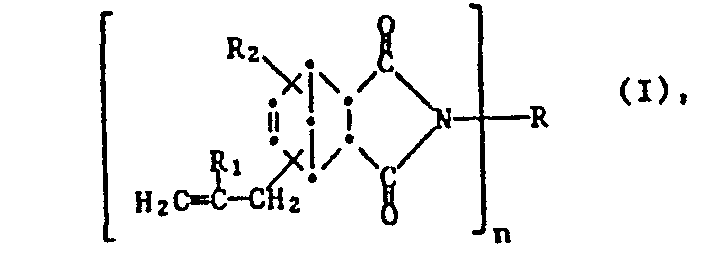
- a) mindestens eine Verbindung der Formel I
- b) mindestens eine Verbindung der Formel II
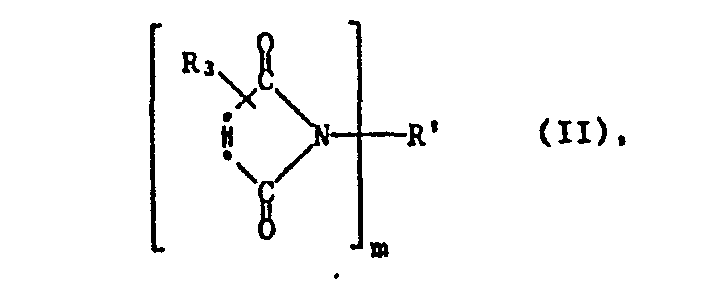
- c) mindestens ein Alkenylphenol oder einen Alkenylphenolether und
- d) Triallylisocyanurat,
eignen sich für die Herstellung von geformten Gegenständen, wie z.B. Prepregs, Verbundwerkstoffen und Ueberzügen.
Description
- Die EP-A-105 024 beschreibt allyl- oder methallylsubstituierte Bicyclo[2.2.1]hept-5-en-2,3-dicarbonsäureimide und deren Verwendung für die Herstellung von Polymeren durch Erhitzen der Imide auf Temperaturen von 180 bis 300°C. Es ist auch bekannt, das Polymaleinimide mit oder ohne Zugabe von Vernetzungsreagentien wie z.B. Diaminen oder Alkenylphenolen zu vernetzten Produkten umgesetzt werden können (z.B. US 3,562,223, 3,658,764, 3,380,964, 4,038,251 und 4,100,140).
- Bei Verwendung von Carbonsäureimide-enthaltenden Systemen, wie z.B. bei der Herstellung von Verbundwerkstoffen und Prepregs, ist es erwünscht, dass die Systeme genügend rasch gehärtet werden können, nicht spröde und genügend klebrig sind, gute Schmiegsamkeitseigenschaften in Form von dünnen Filmen, eine geeignete Gelierzeit und gute Festigkeit und Stabilität aufweisen. Die vorbekannten Systeme erfüllen im allgemeinen mindestens eine dieser wichtigen Anforderungen nicht im genügenden Masse.
- Es wurde nun gefunden, dass wesentlich verbesserte Eigenschaften erreicht werden können, wenn Gemische der erwähnten Dicarbonsäureimide, Polymaleinimide, Alkenylphenole oder Alkenylphenolether und Triallylisocyanurat verwendet werden. Diese Gemische weisen eine schnelle Härtung in Anwesenheit eines Härtungskatalysators, zufriedenstellende Biegsamkeit, Klebrigkeit, und Schmiegsamkeitseigenschaften und Gelierzeit, sowie gute mechanische, thermische und elektrische Eigenschaften auf. Die gehärteten Systeme sind somit für die Verwendung als Hochleistungs-Verbundstoffe und ähnliche Anwendungen gut geeignet. Diese Verbundstoffe bilden auch einen wichtigen Bestandteil der vorliegenden Erfindung.
- Gegenstand der vorliegenden Erfindung sind heisshärtbare Stoffgemische enthaltend
- a) mindestens eine Verbindung der Formel 1

- b) mindestens eine Verbindung der Formel II

- c) mindestens ein Alkenylphenol oder einen Alkenylphenolether und
- d) Triallylisocyanurat,
- Vorzugsweise sind Ri und R2 jeweils ein Wasserstoffatom.
- R kann eine geradkettige oder verzweigte C1-C12-Alkylgruppe, wie z.B. Methyl, Ethyl, Isopropyl, n-Butyl, Isopentyl, n-Hexyl, 2-Ethylhexyl, n-Decyl und n-Dodecyl, vorzugsweise aber eine C1-C8-Alkylgruppe sein. Wenn R C3-C6-Alkenyl ist, kann dieser Rest auch geradkettig oder verzweigt sein, und ist z.B. Allyl, Methallyl, 2-Butenyl oder 3-Hexenyl, wobei Allyl bevorzugt ist. Wenn R eine Cycloalkylgruppe ist, kann es Cyclopentyl, Cyclohexyl, Cycloheptyl oder Cyclooctyl bedeuten, wobei Cyclohexyl bevorzugt ist.
- Wenn R eine Arylgruppe bedeutet, kann es eine unsubstituierte oder eine mit einer oder zwei Methylgruppen substituierte Phenylgruppe darstellen, wie z.B. Tolyl oder Xylyl, oder kann Naphthyl bedeuten. R ist vorzugsweise Phenyl. Wenn R eine -CpH2p-Gruppe ist, kann diese geradkettig oder verzweigt sein, z.B. Ethylen, Propylen, Trimethylen, Tetramethylen, Hexamethylen, Octamethylen und Dodecamethylen. R ist dabei vorzugsweise eine -(CH2)p-Gruppe, mit p gleich 2 bis 12. Wenn R eine Gruppe der Formel III ist, ist diese vorzugsweise in der 4,4'-Stellung zu den Stickstoffatomen gebunden.
- Wenn R eine C6-Clo-Arylengruppe darstellt, kann es sich um eine 1,3-Naphthylen-, 1,4-Naphthylen-, 1,5-Naphthylen- oder 2,6-Naphthylen- oder vorzugsweise um eine m-Phenylen- oder p-Phenylengruppe handeln.
- Wenn R eine Gruppe der Formel III darstellt, ist T vorzugsweise eine Methylengruppe, -0- oder -SOz-.
- Bevorzugt werden Verbindungen der Formel I, worin R1 und R2 jeweils ein Wasserstoffatom sind und R, bei n gleich 1, Wasserstoff, C1-C8-Alkyl, Allyl, Cyclohexyl, Phenyl oder Benzyl, oder bei n gleich 2, R -(CHz) - mit p gleich 2 bis 12, m- oder p-Phenylen, oder eine Gruppe der Formel III darstellt, worin T eine Methylengruppe, -0- oder -SOz- ist.
- Besonders bevorzugte Verbindungen der Formel I sind solche, worin R1 und Rz jeweils ein Wasserstoffatom sind und R, bei n gleich 1, Allyl, oder bei n gleich 2, -(CHz)6- oder

- Am meisten bevorzugt sind erfindungsgemässe Gemische, welche als Komponente (a) N-Allyl-allylbicyclo[2.2.1]hept-5-en-2,3-dicarbon- säureimid, Bis[4-(allylbicyclo)[2.2.1]hept-5-en-2,3-dicarboximido- phenyl}methan und N,N'-Hexamethylen-bis(allylbicyclo)[2.2.1]hept-5-en-2,3-dicarbonsäureimid oder Gemische dieser Verbindungen enthalten.
- Beispiele für spezifische Verbindungen der Formel I sind:
- Allyl-bicyclo[2.2.1]hept-5-en-2,3-dicarbonsäure-N-methylimid,
- Allyl-bicyclo[2.2.1]hept-5-en-2,3-dicarbonsäure-N-allylimid,
- Allyl-bicyclo[2.2.1]hept-5-en-2,3-dicarbonsäure-N-(2-ethylhexyl)-imid,
- Allyl-bicyclo[2.2.1]hept-5-en-2,3-dicarbonsäure-N-cyclohexylimid,
- Allyl-bicyclo[2.2.1]hept-5-en-2,3-dicarbonsäure-N-phenylimid,
- Allyl-bicyclo[2.2.1]hept-5-en-2,3-dicarbonsäure-N-benzylimid,
- N,N'-Ethylen-bis-(allyl-bicyclo[2.2.1]hept-5-en-2,3-dicarbonsäure- imid),
- N,N'-Hexamethylen-bis-(allyl-bicyclo[2.2.1]hept-5-en-2,3-dicarbon- säureimid),
- N,NI-Dodecamethylen-bis-(allyl-bicyclo[2.2.1]hept-5-en-2,3-dicarbon- säureimid),
- Bis-[4-(allyl-bicyclo[2.2.1]hept-5-en-2,3-dicarboximidophenyl)]-methan,
- Bis[4-(methallyl-bicyclo[2.2.1]hept-5-en-2,3-dicarboximidophenyl)]-methan,
- N,N'-p-Phenylen-bis(allyl-bicyclo[2.2.1]hept-5-en-2,3-dicarbon- säureimid,
- Bis[4-(allyl-bicyclo[2.2.1]hept-5-en-2,3-dicarboximidophenyl)]-ether,
- Bis[4-(allyl-bicyclo[2.2.1]hept-5-en-2,3-dicarboximidophenyl)]-sulfon,
- Allyl-methyl-bicyclo[2.2.1]hept-5-en-2,3-dicarbonsäure-N-allylimid, Allyl-methyl-bicyclo[2.2.1]hept-5-en-2,3-dicarbonsäure-N-(2-ethylhexyl)imid,
- Allyl-methyl-bicyclo[2.2.1]hept-5-en-2,3-dicarbonsäure-N-phenylimid, N,N'-Hexamethylen-bis-(allyl-methyl-bicyclo[2.2.1]hept-5-en-2,3-dicarbonsäureimid),
- Bis[4-(allyl-methyl-bicyclo[2.2.1]hept-5-en-2,3-dicarboximido- phenyl)]methan und
- Bis[4-methallyl-methyl-bicyclo[2.2.1]hept-5-en-2,3-dicarboximido- phenyl)]sulfon.
- Die Imide der Formel I können auf an sich bekannte Weise, z.B. analog dem in der EP-A-105 024 beschriebenen Verfahren durch Umsetzen eines Anhydrids der Formel IV


- Als organische Reste R' kommen bei m = 2 z.B. in Betracht: -CpH2p- mit p = 2-20, besonders -(CH2)p- mit p = 2-12, -CH2CH2SCH2CH2-, Arylen mit 6-10 C-Atomen, Xylylen, Cyclopentylen, Cyclohexylen, 1,4-Bis(methylen)cyclohexylen, der Rest des Bicyclohexylmethans oder Reste der Formeln VI oder VII

- Stellt m die Zahl 3 dar, so bedeutet R' z.B. einen Rest der Formel VIII

- Als Verbindungen der Formel II sind solche bevorzugt, worin m die Zahl 2, R3 ein Wasserstoffatom und R' -(CHz) - mit p = 2-12, m-oder p-Phenylen, m- oder p-Xylylen, 1,4-Cyclohexylen, 1,4-Bis(methylen)-cyclohexylen, den Rest des 4,4'-Biscyclohexylmethans und vor allem einen in 4,4'-Stellung gebundenen Rest der Formel VII bedeuten, worin Qi und Q2 je ein Wasserstoffatom und T1 0, CH2 oder SO2 darstellen. Ganz besonders bevorzugt ist das N,N',4,4'-Diphenylmethan-bismaleinimid.
- Erfindungsgemäss werden als Alkenylphenole oder Alkenylphenolether vorzugsweise Allylphenole und Methallylphenole bzw. deren Ether verwendet. Es können ein- oder mehrkernige, vorzugsweise zweikernige, Alkenylphenole und Alkenylphenolether verwendet werden. Vorzugsweise enthält dabei mindestens ein Kern sowohl eine Alkenylgruppe als auch eine gegebenenfalls veretherte phenolische OH-Gruppe.
- Alkenylphenole können bekannterweise durch Umlagerung der entsprechenden Alkenylether der Phenole (z.B. des Allylethers des Phenols) durch Erwärmen hergestellt werden (Claisenumlagerung). Die Alkenylether werden auch auf bekannte Weise durch Umsetzung der Phenole mit z.B. Allylchlorid in Anwesenheit eines Alkalimetallhydroxids in Lösungsmitteln hergestellt.
- Typische Beispiele sind Verbindungn der Formeln IX - XII:
- Verbindungen der Formel IX


- q ist 0 oder 1,
- Z stellt O oder S dar,
- Q1 und Q2 bedeuten unabhängig voneinander ein Halogenatom, besonders Chlor oder Brom, Methyl oder Ethyl und insbesondere ein Wasserstoffatom,
- X ist die direkte Bindung, -CtH2t- mit t = 1-12, Arylen mit 6-10 C-Atomen, Xylylen, Cyclopentylen oder Cyclohexylen und R3 hat die oben angegebene Bedeutung.
- Als spezielle Beispiele für Maleinimide der Formel II, welche in den erfindungsgemässen Mischungen enthalten sein können, seien genannt:
- N,N'-Ethylen-bis-maleinimid,
- N,N'-Hexamethylen-bis-maleinimid,
- N,N'-m-Phenylen-bis-maleinimid,
- N,N'-p-Phenylen-bis-maleinimid,
- N,N'-4,4'-Diphenylmethan-bis-maleinimid,
- N,N'-4,4t-3,3'-Dichlor-diphenylmethan-bis-maleinimid,
- N,N'-4,4'-Diphenylether-bis-maleinimid,
- N,N'-4,4'-Diphenylsulfon-bis-maleinimid,
- N,N'-m-Xylylen-bis-maleinimid,
- N,N'-p-Xylylen-bis-maleinimid,
- N,N'-4,4'-2,2-Diphenylpropan-bis-maleinimid,
- das N,N'-Bis-maleinimid des 4,4'-Diamino-triphenylphosphats,
- das N,N'-Bis-maleinimid des 4,4'-Diamino-triphenylphosphits,
- das N,N'-Bis-maleinimid des 4,4'-Diamino-triphenylthiophosphats,
- das N,N',N"-Trismaleinimid des Tris-(4-aminophenyl)-phosphats,
- worin T die direkte Bindung, Methylen, Isopropyliden, 0, S, SO oder SO2 bedeutet.
- Propenylsubstituierte Phenole der Formel X

- Verbindungen der Formel XI

- Verbindungen der Formel XII

- worin Re, R9, Rio, R11, R12 und R13 unabhängig voneinander ein Wasserstoffatom, Alkyl mit 1-4 C-Atomen, Alkenyl mit 3-4 C-Atomen, vorzugsweise Allyl oder Propenyl bedeuten, wobei mindestens eines von Rs bis R13 für eine Alkenyl-, vorzugsweise Allyl- oder Propenylgruppe steht und a einen Wert von 0 bis 10 darstellt. Es können auch Ether der Verbindungen der Formeln IX, X, XI und XII, welche mindestens einen -OR3-Rest enthalten, verwendet werden, wobei R3 C1-C10-Alkyl, C6-C10-Aryl oder C3-C6-Alkenyl, vorzugsweise Allyl oder Methallyl bedeutet. Bevorzugt sind Verbindungen der Formel XI, worin R4 und R6 je eine Propenylgruppe und Rs und R7 je ein Wasserstoffatom bedeuten und T für Methylen, Isopropyliden oder 0 steht.
- Es können erfindungsgemäss auch Isomerengemische von propenyl- und allylsubstituierten ein- und mehrwertigen Phenolen eingesetzt werden. Bevorzugt werden Gemische von propenyl- und allylsubstituierten Phenolen der Formel IX eingesetzt, insbesondere solche der Formel IXa

- Gute Resultate werden auch mit Gemischen von mehrkernigen Alkenylphenolen und/oder Alkenylphenolethern mit einkernigen Alkenylphenolen und/oder Alkenylphenolethern erreicht.
- Es können auch Gemische von Verbindungen, welche nur eine OH-Gruppe und nur eine Alkenylgruppe pro aromatischen Kern enthalten, mit Verbindungen, welche mehrere OH-Gruppen und/oder mehrere Alkenylgruppen pro aromatischen Kern aufweisen, oder Gemische der entsprechenden Phenylether dieser Verbindungen verwendet werden.
- Solche alkenylsubstituierte Phenole und Polyole sind beispielsweise in US 4,100,140 und US 4,371,719 beschrieben.
- Typische Verbindungen umfassen z.B. o,o'-Diallylbisphenol A, 4,4'-Dihydroxy-3,3'-diallylbiphenyl, Bis-(4-hydroxy-3-allylphenyl)-methan, 2,2-Bis(4-hydroxy-3,5-diallylphenyl)propan, Eugenol (4-Allyl-2-methoxyphenol), o,o'-Dimethallylbisphenol A, 4,4'-Di- hydroxy-3,3'-dimethallylbiphenyl, Bis(4-hydroxy-3-methallylphenyl)-methan, 2,2-Bis(4-hydroxy-3,5-dimethallylphenyl)propan, 4-Methallyl-2-methoxyphenol, 2,2-Bis(4-methoxy-3-allylphenyl)propan, 2,2-Bis(4-methoxy-3-methallylphenyl)propan, 4,4'-Dimethoxy-3,3'- diallylbiphenyl, 4,4'-Dimethoxy-3,3'-dimethallylbiphenyl, Bis(4-methoxy-3-allylphenyl)methan, Bis(4-methoxy-3-methallylphenyl)-methan, 2,2-Bis(4-methoxy-3,5-diallylphenyl)propan, 2,2-Bis(4-methoxy-3,5-dimethallylphenyl)propan, 4-Allylveratrol (4-Allyl-1,2-dimethoxybenzol) und 4-Methallylveratrol (4-Methallyl-1,2-dimethoxybenzol). Besonders bevorzugt ist o,o'-Diallylbisphenol A.
- Vorzugsweise beträgt die Menge der Komponente (a) 30 bis 45 Gew.%, der Komponente (b) 20 bis 40 Gew.X, der Komponente (c) 11 bis 22 Gew.% und der Komponente (d) 12 bis 16 Gew.% bezogen auf das Gesamtgewicht des Stoffgemisches. Besonders bevorzugte Konzentrationen sind 30 bis 32 Gew.% (a), 36 bis 39 Gew.% (b), 12 bis 14 Gew.% (c) und 13 bis 15 Gew.% (d). Wenn die oben erwähnten drei bevorzugten Dicarbonsäureimide verwendet werden, werden sie in einem Gewichtsverhältnis von 3:2:1 und insbesondere 2,7:1,7:1 eingesetzt.
- Die Herstellung der erfindungsgemässen Stoffgemische kann auf an sich bekannte Weise durch Vermahlen und Vermengen oder durch Aufschmelzen der Komponenten vorgenommen werden. Dies geschieht typischerweise bei Temperaturen von 90 bis 140°C.
- Die Härtung bzw. Verarbeitung der Stoffgemische kann in einem inerten organischen Lösungsmittel, vorzugsweise jedoch aus der Schmelze erfolgen. Die Stoffgemische können als solche gehärtet werden. Die mechanischen Eigenschaften der gehärteten Produkte werden allerdings verbessert, wenn die Härtung in Anwesenheit eines Härtungskatalysators erfolgt. Als inerte organische Lösungsmittel eignen sich z.B. N,N-Dimethylformamid, N,N-Dimethylacetamid, N-Methylpyrrolidon, Toluol, Xylole, Methylethylketon und Ethylenglykolmonoalkyl- oder -dialkylether mit 1-4 C-Atomen in den Alkylgruppen. Je nach Art der eingesetzten Komponente c) und der beabsichtigten Verwendung kommen als Härtungskatalysatoren z.B. organische Peroxide, wie Di-tert-butylperoxid, Dicumylperoxid oder tert-Butylperbenzoat, oder basische Katalysatoren, vor allem primäre, sekundäre und tertiäre Amine in Betracht, wie z.B. Diethylamin, Tributylamin, Triethylamin, Benzylamin, N,N,N',N'-Tetramethyl-4,4'-diaminodiphenylmethan, N,N-Diisobutylaminoacetonitril, und heterocyclische Basen, wie Chinolin, N-Methylpyrrolidin und Imidazol. Bevorzugt sind basische Katalysatoren der erwähnten Art. Die Härtung wird im allgemeinen bei Temperaturen zwischen 150 und 350°C, besonders 180 und 300°C vorgenommen.
- Die erfindungsgemässen Stoffgemische stellen niederschmelzende Festharze oder Flüssigharze dar und zeichnen sich durch hohe Reaktivität und gute thermische und mechanische Eigenschaften der damit gehärteten Produkte aus, wie gute Biege-, Scher- und interlaminare Scherfestigkeit. So erhaltene Produkte weisen gute mechanische, thermische und elektrische Eigenschaften und hohe Glasumwandlungstemperaturen auf und sind wenig spröde. Die erfindungsgemässen Stoffgemische können ferner leicht aus der Schmelze, besonders auch ohne Zusatz von schwerflüchtigen Lösungsmitteln, beispielsweise zum Imprägnieren, appliziert werden.
- Während der Härtung bei erhöhter Temperatur entsteht ein Netzwerk mit hoher Vernetzungsdichte. Der hier verwendete Ausdruck Härtung bedeutet daher die Umwandlung von Gemischen in unlösliche und nichtschmelzbare vernetzte Produkte, mit gleichzeitiger Formung zu geformten Artikeln wie z.B. Giesskörpern, Presskörpern, Laminaten, oder zu zweidimensionalen Strukturen, wie z.B. Ueberzügen, Emaillen und Klebverbindungen. Die mit den modifizierten Systemen hergestellten Ueberzüge zeichnen sich z.B. durch erhöhte Zähigkeit aus. Die erfindungsgemässen Stoffgemische können in jeder Verarbeitungsphase vor der Härtung mit den üblichen Modifizierungsmitteln vermischt werden, wie z.B. Streckmittel, Füllstoffe und Verstärkungsmittel, Pigmente, Farbstoffe, organische Lösungsmittel, Plastifizierungsmittel, Mittel zur Verbesserung der Trockenklebrigkeit (Klebrigmacher), Gummis, Beschleuniger, Verdünner usw. Als Streckmittel, Verstärkungsmittel, Füllstoffe und Pigmente kommen z.B. in Frage: Kohleteer, Bitumen, Glasfasern, Borfasern, Kohlefasern, Cellulose, Polyethylenpulver, Polypropylenpulver, Glimmer, Asbest, Quarzpulver, Gips, Antimontrioxid, Bentone, Siliziumdioxidaerogel ("Aerosil"), Lithopon, Barit, Titandioxid, Russ, Graphit, Eisenoxid oder Metallpulver wie z.B. Aluminiumpulver oder Eisenpulver. Den härtbaren Stoffgemische können auch andere übliche Zusätze, wie z.B. Flammschutzmittel, Thixotropiemittel, Verlaufsmittel, wie Silicone, Celluloseacetatbutyrat, Polyvinylbutyrat, Wachse, Stearate und ähnliches (welche zum Teil auch als Formtrennmittel verwendet werden) beigegeben werden.
- Wenn die erfindungsgemässen Zusammensetzungen z.B. als Klebstoffformulierungen verwendet werden, können auch carboxylgruppenendständiger Acrylnitril-Butadien-Kautschuk, Modifizierungsharze, wie Triglycidyl-p-aminophenol und Beschleuniger wie Bortrifluorid-Monoethylaminkomplexe, oder Imidazolkomplexe beigegeben werden.
- Gegenstand der vorliegenden Erfindung sind daher auch Produkte, erhältlich durch Härtung der erfindungsgemässen Zusammensetzungen, sowie Laminate, erhältlich durch Erhitzen eines mit der erfindungsgemässen Zusammensetzung imprägnierten Materials.
- Die beschriebenen erfindungsgemässen Zusammensetzungen können auf verschiedenen Gebieten eingesetzt werden, wie z.B. in Verbundstoffen, Leiterplatten, Giesslingen, Formkörpern, Klebstoffen und Ueberzügen. Von besonderem Interesse ist ihre Anwendung für die Herstellung von Hochleistungsverbundstoffen, welche z.B. in der Luftfahrtindustrie sehr wichtig sind. So können die modifizierten Harze zum Präimprägnieren von verschiedenem faserartigem Material verwendet werden, welches als Deckschicht für Honigwabenstrukturen oder als Strukturteile eingesetzt wird. Verfahren zur Herstellung von Prepregs sind dem Fachmann bekannt. Als faserartige Materialien können z.B. Graphit, Glas oder Kevlar verwendet werden. Auch Verfahren zur Herstellung von Laminaten sind bekannt. Laminate verschiedenster Dicke können z.B. durch Pressformen oder Autoklavformen hergestellt werden. Die erfindungsgemässen Zusammensetzungen können auch erfolgreich als hatfvermittelnde Substanzen eingesetzt werden.
- In den folgenden Beispielen sind einige bevorzugte Ausführungsformen der vorliegenden Erfindung beschrieben.
- Beispiel 1: Ein typisches erfindungsgemässes Stoffgemisch wird durch Zusammenmischen von 25 g N,N'-Hexamethylen-bis(al)ylbicyclo[2.2.1.]-hept-5-en-2,3-dicarbonsäureimid), 40 g Triallylisocyanurat, 35 g 2,2'-Bis(4-hydroxy-3-allylphenyl)propan und 15 g N-Allyl-allyl- bicyclo[2.2.1]hept-5-en-2,3-dicarbonsäureimid in einer Aluminiumkanne erhalten. Das Gemisch wird auf 95°C auf einer Heizplatte erhitzt und mit einem luftgetriebenen Propellerrührer vermischt. 100 g zerkleinertes Bismaleinimid (eutektisches Bismaleinimidgemisch der Technochemie, verkauft unter der Bezeichnung "C-353") werden in kleinen Portionen dem Gemisch beigegeben. Das Stoffgemisch wird während 20 Minuten bei 95°C gehalten und ständig gerührt. Die Temperatur wird auf 135°C erhöht und 40 g pulverförmiges N,N'-4,4'-Diphenylmethan-bis(allyl-bicyclo[2.2.1]hept-5-en-2,3-dicarbon- säureimid werden in kleinen Portionen beigegeben. Das Gemisch wird dann noch 15 Minuten bei der angegebenen Temperatur gerührt, auf 115°C gekühlt und durch einen zweischichtigen Trikotfilter filtriert. Das resultierende Gemisch ist bei 115°C eine homogene hochfliessende Flüssigkeit.
- Beispiele 2 und 3: Beispiel 1 wird unter Verwendung der folgenden Komponenten wiederholt:

- Die erhaltenen Gemische sind bei 115°C homogene, hochfliessende, bernsteinfarbige Flüssigkeiten.
- Ein unidirektionales Graphitprepreg wird aus der Thornel T-500 Graphitfaser (Union Carbide) unter Anwendung von Druck und Hitze auf einer U-D Maschine hergestellt. Das ergibt ein Prepreg mit annehmbarer Schmiegsamkeit und Klebrigkeit. Das Prepreg wird geschnitten, zum Laminat aufeinandergeschichtet, mit dem Vakuumsackverfahren im Autoklav gehärtet und im Ofen nachgehärtet. Das Laminat im Vakuumsack wird in ein Autoklav unter Vakuum bei Raumtemperatur gestellt. Auf den Sack wird ein Druck von 0,6 MPa (85 psi) appliziert und der Autoklav wird während 15 Minuten bei Raumtemperatur equilibriert. Dann wird mit einer Geschwindigkeit von l,7°C/min geheizt bis die Temperatur von 80°C erreicht wird. Das Vakuum wird entlüftet und der Autoklav während 2 Stunden bei 80°C unter Druck gehalten. Am Ende der zweiten Stunde wird wieder mit 1,7°C/min auf 175°C erhitzt und diese Temperatur 4 Stunden gehalten. Der Autoklav wird während 1 1/2 Stunden abkühlen gelassen, der Druck wird gelüftet und die Laminate werden aus dem Autoklav und aus dem Vakuumsack entfernt.
- Die Nachhärtung der Laminate erfolgt freistehend in einem Ofen während 4 Stunden bei 245°C mit einer Aufheizrate von etwa 3°C/min. Die nachgehärteten Laminate werden zu Testkörpern zerschnitten und geprüft. Der Harzgehalt der Laminate beträgt 27 bis 28 Gew.X.
- Die gehärteten Stoffgemische werden mit thermomechanischer Analyse (TMA) geprüft (Eindringverfahren, Heizgeschwindigkeit 10°C/min, Probekörper 0,86 x 1,24 mm). Die Glasumwandlungstemperatur Tg ist aus der Tabelle ersichtlich.
- Mit jedem der oben beschriebenen Systeme werden aus 15 Schichten des Prepregs 0° Laminatplatten hergestellt. Aus diesen Laminaten werden Prüfkörper für die Scherfestigkeit im Kurzbiegeversuch sowie 0° und 90° Biegeprüfkörper hergestellt. Der Kurzbiegeversuch wird nach ASTM D-2344 bei Raumtemperatur und bei 175°C durchgeführt. Die 0° und 90° Biegeeigenschaften werden nach ASTM D-790 bei Raumtemperatur und bei 175°C getestet. Die Resultate sind aus der Tabelle ersichtlich.
- Zusätzlich wird die Bruchzähigkeit [gemäss Journal of Material Science Letters, 511-515 (1982)] und die Randdelaminierung getestet. Der G1C Test wird mit Prüfkörpern von 76 x 38 mm gemessen. Die 0° Laminatplatte für diesen Test ist 12-schichtig. Der Randdelaminierungstest wird mit Laminatplatten mit der folgenden Sequenz bei der Aufschichtung von Prepregs durchgeführt [(±25)2/90)s. Die Resultate sind wie folgt:
-

- Die Resultate zeigen die verbesserten Leistungseigenschaften der erfindungsgemässen Stoffgemische.
wobei in den Formeln I und II n 1 oder 2 bedeutet und m 2 oder 3 ist, R, bei n gleich 1, Wasserstoff, C1-C12-Alkyl, C3-C6-Alkenyl, Cs-Cs-Cycloalkyl, C6-Clo-Aryl oder Benzyl, oder bei n gleich 2, -CpH2p-, worin p eine ganze Zahl von 2 bis 20 ist, oder C6-C10-Arylen oder eine Gruppe der Formel III

Claims (15)


wobei in den Formeln I und II n 1 oder 2 bedeutet und m 2 oder 3 ist, R, bei n gleich 1, Wasserstoff, C1-C12-Alkyl, C3-C6-Alkenyl, Cs-Cs-Cycloalkyl, C6-C10-Aryl oder Benzyl, oder bei n gleich 2, -CpH2p-, worin p eine ganze Zahl von 2 bis 20 ist, oder C6-C10-Arylen oder eine Gruppe der Formel III


Applications Claiming Priority (2)
| Application Number | Priority Date | Filing Date | Title |
|---|---|---|---|
| US831687 | 1986-02-21 | ||
| US06/831,687 US4678849A (en) | 1986-02-21 | 1986-02-21 | Heat-curable mixture containing substituted bicyclo(2.2.1)hept-5-ene-2,3-dicarboximide and polymaleimide |
Publications (3)
| Publication Number | Publication Date |
|---|---|
| EP0235084A2 true EP0235084A2 (de) | 1987-09-02 |
| EP0235084A3 EP0235084A3 (en) | 1988-08-24 |
| EP0235084B1 EP0235084B1 (de) | 1991-01-09 |
Family
ID=25259621
Family Applications (1)
| Application Number | Title | Priority Date | Filing Date |
|---|---|---|---|
| EP19870810087 Expired - Lifetime EP0235084B1 (de) | 1986-02-21 | 1987-02-16 | Heisshärtbare Stoffgemische enthaltend substituierte Bicyclo [2.2.1]hept-5-en-2,3-dicarbonsäureimide und Polymaleinimide |
Country Status (6)
| Country | Link |
|---|---|
| US (1) | US4678849A (de) |
| EP (1) | EP0235084B1 (de) |
| JP (1) | JPS62253607A (de) |
| KR (1) | KR910000201B1 (de) |
| CA (1) | CA1277090C (de) |
| DE (1) | DE3767178D1 (de) |
Families Citing this family (14)
| Publication number | Priority date | Publication date | Assignee | Title |
|---|---|---|---|---|
| DE3582911D1 (de) * | 1984-09-14 | 1991-06-27 | Ciba Geigy Ag | Substituierte bicyclo(2.2.1)hept-5-en-2,3-dicarbonsaeureimide und polymaleinimide enthaltende heisshaertbare stoffgemische und deren verwendung. |
| DE3872596D1 (de) * | 1987-05-22 | 1992-08-13 | Ciba Geigy Ag | Ungesaettigte bisimide und deren polymeren. |
| US4962161A (en) * | 1987-08-17 | 1990-10-09 | Hercules Incorporated | Thermosettable resin compositions |
| US5095074A (en) * | 1987-08-17 | 1992-03-10 | Hercules Incorporated | Thermosettable resin compositions |
| US5367043A (en) * | 1991-11-06 | 1994-11-22 | Enzymol International, Inc. | Durable formaldehyde-free phenolic resins, and method of preparing such resins |
| US5502207A (en) * | 1993-08-13 | 1996-03-26 | Maruzen Petrochemical Co., Ltd. | Alkenyl-substituted bisnadimides, process for manufacturing the same, process for curing the same, and adhesives and coating materials utilizing the same |
| JPH07157631A (ja) * | 1993-12-03 | 1995-06-20 | Maruzen Petrochem Co Ltd | 熱硬化性樹脂組成物 |
| JP3506395B2 (ja) * | 1994-10-26 | 2004-03-15 | 丸善石油化学株式会社 | 熱硬化性水系エマルション |
| US8932705B2 (en) * | 2008-12-24 | 2015-01-13 | Samsung Electro-Mechanics Co., Ltd. | Thermosetting resin composition and board using the same |
| JP6920838B2 (ja) * | 2016-03-31 | 2021-08-18 | 東京応化工業株式会社 | 層間絶縁膜形成用組成物、層間絶縁膜及び層間絶縁膜パターンの形成方法、並びにデバイス |
| JP7008417B2 (ja) | 2016-03-31 | 2022-01-25 | 東京応化工業株式会社 | 層間絶縁膜形成用組成物、層間絶縁膜及び層間絶縁膜パターンの形成方法、並びにデバイス |
| CN109306040A (zh) * | 2017-07-26 | 2019-02-05 | 广东生益科技股份有限公司 | 一种热固性树脂组合物、由其制作的半固化片、覆金属箔层压板及高频电路板 |
| CN109306039A (zh) * | 2017-07-26 | 2019-02-05 | 广东生益科技股份有限公司 | 一种热固性树脂组合物、由其制作的半固化片、覆金属箔层压板及高频电路板 |
| CN109306044A (zh) * | 2017-07-26 | 2019-02-05 | 郑州大学 | 一种低极性本征阻燃树脂及其制备方法和应用 |
Family Cites Families (8)
| Publication number | Priority date | Publication date | Assignee | Title |
|---|---|---|---|---|
| SE316011B (de) * | 1964-11-13 | 1969-10-13 | Rhodiaceta | |
| FR1555564A (fr) * | 1967-07-13 | 1969-01-31 | Rhone Poulenc Sa | Nouvelles résines thermostables dérivées de bis-imides d'acides dicarboxyliques non saturés |
| CH569758A5 (de) * | 1972-07-24 | 1975-11-28 | Ciba Geigy Ag | |
| DE2459925C2 (de) * | 1973-12-21 | 1989-02-23 | Ciba-Geigy Ag, Basel | Verfahren zur Herstellung von Imidgruppen aufweisenden Polyadditionsprodukten |
| CH615935A5 (de) * | 1975-06-19 | 1980-02-29 | Ciba Geigy Ag | |
| US4515962A (en) * | 1982-08-05 | 1985-05-07 | Ciba Geigy Corporation | Allyl or methallyl-bicyclo[2.2.1]hept-5-ene-2,3-dicarboxylic acid imides and bisimides |
| DE3479510D1 (en) * | 1984-01-31 | 1989-09-28 | Ciba Geigy Ag | Process for preparing cross-linked polymers by cationic polymerisation of unsaturated bicyclic imides |
| DE3582911D1 (de) * | 1984-09-14 | 1991-06-27 | Ciba Geigy Ag | Substituierte bicyclo(2.2.1)hept-5-en-2,3-dicarbonsaeureimide und polymaleinimide enthaltende heisshaertbare stoffgemische und deren verwendung. |
-
1986
- 1986-02-21 US US06/831,687 patent/US4678849A/en not_active Expired - Fee Related
-
1987
- 1987-02-16 EP EP19870810087 patent/EP0235084B1/de not_active Expired - Lifetime
- 1987-02-16 DE DE8787810087T patent/DE3767178D1/de not_active Expired - Lifetime
- 1987-02-19 CA CA 530079 patent/CA1277090C/en not_active Expired - Lifetime
- 1987-02-20 JP JP62037702A patent/JPS62253607A/ja active Pending
- 1987-02-21 KR KR1019870001460A patent/KR910000201B1/ko not_active Expired
Also Published As
| Publication number | Publication date |
|---|---|
| EP0235084B1 (de) | 1991-01-09 |
| US4678849A (en) | 1987-07-07 |
| EP0235084A3 (en) | 1988-08-24 |
| KR870007975A (ko) | 1987-09-23 |
| DE3767178D1 (de) | 1991-02-14 |
| KR910000201B1 (ko) | 1991-01-23 |
| CA1277090C (en) | 1990-11-27 |
| JPS62253607A (ja) | 1987-11-05 |
Similar Documents
| Publication | Publication Date | Title |
|---|---|---|
| EP0152372B1 (de) | Substituierte ungesättigte bicyclische Imide und deren Polymeren | |
| DE2754632C2 (de) | Heißhärtbare Imidharze | |
| EP0227598B1 (de) | Stabile imidenthaltende Stoffgemische | |
| DE2627045C2 (de) | ||
| EP0175648B1 (de) | Substituierte Bicyclo[2.2.1]hept-5-en-2,3-dicarbonsäureimide und Polymaleinimide enthaltende heisshärtbare Stoffgemische und deren Verwendung | |
| EP0235084B1 (de) | Heisshärtbare Stoffgemische enthaltend substituierte Bicyclo [2.2.1]hept-5-en-2,3-dicarbonsäureimide und Polymaleinimide | |
| EP0105024B1 (de) | Substituierte ungesättigte bicyclische Imide und deren Polymeren | |
| EP0292434B1 (de) | Ungesättigte Bisimide und deren Polymeren | |
| DE3026384C2 (de) | Härtbare Harzmasse | |
| DE68907035T2 (de) | Durch Alkenylphenoxyimid modifiziertes Polyimid. | |
| EP0321412B1 (de) | Di-oder Polycyanatverbindungen, substituierte Bicyclo[2.2.1]hept-5-en-2,3-dicarbonsäureimide und Thermoplaste enthaltende Gemische sowie deren Verwendung | |
| EP0265374B1 (de) | Di- oder Polycyanatverbindungen und substituierte Bicyclo[2.2.1]hept-5-en-2,3-dicarbonsäureimide enthaltende Gemische und deren Verwendung | |
| US5189128A (en) | Solution stable polyimide resin systems | |
| EP0457732B1 (de) | Neue härtbare Zusammensetzungen | |
| EP0357558B1 (de) | Bisimide der Allyl- oder Methallylbicyclo[2,2,1]hept-5-en-2,3-dicarbonsäure | |
| JPH03221526A (ja) | マレイミド樹脂硬化物の製造方法 | |
| JPH04226526A (ja) | 改変ビスイミド組成物 | |
| EP0300329A2 (de) | Bismaleinimid-Harze | |
| DE2544900A1 (de) | Haertbare mischungen auf basis von polyimiden ungesaettigter dicarbonsaeuren | |
| EP0348345B1 (de) | Lösungsmittelstabile Polyimidharzsysteme | |
| US4247672A (en) | Heat-curable mixtures based on polyimides and poly-β-iminocrotononitriles | |
| EP0524409A1 (de) | Hitzehärtbare Bismaleinimid-Formmassen | |
| DE2350471A1 (de) | Neue, lagerstabile und heisshaertbare mischungen | |
| DE4024193A1 (de) | Mit neuen alkenylphenoxyalkanen modifizierte polyimide, deren verwendung sowie die neuen alkenylphenoxyalkane | |
| EP0272210A2 (de) | (Poly)oxaalkylen-alpha, omega-Bisimide der Allyl-bicyclo[2.2.1]hept-5-en-2,3-dicarbonsäure und deren Verwendung |
Legal Events
| Date | Code | Title | Description |
|---|---|---|---|
| PUAI | Public reference made under article 153(3) epc to a published international application that has entered the european phase |
Free format text: ORIGINAL CODE: 0009012 |
|
| 17P | Request for examination filed |
Effective date: 19870218 |
|
| AK | Designated contracting states |
Kind code of ref document: A2 Designated state(s): CH DE FR GB IT LI NL SE |
|
| PUAL | Search report despatched |
Free format text: ORIGINAL CODE: 0009013 |
|
| AK | Designated contracting states |
Kind code of ref document: A3 Designated state(s): CH DE FR GB IT LI NL SE |
|
| 17Q | First examination report despatched |
Effective date: 19900209 |
|
| GRAA | (expected) grant |
Free format text: ORIGINAL CODE: 0009210 |
|
| AK | Designated contracting states |
Kind code of ref document: B1 Designated state(s): CH DE FR GB IT LI NL SE |
|
| ITF | It: translation for a ep patent filed | ||
| REF | Corresponds to: |
Ref document number: 3767178 Country of ref document: DE Date of ref document: 19910214 |
|
| ET | Fr: translation filed | ||
| GBT | Gb: translation of ep patent filed (gb section 77(6)(a)/1977) | ||
| PLBE | No opposition filed within time limit |
Free format text: ORIGINAL CODE: 0009261 |
|
| STAA | Information on the status of an ep patent application or granted ep patent |
Free format text: STATUS: NO OPPOSITION FILED WITHIN TIME LIMIT |
|
| PGFP | Annual fee paid to national office [announced via postgrant information from national office to epo] |
Ref country code: FR Payment date: 19911210 Year of fee payment: 6 |
|
| PGFP | Annual fee paid to national office [announced via postgrant information from national office to epo] |
Ref country code: DE Payment date: 19911227 Year of fee payment: 6 |
|
| 26N | No opposition filed | ||
| PGFP | Annual fee paid to national office [announced via postgrant information from national office to epo] |
Ref country code: GB Payment date: 19920128 Year of fee payment: 6 |
|
| PGFP | Annual fee paid to national office [announced via postgrant information from national office to epo] |
Ref country code: CH Payment date: 19920204 Year of fee payment: 6 |
|
| PGFP | Annual fee paid to national office [announced via postgrant information from national office to epo] |
Ref country code: SE Payment date: 19920224 Year of fee payment: 6 |
|
| PGFP | Annual fee paid to national office [announced via postgrant information from national office to epo] |
Ref country code: NL Payment date: 19920229 Year of fee payment: 6 |
|
| PG25 | Lapsed in a contracting state [announced via postgrant information from national office to epo] |
Ref country code: GB Effective date: 19930216 |
|
| PG25 | Lapsed in a contracting state [announced via postgrant information from national office to epo] |
Ref country code: SE Effective date: 19930217 |
|
| PG25 | Lapsed in a contracting state [announced via postgrant information from national office to epo] |
Ref country code: LI Effective date: 19930228 Ref country code: CH Effective date: 19930228 |
|
| PG25 | Lapsed in a contracting state [announced via postgrant information from national office to epo] |
Ref country code: NL Effective date: 19930901 |
|
| GBPC | Gb: european patent ceased through non-payment of renewal fee |
Effective date: 19930216 |
|
| NLV4 | Nl: lapsed or anulled due to non-payment of the annual fee | ||
| PG25 | Lapsed in a contracting state [announced via postgrant information from national office to epo] |
Ref country code: FR Effective date: 19931029 |
|
| REG | Reference to a national code |
Ref country code: CH Ref legal event code: PL |
|
| PG25 | Lapsed in a contracting state [announced via postgrant information from national office to epo] |
Ref country code: DE Effective date: 19931103 |
|
| REG | Reference to a national code |
Ref country code: FR Ref legal event code: ST |
|
| EUG | Se: european patent has lapsed |
Ref document number: 87810087.4 Effective date: 19930912 |
|
| PG25 | Lapsed in a contracting state [announced via postgrant information from national office to epo] |
Ref country code: IT Free format text: LAPSE BECAUSE OF NON-PAYMENT OF DUE FEES Effective date: 20050216 |