EP0230686B1 - Verfahren zur Herstellung einer wässrigen Natriumchloridlösung und Verfahren zur Erzeugung von Natriumbikarbonat - Google Patents
Verfahren zur Herstellung einer wässrigen Natriumchloridlösung und Verfahren zur Erzeugung von Natriumbikarbonat Download PDFInfo
- Publication number
- EP0230686B1 EP0230686B1 EP86201977A EP86201977A EP0230686B1 EP 0230686 B1 EP0230686 B1 EP 0230686B1 EP 86201977 A EP86201977 A EP 86201977A EP 86201977 A EP86201977 A EP 86201977A EP 0230686 B1 EP0230686 B1 EP 0230686B1
- Authority
- EP
- European Patent Office
- Prior art keywords
- sodium bicarbonate
- hydrochloride
- organic base
- aqueous solution
- organic
- Prior art date
- Legal status (The legal status is an assumption and is not a legal conclusion. Google has not performed a legal analysis and makes no representation as to the accuracy of the status listed.)
- Expired - Lifetime
Links
- UIIMBOGNXHQVGW-UHFFFAOYSA-M Sodium bicarbonate Chemical compound [Na+].OC([O-])=O UIIMBOGNXHQVGW-UHFFFAOYSA-M 0.000 title claims abstract description 113
- FAPWRFPIFSIZLT-UHFFFAOYSA-M Sodium chloride Chemical compound [Na+].[Cl-] FAPWRFPIFSIZLT-UHFFFAOYSA-M 0.000 title claims abstract description 99
- 239000011780 sodium chloride Substances 0.000 title claims abstract description 59
- 239000007864 aqueous solution Substances 0.000 title claims abstract description 57
- 238000000034 method Methods 0.000 title claims abstract description 56
- 235000017557 sodium bicarbonate Nutrition 0.000 title claims abstract description 56
- 229910000030 sodium bicarbonate Inorganic materials 0.000 title claims abstract description 56
- 238000004519 manufacturing process Methods 0.000 title claims abstract description 14
- 235000002639 sodium chloride Nutrition 0.000 claims abstract description 58
- 239000007788 liquid Substances 0.000 claims abstract description 52
- 150000001412 amines Chemical class 0.000 claims abstract description 48
- -1 nitrogenous organic base Chemical class 0.000 claims abstract description 48
- 239000000243 solution Substances 0.000 claims abstract description 31
- 239000008346 aqueous phase Substances 0.000 claims abstract description 28
- VEXZGXHMUGYJMC-UHFFFAOYSA-N Hydrochloric acid Chemical compound Cl VEXZGXHMUGYJMC-UHFFFAOYSA-N 0.000 claims description 41
- CURLTUGMZLYLDI-UHFFFAOYSA-N Carbon dioxide Chemical compound O=C=O CURLTUGMZLYLDI-UHFFFAOYSA-N 0.000 claims description 33
- 239000002585 base Substances 0.000 claims description 21
- 239000000203 mixture Substances 0.000 claims description 19
- 239000001569 carbon dioxide Substances 0.000 claims description 16
- 229910002092 carbon dioxide Inorganic materials 0.000 claims description 16
- XLYOFNOQVPJJNP-UHFFFAOYSA-N water Substances O XLYOFNOQVPJJNP-UHFFFAOYSA-N 0.000 claims description 15
- 239000012074 organic phase Substances 0.000 claims description 13
- UIIMBOGNXHQVGW-DEQYMQKBSA-M Sodium bicarbonate-14C Chemical compound [Na+].O[14C]([O-])=O UIIMBOGNXHQVGW-DEQYMQKBSA-M 0.000 claims description 10
- 150000001342 alkaline earth metals Chemical class 0.000 claims description 9
- 239000012452 mother liquor Substances 0.000 claims description 9
- 239000011541 reaction mixture Substances 0.000 claims description 9
- 229910052784 alkaline earth metal Inorganic materials 0.000 claims description 8
- 150000003973 alkyl amines Chemical class 0.000 claims description 7
- 125000004432 carbon atom Chemical group C* 0.000 claims description 7
- 229920006395 saturated elastomer Polymers 0.000 claims description 7
- 239000007787 solid Substances 0.000 claims description 6
- 150000007514 bases Chemical class 0.000 claims description 4
- 238000002360 preparation method Methods 0.000 claims description 4
- IXCSERBJSXMMFS-UHFFFAOYSA-N hydrogen chloride Substances Cl.Cl IXCSERBJSXMMFS-UHFFFAOYSA-N 0.000 claims description 3
- 229910000041 hydrogen chloride Inorganic materials 0.000 claims description 3
- 229910052783 alkali metal Inorganic materials 0.000 claims description 2
- 150000001340 alkali metals Chemical class 0.000 claims 1
- 150000004679 hydroxides Chemical class 0.000 claims 1
- 238000004064 recycling Methods 0.000 claims 1
- CDBYLPFSWZWCQE-UHFFFAOYSA-L Sodium Carbonate Chemical compound [Na+].[Na+].[O-]C([O-])=O CDBYLPFSWZWCQE-UHFFFAOYSA-L 0.000 abstract description 19
- HEMHJVSKTPXQMS-UHFFFAOYSA-M Sodium hydroxide Chemical compound [OH-].[Na+] HEMHJVSKTPXQMS-UHFFFAOYSA-M 0.000 description 25
- 238000006243 chemical reaction Methods 0.000 description 22
- QJGQUHMNIGDVPM-UHFFFAOYSA-N nitrogen group Chemical group [N] QJGQUHMNIGDVPM-UHFFFAOYSA-N 0.000 description 14
- 239000011575 calcium Substances 0.000 description 10
- 239000007789 gas Substances 0.000 description 10
- 229910000029 sodium carbonate Inorganic materials 0.000 description 9
- 235000017550 sodium carbonate Nutrition 0.000 description 9
- OYPRJOBELJOOCE-UHFFFAOYSA-N Calcium Chemical compound [Ca] OYPRJOBELJOOCE-UHFFFAOYSA-N 0.000 description 8
- 229910052791 calcium Inorganic materials 0.000 description 8
- 238000010908 decantation Methods 0.000 description 8
- 238000002425 crystallisation Methods 0.000 description 7
- 230000008025 crystallization Effects 0.000 description 7
- 239000012071 phase Substances 0.000 description 7
- BVKZGUZCCUSVTD-UHFFFAOYSA-M Bicarbonate Chemical compound OC([O-])=O BVKZGUZCCUSVTD-UHFFFAOYSA-M 0.000 description 6
- 238000000746 purification Methods 0.000 description 6
- AAIUWVOMXTVLRG-UHFFFAOYSA-N 8,8-dimethylnonan-1-amine Chemical compound CC(C)(C)CCCCCCCN AAIUWVOMXTVLRG-UHFFFAOYSA-N 0.000 description 5
- DGAQECJNVWCQMB-PUAWFVPOSA-M Ilexoside XXIX Chemical compound C[C@@H]1CC[C@@]2(CC[C@@]3(C(=CC[C@H]4[C@]3(CC[C@@H]5[C@@]4(CC[C@@H](C5(C)C)OS(=O)(=O)[O-])C)C)[C@@H]2[C@]1(C)O)C)C(=O)O[C@H]6[C@@H]([C@H]([C@@H]([C@H](O6)CO)O)O)O.[Na+] DGAQECJNVWCQMB-PUAWFVPOSA-M 0.000 description 5
- 125000001477 organic nitrogen group Chemical group 0.000 description 5
- 239000011734 sodium Substances 0.000 description 5
- 229910052708 sodium Inorganic materials 0.000 description 5
- VTYYLEPIZMXCLO-UHFFFAOYSA-L Calcium carbonate Chemical compound [Ca+2].[O-]C([O-])=O VTYYLEPIZMXCLO-UHFFFAOYSA-L 0.000 description 4
- 238000005119 centrifugation Methods 0.000 description 4
- 239000003795 chemical substances by application Substances 0.000 description 4
- 238000000354 decomposition reaction Methods 0.000 description 4
- 238000005868 electrolysis reaction Methods 0.000 description 4
- 230000005484 gravity Effects 0.000 description 4
- 238000009434 installation Methods 0.000 description 4
- 150000007530 organic bases Chemical class 0.000 description 4
- 239000002904 solvent Substances 0.000 description 4
- 238000003756 stirring Methods 0.000 description 4
- 239000000126 substance Substances 0.000 description 4
- 235000008733 Citrus aurantifolia Nutrition 0.000 description 3
- 235000011941 Tilia x europaea Nutrition 0.000 description 3
- ZMANZCXQSJIPKH-UHFFFAOYSA-N Triethylamine Chemical compound CCN(CC)CC ZMANZCXQSJIPKH-UHFFFAOYSA-N 0.000 description 3
- 239000007900 aqueous suspension Substances 0.000 description 3
- BVKZGUZCCUSVTD-UHFFFAOYSA-N carbonic acid Chemical compound OC(O)=O BVKZGUZCCUSVTD-UHFFFAOYSA-N 0.000 description 3
- 239000000839 emulsion Substances 0.000 description 3
- 238000001914 filtration Methods 0.000 description 3
- 239000004571 lime Substances 0.000 description 3
- 238000002156 mixing Methods 0.000 description 3
- 238000000926 separation method Methods 0.000 description 3
- QGZKDVFQNNGYKY-UHFFFAOYSA-N Ammonia Chemical compound N QGZKDVFQNNGYKY-UHFFFAOYSA-N 0.000 description 2
- IJGRMHOSHXDMSA-UHFFFAOYSA-N Atomic nitrogen Chemical compound N#N IJGRMHOSHXDMSA-UHFFFAOYSA-N 0.000 description 2
- BVKZGUZCCUSVTD-UHFFFAOYSA-L Carbonate Chemical compound [O-]C([O-])=O BVKZGUZCCUSVTD-UHFFFAOYSA-L 0.000 description 2
- VEXZGXHMUGYJMC-UHFFFAOYSA-M Chloride anion Chemical compound [Cl-] VEXZGXHMUGYJMC-UHFFFAOYSA-M 0.000 description 2
- ZAMOUSCENKQFHK-UHFFFAOYSA-N Chlorine atom Chemical compound [Cl] ZAMOUSCENKQFHK-UHFFFAOYSA-N 0.000 description 2
- PMZURENOXWZQFD-UHFFFAOYSA-L Sodium Sulfate Chemical compound [Na+].[Na+].[O-]S([O-])(=O)=O PMZURENOXWZQFD-UHFFFAOYSA-L 0.000 description 2
- 229910000019 calcium carbonate Inorganic materials 0.000 description 2
- AXCZMVOFGPJBDE-UHFFFAOYSA-L calcium dihydroxide Chemical compound [OH-].[OH-].[Ca+2] AXCZMVOFGPJBDE-UHFFFAOYSA-L 0.000 description 2
- 239000000920 calcium hydroxide Substances 0.000 description 2
- 229910001861 calcium hydroxide Inorganic materials 0.000 description 2
- OSGAYBCDTDRGGQ-UHFFFAOYSA-L calcium sulfate Chemical compound [Ca+2].[O-]S([O-])(=O)=O OSGAYBCDTDRGGQ-UHFFFAOYSA-L 0.000 description 2
- 239000000460 chlorine Substances 0.000 description 2
- 229910052801 chlorine Inorganic materials 0.000 description 2
- 239000013078 crystal Substances 0.000 description 2
- 238000010586 diagram Methods 0.000 description 2
- 230000000694 effects Effects 0.000 description 2
- XLYOFNOQVPJJNP-UHFFFAOYSA-M hydroxide Chemical compound [OH-] XLYOFNOQVPJJNP-UHFFFAOYSA-M 0.000 description 2
- 150000003141 primary amines Chemical class 0.000 description 2
- 239000000725 suspension Substances 0.000 description 2
- UXVMQQNJUSDDNG-UHFFFAOYSA-L Calcium chloride Chemical compound [Cl-].[Cl-].[Ca+2] UXVMQQNJUSDDNG-UHFFFAOYSA-L 0.000 description 1
- OKTJSMMVPCPJKN-UHFFFAOYSA-N Carbon Chemical compound [C] OKTJSMMVPCPJKN-UHFFFAOYSA-N 0.000 description 1
- 235000019738 Limestone Nutrition 0.000 description 1
- CTQNGGLPUBDAKN-UHFFFAOYSA-N O-Xylene Chemical compound CC1=CC=CC=C1C CTQNGGLPUBDAKN-UHFFFAOYSA-N 0.000 description 1
- 229910052782 aluminium Inorganic materials 0.000 description 1
- XAGFODPZIPBFFR-UHFFFAOYSA-N aluminium Chemical compound [Al] XAGFODPZIPBFFR-UHFFFAOYSA-N 0.000 description 1
- 229910021529 ammonia Inorganic materials 0.000 description 1
- 239000012736 aqueous medium Substances 0.000 description 1
- 125000004429 atom Chemical group 0.000 description 1
- DSAJWYNOEDNPEQ-UHFFFAOYSA-N barium atom Chemical compound [Ba] DSAJWYNOEDNPEQ-UHFFFAOYSA-N 0.000 description 1
- AYJRCSIUFZENHW-UHFFFAOYSA-L barium carbonate Inorganic materials [Ba+2].[O-]C([O-])=O AYJRCSIUFZENHW-UHFFFAOYSA-L 0.000 description 1
- 230000015572 biosynthetic process Effects 0.000 description 1
- 238000001354 calcination Methods 0.000 description 1
- 239000001110 calcium chloride Substances 0.000 description 1
- 229910001628 calcium chloride Inorganic materials 0.000 description 1
- 239000001175 calcium sulphate Substances 0.000 description 1
- 235000011132 calcium sulphate Nutrition 0.000 description 1
- 229910052799 carbon Inorganic materials 0.000 description 1
- 239000003153 chemical reaction reagent Substances 0.000 description 1
- 238000004581 coalescence Methods 0.000 description 1
- 230000001627 detrimental effect Effects 0.000 description 1
- 239000010459 dolomite Substances 0.000 description 1
- 229910000514 dolomite Inorganic materials 0.000 description 1
- 239000007970 homogeneous dispersion Substances 0.000 description 1
- 239000008240 homogeneous mixture Substances 0.000 description 1
- 150000002466 imines Chemical class 0.000 description 1
- 239000012535 impurity Substances 0.000 description 1
- 239000006028 limestone Substances 0.000 description 1
- ZLNQQNXFFQJAID-UHFFFAOYSA-L magnesium carbonate Chemical compound [Mg+2].[O-]C([O-])=O ZLNQQNXFFQJAID-UHFFFAOYSA-L 0.000 description 1
- 239000001095 magnesium carbonate Substances 0.000 description 1
- 229910000021 magnesium carbonate Inorganic materials 0.000 description 1
- 239000012528 membrane Substances 0.000 description 1
- QSHDDOUJBYECFT-UHFFFAOYSA-N mercury Chemical compound [Hg] QSHDDOUJBYECFT-UHFFFAOYSA-N 0.000 description 1
- 229910052753 mercury Inorganic materials 0.000 description 1
- 239000008267 milk Substances 0.000 description 1
- 210000004080 milk Anatomy 0.000 description 1
- 235000013336 milk Nutrition 0.000 description 1
- 238000005065 mining Methods 0.000 description 1
- 229910052757 nitrogen Inorganic materials 0.000 description 1
- 150000002892 organic cations Chemical class 0.000 description 1
- 230000003071 parasitic effect Effects 0.000 description 1
- 230000035699 permeability Effects 0.000 description 1
- 238000005191 phase separation Methods 0.000 description 1
- 230000001376 precipitating effect Effects 0.000 description 1
- 230000000750 progressive effect Effects 0.000 description 1
- 150000003242 quaternary ammonium salts Chemical class 0.000 description 1
- 239000000376 reactant Substances 0.000 description 1
- 239000012429 reaction media Substances 0.000 description 1
- 230000001172 regenerating effect Effects 0.000 description 1
- 150000003335 secondary amines Chemical class 0.000 description 1
- 238000004062 sedimentation Methods 0.000 description 1
- 239000002002 slurry Substances 0.000 description 1
- KKCBUQHMOMHUOY-UHFFFAOYSA-N sodium oxide Chemical compound [O-2].[Na+].[Na+] KKCBUQHMOMHUOY-UHFFFAOYSA-N 0.000 description 1
- 229910001948 sodium oxide Inorganic materials 0.000 description 1
- 229910052938 sodium sulfate Inorganic materials 0.000 description 1
- 235000011152 sodium sulphate Nutrition 0.000 description 1
- 150000003512 tertiary amines Chemical class 0.000 description 1
- 239000008096 xylene Substances 0.000 description 1
Images

Classifications
-
- C—CHEMISTRY; METALLURGY
- C01—INORGANIC CHEMISTRY
- C01D—COMPOUNDS OF ALKALI METALS, i.e. LITHIUM, SODIUM, POTASSIUM, RUBIDIUM, CAESIUM, OR FRANCIUM
- C01D3/00—Halides of sodium, potassium or alkali metals in general
- C01D3/04—Chlorides
- C01D3/06—Preparation by working up brines; seawater or spent lyes
-
- C—CHEMISTRY; METALLURGY
- C01—INORGANIC CHEMISTRY
- C01D—COMPOUNDS OF ALKALI METALS, i.e. LITHIUM, SODIUM, POTASSIUM, RUBIDIUM, CAESIUM, OR FRANCIUM
- C01D7/00—Carbonates of sodium, potassium or alkali metals in general
- C01D7/16—Preparation from compounds of sodium or potassium with amines and carbon dioxide
Definitions
- the invention relates to a process for the preparation of an aqueous solution of sodium chloride from an aqueous solution containing dissolved sodium bicarbonate.
- a technique for the manufacture of sodium bicarbonate according to which an aqueous solution of sodium chloride and an organic phase comprising an amine insoluble in water are mixed, the resulting mixture is treated with a gas containing carbon dioxide. , then subjected to decantation to separate an aqueous suspension of sodium bicarbonate and an organic phase comprising amine hydrochloride, and the aqueous suspension is treated to separate the solid sodium bicarbonate which it contains and a mother liquor and regenerates the amine of the organic phase of amine hydrochloride (GB-S-1082436 (KAISER ALUMINUM & CHEMICAL CORPORATION), page 2, line 105 to page 3, line 5; Central Patents Index, Basic Abstracts Journal, Section E , Week T.49; Derwent Publication Ltd., London, abstract 78430T-E: patent application JP-A-7241237 (ISRAEL MINING IND. INST. RES & DEV.)).
- sodium chloride is usually added to the mother liquor of the crystallization of sodium bicarbonate, to reconstitute the starting aqueous solution of sodium chloride.
- the presence of impurities in the rock salt and, more especially, of calcium sulphate results in precipitating the carbonate and bicarbonate ions of the mother water, in the state of calcium carbonate and in forming sulphate sodium which goes into solution; it follows, on the one hand, a loss of carbonate and bicarbonate ions and, on the other hand, a progressive enrichment of the aqueous solution of sodium chloride, in sodium sulfate, which leads to a decrease in solubility sodium chloride and parasitic reactions with the amine, detrimental to the proper functioning of the technique of making sodium bicarbonate.
- Document GB-A-2146011 describes a process which avoids these drawbacks and which consists in treating an aqueous solution of sodium bicarbonate with chloride of an organic cation (for example amine hydrochloride) so as to decompose sodium bicarbonate, to evacuate the carbon dioxide which forms and then to add rock salt to the resulting aqueous solution. This process involves withdrawing the carbon dioxide produced by the decomposition of sodium bicarbonate.
- chloride of an organic cation for example amine hydrochloride
- the invention aims to provide another process which accommodates the use of rock salt for the preparation of aqueous solutions of sodium chloride, from aqueous solutions containing dissolved sodium bicarbonate, and which does not involve recover carbon dioxide gas.
- the invention relates to a process for the preparation of an aqueous solution of sodium chloride, from an aqueous solution containing dissolved sodium bicarbonate, according to which the sodium bicarbonate solution is treated with a non-organic liquid.
- miscible with the sodium bicarbonate solution and comprising a water-insoluble organic nitrogenous base which has a basic character sufficient to react with hydrogen chloride to form the hydrochloride of the organic nitrogenous base, and rock salt is added to the resulting aqueous phase, the organic liquid optionally comprising hydrochloride of the organic nitrogenous base, in a quantity by weight not exceeding 25% of the total weight of the organic nitrogenous base and of the hydrochloride of the organic nitrogenous base.
- the organic nitrogenous base is, by definition, any organic nitrogenous reagent insoluble in water which has a basic character sufficient to react with hydrogen chloride to form the hydrochloride of the base.
- nitrogenous organic bases which can be used in the process according to the invention are water-insoluble imines and their derivatives, quaternary ammonium salts and amines and their water-insoluble derivatives.
- primary, secondary or tertiary amines can be used interchangeably.
- primary amines are used and, in particular, primary alkylamines comprising 12 to 24 carbon atoms, preferably 12 to 14 carbon atoms, which find advantageous use in the manufacture of sodium bicarbonate by the amine technique described above.
- the organic liquid can be constituted by the organic base as it is, in the case where this is liquid.
- it may be a solution of the organic nitrogenous base in a solvent.
- the solvent must be chosen so that it is insoluble in the aqueous medium.
- insoluble in water means that the solubility of the nitrogenous organic base and, where appropriate, of the solvent in water does not exceed 2% by weight of solution, preferably 1%.
- the organic liquid may optionally contain hydrochloride from the organic nitrogen base.
- the ratio between the weight of hydrochloride of the organic nitrogen base in the organic liquid and the total weight of the mixture of organic base nitrogen and hydrochloride should not exceed 0.25, the lower ratios to 0.20 being recommended and those below 0.15 being preferred. In the following, this report is called "hydrochloride level of the organic liquid".
- the treatment of the aqueous sodium bicarbonate solution with the organic liquid comprising a nitrogenous organic base can be carried out in any suitable chemical reactor in which the solution and the organic liquid are brought into physical contact with each other.
- the treatment most often consists in mixing the aqueous sodium bicarbonate solution with the organic liquid.
- the function of the mixture is to cause an effective, homogeneous dispersion of the organic liquid in the aqueous solution.
- the mixing can be carried out by any known and appropriate means such as stirring by a mechanical stirrer, for example.
- the treatment, in accordance with the invention, of the aqueous sodium bicarbonate solution with the organic liquid has the effect of decomposing the sodium bicarbonate by forming sodium carbonate and carbon dioxide which passes into solution in the organic liquid .
- the amount of organic liquid to be used and the optimum duration of the treatment must be sufficient to cause a substantial conversion of sodium bicarbonate to sodium carbonate; the optimum values depend on various parameters, in particular on the nature of the organic nitrogenous base, the viscosity of the organic liquid and the concentration of sodium bicarbonate in the aqueous solution. They must be determined in each particular case, by means of routine laboratory work.
- the quantity of the organic liquid is adjusted so that after stirring for a time included between about 20 and 60 minutes, the content of sodium bicarbonate dissolved in the aqueous solution fell between 0.2 and 0.4% by weight.
- an aqueous phase and an organic phase are collected separately.
- the separation of the two phases can be carried out by any suitable known means; preferably a physical means is used, for example a decantation which can be effected by gravity or by centrifugation.
- the means used to add the rock salt to the aqueous phase is not critical.
- dissolvers which can be used in the implementation of the method according to the invention are described in patent FR-A-2471350 (SOLVAY & Cie).
- the rock salt to the aqueous phase
- the latter is made to percolate through an underground deposit of the rock salt; for this purpose, two pipes are pressed into the rock salt deposit, in the vicinity of one another (usually a tubular pipe and an annular coaxial pipe), the aqueous phase is injected under pressure into one of the pipes and an aqueous solution of sodium chloride is drawn off via the other line (Dale W. KAUFMANN "Sodium Chloride", American Chemical Society Monograph Series, 1960, Reinhold Publishing Corporation, Chapman & Hall, Ltd., London, pages 142 to 185) .
- the method according to the invention applies, in general, to all sodium bicarbonate solutions, in particular to the mother liquors of the crystallization of sodium bicarbonate, carried out by carbonation of aqueous sodium hydroxide solutions or by the amine technique described above. It applies especially well to dilute aqueous solutions, in particular those whose weight content of sodium bicarbonate does not exceed 2% and is preferably less than 1.5%, for example between 0.4 and 1%.
- a dilute aqueous solution of sodium bicarbonate is used, obtained by treatment of a saturated aqueous solution of sodium bicarbonate with a hydrochloride of the organic nitrogenous base. as described in document FR-A-2551428 (SOLVAY & Cie).
- an organic nitrogenous base is selected whose hydrochloride is soluble in the dilute aqueous solution of sodium bicarbonate and, before adding the rock salt to the aqueous phase , it is treated with a basic agent capable of breaking down the hydrochloride.
- the organic base, the hydrochloride of which is soluble in the dilute aqueous solution may for example be triethylamine or a primary alkylamine containing less than 18 carbon atoms in its molecule, for example between 12 and 14 carbon atoms, such as that known under the brand PRIMENE 81R (Rohm & Haas).
- the basic agent has the function of breaking down the hydrochloride to form the organic nitrogenous base.
- Sodium oxide or hydroxide is advantageously chosen, preferably in aqueous solution.
- the amount of basic agent to be used in the process according to the invention is less than that of the processes of the prior art.
- the reaction mixture collected at the end of the treatment with the basic agent is generally an emulsion of two immiscible phases, one of which is an organic phase comprising the organic nitrogenous base and the other is an aqueous phase to which the Rock salt.
- an organic phase comprising the organic nitrogenous base
- the other is an aqueous phase to which the Rock salt.
- To separate these two phases from one another it is possible, for example, to use gravity or centrifugal decantation or to use a coalescing filter, as described in "Chemical Engineers' Handbook - John H. Perry - 4th edition -Mc Graw - Hill Book Company - 1963 - page 21-19 ".
- aqueous solutions of sodium chloride obtained by the process according to the invention can be used in any industry requiring the use of concentrated aqueous solutions, generally saturated, of sodium chloride, and very especially in the technique of manufacturing sodium hydroxide.
- ammonia in the amine technique defined above and in electrolysis techniques for the production of chlorine and aqueous solutions of sodium hydroxide.
- the process according to the invention finds an interesting application in the amine technique defined above, for simultaneously regenerating therein the aqueous sodium chloride solution and the amine.
- the invention therefore also relates to a process for the manufacture of sodium bicarbonate, according to which an aqueous solution of chloride, sodium, carbon dioxide and a nitrogenous organic base insoluble in water is treated. resulting reaction, solid sodium bicarbonate, water mother and the hydrochloride of the organic nitrogen base and the hydrochloride is broken down to reconstitute the organic nitrogen base; according to the invention, the mother water is mixed with the reconstituted organic nitrogenous base, an aqueous phase and an organic phase are collected which decant from the resulting mixture, the organic phase is recycled to the reaction mixture, and rock salt is added to the aqueous phase which is recycled to the reaction medium.
- aqueous sodium chloride solution with the nitrogenous organic base and carbon dioxide.
- a first procedure the aqueous solution and the nitrogenous organic base are first mixed, and the mixture is then treated with carbon dioxide.
- the nitrogenous organic base is first treated with carbon dioxide to make the bicarbonate and the organic base is then mixed. bicarbonate with aqueous sodium chloride solution.
- the solid alkali metal bicarbonate it contains can first be collected, for example by subjecting it to filtration, sedimentation or centrifugation.
- the decomposition of the hydrochloride can be carried out in a manner known per se, by means of a basic compound of alkaline earth metal, such as oxide, hydroxide or carbonate of alkaline earth metal.
- a basic compound of alkaline earth metal such as oxide, hydroxide or carbonate of alkaline earth metal.
- the nitrogenous organic base is an amine, in particular a primary alkylamine
- the decomposition of the hydrochloride is carried out in two stages.
- a first step the hydrochloride is treated with mother water, as described in document FR-A-2551428 (SOLVAY & Cie), so as to decompose a substantial amount of sodium bicarbonate from mother water and an amount substantial amount of the hydrochloride to restore the organic nitrogen base;
- a second step the hydrochloride which has not been decomposed in the first step is decomposed by means of a basic compound of alkaline earth metal as explained above.
- the reconstituted nitrogenous organic base generally contains dissolved alkaline earth metal, when the decomposition of the hydrochloride has been carried out by means of a basic compound of alkaline earth metal. If necessary, the mixture of the nitrogenous organic base reconstituted with the mother water has the effect of passing the alkaline earth metal into the aqueous phase.
- the calcium purification can be carried out in any manner known per se for the purification of brines, for example by treatment with barium or sodium carbonate ("Chlorine, Its manufacture, properties and uses.” Sconce - Reinhold Publishing Corp - 1962 - page 135).
- the invention applies very particularly to the production of sodium bicarbonate by the amine technique, in which the amine is selected from those in which the hydrochloride is soluble in water, such as the primary alkylamines containing less than 18 atoms carbon in their molecule; it applies especially well to the use of such primary alkylamines containing between 12 and 14 carbon atoms, such as that known under the brand PRIMENE 81R (Rohm & Haas).
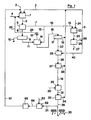
- Figure 1 is a diagram of an installation for the manufacture of sodium bicarbonate by the amine technique, implementing a first embodiment of the method according to the invention.
- FIG. 2 shows another preferred embodiment of the method according to the invention.
- the installation represented in FIG. 1 comprises a crystallization chamber 1 which is continuously supplied with a substantially saturated aqueous solution of sodium chloride 2, an organic amine liquid 3 insoluble in the aqueous solution of sodium chloride and a gas containing carbon dioxide.
- the organic amine liquid can for example be a 50% by weight solution of the amine in xylene.
- the amine selected is a primary alkylamine comprising between 12 and 14 carbon atoms in its molecule (for example the amine PRIMENE 81R® (Rohm & Haas)) whose hydrochloride is soluble in water and aqueous solutions.
- the gas 4 is preferably an enriched gas, containing 60 to 80% by weight of carbon dioxide, obtained for example by mixing in adequate proportions a lime gas with a residual gas from the calcination of sodium bicarbonate into monocarbonate of sodium.
- the amount of gas used must be sufficient to convert a substantial part of the sodium chloride of solution 2 into sodium bicarbonate.
- the treatment in the crystallization chamber 1 can be preceded by a partial carbonation of the mixture by means of a gas poor in carbon dioxide, such as a lime kiln gas.
- a liquid 5 consisting of a mixture of aqueous solution and organic liquid and containing crystals of sodium bicarbonate in suspension.
- This liquid 5 is transferred to a settling chamber 6, where an organic solution of amine hydrochloride 7 is separated by gravity and an aqueous slurry 8 of sodium bicarbonate crystals.
- the latter is sent to a wringing or filtration device 9, where solid sodium bicarbonate 10 and mother liquor 11 are collected separately.
- the latter is saturated with sodium bicarbonate and contains dissolved amine hydrochloride.
- the organic solution of amine hydrochloride 7 is divided into two fractions 12 and 13.
- Fraction 13 is then treated in a manner known per se in the amine technique, to regenerate the amine. For this purpose, it is sent to a reaction chamber 23, where it is subjected to stirring with an aqueous suspension of calcium hydroxide 24, and the resulting reaction mixture 25 is sent to a decantation chamber 26 from which it is collected. separately an aqueous solution of calcium chloride 27 and an organic liquid of amine 68.
- the fraction 12 and the mother liquor 11 are introduced into a reaction chamber 14 and subjected to vigorous stirring therein to generate a reaction between the sodium bicarbonate and the amine hydrochloride, leading to the formation of sodium chloride which passes into aqueous solution, of amine which passes into organic solution and of carbon dioxide.
- the reaction chamber 14 is heated, for example to a temperature of the order of 60 ° C., and the carbon dioxide which is evacuated therefrom is removed. form, by means of a vacuum pump 15.
- the carbon dioxide 28 withdrawn from the reaction chamber 14 by the pump 15 is advantageously discharged into the crystallization chamber 1.
- a liquid 16 formed from a mixture of a dilute aqueous solution of sodium chloride and an organic amine liquid is withdrawn from the reaction chamber 14; the liquid 16 is sent to a decantation chamber 17 from which the dilute aqueous sodium chloride solution 33 and the organic amine liquid 19 are collected separately.
- the aqueous solution 33 still contains sodium bicarbonate and dissolved amine hydrochloride. It is transferred to a reaction chamber 35 which is supplied with an organic amine liquid 40 in an amount sufficient to decompose the sodium bicarbonate and recover the amine hydrochloride. The resulting mixture 36 is withdrawn from the reaction chamber 35 and is sent to a decantation chamber 37, from which a dilute aqueous phase of sodium chloride 18 and an organic amine liquid 38 are collected separately.
- the dilute aqueous phase of sodium chloride 18 still contains a small fraction of dissolved amine hydrochloride, which it is useful to recover. For this purpose, it is transferred to a reaction chamber 29 which is supplied with an aqueous solution of sodium hydroxide 30, in an amount sufficient to decompose the amine hydrochloride.
- the aqueous solution 30 may advantageously consist of an aqueous solution containing between 30 and 60% by weight of sodium hydroxide, obtained by electrolysis of an aqueous solution of sodium chloride in a mercury electrolysis cell or a membrane with permeability selective.
- it can also be an aqueous solution containing between 10 and 20% by weight of sodium hydroxide and between 10 and 20% by weight of sodium chloride, obtained by electrolysis of an aqueous solution of sodium chloride in a diaphragm cell.
- the liquid 31 withdrawn from the reaction chamber 29 has the appearance of an emulsion. It is sent to a coalescence filter 32, designed in a manner known per se to break the emulsion and separate the organic phase 34 and the aqueous phase 39.
- the aqueous phase 39 is a dilute solution of sodium chloride 39; it is introduced into a rock salt deposit 20, from which an equivalent flow rate of a saturated aqueous solution of sodium chloride 21 is drawn off. This is sent to a purification installation 62, where it is in particular treated with carbonate sufficient sodium 63 to precipitate the dissolved calcium therein.
- the liquid 64 withdrawn from the reaction chamber 62 is sent to a decantation or filtration chamber 65, from which collects a saturated aqueous solution of sodium chloride 67, which is sent to the crystallization chamber 1.
- the amine organic liquids 19, 34, 38 and 68 collected from chambers 17, 32, 37 and 26 are combined to reconstitute the starting amine organic liquid 3 and the organic liquid 40 used in chamber 35.
- the organic solution of amine hydrochloride 7 is introduced entirely into the reaction chamber 14, so that the organic liquid 19 collected from the settling chamber 17 contains a large fraction of amine hydrochloride.
- the amine organic liquid 19 is completely introduced as it is into the reaction chamber 23, and the resulting organic amine liquid 40 is sent to the reaction chamber 35.
- This embodiment of the method according to the invention has the additional advantage of carrying out a purification of the amine in calcuim. It is observed in fact that the amine liquid 40 collected after treatment with the suspension of calcium hydroxide in the reaction chamber 23 is contaminated with calcium. The treatment in chamber 35 results in transferring the calcium from the amine into the aqueous solution 33.
- the mother liquor (11) was treated in the reactor (14) with an organic liquid (7) comprising a mixture of 42% by weight of PRIMENE 81R® amine (Rohm & Haas) and 58% by weight of amine hydrochloride, without solvent (hydrochloride level: 0.58).
- the operation of the reactor (14) was adjusted so that the reactants remained there for 1 h 15 min at the temperature of 57.5 ° C and under an absolute pressure of 0.2 bar.
- the aqueous solution (33) was treated, in the reaction chamber (35), with an organic liquid (40) comprising a mixture of 90% of amine PRIMENE 81R® and 10% by weight of hydrochloride amine (hydrochloride level: 0.10) and containing 1300 mg of calcium per kg.
- an organic liquid (40) comprising a mixture of 90% of amine PRIMENE 81R® and 10% by weight of hydrochloride amine (hydrochloride level: 0.10) and containing 1300 mg of calcium per kg.
- the presence of calcium was due to the fact that the organic liquid (40) resulted from a treatment for converting amine hydrochloride into amine by means of a lime milk in the reaction chamber (23).
Landscapes
- Chemical & Material Sciences (AREA)
- Organic Chemistry (AREA)
- Engineering & Computer Science (AREA)
- Materials Engineering (AREA)
- Inorganic Chemistry (AREA)
- Chemical Kinetics & Catalysis (AREA)
- Organic Low-Molecular-Weight Compounds And Preparation Thereof (AREA)
- Pharmaceuticals Containing Other Organic And Inorganic Compounds (AREA)
- Medicines Containing Antibodies Or Antigens For Use As Internal Diagnostic Agents (AREA)
Claims (10)
- Verfahren zur Herstellung einer Wässrigen Natriumchloridlösung aus einer wässrigen, gelöstes Natriumbicarbonat enthaltenden Lösung, dadurch gekennzeichnet, daß man die Natriumbicarbonatlösung (33) mit einer organischen Flüssigkeit (40) behandelt, die mit der Natriumbicarbonatlösung nicht mischbar ist und eine organische, stickstoffhaltige, wasserunlösliche Base enthält, die ausreichende basische Eigenschaften aufweist, um mit dem Chlorwasserstoff durch Bildung von Chlorhydrat der organischen, stickstoffhaltigen Base zu reagieren, und man Steinsalz (20) zu der sich ergebenden wässrigen Phase (18, 39) zufügt, wobei die organische Flüssigkeit gegebenenfalls Chlorhydrat der organischen, stickstoffhaltigen Base umfaßt, in einem Gewichtsanteil, der 25% des Gesamtgewichts der organischen, stickstoffhaltigen Base und des Chlorhydrats der organischen, stickstoffhaltigen Base nicht übersteigt.
- Verfahren nach Anspruch 1, dadurch gekennzeichnet, daß man die organische, stickstoffhaltige Base (40) unter den wasserunlöslichen Aminen auswählt.
- Verfahren nach Anspruch 2, dadurch gekennzeichnet, daß man die organische, stickstoffhaltige Base (40) unter den primären Alkylaminen, die 12 bis 14 kohlenstoffatome in ihrem Molekül enthalten, auswählt.
- Verfahren nach einem der Ansprüche 1 bis 3, dadurch gekennzeichnet, daß man eine verdünnte wässrige Natriumbicarbonatlösung (33) einsetzt, die durch Behandlung einer gesättigten wässrigen Natriumbicarbonatlösung (11) mit einem Chlorhydrat der organischen, stickstoffhaltigen Base (7, 12) erhalten wird.
- Verfahren nach Anspruch 4, dadurch gekennzeichnet, daß man eine verdünnte Natriumbicarbonatlösung (33) einsetzt, die 0,5 bis 0,8 Gew.-% Natriumbicarbonat und eine bestimmte Menge der obengenannten organischen Flüssigkeit (40) enthält, damit der Gehalt an Natriumbicarbonat der wässrigen Phase (18) zwischen 0,2 und 0,4 Gew.-% liegt.
- Verfahren nach Anspruch 4 oder 5, dadurch gekennzeichnet, daß man eine organische, stickstoffhaltige Base (40), deren Chlorhydrat wasserlöslich ist, einsetzt und, daß sie vor dem Zufügen des Steinsalzes (20) zu der wässrigen Phase (39) mit einem basischen Mittel (30), das das Chlorhydrat zersetzen kann, behandelt wird.
- Verfahren nach Anspruch 6, dadurch gekennzeichnet, daß man das basische Mittel (30) auswählt unter den Alkalimetalloxyden und -hydroxyden.
- Verfahren zur Herstellung von Natriumbicarbonat gemäß dem man eine wässrige Natriumchloridlösung (2) mit Kohlensäureanhydrid (4) und einer organische Flüssigkeit der organischen, stickstoffhaltigen Base (3), die wasserunlöslich ist, behandelt, wobei die organische Flüssigkeit mit der Natriumbicarbonatlösung nicht mischbar ist, aus dem sich ergebenden Reaktionsmilieu (1) festes Natriumbicarbonat (10), Mutterlauge (33) und Chlorhydrat (7) der organischen, stickstoffhaltigen Base auffängt, und das Chlorhydrat (7) zersetzt, um die organische, stickstoffhaltige Base (3, 10) wiederherzustellen, dadurch gekennzeichnet, daß man die Mutterlauge (33) mit der wiederhergestellten organischen, stickstoffhaltigen Base (40) mischt, eine wässrige Phase (18, 39) und eine organische Phase (38), die aus der sich ergebenden Mischung (36) dekantieren, auffängt, die organische Phase (38) in das Reaktionsmilieu zurückführt und Steinsalz (20) zu der wässrigen Phase (39), die man in das Rektionsmilieu (1) zurückführt, zufügt.
- Verfahren nach Anspruch 8, dadurch gekennzeichnet, daß man um das Chlorhydrat (7) zu zersetzen, es nacheinander mit der Mutterlauge (33) und mit einer basischen Erdalkalimetallverbindung (24) behandelt.
- Verfahren nach Anspruch 8 oder 9, dadurch gekennzeichnet, daß man die wässrige Erdalkalimetall-Phase vor dem Rückführen in das Reaktionsmilieu reinigt.
Priority Applications (1)
| Application Number | Priority Date | Filing Date | Title |
|---|---|---|---|
| AT86201977T ATE61028T1 (de) | 1985-11-25 | 1986-11-12 | Verfahren zur herstellung einer waessrigen natriumchloridloesung und verfahren zur erzeugung von natriumbikarbonat. |
Applications Claiming Priority (2)
| Application Number | Priority Date | Filing Date | Title |
|---|---|---|---|
| FR8517494A FR2590561B1 (fr) | 1985-11-25 | 1985-11-25 | Procede pour la preparation d'une solution aqueuse de chlorure de sodium et procede pour la production de bicarbonate de sodium |
| FR8517494 | 1985-11-25 |
Publications (2)
| Publication Number | Publication Date |
|---|---|
| EP0230686A1 EP0230686A1 (de) | 1987-08-05 |
| EP0230686B1 true EP0230686B1 (de) | 1991-02-27 |
Family
ID=9325183
Family Applications (1)
| Application Number | Title | Priority Date | Filing Date |
|---|---|---|---|
| EP86201977A Expired - Lifetime EP0230686B1 (de) | 1985-11-25 | 1986-11-12 | Verfahren zur Herstellung einer wässrigen Natriumchloridlösung und Verfahren zur Erzeugung von Natriumbikarbonat |
Country Status (7)
| Country | Link |
|---|---|
| EP (1) | EP0230686B1 (de) |
| JP (1) | JPS62138325A (de) |
| CN (1) | CN1019290B (de) |
| AT (1) | ATE61028T1 (de) |
| DE (1) | DE3677749D1 (de) |
| ES (1) | ES2020936B3 (de) |
| FR (1) | FR2590561B1 (de) |
Families Citing this family (5)
| Publication number | Priority date | Publication date | Assignee | Title |
|---|---|---|---|---|
| FR2882998B1 (fr) * | 2005-03-08 | 2007-06-08 | Solvay | Procede pour l'obtention de cristaux de carbonate de sodium |
| FR2883008B1 (fr) * | 2005-03-08 | 2007-04-27 | Solvay | Procede pour l'obtention conjointe de chlore et de cristaux de carbonate monohydrate |
| EP1900688A1 (de) * | 2006-09-14 | 2008-03-19 | SOLVAY (Société Anonyme) | Verfahren zur Herstellung von Natriumcarbonat-Kristallen |
| CN103288104B (zh) * | 2013-06-26 | 2014-12-03 | 河南城建学院 | 一种用高铁盐去除精制盐异味的方法 |
| CN106115744B (zh) * | 2016-06-22 | 2017-12-01 | 湖南工业大学 | 一种超细NaHCO3粒子及其制备方法和应用 |
Family Cites Families (1)
| Publication number | Priority date | Publication date | Assignee | Title |
|---|---|---|---|---|
| FR2551428B1 (fr) * | 1983-09-05 | 1985-11-22 | Solvay | Procede pour la preparation d'une solution aqueuse de chlorure de sodium et procede de fabrication de bicarbonate de sodium |
-
1985
- 1985-11-25 FR FR8517494A patent/FR2590561B1/fr not_active Expired
-
1986
- 1986-11-12 EP EP86201977A patent/EP0230686B1/de not_active Expired - Lifetime
- 1986-11-12 AT AT86201977T patent/ATE61028T1/de not_active IP Right Cessation
- 1986-11-12 DE DE8686201977T patent/DE3677749D1/de not_active Expired - Fee Related
- 1986-11-12 ES ES86201977T patent/ES2020936B3/es not_active Expired - Lifetime
- 1986-11-21 JP JP61278516A patent/JPS62138325A/ja active Pending
- 1986-11-25 CN CN86108737A patent/CN1019290B/zh not_active Expired
Also Published As
| Publication number | Publication date |
|---|---|
| ATE61028T1 (de) | 1991-03-15 |
| FR2590561A1 (fr) | 1987-05-29 |
| DE3677749D1 (de) | 1991-04-04 |
| CN86108737A (zh) | 1987-08-12 |
| JPS62138325A (ja) | 1987-06-22 |
| ES2020936B3 (es) | 1991-10-16 |
| EP0230686A1 (de) | 1987-08-05 |
| CN1019290B (zh) | 1992-12-02 |
| FR2590561B1 (fr) | 1988-01-29 |
Similar Documents
| Publication | Publication Date | Title |
|---|---|---|
| EP0366182B1 (de) | Verfahren zur Entsorgung eines Natriumsulfat enthaltenden Rückstands | |
| CA2118602C (fr) | Procede de fabrication d'une solution aqueuse industrielle de chlorure de sodium | |
| EP0555163B1 (de) | Verfahren zur Entfernung von Natriumoxalat aus Natriumaluminatlösungen von dem Bayerzyklus | |
| EP1113990B1 (de) | umweltschonendes verfahren zur herstellung von natriumchloridkristallen | |
| EP0173630B1 (de) | Reinigung von Natriumaluminatlösungen des Bayerverfahrens durch Beseitigung von Natriumoxalat | |
| CS212744B2 (en) | Method of preparing calcium hypochlorite | |
| EP0230686A1 (de) | Verfahren zur Herstellung einer wässrigen Natriumchloridlösung und Verfahren zur Erzeugung von Natriumbikarbonat | |
| EP0099152B1 (de) | Verfahren zur Erzeugung von kristallwasserhaltigem Natriumhypochlorit | |
| EP0487379B1 (de) | Verfahren zur umweltschützenden Behandlung eines verbrauchten Raffinierungskatalysators und vollständige Rückgewinnung der metallischen Bestandteile des Katalysators | |
| EP0171106B1 (de) | Verfahren zur Erwerbung von einer wasserunlöslichen organischen Stickstoffbase, aus wasserlöslichem Hydrochlorhydrat dieser Base und ein Verfahren zur Fabrikation von Natrium-Bicarbonat | |
| LU85506A1 (fr) | Procede pour la preparation d'une solution aqueuse de chlorure de sodium et procede de fabrication de bicarbonate de sodium | |
| EP0266830B1 (de) | Verfahren für die Extraktion einer organischen Flüssigkeit, die eine azotierte organische Base aus einer wässrigen Suspension von mineralischen Teilchen enthält und Verfahren zur Herstellung von Alkalimetall-Bikarbonat | |
| CA1230463A (en) | Process for producing high purity solutions of alkali metal hydrosulfites | |
| EP0148524B1 (de) | Verfahren zur Regenerierung einer organischen Lösung von einer wasserunlöslichen organischen Base, ausgehend von einer organischen Lösung dessen Chlorhydrats,und Verfahren zur Produktion von Alkali-Metall-Bicarbonat | |
| FR2590495A1 (fr) | Procede pour epurer une base organique azotee insoluble dans l'eau, en metal alcalino-terreux dissous et procede pour la production de bicarbonate de metal alcalin | |
| LU86005A1 (fr) | Procede pour l'obtention d'une base organique azotee insoluble dans l'eau,au depart d'une solution aqueuse de bicarbonate de metal alcalin et de chlorhydrate de ladite base,et procede de fabrication de bicarbonate de sodium | |
| FR2545079A1 (fr) | Procede et installation pour la production d'une solution organique d'une base organique insoluble dans l'eau | |
| LU85684A1 (fr) | Procede pour la production de bicarbonate de metal alcalin et carbonate de sodium obtenu a partir de ce procede | |
| CN1010306B (zh) | 生产不溶于水的含氮有机碱的方法 | |
| FR2566382A1 (fr) | Purification des solutions d'aluminate de sodium du cycle bayer par elimination d'oxalate de sodium | |
| FR2605892A1 (fr) | Procede pour separer des grains de bicarbonate de metal alcalin, d'une pellicule liquide de chlorhydrate d'une base organique azotee adsorbee a leur surface et procede pour la production de bicarbonate de metal alcalin | |
| JPH0623042B2 (ja) | バナジウムの回収方法 |
Legal Events
| Date | Code | Title | Description |
|---|---|---|---|
| PUAI | Public reference made under article 153(3) epc to a published international application that has entered the european phase |
Free format text: ORIGINAL CODE: 0009012 |
|
| AK | Designated contracting states |
Kind code of ref document: A1 Designated state(s): AT BE CH DE ES FR GB GR IT LI LU NL SE |
|
| 17P | Request for examination filed |
Effective date: 19880125 |
|
| 17Q | First examination report despatched |
Effective date: 19890317 |
|
| GRAA | (expected) grant |
Free format text: ORIGINAL CODE: 0009210 |
|
| AK | Designated contracting states |
Kind code of ref document: B1 Designated state(s): AT BE CH DE ES FR GB GR IT LI LU NL SE |
|
| PG25 | Lapsed in a contracting state [announced via postgrant information from national office to epo] |
Ref country code: SE Effective date: 19910227 Ref country code: GR Free format text: LAPSE BECAUSE OF FAILURE TO SUBMIT A TRANSLATION OF THE DESCRIPTION OR TO PAY THE FEE WITHIN THE PRESCRIBED TIME-LIMIT Effective date: 19910227 Ref country code: AT Effective date: 19910227 |
|
| REF | Corresponds to: |
Ref document number: 61028 Country of ref document: AT Date of ref document: 19910315 Kind code of ref document: T |
|
| ITF | It: translation for a ep patent filed | ||
| REF | Corresponds to: |
Ref document number: 3677749 Country of ref document: DE Date of ref document: 19910404 |
|
| GBT | Gb: translation of ep patent filed (gb section 77(6)(a)/1977) | ||
| PG25 | Lapsed in a contracting state [announced via postgrant information from national office to epo] |
Ref country code: LI Effective date: 19911130 Ref country code: CH Effective date: 19911130 |
|
| PLBE | No opposition filed within time limit |
Free format text: ORIGINAL CODE: 0009261 |
|
| STAA | Information on the status of an ep patent application or granted ep patent |
Free format text: STATUS: NO OPPOSITION FILED WITHIN TIME LIMIT |
|
| 26N | No opposition filed | ||
| REG | Reference to a national code |
Ref country code: FR Ref legal event code: CD |
|
| ITPR | It: changes in ownership of a european patent |
Owner name: CAMBIO RAGIONE SOCIALE;SOLVAY |
|
| REG | Reference to a national code |
Ref country code: CH Ref legal event code: PL |
|
| EPTA | Lu: last paid annual fee | ||
| REG | Reference to a national code |
Ref country code: ES Ref legal event code: PC2A Owner name: SOLVAY (SOCIETE ANONYME) |
|
| NLT1 | Nl: modifications of names registered in virtue of documents presented to the patent office pursuant to art. 16 a, paragraph 1 |
Owner name: SOLVAY (SOCIETE ANONYME) TE BRUSSEL, BELGIE. |
|
| PGFP | Annual fee paid to national office [announced via postgrant information from national office to epo] |
Ref country code: LU Payment date: 19951001 Year of fee payment: 10 |
|
| PGFP | Annual fee paid to national office [announced via postgrant information from national office to epo] |
Ref country code: FR Payment date: 19951027 Year of fee payment: 10 |
|
| PGFP | Annual fee paid to national office [announced via postgrant information from national office to epo] |
Ref country code: BE Payment date: 19951031 Year of fee payment: 10 |
|
| PGFP | Annual fee paid to national office [announced via postgrant information from national office to epo] |
Ref country code: ES Payment date: 19951102 Year of fee payment: 10 |
|
| PGFP | Annual fee paid to national office [announced via postgrant information from national office to epo] |
Ref country code: GB Payment date: 19951103 Year of fee payment: 10 |
|
| PGFP | Annual fee paid to national office [announced via postgrant information from national office to epo] |
Ref country code: DE Payment date: 19951128 Year of fee payment: 10 |
|
| PGFP | Annual fee paid to national office [announced via postgrant information from national office to epo] |
Ref country code: NL Payment date: 19951130 Year of fee payment: 10 |
|
| PG25 | Lapsed in a contracting state [announced via postgrant information from national office to epo] |
Ref country code: LU Free format text: LAPSE BECAUSE OF NON-PAYMENT OF DUE FEES Effective date: 19961112 Ref country code: GB Effective date: 19961112 |
|
| PG25 | Lapsed in a contracting state [announced via postgrant information from national office to epo] |
Ref country code: ES Free format text: LAPSE BECAUSE OF THE APPLICANT RENOUNCES Effective date: 19961113 |
|
| PG25 | Lapsed in a contracting state [announced via postgrant information from national office to epo] |
Ref country code: BE Effective date: 19961130 |
|
| BERE | Be: lapsed |
Owner name: SOLVAY Effective date: 19961130 |
|
| PG25 | Lapsed in a contracting state [announced via postgrant information from national office to epo] |
Ref country code: NL Effective date: 19970601 |
|
| GBPC | Gb: european patent ceased through non-payment of renewal fee |
Effective date: 19961112 |
|
| PG25 | Lapsed in a contracting state [announced via postgrant information from national office to epo] |
Ref country code: FR Effective date: 19970731 |
|
| NLV4 | Nl: lapsed or anulled due to non-payment of the annual fee |
Effective date: 19970601 |
|
| PG25 | Lapsed in a contracting state [announced via postgrant information from national office to epo] |
Ref country code: DE Effective date: 19970801 |
|
| REG | Reference to a national code |
Ref country code: FR Ref legal event code: ST |
|
| REG | Reference to a national code |
Ref country code: ES Ref legal event code: FD2A Effective date: 20010402 |
|
| PG25 | Lapsed in a contracting state [announced via postgrant information from national office to epo] |
Ref country code: IT Free format text: LAPSE BECAUSE OF NON-PAYMENT OF DUE FEES Effective date: 20051112 |