EP0222164B1 - Esters furanniques et leur utilisation en tant qu'ingrédients aromatisants - Google Patents
Esters furanniques et leur utilisation en tant qu'ingrédients aromatisants Download PDFInfo
- Publication number
- EP0222164B1 EP0222164B1 EP86113961A EP86113961A EP0222164B1 EP 0222164 B1 EP0222164 B1 EP 0222164B1 EP 86113961 A EP86113961 A EP 86113961A EP 86113961 A EP86113961 A EP 86113961A EP 0222164 B1 EP0222164 B1 EP 0222164B1
- Authority
- EP
- European Patent Office
- Prior art keywords
- esters
- oxo
- dimethyl
- furyl
- flavoring
- Prior art date
- Legal status (The legal status is an assumption and is not a legal conclusion. Google has not performed a legal analysis and makes no representation as to the accuracy of the status listed.)
- Expired
Links
- 0 CC(C1=O)OC(C)=C1O* Chemical compound CC(C1=O)OC(C)=C1O* 0.000 description 1
- FZMUNLWFPRLQQZ-UHFFFAOYSA-N CC(C1=O)OC(C)=C1OO Chemical compound CC(C1=O)OC(C)=C1OO FZMUNLWFPRLQQZ-UHFFFAOYSA-N 0.000 description 1
Classifications
-
- C—CHEMISTRY; METALLURGY
- C07—ORGANIC CHEMISTRY
- C07D—HETEROCYCLIC COMPOUNDS
- C07D307/00—Heterocyclic compounds containing five-membered rings having one oxygen atom as the only ring hetero atom
- C07D307/02—Heterocyclic compounds containing five-membered rings having one oxygen atom as the only ring hetero atom not condensed with other rings
- C07D307/34—Heterocyclic compounds containing five-membered rings having one oxygen atom as the only ring hetero atom not condensed with other rings having two or three double bonds between ring members or between ring members and non-ring members
- C07D307/56—Heterocyclic compounds containing five-membered rings having one oxygen atom as the only ring hetero atom not condensed with other rings having two or three double bonds between ring members or between ring members and non-ring members with hetero atoms or with carbon atoms having three bonds to hetero atoms with at the most one bond to halogen, e.g. ester or nitrile radicals, directly attached to ring carbon atoms
- C07D307/60—Two oxygen atoms, e.g. succinic anhydride
-
- A—HUMAN NECESSITIES
- A23—FOODS OR FOODSTUFFS; TREATMENT THEREOF, NOT COVERED BY OTHER CLASSES
- A23L—FOODS, FOODSTUFFS OR NON-ALCOHOLIC BEVERAGES, NOT OTHERWISE PROVIDED FOR; PREPARATION OR TREATMENT THEREOF
- A23L27/00—Spices; Flavouring agents or condiments; Artificial sweetening agents; Table salts; Dietetic salt substitutes; Preparation or treatment thereof
- A23L27/20—Synthetic spices, flavouring agents or condiments
- A23L27/205—Heterocyclic compounds
- A23L27/2052—Heterocyclic compounds having oxygen or sulfur as the only hetero atoms
Definitions
- the present invention relates to the field of aromas. It relates in particular to the use of certain new furan compounds as flavoring ingredients intended to reinforce, improve or modify the proper aromatic qualities of foods or drinks.
- the compounds of the invention obey the general formula (I) in which R is used to define a linear or branched saturated C 2 -C 6 alkyl residue. They are therefore furan esters of the family of 4-hydroxy-2,5-dimethyl-2,3-dihydrofuran-3-one, better known in the art under the name of FURANEOL (registered trademark of Firmenich SA, Geneva). Since its discovery, this compound has established itself as a critical ingredient not only for any reconstitution of the strawberry aroma, but also as a constituent of varied fruit aromas, even meaty aromas.
- Application FR-A 2 118 954 describes a process for the preparation of certain furan derivatives, in particular certain substituted 2,3-dihydro-furans-3-ones. It is mentioned therein that the compounds thus prepared are flavoring agents or precursors of important flavoring agents without, however, defining the exact nature of these compounds nor distinguishing between those of the compounds having a flavoring action and those which can serve as precursors of the compounds. assets.
- esters have very interesting properties and that therefore they can be used advantageously for the flavoring of various foods, drinks and tobacco.
- Our invention is based on the fortuitous discovery that 2,5-dimethyl-4-oxo-3 (5H) -furyl butanoate was a constituent of the absolute obtained from an extract of lyophilized strawberries in which it is present at a concentration below about 70 ppm. It is therefore a compound of natural origin whose presence in the aroma of strawberries has so far escaped the numerous examinations and analyzes to which the various extracts obtained from fruits of various origins have been subjected.
- 5H 2,5-dimethyl-4-oxo-3
- the extract was obtained by a multi-step process which consisted in the lyophilization of fresh strawberries, freezing in liquid nitrogen and the extraction with diethyl ether of the powder obtained by grinding the freeze-dried frozen fruits. After concentration, the ether extract was taken up in ethanol and kept stirring at 40 ° C for 30 minutes. After cooling to -7 ° C and cold filtration, the alcohol was removed by distillation. The residue thus obtained was subjected to column chromatographic separation using silica gel as support and pentane and diethyl ether as eluent. 35 fractions were thus obtained, of which only three contained the ester in question whose identity was confirmed by comparison with a sample obtained by direct esterification of Furaneol with butyric anhydride.
- esters of the invention can be used to produce the desired effects vary, as often in such cases, within a fairly wide range of values. Their value will depend first of all on the specific effect desired, on the nature of the product which it is desired to flavor and on the nature of the co-ingredients in a given flavoring composition. Generally these proportions are of the order of 1 to 100 parts per million, preferably between 5 and 20 ppm.
- esters of the invention are incorporated into food, beverages, pharmaceutical preparations or tobacco which it is desired to flavor according to methods customary in the art, generally in admixture with other natural or synthetic flavoring ingredients.
- Their use preferably takes place in solution in one of the usual edible solvents such as triacetin, ethyl alcohol or propylene glycol, or as a mixture on a solid support, for example a dextrin or gum arabic.
- Mention may be made, as food which can be flavored, of ice creams, dessert creams, yogurts, milk products in general, confectionery or bakery products, syrups, cooked sugars or jams. , or broths, solid concentrated extracts for the preparation of soups and sauces or in general meat products or imitating meat.
- tobacco as used herein should be interpreted to include natural products, such as burley tobacco, Turkish or Maryland tobacco, or reconstituted or homogenized tobacco, as well as artificial tobacco replacement products.
- the articles prepared using said tobacco products can just as easily be articles for smoking, as articles for chewing or snuffing.
- esters of the invention can be easily obtained by a simple process of esterification from Furaneol.
- the appropriate anhydride or halide of the carboxylic acid will be used according to scheme (A).
- reaction mixture was allowed to stir while the temperature rose to room value.
- the mixture was then extracted with ether (100 ml), then the ether extract was subjected to the usual neutralization treatments with two 25 ml fractions of 10% aqueous NaOH, washing with water saturated with NaCl and drying on MgS0 4 .
- Evaporation of the solvent in vacuo provided a residue which by distillation on a Vigreux column provided 123 g of a product having Eb. 70 ° / 11.6 Pa.
- esters shown in the following table were prepared. Next to each compound are the corresponding analytical data (IR, NMR and MS).
- a basic flavoring composition of the fruity pineapple type was prepared by mixing the following ingredients (parts by weight):
- compositions were evaluated in an acidic sugar solution (10% sucrose and 0.10% citric acid in spring water) at a rate of 0.10%.
- a basic strawberry-like flavoring composition was prepared by mixing the following ingredients (parts by weight).
- compositions were evaluated in an acidic sugar solution (10% sucrose and 0.10% citric acid in spring water) at a rate of 0.10%.
- flavor B was more ripe, fruity and slightly more buttery than flavor A; it also had a more pronounced strawberry character.
- Aroma A on the other hand, showed a greener note.
- a butter-type flavoring composition was prepared by mixing the following ingredients (parts by weight):
- English type soft dough cookies were prepared by mixing the following ingredients (parts by weight):
- the aroma was added as a premix in the sugar syrup to the mixture X consisting of the fat, syrup and sugar in order to guarantee its good diffusion in the dough.
- the resulting mixture containing the aroma was stirred for 3 minutes in a suitable device, then the other ingredients were added to it while mixing for another 3 minutes.
- the soft dough was pressed on a roller and placed on plates to a thickness of 3 mm.
- the cookies were lightly dusted with sugar before baking. This is done in a laboratory rotary oven at a temperature of 210 ° , the first minute with steam.
- a reconstitution of a beef broth was prepared by mixing the following ingredients (parts by weight):
- the broth thus obtained was then divided into two portions of equal volume and to one of them was added 2,5-dimethyl-4-oxo-3 (5H) -furyl butanoate at a rate of 2 ppm .
- the fraction thus flavored was finally subjected to evaluation by comparison with the non-flavored fraction.
- the flavored broth has a richer and more complete aroma with a slightly more roasted and juicy tone than unflavoured broth.
Landscapes
- Chemical & Material Sciences (AREA)
- Organic Chemistry (AREA)
- Food Science & Technology (AREA)
- Nutrition Science (AREA)
- Life Sciences & Earth Sciences (AREA)
- Engineering & Computer Science (AREA)
- Health & Medical Sciences (AREA)
- Polymers & Plastics (AREA)
- Fats And Perfumes (AREA)
- Seasonings (AREA)
- Cosmetics (AREA)
- Furan Compounds (AREA)
- Medicinal Preparation (AREA)
Description
- La présente invention a trait au domaine des arômes. Elle concerne en particulier l'utilisation de certains composés furanniques nouveaux en tant qu'ingrédients aromatisants destinés à renforcer, améliorer ou modifier les qualités aromatiques propres d'aliments ou boissons.
- Les composés de l'invention obéissent à la formule générale (I) dans laquelle R sert à définir un reste alkyle C2-C6 saturé linéaire ou ramifié. Il s'agit donc d'esters furanniques de la famille de la 4-hydroxy-2,5-diméthyl-2,3-dihydrofuran-3-one, mieux connue dans l'art sous la dénomination de FURANEOL (marque enregistrée de Firmenich SA, Genève). Depuis sa découverte, ce composé s'est imposé comme un ingrédient critique non seulement pour toute reconstitution de l'arôme de fraise, mais également en tant que constituant d'arômes de fruits variés, voire d'arômes viandeux.
- Nombreuses ont été les études consacrées à ce composé; mais, fait étonnant, aucune attention particulière n'a été vouée à l'examen des propriétés organoleptiques de ses dérivés esters.
- Le brevet suisse No 486 850 (publié le 30. 4. 1970) mentionne que certains dérivés pouvant se dégrader in situ pour fournir du Furanéol dans des aliments ou boissons peuvent être employés en remplacement de celui-ci. Le 2,5-diméthyl-3-acétoxy-4-oxo-4,5-dihydrofuranne est mentionné à ce titre.
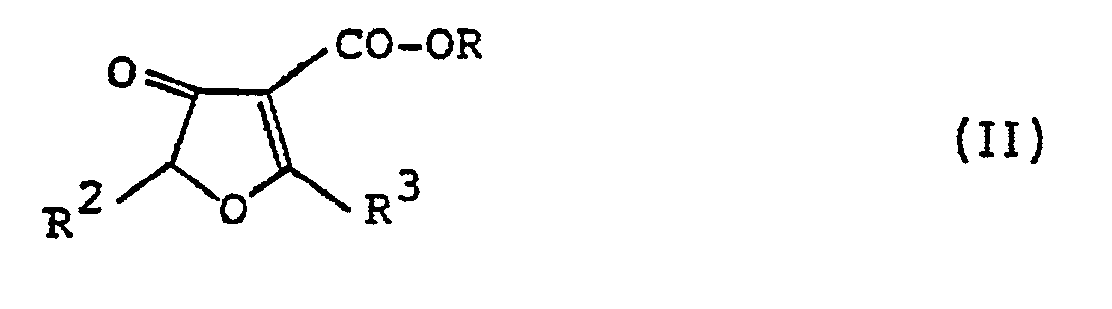
- La DE-OS 2 359 891 (publiée le 6. 6. 1974) décrit certains esters furanniques de formule (II) dans laquelle R représente un reste alkyle G-Cs, R2 représente un groupe alkyle Ci-C4 linéaire ou ramifié et R3 sert à désigner un atome d'hydrogène ou un groupe alkyle Ci-C7, en tant qu'intermédiaires dans un procédé de synthèse de furanones.
- La demande FR-A 2 118 954 décrit un procédé de préparation de certains dérivés furanniques, en particulier de certains 2,3-dihydro-furanne-3-ones substitués. Il y est fait mention que les composés ainsi préparés sont des agents aromatisants ou précurseurs d'agents aromatisants importants sans toutefois définir la nature exacte de ces composés ni distinguer entre ceux des composés ayant une action aromatisante et ceux pouvant servir en tant que précurseurs des composés actifs.
- Aucune mention n'a été faite dans l'art antérieur quant aux qualités aromatisantes des esters de formule (I).
- Nous avons maintenant découvert que lesdits esters possédaient des propriétés fort intéressantes et que de ce fait ils pouvaient être employés avantageusement pour l'aromatisation d'aliments variés, de boissons et du tabac.
- Notre invention est basée sur la découverte fortuite que le butanoate de 2,5-diméthyl-4-oxo-3(5H)-furyle était un constituant de l'absolue obtenue à partir d'un extrait de fraises lyophilisées dans lequel il est présent à une concentration inférieure à environ 70 ppm. Il s'agit donc d'un composé d'origine naturelle dont la présence dans l'arôme de fraise avait échappée jusqu'ici aux nombreux examens et analyses auxquels avaient été soumis les différents extraits obtenus des fruits d'origine variée.
- L'extrait a été obtenu par un procédé en plusieurs étapes qui a consisté en la lyophilisation de fraises fraîches, la congélation dans l'azote liquide et l'extraction à l'éther diéthylique de la poudre obtenue par broyage des fruits lyophilisés congélés. Après concentration, l'extrait éthéré a été repris à l'éthanol et maintenu sous agitation à 40°C pendant 30 minutes. Après refroidissement à -7°C et filtration à froid, l'alcool a été éliminé par distillation. Le résidu ainsi obtenu a été soumis à une séparation chromatographi- que sur colonne en utilisant comme support du gel de silice et comme éluant du pentane et de l'éther diéthylique. 35 fractions ont été ainsi obtenues, parmi lesquelles trois seulement contenaient l'ester en question dont l'identité a été confirmée par une comparaison avec un échantillon obtenu par esterifica- tion directe du Furanéol avec l'anhydride butyrique.
- Quoique les propriétés aromatisantes du butanoate de 2,5-diméthyl-4-oxo-3(5H)-furyle s'apparentent à celles du Furanéol, notamment pour sa note caramel, elles diffèrent du composé connu par son intensité, son caractère plus beurré et par une note moins fruitée. De par ces caractères, et par sa puissance, l'ester mentionné peut donc constituer, suivant le type d'application, un ingrédient d'emploi alternatif ou complémentaire à celui du Furanéol.
- Par ailleurs, les composés définis à l'aide de la formule (I), quoique caractérisés par des légères différences structurales, montrent à l'expérience des différences plus ou moins prononcées quant à l'intensité de leur arôme et à leur qualité.
- Le tableau en annexe résume les propriétés de différents esters selon l'invention en regard de leur formule spécifique.
- Parmi les composés de formule (I), il s'est avéré que le produit qui possédait au mieux les caractères utiles propres à l'emploi envisagé était le butanoate de 2,5-diméthyl-4-oxo-3(5H)-furyle. Toutefois, les autres dérivés analogues définis par la formule (I) peuvent trouver un emploi particulier suivant l'effet aromatisant recherché et la nature du produit que l'on désire aromatiser.
- Les qualités des esters de l'invention apparaissent comme tout à fait surprenantes au vu des connaissances acquises dans l'art.
- L'homme de fart sait par expérience que des légères modifications moléculaires s'accompagnent dans la plupart des cas de modifications souvent fondamentales des propriétés organoleptiques, et ce sans raison apparente.
- Les proportions dans lesquelles les esters de l'invention peuvent être employés pour produire les effets recherchés varient, comme souvent en pareil cas, dans une gamme de valeurs assez étendue. Leur valeur dépendra en premier lieu de l'effet spécifique désiré, de la nature du produit que l'on désire aromatiser et de la nature des coingrédients dans une composition aromatisante donnée. Généralement ces proportions sont de l'ordre de 1 à 100 parties par millions, de préférence comprises entre 5 et 20 ppm.
- Les esters de l'invention sont incorporés aux aliments, boissons, préparations pharmaceutiques ou tabac que l'on désire aromatiser selon des procédés usuels dans l'art, généralement en mélange avec d'autres ingrédients aromatisants naturels ou synthétiques. Leur emploi a lieu de préférence en solution dans l'un des solvants comestibles usuels tels la triacétine, l'alcool éthylique ou le propylène glycol, ou en mélange sur un support solide, par exemple une dextrine ou la gomme arabique.
- A titre d'aliment pouvant être aromatisé on peut mentionner en tant qu'exemple les glaces, les crèmes à dessert, les yogourths, les produits lactés en général, les produits de confiserie ou de boulangerie, les sirops, les sucres cuits ou les confitures, ou encore les bouillons, les extraits concentrés solides pour la préparation de soupes et des sauces ou en général les produits à base de viande ou imitant la viande.
- Le terme "tabac" tel qu'utilisé ici, doit être interprété comme comprenant des produits naturels, tel le tabac burley, le tabac turc ou de Maryland, ou des tabacs reconstitués ou homogénéisés, ainsi que des produits artificiels de remplacement du tabac. Les articles préparés à l'aide desdits produits de tabac peuvent tout aussi bien être des articles à fumer, que des articles à mâcher ou à priser.
- Les esters de l'invention peuvent être aisément obtenus par un procédé simple d'esterification à partir de Furanéol. En fonction de l'ester désiré l'on utilisera l'anhydride ou l'halogénure de l'acide carboxylique approprié suivant le schéma (A).
- Le procédé suivi est en soi courant et la méthode spécifique employée sera illustrée plus en détail par les exemples donnés ci-après. Dans la section suivante seront également décrites certaines applications particulières, mais bien entendu l'invention ne saurait être limitée aux exemples donnés. Les températures sont indiquées en degrés centigrades et les abréviations ont le sens usuel dans l'art.
- 158 Grammes (1 M) d'anhydride butyrique ont été introduits à 0-3° goutte à goutte, sous azote et avec agitation dans un mélange de 128 g (1 M) de Furanéol (produit commercial de Firmenich SA) et 385 g (4,9 M) de pyridine.
- Le mélange de réaction a été laissé sous agitation pendant que la température remonte à la valeur ambiante. Le mélange a été ensuite extrait à l'éther (100 ml), puis l'extrait éthéré a été soumis aux traitements usuels de neutralisation avec deux fractions de 25 ml de NaOH aqueux à 10%, lavage avec de l'eau saturée au NaCI et séchage sur MgS04. L'évaporation sous vide du solvant a fourni un résidu qui par distillation sur une colonne Vigreux a fourni 123 g d'un produit ayant Eb. 70°/11,6 Pa.
- 5,28 Grammes (0,044 M) de chlorure de 2-méthyl-butanoyle ont été introduits goutte à goutte à 0-3°, sous azote et avec agitation, dans un mélange de 5,12 g (0,04 M) de Furanéol et de 12,8 ml (0,2 M) de pyridine. Après avoir laissé remonter la température à la valeur ambiante, le mélange a été traité avec 50 ml d'éther. Comme à l'exemple 1, l'extrait éthéré a été soumis aux traitements usuels. Le résidu obtenu par évaporation du solvant a été distillé sous vide dans un four à boules pour fournir l'ester désiré ayant Eb. 87°/12 Pa.
- En suivant l'une des méthodes générales indiquées ci-dessus, on a préparé les esters figurant dans le tableau suivant. En regard de chaque composé figurent les données analytiques (IR, RMN et SM) correspondantes.
- RMN (CDCI3): 1,0 (3H, t); 1,26 (3H, d); 1,49 (3H, d); 1,6 (1H, m); 1,79 (1H, m); 2,15 (3H, s); 2,62 (1H, m); 4,57 (1 H, q) delta ppm; IR (CHCI3): 2960, 2930, 2870, 1755, 1705, 1630, 1300, 1185, 1135, 1100, 995 cm-'; SM: M+ = 212 (8); m/e: 41 (11), 43 (28), 57 (100), 72 (10), 85 (73), 128 (38), 129 (16).
- RMN (CDCI3): 1,04 (6H, d); 1,5 (3H, d); 2,16 (3H, s); 2,19 (1 H, m); 2,41 (2H, d); 4,56 (1 H, q) delta ppm; IR (CHCl3): 2990, 2955, 2900, 1770, 1720, 1645, 1315, 1195, 1150, 1100, 1010 cm-1; SM: M+ = 212 (11); mle: 39 (6), 41 (22), 43 (47), 57 (100), 72 (9), 85 (87), 128 (75), 129 (11).
- RMN (CDCl3): 1,01 (3H, t); 1,49 (3H, d); 1,74 (2H, m); 2,16 (3H, s); 2,52 (2H, t); 4,56 (1 H, q) delta ppm; IR(CHCl3): 2960, 2930, 2875, 1760, 1710, 1630, 1305, 1185, 1135, 1095, 995 cm-1; SM: M+ = 198 (7); m/e: 41 (9), 43 (100), 57 (11), 71 (51), 72 (11), 85 (33), 128 (54).
- RMN (CDCIs): 1,51 (3H, d); 1,75 (3H, d); 2,17 (3H, s); 4,58 (1 H, q); 6,01 (1 H, d); 7,18 (1 H, dxq) delta ppm; IR (CHCl3): 2990, 2925, 1735, 1700, 1625, 1300, 1285, 1185, 1145, 1095, 995, 960 cm-1; SM: M+ = 196 (4); m/e: 41 (16), 43 (9), 69 (100), 128 (9).
- RMN (CDCl3): 0,95 (3H, t); 1,43 (2H, m); 1,5 (3H, d); 1,7 (2H, m); 2,16 (3H, s); 2,54 (2H, t); 4,57 (1 H, q) delta ppm;
- IR (CHCI3): 2955, 2930, 2875, 1760, 1705, 1630, 1415, 1300, 1185, 1135, 995 cm-1; SM: M+ = 212 (4); m/e: 41 (19), 43 (31), 55 (14), 57 (100), 72 (11), 85 (93), 128 (66).
- RMN (CDCI3): 0,92 (3H, t); 1,36 (4H, m); 1,5 (3H, d); 1,72 (2H, m); 2,16 (3H, s); 2,53 (2H, t); 4,57 (1 H, q) delta ppm;
- IR (CHCl3): 2955, 2925, 2870, 1760, 1705, 1630, 1300, 1185, 1135, 1095, 995 cm-1; SM: M+ = 226 (3); m/e: 41 (11), 43 (100), 55 (17), 57 (10), 71 (69), 72 (15), 85 (35), 99 (51), 128 (76), 129 (11).
- On a procédé à une comparaison des qualités aromatiques du butanoate de 2,5-diméthyl-4-oxo-3(5H)-furyle avec celles développées par le Furanéol en examinant un échantillon des produits en question à un dosage de 20 ppm dans de l'eau de source. Les commentaires exprimés par un panel d'expert sont reproduits ci-après:
- Furanéol: typique caramel, fruité, légèrement brûlé, sucré, fraise
- Butanoate de 2,5-diméthyl-4-oxo-3(5H)-furyle: caramel, moins fruité que le Furanéol, plus beurré, plus puissant
- Une comparaison analogue a été effectuée sur un échantillon d'autres esters de l'invention et le résultat observé a été reproduit dans la section précédente de la spécification.
- Une composition aromatisante de base de type fruité ananas a été préparée en mélangeant les ingrédients suivants (parties en poids):

- En utilisant la base indiquée ci-dessus, on a préparé deux compositions ainsi:

- Les deux compositions résultantes ont été évaluées dans une solution sucrée acide (10% de saccharose et 0,10% d'acide citrique dans l'eau de source) à raison de 0,10%.
- Le groupe d'experts appelés à se prononcer sur les qualités des deux arômes obtenus a trouvé que l'arôme B était plus complet, plus doux, harmonieux et naturel que l'arôme A; il possédait en outre un caractère ananas plus caractéristique.
- Une composition aromatisante de base de type fruité fraise a été préparée en mélangeant les ingrédients suivants (parties en poids).

- En utilisant la base indiquée ci-dessus on a préparé deux compositions ainsi:

- Les deux compositions résultantes ont été évaluées dans une solution sucrée acide (10% de saccharose et 0,10% d'acide citrique dans l'eau de source) à raison de 0,10%.
- De l'avis d'un groupe d'experts, l'arôme B était plus mûre, fruité et légèrement plus beurré que l'arôme A; il possédait en outre un caractère fraise plus prononcé. L'arôme A montrait par contre une note plus verte.
- Une composition aromatisante de type beurre a été préparée en mélangeant les ingrédients suivants (parties en poids):

- A l'aide de ladite composition de base, on a préparé deux autres compositions en mélangeant les ingrédients suivants:

- On a ensuite préparé des biscuits à pâte tendre de type anglais en mélangeant les ingrédients suivants (parties en poids):

- L'arôme a été ajouté sous forme de prémélange dans le sirop de sucre au mélange X constitué par la matière grasse, le sirop et le sucre afin de garantir sa bonne diffusion dans la pâte.
- Le mélange ainsi obtenu contenant l'arôme a été brassé pendant 3 minutes dans un appareil approprié, puis les autres ingrédients y ont été ajoutés tout en mélangeant pendant 3 autres minutes.
- La pâte tendre a été pressée sur rouleau et déposée sur plaques à une épaisseur de 3 mm. Les biscuits ont été saupoudrés légèrement avec du sucre avant leur cuisson. Celle-ci s'effectue dans un four rotatif de laboratoire à une température de 210°, la première minute avec de la vapeur.
- De l'avis du groupe d'experts appelés à se prononcer sur les qualités organoleptiques des biscuits ainsi obtenus, ceux qui avaient été aromatisés à l'aide de l'arôme B possédaient un goût et un arôme plus riches et plus complets que ceux qui avaient été aromatisés à l'aide de l'arôme A; ils montraient en outre un caractère "cuit" plus prononcé.
- Une reconstitution d'un bouillon de boeuf a été préparée en mélangeant les ingrédients suivants (parties en poids):

- Le bouillon ainsi obtenu a été ensuite réparti en deux portions de volume égale et à l'une d'entre elles on a ajouté le butanoate de 2,5-diméthyl-4-oxo-3(5H)-furyle à raison de 2 ppm. La fraction ainsi aromatisée a été finalement soumise à évaluation par comparaison avec la fraction non aromatisée.
- De l'avis d'un panel, le bouillon aromatisé possède un arôme plus riche et plus complet avec une tonalité légèrement plus rôtie et juteuse que le bouillon non aromatisé.
-



Claims (5)

Applications Claiming Priority (2)
| Application Number | Priority Date | Filing Date | Title |
|---|---|---|---|
| CH474685 | 1985-11-05 | ||
| CH4746/85 | 1985-11-05 |
Publications (2)
| Publication Number | Publication Date |
|---|---|
| EP0222164A1 EP0222164A1 (fr) | 1987-05-20 |
| EP0222164B1 true EP0222164B1 (fr) | 1989-05-31 |
Family
ID=4281798
Family Applications (1)
| Application Number | Title | Priority Date | Filing Date |
|---|---|---|---|
| EP86113961A Expired EP0222164B1 (fr) | 1985-11-05 | 1986-10-08 | Esters furanniques et leur utilisation en tant qu'ingrédients aromatisants |
Country Status (4)
| Country | Link |
|---|---|
| US (1) | US4889735A (fr) |
| EP (1) | EP0222164B1 (fr) |
| JP (1) | JPS62108875A (fr) |
| DE (1) | DE3663663D1 (fr) |
Families Citing this family (2)
| Publication number | Priority date | Publication date | Assignee | Title |
|---|---|---|---|---|
| US5698585A (en) * | 1995-04-13 | 1997-12-16 | Kikkoman Corporation | Pharmaceutical preparation for prevention and/or treatment for cataract |
| EP1124443B1 (fr) | 1998-11-04 | 2005-02-09 | Firmenich Sa | Systeme de liberation solide pour ingredients aromatiques |
Family Cites Families (6)
| Publication number | Priority date | Publication date | Assignee | Title |
|---|---|---|---|---|
| CH486850A (de) * | 1964-12-31 | 1970-03-15 | Firmenich & Cie | Verwendung von Dihydrofuranderivaten als Geschmackstoffe |
| GB1383492A (en) * | 1970-12-21 | 1974-02-12 | Unilever Ltd | Dicarbonyl compounds and preparation of dihydrofuranones therefrom |
| NL7216271A (fr) * | 1972-11-30 | 1974-06-04 | ||
| US4127592A (en) * | 1977-03-31 | 1978-11-28 | Polak's Frutal Works, B.V. | Process of the preparation of hydroxyfurenones |
| DE2910131A1 (de) * | 1979-03-15 | 1980-09-25 | Basf Ag | Verfahren zur herstellung von 2,5-dimethyl-4-hydroxy-2,3-dihydrofuran- 3-on |
| IL75430A (en) * | 1984-07-02 | 1989-03-31 | Hercules Inc | Pineapple ketone carbonate derivatives and their use as flavoring agents |
-
1986
- 1986-10-08 EP EP86113961A patent/EP0222164B1/fr not_active Expired
- 1986-10-08 DE DE8686113961T patent/DE3663663D1/de not_active Expired
- 1986-11-05 JP JP61262075A patent/JPS62108875A/ja active Granted
-
1988
- 1988-08-08 US US07/229,791 patent/US4889735A/en not_active Expired - Lifetime
Also Published As
| Publication number | Publication date |
|---|---|
| JPH0521111B2 (fr) | 1993-03-23 |
| JPS62108875A (ja) | 1987-05-20 |
| US4889735A (en) | 1989-12-26 |
| DE3663663D1 (en) | 1989-07-06 |
| EP0222164A1 (fr) | 1987-05-20 |
Similar Documents
| Publication | Publication Date | Title |
|---|---|---|
| KR102045592B1 (ko) | 식품 향미 화합물로서의 n-아실 프롤린 유도체 | |
| KR102045590B1 (ko) | 식품 향미 화합물로서의 n-아실화된 1-아미노사이클로알킬 카복실산 | |
| JPH06335362A (ja) | 呈味改善剤及び呈味改善方法 | |
| US3455702A (en) | Hydrofurans as strawberry-like flavorings for foodstuffs and beverages | |
| US4280011A (en) | Aldehyde generators and foodstuffs containing such generators | |
| JP2001002634A (ja) | フレーバー化合物 | |
| EP0470391B1 (fr) | Utilisation de pyridines à titre d'ingrédients parfumants et aromatisants | |
| EP0482385B1 (fr) | (2E,4Z,7Z)-Décatriénoate d'éthyle et son utilisation à titre d'ingrédient parfumant ou aromatisant | |
| JP7154719B2 (ja) | 4-メルカプト-1-オクタノールまたはその脂肪酸エステル、および香味付与剤 | |
| JP6680938B1 (ja) | バニラ風味飲食品の香味改善剤 | |
| JP2017206451A (ja) | (3r,5r,8s)−5−イソプロペニル−3,8−ジメチル−3,4,5,6,7,8−ヘキサヒドロ−1(2h)−アズレノンおよび香料組成物 | |
| EP0778350B1 (fr) | Procédé de transformation du soufre élémentaire en sulfure | |
| CH632650A5 (fr) | Aldehydes alpha,beta-insatures et leur utilisation en tant qu'ingredients aromatisants. | |
| US3222187A (en) | Flavoring composition | |
| EP0222164A1 (fr) | Esters furanniques et leur utilisation en tant qu'ingrédients aromatisants | |
| JPS599538B2 (ja) | 脂肪族多不飽和エステル、該エステルを含有する香料もしくはフレ−バ−組成物 | |
| JP7332568B2 (ja) | 香味付与剤としての3-メチル-3-ブテン-1-チオール | |
| US20240002746A1 (en) | Citrus oil extract | |
| EP0786248B1 (fr) | Utilisation du dithioacétate de S,S'-éthylidène à titre d'ingrédient parfumant et aromatisant | |
| EP0009632B1 (fr) | Esters aliphatiques polyinsaturés, procédé pour la préparation de ces esters et leur utilisation en tant qu'ingrédients aromatisants et parfumants | |
| EP1153547B1 (fr) | Composition organoleptique | |
| JP2001149034A (ja) | 2−メチルフラン−3−チオール及び/又は誘導体及びメチレンジチオール及び/又は誘導体を含むおいしそうな風味剤 | |
| CH634725A5 (fr) | Aldehydes alpha,beta-insatures et leur utilisation en tant qu'ingredients aromatisants. | |
| US4099531A (en) | Flavoring ingredient | |
| JP7543343B2 (ja) | 含硫化合物およびこれを用いた香味付与組成物 |
Legal Events
| Date | Code | Title | Description |
|---|---|---|---|
| PUAI | Public reference made under article 153(3) epc to a published international application that has entered the european phase |
Free format text: ORIGINAL CODE: 0009012 |
|
| AK | Designated contracting states |
Kind code of ref document: A1 Designated state(s): CH DE FR GB LI NL |
|
| 17P | Request for examination filed |
Effective date: 19870928 |
|
| 17Q | First examination report despatched |
Effective date: 19880603 |
|
| GRAA | (expected) grant |
Free format text: ORIGINAL CODE: 0009210 |
|
| AK | Designated contracting states |
Kind code of ref document: B1 Designated state(s): CH DE FR GB LI NL |
|
| REF | Corresponds to: |
Ref document number: 3663663 Country of ref document: DE Date of ref document: 19890706 |
|
| GBT | Gb: translation of ep patent filed (gb section 77(6)(a)/1977) | ||
| R20 | Corrections of a patent specification |
Effective date: 19890904 |
|
| PGFP | Annual fee paid to national office [announced via postgrant information from national office to epo] |
Ref country code: NL Payment date: 19891031 Year of fee payment: 4 |
|
| PLBE | No opposition filed within time limit |
Free format text: ORIGINAL CODE: 0009261 |
|
| 26N | No opposition filed | ||
| PG25 | Lapsed in a contracting state [announced via postgrant information from national office to epo] |
Ref country code: NL Effective date: 19910501 |
|
| NLV4 | Nl: lapsed or anulled due to non-payment of the annual fee | ||
| PGFP | Annual fee paid to national office [announced via postgrant information from national office to epo] |
Ref country code: CH Payment date: 19930907 Year of fee payment: 8 |
|
| PG25 | Lapsed in a contracting state [announced via postgrant information from national office to epo] |
Ref country code: LI Effective date: 19941031 Ref country code: CH Effective date: 19941031 |
|
| REG | Reference to a national code |
Ref country code: CH Ref legal event code: PL |
|
| REG | Reference to a national code |
Ref country code: GB Ref legal event code: IF02 |
|
| PGFP | Annual fee paid to national office [announced via postgrant information from national office to epo] |
Ref country code: FR Payment date: 20030911 Year of fee payment: 18 |
|
| PGFP | Annual fee paid to national office [announced via postgrant information from national office to epo] |
Ref country code: GB Payment date: 20030916 Year of fee payment: 18 |
|
| PGFP | Annual fee paid to national office [announced via postgrant information from national office to epo] |
Ref country code: DE Payment date: 20030924 Year of fee payment: 18 |
|
| PG25 | Lapsed in a contracting state [announced via postgrant information from national office to epo] |
Ref country code: GB Free format text: LAPSE BECAUSE OF NON-PAYMENT OF DUE FEES Effective date: 20041008 |
|
| PG25 | Lapsed in a contracting state [announced via postgrant information from national office to epo] |
Ref country code: DE Free format text: LAPSE BECAUSE OF NON-PAYMENT OF DUE FEES Effective date: 20050503 |
|
| GBPC | Gb: european patent ceased through non-payment of renewal fee |
Effective date: 20041008 |
|
| PG25 | Lapsed in a contracting state [announced via postgrant information from national office to epo] |
Ref country code: FR Free format text: LAPSE BECAUSE OF NON-PAYMENT OF DUE FEES Effective date: 20050630 |
|
| REG | Reference to a national code |
Ref country code: FR Ref legal event code: ST |