EP0218922B1 - Biegsame aber nichtverformbare Handstickereimatrize und Verfahren zum Anbringen von gedruckten Mustern darauf - Google Patents
Biegsame aber nichtverformbare Handstickereimatrize und Verfahren zum Anbringen von gedruckten Mustern darauf Download PDFInfo
- Publication number
- EP0218922B1 EP0218922B1 EP86112562A EP86112562A EP0218922B1 EP 0218922 B1 EP0218922 B1 EP 0218922B1 EP 86112562 A EP86112562 A EP 86112562A EP 86112562 A EP86112562 A EP 86112562A EP 0218922 B1 EP0218922 B1 EP 0218922B1
- Authority
- EP
- European Patent Office
- Prior art keywords
- computer
- handcraft
- needlework
- paper
- materials
- Prior art date
- Legal status (The legal status is an assumption and is not a legal conclusion. Google has not performed a legal analysis and makes no representation as to the accuracy of the status listed.)
- Expired - Lifetime
Links
- 239000000463 material Substances 0.000 title claims abstract description 158
- 238000000034 method Methods 0.000 title claims abstract description 25
- 238000010417 needlework Methods 0.000 claims abstract description 73
- 239000004744 fabric Substances 0.000 claims abstract description 24
- 230000000007 visual effect Effects 0.000 claims abstract description 20
- 239000010985 leather Substances 0.000 claims abstract description 16
- 239000002023 wood Substances 0.000 claims abstract description 9
- 239000011888 foil Substances 0.000 claims abstract description 8
- 239000002985 plastic film Substances 0.000 claims abstract description 3
- 239000002650 laminated plastic Substances 0.000 claims abstract 2
- 238000007639 printing Methods 0.000 claims description 10
- 230000007246 mechanism Effects 0.000 claims description 7
- 239000002131 composite material Substances 0.000 claims description 6
- 238000007667 floating Methods 0.000 claims description 6
- 229920002994 synthetic fiber Polymers 0.000 claims description 5
- 238000000576 coating method Methods 0.000 claims description 3
- 239000003000 extruded plastic Substances 0.000 claims description 3
- 238000004590 computer program Methods 0.000 claims 3
- 239000013013 elastic material Substances 0.000 claims 1
- 239000000123 paper Substances 0.000 abstract description 19
- 239000004033 plastic Substances 0.000 abstract description 11
- 229920003023 plastic Polymers 0.000 abstract description 11
- 239000000835 fiber Substances 0.000 abstract description 3
- 238000006243 chemical reaction Methods 0.000 abstract 1
- 239000011101 paper laminate Substances 0.000 abstract 1
- 239000010410 layer Substances 0.000 description 30
- 238000005520 cutting process Methods 0.000 description 6
- 230000003287 optical effect Effects 0.000 description 6
- 208000018747 cerebellar ataxia with neuropathy and bilateral vestibular areflexia syndrome Diseases 0.000 description 5
- 230000005540 biological transmission Effects 0.000 description 4
- 239000003086 colorant Substances 0.000 description 4
- 239000002648 laminated material Substances 0.000 description 4
- 239000004753 textile Substances 0.000 description 4
- 239000000853 adhesive Substances 0.000 description 3
- 230000001070 adhesive effect Effects 0.000 description 3
- 230000000694 effects Effects 0.000 description 3
- 238000004080 punching Methods 0.000 description 3
- 229920000742 Cotton Polymers 0.000 description 2
- 239000012790 adhesive layer Substances 0.000 description 2
- 230000000903 blocking effect Effects 0.000 description 2
- 230000001419 dependent effect Effects 0.000 description 2
- 238000005516 engineering process Methods 0.000 description 2
- 239000011159 matrix material Substances 0.000 description 2
- 239000004745 nonwoven fabric Substances 0.000 description 2
- 239000012209 synthetic fiber Substances 0.000 description 2
- 238000009941 weaving Methods 0.000 description 2
- 241000272443 Penelope Species 0.000 description 1
- 239000004820 Pressure-sensitive adhesive Substances 0.000 description 1
- 239000012876 carrier material Substances 0.000 description 1
- 239000003795 chemical substances by application Substances 0.000 description 1
- 239000011248 coating agent Substances 0.000 description 1
- 238000004040 coloring Methods 0.000 description 1
- 238000010276 construction Methods 0.000 description 1
- 230000001351 cycling effect Effects 0.000 description 1
- 238000007688 edging Methods 0.000 description 1
- 230000002708 enhancing effect Effects 0.000 description 1
- 229920002457 flexible plastic Polymers 0.000 description 1
- 238000010426 hand crafting Methods 0.000 description 1
- 230000013011 mating Effects 0.000 description 1
- 239000002991 molded plastic Substances 0.000 description 1
- 239000011087 paperboard Substances 0.000 description 1
- 238000007665 sagging Methods 0.000 description 1
- 238000009958 sewing Methods 0.000 description 1
- 238000004513 sizing Methods 0.000 description 1
- 230000001360 synchronised effect Effects 0.000 description 1
- 230000017105 transposition Effects 0.000 description 1
Images


Classifications
-
- D—TEXTILES; PAPER
- D05—SEWING; EMBROIDERING; TUFTING
- D05C—EMBROIDERING; TUFTING
- D05C1/00—Apparatus, devices, or tools for hand embroidering
- D05C1/08—Patterns for hand embroidering; Manufacture thereof
-
- Y—GENERAL TAGGING OF NEW TECHNOLOGICAL DEVELOPMENTS; GENERAL TAGGING OF CROSS-SECTIONAL TECHNOLOGIES SPANNING OVER SEVERAL SECTIONS OF THE IPC; TECHNICAL SUBJECTS COVERED BY FORMER USPC CROSS-REFERENCE ART COLLECTIONS [XRACs] AND DIGESTS
- Y10—TECHNICAL SUBJECTS COVERED BY FORMER USPC
- Y10T—TECHNICAL SUBJECTS COVERED BY FORMER US CLASSIFICATION
- Y10T428/00—Stock material or miscellaneous articles
- Y10T428/24—Structurally defined web or sheet [e.g., overall dimension, etc.]
- Y10T428/24273—Structurally defined web or sheet [e.g., overall dimension, etc.] including aperture
Definitions
- the present invention relates to handcraft sheet materials. More particularly, the invention relates to needlework materials having for example a uniform pattern of apertures forming a symmetrical gridwork intended to receive needle-directed yarn or thread for the purpose of creating a stitchery design thereon and to other flexible handcraft sheet materials including paper, plastics, leather, wood and fabrics.
- the present invention further relates to materials of the type described for receiving printed designs, patterns, photographs and instructional information and to methods of printing designs, patterns, photographs and instructional information thereon.
- Embroidery is the art or process of forming decorative designs with hand needlework.
- the art form is characterized as "needlepoint” or “canvas embroidery.”
- Needlepoint is distinguished from other forms of embroidery, such as crewel embroidery, in that in needlepoint the stitches are formed by passing needle-directed yarn or thread through openings in the canvas or apertured sheet material in simple even stitches across counted threads or between counted apertures.
- Needlepoint canvas in its simplest form, is comprised of evenly spaced, durable warp and woof threads woven into a textile in which the holes or apertures between the threads are commonly equal to or larger in size than the threads themselves.
- the canvas threads are usually composed of cotton or linen fibers, particularly where the gauge of the canvas (number of threads per cm/inch) falls within the popular range of 4-7 per cm (10 to 18 per inch).
- Fine gauge, needlepoint fabrics normally have 7-16 threads per cm.) (18 to 40 threads per inch) and are woven from silk or synthetic fiber threads in addition to cotton and linen fiber threads.
- Textile and fabric materials, manufactured for use as needlepoint canvas are usually sold by their manufacturers in "bolt" (roll) units having a minimum of 5-10 yards (4.57-9.14 m) of material.
- needlepoint canvases The principal types of needlepoint canvases in use today are designated "mono-" meaning one thread on each side of each hole or aperture and “double” meaning two threads on each side of each major hole or aperture.
- mono-floating the warp and weft (woof) threads are merely woven over and under each other whereas with mono-interlock canvas the warp threads (in fact) comprise two smaller (weaker) threads that are knotted or twisted at each over and under crossing of weft threads.
- Double thread needlepoint canvas (also referred to as "Duo” or “Penelope”) is woven with the warp and woof threads that form the principal holes or apertures of the canvas each comprised of a pair of slightly spaced threads which form small apertures.
- This weave of needlepoint canvas is useful when it is desired to use half stitches or where petit point stitches (small) and gross point stitches (large) are to be worked on the same canvas.
- Other fine woven textiles used in the needlework arts include cloths woven so that the individual threads are thicker than the holes between them, “evenweave” cloth and "Congress” cloth.
- needlepoint canvas From time to time other forms of needlepoint canvas have been manufactured. For example, molded plastic, large gauge (4-15) mesh sheets, with a surface texture simulating the warp and woof thread configuration of woven needlepoint canvas, or with a smooth surface texture, have been made. Also, perforated paper sheets have been made and proposed for needlepoint projects of relatively small size where the resulting needlework is to be framed as a decorative item or where a free-form craft item is to be created using needlework techniques, i.e., book markers, greeting cards, etc.
- needlework techniques i.e., book markers, greeting cards, etc.
- Mono-floating and mono-interlock needlepoint canvases have continued to be used for most stitchery applications despite their many shortcomings and the problems they create for the needlepoint artisan.
- the principal shortcomings and problems include edge raveling, canvas distortion, aperture irregularity and roughness, and thread shifting.
- Great care must be taken when cutting bolt or yardage canvas into smaller popular use size canvas pieces to make certain that each cutting course or line follows a single line of canvas holes or apertures, i.e., between warp and woof threads, so that edge raveling is minimized.
- Edge raveling becomes an even greater problem when the ultimate shape of the needlepoint piece is not rectangular with its edges not in parallel with warp and woof threads.
- Canvas distortion, stretching, sagging, extension and creep constitute major problems to persons performing needlepoint stitchery. If one closely observes needlework canvas as needlepoint stitchery is applied, it becomes obvious that the vertical and horizontal forces applied to the canvas threads (defining each aperture in the canvas) by the yarn-guiding needle and the yarn itself (as they pass through such apertures) are unequal. Although canvas manufacturers have attempted to reduce the distortion problem through the weaving of mono-interlock canvases and by the application of sizing (stiffening) agents to the canvas threads, the problem remains. Distortion correction, after completion of the needlework piece, by straightening or "blocking" the base canvas (and the needlework it bears) must overcome many built-in failure factors. Blocking, a somewhat costly procedure, involves the stretching and straightening of the needlework to its pre-stretched size and shape.
- An infinite number of decorative fabrics may be formed by applying needlework techniques to needlework canvas materials. These fabrics may vary widely in stitch type, yarn thickness, yarn colors, etc. Although some needlework artisans create their own stitchery designs while sewing a fabric or create a design on paper and reproduce it on the fabric, a primary source of designs is provided in kit form with the kit containing a pattern, the yarn types and colors and an appropriate canvas material, or needlwork patterns are sold independently.
- the design or pattern may be printed, drawn or painted on (or transferred to) the fabric and the artisan merely sews over the design or pattern.
- stitch type variation is usually involved.
- the commonly used canvas types (10 to 18 mesh) are substantially air space (apertures greater than canvas thread thickness)
- printing of stitch type instructions is not feasible since most stitchery is directionally oriented.
- the present-day woven canvas materials are distortable and not perfectly true in mesh or grid structure and when design printing thereon is attempted, the design frequently does not properly align with the gridwork of the canvas with the result that stitch type location is faulty. Only thread-by-thread hand painted designs are true and they are very time consuming and costly to produce.
- a pre-printed sheet of material of substantially smaller area than the canvas is prepared having a gridwork printed thereon that should correspond to the gridwork of the canvas and, in addition, it has indicated thereon the stitches and the locations of stitches to be needlepointed on said canvas to form a selected stitch pattern.
- the sheet has on one face a pressure sensitive removable adhesive by means of which the user of the sheet can apply it to an area of the canvas to be worked upon.
- leatherwork encompasses the cutting, tooling and burning of decorative designs in leathers, tanned leathers, suede materials and a wide selection of imitation and simulated leather materials.
- leatherwork may include handcraft design work that involves such materials in design punched or cut forms with the addition of a variety of attached media and adornments.
- needlework it is desirable to apply designs and patterns to leather and leather-like materials for their instructional utility in the performance of cutting, punching, tooling, burning, and adornment handcraft procedures and for their nonfunctional decorative effects.
- a flexible but non-distortable handcraft sheet material having a print receiving surface on at least one side thereof capable of receiving computer-generated print designs, patterns, and photographs as craft instructional or decorative visual information for use in creating finished handcrafted items incorporating the printed areas of said sheet material
- said handcraft sheet material has alignment and feed means located along the edges thereof for positively guiding and moving said material through a computer-directed printer for imprinting a design, pattern or photograph on the print receiving surface thereof
- said handcraft material consists of a primary layer of a material selected from the group comprising: woven needlework canvas; paper; leather, suede and simulated leather; paper-thin woods, wood veneers; plastic sheet materials; foils; and a secondary layer of sheer non-woven, semitransparent random-spun synthetic fibre material permanently or temporarily bonded to the primary layer; and any one of the foregoing handcraft materials pretreated with coatings to improve image printing receptivity, color, detail or density.
- the primary layer is a woven needlepoint canvas
- this is preferably mono-floating or mono-interlock.
- the shearness of the secondary layer is preferably such that the holes or apertures of the canvas remain distinct to the needlepoint artisan as well as the secondary layer being thin so that it is easily penetrated by the yarn bearing stitchery needle.
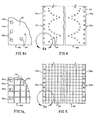
- FIGURES 1 and 1a there is shown examples of the apertured and perforated needlework materials of the invention which are adaptable for receiving computer-generated printed needlework designs, patterns and photographs.
- the apertured needlework material is a composite laminated needlepoint canvas material 10 comprised (as particularly shown in FIGURE 1a) of a non-elastic, open-mesh woven needlework fabric primary layer 12 including warp threads 14 and weft threads 16, which has bonded directly to one of its faces a relatively thin, non-elastic, mesh-stabilizing secondary layer of sheer fabric material 18.
- the composite laminated needlepoint canvas material 10 may be any of my improved flexible, non-distortable composite laminated sheet materials as described hereinbefore. These materials all present on their sheer fabric side a relatively smooth surface adaptable for receiving imprinted designs, patterns or photographs.
- a line of uniformly spaced pin holes 10c and 10d are located along each parallel edge 10a and 10b of material 10 .
- Such printers commonly handle paper widths of 10-39 cm. (4 to 15.5 inches) and special printers are available which accept paper widths of as much as 122 cm (4 feet).
- needlework materials of varying widths, and presenting a printable surface may be fabricated with edge pin holes for moving such materials in positive drive through a computer-directed printer or the materials may be provided with side bands for frictionally moving same through a printer.
- the needlework material is a composite laminated material 20 comprised (as particularly shown in FIGURE 2a) of a non-elastic, heavy, perforated paper primary layer 22 including uniformly spaced perforations 24 forming a grid of perforations for receiving needlework stitchery, which has bonded directly to one of its faces a relatively thin, non-elastic secondary layer of sheer fabric material 26.
- the sheer fabric side of the laminated material 20 presents a relatively smooth surface adaptable for receiving imprinted designs, patterns and photographs.
- a line of uniformly spaced pin holes 20c and 20d are located along each parallel edge 20a and 20b of material 20 are located a line of uniformly spaced pin holes 20c and 20d, respectively, which penetrate the material 20 and receive the standardized pin-feed drive mechanisms of computer-directed printers.
- the needlework material is a composite laminated material 30 comprised (as particularly shown in FIGURE 3a) of a non-elastic, extruded plastic, woven open-mesh needlework primary layer 32 including simulated warp components 34 and simulated weft components 36.
- the primary layer 32 has bonded directly to one of its faces a relatively thin, nonelastic secondary layer of sheer fabric material 38.
- the sheer fabric side of the laminated material 30 presents a relatively smooth surface adaptable for receiving imprinted designs, patterns or photographs.
- apertured and perforated needlework materials of the invention may be provided in a variety, of common printer widths ranging between 4 to 15.5 inches and in special situations in substantially greater widths.
- the material is supplied in bolts of several yards or more and fed from a spool into the computer-directed printer because of the thickness of the material and its stiffness as compared to common printer paper.
- the needlework material of the invention is reasonably flexible and relatively thin it may be fed to the printer as fanfolded material. Individual packets of separate pre-cut sheets of the needlework materials may also be fed to the printer.
- the edge strips of the needlework material including the pin holes may be cut away from the material after it has received the imprinted subject matter.
- the pin holes may be utilized as mounting means for the finished needlework item, or means for connecting the finished or unfinished needlework item to another correlant craft material or craft construct.
- the craft material is a sheet 40 having a primary layer of leather, tanned leather, suede or simulated leather, craft paper or craft plastic foil, paper, paper thin woods or wood veneers and a secondary layer of sheer non-woven, semitransparent random-spun synthetic fibre.
- the primary layer of material 42 of sheet 40 includes various sizes of punched holes or perforations 44 forming a design of perforations leaving large material surface areas for the imprinting of designs and crafting instructional information.
- the primary layer material 42 may be permanently or temporarily bonded to a secondary layer of material (not shown).
- the primary layer may be carried by a secondary release non-woven fabric material bearing a release adhesive and the computer-directed imprinting may be applied to the secondary layer of non-woven, fabric material or to the primary layer 42.
- the parallel edge 40a and 40b of material 40 are located a line of uniformly spaced pin holes 40c and 40d, respectively, which penetrate the material 40 (layer 42 and the secondary layer) and receive the standardized pin-feed drive mechanisms of computer-directed printers.
- the design or pattern imprinted on material 40 may be instructive as to crafting steps to be taken (cutting, tooling, punching, burning, coloring, affixing, etc.), may provide non-functional decorative art work on the material, or may be functionally related or interrelated to other craft materials or craft constructs forming a part of the material 40 or to be matched to or associated with such material.
- the primary layer of the craft material is a flexible sheet 50 of plastic pieces 52 forming a mosaic arrangement mounted on a self-adhesive layer 54 (see FIGURE 5a) protected by a secondary backing layer (not shown).
- the plastic pieces can be scored and bent for crafting purposes and are adaptable to printing for the receipt of designs and patterns.
- a line of uniformly spaced pin holes 50c and 50d are located along the parallel edge 50a and 50b of material 50, which penetrate the material 50 (layer of plastic pieces 52, self adhesive layer 54 and backing layer) and receive the standardized pin-feed (tractor) drive mechanisms of computer-directed printers.
- the handcraft material illustrative thereof is a flexible, non-distortable needlework material comprised of a laminate of open-mesh woven needlepoint fabric which has bonded to one of its faces a relatively thin secondary mesh-stabilizing layer of non-woven, semi-transparent (sheer), random-spun, synthetic fiber material, the secondary layer providing this handcraft material with a print surface for receiving printed design, pattern, photographic and/or instructional information.
- the methodology of the invention for producing needlework and other craft materials bearing designs, patterns, photographs and craft instructional information comprises the utilization of digitized images of designs, patterns, photographs, still objects, live objects, etc. (the subject matter for needlework stitchery) which are computer-directed to a printer.
- the printer is fed with the flexible, non-distortable sheet handcraft material (needlework material, etc.) of the invention with its print receiving surface.
- the visual information (the design subject matter) is converted into digital information through a digitizer.
- the digitizer may be of either the video type 60 utilizing the standard video signal information from a video camera 62, a video cassette recorder 64 or a video disk player 66 (fed to digitizer 60 by their respective transmission cables 62a, 64a and 66a) or the optical type 68 utilizing a light emitter and detector unit 70 with the optical signal information fed to digitizer 68 via transmission cable 70a.
- All digitizers convert visual information into digital information by breaking down an image into a mesh of fine dots and assigning a specific numerical value to the gray level found in each dot.
- Video digitizers use standard video signals created by scanning flat designs, photographs, and three-dimensional objects (still and alive). As shown in FIGURE 6 video camera 62 is scanning a flat design D.
- Optical digitizers through their emitter-detector system of present day design, scan only photographs, illustrations or other flat artwork D.
- the emitter projects a tiny beam of light onto the flat image and the light sensitive detector senses the degree of lightness or darkness in each dot of the image as the beam goes over it.
- optical digitizers base their generated digital information on the light beam's reflection value.
- a video digitizer turns the video signals it receives into a stream of binary numbers, reducing the light intensities represented by the video signal to a high-contrast image which a computer can represent digitally.
- the digitized image information derived through a video digitizer 60 or by an optical digitizer 68 is fed through transmission cable 60a or 68a, respectively, to any one of the many available types and models of personal computers represented in FIGURE 6 as micro-computer system unit 72.
- the micro-computer 72 converts the digital image information into visual image information and transmits same via cable 72a to a CRT display unit 74 (black and white or color picture) for viewing.
- the digital image information is also utilized by micro-computer 72 to direct a printer 76 of either the dot-matrix or laser type to print out (black and white or color) the visual image information on the flexible, non-distortable handcraft material 78 of the invention.
- the readily available and less expensive dot-matrix printers create visual images by producing a series of dots laid out on a grid pattern. These dots are produced by one of three printing methods, i.e., impact, thermal or ink-jet.
- Computer direction of printer 76 is accomplished via transmission cable 72b and the computer is responsible in its transmitting of display information to CRT display unit 74 and printout information to printer 76 to the commands generated by keyboard 80 (through cable 80a) and graphic and artistic software programs and menus supplied to the computer.
- a pattern line grid can be created that corresponds in mesh size to the line gridwork formed by the threads of needlework canvas materials upon which the computer-aligned and computer-directed printing of a design, pattern or photograph is to occur.
- the computer-created line grid may be displayed by the CRT unit with the visual image proposed for needlework handcrafting displayed in superimposed fashion thereon.
- the displayed image may be shifted over the displayed line grid for alignment purposes and the image (if video originated) may be block pixelized to render it as a mosaic pattern matched to the squares within the line grid (corresponding to the needlework apertures) or to cross points of the line grid (corresponding to the thread cross points of the needlework material).
- An image may be "zoomed” down and then"zoomed back up to its original size. This process squeezes information out of the image and then displays the image in its lower resolution and thereby more obvious pixel shape, "posturization” can further enlarge the pixel groups and create abstracts of an image. With optical digitization the generated pixels are generally rectangular so that only blocks of pixels can be made to be exactly aligned with the square gridwork of needlework canvas materials.
- the computer image pixels like the needlework apertures, are an array of small squares which build into a larger picture or geometric design. Placing these pixels exactly in line with or within the screen grid (and thus the needlework grid) allows the computer-directed printer to print a mosaic-like picture on the sheer print surface of the needlework material in alignment with the apertures of the woven primary layer of such material. This makes possible the merger of user-friendly printer interfacing off the computer screen canvas of mosaic computer imagery onto the printer-fed classic woven textile craft form of needlework canvas imagery.
- the modern computer signature translates with precision onto the ancient needlework artforms.
- the displayed image information (with or without a computer-created line grid matching the needlework grid) is computer-directed to the printer for imprinting on the needlework or other craft material as fed through the printer with the result that the visual printed image, produced by the printer, is in symmetrical alignment with the gridwork of the needlework material or in synchronized positioning on the print surface of these and other craft materials.
- computer-generated grid outlines can be rendered in any number of different pattern choices to match the particular material to be imprinted.
- dot grid symbols can be established and embellished in precise dot alignment with the perforations of the needlework paper material of the invention bearing a non-woven laminate backing providing a full print surface.
- grid symbols can be chosen and supplied in the printed image which exactly match the slant of stitch directions.
- the means for feeding the handcraft materials of the invention through a computer-directed printer often may serve as a functional feature of the crafted item, i.e., mounting, binding, edging means and the like.
- the material may include a carrier material such as release paper or non-woven fabric material leaving the ultimate print-bearing craft sheet adhesive free or leaving the craft sheet with pressure sensitive adhesive coating for mounting purposes.
Landscapes
- Engineering & Computer Science (AREA)
- Textile Engineering (AREA)
- Treatment Of Fiber Materials (AREA)
- Laminated Bodies (AREA)
- Decoration Of Textiles (AREA)
- Adornments (AREA)
- Coloring (AREA)
Claims (9)
- Flexibles, aber sich nicht verziehendes bahnförmiges Handarbeitsmaterial, das auf wenigstens einer Seite eine druckaufnehmende Fläche besitzt, die geeignet ist, computererzeugte Druckdesigns, Muster und Photographien als optische Handarbeitsanleitung oder optische Gestaltungshinweise aufzunehmen zur Verwendung bei der Erstellung von fertigen handgearbeiteten Gegenständen, die die bedruckten Bereiche des bahnförmigen Materials enthalten, dadurch gekennzeichnet, daß das bahnförmige Handarbeitsmaterial eine Einrichtung zum Ausrichten und Zuführen aufweist, die entlang seiner Kanten angeordnet ist, um das Material durch einen computergesteuerten Drucker formschlüssig zu führen und zu bewegen, der ein Design, Muster oder eine Photographie auf dessen druckaufnehmende Fläche druckt, und daß das Handarbeitsmaterial aus einer ersten Lage eines Materials besteht, das ausgewählt ist aus der Gruppe umfassend: gewebte Handarbeitsleinwand; Papier; Leder, Wildleder und Kunstleder; hauchdünne Hölzer, Holzfurniere; Kunststoffolien; Metallfolien und Laminate aus Folie und Papier bzw. Folie und Kunststoff; und eine zweite Lage aus hauchfeinem, nichtgewebtem, halbdurchsichtigem wirrgesponnenem Kunstfasermaterial, die dauerhaft oder vorübergehend auf die erste Lage kaschiert ist; und jedes der obengenannten Handarbeitsmaterialien, das mit Beschichtungen vorbehandelt ist, die die Bildabdruckaufnahmefähigkeit, Farbe, Bildfeinheit oder Dichte verbessern.
- Bahnförmiges Material nach Anspruch 1, dadurch gekennzeichnet, daß die Einrichtung zum Ausrichten und Zuführen eine Linie von gleichmäßig beabstandeten feinen Löchern in dem Material umfaßt, die einen Stachelwalzenantriebsmechanismus eines computergesteuerten Druckers aufnehmen.
- Bahnförmiges Material nach Anspruch 1, dadurch gekennzeichnet, daß die Einrichtung zum Ausrichten und Zuführen eine Reibeinrichtung umfaßt, die das Material mit dem Reibantriebsmechanismus eines computergesteuerten Druckers erfaßt.
- Bahnförmiges Material nach einem der vorhergehenden Ansprüche, dadurch gekennzeichnet, daß die erste Lage aus Papier mit einem Gitternetz von Perforationen besteht.
- Bahnförmiges Material nach einem der Ansprüche 1, 2 und 3, dadurch gekennzeichnet, daß die erste Lage ein Gewebe ist, das ausgewählt ist aus der Gruppe umfassend ein aus Monoflottierfäden, Mono-Interlock-Fäden und zweifädig gewebtes Leinwandmaterial, Kongreßstickleinwand, gleichmäßig gewebtes Gewebe und andere gewebte Handarbeitsstoffe.
- Bahnförmiges Material nach einem der Ansprüche 1, 2 und 3, dadurch gekennzeichnet, daß die erste Lage aus nichtelastischem Material ein Gittermaterial aus extrudiertem Kunststoff ist.
- Verfahren zur Herstellung von bahnförmigem Handarbeitsmaterial, umfassend die folgenden Schritte:a) ein Bild, das aus dem auf das bahnförmige Handarbeitsmaterial aufzubringenden Design, Muster oder der Photographie besteht, wird digitalisiert, um die optische Bildinformation zu dem Design, Muster oder der Photographie in digitale Bildinformation umzuwandeln;b) die digitale Bildinformation wird in einen Computer eingegeben;c) ein bahnförmiges Handarbeitsmaterial gemäß einem der vorhergehenden Ansprüche wird in einen elektronischen Drucker eingeführt, wobei das bahnförmige Material eine Oberfläche besitzt, die zur Aufnahme eines Aufdrucks geeignet ist; undd) das ausgewählte Handarbeitsdesign, das Muster oder die Photographie mit der optischen Bildinformation wird auf die Druckseite der Bahn aus Handarbeitsmaterial mit Hilfe des elektronischen Druckers nach den Anweisungen des Computers gedruckt.
- Verfahren nach Anspruch 7, dadurch gekennzeichnet, daß die in den Computer eingegebene digitale Bildinformation abgetastet wird, um das digitalisierte Bild auf dem Bildschirm einer Anzeigeeinheit wiederzugeben.
- Verfahren nach Anspruch 8, dadurch gekennzeichnet, daß:a) ein computerprogrammiertes symmetrisches Gitternetz auf das auf dem Bildschirm der Anzeigeeinheit wiedergegebene digitalisierte Bild gelegt wird, wobei das computerprogrammierte Gitternetz von seiner Größe und Konfiguration her dem symmetrischen fadenbildenden Gitternetz einer Stickleinwand entspricht;b) das wiedergegebene digitalisierte Bild mit Hilfe des Computers in ausgewählte Sticksymbole und Farbtonsymbole umgewandelt wird, und die Farbtöne mit Hilfe des Computers an das computerprogrammierte Gitternetz angepaßt werden; und daßc) die ausgewählten Sticksymbole und Farbtonsymbole, die dem die optische Bildinformation enthaltenden Design, Muster oder der Photographie entsprechen, auf die zweite Lage der zusammengesetzten Stickleinwand mit Hilfe des elektronischen Druckers nach den Anweisungen des Computers entsprechend dem symmetrischen fadenbildenden Gitternetz des Handarbeitsmaterials aufgedruckt werden.
Priority Applications (1)
| Application Number | Priority Date | Filing Date | Title |
|---|---|---|---|
| AT86112562T ATE89347T1 (de) | 1985-09-16 | 1986-09-11 | Biegsame aber nichtverformbare handstickereimatrize und verfahren zum anbringen von gedruckten mustern darauf. |
Applications Claiming Priority (2)
| Application Number | Priority Date | Filing Date | Title |
|---|---|---|---|
| US06/776,759 US4640529A (en) | 1985-09-16 | 1985-09-16 | Flexible non-distortable handcraft sheet material and method of applying printed designs thereto |
| US776759 | 1985-09-16 |
Publications (2)
| Publication Number | Publication Date |
|---|---|
| EP0218922A1 EP0218922A1 (de) | 1987-04-22 |
| EP0218922B1 true EP0218922B1 (de) | 1993-05-12 |
Family
ID=25108293
Family Applications (1)
| Application Number | Title | Priority Date | Filing Date |
|---|---|---|---|
| EP86112562A Expired - Lifetime EP0218922B1 (de) | 1985-09-16 | 1986-09-11 | Biegsame aber nichtverformbare Handstickereimatrize und Verfahren zum Anbringen von gedruckten Mustern darauf |
Country Status (7)
| Country | Link |
|---|---|
| US (1) | US4640529A (de) |
| EP (1) | EP0218922B1 (de) |
| JP (1) | JPS6278000A (de) |
| CN (1) | CN1006651B (de) |
| AT (1) | ATE89347T1 (de) |
| CA (1) | CA1266721A (de) |
| DE (1) | DE3688419T2 (de) |
Families Citing this family (62)
| Publication number | Priority date | Publication date | Assignee | Title |
|---|---|---|---|---|
| EP0244636A1 (de) * | 1986-04-04 | 1987-11-11 | Marcella M. Katz | Personalisierte Puppen und Tierspielzeugfiguren und Verfahren zu deren Herstellung |
| JPS63185788U (de) * | 1987-05-22 | 1988-11-29 | ||
| US4810006A (en) * | 1987-05-26 | 1989-03-07 | Katz Marcella M | Stabilized sheet materials for use with computer-directed printers and method of stabilizing same for computer printers |
| US5561604A (en) * | 1988-12-08 | 1996-10-01 | Hallmark Cards, Incorporated | Computer controlled system for vending personalized products |
| US5036472A (en) * | 1988-12-08 | 1991-07-30 | Hallmark Cards, Inc. | Computer controlled machine for vending personalized products or the like |
| US5993048A (en) * | 1988-12-08 | 1999-11-30 | Hallmark Cards, Incorporated | Personalized greeting card system |
| US5016452A (en) * | 1989-10-27 | 1991-05-21 | Ronald Alexander | Method of transferring photographs to leather |
| US5559708A (en) * | 1990-10-15 | 1996-09-24 | Aluminum Company Of America | Computer controlled flexible manufacturing of aluminum articles |
| US5559714A (en) * | 1990-10-22 | 1996-09-24 | Hallmark Cards, Incorporated | Method and apparatus for display sequencing personalized social occasion products |
| US5546316A (en) * | 1990-10-22 | 1996-08-13 | Hallmark Cards, Incorporated | Computer controlled system for vending personalized products |
| GB2251753B (en) * | 1990-10-23 | 1995-04-19 | Neill Maurice O | Image recording device |
| US5144899A (en) * | 1991-03-14 | 1992-09-08 | Allen Michael N | Combination embroidery/screen printing apparatus and method |
| FR2678292A1 (fr) * | 1991-06-28 | 1992-12-31 | Conditionnement Services Indls | Procede et dispositif pour la saisie et la reproduction de tapisseries. |
| US6359695B1 (en) * | 1992-02-26 | 2002-03-19 | Canon Kabushiki Kaisha | Repeated image forming apparatus with neighboring image boundary gradiation correction |
| EP0582158A1 (de) * | 1992-07-28 | 1994-02-09 | Urase Corp. | Bogen für Stickereibild |
| US5556690A (en) * | 1995-08-21 | 1996-09-17 | Delalott Corporation | Composite ravel-free needlework fabric and method of producing same |
| US5965242A (en) * | 1997-02-19 | 1999-10-12 | Eastman Kodak Company | Glow-in-the-dark medium and method of making |
| US6786420B1 (en) | 1997-07-15 | 2004-09-07 | Silverbrook Research Pty. Ltd. | Data distribution mechanism in the form of ink dots on cards |
| US6618117B2 (en) * | 1997-07-12 | 2003-09-09 | Silverbrook Research Pty Ltd | Image sensing apparatus including a microcontroller |
| US6624848B1 (en) | 1997-07-15 | 2003-09-23 | Silverbrook Research Pty Ltd | Cascading image modification using multiple digital cameras incorporating image processing |
| US6690419B1 (en) * | 1997-07-15 | 2004-02-10 | Silverbrook Research Pty Ltd | Utilising eye detection methods for image processing in a digital image camera |
| AUPO850597A0 (en) * | 1997-08-11 | 1997-09-04 | Silverbrook Research Pty Ltd | Image processing method and apparatus (art01a) |
| US20040119829A1 (en) | 1997-07-15 | 2004-06-24 | Silverbrook Research Pty Ltd | Printhead assembly for a print on demand digital camera system |
| US6879341B1 (en) | 1997-07-15 | 2005-04-12 | Silverbrook Research Pty Ltd | Digital camera system containing a VLIW vector processor |
| AUPO802797A0 (en) * | 1997-07-15 | 1997-08-07 | Silverbrook Research Pty Ltd | Image processing method and apparatus (ART54) |
| US6985207B2 (en) * | 1997-07-15 | 2006-01-10 | Silverbrook Research Pty Ltd | Photographic prints having magnetically recordable media |
| US7110024B1 (en) | 1997-07-15 | 2006-09-19 | Silverbrook Research Pty Ltd | Digital camera system having motion deblurring means |
| US5983952A (en) * | 1998-03-13 | 1999-11-16 | Tietex International, Ltd. | System and method for forming a fabric having a synchronized woven design and printed design |
| ES2147138B1 (es) * | 1998-08-06 | 2001-03-01 | Efemerides S L | Procedimiento de impresion en el confeccionado de punto de cruz. |
| GB2341529B (en) * | 1998-09-03 | 2002-08-07 | Emnet Embroidery Networks Ltd | Three-Dimensional embroidery design simulator |
| AUPP702098A0 (en) | 1998-11-09 | 1998-12-03 | Silverbrook Research Pty Ltd | Image creation method and apparatus (ART73) |
| DE19902585A1 (de) * | 1999-01-22 | 2000-08-03 | Harald Bessler | Abbildungsverfahren von Bildern auf Textilien |
| AUPQ056099A0 (en) | 1999-05-25 | 1999-06-17 | Silverbrook Research Pty Ltd | A method and apparatus (pprint01) |
| US6556211B2 (en) | 1999-06-02 | 2003-04-29 | Punch Software, Llc | Method for constructing architectural models including scaled surface textures |
| US6404424B1 (en) | 1999-06-02 | 2002-06-11 | Punch Software, Llc | Method for constructing architectural models including scaled surface textures |
| AU2002239731A1 (en) | 2000-11-13 | 2002-06-03 | Imaging Alternatives, Inc. | Wood surface inkjet receptor medium and method of making and using same |
| US6862823B2 (en) * | 2001-09-26 | 2005-03-08 | Decarteret Janet C. | Quilt design holding device and method |
| US6907671B2 (en) * | 2003-06-27 | 2005-06-21 | Edward Lloyd Conner | Equisect span divider |
| EP1762380A3 (de) * | 2004-04-15 | 2010-10-13 | Sihl GmbH | Neue Laminate |
| DE102004054121A1 (de) * | 2004-11-08 | 2006-05-11 | Sekip Surget | Träger für Stickereifolie |
| US20060219733A1 (en) * | 2005-04-04 | 2006-10-05 | Gary Gardner | Pre-cut packaged stabilizer |
| FR2915426B3 (fr) * | 2007-04-27 | 2009-03-06 | Tapisseries D Art D Aubusson E | Procede de realisation de cartons pour kit mosaiques et les produits obtenus issus du procede |
| US8141507B2 (en) * | 2007-08-09 | 2012-03-27 | Renae Gilbert Allen | Apparatus, system, and method for facilitating the instruction of quilting techniques |
| US20090228463A1 (en) * | 2008-03-10 | 2009-09-10 | Cramer Richard D | Method for Searching Compound Databases Using Topomeric Shape Descriptors and Pharmacophoric Features Identified by a Comparative Molecular Field Analysis (CoMFA) Utilizing Topomeric Alignment of Molecular Fragments |
| US8739712B2 (en) * | 2009-09-07 | 2014-06-03 | Brother Kogyo Kabushiki Kaisha | Punch data generating device and computer readable medium storing punch data generating program |
| US9027366B2 (en) * | 2010-01-07 | 2015-05-12 | Alida Cathleen Raynor | System and method for forming a design from a flexible filament having indicators |
| CN102700268B (zh) * | 2012-05-28 | 2016-01-27 | 苏州汇诚智造工业设计有限公司 | 仿古建筑印画模板及其制作方法 |
| TWI518221B (en) * | 2012-10-02 | 2016-01-21 | Elastomer fabric-like cloth | |
| US11913166B2 (en) | 2015-09-21 | 2024-02-27 | Modern Meadow, Inc. | Fiber reinforced tissue composites |
| CN105155162B (zh) * | 2015-09-21 | 2017-08-25 | 苏州市会粹纺织有限公司 | 一种粉透双面苏绣生产方法 |
| EP3747901A1 (de) | 2016-02-15 | 2020-12-09 | Modern Meadow, Inc. | Biologisch hergestelltes material mit kollagenfibrillen |
| CN105951327A (zh) * | 2016-05-31 | 2016-09-21 | 四川大学 | 一种基于计算机辅助设计和计算机辅助制造技术的蜀绣上料工艺 |
| CN106202607A (zh) * | 2016-06-23 | 2016-12-07 | 四川大学 | 一种基于计算机辅助设计的蜀绣纹样设计技术 |
| WO2018087786A1 (en) * | 2016-11-14 | 2018-05-17 | Ballanza S.R.L. | A method to allow the realization of a print on a leather layer |
| US10370786B2 (en) * | 2017-03-16 | 2019-08-06 | Yong Chong KIM | Matrix for letters or patterns on fabric |
| AU2018253595A1 (en) | 2017-11-13 | 2019-05-30 | Modern Meadow, Inc. | Biofabricated leather articles having zonal properties |
| CN107571638B (zh) * | 2017-11-22 | 2024-02-23 | 盐城方天无纺制品有限公司 | 一种激光印制的推料机构 |
| EP3633090A1 (de) * | 2018-10-04 | 2020-04-08 | Gitalia Jacquard S.r.l. | Maschine und verfahren zur herstellung von bedruckten garnen |
| MX428668B (es) | 2019-01-17 | 2025-11-13 | Modern Meadow Inc | Materiales de colageno estratificados y metodos para fabricarlos |
| CN111144530B (zh) * | 2020-01-17 | 2024-10-11 | 白复华 | 彩色防伪码布标的制备方法 |
| US20210355326A1 (en) | 2020-05-01 | 2021-11-18 | Modern Meadow, Inc. | Protein polyurethane alloys and layered materials including the same |
| US20210370707A1 (en) * | 2020-06-02 | 2021-12-02 | Hallmark Cards, Inc. | Roll wrap with diy paper bow templates on reverse |
Citations (2)
| Publication number | Priority date | Publication date | Assignee | Title |
|---|---|---|---|---|
| FR911059A (fr) * | 1944-12-27 | 1946-06-27 | Procédé de fabrication de modèles pour broderies, tapisseries et ouvrages analogues | |
| US4133613A (en) * | 1976-08-04 | 1979-01-09 | Harris Corporation | Printer paper feeder |
Family Cites Families (5)
| Publication number | Priority date | Publication date | Assignee | Title |
|---|---|---|---|---|
| US3669814A (en) * | 1970-02-27 | 1972-06-13 | Advance Enterprises Inc | Pre-printed inserts and feed means therefor |
| US4070223A (en) * | 1975-11-17 | 1978-01-24 | Edwin Stalzer | Apparatus and method for introducing connected forms into an associated device |
| US4090300A (en) * | 1976-10-07 | 1978-05-23 | Josephine Vicari Massucci | Ornamental fabric |
| CH652770A5 (de) * | 1980-10-03 | 1985-11-29 | Semcos Ag St Gallen | Verfahren und vorrichtung zur herstellung eines informationstraegers zum steuern einer stickmaschine. |
| GB2126830A (en) * | 1982-08-27 | 1984-03-28 | Peter Maurice Caller | Producing patterns |
-
1985
- 1985-09-16 US US06/776,759 patent/US4640529A/en not_active Expired - Lifetime
-
1986
- 1986-09-11 EP EP86112562A patent/EP0218922B1/de not_active Expired - Lifetime
- 1986-09-11 DE DE86112562T patent/DE3688419T2/de not_active Expired - Fee Related
- 1986-09-11 AT AT86112562T patent/ATE89347T1/de not_active IP Right Cessation
- 1986-09-15 CA CA000518146A patent/CA1266721A/en not_active Expired
- 1986-09-15 CN CN86107006.2A patent/CN1006651B/zh not_active Expired
- 1986-09-16 JP JP61216075A patent/JPS6278000A/ja active Pending
Patent Citations (2)
| Publication number | Priority date | Publication date | Assignee | Title |
|---|---|---|---|---|
| FR911059A (fr) * | 1944-12-27 | 1946-06-27 | Procédé de fabrication de modèles pour broderies, tapisseries et ouvrages analogues | |
| US4133613A (en) * | 1976-08-04 | 1979-01-09 | Harris Corporation | Printer paper feeder |
Also Published As
| Publication number | Publication date |
|---|---|
| CN86107006A (zh) | 1987-12-16 |
| ATE89347T1 (de) | 1993-05-15 |
| CA1266721A (en) | 1990-03-13 |
| EP0218922A1 (de) | 1987-04-22 |
| US4640529A (en) | 1987-02-03 |
| DE3688419T2 (de) | 1994-01-13 |
| DE3688419D1 (de) | 1993-06-17 |
| CN1006651B (zh) | 1990-01-31 |
| JPS6278000A (ja) | 1987-04-10 |
Similar Documents
| Publication | Publication Date | Title |
|---|---|---|
| US4640529A (en) | Flexible non-distortable handcraft sheet material and method of applying printed designs thereto | |
| US5144899A (en) | Combination embroidery/screen printing apparatus and method | |
| JP5178536B2 (ja) | デジタル印刷したアップリケ表像体 | |
| US5399410A (en) | Sheet for embroidered picture | |
| US5673490A (en) | Alignment mechanism | |
| US8311660B2 (en) | Printed appliqué with three-dimensional embroidered appearance | |
| CA1208499A (en) | Method for stitching pattern | |
| US4810006A (en) | Stabilized sheet materials for use with computer-directed printers and method of stabilizing same for computer printers | |
| US4090300A (en) | Ornamental fabric | |
| US4395964A (en) | Method of making patchwork articles | |
| US4672747A (en) | Magnetic device for aiding scaled reproduction of pictorial images in needlework | |
| US6877916B2 (en) | Method for generating non-repeating patterns for printing | |
| US5268210A (en) | Handicraft article | |
| US7036200B2 (en) | Method for making decorative object | |
| US6691631B2 (en) | Transparent template for facilitating embroidery alignment using a support frame of a sewing machine | |
| US6148247A (en) | Embroidery machine control | |
| US4239011A (en) | Needlepoint embroidering method | |
| JP2002302843A (ja) | 装飾用紋紙図柄作成方法とその装飾製品 | |
| JP2000017561A (ja) | パターンの写し取り方法、布地へのパターン付け方法、およびそれに用いられるパターン写し取り用シート | |
| JP2024028069A (ja) | 切り抜き模様地が取り付けられている着物、および切り抜き模様地を着物地に取り付けする方法。 | |
| JP2000290870A (ja) | 刺しゅう方法 | |
| JPS63196765A (ja) | 切り嵌めシ−ト材の製造方法 | |
| JPH0660454B2 (ja) | 絵画織 | |
| JP2001064865A (ja) | 刺繍転写シート、刺繍物及び刺繍転写方法 | |
| US3602996A (en) | Master copy or patterns for machine forming of monograms and method of using same |
Legal Events
| Date | Code | Title | Description |
|---|---|---|---|
| PUAI | Public reference made under article 153(3) epc to a published international application that has entered the european phase |
Free format text: ORIGINAL CODE: 0009012 |
|
| AK | Designated contracting states |
Kind code of ref document: A1 Designated state(s): AT BE CH DE FR GB IT LI NL SE |
|
| 17P | Request for examination filed |
Effective date: 19871008 |
|
| 17Q | First examination report despatched |
Effective date: 19881129 |
|
| GRAA | (expected) grant |
Free format text: ORIGINAL CODE: 0009210 |
|
| AK | Designated contracting states |
Kind code of ref document: B1 Designated state(s): AT BE CH DE FR GB IT LI NL SE |
|
| PG25 | Lapsed in a contracting state [announced via postgrant information from national office to epo] |
Ref country code: NL Effective date: 19930512 |
|
| REF | Corresponds to: |
Ref document number: 89347 Country of ref document: AT Date of ref document: 19930515 Kind code of ref document: T |
|
| REF | Corresponds to: |
Ref document number: 3688419 Country of ref document: DE Date of ref document: 19930617 |
|
| ITF | It: translation for a ep patent filed | ||
| ET | Fr: translation filed | ||
| NLV1 | Nl: lapsed or annulled due to failure to fulfill the requirements of art. 29p and 29m of the patents act | ||
| EAL | Se: european patent in force in sweden |
Ref document number: 86112562.3 |
|
| PGFP | Annual fee paid to national office [announced via postgrant information from national office to epo] |
Ref country code: SE Payment date: 19990930 Year of fee payment: 14 |
|
| PGFP | Annual fee paid to national office [announced via postgrant information from national office to epo] |
Ref country code: CH Payment date: 19991013 Year of fee payment: 14 Ref country code: AT Payment date: 19991013 Year of fee payment: 14 |
|
| PGFP | Annual fee paid to national office [announced via postgrant information from national office to epo] |
Ref country code: FR Payment date: 19991029 Year of fee payment: 14 |
|
| PGFP | Annual fee paid to national office [announced via postgrant information from national office to epo] |
Ref country code: BE Payment date: 19991119 Year of fee payment: 14 |
|
| PG25 | Lapsed in a contracting state [announced via postgrant information from national office to epo] |
Ref country code: AT Free format text: LAPSE BECAUSE OF NON-PAYMENT OF DUE FEES Effective date: 20000911 |
|
| PG25 | Lapsed in a contracting state [announced via postgrant information from national office to epo] |
Ref country code: SE Free format text: THE PATENT HAS BEEN ANNULLED BY A DECISION OF A NATIONAL AUTHORITY Effective date: 20000929 |
|
| PG25 | Lapsed in a contracting state [announced via postgrant information from national office to epo] |
Ref country code: LI Free format text: LAPSE BECAUSE OF NON-PAYMENT OF DUE FEES Effective date: 20000930 Ref country code: CH Free format text: LAPSE BECAUSE OF NON-PAYMENT OF DUE FEES Effective date: 20000930 Ref country code: BE Free format text: LAPSE BECAUSE OF NON-PAYMENT OF DUE FEES Effective date: 20000930 |
|
| PGFP | Annual fee paid to national office [announced via postgrant information from national office to epo] |
Ref country code: GB Payment date: 20001009 Year of fee payment: 15 |
|
| PGFP | Annual fee paid to national office [announced via postgrant information from national office to epo] |
Ref country code: DE Payment date: 20001204 Year of fee payment: 15 |
|
| BERE | Be: lapsed |
Owner name: KATZ MARCELLA M. Effective date: 20000930 |
|
| REG | Reference to a national code |
Ref country code: CH Ref legal event code: PL |
|
| EUG | Se: european patent has lapsed |
Ref document number: 86112562.3 |
|
| PG25 | Lapsed in a contracting state [announced via postgrant information from national office to epo] |
Ref country code: FR Free format text: LAPSE BECAUSE OF NON-PAYMENT OF DUE FEES Effective date: 20010531 |
|
| REG | Reference to a national code |
Ref country code: FR Ref legal event code: ST |
|
| PG25 | Lapsed in a contracting state [announced via postgrant information from national office to epo] |
Ref country code: GB Free format text: LAPSE BECAUSE OF NON-PAYMENT OF DUE FEES Effective date: 20010911 |
|
| GBPC | Gb: european patent ceased through non-payment of renewal fee |
Effective date: 20010911 |
|
| PG25 | Lapsed in a contracting state [announced via postgrant information from national office to epo] |
Ref country code: DE Free format text: LAPSE BECAUSE OF NON-PAYMENT OF DUE FEES Effective date: 20020501 |
|
| PG25 | Lapsed in a contracting state [announced via postgrant information from national office to epo] |
Ref country code: IT Free format text: LAPSE BECAUSE OF NON-PAYMENT OF DUE FEES;WARNING: LAPSES OF ITALIAN PATENTS WITH EFFECTIVE DATE BEFORE 2007 MAY HAVE OCCURRED AT ANY TIME BEFORE 2007. THE CORRECT EFFECTIVE DATE MAY BE DIFFERENT FROM THE ONE RECORDED. Effective date: 20050911 |
|
| PLBE | No opposition filed within time limit |
Free format text: ORIGINAL CODE: 0009261 |
|
| STAA | Information on the status of an ep patent application or granted ep patent |
Free format text: STATUS: NO OPPOSITION FILED WITHIN TIME LIMIT |