EP0214679A1 - Korrosionsfeste Hartmetall-Legierung - Google Patents
Korrosionsfeste Hartmetall-Legierung Download PDFInfo
- Publication number
- EP0214679A1 EP0214679A1 EP86201344A EP86201344A EP0214679A1 EP 0214679 A1 EP0214679 A1 EP 0214679A1 EP 86201344 A EP86201344 A EP 86201344A EP 86201344 A EP86201344 A EP 86201344A EP 0214679 A1 EP0214679 A1 EP 0214679A1
- Authority
- EP
- European Patent Office
- Prior art keywords
- carbide
- weight
- alloy
- hard metal
- corrosion
- Prior art date
- Legal status (The legal status is an assumption and is not a legal conclusion. Google has not performed a legal analysis and makes no representation as to the accuracy of the status listed.)
- Granted
Links
Images


Classifications
-
- C—CHEMISTRY; METALLURGY
- C22—METALLURGY; FERROUS OR NON-FERROUS ALLOYS; TREATMENT OF ALLOYS OR NON-FERROUS METALS
- C22C—ALLOYS
- C22C29/00—Alloys based on carbides, oxides, nitrides, borides, or silicides, e.g. cermets, or other metal compounds, e.g. oxynitrides, sulfides
- C22C29/02—Alloys based on carbides, oxides, nitrides, borides, or silicides, e.g. cermets, or other metal compounds, e.g. oxynitrides, sulfides based on carbides or carbonitrides
- C22C29/06—Alloys based on carbides, oxides, nitrides, borides, or silicides, e.g. cermets, or other metal compounds, e.g. oxynitrides, sulfides based on carbides or carbonitrides based on carbides, but not containing other metal compounds
- C22C29/067—Alloys based on carbides, oxides, nitrides, borides, or silicides, e.g. cermets, or other metal compounds, e.g. oxynitrides, sulfides based on carbides or carbonitrides based on carbides, but not containing other metal compounds comprising a particular metallic binder
Definitions
- the invention relates to a hard metal alloy which, in addition to high mechanical strength and high wear resistance, is extremely corrosion-resistant.
- carbide grades of the most varied composition of carbide and binder phase are known.
- the most frequently used carbide grades, preferably those used in machining, are those based on tungsten carbide with a binding phase made of cobalt or nickel.
- These carbide grades have good mechanical strength and wear resistance, but are not very corrosion-resistant, especially in acidic media.
- the cobalt or nickel binder is particularly exposed to a strong corrosion attack, which leads to a selective dissolution of the binding phase. Subsequently, the strength of the remaining carbide skeleton suddenly drops.
- EP-A 28 620 describes a corrosion-resistant tungsten carbide-based hard metal alloy in which a maximum of 10% of the tungsten carbide can be replaced by additional carbides.
- the binder alloys which contain 5 - 45%, consist of at least 50 vol.% Nickel, 2 - 25 vol.% Chromium and 1 - 15 vol.% Molybdenum.
- the binding phase can also contain one or more of the elements Mn, Al, Si, Cu, Co, Fe and W.
- Another corrosion-resistant hard metal alloy based on tungsten carbide is described in DE-A 14 83 230.
- the tungsten carbide content of this hard metal alloy is at least 88.5% by weight.
- this carbide alloy contains one or more carbides from the group of titanium, niobium and hafnium carbides with a maximum proportion of 8.5% by weight.
- the binder phase which is added to the basic component in an amount of 3-11.5% by weight, has as essential components 20-75% by weight cobalt, 4-50% by weight chromium and up to 45% by weight nickel.
- one or more additional elements from the group W, Mo, Fe, Si, B, C, Ti, Zr, Nb and / or V are included.
- a third hard metal alloy in which chromium is added to the binder phase, is described in US Pat. No. 3,993,446.
- This hard metal alloy consists of 70 - 90% by weight of tungsten carbide-based hard materials, some of which can be replaced by an additional carbide.
- the binding phase which is 10-30% by weight, consists of 20-90% by weight of nickel, 10-80% by weight of cobalt and 5-25% by weight of chromium.
- the object of the present invention is to provide a highly corrosion-resistant hard metal alloy which at the same time has high mechanical strength and high wear resistance.
- this object is achieved by a hard metal alloy consisting of 31-84% by weight of tungsten carbide, 15-60% by weight of one or more carbides from the group tantalum carbide, niobium carbide, zirconium carbide, titanium carbide, chromium carbide, molybdenum carbide and 1-9% by weight.
- a binding alloy consisting of nickel and / or cobalt with 2 - 40 wt.% chromium dissolved.
- the hard metal alloy consists of 44-67% by weight of tungsten carbide, 30-50% by weight of tantalum carbide and / or niobium carbide and 3-6% by weight of a binding alloy consisting of nickel and / or cobalt 2 - 20 wt% chromium.
- the binding phase forms a coherent skeleton.
- Corrosive media can release the entire binding phase if the exposure time is long enough. This leaves a tungsten carbide structure that is low in strength and that is quickly removed under abrasive stress.
- a corrosion-improving one Alloying the binder phase with chromium and / or molybdenum changes little of this undesirable property.
- the corrosion resistance is increased, but the binding phase continues to form a coherent framework, so that a corrosive medium can work its way along fine channels into the interior of the alloy.
- this fact leads to an early destruction of the entire hard metal alloy.
- the high corrosion resistance of the alloy according to the invention can be explained by the fact that the binding phase does not form a coherent skeleton due to the high additional carbide content. This significantly reduces the effectiveness of the corrosion attack, especially since the tungsten carbide and the listed additional carbides themselves have very good corrosion resistance in acidic media.
- Table 1 shows the comparison of the mechanical properties of alloys of different compositions according to the prior art and alloys of different compositions according to the present invention. It can be seen from the table in particular that most of the alloys according to the invention have significantly better hardness and flexural strength values than alloy 6, which is considered the best alloy according to the prior art in terms of its corrosion resistance.
- Comparing the alloys with a high total proportion of the binding phase 6% and above shows by way of example in FIGS. 2, 4 and 5 that the corrosion resistance of the alloys according to the invention is approximately in most corrosive media is comparable to the corrosion resistance of the known alloys and even exceeds them by far in special media.
- Table 1 the values for hardness and flexural strength in the alloys according to the invention are predominantly better than in the known alloys.
- alloys 8 and 10 according to the invention with a binder phase composed of 1% by weight of Co, 1.5% by weight of Ni and 0.5% by weight of Cr with an alloy with the same binder phase, but with a proportion of additional carbide which only 10% by weight, in FIG. 6, using the example of the corrosive medium HCl at 100.degree. C., it is clearly evident that only an additional carbide content significantly above 10% by weight brings about a sudden increase in the corrosion resistance, which then increases with a further increase in the additional carbide content remains about constant.
- the alloy according to the invention can be produced without problems using known powder metallurgy processes, despite the low binder content.
- the additional carbides can be added either individually or in the form of mixed carbide crystals. It is also possible to introduce the tungsten carbide as a single crystal or as a mixed crystal with an additional carbide.
- the advantageous properties can be further improved by a special optimization of the powder metallurgical manufacturing process of the alloy according to the invention. It is essential in this optimized manufacturing process to sinter the alloy at temperatures as low as possible for as short a time as possible, but the formation of a liquid phase during sintering must not be prevented. The residual porosities remaining through this type of sintering are then closed by hot isostatic post-compression.
- This optimized manufacturing process on the one hand achieves the desired discontinuous division of the binder phase, and on the other hand the grain growth of the carbide phase can be kept as low as possible, which leads to a further increase in hardness of the hard metal alloy according to the invention.
- the hard metal alloy 8 was produced as follows:
- the hard material components used were 2 kg of TaC powder with a C. total content of 6.22% and a grain size of 1.5 ⁇ m according to FSSS and 2.84 kg WC powder with an average grain size of 0.8 ⁇ m according to FSSS.
- 0.025 kg Cr3C2, 0.05 kg Co and 0.075 kg Ni were used for the binder.
- the addition of carbon black was 0.007 kg.
- the mixture was ground in a ball mill in 2.5 l of acetone for 120 h. After the batch powder had dried, molded compacts were produced, from which various samples for corrosion tests, flexural strength tests and the like were produced. were formed. These samples were sintered in vacuo at 1450 ° C. for 40 minutes and then post-densified hot isostatically.
- the hard metal alloy 10 was produced as follows:
- the mixture was ground in a ball mill in 2.5 l of acetone for 120 h. After the batch powder had dried, molded articles were produced, from which various samples for corrosion tests, flexural strength tests and the like were produced. were formed. These samples were sintered in vacuo at 1490 ° C. for 40 minutes and subsequently hot isostatically compressed.
- the hard metal alloy 11 was produced as follows:
- the mixture was ground in a ball mill in 2.5 l of acetone for 120 h. After the batch powder had dried, molded articles were produced, from which various samples for corrosion tests, flexural strength tests and the like were produced. were formed. These samples were sintered in vacuo at 1500 ° C. for 40 minutes and subsequently hot isostatically compressed.
- the hard metal alloy 12 was produced as follows:
- the mixture was ground in a ball mill in 2.5 l of acetone for 120 h. After the batch powder had dried, molded articles were produced, from which various samples for corrosion tests, flexural strength tests and the like were produced. were formed. These samples were sintered in a vacuum at 1590 ° C. for 30 minutes and then hot isostatically compressed again.
Landscapes
- Chemical & Material Sciences (AREA)
- Engineering & Computer Science (AREA)
- Materials Engineering (AREA)
- Mechanical Engineering (AREA)
- Metallurgy (AREA)
- Organic Chemistry (AREA)
- Powder Metallurgy (AREA)
Abstract
Description
- Die Erfindung betrifft eine Hartmetall-Legierung, die neben hoher mechanischer Festigkeit und hoher Verschleißfestigkeit äußerst korrosionsfest ist.
- Es ist eine Vielzahl von Hartmetall-Sorten der unterschiedlichsten Zusammensetzung von Karbid- und Bindephase bekannt. Die bisher am häufigsten, vorzugsweise bei der Zerspanung eingesetzten HartmetallSorten sind diejenigen auf Wolframkarbid-Basis mit einer Bindephase aus Kobalt oder Nickel. Diese Hartmetallsorten weisen eine gute mechanische Festigkeit und Verschleißbeständigkeit auf, sind jedoch insbesonders in sauren Medien nicht sehr korrosionsbeständig. Dabei ist besonders der Kobalt- oder Nickelbinder einem starken Korrosionsangriff ausgesetzt, was zu einer selektiven Auflösung der Bindephase führt. In der weiteren Folge vermindert sich dann die Festigkeit des verbleibenden Karbidskeletts sprunghaft.
- Es hat in der Vergangenheit nicht an Versuchen gefehlt, die Korrosionsbeständigkeit von Hartmetall zu verbessern. Ein Versuch in dieser Richtung war, den Kobalt- oder Nickelbinder durch korrosionsfeste Metalle wie Gold oder Platin zu ersetzen. Derartige HartmetallLegierungen haben sich jedoch allein schon aufgrund der hohen Kosten in der Praxis nicht durchsetzen können. In der weiteren Folge wurde versucht, die Korrosionsfestigkeit von Hartmetallen durch Zulegieren von korrosionsfesten Elementen wie Chrom und Molybdän zu verbessern.
- So beschreibt z.B. die EP-A 28 620 eine korrosionsfeste Hartmetall-Legierung auf Wolframkarbid-Basis, bei der maximal 10 % des Wolframkarbids durch Zusatzkarbide ersetzt sein können. Die Binderlegierungen, die zu 5 - 45 % enthalten ist, besteht aus zumindestens 50 Vol.% Nickel, aus 2 - 25 Vol.% Chrom und aus 1 - 15 Vol.% Molybdän. Zusätzlich kann die Bindephase noch eines oder mehrere der Elemente Mn, Al, Si, Cu, Co, Fe und W enthalten.
- Eine weitere korrosionsfeste Hartmetall-Legierung auf WolframkarbidBasis beschreibt die DE-A 14 83 230. Der Wolframkarbidgehalt dieser Hartmetall-Legierung beträgt zumindest 88,5 Gew.%. Zusätzlich sind in dieser Hartmetall-Legierung ein oder mehrere Karbide aus der Gruppe der Titan-, Niob- und Hafniumkarbide mit einem Maximal-Anteil von 8,5 Gew.% enthalten. Die Bindemittelphase, die in einer Menge von 3 - 11,5 Gew.% zur Grundkomponente zugesetzt ist, weist als wesentliche Bestandteile 20 - 75 Gew.% Kobalt, 4 - 50 Gew.% Chrom und bis zu 45 Gew.% Nickel auf. Daneben sind ein oder mehrere Zusatzelemente aus der Gruppe W, Mo, Fe, Si, B, C, Ti, Zr, Nb und/oder V enthalten.
- Eine dritte Hartmetall-Legierung, bei der der Binderphase Chrom zulegiert ist, ist in der US-A 3,993 446 beschrieben. Diese HartmetallLegierung besteht zu 70 - 90 Gew.% aus Hartstoffen auf WolframkarbidBasis, die teilweise durch ein Zusatzkarbid ersetzt sein können. Die Bindephase, die 10 - 30 Gew.% beträgt, besteht aus 20 - 90 Gew.% Nickel, 10 - 80 Gew.% Kobalt und 5 - 25 Gew.% Chrom.
- Allen diesen Hartmetall-Legierungen ist gemeinsam, daß es durch das Zulegieren von Chrom und/oder Molybdän zur Bindephase zwar zu gewissen Verbesserungen in der Korriosionsbeständigkeit kommt. Die Möglichkeit der Zulegierung von Chrom und Molybdän ist aus metallurgischen Gründen jedoch begrenzt, da bei höheren Anteilen dieser Elemente die Herstellbarkeit dieser Legierungen erschwert oder sogar unmöglich gemacht wird. Aufgrund versprödender Phasen sinkt darüberhinaus die mechanische Festigkeit dieser Hartmetalle stark ab und führt bei ihrer mechanischen Bearbeitung oder bei ihrem Einsatz häufig zu Bruch und Ausbrüchen.
- Ein weiterer Weg, die Korrosionsfestigkeit von Hartmetall-Legierungen zu steigern, wurde in der Minimierung des Bindemetallgehaltes gesehen. Die Minimierung des Bindemetallgehaltes führte jedoch zu Sinterproblemen und in der Folge zu erhöhter Porösität und bewirkt ebenfalls einen gravierenden Verlust an mechanischer Festigkeit, so daß auch dieser Weg nicht erfolgreich war.
- Die Aufgabe der vorliegenden Erfindung ist es, eine hochkorrosionsfeste Hartmetall-Legierung zu schaffen, die gleichzeitig eine hohe mechanische Festigkeit und eine hohe Verschleißfestigkeit aufweist.
- Erfindungsgemäß wird diese Aufgabe durch eine Hartmetall-Legierung, bestehend aus 31 - 84 Gew.% Wolframkarbid, 15 - 60 Gew.% eines oder mehrerer Karbide der Gruppe Tantalkarbid, Niobkarbid, Zirkonkarbid, Titankarbid, Chromkarbid, Molybänkarbid sowie 1 - 9 Gew.% einer Bindelegierung, bestehend aus Nickel und/oder Kobalt mit 2 - 40 Gew.% Chrom gelöst.
- In einer besonders vorteilhaften Ausgestaltung der Erfindung besteht die Hartmetall-Legierung aus 44 - 67 Gew.% Wolframkarbid, 30 - 50 Gew.% Tantalkarbid und/oder Niobkarbid sowie 3 - 6 Gew.% einer Bindelegierung, bestehend aus Nickel und/oder Kobalt mit 2 - 20 Gew.% Chrom.
- Entscheidend für die vorliegende Erfindung ist, daß die guten Eigenschaften der Hartmetall-Legierung völlig überraschend durch einen hohen Anteil an Zweitkarbiden erreicht wurden. Bisher bekannte korrosionsfeste Hartmetallsorten enthalten demgegenüber nur einen vergleichsweise geringen Anteil an Zusatzkarbiden.
- Die Eigenschafts-Verbesserungen der erfindungsgemäßen Hartmetallsorte sind herausragend und waren in ihrem Ausmaß in keiner Weise vorhersehbar. Dabei zeigen verschiedene Hartmetall-Legierungen innerhalb der erfindungsgemäßen Zusammensetzung durchaus unterschiedliche, nicht immer gegenüber allen korrosiven Medien gleich vorteilhafte Eigenschaften.
- Bei den bekannten Hartmetallsorten auf Wolframkarbidbasis mit Kobaltoder Nickelbinder bildet die Bindephase ein zusammenhängendes Skelett. Korrosive Medien können also bei genügend langer Einwirkungsdauer die gesamte Bindephase herauslösen. Es bleibt danach ein WolframkarbidGerüst über, das eine geringe Festigkeit aufweist und das bei abrasiver Beanspruchung schnell abgetragen wird. Eine korrosionsverbessernde Legierung der Bindephase mit Chrom und/oder Molybdän ändert an dieser unerwünschten Eigenschaft nur wenig. Die Korrosionsbeständigkeit ist zwar erhöht, aber die Bindephase bildet nach wie vor ein zusammenhängendes Gerüst, so daß sich ein korrosives Medium entlang feiner Kanäle in das Innere der Legierung vorarbeiten kann. Diese Tatsache führt wie bei den Wolframkarbid-Hartmetallen mit reinem Kobaltoder Nickelbinder zu einer baldigen Zerstörung der gesamten HartmetallLegierung.
- Die hohe Korrosionsfestigkeit der erfindungsgemäßen Legierung ist damit zu erklären, daß infolge des hohen Zusatzkarbid-Gehaltes die Bindephase kein zusammenhängendes Skelett ausbildet. Dadurch ist der Korrosionsangriff in seiner Wirksamkeit entscheidend vermindert, zumal das Wolframkarbid sowie die aufgeführten Zusatzkarbide selbst eine sehr gute Korrosionsbeständigkeit in sauren Medien aufweisen.
- Der erfindungsgemäße hohe Anteil eines bestimmten Zusatzkarbides zum Wolframkarbid in Verbindung mit einer ganz spezifischen Binderlegierung ergibt neben einer sprunghaften Erhöhung der Korrosionsfestigkeit zudem auch mechanische Festigkeitseigenschaften und Verschleißeigenschaften, welche denen bekannter korrosionsfester Hartmetall-Legierungen mit geringem Zusatzkarbid-Anteil nicht nachstehen, bzw. diese und in vielen Fällen sogar übertreffen.
- Tabelle 1 zeigt die Gegenüberstellung der mechanischen Eigenschaften von Legierungen verschiedener Zusammensetzungen nach dem Stand der Technik und Legierungen verschiedener Zusammensetzungen nach der vorliegenden Erfindung. Aus der Tabelle ist insbesondere zu entnehmen, daß die meisten erfindungsgemäßen Legierungen im Vergleich zur Legierung 6, die hinsichtlich ihrer Korrosionsfestigkeit als beste Legierung nach dem Stand der Technik gilt, wesentlich bessere Werte in Härte und Biegebruchfestigkeit aufweisen.

- Im folgenden ist die Erfindung anhand von Zeichnungen näher erläutert. Es zeigen:
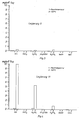
- Figur 1 ein Diagramm der Korrosionsbeständigkeit der Legierung 1, nach dem Stand der Technik, in verschiedenen korrosiven Medien, bei unterschiedlichen Temperaturen
- Figur 2 ein Diagramm der Korrosionsbeständigkeit der Legierung 6, nach dem Stand der Technik, in verschiedenen korrosiven Medien, bei unterschiedlichen Temperaturen
- Figur 3 ein Diagramm der Korrosionsbeständigkeit der erfindungsgemäßen Legierung 8 in verschiedenen korrosiven Medien, bei unterschiedlichen Temperaturen
- Figur 4 ein Diagramm der Korrosionsbeständigkeit der erfindungsgemäßen Legierung 11 in verschiedenen korrosiven Medien, bei unterschiedlichen Temperaturen
- Figur 5 ein Diagramm der Korrosionsbeständigkeit der erfindungsgemäßen Legierung 12 in verschiedenen korrosiven Medien, bei unterschiedlichen Temperaturen
- Figur 6 ein Diagramm der Korrosionsbeständigkeit der erfindungsgemäßen Legierungen 8 und 10 in verdünnter Salzsäure (6N) bei 100°C, im Vergleich mit der Korrosionsbeständigkeit einer Legierung mit derselben Binderzusammensetzung, jedoch mit einem wesentlich geringeren Zusatzkarbidgehalt als bei den erfindungsgemäßen Legierungen
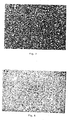
- Figur 7 eine Mikrofotografie des Gefüges der Legierung 1 nach dem Stand der Technik in 1500-facher lichtmikroskopischer Vergrößerung
- Figur 8 eine Mikrofotografie des Gefüges der Legierung 1 nach dem Stand der Technik in 1500-facher rasterelektronenmikroskopischer Vergrößerung
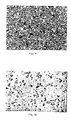
- Figur 9 eine Mikrofotografie des Gefüges der erfindungsgemäßen Legierung 8 in 1500-facher lichtmikroskopischer Vergrößerung
- Figur 10 eine Mikrofotografie des Gefüges der erfindungsgemäßen Legierung 8 in 1500-facher rasterelektronenmikroskopischer Vergrößerung
- Der Vergleich der Legierungen mit einem niedrigen Gesamtanteil der Bindephase von 3 % (bekannte Legierung 1, erfindungsgemäße Legierungen 7, 8, 9, 10,) zeigt durch die Figuren 1 und 3 beispielhaft, daß die Korrosionsfestigkeit der erfindungsgemäßen Legierungen in allen Medien um vieles besser ist, als bei der bekannten Legierung 1. In ihren Werten für Härte und Biegebruchfestigkeit liegen die erfindungsgemäßen Legierungen im Vergleich zur bekannten Legierung zum Großteil ebenfalls höher, wie aus Tabelle 1 zu entnehmen ist.
- Vergleicht man die Legierungen mit hohem Gesamtanteil der Bindephase 6 % und darüber (bekannte Legierungen 2 - 6, erfindungsgemäße Legierungen 11 - 15) zeigt sich durch die Figuren 2, 4 und 5 beispielhaft, daß die Korrosionsfestigkeit der erfindungsgemäßen Legierungen in den meisten korrodierenden Medien etwa vergleichbar der Korrosionsfestigkeit der bekannten Legierungen ist und in speziellen Medien diese sogar bei weitem übertrifft. Wie aus Tabelle 1 zu entnehmen ist, sind die Werte für Härte und Biegebruchfestigkeit bei den erfindungsgemäßen Legierungen überwiegend besser als bei den bekannten Legierungen.
- Durch die Gegenüberstellung der erfindungsgemäßen Legierungen 8 und 10 mit einer Bindephase aus 1 Gew.% Co, 1,5 Gew.% Ni und 0,5 Gew.% Cr mit einer Legierung mit derselben Bindephase, jedoch mit einem Anteil an Zusatzkarbid, der nur 10 Gew.% beträgt, in Figur 6, ist am Beispiel des korrosiven Mediums HCl bei 100°C klar ersichtlich, daß erst ein wesentlich über 10 Gew.% liegender Zusatzkarbidanteil eine sprunghafte Erhöhung der Korrosionsfestigkeit bewirkt, die dann bei weiterer Zunahme des Zusatzkarbidanteils in etwa konstant bleibt.
- Die Vorteile der erfindungsgemäßen Legierung kommen insbesondere bei ihrer Verwendung als Werkstoff für Ventilteile bei Verbrennungskraftmaschinen und für verschleißfeste Teile im Chemieanlagenbau zum Tragen.
- Durch den hohen Zusatzkarbid-Anteil ist die erfindungsgemäße Legierung trotz niedrigen Bindemittelgehaltes mittels bekannter pulvermetallurgischer Verfahren problemlos herstellbar.
- Bei der Herstellung der Pulvermischungen können die Zusatzkarbide sowohl einzeln als auch in Form von Mischkarbid-Kristallen zugegeben werden. Genauso ist es möglich, das Wolframkarbid als Einzelkristall oder als Mischkristall mit einem Zusatzkarbid einzubringen.
- Durch eine spezielle Optimierung des pulvermetallurgischen Herstellungsverfahrens der erfindungsgemäßen Legierung können die vorteilhaften Eigenschaften noch weiter verbessert werden. Wesentlich bei diesem optimierten Herstellverfahren ist es, die Legierung bei möglichst tiefen Temperaturen während möglichst kurzer Zeiten zu sintern, wobei jedoch die Ausbildung einer Flüssigphase bei der Sinterung nicht verhindert werden darf. Die durch diese Art der Sinterung verbleibenden Restporositäten werden dann durch eine heißisostatische Nachverdichtung geschlossen. Durch dieses optimierte Herstellungsverfahren wird einerseits die gewünschte diskontinuierliche Teilung der Bindephase erreicht, anderseits kann dadurch das Kornwachstum der Karbidphase so gering wie möglich gehalten werden, was zu einer weiteren Härtesteigerung der erfindungsgemäßen HartmetallLegierung führt.
- Die Herstellung der erfindungsgemäßen Legierung wird in den folgenden Beispielen näher erläutert, wobei die Endprodukte in diesen Beispielen einzelnen, der in Tabelle 1 aufgeführten Legierungen entsprechen.
- Die Hartmetallegierung 8 wurde folgendermaßen hergestellt:
- Als Hartstoffkomponenten wurden 2 kg TaC-Pulver mit einem C.ges.-Gehalt von 6,22 % und einer Korngröße von 1,5 µm nach FSSS und 2,84 kg WC Pulver mit einer Durchschnittskorngröße von 0,8 µm nach FSSS eingesetzt. Für den Binder wurden 0,025 kg Cr₃C₂, 0,05 kg Co und 0,075 kg Ni verwendet. Die Rußzugabe betrug 0,007 kg.
- Der Ansatz wurde 120 h in einer Kugelmühle in 2,5 l Aceton gemahlen. Nach der Trocknung des Ansatzpulvers wurden Formpreßlinge hergestellt, aus denen diverse Proben für Korrosionstests, Biegebruchfestigkeitstests u.ä. geformt wurden. Diese Proben wurden 40 Minuten bei 1450°C im Vakuum gesintert und anschließend heißisostatisch nachverdichtet.
- Die Hartmetallegierung 10 wurde folgendermaßen hergestellt:
- Als Hartstoffkomponenten wurden 1 kg TaC-Pulver mit einem C.ges.-Gehalt von 6,19 % und einer Korngröße von 1,5 µm nach FSSS und 3,84 kg WC Pulver mit einer Durchschnittskorngröße von 0,8 µm nach FSSS eingesetzt. Für den Binder wurden 0,025 kg Cr₃C₂, 0,05 kg Co und 0,075 kg Ni verwendet. Die Rußzugabe betrug 0,009 kg.
- Der Ansatz wurde 120 h in einer Kugelmühle in 2,5 1 Aceton gemahlen. Nach der Trockung des Ansatzpulvers wurden Formpreßlinge hergestellt, aus denen diverse Proben für Korrosionstests, Biegebruchfestigkeitstests u.ä. geformt wurden. Diese Proben wurden 40 Minuten bei 1490°C im Vakuum gesintert und anschließend heißisostatisch nachverdichtet.
- Die Hartmetallegierung 11 wurde folgendermaßen hergestellt:
- Als Hartstoffkomponenten wurden 2 kg TaC-Pulver mit einem C.ges.-Gehalt von 6,22 % und einer Korngröße von 1,5 µm nach FSSS und 2,49 kg WC Pulver mit einer Durchschnittskorngröße von 0,8 µm nach FSSS eingesetzt. Für den Binder wurden 0,044 kg Cr₃C₂, 0,2 kg Co und 0,2 kg Ni verwendet. Die Rußzugabe betrug 0,006 kg.
- Der Ansatz wurde 120 h in einer Kugelmühle in 2,5 1 Aceton gemahlen. Nach der Trocknung des Ansatzpulvers wurden Formpreßlinge hergestellt, aus denen diverse Proben für Korrosionstests, Biegebruchfestigkeitstests u.ä. geformt wurden. Diese Proben wurden 40 Minuten bei 1500°C im Vakuum gesintert und anschließend heißisostatisch nachverdichtet.
- Die Hartmetallegierung 12 wurde folgendermaßen hergestellt:
- Als Hartstoffkomponenten wurden 2 kg NbC-Pulver mit einem C.ges.-Gehalt von 11,11 % und einer Korngröße von 3,00 µm nach FSSS und 2,49 kg WC Pulver mit einer Durchschnittskorngröße von 0,8 µm nach FSSS eingesetzt. Für den Binder wurden 0,044 kg Cr₃C₂, 0,2 kg Co und 0,2 kg Ni verwendet. Die Rußzugabe betrug 0,045 kg.
- Der Ansatz wurde 120 h in einer Kugelmühle in 2,5 l Aceton gemahlen. Nach der Trockung des Ansatzpulvers wurden Formpreßlinge hergestellt, aus denen diverse Proben für Korrosionstests, Biegebruchfestigkeitstests u.ä. geformt wurden. Diese Proben wurden 30 Minuten bei 1590°C im Vakuum gesintert und anschließend heißisostatisch nachverdichtet.
Claims (3)
Applications Claiming Priority (2)
| Application Number | Priority Date | Filing Date | Title |
|---|---|---|---|
| AT231585A AT385775B (de) | 1985-08-08 | 1985-08-08 | Korrosionsfeste hartmetall-legierung |
| AT2315/85 | 1985-08-08 |
Publications (3)
| Publication Number | Publication Date |
|---|---|
| EP0214679A1 true EP0214679A1 (de) | 1987-03-18 |
| EP0214679B1 EP0214679B1 (de) | 1988-12-21 |
| EP0214679B2 EP0214679B2 (de) | 1993-03-24 |
Family
ID=3532086
Family Applications (1)
| Application Number | Title | Priority Date | Filing Date |
|---|---|---|---|
| EP19860201344 Expired - Lifetime EP0214679B2 (de) | 1985-08-08 | 1986-07-31 | Korrosionsfeste Hartmetall-Legierung |
Country Status (3)
| Country | Link |
|---|---|
| EP (1) | EP0214679B2 (de) |
| AT (1) | AT385775B (de) |
| DE (1) | DE3661483D1 (de) |
Cited By (11)
| Publication number | Priority date | Publication date | Assignee | Title |
|---|---|---|---|---|
| EP0385316A3 (de) * | 1989-03-03 | 1991-04-24 | Valenite Inc. | Korrosionsbeständiges Substrat aus Sinterkarbid |
| WO1992013112A1 (en) * | 1991-01-25 | 1992-08-06 | Sandvik Ab | Corrosion resistant cemented carbide |
| US5925197A (en) * | 1992-01-24 | 1999-07-20 | Sandvik Ab | Hard alloys for tools in the wood industry |
| US6037287A (en) * | 1997-11-26 | 2000-03-14 | Praxair S.T. Technology, Inc. | Laser clad pot roll sleeves and bushings for galvanizing baths |
| US6375707B1 (en) * | 1997-12-22 | 2002-04-23 | Sandvik A.B. | Point ball for ball point pens |
| US6521353B1 (en) | 1999-08-23 | 2003-02-18 | Kennametal Pc Inc. | Low thermal conductivity hard metal |
| DE10135790A1 (de) * | 2001-07-23 | 2003-02-20 | Kennametal Inc | Feinkörniges Sinterhartmetall, Verfahren zu seiner Herstellung und Verwendung |
| US6872234B2 (en) * | 1999-12-24 | 2005-03-29 | Kyocera Corporation | Cutting member |
| WO2014057358A3 (en) * | 2012-10-09 | 2014-06-05 | Sandvik Intellectual Property Ab | Low binder, wear resistant hard metal |
| CN116590586A (zh) * | 2023-04-14 | 2023-08-15 | 深圳市海明润超硬材料股份有限公司 | 一种硬质合金基体、聚晶金刚石复合片及其制备方法 |
| US11821062B2 (en) | 2019-04-29 | 2023-11-21 | Kennametal Inc. | Cemented carbide compositions and applications thereof |
Families Citing this family (3)
| Publication number | Priority date | Publication date | Assignee | Title |
|---|---|---|---|---|
| CN100420762C (zh) * | 2006-04-28 | 2008-09-24 | 自贡硬质合金有限责任公司 | TiC-WC基合金制品 |
| JP7272353B2 (ja) * | 2018-11-01 | 2023-05-12 | 住友電気工業株式会社 | 超硬合金、切削工具および超硬合金の製造方法 |
| GB201820632D0 (en) * | 2018-12-18 | 2019-01-30 | Sandvik Hyperion AB | Cemented carbide for high demand applications |
Citations (4)
| Publication number | Priority date | Publication date | Assignee | Title |
|---|---|---|---|---|
| US2607676A (en) * | 1949-06-01 | 1952-08-19 | Kurtz Jacob | Hard metal compositions |
| US3628921A (en) * | 1969-08-18 | 1971-12-21 | Parker Pen Co | Corrosion resistant binder for tungsten carbide materials and titanium carbide materials |
| WO1980002569A1 (en) * | 1979-05-17 | 1980-11-27 | Sandvik Ab | Cemented carbide |
| EP0121769A1 (de) * | 1983-03-15 | 1984-10-17 | Stellram S.A. | Sinterlegierung auf Karbidbasis sowie Körper aus dieser Legierung |
Family Cites Families (3)
| Publication number | Priority date | Publication date | Assignee | Title |
|---|---|---|---|---|
| US3215510A (en) * | 1963-10-02 | 1965-11-02 | Gen Electric | Alloy |
| US3455682A (en) * | 1967-07-31 | 1969-07-15 | Du Pont | Isostatic hot pressing of refractory bodies |
| SE333437B (de) * | 1969-03-03 | 1971-03-15 | Asea Ab |
-
1985
- 1985-08-08 AT AT231585A patent/AT385775B/de active
-
1986
- 1986-07-31 EP EP19860201344 patent/EP0214679B2/de not_active Expired - Lifetime
- 1986-07-31 DE DE8686201344T patent/DE3661483D1/de not_active Expired
Patent Citations (4)
| Publication number | Priority date | Publication date | Assignee | Title |
|---|---|---|---|---|
| US2607676A (en) * | 1949-06-01 | 1952-08-19 | Kurtz Jacob | Hard metal compositions |
| US3628921A (en) * | 1969-08-18 | 1971-12-21 | Parker Pen Co | Corrosion resistant binder for tungsten carbide materials and titanium carbide materials |
| WO1980002569A1 (en) * | 1979-05-17 | 1980-11-27 | Sandvik Ab | Cemented carbide |
| EP0121769A1 (de) * | 1983-03-15 | 1984-10-17 | Stellram S.A. | Sinterlegierung auf Karbidbasis sowie Körper aus dieser Legierung |
Cited By (15)
| Publication number | Priority date | Publication date | Assignee | Title |
|---|---|---|---|---|
| EP0385316A3 (de) * | 1989-03-03 | 1991-04-24 | Valenite Inc. | Korrosionsbeständiges Substrat aus Sinterkarbid |
| WO1992013112A1 (en) * | 1991-01-25 | 1992-08-06 | Sandvik Ab | Corrosion resistant cemented carbide |
| US6241799B1 (en) | 1991-01-25 | 2001-06-05 | Sandvik Ab | Corrosion resistant cemented carbide |
| US5925197A (en) * | 1992-01-24 | 1999-07-20 | Sandvik Ab | Hard alloys for tools in the wood industry |
| US6037287A (en) * | 1997-11-26 | 2000-03-14 | Praxair S.T. Technology, Inc. | Laser clad pot roll sleeves and bushings for galvanizing baths |
| US6375707B1 (en) * | 1997-12-22 | 2002-04-23 | Sandvik A.B. | Point ball for ball point pens |
| US6521353B1 (en) | 1999-08-23 | 2003-02-18 | Kennametal Pc Inc. | Low thermal conductivity hard metal |
| US6872234B2 (en) * | 1999-12-24 | 2005-03-29 | Kyocera Corporation | Cutting member |
| DE10135790A1 (de) * | 2001-07-23 | 2003-02-20 | Kennametal Inc | Feinkörniges Sinterhartmetall, Verfahren zu seiner Herstellung und Verwendung |
| DE10135790B4 (de) * | 2001-07-23 | 2005-07-14 | Kennametal Inc. | Feinkörniges Sinterhartmetall und seine Verwendung |
| WO2014057358A3 (en) * | 2012-10-09 | 2014-06-05 | Sandvik Intellectual Property Ab | Low binder, wear resistant hard metal |
| US9624417B2 (en) | 2012-10-09 | 2017-04-18 | Sandvik Intellectual Property Ab | Low binder, wear resistant hard metal |
| US11821062B2 (en) | 2019-04-29 | 2023-11-21 | Kennametal Inc. | Cemented carbide compositions and applications thereof |
| US12152294B2 (en) | 2019-04-29 | 2024-11-26 | Kennametal Inc. | Cemented carbide compositions and applications thereof |
| CN116590586A (zh) * | 2023-04-14 | 2023-08-15 | 深圳市海明润超硬材料股份有限公司 | 一种硬质合金基体、聚晶金刚石复合片及其制备方法 |
Also Published As
| Publication number | Publication date |
|---|---|
| EP0214679B2 (de) | 1993-03-24 |
| ATA231585A (de) | 1987-10-15 |
| EP0214679B1 (de) | 1988-12-21 |
| DE3661483D1 (en) | 1989-01-26 |
| AT385775B (de) | 1988-05-10 |
Similar Documents
| Publication | Publication Date | Title |
|---|---|---|
| EP3426813B1 (de) | Zerspanungswerkzeug | |
| EP0689617B1 (de) | Cermet und verfahren zu seiner herstellung | |
| DE3418403C2 (de) | Verfahren zum Herstellen eines Cermets mit hoher Zähigkeit zur Verwendung in Schneidwerkzeugen | |
| DE3884887T2 (de) | Schwermetallegierungen aus Wolfram-Nickel-Eisen-Kobalt mit hoher Härte und Verfahren zur Herstellung dieser Legierungen. | |
| DE68909898T3 (de) | Hochfester, Stickstoff enthaltender Cermet und Verfahren zu seiner Herstellung. | |
| EP0195965B1 (de) | Hartmetall und Verfahren zu seiner Herstellung | |
| DE3785806T2 (de) | Zaehes hartmetall und verfahren zu seiner herstellung. | |
| DE10356470B4 (de) | Zirkonium und Niob enthaltender Hartmetallkörper und Verfahren zu seiner Herstellung und seine Verwendung | |
| DE69818138T2 (de) | Kaltarbeitswerkzeugstahlteilchen mit hoher Schlagfestigkeit aus Metallpulver und Verfahren zu seiner Herstellung | |
| DE69227503T2 (de) | Hartlegierung und deren herstellung | |
| DE69734515T2 (de) | Gesinterte hartlegierung | |
| DE2407410B2 (de) | Karbidhartmetall mit ausscheidungshärtbarer metallischer Matrix | |
| EP0214679B1 (de) | Korrosionsfeste Hartmetall-Legierung | |
| EP0330913B1 (de) | Verfahren zur Herstellung eines gesinterten Hartmetallkörpers und gesinterter Hartmetallkörper | |
| DE19907749A1 (de) | Gesinterter Hartmetallkörper und dessen Verwendung | |
| EP3409801B1 (de) | Pulvermetallurgisch hergestellter, hartstoffpartikel enthaltender verbundwerkstoff, verwendung eines verbundwerkstoffs und verfahren zur herstellung eines bauteils aus einem verbundwerkstoff | |
| DE3884959T2 (de) | Cermet-schneidevorrichtung. | |
| DE68927586T2 (de) | Cermet und dessen Herstellungsverfahren | |
| DE19640788C1 (de) | Beschichtungspulver und Verfahren zu seiner Herstellung | |
| EP3426814B1 (de) | Zerspanungswerkzeug | |
| DE69303998T2 (de) | Gesinterte Karbonitridlegierung und Verfahren zu ihrer Herstellung | |
| DE3784754T2 (de) | Drahtteil aus zementiertem karbid auf der basis von wolframkarbid. | |
| DE3736350C2 (de) | ||
| DE102019110950A1 (de) | Hartmetallzusammensetzungen und deren Anwendungen | |
| EP0425061B1 (de) | Hartmetall auf der Basis von Titankarbonitrid |
Legal Events
| Date | Code | Title | Description |
|---|---|---|---|
| PUAI | Public reference made under article 153(3) epc to a published international application that has entered the european phase |
Free format text: ORIGINAL CODE: 0009012 |
|
| AK | Designated contracting states |
Kind code of ref document: A1 Designated state(s): BE CH DE FR GB IT LI NL SE |
|
| 17P | Request for examination filed |
Effective date: 19870121 |
|
| 17Q | First examination report despatched |
Effective date: 19880601 |
|
| ITF | It: translation for a ep patent filed | ||
| GRAA | (expected) grant |
Free format text: ORIGINAL CODE: 0009210 |
|
| AK | Designated contracting states |
Kind code of ref document: B1 Designated state(s): BE CH DE FR GB IT LI NL SE |
|
| GBT | Gb: translation of ep patent filed (gb section 77(6)(a)/1977) | ||
| REF | Corresponds to: |
Ref document number: 3661483 Country of ref document: DE Date of ref document: 19890126 |
|
| ET | Fr: translation filed | ||
| PLBI | Opposition filed |
Free format text: ORIGINAL CODE: 0009260 |
|
| 26 | Opposition filed |
Opponent name: KRUPP WIDIA GMBH Effective date: 19890721 |
|
| PLBI | Opposition filed |
Free format text: ORIGINAL CODE: 0009260 |
|
| NLR1 | Nl: opposition has been filed with the epo |
Opponent name: KRUPP WIDIA GMBH |
|
| 26 | Opposition filed |
Opponent name: SANDVIK AKTIEBOLAG Effective date: 19890920 Opponent name: KRUPP WIDIA GMBH Effective date: 19890721 |
|
| NLR1 | Nl: opposition has been filed with the epo |
Opponent name: SANDVIK AKTIEBOLAG |
|
| PLAB | Opposition data, opponent's data or that of the opponent's representative modified |
Free format text: ORIGINAL CODE: 0009299OPPO |
|
| R26 | Opposition filed (corrected) |
Opponent name: KRUPP WIDIA GMBH * 890920 SANDVIK AKTIEBOLAG Effective date: 19890721 |
|
| PGFP | Annual fee paid to national office [announced via postgrant information from national office to epo] |
Ref country code: GB Payment date: 19920507 Year of fee payment: 7 |
|
| PGFP | Annual fee paid to national office [announced via postgrant information from national office to epo] |
Ref country code: DE Payment date: 19920615 Year of fee payment: 7 Ref country code: BE Payment date: 19920615 Year of fee payment: 7 |
|
| PGFP | Annual fee paid to national office [announced via postgrant information from national office to epo] |
Ref country code: CH Payment date: 19920616 Year of fee payment: 7 |
|
| PGFP | Annual fee paid to national office [announced via postgrant information from national office to epo] |
Ref country code: FR Payment date: 19920619 Year of fee payment: 7 |
|
| PGFP | Annual fee paid to national office [announced via postgrant information from national office to epo] |
Ref country code: SE Payment date: 19920623 Year of fee payment: 7 |
|
| ITTA | It: last paid annual fee | ||
| PGFP | Annual fee paid to national office [announced via postgrant information from national office to epo] |
Ref country code: NL Payment date: 19920731 Year of fee payment: 7 |
|
| ITF | It: translation for a ep patent filed | ||
| PUAH | Patent maintained in amended form |
Free format text: ORIGINAL CODE: 0009272 |
|
| STAA | Information on the status of an ep patent application or granted ep patent |
Free format text: STATUS: PATENT MAINTAINED AS AMENDED |
|
| 27A | Patent maintained in amended form |
Effective date: 19930324 |
|
| AK | Designated contracting states |
Kind code of ref document: B2 Designated state(s): BE CH DE FR GB IT LI NL SE |
|
| GBTA | Gb: translation of amended ep patent filed (gb section 77(6)(b)/1977) |
Effective date: 19930303 |
|
| REG | Reference to a national code |
Ref country code: CH Ref legal event code: AEN |
|
| NLR2 | Nl: decision of opposition | ||
| ET3 | Fr: translation filed ** decision concerning opposition | ||
| PG25 | Lapsed in a contracting state [announced via postgrant information from national office to epo] |
Ref country code: LI Effective date: 19930731 Ref country code: GB Effective date: 19930731 Ref country code: CH Effective date: 19930731 Ref country code: BE Effective date: 19930731 |
|
| PG25 | Lapsed in a contracting state [announced via postgrant information from national office to epo] |
Ref country code: SE Effective date: 19930801 |
|
| NLR4 | Nl: receipt of corrected translation in the netherlands language at the initiative of the proprietor of the patent | ||
| BERE | Be: lapsed |
Owner name: METALLWERK PLANSEE G.M.B.H. Effective date: 19930731 |
|
| PG25 | Lapsed in a contracting state [announced via postgrant information from national office to epo] |
Ref country code: NL Free format text: LAPSE BECAUSE OF NON-PAYMENT OF DUE FEES Effective date: 19940201 |
|
| GBPC | Gb: european patent ceased through non-payment of renewal fee |
Effective date: 19930731 |
|
| PG25 | Lapsed in a contracting state [announced via postgrant information from national office to epo] |
Ref country code: FR Effective date: 19940331 |
|
| REG | Reference to a national code |
Ref country code: CH Ref legal event code: PL |
|
| PG25 | Lapsed in a contracting state [announced via postgrant information from national office to epo] |
Ref country code: DE Effective date: 19940401 |
|
| ZE | Nl: corrections to earlier entries in headings pe - xe |
Free format text: PAT.BUL.15/93 HEADING RE, SECTION 3, PAGE 2307;SHOULD BE ADDED PAT.BUL.15/93 HEADING RE SECTION 4, PAGE 2307;SHOULD BE DELETED |
|
| NLV4 | Nl: lapsed or anulled due to non-payment of the annual fee | ||
| REG | Reference to a national code |
Ref country code: FR Ref legal event code: ST |
|
| EUG | Se: european patent has lapsed |
Ref document number: 86201344.8 Effective date: 19940310 |
|
| PG25 | Lapsed in a contracting state [announced via postgrant information from national office to epo] |
Ref country code: IT Free format text: LAPSE BECAUSE OF NON-PAYMENT OF DUE FEES;WARNING: LAPSES OF ITALIAN PATENTS WITH EFFECTIVE DATE BEFORE 2007 MAY HAVE OCCURRED AT ANY TIME BEFORE 2007. THE CORRECT EFFECTIVE DATE MAY BE DIFFERENT FROM THE ONE RECORDED. Effective date: 20050731 |