EP0214034B1 - Verfahren zur Herstellung eines faserverstärkten gesinterten Keramikwerkstoffs - Google Patents
Verfahren zur Herstellung eines faserverstärkten gesinterten Keramikwerkstoffs Download PDFInfo
- Publication number
- EP0214034B1 EP0214034B1 EP86401793A EP86401793A EP0214034B1 EP 0214034 B1 EP0214034 B1 EP 0214034B1 EP 86401793 A EP86401793 A EP 86401793A EP 86401793 A EP86401793 A EP 86401793A EP 0214034 B1 EP0214034 B1 EP 0214034B1
- Authority
- EP
- European Patent Office
- Prior art keywords
- powder
- reinforcing fibres
- diameter
- equal
- reinforcing
- Prior art date
- Legal status (The legal status is an assumption and is not a legal conclusion. Google has not performed a legal analysis and makes no representation as to the accuracy of the status listed.)
- Expired
Links
- 238000004519 manufacturing process Methods 0.000 title claims abstract description 4
- 239000000919 ceramic Substances 0.000 title description 12
- 239000000843 powder Substances 0.000 claims abstract description 40
- 230000003014 reinforcing effect Effects 0.000 claims abstract description 35
- 229910010293 ceramic material Inorganic materials 0.000 claims abstract description 33
- 238000005245 sintering Methods 0.000 claims abstract description 21
- 239000002245 particle Substances 0.000 claims abstract description 19
- 239000000203 mixture Substances 0.000 claims abstract description 15
- HBMJWWWQQXIZIP-UHFFFAOYSA-N silicon carbide Chemical compound [Si+]#[C-] HBMJWWWQQXIZIP-UHFFFAOYSA-N 0.000 claims abstract description 15
- 229910010271 silicon carbide Inorganic materials 0.000 claims abstract description 14
- 229910052581 Si3N4 Inorganic materials 0.000 claims abstract description 9
- HQVNEWCFYHHQES-UHFFFAOYSA-N silicon nitride Chemical compound N12[Si]34N5[Si]62N3[Si]51N64 HQVNEWCFYHHQES-UHFFFAOYSA-N 0.000 claims abstract description 9
- IJGRMHOSHXDMSA-UHFFFAOYSA-N Atomic nitrogen Chemical compound N#N IJGRMHOSHXDMSA-UHFFFAOYSA-N 0.000 claims abstract description 8
- XUIMIQQOPSSXEZ-UHFFFAOYSA-N Silicon Chemical compound [Si] XUIMIQQOPSSXEZ-UHFFFAOYSA-N 0.000 claims abstract description 6
- QVGXLLKOCUKJST-UHFFFAOYSA-N atomic oxygen Chemical compound [O] QVGXLLKOCUKJST-UHFFFAOYSA-N 0.000 claims abstract description 5
- 238000002156 mixing Methods 0.000 claims abstract description 5
- 229910052760 oxygen Inorganic materials 0.000 claims abstract description 5
- 239000001301 oxygen Substances 0.000 claims abstract description 5
- 239000006104 solid solution Substances 0.000 claims abstract description 5
- 229910052782 aluminium Inorganic materials 0.000 claims abstract description 4
- XAGFODPZIPBFFR-UHFFFAOYSA-N aluminium Chemical compound [Al] XAGFODPZIPBFFR-UHFFFAOYSA-N 0.000 claims abstract description 4
- 229910052757 nitrogen Inorganic materials 0.000 claims abstract description 4
- 229910052710 silicon Inorganic materials 0.000 claims abstract description 4
- 239000010703 silicon Substances 0.000 claims abstract description 4
- 238000000034 method Methods 0.000 claims description 13
- 239000002671 adjuvant Substances 0.000 claims description 9
- 239000002131 composite material Substances 0.000 description 20
- 239000000835 fiber Substances 0.000 description 18
- 230000035939 shock Effects 0.000 description 9
- 239000000463 material Substances 0.000 description 7
- 239000011159 matrix material Substances 0.000 description 7
- 235000013339 cereals Nutrition 0.000 description 6
- 230000000052 comparative effect Effects 0.000 description 6
- 238000000280 densification Methods 0.000 description 6
- 239000012783 reinforcing fiber Substances 0.000 description 6
- 239000007787 solid Substances 0.000 description 6
- 239000004033 plastic Substances 0.000 description 5
- 230000008569 process Effects 0.000 description 5
- 239000000126 substance Substances 0.000 description 5
- 238000005452 bending Methods 0.000 description 4
- 230000003993 interaction Effects 0.000 description 4
- 238000013001 point bending Methods 0.000 description 4
- 239000000654 additive Substances 0.000 description 3
- PNEYBMLMFCGWSK-UHFFFAOYSA-N aluminium oxide Inorganic materials [O-2].[O-2].[O-2].[Al+3].[Al+3] PNEYBMLMFCGWSK-UHFFFAOYSA-N 0.000 description 3
- 239000012298 atmosphere Substances 0.000 description 3
- 230000006835 compression Effects 0.000 description 3
- 238000007906 compression Methods 0.000 description 3
- 239000006185 dispersion Substances 0.000 description 3
- 230000001590 oxidative effect Effects 0.000 description 3
- OKTJSMMVPCPJKN-UHFFFAOYSA-N Carbon Chemical compound [C] OKTJSMMVPCPJKN-UHFFFAOYSA-N 0.000 description 2
- 240000008042 Zea mays Species 0.000 description 2
- 230000009471 action Effects 0.000 description 2
- 230000008901 benefit Effects 0.000 description 2
- 239000012065 filter cake Substances 0.000 description 2
- 229910002804 graphite Inorganic materials 0.000 description 2
- 239000010439 graphite Substances 0.000 description 2
- 238000010438 heat treatment Methods 0.000 description 2
- 238000005259 measurement Methods 0.000 description 2
- 230000003647 oxidation Effects 0.000 description 2
- 238000007254 oxidation reaction Methods 0.000 description 2
- 238000004663 powder metallurgy Methods 0.000 description 2
- 238000010791 quenching Methods 0.000 description 2
- 230000000171 quenching effect Effects 0.000 description 2
- 230000009467 reduction Effects 0.000 description 2
- 230000000284 resting effect Effects 0.000 description 2
- 238000010583 slow cooling Methods 0.000 description 2
- 230000003685 thermal hair damage Effects 0.000 description 2
- 238000002604 ultrasonography Methods 0.000 description 2
- XLYOFNOQVPJJNP-UHFFFAOYSA-N water Substances O XLYOFNOQVPJJNP-UHFFFAOYSA-N 0.000 description 2
- 229910018072 Al 2 O 3 Inorganic materials 0.000 description 1
- LFQSCWFLJHTTHZ-UHFFFAOYSA-N Ethanol Chemical compound CCO LFQSCWFLJHTTHZ-UHFFFAOYSA-N 0.000 description 1
- 208000035126 Facies Diseases 0.000 description 1
- 229910000831 Steel Inorganic materials 0.000 description 1
- 238000002089 carbo-reduction Methods 0.000 description 1
- 229910052799 carbon Inorganic materials 0.000 description 1
- 238000005256 carbonitriding Methods 0.000 description 1
- 230000008859 change Effects 0.000 description 1
- 238000006243 chemical reaction Methods 0.000 description 1
- 238000004320 controlled atmosphere Methods 0.000 description 1
- 238000001816 cooling Methods 0.000 description 1
- 238000005336 cracking Methods 0.000 description 1
- 239000013078 crystal Substances 0.000 description 1
- 238000005520 cutting process Methods 0.000 description 1
- 230000006378 damage Effects 0.000 description 1
- 229910003460 diamond Inorganic materials 0.000 description 1
- 239000010432 diamond Substances 0.000 description 1
- 239000002270 dispersing agent Substances 0.000 description 1
- 238000006073 displacement reaction Methods 0.000 description 1
- 238000005553 drilling Methods 0.000 description 1
- 238000005516 engineering process Methods 0.000 description 1
- 230000002349 favourable effect Effects 0.000 description 1
- 238000001033 granulometry Methods 0.000 description 1
- 238000000227 grinding Methods 0.000 description 1
- 238000000265 homogenisation Methods 0.000 description 1
- 238000010348 incorporation Methods 0.000 description 1
- 230000006698 induction Effects 0.000 description 1
- NLYAJNPCOHFWQQ-UHFFFAOYSA-N kaolin Chemical compound O.O.O=[Al]O[Si](=O)O[Si](=O)O[Al]=O NLYAJNPCOHFWQQ-UHFFFAOYSA-N 0.000 description 1
- 229910052622 kaolinite Inorganic materials 0.000 description 1
- -1 lightness Chemical class 0.000 description 1
- 239000007788 liquid Substances 0.000 description 1
- 230000007246 mechanism Effects 0.000 description 1
- 229910052751 metal Inorganic materials 0.000 description 1
- 239000002184 metal Substances 0.000 description 1
- 150000002739 metals Chemical class 0.000 description 1
- 150000004767 nitrides Chemical class 0.000 description 1
- 239000012299 nitrogen atmosphere Substances 0.000 description 1
- 239000008188 pellet Substances 0.000 description 1
- 230000000704 physical effect Effects 0.000 description 1
- 239000002798 polar solvent Substances 0.000 description 1
- 235000021395 porridge Nutrition 0.000 description 1
- 238000002360 preparation method Methods 0.000 description 1
- 239000003380 propellant Substances 0.000 description 1
- 229910001404 rare earth metal oxide Inorganic materials 0.000 description 1
- 239000002994 raw material Substances 0.000 description 1
- 239000003870 refractory metal Substances 0.000 description 1
- 239000011226 reinforced ceramic Substances 0.000 description 1
- 230000010076 replication Effects 0.000 description 1
- 229920005989 resin Polymers 0.000 description 1
- 239000011347 resin Substances 0.000 description 1
- 230000000717 retained effect Effects 0.000 description 1
- 230000035945 sensitivity Effects 0.000 description 1
- 239000002002 slurry Substances 0.000 description 1
- 239000010959 steel Substances 0.000 description 1
- 238000006467 substitution reaction Methods 0.000 description 1
- 230000000930 thermomechanical effect Effects 0.000 description 1
- 229920005992 thermoplastic resin Polymers 0.000 description 1
- 229920001187 thermosetting polymer Polymers 0.000 description 1
- 230000003313 weakening effect Effects 0.000 description 1
Images

Classifications
-
- C—CHEMISTRY; METALLURGY
- C04—CEMENTS; CONCRETE; ARTIFICIAL STONE; CERAMICS; REFRACTORIES
- C04B—LIME, MAGNESIA; SLAG; CEMENTS; COMPOSITIONS THEREOF, e.g. MORTARS, CONCRETE OR LIKE BUILDING MATERIALS; ARTIFICIAL STONE; CERAMICS; REFRACTORIES; TREATMENT OF NATURAL STONE
- C04B35/00—Shaped ceramic products characterised by their composition; Ceramics compositions; Processing powders of inorganic compounds preparatory to the manufacturing of ceramic products
- C04B35/515—Shaped ceramic products characterised by their composition; Ceramics compositions; Processing powders of inorganic compounds preparatory to the manufacturing of ceramic products based on non-oxide ceramics
- C04B35/58—Shaped ceramic products characterised by their composition; Ceramics compositions; Processing powders of inorganic compounds preparatory to the manufacturing of ceramic products based on non-oxide ceramics based on borides, nitrides, i.e. nitrides, oxynitrides, carbonitrides or oxycarbonitrides or silicides
- C04B35/597—Shaped ceramic products characterised by their composition; Ceramics compositions; Processing powders of inorganic compounds preparatory to the manufacturing of ceramic products based on non-oxide ceramics based on borides, nitrides, i.e. nitrides, oxynitrides, carbonitrides or oxycarbonitrides or silicides based on silicon oxynitride, e.g. SIALONS
-
- C—CHEMISTRY; METALLURGY
- C04—CEMENTS; CONCRETE; ARTIFICIAL STONE; CERAMICS; REFRACTORIES
- C04B—LIME, MAGNESIA; SLAG; CEMENTS; COMPOSITIONS THEREOF, e.g. MORTARS, CONCRETE OR LIKE BUILDING MATERIALS; ARTIFICIAL STONE; CERAMICS; REFRACTORIES; TREATMENT OF NATURAL STONE
- C04B35/00—Shaped ceramic products characterised by their composition; Ceramics compositions; Processing powders of inorganic compounds preparatory to the manufacturing of ceramic products
- C04B35/71—Ceramic products containing macroscopic reinforcing agents
- C04B35/78—Ceramic products containing macroscopic reinforcing agents containing non-metallic materials
- C04B35/80—Fibres, filaments, whiskers, platelets, or the like
Definitions
- the present invention relates to a method for obtaining a ceramic material by sintering under load of a powder incorporating reinforcing filaments.
- thermomechanical ceramic materials have many advantages over metals, such as lightness, high mechanical resistance at high temperature, chemical inertia and good behavior against friction and wear. Conversely, solid or monolithic ceramics have the drawbacks of being not very ductile and of having a low resistance to thermal shock and to mechanical shock. Furthermore, it is known that the mechanical properties of such ceramic materials are directly a function of the density of the latter.
- the object of the present invention is to remedy these drawbacks and to produce a composite ceramic / sintered ceramic that is not very fragile, having a high resistance to thermal shock and to mechanical shock.
- the process for obtaining a ceramic material by sintering under load of a powder incorporating reinforcing filaments is characterized in that said reinforcing filaments have a length at most equal to 3000 ⁇ m and a diameter at most equal to 15 ⁇ m, in that the particle size of said powder is micronic or submicronic as a direct function of the diameter of said reinforcing filaments, and in that said mixture is sintered at a temperature between 1500 ° C and 1650 ° C and under a pressure of the order of 40 MPa.
- the solid solution (matrix) based on silicon, aluminum, oxygen and nitrogen is, in the art, generally designated by the term "Sialon".
- Sialon is one of those meeting the general formula where x is less than or equal to 4.2.
- said reinforcing filaments can be either silicon carbide fibers having a length of between approximately 100 and 3000 ⁇ m and a diameter of the order of 10 ⁇ m, or whiskers of carbide or silicon nitride, optionally single crystal - linens (generally designated by the term “whiskers” in the art), having a length of between approximately 10 and 300 l im, and a diameter of the order of 0.1 and 0.5 ⁇ m.
- the proportion by weight of reinforcing filaments is at most equal to 40%.
- document US-A-4 507 224 describes a ceramic material containing reinforcing filaments having a length of 50 to 500 ⁇ m and a diameter of 0.1 to 5 ⁇ m, the particle size of the powder being between 0, 5 and 2 ⁇ m.
- Such a Sialon powder can be prepared by reacting mixtures of oxides and nitrides under a controlled atmosphere in a temperature range from 1600 ° C. to 1800 ° C. It can also be obtained from natural raw materials (kaolinite, pyrophillite) by carboreduction under a nitrogen atmosphere. For cost reasons, it is advantageous to use a Sialon produced by carbonitriding, at about 1450 ° C., of clay-alumina mixtures. This last Sialon has a density of 3.27 g / cm 3 and its formula is:
- the Sialon powder used is subjected to grinding and the particle size is adjusted so that, at least approximately and on average, the grains of said powder have dimensions of the order of the diameter of the reinforcing filaments used.
- the mean particle size of the Sialon powder is adjusted to a value close to 10 ⁇ m.
- whiskers of silicon carbide or silicon nitride having a diameter of approximately 0.1 to 0.5 ⁇ m, the particle size of the Sialon powder at a value of a few tenths of a micron.
- These silicon carbide fibers have, for example, a length of between 100 and 3000 ⁇ m, while that of the whiskers can vary from 10 to 300 ⁇ m.
- the reinforcing filaments are added (in a maximum proportion of 40% by weight) to the Sialon powder of corresponding particle size and to densification additives , such as Ca O, A I 2 0 3 , MgO, Y 2 0 3 , Zr0 2 or rare earth oxides.
- densification additives such as Ca O, A I 2 0 3 , MgO, Y 2 0 3 , Zr0 2 or rare earth oxides.
- a proportion by weight of densification additives is used at most equal to 10%, and preferably of the order of 7%.
- various known techniques can be used, such as powder metallurgy and / or the use of thermoplastic resins and thermosetting resins.
- the Sialon powder, the densification aids and the reinforcing filaments are mixed in a polar solvent, such as water or an alcohol, and containing one or more dispersing agents, using a mechanical disperser. rotating at high speed.
- a polar solvent such as water or an alcohol
- disperser brand "ULTRA-TURAX” The high speed of rotation (15000 revolutions per minute) of this disperser creates very important turbulences, which make the agglomerates of filaments and grains of powder disappear.
- the porridge thus obtained can then be treated by ultrasound to perfect its homogenization, then be vigorously stirred again using the mechanical disperser.
- the slurry is then filtered under vacuum, then dried, to remove the liquids therefrom and provide filter cakes intended to be sintered under load.
- these filter cakes are precompacted, for example by ultrasound, before sintering.
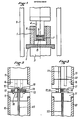
- FIG. 1 To carry out such a sintering, the apparatus shown in FIG. 1 is used for example.
- This apparatus essentially comprises a mold 1 resting on a support 2, for example itself supported by a hydropneumatic counter-piston 3, crossed by a piston hydropneumatic 4 capable of cooperating with said counter-piston 3 and surrounded by an electric induction heating device 5.
- the mold 1 has an inner liner of graphite 6 and the sintering cake 7 is placed inside said liner.
- the pressure of the piston 4 and of the counter-piston 3 is applied to the cake 7 by means of graphite pellets 8 and 9.
- This machine has a fixed lower part consisting of an alumina tube 10 resting on a force measurement cell (not shown) and a steel plate 11 supported by said tube 10.
- a plate 11 In the plate 11 are provided two parallel V-shaped grooves serving as partial housing for cylinders 12 and 13, serving as lower transverse supports for a test tube 14.
- the machine also comprises a movable upper part, intended to transmit the load and consisting of a tube alumina 15 and a compression plate 16.
- the movable part 15, 16. is driven by a mechanism not shown.
- the compression plate 16 has a V-shaped groove capable of serving as a partial housing for a cylinder 17, parallel to the cylinders 12 and 13 and disposed halfway between them.
- the cylinder 17 can press transversely the test piece 14, by the upper face of the latter.
- Two columns 18 and 19 serve to guide the relative sliding of the movable part relative to the fixed part.
- Two displacement sensors 20 and 21, of the same sensitivity and mounted in opposition, bear on each of the plates 11 and 16 and make it possible to record the deformation of the test piece 14 under compression, independently of the deformations of the seems 10 - 13, 15 - 17.
- a thermocouple 22 makes it possible to regulate the temperature of the test piece 14.
- Test pieces 14 of monolithic ceramic material based on micron particle size Sialon powder are subjected for 24 hours to an oxidizing atmosphere, respectively at temperatures of 950 ° C, 1000 ° C and 1100 ° C. After slow cooling, these test pieces are tested, at room temperature, in three-point bending using the machine of FIGS. 2 and 3 (speed of application of the load equal to 0.08 mm per minute).
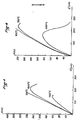
- the curves representative of the deformation d (in ⁇ m) of the test pieces are plotted as a function of the force P (in Newton) which is applied to them (see FIG. 4).
- test pieces 14 of composite material according to the invention are subjected to an oxidizing atmosphere for 24 hours, respectively at temperatures of 900 ° C, 925 ° C, 950 ° C and 1000 ° C. After slow cooling, these test pieces are tested in three-point bending in an identical manner to what has been described above for the monolithic ceramic material. The results are given by the curves of FIG. 5.
- the composite material of the invention exhibits the same behavior as the monolithic ceramic material. Beyond 900 ° C, a plastic deformation domain appears, the extent of which increases significantly with temperature. Thus, even after oxidation at high temperature, the composite material according to the invention, tested at room temperature, has a mechanical resistance varying according to its degree of damage. If one observes, for example with a scanning electron microscope, the fracture facies of a test piece of material according to the invention, it can be seen that the fracture surface is very tormented. The break is accompanied by numerous loosening of the fibers, which considerably slows down the rate of cracking. It can be deduced therefrom that the fibers do not constitute a privileged access route for oxygen and therefore of weakening of the mechanical resistance, and that the overall reaction is governed by the oxidation of the matrix.
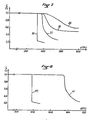
- test pieces 14 of composite material according to the invention are subjected, for 24 hours, respectively to temperatures of 900 ° C, 950 ° C and 1000 ° C in an oxidizing atmosphere. These test pieces undergo three-point bending tests identical to those described above and the results of which are illustrated by the curves in FIG. 6.
- test pieces 14 previously brought to a temperature T are immersed in water at 20 ° C.
- the measurement of the load at break in bending C, measured by the machine of FIGS. 2 and 3, of a test piece 14 thermally shocked allows you to know how to bear without being damaged.
- Figures 7 and 8 show the variation in the ratio of the load at break after quenching C to the load at break Co in the absence of quenching, as a function of this temperature difference AT.
- curve 30 illustrates, the behavior of a solid ceramic material (without reinforcing filaments) obtained from a powder with micron particle size
- curves 31, 32, 33 relate to corresponding composite ceramic materials according to the invention, respectively for weight contents of silicon carbide fibers of 10%, 30% and 40%.
- Curve 40 of FIG. 8 relates to a solid ceramic material obtained from a powder of submicron particle size, curve 41 of this same figure illustrating a corresponding composite ceramic material of the invention, incorporating a weight proportion of 30% of silicon carbide whiskers.
- ceramic / ceramic composite materials with random fibers are obtained having improved mechanical characteristics compared to monolithic materials of the same nature.
- the materials according to the invention have a high temperature plastic range and good resistance to thermal shock.
- the process according to the invention makes it possible to obtain homogeneous materials and of controlled microstructure.
- the ratio between the size of the grains of the matrix and that of the fibers being variable, the invention makes it possible to prepare parts of adjustable density according to the ap planned replication.
- the ceramic materials according to the invention are particularly suitable for being used in substitution for refractory metals, for example for the production of engine parts (diesel, turbomachines, propellants, etc.), of armorages against projectiles. , friction parts, cutting and drilling tools, etc.
Landscapes
- Chemical & Material Sciences (AREA)
- Engineering & Computer Science (AREA)
- Ceramic Engineering (AREA)
- Manufacturing & Machinery (AREA)
- Materials Engineering (AREA)
- Structural Engineering (AREA)
- Organic Chemistry (AREA)
- Chemical Kinetics & Catalysis (AREA)
- Ceramic Products (AREA)
- Manufacture Of Alloys Or Alloy Compounds (AREA)
Claims (7)

Priority Applications (1)
| Application Number | Priority Date | Filing Date | Title |
|---|---|---|---|
| AT86401793T ATE47587T1 (de) | 1985-08-19 | 1986-08-11 | Verfahren zur herstellung eines faserverstaerkten gesinterten keramikwerkstoffs. |
Applications Claiming Priority (2)
| Application Number | Priority Date | Filing Date | Title |
|---|---|---|---|
| FR8512503A FR2586246B1 (fr) | 1985-08-19 | 1985-08-19 | Matiere ceramique frittee a filaments de renforcement et procede pour la fabrication d'une telle matiere |
| FR8512503 | 1985-08-19 |
Publications (2)
| Publication Number | Publication Date |
|---|---|
| EP0214034A1 EP0214034A1 (de) | 1987-03-11 |
| EP0214034B1 true EP0214034B1 (de) | 1989-10-25 |
Family
ID=9322291
Family Applications (1)
| Application Number | Title | Priority Date | Filing Date |
|---|---|---|---|
| EP86401793A Expired EP0214034B1 (de) | 1985-08-19 | 1986-08-11 | Verfahren zur Herstellung eines faserverstärkten gesinterten Keramikwerkstoffs |
Country Status (5)
| Country | Link |
|---|---|
| EP (1) | EP0214034B1 (de) |
| AT (1) | ATE47587T1 (de) |
| DE (1) | DE3666581D1 (de) |
| ES (1) | ES2001898A6 (de) |
| FR (1) | FR2586246B1 (de) |
Families Citing this family (4)
| Publication number | Priority date | Publication date | Assignee | Title |
|---|---|---|---|---|
| FR2610921B1 (fr) * | 1987-02-16 | 1991-10-04 | Aerospatiale | Matiere ceramique composite a filaments de renforcement, et procede pour la fabrication d'une telle matiere |
| JPH0745350B2 (ja) * | 1987-12-01 | 1995-05-17 | 日本特殊陶業株式会社 | 繊維強化セラミックス |
| FR2692633B1 (fr) * | 1992-06-17 | 1995-08-25 | Aerospatiale | Visserie en materiau composite constitue d'une matrice ceramique renforcee de fibres refractaires. |
| US9878809B2 (en) | 2015-06-12 | 2018-01-30 | The Boeing Company | Stand-off panel thermal protection system and method of fabricating the same |
Family Cites Families (6)
| Publication number | Priority date | Publication date | Assignee | Title |
|---|---|---|---|---|
| FR2462405A1 (fr) * | 1979-08-03 | 1981-02-13 | Produits Refractaires | Procede de preparation de sialons |
| US4463058A (en) * | 1981-06-16 | 1984-07-31 | Atlantic Richfield Company | Silicon carbide whisker composites |
| JPS5954677A (ja) * | 1982-09-21 | 1984-03-29 | タテホ化学工業株式会社 | α−サイアロン焼結体の改良 |
| US4507224A (en) * | 1982-12-03 | 1985-03-26 | Agency Of Industrial Science & Technology | Ceramics containing fibers of silicon carbide |
| JPS605079A (ja) * | 1983-06-23 | 1985-01-11 | 三菱マテリアル株式会社 | サイアロン基セラミツクスの製造法 |
| SE451581B (sv) * | 1984-04-06 | 1987-10-19 | Sandvik Ab | Keramiskt material huvudsakligen baserat pa kiselnitrid, aluminiumnitrid och aluminiumoxid |
-
1985
- 1985-08-19 FR FR8512503A patent/FR2586246B1/fr not_active Expired - Fee Related
-
1986
- 1986-07-30 ES ES8601423A patent/ES2001898A6/es not_active Expired
- 1986-08-11 DE DE8686401793T patent/DE3666581D1/de not_active Expired
- 1986-08-11 EP EP86401793A patent/EP0214034B1/de not_active Expired
- 1986-08-11 AT AT86401793T patent/ATE47587T1/de not_active IP Right Cessation
Also Published As
| Publication number | Publication date |
|---|---|
| EP0214034A1 (de) | 1987-03-11 |
| ATE47587T1 (de) | 1989-11-15 |
| FR2586246B1 (fr) | 1991-04-05 |
| ES2001898A6 (es) | 1988-07-01 |
| FR2586246A1 (fr) | 1987-02-20 |
| DE3666581D1 (en) | 1989-11-30 |
Similar Documents
| Publication | Publication Date | Title |
|---|---|---|
| FR2475534A1 (fr) | Structure composite a matiere ceramique renforcee de fibres de carbure de silicium | |
| FR2458510A1 (fr) | Procede et appareil de fabrication de nitrure de bore cubique a partir de nitrure de bore hexagonal et produits obtenus | |
| FR2544711A1 (fr) | Plaquette de coupe pour travail par enlevement de copeaux et son procede de fabrication | |
| EP0214034B1 (de) | Verfahren zur Herstellung eines faserverstärkten gesinterten Keramikwerkstoffs | |
| EP1343600B1 (de) | Herstellungsverfahren für dünne bänder aus metall/keramik-kompositmaterial | |
| EP0651067B1 (de) | Keramik-Metallverbundkörper mit hoher Zähigkeit sowie Verfahren seiner Herstellung | |
| FR2646663A1 (fr) | Nitrure de bore amorphe ou turbostratique a morphologie spherique et son procede de preparation | |
| Mitra et al. | Processing—microstructure—property relationships in reaction hot-pressed MoSi2 and MoSi2/SiCp composites | |
| WO2006010823A1 (fr) | Melange de grains d'alumine-zircone fondus | |
| FR2610922A2 (fr) | Application ou utilisation d'un procede de preparation de materiaux composites a elements de renforcement orientes, a la fabrication de ceramiques composites, et les ceramiques composites ainsi obtenues | |
| EP2321236A1 (de) | Verfahren für die herstellung eines siliciumcarbidelements ohne sinterzusätze | |
| WO1996022829A1 (fr) | Support poreux inorganique pour membrane de filtration et procede de fabrication | |
| FR2682674A1 (fr) | Materiau composite a matrice vitro-ceramique ou ceramique obtenue par la voie sol-gel et renforcee par des fibres de type carbure de sicilium, sa fabrication et ses applications. | |
| EP0282376B1 (de) | Faserverstärkter Keramikverbundwerkstoff und Verfahren zu seiner Herstellung | |
| WO2013160581A1 (fr) | Produit en carbure de silicium dense | |
| EP2451884A1 (de) | Suspension aus schleifkörnern | |
| FR2499102A1 (fr) | Nouvelles compositions dures, melanges precurseurs et procedes pour leur preparation | |
| EP0107571B1 (de) | Keramischer Werkstoff auf der Basis von Aluminiumoxid und Verfahren zu seiner Herstellung | |
| FR2684684A1 (fr) | Pieces denses autolubrifiantes en fluorures de terres rares frittes et leur procede d'obtention. | |
| WO2019175501A1 (fr) | Composite a matrice ceramique oxyde/oxyde | |
| EP0424220A1 (de) | Oxynitrid-Glaszusammensetzungen, ihre Vorläufer und ihre Verwendung zur Herstellung von Glaskeramikzusammensetzungen und von Verbundwerkstoffen | |
| FR2637890A1 (fr) | Materiau composite a matrice zircone | |
| FR2892814A1 (fr) | Procede et dispositif pour la determination d'au moins une propriete dynamique d'un materiau fluide ou solide deformable | |
| FR2556711A1 (fr) | Pieces transparentes en oxynitrure d'aluminium et leur procede de fabrication | |
| EP0710635B1 (de) | Verfahren zur Herstellung eines superplastischen keramischen Materials auf Siliciumnitridbasis, erhaltene Materialien und Verwendung bei der Herstellung eines fertigen Bauteils |
Legal Events
| Date | Code | Title | Description |
|---|---|---|---|
| PUAI | Public reference made under article 153(3) epc to a published international application that has entered the european phase |
Free format text: ORIGINAL CODE: 0009012 |
|
| AK | Designated contracting states |
Kind code of ref document: A1 Designated state(s): AT BE CH DE GB IT LI NL SE |
|
| 17P | Request for examination filed |
Effective date: 19870325 |
|
| 17Q | First examination report despatched |
Effective date: 19880303 |
|
| GRAA | (expected) grant |
Free format text: ORIGINAL CODE: 0009210 |
|
| AK | Designated contracting states |
Kind code of ref document: B1 Designated state(s): AT BE CH DE GB IT LI NL SE |
|
| REF | Corresponds to: |
Ref document number: 47587 Country of ref document: AT Date of ref document: 19891115 Kind code of ref document: T |
|
| REF | Corresponds to: |
Ref document number: 3666581 Country of ref document: DE Date of ref document: 19891130 |
|
| GBT | Gb: translation of ep patent filed (gb section 77(6)(a)/1977) | ||
| ITF | It: translation for a ep patent filed | ||
| PLBE | No opposition filed within time limit |
Free format text: ORIGINAL CODE: 0009261 |
|
| STAA | Information on the status of an ep patent application or granted ep patent |
Free format text: STATUS: NO OPPOSITION FILED WITHIN TIME LIMIT |
|
| 26N | No opposition filed | ||
| ITTA | It: last paid annual fee | ||
| EAL | Se: european patent in force in sweden |
Ref document number: 86401793.4 |
|
| PGFP | Annual fee paid to national office [announced via postgrant information from national office to epo] |
Ref country code: CH Payment date: 19970717 Year of fee payment: 12 |
|
| PGFP | Annual fee paid to national office [announced via postgrant information from national office to epo] |
Ref country code: AT Payment date: 19970724 Year of fee payment: 12 |
|
| PGFP | Annual fee paid to national office [announced via postgrant information from national office to epo] |
Ref country code: GB Payment date: 19970801 Year of fee payment: 12 |
|
| PGFP | Annual fee paid to national office [announced via postgrant information from national office to epo] |
Ref country code: BE Payment date: 19970812 Year of fee payment: 12 |
|
| PGFP | Annual fee paid to national office [announced via postgrant information from national office to epo] |
Ref country code: NL Payment date: 19970831 Year of fee payment: 12 |
|
| PG25 | Lapsed in a contracting state [announced via postgrant information from national office to epo] |
Ref country code: GB Free format text: LAPSE BECAUSE OF NON-PAYMENT OF DUE FEES Effective date: 19980811 Ref country code: AT Free format text: LAPSE BECAUSE OF NON-PAYMENT OF DUE FEES Effective date: 19980811 |
|
| PG25 | Lapsed in a contracting state [announced via postgrant information from national office to epo] |
Ref country code: LI Free format text: LAPSE BECAUSE OF NON-PAYMENT OF DUE FEES Effective date: 19980831 Ref country code: CH Free format text: LAPSE BECAUSE OF NON-PAYMENT OF DUE FEES Effective date: 19980831 Ref country code: BE Free format text: LAPSE BECAUSE OF NON-PAYMENT OF DUE FEES Effective date: 19980831 |
|
| BERE | Be: lapsed |
Owner name: AEROSPATIALE SOC. NATIONALE INDUSTRIELLE Effective date: 19980831 |
|
| PG25 | Lapsed in a contracting state [announced via postgrant information from national office to epo] |
Ref country code: NL Free format text: LAPSE BECAUSE OF NON-PAYMENT OF DUE FEES Effective date: 19990301 |
|
| GBPC | Gb: european patent ceased through non-payment of renewal fee |
Effective date: 19980811 |
|
| REG | Reference to a national code |
Ref country code: CH Ref legal event code: PL |
|
| NLV4 | Nl: lapsed or anulled due to non-payment of the annual fee |
Effective date: 19990301 |
|
| PGFP | Annual fee paid to national office [announced via postgrant information from national office to epo] |
Ref country code: SE Payment date: 19990730 Year of fee payment: 14 Ref country code: DE Payment date: 19990730 Year of fee payment: 14 |
|
| PG25 | Lapsed in a contracting state [announced via postgrant information from national office to epo] |
Ref country code: SE Free format text: LAPSE BECAUSE OF NON-PAYMENT OF DUE FEES Effective date: 20000812 |
|
| EUG | Se: european patent has lapsed |
Ref document number: 86401793.4 |
|
| PG25 | Lapsed in a contracting state [announced via postgrant information from national office to epo] |
Ref country code: DE Free format text: LAPSE BECAUSE OF NON-PAYMENT OF DUE FEES Effective date: 20010501 |
|
| PG25 | Lapsed in a contracting state [announced via postgrant information from national office to epo] |
Ref country code: IT Free format text: LAPSE BECAUSE OF NON-PAYMENT OF DUE FEES;WARNING: LAPSES OF ITALIAN PATENTS WITH EFFECTIVE DATE BEFORE 2007 MAY HAVE OCCURRED AT ANY TIME BEFORE 2007. THE CORRECT EFFECTIVE DATE MAY BE DIFFERENT FROM THE ONE RECORDED. Effective date: 20050811 |