EP0210107A1 - Kontinuierliches immunologisches Verfahren zur Bestimmung von organischen Zusammensetzungen in einer zirkulierenden Flüssigkeit und Vorrichtung zum Durchführen desselben - Google Patents
Kontinuierliches immunologisches Verfahren zur Bestimmung von organischen Zusammensetzungen in einer zirkulierenden Flüssigkeit und Vorrichtung zum Durchführen desselben Download PDFInfo
- Publication number
- EP0210107A1 EP0210107A1 EP86401608A EP86401608A EP0210107A1 EP 0210107 A1 EP0210107 A1 EP 0210107A1 EP 86401608 A EP86401608 A EP 86401608A EP 86401608 A EP86401608 A EP 86401608A EP 0210107 A1 EP0210107 A1 EP 0210107A1
- Authority
- EP
- European Patent Office
- Prior art keywords
- tracer
- antibody
- immunoadsorbent
- organic compounds
- cartridge
- Prior art date
- Legal status (The legal status is an assumption and is not a legal conclusion. Google has not performed a legal analysis and makes no representation as to the accuracy of the status listed.)
- Withdrawn
Links
- 239000012530 fluid Substances 0.000 title claims abstract description 16
- 150000002894 organic compounds Chemical class 0.000 title claims description 14
- 238000003018 immunoassay Methods 0.000 title abstract description 3
- 239000000700 radioactive tracer Substances 0.000 claims abstract description 43
- 150000001875 compounds Chemical class 0.000 claims abstract description 12
- 230000000890 antigenic effect Effects 0.000 claims abstract description 7
- 238000000034 method Methods 0.000 claims description 25
- 239000000427 antigen Substances 0.000 claims description 21
- 102000036639 antigens Human genes 0.000 claims description 18
- 108091007433 antigens Proteins 0.000 claims description 18
- 238000001514 detection method Methods 0.000 claims description 10
- 230000002255 enzymatic effect Effects 0.000 claims description 7
- 238000009826 distribution Methods 0.000 claims description 2
- 238000010324 immunological assay Methods 0.000 claims description 2
- XLYOFNOQVPJJNP-UHFFFAOYSA-N water Substances O XLYOFNOQVPJJNP-UHFFFAOYSA-N 0.000 description 14
- KSQIAZKOUOEHSA-UHFFFAOYSA-N Carbocromen hydrochloride Chemical compound [Cl-].CC1=C(CC[NH+](CC)CC)C(=O)OC2=CC(OCC(=O)OCC)=CC=C21 KSQIAZKOUOEHSA-UHFFFAOYSA-N 0.000 description 13
- 239000000575 pesticide Substances 0.000 description 12
- 238000006243 chemical reaction Methods 0.000 description 11
- 108091003079 Bovine Serum Albumin Proteins 0.000 description 10
- 229940098773 bovine serum albumin Drugs 0.000 description 10
- 238000003556 assay Methods 0.000 description 7
- 239000000243 solution Substances 0.000 description 7
- 230000008878 coupling Effects 0.000 description 5
- 238000010168 coupling process Methods 0.000 description 5
- 238000005859 coupling reaction Methods 0.000 description 5
- 239000003814 drug Substances 0.000 description 5
- 229940079593 drug Drugs 0.000 description 5
- 238000004519 manufacturing process Methods 0.000 description 5
- 230000002285 radioactive effect Effects 0.000 description 5
- 239000000126 substance Substances 0.000 description 5
- 238000010586 diagram Methods 0.000 description 4
- 238000004458 analytical method Methods 0.000 description 3
- 238000010494 dissociation reaction Methods 0.000 description 3
- 230000005593 dissociations Effects 0.000 description 3
- 239000003651 drinking water Substances 0.000 description 3
- 235000020188 drinking water Nutrition 0.000 description 3
- 238000001914 filtration Methods 0.000 description 3
- 230000001900 immune effect Effects 0.000 description 3
- 239000000203 mixture Substances 0.000 description 3
- 231100000331 toxic Toxicity 0.000 description 3
- 230000002588 toxic effect Effects 0.000 description 3
- ZCYVEMRRCGMTRW-UHFFFAOYSA-N 7553-56-2 Chemical compound [I] ZCYVEMRRCGMTRW-UHFFFAOYSA-N 0.000 description 2
- OKTJSMMVPCPJKN-UHFFFAOYSA-N Carbon Chemical compound [C] OKTJSMMVPCPJKN-UHFFFAOYSA-N 0.000 description 2
- 241000283973 Oryctolagus cuniculus Species 0.000 description 2
- 210000004369 blood Anatomy 0.000 description 2
- 239000008280 blood Substances 0.000 description 2
- 230000000694 effects Effects 0.000 description 2
- 230000008030 elimination Effects 0.000 description 2
- 238000003379 elimination reaction Methods 0.000 description 2
- RIFGWPKJUGCATF-UHFFFAOYSA-N ethyl chloroformate Chemical compound CCOC(Cl)=O RIFGWPKJUGCATF-UHFFFAOYSA-N 0.000 description 2
- 239000005556 hormone Substances 0.000 description 2
- 229940088597 hormone Drugs 0.000 description 2
- 238000002347 injection Methods 0.000 description 2
- 239000007924 injection Substances 0.000 description 2
- 239000011630 iodine Substances 0.000 description 2
- 229910052740 iodine Inorganic materials 0.000 description 2
- 238000012544 monitoring process Methods 0.000 description 2
- 239000008239 natural water Substances 0.000 description 2
- 238000003756 stirring Methods 0.000 description 2
- 238000012360 testing method Methods 0.000 description 2
- NNWAARLSYSBVPB-UHFFFAOYSA-N 1h-imidazole-4,5-dicarboxamide Chemical compound NC(=O)C=1N=CNC=1C(N)=O NNWAARLSYSBVPB-UHFFFAOYSA-N 0.000 description 1
- UFBJCMHMOXMLKC-UHFFFAOYSA-N 2,4-dinitrophenol Chemical compound OC1=CC=C([N+]([O-])=O)C=C1[N+]([O-])=O UFBJCMHMOXMLKC-UHFFFAOYSA-N 0.000 description 1
- 108010088751 Albumins Proteins 0.000 description 1
- 102000009027 Albumins Human genes 0.000 description 1
- GDOPTJXRTPNYNR-UHFFFAOYSA-N CC1CCCC1 Chemical compound CC1CCCC1 GDOPTJXRTPNYNR-UHFFFAOYSA-N 0.000 description 1
- MBHKJLMNMPZVKJ-KOVAJBLNSA-N CCC(C)CC1(CC2)CC2C(CC[C@H](C)OC)C1 Chemical compound CCC(C)CC1(CC2)CC2C(CC[C@H](C)OC)C1 MBHKJLMNMPZVKJ-KOVAJBLNSA-N 0.000 description 1
- PAZCDBHCWGKVNT-DQJFZVCTSA-N CC[C@H](C)[C@H](CC1)C2[C@@H]1[C@H](C)CC2 Chemical compound CC[C@H](C)[C@H](CC1)C2[C@@H]1[C@H](C)CC2 PAZCDBHCWGKVNT-DQJFZVCTSA-N 0.000 description 1
- 102000004190 Enzymes Human genes 0.000 description 1
- 108090000790 Enzymes Proteins 0.000 description 1
- NQTADLQHYWFPDB-UHFFFAOYSA-N N-Hydroxysuccinimide Chemical compound ON1C(=O)CCC1=O NQTADLQHYWFPDB-UHFFFAOYSA-N 0.000 description 1
- CBENFWSGALASAD-UHFFFAOYSA-N Ozone Chemical compound [O-][O+]=O CBENFWSGALASAD-UHFFFAOYSA-N 0.000 description 1
- 239000002253 acid Substances 0.000 description 1
- 239000002671 adjuvant Substances 0.000 description 1
- 238000013019 agitation Methods 0.000 description 1
- 150000001408 amides Chemical class 0.000 description 1
- 239000011324 bead Substances 0.000 description 1
- 150000001556 benzimidazoles Chemical class 0.000 description 1
- 230000004071 biological effect Effects 0.000 description 1
- 230000015572 biosynthetic process Effects 0.000 description 1
- 150000004657 carbamic acid derivatives Chemical class 0.000 description 1
- KLOIYEQEVSIOOO-UHFFFAOYSA-N carbocromen Chemical compound CC1=C(CCN(CC)CC)C(=O)OC2=CC(OCC(=O)OCC)=CC=C21 KLOIYEQEVSIOOO-UHFFFAOYSA-N 0.000 description 1
- 229960005003 carbocromen Drugs 0.000 description 1
- 150000001732 carboxylic acid derivatives Chemical group 0.000 description 1
- 239000003795 chemical substances by application Substances 0.000 description 1
- VDQQXEISLMTGAB-UHFFFAOYSA-N chloramine T Chemical compound [Na+].CC1=CC=C(S(=O)(=O)[N-]Cl)C=C1 VDQQXEISLMTGAB-UHFFFAOYSA-N 0.000 description 1
- 239000000544 cholinesterase inhibitor Substances 0.000 description 1
- 238000003759 clinical diagnosis Methods 0.000 description 1
- 230000000295 complement effect Effects 0.000 description 1
- 239000012141 concentrate Substances 0.000 description 1
- 230000021615 conjugation Effects 0.000 description 1
- 238000007796 conventional method Methods 0.000 description 1
- 230000001419 dependent effect Effects 0.000 description 1
- 238000011161 development Methods 0.000 description 1
- 238000000502 dialysis Methods 0.000 description 1
- HPNMFZURTQLUMO-UHFFFAOYSA-N diethylamine Chemical compound CCNCC HPNMFZURTQLUMO-UHFFFAOYSA-N 0.000 description 1
- 125000000118 dimethyl group Chemical group [H]C([H])([H])* 0.000 description 1
- 238000000605 extraction Methods 0.000 description 1
- ZHNUHDYFZUAESO-UHFFFAOYSA-N formamide Substances NC=O ZHNUHDYFZUAESO-UHFFFAOYSA-N 0.000 description 1
- 238000004817 gas chromatography Methods 0.000 description 1
- 239000011521 glass Substances 0.000 description 1
- 150000004676 glycans Chemical class 0.000 description 1
- 229920006158 high molecular weight polymer Polymers 0.000 description 1
- 238000004128 high performance liquid chromatography Methods 0.000 description 1
- 230000037189 immune system physiology Effects 0.000 description 1
- 229910052500 inorganic mineral Inorganic materials 0.000 description 1
- 238000002372 labelling Methods 0.000 description 1
- 229920002521 macromolecule Polymers 0.000 description 1
- 239000012528 membrane Substances 0.000 description 1
- 239000011707 mineral Substances 0.000 description 1
- 238000012986 modification Methods 0.000 description 1
- 230000004048 modification Effects 0.000 description 1
- 230000000737 periodic effect Effects 0.000 description 1
- -1 phenoxyacetic Chemical class 0.000 description 1
- 150000003071 polychlorinated biphenyls Chemical group 0.000 description 1
- 229920001282 polysaccharide Polymers 0.000 description 1
- 239000005017 polysaccharide Substances 0.000 description 1
- 239000000843 powder Substances 0.000 description 1
- 238000002360 preparation method Methods 0.000 description 1
- 230000005855 radiation Effects 0.000 description 1
- 230000000717 retained effect Effects 0.000 description 1
- 239000000523 sample Substances 0.000 description 1
- 230000035945 sensitivity Effects 0.000 description 1
- 210000002966 serum Anatomy 0.000 description 1
- 150000003384 small molecules Chemical class 0.000 description 1
- 238000001179 sorption measurement Methods 0.000 description 1
- 238000010183 spectrum analysis Methods 0.000 description 1
- 125000001424 substituent group Chemical group 0.000 description 1
- 239000000758 substrate Substances 0.000 description 1
- 238000003786 synthesis reaction Methods 0.000 description 1
- YFNCATAIYKQPOO-UHFFFAOYSA-N thiophanate Chemical compound CCOC(=O)NC(=S)NC1=CC=CC=C1NC(=S)NC(=O)OCC YFNCATAIYKQPOO-UHFFFAOYSA-N 0.000 description 1
- 150000003918 triazines Chemical class 0.000 description 1
- 230000001960 triggered effect Effects 0.000 description 1
- 239000003643 water by type Substances 0.000 description 1
Images
Classifications
-
- G—PHYSICS
- G01—MEASURING; TESTING
- G01N—INVESTIGATING OR ANALYSING MATERIALS BY DETERMINING THEIR CHEMICAL OR PHYSICAL PROPERTIES
- G01N33/00—Investigating or analysing materials by specific methods not covered by groups G01N1/00 - G01N31/00
- G01N33/48—Biological material, e.g. blood, urine; Haemocytometers
- G01N33/50—Chemical analysis of biological material, e.g. blood, urine; Testing involving biospecific ligand binding methods; Immunological testing
- G01N33/53—Immunoassay; Biospecific binding assay; Materials therefor
- G01N33/557—Immunoassay; Biospecific binding assay; Materials therefor using kinetic measurement, i.e. time rate of progress of an antigen-antibody interaction
-
- G—PHYSICS
- G01—MEASURING; TESTING
- G01N—INVESTIGATING OR ANALYSING MATERIALS BY DETERMINING THEIR CHEMICAL OR PHYSICAL PROPERTIES
- G01N33/00—Investigating or analysing materials by specific methods not covered by groups G01N1/00 - G01N31/00
- G01N33/48—Biological material, e.g. blood, urine; Haemocytometers
- G01N33/50—Chemical analysis of biological material, e.g. blood, urine; Testing involving biospecific ligand binding methods; Immunological testing
- G01N33/53—Immunoassay; Biospecific binding assay; Materials therefor
- G01N33/543—Immunoassay; Biospecific binding assay; Materials therefor with an insoluble carrier for immobilising immunochemicals
Definitions
- the invention relates to a method for the continuous immunological determination of organic products (residual drugs, pesticides, for example) in a circulating fluid (water for example).
- the invention therefore provides a method of continuous immunological assay of organic compounds of antigenic nature in a circulating fluid, in which an aliquot of the fluid is introduced into a closed circuit comprising a cartridge containing an appropriate antibody in equilibrium with a known quantity. a macromolecular tracer of the same antigenic character as the compound or compounds to be assayed and the variation in the tracer distribution is detected (proportion of bound tracer / free tracer).
- the antibody used may be specific for a given organic compound or for a family of compounds. Likewise, the use of polyclonal or monoclonal antibodies can be envisaged.
- the global assay of several organic compounds may be carried out if the cartridge contains several antibodies.
- a device for implementing the method comprising an exchange filter on the circulating fluid, a circuit closed by an exchange filter forming a loop around the exchange filter and comprising a cartridge containing an immunoadsorbent on which is attached the antibody, a detector, and a pump for circulating fluid in the closed circuit, the antigen tracer being designed so as to be captive in the closed circuit either in the state fixed on the antibody or in the free state in the fluid.
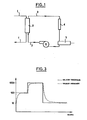
- the fluid circulating in line 1 enters an exchange filter 2 (dialysis membrane, filter) allowing the passage of small molecules and retaining those of high molecular weight.
- an exchange filter 2 dialysis membrane, filter
- a closed circuit 3 comprising a cartridge 4 in which the antibody is fixed on an immunoadsorbent, a detector 5 and a pump 6 to compensate for the pressure drop in the immunoadsorbent.
- Circuit 3 contains a known quantity of tracer of antigenic nature. At equilibrium, part of the tracer is fixed on the antibody linked to the immunoadsorbent due to the antibody-antigen reaction and the other part of the tracer is free and circulates in circuit 3. in the dissolved state in the water. This tracer consisting of a high molecular weight molecule is retained by the filter 2 and is therefore captive in the circuit 3. The detector then gives a reference value.
- the water to be analyzed contains an organic product to be detected (pesticide for example) constituting an antigen, it enters circuit 3 through filter 2 and enters into competition with the worker fixed on the immunoadsorbent for the antigen reaction. - antibodies. The quantity of tracer in circulation is modified and the detector detects this modification.
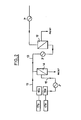
- FIG. 2 shows another implementation device.
- Water circulates in the pipe 11. Part of the water passes through a first filter 12 comprising a filter retaining the molecules of high molecular weight (greater than 50,000 for example).
- the water thus filtered passes through the pipe 13 then is injected into the circuit 15.
- the water containing the antigen (whose molecular weight allows it to pass through the filters 12 and 14) then circulates in the circuit 15 comprising several cartridges 16 immunoadsorbent (two being shown in Figure 2, 16a and 16b).
- Detectors 17 are connected to the cartridges 16 and FIG. 2 shows two detectors 17a and 17b corresponding respectively to the cartridges 16a and 16b.
- the filter 14 with a cut-off value of 10,000 ensures the elimination of excess water from circuit 15 by retaining the tracer (molecular weight> 10,000).
- P pumps ensure the circulation of water to compensate for the pressure losses due to filtration.
- the water rejected by filters 12 and 14 is sent to the drain.
- the principle of the immunoassay is an antigen-antibody reaction, for which an antigen and a specific antibody must be present.
- Any molecule with a molecular weight equal to or greater than 200 can constitute an antigen and can be assayed by an immunological process provided that the complementary antibody can be synthesized.
- the production of antibodies requires the synthesis of the antigen-macromolecule pair,
- the antibody is then fixed on an immunoadsorbent.
- the imunoadsorbents are organic or mineral supports (powder or glass beads, ...) allowing the grafting of antibodies by covalent or adsorption reaction.
- Immunoadsorbents have a binding capacity of 1 to 50 mg of antibody per 10 ml of immunoadsorbent. In practice, we will use around 2 nanomoles of antibodies in the circuit.
- the immunoadsorentant is contained in a cartridge, generally a small column whose diameter allows a flow corresponding to that existing in the circuit.
- the antigen after coupling with a polymeric or proteinaceous substance must then be transformed into a tracer. This is obtained by coupling the antigen with the appropriate tracer group (radioactive, fluorescent or enzymatic substituent) to the detection method used.
- the most widely used tracers are molecules labeled with radioactive iodine ( 125 l ) and it is known at the present time to synthesize iodinated tracers even with fragile nolecules, for example by coupling them with already iodized molecules. .
- the detector is of course dependent on the type of tracer used.
- radioactive tracer e.g. serum abum ine labeled with 125 I and bearing the pattern antigou q ue
- the radioactive radiation is recorded using a probe appropriate (for example Nardeux IMP10 + SMX) either at the level of the immunoadsorbent and a decrease in radioactivity (due to the decrease in the amount of tracer bound) is observed or on the circuit (for example by introducing a empty cartridge) and an increase in radioactivity (increase in the quantity of tracer in circulation) is then observed.
- a probe appropriate for example Nardeux IMP10 + SMX
- the detection is carried out outside the immunoadsorbent by injection of substrate and determination of the enzymatic activity, for example differential colorimetric detection for continuous detection of the free tracer circulating in circuit 15.
- the tracer may also include an element giving rise to fluorescence and the detector is then a fluorescence detector.
- the invention is not limited to the use of a particular type of detection and other detection techniques can be envisaged. Mention may be made, for example, of detectors with enzymatic electrodes which make it possible to detect the presence of pesticides.
- One of the important parameters of the metering device is the response time, that is to say the time necessary to obtain a value corresponding to the actual value of the content of organic compounds.
- the response time is a function of the kinetics of the antigen-antibody reaction which will be briefly described below.
- the graph in FIG. 3 shows in solid lines the theoretical value of the concentration of antigen in the fluid to be analyzed (arbitrary units on the ordinate) as a function of time and the curve in broken lines gives the value measured by the detector. It is noted that the detected value increases rapidly and up to an asymptotic value. Knowing the rate constants of association and dissociation of a given antigen-antibody complex, we can calculate the speed of the variation in the concentration of tracer and deduce the concentration of the substance to be assayed. It will generally be possible to choose the antibody-tracer antigen pair so that the response time is of the order of one hour.
- the detector can be connected to an alarm which is triggered when the measured value reaches a predetermined value, even if the measured value has not reached its maximum level.
- the dosing method and the appropriate device apply to the dosing of very many organic compounds, whether they are drugs, toxic products, pesticides, industrial residues, insofar as they can constitute an antigen and where an antibody and a corresponding antigen tracer can be synthesized. Likewise others. fluids as water can thus be analyzed.
- the closed circuit can be modified by valves causing its periodic and no longer continuous operation.
- the quantity of organic compound collected will be determined in a given time, with a concentration effect which makes it possible to dose even lower quantities of organic compound.
- Example The Intensain or carbochromene has the formula which also exists in acid form. 1) Obtaining the anti-Intensain antibody,
- a rabbit antiserum obtained by injection of anti-Intensain antibody is coupled to Affigel 10 according to the following procedure. 10 ml of Affigel 10 are washed successively with 30 ml of isoprcpanol, 200 ml of H 2 0 and 200 ml of 0.1 M NaHCO 3 at pH 8.5, then they are brought into contact at 4 ° C. with 0.6 ml of antiserum diluted in 5 ml of NaHCO 3 0.1 M at pH 8.5, The mixture is left stirring for 18 hours at 4 ° C and blocked by reaction with 2 ml of 0.5 M glycamide at pH 7.2 for 1 hour at 4 ° C.
- the coupling yield is 55% and the product obtained contains approximately 2 nanomoles of specific antibody per 5 ml of gel.
- Intensain is coupled to BSA according to the procedure used for the preparation of anti-Intensain antibodies but using a different proportion of Intensain.
- a complex comprising 3.3 moles of Intensain per mole of BSA.
- the radioactive iodine labeling is carried out according to a conventional procedure (chloramine T) and an Intensain -BSA-I radioactive complex is obtained.
- a circuit is mounted according to the diagram in FIG. 1. except that the radioactivity detector is placed on the immunoadsorbent cartridge. The desired quantity of tracer is introduced into the circuit and the circuit is left to equilibrate for approximately 18 hours.
Landscapes
- Health & Medical Sciences (AREA)
- Immunology (AREA)
- Life Sciences & Earth Sciences (AREA)
- Engineering & Computer Science (AREA)
- Chemical & Material Sciences (AREA)
- Hematology (AREA)
- Urology & Nephrology (AREA)
- Biomedical Technology (AREA)
- Molecular Biology (AREA)
- Microbiology (AREA)
- Analytical Chemistry (AREA)
- Biotechnology (AREA)
- Pathology (AREA)
- Food Science & Technology (AREA)
- Medicinal Chemistry (AREA)
- Physics & Mathematics (AREA)
- Cell Biology (AREA)
- Biochemistry (AREA)
- General Health & Medical Sciences (AREA)
- General Physics & Mathematics (AREA)
- Chemical Kinetics & Catalysis (AREA)
- Peptides Or Proteins (AREA)
- Investigating Or Analysing Materials By Optical Means (AREA)
Applications Claiming Priority (2)
| Application Number | Priority Date | Filing Date | Title |
|---|---|---|---|
| FR8511446 | 1985-07-26 | ||
| FR8511446A FR2585367B1 (fr) | 1985-07-26 | 1985-07-26 | Procede de dosage immunologique en continu de composes organiques dans un fluide en circulation, et dispositif de mise en oeuvre |
Publications (1)
| Publication Number | Publication Date |
|---|---|
| EP0210107A1 true EP0210107A1 (de) | 1987-01-28 |
Family
ID=9321672
Family Applications (1)
| Application Number | Title | Priority Date | Filing Date |
|---|---|---|---|
| EP86401608A Withdrawn EP0210107A1 (de) | 1985-07-26 | 1986-07-18 | Kontinuierliches immunologisches Verfahren zur Bestimmung von organischen Zusammensetzungen in einer zirkulierenden Flüssigkeit und Vorrichtung zum Durchführen desselben |
Country Status (3)
| Country | Link |
|---|---|
| EP (1) | EP0210107A1 (de) |
| JP (1) | JPS63265168A (de) |
| FR (1) | FR2585367B1 (de) |
Cited By (2)
| Publication number | Priority date | Publication date | Assignee | Title |
|---|---|---|---|---|
| WO1991013354A1 (en) * | 1990-02-23 | 1991-09-05 | The Government Of The United States Of America, As Represented By The Secretary Of The Department Of The Navy | Flow immunosensor method and apparatus |
| WO1995023972A1 (de) * | 1994-03-04 | 1995-09-08 | Dr. Karl Thomae Gmbh | Heterogener immunassay und dessen verwendung zur bestimmung von proteinen |
Citations (5)
| Publication number | Priority date | Publication date | Assignee | Title |
|---|---|---|---|---|
| FR2272102A1 (de) * | 1974-05-20 | 1975-12-19 | Technicon Instr | |
| FR2357900A1 (fr) * | 1976-07-06 | 1978-02-03 | Becton Dickinson Co | Support revetu avec un recepteur et un ligand marque pour la determination des ligands |
| FR2365124A1 (fr) * | 1976-09-18 | 1978-04-14 | Boehringer Mannheim Gmbh | Procede et appareillage pour la detection d'une proteine de fixation specifique ou d'une substance capable de se livrer sur cette proteine |
| FR2430013A1 (fr) * | 1978-06-27 | 1980-01-25 | Sebia Sa | Systeme physico-biochimique pour la detection des substances, a activite antigenique |
| EP0094770A1 (de) * | 1982-05-17 | 1983-11-23 | Becton Dickinson and Company | Kompetitiver Proteinbindungstest |
-
1985
- 1985-07-26 FR FR8511446A patent/FR2585367B1/fr not_active Expired
-
1986
- 1986-07-18 EP EP86401608A patent/EP0210107A1/de not_active Withdrawn
- 1986-07-25 JP JP17544786A patent/JPS63265168A/ja active Pending
Patent Citations (5)
| Publication number | Priority date | Publication date | Assignee | Title |
|---|---|---|---|---|
| FR2272102A1 (de) * | 1974-05-20 | 1975-12-19 | Technicon Instr | |
| FR2357900A1 (fr) * | 1976-07-06 | 1978-02-03 | Becton Dickinson Co | Support revetu avec un recepteur et un ligand marque pour la determination des ligands |
| FR2365124A1 (fr) * | 1976-09-18 | 1978-04-14 | Boehringer Mannheim Gmbh | Procede et appareillage pour la detection d'une proteine de fixation specifique ou d'une substance capable de se livrer sur cette proteine |
| FR2430013A1 (fr) * | 1978-06-27 | 1980-01-25 | Sebia Sa | Systeme physico-biochimique pour la detection des substances, a activite antigenique |
| EP0094770A1 (de) * | 1982-05-17 | 1983-11-23 | Becton Dickinson and Company | Kompetitiver Proteinbindungstest |
Cited By (4)
| Publication number | Priority date | Publication date | Assignee | Title |
|---|---|---|---|---|
| WO1991013354A1 (en) * | 1990-02-23 | 1991-09-05 | The Government Of The United States Of America, As Represented By The Secretary Of The Department Of The Navy | Flow immunosensor method and apparatus |
| US5183740A (en) * | 1990-02-23 | 1993-02-02 | The United States Of America As Represented By The Secretary Of The Navy | Flow immunosensor method and apparatus |
| US6245296B1 (en) * | 1990-02-23 | 2001-06-12 | The United States Of America As Represented By The Secretary Of The Navy | Flow immunosensor apparatus |
| WO1995023972A1 (de) * | 1994-03-04 | 1995-09-08 | Dr. Karl Thomae Gmbh | Heterogener immunassay und dessen verwendung zur bestimmung von proteinen |
Also Published As
| Publication number | Publication date |
|---|---|
| FR2585367B1 (fr) | 1987-10-02 |
| FR2585367A1 (fr) | 1987-01-30 |
| JPS63265168A (ja) | 1988-11-01 |
Similar Documents
| Publication | Publication Date | Title |
|---|---|---|
| KR0171392B1 (ko) | 유동 면역센서법 및 그 장치 | |
| Felice et al. | Determination of catecholamines in rat brain parts by reverse‐phase ion‐pair liquid chromatography | |
| JP2559069B2 (ja) | 免疫分析による化学物質の検出 | |
| US4459361A (en) | Ligand assay with one or two particulate reagents and filter | |
| CH621873A5 (de) | ||
| FR2661502A1 (fr) | Detecteur a fibres optiques. | |
| WO1992001224A1 (fr) | Procede de reduction d'interferences dans un dosage par fluorescence | |
| DE60038363T2 (de) | Detektion von kleinen molekülen mit piezo-elektrischem sensor | |
| JP2893772B2 (ja) | 免疫測定法 | |
| JP2000513817A (ja) | サンプル中の低レベル分析物の検出 | |
| Bjarnason et al. | Flow injection enzyme immunoassay of atrazine herbicide in water | |
| Henry et al. | Combined high speed liquid chromatography and bioassay for the evaluation and analysis of an organophosphorus larvacide | |
| EP0210107A1 (de) | Kontinuierliches immunologisches Verfahren zur Bestimmung von organischen Zusammensetzungen in einer zirkulierenden Flüssigkeit und Vorrichtung zum Durchführen desselben | |
| CA2546066A1 (en) | Mixture of at least two different antibodies specific for predetermined antigens and use of the mixture | |
| Brendel et al. | Simultaneous determination of 5-aminosalicylic acid and 5-acetylaminosalicylic acid by high-performance liquid chromatography | |
| Starodub et al. | Construction and biomedical application of immunosensors based on fiber optics and enhanced chemiluminescence | |
| Starodub | Efficiencies of biosensors in environmental monitoring | |
| EP1567865A1 (de) | Kontinuierliche analyten überwachung mit einer trifunktionellen reagenz | |
| Eisinger et al. | Fluorescence polarization study of human erythrocyte membranes with 1-phenyl-3-(2-naphthyl)-2-pyrazoline as orientational probe | |
| BE877090A (fr) | Procede et necessaire utilisant des microcapsules semi-permeables active et libre. | |
| Prakash et al. | Aging of tubulin at neutral pH: the destabilizing effect of vinca alkaloids | |
| EP0569574A1 (de) | Vorrichtung zum immunologischen Nachweis eines Analyten | |
| Kida et al. | Effective collection of volatile organic compounds in water using rimming flow with odorant-binding proteins | |
| JP3414856B2 (ja) | ジフェニルエーテル化合物の免疫学的測定方法 | |
| Munson | Analytical techniques in dissolution testing and bioavailability studies |
Legal Events
| Date | Code | Title | Description |
|---|---|---|---|
| PUAI | Public reference made under article 153(3) epc to a published international application that has entered the european phase |
Free format text: ORIGINAL CODE: 0009012 |
|
| AK | Designated contracting states |
Kind code of ref document: A1 Designated state(s): AT BE CH DE GB IT LI LU NL SE |
|
| 17P | Request for examination filed |
Effective date: 19870702 |
|
| 17Q | First examination report despatched |
Effective date: 19890816 |
|
| STAA | Information on the status of an ep patent application or granted ep patent |
Free format text: STATUS: THE APPLICATION IS DEEMED TO BE WITHDRAWN |
|
| 18D | Application deemed to be withdrawn |
Effective date: 19911001 |
|
| RIN1 | Information on inventor provided before grant (corrected) |
Inventor name: PRINCE, PAUL Inventor name: MALLEVIALLE, JOEL Inventor name: DELAAGE, MICHEL Inventor name: COGNET, LOUIS |