EP0209022B1 - 4-Substituierte 10-Cyanmethylen-thieno[4,3-e]-benzo-azepine - Google Patents
4-Substituierte 10-Cyanmethylen-thieno[4,3-e]-benzo-azepine Download PDFInfo
- Publication number
- EP0209022B1 EP0209022B1 EP86109187A EP86109187A EP0209022B1 EP 0209022 B1 EP0209022 B1 EP 0209022B1 EP 86109187 A EP86109187 A EP 86109187A EP 86109187 A EP86109187 A EP 86109187A EP 0209022 B1 EP0209022 B1 EP 0209022B1
- Authority
- EP
- European Patent Office
- Prior art keywords
- thieno
- cyanomethylene
- cis
- trans
- carbon atoms
- Prior art date
- Legal status (The legal status is an assumption and is not a legal conclusion. Google has not performed a legal analysis and makes no representation as to the accuracy of the status listed.)
- Expired
Links
- -1 4-Substituted 10-cyanomethylene-thieno[4,3-e]-benzo-azepines Chemical class 0.000 title claims description 15
- 150000001875 compounds Chemical class 0.000 claims abstract description 23
- 208000037265 diseases, disorders, signs and symptoms Diseases 0.000 claims abstract description 4
- 208000035475 disorder Diseases 0.000 claims abstract description 3
- 125000004432 carbon atom Chemical group C* 0.000 claims description 22
- IJGRMHOSHXDMSA-UHFFFAOYSA-N Atomic nitrogen Chemical compound N#N IJGRMHOSHXDMSA-UHFFFAOYSA-N 0.000 claims description 18
- 229910052757 nitrogen Inorganic materials 0.000 claims description 17
- 239000002253 acid Substances 0.000 claims description 15
- 150000003839 salts Chemical class 0.000 claims description 8
- ATHXCIJIYMPTJG-UHFFFAOYSA-N 10-cyanomethylene4-(4-methylpiperazin-1-yl)-thieno[4,3-e]benzoazepine Chemical compound C1CN(C)CCN1C(C=CN=C1C=CC(=CC#N)C2)=C3C21CSC3 ATHXCIJIYMPTJG-UHFFFAOYSA-N 0.000 claims description 7
- 150000001412 amines Chemical class 0.000 claims description 7
- 125000004433 nitrogen atom Chemical group N* 0.000 claims description 7
- 150000001204 N-oxides Chemical class 0.000 claims description 6
- 125000000217 alkyl group Chemical group 0.000 claims description 6
- 229920006395 saturated elastomer Polymers 0.000 claims description 6
- QVGXLLKOCUKJST-UHFFFAOYSA-N atomic oxygen Chemical compound [O] QVGXLLKOCUKJST-UHFFFAOYSA-N 0.000 claims description 5
- 239000001257 hydrogen Substances 0.000 claims description 5
- 229910052739 hydrogen Inorganic materials 0.000 claims description 5
- 125000004435 hydrogen atom Chemical group [H]* 0.000 claims description 5
- 239000001301 oxygen Substances 0.000 claims description 5
- 229910052760 oxygen Inorganic materials 0.000 claims description 5
- MDFFNEOEWAXZRQ-UHFFFAOYSA-N aminyl Chemical compound [NH2] MDFFNEOEWAXZRQ-UHFFFAOYSA-N 0.000 claims description 4
- 125000000753 cycloalkyl group Chemical group 0.000 claims description 4
- 125000005842 heteroatom Chemical group 0.000 claims description 4
- ZAMOUSCENKQFHK-UHFFFAOYSA-N Chlorine atom Chemical group [Cl] ZAMOUSCENKQFHK-UHFFFAOYSA-N 0.000 claims description 3
- 239000000460 chlorine Chemical group 0.000 claims description 3
- 229910052801 chlorine Inorganic materials 0.000 claims description 3
- 239000003814 drug Substances 0.000 claims description 3
- 238000004519 manufacturing process Methods 0.000 claims description 3
- 125000002023 trifluoromethyl group Chemical group FC(F)(F)* 0.000 claims description 3
- PXGOKWXKJXAPGV-UHFFFAOYSA-N Fluorine Chemical group FF PXGOKWXKJXAPGV-UHFFFAOYSA-N 0.000 claims description 2
- 150000007513 acids Chemical class 0.000 claims description 2
- 239000003085 diluting agent Substances 0.000 claims description 2
- 229910052731 fluorine Chemical group 0.000 claims description 2
- 239000011737 fluorine Chemical group 0.000 claims description 2
- 125000002496 methyl group Chemical group [H]C([H])([H])* 0.000 claims description 2
- 125000004193 piperazinyl group Chemical group 0.000 claims description 2
- 125000003386 piperidinyl group Chemical group 0.000 claims description 2
- 229940124597 therapeutic agent Drugs 0.000 claims description 2
- 150000008038 benzoazepines Chemical class 0.000 claims 2
- 125000002768 hydroxyalkyl group Chemical group 0.000 claims 2
- 125000004183 alkoxy alkyl group Chemical group 0.000 claims 1
- 125000003545 alkoxy group Chemical group 0.000 claims 1
- 125000000304 alkynyl group Chemical group 0.000 claims 1
- 125000004103 aminoalkyl group Chemical group 0.000 claims 1
- 125000004981 cycloalkylmethyl group Chemical group 0.000 claims 1
- 125000001559 cyclopropyl group Chemical group [H]C1([H])C([H])([H])C1([H])* 0.000 claims 1
- 125000001495 ethyl group Chemical group [H]C([H])([H])C([H])([H])* 0.000 claims 1
- 229910052736 halogen Inorganic materials 0.000 claims 1
- 150000002367 halogens Chemical group 0.000 claims 1
- 125000002568 propynyl group Chemical group [*]C#CC([H])([H])[H] 0.000 claims 1
- ZMXDDKWLCZADIW-UHFFFAOYSA-N N,N-Dimethylformamide Chemical compound CN(C)C=O ZMXDDKWLCZADIW-UHFFFAOYSA-N 0.000 description 34
- YMWUJEATGCHHMB-UHFFFAOYSA-N Dichloromethane Chemical compound ClCCl YMWUJEATGCHHMB-UHFFFAOYSA-N 0.000 description 26
- LFQSCWFLJHTTHZ-UHFFFAOYSA-N Ethanol Chemical compound CCO LFQSCWFLJHTTHZ-UHFFFAOYSA-N 0.000 description 22
- OKKJLVBELUTLKV-UHFFFAOYSA-N Methanol Chemical compound OC OKKJLVBELUTLKV-UHFFFAOYSA-N 0.000 description 18
- YXFVVABEGXRONW-UHFFFAOYSA-N Toluene Chemical compound CC1=CC=CC=C1 YXFVVABEGXRONW-UHFFFAOYSA-N 0.000 description 15
- DYLIWHYUXAJDOJ-OWOJBTEDSA-N (e)-4-(6-aminopurin-9-yl)but-2-en-1-ol Chemical compound NC1=NC=NC2=C1N=CN2C\C=C\CO DYLIWHYUXAJDOJ-OWOJBTEDSA-N 0.000 description 12
- WYURNTSHIVDZCO-UHFFFAOYSA-N Tetrahydrofuran Chemical compound C1CCOC1 WYURNTSHIVDZCO-UHFFFAOYSA-N 0.000 description 12
- 239000000126 substance Substances 0.000 description 12
- 239000000203 mixture Substances 0.000 description 10
- 239000000243 solution Substances 0.000 description 10
- 238000006243 chemical reaction Methods 0.000 description 8
- 230000000694 effects Effects 0.000 description 8
- XHXFXVLFKHQFAL-UHFFFAOYSA-N phosphoryl trichloride Chemical compound ClP(Cl)(Cl)=O XHXFXVLFKHQFAL-UHFFFAOYSA-N 0.000 description 8
- 238000003756 stirring Methods 0.000 description 8
- 230000001078 anti-cholinergic effect Effects 0.000 description 7
- 239000000932 sedative agent Substances 0.000 description 7
- MHAJPDPJQMAIIY-UHFFFAOYSA-N Hydrogen peroxide Chemical compound OO MHAJPDPJQMAIIY-UHFFFAOYSA-N 0.000 description 6
- GUBGYTABKSRVRQ-QKKXKWKRSA-N Lactose Chemical compound OC[C@H]1O[C@@H](O[C@H]2[C@H](O)[C@@H](O)C(O)O[C@@H]2CO)[C@H](O)[C@@H](O)[C@H]1O GUBGYTABKSRVRQ-QKKXKWKRSA-N 0.000 description 6
- ZMANZCXQSJIPKH-UHFFFAOYSA-N Triethylamine Chemical compound CCN(CC)CC ZMANZCXQSJIPKH-UHFFFAOYSA-N 0.000 description 6
- 239000013078 crystal Substances 0.000 description 6
- 239000003826 tablet Substances 0.000 description 6
- YLQBMQCUIZJEEH-UHFFFAOYSA-N tetrahydrofuran Natural products C=1C=COC=1 YLQBMQCUIZJEEH-UHFFFAOYSA-N 0.000 description 6
- XLYOFNOQVPJJNP-UHFFFAOYSA-N water Chemical compound O XLYOFNOQVPJJNP-UHFFFAOYSA-N 0.000 description 6
- UHOVQNZJYSORNB-UHFFFAOYSA-N Benzene Chemical compound C1=CC=CC=C1 UHOVQNZJYSORNB-UHFFFAOYSA-N 0.000 description 5
- JLTDJTHDQAWBAV-UHFFFAOYSA-N N,N-dimethylaniline Chemical compound CN(C)C1=CC=CC=C1 JLTDJTHDQAWBAV-UHFFFAOYSA-N 0.000 description 5
- 238000004440 column chromatography Methods 0.000 description 5
- 239000011541 reaction mixture Substances 0.000 description 5
- 230000001624 sedative effect Effects 0.000 description 5
- 239000007787 solid Substances 0.000 description 5
- PAYRUJLWNCNPSJ-UHFFFAOYSA-N Aniline Chemical compound NC1=CC=CC=C1 PAYRUJLWNCNPSJ-UHFFFAOYSA-N 0.000 description 4
- VEXZGXHMUGYJMC-UHFFFAOYSA-N Hydrochloric acid Chemical compound Cl VEXZGXHMUGYJMC-UHFFFAOYSA-N 0.000 description 4
- 241001465754 Metazoa Species 0.000 description 4
- VYPSYNLAJGMNEJ-UHFFFAOYSA-N Silicium dioxide Chemical compound O=[Si]=O VYPSYNLAJGMNEJ-UHFFFAOYSA-N 0.000 description 4
- WQDUMFSSJAZKTM-UHFFFAOYSA-N Sodium methoxide Chemical compound [Na+].[O-]C WQDUMFSSJAZKTM-UHFFFAOYSA-N 0.000 description 4
- 239000004480 active ingredient Substances 0.000 description 4
- VMWNQDUVQKEIOC-CYBMUJFWSA-N apomorphine Chemical compound C([C@H]1N(C)CC2)C3=CC=C(O)C(O)=C3C3=C1C2=CC=C3 VMWNQDUVQKEIOC-CYBMUJFWSA-N 0.000 description 4
- 229960004046 apomorphine Drugs 0.000 description 4
- 239000012043 crude product Substances 0.000 description 4
- 239000012071 phase Substances 0.000 description 4
- 239000000047 product Substances 0.000 description 4
- 238000010992 reflux Methods 0.000 description 4
- QZAYGJVTTNCVMB-UHFFFAOYSA-N serotonin Chemical compound C1=C(O)C=C2C(CCN)=CNC2=C1 QZAYGJVTTNCVMB-UHFFFAOYSA-N 0.000 description 4
- 239000000741 silica gel Substances 0.000 description 4
- 229910002027 silica gel Inorganic materials 0.000 description 4
- 239000002904 solvent Substances 0.000 description 4
- 0 *C(CC1)CCC(C(C2C3=CSC2)=C(*)C#N)OC1CCC=C3N Chemical compound *C(CC1)CCC(C(C2C3=CSC2)=C(*)C#N)OC1CCC=C3N 0.000 description 3
- PVOAHINGSUIXLS-UHFFFAOYSA-N 1-Methylpiperazine Chemical group CN1CCNCC1 PVOAHINGSUIXLS-UHFFFAOYSA-N 0.000 description 3
- BZZKABPYTXDJQF-UHFFFAOYSA-N 1-benzazepin-4-one Chemical compound O=C1C=CN=C2C=CC=CC2=C1 BZZKABPYTXDJQF-UHFFFAOYSA-N 0.000 description 3
- WXONJUAIIJMOLJ-UHFFFAOYSA-N 2-(6-piperazin-1-yl-3-thia-9-azatricyclo[8.4.0.01,5]tetradeca-5,7,9,11-tetraen-13-ylidene)acetonitrile Chemical compound C1=CN=C2C=CC(=CC#N)CC32CSCC3=C1N1CCNCC1 WXONJUAIIJMOLJ-UHFFFAOYSA-N 0.000 description 3
- PPPFMBRKIYPQRS-UHFFFAOYSA-N 3-thia-9-azatricyclo[8.4.0.01,5]tetradeca-5,7,9,11,13-pentaene Chemical compound C1SCC2=CC=CN=C3C21C=CC=C3 PPPFMBRKIYPQRS-UHFFFAOYSA-N 0.000 description 3
- 229920002261 Corn starch Polymers 0.000 description 3
- QOSSAOTZNIDXMA-UHFFFAOYSA-N Dicylcohexylcarbodiimide Chemical compound C1CCCCC1N=C=NC1CCCCC1 QOSSAOTZNIDXMA-UHFFFAOYSA-N 0.000 description 3
- RTZKZFJDLAIYFH-UHFFFAOYSA-N Diethyl ether Chemical compound CCOCC RTZKZFJDLAIYFH-UHFFFAOYSA-N 0.000 description 3
- MUBZPKHOEPUJKR-UHFFFAOYSA-N Oxalic acid Chemical compound OC(=O)C(O)=O MUBZPKHOEPUJKR-UHFFFAOYSA-N 0.000 description 3
- PIJVFDBKTWXHHD-UHFFFAOYSA-N Physostigmine Natural products C12=CC(OC(=O)NC)=CC=C2N(C)C2C1(C)CCN2C PIJVFDBKTWXHHD-UHFFFAOYSA-N 0.000 description 3
- HEMHJVSKTPXQMS-UHFFFAOYSA-M Sodium hydroxide Chemical compound [OH-].[Na+] HEMHJVSKTPXQMS-UHFFFAOYSA-M 0.000 description 3
- 238000007239 Wittig reaction Methods 0.000 description 3
- 239000002585 base Substances 0.000 description 3
- CLNZGSBUQVNNNS-UHFFFAOYSA-N benzamide;thiophene-3,4-dicarboxylic acid Chemical compound NC(=O)C1=CC=CC=C1.OC(=O)C1=CSC=C1C(O)=O CLNZGSBUQVNNNS-UHFFFAOYSA-N 0.000 description 3
- KRKNYBCHXYNGOX-UHFFFAOYSA-N citric acid Chemical compound OC(=O)CC(O)(C(O)=O)CC(O)=O KRKNYBCHXYNGOX-UHFFFAOYSA-N 0.000 description 3
- 239000008120 corn starch Substances 0.000 description 3
- 238000001035 drying Methods 0.000 description 3
- 239000005457 ice water Substances 0.000 description 3
- 239000012074 organic phase Substances 0.000 description 3
- 239000003960 organic solvent Substances 0.000 description 3
- 230000000144 pharmacologic effect Effects 0.000 description 3
- PIJVFDBKTWXHHD-HIFRSBDPSA-N physostigmine Chemical compound C12=CC(OC(=O)NC)=CC=C2N(C)[C@@H]2[C@@]1(C)CCN2C PIJVFDBKTWXHHD-HIFRSBDPSA-N 0.000 description 3
- 229960001697 physostigmine Drugs 0.000 description 3
- 229940125723 sedative agent Drugs 0.000 description 3
- 238000000926 separation method Methods 0.000 description 3
- UBOXGVDOUJQMTN-UHFFFAOYSA-N 1,1,2-trichloroethane Chemical compound ClCC(Cl)Cl UBOXGVDOUJQMTN-UHFFFAOYSA-N 0.000 description 2
- RYHBNJHYFVUHQT-UHFFFAOYSA-N 1,4-Dioxane Chemical compound C1COCCO1 RYHBNJHYFVUHQT-UHFFFAOYSA-N 0.000 description 2
- ONXXSWXNQFVPPN-UHFFFAOYSA-N 2-(3-thia-9-azatricyclo[8.4.0.01,5]tetradeca-5,7,9,11-tetraen-13-ylidene)acetonitrile Chemical group C1=CN=C2C=CC(=CC#N)CC32CSCC3=C1 ONXXSWXNQFVPPN-UHFFFAOYSA-N 0.000 description 2
- KWMBADTWRIGGGG-UHFFFAOYSA-N 2-diethoxyphosphorylacetonitrile Chemical compound CCOP(=O)(CC#N)OCC KWMBADTWRIGGGG-UHFFFAOYSA-N 0.000 description 2
- KYRQMUDTSNUOFK-UHFFFAOYSA-N 4-chloro-10-cyanomethylenethieno[4,3-e]benzoazepine Chemical compound C1=CC(Cl)=C2CSCC22CC(=CC#N)C=CC2=N1 KYRQMUDTSNUOFK-UHFFFAOYSA-N 0.000 description 2
- 229910002012 Aerosil® Inorganic materials 0.000 description 2
- KXDAEFPNCMNJSK-UHFFFAOYSA-N Benzamide Chemical compound NC(=O)C1=CC=CC=C1 KXDAEFPNCMNJSK-UHFFFAOYSA-N 0.000 description 2
- VTYYLEPIZMXCLO-UHFFFAOYSA-L Calcium carbonate Chemical compound [Ca+2].[O-]C([O-])=O VTYYLEPIZMXCLO-UHFFFAOYSA-L 0.000 description 2
- OKTJSMMVPCPJKN-UHFFFAOYSA-N Carbon Chemical compound [C] OKTJSMMVPCPJKN-UHFFFAOYSA-N 0.000 description 2
- 239000004215 Carbon black (E152) Substances 0.000 description 2
- VZCYOOQTPOCHFL-OWOJBTEDSA-N Fumaric acid Chemical compound OC(=O)\C=C\C(O)=O VZCYOOQTPOCHFL-OWOJBTEDSA-N 0.000 description 2
- 238000006546 Horner-Wadsworth-Emmons reaction Methods 0.000 description 2
- AFVFQIVMOAPDHO-UHFFFAOYSA-N Methanesulfonic acid Chemical compound CS(O)(=O)=O AFVFQIVMOAPDHO-UHFFFAOYSA-N 0.000 description 2
- MZRVEZGGRBJDDB-UHFFFAOYSA-N N-Butyllithium Chemical compound [Li]CCCC MZRVEZGGRBJDDB-UHFFFAOYSA-N 0.000 description 2
- NQTADLQHYWFPDB-UHFFFAOYSA-N N-Hydroxysuccinimide Chemical compound ON1C(=O)CCC1=O NQTADLQHYWFPDB-UHFFFAOYSA-N 0.000 description 2
- 238000011785 NMRI mouse Methods 0.000 description 2
- NBIIXXVUZAFLBC-UHFFFAOYSA-N Phosphoric acid Chemical compound OP(O)(O)=O NBIIXXVUZAFLBC-UHFFFAOYSA-N 0.000 description 2
- KEAYESYHFKHZAL-UHFFFAOYSA-N Sodium Chemical compound [Na] KEAYESYHFKHZAL-UHFFFAOYSA-N 0.000 description 2
- FAPWRFPIFSIZLT-UHFFFAOYSA-M Sodium chloride Chemical compound [Na+].[Cl-] FAPWRFPIFSIZLT-UHFFFAOYSA-M 0.000 description 2
- QAOWNCQODCNURD-UHFFFAOYSA-N Sulfuric acid Chemical compound OS(O)(=O)=O QAOWNCQODCNURD-UHFFFAOYSA-N 0.000 description 2
- XSQUKJJJFZCRTK-UHFFFAOYSA-N Urea Chemical compound NC(N)=O XSQUKJJJFZCRTK-UHFFFAOYSA-N 0.000 description 2
- VSCWAEJMTAWNJL-UHFFFAOYSA-K aluminium trichloride Chemical compound Cl[Al](Cl)Cl VSCWAEJMTAWNJL-UHFFFAOYSA-K 0.000 description 2
- 230000008485 antagonism Effects 0.000 description 2
- 229940125688 antiparkinson agent Drugs 0.000 description 2
- 239000000939 antiparkinson agent Substances 0.000 description 2
- 239000011230 binding agent Substances 0.000 description 2
- 230000037396 body weight Effects 0.000 description 2
- 239000004202 carbamide Substances 0.000 description 2
- 125000002915 carbonyl group Chemical group [*:2]C([*:1])=O 0.000 description 2
- 239000007795 chemical reaction product Substances 0.000 description 2
- 150000008280 chlorinated hydrocarbons Chemical class 0.000 description 2
- 239000000812 cholinergic antagonist Substances 0.000 description 2
- 230000009194 climbing Effects 0.000 description 2
- ARPLQAMUUDIHIT-UHFFFAOYSA-M cyanomethyl(triphenyl)phosphanium;chloride Chemical compound [Cl-].C=1C=CC=CC=1[P+](C=1C=CC=CC=1)(CC#N)C1=CC=CC=C1 ARPLQAMUUDIHIT-UHFFFAOYSA-M 0.000 description 2
- NNBZCPXTIHJBJL-UHFFFAOYSA-N decalin Chemical compound C1CCCC2CCCCC21 NNBZCPXTIHJBJL-UHFFFAOYSA-N 0.000 description 2
- UZVGSSNIUNSOFA-UHFFFAOYSA-N dibenzofuran-1-carboxylic acid Chemical compound O1C2=CC=CC=C2C2=C1C=CC=C2C(=O)O UZVGSSNIUNSOFA-UHFFFAOYSA-N 0.000 description 2
- 150000002148 esters Chemical class 0.000 description 2
- 238000002474 experimental method Methods 0.000 description 2
- 239000000706 filtrate Substances 0.000 description 2
- 238000001640 fractional crystallisation Methods 0.000 description 2
- 229920000159 gelatin Polymers 0.000 description 2
- 235000019322 gelatine Nutrition 0.000 description 2
- 125000005843 halogen group Chemical group 0.000 description 2
- 229930195733 hydrocarbon Natural products 0.000 description 2
- 230000035873 hypermotility Effects 0.000 description 2
- 239000003326 hypnotic agent Substances 0.000 description 2
- 230000000147 hypnotic effect Effects 0.000 description 2
- 239000012442 inert solvent Substances 0.000 description 2
- 238000000034 method Methods 0.000 description 2
- 239000003158 myorelaxant agent Substances 0.000 description 2
- 239000003176 neuroleptic agent Substances 0.000 description 2
- 239000012038 nucleophile Substances 0.000 description 2
- 238000006772 olefination reaction Methods 0.000 description 2
- 125000004430 oxygen atom Chemical group O* 0.000 description 2
- BASFCYQUMIYNBI-UHFFFAOYSA-N platinum Chemical compound [Pt] BASFCYQUMIYNBI-UHFFFAOYSA-N 0.000 description 2
- 229940076279 serotonin Drugs 0.000 description 2
- ODZPKZBBUMBTMG-UHFFFAOYSA-N sodium amide Chemical compound [NH2-].[Na+] ODZPKZBBUMBTMG-UHFFFAOYSA-N 0.000 description 2
- 239000012312 sodium hydride Substances 0.000 description 2
- 229910000104 sodium hydride Inorganic materials 0.000 description 2
- 239000007858 starting material Substances 0.000 description 2
- 208000024891 symptom Diseases 0.000 description 2
- XQTUSPVIMZCNPC-UHFFFAOYSA-N thieno[3,4-c]furan-1,3-dione Chemical compound S1C=C2C(=O)OC(=O)C2=C1 XQTUSPVIMZCNPC-UHFFFAOYSA-N 0.000 description 2
- VZCYOOQTPOCHFL-UHFFFAOYSA-N trans-butenedioic acid Natural products OC(=O)C=CC(O)=O VZCYOOQTPOCHFL-UHFFFAOYSA-N 0.000 description 2
- 238000005406 washing Methods 0.000 description 2
- 238000012982 x-ray structure analysis Methods 0.000 description 2
- WXLCDTBTIVJDCE-UHFFFAOYSA-N 1,4-oxazepine Chemical class O1C=CC=NC=C1 WXLCDTBTIVJDCE-UHFFFAOYSA-N 0.000 description 1
- QPPOMEOQNLTFRU-UHFFFAOYSA-N 1,4-thiazepine Chemical class S1C=CC=NC=C1 QPPOMEOQNLTFRU-UHFFFAOYSA-N 0.000 description 1
- POXWDTQUDZUOGP-UHFFFAOYSA-N 1h-1,4-diazepine Chemical class N1C=CC=NC=C1 POXWDTQUDZUOGP-UHFFFAOYSA-N 0.000 description 1
- CDEDDKOSDLSVFC-UHFFFAOYSA-N 2-[6-(4-cyclopropylpiperazin-1-yl)-3-thia-9-azatricyclo[8.4.0.01,5]tetradeca-5,7,9,11-tetraen-13-ylidene]acetonitrile Chemical compound C1=CN=C2C=CC(=CC#N)CC32CSCC3=C1N(CC1)CCN1C1CC1 CDEDDKOSDLSVFC-UHFFFAOYSA-N 0.000 description 1
- AHFFJPBYGBHXFY-UHFFFAOYSA-N 2-[6-(4-ethylpiperazin-1-yl)-3-thia-9-azatricyclo[8.4.0.01,5]tetradeca-5,7,9,11-tetraen-13-ylidene]acetonitrile Chemical compound C1CN(CC)CCN1C(C=CN=C1C=CC(=CC#N)C2)=C3C21CSC3 AHFFJPBYGBHXFY-UHFFFAOYSA-N 0.000 description 1
- AVTPQHNYVDVNLP-UHFFFAOYSA-N 2-[6-(4-methyl-1,4-diazepan-1-yl)-3-thia-9-azatricyclo[8.4.0.01,5]tetradeca-5,7,9,11-tetraen-13-ylidene]acetonitrile Chemical compound C(#N)C=C1C=CC=2C3(C(=C(/C=C/N=2)N2CCN(CCC2)C)CSC3)C1 AVTPQHNYVDVNLP-UHFFFAOYSA-N 0.000 description 1
- IFQQSYGSFGQLPM-UHFFFAOYSA-N 2-[6-[2-(dimethylamino)ethylamino]-3-thia-9-azatricyclo[8.4.0.01,5]tetradeca-5,7,9,11-tetraen-13-ylidene]acetonitrile Chemical compound C1=CC(NCCN(C)C)=C2CSCC22CC(=CC#N)C=CC2=N1 IFQQSYGSFGQLPM-UHFFFAOYSA-N 0.000 description 1
- ZYXJJJMWZVDCEF-UHFFFAOYSA-N 2-[6-[4-(cyclopropylmethyl)piperazin-1-yl]-3-thia-9-azatricyclo[8.4.0.01,5]tetradeca-5,7,9,11-tetraen-13-ylidene]acetonitrile Chemical compound C(#N)C=C1C=CC=2C3(C(=C(/C=C/N=2)N2CCN(CC2)CC2CC2)CSC3)C1 ZYXJJJMWZVDCEF-UHFFFAOYSA-N 0.000 description 1
- 125000003006 2-dimethylaminoethyl group Chemical group [H]C([H])([H])N(C([H])([H])[H])C([H])([H])C([H])([H])* 0.000 description 1
- 125000004195 4-methylpiperazin-1-yl group Chemical group [H]C([H])([H])N1C([H])([H])C([H])([H])N(*)C([H])([H])C1([H])[H] 0.000 description 1
- LDCYZAJDBXYCGN-VIFPVBQESA-N 5-hydroxy-L-tryptophan Chemical compound C1=C(O)C=C2C(C[C@H](N)C(O)=O)=CNC2=C1 LDCYZAJDBXYCGN-VIFPVBQESA-N 0.000 description 1
- 208000019901 Anxiety disease Diseases 0.000 description 1
- WKBOTKDWSSQWDR-UHFFFAOYSA-N Bromine atom Chemical compound [Br] WKBOTKDWSSQWDR-UHFFFAOYSA-N 0.000 description 1
- KAAZGXDPUNNEFN-UHFFFAOYSA-N Clotiapine Chemical compound C1CN(C)CCN1C1=NC2=CC=CC=C2SC2=CC=C(Cl)C=C12 KAAZGXDPUNNEFN-UHFFFAOYSA-N 0.000 description 1
- XDTMQSROBMDMFD-UHFFFAOYSA-N Cyclohexane Chemical compound C1CCCCC1 XDTMQSROBMDMFD-UHFFFAOYSA-N 0.000 description 1
- FEWJPZIEWOKRBE-JCYAYHJZSA-N Dextrotartaric acid Chemical compound OC(=O)[C@H](O)[C@@H](O)C(O)=O FEWJPZIEWOKRBE-JCYAYHJZSA-N 0.000 description 1
- 206010013786 Dry skin Diseases 0.000 description 1
- 238000010917 Friedel-Crafts cyclization Methods 0.000 description 1
- 238000005727 Friedel-Crafts reaction Methods 0.000 description 1
- 108010010803 Gelatin Proteins 0.000 description 1
- 239000001828 Gelatine Substances 0.000 description 1
- DGAQECJNVWCQMB-PUAWFVPOSA-M Ilexoside XXIX Chemical compound C[C@@H]1CC[C@@]2(CC[C@@]3(C(=CC[C@H]4[C@]3(CC[C@@H]5[C@@]4(CC[C@@H](C5(C)C)OS(=O)(=O)[O-])C)C)[C@@H]2[C@]1(C)O)C)C(=O)O[C@H]6[C@@H]([C@H]([C@@H]([C@H](O6)CO)O)O)O.[Na+] DGAQECJNVWCQMB-PUAWFVPOSA-M 0.000 description 1
- 241000699670 Mus sp. Species 0.000 description 1
- CTQNGGLPUBDAKN-UHFFFAOYSA-N O-Xylene Chemical compound CC1=CC=CC=C1C CTQNGGLPUBDAKN-UHFFFAOYSA-N 0.000 description 1
- 208000018737 Parkinson disease Diseases 0.000 description 1
- PWRPUAKXMQAFCJ-UHFFFAOYSA-N Perlapine Chemical compound C1CN(C)CCN1C1=NC2=CC=CC=C2CC2=CC=CC=C12 PWRPUAKXMQAFCJ-UHFFFAOYSA-N 0.000 description 1
- OFOBLEOULBTSOW-UHFFFAOYSA-N Propanedioic acid Natural products OC(=O)CC(O)=O OFOBLEOULBTSOW-UHFFFAOYSA-N 0.000 description 1
- 208000001431 Psychomotor Agitation Diseases 0.000 description 1
- 208000028017 Psychotic disease Diseases 0.000 description 1
- 206010038743 Restlessness Diseases 0.000 description 1
- 208000013738 Sleep Initiation and Maintenance disease Diseases 0.000 description 1
- CZMRCDWAGMRECN-UGDNZRGBSA-N Sucrose Chemical compound O[C@H]1[C@H](O)[C@@H](CO)O[C@@]1(CO)O[C@@H]1[C@H](O)[C@@H](O)[C@H](O)[C@@H](CO)O1 CZMRCDWAGMRECN-UGDNZRGBSA-N 0.000 description 1
- 229930006000 Sucrose Natural products 0.000 description 1
- FEWJPZIEWOKRBE-UHFFFAOYSA-N Tartaric acid Natural products [H+].[H+].[O-]C(=O)C(O)C(O)C([O-])=O FEWJPZIEWOKRBE-UHFFFAOYSA-N 0.000 description 1
- 206010044565 Tremor Diseases 0.000 description 1
- CIUQDSCDWFSTQR-UHFFFAOYSA-N [C]1=CC=CC=C1 Chemical compound [C]1=CC=CC=C1 CIUQDSCDWFSTQR-UHFFFAOYSA-N 0.000 description 1
- 125000001931 aliphatic group Chemical group 0.000 description 1
- 229910000147 aluminium phosphate Inorganic materials 0.000 description 1
- 230000003042 antagnostic effect Effects 0.000 description 1
- 230000001090 anti-dopaminergic effect Effects 0.000 description 1
- 229940065524 anticholinergics inhalants for obstructive airway diseases Drugs 0.000 description 1
- 239000003963 antioxidant agent Substances 0.000 description 1
- 230000036506 anxiety Effects 0.000 description 1
- 239000000010 aprotic solvent Substances 0.000 description 1
- 239000008346 aqueous phase Substances 0.000 description 1
- 230000037007 arousal Effects 0.000 description 1
- XYOVOXDWRFGKEX-UHFFFAOYSA-N azepine Chemical compound N1C=CC=CC=C1 XYOVOXDWRFGKEX-UHFFFAOYSA-N 0.000 description 1
- 150000001538 azepines Chemical class 0.000 description 1
- 125000005605 benzo group Chemical group 0.000 description 1
- 239000008280 blood Substances 0.000 description 1
- 210000004369 blood Anatomy 0.000 description 1
- GDTBXPJZTBHREO-UHFFFAOYSA-N bromine Substances BrBr GDTBXPJZTBHREO-UHFFFAOYSA-N 0.000 description 1
- 229910052794 bromium Inorganic materials 0.000 description 1
- 229910000019 calcium carbonate Inorganic materials 0.000 description 1
- 239000002775 capsule Substances 0.000 description 1
- 230000003197 catalytic effect Effects 0.000 description 1
- 239000003795 chemical substances by application Substances 0.000 description 1
- 235000015165 citric acid Nutrition 0.000 description 1
- 229960003864 clotiapine Drugs 0.000 description 1
- 229960004170 clozapine Drugs 0.000 description 1
- QZUDBNBUXVUHMW-UHFFFAOYSA-N clozapine Chemical compound C1CN(C)CCN1C1=NC2=CC(Cl)=CC=C2NC2=CC=CC=C12 QZUDBNBUXVUHMW-UHFFFAOYSA-N 0.000 description 1
- 230000000052 comparative effect Effects 0.000 description 1
- 239000012050 conventional carrier Substances 0.000 description 1
- 238000001816 cooling Methods 0.000 description 1
- 229920001577 copolymer Polymers 0.000 description 1
- 239000006071 cream Substances 0.000 description 1
- 238000002425 crystallisation Methods 0.000 description 1
- 230000008025 crystallization Effects 0.000 description 1
- 150000004292 cyclic ethers Chemical class 0.000 description 1
- 125000004122 cyclic group Chemical group 0.000 description 1
- 230000003247 decreasing effect Effects 0.000 description 1
- JSYGRUBHOCKMGQ-UHFFFAOYSA-N dichloramine Chemical compound ClNCl JSYGRUBHOCKMGQ-UHFFFAOYSA-N 0.000 description 1
- 201000010099 disease Diseases 0.000 description 1
- 239000002270 dispersing agent Substances 0.000 description 1
- 238000009826 distribution Methods 0.000 description 1
- 239000008298 dragée Substances 0.000 description 1
- 239000003480 eluent Substances 0.000 description 1
- 239000003995 emulsifying agent Substances 0.000 description 1
- 238000005516 engineering process Methods 0.000 description 1
- 239000002702 enteric coating Substances 0.000 description 1
- 238000009505 enteric coating Methods 0.000 description 1
- 238000000605 extraction Methods 0.000 description 1
- 239000000945 filler Substances 0.000 description 1
- 239000007941 film coated tablet Substances 0.000 description 1
- 238000001914 filtration Methods 0.000 description 1
- 239000012467 final product Substances 0.000 description 1
- 210000004744 fore-foot Anatomy 0.000 description 1
- 239000001530 fumaric acid Substances 0.000 description 1
- 235000011087 fumaric acid Nutrition 0.000 description 1
- 239000008273 gelatin Substances 0.000 description 1
- 235000011852 gelatine desserts Nutrition 0.000 description 1
- 239000008187 granular material Substances 0.000 description 1
- 230000002140 halogenating effect Effects 0.000 description 1
- 238000010438 heat treatment Methods 0.000 description 1
- 125000000623 heterocyclic group Chemical group 0.000 description 1
- 150000002430 hydrocarbons Chemical class 0.000 description 1
- 239000011261 inert gas Substances 0.000 description 1
- 206010022437 insomnia Diseases 0.000 description 1
- 239000000644 isotonic solution Substances 0.000 description 1
- 231100000636 lethal dose Toxicity 0.000 description 1
- 239000007788 liquid Substances 0.000 description 1
- 229960000423 loxapine Drugs 0.000 description 1
- XJGVXQDUIWGIRW-UHFFFAOYSA-N loxapine Chemical compound C1CN(C)CCN1C1=NC2=CC=CC=C2OC2=CC=C(Cl)C=C12 XJGVXQDUIWGIRW-UHFFFAOYSA-N 0.000 description 1
- VZCYOOQTPOCHFL-UPHRSURJSA-N maleic acid Chemical compound OC(=O)\C=C/C(O)=O VZCYOOQTPOCHFL-UPHRSURJSA-N 0.000 description 1
- 239000011976 maleic acid Substances 0.000 description 1
- 239000000155 melt Substances 0.000 description 1
- AUHZEENZYGFFBQ-UHFFFAOYSA-N mesitylene Substances CC1=CC(C)=CC(C)=C1 AUHZEENZYGFFBQ-UHFFFAOYSA-N 0.000 description 1
- 125000001827 mesitylenyl group Chemical group [H]C1=C(C(*)=C(C([H])=C1C([H])([H])[H])C([H])([H])[H])C([H])([H])[H] 0.000 description 1
- 229940098779 methanesulfonic acid Drugs 0.000 description 1
- 125000000956 methoxy group Chemical group [H]C([H])([H])O* 0.000 description 1
- 125000002757 morpholinyl group Chemical group 0.000 description 1
- 229940035363 muscle relaxants Drugs 0.000 description 1
- 230000000701 neuroleptic effect Effects 0.000 description 1
- 239000012299 nitrogen atmosphere Substances 0.000 description 1
- 239000002674 ointment Substances 0.000 description 1
- 150000002902 organometallic compounds Chemical class 0.000 description 1
- 235000006408 oxalic acid Nutrition 0.000 description 1
- 229950009253 perlapine Drugs 0.000 description 1
- UEZVMMHDMIWARA-UHFFFAOYSA-M phosphonate Chemical compound [O-]P(=O)=O UEZVMMHDMIWARA-UHFFFAOYSA-M 0.000 description 1
- 150000004714 phosphonium salts Chemical class 0.000 description 1
- 239000000902 placebo Substances 0.000 description 1
- 229940068196 placebo Drugs 0.000 description 1
- 239000004014 plasticizer Substances 0.000 description 1
- 229910052697 platinum Inorganic materials 0.000 description 1
- 239000002798 polar solvent Substances 0.000 description 1
- 229920000191 poly(N-vinyl pyrrolidone) Polymers 0.000 description 1
- 229920001592 potato starch Polymers 0.000 description 1
- 239000000843 powder Substances 0.000 description 1
- 238000002360 preparation method Methods 0.000 description 1
- 239000003755 preservative agent Substances 0.000 description 1
- 229940002612 prodrug Drugs 0.000 description 1
- 239000000651 prodrug Substances 0.000 description 1
- 239000003380 propellant Substances 0.000 description 1
- 238000001953 recrystallisation Methods 0.000 description 1
- 235000012239 silicon dioxide Nutrition 0.000 description 1
- 239000011734 sodium Substances 0.000 description 1
- 229910052708 sodium Inorganic materials 0.000 description 1
- 239000011780 sodium chloride Substances 0.000 description 1
- QDRKDTQENPPHOJ-UHFFFAOYSA-N sodium ethoxide Chemical compound [Na+].CC[O-] QDRKDTQENPPHOJ-UHFFFAOYSA-N 0.000 description 1
- 239000007921 spray Substances 0.000 description 1
- 229960004793 sucrose Drugs 0.000 description 1
- IIACRCGMVDHOTQ-UHFFFAOYSA-N sulfamic acid Chemical compound NS(O)(=O)=O IIACRCGMVDHOTQ-UHFFFAOYSA-N 0.000 description 1
- 125000000446 sulfanediyl group Chemical group *S* 0.000 description 1
- 239000000829 suppository Substances 0.000 description 1
- 239000007885 tablet disintegrant Substances 0.000 description 1
- 239000000454 talc Substances 0.000 description 1
- 229910052623 talc Inorganic materials 0.000 description 1
- 239000011975 tartaric acid Substances 0.000 description 1
- 235000002906 tartaric acid Nutrition 0.000 description 1
- 239000003204 tranquilizing agent Substances 0.000 description 1
- 230000002936 tranquilizing effect Effects 0.000 description 1
- 239000000080 wetting agent Substances 0.000 description 1
- 238000010626 work up procedure Methods 0.000 description 1
- 239000008096 xylene Substances 0.000 description 1
Classifications
-
- C—CHEMISTRY; METALLURGY
- C07—ORGANIC CHEMISTRY
- C07D—HETEROCYCLIC COMPOUNDS
- C07D495/00—Heterocyclic compounds containing in the condensed system at least one hetero ring having sulfur atoms as the only ring hetero atoms
- C07D495/02—Heterocyclic compounds containing in the condensed system at least one hetero ring having sulfur atoms as the only ring hetero atoms in which the condensed system contains two hetero rings
- C07D495/04—Ortho-condensed systems
-
- A—HUMAN NECESSITIES
- A61—MEDICAL OR VETERINARY SCIENCE; HYGIENE
- A61P—SPECIFIC THERAPEUTIC ACTIVITY OF CHEMICAL COMPOUNDS OR MEDICINAL PREPARATIONS
- A61P25/00—Drugs for disorders of the nervous system
-
- A—HUMAN NECESSITIES
- A61—MEDICAL OR VETERINARY SCIENCE; HYGIENE
- A61P—SPECIFIC THERAPEUTIC ACTIVITY OF CHEMICAL COMPOUNDS OR MEDICINAL PREPARATIONS
- A61P25/00—Drugs for disorders of the nervous system
- A61P25/08—Antiepileptics; Anticonvulsants
-
- A—HUMAN NECESSITIES
- A61—MEDICAL OR VETERINARY SCIENCE; HYGIENE
- A61P—SPECIFIC THERAPEUTIC ACTIVITY OF CHEMICAL COMPOUNDS OR MEDICINAL PREPARATIONS
- A61P25/00—Drugs for disorders of the nervous system
- A61P25/20—Hypnotics; Sedatives
Definitions
- the invention relates to 10-cyanomethylene thieno [4,3-e] -benzo-azepines substituted in the 4-position, processes for their preparation and their use as medicaments which can be used as sedatives, hypnotics, tranquilizers, muscle relaxants, neuroleptics or antiparkinson agents.
- tricyclic ring systems with a dibenzo structure to form a central heterocyclic 7-ring which may have a basic side residue such as an N-methylpiperazine residue
- Such tricycles are, for example, N-methylpiperazine derivatives of dibenzo [b, e,] [1,4] diazepines (clozapine), dibenzo [b, f] [1,4] thiazepines (clotiapine), dibenzo [b , f] [1,4] -oxazepines (loxapine) or morphantridines (perlapine), as can be seen, for example, from the summary by J. Schmutz in Arzneistoffforschung 25, 712-720 (1975).
- DE-OS 29 18 778 and DE-OS 30 37 971 6-substituted 11-alkylene-morphantridines or 5-substituted-9-cyanomethylene-dithieno [3,4-b: 4'.3'-e ] azepines with valuable pharmacological properties.
- R represents a hydrogen or halogen atom, an alkyl radical having 1 to 3 carbon atoms, trifluoromethyl or an alkoxy radical having 1 to 3 carbon atoms
- A represents an amino radical -NR1R2 in which R 1 and R 2 together with them connecting nitrogen atom mean a 5- to 7-membered saturated ring which optionally contains a nitrogen or oxygen atom as a further heteroatom, an additionally present nitrogen atom optionally being substituted by an alkyl radical having 1 to 3 carbon atoms, a hydroxyalkyl radical having 2 to 3 carbon atoms Atoms, an alkoxyalkyl radical with 2 to 3 carbon atoms in the alkyl or alkoxy radical, a cycloalkyl or cycloalkylmethyl radical with 3 to 7 carbon atoms in the cycloalkyl ring, an alkyny
- Oxide is substituted, or A is an amino radical -NHR3, in which R 3 is an aminoalkyl radical having 2 to 7 carbon atoms, the amine nitrogen atom optionally being substituted by a lower alkyl radical having 1 to 5 C atoms is substituted or is part of a 5- to 7-membered saturated ring which optionally contains a nitrogen or oxygen atom as a further heteroatom, an existing nitrogen atom being represented by a lower alkyl radical having 1 to 3 C atoms or a hydroxyalkyl radical having 2 can be substituted to 3 carbon atoms, and their physiologically tolerated acid addition salts have valuable pharmacological properties.
- radical R hydrogen, fluorine, chlorine, methyl, trifluoromethyl and methoxy.
- Piperazinyl, homopiperazinyl, piperidinyl and morpholinyl residues are preferably to be mentioned as amine residues -NR 1 R 2 for A.
- radicals -NR 1 R 2 are the 4-methyl-piperazinyl, 4-methyl-4-oxy-piperazinyl, 4-ethyl-piperazinyl and the N-methyl-homopiperazinyl radical.
- the cis-trans isomers can be separated, for example, by fractional crystallization or by column chromatography.
- the separation into the cis and trans isomers can be carried out without too much effort in individual cases.
- the compounds of formula I according to the invention are prepared by using a compound of formula 11 in which R has the meanings indicated and Z represents a nucleofugic leaving group, is reacted with a nucleophile AH in which A has the meanings indicated for formula I, optionally separates into the pure cis and trans isomers and / or optionally the compound obtained converted into the N-oxide and / or into the acid addition salt of a physiologically acceptable acid.
- Halogen atoms in particular bromine or chlorine, are suitable as the nucleofugic leaving group for Z.
- the reaction is advantageously carried out in the presence of an excess amount of the amine AH used, which simultaneously serves as a solvent and, if appropriate, as an acid-binding agent.
- an inert solvent such as a cyclic saturated ether, in particular tetrahydrofuran or dioxane, of benzene or a benzene hydrocarbon, such as toluene, xylene, mesitylene or decahydronaphthalene or an aprotic polar solvent, such as dimethylformamide.
- an inert solvent such as a cyclic saturated ether, in particular tetrahydrofuran or dioxane
- benzene or a benzene hydrocarbon such as toluene, xylene, mesitylene or decahydronaphthalene or an aprotic polar solvent, such as dimethylformamide.
- an inert base e.g. Triethylamine.
- the reaction is usually carried out at temperatures from 80 to 150 ° C, and is generally completed within 3 to 10 hours. It may be advantageous to exclude the oxygen in the air and to work under an inert gas, for example under nitrogen.
- the nucleophile AH is advantageously used in at least a 2 to 20-fold molar excess.
- a compound of the formula I is converted into the N-oxide in the customary manner, advantageously with aqueous hydrogen peroxide (30% by weight) in ethanolic solution.
- the conversion into the acid addition salt of a physiologically acceptable acid is also carried out in the usual way.
- the starting compounds of formula II are obtained by using a 10-cyanomethylene thio [4,3-e] benzo-4,5-dihydro-azepin-4-one of formula III in the R has the meanings given for formula II, with an excess of halogenating agent, such as phosphorus oxychloride, in the presence of a solvent and in the presence of a catalytic amount of N, N-dimethylaniline, heated to reflux temperatures for 3 to 5 hours and the iminochloride obtained after the excess phosphorus oxychloride has been distilled off and work-up in an aqueous two-phase system isolated by extraction with a chlorinated hydrocarbon such as methylene chloride.
- halogenating agent such as phosphorus oxychloride
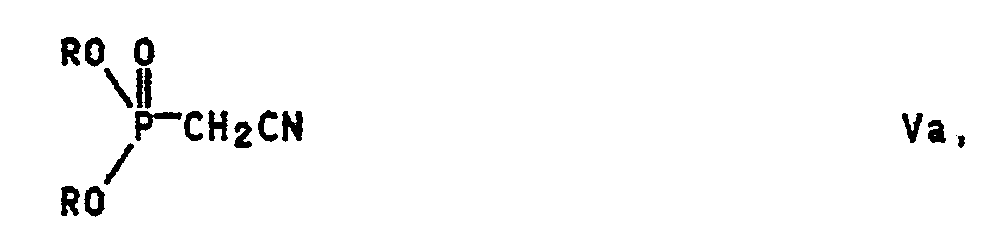
- the new 10-cyanomethylene thieno [4,3-e] benzo-4,5-dihydro-azepin-4-one of the formula 111, in which R has the meanings given for formula I, is prepared by carbonyl olefination by a thieno [4,3-e] benzo-4,5-dihydro-azepine-4,10-dione of the formula IV with a phosphonate of the formula Va in which R is an alkyl radical having 1 to 3 carbon atoms, under the conditions of the Wittig-Horner reaction in an inert solvent, particularly preferably dimethylformamide, in the presence of a molar equivalent of a base, preferably sodium alcoholate, sodium hydride or sodium amide, at temperatures of Converts 20 to 80 ° C.
- a base preferably sodium alcoholate, sodium hydride or sodium amide
- a phosphonium salt of the formula Vb in the Ph represents a phenyl radical under the conditions of the classic Wittig reaction in an aprotic organic solvent, in particular a saturated aliphatic or saturated cyclic ether, such as diethyl ether, tetrahydrofuran or dioxane, or preferably in dimethylformamide, in the presence of a molar equivalent of a base, in particular sodium ethylate or sodium amide or an organometallic compound, such as butyllithium, at temperatures of 20 to 100 ° C.
- an aprotic organic solvent in particular a saturated aliphatic or saturated cyclic ether, such as diethyl ether, tetrahydrofuran or dioxane, or preferably in dimethylformamide, in the presence of a molar equivalent of a base, in particular sodium ethylate or sodium amide or an organometallic compound, such as butyllithium, at temperatures of 20 to 100
- the new thieno [4,3-e] benzo-4,5-dihydro-azepine-4,10-dione of the formula IV, in which R has the meanings given for the formula I, is prepared by Friedel-Crafts cyclization, by using a thiophene-3,4-dicarboxylic acid benzamide of the formula VI with N-hydroxysuccinimide in the presence of a molar equivalent of dicyclohexylcarbodiimide in the activated ester of formula VII transferred and then then cyclized in the presence of a 5 to 8-fold excess of aluminum chloride in a dipolar aprotic solvent such as dimethylformamide according to Friedel-Crafts at temperatures between 50 and 120 ° C for 1 to 3 hours.
- a dipolar aprotic solvent such as dimethylformamide according to Friedel-Crafts at temperatures between 50 and 120 ° C for 1 to 3 hours.
- the former reaction (VI-Nil) is carried out in an inert organic solvent, e.g. Tetrahydrofuran, and is completed at room temperature within 1 to 3 hours.
- the precipitated urea is suctioned off and the activated ester of formula VII is isolated.
- the thiophene-3,4-diocarboxylic acid benzamide of the formula VI is obtained in a simple manner by reacting thiophene-3,4-dicarboxylic acid anhydride with the corresponding aniline in tetrahydrofuran at room temperature for 1 to 5 hours.
- the compounds of the formula according to the invention are generally obtained in the form of yellowish to yellow crystals and can be recrystallized by recrystallization from the customary organic solvents, preferably from a lower alcohol, such as ethanol, or purified by column chromatography.
- the individual cis and trans isomers are separated by fractional crystallization in a chlorinated hydrocarbon, preferably methylene chloride, a lower monohydric alcohol, preferably methanol or ethanol, or a saturated cycloaliphatic hydrocarbon, preferably cyclohexane, or by column chromatography, in particular in Methylene chloride and methanol in a ratio of 99: 1 to 85:15 parts by volume.
- a chlorinated hydrocarbon preferably methylene chloride, a lower monohydric alcohol, preferably methanol or ethanol, or a saturated cycloaliphatic hydrocarbon, preferably cyclohexane
- the free substituted 10-cyanomethylene thieno [4,3-e] benzo-azepines of the formula can be converted in a conventional manner into the acid addition salt of a pharmacologically acceptable acid, preferably by adding a solution of one equivalent of the corresponding acid to a solution.
- Pharmaceutically acceptable acids are, for example, hydrochloric acid, phosphoric acid, sulfuric acid, methanesulfonic acid, amidosulfonic acid, maleic acid, fumaric acid, oxalic acid, tartaric acid and citric acid.
- the compounds according to the invention have valuable properties after the pharmacological experiments.
- they can be used as sedatives / hypnotics, minor or major tranquilizers and as anti-Parkinson agents. They are therefore suitable for the treatment of central nervous disorders, such as restlessness and anxiety, insomnia, endogenous and exogenous psychoses and Parkinson's disease.
- a single isomer (after separation of the isomers) can preferably have an effect.
- the ED is used to determine the dose which, compared to placebo-treated control animals, causes a reduction in the orientation hypermotility by 50%.
- Apomorphine (1.21 mg / kg sc) leads to increased climbing in mice if they are kept in a suitable environment (eg wire mesh cage). The animals are observed for 30 minutes after apomorphine administration and the climbing is quantified every 2 minutes using a score. The test substances are given po 60 min before the apomorphine is administered. The ED s o is calculated as the dose, which, on average, reduces the score values observed in a control group by 50%.
- L-5-hydroxytryptamine (L-5HTP), a pro-drug for serotonin, leads to an arousal in the rat (316 mg / kg ip), which is characterized by symptoms such as shaking of the head, tremor and forefoot movements.
- the animals are observed for 1 hour after L-SHTP administration and the symptoms that occur quantified every 10 min with the help of a score.
- the test substances are given 1 h before L-5HTP po.
- the ED is calculated as the dose, which on average reduces the score values observed in a control group by 50%.
- mice received physostigmine in a lethal dose (0.825 mg / kg) subcutaneously.
- the test substances are administered orally 30 minutes before the physostigmine application.
- the ED 50 is used to determine the substance dose that protects 50% of the animals from death by physostigmine.
- the majority of the compounds of the invention show good effects in these experiments, in which sedatives, minor or major tranquilizers and central anticholinergics are typically active.
- the comparative substance is at least achieved in the sedative and antimonaminergic effect, but usually significantly (up to 10 times) exceeded.
- the anticholinergic effect is less pronounced for the majority of the compounds, which is advantageous in clinical use with regard to anticholinergic side effects.
- the separation of the isomers shows that the sedative and antimonaminergic activity is preferably found in the cis isomer (Example 1), the anticholinergic activity decreasing strongly. Conversely, the trans isomer (Example 1) shows a predominance of the anticholinergic activity with weaker sedative and antimonaminergic activity. The anticholinergic effect is also stronger than that of the comparison substances.
- the invention accordingly also relates to a therapeutic agent, characterized in that it contains a compound of the formula or its pharmacologically acceptable acid addition salt as active ingredient in addition to conventional carriers and diluents, and the use of the new compounds in combating diseases.
- the compounds according to the invention can be administered orally or parenterally, intravenously or intramuscularly in the customary manner.
- the dosage depends on the age, condition and weight of the patient as well as the type of application. As a rule, the daily dose of active ingredient is between approximately 1 and 20 mg / kg body weight when administered orally and between 0.1 and 2 mg / kg body weight when administered parenterally.
- the new compounds can be used in common galenical application forms, solid or liquid, e.g. as tablets, film-coated tablets, capsules, powders, granules, dragees, suppositories, solutions, ointments, creams or sprays. These are manufactured in the usual way.
- the active ingredients can be processed with the usual pharmaceutical auxiliaries such as tablet binders, fillers, preservatives, tablet disintegrants, flow regulators, plasticizers, wetting agents, dispersants, emulsifiers, solvents, retardants, antioxidants and / or propellants (see H. Sucker et al: Pharmaceutical Technology , Thieme-Verlag, Stuttgart, 1978).
- the administration forms obtained in this way normally contain the active ingredient in an amount of 0.1 to 99% by weight.
- the core mass consists of 9 parts of corn starch, 3 parts of milk sugar and 1 part of Luviskol @ VA 64 (vinyl pyrrolidone / vinyl acetate copolymer 60:40, see Pharm. Ind. 1962, 586).
- the saccharification mass consists of 5 parts of cane sugar, 2 parts of corn starch, 2 parts of calcium carbonate and 1 part of talc.
- the coated tablets produced in this way are then coated with an enteric coating.
- Example 1 10 g of the substance of Example 1 (cis) are dissolved in 5000 ml of water with the addition of NaCl and adjusted to pH 6.0 with 0.1 N NaOH, so that a blood isotonic solution is formed. 5 ml portions of this solution are filled into ampoules and sterilized.
Landscapes
- Health & Medical Sciences (AREA)
- Chemical & Material Sciences (AREA)
- Organic Chemistry (AREA)
- Medicinal Chemistry (AREA)
- General Health & Medical Sciences (AREA)
- Neurology (AREA)
- Neurosurgery (AREA)
- Bioinformatics & Cheminformatics (AREA)
- Chemical Kinetics & Catalysis (AREA)
- General Chemical & Material Sciences (AREA)
- Engineering & Computer Science (AREA)
- Nuclear Medicine, Radiotherapy & Molecular Imaging (AREA)
- Veterinary Medicine (AREA)
- Pharmacology & Pharmacy (AREA)
- Life Sciences & Earth Sciences (AREA)
- Animal Behavior & Ethology (AREA)
- Biomedical Technology (AREA)
- Public Health (AREA)
- Pain & Pain Management (AREA)
- Anesthesiology (AREA)
- Heterocyclic Carbon Compounds Containing A Hetero Ring Having Oxygen Or Sulfur (AREA)
- Pharmaceuticals Containing Other Organic And Inorganic Compounds (AREA)
- Nitrogen Condensed Heterocyclic Rings (AREA)
Description
- Die Erfindung betrifft in 4-Stellung substituierte 10-Cyanmethylenthieno[4,3-e]-benzo-azepine, Verfahren zu ihrer Herstellung und ihre Anwendung als Arzneimittel, die als Sedativa, Hypnotika, Tranquilizer, Muskelrelaxantien, Neuroleptika oder Antiparkinsonmittel verwendet werden können.
- Es ist bekannt, daß tricyclische Ringsysteme mit einer Dibenzo-Struktur zu einem zentralen heterocyclischen 7-Ring, der gegebenenfalls einen basischen Seitenrest, wie beispielsweise einen N-Methylpiperazinrest aufweist, neuroleptische Wirkungen aufweisen können. Solche Tricyclen sind beispielsweise N-Methylpiperazin-Derivate von Dibenzo[b,e,][1,4]-diazepinen (Clozapine), Dibenzo[b,f][1,4]-thiazepi- nen (Clotiapine), Dibenzo[b,f][1,4]-oxazepinen (Loxapine) oder Morphantridinen (Perlapine), wie beispielsweise aus der Zusammenfassung von J. Schmutz in der Arzneimittelforschung 25, 712-720 (1975) hervorgeht.
- In der DE-OS 29 18 778 und der DE-OS 30 37 971 werden 6-substituierte 11-Alkylen-morphantridine bzw. 5-substituierte-9-Cyanmethylen-dithieno[3,4-b:4'.3'-e]azepine mit wertvollen pharmakologischen Eigenschaften beschrieben.
- Es wurde nun gefunden, daß 4-substituierte 10-Cyanmethylen-thieno[4,3-e]-benzo-azepine der Formel

R ein Wasserstoff- oder Halogenatom, einen Alkylrest mit 1 bis 3 C-Atomen, Trifluormethyl oder einen Alkoxyrest mit 1 bis 3 C-Atomen bedeutet, und A für einen Aminorest -NR1R2 steht, in dem R1 und R2 zusammen mit dem sie verbindenden Stickstoffatom einen 5- bis 7-gliedrigen gesättigten Ring bedeuten, der gegebenenfalls als weiteres Heteroatom ein Stickstoff-oder Sauerstoffatom enthält, wobei ein zusätzlich vorhandenes Stickstoffatom gegebenenfalls durch einen Alkylrest mit 1 bis 3 C-Atomen, einen Hydroxyalkylrest mit 2 bis 3 C-Atomen, einen Alkoxyalkylrest mit 2 bis 3 C-Atomen im Alkyl- oder Alkoxyrest, einen Cycloalkyl- oder Cycloalkylmethylrest mit 3 bis 7 C-Atomen im Cycloalkylring, einen Alkinylrest mit 2 bis 5 C-Atomen und gegebenenfalls zusätzlich durch Sauerstoff in Form eines N-Oxids substituiert ist, oder A einen Aminorest -NHR3, in dem R3 einen Aminoalkylrest mit 2 bis 7 C-Atomen bedeutet, wobei das Aminstickstoffatom gegebenenfalls durch einen niederen Alkylrest mit 1 bis 5 C-Atomen substituiert oder Bestandteil eines 5- bis 7-gliedrigen gesättigten Ringes ist, der gegebenenfalls ein Stickstoff- oder Sauerstoffatom als weiteres Heteroatom enthält, wobei ein vorhandenes Stickstoffatom durch einen niederen Alkylrest mit 1 bis 3 C-Atomen oder einen Hydroxyalkylrest mit 2 bis 3 C-Atomen substituiert sein kann, bedeutet, und ihre physiologisch verträglichen Säureadditionssalze wertvolle pharmakologische Eigenschaften aufweisen. - Für den Rest R kommen insbesondere folgende Bedeutungen in Betracht: Wasserstoff, Fluor, Chlor, Methyl, Trifluormethyl und Methoxy.
- Als Aminreste -NR1R2 für A sind vorzugsweise Piperazinyl-, Homopiperazinyl-, Piperidinyl- und Morpholinylreste zu nennen.
- Besonders bevorzugte Reste -NR1R2 sind der 4-Methyl-piperazinyl-, 4-Methyl-4-oxy-piperazinyl-, 4-Ethyl-piperazinyl- und der N-Methyl-homopiperazinyl-Rest.
- Im Aminrest -NHR3 sind für R3 der 2-Dimethylamino-ethyl- und der 2-Piperidin-1-yl-ethyl-Rest hervorzuheben.
- Es sei darauf hingewiesen, daß die erfindungsgemäßen Verbindungen der Formel I als cis-trans-Isomere la und b vorliegen.

- Die cis-trans-Isomeren können beispielsweise durch fraktionierte Kristallisation oder durch Säulenchromatographie getrennt werden.
- Die Zuordnung der einzelnen Isomeren erfolgt beispielsweise durch Röntgenstrukturanalyse, wie aus den Beispielen hervorgeht.
- Aufgrund der oben genannten Bedeutungen sind die folgenden Verbindungen als besonders bevorzugt und wirksam zu nennen:
- cis,trans-10-Cyanmethylen-4-(4-methyl-piperazin-1-yl)-thieno[4,3-e]benzo-azepin
- cis-10-Cyanmethylen-4-(4-methyl-piperazin-1-yl)-thieno[4,3-e]benzo-azepin
- trans-10-Cyanmethylen-4-(4-methyl-piperazin-1-yl)-thieno[4,3-e]benzo-azepin
- cis,trans-7-Chlor-10-cyanmethylen-4-(4-methyl-piperazin-1-yl)-thieno[4,3-e]benzo-azepin
- cis-7-Chlor-10-cyanmethylen-4-(4-methyl-piperazin-1-yl)-thieno[4,3-e]benzo-azepin
- trans-7-Chlor-10-cyanmethylen-4-(4-methyl-piperazin-1-yl)-thieno[4,3-e]benzo-azepin
- cis, trans-7-Fluor-10-cyanmethylen-4-(4-methyl-piperazin-1-yl)-thieno[4,3-e]-benzo-azepin
- cis, trans-7-Methyl-1 0-cyanmethylen-4-(4-methyl-piperazin-1 -yl)-thieno[4,3-e]benzo-azepin
- cis, trans-7-Trifluormethyl-10-cyanmethylen-4-(4-methyl-piperazin-1-yl)-thieno[4,3-e]benzo-azepin
- cis, trans-7-Methoxy-10-cyanmethylen-4-(4-methyl-piperazin-1-yl)-thieno[4,3-e]benzo-azepin
- cis, trans-1 0-cyanmethylen-4-piperazin-1 -yl-thieno[4,3-e]benzo-azepin
- Wie die Ausführungsbeispiele zeigen, kann im Einzelfall die Trennung in das cis- und trans-Isomere ohne allzu großen Aufwand vorgenommen werden.
- Die erfindungsgemäßen Verbindungen der Formel I werden hergestellt, indem man eine Verbindung der Formel 11

- Als nukleofuge Abgangsgruppe für Z kommen Halogenatome, insbesondere Brom oder Chlor, in Betracht.
- Die Umsetzung erfolgt zweckmäßig in Gegenwart einer überschüssigen Menge des verwendeten Amins AH, das gleichzeitig als Lösungsmittel und gegebenenfalls als säurebindendes Mittel dient. Gegebenenfalls kann in Gegenwart eines inerten Lösungsmittels, wie einem cyclischen gesättigten Ether, insbesondere Tetrahydrofuran oder Dioxan, von Benzol oder eines Benzolkohlenwasserstoffes, wie Toluol, Xylol, Mesitylen oder Decahydronaphthalin oder eines aprotischen polaren Lösungsmittels, wie Dimethylformamid, gearbeitet werden. Falls nur mit einem Äquivalent des Amins AH gearbeitet wird, muß noch 1 Äquivalent einer inerten Base, wie z.B. Triethylamin, zugesetzt werden.
- Die Umsetzung erfolgt in der Regel bei Temperaturen von 80 bis 150°C, und ist im allgemeinen innerhalb von 3 bis 10 Stunden beendet. Gegebenenfalls ist der Ausschluß des Sauerstoffs der Luft und das Arbeiten unter Inertgas, beispielsweise unter Stickstoff, von Vorteil.
- Bei den Umsetzungen wird das Nukleophil AH vorteilhafterweise in mindestens 2- bis 20-fachem molarem Überschuß verwendet.
- Die Überführung einer Verbindung der Formel I in das N-Oxid erfolgt in üblicher Weise, zweckmäßig mit wäßrigem Wasserstoffperoxid (30 Gew.%) in ethanolischer Lösung. Die Überführung in das Säureadditionssalz einer physiologisch verträglichen Säure erfolgt ebenso in üblicher Weise.
- Die Ausgangsverbindungen der Formel II werden erhalten, indem man ein 10-Cyanmethylen-thie- no[4,3-e]benzo-4,5-dihydro-azepin-4-on der Formel III

R die für Formel II angegebenen Bedeutungen hat, mit einem Überschuß an Halogenierungsmittel, wie Phosphoroxychlorid, in Gegenwart eines Lösungsmittels und in Gegenwart einer katalytischen Menge N,N-Dimethylanilin 3 bis 5 Stunden auf Rückflußtemperaturen erhitzt und das erhaltene Iminochlorid nach dem Abdestillieren des überchüssigen Phosphoroxychlorids und Aufarbeitung in einem wäßrigen zweiphasigen System durch Extraktion mit einem chlorierten Kohlenwasserstoff, wie Methylenchlorid, isoliert. - Das neue 10-Cyanmethylen-thieno[4,3-e]benzo-4,5-dihydro-azepin-4-on der Formel 111, in der R die für Formel I angegebenen Bedeutungen hat, wird durch Carbonyl-Olefinierung hergestellt, indem man ein Thieno[4,3-e]benzo-4,5-dihydro-azepin-4,10-dion der Formel IV

oder mit einem Phosphoniumsalz der Formel Vb
- Das neue Thieno[4,3-e]benzo-4,5-dihydro-azepin-4,10-dion der Formel IV, in der R die für die Formel I angegebenen Bedeutungen hat, wird durch Friedel-Crafts-Cyclisierung hergestellt, indem man ein Thiophen-3,4-dicarbonsäure-benzamid der Formel VI


- Die erstere Reaktion (VI-Nil) wird in einem inerten organischen Lösungsmittel, z.B. Tetrahydrofuran, durchgeführt und ist bei Raumtemperatur innerhalb von 1 bis 3 Stunden beendet. Der ausfallende Harnstoff wird abgesaugt und der aktivierte Ester der Formel VII isoliert.
- Das Thiophen-3,4-diocarbonsäure-benzamid der Formel VI erhält man in einfacher Weise durch Umsetzung von Thiophen-3,4-dicarbonsäureanhydrid mit dem entsprechenden Anilin in Tetrahydrofuran bei Raumtemperatur während 1 bis 5 Stunden.
- Die erfindungsgemäßen Verbindungen der Formel werden in der Regel in Form gelblicher bis gelber Kristalle erhalten und können durch Umkristallisation aus den üblichen organischen Lösungsmitteln, bevorzugt aus einem niederen Alkohol, wie Ethanol, umkristallisiert oder durch Säulenchromatographie gereinigt werden.
- Falls erforderlich erfolgt eine Trennung in die einzelnen cis- und trans-Isomeren durch fraktionierte Kristallisation in einem chlorierten Kohlenwasserstoff, bevorzugt Methylenchlorid, einem niederen einwertigen Alkohol, bevorzugt Methanol oder Ethanol, oder einem gesättigten cycloaliphatischen Kohlenwasserstoff, bevorzugt Cyclohexan, oder durch Säulenchromatographie, insbesondere in Methylenchlorid und Methanol im Verhältnis 99:1 bis 85:15 Volumenteilen.
- Die freien substituierten 10-Cyanmethylen-thieno[4,3-e]benzo-azepine der Formel können in üblicher Weise in das Säureadditionssalz einer pharmakologisch verträglichen Säure überführt werden, vorzugsweise durch Versetzen einer Lösung mit einem Äquivalent der entsprechenden Säure. Pharmazeutisch verträgliche Säuren sind beispielsweise Salzsäure, Phosphorsäure, Schwefelsäure, Methansulfonsäure, Amidosulfonsäure, Maleinsäure, Fumarsäure, Oxalsäure, Weinsäure und Zitronensäure.
- Die erfindungsgemäßen Verbindungen weisen nach den pharmakologischen Experimenten wertvolle Eigenschaften auf. In Anbetracht ihrer sedativmuskelrelaxierenden, antimonaminergen und zentralanticholinergen Wirkung können sie als Sedativa/Hypnotika, Minor- bzw. Major-Tranquilizer sowie als Antiparkinsonmittel Verwendung finden. Sie eignen sich daher zur Behandlung zentralnervöser Störungen, wie insbesondere Unruhe- und Angstzustände, Schlaflosigkeit, endogene und exogene Psychosen und Parkinsonsche Krankheit.
- Mehrere der genannten Wirkungsqualitäten können kombiniert bei einer erfindungsgemäßen Verbindung auftreten. Ein einzelnes Isomeres (nach erfolgter Isomerentrennung) kann eine Wirkung bevorzugt aufweisen.
- Zur Wirkungscharakterisierung wurden folgende Methoden angewendet.
- 4 bis 8 Gruppen von jeweils 3 weiblichen NMRI-Mäusen erhalten die Substanzen oral appliziert. Die photoelektrische Bestimmung der durch eine neue Umgebung induzierten Orientierungshypermotilität erfolgt 30 min nach der Applikation der Substanzen für eine Dauer von 30 min.
- Als EDso wird die Dosis bestimmt, welche im Vergleich zu placebobehandelten Kontrolltieren eine Abnahme der Orientierungshypermotilität um 50 % bewirkt.
- Apomorphin (1,21 mg/kg s.c.) führt bei Mäusen, wenn sie in einer geeigneten Umgebung (z.B. Maschendrahtkäfig) gehalten werden, zu einem vermehrten Klettern. Die Tiere werden 30 min lang nach Apomorphingabe beobachtet und das Klettern alle 2 min mit Hilfe eines Score quantifiziert. Die Testsubstanzen werden 60 min vor der Apomorphingabe p.o. gegeben. Als EDso wird die Dosis berechnet, die, im Mittel die bei einem kontrollkollektiv, beobachteten Score-Werte um 50 % vermindert.
- L-5-Hydroxytryptamin (L-5HTP), ein Pro-drug für Serotonin, führt an der Ratte (316 mg/kg i.p.) zu einem Erregungsbild, das durch Symptome wie Kopfschütteln, Tremor und Vorderpfotenbewegungen charakterisiert ist. Die Tiere werden 1 h lang nach L-SHTP-Gabe beobachtet und die auftretenden Symptome alle 10 min mit Hilfe eines Score quantifiziert. Die Testsubstanzen werden 1 h vor L-5HTP p.o. gegeben. Als EDso wird die Dosis berechnet, die im Mittel die bei einem kontrollkollektiv beobachteten Scorewerte um 50 % reduziert.
- Gruppen von 10 weiblichen NMRI-Mäusen erhalten Physostigmin in einer letalen Dosis (0,825 mg/kg) subcutan. Die Prüfsubstanzen werden 30 min vor der Physostigminapplikation oral appliziert. Als ED50 wird die Substanzdosis bestimmt, welche 50 % der Tiere vor dem Tod durch Physostigmin schützt.
- Die Ergebnisse sind in der Tabelle zusammengestellt.
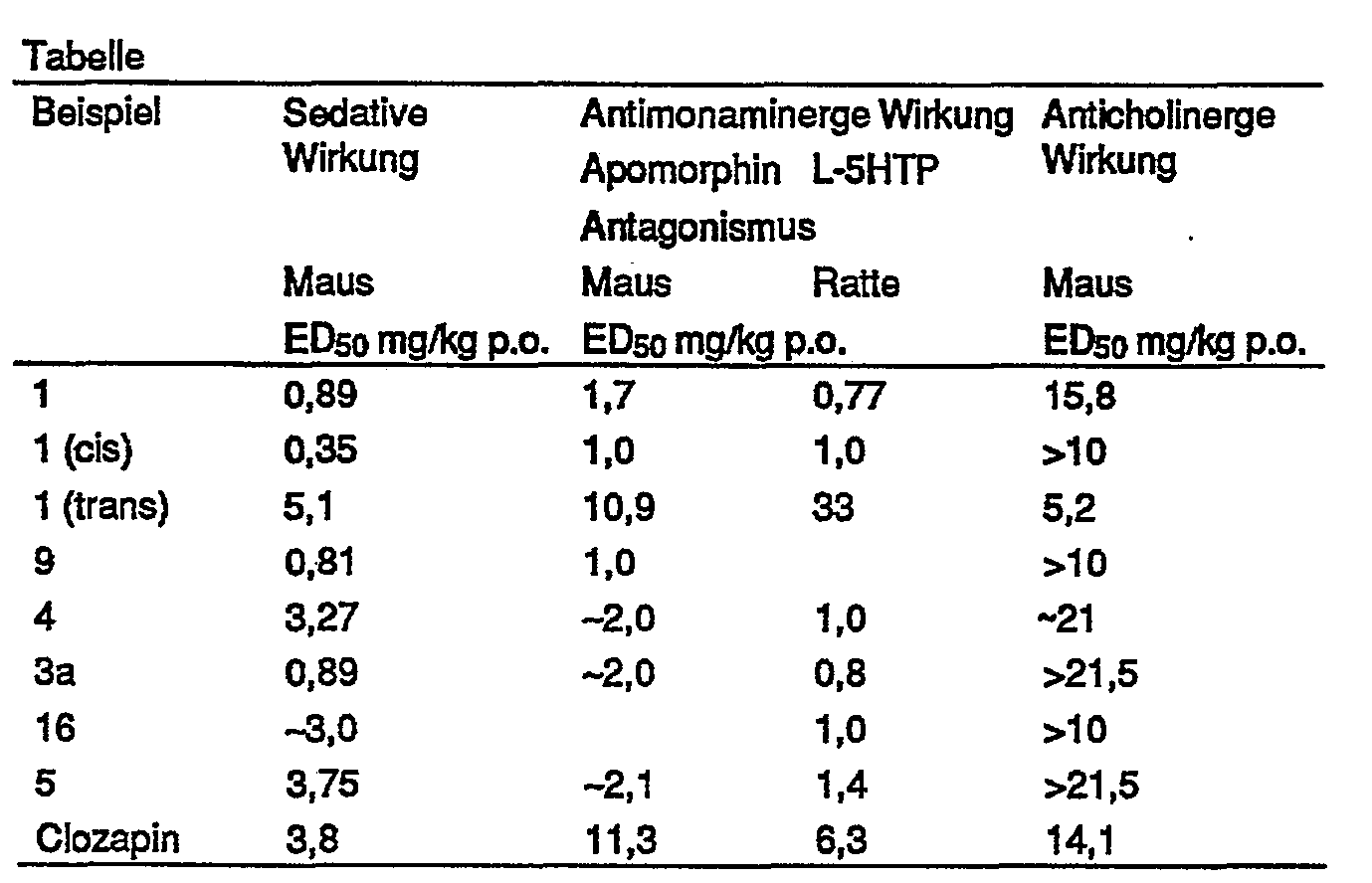
- Die Mehrzahl der erfindungsgemäßen Verbindungen zeigen in diesen Experimenten, in denen Sedativa, Minor oder Major Tranquilizer und zentrale Anticholinergica typischerweise wirksam sind, gute Wirkungen. Die Vergleichssubstanz wird in der sedativen und antimonaminergen Wirkung mindestens erreicht, meist jedoch deutlich (bis zum 10fachen) übertroffen. Die anticholinerge Wirkung ist bei der Mehrzahl der Verbindungen geringer ausgeprägt, was bei klinischer Anwendung im Hinblick auf anticholinerge Nebenwirkungen günstig ist.
- Die Isomerentrennung zeigt, daß die sedative und antimonaminerge Wirkung bevorzugt beim cis-Isomeren (Beispiel 1) zu finden ist, wobei die anticholinerge Wirkung stark zurücktritt. Das trans-Isomere (Beispiel 1) zeigt dagegen umgekehrt ein Überwiegen der anticholinergen Wirkung bei schwächerer sedativer und antimonaminerger Wirkung. Die anticholinerge Wirkung ist auch stärker als die der Vergleichssubstanzen.
- Die Erfindung betrifft dementsprechend auch ein therapeutisches Mittel, gekennzeichnet durch einen Gehalt an einer Verbindung der Formel oder deren pharmakologisch verträgliches Säureadditionssalz als Wirkstoff neben üblichen Träger- und Verdünnungsmitteln, sowie die Verwendung der neuen Verbindungen bei der Bekämpfung von Krankheiten.
- Die erfindungsgemäßen Verbindungen können in üblicher Weise oral oder parenteral, intravenös oder intramuskulär verabfolgt werden.
- Die Dosierung hängt vom Alter, Zustand und Gewicht des Patienten sowie von der Applikationsart ab. In der Regel beträgt die tägliche Wirkstoffdosis zwischen etwa 1 und 20 mg/kg Körpergewicht bei oraler Gabe und zwischen 0,1 und 2 mg/kg Körpergewicht bei parenteraler Gabe.
- Die neuen Verbindungen können in gebräuchlichen galenischen Applikationsformen fest oder flüssig angewendet werden, z.B. als Tabletten, Filmtabletten, Kapseln, Pulver, Granulate, Dragees, Suppositorien, Lösungen, Salben, Cremes oder Sprays. Diese werden in üblicher Weise hergestellt. Die Wirkstoffe können dabei mit den üblichen galenischen Hilfsmitteln wie Tablettenbindern, Füllstoffen, Konservierungsmitteln, Tablettensprengmitteln, Fließreguliermitteln, Weichmachern, Netzmitteln, Dispergiermittein, Emulgatoren, Lösungsmitteln, Retardierungsmitteln, Antioxidantien und/oder Treibgasen verarbeitet werden (vgl. H. Sucker et al: Pharmazeutische Technologie, Thieme-Verlag, Stuttgart, 1978). Die so erhaltenen Applikationsformen enthalten den Wirkstoff normalerweise in einer Menge von 0,1 bis 99 Gew.%.
- Die folgenden Beispiele dienen zur Erläuterung der Erfindung:
- Zu 18,0 g (117 mM) Thiophen-3,4-dicarbonsäureanhydrid in 200 ml Toluol wurden 10,9 g (117 mM) Anilin in 20 ml Toluol bei Raumtemperatur unter gutem Rühren zugetropft. Man ließ anschließend 2 bis 3 h nachrühren, saugte dann die dick ausgefallenen Festkörper ab, wusch gut mit Toluol nach und trocknete die Festkörper zuerst an der Luft und später im Vakuum. Die Ausbeute betrug 28 g (98 %), Schmp. 161-163°C.
- 17,5 g (71 mM) Thiophen-3,4-dicarbonsäurebenzamid wurden in 300 ml Tetrahydrofuran gelöst und unter gutem Rühren mit 8,2 g (71 mM) N-Hydroxysuccinimid sowie 14,7 g (71 mM) N,N'-Dicyclohexyl-carbodiimid versetzt. Man ließ das Reaktionsprodukt 2 h bei Raumtemperatur nachrühren, saugte den ausgefallenen Harnstoff ab, wusch mit wenig Tetrahydrofuran nach und engte das Filtrat zur Trockne ein. Der Rückstand wurde portionsweise in eine Schmelze aus 70 g (526 mM) AICI3 mit 10,5 ml Dimethylformamid bei 90°C Innentemperatur unter gutem Rühren eingetragen. Man hielt die Reaktionsmischung noch 2 h auf 90°C und goß anschließend den Ansatz noch heiß auf Eis, stellte mit HCI sauer und saugte die hellbraunen Festkörper nach einigem Rühren ab. Nach dem Nachwaschen mit H20 wurde das Produkt an der Luft getrocknet. Man erhielt 15,3 g (94 %) Produkt mit genügender Reinheit für die weitere Umsetzung.
- Zur Herstellung dieses Produktes führte man eine Carbonyl-Olefinierung des 4,5-Dihydro-thie- no[4,3-e]benzo-azepin-4,10-dions mit Hilfe der Wittig-Horner-Reaktion (a) oder über die klassische Wittig-Synthese (b) durch:
- a) 8,8 g (38,5 mM) 4,5-Dihydro-thieno[4,3-e]benzo-azepin-4,10-dion wurden in 70 ml Dimethylformamid unter Erwärmen gelöst und unter Stickstoff gerührt. Man ließ dann gleichzeitig 8,0 g (45 mM) Diethyl-cyanmethyl-phosphonat und 8,1 g (45 mM) Natriummethylat (30 %) gelöst in 10 ml Dimethylformamid langsam zutropfen (Farbzunahme und Temperaturerhöhung zeigen den Beginn der Wittig-Reaktion an). Nach 12 h Nachrühren bei Raumtemperatur goß man das Reaktionsprodukt auf Eiswasser und saugte die ausfallenden Festkörper ab. Nach gutem Nachwaschen mit Wasser wurde das Rohprodukt getrocknet und aus Ethanol umkristallisiert. Ausbeute: 8,8 g (91 %) 10-Cyanmethylen-4,5-dihydro-thie- no;[4,3-e]benzo-azepin-4-on, farblose Kristalle, Schmp. >265°C.
- b) Man legte Triphenyl-cyanomethyl-phosphonium-chlorid in Dimethylformamid vor, ließ anschließend 1 Moläquivalent einer 30 %igen Natriummethylat-Lösung zutropfen oder versetzte mit 1 Moläquivalent Natriumhydrid und fügte zuletzt 1 Moläquivalent einer Lösung von 4,5-Dihydro-thieno[4,3-e]benzo- azepin-4,10-dion in Dimethylformamid hinzu. Man ließ das Reaktionsgemisch 5 bis 8 h bei 50 bis 80°C nachrühren, goß anschließend auf Eiswasser und extrahierte mehrmals mit Methylenchlorid. Nach dem Trocknen und Einengen der organischen Phase kristallisierte man das Rohprodukt aus Ethanol um. Ausbeute: 65 % farblose Kristalle, Schmp. >265°C.
-
- a) 11,0 g (44 mM) 10-Cyanmelhylen-4,5-dihydro-thieno[4,3-e]4,3-e]benzo-azepin-4-on (cis,trans-Isomerengemisch) in 100 ml 1,1,2-Trichlorethan wurden mit 30 ml Phosphoroxychlorid und 1,0 ml N,N-Dimethylanilin versetzt und 0,5 h unter Stickstoffatmosphäre unter Rückfluß gekocht. Nach vollständigem Abdestillieren des überschüssigen Phosphoroxychlorids und Dimethylanilins im Ölpumpenvakuum verteilte man den Rückstand zwischen Methylenchlorid und Wasser, extrahierte die wäßrige Phase noch zweimal mit Methylenchlorid und wusch die vereinigten organischen Phasen mit verdünnter HCI und Wasser gründlich nach. Trocknen und Einengen der organischen Phase lieferte 11,6 g (98 %) 4-Chlor-10-cyanmethylen-thieno[4,3-e]benzo-azepin, das für die weitere Umsetzung genügend rein ist. 11,6 g (43 mM) 4-Chlor-10-cyanmethylen-thieno[4,3-e]benzo-azepin wurden in 70 ml Dimethylformamid gelöst, mit 10 ml (90 mM) N-Methyl-piperazin und 10 ml (75 mM) Triethylamin (stark exotherme Reaktion) versetzt und 2 bis 3 h bei 100°C unter Stickstoff gerührt. Das dunkle homogene Reaktionsgemisch goß man dann nach dem Abkühlen auf Eiswasser und saugte das gelbliche Rohprodukt, 10-Cyanmethylen-4-(4-methyl-piperazin-1-yl)-thieno[4,3-e]benzo-azepin, ab. Nach dem Trocknen im Vakuumtrockenschrank kristallisierte man das Rohprodukt aus Ethanol unter Zusatz von Aktivkohle um oder reinigte durch Säulenchromatographie (Kieselgel, Laufmittel Methylenchlorid/Methanol 95/5). Man erhielt 11,6 g (81 %) gelbliches 10-Cyanmethylen-4-(4-methyl-piperazin-1-yl)-thieno[4,3-e]benzo-azepin in Form eines cis,trans-Isomerengemisches, Schmp. 90 bis 92°C.
- b) Zur Trennung der cis,trans-Isomeren kristallisierte man das Isomerengemisch fraktioniert aus Ethanol um. Man isolierte als erste Fraktion 3,1 g gelbe Kristalle die nach dem Dünnschichtchromatogramm (Kieselgel, Laufmittel Toluol/Methanol 85/15) vornehmlich aus dem unpolaren isomeren a bestehen.
- Aus dem Filtrat kristallisierten, nachdem man die Lösung durch Einengen etwas konzentriert hatte, langsam 2,9 g gelbe Kristalle, die nach dem Dünnschichtchromatogramm (Kieselgel, Laufmittel To-Iuol/Methanol 85/15) vomehmlich aus dem polaren Isomeren b bestehen.
- Durch darauffolgende Kristallisation der angereicherten Produkte a und b aus Ethanol fielen die cis,trans-Isomeren praktisch rein an.
- Die Röntgenstrukturanalyse zeigte, daß es sich bei a um das cis-isomere und bei b um das trans-isomere 10-Cyanmethylen-4-(4-methyl-piperazin-1 -yl)-thieno[4,3-e]benzo-azepin handelt.
- Schmp.: Cis-Isomeres a 191-193°C, trans-Isomeres b 220-221°C.

- 2,8 g (8,4 mM) cis,trans-10-Cyanmethylen-4-(4-methyl-piperazin-1-yl)-thieno [4,3-e]benzo-azepin (vgl. Beispiel 1) wurden in 100 ml heißem Ethanol gelöst und mit 1,5 ml 30 %igem Wasserstoffperoxid versetzt. Nach 5 h Rückflußkochen zerstörte man das überschüssige Wasserstoffperoxid mit Hilfe eines kleinen Platinbleches, das in das Reaktionsgemisch geworfen wurde, durch 2 h Rückflußkochen. Nach dem Filtrieren engte man das Reaktionsgemisch ein und reinigte das erhaltene N-Oxid durch Säulenchromatographie (Kieselgel, Laufmittel Methylenchlorid/Methanol 95/5). Man isolierte 1,8 g (63 %) gelbe Kristalle.
- Die folgenden Substanzen erhält man analog Beispiel 1 und 2 unter Einsatz der entsprechenden substituierten Amine:
- 3. cis,trans-7-Chlor-10-cyanmethylen-4-(4-methyl-piperazin-1-yl)-thieno[4,3-e]benzo-azepin.
- 3a. c7is-7-Chlor-10-cyanmethylen-4-(4-methyl-piperazin-1-yl)-thieno[4,3-e]benzo-azepin.
- 3b. trans-7-Ch)or-10-cyanmethylen-4-(4-methyl-piperazin-1-yl)-thieno[4,3-e]benzo-azepin.
- 4. cis,trans-7-Fluor-10-cyanmethylen-4-(4-methyl-piperazin-1-yl)-thieno[4,3-e]benzo-azepin.
- 5. cis,trans-7-Methyl-10-cyanmethylen-4-(4-methyl-piperazin-1-yl)-thieno[4,3-e]benzo-azepin.
- 6. cis,trans-7-Trifluormethyl-10-cyanmethylen-4-(4-methyl-piperazin-1-yl)-thieno[4,3-e]benzo- azepin.
- 7. cis,trans-7-Methoxy-10-cyanmethylen-4-(4-methyl-piperazin-1-yl)-thieno[4,3-e]benzo-azepin.
- 8. cis,trans-10-Cyanmethylen-4-(piperazin-1-yl)-thieno[4,3-e]benzo-azepin.
- 9. cis,trans-10-Cyanmethylen-4-(4-ethyl-piperazin-1-yl)-thieno[4,3-e]benzo-azepin.
- 10. cis,trans-10-Cyanmethylen-4-(N'-methyl-homopiperazin-1-yl)-thieno[4,3-e]benzo-azepin.
- 11. cis,trans-10-Cyanmethylen-4-(2-piperidin-1-yl)-ethyl-amino)-thieno[4,3-e]benzo-azepin.
- 12. cis,trans-10-Cyanmethylen-4-(2-dimethylamino-ethylamino)-thieno[4,3-e]benzo-azepin.
- 13. cis,trans-10-Cyanmethylen-4-(4-cyclopropyl-piperazin-1-yl)-thieno[4,3-e]benzo-azepin.
- 14. cis,trans-10-Cyanmethylen-4-(4-cyclopropylmethyl-piperazin-1-yl)-thieno[4,3-e]benzo-azepin.
- 15. cis,trans-10-Cyanmethylen-4-(4-propin-2-yl-piperazin-1-yl)-thieno[4,3-e]benzo-azepin.
- 16. trans-6-Chlor-1 0-cyanmethylen-4-(4-methyl-piperazin-1 -yl)-thieno-[4,3-e]benzo-azepin
- Auf einer Tablettenpresse werden in üblicher Weise Tabletten folgender Zusammensetzung gepreßt:
- 40 mg Substanz des Beispiels 1 (cis)
- 120 mg Maisstärke
- 13,5 mg Gelatine
- 45 mg Milchzucker
- 2,25 mg Aerosil® (chemisch reine Kieselsäure in submikroskopisch feiner Verteilung)
- 6,75 mg Kartoffelstärke (als 6 %iger Kleister)
- In üblicher Weise werden Dragees folgender Zusammensetzung hergestellt:
- 20 mg Substanz des Beispiels 1 (cis)
- 60 mg Kernmasse
- 60 mg Verzuckerungsmasse
- Die Kernmasse besteht aus 9 Teilen Maisstärke, 3 Teilen Milchzucker und 1 Teil Luviskol@ VA 64 (Vinylpyrrolidon-Vinylacetat-Mischpolymerisat 60:40, vgl. Pharm. lnd. 1962, 586). Die Verzuckerungsmasse besteht aus 5 Teilen Rohrzucker, 2 Teilen Maisstärke, 2 Teilen Calciumcarbonat und 1 Teil Talk. Die so hergestellten Dragees werden anschließend mit einem magensaftresistenten Überzug versehen.
- 10 g Substanz des Beispiels 1 (cis) werden in 5000 ml Wasser unter Zusatz von NaCI gelöst und mit 0,1 N NaOH auf pH 6,0 eingestellt, so daß eine blutisotonische Lösung entsteht. Jeweils 5 ml dieser Lösung werden in Ampullen gefüllt und sterilisiert.
Claims (12)

R ein Wasserstoff- oder Halogenatom, einen Alkylrest mit 1 bis 3 C-Atomen, Trifluormethyl oder einen Alkoxyrest mit 1 bis 3 C-Atomen bedeutet, und A für einen Aminorest -NRiR2 steht, in dem R1 und R2 zusammen mit dem sie verbindenden Stickstoffatom einen 5- bis 7-gliedrigen gesättigten Ring bedeuten, der gegebenenfalls als weiteres Heteroatom ein Stickstoff- oder Sauerstoffatom enthält, wobei ein zusätzlich vorhandenes Stickstoffatom gegebenenfalls durch einen Alkylrest mit 1 bis 3 C-Atomen, einen Hydroxyalkylrest mit 2 bis 3 C-Atomen, einen Alkoxyalkylrest mit 1 bis 3 C-Atomen im Alkyl- und Alkoxyrest, einen Cycloalkyl- oder Cycloalkylmethylrest mit 3 bis 7 C-Atomen im Cycloalkylring, einen Alkinylrest mit 2 bis 5 C-Atomen und gegebenenfalls zusätzlich durch Sauerstoff in Form eines N-Oxids substituiert ist, oder A einen Aminorest -NHR3, in dem R3 einen Aminoalkylrest mit 2 bis 7 C-Atomen bedeutet, wobei das Aminstickstoffatom gegebenenfalls durch einen niederen Alkylrest mit 1 bis 5 C-Atomen substituiert oder Bestandteil eines 5- bis 7-gliedrigen gesättigten Ringes ist, der gegebenenfalls ein Stickstoff- oder Sauerstoffatom als weiteres Heteroatom enthält, wobei ein vorhandenes Stickstoffatom durch einen niederen Alkylrest mit 1 bis 3 C-Atomen oder einen Hydroxyalkylrest mit 2 bis 3 C-Atomen substituiert sein kann, bedeutet, und ihre physiologisch verträglichen Säureadditionssalze, dadurch gekennzeichnet, daß man eine Verbindung der Formel II

Priority Applications (1)
| Application Number | Priority Date | Filing Date | Title |
|---|---|---|---|
| AT86109187T ATE47392T1 (de) | 1985-07-11 | 1986-07-04 | 4-substituierte 10-cyanmethylen-thieno(4,3-e>benzo-azepine. |
Applications Claiming Priority (2)
| Application Number | Priority Date | Filing Date | Title |
|---|---|---|---|
| DE3524744 | 1985-07-11 | ||
| DE19853524744 DE3524744A1 (de) | 1985-07-11 | 1985-07-11 | 4-substituierte 10-cyanmethylen-thieno (4,3-e)-benzo-azepine |
Publications (2)
| Publication Number | Publication Date |
|---|---|
| EP0209022A1 EP0209022A1 (de) | 1987-01-21 |
| EP0209022B1 true EP0209022B1 (de) | 1989-10-18 |
Family
ID=6275481
Family Applications (1)
| Application Number | Title | Priority Date | Filing Date |
|---|---|---|---|
| EP86109187A Expired EP0209022B1 (de) | 1985-07-11 | 1986-07-04 | 4-Substituierte 10-Cyanmethylen-thieno[4,3-e]-benzo-azepine |
Country Status (6)
| Country | Link |
|---|---|
| US (1) | US4745111A (de) |
| EP (1) | EP0209022B1 (de) |
| JP (1) | JPS6219590A (de) |
| AT (1) | ATE47392T1 (de) |
| CA (1) | CA1267894A (de) |
| DE (2) | DE3524744A1 (de) |
Families Citing this family (4)
| Publication number | Priority date | Publication date | Assignee | Title |
|---|---|---|---|---|
| DE3717069A1 (de) * | 1987-05-21 | 1988-12-08 | Basf Ag | 5-substituierte 10-cyanmethylen-thieno(3,4-b)-benzo-azepine |
| DE3717068A1 (de) * | 1987-05-21 | 1988-12-08 | Basf Ag | 4-substituierte 10-cyanmethylen-pyrrolo(4,3-e)-benzo-azepine |
| AU5119400A (en) * | 1999-05-26 | 2000-12-18 | Astrazeneca Ab | Compounds |
| TW200808810A (en) * | 2006-02-23 | 2008-02-16 | Novartis Ag | Organic compounds |
Family Cites Families (5)
| Publication number | Priority date | Publication date | Assignee | Title |
|---|---|---|---|---|
| CH592096A5 (de) * | 1974-03-26 | 1977-10-14 | Sandoz Ag | |
| EP0001401A1 (de) * | 1977-09-29 | 1979-04-18 | Sandoz Ag | Thienobenzazepinderivate, Verfahren zu deren Herstellung, und diese enthaltende pharmazeutische Zusammensetzungen |
| DE2918778A1 (de) * | 1979-05-10 | 1980-11-20 | Basf Ag | 6-substituierte 11-alkylen-morphantridine |
| DE3037971A1 (de) * | 1980-10-08 | 1982-05-13 | Basf Ag, 6700 Ludwigshafen | 5-substituierte 9-cyanmethylendithieno (3,4-b:4' 3'-e) -azepine |
| US4362727A (en) * | 1981-09-29 | 1982-12-07 | Basf Aktiengesellschaft | 5-Substituted 9-cyanomethylene-dithieno[3,4-b:4,3-e]-azepines and therapeutic agents which contain these compounds |
-
1985
- 1985-07-11 DE DE19853524744 patent/DE3524744A1/de not_active Withdrawn
-
1986
- 1986-07-04 AT AT86109187T patent/ATE47392T1/de active
- 1986-07-04 CA CA000513128A patent/CA1267894A/en not_active Expired - Lifetime
- 1986-07-04 DE DE8686109187T patent/DE3666433D1/de not_active Expired
- 1986-07-04 EP EP86109187A patent/EP0209022B1/de not_active Expired
- 1986-07-09 US US06/883,628 patent/US4745111A/en not_active Expired - Fee Related
- 1986-07-10 JP JP61161009A patent/JPS6219590A/ja active Pending
Non-Patent Citations (1)
| Title |
|---|
| Medical Chemistry: Berger, Part I, Willy-Interscience, 1970, Seite 77 * |
Also Published As
| Publication number | Publication date |
|---|---|
| US4745111A (en) | 1988-05-17 |
| EP0209022A1 (de) | 1987-01-21 |
| CA1267894A (en) | 1990-04-17 |
| DE3666433D1 (en) | 1989-11-23 |
| JPS6219590A (ja) | 1987-01-28 |
| ATE47392T1 (de) | 1989-11-15 |
| DE3524744A1 (de) | 1987-01-15 |
Similar Documents
| Publication | Publication Date | Title |
|---|---|---|
| DE3342164C2 (de) | ||
| DE3008944A1 (de) | Dibenzimidazoazepine, ihre herstellung und verwendung | |
| DE69007905T2 (de) | 1-Oxa-2-oxo-8-azaspiro[4,5]decan-Derivate, Verfahren zu ihrer Herstellung und pharmazeutische Zusammensetzungen daraus. | |
| EP0019172B1 (de) | 6-Substituierte 11-Alkylen-morphantridine, Verfahren zu ihrer Herstellung und diese enthaltende therapeutische Mittel | |
| EP0050212B1 (de) | 5-Substituierte 9-Cyanmethylen-dithieno(3,4-b:4'.3'-e)-azepine, Verfahren zu ihrer Herstellung und diese enthaltende therapeutische Mittel | |
| EP0209022A1 (de) | 4-Substituierte 10-Cyanmethylen-thieno[4,3-e]-benzo-azepine | |
| DE2847623C2 (de) | 4-Amino-2-(piperazin-1-yl oder homopiperazin-1-yl)-chinazolinderivate, Verfahren zu ihrer Herstellung und diese enthaltende Arzneimittel | |
| DE2229845B2 (de) | 6-o-Halogenphenyl-4H-s-triazolo [3,4-c] thieno [2,3e] [1,4] diazepine, Verfahren zu deren Herstellung und diese enthaltende pharmazeutische Massen | |
| EP0291888B1 (de) | 4-substituierte 10-Cyanmethylenpyrrolo[4,3-e]-benzo-azepine | |
| EP0061709B1 (de) | 5,6-Dihydro-11-alkylen-morphantridin-6-one, ihre Herstellung und diese enthaltende Arzneimittel | |
| DE2931398A1 (de) | Neue 1-benzoxepin-5(2h)-on-derivate und ihre salze, verfahren und zwischenprodukte zu deren herstellung und diese verbindungen enthaltende arzneimittel | |
| DE3717069A1 (de) | 5-substituierte 10-cyanmethylen-thieno(3,4-b)-benzo-azepine | |
| EP0110253B1 (de) | Substituierte 1-Oxo-2-phenyl-2-(2-alkylaminoethyl)-1,2,3,4-tetrahydronaphthaline, ihre Herstellung und Verwendung | |
| EP0000479B1 (de) | Substituierte 1-Piperazinyl-4H-s-triazolo (3,4-c)thieno(2,3-e)1,4-diazepine, Verfahren zu deren Herstellung und diese enthaltende Arzneimittel | |
| EP0167045A1 (de) | Benzo (c)(1,8)naphthyridine, Verfahren zu ihrer Herstellung und ihre Verwendung sowie diese Verbindungen enthaltende Zubereitungen | |
| EP0035711B1 (de) | 10-substituierte 5-Cyanmethylen-dibenzo(a,d)-cycloheptene, Verfahren zu ihrer Herstellung und diese enthaltende therapeutische Mittel | |
| EP0035714B1 (de) | 10-substituierte 5-Cyanmethylen-10,11-dihydro-dibenzo-(a,d)-cycloheptene, Verfahren zu ihrer Herstellung und diese enthaltende therapeutische Mittel | |
| EP0008045B1 (de) | (1,2)-Anellierte 7-Phenyl-1,4-benzodiazepinderivate und deren Salze; Verfahren zu deren Herstellung und diese Verbindungen enthaltende Arzneimittel | |
| DE60220305T2 (de) | Verbrückte bicyclische (1,4) benzodiazepine als vasopressinrezeptorantagonisten | |
| DE3611097A1 (de) | Neues, in 11-stellung substituiertes 5,11-dihydro-6h-pyrido(2,3-b)(1,4)benzodiazepin-6-on, verfahren zu seiner herstellung und diese verbindung enthaltende arzneimittel | |
| DE3704604A1 (de) | Oximether von 2,6-dioxabicyclo(3.3.0)octanonen, herstellungsverfahren und anwendung als arzneimittel | |
| DD271519A5 (de) | Verfahren zur herstellung von neuen 1-aryloxy-dihydrobenzothiadiazinylalkylamino-alkanen | |
| CH637394A5 (en) | Tetracyclic compounds possessing therapeutic activity | |
| DE1908497A1 (de) | Neue Pyrimidinderivate und Verfahren zu deren Herstellung | |
| DE3339635A1 (de) | Azepino(1,2-a)pyrimidin-derivate, verfahren zu deren herstellung und diese verbindungen enthaltende pharmazeutische praeparate |
Legal Events
| Date | Code | Title | Description |
|---|---|---|---|
| PUAI | Public reference made under article 153(3) epc to a published international application that has entered the european phase |
Free format text: ORIGINAL CODE: 0009012 |
|
| AK | Designated contracting states |
Kind code of ref document: A1 Designated state(s): AT BE CH DE FR GB IT LI NL SE |
|
| 17P | Request for examination filed |
Effective date: 19861129 |
|
| 17Q | First examination report despatched |
Effective date: 19880425 |
|
| GRAA | (expected) grant |
Free format text: ORIGINAL CODE: 0009210 |
|
| AK | Designated contracting states |
Kind code of ref document: B1 Designated state(s): AT BE CH DE FR GB IT LI NL SE |
|
| REF | Corresponds to: |
Ref document number: 47392 Country of ref document: AT Date of ref document: 19891115 Kind code of ref document: T |
|
| ITF | It: translation for a ep patent filed | ||
| GBT | Gb: translation of ep patent filed (gb section 77(6)(a)/1977) | ||
| REF | Corresponds to: |
Ref document number: 3666433 Country of ref document: DE Date of ref document: 19891123 |
|
| ET | Fr: translation filed | ||
| PLBE | No opposition filed within time limit |
Free format text: ORIGINAL CODE: 0009261 |
|
| STAA | Information on the status of an ep patent application or granted ep patent |
Free format text: STATUS: NO OPPOSITION FILED WITHIN TIME LIMIT |
|
| 26N | No opposition filed | ||
| ITTA | It: last paid annual fee | ||
| EAL | Se: european patent in force in sweden |
Ref document number: 86109187.4 |
|
| PGFP | Annual fee paid to national office [announced via postgrant information from national office to epo] |
Ref country code: FR Payment date: 19970623 Year of fee payment: 12 |
|
| PGFP | Annual fee paid to national office [announced via postgrant information from national office to epo] |
Ref country code: SE Payment date: 19970625 Year of fee payment: 12 |
|
| PGFP | Annual fee paid to national office [announced via postgrant information from national office to epo] |
Ref country code: GB Payment date: 19970701 Year of fee payment: 12 |
|
| PGFP | Annual fee paid to national office [announced via postgrant information from national office to epo] |
Ref country code: CH Payment date: 19970703 Year of fee payment: 12 Ref country code: AT Payment date: 19970703 Year of fee payment: 12 |
|
| PGFP | Annual fee paid to national office [announced via postgrant information from national office to epo] |
Ref country code: NL Payment date: 19970708 Year of fee payment: 12 |
|
| PGFP | Annual fee paid to national office [announced via postgrant information from national office to epo] |
Ref country code: BE Payment date: 19970711 Year of fee payment: 12 |
|
| PGFP | Annual fee paid to national office [announced via postgrant information from national office to epo] |
Ref country code: DE Payment date: 19970723 Year of fee payment: 12 |
|
| PG25 | Lapsed in a contracting state [announced via postgrant information from national office to epo] |
Ref country code: GB Free format text: LAPSE BECAUSE OF NON-PAYMENT OF DUE FEES Effective date: 19980704 Ref country code: AT Free format text: LAPSE BECAUSE OF NON-PAYMENT OF DUE FEES Effective date: 19980704 |
|
| PG25 | Lapsed in a contracting state [announced via postgrant information from national office to epo] |
Ref country code: SE Free format text: LAPSE BECAUSE OF NON-PAYMENT OF DUE FEES Effective date: 19980705 |
|
| PG25 | Lapsed in a contracting state [announced via postgrant information from national office to epo] |
Ref country code: DE Free format text: LAPSE BECAUSE OF THE APPLICANT RENOUNCES Effective date: 19980728 |
|
| PG25 | Lapsed in a contracting state [announced via postgrant information from national office to epo] |
Ref country code: LI Free format text: LAPSE BECAUSE OF NON-PAYMENT OF DUE FEES Effective date: 19980731 Ref country code: CH Free format text: LAPSE BECAUSE OF NON-PAYMENT OF DUE FEES Effective date: 19980731 Ref country code: BE Free format text: LAPSE BECAUSE OF NON-PAYMENT OF DUE FEES Effective date: 19980731 |
|
| BERE | Be: lapsed |
Owner name: BASF A.G. Effective date: 19980731 |
|
| PG25 | Lapsed in a contracting state [announced via postgrant information from national office to epo] |
Ref country code: NL Free format text: LAPSE BECAUSE OF NON-PAYMENT OF DUE FEES Effective date: 19990201 |
|
| GBPC | Gb: european patent ceased through non-payment of renewal fee |
Effective date: 19980704 |
|
| REG | Reference to a national code |
Ref country code: CH Ref legal event code: PL |
|
| EUG | Se: european patent has lapsed |
Ref document number: 86109187.4 |
|
| PG25 | Lapsed in a contracting state [announced via postgrant information from national office to epo] |
Ref country code: FR Free format text: LAPSE BECAUSE OF NON-PAYMENT OF DUE FEES Effective date: 19990331 |
|
| NLV4 | Nl: lapsed or anulled due to non-payment of the annual fee |
Effective date: 19990201 |
|
| REG | Reference to a national code |
Ref country code: FR Ref legal event code: ST |
|
| PG25 | Lapsed in a contracting state [announced via postgrant information from national office to epo] |
Ref country code: IT Free format text: LAPSE BECAUSE OF NON-PAYMENT OF DUE FEES;WARNING: LAPSES OF ITALIAN PATENTS WITH EFFECTIVE DATE BEFORE 2007 MAY HAVE OCCURRED AT ANY TIME BEFORE 2007. THE CORRECT EFFECTIVE DATE MAY BE DIFFERENT FROM THE ONE RECORDED. Effective date: 20050704 |