EP0206727B2 - Herstellung von mechanisch legierten Pulvern - Google Patents
Herstellung von mechanisch legierten Pulvern Download PDFInfo
- Publication number
- EP0206727B2 EP0206727B2 EP86304644A EP86304644A EP0206727B2 EP 0206727 B2 EP0206727 B2 EP 0206727B2 EP 86304644 A EP86304644 A EP 86304644A EP 86304644 A EP86304644 A EP 86304644A EP 0206727 B2 EP0206727 B2 EP 0206727B2
- Authority
- EP
- European Patent Office
- Prior art keywords
- powder
- milling
- mill
- apparent density
- produce
- Prior art date
- Legal status (The legal status is an assumption and is not a legal conclusion. Google has not performed a legal analysis and makes no representation as to the accuracy of the status listed.)
- Expired - Lifetime
Links
Images
Classifications
-
- B—PERFORMING OPERATIONS; TRANSPORTING
- B22—CASTING; POWDER METALLURGY
- B22F—WORKING METALLIC POWDER; MANUFACTURE OF ARTICLES FROM METALLIC POWDER; MAKING METALLIC POWDER; APPARATUS OR DEVICES SPECIALLY ADAPTED FOR METALLIC POWDER
- B22F9/00—Making metallic powder or suspensions thereof
- B22F9/02—Making metallic powder or suspensions thereof using physical processes
- B22F9/04—Making metallic powder or suspensions thereof using physical processes starting from solid material, e.g. by crushing, grinding or milling
-
- B—PERFORMING OPERATIONS; TRANSPORTING
- B22—CASTING; POWDER METALLURGY
- B22F—WORKING METALLIC POWDER; MANUFACTURE OF ARTICLES FROM METALLIC POWDER; MAKING METALLIC POWDER; APPARATUS OR DEVICES SPECIALLY ADAPTED FOR METALLIC POWDER
- B22F9/00—Making metallic powder or suspensions thereof
- B22F9/02—Making metallic powder or suspensions thereof using physical processes
- B22F9/04—Making metallic powder or suspensions thereof using physical processes starting from solid material, e.g. by crushing, grinding or milling
- B22F2009/041—Making metallic powder or suspensions thereof using physical processes starting from solid material, e.g. by crushing, grinding or milling by mechanical alloying, e.g. blending, milling
-
- B—PERFORMING OPERATIONS; TRANSPORTING
- B22—CASTING; POWDER METALLURGY
- B22F—WORKING METALLIC POWDER; MANUFACTURE OF ARTICLES FROM METALLIC POWDER; MAKING METALLIC POWDER; APPARATUS OR DEVICES SPECIALLY ADAPTED FOR METALLIC POWDER
- B22F9/00—Making metallic powder or suspensions thereof
- B22F9/02—Making metallic powder or suspensions thereof using physical processes
- B22F9/04—Making metallic powder or suspensions thereof using physical processes starting from solid material, e.g. by crushing, grinding or milling
- B22F2009/043—Making metallic powder or suspensions thereof using physical processes starting from solid material, e.g. by crushing, grinding or milling by ball milling
-
- Y—GENERAL TAGGING OF NEW TECHNOLOGICAL DEVELOPMENTS; GENERAL TAGGING OF CROSS-SECTIONAL TECHNOLOGIES SPANNING OVER SEVERAL SECTIONS OF THE IPC; TECHNICAL SUBJECTS COVERED BY FORMER USPC CROSS-REFERENCE ART COLLECTIONS [XRACs] AND DIGESTS
- Y10—TECHNICAL SUBJECTS COVERED BY FORMER USPC
- Y10S—TECHNICAL SUBJECTS COVERED BY FORMER USPC CROSS-REFERENCE ART COLLECTIONS [XRACs] AND DIGESTS
- Y10S241/00—Solid material comminution or disintegration
- Y10S241/14—Grinding in inert, controlled atmosphere
Definitions
- This invention relates to powder metallurgy, and more particularly to a method of assessing the processing level of a mechanically alloyed powder produced on a commercial scale.
- a method for producing metal powders comprised of a plurality of constituents mechanically alloyed together such that each of the particles is characterized metallographically by an internal structure in which the starting constituents are mutually interdispersed within each particle.
- production of such particles involves the dry, intensive, impact milling of powder particles such that the constituents are welded and fractured continuously and repetitively until, in time, the intercom- ponent spacing of the constituents within the particles can be made very small.
- the particles are heated to a diffusion temperature, interdiffusion of the diffusable constituents is effected quite rapidly.
- the powders produced by mechanical alloying are subsequently consolidated into bulk forms by various well known methods such as degassing and hot compaction followed by shaping, e.g., by extrusion, rolling or forging.
- alloying ingredients such as chromium, aluminum and titanium, which have a propensity to oxidize easily.
- This permits production of mechanically alloyed powder particles containing any of the metals normally difficult to alioy with another metal.
- alloy systems of readily oxidizable components such as aluminum, magnesium, lithium, titanium, and copper.
- the present invention is independent of the type of mill used to achieve the mechanically alloyed powder.
- one aspect of the present invention is that the milling to produce the mechanically alloyed powder is carried out in a "gravity-dependent-type" ball mill. Dry, intensive, high energy milling is not restricted to any type of apparatus.
- the principal method of producing mechanically alloyed powders has been in attritors.
- An attritor is a high energy ball mill in which the charge media are agitated by an impeller located in the media. In the attritor the ball motion is imparted by action of the impeller.
- Other types of mills in which high intensity milling can be carried out are gravity-dependent-type ball mills, which are rotating mills in which the axis of rotation of the shell of the apparatus is coincidental with a central axis.
- the axis of a gravity-dependent-type ball mill (GTBM) is typically horizontal but the mill may be inclined even to where the axis approaches a vertical level.
- the mill shape is typically circular, but it can be other shapes, for example, conical.
- Ball motion is imparted by a combination of mill shell rotation and gravity.
- the GTBM's contain lifters, which on rotation of the shell inhibit sliding of the balls along the mill wall. In the GTBM, ball-powder interaction is dependent on the drop height of the balls.
- the present method is distinguished from prior use of GTBM apparatus to grind flake, particles of foil, or other particles so as to reduce the particle size, and thereby to reduce the interparticle spacing of dispersoid.
- the present process differs from prior art grinding in a GTBM, for example, in the type of environment used in the mill, the time to achieve the end purpose and the type of product obtained.
- the milling is carried out in a medium which encourages fracturing of the particles.
- mechanically alloy the components of a system, repetitive welding and fracturing of the particles are required.
- the processing is essentially dry and a process control agent may be necessary. Such agents will vary with the materials being processed.
- the process control agent may also contribute to the composition, e.g., as a precursor of oxides and carbides.
- U.S. Patent No. 4,443,249 discloses an improved process for producing mechanically alloyed powders on a commercial scale.
- the present invention is a further improvement in producing mechanically alloyed powders, and it may also be carried out in a GTBM.
- mechanical alloying has a potential for use with a vast number of systsms.
- the principles disclosed herein are of general application, enabling one to process materials in a GTBM in a practical and commercial manner.
- the description below will be mainly with reference to obtaining mechanically alloyed powders of materials which are readily mechanically weldable. This may occur, for example, in preparing alloy compositions containing metals such as aluminum, magnesium, titanium, copper, lithium, chromium and/or tantalum in sufficient amount for their cold weldability to become a major factor in processing.
- Composition is only one contributing factor to properties.
- Mechanical alloying is another, in that it enables the unique combination of materials.
- Still another determinative factor is the processing level of the mechanically alloyed powder.
- a characteristic feature of mechanically alloyed powder is the mutual interdispersion of the initial constituents within each particle.
- each particle has substantially the same composition as the nominal composition of the alloy.
- the powder processing level is the extent to which the individual constituents are commingled into composite particles and the extent to which the individual constituents are refined in size.
- the mechanically alloyed powder can be overprocessed as well as underprocessed.
- An acceptable processing level is the extent of mechanical alloying required in the powder.
- the morphology of the powder may be sufficiently changed so as to make it more difficult to obtain the desired properties in the consolidated end product.
- Processing beyond complete process control agent utilization may only add redundant cold work to the powder. Determination of the properties of a material can only be made after consolidation and thermomechanical processing of the powders. It will be appreciated that it is costly to learn at such a late stage that powder has not been processed to an acceptable level. Costs, inconvenience, loss of time and availability of equipment increase as the quantities of material increase. Thus, in a ball mill in which large amounts of high quality, high cost materials, such costs can make the materials unacceptable from an economic vantagepoint.
- the present method offers a simple, economical way of meeting an acceptable processing level in mechanically alloyed powders.
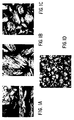
- Figures 1a, b, c and d are photomicrographs at 200x magnification of a mechanically alloyed powder having the nominal aluminum and magnesium levels, respectively, of 96% and 4% by weight, and prepared in a GTBM at a 31.5 mill vol. % and a 20:1 ball to powder ratio. Stearic acid in an amount of 1.5% was added and milling was carried out for 7, 12, 16 and 24 hours, respectively.
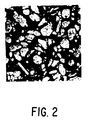
- Figure 2 is a photomicrograph at 200x magnification of a mechanically alloyed powder having essentially the same aluminum-magnesium composition as that of Figure 1d. However, the powder was processed in an attritor.
- While the present invention is not restricted to any type of mill, for example, it can be carried out in an attritor-type or gravity-dependent-type mill, it is particularly useful in a gravity-dependent-type mill since the latter type mills are capable of processing larger feed-throughs.
- the apparent density for powder is the weight of a unit volume of loose powder expressed in grams per cubic centimeter determined by a specific method. In the tests reported herein the apparent density was determined by ASTM Test No. B 212-48 (for flowable powder) and No. B 417-64 (for non-free-flowing powder).
- Fully compacted density of the powder is the density of an essentially non-porous compacted material made from the powder. An essentially non-porous material is one which has no readily discernable residual porosity.
- the apparent density is above 30%, and preferably at least 35% of the fully compacted density.
- the apparent density is no greater than about 65% of the fully compacted density, and preferably it may range up to about 55%.
- the apparent density is in the range of about 30% to about 60%, and preferably above about 30% up to about 50% of the fully compacted density.
- the fully compacted density was determined to be about 2.66 g/cm 3 , and for achieving optimum and reproducible properties in the end product the apparent density is suitably at least about 0.8 g/cm3, advantageously 0.9 g/cm 3 and preferably in the range of about 1 to about 1.3 g/cm 3 .
- the present process applies generally to materials that can be produced as mechanically alloyed powders.
- Such powders may range from simple binary systems to complex alloys, such systems not being limited by considerations imposed. They may or may not include a refractory dispersoid. They may be dispersion strengthened or composite systems. All components of the system are or are capable of being uniformly dispersed with a suitable heat treatment.
- the systems contain at least one metal, which may be a noble or a base metal.
- the metal may be present in elemental form, as an intermetallic, as a compound or part of a compound. Examples of alloy systems amenable to mechanical alloying techniques are described in detail in the aforementioned U.S. Patents, which are incorporated herein by reference.
- the patents describe, for example, many nickel-, iron-, cobalt-, copper-, precious metal-, titanium- and aluminum-base alloy systems.
- Examples of the more complex alloy systems that can be produced by the invention include well known heat resistant alloys such as alloys based on nickel-chromium, cobalt-chromium, iron-chromium systems containing one or more of such alloying additions as molybdenum, manganese, tungsten, niobium, tantalum, aluminum, titanium, zinc, cerium and the like.
- the present system is particularly useful for producing mechanically alloyed powders of readily mechanically weldable materials, for example, aluminum, titanium, magnesium, copper, tantalum, niobium, lithium containing materials.
- Such materials may be alloys, e.g., with each other and/or containing one or more of such components comprising lithium, calcium, boron, yttrium, zinc, silicon, nickel, cobalt, chromium, vanadium, cerium and other rare earth metals, beryllium, manganese, tin, iron and/or zirconium.
- Constituents may be added in their elemental form or, to avoid contamination from atmospheric exposure, as master alloy or metal compound additions wherein the more reactive alloying addition is diluted or compounded with a less reactive metal such as nickel, iron, cobalt, etc.
- a less reactive metal such as nickel, iron, cobalt, etc.
- Certain of the alloying non-metals, such as carbon, silicon, boron, and the like, may be employed in the powder form or added as master alloys diluted or compounded with less reactive metals.
- the simple or more complex alloys can be produced with uniform dispersions of hard phases, such as oxides, carbides, nitrides, borides and the like.
- the dispersion may be oxides, carbides, nitrides, borides of such elements as thorium, zirconium, hafnium, titanium, silicon, boron, aluminum, yttrium, cerium and other rare earth metals, uranium, magnesium, calcium, beryllium, tantalum, etc.
- Compositions produced may include hard phases over a broad range so long as a sufficiently ductile component is present to provide a host matrix for the hard phase or dispersoid.
- the amount of dispersoid may range from a small but effective amount for increased strength, e.g., 0.15% by volume or even less (e.g., 0.1%) up to 25% by volume or more, advantageously from about 0.1% to about 5% or 10% by volume.
- the hard phases may range to a considerably higher percentage of the system even over 50 or 60 volume %.
- the processing of the present invention is not limited to any particular system.
- readily mechanically weldable alloys e.g. of the type aluminum-, magnesium-, titanium-, copper-, lithium- and tantalum-base alloys
- examples can be found by those skilled in the art in well-known metals handbooks.
- aluminum alloys such alloys would be of the 1000 through 8000 series and aluminum- lithium alloys.
- the nominal magnesium content is about 4%
- the carbon content ranges from about 1 % to about 1.3%
- oxygen is present in a small amount, viz. less than 1%.
- typical alloys may comprise by weight up to about 65% chromium, e.g., about 5% to 30% chromium, up to about 10% aluminum, e.g., about 0.1% to 9.0% aluminum, up to about 10% titanium, e.g., about 0.1 % to 9.0% titanium, up to about 40% molybdenum, up to about 40% tungsten, up to about 30% niobium, up to about 30% tantalum, up to about 2% vanadium, up to about 15% manganese, up to about 2% carbon, up to about 3% silicon, up to about 1% boron, up to about 2% zirconium, up to about 0.5% magnesium and the balance at least one element selected from a group consisting of essentially of iron group metals (iron, nickel, cobalt) and copper with the sum of the iron, nickel, cobalt and copper being at least 25%, with or without dispersion strengthening constituents such as yttria
- the metal systems of limited solubility may include copper-iron with the copper ranging from about 1% to 95%; copper-tungsten with the copper ranging from about 5% to 98% and the balance substantially tungsten; chromium-copper with the chromium ranging from about 0.1 % to 95% and the balance substantially copper and the like.
- the system of limited solubility is a copper-base material
- the second element e.g., tungsten, chromium and the like, may be employed as dispersion strengtheners.
- the starting particle size of the starting metals may range from about over 1 micrometers up to as high as 1000 micrometers. It is advantageous not to use too fine a particle size, particularly where reactive metals are involved. Therefore, it is preferred that the starting particle size of the metals range from about 3 micrometers up to about 250 micrometers.
- composition should be selected with end use contemplated.
- oxygen level should be less than 1%.
- carbon content should be less than 2%.
- the chemical constituents of the powder product are interdispersed, and the uniformity and energy content of the powder product will depend on the processing conditions.
- important the powder processing are the size of the mill, the size of the balls, the ball mass to powder mass ratio, the mill charge volume, the mill speed, the process control agents (including the processing atmosphere) and processing time. Even the materials of construction of the mills and balls may have a bearing on the powder product.
- the feed materials to the mill may be fed directly to the mill or may be preblended and/or may be pre- alloyed.
- the feed is charged to a GTBM which, for example, has a diameter ranging from above 1 foot (30 cm) to about 8 feet (2.44 m) (and greater). Economic factors may mitigate against scale-up of such a mill to greater than 8 feet in diameter, and the length may vary from about 1 foot (30 cm) to about 10 feet (3.05m) (and greater) depending on the demand for material.
- the lining of the mill is material which during milling should not crush or spall, or otherwise contaminate the powder. An alloy steel would be suitable.
- the balls charged to the mill are preferably steel, e.g. 52100 steel.
- the volume of balls charged to the mill is typically about 15% up to about 45%, i.e., the balls will occupy about 15 to 45% of the volume of the mill.
- the ball charge to the mill will be about 25 to 40 volume %, e.g. about 35 volume %.
- the balls will occupy too much of the volume of the mill and this will affect the average drop height of the balls adversely.
- Below about 15 volume % the number of collisions is reduced excessively, mill wear will be high and with only a small production of powder.
- the ratio of mill diameter to initial ball diameter is from about 24 to about 200/1, with about 150/1 recommended for commercial processing.
- the initial ball diameter may suitably range from about 3/16" (0.5 cm) to about %" (1.9 cm), and is advantageously about %" (0.95 cm) to about %" (1.9 cm), e.g. about 1 ⁇ 2" (1.27 cm).
- the collision energy is too low to get efficient mechanical alloying
- the ball diameter is too large, e.g. above about %" (1.9 cm)
- the number of collisions per unit time will decrease.
- the mechanical alloying rate decreases and a lower uniformity of processing of the powder may also result.
- balls having an initial diameter of 1 ⁇ 2" (1.27 cm) are used in 6' (1.83 m) diameter GTBM's.
- the ball mass/powder mass (B/P) ratio in the mi is in the range of about 40/1 to about 5/1.
- a B/P ratio of about 20/1 has been found satisfactory. Above about 40/1 there is more possibility of contamination. Because there tend to be more ball-to-ball collisions, there is a higher rate of ball wear. At the lower ball to powder ratios, e.g. below about 5/1, processing is slow.
- the present process is carried out advantageously in a GTBM at about 65% to about 90% of the critical rotational speed (Nc) of the mill.
- the critical rotational speed is the speed at which the balls are pinned to the inner circumferential surface of the GTBM due to centrifugal force.
- the drop height of the balls is much less effective below about 65% Nc.
- the dry, impact milling is typically carried out in a GTBM as a batch process.
- the powder is collected, screened to size, consolidated, and the consolidated material is subjected to various thermomechanical processing steps which might include hot and/or cold working steps, and/or heat treatments, aging treatments, grain coarsening, etc.
- Attritors may range in size to a capacity of about 200 lbs. (91 kg) of powder.
- a GTBM may range in size to those with a capacity for processing up to, for example, about 3000-4000 Ibs (1360-1814 kg) in a batch. It will be appreciated that the opportunity afforded by producing large quantities of mechanically alloyed powders to a readily ascertainable acceptable processing level offers attractive commercial possibilities not possible with presently available attritors.
- Milling is carried out until the powder has an apparent density of at least about 25% of the fully compacted density of the powder product.
- the powder is not only mechanically alloyed, but also it has suitable packing qualities and is further characterized in that the powder can be converted to consolidated products having predetermined desired properties, e.g., in respect to strength, ductility, chemical homogeneity and microstructure.
- the apparent density of the powder can be determined easily by standard tests, e.g., ASTM Test Nos. B 212-48 and B 417-64 depending upon whether the powder is flowable (B 212-48) or non-free-flowing (B 417-64).
- the mechanical alloyed powder is prepared by subjecting the charge material to dry, impact milling in the presence of a grinding media, e.g. balls, and a process control agent.
- the process control agent is one which will enable the charge material to repeatedly fracture and weld during milling so as to create new dense particles containing fragments of the initial powder materials intimately associated and uniformly dispersed.
- the process control agent may consist of one or more substances which may be in the mill environment and/or present as part of the feed material.
- the process control agents may become a component of the powder product. Thus in determining the amount of processing agent to be used both its weld-retarding property and desired contribution (if any) to the end product must be considered.
- the milling is carried out in a controlled atmosphere, thereby facilitating, for example, oxygen control.
- controlled environment are inert gas which may contain free oxygen.
- a component of the mill atmosphere may become part of the powder product, e.g. oxygen in the mill atmosphere may contribute to all or part of the oxide dispersoid in the alloy.
- the process control agent may be the controlled atmosphere in the mill, depending on the alloy composition.
- nickel-base alloys are processed in an O Z - containing atmosphere, e.g. 0 2 or air, carried in a carrier gas such as N 2 or Ar.
- An appropriate environment containing free oxygen is, for example, about 0.2% to 4.0% oxygen in N 2 .
- Cobalt-base alloys can be processed in an environment similar to that used for nickel-base alloys.
- the controlled atmosphere should be suitably inert. In general, it is non-oxidizing, and for some iron-base alloys the nitrogen should be substantially excluded from the atmosphere.
- an inert atmosphere for example, an argon atmosphere is used.
- the atmosphere is an inert gas such as argon, helium, or nitrogen with small additions of air or oxygen to insure a balance between cold welding and fracture.
- the process control agent is present in a weld-controlling amount and in one aspect of this invention comprises an oxygen- and/or carbon-contributing compound.
- the process control agent may comprise, e.g., graphite and/or a volatilizable amount of an oxygen-containing hydrocarbon such as organic acids, alcohols, aldehydes and ethers.
- suitable process control agents for alloys of this type are methanol, stearic acid, and derivatives thereof, e.g., octadecanoamide.
- the process control agent may be present in an amount ranging from about 0.01% to about 5%, based on the weight of the particulate components of the powder product.
- the process control agent comprises a non-gaseous component, e.g. stearic acid or a derivative thereof, the non-gaseous component may be present in an amount ranging from about 0.1% to about 5%.
- Samples of powder having a composition designed to produce a powder product having the nominal aluminum and magnesium levels of 96% and 4% by weight, respectively, are charged to a 1.5 m (5 ft.) diameter x 0.3 m (1 ft.) long GTBM.
- the mill rotates about a substantially horizontal central axis and is charged with 13 mm (0.5 in.) diameter 52100 balls.
- the samples are processed to powder products in the mill under various conditions, viz. ball to powder weight ratios (B/P), duration of processing, mill speeds and amounts, and mode of stearic acid (SA) addition.
- B/P ball to powder weight ratios
- SA mode of stearic acid
- Powder could be processed in the ball mill at all levels of SA addition, viz. 0.5%, 1.0% and 1.5%.
- Run 11 having a B/P 30/1, milling for 15 hours produced a powder with oxygen content at the high end of the permissible range, viz. 0.97%, and only 1.04% carbon, and a low apparent density of 0.76 g/cm 3 .
- the powder was still flaky and less powder was needed to fill a vacuum hot press die than powders which are processed to an apparent density of at least 1.
- This example shows tensile and notch properties of extrusion billets made from powder drained at the end of various runs shown in TABLE II. To prepare the samples the powder is drained, degassed and compacted followed by extrusion.
- powder produced in Run 11 of TABLE II which had an apparent density of 0.76 (or about 29% of the fully compacted density) not only packed more poorly but also was found to have inferior strength compared to powders processed to a higher apparent density.
- the apparent density preferably, is about 35% of the fully compacted density.
Landscapes
- Powder Metallurgy (AREA)
- Manufacture Of Metal Powder And Suspensions Thereof (AREA)
- Other Surface Treatments For Metallic Materials (AREA)
- Crushing And Grinding (AREA)
Claims (13)
Priority Applications (1)
| Application Number | Priority Date | Filing Date | Title |
|---|---|---|---|
| AT86304644T ATE57485T1 (de) | 1985-06-18 | 1986-06-16 | Herstellung von mechanisch legierten pulvern. |
Applications Claiming Priority (2)
| Application Number | Priority Date | Filing Date | Title |
|---|---|---|---|
| US06/745,890 US4627959A (en) | 1985-06-18 | 1985-06-18 | Production of mechanically alloyed powder |
| US745890 | 1985-06-18 |
Publications (4)
| Publication Number | Publication Date |
|---|---|
| EP0206727A2 EP0206727A2 (de) | 1986-12-30 |
| EP0206727A3 EP0206727A3 (en) | 1987-03-18 |
| EP0206727B1 EP0206727B1 (de) | 1990-10-17 |
| EP0206727B2 true EP0206727B2 (de) | 1994-08-03 |
Family
ID=24998664
Family Applications (1)
| Application Number | Title | Priority Date | Filing Date |
|---|---|---|---|
| EP86304644A Expired - Lifetime EP0206727B2 (de) | 1985-06-18 | 1986-06-16 | Herstellung von mechanisch legierten Pulvern |
Country Status (6)
| Country | Link |
|---|---|
| US (1) | US4627959A (de) |
| EP (1) | EP0206727B2 (de) |
| JP (1) | JPS61291903A (de) |
| AT (1) | ATE57485T1 (de) |
| CA (1) | CA1269549A (de) |
| DE (1) | DE3674953D1 (de) |
Families Citing this family (54)
| Publication number | Priority date | Publication date | Assignee | Title |
|---|---|---|---|---|
| US4954186A (en) * | 1986-05-30 | 1990-09-04 | Union Oil Company Of California | Rear earth-iron-boron permanent magnets containing aluminum |
| US4799955A (en) * | 1987-10-06 | 1989-01-24 | Elkem Metals Company | Soft composite metal powder and method to produce same |
| US4941920A (en) * | 1987-11-25 | 1990-07-17 | Hitachi Metals, Ltd. | Sintered target member and method of producing same |
| US4834810A (en) * | 1988-05-06 | 1989-05-30 | Inco Alloys International, Inc. | High modulus A1 alloys |
| USRE34262E (en) * | 1988-05-06 | 1993-05-25 | Inco Alloys International, Inc. | High modulus Al alloys |
| US4923532A (en) * | 1988-09-12 | 1990-05-08 | Allied-Signal Inc. | Heat treatment for aluminum-lithium based metal matrix composites |
| IL92832A (en) * | 1988-12-22 | 1994-11-11 | Univ Western Australia | Production of metals, alloys and ceramic materials by mechanically activated chemical reduction process |
| FR2645771B1 (fr) * | 1989-04-17 | 1991-06-14 | Air Liquide | Procede de restructuration d'un ensemble de poudres fines |
| US5445327A (en) * | 1989-07-27 | 1995-08-29 | Hyperion Catalysis International, Inc. | Process for preparing composite structures |
| DE3925973A1 (de) * | 1989-08-05 | 1991-02-07 | Eckart Standard Bronzepulver | Verfahren zur herstellung eines alpb-pulvers |
| US5114505A (en) * | 1989-11-06 | 1992-05-19 | Inco Alloys International, Inc. | Aluminum-base composite alloy |
| US5045278A (en) * | 1989-11-09 | 1991-09-03 | Allied-Signal Inc. | Dual processing of aluminum base metal matrix composites |
| CH680137A5 (de) * | 1989-12-22 | 1992-06-30 | Htm Ag | |
| US5043025A (en) * | 1990-06-12 | 1991-08-27 | Iowa State University Research Foundation, Inc. | High strength-high conductivity Cu--Fe composites produced by powder compaction/mechanical reduction |
| JPH0762191B2 (ja) * | 1990-11-29 | 1995-07-05 | 大同メタル工業株式会社 | 焼結銅合金層を有する摺動部材 |
| JP2634103B2 (ja) * | 1991-07-12 | 1997-07-23 | 大同メタル工業 株式会社 | 高温用軸受合金およびその製造方法 |
| US5312648A (en) * | 1991-09-05 | 1994-05-17 | Technalum Research, Inc. | Method for coating particles using counter-rotating disks |
| US5236648A (en) * | 1991-10-03 | 1993-08-17 | Eastman Kodak Company | Method of manufacturing a reference member for calibrating toner concentration monitors in electrophotographic document production apparatus |
| US5322666A (en) * | 1992-03-24 | 1994-06-21 | Inco Alloys International, Inc. | Mechanical alloying method of titanium-base metals by use of a tin process control agent |
| AU3093592A (en) * | 1992-11-20 | 1994-06-22 | Techma Gesellschaft Mit Beschrankter Haftung | Aluminium alloy |
| AU3093692A (en) * | 1992-11-20 | 1994-06-22 | Techma Gesellschaft Mit Beschrankter Haftung | High-strength magnesium alloy |
| DE4343106C2 (de) * | 1992-12-23 | 1995-12-07 | Deutsche Forsch Luft Raumfahrt | Mechanisches Legieren von spröden und harten Materialien mittels Planetenmühlen |
| US5447291A (en) * | 1993-10-08 | 1995-09-05 | The Ohio State University | Processes for fabricating structural ceramic bodies and structural ceramic-bearing composite bodies |
| DE4418600C2 (de) * | 1994-05-27 | 1997-03-20 | Fraunhofer Ges Forschung | Verfahren zur Herstellung von dispersionsverstärkten metallischen Werkstoffen, insbesondere Kupfer und Silber |
| US5968316A (en) * | 1995-06-07 | 1999-10-19 | Mclauglin; John R. | Method of making paper using microparticles |
| US6193844B1 (en) | 1995-06-07 | 2001-02-27 | Mclaughlin John R. | Method for making paper using microparticles |
| IL118088A0 (en) * | 1995-06-07 | 1996-08-04 | Anzon Inc | Colloidal particles of solid flame retardant and smoke suppressant compounds and methods for making them |
| US5704556A (en) * | 1995-06-07 | 1998-01-06 | Mclaughlin; John R. | Process for rapid production of colloidal particles |
| US5935890A (en) * | 1996-08-01 | 1999-08-10 | Glcc Technologies, Inc. | Stable dispersions of metal passivation agents and methods for making them |
| US5900116A (en) | 1997-05-19 | 1999-05-04 | Sortwell & Co. | Method of making paper |
| RU2113941C1 (ru) * | 1997-07-29 | 1998-06-27 | Институт химии и технологии редких элементов и минерального сырья Кольского научного центра РАН | Способ получения легированного порошка на основе алюминия |
| DE19752805C2 (de) * | 1997-11-28 | 2000-06-08 | Dorn Gmbh C | Dispersionsverfestigter Kupferwerkstoff |
| JP3074649B1 (ja) * | 1999-02-23 | 2000-08-07 | インターナショナル・ビジネス・マシーンズ・コーポレ−ション | 無鉛半田粉末、無鉛半田ペースト、およびそれらの製造方法 |
| IL132291A0 (en) * | 1999-10-08 | 2001-03-19 | Advanced Alloys Technologies L | A method for production of tantalum powder with highly developed surface |
| US6899772B1 (en) * | 2000-03-27 | 2005-05-31 | Alphatech, Inc. | Alloy molten composition suitable for molten magnesium environments |
| US7435306B2 (en) * | 2003-01-22 | 2008-10-14 | The Boeing Company | Method for preparing rivets from cryomilled aluminum alloys and rivets produced thereby |
| AU2003224852A1 (en) * | 2003-02-07 | 2004-09-06 | King Machine And Tool Co. | Improved disc mill assembly for pulverizing system |
| DE10329912B4 (de) * | 2003-07-02 | 2005-06-09 | Daimlerchrysler Ag | Verfahren zur Herstellung eines Ventilsitzes |
| US20100092334A1 (en) * | 2007-05-10 | 2010-04-15 | Gebauer & Griller Metallwerk Gmbh | Metal Alloy |
| AT505202B1 (de) * | 2007-05-10 | 2009-07-15 | Gebauer & Griller Metallwerk G | Metall-legierung |
| US8034197B2 (en) | 2007-06-19 | 2011-10-11 | Carnegie Mellon University | Ultra-high strength stainless steels |
| US9206495B2 (en) * | 2009-03-19 | 2015-12-08 | Aerojet Rocketdyne Of De, Inc. | Superalloy powder, method of processing, and article fabricated therefrom |
| US8287772B2 (en) * | 2009-05-14 | 2012-10-16 | 3M Innovative Properties Company | Low energy milling method, low crystallinity alloy, and negative electrode composition |
| US8257864B2 (en) * | 2009-06-29 | 2012-09-04 | 3M Innovative Properties Company | Method of making tin-based alloys for negative electrode compositions |
| CA2803904C (en) | 2010-07-26 | 2014-01-28 | Sortwell & Co. | Method for dispersing and aggregating components of mineral slurries and high-molecular weight multivalent anionic polymers for clay aggregation |
| CA2850856C (en) * | 2011-10-20 | 2019-09-17 | Institut National De La Recherche Scientifique | Inert anodes for aluminum electrolysis and method of production thereof |
| US8721896B2 (en) | 2012-01-25 | 2014-05-13 | Sortwell & Co. | Method for dispersing and aggregating components of mineral slurries and low molecular weight multivalent polymers for mineral aggregation |
| CN103074033B (zh) * | 2013-02-05 | 2014-06-04 | 长安大学 | 一种球磨过程控制剂的制备方法 |
| KR20150104348A (ko) * | 2014-03-05 | 2015-09-15 | 한국원자력연구원 | 크리프 저항성이 향상된 페라이트/마르텐사이트계 산화물분산강화 강 및 이의 제조방법 |
| CN105220042A (zh) * | 2014-06-30 | 2016-01-06 | 比亚迪股份有限公司 | 一种镁合金及其制备方法和应用 |
| JP6513968B2 (ja) * | 2015-02-26 | 2019-05-15 | 学校法人慶應義塾 | 表面処理方法 |
| KR101640237B1 (ko) * | 2015-04-28 | 2016-07-22 | 한국원자력연구원 | 우라늄 알루미나이드 분말의 제조방법 및 이로 제조된 우라늄 알루미나이드 분말 |
| US11414726B2 (en) * | 2018-03-07 | 2022-08-16 | The University Of Akron | Inhibitor-containing metal particles by mechanical alloying |
| EP3826770B1 (de) * | 2018-07-24 | 2024-08-28 | Camx Power, L.L.C. | Trockenvermahlungsadditiv und verfahren |
Family Cites Families (32)
| Publication number | Priority date | Publication date | Assignee | Title |
|---|---|---|---|---|
| DE1286702B (de) * | 1965-04-02 | 1969-01-09 | Deutsche Edelstahlwerke Ag | Verfahren zum Ermitteln der guenstigsten Mahl- und Sinterbedingungen fuer Metall-, Oxyd- und Hartstoffpulver oder Mischungen derselben |
| US3591362A (en) * | 1968-03-01 | 1971-07-06 | Int Nickel Co | Composite metal powder |
| US3785801A (en) * | 1968-03-01 | 1974-01-15 | Int Nickel Co | Consolidated composite materials by powder metallurgy |
| US3728088A (en) * | 1968-03-01 | 1973-04-17 | Int Nickel Co | Superalloys by powder metallurgy |
| US3723092A (en) * | 1968-03-01 | 1973-03-27 | Int Nickel Co | Composite metal powder and production thereof |
| US3738817A (en) * | 1968-03-01 | 1973-06-12 | Int Nickel Co | Wrought dispersion strengthened metals by powder metallurgy |
| US3597188A (en) * | 1968-08-23 | 1971-08-03 | Domtar Ltd | Method of making high density iron powder |
| US3623849A (en) * | 1969-08-25 | 1971-11-30 | Int Nickel Co | Sintered refractory articles of manufacture |
| US3696486A (en) * | 1969-08-25 | 1972-10-10 | Int Nickel Co | Stainless steels by powder metallurgy |
| US3809545A (en) * | 1969-08-25 | 1974-05-07 | Int Nickel Co | Superalloys by powder metallurgy |
| US3660049A (en) * | 1969-08-27 | 1972-05-02 | Int Nickel Co | Dispersion strengthened electrical heating alloys by powder metallurgy |
| US3749612A (en) * | 1971-04-06 | 1973-07-31 | Int Nickel Co | Hot working of dispersion-strengthened heat resistant alloys and the product thereof |
| US3816080A (en) * | 1971-07-06 | 1974-06-11 | Int Nickel Co | Mechanically-alloyed aluminum-aluminum oxide |
| US3737300A (en) * | 1971-07-06 | 1973-06-05 | Int Nickel Co | Dispersion strengthened titanium alloys |
| BE785949A (fr) * | 1971-07-06 | 1973-01-08 | Int Nickel Ltd | Poudres metalliques composees et leur production |
| BE794142A (fr) * | 1972-01-17 | 1973-07-17 | Int Nickel Ltd | Alliages pour hautes temperatures |
| BE794801A (fr) * | 1972-01-31 | 1973-07-31 | Int Nickel Ltd | Procede de recuit en zones d'alliages |
| US3912552A (en) * | 1972-05-17 | 1975-10-14 | Int Nickel Co | Oxidation resistant dispersion strengthened alloy |
| US3830435A (en) * | 1972-06-12 | 1974-08-20 | Int Nickel Co | Production of ceramic-metal composite powders and articles thereof |
| US3926568A (en) * | 1972-10-30 | 1975-12-16 | Int Nickel Co | High strength corrosion resistant nickel-base alloy |
| US3814635A (en) * | 1973-01-17 | 1974-06-04 | Int Nickel Co | Production of powder alloy products |
| US3865572A (en) * | 1973-01-29 | 1975-02-11 | Int Nickel Co | Mechanical alloying and interdispersion cold bonding agents therefor |
| US3877930A (en) * | 1973-01-29 | 1975-04-15 | Int Nickel Co | Organic interdispersion cold bonding control agents for use in mechanical alloying |
| US3900309A (en) * | 1973-08-16 | 1975-08-19 | United States Steel Corp | Process for the production of high apparent density water atomized steel powders |
| US3844847A (en) * | 1973-09-11 | 1974-10-29 | Int Nickel Co | Thermomechanical processing of mechanically alloyed materials |
| US4134852A (en) * | 1977-09-02 | 1979-01-16 | The International Nickel Company, Inc. | Process for preparing mixed metal oxide catalysts |
| US4297136A (en) * | 1978-10-16 | 1981-10-27 | The International Nickel Co., Inc. | High strength aluminum alloy and process |
| US4292079A (en) * | 1978-10-16 | 1981-09-29 | The International Nickel Co., Inc. | High strength aluminum alloy and process |
| US4532106A (en) * | 1980-07-31 | 1985-07-30 | Inco Alloys International, Inc. | Mechanically alloyed dispersion strengthened aluminum-lithium alloy |
| US4409038A (en) * | 1980-07-31 | 1983-10-11 | Novamet Inc. | Method of producing Al-Li alloys with improved properties and product |
| US4443249A (en) * | 1982-03-04 | 1984-04-17 | Huntington Alloys Inc. | Production of mechanically alloyed powder |
| US4557893A (en) * | 1983-06-24 | 1985-12-10 | Inco Selective Surfaces, Inc. | Process for producing composite material by milling the metal to 50% saturation hardness then co-milling with the hard phase |
-
1985
- 1985-06-18 US US06/745,890 patent/US4627959A/en not_active Expired - Lifetime
-
1986
- 1986-06-16 CA CA000511635A patent/CA1269549A/en not_active Expired - Lifetime
- 1986-06-16 EP EP86304644A patent/EP0206727B2/de not_active Expired - Lifetime
- 1986-06-16 DE DE8686304644T patent/DE3674953D1/de not_active Expired - Fee Related
- 1986-06-16 AT AT86304644T patent/ATE57485T1/de active
- 1986-06-18 JP JP61142468A patent/JPS61291903A/ja active Granted
Also Published As
| Publication number | Publication date |
|---|---|
| JPH0241561B2 (de) | 1990-09-18 |
| EP0206727B1 (de) | 1990-10-17 |
| CA1269549A (en) | 1990-05-29 |
| US4627959A (en) | 1986-12-09 |
| DE3674953D1 (de) | 1990-11-22 |
| EP0206727A2 (de) | 1986-12-30 |
| ATE57485T1 (de) | 1990-11-15 |
| EP0206727A3 (en) | 1987-03-18 |
| JPS61291903A (ja) | 1986-12-22 |
Similar Documents
| Publication | Publication Date | Title |
|---|---|---|
| EP0206727B2 (de) | Herstellung von mechanisch legierten Pulvern | |
| US4443249A (en) | Production of mechanically alloyed powder | |
| US3623849A (en) | Sintered refractory articles of manufacture | |
| US3865586A (en) | Method of producing refractory compound containing metal articles by high energy milling the individual powders together and consolidating them | |
| Gessinger et al. | Powder metallurgy of superalloys | |
| US3723092A (en) | Composite metal powder and production thereof | |
| US3816080A (en) | Mechanically-alloyed aluminum-aluminum oxide | |
| US3591362A (en) | Composite metal powder | |
| Benjamin et al. | Dispersion strengthened aluminum-4 pct magnesium alloy made by mechanical alloying | |
| US3740210A (en) | Mechanically alloyed aluminum aluminum oxide | |
| US3660049A (en) | Dispersion strengthened electrical heating alloys by powder metallurgy | |
| US3738817A (en) | Wrought dispersion strengthened metals by powder metallurgy | |
| JP5025084B2 (ja) | 融解せずに金属合金物品を製造する方法 | |
| US3778249A (en) | Dispersion strengthened electrical heating alloys by powder metallurgy | |
| EP0230123A1 (de) | Bildung von intermetallischen und intermetallischähnlichen Vorlegierungen für anschliessende Anwendung beim mechanischen Legieren | |
| US3728088A (en) | Superalloys by powder metallurgy | |
| EP1405927A1 (de) | Verfahren zur Herstellung von kryogen zerkleinerten Legierungen für strangegepressten und geschmiedeten Bauteile | |
| EP0229499B1 (de) | Bildung von intermetallischen und intermetallischähnlichen Vorlegierungen für anschliessende Anwendung beim mechanischen Legieren | |
| US3814635A (en) | Production of powder alloy products | |
| JPH0726121B2 (ja) | チタン系合金の機械的合金化法 | |
| US3809545A (en) | Superalloys by powder metallurgy | |
| US3776704A (en) | Dispersion-strengthened superalloys | |
| EP0258758B1 (de) | Dispersionsverstärkte Aluminiumlegierungen | |
| CA1213758A (en) | Dispersion strengthened low density ma-a1 | |
| US3874938A (en) | Hot working of dispersion-strengthened heat resistant alloys and the product thereof |
Legal Events
| Date | Code | Title | Description |
|---|---|---|---|
| PUAI | Public reference made under article 153(3) epc to a published international application that has entered the european phase |
Free format text: ORIGINAL CODE: 0009012 |
|
| AK | Designated contracting states |
Kind code of ref document: A2 Designated state(s): AT BE CH DE FR GB IT LI NL SE |
|
| PUAL | Search report despatched |
Free format text: ORIGINAL CODE: 0009013 |
|
| AK | Designated contracting states |
Kind code of ref document: A3 Designated state(s): AT BE CH DE FR GB IT LI NL SE |
|
| 17P | Request for examination filed |
Effective date: 19870914 |
|
| 17Q | First examination report despatched |
Effective date: 19881227 |
|
| GRAA | (expected) grant |
Free format text: ORIGINAL CODE: 0009210 |
|
| AK | Designated contracting states |
Kind code of ref document: B1 Designated state(s): AT BE CH DE FR GB IT LI NL SE |
|
| REF | Corresponds to: |
Ref document number: 57485 Country of ref document: AT Date of ref document: 19901115 Kind code of ref document: T |
|
| ITF | It: translation for a ep patent filed | ||
| REF | Corresponds to: |
Ref document number: 3674953 Country of ref document: DE Date of ref document: 19901122 |
|
| ET | Fr: translation filed | ||
| PLBI | Opposition filed |
Free format text: ORIGINAL CODE: 0009260 |
|
| 26 | Opposition filed |
Opponent name: ECKART-WERKE STANDARD BRONZEPULVER-WERKE CARL ECKA Effective date: 19910716 |
|
| NLR1 | Nl: opposition has been filed with the epo |
Opponent name: ECKART-WERKE STANDARD BRONZEPULVER-WERKE CARL ECKA |
|
| PGFP | Annual fee paid to national office [announced via postgrant information from national office to epo] |
Ref country code: SE Payment date: 19920520 Year of fee payment: 7 |
|
| PGFP | Annual fee paid to national office [announced via postgrant information from national office to epo] |
Ref country code: CH Payment date: 19920521 Year of fee payment: 7 |
|
| ITTA | It: last paid annual fee | ||
| PGFP | Annual fee paid to national office [announced via postgrant information from national office to epo] |
Ref country code: NL Payment date: 19920630 Year of fee payment: 7 |
|
| PG25 | Lapsed in a contracting state [announced via postgrant information from national office to epo] |
Ref country code: SE Effective date: 19930617 |
|
| PG25 | Lapsed in a contracting state [announced via postgrant information from national office to epo] |
Ref country code: LI Effective date: 19930630 Ref country code: CH Effective date: 19930630 |
|
| PG25 | Lapsed in a contracting state [announced via postgrant information from national office to epo] |
Ref country code: NL Effective date: 19940101 |
|
| NLV4 | Nl: lapsed or anulled due to non-payment of the annual fee | ||
| REG | Reference to a national code |
Ref country code: CH Ref legal event code: PL |
|
| PGFP | Annual fee paid to national office [announced via postgrant information from national office to epo] |
Ref country code: FR Payment date: 19940511 Year of fee payment: 9 |
|
| PGFP | Annual fee paid to national office [announced via postgrant information from national office to epo] |
Ref country code: AT Payment date: 19940516 Year of fee payment: 9 |
|
| PGFP | Annual fee paid to national office [announced via postgrant information from national office to epo] |
Ref country code: BE Payment date: 19940517 Year of fee payment: 9 |
|
| PGFP | Annual fee paid to national office [announced via postgrant information from national office to epo] |
Ref country code: GB Payment date: 19940519 Year of fee payment: 9 |
|
| PGFP | Annual fee paid to national office [announced via postgrant information from national office to epo] |
Ref country code: DE Payment date: 19940520 Year of fee payment: 9 |
|
| PUAA | Information related to the publication of a b2 document modified |
Free format text: ORIGINAL CODE: 0009299PMAP |
|
| PUAH | Patent maintained in amended form |
Free format text: ORIGINAL CODE: 0009272 |
|
| STAA | Information on the status of an ep patent application or granted ep patent |
Free format text: STATUS: PATENT MAINTAINED AS AMENDED |
|
| 27A | Patent maintained in amended form |
Effective date: 19940803 |
|
| AK | Designated contracting states |
Kind code of ref document: B2 Designated state(s): SE |
|
| ET3 | Fr: translation filed ** decision concerning opposition | ||
| R27A | Patent maintained in amended form (corrected) |
Effective date: 19940803 |
|
| EUG | Se: european patent has lapsed |
Ref document number: 86304644.7 Effective date: 19940110 |
|
| PG25 | Lapsed in a contracting state [announced via postgrant information from national office to epo] |
Ref country code: GB Effective date: 19950616 Ref country code: AT Effective date: 19950616 |
|
| PG25 | Lapsed in a contracting state [announced via postgrant information from national office to epo] |
Ref country code: BE Effective date: 19950630 |
|
| BERE | Be: lapsed |
Owner name: INCO ALLOYS INTERNATIONAL INC. Effective date: 19950630 |
|
| GBPC | Gb: european patent ceased through non-payment of renewal fee |
Effective date: 19950616 |
|
| PG25 | Lapsed in a contracting state [announced via postgrant information from national office to epo] |
Ref country code: FR Effective date: 19960229 |
|
| PG25 | Lapsed in a contracting state [announced via postgrant information from national office to epo] |
Ref country code: DE Effective date: 19960301 |
|
| REG | Reference to a national code |
Ref country code: FR Ref legal event code: ST |
|
| PG25 | Lapsed in a contracting state [announced via postgrant information from national office to epo] |
Ref country code: IT Free format text: LAPSE BECAUSE OF NON-PAYMENT OF DUE FEES;WARNING: LAPSES OF ITALIAN PATENTS WITH EFFECTIVE DATE BEFORE 2007 MAY HAVE OCCURRED AT ANY TIME BEFORE 2007. THE CORRECT EFFECTIVE DATE MAY BE DIFFERENT FROM THE ONE RECORDED. Effective date: 20050616 |