EP0201813A2 - Geformter Bremsbelag - Google Patents
Geformter Bremsbelag Download PDFInfo
- Publication number
- EP0201813A2 EP0201813A2 EP86106013A EP86106013A EP0201813A2 EP 0201813 A2 EP0201813 A2 EP 0201813A2 EP 86106013 A EP86106013 A EP 86106013A EP 86106013 A EP86106013 A EP 86106013A EP 0201813 A2 EP0201813 A2 EP 0201813A2
- Authority
- EP
- European Patent Office
- Prior art keywords
- composition
- friction
- recited
- phenolic resin
- dibasic
- Prior art date
- Legal status (The legal status is an assumption and is not a legal conclusion. Google has not performed a legal analysis and makes no representation as to the accuracy of the status listed.)
- Granted
Links
Images

Classifications
-
- C—CHEMISTRY; METALLURGY
- C09—DYES; PAINTS; POLISHES; NATURAL RESINS; ADHESIVES; COMPOSITIONS NOT OTHERWISE PROVIDED FOR; APPLICATIONS OF MATERIALS NOT OTHERWISE PROVIDED FOR
- C09K—MATERIALS FOR MISCELLANEOUS APPLICATIONS, NOT PROVIDED FOR ELSEWHERE
- C09K3/00—Materials not provided for elsewhere
- C09K3/14—Anti-slip materials; Abrasives
-
- F—MECHANICAL ENGINEERING; LIGHTING; HEATING; WEAPONS; BLASTING
- F16—ENGINEERING ELEMENTS AND UNITS; GENERAL MEASURES FOR PRODUCING AND MAINTAINING EFFECTIVE FUNCTIONING OF MACHINES OR INSTALLATIONS; THERMAL INSULATION IN GENERAL
- F16D—COUPLINGS FOR TRANSMITTING ROTATION; CLUTCHES; BRAKES
- F16D69/00—Friction linings; Attachment thereof; Selection of coacting friction substances or surfaces
- F16D69/02—Composition of linings ; Methods of manufacturing
-
- C—CHEMISTRY; METALLURGY
- C08—ORGANIC MACROMOLECULAR COMPOUNDS; THEIR PREPARATION OR CHEMICAL WORKING-UP; COMPOSITIONS BASED THEREON
- C08L—COMPOSITIONS OF MACROMOLECULAR COMPOUNDS
- C08L61/00—Compositions of condensation polymers of aldehydes or ketones; Compositions of derivatives of such polymers
- C08L61/04—Condensation polymers of aldehydes or ketones with phenols only
- C08L61/06—Condensation polymers of aldehydes or ketones with phenols only of aldehydes with phenols
Definitions
- This invention relates to a molded brake pad wherein liquid double salts of dibasic and monobasic phosphoric acid (DSP) is added to a mixture of reinforcing fiber, friction modifiers, fillers and phenolic resin. Thereafter, metallic oxide and para formaldehyde (para) are added to the mixture and simultaneously react with the DSP and phenolic resin, respectively. The reaction of the metallic oxide with DSP creates an exothermic temperature change in the mixture which acts as a catalyst to accelerate the reaction of the para and phenolic resin. When the phenolic resin and para reaction is completed an infusible two binder matrix is produced.
- DSP dibasic and monobasic phosphoric acid
- Foom temperature curable epoxy resin such as disclosed in U. S. Patent No. 3,704,229 for paints is known to provide a hard protective coating for a substrate.
- epoxy resins are used in components that possess bulk or thickness such as a brake pad, the results have not always been satisfactory since the cure rate throughout the entire component has not been uniform.
- the molds have a desired shape, however the viscosity of the mixture is selected to allow sufficient flow in the mixture to completely fill the mold. Any excess material is removed from the mold and after an initial green strength is achieved, the resulting friction pads are removed from the molds and allowed to finish curing. The curing takes place in a ventilated room which has a constant temperature of about 20°C and after 12-24 hours of curing, the friction pad is ready for use as a brake pad.
- composition A could be used in a brake lining that the liquid binder would need to be reduced to a maximum of about 25% by weight and a reinforcing fiber added to provide the structural strength needed to withstand dynamic loading associated with a brake application.
- composition A In an effort to reduce cost, the binder in composition A was replaced with:
- the friction modifiers carbon and graphite were reduced and the filler replaced by a liquid latex.
- the reinforcing fiber needed for strength was selected from a combination of about 60% steel fiber and 40% calcium- sodium metaphosphate fiber.
- composition B having the approximate weight percentages shown in Figure 2 was created.
- composition B The manufacture of a brake pad using composition B was as illustrated in Figure 1.
- liquid latex from tank 18, liquid plenolic resin from tank 29 and DSP from tank 21 were added to the mixer 16.
- metallic oxide magnesium oxide
- a curing agent para formaldehyde
- the very fine magnesium oxide reacted with the DSP to create an exothermic reaction which can reach 65°C within about 5 minutes.
- the viscosity of the mix remain relatively high until such time as a quantity of material is deposited in molds 20, 20'...20 N as they pass the end of nozzle 22 since gelling occurs.
- One aid that also helps in the flow of the material into the molds 20, 20'...20 is the heating of the molds 20, 20'...20 N by a radiant heater 24 just prior to reaching the nozzle 22.
- the molds 20, 20'...20 N are filled, they are grasped by fingers 26 and 28 of a vibrator 30 which gently shakes the molds 20, 20'...20 N without creating a separation of the ingredients to assure that the material conforms to the sides of the molds 20, 20'... 20 N . Thereafter, a scraper blade 32 levels the top surface 34 of the friction pad 36".
- the exothermic reaction has built up in the internal temperature to about 65°C and neutralization of the DSP changes the pH of the mixture from an acidic to basic by the metallic oxide reaction, the para cures the phenolic resin.
- the reaction of the metallic oxide with DSP and para with the phenolic resin forms an infusible matrix system for the resulting friction pad.
- the pads 36 would normally cure at room temperature (20°C) in from 12 to 48 hours but the curing time can be reduced to about 2 hours by maintaining the temperature in the ventilated chamber at 200°C.
- composition C shown in Figure 2 was placed in a mixer and uniformly mixed.
- the reinforcing fiber was steel fiber
- the friction modifiers were sponge iron, iron powder and barytes
- the filler was barytes
- the binder was phenolic resin + a hexa curative.
- the briquette was further cured in a chamber having a temperature of about 160°C.
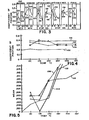
- a friction pad or sample made with composition C was removed and when tested on the sample dynamometer produced an average coefficient of friction illustrated by curve 110 in Figure 4 and a wear rate illustrated by curve 112 in Figure 5.
- the friction of composition B is acceptable as compared with the base line composition C, however the wear rate is relatively high and may not be acceptable when a duty cycle above 175°C is expected for normal use.
- composition B In an effort to evaluate other reinforcing fibers, the steel and calcium-sodium metaphosphate fiber in composition B were replaced with fiber glass and the friction modifiers were replaced by a minimum quantity of organic friction dust and cashew nut powder while the fillers were replaced by a large quantity of barytes and liquid latex.
- the phenolic resin and DSP were added in substantially equal amounts.
- the metallic oxide magnesium oxide was also reduced to a minimum amount of fine material, based on the weight percentage needed to establish a desired exothermic reaction to produce composition D shown in Figure 2. After composition D was mixed and distributed to molds 20, 20'...20 it was transported to ventilated chamber 50 where it was allowed to cure at ambient temperature (20°C) for about 48 hours.
- composition E whose weight percentage is as shown in Figure 2 was compounded.
- the reinforcing fiber in composition E is steel fiber, the friction modifier (carbon and graphite), the filler (barytes and rubber scrap), the binder phenolic resin and DSP.
- the percentage of metallic oxide was increased to about the 20% by weight of the DSP, as a result the composition started to gel in about 2 minutes.
- Composition E was made into brake pads 36, 36'... 36 N in accordance with the method of manufacture for composition B.
- the brake pads 36, 36'...36 N were placed on a Ford Escort and compared with similar brake pads made with composition C.
- the test performed in Figure 3 represents the coefficient of friction required to stop a vehicle at 30 to 60 mph and the change in friction experienced after a series of stops.
- Composition C or the base line is illustrated by curve 120, 122, 124, 126, 128, 130, 132, 134, 136, 138, 140 and 142 while composition E is illustrated by curves 121, 123, 125, 127, 129, 131, 133, 135, 137, 139, 141 and 143.
- the coefficient of friction for the molded friction pad of composition E is more stable that a conventional base line press cured friction pad made of composition C.
- the rotor wear for the composition E was higher than for composition C, however the pad wear was lower and the total overall wear was essentially the same for both compositions C and E.
- composition F shown in Figure 2.
- the amount of liquid phenolic resin and liquid depolymerized rubber provided the carrier to establish the viscosity for creating a slurry sufficient to allow the mixture to flow into molds 20, 20'...20 N .
- the para and phenolic resin while reacting at a slower rate, completely cured in about 48 hours.
- the Ford Escort S.A.E. Performance Test shown in Figure 3 was run on the resulting brake pad made from composition F.
- composition G shown in Figure 2 was compounded.
- the reinforcing fiber is asbestos
- the friction modifier is cashew nut powder
- the filler is rubber and barytes
- the binder is phenolic resin.
- Composition G was manufactured in a conventional manner wherein asbestos fiber, dry phenolic resin, equal parts of cashew nut powder and synthetic rubber scrap, and barytes were mixed together until a homogenous mixture was achieved. Thereafter, the mixture was placed in a mold and compacted into a briquette. The briquette was then transferred to a press and compressed by a force of about 350 Kg per cm 2 while the temperature of the briquette was raised to about 120°C temperature.
- the 120°C temperature causes the phenolic resin to flow throughout the mixture and establish a matrix for holding the other ingredients in a fixed position.
- the briquette was then transferred to a curing chamber having a temperature of about 260°C to further set the resin.
- the briquette was then ground to a specific size corresponding to a brake pad. This brake pad was then subjected to a Ford Escort S.A.E. Performance test.
- composition H shown in Figure 2 was made in the laboratory.
- the reinforcing fiber (steel), the friction modifiers (graphite and carbon), the filler (rubber and barytes), the binder (phenolic resin) and the primary slurry producing ingredient, DSP modified by metallic (magnesium) oxide were mixed together.
- the fine particles of metallic oxide in composition H were equal to about 20% by weight of the DSP. With this amount of metallic oxide it was calculated that there would be about five minutes before the exothermic temperature of the mixture would reach about 66°C and an accelerated para and phenolic resin reaction begins.
- the mixture has an initial pH which is acidic but as the DSP reacts with the metallic oxide the mixture shifts to a basic pH.
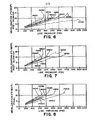
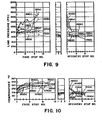
- the friction pads made with composition H were fully cured at ambient temperature 20°C in about 24 hours they were subjected to a standard S.A.E. Performance test on a Ford Escort brake. The results of the various tests are illustrated by curves 169 (a & b) in Figure 6, 170 (a & b) in Figure 7,172 (a & b) in Figure 8, 173 (a & b) and 174 (a & b) in Figure 9 and 175 (a & b) and 176 (a & b) in Figure 10..
- composition H was remixed and a small quantity, (2 drops) of a surfactant was added to improve binder particle bonding to produce composition I shown in Figure 2.
- the method of manufacture of composition I was identical to composition H and after the ambient temperature cure, composition I was subjected to the same S.A.E. performance test for the Ford Escort. The results of these tests are illustrated by curves 180 (a & b) in Figure 6, 182 (a & b) in Figure 7, 184 (a & b) in Figure 8, 186 (a & b) and 188 (a & b) in Figure 9 and 190 (a & b) and 192 (a & b) in Figure 10.
Landscapes
- Engineering & Computer Science (AREA)
- General Engineering & Computer Science (AREA)
- Chemical & Material Sciences (AREA)
- Mechanical Engineering (AREA)
- Organic Chemistry (AREA)
- Medicinal Chemistry (AREA)
- Chemical Kinetics & Catalysis (AREA)
- Polymers & Plastics (AREA)
- Health & Medical Sciences (AREA)
- Materials Engineering (AREA)
- Braking Arrangements (AREA)
- Manufacture Of Macromolecular Shaped Articles (AREA)
- Compositions Of Macromolecular Compounds (AREA)
Applications Claiming Priority (2)
| Application Number | Priority Date | Filing Date | Title |
|---|---|---|---|
| US06/733,332 US4617165A (en) | 1985-05-13 | 1985-05-13 | Molded brake pad |
| US733332 | 1985-05-13 |
Publications (3)
| Publication Number | Publication Date |
|---|---|
| EP0201813A2 true EP0201813A2 (de) | 1986-11-20 |
| EP0201813A3 EP0201813A3 (en) | 1988-12-14 |
| EP0201813B1 EP0201813B1 (de) | 1991-03-27 |
Family
ID=24947175
Family Applications (1)
| Application Number | Title | Priority Date | Filing Date |
|---|---|---|---|
| EP86106013A Expired - Lifetime EP0201813B1 (de) | 1985-05-13 | 1986-05-02 | Geformter Bremsbelag |
Country Status (7)
| Country | Link |
|---|---|
| US (1) | US4617165A (de) |
| EP (1) | EP0201813B1 (de) |
| JP (1) | JPS61281148A (de) |
| KR (1) | KR900005414B1 (de) |
| CN (1) | CN86103422A (de) |
| CA (1) | CA1250714A (de) |
| DE (1) | DE3678330D1 (de) |
Cited By (1)
| Publication number | Priority date | Publication date | Assignee | Title |
|---|---|---|---|---|
| EP2034204A3 (de) * | 2007-08-30 | 2011-10-26 | LuK Lamellen und Kupplungsbau Beteiligungs KG | Verfahren zum Aufbringen eines Reibbelags mittels Siebdruckverfahrens |
Families Citing this family (13)
| Publication number | Priority date | Publication date | Assignee | Title |
|---|---|---|---|---|
| US4722950A (en) * | 1986-07-07 | 1988-02-02 | Allied Corporation | Friction material |
| JP2817923B2 (ja) * | 1987-10-30 | 1998-10-30 | デヴァーズ・エムエス・カンパニー | ソリッドステート電池 |
| CA2002057C (en) * | 1988-11-22 | 1994-01-25 | Yasuhiro Hara | Clutch driven plates and method of producing the same |
| CN1037184C (zh) * | 1992-06-26 | 1998-01-28 | 中国科学院长春应用化学研究所 | 酚醛树脂复合材料的制备方法 |
| US5576358A (en) * | 1995-02-03 | 1996-11-19 | Alliedsignal Inc. | Composition for use in friction materials and articles formed therefrom |
| US5871685A (en) * | 1995-02-17 | 1999-02-16 | Performance Friction Corp. | Method of burnishing brake pads |
| US5658360A (en) * | 1995-08-02 | 1997-08-19 | Norton Company | Compression molding of abrasive articles using water as a temporary binder |
| US6668984B2 (en) | 2000-12-06 | 2003-12-30 | Honeywell Advanced Composites Inc. | Oxidation protection for carbon/carbon composite and graphite friction materials |
| US6878331B2 (en) * | 2002-12-03 | 2005-04-12 | Ucar Carbon Company Inc. | Manufacture of carbon composites by hot pressing |
| US7207424B2 (en) * | 2002-12-03 | 2007-04-24 | Ucar Carbon Company Inc. | Manufacture of carbon/carbon composites by hot pressing |
| JP4426526B2 (ja) | 2003-07-17 | 2010-03-03 | ハネウエル・インターナシヨナル・インコーポレーテツド | 最新式のマイクロエレクトロニクス用途およびデバイス用の平坦化膜およびそれらの製造方法 |
| US8689671B2 (en) | 2006-09-29 | 2014-04-08 | Federal-Mogul World Wide, Inc. | Lightweight armor and methods of making |
| CN104632960B (zh) * | 2014-12-10 | 2017-02-22 | 重庆红宇摩擦制品有限公司 | 防止锈粘连的鼓式制动片及其制备方法 |
Family Cites Families (1)
| Publication number | Priority date | Publication date | Assignee | Title |
|---|---|---|---|---|
| US4363884A (en) * | 1980-03-17 | 1982-12-14 | Akebono Brake Industry Company, Ltd. | Friction material |
-
1985
- 1985-05-13 US US06/733,332 patent/US4617165A/en not_active Expired - Lifetime
-
1986
- 1986-04-17 CA CA000506892A patent/CA1250714A/en not_active Expired
- 1986-04-25 KR KR1019860003188A patent/KR900005414B1/ko not_active Expired
- 1986-05-02 DE DE8686106013T patent/DE3678330D1/de not_active Expired - Lifetime
- 1986-05-02 EP EP86106013A patent/EP0201813B1/de not_active Expired - Lifetime
- 1986-05-12 CN CN198686103422A patent/CN86103422A/zh active Pending
- 1986-05-13 JP JP61107803A patent/JPS61281148A/ja active Pending
Cited By (1)
| Publication number | Priority date | Publication date | Assignee | Title |
|---|---|---|---|---|
| EP2034204A3 (de) * | 2007-08-30 | 2011-10-26 | LuK Lamellen und Kupplungsbau Beteiligungs KG | Verfahren zum Aufbringen eines Reibbelags mittels Siebdruckverfahrens |
Also Published As
| Publication number | Publication date |
|---|---|
| EP0201813B1 (de) | 1991-03-27 |
| KR860009096A (ko) | 1986-12-20 |
| DE3678330D1 (de) | 1991-05-02 |
| US4617165A (en) | 1986-10-14 |
| JPS61281148A (ja) | 1986-12-11 |
| CA1250714A (en) | 1989-03-07 |
| EP0201813A3 (en) | 1988-12-14 |
| CN86103422A (zh) | 1986-11-12 |
| KR900005414B1 (ko) | 1990-07-30 |
Similar Documents
| Publication | Publication Date | Title |
|---|---|---|
| EP0201813B1 (de) | Geformter Bremsbelag | |
| US8863917B2 (en) | Friction material for brakes | |
| EP2745027B1 (de) | Reibungsmaterial für bremsen | |
| CN103827538B (zh) | 摩擦材料的制造方法 | |
| EP0149726B1 (de) | Reibungsmaterial für Bremsbeläge | |
| US4831067A (en) | Process for the manufacture of frictional elements and frictional elements produced thereby | |
| US5132065A (en) | Method for producing friction compositions and products | |
| US4432922A (en) | Process for molding a brake lining friction product | |
| US4125496A (en) | Friction material | |
| US3972394A (en) | Friction material | |
| JPH01275925A (ja) | 摩擦材料 | |
| EP0409495B1 (de) | Zusammensetzungen für Reibungselemente | |
| US2534607A (en) | Molded brake lining | |
| EP1160481A1 (de) | Verfahren zur Herstellung von Reibungsmaterial und Reibungsmaterial | |
| US3842031A (en) | Friction material | |
| JP3792839B2 (ja) | 造粒物及び摩擦材の製造方法 | |
| US2472247A (en) | Fast-setting compound of resin and powdered metal | |
| JP3809924B2 (ja) | 摩擦材組成物、摩擦材組成物の製造法及び摩擦材組成物を用いた摩擦材 | |
| JP3782243B2 (ja) | ブレーキ用摩擦材 | |
| CA1312401C (en) | Process for the manufacture of frictional elements and frictional elements produced thereby | |
| EP3677657B1 (de) | Verfahren zur herstellung von reibungsmaterial | |
| US3723382A (en) | Friction materials | |
| JPH0214223A (ja) | ディスクブレーキパッドの製造方法 | |
| JPS5811580A (ja) | 摩擦材 | |
| US20250003463A1 (en) | Friction material |
Legal Events
| Date | Code | Title | Description |
|---|---|---|---|
| PUAI | Public reference made under article 153(3) epc to a published international application that has entered the european phase |
Free format text: ORIGINAL CODE: 0009012 |
|
| AK | Designated contracting states |
Kind code of ref document: A2 Designated state(s): DE FR |
|
| PUAL | Search report despatched |
Free format text: ORIGINAL CODE: 0009013 |
|
| AK | Designated contracting states |
Kind code of ref document: A3 Designated state(s): DE FR |
|
| 17P | Request for examination filed |
Effective date: 19890131 |
|
| RAP1 | Party data changed (applicant data changed or rights of an application transferred) |
Owner name: ALLIED-SIGNAL INC. (A DELAWARE CORPORATION) |
|
| 17Q | First examination report despatched |
Effective date: 19891108 |
|
| GRAA | (expected) grant |
Free format text: ORIGINAL CODE: 0009210 |
|
| AK | Designated contracting states |
Kind code of ref document: B1 Designated state(s): DE FR |
|
| ET | Fr: translation filed | ||
| REF | Corresponds to: |
Ref document number: 3678330 Country of ref document: DE Date of ref document: 19910502 |
|
| PGFP | Annual fee paid to national office [announced via postgrant information from national office to epo] |
Ref country code: FR Payment date: 19910522 Year of fee payment: 6 |
|
| PGFP | Annual fee paid to national office [announced via postgrant information from national office to epo] |
Ref country code: DE Payment date: 19910531 Year of fee payment: 6 |
|
| PLBE | No opposition filed within time limit |
Free format text: ORIGINAL CODE: 0009261 |
|
| STAA | Information on the status of an ep patent application or granted ep patent |
Free format text: STATUS: NO OPPOSITION FILED WITHIN TIME LIMIT |
|
| 26N | No opposition filed | ||
| PG25 | Lapsed in a contracting state [announced via postgrant information from national office to epo] |
Ref country code: FR Effective date: 19930129 |
|
| PG25 | Lapsed in a contracting state [announced via postgrant information from national office to epo] |
Ref country code: DE Effective date: 19930202 |
|
| REG | Reference to a national code |
Ref country code: FR Ref legal event code: ST |