EP0200287A2 - Verfahren und Vorrichtung zur Herstellung eines dünnen Gegenstandes - Google Patents
Verfahren und Vorrichtung zur Herstellung eines dünnen Gegenstandes Download PDFInfo
- Publication number
- EP0200287A2 EP0200287A2 EP86300485A EP86300485A EP0200287A2 EP 0200287 A2 EP0200287 A2 EP 0200287A2 EP 86300485 A EP86300485 A EP 86300485A EP 86300485 A EP86300485 A EP 86300485A EP 0200287 A2 EP0200287 A2 EP 0200287A2
- Authority
- EP
- European Patent Office
- Prior art keywords
- liquid
- container
- feed
- film
- feed material
- Prior art date
- Legal status (The legal status is an assumption and is not a legal conclusion. Google has not performed a legal analysis and makes no representation as to the accuracy of the status listed.)
- Granted
Links
Images
Classifications
-
- B—PERFORMING OPERATIONS; TRANSPORTING
- B29—WORKING OF PLASTICS; WORKING OF SUBSTANCES IN A PLASTIC STATE IN GENERAL
- B29C—SHAPING OR JOINING OF PLASTICS; SHAPING OF MATERIAL IN A PLASTIC STATE, NOT OTHERWISE PROVIDED FOR; AFTER-TREATMENT OF THE SHAPED PRODUCTS, e.g. REPAIRING
- B29C41/00—Shaping by coating a mould, core or other substrate, i.e. by depositing material and stripping-off the shaped article; Apparatus therefor
- B29C41/24—Shaping by coating a mould, core or other substrate, i.e. by depositing material and stripping-off the shaped article; Apparatus therefor for making articles of indefinite length
-
- B—PERFORMING OPERATIONS; TRANSPORTING
- B29—WORKING OF PLASTICS; WORKING OF SUBSTANCES IN A PLASTIC STATE IN GENERAL
- B29C—SHAPING OR JOINING OF PLASTICS; SHAPING OF MATERIAL IN A PLASTIC STATE, NOT OTHERWISE PROVIDED FOR; AFTER-TREATMENT OF THE SHAPED PRODUCTS, e.g. REPAIRING
- B29C41/00—Shaping by coating a mould, core or other substrate, i.e. by depositing material and stripping-off the shaped article; Apparatus therefor
- B29C41/34—Component parts, details or accessories; Auxiliary operations
- B29C41/36—Feeding the material on to the mould, core or other substrate
-
- B—PERFORMING OPERATIONS; TRANSPORTING
- B29—WORKING OF PLASTICS; WORKING OF SUBSTANCES IN A PLASTIC STATE IN GENERAL
- B29K—INDEXING SCHEME ASSOCIATED WITH SUBCLASSES B29B, B29C OR B29D, RELATING TO MOULDING MATERIALS OR TO MATERIALS FOR MOULDS, REINFORCEMENTS, FILLERS OR PREFORMED PARTS, e.g. INSERTS
- B29K2027/00—Use of polyvinylhalogenides or derivatives thereof as moulding material
- B29K2027/12—Use of polyvinylhalogenides or derivatives thereof as moulding material containing fluorine
-
- B—PERFORMING OPERATIONS; TRANSPORTING
- B29—WORKING OF PLASTICS; WORKING OF SUBSTANCES IN A PLASTIC STATE IN GENERAL
- B29K—INDEXING SCHEME ASSOCIATED WITH SUBCLASSES B29B, B29C OR B29D, RELATING TO MOULDING MATERIALS OR TO MATERIALS FOR MOULDS, REINFORCEMENTS, FILLERS OR PREFORMED PARTS, e.g. INSERTS
- B29K2027/00—Use of polyvinylhalogenides or derivatives thereof as moulding material
- B29K2027/12—Use of polyvinylhalogenides or derivatives thereof as moulding material containing fluorine
- B29K2027/18—PTFE, i.e. polytetrafluorethene, e.g. ePTFE, i.e. expanded polytetrafluorethene
-
- B—PERFORMING OPERATIONS; TRANSPORTING
- B29—WORKING OF PLASTICS; WORKING OF SUBSTANCES IN A PLASTIC STATE IN GENERAL
- B29K—INDEXING SCHEME ASSOCIATED WITH SUBCLASSES B29B, B29C OR B29D, RELATING TO MOULDING MATERIALS OR TO MATERIALS FOR MOULDS, REINFORCEMENTS, FILLERS OR PREFORMED PARTS, e.g. INSERTS
- B29K2105/00—Condition, form or state of moulded material or of the material to be shaped
- B29K2105/0058—Liquid or visquous
- B29K2105/0073—Solution
-
- B—PERFORMING OPERATIONS; TRANSPORTING
- B29—WORKING OF PLASTICS; WORKING OF SUBSTANCES IN A PLASTIC STATE IN GENERAL
- B29L—INDEXING SCHEME ASSOCIATED WITH SUBCLASS B29C, RELATING TO PARTICULAR ARTICLES
- B29L2007/00—Flat articles, e.g. films or sheets
- B29L2007/008—Wide strips, e.g. films, webs
Definitions
- the present invention relates to a the preparation of a thin film, using a casting process on the surface of a liquid.
- one of the processes for preparing a thin film is a water casting process wherein a droplet of a casting solution of a polymer in a water-immiscible solvent is deposited on a surface of water, the solution spreads rapidly over the surface, and then the thin film is left floating on the water after evaporation of the solvent of the solution.
- the process utilizes spread of the solution on the basis of an interfacial phenomenon between a droplet of the solution and the surface of water.
- the above-mentioned process exhibits some difficulties if it is desired to obtain a thin film having a large area and to produce such a film continuously.
- a variety of processes have recently been proposed for preparation of a thin film having a large area. Particularly, there have been proposals to remove the defects of the conventional processes by supplying a polymer solution in a linear form instead of the droplet form onto the surface of water. They include, for example, (1) a process which comprises dropping a polymer solution on the surface of water in an area thereof partitioned by a pair of partition rods while, at the same time, expanding the distance between the partition rods, (2) a process which comprises allowing a solution of a polymer in a solvent having a higher density than that of water to adhere onto the surface of a rotating roll, passing through a reservoir of the solution disposed under the surface of water, and pulling up the adherent solution to forcibly spread the solution on the surface of water (U.S.
- Patent No. 3,767,737 (3) a process which comprises spreading a polymer solution on the surface of water by controlling the mutual liquid surface position between the water phase and the polymer solution phase (Japanese Patent Laid-Open No. 92,526/1983), and (4) a process which comprises supplying a polymer solution along a plate, one side of which is immersed in water, onto the surface of water (Japanese Patent Laid-Open No. 22,724/1984).
- the process (1) is limitative in that a thin film cannot be continuously obtained.
- uniformity of the thin film is spoiled because transfer of the solution adherent on the roll onto the surface of the water may not necessarily be completely effected.
- the balance between the rate of removing the formed thin film and the rate of supplying the polymer solution must be accurately controlled.
- first liquid the solution of the film forming material in solvent
- second liquid the liquid, usually water, onto the surface of which the first liquid is fed
- the first liquid is fed to the surface of the second liquid by utilizing interfacial tension.
- the thin film formed on the surface of the second liquid is collected continuously therefrom during normal operation of the process.
- the step of continuously collecting the thin film from the surface of the second liquid may be stopped and started again at will as, for example, in a batchwise process where batches of film are collected on different respective rollers.
- the collection of the film may be stopped to allow a change of roller.
- Such batchwise processes are continuous processes within the present invention.
- the feed of the first liquid to the surface of the second liquid may be effected through a feed material which shows selective wettability for the first liquid in preference to the second liquid.
- a feed material which shows selective wettability for the first liquid in preference to the second liquid.
- use may be made of one or more capillaries open at one end to the first liquid and elsewhere to the surface of the second liquid.
- apparatus for forming a thin film comprises at least
- the present invention provides significant improvements over a known water casting processes in that (1) the width of the thin film can be expanded by introducing the first liquid over a wide width, (2) spontaneous supply of the first liquid by the interfacial tension makes accurate control for supply of the solution unnecessary. Accordingly, a thin film even with a large width, which is difficult to prepare with the conventional process, can be continuously prepared with a very simplified apparatus.
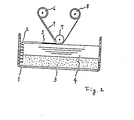
- a first liquid 3 which is a solution of a film-forming material as the main component in an organic solvent, is present in the bottom of a tray 1.
- a second liquid 4 is poured thereon.
- a supply channel 2 for the first liquid is provided near or in touch with the wall of the tray.
- the supply channel 2 has one end opening into the first liquid 3 and another end opening on the surface of the second liquid 4.
- the channel port has any kind of structure such as fine tubes or a fine slit, in so far as it can develop such capillarity as to push up the first liquid to the surface of the second liquid.
- a support 9 is continuously and sequentially unwound from a supply roll 6, passed around a control roll 7, and taken up on a winding roll 8.
- the support is continuously passed into contact with the thin film 5 to continuously remove it upwardly from a region of the liquid surface.
- release paper may be laminated between thin films, and the support may be an endless belt. The film thickness can be adequately controlled by adjusting the rate of winding up of the support.
- the first liquid is continuously supplied onto the surface of the second liquid through the supply channel.
- the first liquid 3 may, of course, be continuously supplied from outside. Both the first and the second liquids are not always required to be put into a tray, but may be separately put into two or more trays.
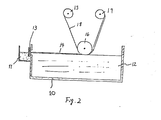
- Fig. 2 shows another preferred embodiment of the invention which has significant differences from the above-mentioned embodiment.
- a supply port 13 may comprise a non-woven fluororesin fabric placed vertically between the first liquid 11 and the second liquid 12.
- the first liquid 11 is a solution of the film forming material and the second liquid plays the role of a liquid substrate. As the first liquid 11 is more permeable to the supply port than the second liquid 12, only the first liquid is kept in the pores of the supply port.
- the means for taking up the thin film can be the same as in Fig. 1, the rolls 6, 7 and 8 of Fig.1 having been numbered 15, 16 and 17 and the support 9 having been numbered 18.
- the supply of the first liquid by utilizing interfacial tension may be effected either by a material which shows selective wettability for the first liquid in preference to the second liquid or a structure capable of developing capillarity.
- An index of selective wettability is the critical surface tension of the liquid.
- Whether or not a given material is one having a selective wettability for a first liquid rather than for a second liquid may be determined by examining values of contact angles between the flat surface of the material and respective droplets of the first liquid and the second liquid, which values are measured after the droplets of these liquids are dropped on the flat surface of material.
- the value of the contact angle formed by a droplet of the first liquid is smaller than that of the contact angle formed by a droplet of the second liquid, the material has a selective wettability for the first liquid rather than for the second liquid; that is, the material is a desired material.
- the contact angles of the material with the first liquid and the second liquid can be easily measured by a contact angle meter.
- the solvent of the first liquid is preferably a nonpolar organic solvent
- the second liquid is preferably water. So a feed material which has a critical surface tension of 30 dyn/cm or less can be preferred.
- material having a selective wettability for the first liquid rather than for the second liquid include fluoropolymers such as polytetrafluoroethylene, polytrifluoroethylene, polyvinylidene fluoride, tetrafluoroethylene-fluoroalkylvinylether copolymer, tetrafluoroethylene-hexafluoropropylene copolymer and tetrafluoroethylene-ethylene copolymer; polyolefins such as polyethylene and polypropylene; and silicone polymers such as polyorganosiloxane.
- Particularly preferred materials are fluoropolymers which are hardly eroded by either the first liquid or the second liquid.
- the supply of the first liquid onto the second liquid by utilizing the selective wettability of a feed material for the first liquid makes use of the following phenomenon of interfacial chemistry.
- dropping of a liquid B immiscible with the liquid A into an interface S/A may allow the liquid B to spread over the solid surface S by pushing the liquid A aside, provided that the interfacial free energy of an interface S/B is lower than that of the interface S/A.
- the free energy secured by using a feed material having a selective wettability for the first liquid rather than for the second liquid is the driving force of supply of the first liquid.
- the specific method of supplying the first liquid onto the second liquid by utilizing selective wettability according to the above-mentioned principle is not particularly limited in the present invention.
- the first liquid rises up along the said internal wall of the container while pushing the second liquid aside, and spread of the first liquid over the second liquid begins immediately.
- the feed material may provide the internal wall or the entire internal surface of the container, or even the entire container.
- Structures capable of giving rise to capillarity include those having a capillary tube or tubes, those having a slit provided by two plates, and a plate having grooves in the surface, as well as woven or knitted fabrics, non-woven fabrics, and polymer foams having open cells, microporous membranes, microporous glass, microporous ceramics, and microporous metals.
- capillarity is afforded by opening(s) or slit(s) having an entry at one end and an exit at the other, strict control of the position of the surface of the second liquid in agreement with the exit of the opening(s) or slit(s) is necessary for fast and stable supply of the first liquid.
- any structure where capillarity is afforded by groove(s) or continuous microporous structure running from the first liquid through the second liquid to air, such as a non-woven fabric and a plate having grooves in the surface since the surface of the second liquid can always be in contact with the opening(s), strict control of the position of the surface of the second liquid is not needed to facilitate preparation of a desired thin film.
- the first liquid is preferably fed to the surface of the second liquid by means of an element capable of giving rise to capillarity and also having a selective wettability for the first liquid rather than for the second liquid, thus facilitating more stable supply of the first liquid due to the combined effect of capillarity and wettability with the first liquid.
- an element capable of giving rise to capillarity and also having a selective wettability for the first liquid rather than for the second liquid thus facilitating more stable supply of the first liquid due to the combined effect of capillarity and wettability with the first liquid.
- a "Teflon"(trade mark) plate having an arbitrary shape and an arbitrary number of grooves formed or a commercially available non-woven fluororesin fabric (trade name: Polyflon Paper manufactured by Daikin Kogyo Co., Ltd.) is preferred.
- the amount of the first liquid supplied can be easily controlled by varying the width and depth of the grooves in the structure or the porosity of the non-woven fabric.
- the first liquid may be fed to the surface of the second liquid by placing the fabric vertically between the first liquid and the second liquid as previously described and shown in Fig. 2.
- the first liquid selectively permeates the fabric and spontaneous spreading of the first liquid occurs on the surface of the second liquid from the other side of the fabric.
- examples of the film forming material generally include any kind of polymers capable of forming a substantially non-porous film by solvent casting (including mixtures of polymers, graft polymers, block polymers, and copolymers). These polymers may be natural or synthetic. Organic polymers, inorganic polymers, or mixed organic and I inorganic polymers may be used. In general, various kinds of polymers can be used depending on application or use of the thin film.
- polymers examples include synthetic polymers, e.g., general-purpose polymers such as polyolefins, vinyl polymers, poly(meth) acrylates, polyamides, polyesters, and polyethers; engineering plastics such as acrylonitrile-butadiene-styrene copolymer, polyphenylene oxide, polycarbonate, polysulfone, polyether-sulfone, methylpentene polymer, and polyethylene terephthalate-isophthalate copolymer; polyorganosiloxane; and natural polymers such as cellulose derivatives and polyamino acids.
- synthetic polymers e.g., general-purpose polymers such as polyolefins, vinyl polymers, poly(meth) acrylates, polyamides, polyesters, and polyethers
- engineering plastics such as acrylonitrile-butadiene-styrene copolymer, polyphenylene oxide, polycarbonate, polysulfone, polyether-sulf
- polymers capable of providing a liquid separation performance can be employed. They include cellulose derivatives, e.g., cellulose diacetate, and cellulose triacetate, aromatic polyamides, polyamide hydrazide, polyamide acids, polyimidazopyrolone, polysulfonamide, polybenzimidazole, polybenzimidazolone, polyarylene oxide, polyvinyl methyl ether, polyacrylonitrile, polyhydroxyethyl methacrylate, and polyvinylidene carbonate.
- cellulose derivatives e.g., cellulose diacetate, and cellulose triacetate
- aromatic polyamides e.g., cellulose diacetate, and cellulose triacetate
- aromatic polyamides e.g., polyamide hydrazide
- polyamide acids e.g., polyimidazopyrolone, polysulfonamide, polybenzimidazole, polybenzimidazolone, polyarylene oxide, polyvinyl methyl ether, polyacryl
- polymers usable in water-alcohol separation or separation of an organic liquid include polyurea, polyether amides, polyether urea, polyamides, polyesters, polyethers, polyvinyl halides, cellulose derivatives, polysaccharides such as chitin and chitosan, silicon-containing polymers such as polysiloxane, and substituted acetylene polymers such as poly(1-trimethylsilyl-1-propyne).
- polymers usable in gas separation include vinyl polymers such as poly(4-methyl-I-pentene), polybutadiene, polystyrene, polyalkyl acrylates, polyalkyl methacrylates, and polyvinyl pivalate; cellulose derivatives such as ethylcellulose; polycarbonate; polyphenylene oxide and derivatives thereof; polysulfone; fluorine-containing polymers; substituted acetylene polymers such as poly tert- butylacetylene, polyorganosiloxane and derivatives thereof; and inorganic polymers such as polyphosphazene.
- vinyl polymers such as poly(4-methyl-I-pentene), polybutadiene, polystyrene, polyalkyl acrylates, polyalkyl methacrylates, and polyvinyl pivalate
- cellulose derivatives such as ethylcellulose
- polycarbonate polyphenylene oxide and derivatives thereof
- polysulfone fluorine-containing poly
- amplipatic substances capable of forming a monomolecular membrane according to the Langmuir-Brodgett method or the like, examples of which include carboxylic acids and alcohols having a long-chain alkyl group, and biolipids such as cholesterol, can be used as the film forming materials.
- a solvent capable of uniformly dissolving a film forming material, and having a lower surface tension than that of a liquid substrate (the second liquid) and such an adequate volatility as to allow easy removal thereof from a thin layer of a casting solution spread on the surface of the liquid substrate may be employed as the solvent of the first liquid (the casting solution).
- the solvent whose spreading coefficient represented by equation (1) is positive can be preferably used.
- a general-purpose organic solvent whose surface tension is 35 dyn/cm or less almost always shows a positive value where water is the second liquid and is therefore preferred.
- a polymer or a compound having a hydrophilic group can be added to the first liquid.
- examples of a polymer having a hydrophilic group include any kind of oil-soluble polymer having a carbonyl group, a hydroxyl group, an amino group, or an ammonium group.
- a polymer having non ionic hydrophilic group such as polyethylene glycol or polypropylene glycol can be used.
- commercial polyolefinpolyol trade name Polytel manufactured by Mitsubishi Chemical Industry ) can be used because of the solubility therein of film-forming materials such as polyolefin.
- An amino-functionalized polydimethylsiloxane or carbinol-functionalized polydimethylsiloxane can also be used with silicone-containing film-forming materials.
- the compound having a hydrophilic group include any kind of organic compound such as alcohols, carboxylic acids, peroxides, aldehydes, ketones, amines, or amides. In these compounds, oil-soluble surface active reagents are preferred. When the first liquid including such surface active reagent is supplied on the surface of the second liquid, the surface active reagent is rapidly absorbed on the interface between the first liquid and the second liquid to reduce the interfacial tension and help the stable spreading of the first liquid.
- sorbitan monolaurate, sorbitan monopalmitate, sorbitan monostearate, sorbitan monooleate, polyoxyethylene sorbitan monolaurate, polyoxyethylene sorbitan monooleate, and fluoro-containing surface active reagents are suitable.
- concentration of the polymer or the compound having a hydrophilic group in the first liquid may be, e.g. , up to about 0.5 % by weight, and preferably from about 0.001 % to about 0.1 % by weight.
- solvents used in the first include aliphatic hydrocarbons such as n-hexane, cyclohexane, n-heptane, and cyclohexene, and derivatives thereof; aromatic hydrocarbons such as benzene, and derivatives thereof; and halogen-containing organic solvents such as trifluorotrichloroethane (boiling point: 47.6 °C, specific gravity: 1.57, surface tension at 25°C: 17.8 dyn/cm), carbon tetrachloride (boiling point: 76.7°C, specific gravity: 1.59, surface tension at 25°C: 26.9 dyn/cm), chloroform (boiling point: 61 - 62°C,specific gravity: 1.48, surface tension at 25°C: 25.5 dyn/cm), methylene chloride (boiling point: 39.75°C, specific gravity: 1.33, surface tension at 25°C: 28.0 dyn/c
- the casting solution may be prepared by dissolving the film forming material in a solvent capable of dissolving the same and subsequently diluting the resulting solution with the above-mentioned solvent.
- the solvent is arbitrarily chosen with due consideration for solubility of a film forming material to be used, operational conditions, etc.
- the presence of a solvent other than organic solvents does not provide any problems in so far as it is used in such an amount as not to spoil the effect of the present invention.
- the concentration of the film forming material in the solvent depends on the nature of the film forming material, so suitable concentration may be determined by an experimental data. But, in general, the concentration of the film forming material may be, e.g., up to about 10% by weight, and preferably is from about 0.01 to about 5% by weight.
- the liquid substrate the second liquid.
- any liquid having such properties may be employed, polar liquids are preferred. Among them, water (specific gravity: 1.0, surface tension at 25°C: 72.8 dyn/cm) is particularly preferred.
- the process of this invention is sufficiently operable with water alone.
- an aqueous solution of an inorganic salt may be used for decreasing the solubility of the film forming material or increasing the surface tension, which may facilitate formation of a thinner film.
- solvent removal (evaporation) from the thin layer of the casting solution formed on the liquid substrate is preferably effected by controlling the ambient temperature or the like.
- solvent of the casting solution solvent removal from the formed thin layer of the casting solution is spontaneously and quickly effected by setting the ambient temperature at 25 to 28°C to form a thin film consisting essentially of the film forming material as such.
- control of the temperature according to infrared irradiation or the like is preferred in forming a uniform film on the surface of the liquid substrate without disturbing the surface of the latter.
- a current of air may be moderately blown over the surface, or the pressure of the space on the surface may be maintained on a reduced level.
- the gas present in the space may be of any kind. Air, nitrogen gas, water vapor, carbon dioxide gas, or the like can be employed properly in accordance with the property of the formed thin film. Above all, film formation is most preferably effected in air from the viewpoints of safety and economy.
- a spontaneous supply of the first liquid may be achieved by a stationary feed which utilizes interfacial tension; however, a little movement of the feed may be allowed in supplying of the first liquid by the interfacial tension in so far as it does not disturb the second liquid surface.
- the thickness of the film prepared by the process described above is controlled by ; (1) the rate at which the first liquid is delivered to the surface of the second liquid, which is controlled by the means employed to feed it; (2) the concentration of the film-forming material in the first liquid (lower concentrations provide thinner films ) ; (3) the rate at which the support is drawn upwardly from the liquid substrate on take-up roll (the faster the rotation of the roll, the thinner the film will be ).
- any customary method can be adopted in taking up the formed thin film.
- a method of winding it up on a rotating roll in contact with the surface of the liquid substrate and a method of taking it up on a support by means of a take-up roll, though the method of taking up the thin film is not limited thereto.
- porous support can be used as required.
- thin metal film can be used for the manufacture of condensers.
- a porous support is preferred.
- Suitable porous supports include, e.g. , microporous polypropylene (available from Celanese Plastics Company under the trademark Celgard ), Solvinert TM ultrafiltration membranes ( available from Millipore Corporation ), microporous nylon-reinforced poly ( vinyl chloride-acrylonitrile ) ( available from Gelman Instrument Company under the trademark Acropor ), microporous polytetrafluoroethylene ( available fror W. L. Gore and associates, Inc. under trademark GORE-TEX ), microporous polysulfone, and microporous cellulose acetate.
- surface treatment or surface coating can be done on the surface of the support.
- a 2 wt.% chloroform solution of polycarbonate _' (trade name: "Lexan” 121-111 manufactured by General Electric Co.) was prepared. 100 ml of this solution was poured into a Teflon-coated tray of 20 cm (length) x 17 cm (width) x 2.5 cm (depth) at a room temperature of about 25°C. Distilled water was added onto the solution in such an amount as to cover substantially the whole surface of the polymer solution. Thus, a thin layer of the polymer solution was formed all over the surface of distilled water, and the solvent was gradually removed to form a thin film, which was then continuously recovered from the surface of water. The film thickness was measured with a dial gauge to be 3.2 pm
- a "Teflon" plate of 5 cm (height) x 14 cm (width) x 0.3 cm (thickness) ) having 9 parallel grooves of 0.5 mm (width) x 0.5 mm (uepth) provided at intervals of 1.5 cm in the height-wise direction was allowed to stand upright in the above-mentioned container along the wall in the width-wise direction of the container.
- the 6 grooves provided in the "Teflon” plate ran from the poly(4-methyl-l-pentene) solution phase through the water phase to the surface of the water phase.
- the poly(4-methyl-l-pentene) solution in the lower layer was carried through the grooves to the surface of the water phase and immediately spread over the whole surface of the water phase to form a thin layer of the polymer solution, from which the solvent was gradually removed to form a thin film of the polymer.
- This thin film was contacted with a rotating roll over which a microporous polysulfone support having a crosslinked polydimethylsiloxane layer in the surface was wound.
- the thin film was wound up on the support at a rate of 0.5 m/min.
- the polymer solution continuously spread over the surface of the water phase along the grooves provided in the "Teflon" plate. Even after the winding operation, the thin film was continually formed over the surface of water.
- the film thickness of the poly(4-methyl-I-pentene) layer thus formed was measured according to 0 ellipsometry to be 920A. (92 nm)
- a non-woven "Teflon” fabric (Polyflon Filter PF-2, manufactured by Toyo Roshi K.K.) of 5 cm (height) x 14 cm (width) was allowed to stand upright in the above-mentioned container along the wall of the container in the width-wise direction.
- the poly(4-methyl-l-pentene) solution in the lower layer permeated into the non-woven "Teflon” fabric rose up to the surface of the water layer, and immediately spread over the surface of the water layer.
- a thin film of the polymer was formed.
- the thin film was continuously recovered onto a microporous polysulfone support having a crosslinked polydimethylsiloxane layer in the surface in the same manner as in Example 2.
- the film thickness of the poly(4-methyl-l-pentene) layer was measured according to ellipsometry to be 760A (76 nm)
- poly(2,6-dimethylphenylene oxide) which is available from Aldrich Chemical Co.
- a thin film of poly(2,6-dimethylphenylene oxide) was formed on the surface of water in the same manner as in Example 2.
- the thin film was recovered from the surface of water, and the thickness thereof was measured with a dial gauge to be 0.9pm.
- a thin film consisting of poly(2,6-dimethylphenylene oxide) and polyolefinpolyol (trade name : "Polytel H” manufactured by Mitsubishi Chemical Industry) was prepared in the same manner as in Example 5 except that a casting solution is 1 weight part of poly(2,6-dimethylphenylene oxide) and 0.25 weight part of polyolefinpolyol in 98.75 weight parts of chloroform.
- the thin film was 0.5um thick.
- a casting solution of 5 weight % of cellulose triacetate in methylene dichloride was prepared.
- the film was continuously taken up on a microporous polysulfone support at a rate of 0.5 m/min to form a composite membrane.
- the thickness of the film was 1200A (120nm), according to ellipsomety measurement.
- Reverse Osmosis performance of the composite membrane was Rej 65.2% and Flux 0.17 m 3 /m 2 .day under the conditions (0.15% NaCl aq. solution, 25°C, 30kg/cm 2 ).
Landscapes
- Engineering & Computer Science (AREA)
- Mechanical Engineering (AREA)
- Moulding By Coating Moulds (AREA)
- Separation Using Semi-Permeable Membranes (AREA)
Applications Claiming Priority (4)
| Application Number | Priority Date | Filing Date | Title |
|---|---|---|---|
| JP1093885 | 1985-01-25 | ||
| JP10938/85 | 1985-01-25 | ||
| JP61597/85 | 1985-03-26 | ||
| JP6159785 | 1985-03-26 |
Publications (3)
| Publication Number | Publication Date |
|---|---|
| EP0200287A2 true EP0200287A2 (de) | 1986-11-05 |
| EP0200287A3 EP0200287A3 (en) | 1987-12-23 |
| EP0200287B1 EP0200287B1 (de) | 1991-03-20 |
Family
ID=26346306
Family Applications (1)
| Application Number | Title | Priority Date | Filing Date |
|---|---|---|---|
| EP86300485A Expired EP0200287B1 (de) | 1985-01-25 | 1986-01-24 | Verfahren und Vorrichtung zur Herstellung eines dünnen Gegenstandes |
Country Status (4)
| Country | Link |
|---|---|
| US (1) | US4814132A (de) |
| EP (1) | EP0200287B1 (de) |
| CA (1) | CA1274963A (de) |
| DE (1) | DE3678194D1 (de) |
Cited By (2)
| Publication number | Priority date | Publication date | Assignee | Title |
|---|---|---|---|---|
| US4927589A (en) * | 1988-03-16 | 1990-05-22 | Kabushiki Kaisha Toshiba | Method for manufacturing organic thin film |
| EP0339391A3 (de) * | 1988-04-27 | 1991-01-09 | Bayer Ag | Verfahren zur Herstellung von Folien und anderen Formkörpern |
Families Citing this family (10)
| Publication number | Priority date | Publication date | Assignee | Title |
|---|---|---|---|---|
| JPH01104305A (ja) * | 1987-10-15 | 1989-04-21 | Tadashi Uragami | 液体分離用膜 |
| US5190879A (en) * | 1990-05-08 | 1993-03-02 | Bowolfe, Inc. | Controlled environment animal isolation systems |
| FR2676007B1 (fr) * | 1991-04-30 | 1994-04-08 | Tech Sep | Membrane composite de nanofiltration. |
| JP3498881B2 (ja) * | 1996-05-27 | 2004-02-23 | セントラル硝子株式会社 | 撥水性ガラスの製法 |
| US6808435B2 (en) * | 2000-10-11 | 2004-10-26 | Matsushita Electric Industrial Co., Ltd. | Paint for forming insulating film, and plasma display panel using the paint and method of manufacturing the same |
| CN100591811C (zh) * | 2004-04-15 | 2010-02-24 | 清华大学 | 纺丝方法 |
| RU2441043C2 (ru) * | 2006-05-31 | 2012-01-27 | Мицубиси Гэс Кемикал Компани, Инк. | Композиция полиамидной смолы |
| WO2008006211A1 (en) * | 2006-07-12 | 2008-01-17 | Nanometrix Inc. | Method and apparatus for thin film/layer fabrication and deposition |
| CN108956261B (zh) * | 2018-09-07 | 2021-08-31 | 香港理工大学 | 一种沥青薄膜的制备方法 |
| US11613614B2 (en) * | 2020-03-19 | 2023-03-28 | 86 Solar Inc. | Lazarev reactor 1 : production of films of two-dimensional polymers |
Family Cites Families (12)
| Publication number | Priority date | Publication date | Assignee | Title |
|---|---|---|---|---|
| US2641022A (en) * | 1950-02-21 | 1953-06-09 | Extruders Inc | Method of manufacturing plastic film |
| US2708617A (en) * | 1951-05-12 | 1955-05-17 | Du Pont | Formation of films and filament directly from polymer intermediates |
| US3767737A (en) * | 1971-09-07 | 1973-10-23 | Gen Electric | Method for production casting of ultrathin polymer membranes |
| US4279855A (en) * | 1973-05-02 | 1981-07-21 | General Electric Company | Method for the casting of ultrathin polymer membranes |
| US3989466A (en) * | 1973-08-13 | 1976-11-02 | Pan Samuel C | Liquid-liquid extraction apparatus including fibrous strand packing |
| US3892665A (en) * | 1973-10-15 | 1975-07-01 | Standard Oil Co | Membrane method and product |
| US4192842A (en) * | 1977-07-21 | 1980-03-11 | General Electric Company | Method for casting ultrathin methylpentene polymer membranes |
| US4155793A (en) * | 1977-11-21 | 1979-05-22 | General Electric Company | Continuous preparation of ultrathin polymeric membrane laminates |
| US4406673A (en) * | 1979-12-27 | 1983-09-27 | Teijin Limited | Ultrathin solid membrane, process for production thereof, and use thereof for concentrating a specified gas in a gaseous mixture |
| JPH0239742B2 (de) * | 1980-09-02 | 1990-09-06 | Dow Chemical Co | |
| JPS5892526A (ja) * | 1981-11-30 | 1983-06-01 | Asahi Glass Co Ltd | 高分子超薄膜の製造方法 |
| JPS5922724A (ja) * | 1982-07-29 | 1984-02-06 | Asahi Glass Co Ltd | 薄膜の製造方法 |
-
1986
- 1986-01-24 EP EP86300485A patent/EP0200287B1/de not_active Expired
- 1986-01-24 DE DE8686300485T patent/DE3678194D1/de not_active Expired - Fee Related
- 1986-01-24 CA CA000500353A patent/CA1274963A/en not_active Expired - Fee Related
-
1988
- 1988-06-28 US US07/214,911 patent/US4814132A/en not_active Expired - Fee Related
Cited By (2)
| Publication number | Priority date | Publication date | Assignee | Title |
|---|---|---|---|---|
| US4927589A (en) * | 1988-03-16 | 1990-05-22 | Kabushiki Kaisha Toshiba | Method for manufacturing organic thin film |
| EP0339391A3 (de) * | 1988-04-27 | 1991-01-09 | Bayer Ag | Verfahren zur Herstellung von Folien und anderen Formkörpern |
Also Published As
| Publication number | Publication date |
|---|---|
| US4814132A (en) | 1989-03-21 |
| EP0200287B1 (de) | 1991-03-20 |
| CA1274963A (en) | 1990-10-09 |
| DE3678194D1 (de) | 1991-04-25 |
| EP0200287A3 (en) | 1987-12-23 |
Similar Documents
| Publication | Publication Date | Title |
|---|---|---|
| US4155793A (en) | Continuous preparation of ultrathin polymeric membrane laminates | |
| EP0247596B1 (de) | Poröse Membran | |
| EP0200287B1 (de) | Verfahren und Vorrichtung zur Herstellung eines dünnen Gegenstandes | |
| CA1118560A (en) | Processes of making a porous membrane material from polyvinylidene fluoride, and products | |
| EP0031725B1 (de) | Verfahren zur Herstellung einer ultradünnen Feststoffmembran und ihre Verwendung zum Konzentrieren eines bestimmten Gases in einer Gasmischung | |
| US5242636A (en) | Method of making a multilayer capillary membrane | |
| JP2011200861A (ja) | スキン化中空繊維膜とその製造方法 | |
| KR910001901B1 (ko) | 고침투성 복합공동섬유막의 피복방법 | |
| US6977043B2 (en) | Skinned hollow fiber membrane and method of manufacture | |
| KR900002095B1 (ko) | 다공질막의 제조방법 | |
| KR20130090906A (ko) | 시트형 분리막의 제조방법 | |
| US6802972B1 (en) | Microporous hollow fiber membranes from perfluorinated thermoplastic polymers | |
| EP1144097B1 (de) | Verfahren zur herstellung von mikroporösen hohlfasermembranen aus perfluorierten thermoplastischen polymeren | |
| JPH09141071A (ja) | 複合膜、その製造方法および使用方法 | |
| US4869857A (en) | Process for producing porous membranes | |
| KR20220100651A (ko) | 미세여과 멤브레인 | |
| Chaiko et al. | Characterization of liquid membrane supports | |
| JPS6342705A (ja) | 複合中空糸膜の製造方法 | |
| JPS5892526A (ja) | 高分子超薄膜の製造方法 | |
| JPS642401B2 (de) | ||
| JPS62250970A (ja) | 薄膜の製造方法およびその装置 | |
| JPH0120966B2 (de) | ||
| JPH0443691B2 (de) | ||
| JPS5835723B2 (ja) | 複合膜の製造方法および装置 | |
| Jian | Integral asymmetric fluoropolymer membranes for the removal of organic compounds from dilute aqueous solutions |
Legal Events
| Date | Code | Title | Description |
|---|---|---|---|
| PUAI | Public reference made under article 153(3) epc to a published international application that has entered the european phase |
Free format text: ORIGINAL CODE: 0009012 |
|
| AK | Designated contracting states |
Kind code of ref document: A2 Designated state(s): DE FR GB IT |
|
| PUAL | Search report despatched |
Free format text: ORIGINAL CODE: 0009013 |
|
| AK | Designated contracting states |
Kind code of ref document: A3 Designated state(s): DE FR GB IT |
|
| 17P | Request for examination filed |
Effective date: 19880609 |
|
| 17Q | First examination report despatched |
Effective date: 19881208 |
|
| GRAA | (expected) grant |
Free format text: ORIGINAL CODE: 0009210 |
|
| AK | Designated contracting states |
Kind code of ref document: B1 Designated state(s): DE FR GB IT |
|
| REF | Corresponds to: |
Ref document number: 3678194 Country of ref document: DE Date of ref document: 19910425 |
|
| ITF | It: translation for a ep patent filed | ||
| ET | Fr: translation filed | ||
| PLBE | No opposition filed within time limit |
Free format text: ORIGINAL CODE: 0009261 |
|
| STAA | Information on the status of an ep patent application or granted ep patent |
Free format text: STATUS: NO OPPOSITION FILED WITHIN TIME LIMIT |
|
| 26N | No opposition filed | ||
| PGFP | Annual fee paid to national office [announced via postgrant information from national office to epo] |
Ref country code: FR Payment date: 19940111 Year of fee payment: 9 |
|
| PGFP | Annual fee paid to national office [announced via postgrant information from national office to epo] |
Ref country code: GB Payment date: 19940114 Year of fee payment: 9 |
|
| PGFP | Annual fee paid to national office [announced via postgrant information from national office to epo] |
Ref country code: DE Payment date: 19940121 Year of fee payment: 9 |
|
| PG25 | Lapsed in a contracting state [announced via postgrant information from national office to epo] |
Ref country code: GB Effective date: 19950124 |
|
| GBPC | Gb: european patent ceased through non-payment of renewal fee |
Effective date: 19950124 |
|
| PG25 | Lapsed in a contracting state [announced via postgrant information from national office to epo] |
Ref country code: FR Effective date: 19950929 |
|
| PG25 | Lapsed in a contracting state [announced via postgrant information from national office to epo] |
Ref country code: DE Effective date: 19951003 |
|
| REG | Reference to a national code |
Ref country code: FR Ref legal event code: ST |
|
| PG25 | Lapsed in a contracting state [announced via postgrant information from national office to epo] |
Ref country code: IT Free format text: LAPSE BECAUSE OF NON-PAYMENT OF DUE FEES;WARNING: LAPSES OF ITALIAN PATENTS WITH EFFECTIVE DATE BEFORE 2007 MAY HAVE OCCURRED AT ANY TIME BEFORE 2007. THE CORRECT EFFECTIVE DATE MAY BE DIFFERENT FROM THE ONE RECORDED. Effective date: 20050124 |