EP0199654B1 - Trockenschleuderkorb für feuchtes körniges Material - Google Patents
Trockenschleuderkorb für feuchtes körniges Material Download PDFInfo
- Publication number
- EP0199654B1 EP0199654B1 EP86400897A EP86400897A EP0199654B1 EP 0199654 B1 EP0199654 B1 EP 0199654B1 EP 86400897 A EP86400897 A EP 86400897A EP 86400897 A EP86400897 A EP 86400897A EP 0199654 B1 EP0199654 B1 EP 0199654B1
- Authority
- EP
- European Patent Office
- Prior art keywords
- basket
- wall
- supports
- ring
- edge
- Prior art date
- Legal status (The legal status is an assumption and is not a legal conclusion. Google has not performed a legal analysis and makes no representation as to the accuracy of the status listed.)
- Expired - Lifetime
Links
- 239000008187 granular material Substances 0.000 title abstract description 3
- 239000000463 material Substances 0.000 claims abstract description 92
- 230000002093 peripheral effect Effects 0.000 claims abstract description 39
- 238000001035 drying Methods 0.000 claims abstract 6
- 230000014759 maintenance of location Effects 0.000 claims description 25
- 238000005192 partition Methods 0.000 claims description 8
- 238000011144 upstream manufacturing Methods 0.000 claims description 7
- 230000002301 combined effect Effects 0.000 claims description 2
- 230000001737 promoting effect Effects 0.000 claims description 2
- 230000007423 decrease Effects 0.000 claims 1
- 238000006073 displacement reaction Methods 0.000 claims 1
- 230000000717 retained effect Effects 0.000 abstract description 4
- 241000782128 Albizia adianthifolia Species 0.000 description 8
- 230000015572 biosynthetic process Effects 0.000 description 4
- 239000003245 coal Substances 0.000 description 4
- 235000021183 entrée Nutrition 0.000 description 4
- 230000035939 shock Effects 0.000 description 4
- 238000009987 spinning Methods 0.000 description 4
- 238000005406 washing Methods 0.000 description 4
- 239000002184 metal Substances 0.000 description 3
- OKTJSMMVPCPJKN-UHFFFAOYSA-N Carbon Chemical compound [C] OKTJSMMVPCPJKN-UHFFFAOYSA-N 0.000 description 2
- 229910052799 carbon Inorganic materials 0.000 description 2
- XLYOFNOQVPJJNP-UHFFFAOYSA-N water Substances O XLYOFNOQVPJJNP-UHFFFAOYSA-N 0.000 description 2
- 239000000109 continuous material Substances 0.000 description 1
- 230000003247 decreasing effect Effects 0.000 description 1
- 239000006185 dispersion Substances 0.000 description 1
- 230000000694 effects Effects 0.000 description 1
- 239000012634 fragment Substances 0.000 description 1
- 230000005484 gravity Effects 0.000 description 1
- 230000000670 limiting effect Effects 0.000 description 1
- 230000002829 reductive effect Effects 0.000 description 1
- 239000011435 rock Substances 0.000 description 1
- 230000003313 weakening effect Effects 0.000 description 1
- 238000003466 welding Methods 0.000 description 1
Images

Classifications
-
- B—PERFORMING OPERATIONS; TRANSPORTING
- B04—CENTRIFUGAL APPARATUS OR MACHINES FOR CARRYING-OUT PHYSICAL OR CHEMICAL PROCESSES
- B04B—CENTRIFUGES
- B04B3/00—Centrifuges with rotary bowls in which solid particles or bodies become separated by centrifugal force and simultaneous sifting or filtering
-
- F—MECHANICAL ENGINEERING; LIGHTING; HEATING; WEAPONS; BLASTING
- F26—DRYING
- F26B—DRYING SOLID MATERIALS OR OBJECTS BY REMOVING LIQUID THEREFROM
- F26B5/00—Drying solid materials or objects by processes not involving the application of heat
- F26B5/08—Drying solid materials or objects by processes not involving the application of heat by centrifugal treatment
Definitions
- the invention relates to extractors of wet granular material such as, for example, pre-drained coal leaving the washing tanks. More particularly, it relates to a spin basket which contains an entry piece which is attached to it.
- This part follows a fixed supply line and it rotates at high speed with the spin basket; it receives from this pipe the material to be wrung and it directs this material towards the peripheral and wringing wall of the basket.
- the entry piece has generally consisted of a truncated cone which is joined and fixed to the bottom of the basket by several supports. This truncated cone receives the material to be wrung by its narrowest circular opening and it directs it onto the wringing wall of the basket through its widest circular opening.
- the present invention relates to wet matter extractors; its main purpose is to greatly reduce if not eliminate the drawbacks mentioned above of known spin dryers, in particular by providing a spin basket with which wear is considerably reduced or even eliminated at the same time as the material to be wrung is driven in rotation more efficiently up to a speed little different, if not identical, to that of the spin basket.
- a centrifugal wringer basket having a wringing peripheral wall, mounted rotating around an axis xx ′ for wringing out a fragmented material circulating in this basket during the rotation thereof, containing an entry piece fixed to this basket by supports in the arrival area of the material to be wrung, opposite an extreme upstream part of the wringing peripheral wall, in the direction of circulation of said material, is characterized according to the invention by the fact that the inlet part and said upstream end portion of the wiping wall are each provided with a means for retaining fragmented material, these two retaining means retaining during operation an annular volume driven in rotation of material to be wrung and being disposed l one after the other so that the surplus material received by the retention means of the entry piece directly feeds the retention means of the extreme upstream part of the a wiping wall, these two retention means having the combined effect of slowing down the circulation of the fragmented material through the basket and of promoting their rotational drive with the latter.
- each retention volume has a substantially triangular cross-section profile and the material which is contained therein during operation forms a natural slope of decreasing thickness parallel to the axis XX '.
- the material which arrives and which circulates through the basket successively meets the material contained in each of the retention volumes, which effectively protects against wear the entry piece on the one hand and the peripheral wall of somewhere else ; in addition, the significant friction which takes place between the material which comes through the fixed pipe and the continuous material in the retention volume situated on the entry piece in the impact zone results in a good rotational drive of the material before its projection against the wringing peripheral wall; this results in a better distribution of the material and a notable weakening of the vibrations.
- the entry piece comprises on the one hand a crown disposed coaxially with the wringing basket in a plane substantially perpendicular to the axis of the latter with an inner peripheral edge intended to surround in a wringer the inlet pipe for the material to be wrung and an outer peripheral edge, on the other hand a cylindrical wall extending in the direction of flow of the material to be wrung from a location on said crown spaced from its inner peripheral edge, preferably from its outer peripheral edge.
- the supports of the entry piece are fixed, on the one hand to the cylindrical wall of this entry piece, on the other hand to the peripheral wall of the basket.
- the ratio between the width in the radial direction of the crown and the length in the longitudinal direction of the cylindrical wall determines the slope of the slope of material which remains in the retention volume. This ratio must be adjusted according to the nature of the material to be wrung, so that the rotational drive of the flowing material by friction on the material contained in the retention volume is suitable.
- the supports for fixing the entry piece to the basket are located downstream of said edge and of the projection area.
- an annular partition is arranged in a substantially transverse plane downstream of this same edge and of the projection area, with an outer peripheral edge in contact with the peripheral wall of the basket and an inner peripheral edge spaced from the cylindrical wall of the entry room.
- This transverse partition limits a second annular retention volume intended to extend to the projection area and to contain part of the material to be wrung so that the material in circulation is projected onto the material retained.
- This transverse partition can be fixed directly to the peripheral wall of the basket; as it is not desirable to reduce the wringing useful length of the peripheral wall of the basket, it is preferable to place the transverse partition as close as possible downstream from the projection area and from the annular free edge defined above.
- the transverse partition limiting the second retention volume is a flat crown arranged in a plane perpendicular to the axis of the spin basket between the annular free edge and the supports.
- this flat crown is backed by the supports.
- the material to be wrung is brought into the basket by means of a bent pipe 1, which is fixed, and which feeds an inlet part 2.
- the entry piece 2 is constituted by a metal truncated cone, of axis XX 'joined and fixed by several supports 3 to the bottom 4 of the spinning basket which rotates at high speed (450 rpm) around XX '.
- This basket has a frustoconical peripheral and wringing wall 5 which has a multitude of small width openings. It rotates inside a fixed casing 6 to which the pipe 1 is itself fixed by its opening 7.
- the material is pre-drained granular carbon from the coal fines washing tanks. It flows by gravity in line 1 to the center of the basket.
- the material comes into contact in an impact zone 9 with the input part 2, which rotates at high speed with the basket.
- This part 2 in a truncated cone exerts only a very low friction force on the material; the circumferential speed setting thereof is therefore insufficient.
- the main result is that the material is distributed in packages in the basket.
- the supports 3 which rotate with the basket strike the material and disperse it in a disorderly manner. All of this results in vibrations of the basket and poor spin conditions.
- the wringer basket has three significant and rapid wear zones: the truncated cone 2 itself, the supports 3 and a projection zone 10 of the peripheral wall 5 of the basket, where the material is projected by centrifugal force when it leaves the input part 2, with an insufficient circumferential speed compared to that of the basket.
- the material then travels along the entire length 11 of its peripheral wall: the fine wrung out evacuates downwards at 13, while the water and the schlamms pass through the basket over the entire surface of the wringer 5, as indicated by arrows 12, and are then discharged through an opening (not shown) formed in the casing 6.
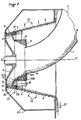
- FIG. 2 to describe a wringer basket according to the invention.
- the same references have been used as in FIG. 1 to designate the identical parts of the wringer basket not modified by the invention.
- new reference numerals have been used to designate the parts or parts of new parts in accordance with the invention.
- the entry piece produced in the spirit of the invention comprises a flat crown 14 arranged in a transverse plane perpendicular to the axis XX 'of the wringer basket.
- This crown is made of sheet metal with a thickness of 10 mm; it has an inner peripheral edge 14A by which it surrounds the fixed duct 1 and an outer peripheral edge 14B. From this outer edge 14B, a pa cylindrical king 15, also made of 10 mm sheet, extends concentrically with the axis XX 'in the direction of the bottom 4 of the basket, but it is interrupted before reaching it.
- Peripherally spaced supports 16 extend radially with respect to the axis XX 'between the outer face of the cylindrical wall 15 and the peripheral wall 5 of the basket.
- This flat crown 17 has an outer peripheral edge 17A which is in contact with the peripheral wall 5 of the basket and an inner peripheral edge 17B which is widely spaced from the cylindrical wall 15. Provision may be made to directly weld the flat crown 17 to the wall device 5 of the basket; but it can also be welded to the supports 16 so that it forms part of the entry piece so that it is put in its place by its outer edge 17A against the peripheral wall 5 when the entry piece is itself inside the basket.
- the supports 16 are fixed with bolts (not shown) to the peripheral wall 5 of the basket, so that this entry piece can be easily replaced.
- the cylindrical wall 15 ends with a free circular edge 15A which faces the bottom 4 of the basket.
- the supports 16 and the flat crown 17 are set back relative to this free edge 15A, in the direction of the flow of the material.
- the basket according to the invention comprises two retention volumes of the material to be wrung, which greatly reduce, if it does not remove it, the wear of the most exposed areas and which improve the rotation of this material before it reaches the basket, as will be explained now.
- part of the material which arrives via the fixed duct 1 remains contained in the annular volume 18, with a triangular cross section, limited by the flat crown 14 and by the cylindrical wall 15.
- the material By passing above the free circular edge 15A, the material is projected onto the cylindrical wall 5 of the basket in an area which is the projection area 10 on the conventional basket of FIG. 1. Due to the existence of the crown transverse plate 17, part of the material which travels along the cylindrical wall 5 remains contained in the annular volume 20 limited by this cylindrical wall 5 and by the crown 17. In this retention volume the material forms an annular slope on the surface 21 from which the material arriving in the basket is projected; then the material overflows above the crown 17 and continues its progression along the wringing peripheral wall 5.
- the material is wrung over the entire surface of the wall 5 of the basket: the fine wrung out evacuates downwards at 22, while the water and the schlamms exit according to the arrows 23 and are then evacuated by an opening of the casing 6 (not shown).
- the natural slope of material contained in the retention volumes during operation receives the shock of the flowing material, which has two advantages: on the one hand, the entry piece hardly wears out, and on the other on the other hand, the high friction between the flowing material and the contained material causes a regular distribution in the basket of the flowing material; this quickly reaches a notable circumferential speed. This avoids the formation of bundles of material, vibrations of the basket, and improves the wringing conditions.
- wringer of the invention illustrated in FIG. 2 a reduction of 1% to 2% was obtained in the moisture content of the product collected. at the outlet 22, and a very regularity of this content in comparison with the same product wrung in the conventional basket of FIG. 1.
- Another important advantage of the invention is that the shocks of the flowing material against the supports 16 according to FIG. 2 are much less brutal than against the supports 3 of a conventional basket like that of FIG. 1, because the new position of these supports 16 and the best circumferential speed setting of the flowing material, mean that the rotational speeds of the material and the supports are not very different when the shocks occur. It follows, on the one hand, that the supports 16 of an entry piece according to the invention wear out much less quickly than the supports 3 in a conventional basket, and on the other hand, that these shocks do not more cause a disorderly and uneven dispersion of the material, which hampered a good spin with conventional dryers.
- Another important advantage of the invention results from the formation of the second retention volume 20 created by the transverse crown 17. Thanks to the presence of the ring of material which receives the projected material, a wringing basket conforming to the invention has a service life more than doubled compared to a conventional basket.
- the main advantages of the invention are: a gain in the quality and regularity of spinning, a gain over the service life of the input room, and a gain over the service life of the spin basket.
- the extractors equipped with a basket according to the invention are particularly advantageous for treating the products of washing trays for carbon fines. But they can also be applied advantageously to most industrial products to be wrung.
Landscapes
- Engineering & Computer Science (AREA)
- Health & Medical Sciences (AREA)
- Life Sciences & Earth Sciences (AREA)
- Molecular Biology (AREA)
- Mechanical Engineering (AREA)
- General Engineering & Computer Science (AREA)
- Centrifugal Separators (AREA)
- Drying Of Solid Materials (AREA)
Claims (8)
Priority Applications (1)
| Application Number | Priority Date | Filing Date | Title |
|---|---|---|---|
| AT86400897T ATE51350T1 (de) | 1985-04-26 | 1986-04-24 | Trockenschleuderkorb fuer feuchtes koerniges material. |
Applications Claiming Priority (2)
| Application Number | Priority Date | Filing Date | Title |
|---|---|---|---|
| FR8506402 | 1985-04-26 | ||
| FR8506402A FR2580955B1 (fr) | 1985-04-26 | 1985-04-26 | Panier d'essoreuse centrifuge pour matiere granuleuse humide |
Publications (3)
| Publication Number | Publication Date |
|---|---|
| EP0199654A2 EP0199654A2 (de) | 1986-10-29 |
| EP0199654A3 EP0199654A3 (en) | 1988-09-21 |
| EP0199654B1 true EP0199654B1 (de) | 1990-03-28 |
Family
ID=9318727
Family Applications (1)
| Application Number | Title | Priority Date | Filing Date |
|---|---|---|---|
| EP86400897A Expired - Lifetime EP0199654B1 (de) | 1985-04-26 | 1986-04-24 | Trockenschleuderkorb für feuchtes körniges Material |
Country Status (9)
| Country | Link |
|---|---|
| US (1) | US4682423A (de) |
| EP (1) | EP0199654B1 (de) |
| JP (1) | JPS61250484A (de) |
| AT (1) | ATE51350T1 (de) |
| AU (1) | AU577758B2 (de) |
| CA (1) | CA1274186A (de) |
| DE (1) | DE3669833D1 (de) |
| FR (1) | FR2580955B1 (de) |
| ZA (1) | ZA863033B (de) |
Families Citing this family (4)
| Publication number | Priority date | Publication date | Assignee | Title |
|---|---|---|---|---|
| US5155923A (en) * | 1990-01-11 | 1992-10-20 | Blaw Knox Food & Chemical Equipment Company | Apparatus and process for conditioning particulate material |
| US5068979A (en) * | 1990-01-11 | 1991-12-03 | Blaw Knox Food & Chemical Equipment Company | Apparatus for conditioning particulate material |
| US5230281A (en) * | 1991-07-10 | 1993-07-27 | Blaw Knox Food & Chemical Equipment Co. | Apparatus for roasting coffee beans or the like |
| GB9519248D0 (en) * | 1995-09-21 | 1995-11-22 | Mud Recovery Systems Ltd | A method of recovering drilling muds |
Family Cites Families (8)
| Publication number | Priority date | Publication date | Assignee | Title |
|---|---|---|---|---|
| NL196699A (de) * | 1954-05-15 | |||
| FR1154064A (fr) * | 1957-01-10 | 1958-04-02 | Wintershall Ag | Perfectionnements aux essoreuses centrifuges à poussoir, résistant à l'usure |
| DE1080028B (de) * | 1959-02-27 | 1960-04-14 | Krupp Dolberg G M B H | Schub- oder Schneckenzentrifuge |
| US3970257A (en) * | 1972-10-05 | 1976-07-20 | Macdonald George James | Apparatus for reducing the size of discrete material |
| US3834631A (en) * | 1973-04-18 | 1974-09-10 | T King | Spin breaking process |
| US3831764A (en) * | 1973-06-05 | 1974-08-27 | Pennwalt Corp | Pusher-type centrifuge |
| IT1228409B (it) * | 1983-12-12 | 1991-06-14 | Cam Srl | Impianto per l'essiccamento della tornitura o rottami prima del loro utilizzo nei forni fusori e per il trattamento di rifiuti ed altri materiali di scarto |
| DE3616564A1 (de) * | 1986-05-16 | 1987-11-19 | Krupp Gmbh | Fuellvorrichtung fuer einen roehrentrockner |
-
1985
- 1985-04-26 FR FR8506402A patent/FR2580955B1/fr not_active Expired
-
1986
- 1986-04-23 ZA ZA863033A patent/ZA863033B/xx unknown
- 1986-04-23 US US06/854,896 patent/US4682423A/en not_active Expired - Fee Related
- 1986-04-24 DE DE8686400897T patent/DE3669833D1/de not_active Expired - Fee Related
- 1986-04-24 AT AT86400897T patent/ATE51350T1/de not_active IP Right Cessation
- 1986-04-24 EP EP86400897A patent/EP0199654B1/de not_active Expired - Lifetime
- 1986-04-25 CA CA000507569A patent/CA1274186A/fr not_active Expired - Fee Related
- 1986-04-25 JP JP61094999A patent/JPS61250484A/ja active Pending
- 1986-04-28 AU AU56810/86A patent/AU577758B2/en not_active Ceased
Also Published As
| Publication number | Publication date |
|---|---|
| JPS61250484A (ja) | 1986-11-07 |
| ATE51350T1 (de) | 1990-04-15 |
| AU5681086A (en) | 1986-10-30 |
| US4682423A (en) | 1987-07-28 |
| FR2580955A1 (fr) | 1986-10-31 |
| AU577758B2 (en) | 1988-09-29 |
| DE3669833D1 (de) | 1990-05-03 |
| CA1274186A (fr) | 1990-09-18 |
| EP0199654A3 (en) | 1988-09-21 |
| FR2580955B1 (fr) | 1989-11-03 |
| EP0199654A2 (de) | 1986-10-29 |
| ZA863033B (en) | 1986-12-30 |
Similar Documents
| Publication | Publication Date | Title |
|---|---|---|
| FR2460720A1 (fr) | Separateur de sable pour la preparation de pate cellulosique | |
| EP0199654B1 (de) | Trockenschleuderkorb für feuchtes körniges Material | |
| FR2584306A1 (fr) | Dispositif de separation de particules non desirees presentes dans une pate de fibres | |
| FR2663512A2 (fr) | Machine pour l'epluchage de denrees, notamment pour l'ecalage des noix. | |
| EP0013230A1 (de) | Vorrichtung zum Entfernen einer Flüssigkeit von der Oberfläche eines langen, sich kontinuierlich bewegenden Produktes | |
| FR2723752A1 (fr) | Recipient doseur et diffuseur de produits de lavage | |
| EP0062576B1 (de) | Kontinuierlich arbeitende Zentrifuge | |
| FR2482874A1 (fr) | Brides de fixation de fermeture d'extremite de bol de centrifugeur | |
| EP0037783B1 (de) | Vorrichtung zum Aufwirbeln pulverförmigen oder körnigen Materials durch Aufnahme eines Gases unter Druck in dieses Material | |
| FR3010914A1 (fr) | Outil melangeur | |
| FR2920690A1 (fr) | Broyeur de vegetaux pour la production de particules de bois calibres | |
| EP1283293B1 (de) | Trockner mit einer drehenden horizontalen Trommel | |
| EP0475867B1 (de) | Wäscher-Tür für Massagevorrichtung | |
| FR2527899A1 (fr) | Dispositif d'introduction pour moissonneuse-batteuse a ecoulement axial | |
| FR2523873A1 (fr) | Separateur a inertie | |
| EP2949438B1 (de) | Pflanzenhäcksler zur erzeugung von kalibrierten partikeln | |
| FR2584948A1 (fr) | Appareil de separation des substances solides des eaux usees | |
| FR2601551A1 (fr) | Machine a desiler a rotor perfectionne. | |
| BE522716A (de) | ||
| FR2467065A1 (fr) | Dispositif notamment pour la separation des constituants de solides en particulier les plaquettes bois | |
| BE430264A (de) | ||
| FR2502031A3 (fr) | Crible rotatif | |
| BE700997A (de) | ||
| BE556676A (de) | ||
| BE433837A (de) |
Legal Events
| Date | Code | Title | Description |
|---|---|---|---|
| PUAI | Public reference made under article 153(3) epc to a published international application that has entered the european phase |
Free format text: ORIGINAL CODE: 0009012 |
|
| AK | Designated contracting states |
Kind code of ref document: A2 Designated state(s): AT BE CH DE GB IT LI LU NL SE |
|
| 17P | Request for examination filed |
Effective date: 19861230 |
|
| RAP1 | Party data changed (applicant data changed or rights of an application transferred) |
Owner name: CHARBONNAGES DE FRANCE, ETABLISSEMENT PUBLIC DITE: |
|
| RAP1 | Party data changed (applicant data changed or rights of an application transferred) |
Owner name: CHARBONNAGES DE FRANCE, ETABLISSEMENT PUBLIC DIT: |
|
| PUAL | Search report despatched |
Free format text: ORIGINAL CODE: 0009013 |
|
| AK | Designated contracting states |
Kind code of ref document: A3 Designated state(s): AT BE CH DE GB IT LI LU NL SE |
|
| 17Q | First examination report despatched |
Effective date: 19890106 |
|
| GRAA | (expected) grant |
Free format text: ORIGINAL CODE: 0009210 |
|
| AK | Designated contracting states |
Kind code of ref document: B1 Designated state(s): AT BE CH DE GB IT LI LU NL SE |
|
| PG25 | Lapsed in a contracting state [announced via postgrant information from national office to epo] |
Ref country code: IT Free format text: LAPSE BECAUSE OF FAILURE TO SUBMIT A TRANSLATION OF THE DESCRIPTION OR TO PAY THE FEE WITHIN THE PRE;WARNING: LAPSES OF ITALIAN PATENTS WITH EFFECTIVE DATE BEFORE 2007 MAY HAVE OCCURRED AT ANY TIME BEFORE 2007. THE CORRECT EFFECTIVE DATE MAY BE DIFFERENT FROM THE ONE RECORDED.SCRIBED TIME-LIMIT Effective date: 19900328 Ref country code: NL Effective date: 19900328 Ref country code: SE Effective date: 19900328 Ref country code: AT Effective date: 19900328 |
|
| REF | Corresponds to: |
Ref document number: 51350 Country of ref document: AT Date of ref document: 19900415 Kind code of ref document: T |
|
| GBT | Gb: translation of ep patent filed (gb section 77(6)(a)/1977) | ||
| PGFP | Annual fee paid to national office [announced via postgrant information from national office to epo] |
Ref country code: BE Payment date: 19900427 Year of fee payment: 5 |
|
| PG25 | Lapsed in a contracting state [announced via postgrant information from national office to epo] |
Ref country code: CH Effective date: 19900430 Ref country code: LI Effective date: 19900430 Ref country code: LU Free format text: LAPSE BECAUSE OF NON-PAYMENT OF DUE FEES Effective date: 19900430 |
|
| REF | Corresponds to: |
Ref document number: 3669833 Country of ref document: DE Date of ref document: 19900503 |
|
| NLV1 | Nl: lapsed or annulled due to failure to fulfill the requirements of art. 29p and 29m of the patents act | ||
| REG | Reference to a national code |
Ref country code: CH Ref legal event code: PL |
|
| PLBI | Opposition filed |
Free format text: ORIGINAL CODE: 0009260 |
|
| 26 | Opposition filed |
Opponent name: KRUPP BUCKAU MASCHINENBAU GMBH Effective date: 19901214 |
|
| PGFP | Annual fee paid to national office [announced via postgrant information from national office to epo] |
Ref country code: GB Payment date: 19910410 Year of fee payment: 6 |
|
| PGFP | Annual fee paid to national office [announced via postgrant information from national office to epo] |
Ref country code: DE Payment date: 19910416 Year of fee payment: 6 |
|
| PG25 | Lapsed in a contracting state [announced via postgrant information from national office to epo] |
Ref country code: BE Effective date: 19910430 |
|
| BERE | Be: lapsed |
Owner name: CHARBONNAGES DE FRANCE Effective date: 19910430 |
|
| PLBM | Termination of opposition procedure: date of legal effect published |
Free format text: ORIGINAL CODE: 0009276 |
|
| STAA | Information on the status of an ep patent application or granted ep patent |
Free format text: STATUS: OPPOSITION PROCEDURE CLOSED |
|
| 27C | Opposition proceedings terminated |
Effective date: 19911115 |
|
| PG25 | Lapsed in a contracting state [announced via postgrant information from national office to epo] |
Ref country code: GB Effective date: 19920424 |
|
| GBPC | Gb: european patent ceased through non-payment of renewal fee | ||
| PG25 | Lapsed in a contracting state [announced via postgrant information from national office to epo] |
Ref country code: DE Effective date: 19930101 |