EP0195199A1 - Kohlenwasserstoffharz-Polyphenylenether-Kammpolymere und deren Mischungen mit Polyphenylenethern sowie Verfahren zu ihrer Herstellung - Google Patents
Kohlenwasserstoffharz-Polyphenylenether-Kammpolymere und deren Mischungen mit Polyphenylenethern sowie Verfahren zu ihrer Herstellung Download PDFInfo
- Publication number
- EP0195199A1 EP0195199A1 EP86101005A EP86101005A EP0195199A1 EP 0195199 A1 EP0195199 A1 EP 0195199A1 EP 86101005 A EP86101005 A EP 86101005A EP 86101005 A EP86101005 A EP 86101005A EP 0195199 A1 EP0195199 A1 EP 0195199A1
- Authority
- EP
- European Patent Office
- Prior art keywords
- hydrocarbon resin
- polyphenylene ether
- unsaturated hydrocarbon
- phenols
- mixture
- Prior art date
- Legal status (The legal status is an assumption and is not a legal conclusion. Google has not performed a legal analysis and makes no representation as to the accuracy of the status listed.)
- Granted
Links
- 0 Cc(c(*)c1*)cc(*)c1O Chemical compound Cc(c(*)c1*)cc(*)c1O 0.000 description 2
Images
Classifications
-
- C—CHEMISTRY; METALLURGY
- C08—ORGANIC MACROMOLECULAR COMPOUNDS; THEIR PREPARATION OR CHEMICAL WORKING-UP; COMPOSITIONS BASED THEREON
- C08G—MACROMOLECULAR COMPOUNDS OBTAINED OTHERWISE THAN BY REACTIONS ONLY INVOLVING UNSATURATED CARBON-TO-CARBON BONDS
- C08G65/00—Macromolecular compounds obtained by reactions forming an ether link in the main chain of the macromolecule
- C08G65/34—Macromolecular compounds obtained by reactions forming an ether link in the main chain of the macromolecule from hydroxy compounds or their metallic derivatives
- C08G65/38—Macromolecular compounds obtained by reactions forming an ether link in the main chain of the macromolecule from hydroxy compounds or their metallic derivatives derived from phenols
- C08G65/44—Macromolecular compounds obtained by reactions forming an ether link in the main chain of the macromolecule from hydroxy compounds or their metallic derivatives derived from phenols by oxidation of phenols
-
- Y—GENERAL TAGGING OF NEW TECHNOLOGICAL DEVELOPMENTS; GENERAL TAGGING OF CROSS-SECTIONAL TECHNOLOGIES SPANNING OVER SEVERAL SECTIONS OF THE IPC; TECHNICAL SUBJECTS COVERED BY FORMER USPC CROSS-REFERENCE ART COLLECTIONS [XRACs] AND DIGESTS
- Y10—TECHNICAL SUBJECTS COVERED BY FORMER USPC
- Y10S—TECHNICAL SUBJECTS COVERED BY FORMER USPC CROSS-REFERENCE ART COLLECTIONS [XRACs] AND DIGESTS
- Y10S525/00—Synthetic resins or natural rubbers -- part of the class 520 series
- Y10S525/905—Polyphenylene oxide
Definitions
- the present invention relates to novel hydrocarbon resin-polyphenylene ether comb polymers and their mixtures with polyphenylene ethers and to processes for their preparation.
- Polyphenylene ethers in particular poly (2,6-dimethylphenylene ether) (PPEh and processes for their preparation are known. They are described, for example, in Buhler “Spezialplaste” (Akademieverlag, Berlin, 1978) and in US Pat. No. 3,306,874 and 3,306,875.
- Polyphenylene ethers are technical high-performance thermoplastics with high melt viscosities and softening points. They are suitable for numerous technical applications where durability at high temperatures is important. Certain properties of the polyphenylene ethers are undesirable for some technical applications. For example, molded parts made from polyphenylene ethers are extremely brittle due to their poor impact strength. Processing as a melt has so far been of no technical importance, since the required high temperatures lead to degradation reactions, which are noticeable through discoloration of the product.
- polystyrene resins preferably rubber-modified impact-resistant polystyrenes.
- DE-OS 21 07 935 describes a process for producing a mixture of a polyphenylene ether and a rubber. This process provides that a 2,6-disubstituted phenol in the presence of a rubber, such as. B. polyisoprene polymerized. A product is obtained in this way in which the identity of the mixture components, polyphenylene ether and rubber, is retained. This is most clearly demonstrated by the fact that the components of the mixture can be separated again by suitable measures. For example, the mixture can be completely dissolved in a suitable solvent and separation of the components can be achieved by adding another solvent which does not dissolve one of the two components. This also applies to finely divided powder mixtures of polyphenylene ethers and rubber, which are obtained according to DE-PS 21 11 043.
- Polyphenylene ether and hydrocarbon resins are only slightly compatible with one another.
- the addition of polyethylenes to polyphenylene ethers and their mixtures with polystyrene resins is therefore restricted to very small amounts if embrittlement and delamination should not occur (cf. EP-OS 0 080 666, page 2, lines 4 to 10).
- An improvement has so far only been achieved by adding compatibilizers such as styrene-butadiene block copolymers.
- a more recent process provides for 2,6-disubstituted phenols to be oxidatively coupled in the presence of certain manganese-amine catalysts and for the amino component to be incorporated into the polymer obtained.
- the functionalized polyphenylene ethers obtained can be grafted with unsaturated compounds at elevated temperature (cf. EP-OS 0 101 873). With this method, however, there is a risk of gel formation. The examples show this. The grafting process described should not prevail because it can only be used on specially produced functionalized polyphenylene ethers.
- An object of the present invention was to provide a new hydrocarbon resin component compatible with polyphenylene ethers. Another goal was to synthesize novel polyphenylene ethers.
- the reaction product obtained is a mixture of a polyphenylene ether and a comb polymer with a hydrocarbon resin as the main chain and polyphenylene ether groups as the side chain.
- This comb polymer can also be prepared separately in a simple manner.
- the present invention relates to the method for the production. These polyphenylene ether mixtures or the separated comb polymer according to claims 1 to 8 and the products obtainable by these processes according to claims 9 and 10.
- R 1 and R 2 independently of one another represent a methyl radical or preferably hydrogen.
- R 3 is hydrogen and R 4 is a tertiary alkyl radical with up to 6 carbon atoms, such as.
- B the tertiary butyl radical, or R 3 and R 4 each independently have the meaning of an n-alkyl radical having up to 6 carbon atoms.
- 2,6-Dimethylphenol is preferably used. Mixtures of the monomeric phenols listed here can of course also be used.
- the trisubstituted phenol component (II) can be represented by the general formula are characterized, where A is derived from the basic structure of a hydrocarbon resin, B for a phenolic side group of the formula is in which the radicals R 5 , R 6 and R 7 each represent a halogen, a phenyl radical or an n-alkyl radical having up to 6 carbon atoms, preferably the methyl radical, and the radical R 7 can also be hydrogen and n the Number of side phenolic groups bonded to a molecule of the hydrocarbon resin. n has an average value between 2 and 70, preferably between 5 and 30.
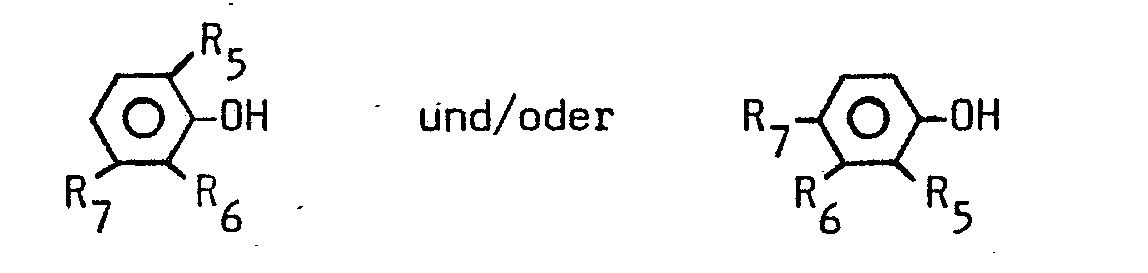
- the modified hydrocarbon resins (II) of the general formula is obtained by reacting unsaturated hydrocarbon resins (III) with phenols (IV) of the formula where R 5 , R 6 and R 7 have the meaning given above (cf. Angew. Macromol. Chem. 24, 205 (1972), and 74, 17 (1978).
- R 5 and R 6 have the meaning of a methyl group and R 7 stands for hydrogen.
- the attachment of the phenol to the unsaturated hydrocarbon resin is usually carried out in the presence of an acid.
- Suitable acids are e.g. As sulfuric acid, perchloric acid, p-toluenesulfonic acid and benzenesulfonic acid. Methanesulfonic acid is preferred.
- Suitable unsaturated hydrocarbon resins (III) have a molecular weight of 1,000 to 1,000,000, preferably 50,000 to 500,000. They are preferably hydrocarbon resins whose double bonds are not in conjugation with one another. Rather, there are a maximum of 20 double bonds per 100 C-C bonds. Usually it is at least 1 double bond.
- Suitable are terpolymers of ethylene, propylene and a diene, which are also referred to as EPDM resins, in particular an ethylene-propylene-ethylidene norbornene terpolymer, and also polyalkenylenes which are obtained by ring-opening polymerization of a cyclic olefin having 5 to 12 carbon atoms, especially polyoctenylenes.
- the number n of phenolic groups added per molecule depends, among other things, on the molecular weight and the double bond content of the unsaturated hydrocarbon resins used.
- a mixture of the modified hydrocarbon resin (II) and substituted phenols (I) just described is subjected to the oxidative coupling reaction.
- the mass fraction of the modified hydrocarbon resin (II) in this mixture is between 1 and 50, preferably between 3 and 20%.
- Such a mixture can be produced by combining the two components (I + II). However, it is also possible to react the unsaturated hydrocarbon resin II from the outset with an excess of phenol and to subject the reaction mixture obtained directly to the oxidative coupling reaction. This reaction is preferably carried out by the processes of DE-OSS 32 24 692 and 33 13 864 and German patent application P 33 32 377.1.
- the comb polymer itself and its mixtures with polyphenylene ethers are of great interest for the production of molding compositions with novel properties.
- the viscosity is determined using the J value analogously to DIN 53 728 by dissolving 0.5 g of substance in 100 cm 3 of chloroform.
- DMP Dimethylphenol
- the solution cooled to room temperature, is washed with water until neutral and then dried over sodium sulfate.
- the solution obtained in this way can be subjected directly to the oxidative coupling reaction to produce a mixture of poly (2,6-dimethyl-1,4-phenylene ether) and an EPDM resin-PPE comb polymer.
- the yield is 1.8 kg; this corresponds to 95%.
- the phenol content in the product is 2.5 percent by weight.
- a modified polyoctenylene is prepared from 2 kg of polyoctenylene, 20 kg of o-xylene, 1.6 kg of 2,6-dimethylphenol and a mixture of 80 g of methanesulfonic acid in 800 g of o-xylene and 400 g of 2,6-dimethylphenol .
- the polyoctenylene used has a J value of 120 ml / g and a trans content of 80%.
- Such a product is commercially available under the name VESTENAMER® 8012 (manufacturer: Chemische Werke Hüls AG, D-4370 Marl 1).
- the reaction temperature is between 145 and 150 ° C.
- the product is reprecipitated by dissolving in toluene and then precipitating with methanol.
- the yield is 1.8 kg.
- the phenol content is 0.9 percent by weight.
- the modified polyoctenylene obtained according to Example 6 is polycondensed analogously to Example 4.
- the comb polymer can be separated from the mixtures obtained according to Examples 4, 5 and 7.
- a mixture of 9 parts by weight of PPE and 1 part by weight of the unmodified EPDM resin described in Example 1 is combined with 90 parts by weight of toluene and slightly warmed. 5 times the volume of a mixture of hexane and methylcyclohexane in a ratio of 1: 1 is added at room temperature. While the PPE fails, the unmodified EPDM resin remains dissolved.
- Press plates are produced from a mixture of 90 percent by weight of the polyphenylene ether, which is obtained according to Example 2 without addition of the modified EPDM resin, and 10 percent by weight of the EPDM resin used in Example 1.
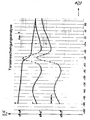
- the torsional vibration spectrum is shown in Figure 1. A clear decrease in the elastic modulus of the physical mixture can be seen above the glass temperature of the EPDM.
- Press plates are produced from a mixture of polyphenylene ether and EPDM-polyphenylene ether comb polymer, which is obtainable according to Example 2.
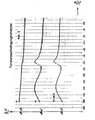
- the torsional vibration spectrum is shown in Figure 2 again given. It can be seen that the elastic modulus of the entire mixture remains largely unchanged even above the observable glass transition temperature of the EPDM phase.
Landscapes
- Chemical & Material Sciences (AREA)
- Health & Medical Sciences (AREA)
- Chemical Kinetics & Catalysis (AREA)
- Medicinal Chemistry (AREA)
- Polymers & Plastics (AREA)
- Organic Chemistry (AREA)
- Polyethers (AREA)
- Compositions Of Macromolecular Compounds (AREA)
Abstract
Description
- Die vorliegende Erfindung betrifft neuartige Kohlenwasserstoffharz-Polyphenylenether-Kammpolymere und deren Mischungen mit Polyphenylenethern sowie Verfahren zu ihrer Herstellung.
- Polyphenylenether, insbesondere Poly-(2,6-dimethylphenylenether) (PPEh und Verfahren zu ihrer Herstellung sind bekannt. Sie werden z. B. in Bühler "Spezialplaste" (Akademieverlag, Berlin, 1978) und bereits in den US-PSS 3 306 874 und 3 306 875 beschrieben.
- Im industriellen Bereich haben sich die Verfahren durchgesetzt, bei denen ortho-substituierte Phenole in Gegenwart von Sauerstoff bzw. Sauerstoff enthaltenden Gasmischungen durch Kupferamin-Komplexe oxidativ gekuppelt werden.
- Polyphenylenether sind technische Hochleistungsthermoplaste mit hohen Schmelzviskositäten und Erweichungspunkten. Sie eignen sich für zahlreiche technische Anwendungen, bei denen es auf Beständigkeit bei hoher Temperatur ankommt. Gewisse Eigenschaften der Polyphenylenether sind für einige technische Anwendungen unerwünscht. Beispielsweise sind Formteile aus Polyphenylenethern aufgrund ihrer schlechten Schlagzähigkeit überaus spröde. Die Verarbeitung als Schmelze ist technisch bisher ohne Bedeutung geblieben, da es bei den erforderlichen hohen Temperaturen zu Abbaureaktionen kommt, die sich durch Verfärbung des Produkts bemerkbar machen.
- Es ist bekannt, daß die Eigenschaften von Polyphenylenethern durch Abmischungen mit anderen Polymeren verbessert werden können. So ist aus der US-PS 3 383 435 und der DE-AS 21 19 301 bekannt, daß die Verarbeitbarkeit von Polyphenylenethern in der Schmelze durch Abmischungen mit Polystyrolharzen, vorzugsweise kautschukmodifizierten schlagzähen Polystyrolen, verbessert werden kann.
- Die Materialeigenschaften derartiger Formmassen sind im allgemeinen noch nicht zufriedenstellend: die Formteile weisen vielfach eine nicht ausreichende Schlagzähigkeit und Wärmeformbeständigkeit auf.
- Es ist deshalb vorgeschlagen worden, die Schlagzähigkeit durch Zugabe von elastomeren Blockmischpolymerisaten zu erhöhen. So werden z. B. in der DE-AS 19 32 234 sowie in den DE-OSS 24 34 848, 27 13 509, 27 50 515 Formmassen aus Styrolpolymerisaten, Polyphenylenethern und Zusätzen von unterschiedlich aufgebauten hydrierten und/oder nichthydrierten Blockmischpolymeren beschrieben. Letztere bestehen vornehmlich aus polymerisierten vinylaromatischen Kohlenwasserstoffblöcken und polymerisierten konjugierten Dienpolymerisatblöcken. Ferner sind in den US-PSS 3 658 945, 3 943 191, 3 959 211, 3 974 235, 4 101 503, 4 101 504, 4 101 505 und 4 102 850 Verfahren beschrieben, bei denen die Polystyrolkomponente durch Pfropfung mit einem Ethylen-α-Olefin-Dien-Terpolymeren modifiziert wird. Für diese Verfahren gilt jedoch, daß die Herstellung der Blockmischpolymeren und der Pfropfprodukte aufwendig und ihr Zusatz mit einer Senkung der Wärmeformbeständigkeit verbunden ist.
- Die DE-OS 21 07 935 beschreibt ein Verfahren zur Herstellung einer Mischung aus einem Polyphenylenether und einem Kautschuk. Dieses Verfahren sieht vor, daß man ein 2,6-disubstituiertes Phenol in Gegenwart eines Kautschuks, wie z. B. Polyisopren, polymerisiert. Man erhält auf diese Weise ein Produkt, bei dem die Identität der Mischungskomponenten, Polyphenylenether und Kautschuk, erhalten bleibt. Dies wird am deutlichsten dadurch demonstriert, daß man die Komponenten der Mischung durch geeignete Maßnahmen wieder trennen kann. Beispielsweise kann man die Mischung in einem geeigneten Lösemittel vollständig auflösen und durch Zugabe eines weiteren Lösemittels, das eine der beiden Komponenten nicht löst, eine Trennung der Komponenten erreichen. Dies gilt auch für feinteilige Pulvergemische aus Polyphenylenethern und Kautschuk, die gemäß der DE-PS 21 11 043 erhalten werden.
- Polyphenylenether und Kohlenwasserstoffharze sind nur wenig miteinander verträglich. Daher ist der Zusatz von Polyethylenen zu Polyphenylenethern und deren Mischungen mit Polystyrolharzen auf sehr geringe Mengen beschränkt, wenn es nicht zu Versprödung und Delaminierung kommen soll (vgl. EP-OS 0 080 666, Seite 2, Zeilen 4 bis 10). Eine Verbesserung wird bisher nur durch den Zusatz von Verträglichkeitsvermittlern, wie Styrol-Butadien-Blockcopolymeren erreicht.
- Ein neueres Verfahren sieht vor, 2,6-disubstituierte Phenole in Gegenwart bestimmter Mangan-Amin-Katalysatoren oxidativ zu kuppeln und die Aminokomponente in das erhaltene Polymere mit einzubauen. Die erhaltenen funktionalisierten Polyphenylenether lassen sich bei erhöhter Temperatur mit ungesättigten Verbindungen pfropfen (vgl. EP-OS 0 101 873). Bei diesem Verfahren besteht allerdings die Gefahr, daß es zu Gelbildung kommt. Dies belegen die Beispiele. Das beschriebene Pfropfungsverfahren dürfte sich schon deshalb nicht durchsetzen, da es nur auf speziell hergestellte funktionalisierte Polyphenylenether anwendbar ist.
- Schließlich war es aus der DE-05 17 45 201 bekannt, daß die Kettenlänge von Polyphenylenethern dadurch geregelt werden kann, daß man dem Reaktionsansatz ein Phenol beifügt, das in den Positionen 2, 4 und 6 durch niedere Alkylgruppen substituiert ist.
- Ein Ziel der vorliegenden Erfindung war es, eine neue, mit Polyphenylenethern verträgliche Kohlenwasserstoffharzkomponente bereitzustellen. Ein weiteres Ziel bestand darin, neuartige Polyphenylenether zu synthetisieren.
- Es wurde jetzt gefunden, daß man die aus alkylierten Phenolen und ungesättigten Kohlenwasserstoffharzen erhältlichen funktionalisierten Kohlenwasserstoffharze mit freien Phenolgruppen als Comonomere bei der oxidativen Kupplung von ortho-substituierten Phenolen einsetzen kann. Das erhaltene Reaktionsprodukt stellt ein Gemisch aus einem Polyphenylenether und einem Kammpolymer mit einem Kohlenwasserstoffharz als Hauptkette und Polyphenylenethergruppen als Seitenkette dar. Dieses Kammpolymer ist auf einfache Weise auch separat herstellbar.
- Gegenstand der vorliegenden Erfindung ist das Verfahren zur Herstellung . dieser Polyphenylenethergemische bzw. des separierten Kammpolymeren nach den Ansprüchen 1 bis 8 sowie die nach diesen Verfahren erhältlichen Produkte gemäß den Ansprüchen 9 und 10.
- Als substituierte Phenole (I) kommen Verbindungen der allgemeinen Formel

- Die trisubstituierte Phenolkomponente (II) kann durch die allgemeine Formel
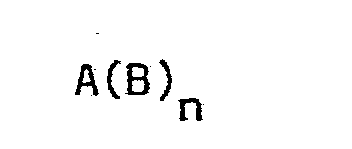

- Die modifizierten Kohlenwasserstoffharze (II) der allgemeinen Formel


- Die Anlagerung des Phenols an das ungesättigte Kohlenwasserstoffharz wird üblicherweise in Gegenwart einer Säure durchgeführt. Geeignete Säuren sind z. B. Schwefelsäure, Perchlorsäure, p-Toluolsulfonsäure und Benzolsulfonsäure. Bevorzugt wird Methansulfonsäure.
- Geeignete ungesättigte Kohlenwasserstoffharze (III) haben ein Molekulargewicht von 1 000 bis 1 000 000, vorzugsweise von 50 000 bis 500 000. Vorzugsweise handelt es sich um Kohlenwasserstoffharze, deren Doppelbindungen nicht zueinander in Konjugation stehen. Vielmehr kommen auf 100 C-C-Bindungen im Durchschnitt maximal 20 Doppelbindungen. Üblicherweise ist es mindestens 1 Doppelbindung. Geeignet sind Terpolymere des Ethylens, Propylens und eines Diens, die auch als EPDM-Harze bezeichnet werden, insbesondere ein Ethylen-Propylen-Ethylidennorbornen-Terpolymeres, sowie Polyalkenylene, die durch ringöffnende Polymerisation eines cyclischen Olefins mit 5 bis 12 C-Atomen erhalten werden, insbesondere Polyoctenylene.
- Die Zahl n der pro Molekül addierten phenolischen Gruppen hängt unter anderem vom Molekulargewicht und dem Doppelbindungsgehalt der eingesetzten ungesättigten Kohlenwasserstoffharze ab.
- Der oxidativen Kupplungsreaktion wird ein Gemisch aus dem soeben beschriebenen modifizierten Kohlenwasserstoffharz (II) und substituierten Phenolen (I) unterworfen. Der Masseanteil des modifizierten Kohlenwasserstoffharzes (II) in diesem Gemisch liegt zwischen 1 und 50, vorzugsweise zwischen 3 und 20 %.
- Ein solches Gemisch kann durch Vereinigen der beiden Komponenten (I + II) hergestellt werden. Es ist aber auch möglich, das ungesättigte Kohlenwasserstoffharz II von vornherein mit einem Phenolüberachuß umzusetzen und das erhaltene Reaktionsgemisch direkt der oxidativen Kupplungsreaktion zu unterwerfen. Vorzugsweise erfolgt diese Reaktion nach den Verfahren der DE-OSS 32 24 692 und 33 13 864 sowie der deutschen Patentanmeldung P 33 32 377.1.
- Die Aufarbeitung der im Anschluß an die oxidative Kupplung erhaltenen Lösungen aus Polyphenylenether und Kohlenwasserstoffharz/Polyphenylenether-Kammpolymer kann nach den üblichen Verfahren, z. B. durch gemeinsame Fällung mittels Zugabe eines Antilösungsmittels, durch Direktisolationsverfahren (Sprühtrocknung oder Heißwasserzerkrümelung) oder direkt durch Eindampfung und anschließende Entgasung gemäß deutscher Patentanmeldung P 33 37 629.8 (Verfahren zum Herstellen thermoplastischer Formmassen, enthaltend Polyphenylenether) erfolgen.
- Aus dem so erhaltenen Gemisch, das nur den Polyphenylenether und das Kohlenwasserstoffharz-Polyphenylenether-Kammpolymere enthält, läßt sich letzterer auf folgende Weise abtrennen:
- Man löst das Gemisch in einem Lösemittel auf, das beide Komponenten zu lösen imstande ist. Infrage kommen Lösemittel, wie Toluol, Benzol, Ethylbenzol, Xylol, Chloraform,Chlorbenzol und Dichlorbenzol. Vorzugsweise verwendet man Toluol. Anschließend fügt man zu dieser Lösung ein sogenanntes Antilösemittel, d. h. ein Lösemittel, in dem der Polyphenylenether unlöslich, das Kammpolymere aber löslich ist. Geeignete Antilösemittel sind z. B. Hexan, Heptan und Cyclohexan. Nach Abtrennung des Polyphenylenethers dampft man die erhaltene Lösung ein und erhält so das Kammpolymere.
- Eine weitere Möglichkeit besteht darin, daß man unmittelbar von der nach der oxidativen Kupplungsreaktion anfallenden organischen Lösung des Reaktionsprodukts ausgeht. Dies setzt aber voraus, daß für die oxidative Kupplungsreaktion ein Lösemittel gewählt wurde, in dem das Reaktionsprodukt hinreichend löslich ist. Die Lösemittel sind der einschlägigen Literatur zu entnehmen. Besonders geeignet ist Toluol. Anschließend wird das Antilösemittel zugesetzt und das Kammpolymere isoliert, wie oben beschrieben.
- Das Kammpolymere selbst sowie seine Mischungen mit Polyphenylenethern sind von großem Interesse für die Herstellung von Formmassen mit neuartigen Eigenschaften.
- Die Bestimmung der Viskosität mit Hilfe des J-Wertes erfolgt analog zu DIN 53 728 durch Auflösen von 0,5 g Substanz in 100 cm3 Chloroform.
- Dimethylphenol wird im folgenden vielfach mit DMP abgekürzt.
- Herstellung einer Lösung aus 2,6-DMP-modifiziertem EPDM-Harz und 2,6-DMP
- 2 kg EPDM-Harz (Copolymer aus 48 Masseprozent Ethylen, 42 Masseprozent Propylen und 10 Masseprozent 5-Ethyliden-bicyclo-(2.2.1)-hept-2-en, Mooney-Viskosität ML (1 + 4) bei 100 °C = 45, Mw = ca. 160 000) werden in einer Inertgasatmosphäre bei 150 °C unter Rühren in 17,8 kg 2,6-Dimethylphenol gelöst und mit einer Lösung von 50 g Methansulfonsäure in 200 g Xylol und 200 g 2,6-Dimethylphenol versetzt. Man läßt 4 Stunden reagieren und verdünnt nach Abkühlen auf 100 °C mit 50 kg Toluol. Die auf Raumtemperatur abgekühlte Lösung wird mit Wasser bis zur neutralen Reaktion gewaschen und danach über Natriumsulfat getrocknet. Die auf diese Weise erhaltene Lösung kann direkt der oxidativen Kupplungsreaktion zur Herstellung einer Mischung aus Poly-(2,6-dimethyl-l,4-phenylen- ether) und eines EPDM-Harz-PPE-Kammpolymeren unterworfen werden.
- Eine Probe der so erhaltenen Lösung wird aufgearbeitet und der Gewichtsanteil der phenolischen Seitengruppen im Kammpolymeren bestimmt. Laut IR- und UV-Messungen beträgt dieser Anteil 1,5 %.
- In einem Rührkessel legt man eine Mischung aus 140 kg Toluol, 26 kg Methanol, 3,6 kg Morpholin und eine Lösung von 0,2 kg CuCO3 in 0,7 kg Bromwasserstoffsäure (48 %ig) vor. Unter Rühren (250 U/min) und Einleiten eines Luftstroms von ca. 8 m3/h gibt man die in Beispiel 1 hergestellte Lösung von 2,6-Dimethylphenol und modifiziertem EPDM-Harz in Toluol über einen Zeitraum von 30 Minuten zu. 60 Minuten nach Beendigung der Zugabe wird die Polykondensation durch Zugabe von wäßriger Essigsäure gestoppt. Man fällt das Polymere durch Zugabe von Methanol aus und trocknet es.


- 68 % H Ar-CH3 = 2,1 (s)
- 7 % H Alk.-CH2-Alk. = 1,3 (m)
- 3 % H Alk.-CH3 = 0,9 (m)
- Laut GPC-Analyse lag eine Mischung aus 75 Gewichtsprozent PPE und 25 Gewichtsprozent eines PPE-Harz-EPDM-Kammpolymeren vor.


- 2 kg des in Beispiel 1 beschriebenen unmodifizierten EPDM-Harzes werden in 18 kg 1,2-Dichlorbenzol unter Stickstoff bei 150 °C gelöst. Anschließend tropft man zu dieser Lösung innerhalb von 15 Minuten eine Mischung aus 50 g Methansulfonsäure, 2 kg 1,2-Dichlorbenzol und 2 kg 2,4-Dimethylphenol. Man hält die Reaktionsmischung 4 Stunden bei 170 bis 175 °C, verdünnt den Ansatz nach Abkühlen durch Zusatz der gleichen Volumen- . menge Toluol und isoliert das modifizierte EPDM-Harz durch Eingießen in 50 kg Methanol. Das abdekantierte Produkt wird zweimal umgefällt, indem man es in Chloroform löst und mit Methanol fällt, und anschließend im Vakuum bei 80 °C getrocknet.
- Die Ausbeute beträgt 1,8 kg; dies entspricht 95 %. Der Phenolgehalt im Produkt beträgt 2,5 Gewichtsprozent.
- 1,8 kg des nach Beispiel 3 erhaltenen modifizierten EPDM-Harzes werden in einer Mischung aus 16 kg 2,6-Dimethylphenol und 20 kg Toluol gelöst und gemäß Beispiel 5 polykondensiert.


- 68 % H Ar-CH3 δ = 2,1 (s)
- 7 % H Alk-CH2-Alk δ = 1,3 (m)
- 3 % H Alk-CH3 δ = 0,9 (m)
- Entsprechend Beispiel 1 werden 2,7 kg unmodifiziertes EPDM-Harz mit 15,3 kg 2,6 DMP umgesetzt. Die erhaltene Reaktionslösung wird auf einen Volumengehalt von 20 Litern Toluol eingeengt. Die so erhaltene Lösung wird innerhalb von 30 Minuten zu einer Mischung gegeben, die aus 170 kg Toluol, 26 kg Methanol, 3,6 kg Morpholin und einer Lösung von 0,2 kg Kupfercarbonat in 0,7 kg 48 %iger Bromwasserstoffsäure besteht und in einem Rührkessel mit einer Geschwindigkeit von 250 Umdrehungen pro Minute gerührt wird, während gleichzeitig 8 m3 Luft pro Stunde eingeleitet werden. 60 Minuten nach Beendigung der Zugabe wird die Polykondensation durch Unterbrechung der Luftzufuhr und gleichzeitiges Einführen einer Mischung aus 45 kg Wasser und 5 kg Methanol und 15minütigem Einleiten von Kohlendioxid (5 m3/h) gestoppt. Danach trennt man die Phasen, wäscht die organische Phase mit 100 kg Wasser bei 80 °C und isoliert nach anschließender Phasentrennung das Produkt durch Zugabe von 200 kg Methanol und anschließende Filtration und Trocknung.


- 64,2 % H Ar-CH3
- 10,5 % H Alk-CH2-Alk
- 4,5 % H Alk-CH3
- Analog zu Beispiel 3 wird aus 2 kg Polyoctenylen, 20 kg o-Xylol, 1,6 kg 2,6-Dimethylphenol sowie einer Mischung aus 80 g Methansulfonsäure in 800 g o-Xylol und 400 g 2,6-Dimethylphenol ein modifiziertes Polyoctenylen hergestellt. Das eingesetzte Polyoctenylen weist einen J-Wert von 120 ml/g und einen trans-Gehalt von 80 % auf. Ein solches Produkt ist unter dem Namen VESTENAMER® 8012 im Handel erhältlich (Hersteller: Chemische Werke Hüls AG, D-4370 Marl 1). Weitere Kenndaten dieses Produkts sind der Zeitschrift "Kautschuk, Gummi, Kunststoffe" 1981, Seiten 185 bis 190, sowie dem hüls-Merkblatt Nr. 2247 "VESTENAMER® 8012" zu entnehmen. Alternativ kann das Produkt auch hergestellt werden. Es sei verwiesen auf K. J. Ivin "Olefin Metathesis", Academic Press, Seite 236 ff., 1983.
- Die Reaktionstemperatur liegt zwischen 145 und 150 °C. Das Umfällen des Produkts erfolgt durch Auflösen in Toluol und anschließendes Fällen mit Methanol.
- Die Ausbeute beträgt 1,8 kg. Der Phenolgehalt beträgt 0,9 Gewichtsprozent.
- Das nach Beispiel 6 erhaltene modifizierte Polyoctenylen wird analog zu Beispiel 4 polykondensiert.


- 10 Gewichtsteile der nach Beispiel 2 erhaltenen Mischung aus PPE und EPDM-Harz-PPE-Kammpolymeren werden mit 90 Gewichtsteilen Toluol vereinigt und leicht erwärmt. Man setzt bei Raumtemperatur eine Mischung aus Hexan und Methylcyclohexan im Verhältnis 1 : 1 zu. Während das reine PPE bei Raumtemperatur ausfällt, bleibt das Kammpolymere in Lösung.
- In analoger Weise kann das Kammpolymere aus den nach den Beispielen 4, 5 und 7 erhaltenen Mischungen abgetrennt werden.
- Eine Mischung aus 9 Gewichtsteilen PPE und 1 Gewichtsteil des in Beispiel 1 beschriebenen unmodifizierten EPDM-Harzes wird mit 90 Gewichtsteilen Toluol vereinigt und leicht erwärmt. Man setzt bei Raumtemperatur das 5fache Volumen einer Mischung aus Hexan und Methylcyclohexan im Verhältns 1 : 1 zu. Während das PPE ausfällt, bleibt das unmodifizierte EPDM-Harz gelöst.
- Aus einer Mischung aus 90 Gewichtsprozent des Polyphenylenethers, der nach Beispiel 2 ohne Zusatz des modifizierten EPDM-Harzes erhalten wird, und 10 Gewichtsprozent des in Beispiel 1 eingesetzten EPDM-Harzes werden Preßplatten hergestellt. Das Torsionsschwingungsspektrum ist in Abbildung 1 wiedergegeben. Man erkennt oberhalb der Glastemperatur des EPDM einen deutlichen Rückgang des Elastizitätsmoduls der physikalischen Mischung.
- Aus einer Mischung von Polyphenylenether und EPDM-Polyphenylenether-Kammpolymer, die nach Beispiel 2 erhältlich ist, werden Preßplatten hergestellt. Das Torsionsschwingungsspektrum ist in Abbildung 2 wiedergegeben. Man erkennt, daß auch oberhalb der zu beobachtbaren Glasübergangstemperatur der EPDM-Phase der Elastizitätsmodul der gesamten Mischung weitgehend unverändert bleibt.
Claims (10)

dadurch gekennzeichnet,
daß man als trisubstituierte Phenolkomponente (II) ein Kohlenwasserstoffharz mit Seitengruppen der Formel

dadurch gekennzeichnet,
daß man als trisubstituierte Phenolkomponente (II) ein Produkt einsetzt, das durch säurekatalysierte Umsetzung eines ungesättigten Kohlenwasserstoffharzes (III) mit Phenolen (IV) der Formel
dadurch gekennzeichnet,
daß das ungesättigte Kohlenwasserstoffharz keine konjugier.ten Doppelbindungen enthält und - bezogen auf 100 C-C-Bindungen - maximal 20 Doppelbindungen aufweist.
dadurch gekennzeichnet,
daß das ungesättigte Kohlenwasserstoffharz ein Ethylen-Propylen-Dien-Terpolymeres ist.
dadurch gekennzeichnet,
daß das ungesättigte Kohlenwasserstoffharz ein Ethylen-Propylen-Ethylidennorbornen-Terpolymeres ist.
dadurch gekennzeichnet,
daß das ungesättigte Kohlenwasserstoffharz ein Polyalkenylen, vorzugsweise ein Polyoctenylen, ist.
dadurch gekennzeichnet,
daß der Masseanteil der in Anspruch 1 aufgeführten trisubstituierten Phenolkomponente (II), bezogen auf die Gesamtmenge der eingesetzten Phenole (I + II), 1 bis 50 % beträgt.
dadurch gekennzeichnet,
daß man die nach den Verfahren der Ansprüche 1 bis 7 erhältlichen homogenen Lösungen des Reaktionsprodukts in einem organischen Lösemittel, wie z. B. Toluol, mit einem - bezogen auf Polyphenylenether - sogenannten "Antilösemittel" versetzt, den Polyphenylenether ausfällt und das Kammpolymere aus der erhaltenen Lösung durch Entfernung des Lösemittel isoliert.
Priority Applications (1)
| Application Number | Priority Date | Filing Date | Title |
|---|---|---|---|
| AT86101005T ATE43618T1 (de) | 1985-03-14 | 1986-01-25 | Kohlenwasserstoffharz-polyphenylenetherkammpolymere und deren mischungen mit polyphenylenethern sowie verfahren zu ihrer herstellung. |
Applications Claiming Priority (2)
| Application Number | Priority Date | Filing Date | Title |
|---|---|---|---|
| DE3509093 | 1985-03-14 | ||
| DE19853509093 DE3509093A1 (de) | 1985-03-14 | 1985-03-14 | Kohlenwasserstoffharz-polyphenylenether-kammpolymere und deren mischungen mit polyphenylenethern sowie verfahren zu ihrer herstellung |
Publications (2)
| Publication Number | Publication Date |
|---|---|
| EP0195199A1 true EP0195199A1 (de) | 1986-09-24 |
| EP0195199B1 EP0195199B1 (de) | 1989-05-31 |
Family
ID=6265152
Family Applications (1)
| Application Number | Title | Priority Date | Filing Date |
|---|---|---|---|
| EP86101005A Expired EP0195199B1 (de) | 1985-03-14 | 1986-01-25 | Kohlenwasserstoffharz-Polyphenylenether-Kammpolymere und deren Mischungen mit Polyphenylenethern sowie Verfahren zu ihrer Herstellung |
Country Status (5)
| Country | Link |
|---|---|
| US (1) | US4876310A (de) |
| EP (1) | EP0195199B1 (de) |
| JP (1) | JPS62526A (de) |
| AT (1) | ATE43618T1 (de) |
| DE (2) | DE3509093A1 (de) |
Families Citing this family (2)
| Publication number | Priority date | Publication date | Assignee | Title |
|---|---|---|---|---|
| US5624027A (en) * | 1995-05-10 | 1997-04-29 | Joseph M. Torsella | Apparatus for securing a computer diskette to an object |
| US7022765B2 (en) * | 2004-01-09 | 2006-04-04 | General Electric | Method for the preparation of a poly(arylene ether)-polyolefin composition, and composition prepared thereby |
Family Cites Families (3)
| Publication number | Priority date | Publication date | Assignee | Title |
|---|---|---|---|---|
| US3658949A (en) * | 1970-12-07 | 1972-04-25 | Sumitomo Chemical Co | Process for producing modified polyphenylene oxide composition |
| JPS529098A (en) * | 1975-07-10 | 1977-01-24 | Mitsubishi Gas Chem Co Inc | Preparation of novel polyphenylene oxide modified with rubber |
| EP0101873B1 (de) * | 1982-07-27 | 1987-09-16 | General Electric Company | Verfahren zur Modifizierung von ungesättigten Kautschuken und die hergestellten Gegenstände |
-
1985
- 1985-03-14 DE DE19853509093 patent/DE3509093A1/de not_active Withdrawn
-
1986
- 1986-01-25 DE DE8686101005T patent/DE3663674D1/de not_active Expired
- 1986-01-25 EP EP86101005A patent/EP0195199B1/de not_active Expired
- 1986-01-25 AT AT86101005T patent/ATE43618T1/de not_active IP Right Cessation
- 1986-02-28 US US06/834,423 patent/US4876310A/en not_active Expired - Fee Related
- 1986-03-13 JP JP61053834A patent/JPS62526A/ja active Pending
Also Published As
| Publication number | Publication date |
|---|---|
| DE3509093A1 (de) | 1986-09-18 |
| DE3663674D1 (en) | 1989-07-06 |
| JPS62526A (ja) | 1987-01-06 |
| EP0195199B1 (de) | 1989-05-31 |
| ATE43618T1 (de) | 1989-06-15 |
| US4876310A (en) | 1989-10-24 |
Similar Documents
| Publication | Publication Date | Title |
|---|---|---|
| DE69808707T2 (de) | Wiederverteilung von polyphenylenethern und polyphenylenether mit neuartigen strukturen | |
| DE68929234T2 (de) | Polymermischung, die einen Polyphenylenether und ein Polyarylensulfid enthält | |
| DE3785298T2 (de) | Funktionalisierte polyphenylenether, verfahren zur herstellung, und daraus hergestellte polyphenylenether-polyamid-zusammensetzungen. | |
| DE2713455C2 (de) | ||
| EP0071093A1 (de) | Verfahren zur Herstellung von Polyphenylenether enthaltenden Formmassen | |
| DE69031210T2 (de) | Polyindane als Verfahrenshilfsmittel für Thermoplasten | |
| EP0095098B1 (de) | Thermoplastische Formmassen | |
| EP0062283B1 (de) | Schlagzähe thermoplastische Formmassen | |
| DE3813354A1 (de) | Thermoplastische formmassen auf basis von funktionalisierten polyphenylenethern und polyamiden | |
| DE3831348A1 (de) | Schlagzaehe thermoplastische formmassen auf basis von polyphenylenether-pfropfcopolymeren und polyamiden sowie verfahren zu ihrer herstellung | |
| EP0195199B1 (de) | Kohlenwasserstoffharz-Polyphenylenether-Kammpolymere und deren Mischungen mit Polyphenylenethern sowie Verfahren zu ihrer Herstellung | |
| EP0298365B1 (de) | Thermoplastische Formmassen | |
| EP0236554A1 (de) | Thermoplastische Formmassen | |
| EP0194423B1 (de) | Thermoplastische Formmassen | |
| DE69016062T2 (de) | Aryloxytriazin-endverschlossene Polyphenylenether und Verfahren zu ihrer Herstellung. | |
| EP0513488A1 (de) | Formmassen auf Basis modifizierter Polyarylether | |
| DE19531976C2 (de) | Zusammensetzungen aus Polyphenylenetherharz | |
| DE2446424C2 (de) | ||
| DE69614862T2 (de) | Metallisierung und funktionalisierung von polymeren und copolymeren | |
| DE68918325T2 (de) | Reagierende Pfropfpolymere. | |
| DE2802664A1 (de) | Gummimodifizierter polyphenylenaether und verfahren zu seiner herstellung | |
| DE3206637C2 (de) | ||
| DE2136837B2 (de) | Verfahren zur Herstellung von amorphen Polyphenylenoxiden | |
| DE1520311A1 (de) | Ungesaettigte Polycarbonylverbindungen mit hohem Molekulargewicht und Verfahren zu ihrer Herstellung | |
| DE69223578T2 (de) | Polyphenylenether enthaltend reaktive Endgruppen, Verfahren zur Herstellung und deren thermoplastische Mischungen |
Legal Events
| Date | Code | Title | Description |
|---|---|---|---|
| PUAI | Public reference made under article 153(3) epc to a published international application that has entered the european phase |
Free format text: ORIGINAL CODE: 0009012 |
|
| AK | Designated contracting states |
Kind code of ref document: A1 Designated state(s): AT BE CH DE FR GB IT LI NL SE |
|
| 17P | Request for examination filed |
Effective date: 19860731 |
|
| 17Q | First examination report despatched |
Effective date: 19871106 |
|
| GRAA | (expected) grant |
Free format text: ORIGINAL CODE: 0009210 |
|
| AK | Designated contracting states |
Kind code of ref document: B1 Designated state(s): AT BE CH DE FR GB IT LI NL SE |
|
| REF | Corresponds to: |
Ref document number: 43618 Country of ref document: AT Date of ref document: 19890615 Kind code of ref document: T |
|
| GBT | Gb: translation of ep patent filed (gb section 77(6)(a)/1977) | ||
| REF | Corresponds to: |
Ref document number: 3663674 Country of ref document: DE Date of ref document: 19890706 |
|
| ET | Fr: translation filed | ||
| ITF | It: translation for a ep patent filed | ||
| PGFP | Annual fee paid to national office [announced via postgrant information from national office to epo] |
Ref country code: SE Payment date: 19891211 Year of fee payment: 5 |
|
| PGFP | Annual fee paid to national office [announced via postgrant information from national office to epo] |
Ref country code: FR Payment date: 19891219 Year of fee payment: 5 |
|
| PGFP | Annual fee paid to national office [announced via postgrant information from national office to epo] |
Ref country code: BE Payment date: 19900112 Year of fee payment: 5 |
|
| PGFP | Annual fee paid to national office [announced via postgrant information from national office to epo] |
Ref country code: CH Payment date: 19900124 Year of fee payment: 5 |
|
| PGFP | Annual fee paid to national office [announced via postgrant information from national office to epo] |
Ref country code: GB Payment date: 19900131 Year of fee payment: 5 Ref country code: AT Payment date: 19900131 Year of fee payment: 5 |
|
| PLBE | No opposition filed within time limit |
Free format text: ORIGINAL CODE: 0009261 |
|
| STAA | Information on the status of an ep patent application or granted ep patent |
Free format text: STATUS: NO OPPOSITION FILED WITHIN TIME LIMIT |
|
| 26N | No opposition filed | ||
| PG25 | Lapsed in a contracting state [announced via postgrant information from national office to epo] |
Ref country code: GB Effective date: 19910125 Ref country code: AT Effective date: 19910125 |
|
| PGFP | Annual fee paid to national office [announced via postgrant information from national office to epo] |
Ref country code: DE Payment date: 19910125 Year of fee payment: 6 |
|
| PG25 | Lapsed in a contracting state [announced via postgrant information from national office to epo] |
Ref country code: SE Effective date: 19910126 |
|
| ITTA | It: last paid annual fee | ||
| PG25 | Lapsed in a contracting state [announced via postgrant information from national office to epo] |
Ref country code: LI Effective date: 19910131 Ref country code: CH Effective date: 19910131 Ref country code: BE Effective date: 19910131 |
|
| PGFP | Annual fee paid to national office [announced via postgrant information from national office to epo] |
Ref country code: NL Payment date: 19910131 Year of fee payment: 6 |
|
| GBPC | Gb: european patent ceased through non-payment of renewal fee | ||
| PG25 | Lapsed in a contracting state [announced via postgrant information from national office to epo] |
Ref country code: FR Effective date: 19910930 |
|
| REG | Reference to a national code |
Ref country code: CH Ref legal event code: PL |
|
| REG | Reference to a national code |
Ref country code: FR Ref legal event code: ST |
|
| PG25 | Lapsed in a contracting state [announced via postgrant information from national office to epo] |
Ref country code: NL Effective date: 19920801 |
|
| NLV4 | Nl: lapsed or anulled due to non-payment of the annual fee | ||
| PG25 | Lapsed in a contracting state [announced via postgrant information from national office to epo] |
Ref country code: DE Effective date: 19921001 |
|
| EUG | Se: european patent has lapsed |
Ref document number: 86101005.6 Effective date: 19910910 |
|
| PG25 | Lapsed in a contracting state [announced via postgrant information from national office to epo] |
Ref country code: IT Free format text: LAPSE BECAUSE OF NON-PAYMENT OF DUE FEES;WARNING: LAPSES OF ITALIAN PATENTS WITH EFFECTIVE DATE BEFORE 2007 MAY HAVE OCCURRED AT ANY TIME BEFORE 2007. THE CORRECT EFFECTIVE DATE MAY BE DIFFERENT FROM THE ONE RECORDED. Effective date: 20050125 |