EP0178450A2 - Metallkomplexe, an die ein immunologisch aktives Material gekoppelt werden kann bzw. ist, deren Herstellung und Verwendung - Google Patents
Metallkomplexe, an die ein immunologisch aktives Material gekoppelt werden kann bzw. ist, deren Herstellung und Verwendung Download PDFInfo
- Publication number
- EP0178450A2 EP0178450A2 EP85111377A EP85111377A EP0178450A2 EP 0178450 A2 EP0178450 A2 EP 0178450A2 EP 85111377 A EP85111377 A EP 85111377A EP 85111377 A EP85111377 A EP 85111377A EP 0178450 A2 EP0178450 A2 EP 0178450A2
- Authority
- EP
- European Patent Office
- Prior art keywords
- group
- ligands
- complex according
- ruthenium complex
- ruthenium
- Prior art date
- Legal status (The legal status is an assumption and is not a legal conclusion. Google has not performed a legal analysis and makes no representation as to the accuracy of the status listed.)
- Granted
Links
Classifications
-
- C—CHEMISTRY; METALLURGY
- C07—ORGANIC CHEMISTRY
- C07F—ACYCLIC, CARBOCYCLIC OR HETEROCYCLIC COMPOUNDS CONTAINING ELEMENTS OTHER THAN CARBON, HYDROGEN, HALOGEN, OXYGEN, NITROGEN, SULFUR, SELENIUM OR TELLURIUM
- C07F15/00—Compounds containing elements of Groups 8, 9, 10 or 18 of the Periodic Table
- C07F15/0006—Compounds containing elements of Groups 8, 9, 10 or 18 of the Periodic Table compounds of the platinum group
- C07F15/0046—Ruthenium compounds
- C07F15/0053—Ruthenium compounds without a metal-carbon linkage
-
- G—PHYSICS
- G01—MEASURING; TESTING
- G01N—INVESTIGATING OR ANALYSING MATERIALS BY DETERMINING THEIR CHEMICAL OR PHYSICAL PROPERTIES
- G01N33/00—Investigating or analysing materials by specific methods not covered by groups G01N1/00 - G01N31/00
- G01N33/48—Biological material, e.g. blood, urine; Haemocytometers
- G01N33/50—Chemical analysis of biological material, e.g. blood, urine; Testing involving biospecific ligand binding methods; Immunological testing
- G01N33/53—Immunoassay; Biospecific binding assay; Materials therefor
- G01N33/531—Production of immunochemical test materials
- G01N33/532—Production of labelled immunochemicals
- G01N33/533—Production of labelled immunochemicals with fluorescent label
-
- Y—GENERAL TAGGING OF NEW TECHNOLOGICAL DEVELOPMENTS; GENERAL TAGGING OF CROSS-SECTIONAL TECHNOLOGIES SPANNING OVER SEVERAL SECTIONS OF THE IPC; TECHNICAL SUBJECTS COVERED BY FORMER USPC CROSS-REFERENCE ART COLLECTIONS [XRACs] AND DIGESTS
- Y10—TECHNICAL SUBJECTS COVERED BY FORMER USPC
- Y10S—TECHNICAL SUBJECTS COVERED BY FORMER USPC CROSS-REFERENCE ART COLLECTIONS [XRACs] AND DIGESTS
- Y10S436/00—Chemistry: analytical and immunological testing
- Y10S436/80—Fluorescent dyes, e.g. rhodamine
Definitions
- the present invention relates to ruthenium complexes to which an immunologically active material can be coupled.
- the ruthenium complexes have the general formula 1, wherein L 1 , L, and L, are the same or different and each represent a bi- or polycyclic ligand with at least two nitrogen-containing heterocycles, at least one of these ligands being substituted with at least one water-solubilizing group, and at least one of these Ligands with at least one reactive group, optionally substituted via a spacer group, and wherein the ligands L 1 , L, and L are bonded to the ruthenium via nitrogen atoms.
- the ligands L and L can be the same or different and contain, for example, 2,2'-bipyridine, 1,10-phen anthroline, benzbathophenanthroline or in particular bathophenanthroline groups.
- the ligands L 1 and L are preferably the same.
- Particularly suitable groups which make the ligands water-soluble are sulfonic acid groups, which are preferably in the form of their salts.
- the sodium salts are particularly preferred.
- Ligand L for example, contains a 2,2'-bipyridine, 1,10-phenanthroline or, in particular, a bathophenanthroline group.
- the spacer group mentioned at the outset is preferably an alkylene group with at most 8 carbon atoms, which may optionally have -SO 2 -NH-, -S-, -0-, -COO- or -CO-NH-.
- the reactive groups to which the immunologically active material is bound are preferably -COOH, -J, -NH 2 , -NCS or -SO, Hal groups.
- the ligand In Ru complexes with 3 identical ligands L 1 , L, and L, the ligand must have both a water-solubilizing group and a spacer group with a reactive group.
- a suitable ligand for this is the compound of the formula [(SO 2 Na) (SO 2 NH CH 2 CH 2 COOH) batho]
- one type of ligand can carry the water-solubilizing group or groups, while the other type of ligand has one or more linking groups (reactive group which is bound to the heterocycle via a spacer)
- the groups of the formula are particularly suitable as ligands L and L and as ligand L, preferably the following groups [(SO 2 Na) (SO 2 NH CH 2 CH 2 COOH) batho]
- the ruthenium complexes with 2 different ligandlypes are prepared by methods known from the literature, e.g. according to Belser et al. Helv.Chim.ACta 63, 1675 (1980).
- Is used as ligand L a compound whose reactive group exists in a protected form - e.g. as t-butyl ester in the sulfonamide derivatives of bathophenanthroin - this protective group is preferably cleaved only after the synthesis of the corresponding Ru complex.
- the ruthenium complexes formed are isolated and purified by conventional methogen by reprecipitation, column chromatography or preparative thick-layer chromatography.
- antigens, haptens or antibodies can be considered as immunologically active materials which are coupled to the aforementioned ruthenium complexes.
- Fab fragments can be considered as immunologically active materials which are coupled to the aforementioned ruthenium complexes. Both polyclonal and monoclonal antibodies can be used as antibodies.
- a particularly preferred immunologically active material is an antibody against carcinoembryonic antigen.
- Another particularly preferred immunologically active material is an antibody against human chorionic gonadotropin, and an antibody against ⁇ -interferon.
- the immunological material is coupled to the ruthenium complex in a manner known per se.
- a preferred way of coupling is that the ruthenium complex and the immunologically active material are mixed with a water-soluble carbodiimide derivative, for example. treated with N-cycloheyl-N '- (2-morpholinoethyl) carbodiimide methyl p-toluenesulfonate.
- the ruthenium complexes according to the present invention can be detected very sensitively by fluorescence spectroscopy. They are ideally suited as marker molecules for highly sensitive fluorescence immunoassays. They are particularly suitable for a time-resolved fluorescence immunoassay, as described, for example, in DT-OS 2628158.
- FITC fluorescein isothiocyanate
- the sensitivity of detection in fluorescence immunoassays can be improved. This is particularly important when determining small amounts of antigens in body fluids, e.g. Plasma and serum, advantageous Examples of such antigens are e.g. the carcinoembryonic antigen (CEA), the ⁇ -HCG or the a-interferon.
- the measuring apparatus used in the context of the present invention for the time-resolved fluorescence measurement is described in the following and explained using a diagram.
- the individual detected photons generate current pulses that are digitally counted after amplification and normalization (photon counting method).
- the delay time ⁇ is chosen so that the stray light effects and the background fluorescence have practically completely subsided. In this way, the number ofroue counted becomes proportional to the marker fluorescence intensity, which is measured separately from the background.
- the raw sodium chloride is first treated briefly with 150 ml of benzene, which are discarded (in order to remove traces of impurities). It is then extracted twice with 150 ml of chloroform, with stirring for 1 hour at room temperature.
- the crude product is dissolved in 150 ml of chloroform and this solution is shaken out three times with 100 ml of water.
- the monosulfonamide is then reprecipitated twice.
- the compound is dissolved in 50 ml of methanol / chloroform (3/1) and it is precipitated again by slowly adding 200 ml of ether. Yield: 360 mg.
- the resulting Ru3 + complex is reduced with 250 ⁇ l of a 1 molar NaH, PO, solution to the corresponding Ru 2+ complex and then boiled again under reflux for 2 hours
- the solution was then filtered, 900 ml of a 10% strength aqueous ammonium hexafluorophosphate solution were added and the solution was left to stand at 4 ° C. overnight.
- the complex fails.
- a front red zone is isolated (50 mg of pure product) and 5 ml of trifluoroacetic acid are added at room temperature for saponification. After 1 hour the trifluoroacetic acid was removed in a water jet vacuum.
- the product is dissolved in 1.5 ml of methanol and 0.5 ml of DMF and chromatographed on SiO using the eluent chloroform / methanol / water (7/3 / 0.5) (yield: 75 mg).
- the final purification is carried out using preparative thick layer chromatography.
- 40 mg of the Ru complex are dissolved in 700 ⁇ l of water and applied to 4 PSC plates (SiO 2 plates from Merck). These are dried at 60 ° C. overnight and then chromatographed with the eluent chloroform / methanol / water (50/50/2). The main zone is scraped out and extracted three times with 40 ml of water each time (the silica gel is separated off by centrifugation). After concentration, the last traces of SiO are removed from the product by dissolving it in a little methanol and centrifuging off the undissolved silica gel (yield: 38 mg).
- reaction mixture is refluxed for 5 hours under N, giving a deep red solution. After cooling, the reaction solution is concentrated in vacuo to about 70 ml and the mixed Ru complex is then precipitated by slowly adding dropwise 1.4 I of acetone.
- the soaked raw product is repurposed twice.
- the precipitation is dissolved in about 150 ml of MeOH / H 2 O / CH 2 Cl 2 (2: 1: 0.3) and the complex is then precipitated out again by slowly adding 1.5 I of acetone dropwise.
- reaction mixture is pipetted into a stirred mixture of ice, water and ether.
- the organic phase is washed neutral with bicarbonate solution and water. After drying over MgSO. the solvent is removed. This gives 5.03 g of crystalline product
- reaction mixture is cooled and pipetted into a stirred mixture of 50 ml of water and 125 ml of CH 2 Cl 2 , which is cooled well with ice.
- the pH value is brought to 5 by adding sodium hydroxide solution. The substance goes into the organic phase.
- the concentrated CH 2 Cl 2 extract is recrystallized from benzene, giving 1.35 g of product.
- a further 0.338 g of product is obtained from the concentrated mother liquor by recrystallization from ethanol
- the crude product is purified by means of preparative thick layer chromatography.
- the complex is dissolved in a little water and applied to 6 PSC plates (SiO 2 plates from Merck). After drying the plates at 70 °, chromatographed with the eluent chloroform / acetone / methanol (4/3/3).
- the main zone product extracted with water was subjected to preparative thick layer chromatography three more times, using the following solvents: acetone / water (9/1), then acetone / water (8.5 / 1.5) and finally chloroform / methanol / water (50 / 50/2).
- the extracted product is dissolved in a little methanol and the undissolved silica gel is centrifuged off. The product was then precipitated from 1 ml of methanolic solution with 50 ml of acetone. Yield: 42.6 mg (red powder).
- reaction mixture is pipetted into a stirred mixture of ice, water and ether.
- the organic phase is washed neutral with bicarbonate solution and water. After drying over MgSO4. the solvent is removed. This gives 10.2 g of crystalline product
- reaction mixture is cooled and pipetted into a stirred mixture of 100 ml of water and 250 ml of CH 2 Cl 2 , which is cooled well with ice.
- the pH is then brought to 5 by adding sodium hydroxide solution (about 2/3 of a solution of 45 g of NaOH in 200 ml of water).
- the substance then passes into the organic phase.
- the ester is dissolved in 4 5 ml of ethanol, this solution is treated with sodium hydroxide solution (2.24 g of NaOH dissolved in 11 ml of H, O) and heated to 80 ° C. under argon for 2 hours. The ethanol is then stripped off on a rotary evaporator and the residue is taken up in a mixture of CH 2 Cl 2 / water. With 3.75 ml of H 3 PO 4 85%, the pH is adjusted to about 3 and the product is then extracted.
- the benzene-free product has an Fpkt. of 195 °.
- the product is first purified by column chromatography twice over SiO 2 using the eluent chloroform / methanol / water (7/3 / 0.5).
- the complex is then cleaned using preparative thick-layer chromatography (SiO 2 plates from Merck).
- Mobile solvent chloroform / methanol / water (7/3 / 0.5).
- the main zone is extracted with methanol after being scraped out. Yield: 162 mg (red powder).
- the mixed Ru complex [RC-2] was coupled to anti-CEA using the water-soluble carbodiimide derivative N-cyclohexy) -N '- (2-morpholinoethyl) carbodiimide methyl-p-toluenesulfonate. Since the complex has two reactive groups per molecule, twice the amount of carbodiimide is used.
- the balls After a 24-hour incubation at 37 ° C., the balls are again washed three times with 2-5 ml of distilled water and then transferred into test tubes with 2 ml of sulfuric acid (0.09N) each. After 30 minutes, the sulfuric acid solution is pipetted into measuring cuvettes and the Ru complex content is measured by fluorescence spectroscopy (excitation wavelength 453 nm, emission wavelength 612 nm).
- the measurement was carried out using the apparatus previously described, using a B 610 edge filter from Balzers, a time delay of the fluorescence measurement of 2 ⁇ sec (based on the excitation pulse) and an opening of the measurement window of 3 ⁇ sec.
- Table I lists the values of a CEA determination obtained with a number of Roche CEA standards.
- the sensitivity in this two-step test is 60 pg / ml CEA.
- the CEA test could also be carried out in a one-pot procedure according to the following procedure.
- the balls are then washed three times with 2-5 ml of distilled water and then transferred into test tubes with 2 ml of sulfuric acid (0.09N) each. After 30 minutes, the sulfuric acid solution is pipetted into measuring cuvettes and the Ru complex content is measured by fluorescence spectroscopy (the measuring conditions are identical to those of part a)).
- the results of this CEA determination are summarized in Table II.
- the one-pot process has a sensitivity of 430 pg / ml CEA.
- 150 ⁇ l stock solution 1 are diluted with 250 ⁇ l water pH 4.5 (adjusted with HCl). 0.30 mg N-cyclohexyl-N '- (2-morpholinoethyl) -carbodiimide -methyl-p-toluoisulfonate is added to this solution and mixed briefly at the vortex. After 2 minutes, add the anti-HCG solution (222 ⁇ l stock solution 2 diluted with 178 ⁇ l of a 200 mM N aHCO 3 solution pH 8.5) and mix well on the vortex. The pH is adjusted to 8.5 with a little HCl. The reaction mixture is then left in the dark at room temperature for 1 to 7 hours.
- a sandwich test is carried out with a momoclonal ⁇ -HCG antibody and a polyclonal HCG antibody (labeled antibodies from DAKO) as follows
- test tubes (10 x 75 mm) add 0.050 ml of ⁇ -HCG standard solution (0 mlU / ml; 10 mlU / ml; 25 mlU / ml; 50 mlU / ml; 100 mlU / ml; 200 mlU / ml), 0.050 ml solution containing 5.12 x 10 -8 M / 1 anti-HCG labeled with the Ru complex (degree of labeling 1.0; Ver Positionnurgspuffer pH 7, containing 1 0, 1 M / l Tris, 20 % fetal calf serum, 0.05% thimerosal and 0.02% Tween 20) and 0.150 ml buffer solution (150 mM NaCl, 10 mM Na phosphate with 20 g / l bovine serum albumin). Then add a polystyrene ball (diameter 6.5 mm sensitized with monocional anti-ß
- the balls are then washed three times with 2-5 ml of distilled water and then transferred into test tubes with 2 ml of sulfuric acid (0.09N) each. After 30 minutes, the sulfuric acid solution is pipetted into measuring cuvettes and the Ru complex content is measured by fluorescence spectroscopy (the measuring conditions are identical to those of Example 12).
- reaction mixture 500 ⁇ l is chromatographed on a column (length 30 cm, diameter 9 mm) with acrylamide gel AcA-54 from LKB (mobile solvent: 150 mM NaCl, 10 mM Na phosphate, 0 , 02% NaN 3 , pH 7.0).
- a sandwich test developed by Roche Diagnostica as EIA is used for the quantitative determination of interferon-r ⁇ A standards (recombinant leucocyte interteron). Instead of the enzyme-labeled second antibody, however, monoclonal anti-interferon is used, which is labeled with the Ru complex [RC-2] (labeling level 6.4).
- the balls are then washed three times with 2-5 ml of distilled water and then transferred into test tubes with 2 ml of sulfuric acid (0.09N) each. After 30 minutes, the sulfuric acid solution is pipetted into measuring cuvettes and the Ru complex content is measured by fluorescence spectroscopy. (The measurement conditions are identical to those of Example 12).
- the coupling reaction is carried out according to the method described in Example 11. 400 ⁇ l of stock solutions 1 and 2 and 0.56 mg of water-soluble carbodiimide are used for this.
- the labeled antibodies were - as described in Example 11 - separated from the excess of Ru complex [RC-7] by gel chromatography.
- the coupling reaction is carried out according to the method described in Example 11. 400 ⁇ l of stock solutions 1 and 2 and 0.19 mg of water-soluble carbodiimide are used for this.
- the labeled antibodies were - as described in Example 11 - separated from the excess Ru complex [RC-8] by gel chromatography
- the coupling reaction takes place according to the method described in Example 11. 400 ⁇ l of stock solutions 1 and 2 and 0.37 mg of water-soluble carbodiimide are used.
- the labeled antibodies are - as described in Example 11 - separated from the excess Ru complex [RC-6] by gel chromatography.
- the labeled antibodies are - as described in Example 11 - separated from the excess Ru complex [RC-1] by gel chromatography.
- the labeled antibodies are - as described in Example 11 - separated from the excess of Ru complex [RC-10] by gel chromatography
- the labeled antibodies are - as described in Example 11 - separated from the excess Ru complex [RC-3] by gel chromatography
- the labeled antibodies are - as described in Example 1 1 - by gel chromatography from the excess of Ru complex separated [RC-4]
- the coupling reaction takes place according to the method described in Example 11. 400 ⁇ l of stock solutions 1 and 2 and 0.75 mg of water-soluble carbodiimide are used.
- the labeled antibodies are - as in Example 11 1
- the coupling reaction takes place according to the method described in Example 11. 400 ⁇ l of stock solutions 1 and 2 and 0.375 ⁇ l of water-soluble carbodiimide are used.
- the labeled antibodies are - as described in Example 11 - separated from the excess Ru complex [RC-9] by gel chromatography
Landscapes
- Health & Medical Sciences (AREA)
- Immunology (AREA)
- Chemical & Material Sciences (AREA)
- Life Sciences & Earth Sciences (AREA)
- Engineering & Computer Science (AREA)
- Urology & Nephrology (AREA)
- Molecular Biology (AREA)
- Biomedical Technology (AREA)
- Organic Chemistry (AREA)
- Hematology (AREA)
- Analytical Chemistry (AREA)
- Biochemistry (AREA)
- Cell Biology (AREA)
- Food Science & Technology (AREA)
- Medicinal Chemistry (AREA)
- Physics & Mathematics (AREA)
- Biotechnology (AREA)
- Microbiology (AREA)
- General Health & Medical Sciences (AREA)
- General Physics & Mathematics (AREA)
- Pathology (AREA)
- Pyridine Compounds (AREA)
- Plural Heterocyclic Compounds (AREA)
- Nitrogen Condensed Heterocyclic Rings (AREA)
- Medicines Containing Antibodies Or Antigens For Use As Internal Diagnostic Agents (AREA)
- Peptides Or Proteins (AREA)
Abstract

Description
- Die vorliegende Erfindung betrifft Rutheniumkomplexe, an die ein immunologisch aktives Material gekoppelt werden kann.
- Die Rutheniumkomplexe weisen die allgemeine Formel

- Die Liganden L, und L, können gleich oder verschieden sein und beispielsweise 2,2'-Bipyridin-, 1,10-Phen anthrolin-, Benzbathophenanthrolin- oder insbesondere Bathophenanthrolingruppen enthalten. Die Liganden L1 und L, sind vorzugsweise gleich.
- Als Gruppen, welche die Liganden wasserlöslich machen, kommen insbesondere Sulfonsäuregruppen in betracht, die vorzugsweise in Form ihrer Salze vorliegen.
- Besonders bevorzugt sind hierbei die Natriumsalze.
- Der Ligand L, enthält beispiesweise eine 2,2'-Bipyridin-, 1,10-Phenanthrolin- oder insbesondere eine Bathophenanthrolingruppe.
- Die eingangs erwähnte Spacergruppe ist vorzugsweise eine Alkylengruppe mit höchstens 8 C-Atomen, die gegebenenfalls -SO2-NH-, -S-, -0-, -COO- oder -CO-NH- aufweisen kann.
- Als reaktive Gruppen, an die das immunologisch aktive Material gebunden wird, kommen vorzugsweise -COOH, -J, -NH2, -NCS oder -SO, Hal Gruppen in Betracht.
- Bei Ru-Komplexen mit 3 identischen Liganden L1, L, und L, muss der Ligand sowohl eine wasserlöslich machende Gruppe wie auch eine Spacergruppe mit reaktiver Gruppe aufweisen.
- Ein hierfür geeigneier Ligand ist die Verbindung der Formel [(SO2Na)(SO2NH CH2CH2COOH)batho]

- Bei Ru-Komplexen, die zwei verschiedene Ligandtypen aufweisen, kann der eine Ligandtyp die wasserlöslich machende Gruppe oder Gruppen tragen, während der andere Ligandtyp über eine oder mehrere Linkinggruppen (reaktive Gruppe, die über einen Spacer an Heterocyclus gebunden ist) verfügt
- Als Liganden L, und L, eignen sich in diesem Falle vorzüglich die Gruppen der Formel


- [(SO,NH CH2COOH2)batho]

- [(SO,NH CH,CH,COOH),batho]

- [(SO,NH CH2CH=CH2COOH)2batho]

- [(SO,NH CH2CH2CH2CH2CH2COOH)2batho]

- [(CH,CH,CH,CH,COOH)batho]

- [(CH2CH2CH2CH2CH2COOH)batho]

- [(CH,CH,CH,CH,COOH)benzobatho]

- [(COOH),bpy]

- Die Synthese der Liganden L3, weiche die Linking Gruppe bzw. Gruppen tragen, erfolgt nach Verfahren, die nachfolgend schematisch beschrieben sind:
- a)[(SO2NH{CH2 x COO-t-butyl)2batho] und [(SO3Na)(SO2NH CH2CH2COO-t-butyl)batho Bei der Synthese dieser Verbindungen geht man vom Dinatrium-Salz der Bathophenanthrolindisulfonsäure aus. Daraus stellt man mit PCis zunächst das entsprechende Disulfochlorid her (vgl. F. Muth in "Houben-Weyl, Methoden der Organischen Chemie", Band IX, S. 563, 4. Auflage 1955, G. Thieme Verlag, Stuttgart). Dieses wird anschtiessend mit dem t-Butytester einer Aminosäure (wie z.B. β -Alanin, Glycin, 4-Aminobuttersäure oder 6-Aminocapronsäure) gemäss folgendem Schema zum entsprechenden Sulfonamid umgesetzt (vgl. F. Muth in "Houben-Weyl, Methoden der Organischen Chemie", Band IX, S. 609, 4. Auflage 1955, G. Thieme Verlaug Stuttgart):

- Bei dieser Reaktion entsteht neben dem Disulfonamid als Nebenprodukt immer auch noch das Monosulfonamid.
- Die Verseifung der t-Butyiester erfoigt erst nach der Synthese der entsprechenden Ru-Komplexe. b) [(CH2CH2CH2CH2COOH)batho] bzw. [(CH2CH2CH2CH2CH2COOH)batho]
- Die Synttese dieser Liganden mit Valeriansäure bzw. Capronsäure als Linking-Gruppe erfolgt mittels Skraup'scher Reektion (vgl. F.H. Case und P.F. Strohm; J.Org.Chem. 27, 1641 (1962)) aus 4-Phenyl-8-amino-chirrolin (vgL F.H. Case; J.Org.Chem. 16, 1541 (1951)) und den p -[β-Chlorpropionyl]-Derivaten der entsprechenden -Phenyifettsäuremthyledter, wobei die letzteren durch Acylieung des 5-Phenyl valeriansäuremthylester (Fluka) bzw. des 6-Phenyicapronsäuremethylesters (vgl. W.E. Truce und C.E. Olson; J. Amer. Chem.Soc. 75, 1651 (1953)) mit β-Chlorpropionyichiorid gemäss nachfolgendem Reaktionsschema erhalten werden:
-

- n = 4: 5-[p-(7-Phenyl-1,10-phenanthrolin-4-yl)phenyl] pentansäure ≡[(CH2CH2CH2CH2COOH)batho]
- n = 5: 6-[p-(7-Phenyl-1,10-phenanthrolin-4-yl)pbenyl] hexansäure ≡[(CH2CH2CH2CH2CH2COOH)batho]
- c) [(CH,CH,CH,CH,COOH)benzobatho]
- Die Synthese dieser Verbindung (Benzo-bathophenanthrolin-pentansäure) erfolgt Ober mehrere Stufen aus 2-Amino-3-naphthoesäure gemäss folgendem Schema (vgl. E. Koft und F.H. Case; J.Org.Chem. 27, 865 (1962))

- Für die Synthese von Ru-Komplexen mit 3 identischen Liganden werden in der Literatur 2 Verfahren beschrieben:
- Nach Braddock und Meyer [J.Am.Chem.Soc. 95, 3158 (1973)] erhitzt man wasserlösliches Rutheniumtrichlorid zusammen mit dem Liganden für längere Zeit in DMF, wobei sich der Komplex unter teilweiser Zersetzung des Lösemittels bildet
- Bevorzugt verwendet man jedoch das von Lin et al. (J.Am.Chem.Soc. 98,6536 (1976)] beschriebene Verfahren. Dabei erhitzt man Kaliumpentachloroaquoruthenat (K,Ru Cl3·H2O) in schwach salzsaurer Umgebung mit der 3-fachen stöchiometrischen Menge an Ligand und reduziert anschliessend die Lösung mit Natriumhypophosphit
- Die Herstellung der Rutheniumkomplexe mit 2 verschiedenen Ligandlypen erfolgt nach literaturbekannten Methoden, z.B. gemäss Belser et al. Helv.Chim.ACta 63, 1675 (1980).
- Im Hinblick auf die Tatsache, dass bei diesen Komplexen der Ligand L, von den Liganden L, und L2 verschieden ist, wird ein stufenweiser Aufbau des Komplexes bevorzugt. (Selbstverständlich könnte der Komplex auch mittels einer statistischen Synthese hergestellt werden, doch ist diese Möglichkeit nicht bevorzugt, da sie schwerer kontrollierbar ist.) Dabei wird in einer ersten Stufe mit wasserlöslichem Rutheniumfrichlorid und der doppelt stöchiometrischen Menge an Ligand L, bzw. L, in Dimethylformamid (mit Lithiumchlorid als Katalysator) das Zwischenprodukt RuL1L2Cl2, hergestellt. Dieses Zwischenprodukt wird mit dem Liganden L, anschliessend zum gewünschten Komplex umgesetzt
- Wird als Ligand L, eine Verbindung varwendet, deren reaktive Gruppe in geschützter Form vorligt-z.B. als t-Butylester bei den Sulfonamid-Derivaten des Bathophenanthroins - so erfolgt die Abspaltung dieser Schutzgruppe bevorzugt erst nach der Synthese des entsprechenden Ru-Kom plexes.
- Die Isolierung und Reinigung der gebildeten Rutheniumkomplexe erfolgt nach herkömmlichen Methogen durch Umfällen, Säulenchromatographie oder präparative Dickschichtchromatographie.
- Als immunologisch aktive Materialien, welche an die vorerwähnten Rutheniukomplexe gekoppelt sind, kommen insbesondere Antigene, Haptene oder Antikörper (inklusive, z.B. Fab-Fragmente in Betracht Als Antikörper können sowohl polyklonale wie monoklonale Antikörper verwendet werden.
- Ein besonders bevorzugbtes immunologisch aktives Material ist ein Antikörper gegen carcinoembryonales Antigen. Ein weiterhin besonders bevorzugtes immunologisch aktives Material ist ein Antikörper gegen menschliches Choriongonadotropin, sowie ein Antikörper gegen α -Interferon.
- Die Kopplung des immunologischen Materials an den Rutheniumkomplex erfolgt in an sich bekannter Weise. Eine bevorzugte Kopplungsweise besteht darin, dass man den Rutheniumkomplex und das immunologisch aktive Material mit einem wasserlöslichem Carbodiimidderivat, zB. mit N-Cycloheyl-N'-(2-morpholinoäthyl)carbodiimid methyl-p-toluolsulfonat behandelt.
- Die Rutheniumkomplexe gemäss vorliegender Erfindung lassen sich fluoreszenzspektroskopisch sehr empfindlich nachweisen. Sie sind bestens geeignet als Markermoleküle für hochempfindliche Fluoreszenz-Immuno-Assays. Sie sind insbesondere geeignet für einen zeitaufgelösten Fluoreszenz-Immuno-Assay, wie er beispielsweise in der DT-OS 2628158 beschrieben wird. Durch die Verwendung der Rutheniumkomplexe gemäss vorliegender Erfindung anstelle des häufig verwendeten FITC (Fluoresceinisothiocyanat) kann die Nachweisempfindtichkeit bei Fluoreszenz-Immuno-Assays verbessert werden. Dies ist insbesondere bei der Bestimmung geringer Mengen von Antigenen in Körperflüssigkeiten, wie z.B. Plasma und Serum, von Vorteil Beispiele für solche Antigene sind z.B. das carcinoembryonale Antigen (CEA), das β-HCG oder das a-Interferon.
- Die im Rahmen der vorliegenden Erfindung verwendete Messapparatur für die zeitaufgelöste Fluoreszenzmessung wird im foigenden beschrieben und anhand eines Schemas erläutert.
- Eine gepulste Lichtquelle - Farbstoffiaser - regt mit Lichtblitzen geeigneter Wellenlänge, λ= 453 nm, die Messprobe zur Fluoreszenz an, wobei die Blitzdauer t = 0,7 ns viel kürzer als die Abklingzeit des fluoreszierenden Markers ist Die Fluoreszenzstrahlung wird dann mit einer Optik durch einen Kantenfilter (Balzers 610), der die Emissionswellenlänge des Markers durchlässt, auf die Photokathode eines Photomultipliers geführt. Die einzelnen detektierten Photonen erzeugen Strompulse, die nach Verstärkung und Normierung digital gezählt werden (Photon-counting-Methode). Ueber eine Photodiode steuert das anregende Blitzlicht gleichzeitig eine Torschaltung, welche nach einer einstellbaren Verzögerungszeit δ = 2 2 µs den Zähler startet und nach einer einstellbaren Oeffnungezeit des Messfensters Δt = 3 µs den Zählprozess wieder stoppt. Die Verzögerungszeit Δ wird so gewählt, dass in ihr Streulichteffekte sowie die Backgroundfluoreszenz praktisch vollständig abgeklungen sind. Auf diese Art wird die Anzahl gezählter Puise proportional zu der Markerfluoreszenzintensität, welche separat vom Background gemessen wird.
-

- 1. Lichtquelle
- 2. Quarzplatte
- 3. Probe
- 4. Sammellinse
- 5. Kantenfilter
- 6. Fokussierlinse
- 7. Photomultiplier
- 8. Verstärker
- 9. Diskriminator
- 10. Zähler
- 11. Photodiode
- 12. Torschaltung
- 13. Anregungs-Lichtblitz
- 14. Fluoreszenzlicht
- 15. Lichtblitz zur Steuerung der Torschaltung (Trigger)
- 2,2 g getrocknetes Bathophenanthrolindisulfonsäure-Dinatriumsalz (Fluka) werden mit 3,1 g PCl, und 750 µl POCI, in einem 500 ml Rundkolben gut durchmischt. Der Kolben wird, versehen mit einem Rückflusskühler und einem Calciumchloridrohr, 2,5 Stunden lang in einem Oelbad auf 110°C erhitzt. Absublimiertes PCI" das sich an den kühleren Stellen des Kolbens niedergeschlagen hat, wird zwischendurch abgekratzt. Anschliessend zieht man am Wasserstrahlvakuum bei 110°C das nicht umgesetzte PCl, sowie das POCI, innerhalb von 5 Stunden vollständig ab.
- Nach dem Abkühlen auf Zimmertemperatur behandelt man das rohe Sutfochlorid zunächst kurz mit 150 ml Benzol, die verworfen werden (um Spuren von Verunreinigungen zu entfernen). Anschliessend wird es zweimal mit je 150 ml Chloroform extrahiert, wobei jeweils 1 Stunde bei Zimmertemperatur gerührt wird.
- Die vereinigten Chloroformextrakte engt man am Vakuum ein. Das_zurüdbleibende Sulfochlorid wird dann 4 Stunden lang am Vakuum bei 110°C getrocknet (Ausbeute: 1,8g).
-


- Die Reinigung des Rückstandes erfolgt durch Chromatographie Ober SiO,. Sie führt zu 2 Produkten.
- a) Isolation des Disulfonamids

- Mit 8 I Aceton eluiert man dabei zunächst das praktisch reine Disuffonamid. Ausbeute: 900 mg.
- b) Isolation des Monosulfonamids
-

- Mit 3 I eines Gemisches aus Chloroform/Methanol/Wasser (7/3/0,5) eluiert man eine weitere Zone, die aufgrund ihrer Fiuoreszenzeigenschaften ein Phenanthrolinderivat sein muss. Nach NMR handelt es sich dabei um das Monosulfonamid der Bathophenanthrdindisulfonsäure, das wahrscheinlich durch teilweise Hydrolyse des Bathophenanthrolindisulfochlorids bei der Reaktion hat entstehen können (Ausbeute: 1,2 g Rohprodukt).
- Zur weiteren Reinigung löst man das Rohprodukt in 150 ml Chloroform und schüttelt diese Lösung insgesamt dreimal mit je 100 ml Wasser aus. Anschliessend wird das Monosulfonamid noch zweimal umgefällt. Hierzu löst man die Verbindung in 50 ml Methanol/Chloroform (3/1) und fällt sie wieder durch langsames Zutropfen von 200 ml Aether aus. Ausbeute: 360 mg.
-

- 18,7 mg Kaliumpentachloroaquoruthenat (K,RuCl, H2O) werden bei 60° in 2 ml Wasser aufgelöst, dem vorher noch 1 Tropfen 6N HCI zugesetzt worden war. Zu dieser Lösung gab man die 3-fache stöchiometrische Menge an Ligand (95.8 mg tert-Butylester gemäss b) gelöst in 1 ml DMF) und erhitzte das Gemisch 2,5 Stunden lang unter N, am Rückfluss.
- Nach dem Abkühlen der Reaktionslösung wird der entstendene Ru3+-Komplex mit 250 µl einer 1 molaren NaH,PO,-Lösung zum entsprechenden Ru2+-Komplex reduziert und dann nochmals für 2 Stunden am Rückfluss gekocht
- Anschliessend filtrierte man die Lösung, versetzte sie mit 900 µl einer 10%igen wässrigen Ammoniumhexafluorophosphatösung und lässt sie über Nacht bei 4°C stehen. Dabei fällt der Komplex aus.
- Nach dem Abnutschen wird er mittels präparativer Dickschichtchromatographie (4 Kieselgel-Platten, Laufmittel CH2Cl2/MeOH/H2O (7:3:0,5) gereinigt
- Eine vordere rote Zone wird isoliert (50 mg reines Produkt) und zur Verseifung mit 5 ml Trifluoressigsäure bei Zimmertemperatur versetzt. Nach 1 Stunde wurde die Trifluoressigsäure am Wasserstrahivakuum abgezogen.
- 627 mg RuCl33H2O, 568 mg LiCl und 3,26 g Bathophenanthrolindisulfonsäure-diNa-Salz (Fluka) werden in 8 ml DMF 6 Stunden lang am Rückfluss gekocht Nach dem Abkühlen auf Zimmertemperatur versetzt man die Reaktionslösung langsam mit 60 ml Aceton und lässt sie dann 20 Stunden lang bei 4°C stehen. Dabei fällt das violette Rohprodukt aus. Dieses wird abgenutscht und gut mit Aceton gewaschen. Eine erste Reinigung erfolgt dann durch Umfällen. Hierzu löst man das Rohprodukt in 50 ml Methanol und fällt es anschliessend wieder mit 500 ml Aceton/Aether (1/1) aus. Dieses Verfahren wird wiederholt. Die weitere Reinigung erfolgt durch Chromatographie über SiO,. Mit 5 I Chloroform/Methanol/Aceton (4/3/3) eluiert man 600 mg praktisch reines Produkt (Ausbeute: 600 mg).
- 76,2 mg Ru[(So2Na)2batho]2Cl2 werden in einem Gemisch aus 1 ml Wasser und 4 ml Methanol gelöst und mit 41,0 mg [(SO2-NH-CH2-CH2-COO-t-bulyl)2batho] (vgl. Beispiel 1a) (gelöst in 3 ml Chloroform) vermischt Dieses Reaktionsgemisch wird 3 Stunden lang unter N, am Rückfluss erhitzt, wobei eine orange-rote Lösung entsteht Anschliessend wird das Lösemittel durch Einblasen von N, und leichtem Erwärmen zu etwa 90% abdestilliert. Beim Abkühlen auf Zimmertemperatur fällt ein Teil des Produktes aus. Zur Reinigung löst man das Produkt in 1,5 ml Methanol und 0,5 ml DMF und chromatographiert es über SiO, mit dem Laufmittel Chloroform/Methanol/Wasser (7/3/0,5) (Ausbeute: 75 mg).
- Verseifung des t-Butylesters. Hierzu werden 55 mg


- Das Rohprodukt wurde zunächst durch Säulenchromatographie Ober SiO, gereinigt Laufmittel:
- 300 ml Chloroform/Aceton/Methanol (4/3/3)
- 500 ml Chloroform/Methanot/Wasser (50/50/2)
- 500 ml Chloroform/Methanol/Wasser (50/50/5)
- 250 ml Chloroform/Methanol/Wasser (50/50/10)
- 100 ml Methanol/Wasser (10/1)
- 100 ml Methanol/Wasser (1/1)
- Die endgültige Reinigung erfolgt mittels präperativer Dickschichtchromatographie. 40 mg des Ru-Komplexes werden hierzu in 700 µl Wasser gelöst und auf 4 PSC-Platten (SiO2-Platten von Merck) aufgetragen. Ueber Nacht werden diese bei 60°C getrocknet und anschliessend mit dem Laufmittel Chloroform/Methanol/Wasser (50/50/2) chromatographiert. Die Hauptzone wird herausgekratzt und dreimal mit je 40 ml Wasser extrahiert (das Kieselgel wird dabei durch Zentrifugation abgetrennt). Nach dem Einengen werden vom Produkt noch letzte Spuren SiO, entfernt, indem man es in wenig Methanol löst und das ungelöste Kieselgel abzentrifugiert (Ausbeute: 38 mg).
- Diese Sulfonamidsynthese erfolgte analog der in Beispiel 1 beschriebenen.
- Ansatz: Glycin-t-butyiester Dibenzolsulfimidsalz (10,3 g), Triäthylamin (28 ml) und Bathophenanthrolindisulfochlorid (4,2 g).
- Ausbeute: 4,9 g [(SO2NH CH2COO-t-butyl)2batho]
- 3,6 g Ru[(SO2Ne)2batho]2Cl, (siehe Beispiel 2) werden in einem Gemisch aus 160 ml Methanol und 100 ml Wasser gelöst und mit 2,01 g [(SO,NH CH,C oo-t-butyl)2batho] (gelöst in 80 ml Methanol) vermiecht.
- Dieses Reaktionsgemisch wird 5 Stunden lang unter N, am Rückfluss gekocht, wobei eine tiefrote Lösung entsteht. Nach dem Abkühlen engt man die Reaktionslösung am Vakuum auf etwa 70 ml ein und fällt den gemischten Ru-Komplex dann durch langsames Zutropfen von 1,4 I Aceton aus.
- Zur weiteren Reinigung wird das abgenutschte Rohprodukt zweimal umgofällt. Man löst hierzu den Niederschtag in etwa 150 ml MeOH/H2O/CH2Cl2 (2:1:0,3) und fällt den Komplex dann wieder aus durch langsames Zutropfen von 1, 5 I Aceton.
- Zum Schluss wird das Produkt noch zweimal über Kieselgel chromatographiert mit dem Laufmittel CH2Cl2/MeOH/H2O (7:3:0,5). Nach einer weiteren Umfällung analog oben erhält man ein reines Produkt Ausbeute: 3,0 g rotes Pulver.
- 500 mg Ru[( SO2Na)2batho]2[(SO2NHCH2COO-t-butyl)2batho]Cl2 werden in 40 ml Trfluoressigsäure dispergiert. Nach 2,5-stündigem Rühren bei RT wird die Trifluoressigsäure am Vakuum abgezogen. Den Rückstand löst man in.einem Gemisch aus 1 ml DMF und 3 ml Wasser. Durch langsames Zutropfen von 500 ml Aceton/MeOH (8:2) fällt man da raus den Komplex wieder aus.
- Dieser Umfällprozess wird noch zweimal wiederholt, dann trocknet man das rote Pulver bei 70°C am Vakuum. Ausbeute: 420 mg.
-

- Diese Sulfonamidsynthese erfolgte analog der in Beispiel 1 beschriebenen.
- Ansatz 4-Aminobuttersäure-t-butylester (1,57 g) Triäthylamin (17 ml) und Bathophenanthrolindisulfochlorid (2,1 g). Ausbeute: 1,3 g [(SO,NH CH,C H2CH2COO-t-butyl2batho]
-

- Diese Synthese erfolgte analog der Vorschrift von Beispiel 3.
- Ansatz: 1,28 g Ru[(SO2Na)2batho]2Cl2 und 0,775 g [(SO2NH CH2CH2CH2COO-t-butyl)2batho]. Ausbeute: 1,65 g rotes Pulver.
-

- Ansatz: Verseifung von 70 mg t-Butylester-Derivat Ru[(SO2Na)2batho]2[(SO2NH CH,CH,CH,-COO-t butyl)2 batho]Cl2 analog der Vorschrift von Beispiel 3. Ausbeute: 50 mg.
-

- Diese Sulfonamidsynthese erfolgte analog der in Beispiel 1 beschriebenen.
- Ansatz 6-Aminocapronsäure-t-butylester (2,27 g) Triäthylamin (17 ml) und Bathophenanthrolindisulfochloric (2,1 g). Ausbeute: 1,8 g [(SO2NH CH2CH2CH2CH2CH2COO-t-butyl)2batho].
-

- Diese Synthese erfolgte analog der Vorschrift von Beispiel 3.
-

- Ansatz: Verseifung von 100 mg t-Butyiester-Derivat Ru[(SO2Na)2batho]2[SO2NH CH2CH2CH2CH2CH2COO-t-butyl)2batho]Cl2 analog der Vorschrift von Beispiel 3. Ausbeute: 85 mg.
-

- Diese Synthese erfolgte analog der Vorschrift von Beispiel 3.
- Ansatz: 102 mg Ru[(SO3Na)2batho]2Cl2 und 51 mg [(SO3Na)(SO2NH CH2CH2COO-t-butyl)batho] (siehe Beispiel 1). Ausbeute: 105 mg rotes Pulver.
-

- Ansatz: Veraeifung von 105 mg t-Butylester-Derivat Ru[(SO3Na),batho]2((SO3Na)(SO2NH CH2C H2COO-tbutyl)batho]Cl2 analog der Vorschrift von Beispiel 3. Reinigung erfolgt durch präparative Dickschichtchromatographie (Kieselgel-Platten, Laufmittel CHCl3/MeOH/Aceton (4:3:3)). Ausbeute: 32 mg.
- In einem ROhrkolben mit Rückflusskühler werden 9,3 g AlCl2, 10 ml CS, und 1,98 ml β-Chlorpropionylhlorid vorgelegt. Zu diesem Gemisch lässt man bei Zimmertemperatur innert 5 Minuten 3,61 g 5-Phenyivaleriansäure zutropfen (nachgespült wird mit 2 ml CS2). Das Reaktionsgemisch wird anschliessend noch 15 Minuten weiter gerührt, leicht erwärmt und dann abgekühlt
- Dann pipettiert man das Reaktionsgemisch in eine gerührte Mischung von Eis, Wasser und Aether. Die organische Phase wäscht man mit Bicarbonatlösung und Wasser neutral. Nach dem Trocknen Ober MgSO. zieht man das Lösemittel ab. Dabei erhält man 5,03 g kristallines Produkt
-

- In einem ROhrkolben werden unter Argon 2,54 g 4-Phenyl-8-aminochinolin, 11,5 ml H3PO4 (85%ig) und 2,3 ml Arsensäurelösung (80%ige H3AsO4) vorgelegt. Zum Lösen des Chinolins erhitzt man das Gemisch auf 120°C. Dann fügt man innerhalb von 5 Minuten noch 4,56 g p-[β-Chlorpionyl]-5-phenylvaleriansäuremethylester hinzu. Anschliessend heizt man das Reaktionsgemisch unter Rühren innerhalb von 10 Minuten auf 140°C auf und lässt es auf dieser Temperatur noch 1 Stunde.
- Zur Aufarbeitung köhlt man das Reaktionsgemisch ab und pipettiert es in ein gerührtes Gemisch von 50 ml Wasser und 125 ml CH2Cl2, das gut mit Eis gekühlt wird. Durch Zufügen von Natronlauge bringt man den pH-Wert auf 5. Dabei geht die Substanz in die organische Phase Ober.
- Nach dem Abdampfen des Lösemittels erhält man ein Rohprodukt, das neben dem Methylester auch noch freie Säure enthält (die Reaktionsbedingungen wirken hydrolysierend). Durch Behandlung mit Diazomethan (in Aether/Methanol) wird das Gemisch wieder vollständig in den Methylesterz überführt.
- Nach zweimaliger Chromatographie mit Essigester an Alox III (mit 1,5% H2O noch zusätzlich desaktiviert) erhätt man 3,022 g Methylester.
- Zur Verseifung löst man diesen in 20 ml Aethanoi auf, versetzt die Lösung mit Natronlauge (0,950 g NaOH gelöst in 5 ml H2O) und erhitzt sie unter Argon für 2 Stunden auf 80°C. Die abgekühlte Lösung wird in ein CH2Cl2/H2O Gemisch gegeben, dann der pH-Wert der Lösung mit 85%iger H3PO4 auf 4-5 eingestellt und anschliessend das Produkt extrahiert.
- Das eingeengte CH2Cl2-Extrakt wird aus Benzol umkristallisiert, dabei erhält man 1,35 g Produkt Aus der eingeengten Mutterlauge erhält man durch Umkristallisieren aus Aethanol noch weitere 0,338 g Produkt
- Gesamtausbeute 1,688 g Säure (kristallisiert ohne Lösemittel), Fpkt. 234-235°C.
-

- Zu einer Lösung von 102,4 mg R u[(SO2Na)2batho]2-Cl2 2H2O in 4 ml Methanol und 8 ml Wasser gibt man 34,6 mg 5-[p-(7-Phenyl-1,10-Phenanthrolin-4-yl)phenyl]-pentansäure aufgelöst in 2 ml Methanol. Dieses Gemisch wird 3 Stunden lang unter N, am Rückfluss erhitzt, wobei eine orange-rote Lösung entsteht
- Anschliessend entfemt man den grössten Teil des Lösungsmittels durch Einblasen von N,. Der Rest wird dann vollends mit dem Rotationsverdampfer abgezogen.
- Die Reinigung des Rohproduktes erfolgt mittels präparativer Dickschichtchromatographie. Der Komplex wird hierzu in wenig Wasser aufgelöst und auf 6 PSC-Platten (SiO2-Platten von Merck) aufgetragen. Nach dem Trocknen der Platten bei 70° chromatographiert man mit dem Laufmittel Chloroform/Aceton/Methanol (4/3/3).
- Das mit Wasser extrahierte Hauptzonenprodukt wurde noch dreimal einer präparativen Dickschichtchromatographie unterworfen, wobei folgende Laufmittel verwendet wurden: Aceton/Wasser (9/1), dann Aceton/Wasser (8,5/1,5) und schtiesslich Chloroform/Methanol/Wasser (50/50/2).
- Zur Entfernung von letzten Spuren SiO, löst man das extrahierte Produkt in wenig Methanol und zentrifugiert das ungelöste Kieselgel ab. Aus 1 ml methanolischer Lösung wurde dann das Produkt mit 50 ml Aceton ausgefällt. Ausbeute: 42,6 mg (rotes Pulver).
- In einem Rührkolben mit Rückflusskuhler werden 17,2 g AlCl2, 18,5 ml CS, und 3,6 ml β-Chlor-propionylchiorid vorgelegt. Zu diesem Gemisch lässt man bei Zimmertemperatur innert 10 Minuten 7,06 g 6-Phenylcapronsäuremethylester zutropfen (nachgeapült wird mit 4 ml CS,). Das Reaktionsgemisch wird anschliessend noch 15 Minuten weiter gerührt leicht erwärmt und dann abgekühlt.
- Dann pipettiert man das Reaktionsgemisch in eine gerührte Mischung von Eis, Wasser und Aether. Die organische Phase wäscht man mit Bicarbonatlösung und Wasser neutral. Nach dem Trocknen über MgSO. zieht man das Lösungsmittel ab. Dabei erhält man 10,2 g kristallines Produkt
-

- In einem Rührkolben werden unter Argon 5,90 g 4-Phenyl-8-aminochinolin, 27 ml. H3PO4 (85%ig) und 5,35 ml Arsen säurelösung (80%ige H3AsO4) vorgelegt. Zum Lösen des Chinolins erhitzt man das Gemisch auf 120°C.
- Dann fügt man innerhalb von 5 Minuten noch 11,15 g p-[β-Chlorpropionyl]-6-phenylcapronsäuremethylester hinzu. Anschliessend erhitzt man das Reaktionsgemisch unter ROhren innerhalb von 10 Minuten auf 140°C und lässt es auf dieser Temperatur noch 1 Stunde.
- Zur Aufarbeitung kühtt man das Reaktionsgemisch ab und pipettiert es in ein gerührtes Gemisch von 100 ml Wasser und 250 ml CH2Cl2, das gut mit Eis gekühlt wird. Durch Zufügen von Natronlauge (etwa 2/3 einer Lösung aus 45 g NaOH in 200 ml Wasser) bringt man dann den pH-Wert auf 5. Dabei geht die Substanz in die organische Phase über.
- Nach dem Abdampfen des Lösemittels erhält man 15,76 g dickflüssiges Oel, das neben dem Methylester auch noch freie Säure enthäit (die Reaktionsbedingungen wirken hydrolysierend). Durch Behandlung mit Diazomethan (in Aether/Methanol) wird das Gemisch wieder vollständig in den Methylester überführt. Dieser wird mit Essigester an 350 g Alox III (mit 1% H2O noch zusätzlich desaktiviert) chromatographiert (Fraktionen à 120 ml). Reines Produkt enthalten die Fraktionen 5 bis 9.
- Die Fraktionen 3, 4 und 10 sind dagegen noch verunreinigt. Sie werden nochmals mit Essigester über Aluminiumoxid chromatographiert (wie vorher beschrieben). Aus den reinen Fraktionen der beiden Chromatographien erhält man nach dem Abziehen des Lösemittels 6.979 g Methyiester.
- Zur Verseifung löst man den Ester in 45 ml Aethanol auf, versent diese Lösung mit Natronlauge (2,24 g NaOH gelöst in 11 ml H,O) und erhitzt sie unter Argon für 2 Stunden auf 80°C. Dann zieht man am Rotatonsverdampfer das Aethanol ab und nimmt den Rückstand in einem Gemisch von CH2Cl2/Wasser auf. Mit 3,75 ml H3PO4 85%ig wird der pH-Wert auf ca. 3 eingestellt und dann das Produkt extrahiert.
- Das Extrakt wird neutral gewaschen, getrocknet und bis auf 300 ml eingeengt. Nach dem Zusatz von insgesamt 3,5 g Norit SX-3 rührt man die Lösung 40 Minuten lang, filtriert sie und engt sie bis auf wenig CH2Cl2 ein. Nun gibt man 20 ml Benzol hinzu und lässt die Substanz während 48 Stunden bei Zimmertemperatur auskristallisieren.
- Durch Abnutschen, Waschen mit Benzol und Trocknen im Exsikkator erhält man 5,393 g Produkt, das im Kristall noch Benzol enthält.
- Das Benzol-freie Produkt hat einen Fpkt. von 195°.
-

- Zu einer Lösung von 384 mg R u[(SO2Na)2batho]2-Cl2 2H2O in 20 ml Methanol und 5 ml Wasser gibt man 134,2 mg 6-[p-(7-Phenyl-1,10-phenanthrolin-4-yl)phenyl]-hexansäure aufgelöst in 5,7 ml Methanol. Dieses Gemisch wird 3 Stunden lang unter N, am Rückfluss erhitzt, wobei eine orange-rote Lösung entsteht.
- Anachliessend entfemt man den grösstem Teil des Löeemittels durch Einblasen von N,. Der Rest wird dann vollends mit dem Rotationsverdampfer abgezogen.
- Die Reinigung des Produktes erfolgt zunächst durch zweimalige Säulenchromatographie Ober SiO2 mit dem Laufmittel Chloroform/Methanol/Wasser (7/3/0,5). Anschliessend wird der Komplex noch mittels präparativer Dickschichtchromatographie gereinigt (SiO2-Platten von Merck). Laufmittel: Chloroform/Methanol/Wasser (7/3/0,5).
- Die Hauptzone wird nach dem Herauskratzen mit Methanol extrahiert. Ausbeute: 162 mg (rotes Puiver).
- Herstellung der Benzobathophenanthrolinyl-pentansäure
-

- Die Synthese dieser Verbindung erfolgte aus 2-Amino-3-naphthoesäure mittels Skraup'scher Reaktion analog dem in Beispiel 7 angegebenen Verfahren für [(CH2CH2CH2CH2COOH)batho]. Gesamtausbeute: 1,07 g.
-

- Diese Synthese erfolgte analog der Vorschrift von Beispiel 3.
- Ansatz:1,28 g Ru[(SO3Na)2batho]2Cl2 und 0,561 g [(CH,CH,CH,CH,COOH)benzobatho]. Ausbeute: 1,1 g rotes Pulver.
-

- Diese Synthese erfolgte analog der Vorschrift von Beispiel 3.
- Ansatz: 256 mg Ru[(SO3Na)2batho]2Cl2, 49 mg 4,4'-Dicarboxy-2,2'-bipyridin und 60 mg NaHCO3 (zum Solubilisieren des Bipyridins) in 25 ml MeOH/H2O (1:2).
- Ausbeute: 290 mg rotes Pulver.
- Die Kopplung des gemischten Ru-Komplexes [RC-2] an anti-CEA erfolgte mit Hilfe des wasseriöslichen Carbodiimid-Derivates N-Cyclohexy)-N'-(2-morpholinoäthyl)-carbodiimid methyl-p-toluolsulfonat. Da der Komplex über zwei reaktive Gruppen pro Molekül verfügt, wird molar die doppelte Menge an Carbodiimid verwendet.
- Für die Kopplungsreaktion stellt man die folgenden Stammlösungen her:
- 1) 4,00 mg/ml Ru-Komplex [RC-2] in Wasser bei pH 4,5
- 2) 2,17 mg/ml anti-CEA vom Kaninchen (DAKO Code Nr. A 115, Lot 112 B) in 200 mM NaHCO3; pH 8,5.
- 136 µl Stammlösung 1 werden mit 264 µl Wasser pH 4,5 (eingestellt mit HCl) verdünnt Dazu gibt man 0,27 mg N-Cycbhexyl-N'-(2-nxypholinoäthyl)-carbodiimid methyl-p-toluolsulfonat und durchmischt kurz am Vortex. Nach 2 Minuten fügt man 400 µl von der anti-CEA Stammlösung 2 hinzu und durchmischt wieder gut am Vortex. Durch die Zugabe von wenig 1N HCI wird der pH-Wert auf 8,5 eingestellt. Dann lässt man das Reaktionsgemisch 17 Stunden lang bei Zimmertemperatur im Dunkeln stehen. Zur Abtrennung des markierten anti-CEAs wurden 500 µl des Resktionsgemisches über eine Säule (Länge 30 cm, Durchmesser 9 mm) mit Acrylamid Gel AcA-54 von LKB chromatographiert (Laufmittel; 150 mM NaCl, 10 mM Na-phosphat, 0,02% NaN3, pH 7,0). Die Fraktionen mit dem höchsten Gehalt an markiertem anti-CEA wurden vereinigt - insgesamt 5,2 ml. In dieser Lösung wurde der Gehalt an anti-CEA und an Ru-Komplex UV-spektroskopisch bestimmt (aus der optischen Dichte bei 278 nm - Absorption von anti-CEA und Ru-Komplex, sowie aus der optischen Dichte bei 445 nm - Absorption des Ru-Komplexes allein). Es wurden dabei folgende Konzentrationen erhatten:
- 0,66 x 10⁻⁶M/l Ru-Komplex
- 0,58 x 10⁻⁶M/l anti-CEA.
- Dies entspricht einem Markierungsgrad von 1,1.
- Zur quantitativen Bestimmung von CEA-Standards wird ein Sandwichtest mit einem momoklonalen CEA-Antikörper und einem polyklonalen CEA-Antikörper (markierte Antikörper von DAKO) wie folgt durchgeführt:
- a) In die erforderliche Anzahl Teströhrchen (10 x 75 mm) werden je 0,250 ml CEA-Standardlösung (0 ng/ml CEA; 2,5 ng/ml CEA; 5 ng/ml CEA; 10 ng/ml CEA und 20 ng/ml CEA in 150 mM NaCl, 10 mM Na-Phosphat mit 20 g/l Rinderserumalbumin) pipettiert, je eine mit monoklonatem anti-CEA sensibilisierte Polystyrolkugel (Durchmesser 6,5 mm) zugefügt und bei 37°C während 24 Stunden inkubiert. Anschliessend werden die Polystyrolkugeln dreimal mit je 2-5 ml destilliertem Wasser gewaschen und dann in Teströhrchen transferiert, die je 0,250 ml Pufferlösung mit 1 x 10⁻⁸ M/l markiertem Kaninchen anti-CEA enthalten (Markierungsgrad 1,1).
- Nach einer 24-stündigen Inkubation bei 37°C werden die Kugeln wieder dreimal mit je 2-5 ml destilliertem Wasser gewaschen und anschliessend in Teströhrchen mit je 2 ml Schwefelsäure (0,09N) transferiert. Nach 30 Minuten pipet tiert man die Schwefelsäure-Lösung in Messküvetten und misst den Gehalt an Ru-Komplex fluoreszenzspektroskopisch (Anregungswellenlänge 453 nm, Emissionswellenlänge 612 nm).
- Die Messung erfolgte mit der früher beschriebenen Apparatur unter Verwendung eines Kantenfilters B 610 von Balzers, einer zeitlichen Verzögerung der Fluoreszenzmessung von 2 µsec (bezogen auf den Anregungspuls) und einer Oeffnung des Messfensters von 3 µsec.
- In der Tabelle I sind die Werte einer CEA-Bestimmung aufgeführt, die mit einer Reihe von CEA-Standards von Roche erhalten wurden.
- Die Empfindlichkeit bei diesem zweistufigen Test beträgt 60 pg/ml CEA.
- Der CEA Test konnte auch in einem Eintopfverfahren gemäss folgendem Verfahren durchgeführt werden.
- b) In die erforderliche Anzahl Teströhrchen (10 x 75 mm) gibt man je 0,125 ml CEA-Standardlösung (0 ng/ml CEA; 2,5 ng/ml CEA; 5 nglml CEA; 10 ng/ml CEA; 20 ng/ml CEA in fötalem Kälberserum) sowie je 0,125 ml Lösung mit 2 x 10⁻⁸ M/l Kaninchen anti-CEA, das mit dem Ru-Komplex markiert ist (Markierungsgrad 1,25; Verdunnungspuffer pH 7,1 enthält 0,1 M/l Tris, 20% fötales Kälberserum 0,05% Timerosal und 0,02% Tween 20). Dann fügt man noch je eine Polystyrolkugel (Durchmesser 6,5 mm sensibilisiert mit monoklonalem anti-CEA) hinzu und inkubiert bei 37°C während 24 Stunden.
- Anschliessend werden die Kugeln dreimal mit je 2-5 ml destilliertem Wasser gewaschen und dann in Teströhrchen mit je 2 ml Schwefelsäure (0,09N) transferiert. Nach 30 Minuten pipettiert man die Schwefelsäure-Lösung in Messküvetten und misst den Gehalt an Ru-Komplex fluoreszenzspektroskopisch (die Messbedingungen sind identisch mit jenen von Teil a)).
- Die Resultate dieser CEA-Bestimmung sind in Tabelle II zusammengesttllt. Bei den Eintopfverfahren findet man eine Empfindlichkeit von 430 pg/ml CEA.


- Die Markierung von anti-HCG mit dem Ru-Kompiex [RC-2] erfolgte auf gleiche Art und Weise wie jene von anti-CEA gemäss Beispiel 11.
- Für die Kopplungsreaktion stellt man die folgenden Stammlösungen her:
- 1) 4,00 mg/ml Ru-Komplex [RC-2] in Wasser bei pH 4,5
- 2) 10,83 mg/ml anti-HCG vom Kaninchen (DAKO Code Nr. A 231 Lot 032 A) in 200 mM NaHCO3; pH 8.5.
- 150 µl Stammlösung 1 werden mit 250 µl Wasser pH 4,5 (eingestellt mit HCl) verdünnt Zu dieser Lösung gibt man 0,30 mg N-Cyclohexyl-N'-(2-morpholinoäthyl)-carbodiimid -methyl - p-toluoisulfonat und durchmischt kurz am Vortex. Nach 2 Minuten fügt man die anti-HCG-Lösung (222 µl Stammlösung 2 verdünnt mit 178 µl einer 200 mM N aHCO3-Lösung pH 8,5) hinzu und durchmischt gut am Vortex. Mit wenig HCI wird der pH-Wert auf 8,5 eingestellt Dann lässt man das Reaktionsgemisch 17 Stunden lang bei Zimmertemperatur im Dunkeln stehen.
- Zur Abtrennung des merkierten anti-HCGs werden 500 µl des Reaktionsgemisches über eine Säule (Länge 30 cm, Durchmesser 9 mm) mit Acrylamid Gel AcA-54 (von LKB) chromatographiert (Laufmittel: 150 mM NaCl, 10 mM Na-Phosphat, 0,02% NaN3, pH 7,0). Die Fraktionen mit dem höchsten Gehalt an markiertem anti-HCG werden vereinigt - inagesamt 5,2 ml. In dieser Lösung wird der Gehalt an anti-HCG und an Ru-Komplex UV-spektroskcopisch bestimmt Es werden dabei folgende Konzentrationen erhalten:
- 2,01 x 10⁻⁶M/l Ru-Komplex
- 2,04 x 10⁻⁶ M/l anti-HCG
- Dies entspricht einem Markierungsgrad von 1,0.
- Zur quantitativen Bestimmung von β-HCG-Standards wird ein Sandwichtest mit einem momoklonalen β -HCG-Antikörper und einem polyklonalen HCG-Antikörper (markierte Antikörper von DAKO) wie folgt durchgeführt
- In die erforderüche Anzahl Teströhrchen (10 x 75 mm) gibt man je 0,050 ml β-HCG-Standardlösung (0 mlU/ml; 10 mlU/ml; 25 mlU/ml; 50 mlU/ml; 100 mlU/ml; 200 mlU/ml), 0,050 ml Lösung mit 5,12 x 10⁻⁸ M/1 anti-HCG, das mit dem Ru-Komplex markiert ist (Markierungsgrad 1,0; Verdünnurgspuffer pH 7,1 enthält 0,1 M/l Tris, 20% fötales Kälberserum, 0,05% Thimerosal und 0,02% Tween 20) sowie je 0,150 ml Pufferlösung (150 mM NaCl, 10 mM Na-Phosphat mit 20 g/l Rinderserumalbumin). Dann fügt man noch je eine Polystyrolkugel (Durchmesser 6,5 mm sensibilisiert mit monokionalem anti-ß-HCG) hinzu und inkubiert bei 37°C während 16 Stunden.
- Anschliessend werden die Kugeln dreimal mit je 2-5 ml destilliertem Wasser gewaschen und dann in Teströhrchen mit je 2 ml Schwefelsäure (0,09N) transieriert. Nach 30 Minuten pipettiert man die Schwefelsäure-Lösung in Messküvetten und misst den Gehalt an Ru-Komplex fluoreszenzspektroskopisch (die Messbedingungen sind identisch mit jenen von Beispiel 12).
- Die Resultate dieser β-HCG-Bestimmung sind in der Tabelle III zusammengestellt. Bei diesem Eintopfverfahren findet man eine Empfindlichkeit von 2,2 mlU/ml β-HCG.


- Die Markierung von monoklonalem anti-α-Interferon (von Roche Diagnostica) mit dem Ru-Komplex [RC-2] erfolgte auf gleiche Art und Weise wie jene von anti-CEA gemäss Beispiel 11.
- Für die Kopplungsreaktion stellt man die folgenden Stammlösungen her:
- 1) 3,75 mg Ru-Komplex [RC-2] in Wasser bei pH 4,5
- 2) 6,0 mg/ml monokkmales anti-α-Interferon in 200 mM NaHCO3; pH 8.5.
- Zu 400 µl Stammlösung 1 gibt man 0,81 mg vom wasserlöslichen Carbodiimid-Derivat und durchmischt kurz am Vortex.
- Nach 2 Minuten fügt man 400 µl von der a nti-α-Interferon-Stammlösung 2 hinzu und durchmischt wiederum kurz am Vortex. Dann lässt man das Reaktionsgemisch 17 Stunden lang bei Zimmertemperatur im Dunkeln stehen.
- Zur Abtrennung des markierben anti-α-Interferons werden 500 µl des Reaktionsgemisches Ober eine Säule (Länge 30 cm, Durchmesser 9 mm) mit Acrylamid-Gel AcA-54 von LKB chromatographiert (Laufmittel: 150 mM NaCl, 10 mM Na-Phosphat, 0,02% NaN3, pH 7,0).
- Die Fraktion mit dem höchsten Gehalt an markiertem anti-α-Interferon werden vereinigt - insgesamt 5,2 ml. In dieser Lösung wird der Gehalt an anti-α-Irnerferon und an Ru-Komplex UV-spoktroskopisch bestimmt
- Man erhält dabei folgende Konzentrationen:
- 11,5 x 10⁻⁶ M/l Ru-Komplex
- 1,8 x 10⁻⁶ M/l anfi-α-Interteron (monokional).
- Dies entspricht einem Markierungsgrad MG von 6,4.
- Zur quantitativen Bestimmung von Interferon-rαA Standards (recombinant leucocyte interteron) wird ein von Roche Diagnostica als EIA entwickelter Sandwichtest verwendet. Anstelle des Enzym-markierten zweiten Antikörpers benutzt man jedoch monoklonales anti-Interferon, das mit dem Ru-Komplex [RC-2] markiert ist (Markierungsgrad 6,4).
- Die quantitadve Bestimmung der verschiedenen Interferon-rαA Standards erfolgte nach folgendem Verfahren (einstufiger Test):
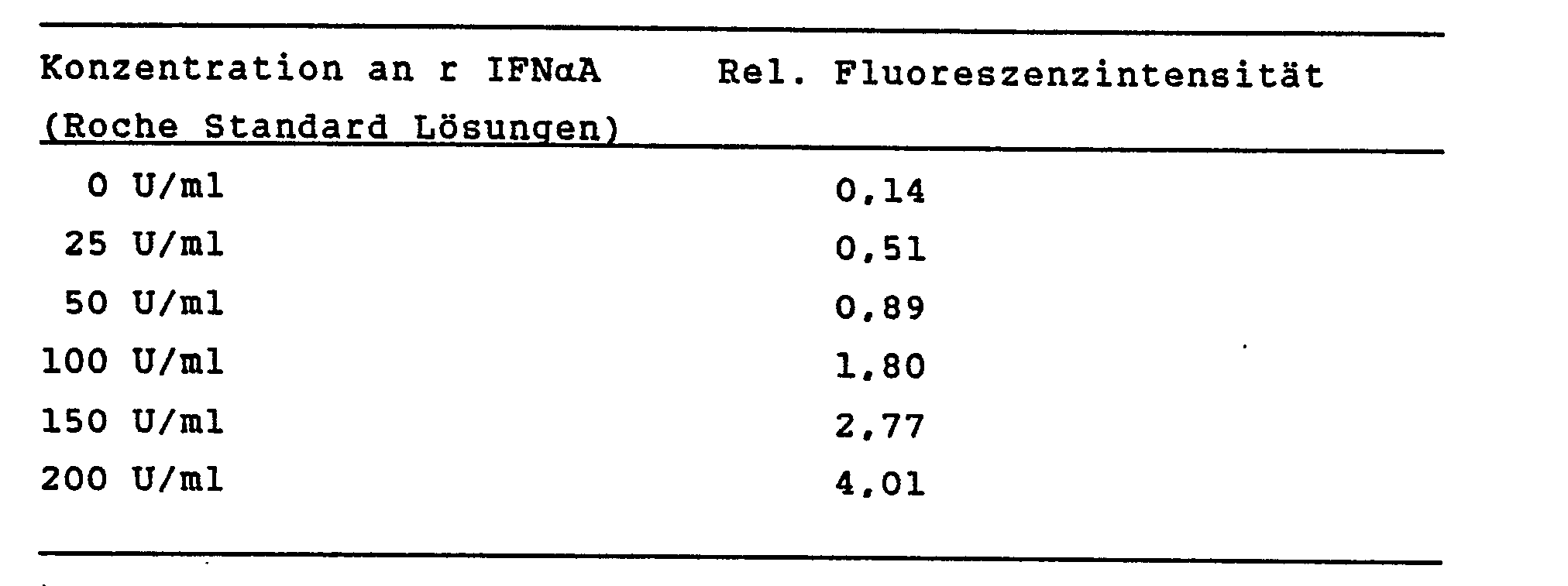
- In die erforderliche Anzahl Teströhrchen (10 x 75 mm) gibt man je 0,100 ml Interferon-rαA Standard-Lösung (0 U/ml r IFNaA; 25 U/ml r IFNaA; 50 U/ml rIFNαA; 100 U/ml r IFNaA; 150 U/ml r IFNaA; 200 U/ml r IFNaA in Normal-Human-Serum mit Thimerosal) sowie je 0,500 ml Lösung mit 5,26 x 10⁻¹⁰ MA monoklonalem anti-α-inierferon, das mit dem Ru-Komplex [RC-2] markiert ist (Markierungsgrad 6,4; Puffersystem: 150 mM NaCl, 10 mM Na-Phosphat pH 7,5). Dann fügt man noch je eine Polystyrolkugel (Durchmesser 6,5 mm; sensibitisiert mit monoklonalem anti-interferon) hinzu und inkubiert bei Zimmertemperatur (26° C) während 24 Stunden.
- Anschliessend werden die Kugeln dreimal mit je 2-5 ml destilliertern Wasser gewaschen und dann in Teströhrchen mit je 2 ml Schwefelsäure (0,09N) transferiert. Nach 30 Minuten pipettiert man die Schwefelsäure-Lösung in Messküvetten und misst den Gehalt an Ru-Komplex fluoreszenzspektroskopisch. (Die Messbedingungen sind identisch mit jenen von Beispiel 12).
- Die Resultate der r IFNαA Bestimmungen sind in Tabelle IV zusammengestellt
- Im Bereich von 0-200 U/ml findet man annähernd eine lineare Beziehung zwischen der Fluoreszenzintensität und der r IFNαA-Konzentration. Die Empfindlichkeit beträgt 0,46 U/ml r IFNaA.

- Für die Kopplungsreaktion werden die folgenden Stammlösungen hergestellt
- 1) 5,4 mg/ml Ru-Komplex [RC-7].in Wasser bei pH 4,5.
- 2) 6,0 mg/ml polyklonales anti-HCG vom Kaninchen (DAKO Code Nr. A 231, Lot 032A) in 200 mM NaHCO2; pH 8.5.
- Die Kopplungsreaktion wird nach dem im Beispiel 11 beschriebenen Verfahren durchgeführt. Man verwendet hierzu jeweils 400 µl von den Stammlösungen 1 und 2 sowie 0,56 mg vom wesserlöslich Carbodiimid.
- Die markierten Antikörper wurden - wie in Beispiel 11 beschrieben - durch Gelchromatographie vom Ueberschuss an Ru-Kompiex [RC-7] abgetrennt.
- Die UV-spektroskopische Bestimmung des Gehaltes an anti-HCG und an Ru-Komplex ergab folgende Werte:
- 3,81 x 10⁻⁶ M/l Ru-Komplex
- 1,87 x 10⁻⁶ M/l anti-HCG (polyklonal).
- Dies entspricht einem Markierungsgrad MG von 2,0.
- Für die Kopplungsreaktion werden die folgenden Stammlösungen hergestellt:
- 1) 1,71 mg/ml Ru-Komplex [RC-8] in Wasser bei pH 4,5.
- 2) 2,17 mg/ml polyklonaies anti-CEA vom Kaninchen (DAKO Code No. A115, Lot 112B) in 200 mM NaHCO,; pH 8,5.
- Die Kopplungsreaktion wird nach dem im Beispiel 11 beschriebenen Verfahren durchgeführt. Man verwendet hierzu jeweils 400 µl von den Stammlösungen 1 und 2 sowie 0,19 mg vom wasserlöslichen Carbodiimid.
- Die markierten Antikörper wurden - wie in Beispiel 11 beschrieben - durch Gelchromatographie vom Ueberschuss an Ru-Komplex [RC-8] abgetrennt
- Die UV-spektroskopische Bestimmung des Gehaltes an anti-CEA und an Ru-Komplex ergab folgende Werte:
- 0,43 x 10⁻⁶ M/l Ru-Komplex
- 0,94 x 10⁻⁶ M/l anti-CEA
- Dies entspricht einem Markierungsgrad MG von 0,5.
- Für die Kopplungsreaktion werden die folgenden Stammlösungen hergestellt
- 1) 3,6 mg/ml Ru-Komplex [RC-6] in Wasser bei pH 4,5
- 2) 6,0 mg/ml h-IgG in 200 mM NaHCO2; pH 8,5.
- Die Kopplungsreaktion erfolgt nach dem in Beispiel 11 beschriebenen Verfahren. Dabei werden jeweils 400 µl von den Stammlösungen 1 und 2 sowie 0,37 mg vom wasserlöslichen Carbodiimid verwendet.
- Die markierten Antikörper werden - wie in Beispiel 11 beschrieben - durch Gelchromatographie vom Ueberschuss an Ru-Komplex [RC-6] abgetrennt.
- Die UV-spoktroskopische Bestimmung des Gehaltes an h-IgG und an Ru-Komplex ergab folgende Werte:
- 2,31 x 10⁻⁶ M/l Ru-Komplex 1,62 x 10⁻⁶ M/l h-IgG
- Dies entspricht einem Markierungsgrad MG von 1,4.
- Für die Kopplungsreaktion werden die folgenden Stammlösungen hergestellt
- 1) 4,0 mg/ml Ru-Komplex [RC-1] in Wasser bei pH 4,5
- 2) 6,0 mg/ml h-IgG in 200 mM NaHCO,; pH 8,5.
- Die Kopplungsreaktion erfolgt nach dem in Beispiel 11 beschriebenen Verfahren. Dabei werden jeweils 400 µl von den Stammlösungen 1 und 2 sowie 1,11 mg vom wasserlöslichen Carbodiimid verwendet
- Die markierten Antikörper werden - wie in Beispiel 11 beschrieben - durch Gelchromatographie vom Ueberschuss an Ru-Komplex [RC-1] abgetrennt.
- Die UV-Spektroskopische Bestimmung des Gehaltes an h-IgG und an Ru-Komplex ergab folgende Werte:
- 10,4 x 10⁻⁶ M/l Ru-Komplex
- 1,8 x 10⁻⁶ M/l h-IgG
- Dies entspricht einem Markierungsgrad MG von 5,8.
- Für die Koppiungsreaktion werden die folgenden Stammlösungen hergestellt
- 1) 29,0 mg/ml Ru-Komplex [RC-10] in Wasser bei pH 4,5
- 2) 6,0 mg/ml h-IgG in 200 mM NaHCO2; pH 8,5.
- Die Kopplungsreaktion erfolgt nach dem in Beispiel 11 beschriebenen Verfahren. Dabei werden 526 µl von der Stammlösung 1 und 400 µl von der Stammlösung 2 sowie 7,45 mg vom wasserlöslichen Carbodiimid verwendet
- Die markierten Antikörper werden - wie in Beispiel 11 beschrieben - durch Gelchromalographie vom Ueberschuss an Ru-Komplex [RC-10] abgetrennt
- Die UV-spaktroslcopiache Bestimmung des Gehaltes an h-IgG und an Ru-Komplex ergab folgende Werte:
- 0,81 x 10⁻⁶ M/1 Ru-Komplex
- 0,78 x 10⁻⁶ M/l h-IgG
- Dies entspricht einem Markierungsgrad MG von 1,0.
- Für die Kopplungsreaktion werden die folgenden Stammlösungen hergestellt 1)
- 3,7 mg/ml Ru-Komplex [RC-3] in Wasser bei pH 4,5 2)
- 6,0 mg/ml h-IgG in 200 mM NaHCO2; pH 8,5.
- Die Kopplungsreaktion erfolgt nach dem in Beispiel 11 beschriebenen Verfahran. Dabei werden jeweils 400 µl von den Stammlösungen 1 und 2 sowie 0,75 mg vom wasserlöslichen Carbodiimid verwendet
- Die markierten Antikörper werden - wie in Beispiel 11 beschrieben - durch Gelchromatographie vom Ueberschuss an Ru-Komplex [RC-3] abgetrennt
- Die UV-spektroskopische Bestimmung des Gehaltes an h-IgG und an Ru-Komplex ergab folgende Werte:
- 4,41 x 10⁻⁶ M/l Ru-Komplex
- 1,21 x 10⁻⁶ M/l h-IgG
- Dies entspricht einem Markierungsgrad MG von 3.6.
- Für die Kopplungsresktion werden die folgenden Stammlösungen hergestellt
- 1) 3,81 mg/ml Ru-Komplex [RC-4] in Wasser bei pH 4,5
- 2) 6,0 mg/ml h-IgG in 200 mM NaHCO2; pH 8,5.
- Die Kopplungsreaktion erfolgt nach dem in Beispiel 11 beschriebenen Verfahren. Dabei werden jeweils 400 µl von den Stammlösungen 1 und 2 sowie 0,75 mg vom wasserlöslichen Carbodiimid verwendet
- Die markierten Antikörper werden - wie in Beispiel 11 beschrieben - durch Gelchromatographie vom Ueberschuss an Ru-Komplex [RC-4] abgetrennt
- Die UV-spektroskopische Bestimmung des Gehaltes an h-IgG und an Ru-Komplex ergab folgende Werte:
- 5,51 x 10⁻⁶ M/l Ru-Komplex
- 1,17 x 10⁻⁶ M/l h-IgG
- Dies entspricht einem Markierungsgrad MG von 4,70.
- Für die Kopplungsreaktion werden die folgenden Stammlösungen hergestellt
- 1) 3,87 mg/ml Ru-Komplex [RC-5] in Wasser bei pH 4,5
- 2) 6,0 mg/ml h-IgG in 200 mM NaHCO2; pH 8,5.
- Die Kopplungsreaktion erfolgt nach dem in Beispiel 11 beschdebenen Verfahren. Dabei werden jeweils 400 µl von den Stammlösungen 1 und 2 sowie 0,75 mg vom wasserlöslichen Carbodiimid verwendet.
- Die markierten Antikörper werden - wie in Beispiel 11 1
- beschrieben - durch Gelchromatographie vom Ueberschuss an Ru-Komplex [RC-5] abgetrennt.
- Die UV-spektroskopische Bestimmung des Gehaltes an h-IgG und an Ru-Komplex ergab folgende Werte:
- 11,7 x 10⁻⁶ M/l Ru-Komplex
- 1,04 x 10⁻⁶ M/l h-IgG
- Dies entspricht einem Markierungsgrad MG von 11,2.
- Für die Kopplungsreaktion werden die folgenden Stammlöungen hergestellt
- 1) 3,45 mg/ml Ru-Komplex [RC-9] in Wasser bei pH 4,5
- 2) 6,0 mg/ml h-IgG in 200 mM NaHCO2; pH 8,5.
- Die Kopplungsreaktion erfolgt nach dem in Beispiel 11 beschriebenen Verfahren. Dabei werden jeweils 400 µl von den Stammlösungen 1 und 2 sowie 0,375 µl vom wasserlöslichen Carbodiimid verwendet.
- Die markierten Antikörper werden - wie in Beispiel 11 beschrieben - durch Gelchromatographie vom Ueberschuss an Ru-Komplex [RC-9] abgetrennt
- Die UV-spektroskopische Bestimmung des Gehaltes an h-IgG und an Ru-Komplex ergab folgende Werte:
- 5,69 x 10⁻⁶ M/l Ru-Kompiex
- 0,45 x 10⁻⁶ M/l h-IgG
- Dies entspricht einem Markierungsgrad MG von 12,8.
Claims (27)


Priority Applications (1)
| Application Number | Priority Date | Filing Date | Title |
|---|---|---|---|
| AT85111377T ATE62749T1 (de) | 1984-09-17 | 1985-09-09 | Metallkomplexe, an die ein immunologisch aktives material gekoppelt werden kann bzw. ist, deren herstellung und verwendung. |
Applications Claiming Priority (4)
| Application Number | Priority Date | Filing Date | Title |
|---|---|---|---|
| CH443384 | 1984-09-17 | ||
| CH4433/84 | 1984-09-17 | ||
| CH298485 | 1985-07-10 | ||
| CH2984/85 | 1985-07-10 |
Publications (3)
| Publication Number | Publication Date |
|---|---|
| EP0178450A2 true EP0178450A2 (de) | 1986-04-23 |
| EP0178450A3 EP0178450A3 (en) | 1987-08-05 |
| EP0178450B1 EP0178450B1 (de) | 1991-04-17 |
Family
ID=25691887
Family Applications (1)
| Application Number | Title | Priority Date | Filing Date |
|---|---|---|---|
| EP85111377A Expired - Lifetime EP0178450B1 (de) | 1984-09-17 | 1985-09-09 | Metallkomplexe, an die ein immunologisch aktives Material gekoppelt werden kann bzw. ist, deren Herstellung und Verwendung |
Country Status (10)
| Country | Link |
|---|---|
| US (1) | US4745076A (de) |
| EP (1) | EP0178450B1 (de) |
| JP (1) | JPH0690201B2 (de) |
| AU (1) | AU586831B2 (de) |
| CA (1) | CA1261744A (de) |
| DE (1) | DE3582549D1 (de) |
| DK (1) | DK365785A (de) |
| ES (1) | ES8705634A1 (de) |
| NO (1) | NO163694C (de) |
| NZ (1) | NZ213420A (de) |
Cited By (30)
| Publication number | Priority date | Publication date | Assignee | Title |
|---|---|---|---|---|
| WO1987004523A1 (en) * | 1986-01-23 | 1987-07-30 | Robert Stephen Davidson | Binding assay and assay reagent |
| EP0265519A4 (de) * | 1986-04-30 | 1990-05-14 | Igen Inc | Elektrochemilumineszenz-testverfahren. |
| EP0408748A4 (en) * | 1988-03-25 | 1991-01-30 | Rikagaku Kenkyusho | Light emitting probe complex for measuring ph and method of ph measurement |
| EP0340605A3 (de) * | 1988-05-04 | 1991-05-08 | F. Hoffmann-La Roche Ag | Rutheniumkomplex-Verbindungen enthaltend eine DNA- oder RNA Sequenz |
| EP0439036A3 (en) * | 1990-01-25 | 1992-06-10 | F. Hoffmann-La Roche Ag | Energy transferring system |
| FR2673183A1 (fr) * | 1991-02-21 | 1992-08-28 | Asulab Sa | Complexes mono, bis ou tris (2,2'-bipyridine substituee) d'un metal choisi parmi le fer, le ruthenium, l'osmium ou le vanadium et leurs procedes de preparation . |
| US5221605A (en) * | 1984-10-31 | 1993-06-22 | Igen, Inc. | Luminescent metal chelate labels and means for detection |
| WO1992008494A3 (en) * | 1990-11-08 | 1993-07-08 | Sterling Winthrop Inc | Targeting radioactive immunoreagents |
| WO1993021957A1 (en) * | 1992-05-07 | 1993-11-11 | Sterling Winthrop Inc. | Complexing agents and targeting immunoreagents |
| US5310687A (en) * | 1984-10-31 | 1994-05-10 | Igen, Inc. | Luminescent metal chelate labels and means for detection |
| WO1996003650A1 (de) * | 1994-07-25 | 1996-02-08 | Boehringer Mannheim Gmbh | Oligomere trägermoleküle mit definiert eingebauten markierungsgruppen und haptenen |
| WO1996003652A1 (de) * | 1994-07-25 | 1996-02-08 | Boehringer Mannheim Gmbh | Bestimmung von spezifischem immunglobulin unter verwendung multipler antigene |
| WO1996003651A1 (de) | 1994-07-25 | 1996-02-08 | Boehringer Mannheim Gmbh | Metallchelat-markierte peptide |
| US5597910A (en) * | 1991-12-11 | 1997-01-28 | Igen, Inc. | Electrochemiluminescent label for DNA probe assays |
| EP0757252A3 (de) * | 1988-11-03 | 1997-04-16 | Igen Inc | Elektrochemilumineszente Testverfahren |
| US5811526A (en) * | 1986-01-23 | 1998-09-22 | Alusuisse Holdings A.G. | Binding assay and assay reagent |
| EP0949503A1 (de) * | 1998-03-17 | 1999-10-13 | Roche Diagnostics GmbH | Verfahren zum Nachweis eines Analyten in einer Probe durch Elektrochemilumineszenzmessung |
| EP0973035A1 (de) * | 1998-06-25 | 2000-01-19 | Roche Diagnostics GmbH | Verwendung derivatisierter Reagenzien in Chemilumineszenz- und Elektrochemilumineszenz-Nachweisverfahren |
| US6165729A (en) * | 1986-04-30 | 2000-12-26 | Hyperion Catalysis International, Inc. | Electrochemiluminescent reaction utilizing amine-derived reductant |
| US6451225B1 (en) | 1986-04-30 | 2002-09-17 | Igen International, Inc. | Electrochemiluminescent reaction utilizing amine-derived reductant |
| US6702986B1 (en) | 1988-04-29 | 2004-03-09 | Igen International, Inc. | Electrochemiluminescent reaction utilizing amine-derived reductant |
| US7070921B2 (en) | 2000-04-28 | 2006-07-04 | Molecular Devices Corporation | Molecular modification assays |
| US7632651B2 (en) | 1997-09-15 | 2009-12-15 | Mds Analytical Technologies (Us) Inc. | Molecular modification assays |
| US7745142B2 (en) | 1997-09-15 | 2010-06-29 | Molecular Devices Corporation | Molecular modification assays |
| US8937163B2 (en) | 2011-03-31 | 2015-01-20 | Alethia Biotherapeutics Inc. | Antibodies against kidney associated antigen 1 and antigen binding fragments thereof |
| WO2016207124A1 (en) | 2015-06-25 | 2016-12-29 | F. Hoffmann-La Roche Ag | Cell based assay for determining antibody or ligand binding and function |
| US9855291B2 (en) | 2008-11-03 | 2018-01-02 | Adc Therapeutics Sa | Anti-kidney associated antigen 1 (KAAG1) antibodies |
| WO2018114772A1 (en) | 2016-12-21 | 2018-06-28 | F. Hoffmann-La Roche Ag | Assay for determining antibody or ligand binding and function |
| CN111247156A (zh) * | 2017-10-25 | 2020-06-05 | 默克专利股份有限公司 | 用于覆盖多孔电介质的芳族氨基硅氧烷功能材料 |
| US11084872B2 (en) | 2012-01-09 | 2021-08-10 | Adc Therapeutics Sa | Method for treating breast cancer |
Families Citing this family (34)
| Publication number | Priority date | Publication date | Assignee | Title |
|---|---|---|---|---|
| US5238808A (en) * | 1984-10-31 | 1993-08-24 | Igen, Inc. | Luminescent metal chelate labels and means for detection |
| US6316607B1 (en) | 1986-04-30 | 2001-11-13 | Igen International, Inc. | Electrochemiluminescent assays |
| US6881536B1 (en) * | 1986-04-30 | 2005-04-19 | Bioveris Corporation | Particle based electrochemiluminescent assays |
| US5591581A (en) | 1986-04-30 | 1997-01-07 | Igen, Inc. | Electrochemiluminescent rhenium moieties and methods for their use |
| US6881589B1 (en) * | 1987-04-30 | 2005-04-19 | Bioveris Corporation | Electrochemiluminescent localizable complexes for assay compositions |
| US5208007A (en) * | 1988-11-22 | 1993-05-04 | Board Of Regents Of The University Of Oklahoma | Isotopic tracer composition and method for making and using same |
| EP0720614B1 (de) * | 1994-07-25 | 2000-05-24 | Roche Diagnostics GmbH | Metallkomplexe mit geladenem linker |
| ATE187732T1 (de) * | 1994-07-25 | 2000-01-15 | Roche Diagnostics Gmbh | Hydrophile metallkomplexe |
| US6306661B1 (en) * | 1998-02-05 | 2001-10-23 | Joseph R. Lakowicz | Water soluble luminescence oxygen sensor and method |
| EP0957360B1 (de) | 1998-05-06 | 2002-07-31 | Roche Diagnostics GmbH | Entstörung durch Rheumafaktoren |
| US6410255B1 (en) * | 1999-05-05 | 2002-06-25 | Aurora Biosciences Corporation | Optical probes and assays |
| WO2001046209A1 (en) * | 1999-12-20 | 2001-06-28 | Fluorrx, Inc. | Fluorescent probes |
| US7198924B2 (en) * | 2000-12-11 | 2007-04-03 | Invitrogen Corporation | Methods and compositions for synthesis of nucleic acid molecules using multiple recognition sites |
| DE10048417A1 (de) * | 2000-09-29 | 2002-04-11 | Roche Diagnostics Gmbh | Verbindungen mit verzweigtem Linker |
| US6808939B2 (en) | 2001-06-29 | 2004-10-26 | Igen International, Inc. | ECL labels having improved non-specific binding properties, methods of using and kits containing the same |
| US6664111B2 (en) * | 2001-08-22 | 2003-12-16 | 3M Innovative Properties Company | Fluorescence based oxygen sensor systems |
| DE10239098A1 (de) * | 2002-08-26 | 2004-03-11 | Roche Diagnostics Gmbh | Erzeugung von Chemilumineszenz durch Wasserstoff |
| CA2445420A1 (en) * | 2003-07-29 | 2005-01-29 | Invitrogen Corporation | Kinase and phosphatase assays |
| US7619059B2 (en) * | 2003-07-29 | 2009-11-17 | Life Technologies Corporation | Bimolecular optical probes |
| US7727752B2 (en) * | 2003-07-29 | 2010-06-01 | Life Technologies Corporation | Kinase and phosphatase assays |
| US20050069929A1 (en) | 2003-08-08 | 2005-03-31 | Invitrogen Corporation | Methods and compositions for seamless cloning of nucleic acid molecules |
| ATE458200T1 (de) * | 2003-09-12 | 2010-03-15 | Life Technologies Corp | Anwendungen des resonanzenergietransfers zwischen terbium und gfp |
| US8304189B2 (en) | 2003-12-01 | 2012-11-06 | Life Technologies Corporation | Nucleic acid molecules containing recombination sites and methods of using the same |
| CA2553632A1 (en) | 2004-02-06 | 2005-08-25 | Bayer Healthcare Llc | Oxidizable species as an internal reference for biosensors and method of use |
| JP2007538258A (ja) * | 2004-05-15 | 2007-12-27 | ジェネンテック・インコーポレーテッド | 標的分子に結合親和性を有する分子を検出するためのクロススクリーニングシステムと方法 |
| ITTO20040372A1 (it) * | 2004-06-01 | 2004-09-01 | Giuseppe Caputo | Composti luminescenti aventi un braccio di legame funzionalizzato. |
| JP5590796B2 (ja) | 2005-06-03 | 2014-09-17 | ボード・オブ・リージェンツ・オブ・ザ・ユニバーシティ・オブ・テキサス・システム | 電気化学および単一ファラデー電極による電気化学発光 |
| KR101321296B1 (ko) | 2005-07-20 | 2013-10-28 | 바이엘 헬스케어 엘엘씨 | 게이트형 전류 측정법 온도 결정 방법 |
| KR101477947B1 (ko) | 2005-09-30 | 2014-12-30 | 바이엘 헬스케어 엘엘씨 | 게이트형 전압 전류 측정 이온화제 및 헤마토크리트 결정 방법 |
| JP5564249B2 (ja) * | 2006-06-23 | 2014-07-30 | アレシア・バイオセラピューティクス・インコーポレーテッド | 癌に関与するポリヌクレオチド配列およびポリペプチド配列 |
| IL178494A0 (en) * | 2006-10-05 | 2007-02-11 | Univ Ben Gurion | Fluorescent ruthenium compounds for detecting calcium binding proteins |
| BRPI0717620A2 (pt) | 2006-10-24 | 2013-10-22 | Bayer Healthcare Llc | Amperometria de decaimento transitório |
| GB0711849D0 (en) | 2007-06-19 | 2007-07-25 | Oxford Biosensors Ltd | Redox Mediators |
| WO2009076302A1 (en) | 2007-12-10 | 2009-06-18 | Bayer Healthcare Llc | Control markers for auto-detection of control solution and methods of use |
Family Cites Families (8)
| Publication number | Priority date | Publication date | Assignee | Title |
|---|---|---|---|---|
| IL49685A (en) * | 1976-05-31 | 1978-10-31 | Technion Res & Dev Foundation | Specific binding assay method for determining the concentration of materials and reagent means therefor |
| US4283382A (en) * | 1977-12-28 | 1981-08-11 | Eastman Kodak Company | Fluorescent labels comprising rare earth chelates |
| SE428332B (sv) * | 1979-03-08 | 1983-06-20 | Wallac Oy | Forfarande for fluorescensspektroskopisk bestemning av biologiskt aktivt emne, sasom hapten, antikropp eller antigen |
| US4372745A (en) * | 1979-12-19 | 1983-02-08 | Electro-Nucleonics, Inc. | Chemical luminescence amplification substrate system for immunochemistry involving microencapsulated fluorescer |
| US4293310A (en) * | 1980-03-14 | 1981-10-06 | University Of Pittsburgh | Photoelectrochemical immunoassay |
| US4341757A (en) * | 1980-09-02 | 1982-07-27 | Nutrition 21 | Stable isotopic immunoassay method employing non-radioactive selenium label |
| SE454115B (sv) * | 1982-09-13 | 1988-03-28 | Wallac Oy | Homogenfasanalys med lantanidkelat som merksubstans |
| US5238808A (en) * | 1984-10-31 | 1993-08-24 | Igen, Inc. | Luminescent metal chelate labels and means for detection |
-
1985
- 1985-08-12 DK DK365785A patent/DK365785A/da not_active Application Discontinuation
- 1985-08-16 CA CA000488837A patent/CA1261744A/en not_active Expired
- 1985-09-09 EP EP85111377A patent/EP0178450B1/de not_active Expired - Lifetime
- 1985-09-09 DE DE8585111377T patent/DE3582549D1/de not_active Expired - Lifetime
- 1985-09-09 US US06/773,956 patent/US4745076A/en not_active Expired - Fee Related
- 1985-09-10 NZ NZ213420A patent/NZ213420A/en unknown
- 1985-09-10 AU AU47334/85A patent/AU586831B2/en not_active Ceased
- 1985-09-13 JP JP60203205A patent/JPH0690201B2/ja not_active Expired - Lifetime
- 1985-09-16 NO NO85853635A patent/NO163694C/no unknown
- 1985-09-16 ES ES547019A patent/ES8705634A1/es not_active Expired
Cited By (50)
| Publication number | Priority date | Publication date | Assignee | Title |
|---|---|---|---|---|
| US6140138A (en) * | 1984-10-31 | 2000-10-31 | Igen International Inc. | Electrochemiluminescent metal chelates and means for detection |
| US5714089A (en) * | 1984-10-31 | 1998-02-03 | Igen International, Inc. | Luminescent metal chelatte labels and means for detection |
| US5731147A (en) * | 1984-10-31 | 1998-03-24 | Igen International, Inc. | Luminescent metal chelate labels and means for detection |
| US5453356A (en) * | 1984-10-31 | 1995-09-26 | Igen, Inc. | Luminescent metal chelate labels and means for detection |
| US5310687A (en) * | 1984-10-31 | 1994-05-10 | Igen, Inc. | Luminescent metal chelate labels and means for detection |
| US5221605A (en) * | 1984-10-31 | 1993-06-22 | Igen, Inc. | Luminescent metal chelate labels and means for detection |
| US5811526A (en) * | 1986-01-23 | 1998-09-22 | Alusuisse Holdings A.G. | Binding assay and assay reagent |
| WO1987004523A1 (en) * | 1986-01-23 | 1987-07-30 | Robert Stephen Davidson | Binding assay and assay reagent |
| US6165729A (en) * | 1986-04-30 | 2000-12-26 | Hyperion Catalysis International, Inc. | Electrochemiluminescent reaction utilizing amine-derived reductant |
| US6451225B1 (en) | 1986-04-30 | 2002-09-17 | Igen International, Inc. | Electrochemiluminescent reaction utilizing amine-derived reductant |
| EP0658564A1 (de) * | 1986-04-30 | 1995-06-21 | Igen, Inc. | Elektrolumineszente Verbindungen und Zwischenprodukte zur Herstellung |
| EP0265519A4 (de) * | 1986-04-30 | 1990-05-14 | Igen Inc | Elektrochemilumineszenz-testverfahren. |
| EP0408748A4 (en) * | 1988-03-25 | 1991-01-30 | Rikagaku Kenkyusho | Light emitting probe complex for measuring ph and method of ph measurement |
| US6702986B1 (en) | 1988-04-29 | 2004-03-09 | Igen International, Inc. | Electrochemiluminescent reaction utilizing amine-derived reductant |
| EP0340605A3 (de) * | 1988-05-04 | 1991-05-08 | F. Hoffmann-La Roche Ag | Rutheniumkomplex-Verbindungen enthaltend eine DNA- oder RNA Sequenz |
| EP0757252A3 (de) * | 1988-11-03 | 1997-04-16 | Igen Inc | Elektrochemilumineszente Testverfahren |
| EP0439036A3 (en) * | 1990-01-25 | 1992-06-10 | F. Hoffmann-La Roche Ag | Energy transferring system |
| US5367080A (en) * | 1990-11-08 | 1994-11-22 | Sterling Winthrop Inc. | Complexing agents and targeting radioactive immunoreagents useful in therapeutic and diagnostic imaging compositions and methods |
| US5707603A (en) * | 1990-11-08 | 1998-01-13 | Nycomed Imaging As | Pyridine complexing agents and targeting immunoreagents useful in therapeutic and diagnostic compositions |
| WO1992008494A3 (en) * | 1990-11-08 | 1993-07-08 | Sterling Winthrop Inc | Targeting radioactive immunoreagents |
| FR2673183A1 (fr) * | 1991-02-21 | 1992-08-28 | Asulab Sa | Complexes mono, bis ou tris (2,2'-bipyridine substituee) d'un metal choisi parmi le fer, le ruthenium, l'osmium ou le vanadium et leurs procedes de preparation . |
| WO1992014741A1 (fr) * | 1991-02-21 | 1992-09-03 | Asulab S.A. | Complexes mono, bis ou tris (2,2'-bipyridine substituee) d'un metal choisi parmi le fer, le ruthenium, l'osmium ou le vanadium et leurs procedes de preparation |
| US5393903A (en) * | 1991-02-21 | 1995-02-28 | Asulab S.A. | Mono, bis or tris(substituted 2,2'-bipyridine) iron, ruthenium, osmium or vanadium complexes and their methods of preparation |
| US5597910A (en) * | 1991-12-11 | 1997-01-28 | Igen, Inc. | Electrochemiluminescent label for DNA probe assays |
| US5686244A (en) * | 1991-12-11 | 1997-11-11 | Igen Incorporated | Method for detecting a nucleic acid analyte using an improved electrochemiluminescent label |
| US5610017A (en) * | 1991-12-11 | 1997-03-11 | Igen, Inc. | Method for conducting a polymerase chain reaction using an improved electrochemiluminescent label |
| WO1993021957A1 (en) * | 1992-05-07 | 1993-11-11 | Sterling Winthrop Inc. | Complexing agents and targeting immunoreagents |
| WO1996003650A1 (de) * | 1994-07-25 | 1996-02-08 | Boehringer Mannheim Gmbh | Oligomere trägermoleküle mit definiert eingebauten markierungsgruppen und haptenen |
| AU688953B2 (en) * | 1994-07-25 | 1998-03-19 | Boehringer Mannheim Gmbh | Determination of a specific immunoglobulin using multiple antigens |
| US6531572B1 (en) | 1994-07-25 | 2003-03-11 | Roche Diagnostics Gmbh | Metal chelate-labelled peptides |
| WO1996003652A1 (de) * | 1994-07-25 | 1996-02-08 | Boehringer Mannheim Gmbh | Bestimmung von spezifischem immunglobulin unter verwendung multipler antigene |
| WO1996003651A1 (de) | 1994-07-25 | 1996-02-08 | Boehringer Mannheim Gmbh | Metallchelat-markierte peptide |
| US6780967B1 (en) | 1994-07-25 | 2004-08-24 | Roche Diagnostics Gmbh | Metal chelate-labelled peptides |
| US7390624B2 (en) | 1994-07-25 | 2008-06-24 | Roche Diagnostics Gmbh | Metal chelate-labelled peptides |
| US7745142B2 (en) | 1997-09-15 | 2010-06-29 | Molecular Devices Corporation | Molecular modification assays |
| US7632651B2 (en) | 1997-09-15 | 2009-12-15 | Mds Analytical Technologies (Us) Inc. | Molecular modification assays |
| EP0949503A1 (de) * | 1998-03-17 | 1999-10-13 | Roche Diagnostics GmbH | Verfahren zum Nachweis eines Analyten in einer Probe durch Elektrochemilumineszenzmessung |
| EP0973035A1 (de) * | 1998-06-25 | 2000-01-19 | Roche Diagnostics GmbH | Verwendung derivatisierter Reagenzien in Chemilumineszenz- und Elektrochemilumineszenz-Nachweisverfahren |
| US6281021B1 (en) | 1998-06-25 | 2001-08-28 | Roche Diagnostics Gmbh | Use of derivatized reagents in chemiluminescence and electrochemiluminescence detection methods |
| US7070921B2 (en) | 2000-04-28 | 2006-07-04 | Molecular Devices Corporation | Molecular modification assays |
| US9855291B2 (en) | 2008-11-03 | 2018-01-02 | Adc Therapeutics Sa | Anti-kidney associated antigen 1 (KAAG1) antibodies |
| US9393302B2 (en) | 2011-03-31 | 2016-07-19 | Alethia Biotherapeutics Inc. | Antibodies against kidney associated antigen 1 and antigen binding fragments thereof |
| US8937163B2 (en) | 2011-03-31 | 2015-01-20 | Alethia Biotherapeutics Inc. | Antibodies against kidney associated antigen 1 and antigen binding fragments thereof |
| US9828426B2 (en) | 2011-03-31 | 2017-11-28 | Adc Therapeutics Sa | Antibodies against kidney associated antigen 1 and antigen binding fragments thereof |
| US10597450B2 (en) | 2011-03-31 | 2020-03-24 | Adc Therapeutics Sa | Antibodies against kidney associated antigen 1 and antigen binding fragments thereof |
| US11084872B2 (en) | 2012-01-09 | 2021-08-10 | Adc Therapeutics Sa | Method for treating breast cancer |
| WO2016207124A1 (en) | 2015-06-25 | 2016-12-29 | F. Hoffmann-La Roche Ag | Cell based assay for determining antibody or ligand binding and function |
| WO2018114772A1 (en) | 2016-12-21 | 2018-06-28 | F. Hoffmann-La Roche Ag | Assay for determining antibody or ligand binding and function |
| CN111247156A (zh) * | 2017-10-25 | 2020-06-05 | 默克专利股份有限公司 | 用于覆盖多孔电介质的芳族氨基硅氧烷功能材料 |
| CN111247156B (zh) * | 2017-10-25 | 2023-10-27 | 默克专利股份有限公司 | 用于覆盖多孔电介质的芳族氨基硅氧烷功能材料 |
Also Published As
| Publication number | Publication date |
|---|---|
| JPH0690201B2 (ja) | 1994-11-14 |
| ES547019A0 (es) | 1987-05-01 |
| EP0178450A3 (en) | 1987-08-05 |
| NZ213420A (en) | 1990-01-29 |
| NO163694C (no) | 1990-07-04 |
| NO163694B (no) | 1990-03-26 |
| AU586831B2 (en) | 1989-07-27 |
| DK365785A (da) | 1986-03-18 |
| DE3582549D1 (de) | 1991-05-23 |
| ES8705634A1 (es) | 1987-05-01 |
| US4745076A (en) | 1988-05-17 |
| AU4733485A (en) | 1986-03-27 |
| NO853635L (no) | 1986-03-18 |
| JPS6173066A (ja) | 1986-04-15 |
| CA1261744A (en) | 1989-09-26 |
| DK365785D0 (da) | 1985-08-12 |
| EP0178450B1 (de) | 1991-04-17 |
Similar Documents
| Publication | Publication Date | Title |
|---|---|---|
| EP0178450B1 (de) | Metallkomplexe, an die ein immunologisch aktives Material gekoppelt werden kann bzw. ist, deren Herstellung und Verwendung | |
| EP0127797B1 (de) | Markermoleküle für Fluoreszenz-Immuno-Assays sowie Verfahren und Zwischenprodukte zu deren Herstellung | |
| DE3881735T2 (de) | Diagnostischer Fluoreszenztest, Testbestandteile und Konjugate. | |
| DE69731179T3 (de) | Fluorierte xanthenderivate | |
| DE68928973T2 (de) | Makrocyclische komplexe von yttrium, den lanthaniden und den actiniden mit peripheren kupplungsfunktionalitäten | |
| DE69329963T2 (de) | Verbindungen für Fluoreszenzpolarisationsimmunoassays und Verwendung derselben in Immunoassays | |
| EP0209875A1 (de) | Resorufin-Derivate sowie Verfahren zu deren Herstellung | |
| DE69925032T2 (de) | Fluoreszenzfarbstoffe zum festphasen- und flüssigphasen-screening | |
| DE3628573C2 (de) | Chemilumineszierende Acridinderivate, Verfahren zu deren Herstellung und ihre Verwendung in Lumineszenzimmunoassays | |
| DE69909611T2 (de) | Reagenz zum nachweis von singulett-sauerstoff | |
| EP0567622B1 (de) | Neue pentacyclische verbindungen und ihre verwendung als absorptions- oder fluoreszenzfarbstoffe | |
| EP0632810B1 (de) | Neues biotinylierungsreagenz | |
| EP1173519B1 (de) | Neue carbopyronin-fluoreszenz-farbstoffe | |
| DE3844954C2 (de) | Spezielle chemilumineszierende Acridinderivate und ihre Verwendung in Lumineszenzimmunoassays | |
| DE69332903T2 (de) | Biotinylierte, chemolumineszente label, konjugate, assays sowie assay kits | |
| DE3853320T2 (de) | Fluorophore für die Abkapselung in Liposome. | |
| DE2921782C2 (de) | ||
| DE29915165U1 (de) | Energy Transfer Dyes | |
| US5075447A (en) | Ruthenium complexes useful as carriers for immunologically active materials | |
| EP0146866A2 (de) | Phenolsulfonphtaleinyl-Beta-D-galactoside, Verfahren zu deren Herstellung sowie deren Verwendung zur Bestimmung der Beta-D-Galactosidase | |
| DE69608878T2 (de) | Markiertes Reagens für den Einsatz in Immunoassays, sowie dabei verwendete fluoreszierende Verbindungen und Komplexe | |
| DE2924249C2 (de) | Spezifische bindungs-untersuchungsmethode zur bestimmung eines liganden in einem fluessigen medium und reagentien zur durchfuehrung dieser methode | |
| EP0217371A2 (de) | Phosphate von Resorufin-Derivaten, Verfahren zu deren Herstellung sowie deren Verwendung zur Bestimmung der Aktivität von Phosphatasen | |
| EP0131942A1 (de) | Anthracyclin-Derivate, ein Verfahren zu ihrer Herstellung und ihre Verwendung als Cytostatika | |
| DE2458710A1 (de) | Verfahren zur bestimmung von folat- verbindungen durch saettigungsanalyse |
Legal Events
| Date | Code | Title | Description |
|---|---|---|---|
| PUAI | Public reference made under article 153(3) epc to a published international application that has entered the european phase |
Free format text: ORIGINAL CODE: 0009012 |
|
| 17P | Request for examination filed |
Effective date: 19850909 |
|
| AK | Designated contracting states |
Kind code of ref document: A2 Designated state(s): AT BE CH DE FR GB IT LI NL SE |
|
| PUAL | Search report despatched |
Free format text: ORIGINAL CODE: 0009013 |
|
| AK | Designated contracting states |
Kind code of ref document: A3 Designated state(s): AT BE CH DE FR GB IT LI NL SE |
|
| RAP1 | Party data changed (applicant data changed or rights of an application transferred) |
Owner name: F. HOFFMANN-LA ROCHE AG |
|
| RAP1 | Party data changed (applicant data changed or rights of an application transferred) |
Owner name: F. HOFFMANN-LA ROCHE AG |
|
| 17Q | First examination report despatched |
Effective date: 19891020 |
|
| GRAA | (expected) grant |
Free format text: ORIGINAL CODE: 0009210 |
|
| AK | Designated contracting states |
Kind code of ref document: B1 Designated state(s): AT BE CH DE FR GB IT LI NL SE |
|
| REF | Corresponds to: |
Ref document number: 62749 Country of ref document: AT Date of ref document: 19910515 Kind code of ref document: T |
|
| REF | Corresponds to: |
Ref document number: 3582549 Country of ref document: DE Date of ref document: 19910523 |
|
| ITF | It: translation for a ep patent filed | ||
| ET | Fr: translation filed | ||
| GBT | Gb: translation of ep patent filed (gb section 77(6)(a)/1977) | ||
| PLBE | No opposition filed within time limit |
Free format text: ORIGINAL CODE: 0009261 |
|
| STAA | Information on the status of an ep patent application or granted ep patent |
Free format text: STATUS: NO OPPOSITION FILED WITHIN TIME LIMIT |
|
| 26N | No opposition filed | ||
| PGFP | Annual fee paid to national office [announced via postgrant information from national office to epo] |
Ref country code: SE Payment date: 19940817 Year of fee payment: 10 Ref country code: GB Payment date: 19940817 Year of fee payment: 10 |
|
| PGFP | Annual fee paid to national office [announced via postgrant information from national office to epo] |
Ref country code: BE Payment date: 19940824 Year of fee payment: 10 |
|
| PGFP | Annual fee paid to national office [announced via postgrant information from national office to epo] |
Ref country code: FR Payment date: 19940908 Year of fee payment: 10 |
|
| PGFP | Annual fee paid to national office [announced via postgrant information from national office to epo] |
Ref country code: CH Payment date: 19940913 Year of fee payment: 10 |
|
| PGFP | Annual fee paid to national office [announced via postgrant information from national office to epo] |
Ref country code: DE Payment date: 19940923 Year of fee payment: 10 |
|
| PGFP | Annual fee paid to national office [announced via postgrant information from national office to epo] |
Ref country code: NL Payment date: 19940930 Year of fee payment: 10 Ref country code: AT Payment date: 19940930 Year of fee payment: 10 |
|
| EAL | Se: european patent in force in sweden |
Ref document number: 85111377.9 |
|
| PG25 | Lapsed in a contracting state [announced via postgrant information from national office to epo] |
Ref country code: GB Effective date: 19950909 Ref country code: AT Effective date: 19950909 |
|
| PG25 | Lapsed in a contracting state [announced via postgrant information from national office to epo] |
Ref country code: SE Effective date: 19950910 |
|
| PG25 | Lapsed in a contracting state [announced via postgrant information from national office to epo] |
Ref country code: LI Effective date: 19950930 Ref country code: CH Effective date: 19950930 Ref country code: BE Effective date: 19950930 |
|
| BERE | Be: lapsed |
Owner name: F. HOFFMANN-LA ROCHE A.G. Effective date: 19950930 |
|
| PG25 | Lapsed in a contracting state [announced via postgrant information from national office to epo] |
Ref country code: NL Effective date: 19960401 |
|
| GBPC | Gb: european patent ceased through non-payment of renewal fee |
Effective date: 19950909 |
|
| REG | Reference to a national code |
Ref country code: CH Ref legal event code: PL |
|
| PG25 | Lapsed in a contracting state [announced via postgrant information from national office to epo] |
Ref country code: FR Effective date: 19960531 |
|
| PG25 | Lapsed in a contracting state [announced via postgrant information from national office to epo] |
Ref country code: DE Effective date: 19960601 |
|
| NLV4 | Nl: lapsed or anulled due to non-payment of the annual fee |
Effective date: 19960401 |
|
| EUG | Se: european patent has lapsed |
Ref document number: 85111377.9 |
|
| REG | Reference to a national code |
Ref country code: FR Ref legal event code: ST |