EP0176818A2 - Temperaturkompensierter Oszillator - Google Patents
Temperaturkompensierter Oszillator Download PDFInfo
- Publication number
- EP0176818A2 EP0176818A2 EP85111409A EP85111409A EP0176818A2 EP 0176818 A2 EP0176818 A2 EP 0176818A2 EP 85111409 A EP85111409 A EP 85111409A EP 85111409 A EP85111409 A EP 85111409A EP 0176818 A2 EP0176818 A2 EP 0176818A2
- Authority
- EP
- European Patent Office
- Prior art keywords
- signal
- digital
- temperature
- digital signal
- means comprises
- Prior art date
- Legal status (The legal status is an assumption and is not a legal conclusion. Google has not performed a legal analysis and makes no representation as to the accuracy of the status listed.)
- Granted
Links
- 230000010355 oscillation Effects 0.000 title claims abstract description 39
- 239000013078 crystal Substances 0.000 description 4
- 238000010586 diagram Methods 0.000 description 3
- 230000006870 function Effects 0.000 description 3
- 230000004048 modification Effects 0.000 description 3
- 238000012986 modification Methods 0.000 description 3
- 238000006243 chemical reaction Methods 0.000 description 2
- 238000010276 construction Methods 0.000 description 1
- 230000000694 effects Effects 0.000 description 1
Images


Classifications
-
- H—ELECTRICITY
- H03—ELECTRONIC CIRCUITRY
- H03L—AUTOMATIC CONTROL, STARTING, SYNCHRONISATION OR STABILISATION OF GENERATORS OF ELECTRONIC OSCILLATIONS OR PULSES
- H03L1/00—Stabilisation of generator output against variations of physical values, e.g. power supply
- H03L1/02—Stabilisation of generator output against variations of physical values, e.g. power supply against variations of temperature only
- H03L1/022—Stabilisation of generator output against variations of physical values, e.g. power supply against variations of temperature only by indirect stabilisation, i.e. by generating an electrical correction signal which is a function of the temperature
- H03L1/023—Stabilisation of generator output against variations of physical values, e.g. power supply against variations of temperature only by indirect stabilisation, i.e. by generating an electrical correction signal which is a function of the temperature by using voltage variable capacitance diodes
- H03L1/025—Stabilisation of generator output against variations of physical values, e.g. power supply against variations of temperature only by indirect stabilisation, i.e. by generating an electrical correction signal which is a function of the temperature by using voltage variable capacitance diodes and a memory for digitally storing correction values
Definitions
- the present invention relates to a temperature-compensated oscillation device and, more particularly, to a digitally controlled temperature-compensated oscillation device.
- a digitally controlled temperature-compensated oscillation device has been extensively used as a local oscillator of a mobile radio apparatus because its frequency generally remains stable over a wide temperature range.
- Such a type of oscillation device comprises a temperature sensing section made up of a temperature sensor and an analog-to-digital (AD) converter, a read only memory (ROM) which stores compensation data associated with outputs of the AD converter, and an oscillating section responsive tc an output of the ROM and made up of a digital-to-analog (DA) converter and a voltage controlled oscillator (VCO).
- AD analog-to-digital
- ROM read only memory
- VCO voltage controlled oscillator
- the problem with an oscillation device having the above construction is that a noticeable variation in ambient temperature causes an output of the AD converter, i.e., an output value of the ROM, to sharply vary for a moment to thereby add frequency modulation noise and phase modulation noise to an output of the VCO.
- Such, in a multichannel communication system constitutes a source of noise for other channels or needs to be coped with by designing the exclusive frequency band undesirably wide .
- a temperature-compensated oscillator device to which the present invention is applicable comprises temperature sensing section means including temperature sensor means for sensing an ambient temperature to provide a temperature data signal representative of the sensed temperature and analog-to-digital converter means for converting the temperature data signal to a first digital signal having a first digital value; control section means for converging the first digital signal to a second digital signal having a second digital value; and oscillating section means including converter means for converting the second digital signal to a frequency control signal and voltage-controlled oscillator means responsive to the frequency control signal for changing the oscillation signal frequency thereof.
- the control section means comprises first means for converting a variation in the first digital value to a plurality of time-divided fractional variations in the second digital value.
- the device comprises a temperature sensing section 1 made up of a temperature sensor 11 and an analog-to-digital (AD) converter 12, a read only memory (ROM) 21, and an oscillating section 3 made up of a digital-to-analog (DA) converter 31 and a voltage-controlled oscillator (VCO) 32.
- the VCO 32 comprises a crystal oscillator and a variable capacitance element.
- the AD converter 12 quantizes the input signal 101 to provide a first digital value which is produced as a first digital signal 102.
- This signal 102 is delivered to an address input terminal of the ROM 21 so as to specify a particular address of the latter, whereby a second digital value stored in that address is outputted as a second digital signal 205a.
- the DA converter 31 to which the second digital signal 205a is routed transforms the signal 205a into a voltage and applies the voltage as a frequency control signal 301 to the VCO 32. Responsive to the signal 301, the VCO 32 controls the capacitance of its variable capacitance element and, as a result, temperature-compensates the frequency of an oscillation signal 302, which is an output of the VCO 32.
- the frequency of the oscillation signal 302 may vary with the ambient temperature as shown in Fig. 2A.
- the graph represents a relationship between the temperature surrounding the crystal oscillator of the VCO 32 and the variation of its resonance frequency.
- the frequency of the oscillation signal 302 may vary with the frequency control signal 301 as shown in Fig. 2B. If the relationship between the first digital signal 102 and the second digital signal 205a in the ROM 21 is selected such that the relationship shown in Fig.
- the frequency of the oscillation signal 302 will be temperature-compensated.
- the curve shown in Fig. 2C is stepwise because the ambient temperature is quantized as the first digital signal 102.
- the frequency variation of the oscillation signal 302 after temperature compensation is shown in Fig. 3 relative to the ambient temperature. Comparing Fig. 3 with Fig. 2A, it will be seen that as a result of temperature compensation the frequency variation of the oscillation signal 302 has been reduced to about 1/4 over the temperature range of -20°C to +60°C.
- the ambient temperature as shown in Fi g. 4 is assumed to increase with time and a temperature T 1 is associated with a time t 1 and a temperature T 2 with a time t 2 .
- the frequency control signal 301 remains at a constant voltage V 1 and the frequency of the oscillation signal 302 increases with time.
- the signal 301 shifts from the voltage V 1 to a voltage V 2 and, at this moment, the frequency of the signal 302 is sharply lowered. In this manner, at the moment when the output of the AD converter is varied, the frequency of the oscillation signal 302 is sharply varied with the result that frequency modulation noise and phase modulation noise are added to the signal 302.
- the digitally temperature-controlled oscillation device installed in a radio frequency or phase modulation communication system is sufficiently small in frequency variation, but cannot avoid a substantial magnitude of noise as previously discussed.
- the influence of noise extends even to other channels.
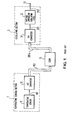
- the oscillation device comprises a temperature sensing section 1 which includes a temperature sensor 11 and an AD converter 12, a control section 2 made u p a ROM 21, a comparator 22 and an up-down counter 23, and an oscillating section 3 made up of a DA converter 31 and a VCO 32.
- the VCO 32 comprises a crystal oscillator and a variable capacitance element.
- the temperature sensor 11 converts an ambient temperature to a voltage and produces the voltage as a temperature data signal 101.
- the AD converter 12 quantizes it to provide a first digital value and applies the first digital value as a first digital signal 102 to an address input terminal of the ROM 21.
- the ROM 21 produces a third digital value (assumed to have a value A) from a particular address thereof which is specified by the input signal 102, the third digital value being applied to one input terminal of the comparator 22.
- Applied to the other input terminal of the comparator 22 is a count from the up-down counter 23 (assumed to have a value B)
- the comparator 22 also produces a discrimination signal 203 which is a high level "1" when A > B and a low level "0" when A ⁇ B.
- the identification signal 202 and the discrimination signal 203 are applied to the up-down counter 23.
- a clock signal 204 is also applied to the up-down counter 23 via a clock input terminal 24 of the control section 2. While the identification signal 202 is a high level, the counter 23 is disenabled to maintain the value equal to the value A. While the identification signal 202 is a low level and the discrimination signal 203 is a high level, the counter 23 is incremented responsive to each pulse of the clock signal 204.
- the output 205 of the counter 23 is also applied to the DA converter 31.
- the DA converter 31 converts the input signal 205 to a voltage and applies it to the VCO 301 as a frequency control signal 301.
- the signal 301 controls the capacitance of the variable capacitance element of the VCO 301 to thereby temperature- compensate the frequency of an oscillation signal 302 which is outputted from the oscillation device.
- control section 2 converts a variation in the first digital signal 102 to a plurality of time-divided fractional variations in the output 205 of the counter 23.
- FIG. 6 an exemplary relationship between time and the frequency variation of the oscillation signal 302 in accordance with the illustrative embodiment is shown, the temperature being assumed as varying with time.
- a value A associated with an ambient temperature at a time immediately before a time t 1 is A 1
- the value A 1 has changed to A 2 at the time t 1 .
- the value B changes from A 1 to (A 1 - 1) at the time t 1 , to tA 1 - 2) at a-time (t 1 + t c ), and to (A 1 - 3) at a time (t 1 + 2t c ), where t c is the period of the clock signal 204.
- t c is the period of the clock signal 204.
- a 2 is equal to (A 1 - 3).
- the frequency of the oscillation signal 302 is also varied in a stepwise manner at those times. Comparing Fig. 6 with Fig. 4, it will be apparent that the stepwise variations, i.e., the amounts of sharp variations of the frequency of the signal 302 are smaller in the illustrative embodiment than in the prior art and, as a result, noise introduced into the signal 302 due to the sharp frequency variations is reduced.
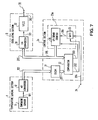
- FIG. 7 another embodiment of the present invention is shown.
- the oscillation device in this particular embodiment differs from that of Fig. 5 in that the up-down counter 23 of the latter is replaced with a gate 25 and an up-down counter 26, and in that the identification signal 202 and clock signal 204 are applied to the gate 25.
- the gate 25 is enabled to pass the clock signal 204 to the up-down counter 26 as an output signal 206.
- the gate 25 is disenabled to interrupt the supply of the clock signal 204 to the counter 26.
- the gate 25 and the counter 26 cooperates, as labeled 23a in the drawing, to fulfill the function which is assigned to the counter 23 of the first embodiment.
- the embodiment of Fig. 7 is the same in operation and effect as the embodiment of Fig. 5.
- the present invention provides a temperature-compensated oscillation device which reduces frequency variations and noise over a wide temperature range.
- a radio communication apparatus implemented with such a device of the present invention will narrow the exclusive frequency band width, compared to a prior art apparatus.
- ROM 21 is used in the illustrative embodiments to serve the function of numerical value conversion means for converting the first digital signal 102 to the third digital signal 201, such a function may alternatively be fulfilled by means of a memory which generates a ccnstant of a polynominal for converting a first digital value to a second digital value and an operation unit for operating the polynomial.
- a kind of conversion means is disclosed in Japanese Unexamined Patent Publication (Kokai) 58-184809, for example.
- the crystal oscillator included in the VCO 32 may be replaced with an elastic surface wave element.
- the clock signal input terminal 24 may be omitted and, instead, a clock signal generator may be added to the control section 2, in which case the output of the clock signal generator will serve as the clock signal 204.
Landscapes
- Oscillators With Electromechanical Resonators (AREA)
- Stabilization Of Oscillater, Synchronisation, Frequency Synthesizers (AREA)
Applications Claiming Priority (2)
| Application Number | Priority Date | Filing Date | Title |
|---|---|---|---|
| JP189138/84 | 1984-09-10 | ||
| JP59189138A JPS6166410A (ja) | 1984-09-10 | 1984-09-10 | 温度補償発振装置 |
Publications (3)
| Publication Number | Publication Date |
|---|---|
| EP0176818A2 true EP0176818A2 (de) | 1986-04-09 |
| EP0176818A3 EP0176818A3 (en) | 1987-12-09 |
| EP0176818B1 EP0176818B1 (de) | 1991-05-29 |
Family
ID=16236043
Family Applications (1)
| Application Number | Title | Priority Date | Filing Date |
|---|---|---|---|
| EP85111409A Expired EP0176818B1 (de) | 1984-09-10 | 1985-09-09 | Temperaturkompensierter Oszillator |
Country Status (6)
| Country | Link |
|---|---|
| US (1) | US4611181A (de) |
| EP (1) | EP0176818B1 (de) |
| JP (1) | JPS6166410A (de) |
| AU (1) | AU571420B2 (de) |
| CA (1) | CA1229887A (de) |
| DE (1) | DE3582989D1 (de) |
Cited By (3)
| Publication number | Priority date | Publication date | Assignee | Title |
|---|---|---|---|---|
| GB2219161A (en) * | 1986-08-28 | 1989-11-29 | John Y Ma | Temperature compensated tcxd |
| EP0375052A3 (de) * | 1988-12-22 | 1992-01-15 | Philips Patentverwaltung GmbH | Gerät der Nachrichtentechnik |
| DE4118849A1 (de) * | 1991-06-07 | 1992-12-10 | Philips Patentverwaltung | Mobilfunkgeraet |
Families Citing this family (29)
| Publication number | Priority date | Publication date | Assignee | Title |
|---|---|---|---|---|
| GB2205460B (en) * | 1987-06-02 | 1991-09-04 | Multitone Electronics Plc | Local oscillators for radio receivers |
| JPH0771003B2 (ja) * | 1987-08-05 | 1995-07-31 | 株式会社東芝 | 冷蔵庫の制御装置 |
| US7606575B2 (en) * | 1988-08-04 | 2009-10-20 | Broadcom Corporation | Remote radio data communication system with data rate switching |
| US20010050943A1 (en) * | 1989-08-03 | 2001-12-13 | Mahany Ronald L. | Radio frequency communication network having adaptive communication parameters |
| US4906944A (en) * | 1988-08-17 | 1990-03-06 | Rockwell International Corporation | Integrator controlled time compensated clock oscillator |
| GB2232841B (en) * | 1989-05-19 | 1994-01-26 | Quantel Ltd | An amplification circuit with temperature compensation |
| US4922212A (en) * | 1989-06-05 | 1990-05-01 | Novatel Communications, Ltd. | Oscillator temperature compensating circuit using stored and calculated values |
| AU631442B2 (en) * | 1989-06-22 | 1992-11-26 | British Aerospace Australia Limited | Self-calibrating temperature-compensated frequency source |
| WO1990016113A1 (en) * | 1989-06-22 | 1990-12-27 | Advanced Systems Research Pty Limited | Self-calibrating temperature-compensated frequency source |
| US5204972A (en) * | 1989-07-18 | 1993-04-20 | Nec Corporation | Arrangement for compensating for temperature dependent performance characteristics of surface acoustic wave filter |
| ES2040622B1 (es) * | 1991-09-30 | 1995-12-16 | Tiempo Frecuencia Y Electronic | Oscilador autocompensado en temperatura. |
| JP2648080B2 (ja) * | 1993-05-14 | 1997-08-27 | 日本電気株式会社 | ディジタル温度補償型発振器 |
| WO1995011456A1 (en) * | 1993-10-22 | 1995-04-27 | Toyo Communication Equipment Co., Ltd. | Frequency counter and frequency counting method |
| US5576666A (en) * | 1993-11-12 | 1996-11-19 | Nippondenso Technical Center Usa, Inc. | Fractional-N frequency synthesizer with temperature compensation |
| EP0658004A3 (de) * | 1993-12-07 | 1996-05-01 | Meidensha Electric Mfg Co Ltd | Digitaler temperaturkompensierter Quarzoszillator. |
| US5798667A (en) * | 1994-05-16 | 1998-08-25 | At&T Global Information Solutions Company | Method and apparatus for regulation of power dissipation |
| US5459436A (en) * | 1994-08-31 | 1995-10-17 | Motorola, Inc. | Temperature compensated crystal oscillator with disable |
| JP2984614B2 (ja) * | 1997-01-24 | 1999-11-29 | 日本電気アイシーマイコンシステム株式会社 | 移動体通信装置の間欠受信方式 |
| IL120119A0 (en) * | 1997-01-31 | 1997-04-15 | Binder Yehuda | Method and system for calibrating a crystal oscillator |
| US6078209A (en) * | 1998-07-13 | 2000-06-20 | Xilinx, Inc. | System and method for controlled performance degradation in electronic circuits |
| US6043692A (en) * | 1998-07-13 | 2000-03-28 | Xilinx, Inc. | Circuit and method for generating clock signals with an incrementally reduced effective frequency |
| JP3361086B2 (ja) * | 1999-06-22 | 2003-01-07 | 株式会社東芝 | 温度補正回路と温度補正機能を備えた電子機器 |
| US6483371B1 (en) | 2000-10-02 | 2002-11-19 | Northrop Grumman Corporation | Universal temperature compensation application specific integrated circuit |
| US6853259B2 (en) * | 2001-08-15 | 2005-02-08 | Gallitzin Allegheny Llc | Ring oscillator dynamic adjustments for auto calibration |
| JP3960016B2 (ja) * | 2001-11-09 | 2007-08-15 | 株式会社村田製作所 | デジタル制御温度補償水晶発振器およびそれを用いた電子装置 |
| US7010307B2 (en) * | 2002-02-22 | 2006-03-07 | Global Locate, Inc. | Method and apparatus for compensating an oscillator in a location-enabled wireless device |
| JP4461430B2 (ja) * | 2004-12-10 | 2010-05-12 | エルピーダメモリ株式会社 | セルフリフレッシュタイマ回路及びセルフリフレッシュタイマの調整方法 |
| JP6720687B2 (ja) * | 2015-10-27 | 2020-07-08 | セイコーエプソン株式会社 | 回路装置、発振器、電子機器及び移動体 |
| JP6772542B2 (ja) * | 2015-10-27 | 2020-10-21 | セイコーエプソン株式会社 | 回路装置、発振器、電子機器及び移動体 |
Family Cites Families (6)
| Publication number | Priority date | Publication date | Assignee | Title |
|---|---|---|---|---|
| US3719838A (en) * | 1971-08-02 | 1973-03-06 | Bulova Watch Co Inc | Temperature compensating digital system for electromechanical resonators |
| US3713033A (en) * | 1971-09-01 | 1973-01-23 | Collins Radio Co | Digitally temperature compensated oscillator |
| GB2054997B (en) * | 1979-05-23 | 1984-01-18 | Suwa Seikosha Kk | Temperature detecting circuit |
| DE2936378A1 (de) * | 1979-09-08 | 1981-03-26 | Robert Bosch Gmbh, 70469 Stuttgart | Vorrichtung zur kompensation des frequenz-temperaturverlaufes eines schwingquarzes |
| JPS58184809A (ja) * | 1982-04-22 | 1983-10-28 | Nippon Telegr & Teleph Corp <Ntt> | デイジタル制御形温度補償水晶発振器の周波数制御方法 |
| GB2121629B (en) * | 1982-05-18 | 1985-10-23 | Standard Telephones Cables Ltd | Temperature controlled crystal oscillator |
-
1984
- 1984-09-10 JP JP59189138A patent/JPS6166410A/ja active Granted
-
1985
- 1985-09-03 US US06/772,148 patent/US4611181A/en not_active Expired - Lifetime
- 1985-09-09 AU AU47184/85A patent/AU571420B2/en not_active Ceased
- 1985-09-09 CA CA000490225A patent/CA1229887A/en not_active Expired
- 1985-09-09 EP EP85111409A patent/EP0176818B1/de not_active Expired
- 1985-09-09 DE DE8585111409T patent/DE3582989D1/de not_active Expired - Lifetime
Cited By (4)
| Publication number | Priority date | Publication date | Assignee | Title |
|---|---|---|---|---|
| GB2219161A (en) * | 1986-08-28 | 1989-11-29 | John Y Ma | Temperature compensated tcxd |
| EP0375052A3 (de) * | 1988-12-22 | 1992-01-15 | Philips Patentverwaltung GmbH | Gerät der Nachrichtentechnik |
| DE4118849A1 (de) * | 1991-06-07 | 1992-12-10 | Philips Patentverwaltung | Mobilfunkgeraet |
| EP0517336A3 (en) * | 1991-06-07 | 1993-03-31 | Philips Patentverwaltung Gmbh | Mobile radio transceiver |
Also Published As
| Publication number | Publication date |
|---|---|
| JPS6166410A (ja) | 1986-04-05 |
| US4611181A (en) | 1986-09-09 |
| DE3582989D1 (de) | 1991-07-04 |
| EP0176818A3 (en) | 1987-12-09 |
| EP0176818B1 (de) | 1991-05-29 |
| JPH0339411B2 (de) | 1991-06-13 |
| CA1229887A (en) | 1987-12-01 |
| AU4718485A (en) | 1986-03-20 |
| AU571420B2 (en) | 1988-04-14 |
Similar Documents
| Publication | Publication Date | Title |
|---|---|---|
| EP0176818A2 (de) | Temperaturkompensierter Oszillator | |
| EP0897616B1 (de) | Frequenzsynthetisierer mit temperaturkompensation und frequenzvervielfachung sowie verfahren dafür | |
| US5036295A (en) | Frequency synthesizer allowing rapid frequency switching | |
| US5574408A (en) | Oscillator circuit having a memory that stores the characteristic information of the individual oscillator crystal | |
| EP0824290B1 (de) | Frequenzsteuerbarer Oszillator | |
| US6559731B2 (en) | VCXO temperature compensation circuit | |
| US6342798B1 (en) | PLL circuit used temperature compensated VCO | |
| EP1547249B1 (de) | Voreinstellschaltung für einen spannungsgesteuerten oszillator | |
| US5977839A (en) | Compensated frequency source with latched temperature compensation, and method for it's control | |
| US6104252A (en) | Circuit for automatic frequency control using a reciprocal direct digital synthesis | |
| EP0671079B1 (de) | Oszillatoreinheit für eine basisstation in einem digitalen zellularen mobilfunksystem | |
| FI98577C (fi) | Oskillaattorin keskitaajuuden viritysmenetelmä | |
| JPH10501108A (ja) | 位相固定ループを制御する方法および位相固定ループ | |
| US5900751A (en) | Automatic frequency control circuit with simplified circuit constitution | |
| US6326850B1 (en) | High frequency signal generator from a horological time base | |
| JPH04368020A (ja) | 周波数シンセサイザ | |
| EP0555001A1 (de) | FM Demodulatorschaltung | |
| GB2319409A (en) | Transceivers | |
| KR20000052010A (ko) | 발진기 출력 편차 보상 시스템 | |
| GB2219077A (en) | Atomic clock | |
| JPH04320104A (ja) | 送信機のapc装置 |
Legal Events
| Date | Code | Title | Description |
|---|---|---|---|
| PUAI | Public reference made under article 153(3) epc to a published international application that has entered the european phase |
Free format text: ORIGINAL CODE: 0009012 |
|
| 17P | Request for examination filed |
Effective date: 19850909 |
|
| AK | Designated contracting states |
Kind code of ref document: A2 Designated state(s): DE FR GB SE |
|
| PUAL | Search report despatched |
Free format text: ORIGINAL CODE: 0009013 |
|
| AK | Designated contracting states |
Kind code of ref document: A3 Designated state(s): DE FR GB SE |
|
| 17Q | First examination report despatched |
Effective date: 19891129 |
|
| GRAA | (expected) grant |
Free format text: ORIGINAL CODE: 0009210 |
|
| AK | Designated contracting states |
Kind code of ref document: B1 Designated state(s): DE FR GB SE |
|
| ET | Fr: translation filed | ||
| REF | Corresponds to: |
Ref document number: 3582989 Country of ref document: DE Date of ref document: 19910704 |
|
| PLBE | No opposition filed within time limit |
Free format text: ORIGINAL CODE: 0009261 |
|
| STAA | Information on the status of an ep patent application or granted ep patent |
Free format text: STATUS: NO OPPOSITION FILED WITHIN TIME LIMIT |
|
| 26N | No opposition filed | ||
| EAL | Se: european patent in force in sweden |
Ref document number: 85111409.0 |
|
| PGFP | Annual fee paid to national office [announced via postgrant information from national office to epo] |
Ref country code: SE Payment date: 19970910 Year of fee payment: 13 |
|
| PG25 | Lapsed in a contracting state [announced via postgrant information from national office to epo] |
Ref country code: SE Free format text: LAPSE BECAUSE OF NON-PAYMENT OF DUE FEES Effective date: 19980910 |
|
| EUG | Se: european patent has lapsed |
Ref document number: 85111409.0 |
|
| PGFP | Annual fee paid to national office [announced via postgrant information from national office to epo] |
Ref country code: GB Payment date: 19990908 Year of fee payment: 15 |
|
| PGFP | Annual fee paid to national office [announced via postgrant information from national office to epo] |
Ref country code: FR Payment date: 19990909 Year of fee payment: 15 |
|
| PGFP | Annual fee paid to national office [announced via postgrant information from national office to epo] |
Ref country code: DE Payment date: 19990910 Year of fee payment: 15 |
|
| PG25 | Lapsed in a contracting state [announced via postgrant information from national office to epo] |
Ref country code: GB Free format text: LAPSE BECAUSE OF NON-PAYMENT OF DUE FEES Effective date: 20000909 |
|
| GBPC | Gb: european patent ceased through non-payment of renewal fee |
Effective date: 20000909 |
|
| PG25 | Lapsed in a contracting state [announced via postgrant information from national office to epo] |
Ref country code: FR Free format text: LAPSE BECAUSE OF NON-PAYMENT OF DUE FEES Effective date: 20010531 |
|
| PG25 | Lapsed in a contracting state [announced via postgrant information from national office to epo] |
Ref country code: DE Free format text: LAPSE BECAUSE OF NON-PAYMENT OF DUE FEES Effective date: 20010601 |
|
| REG | Reference to a national code |
Ref country code: FR Ref legal event code: ST |