EP0172278A2 - Verfahren zur Herstellung von Formteilen aus organischem Stoff - Google Patents
Verfahren zur Herstellung von Formteilen aus organischem Stoff Download PDFInfo
- Publication number
- EP0172278A2 EP0172278A2 EP84305493A EP84305493A EP0172278A2 EP 0172278 A2 EP0172278 A2 EP 0172278A2 EP 84305493 A EP84305493 A EP 84305493A EP 84305493 A EP84305493 A EP 84305493A EP 0172278 A2 EP0172278 A2 EP 0172278A2
- Authority
- EP
- European Patent Office
- Prior art keywords
- die
- mixture
- binder
- organic substance
- shaped article
- Prior art date
- Legal status (The legal status is an assumption and is not a legal conclusion. Google has not performed a legal analysis and makes no representation as to the accuracy of the status listed.)
- Granted
Links
Images
Classifications
-
- B—PERFORMING OPERATIONS; TRANSPORTING
- B27—WORKING OR PRESERVING WOOD OR SIMILAR MATERIAL; NAILING OR STAPLING MACHINES IN GENERAL
- B27N—MANUFACTURE BY DRY PROCESSES OF ARTICLES, WITH OR WITHOUT ORGANIC BINDING AGENTS, MADE FROM PARTICLES OR FIBRES CONSISTING OF WOOD OR OTHER LIGNOCELLULOSIC OR LIKE ORGANIC MATERIAL
- B27N5/00—Manufacture of non-flat articles
Definitions
- This invention relates to a method for the manufacture of shaped articles of an organic substance.
- the shaped articles produced from organic substances as raw materials find extensive utility in numerous fiedls.
- shaped materials, noise absorbers, and heat insulation panels are used in automobiles, buildings, and electric appliances and cushioning materials are used for protection of various packages.
- the term "organic substance" as used herein means waste fibers arising from textile products such as articles of clothing, fibers arising from used paper, synthetic fibers, natural fibers, and pulp fibers. Wood flour, ground rice hulls, powdered pulp, chips, flakes, and other similar small particles are also usable as raw materials.
- a typical wet method comprises the steps of casting a pulp suspension in a metal die capable of removing water by suction, pressing the pulp suspension with a rubber pack thereby squeezing water therefrom and, at the same time, preforming the drained pulp, then drying the preformed mass of pulp by means of hot air or high frequency or compression drying the drained mass of pulp in a heated die.
- a typical dry method comprises blowing current of hot air through a mixture of pulp and thermoplastic resin or thermosetting resin thereby half burning the mixture and, at the same time, fleece molding it, and then completely burning the molded mixture by additional heating or by being compression heated in a heated metal die.
- the wet method is disadvantageous in that the metal die has a complicate structure because it is required to be provided with numerous fine through holes for permitting passage of water and steam, that the metal die for compression drying entails consumption of large amount of thermal energy because it is heated to a temperature of 200° to 250°C, that the operation of the metal die which exposes the metal die to compressive force of 15 to 50 kg/cm necessitates provision of a large compression device, and that the molding work takes up so much time as to impair the productivity of the method to a great extent.
- the dry method is also disadvantageous in that the process of fleece molding consumes a large volume of hot air kept at a temperature of about 200°C, that similarly to the wet method, the operation of the metal die for complete burning uses up a large volume of thermal energy because the metal die is heated to a temperature of 200° to 250°C, and that the operation of the metal die which exposes the metal die to compressive force of 15 to 50 kg/cm 2 necessitates provision of a large compression device.
- An object of this invention is to provide a method for the manufacture of shaped articles of an organic substance, which enables shaped articles such as noise absorbers, heat insulation panels, and plate materials to be produced from organic substances efficiently and inexpensively at low energy consumption by the use of an inexpensive die of simple structure.
- the present invention resides essentially in a method which comprises mixing an organic substance given as raw material with a binder, filling a die with the binder-containing mixture, compressing the mixture in a prescribed shape within the die, and forcing a fluid curing agent through the compressed mixture thereby solidifying the organic substance contained therein.
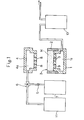
- Fig. 1 illustrates the construction of an apparatus for producing shaped articles of an organic substance.
- 1 denotes a lower die provided internally with a hollow chamber la.
- a frame member 2 is fitted around the upper portion of the lower die 1 to enclose a cavity 3 therein. What serves as a partition between the cavity 3 and the hollow chamber la is perforated with a plurality of ventholes 9.
- the hollow chamber la communicates with a vacuum pump not shown in the diagram via a neutralizing tank 10 by pipes.
- By 4 is denoted an upper die fastened to a movable base not shown in the diagram.
- the upper die has a hollow chamber 4a formed therein and has a lower wall thereof perforated with ventholes 8 communicating with the hollow chamber 4a.
- the hollow chamber 4a of the upper die 4 communicates with a curing agent feed device 7 and a compressed air source 11 via a three-way switch valve 6 by means of pipes.
- binder and its curing agent are as follows.
- a binder which is made of a polyol or isocyanate resin an amine type curing agent is used in the form of gas or aerosol and the curing is effected by a urethanizing reaction.
- water as in the form of steam may be used as a curing agent.
- an acidic gas such as carbon dioxide is used as a curing agent.
- a fibrous substance such as synthetic fibers, natural fibers, or pulp fibers, a powdery substance such as wood flour or pulp powder, and chips, flakes, or a mixture thereof are mixed with a stated binder for a prescribed length of time to produce a binder-containing mixture M.
- This mixture M is placed to fill the cavity 3 which is defined by the lower die 1 and the frame member 2.
- the upper die 4 is lowered and pressed down into the cavity 3 to compress the mixture M with stated pressure.
- the switch valve 5 is opened and the three-way switch valve 6 is manipulated to introduce the gas or aerosol of curing agent issuing from the curing agent feed device 7 into the hollow chamber 4a of the upper die 4 and, at the same time, the vacuum pump (not shown) is set rotating to evacuate the hollow chamber la of the lower die 1. Consequently, the curring agent held inside the hollow chamber 4a finds its way through the ventholes 8 of the upper die 4 into the cavity 3 and then permeates the mixture M. At this time, the curing agent in the form of gas or aerosol acts on the binder in the mixture M and cures it, with the result that the mixture is solidified.
- the curing agent in the form of gas or aerosol which is discharged via the ventholes 9 of the lower die 1 into the hollow chamber la is passed through the neutralizing tank 10, there to be neutralized. Then it is released into the atmosphere through the vacuum pump.
- the switch valve 5 is closed and the three-way switch valve 6 is manipulated to establish communication between the hollow chamber 4a and the compressed air source 11 and purge the mixture M in the cavity 3 by passage therethrough of the compressed air. Consequently, a shaped article of organic substance is obtained.
- the shaped articles of organic substances are required to possess strength, density, water resistance, heat resistance, and inflammability at varying levels depending on applications in which they are put to use. These properties can be adjusted by suitably selecting organic substances as raw materials by their kind and form, the kind and application rate of binders, and the magnitude of compressive force used during the shaping.
- the strength of the shaped article tends to increase in proportion as the amount of an organic substance increases relative to the amount of a powdery substance and further in proportion as the length of fibers in a fibrous substance increases.
- the strength is greater when urethane resin or isocyanate resin is used as a binder than when sodium silicate is used.
- the strength also increases in proportion as the amount of a given binder is increased.
- the strength of the mixture of the organic substance with the binder increases in proportion as the compressive force exerted thereon is increased.
- the compressive force exerted upon the mixture may be decreased to the lowest extent at which the mixture in the die will be neatly shaped.
- the water resistance, the heat resistance, and the inflammability of the produced shaped article hinge heavily on the kind of binder to be used.
- ventholdes each fitted with a vent plug may be disposed at suitable positions in the upper die and the lower die so that the incoming curing agent will be enabled to permeate the mixture uniformly throughout its entire volume.
- ventholes to be bored through the upper die the lower die' should be carefully distributed so that those in the upper die and those in the lower die will avoid aligning with each other.
- the uniform penetration of the curing agent may otherwise be ensured by forming a smaller number of ventholes in the discharge side die than in the gas inlet side die or by forming the ventholes in the discharge side die in a smaller cross-sectional area than those in the gas inlet side die.
- required hardness distribution in the shaped article can be attained by decreasing the amount of the curing agent flowing to the portion of lower strength or having the ventholes distributed so that the curing agent will be prevented from flowing in that portion.
- the method of this invention enables shaped articles to be mnufactured with high productivity.
- This high productivity may be further enhanced by setting the die temperature at a level higher than the normal room temperature, by having the raw material heated in advance of their use in the appratus of this invention, or by preheating the curing gas, for example.
- the pattern die to be used in the manufacture of shaped articles of organic substance by the method of this invention may be a metal die, a resin die, or a wooden die.
- the selection of the material of this die depends mainly on the strength which the shaped article is expected to acquire. While the strnegth of the shaped article can be increased by increasing the amount of the binder to be added to the organic substance, it can also be increased by increasing the compressive force to be exerted on the aforementioned mixture. When the compressive force to which the die is exposed exceeds about 10 kg/cm , the die must be metal product. So far as the compressive force is not expected to exceed about 6 kg/cm , the die may be a resin product or wooden product.
- the method of shaping contemplated by this invention produces shaped articles which fully satisfy practical applications in terms of form and strength.
- this method obviates the necessity of using an expensive metal die.
- the metal die may be used with the compressive force safely increased to a level exceeding 10 kg/cm 2 ..
- a mixed composite of hemp (having an average fiber length of 30 mm) and ground rice hull (having an average particle diameter of 80 mesh) were mixed with a polyol (product of Hodogaya Chemical Industry Co. marketed under trademark designation of Isocure Part I 306) and polyisocyanate (product of Hodogaya Chemical Industry Co. marketed under trademark designation of Isocure - .Part II 600) as a binder.
- a curing gas triethylamine (product of Daicel Chemical Industry Co.) was used.
- the produced mixture was shaped.
- the shaping conditions used in this case and the results of the test of the produced shaped article for physical properties are shown in Table 1.
- the results of bending strength indicated were obtained by the method of JIS A-5905 and those of tensile strength by the method of JIS P-8113 respectively.
- a mixed composite of waste fibers (mixture of 60% of nylon- polyester fibers, 20% of wool, and 20% of cotton) and wood flour (having an average particle diameter of 60 to 80 mesh) was mixed with a moisture-curing aromatic polyisocyanate (product of Sumitomo-Bayer Urethane Co. marketed under trademark designation of Sumieur E21-1) preparatorily incorporating therein 0.05% of dibutyl tin dilaurate (DBTDL) as a catalyst.
- DBTDL dibutyl tin dilaurate
- compressed steam (2 kg/cm , 120°C) was used. With the apparatus illustrated in the drawing, the resultant mixture was shaped.
- the shaping conditions used in this case the results of the test of the produced shaped article for physical properties are shown in Table 2.
- a mixed composite of pulp fibers (having an average fiber length of 5 mm) and pulp powder (having an average particle diameter of 60 mesh) was mixed with sodium silicate (product of Toa Chemical Co. marketed under trademark designation of Aron Set No. 2) as a binder.
- sodium silicate product of Toa Chemical Co. marketed under trademark designation of Aron Set No. 2
- carbon dioxide gas was used as a curing agent.
- the resultant mixture was shaped.
- the shaping conditions used in this case and the results of the test of the produced shaped article for physical properties are shown in Table 3.
- Polyester fibers having an average fiber length of 5 mm and a fiber thickness of 4 d
- isocyanate prepolymer product of Gunei Chemical Co. marketed under trademark designation of UL-4800
- acetone As a curing gas, triethylamine was used.
- the resultant mixture was shaped. The shaping conditions used in this case and the results of the test of the produced shaped article for physical properties are shown in Table 4.
- a mixed composite of crushed waste paper (having an average fiber length of 2 mm) and ground rice hull (having an average particle diameter of 80 mesh) was mixed with a polyol (product of Hodogaya Chemical Industry Co. marketed under trademark designation of I 306) and polyisocyanate (product of Hodogaya Chemical Industry Co. marketed under trademark designation of II 600) as a binder.
- a curing gas triethylamine (product of Daicel Chemical Industry Co.) was used. With the apparatus illustrated in the drawing, the resultant mixture was shaped. The shaping conditions used in this case and the results of the test of the produced shaped article for physical properties are shown in Table 5.
- Pulp fibers having an average fiber length of 7 mm
- a polyol product of Hodogaya Chemical Industry Co. marketed under trademark designation of Isocure Part I 306
- anC polyisocyanate product of Hodogaya Chemical Industry Co. marketed under trademark designation of Isocure Part II 600
- triethylamine product of Daicel Chemical Industry Co.
- this invention is constructed to effect manufacture of a shaped article of organic substance by mixing a material containing the organic substance with a binder, filling a die with the resultant mixture, compressing this mixture in the die, and forcing a liquid curing agent through the compressed mixture thereby solidifying the organic substance.
- the compressive force exerted within the die can be decreased below the level normally required and the die itself can be an inexpensive product of resin or wood.
- the device for application of compressive force can be in a smaller size than is normally required.
- the die is not required to be heated at all. The process of heating the die which has been indispensable to the conventional method is no longer necessary. This fact contributes to decreasing the production cost.
- the retention time of the curing agent in the compressed mass is very small, falling on the order of several seconds to some tens of seconds. Consequently, the productivity is improved to a great extent
Landscapes
- Life Sciences & Earth Sciences (AREA)
- Engineering & Computer Science (AREA)
- Manufacturing & Machinery (AREA)
- Wood Science & Technology (AREA)
- Forests & Forestry (AREA)
- Dry Formation Of Fiberboard And The Like (AREA)
Priority Applications (1)
| Application Number | Priority Date | Filing Date | Title |
|---|---|---|---|
| DE8484305493T DE3478908D1 (en) | 1984-08-13 | 1984-08-13 | Method for manufacture of shaped article of organic substance |
Applications Claiming Priority (1)
| Application Number | Priority Date | Filing Date | Title |
|---|---|---|---|
| JP58033431A JPS59158242A (ja) | 1983-02-28 | 1983-02-28 | 有機物質成形品の成形方法 |
Publications (3)
| Publication Number | Publication Date |
|---|---|
| EP0172278A2 true EP0172278A2 (de) | 1986-02-26 |
| EP0172278A3 EP0172278A3 (en) | 1986-12-30 |
| EP0172278B1 EP0172278B1 (de) | 1989-07-12 |
Family
ID=12386351
Family Applications (1)
| Application Number | Title | Priority Date | Filing Date |
|---|---|---|---|
| EP84305493A Expired EP0172278B1 (de) | 1983-02-28 | 1984-08-13 | Verfahren zur Herstellung von Formteilen aus organischem Stoff |
Country Status (3)
| Country | Link |
|---|---|
| US (1) | US4623499A (de) |
| EP (1) | EP0172278B1 (de) |
| JP (1) | JPS59158242A (de) |
Cited By (2)
| Publication number | Priority date | Publication date | Assignee | Title |
|---|---|---|---|---|
| DE3742652A1 (de) * | 1986-11-14 | 1989-07-13 | Held Kurt | Verfahren und vorrichtung zur herstellung von holzwerkstoffplatten |
| EP0267516B1 (de) * | 1986-11-14 | 1993-01-20 | Kurt Held | Verfahren und Vorrichtungen zur Herstellung von Holzwerkstoffplatten |
Families Citing this family (14)
| Publication number | Priority date | Publication date | Assignee | Title |
|---|---|---|---|---|
| GB8813396D0 (en) * | 1988-06-07 | 1988-07-13 | Earl H A | Composite materials |
| SE462525B (sv) * | 1988-11-16 | 1990-07-09 | Toolvac Engineering Ab | Foerfarande foer reglering av temperaturen i ett sintrat formverktyg |
| CH681990A5 (de) * | 1989-04-14 | 1993-06-30 | Matec Holding | |
| FI90324C (fi) * | 1990-12-14 | 1994-01-25 | Neste Oy | Menetelmä sähköäjohtavan muovituotteen valmistamiseksi |
| CH686785A5 (de) * | 1993-10-06 | 1996-06-28 | Matec Holding Ag | Geruchsarmer, schall- und waermedaemmender Formkoerper sowie Verfahren zu dessen Herstellung. |
| DE4415586C1 (de) * | 1994-05-03 | 1996-02-08 | Stankiewicz Gmbh | Verfahren zur Herstellung eines Verbundschaums aus Schaumflocken, Verbundschaum sowie Verwendungen dieses Verbundschaumes |
| US6093013A (en) * | 1997-12-22 | 2000-07-25 | E. I. Du Pont De Nemours And Company | Adiabatic mold having composite structure |
| US6863971B2 (en) * | 2001-03-22 | 2005-03-08 | Cycletec Ltd. | Strong durable low cost composite materials made from treated cellulose and plastic |
| US20040021244A1 (en) * | 2002-08-02 | 2004-02-05 | Yun-Tsai Liu | Method for manufacturing a container that may be dissolved naturally |
| WO2005033042A1 (en) * | 2003-10-07 | 2005-04-14 | Kyungdong Ceratech Co., Ltd. | Manufacturing method of ceramic body with excellent adiabatic capacity |
| KR101552018B1 (ko) * | 2012-11-07 | 2015-09-09 | 오씨아이 주식회사 | 진공단열재 심재의 성형 장치 및 이를 통해 제조된 진공단열재 |
| DE102016113201B4 (de) | 2016-07-18 | 2019-07-18 | Johann Borgers GmbH | Verfahren zur Herstellung eines porösen Faservliesformkörpers mittels eines thermischen Formgebungsverfahrens sowie dafür geeignete Vorrichtung |
| US11369806B2 (en) | 2017-11-14 | 2022-06-28 | Reflexion Medical, Inc. | Systems and methods for patient monitoring for radiotherapy |
| FI130116B (en) * | 2018-09-21 | 2023-03-03 | Woodio Oy | A method of producing a moulded article |
Family Cites Families (13)
| Publication number | Priority date | Publication date | Assignee | Title |
|---|---|---|---|---|
| DE937015C (de) * | 1951-01-17 | 1955-12-29 | Evans Bellhouse Ltd | Verfahren zum Herstellen eines elastischen, luftdurchlaessigen, einseitig offenen Verpackungskoerpers |
| US2850786A (en) * | 1953-08-31 | 1958-09-09 | Carbon C Dubbs | Method of molding articles from liquid suspensions |
| FR1126158A (fr) * | 1955-06-14 | 1956-11-16 | Paquetage pour objets fragiles | |
| US3008205A (en) * | 1958-09-19 | 1961-11-14 | Gen Motors Corp | Shell type molds and cores |
| US2976164A (en) * | 1958-09-25 | 1961-03-21 | Durel Inc | Lignocellulose product and method |
| US2984579A (en) * | 1958-10-02 | 1961-05-16 | Durel Inc | Methods of making a lignocellulose product and products resulting therefrom |
| US3086248A (en) * | 1959-12-07 | 1963-04-23 | Armstrong Cork Co | Process for reducing aging period of cellular products formed with steam |
| CH486315A (de) * | 1968-02-27 | 1970-02-28 | Laszlo Dr Futo | Verfahren zur Herstellung von Presslingen, insbesondere aus Holz, und Vorrichtung zur Durchführung des Verfahrens |
| BE712436A (de) * | 1968-03-19 | 1968-07-31 | ||
| CH515116A (de) * | 1968-11-18 | 1971-11-15 | Maekinen Alpo & Co Instmsto | Verfahren zum Heisspressen von Platten aus lignozellulosehaltigen Stoffen |
| US3891738A (en) * | 1972-11-10 | 1975-06-24 | Canadian Patents Dev | Method and apparatus for pressing particleboard |
| JPS52130788A (en) * | 1976-04-22 | 1977-11-02 | Shinken Sumitomo | Method of making packed buffer material for packed merchandise |
| US4379101A (en) * | 1980-06-04 | 1983-04-05 | Allen Industries, Inc. | Forming apparatus and method |
-
1983
- 1983-02-28 JP JP58033431A patent/JPS59158242A/ja active Pending
-
1984
- 1984-08-09 US US06/639,172 patent/US4623499A/en not_active Expired - Fee Related
- 1984-08-13 EP EP84305493A patent/EP0172278B1/de not_active Expired
Cited By (2)
| Publication number | Priority date | Publication date | Assignee | Title |
|---|---|---|---|---|
| DE3742652A1 (de) * | 1986-11-14 | 1989-07-13 | Held Kurt | Verfahren und vorrichtung zur herstellung von holzwerkstoffplatten |
| EP0267516B1 (de) * | 1986-11-14 | 1993-01-20 | Kurt Held | Verfahren und Vorrichtungen zur Herstellung von Holzwerkstoffplatten |
Also Published As
| Publication number | Publication date |
|---|---|
| EP0172278A3 (en) | 1986-12-30 |
| JPS59158242A (ja) | 1984-09-07 |
| US4623499A (en) | 1986-11-18 |
| EP0172278B1 (de) | 1989-07-12 |
Similar Documents
| Publication | Publication Date | Title |
|---|---|---|
| EP0172278B1 (de) | Verfahren zur Herstellung von Formteilen aus organischem Stoff | |
| US2544019A (en) | Manufacture of plastic-fiber composition | |
| EP0483716B1 (de) | Verfahren zur Herstellung einer Formmasse aus faserverstärktem thermoplastischem Harz | |
| EP0752444B1 (de) | Verfahren zur Herstellung eines aus Fasern bestehenden Formteils | |
| US20010024727A1 (en) | Apparatus and method for continuous formation of composites having filler and thermoactive materials, and products made by the method | |
| CN1964827B (zh) | 形成高强度模制产品的方法 | |
| JPS62271715A (ja) | 繊維強化複合材料品およびその製造方法 | |
| ES2139701T3 (es) | Pieza moldeada de material celular de plastico, y procedimiento y aparato para su fabricacion. | |
| EP0148762B1 (de) | Faserverstärkte geformte Kunststoffgegenstände | |
| US6187249B1 (en) | Manufacture of bodies using rice hulls | |
| JPH07503908A (ja) | セルロース含有製品を製造する改良した方法及び装置、並びに製造した製品 | |
| US3045058A (en) | Separators for electric accumulators, especially lead accumulators, and process of manufacture thereof | |
| GB2214857A (en) | Compression moulding fibrous material | |
| EP0288634A1 (de) | Verfahren zum Herstellen von Formteilen aus einem expandierbaren Styren-Polymer | |
| CN1703311B (zh) | 带有通风装置的注射成型设备及方法 | |
| KR0161818B1 (ko) | 섬유폐기물을 재생가공한 신소재 섬유판재의 제조방법 | |
| JPS59201844A (ja) | 有機物質の成形方法 | |
| US3130114A (en) | Process of manufacturing fibreboards and pressings from lignocellulose material | |
| CA3248522A1 (en) | MINERAL WOOL MATERIAL RECYCLING PROCESS | |
| US2548095A (en) | Production of construction materials from wood and other vegetable fibers | |
| US5151226A (en) | Process of making contoured vehicle internal panelling supports | |
| CN119754104B (zh) | 一种干法纸基缓冲材料的制备方法及干法纸基缓冲材料 | |
| EP0687216B1 (de) | Verfahren und mittel bei der herstellung von expandierten polymergegenständen | |
| JPS60180802A (ja) | 繊維質成形層体の製造法 | |
| CN218270101U (zh) | 一种木塑原料的混合干燥装置 |
Legal Events
| Date | Code | Title | Description |
|---|---|---|---|
| PUAI | Public reference made under article 153(3) epc to a published international application that has entered the european phase |
Free format text: ORIGINAL CODE: 0009012 |
|
| AK | Designated contracting states |
Designated state(s): DE FR GB IT SE |
|
| PUAL | Search report despatched |
Free format text: ORIGINAL CODE: 0009013 |
|
| AK | Designated contracting states |
Kind code of ref document: A3 Designated state(s): DE FR GB IT SE |
|
| 17P | Request for examination filed |
Effective date: 19870617 |
|
| 17Q | First examination report despatched |
Effective date: 19881019 |
|
| GRAA | (expected) grant |
Free format text: ORIGINAL CODE: 0009210 |
|
| AK | Designated contracting states |
Kind code of ref document: B1 Designated state(s): DE FR GB IT SE |
|
| REF | Corresponds to: |
Ref document number: 3478908 Country of ref document: DE Date of ref document: 19890817 |
|
| ITF | It: translation for a ep patent filed | ||
| ET | Fr: translation filed | ||
| PLBI | Opposition filed |
Free format text: ORIGINAL CODE: 0009260 |
|
| 26 | Opposition filed |
Opponent name: G. SIEMPELKAMP GMBH & CO. Effective date: 19900407 |
|
| PGFP | Annual fee paid to national office [announced via postgrant information from national office to epo] |
Ref country code: GB Payment date: 19910621 Year of fee payment: 8 |
|
| PGFP | Annual fee paid to national office [announced via postgrant information from national office to epo] |
Ref country code: SE Payment date: 19910702 Year of fee payment: 8 |
|
| PGFP | Annual fee paid to national office [announced via postgrant information from national office to epo] |
Ref country code: FR Payment date: 19910705 Year of fee payment: 8 |
|
| PGFP | Annual fee paid to national office [announced via postgrant information from national office to epo] |
Ref country code: DE Payment date: 19910709 Year of fee payment: 8 |
|
| ITTA | It: last paid annual fee | ||
| PG25 | Lapsed in a contracting state [announced via postgrant information from national office to epo] |
Ref country code: GB Effective date: 19920813 |
|
| PG25 | Lapsed in a contracting state [announced via postgrant information from national office to epo] |
Ref country code: SE Effective date: 19920814 |
|
| GBPC | Gb: european patent ceased through non-payment of renewal fee |
Effective date: 19920813 |
|
| RDAG | Patent revoked |
Free format text: ORIGINAL CODE: 0009271 |
|
| STAA | Information on the status of an ep patent application or granted ep patent |
Free format text: STATUS: PATENT REVOKED |
|
| REG | Reference to a national code |
Ref country code: FR Ref legal event code: ST |
|
| 27W | Patent revoked |
Effective date: 19930219 |
|
| EUG | Se: european patent has lapsed |
Ref document number: 84305493.3 Effective date: 19930307 |