EP0171755A1 - Ester von Vinylcarbonsäuren - Google Patents
Ester von Vinylcarbonsäuren Download PDFInfo
- Publication number
- EP0171755A1 EP0171755A1 EP85109956A EP85109956A EP0171755A1 EP 0171755 A1 EP0171755 A1 EP 0171755A1 EP 85109956 A EP85109956 A EP 85109956A EP 85109956 A EP85109956 A EP 85109956A EP 0171755 A1 EP0171755 A1 EP 0171755A1
- Authority
- EP
- European Patent Office
- Prior art keywords
- esters
- monomers
- vinyl
- carboxylic
- acrylic
- Prior art date
- Legal status (The legal status is an assumption and is not a legal conclusion. Google has not performed a legal analysis and makes no representation as to the accuracy of the status listed.)
- Granted
Links
- NIXOWILDQLNWCW-UHFFFAOYSA-N Acrylic acid Chemical class OC(=O)C=C NIXOWILDQLNWCW-UHFFFAOYSA-N 0.000 title claims abstract description 9
- 239000000178 monomer Substances 0.000 claims abstract description 13
- 150000002148 esters Chemical class 0.000 claims abstract description 11
- 239000001257 hydrogen Substances 0.000 claims abstract description 4
- 229910052739 hydrogen Inorganic materials 0.000 claims abstract description 4
- 125000002496 methyl group Chemical group [H]C([H])([H])* 0.000 claims abstract description 4
- 125000004435 hydrogen atom Chemical group [H]* 0.000 claims abstract description 3
- 238000010526 radical polymerization reaction Methods 0.000 claims abstract description 3
- 229920000642 polymer Polymers 0.000 claims description 9
- 238000000034 method Methods 0.000 claims description 3
- CERQOIWHTDAKMF-UHFFFAOYSA-N Methacrylic acid Chemical compound CC(=C)C(O)=O CERQOIWHTDAKMF-UHFFFAOYSA-N 0.000 description 8
- VVQNEPGJFQJSBK-UHFFFAOYSA-N Methyl methacrylate Chemical compound COC(=O)C(C)=C VVQNEPGJFQJSBK-UHFFFAOYSA-N 0.000 description 8
- SMZOUWXMTYCWNB-UHFFFAOYSA-N 2-(2-methoxy-5-methylphenyl)ethanamine Chemical compound COC1=CC=C(C)C=C1CCN SMZOUWXMTYCWNB-UHFFFAOYSA-N 0.000 description 4
- 239000003054 catalyst Substances 0.000 description 4
- CLYAQFSQLQTVNO-UHFFFAOYSA-N 3-cyclohexylpropan-1-ol Chemical compound OCCCC1CCCCC1 CLYAQFSQLQTVNO-UHFFFAOYSA-N 0.000 description 3
- OKKJLVBELUTLKV-UHFFFAOYSA-N Methanol Chemical compound OC OKKJLVBELUTLKV-UHFFFAOYSA-N 0.000 description 3
- 150000001875 compounds Chemical class 0.000 description 3
- 125000005395 methacrylic acid group Chemical group 0.000 description 3
- 229920003023 plastic Polymers 0.000 description 3
- 239000004033 plastic Substances 0.000 description 3
- 238000006116 polymerization reaction Methods 0.000 description 3
- 238000005809 transesterification reaction Methods 0.000 description 3
- PVGIJQPGPCDMBI-UHFFFAOYSA-N 3-cyclohexylpropyl 2-methylprop-2-enoate Chemical compound CC(=C)C(=O)OCCCC1CCCCC1 PVGIJQPGPCDMBI-UHFFFAOYSA-N 0.000 description 2
- NIXOWILDQLNWCW-UHFFFAOYSA-M Acrylate Chemical compound [O-]C(=O)C=C NIXOWILDQLNWCW-UHFFFAOYSA-M 0.000 description 2
- QIGBRXMKCJKVMJ-UHFFFAOYSA-N Hydroquinone Chemical compound OC1=CC=C(O)C=C1 QIGBRXMKCJKVMJ-UHFFFAOYSA-N 0.000 description 2
- PPBRXRYQALVLMV-UHFFFAOYSA-N Styrene Chemical compound C=CC1=CC=CC=C1 PPBRXRYQALVLMV-UHFFFAOYSA-N 0.000 description 2
- QAOWNCQODCNURD-UHFFFAOYSA-N Sulfuric acid Chemical compound OS(O)(=O)=O QAOWNCQODCNURD-UHFFFAOYSA-N 0.000 description 2
- 238000006243 chemical reaction Methods 0.000 description 2
- DMBHHRLKUKUOEG-UHFFFAOYSA-N diphenylamine Chemical compound C=1C=CC=CC=1NC1=CC=CC=C1 DMBHHRLKUKUOEG-UHFFFAOYSA-N 0.000 description 2
- 239000003112 inhibitor Substances 0.000 description 2
- 239000007788 liquid Substances 0.000 description 2
- NWVVVBRKAWDGAB-UHFFFAOYSA-N p-methoxyphenol Chemical compound COC1=CC=C(O)C=C1 NWVVVBRKAWDGAB-UHFFFAOYSA-N 0.000 description 2
- JOXIMZWYDAKGHI-UHFFFAOYSA-N toluene-4-sulfonic acid Chemical compound CC1=CC=C(S(O)(=O)=O)C=C1 JOXIMZWYDAKGHI-UHFFFAOYSA-N 0.000 description 2
- UJVBZCCNLAAMOV-UHFFFAOYSA-N 2h-1,2-benzothiazine Chemical compound C1=CC=C2C=CNSC2=C1 UJVBZCCNLAAMOV-UHFFFAOYSA-N 0.000 description 1
- -1 3-cyclohexylpropyl halides Chemical class 0.000 description 1
- WYLDRIOSIQVQMS-UHFFFAOYSA-N 3-cyclohexylpropyl prop-2-enoate Chemical compound C=CC(=O)OCCCC1CCCCC1 WYLDRIOSIQVQMS-UHFFFAOYSA-N 0.000 description 1
- NLHHRLWOUZZQLW-UHFFFAOYSA-N Acrylonitrile Chemical compound C=CC#N NLHHRLWOUZZQLW-UHFFFAOYSA-N 0.000 description 1
- CPELXLSAUQHCOX-UHFFFAOYSA-M Bromide Chemical compound [Br-] CPELXLSAUQHCOX-UHFFFAOYSA-M 0.000 description 1
- WKBOTKDWSSQWDR-UHFFFAOYSA-N Bromine atom Chemical group [Br] WKBOTKDWSSQWDR-UHFFFAOYSA-N 0.000 description 1
- VEXZGXHMUGYJMC-UHFFFAOYSA-M Chloride anion Chemical compound [Cl-] VEXZGXHMUGYJMC-UHFFFAOYSA-M 0.000 description 1
- RYGMFSIKBFXOCR-UHFFFAOYSA-N Copper Chemical compound [Cu] RYGMFSIKBFXOCR-UHFFFAOYSA-N 0.000 description 1
- JIGUQPWFLRLWPJ-UHFFFAOYSA-N Ethyl acrylate Chemical compound CCOC(=O)C=C JIGUQPWFLRLWPJ-UHFFFAOYSA-N 0.000 description 1
- UFHFLCQGNIYNRP-UHFFFAOYSA-N Hydrogen Chemical compound [H][H] UFHFLCQGNIYNRP-UHFFFAOYSA-N 0.000 description 1
- GYCMBHHDWRMZGG-UHFFFAOYSA-N Methylacrylonitrile Chemical compound CC(=C)C#N GYCMBHHDWRMZGG-UHFFFAOYSA-N 0.000 description 1
- ZLMJMSJWJFRBEC-UHFFFAOYSA-N Potassium Chemical compound [K] ZLMJMSJWJFRBEC-UHFFFAOYSA-N 0.000 description 1
- 238000006887 Ullmann reaction Methods 0.000 description 1
- QYKIQEUNHZKYBP-UHFFFAOYSA-N Vinyl ether Chemical class C=COC=C QYKIQEUNHZKYBP-UHFFFAOYSA-N 0.000 description 1
- 239000002253 acid Substances 0.000 description 1
- 230000002378 acidificating effect Effects 0.000 description 1
- 239000003513 alkali Substances 0.000 description 1
- 150000001408 amides Chemical class 0.000 description 1
- 150000004982 aromatic amines Chemical class 0.000 description 1
- 239000011324 bead Substances 0.000 description 1
- GDTBXPJZTBHREO-UHFFFAOYSA-N bromine Chemical group BrBr GDTBXPJZTBHREO-UHFFFAOYSA-N 0.000 description 1
- 229910052794 bromium Chemical group 0.000 description 1
- 125000000484 butyl group Chemical group [H]C([*])([H])C([H])([H])C([H])([H])C([H])([H])[H] 0.000 description 1
- 239000003795 chemical substances by application Substances 0.000 description 1
- 239000000460 chlorine Substances 0.000 description 1
- 229910052801 chlorine Inorganic materials 0.000 description 1
- 125000001309 chloro group Chemical group Cl* 0.000 description 1
- 229920001577 copolymer Polymers 0.000 description 1
- 238000007334 copolymerization reaction Methods 0.000 description 1
- 229910052802 copper Inorganic materials 0.000 description 1
- 239000010949 copper Substances 0.000 description 1
- 238000004821 distillation Methods 0.000 description 1
- 230000032050 esterification Effects 0.000 description 1
- 238000005886 esterification reaction Methods 0.000 description 1
- 125000001495 ethyl group Chemical group [H]C([H])([H])C([H])([H])* 0.000 description 1
- 238000004817 gas chromatography Methods 0.000 description 1
- 159000000014 iron salts Chemical class 0.000 description 1
- 229910052751 metal Inorganic materials 0.000 description 1
- 239000002184 metal Substances 0.000 description 1
- WCYWZMWISLQXQU-UHFFFAOYSA-N methyl Chemical group [CH3] WCYWZMWISLQXQU-UHFFFAOYSA-N 0.000 description 1
- CXKWCBBOMKCUKX-UHFFFAOYSA-M methylene blue Chemical compound [Cl-].C1=CC(N(C)C)=CC2=[S+]C3=CC(N(C)C)=CC=C3N=C21 CXKWCBBOMKCUKX-UHFFFAOYSA-M 0.000 description 1
- 229960000907 methylthioninium chloride Drugs 0.000 description 1
- 239000000203 mixture Substances 0.000 description 1
- 150000002828 nitro derivatives Chemical class 0.000 description 1
- PNJWIWWMYCMZRO-UHFFFAOYSA-N pent‐4‐en‐2‐one Natural products CC(=O)CC=C PNJWIWWMYCMZRO-UHFFFAOYSA-N 0.000 description 1
- 150000002989 phenols Chemical class 0.000 description 1
- 229920000193 polymethacrylate Polymers 0.000 description 1
- 229910052700 potassium Inorganic materials 0.000 description 1
- 239000011591 potassium Substances 0.000 description 1
- 125000001436 propyl group Chemical group [H]C([*])([H])C([H])([H])C([H])([H])[H] 0.000 description 1
- 150000004053 quinones Chemical class 0.000 description 1
- 150000003254 radicals Chemical group 0.000 description 1
- 230000035484 reaction time Effects 0.000 description 1
- 238000010992 reflux Methods 0.000 description 1
- 239000007858 starting material Substances 0.000 description 1
- 238000010557 suspension polymerization reaction Methods 0.000 description 1
- LLZRNZOLAXHGLL-UHFFFAOYSA-J titanic acid Chemical class O[Ti](O)(O)O LLZRNZOLAXHGLL-UHFFFAOYSA-J 0.000 description 1
- VXUYXOFXAQZZMF-UHFFFAOYSA-N titanium(IV) isopropoxide Chemical compound CC(C)O[Ti](OC(C)C)(OC(C)C)OC(C)C VXUYXOFXAQZZMF-UHFFFAOYSA-N 0.000 description 1
- 125000005490 tosylate group Chemical group 0.000 description 1
- XLYOFNOQVPJJNP-UHFFFAOYSA-N water Substances O XLYOFNOQVPJJNP-UHFFFAOYSA-N 0.000 description 1
Classifications
-
- C—CHEMISTRY; METALLURGY
- C08—ORGANIC MACROMOLECULAR COMPOUNDS; THEIR PREPARATION OR CHEMICAL WORKING-UP; COMPOSITIONS BASED THEREON
- C08F—MACROMOLECULAR COMPOUNDS OBTAINED BY REACTIONS ONLY INVOLVING CARBON-TO-CARBON UNSATURATED BONDS
- C08F20/00—Homopolymers and copolymers of compounds having one or more unsaturated aliphatic radicals, each having only one carbon-to-carbon double bond, and only one being terminated by only one carboxyl radical or a salt, anhydride, ester, amide, imide or nitrile thereof
- C08F20/02—Monocarboxylic acids having less than ten carbon atoms, Derivatives thereof
- C08F20/10—Esters
- C08F20/12—Esters of monohydric alcohols or phenols
- C08F20/16—Esters of monohydric alcohols or phenols of phenols or of alcohols containing two or more carbon atoms
- C08F20/18—Esters of monohydric alcohols or phenols of phenols or of alcohols containing two or more carbon atoms with acrylic or methacrylic acids
-
- A—HUMAN NECESSITIES
- A61—MEDICAL OR VETERINARY SCIENCE; HYGIENE
- A61K—PREPARATIONS FOR MEDICAL, DENTAL OR TOILETRY PURPOSES
- A61K6/00—Preparations for dentistry
- A61K6/80—Preparations for artificial teeth, for filling teeth or for capping teeth
- A61K6/884—Preparations for artificial teeth, for filling teeth or for capping teeth comprising natural or synthetic resins
- A61K6/887—Compounds obtained by reactions only involving carbon-to-carbon unsaturated bonds
Definitions
- the invention relates to new esters of vinyl carboxylic acids as monomers which can be polymerized in free-radical polymerization or copolymerized with other monomers.
- the technology has a large number of radically polymerizable monomers available.
- a special class of plastics was developed on the basis of methyl methacrylate in particular, which is used extensively in many areas of technology (cf. R. Vieweg, F. Esser, Plastics Manual, Volume IX, "Polymethacrylates", C. Hanser Verlag , 1975).
- methyl methacrylate numerous other acrylic or methacrylic compounds serve as monomeric starting compounds for polymers and copolymers (cf. J. Brandrup & EH Immergut. Polymer Handbock. 2nd edition. Wiley-Interscience. 1975).
- the properties of the polymers formed can be influenced by the choice of the monomers and the mode of polymerization. Conversely, certain requirement profiles for plastics trigger the desire for new monomers that meet the requirements better than those already on the market. Although the polymer skilled in the art the behavior and influence of a single monomer on the Apart from certain strictly homologous compounds, predictions may still be subject to considerable uncertainties, apart from certain strictly homologous compounds.
- the new esters of the formula I can be prepared in a manner known per se, for example by reacting activated derivatives of acrylic or methacrylic acid of the formula II where X represents chlorine or bromine or a radical where R has the meaning given above with 3-cyclo hexylpropanol, optionally in the presence of an acid acceptor (cf. US Pat. No.
- Transesterification catalysts include basic catalysts such as alkali alcoholates (cf. CH-PS 239 750), acidic catalysts such as p-toluenesulfonic acid. Sulfuric acid (GB-PS 461 979.
- GB-PS 960 005) or orthotitanic acid esters (GB-PS 960 005 and GB-PS 962 928) in question.
- the reactions are expediently carried out in the presence of known polymerization inhibitors such as quinones, benzothiazine, phenols, methylene blue, aromatic amines (diphenylamine) or nitro compounds, optionally also copper or iron salts.
- polymerization inhibitors such as quinones, benzothiazine, phenols, methylene blue, aromatic amines (diphenylamine) or nitro compounds, optionally also copper or iron salts.
- Inhibitor amounts are usually in the order of 0.01 to 0.1% by weight (based on the ester used).
- hydroquinone monomethyl ether and the hydroquinone.
- the compounds of formula I are colorless, distillable liquids.
- esters of (meth) acrylic acid they are particularly suitable for the polymerization or copolymerization with other free-radically polymerizable monomers, in particular the esters and amides of acrylic or methacrylic acid, acrylonitrile and methacrylonitrile, styrene and its alkylated derivatives, vinyl ethers and -esters etc.
- the 3-cyclohexylpropyl acrylate can also be prepared completely analogously to Example 1 by using ethyl acrylate instead of methyl methacrylate (reaction time 3 hours).
- a bead polymer made from 92 parts by weight of methyl methacrylate and 8 parts by weight of 3-cyclohexylpropyl methacrylate is used, prepared by the customary bead polymerization process.
- the polymer is processed into a dental prosthesis using the customary powder-liquid method (vg1. Ullmann's Encyclopedia of Techn. Chemistry 4th Edition, Volume 10, pp. 8-9, Verlag Chemie).
- the dough obtained when pasting with 0.5 parts of methyl methacrylate is tack-free very quickly (after about 3 minutes) and can be processed for about 1 hour.
Landscapes
- Health & Medical Sciences (AREA)
- Oral & Maxillofacial Surgery (AREA)
- Chemical & Material Sciences (AREA)
- Veterinary Medicine (AREA)
- Chemical Kinetics & Catalysis (AREA)
- Animal Behavior & Ethology (AREA)
- General Health & Medical Sciences (AREA)
- Public Health (AREA)
- Epidemiology (AREA)
- Plastic & Reconstructive Surgery (AREA)
- Life Sciences & Earth Sciences (AREA)
- Medicinal Chemistry (AREA)
- Polymers & Plastics (AREA)
- Organic Chemistry (AREA)
- Organic Low-Molecular-Weight Compounds And Preparation Thereof (AREA)
- Addition Polymer Or Copolymer, Post-Treatments, Or Chemical Modifications (AREA)
- Dental Preparations (AREA)
Abstract
Description
- Die Erfindung betrifft neue Ester von Vinylcarbonsäuren als Monomere, die in radikalischer Polymerisation polymerisiert bzw. mit anderen Monomeren copolymerisiert werden können.
- Der Technik steht eine große Anzahl radikalisch polymerisierbarer Monomerer zur Verfügung. Eine bedeutende Rolle spielen Derivate der Acryl- und der Methacrylsäure, insbesondere deren Ester. So wurde auf der Grundlage speziell des Methylmethacrylats eine eigene Klasse von Kunststoffen entwickelt, die in vielen Bereichen der Technik ausgedehnte Anwendung findet (vgl. R. Vieweg, F. Esser, Kunststoff-Handbuch, Band IX, "Polymethacrylate" , C. Hanser Verlag, 1975). Nebem dem Methylmethacrylat dienen zahlreiche andere Acryl- bzw. Methacrylverbindungen als monomere Ausgangsverbindungen für Polymerisate und Copolymerisate (vgl. J. Brandrup & E.H. Immergut. Polymer Handbock. 2. Auflage. Wiley-Interscience. 1975). Durch die Wahl der Monomeren und des Polymerisationsmodus lassen sich die Eigenschaften der gebildeten Polymeren beeinflussen. Umgekehrt rufen bestimmte Anforderungsprofile für Kunststoffe den Wunsch nach neuen Monomeren hervor, die den Anforderungen besser gerecht werden als die bereits auf dem Markt befindlichen. Obwohl der Polymer-Fachmann das Verhalten und den Einfluß eines einzelnen Monomeren auf das Polymerisat mehr oder weniger korrekt abzuschätzen und teilweise auch zu berechnen vermag, sind vielleicht abgesehen von gewissen strikt homologen Verbindungen Voraussagen nach wie vor mit beträchtlichen Unsicherheiten behaftet.
- Ungeachtet der vielen bekannten Acrylat- bzw. Methacrylmonomeren, besteht ein Bedarf an weiteren Monomeren, die es gestatten, bestimmte Polymerisateigenschaften herbeizuführen bzw. diese Eigenschaften zu beeinflussen. So sind z.B. weitere Monomere erwünscht zur Verbesserung der Eigenschaften von Dentalmassen auf Acrylatbasis.
- Es wurde nun gefunden, daß neue Ester der Acryl- bzw. der Methacrylsäure der Formel I

worin R für Wasserstoff oder einen Methylrest steht, die Anforderungen der Technik in besonderem Maße erfüllen. - Die neuen Ester der Formel I können in an sich bekannter Weise, z.B. durch Umsetzung aktivierter Derivate der Acryl- bzw. der Methacrylsäure der Formel II

worin X für Chlor oder Brom oder für einen Rest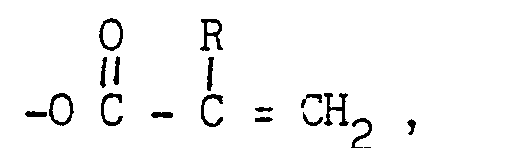

worin R' für Methyl oder Wasserstoff und R" für Methyl, Ethyl, Propyl oder Butyl steht, vorzugsweise in Gegenwart von ümesterungskatalysatoren hergestellt werden. (Vgl. H. Rauch-Puntigam. Th. Völker "Acryl- und Methacrylverbindungen". Springer Verlag. 1967. pp. 36-40. US-PS 2 138 763). - Als Umesterungskatalysatoren kommen z.B. basische Katalysatoren wie Alkalialkoholate (vgl. CH-PS 239 750), saure Katalysatoren wie p-Toluolsulfonsäure. Schwefelsäure (GB-PS 461 979.
- GB-PS 960 005) oder Orthotitansäureester (GB-PS 960 005 und GB-PS 962 928) in Frage.
- Zweckmäßigerweise werden die Umsetzungen in Gegenwart von an sich bekannten Polymerisationsinhibitoren wie Chinone, Benzthiazin, Phenole, Methylenblau, aromatische Amine (Diphenylamin) oder Nitroverbindungen, gegebenenfalls auch Kupfer- oder Eisensalzen durchgeführt. Die anzuwendenden
- Inhibitormengen liegen meist in der Größenordnung von 0.01 bis 0,1 Gew.-% (bezogen auf eingesetzten Ester).
- (Vgl. Ullmanns Encyklopädie der techn. Chemie, 4. Auflage, Bd. 15, pg. 256ff, Verlag Chemie, 1978).
- Genannt seien z.B. der Hydrochinonmonomethylether und das Hydrochinon.
- Die folgenden Beispiele dienen zur Erläuterung der Erfindung. Die Verbindungen der Formel I sind farblose, destillierbare Flüssigkeiten. Sie eignen sich wie die bekannten Ester der (Meth)acrylsäure insbesondere zur Polymerisation oder Copolymerisation mit anderen, radikalisch polymerisierbaren Monomeren, insbesondere den Estern und Amiden der Acryl- bzw. der Methacrylsäure, Acryl- und Methacrylnitril, Styrol und dessen alkylierten Derivaten, Vinyläthern und -estern u.ä.
- In einem 4-1-Dreihalsrundkolben, ausgestattet mit Thermometer, Rückflußkühler mit Destillationsaufsatz und Rührer, werden 852 g (6 Mol) 3-Cyclohexylpropanol. 1800 g (18 Mol) Methylmethacrylat, 0,18 g p-Methoxyphenol und 26 g Isopropyltitanat unter Einleiten von Luft zum Sieden erhitzt und solange ein Methanol/Methylmethacrylat-Azeotrop abgezogen, bis vollständiger Unsatz erreicht ist (ca. 3,5 h). Das überschüssige Methylmethacrylat wird im Rotationsverdampfer entfernt und der Rückstand destilliert. Man erhält das 3-Cyclohexylpropylmethacrylat in 91,5 % Ausbeute; gaschromatographisch bestimmte Reinheit: > 98 %, Sdp. 0,8 mm: 88°C n20 D : 1,464
- Völlig analog Beispiel 1 kann auch das 3-Cyclohexylpropylacrylat hergestellt werden, indem anstelle von Methylmethacrylat Äthylacrylat eingesetzt wird (Reaktionszeit 3 Std.).

- Dentalanwendung der Polymerisate.
- Ein nach dem üblichen Perlpolymerisationsverfahren hergestelltes Perlpolymerisat aus 92 Gew.-Teilen Methylmethacrylat und 8 Gew.-Teilen 3-Cyclohexylpropylmethacrylat wird verwendet. Die zentrale Perlgröße beträgt Z2 = 90 um. Das Polymere wird nach dem üblichen Pulver-Flüssigkeitsverfahren (vg1. Ullmann's Encyclopädie der Techn. Chemie 4. Auflage, Band 10, pp. 8-9, Verlag Chemie) zu einer Zahnprothese verarbeitet. Der beim Anteigen mit 0,5 Teilen Methylmethacrylat erhaltene Teig ist sehr schnell (nach ca. 3 Minuten) klebfrei und läßt sich ca. 1 Stunde lang verarbeiten.
Claims (2)

worin R für Wasserstoff oder Methyl steht.
dadurch gekennzeichnet,
daß man als Monomere die Ester von Vinylcarbonsäuren der Formel I

einsetzt.
Applications Claiming Priority (2)
| Application Number | Priority Date | Filing Date | Title |
|---|---|---|---|
| DE3430446 | 1984-08-18 | ||
| DE19843430446 DE3430446A1 (de) | 1984-08-18 | 1984-08-18 | Ester von vinylcarbonsaeuren |
Publications (2)
| Publication Number | Publication Date |
|---|---|
| EP0171755A1 true EP0171755A1 (de) | 1986-02-19 |
| EP0171755B1 EP0171755B1 (de) | 1988-05-25 |
Family
ID=6243367
Family Applications (1)
| Application Number | Title | Priority Date | Filing Date |
|---|---|---|---|
| EP85109956A Expired EP0171755B1 (de) | 1984-08-18 | 1985-08-07 | Ester von Vinylcarbonsäuren |
Country Status (4)
| Country | Link |
|---|---|
| US (1) | US4594448A (de) |
| EP (1) | EP0171755B1 (de) |
| JP (1) | JPS6157533A (de) |
| DE (2) | DE3430446A1 (de) |
Families Citing this family (5)
| Publication number | Priority date | Publication date | Assignee | Title |
|---|---|---|---|---|
| US5106885A (en) * | 1989-11-03 | 1992-04-21 | Isp Investments Inc. | Radiation curable compositions containing multifunctional vinyl ether monomers and protective coatings formed therefrom |
| DE9216813U1 (de) * | 1992-12-10 | 1993-02-11 | Röhm GmbH & Co. KG, 64293 Darmstadt | Reinaliphaten-lösliches pulverförmiges Bindemittel für Anstrichfarben |
| JP4499896B2 (ja) | 2000-08-30 | 2010-07-07 | 株式会社日本触媒 | (メタ)アクリル酸エステル系樹脂組成物 |
| DE102009026819A1 (de) | 2008-09-08 | 2010-03-11 | Evonik Röhm Gmbh | Monomermischung, Polymer, Beschichtungsmittel und Verfahren zur Herstellung einer Beschichtung |
| DE102008046075A1 (de) | 2008-09-08 | 2010-03-11 | Evonik Röhm Gmbh | (Meth)acrylatmonomer, Polymer sowie Beschichtungsmittel |
Citations (6)
| Publication number | Priority date | Publication date | Assignee | Title |
|---|---|---|---|---|
| FR1363955A (fr) * | 1963-04-03 | 1964-06-19 | Rhone Poulenc Sa | Alcène-2 oates d'homopérillyle |
| EP0027857A2 (de) * | 1979-10-29 | 1981-05-06 | Röhm Gmbh | Verfahren zur Herstellung eines ionisch vernetzten Acrylkunststoffes |
| EP0052233A1 (de) * | 1980-11-13 | 1982-05-26 | Vianova Kunstharz Aktiengesellschaft | Verfahren zur Herstellung von Copolymerisaten |
| US4336345A (en) * | 1971-04-23 | 1982-06-22 | Rohm And Haas Company | Composition comprising condensation cross-linkable novel methacrylate polymers |
| DE3149198A1 (de) * | 1980-12-11 | 1982-07-22 | E.I. du Pont de Nemours and Co., 19898 Wilmington, Del. | Verfahren zur polymerisation von methylmethacrylat-sirup |
| EP0096196A1 (de) * | 1982-04-29 | 1983-12-21 | Bayer Ag | Methacrylsäureester als Reaktivverdünner für oxidativ vernetzbare Alkydharze und deren Herstellung |
-
1984
- 1984-08-18 DE DE19843430446 patent/DE3430446A1/de not_active Withdrawn
-
1985
- 1985-08-07 DE DE8585109956T patent/DE3562905D1/de not_active Expired
- 1985-08-07 EP EP85109956A patent/EP0171755B1/de not_active Expired
- 1985-08-09 US US06/764,010 patent/US4594448A/en not_active Expired - Fee Related
- 1985-08-19 JP JP60180619A patent/JPS6157533A/ja active Pending
Patent Citations (6)
| Publication number | Priority date | Publication date | Assignee | Title |
|---|---|---|---|---|
| FR1363955A (fr) * | 1963-04-03 | 1964-06-19 | Rhone Poulenc Sa | Alcène-2 oates d'homopérillyle |
| US4336345A (en) * | 1971-04-23 | 1982-06-22 | Rohm And Haas Company | Composition comprising condensation cross-linkable novel methacrylate polymers |
| EP0027857A2 (de) * | 1979-10-29 | 1981-05-06 | Röhm Gmbh | Verfahren zur Herstellung eines ionisch vernetzten Acrylkunststoffes |
| EP0052233A1 (de) * | 1980-11-13 | 1982-05-26 | Vianova Kunstharz Aktiengesellschaft | Verfahren zur Herstellung von Copolymerisaten |
| DE3149198A1 (de) * | 1980-12-11 | 1982-07-22 | E.I. du Pont de Nemours and Co., 19898 Wilmington, Del. | Verfahren zur polymerisation von methylmethacrylat-sirup |
| EP0096196A1 (de) * | 1982-04-29 | 1983-12-21 | Bayer Ag | Methacrylsäureester als Reaktivverdünner für oxidativ vernetzbare Alkydharze und deren Herstellung |
Also Published As
| Publication number | Publication date |
|---|---|
| EP0171755B1 (de) | 1988-05-25 |
| DE3430446A1 (de) | 1986-02-20 |
| DE3562905D1 (en) | 1988-06-30 |
| US4594448A (en) | 1986-06-10 |
| JPS6157533A (ja) | 1986-03-24 |
Similar Documents
| Publication | Publication Date | Title |
|---|---|---|
| DE69422931T2 (de) | Agentien zum allylkettentransfer | |
| EP0171755B1 (de) | Ester von Vinylcarbonsäuren | |
| EP1689735A2 (de) | Verfahren zur herstellung von glycerincarbonatmethacrylat | |
| DE1911447C3 (de) | Verfahren zur Herstellung von Hydroxyalkylacrylaten oder -methacrylaten | |
| EP0268192A2 (de) | (Meth)Acrylsäureester | |
| DE2027443B2 (de) | Verfahren zur Reinigung von Hydroxyalkylacrylaten oder Hydroxyalkylmethacrylaten | |
| EP0577979A1 (de) | Cyclopolymerisierbare Fluorverbindungen, Verfahren zu deren Herstellung und daraus erhältliche thermoplastische Fluorpolymere | |
| DE2423405A1 (de) | Verfahren zur herstellung von glycidylmethacrylat | |
| DE102008018905A1 (de) | Hydrolytisch abbaubare ionische Copolymerisate | |
| EP0343476A2 (de) | Ethylenisch ungesättigte Harnstoffderivate und Verfahren zu ihrer Herstellung | |
| EP0132703A1 (de) | Verfahren zur Isolierung von salzförmigen Vinylverbindungen in fester Form aus wässrigen Lösungen | |
| EP0613485A1 (de) | Thermoplastische fluorcopolymere und verfahren zur herstellen des fluormonomers zum einsatz bei der herstellung des fluorocopolymers | |
| EP1231202A2 (de) | Umesterung von (Meth)acrylsäureestern in Gegenwart von Alkalimetallcyanat enthaltenden Mischkatalysatoren | |
| DE2363779A1 (de) | Tetrachloraethoxyaethyl-ester der acrylund methacrylsaeure, ihre polymerisate, mischpolymerisate und verfahren zu ihrer herstellung | |
| EP0017897A1 (de) | Thiocarbamylhydroxylamin-Verbindungen und deren Verwendung als Polymerisationsinitiatoren | |
| EP1218320B1 (de) | Behandlung von gemischen, die wenigstens eine ethylenisch ungesättigte verbindung enthalten | |
| EP0186428B1 (de) | Copolymerisierbare äthylenisch ungesättigte oberflächenaktive Substanzen und deren Verwendung in Polymerisationsprozessen | |
| DE1568385B2 (de) | Verfahren zur herstellung von alpha-methylencarbonsaeureestern aliphatischer hydroxysulfonsaeuren | |
| DE720223C (de) | Verfahren zur Herstellung von ?, ª†-disubstituierten Pimelinsaeureestern | |
| DE10047023A1 (de) | Wässrige Polymerisatdispersion | |
| DE3807564C2 (de) | Diisopropylbenzol-bisperneoalkanoate, Verfahren zu ihrer Herstellung und ihre Verwendung als Polymerisationsinitiatoren | |
| DE1420490A1 (de) | Endstaendig ungesaettigte Polyalkenylmethane,ihre Herstellung und Verwendung | |
| DE2604912A1 (de) | Acrylsaeure- und methacrylsaeure- ester des 3-methylpentan-1,5-diols | |
| DE10101389A1 (de) | Unsymmetrische (Meth)acrylatvernetzer | |
| DE3804263A1 (de) | Tricyclodecanderivat |
Legal Events
| Date | Code | Title | Description |
|---|---|---|---|
| PUAI | Public reference made under article 153(3) epc to a published international application that has entered the european phase |
Free format text: ORIGINAL CODE: 0009012 |
|
| AK | Designated contracting states |
Designated state(s): DE FR GB |
|
| 17P | Request for examination filed |
Effective date: 19860422 |
|
| 17Q | First examination report despatched |
Effective date: 19870422 |
|
| GRAA | (expected) grant |
Free format text: ORIGINAL CODE: 0009210 |
|
| AK | Designated contracting states |
Kind code of ref document: B1 Designated state(s): DE FR GB |
|
| REF | Corresponds to: |
Ref document number: 3562905 Country of ref document: DE Date of ref document: 19880630 |
|
| ET | Fr: translation filed | ||
| GBT | Gb: translation of ep patent filed (gb section 77(6)(a)/1977) | ||
| PLBE | No opposition filed within time limit |
Free format text: ORIGINAL CODE: 0009261 |
|
| STAA | Information on the status of an ep patent application or granted ep patent |
Free format text: STATUS: NO OPPOSITION FILED WITHIN TIME LIMIT |
|
| 26N | No opposition filed | ||
| PGFP | Annual fee paid to national office [announced via postgrant information from national office to epo] |
Ref country code: DE Payment date: 19920724 Year of fee payment: 8 |
|
| PGFP | Annual fee paid to national office [announced via postgrant information from national office to epo] |
Ref country code: GB Payment date: 19920731 Year of fee payment: 8 |
|
| PGFP | Annual fee paid to national office [announced via postgrant information from national office to epo] |
Ref country code: FR Payment date: 19920818 Year of fee payment: 8 |
|
| PG25 | Lapsed in a contracting state [announced via postgrant information from national office to epo] |
Ref country code: GB Effective date: 19930807 |
|
| GBPC | Gb: european patent ceased through non-payment of renewal fee |
Effective date: 19930807 |
|
| PG25 | Lapsed in a contracting state [announced via postgrant information from national office to epo] |
Ref country code: FR Effective date: 19940429 |
|
| PG25 | Lapsed in a contracting state [announced via postgrant information from national office to epo] |
Ref country code: DE Effective date: 19940503 |
|
| REG | Reference to a national code |
Ref country code: FR Ref legal event code: ST |