EP0171007B1 - Geschirreinigungsmittel - Google Patents
Geschirreinigungsmittel Download PDFInfo
- Publication number
- EP0171007B1 EP0171007B1 EP85109465A EP85109465A EP0171007B1 EP 0171007 B1 EP0171007 B1 EP 0171007B1 EP 85109465 A EP85109465 A EP 85109465A EP 85109465 A EP85109465 A EP 85109465A EP 0171007 B1 EP0171007 B1 EP 0171007B1
- Authority
- EP
- European Patent Office
- Prior art keywords
- weight
- alkali
- chain
- alkanols
- optionally
- Prior art date
- Legal status (The legal status is an assumption and is not a legal conclusion. Google has not performed a legal analysis and makes no representation as to the accuracy of the status listed.)
- Expired - Lifetime
Links
- 239000012459 cleaning agent Substances 0.000 title description 9
- 239000000203 mixture Substances 0.000 claims abstract description 24
- 239000003513 alkali Substances 0.000 claims abstract description 17
- 229910019142 PO4 Inorganic materials 0.000 claims abstract description 12
- 235000021317 phosphate Nutrition 0.000 claims abstract description 12
- 238000004851 dishwashing Methods 0.000 claims abstract description 9
- GOOHAUXETOMSMM-UHFFFAOYSA-N Propylene oxide Chemical compound CC1CO1 GOOHAUXETOMSMM-UHFFFAOYSA-N 0.000 claims abstract description 8
- 238000005187 foaming Methods 0.000 claims abstract description 8
- 150000003013 phosphoric acid derivatives Chemical class 0.000 claims abstract description 8
- 108091005804 Peptidases Proteins 0.000 claims abstract description 7
- CDBYLPFSWZWCQE-UHFFFAOYSA-L Sodium Carbonate Chemical compound [Na+].[Na+].[O-]C([O-])=O CDBYLPFSWZWCQE-UHFFFAOYSA-L 0.000 claims abstract description 7
- UIIMBOGNXHQVGW-UHFFFAOYSA-M Sodium bicarbonate Chemical compound [Na+].OC([O-])=O UIIMBOGNXHQVGW-UHFFFAOYSA-M 0.000 claims abstract description 7
- 239000008139 complexing agent Substances 0.000 claims abstract description 7
- 239000002736 nonionic surfactant Substances 0.000 claims abstract description 7
- IGFHQQFPSIBGKE-UHFFFAOYSA-N Nonylphenol Natural products CCCCCCCCCC1=CC=C(O)C=C1 IGFHQQFPSIBGKE-UHFFFAOYSA-N 0.000 claims abstract description 6
- 102000035195 Peptidases Human genes 0.000 claims abstract description 6
- 239000004365 Protease Substances 0.000 claims abstract description 6
- QVGXLLKOCUKJST-UHFFFAOYSA-N atomic oxygen Chemical compound [O] QVGXLLKOCUKJST-UHFFFAOYSA-N 0.000 claims abstract description 6
- SNQQPOLDUKLAAF-UHFFFAOYSA-N nonylphenol Chemical compound CCCCCCCCCC1=CC=CC=C1O SNQQPOLDUKLAAF-UHFFFAOYSA-N 0.000 claims abstract description 6
- 229910052760 oxygen Inorganic materials 0.000 claims abstract description 6
- 239000001301 oxygen Substances 0.000 claims abstract description 6
- 235000019353 potassium silicate Nutrition 0.000 claims abstract description 6
- 102000013142 Amylases Human genes 0.000 claims abstract description 5
- 108010065511 Amylases Proteins 0.000 claims abstract description 5
- OYPRJOBELJOOCE-UHFFFAOYSA-N Calcium Chemical compound [Ca] OYPRJOBELJOOCE-UHFFFAOYSA-N 0.000 claims abstract description 5
- 102000004882 Lipase Human genes 0.000 claims abstract description 5
- 108090001060 Lipase Proteins 0.000 claims abstract description 5
- 239000004367 Lipase Substances 0.000 claims abstract description 5
- 125000002947 alkylene group Chemical group 0.000 claims abstract description 5
- 235000019418 amylase Nutrition 0.000 claims abstract description 5
- 239000011575 calcium Substances 0.000 claims abstract description 5
- 229910052791 calcium Inorganic materials 0.000 claims abstract description 5
- 235000019421 lipase Nutrition 0.000 claims abstract description 5
- 229920001451 polypropylene glycol Polymers 0.000 claims abstract description 5
- NTHWMYGWWRZVTN-UHFFFAOYSA-N sodium silicate Chemical compound [Na+].[Na+].[O-][Si]([O-])=O NTHWMYGWWRZVTN-UHFFFAOYSA-N 0.000 claims abstract description 5
- 239000010457 zeolite Substances 0.000 claims abstract description 5
- 229940025131 amylases Drugs 0.000 claims abstract description 4
- 102000004157 Hydrolases Human genes 0.000 claims abstract description 3
- 108090000604 Hydrolases Proteins 0.000 claims abstract description 3
- 229910000030 sodium bicarbonate Inorganic materials 0.000 claims abstract description 3
- 235000017557 sodium bicarbonate Nutrition 0.000 claims abstract description 3
- 229910000029 sodium carbonate Inorganic materials 0.000 claims abstract description 3
- 239000001226 triphosphate Substances 0.000 claims abstract description 3
- 230000000536 complexating effect Effects 0.000 claims abstract 2
- 235000011178 triphosphate Nutrition 0.000 claims abstract 2
- 125000002264 triphosphate group Chemical class [H]OP(=O)(O[H])OP(=O)(O[H])OP(=O)(O[H])O* 0.000 claims abstract 2
- 102000004190 Enzymes Human genes 0.000 claims description 17
- 108090000790 Enzymes Proteins 0.000 claims description 17
- 229940088598 enzyme Drugs 0.000 claims description 17
- 150000001875 compounds Chemical class 0.000 claims description 9
- 229910052910 alkali metal silicate Inorganic materials 0.000 claims description 5
- 239000012190 activator Substances 0.000 claims description 4
- NBIIXXVUZAFLBC-UHFFFAOYSA-K phosphate Chemical compound [O-]P([O-])([O-])=O NBIIXXVUZAFLBC-UHFFFAOYSA-K 0.000 claims description 4
- 239000010452 phosphate Substances 0.000 claims description 4
- 150000004649 carbonic acid derivatives Chemical class 0.000 claims description 3
- 239000001177 diphosphate Substances 0.000 claims description 2
- 235000011180 diphosphates Nutrition 0.000 claims description 2
- XPPKVPWEQAFLFU-UHFFFAOYSA-J diphosphate(4-) Chemical class [O-]P([O-])(=O)OP([O-])([O-])=O XPPKVPWEQAFLFU-UHFFFAOYSA-J 0.000 claims 1
- 238000005406 washing Methods 0.000 abstract description 2
- 235000017550 sodium carbonate Nutrition 0.000 abstract 1
- 238000004140 cleaning Methods 0.000 description 20
- 239000003599 detergent Substances 0.000 description 11
- -1 alkali phosphates Chemical class 0.000 description 10
- 238000007792 addition Methods 0.000 description 7
- 229920002472 Starch Polymers 0.000 description 6
- KRKNYBCHXYNGOX-UHFFFAOYSA-N citric acid Chemical compound OC(=O)CC(O)(C(O)=O)CC(O)=O KRKNYBCHXYNGOX-UHFFFAOYSA-N 0.000 description 6
- 235000021186 dishes Nutrition 0.000 description 6
- 230000000694 effects Effects 0.000 description 6
- 235000019698 starch Nutrition 0.000 description 6
- XLYOFNOQVPJJNP-UHFFFAOYSA-N water Substances O XLYOFNOQVPJJNP-UHFFFAOYSA-N 0.000 description 6
- IAYPIBMASNFSPL-UHFFFAOYSA-N Ethylene oxide Chemical class C1CO1 IAYPIBMASNFSPL-UHFFFAOYSA-N 0.000 description 5
- 239000003795 chemical substances by application Substances 0.000 description 5
- 239000008107 starch Substances 0.000 description 5
- DGAQECJNVWCQMB-PUAWFVPOSA-M Ilexoside XXIX Chemical compound C[C@@H]1CC[C@@]2(CC[C@@]3(C(=CC[C@H]4[C@]3(CC[C@@H]5[C@@]4(CC[C@@H](C5(C)C)OS(=O)(=O)[O-])C)C)[C@@H]2[C@]1(C)O)C)C(=O)O[C@H]6[C@@H]([C@H]([C@@H]([C@H](O6)CO)O)O)O.[Na+] DGAQECJNVWCQMB-PUAWFVPOSA-M 0.000 description 4
- FAPWRFPIFSIZLT-UHFFFAOYSA-M Sodium chloride Chemical compound [Na+].[Cl-] FAPWRFPIFSIZLT-UHFFFAOYSA-M 0.000 description 4
- 229910000318 alkali metal phosphate Inorganic materials 0.000 description 4
- 235000015278 beef Nutrition 0.000 description 4
- KBPLFHHGFOOTCA-UHFFFAOYSA-N caprylic alcohol Natural products CCCCCCCCO KBPLFHHGFOOTCA-UHFFFAOYSA-N 0.000 description 4
- 239000004519 grease Substances 0.000 description 4
- 102000004169 proteins and genes Human genes 0.000 description 4
- 108090000623 proteins and genes Proteins 0.000 description 4
- 229910052708 sodium Inorganic materials 0.000 description 4
- 239000011734 sodium Substances 0.000 description 4
- 239000002689 soil Substances 0.000 description 4
- 239000003760 tallow Substances 0.000 description 4
- 230000002378 acidificating effect Effects 0.000 description 3
- 239000003925 fat Substances 0.000 description 3
- 238000000034 method Methods 0.000 description 3
- 159000000001 potassium salts Chemical class 0.000 description 3
- 150000003839 salts Chemical class 0.000 description 3
- 239000000126 substance Substances 0.000 description 3
- YIWUKEYIRIRTPP-UHFFFAOYSA-N 2-ethylhexan-1-ol Chemical compound CCCCC(CC)CO YIWUKEYIRIRTPP-UHFFFAOYSA-N 0.000 description 2
- NLXLAEXVIDQMFP-UHFFFAOYSA-N Ammonia chloride Chemical compound [NH4+].[Cl-] NLXLAEXVIDQMFP-UHFFFAOYSA-N 0.000 description 2
- FYYHWMGAXLPEAU-UHFFFAOYSA-N Magnesium Chemical compound [Mg] FYYHWMGAXLPEAU-UHFFFAOYSA-N 0.000 description 2
- NBIIXXVUZAFLBC-UHFFFAOYSA-N Phosphoric acid Chemical compound OP(O)(O)=O NBIIXXVUZAFLBC-UHFFFAOYSA-N 0.000 description 2
- 240000004808 Saccharomyces cerevisiae Species 0.000 description 2
- VYPSYNLAJGMNEJ-UHFFFAOYSA-N Silicium dioxide Chemical compound O=[Si]=O VYPSYNLAJGMNEJ-UHFFFAOYSA-N 0.000 description 2
- PMZURENOXWZQFD-UHFFFAOYSA-L Sodium Sulfate Chemical compound [Na+].[Na+].[O-]S([O-])(=O)=O PMZURENOXWZQFD-UHFFFAOYSA-L 0.000 description 2
- GWEVSGVZZGPLCZ-UHFFFAOYSA-N Titan oxide Chemical compound O=[Ti]=O GWEVSGVZZGPLCZ-UHFFFAOYSA-N 0.000 description 2
- 230000001580 bacterial effect Effects 0.000 description 2
- 125000004432 carbon atom Chemical group C* 0.000 description 2
- BVKZGUZCCUSVTD-UHFFFAOYSA-N carbonic acid Chemical class OC(O)=O BVKZGUZCCUSVTD-UHFFFAOYSA-N 0.000 description 2
- MWKFXSUHUHTGQN-UHFFFAOYSA-N decan-1-ol Chemical compound CCCCCCCCCCO MWKFXSUHUHTGQN-UHFFFAOYSA-N 0.000 description 2
- 238000011156 evaluation Methods 0.000 description 2
- 239000011777 magnesium Substances 0.000 description 2
- 229910052749 magnesium Inorganic materials 0.000 description 2
- YDSWCNNOKPMOTP-UHFFFAOYSA-N mellitic acid Chemical compound OC(=O)C1=C(C(O)=O)C(C(O)=O)=C(C(O)=O)C(C(O)=O)=C1C(O)=O YDSWCNNOKPMOTP-UHFFFAOYSA-N 0.000 description 2
- 238000002156 mixing Methods 0.000 description 2
- TVMXDCGIABBOFY-UHFFFAOYSA-N n-Octanol Natural products CCCCCCCC TVMXDCGIABBOFY-UHFFFAOYSA-N 0.000 description 2
- MGFYIUFZLHCRTH-UHFFFAOYSA-N nitrilotriacetic acid Chemical compound OC(=O)CN(CC(O)=O)CC(O)=O MGFYIUFZLHCRTH-UHFFFAOYSA-N 0.000 description 2
- 210000002374 sebum Anatomy 0.000 description 2
- 239000011780 sodium chloride Substances 0.000 description 2
- 235000019795 sodium metasilicate Nutrition 0.000 description 2
- 229910052938 sodium sulfate Inorganic materials 0.000 description 2
- 235000011152 sodium sulphate Nutrition 0.000 description 2
- 238000009736 wetting Methods 0.000 description 2
- ZQIHYCWJAUSBQV-UHFFFAOYSA-N 1-hydroxyethane-1,1,2-tricarboxylic acid Chemical compound OC(=O)CC(O)(C(O)=O)C(O)=O ZQIHYCWJAUSBQV-UHFFFAOYSA-N 0.000 description 1
- NIXOWILDQLNWCW-UHFFFAOYSA-N 2-Propenoic acid Natural products OC(=O)C=C NIXOWILDQLNWCW-UHFFFAOYSA-N 0.000 description 1
- PLLBRTOLHQQAQQ-UHFFFAOYSA-N 8-methylnonan-1-ol Chemical compound CC(C)CCCCCCCO PLLBRTOLHQQAQQ-UHFFFAOYSA-N 0.000 description 1
- 239000004382 Amylase Substances 0.000 description 1
- 244000063299 Bacillus subtilis Species 0.000 description 1
- 235000014469 Bacillus subtilis Nutrition 0.000 description 1
- KXDHJXZQYSOELW-UHFFFAOYSA-N Carbamic acid Chemical class NC(O)=O KXDHJXZQYSOELW-UHFFFAOYSA-N 0.000 description 1
- ZAMOUSCENKQFHK-UHFFFAOYSA-N Chlorine atom Chemical compound [Cl] ZAMOUSCENKQFHK-UHFFFAOYSA-N 0.000 description 1
- FEWJPZIEWOKRBE-JCYAYHJZSA-N Dextrotartaric acid Chemical compound OC(=O)[C@H](O)[C@@H](O)C(O)=O FEWJPZIEWOKRBE-JCYAYHJZSA-N 0.000 description 1
- DBVJJBKOTRCVKF-UHFFFAOYSA-N Etidronic acid Chemical compound OP(=O)(O)C(O)(C)P(O)(O)=O DBVJJBKOTRCVKF-UHFFFAOYSA-N 0.000 description 1
- 241000233866 Fungi Species 0.000 description 1
- 229920000388 Polyphosphate Polymers 0.000 description 1
- 102100037486 Reverse transcriptase/ribonuclease H Human genes 0.000 description 1
- 239000004115 Sodium Silicate Substances 0.000 description 1
- 229920002125 Sokalan® Polymers 0.000 description 1
- 102000005158 Subtilisins Human genes 0.000 description 1
- 108010056079 Subtilisins Proteins 0.000 description 1
- FEWJPZIEWOKRBE-UHFFFAOYSA-N Tartaric acid Natural products [H+].[H+].[O-]C(=O)C(O)C(O)C([O-])=O FEWJPZIEWOKRBE-UHFFFAOYSA-N 0.000 description 1
- BGRWYDHXPHLNKA-UHFFFAOYSA-N Tetraacetylethylenediamine Chemical compound CC(=O)N(C(C)=O)CCN(C(C)=O)C(C)=O BGRWYDHXPHLNKA-UHFFFAOYSA-N 0.000 description 1
- 244000269722 Thea sinensis Species 0.000 description 1
- UAOKXEHOENRFMP-ZJIFWQFVSA-N [(2r,3r,4s,5r)-2,3,4,5-tetraacetyloxy-6-oxohexyl] acetate Chemical compound CC(=O)OC[C@@H](OC(C)=O)[C@@H](OC(C)=O)[C@H](OC(C)=O)[C@@H](OC(C)=O)C=O UAOKXEHOENRFMP-ZJIFWQFVSA-N 0.000 description 1
- 239000002253 acid Substances 0.000 description 1
- 150000007513 acids Chemical class 0.000 description 1
- 239000004480 active ingredient Substances 0.000 description 1
- 239000013543 active substance Substances 0.000 description 1
- 239000000654 additive Substances 0.000 description 1
- 229910052783 alkali metal Inorganic materials 0.000 description 1
- 229910000272 alkali metal oxide Inorganic materials 0.000 description 1
- 125000000217 alkyl group Chemical group 0.000 description 1
- BJEPYKJPYRNKOW-UHFFFAOYSA-N alpha-hydroxysuccinic acid Natural products OC(=O)C(O)CC(O)=O BJEPYKJPYRNKOW-UHFFFAOYSA-N 0.000 description 1
- 229910000147 aluminium phosphate Inorganic materials 0.000 description 1
- 150000001412 amines Chemical class 0.000 description 1
- 235000019270 ammonium chloride Nutrition 0.000 description 1
- 230000003625 amylolytic effect Effects 0.000 description 1
- 238000004458 analytical method Methods 0.000 description 1
- 210000001557 animal structure Anatomy 0.000 description 1
- 230000003139 buffering effect Effects 0.000 description 1
- 150000001735 carboxylic acids Chemical class 0.000 description 1
- 239000000969 carrier Substances 0.000 description 1
- 239000003054 catalyst Substances 0.000 description 1
- 239000000460 chlorine Substances 0.000 description 1
- 229910052801 chlorine Inorganic materials 0.000 description 1
- 230000002301 combined effect Effects 0.000 description 1
- 239000000470 constituent Substances 0.000 description 1
- 238000002425 crystallisation Methods 0.000 description 1
- 230000008025 crystallization Effects 0.000 description 1
- 230000001079 digestive effect Effects 0.000 description 1
- 229940079919 digestives enzyme preparation Drugs 0.000 description 1
- 235000019820 disodium diphosphate Nutrition 0.000 description 1
- GYQBBRRVRKFJRG-UHFFFAOYSA-L disodium pyrophosphate Chemical compound [Na+].[Na+].OP([O-])(=O)OP(O)([O-])=O GYQBBRRVRKFJRG-UHFFFAOYSA-L 0.000 description 1
- 239000000975 dye Substances 0.000 description 1
- 239000003623 enhancer Substances 0.000 description 1
- 230000002255 enzymatic effect Effects 0.000 description 1
- 238000002474 experimental method Methods 0.000 description 1
- 238000009472 formulation Methods 0.000 description 1
- 230000002209 hydrophobic effect Effects 0.000 description 1
- 150000002484 inorganic compounds Chemical class 0.000 description 1
- 239000007788 liquid Substances 0.000 description 1
- 239000001630 malic acid Substances 0.000 description 1
- 235000011090 malic acid Nutrition 0.000 description 1
- 235000013575 mashed potatoes Nutrition 0.000 description 1
- 235000013372 meat Nutrition 0.000 description 1
- 235000013336 milk Nutrition 0.000 description 1
- 239000008267 milk Substances 0.000 description 1
- 210000004080 milk Anatomy 0.000 description 1
- 230000007935 neutral effect Effects 0.000 description 1
- 150000002894 organic compounds Chemical class 0.000 description 1
- HWGNBUXHKFFFIH-UHFFFAOYSA-I pentasodium;[oxido(phosphonatooxy)phosphoryl] phosphate Chemical compound [Na+].[Na+].[Na+].[Na+].[Na+].[O-]P([O-])(=O)OP([O-])(=O)OP([O-])([O-])=O HWGNBUXHKFFFIH-UHFFFAOYSA-I 0.000 description 1
- 239000002304 perfume Substances 0.000 description 1
- JRKICGRDRMAZLK-UHFFFAOYSA-L persulfate group Chemical group S(=O)(=O)([O-])OOS(=O)(=O)[O-] JRKICGRDRMAZLK-UHFFFAOYSA-L 0.000 description 1
- 150000003009 phosphonic acids Chemical class 0.000 description 1
- 239000004033 plastic Substances 0.000 description 1
- 229920003023 plastic Polymers 0.000 description 1
- 239000004584 polyacrylic acid Substances 0.000 description 1
- 239000001205 polyphosphate Substances 0.000 description 1
- 235000011176 polyphosphates Nutrition 0.000 description 1
- 235000021395 porridge Nutrition 0.000 description 1
- 229920001592 potato starch Polymers 0.000 description 1
- 238000002360 preparation method Methods 0.000 description 1
- 229940024999 proteolytic enzymes for treatment of wounds and ulcers Drugs 0.000 description 1
- 235000011962 puddings Nutrition 0.000 description 1
- 230000035945 sensitivity Effects 0.000 description 1
- 239000000377 silicon dioxide Substances 0.000 description 1
- 235000012239 silicon dioxide Nutrition 0.000 description 1
- FQENQNTWSFEDLI-UHFFFAOYSA-J sodium diphosphate Chemical compound [Na+].[Na+].[Na+].[Na+].[O-]P([O-])(=O)OP([O-])([O-])=O FQENQNTWSFEDLI-UHFFFAOYSA-J 0.000 description 1
- GCLGEJMYGQKIIW-UHFFFAOYSA-H sodium hexametaphosphate Chemical compound [Na]OP1(=O)OP(=O)(O[Na])OP(=O)(O[Na])OP(=O)(O[Na])OP(=O)(O[Na])OP(=O)(O[Na])O1 GCLGEJMYGQKIIW-UHFFFAOYSA-H 0.000 description 1
- 235000019982 sodium hexametaphosphate Nutrition 0.000 description 1
- 159000000000 sodium salts Chemical class 0.000 description 1
- 229910052911 sodium silicate Inorganic materials 0.000 description 1
- 235000019351 sodium silicates Nutrition 0.000 description 1
- 235000019832 sodium triphosphate Nutrition 0.000 description 1
- MWNQXXOSWHCCOZ-UHFFFAOYSA-L sodium;oxido carbonate Chemical compound [Na+].[O-]OC([O-])=O MWNQXXOSWHCCOZ-UHFFFAOYSA-L 0.000 description 1
- 239000007787 solid Substances 0.000 description 1
- 239000007858 starting material Substances 0.000 description 1
- 239000004094 surface-active agent Substances 0.000 description 1
- 239000011975 tartaric acid Substances 0.000 description 1
- 235000002906 tartaric acid Nutrition 0.000 description 1
- 150000003512 tertiary amines Chemical class 0.000 description 1
- 235000019818 tetrasodium diphosphate Nutrition 0.000 description 1
- 239000001577 tetrasodium phosphonato phosphate Substances 0.000 description 1
- 239000004408 titanium dioxide Substances 0.000 description 1
- 230000007704 transition Effects 0.000 description 1
- 235000013311 vegetables Nutrition 0.000 description 1
Classifications
-
- C—CHEMISTRY; METALLURGY
- C11—ANIMAL OR VEGETABLE OILS, FATS, FATTY SUBSTANCES OR WAXES; FATTY ACIDS THEREFROM; DETERGENTS; CANDLES
- C11D—DETERGENT COMPOSITIONS; USE OF SINGLE SUBSTANCES AS DETERGENTS; SOAP OR SOAP-MAKING; RESIN SOAPS; RECOVERY OF GLYCEROL
- C11D3/00—Other compounding ingredients of detergent compositions covered in group C11D1/00
- C11D3/16—Organic compounds
- C11D3/38—Products with no well-defined composition, e.g. natural products
- C11D3/386—Preparations containing enzymes, e.g. protease or amylase
- C11D3/38627—Preparations containing enzymes, e.g. protease or amylase containing lipase
-
- C—CHEMISTRY; METALLURGY
- C11—ANIMAL OR VEGETABLE OILS, FATS, FATTY SUBSTANCES OR WAXES; FATTY ACIDS THEREFROM; DETERGENTS; CANDLES
- C11D—DETERGENT COMPOSITIONS; USE OF SINGLE SUBSTANCES AS DETERGENTS; SOAP OR SOAP-MAKING; RESIN SOAPS; RECOVERY OF GLYCEROL
- C11D3/00—Other compounding ingredients of detergent compositions covered in group C11D1/00
- C11D3/16—Organic compounds
- C11D3/38—Products with no well-defined composition, e.g. natural products
- C11D3/386—Preparations containing enzymes, e.g. protease or amylase
- C11D3/38609—Protease or amylase in solid compositions only
Definitions
- the invention relates to dishwashing detergents, in particular for the automatic washing of dishes at low temperatures, which are distinguished by a high level of cleaning ability, in particular also in relation to stubborn and normally difficult to remove soiling, such as sebum / grease soiling, and by an extraordinarily low foaming ability.
- alkaline cleaning agent mixtures are used for the automatic cleaning of dishes, which essentially consist of inorganic salts such as alkali phosphates, alkali silicates and alkali carbonates as well as active chlorine carriers and which, in order to improve the wetting effect, may contain minor additions of a low-foaming nonionic surfactant. These mixtures have a good cleaning ability against all stains at generally normal working temperatures of 55 to 65 ° C.
- dishwashing detergent in addition to an enzyme mixture as cleaning enhancer, is primary, straight-chain or branched-chain C8-C10 alkanols, which may optionally be propoxylated, is added.
- the invention therefore relates to agents for the mechanical cleaning of dishes based on polymeric alkali phosphates and / or their substitutes, alkali silicates, alkali carbonates and optionally active oxygen-releasing compounds and low-foaming nonionic surfactants, which are characterized in that they contain enzymes and primary, straight-chain or branched chain C8 -C10 alkanols, which may optionally be propoxylated, contain.
- Suitable polymeric alkali metal phosphates are the condensed phosphates which are customarily used in detergent and cleaning agent mixtures and which may be present in the form of their alkaline neutral or acidic sodium or potassium salts. Examples include: tetrasodium pyrophosphate, disodium dihydrogen pyrophosphate, pentasodium triphosphate, sodium hexametaphosphate and the corresponding potassium salts or mixtures of sodium and potassium salts.
- the water-soluble organic complexing agents for calcium are essentially found among the polycarboxylic acids, hydroxycarboxylic acids, aminocarboxylic acids, carboxyalkyl ethers, polyanionic polymeric carboxylic acids and the phosphonic acids, these compounds mostly being used in the form of their water-soluble salts.
- Specific but not exhaustive examples are citric acid, carboxymethyl tartronic acid, mellitic acid, polyacrylic acid, poly- ⁇ -hydroxy acrylic acid, carboxymethyl malic acid, nitrilotriacetic acid and 1-hydroxy-ethane-1,1-diphosphonic acid.
- Water-soluble sodium or potassium metasilicates are used as alkali metal silicates. They can be anhydrous, hydrated or contain water of crystallization and contain 5 to 9 moles of water.
- Water glass is understood to mean water-soluble sodium or potassium silicates in which the ratio of alkali oxide to silicon dioxide is approximately 1: 2 to 1: 4. They can be used as anhydrous solid substances or as liquid, approximately 50% solutions.
- Such enzymes are those of animal and vegetable origin, in particular active substances obtained from digestive ferment, yeast and bacterial strains. They usually represent a complex mixture of various enzymatic active ingredients. Of particular interest are enzymes that break down starches, proteins or fats, such as amylases, proteases and lipases.
- the enzymes are obtained from a variety of processes from bacterial strains, fungi, yeast or animal organs and are sold under different names. Most of these are enzyme mixtures that have a combined effect on starch, protein and fats have.
- the enzyme preparations obtained from Bacillus subtilis have the particular advantage for practical use that they are relatively resistant to alkalis. The temperature sensitivity of the enzymes no longer plays a significant role here.
- the manufacturers set the enzymes to a certain degree of activity, optionally with the addition of blending agents such as sodium sulfate, sodium chloride, alkali phosphates or alkali polyphosphates.
- blending agents such as sodium sulfate, sodium chloride, alkali phosphates or alkali polyphosphates.
- LVE / g Löhlein-Volhard units per gram
- IU international units
- DE / g Device-g
- the activity is often stated in LVE / g.
- the proteolytic enzyme activity should be 100 to 5,000, preferably 200 to 2,000 LVE / g.
- Amylolytic activity is generally reported in SKB / g (Sandstedt-Kneen-Blish units per gram). It should be about 5 to 1,000, preferably 15 to 250, SKB / g in the detergent mixture. The amount of the enzymes to be used in the dishwashing detergents depends on these values.
- the primary, straight or branched chain alkanols contain 8 to 10 carbon atoms in the alkyl radical. They can be propoxylated with 1 to 2, preferably 2, moles per mole of alkanol propylene oxide. These include in particular n-octanol, 2-ethylhexanol, isononanyl alcohol, n-decanol, isodecanol and preferably n-octanol + 2 moles of propylene oxide (PO).
- PO propylene oxide
- alkali perborates, persulfates and percarbonate which can be activated by activators such as tetraacetylethylenediamine, tetraacetylglycoluril, pentaacetylglucose, but also compounds such as magnesium monoperphthalate, can be used as compounds which release active oxygen, but also compounds such as magnesium monoperphthalate, it being possible to dispense with the addition of activator.
- activators such as tetraacetylethylenediamine, tetraacetylglycoluril, pentaacetylglucose, but also compounds such as magnesium monoperphthalate, can be used as compounds which release active oxygen, but also compounds such as magnesium monoperphthalate, it being possible to dispense with the addition of activator.
- Preferred non-ionic low-foaming surfactants are ethylene oxide adducts with higher molecular weight polypropylene glycols with a molecular weight of 900 to 4,000, and ethylene oxide or. Ethylene oxide and propylene oxide adducts with C12-C18 alkanols and nonylphenol into consideration.
- the preparation is carried out in a known manner by addition of the alkylene oxides in question in the presence of mostly alkaline catalysts, if appropriate under pressure and at elevated temperatures, it being possible to add up to three times the amount by weight of the starting compounds on alkylene oxides.
- Suitable addition products are the adduct of 10% by weight of ethylene oxide with a polyoxypropylene glycol with a molecular weight of 1750, and the adduct of 9 mol of ethylene oxide and 10 mol of propylene oxide with nonylphenol, and the like.
- the usable nonionic surfactants also include the surface-active amine oxides, which are mostly derived from tertiary amines with a hydrophobic C10-C20 alkyl group and two shorter alkyl and / or alkylol groups each containing up to 4 C atoms.
- Typical representatives are, for example, the compounds N-dodecyl-N, N-dimethylamine oxide, N-tetradecyl-N, N-dihydroxyethylamine oxide or N-hexadecyl-N, N-bis (2,3-dihydroxypropyl) amine oxide.
- the claimed mixtures may contain further components, in particular inorganic salts such as sodium sulfate, as a blending agent.
- inorganic salts such as sodium sulfate
- acidic or alkaline or buffering inorganic or organic compounds can be used to establish a pH value which is advantageous for the enzyme action.
- the pH values are between 4 and 12, depending on the type of enzyme.
- enzyme-activating additives such as ammonium chloride, sodium chloride, dyes, perfumes and the like, can also be added to the mixtures.
- the claimed agents are generally used as mixtures of granular or powdery individual substances or as granulated, agglomerated or prilled products.
- the claimed cleaning agent combinations are characterized by a high wetting effect and an extraordinarily good low-temperature cleaning ability, especially in relation to stubborn stains, such as grease, protein and starch deposits.
- the application takes place by adding the powdered, granulated, agglomerated or prilled agents by hand into the dishwashing liquor or preferably by means of automatic dosing devices.
- the application concentrations in the cleaning liquor should be about 2 to 7 g / l, temperatures of about 40 to 45 ° C. being used.
- the test soils consisted of oatmeal porridge and starch in the form of mashed potatoes, which were placed on plates and scraped off. The dishes were then left to stand in the air for 6 hours at room temperature and then placed in the dishwasher.
- the procedure for soiling beef tallow was as follows: 0.5 to 0.8 g of beef tallow were heated to liquefaction and approx. 2% titanium dioxide was stirred in. Then the still warm mass was spread evenly onto red plastic plates using a brush.
- a conventional standard cleaning agent (A) was used, which had the following composition:
Landscapes
- Chemical & Material Sciences (AREA)
- Life Sciences & Earth Sciences (AREA)
- Engineering & Computer Science (AREA)
- Chemical Kinetics & Catalysis (AREA)
- Oil, Petroleum & Natural Gas (AREA)
- Wood Science & Technology (AREA)
- Organic Chemistry (AREA)
- Detergent Compositions (AREA)
- Washing And Drying Of Tableware (AREA)
- Bidet-Like Cleaning Device And Other Flush Toilet Accessories (AREA)
Description
- Die Erfindung betrifft Geschirreinigungsmittel, insbesondere für das maschinelle Spülen von Geschirr bei niedrigen Temperaturen, die sich durch ein hohes Reinigungsvermögen, insbesondere auch gegenüber hartnäckigen und normalerweise schwer zu entfernenden Anschmutzungen wie etwa Talg - Fettanschmutzungen, sowie durch ein außerordentlich geringes Schäumvermögen auszeichnen.
- Zum maschinellen Reinigen von Geschirr werden bekanntlich alkalische Reinigungsmittelgemische verwendet, die im wesentlichen aus anorganischen Salzen wie Alkaliphosphaten, Alkalisilikaten und Alkalicarbonaten sowie aus Aktivchlorträgern bestehen und die zur Verbesserung der Benetzungswirkung gegebenenfalls noch geringe Zusätze eines schwachschäumenden nichtionogenen Tensids enthalten. Diese Gemische besitzen ein gutes Reinigungsvermögen gegenüber allen Anschmutzungen bei im allgemeinen üblichen Arbeitstemperaturen von 55 bis 65 °C. Zur Verhinderung von dünnen Belägen, die sich im Laufe der Zeit auf den Geschirroberflächen absetzen können, die im wesentlichen aus Stärke und eventuell Eiweißspuren bestehen und die das Aussehen des gespülten Geschirrs unter Umständen erheblich beeinträchtigen, wurden verbesserte, enzymhaltige Geschirrspülmittel angewendet, wie sie beispielsweise in der DE-OS 17 67 567 beschrieben sind.
- Dem Zwang zum Energiesparen folgend haben viele Hersteller bereits Geschirrspülmaschinen als energiesparsame Modelle auf den Markt gebracht, bei denen der Wasserverbrauch der Reinigungsflotte nicht nur von 10 auf 6 bis 7 Liter gesenkt wurde, sondern die auch ein Sparprogramm mit stark herabgesetzter Temperatur anbieten. Eine von der Firma AEG in den Handel gebrachte Haushaltsgeschirrspülmaschine vom Typ "Favorit de Luxe Elektronik i" benötigt für die Reinigungsflotte beispielsweise nur etwa 6 Liter Wasser. Der Stromverbrauch des Programms "40 °C Normal" (Klarspültemperatur: 55 °C) beträgt, im Gegensatz zum bisher üblichen Verbrauch von 1,9 bis 2,2 kW/h bei 65 °C,lediglich nur noch 1,1 kW/h. Beim Arbeiten mit dieser Maschine hat es sich jedoch gezeigt, daß die Reinigungsleistung von - wie bisher üblich - 30 g Standardreiniger (∿5 g/l) beim Übergang vom 65 °C-Programm auf das 40 °C-Programm bei 8 Testanschmutzungen um durchschnittlich 1,4 Bewertungspunkte abfiel.
- Während ein Zusatz von 1 % eines Amylase-Protease-Gemisches im Reinigungsgang zwar die Entfernung von Haferflocken-und Stärkerückständen verbesserte, war ein Lipasezusatz zum Reiniger zur Steigerung der Fettentfernung wenig wirksam. Talgfettanschmutzungen ließen sich bei Temperaturen um 40 °C nur noch schwer entfernen.
- Überraschenderweise wurde nun gefunden, daß die Entfernung besonders von hartnäckigen Fettanschmutzungen, wie z.B. Rindertalg bei Reinigungstemperaturen um 40 °C über das normale bekannte 65 °C-Ergebnis hinaus verbessert wird, wenn man dem Geschirrspülmittel außer einem Enzymgemisch als Reinigungsverstärker primäre, gerad- oder verzweigtkettige C₈-C₁₀-Alkanole, die gegebenenfalls noch propoxyliert sein können, zusetzt.
- Die Erfindung betrifft daher Mittel zum maschinellen Reinigen von Geschirr auf Basis von polymeren Alkaliphosphaten und/oder deren Austauschstoffen, Alkalisilikaten, Alkalicarbonaten sowie gegebenenfalls Aktivsauerstoff abspaltenden Verbindungen und schwachschäumenden nichtionischen Tensiden, die dadurch gekennzeichnet sind, daß sie Enzyme und primäre, gerad-oder verzweigtkettige C₈-C₁₀-Alkanole, die gegebenenfalls propoxyliert sein können, enthalten.
- Die erfindungsgemäßen Reinigungsmittel bestehen im einzelnen aus einer Kombination aus
- 0 bis 50,
- vorzugsweise 10 bis 40 Gew.-%, eines polymeren Alkaliphosphates aus der Gruppe der Alkalidiphosphate und Alkalitriphosphate,
- 0 bis 60,
- vorzugsweise 5 bis 50 Gew.-% an wasserunlöslichen, komplexbildenden Zeolithen vom Typ NaA oder NaX bzw: deren Gemischen oder wasserlöslichen organischen Komplexierungsmitteln für Calcium, wobei wenigstens eine dieser Verbindungen oder eines der polymeren Alkaliphosphate anwesend sein muß,
- 10 bis 60,
- vorzugsweise 20 bis 50 Gew.-% Alkalimetasilikat,
- 2 bis 40,
- vorzugsweise 5 bis 30 Gew.-% Natriumcarbonat,
- 0 bis 20,
- vorzugsweise 5 bis 20 Gew.-% Natriumhydrogencarbonat,
- 1 bis 20,
- vorzugsweise 1 bis 15 Gew.-% Wasserglas,
- 0,1 bis 5,
- vorzugsweise 0,5 bis 3 Gew.-% eines Enzyms oder Enzymgemisches aus der Gruppe der Hydrolasen, vorzugsweise Amylasen, Proteasen und Lipasen,
- 0,1 bis 10,
- vorzugsweise 0,5 bis 5 Gew.-% an primären, gerad- oder verzweigtkettigen C₈-C₁₀-Alkanole, die gegebenenfalls noch mit 1 bis 2 Mol Propylenoxid pro Mol Alkanol propoxyliert sein können,
- 0 bis 10,
- vorzugsweise 0,5 bis 5 Gew.-% an aktivsauerstoffabspaltenden Verbindungen, gegebenenfalls auch Aktivatoren für diese, und
- 0 bis 5,
- vorzugsweise 0,5 bis 2 Gew.-% eines schwachschäumenden nichtionogenen Tensids aus der Gruppe der Alkylenoxidaddukte an C₁₂-C₁₈-Alkanole, Nonylphenol oder an Polypropylenglykole der Molgewichte 900 bis 4 000.
- Als polymere Alkaliphosphate kommen die üblicherweise in Spül- und Reinigungsmittelgemischen verwendeten kondensierten Phosphate in Betracht, die in Form ihrer alkalischen neutralen oder sauren Natrium- oder Kaliumsalze vorliegen können. Beispiele hierfür sind: Tetranatriumpyrophosphat, Dinatriumdihydrogenpyrophosphat, Pentanatriumtriphosphat, Natriumhexametaphosphat sowie die entsprechenden Kaliumsalze bzw. Gemische aus Natrium- und Kaliumsalzen.
- Nun wird bekanntlich der Phosphatgehalt von Waschmitteln allgemein von der Fachwelt und der Öffentlichkeit in zunehmendem Maße für die Gewässereutrophierung verantwortlich gemacht und deshalb als ein Nachteil angesehen. Man hat daher ein Reihe von Substanzen als Ersatz für die bisher üblichen Waschmittelphosphate vorgeschlagen. Am besten bewährt und durchgesetzt haben sich offensichtlich Natriumaluminiumsilikate in Form der synthetisch hergestellten Zeolithe vom Typ NaA und Nax , wie sie beispielsweise in den US-amerikanischen Patentschriften 2 882 243 und 2 882 244 beschrieben sind. Die Zeolithe werden in ihrer hydratisierten Form eingesetzt.
- Die wasserlöslichen organischen Komplexierungsmittel für Calcium finden sich im wesentlichen unter den Polycarbonsäuren, Hydroxycarbonsäuren, Aminocarbonsäuren, Carboxyalkylethern, polyanionischen polymeren Carbonsäuren und den Phosphonsäuren, wobei diese Verbindungen meist in Form ihrer wasserlöslichen Salze eingesetzt werden. Spezifische, aber nicht vollständige Beispiele sind Citronensäure, Carboxymethyltartronsäure, Mellithsäure, Polyacrylsäure, Poly-∝-hydroxyacrylsäure, Carboxymethyläpfelsäure, Nitrilotriessigsäure und 1-Hydroxy-äthan-1,1-diphosphonsäure.
- Als Alkalimetasilikate werden wasserlösliche Natrium- oder Kaliummetasilikate verwendet. Sie können wasserfrei, anhydratisiert oder kristallwasserhaltig sein und 5 bis 9 Mol Wasser enthalten.
- Unter Wasserglas werden wasserlösliche Natrium- oder Kaliumsilikate verstanden, bei denen das Verhältnis von Alkalioxid zu Siliciumdioxid etwa 1 : 2 bis 1 : 4 beträgt. Sie können als wasserfreie feste Substanzen oder als flüssige, etwa 50%ige Lösungen eingesetzt werden.
- Als Enzyme kommen solche tierischen und pflanzlichen Ursprungs, insbesondere aus Verdauungsfermenten, Hefen und Bakterienstämmen gewonnene Wirkstoffe in Frage. Sie stellen meist ein kompliziert zusammengesetztes Gemisch verschiedener enzymatischer Wirkstoffe dar. Von besonderem Interesse sind Stärke, Eiweiß oder Fette spaltende Enzyme, wie Amylasen, Proteasen und Lipasen. Die Enzyme werden nach den verschiedensten Verfahren aus Bakterienstämmen, Pilzen, Hefen oder tierischen Organen gewonnen und unter unterschiedlichen Namen im Handel angeboten. Meist handelt es sich dabei um Enzymgemische, die eine kombinierte Wirkung gegenüber Stärke, Eiweiß und Fetten besitzen. Die aus Bacillus subtilis gewonnenen Enzympräparate besitzen den für die praktische Verwendung besonderen Vorteil, daß sie gegenüber Alkalien relativ beständig sind. Die Temperaturempfindlichkeit der Enzyme spielt hier keine nennenswerte Rolle mehr.
- Die Enzyme werden von den Herstellern,gegebenenfalls unter Zusatz von Verschnittmitteln wie Natriumsulfat, Natriumchlorid, Alkaliphosphaten oder Alkalipolyphosphaten,auf einen bestimmten Aktivitätsgrad eingestellt. Üblich sind die Angaben in LVE/g (Löhlein-Volhard-Einheiten pro Gramm), IU (Internationale Einheiten) und DE/g (Delfter Einheiten pro Gramm) für proteolytische Enzyme. Wegen der einfachen Analysenmethode wird vielfach die Aktivität in LVE/g angegeben. In den erfindungsgemäßen Geschirrspülmitteln soll die proteolytische Enzymaktivität 100 bis 5 000, vorzugsweise 200 bis 2 000 LVE/g betragen. Die amylolytische Aktivität wird im allgemeinen in SKB/g (Sandstedt-Kneen-Blish-Einheiten pro Gramm) angegeben. Sie soll im Reinigergemisch etwa 5 bis 1 000, vorzugsweise 15 bis 250 SKB/g betragen. Die Menge,der in den Geschirreinigungsmitteln zu verwendenden Enzyme,richtet sich nach diesen Werten.
- Die primären, gerad- oder verzweigtkettigen Alkanole enthalten 8 bis 10 Kohlenstoffatome im Alkylrest. Sie können mit 1 bis 2, vorzugsweise 2 Mol pro Mol Alkanol Propylenoxid propoxyliert sein. Hierzu gehören insbesondere n-Octanol, 2-Ethylhexanol, Isononanylalkohol, n-Decanol, Isodecanol und bevorzugt n-Octanol + 2 Mol Propylenoxid (PO).
- Als Aktivsauerstoff abspaltende Verbindungen können die bekannten Alkaliperborate, -persulfate und -percarbonat dienen, die durch Aktivatoren wie Tetraacetylethylendiamin, Tetraacetylglykoluril, Pentaacetylglukose aktiviert werden können, aber auch Verbindungen wie Magnesiummonoperphthalat, wobei auf Aktivatorzusatz verzichtet werden kann.
- Als nichtionogene schwachschäumende Tenside kommen vorzugsweise Ethylenoxidaddukte an höhermolekulare Polypropylenglykole der Molgewichte 900 bis 4 000, sowie Ethylenoxid-bzw. Ethylenoxid- und Propylenoxidaddukte an C₁₂-C₁₈-Alkanole und Nonylphenol in Betracht. Die Herstellung erfolgt in bekannter Weise durch Anlagerung der betreffenden Alkylenoxide in Gegenwart meist alkalischer Katalysatoren, gegebenenfalls unter Druck und bei erhöhten Temperaturen, wobei bis zur dreifachen Gewichtsmenge der Ausgangsverbindungen an Alkylenoxiden angelagert werden kann. Beispiele für geeignete Anlagerungsprodukte sind das Addukt von 10 Gewichtsprozent Ethylenoxid an ein Polyoxypropylenglykol des Molgewichtes 1750, sowie das Addukt von 9 Mol Ethylenoxid und 10 Mol Propylenoxid an Nonylphenol, und dergleichen.
- Zu den brauchbaren nichtionischen Tensiden gehören auch die oberflächenaktiven Aminoxide, die sich meist von tertiären Aminen mit einer hydrophoben C₁₀-C₂₀-Alkylgruppe und zwei kürzeren, bis zu je 4 C-Atome enthaltenden Alkyl- und/oder Alkylolgruppen ableiten. Typische Vertreter sind beispielsweise die Verbindungen N-Dodecyl-N,N-dimethylaminoxid, N-Tetradecyl-N,N-dihydroxyethylaminoxid bzw. N-Hexadecyl-N,N-bis(2,3-dihydroxypropyl)-aminoxid.
- Außer den genannten Bestandteilen können die beanspruchten Gemische weitere Komponenten, insbesondere anorganische Salze wie Natriumsulfat als Verschnittmittel enthalten. Weiterhin kommen sauer oder alkalisch reagierende bzw. puffernde anorganische oder organische Verbindungen zur Einstellung eines für die Enzymwirkung vorteilhaften pH-Wertes in Betracht. Bevorzugt werden hierfür die auch als Komplexbildner verwendeten organischen Hydroxycarbonsäuren, wie Zitronensäure oder Weinsäure, sowie Phosphorsäure oder saure Alkaliorthophosphate. Im allgemeinen liegen die pH-Werte - je nach Art des Enzyms - zwischen 4 und 12. Schließlich können den Gemischen noch enzymaktivierende Zusätze, wie Ammoniumchlorid, Natriumchlorid, Farbstoffe, Parfüms und dergleichen zugesetzt werden.
- Die beanspruchten Mittel werden im allgemeinen als Mischungen von gekörnten oder pulverförmigen Einzelsubstanzen oder als granulierte, agglomerierte oder geprillte Produkte angewendet.
- Die beanspruchten Reinigungsmittelkombinationen zeichnen sich durch eine hohe Benetzungswirkung sowie ein außerordentlich gutes Niedrigtemperatur-Reinigungsvermögen, insbesondere gegenüber hartnäckigen Anschmutzungen, wie Fett-, Eiweiß- und Stärkebelägen aus.
- Die Anwendung erfolgt durch Zugabe der pulverförmigen, granulierten, agglomerierten oder geprillten Mittel von Hand in die Geschirreinigungsflotte oder vorzugsweise mittels automatischer Dosiervorrichtungen. Die Anwendungskonzentrationen in der Reinigungsflotte sollen etwa 2 bis 7 g/l betragen, wobei Temperaturen von etwa 40 bis 45 °C angewendet werden.
- Zur Prüfung des Reinigungsergebnisses der erfindungsgemäßen Reinigungsmittel wurden Teller mit Kartoffelstärke- und Haferbreianschmutzungen sowie mit Fettstift- und Rindertalgbelägen, Schalen mit Milch-, Pudding- und Hackfleischanschmutzungen und weiterhin Tassen mit angetrockneten Teeresten gereinigt. Die Versuche wurden in einer Haushaltsgeschirrspülmaschine (HGSM) vom Typ AEG "Favorit de Luxe Elektronik i" mit Düsseldorfer Stadtwasser (16 °d) durchgeführt, die folgende Programmschritte aufwies:
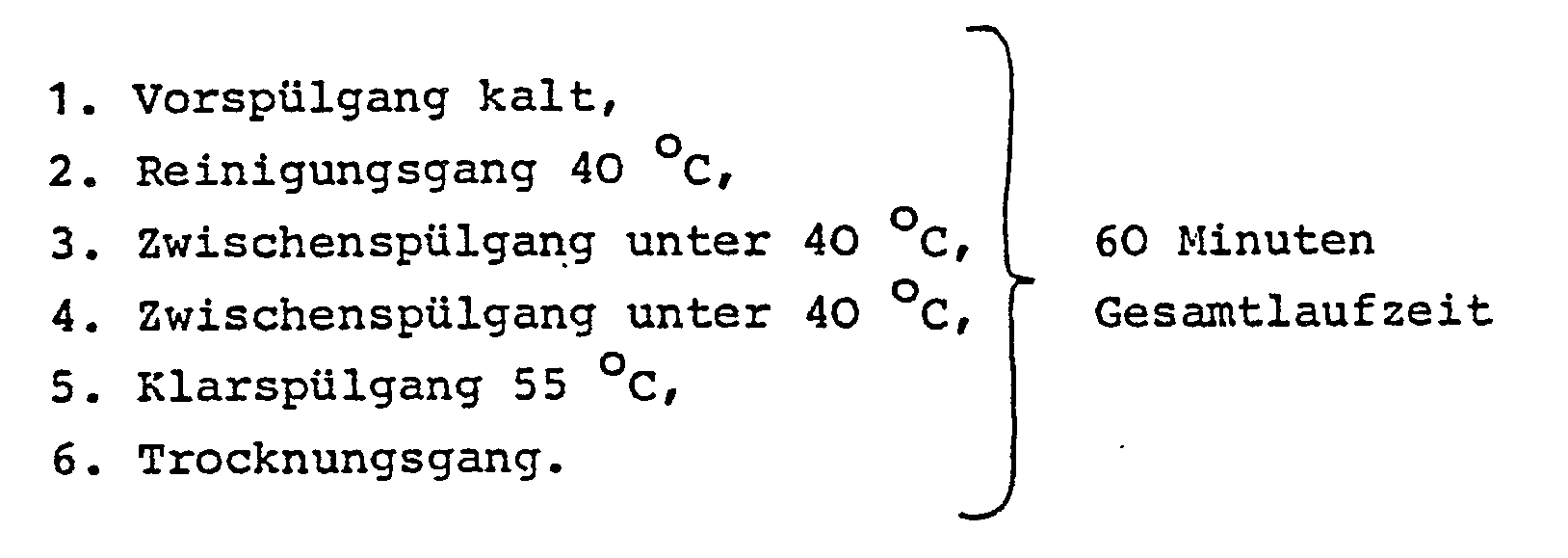
- Im Reinigungsgang wurden 30 g Reinigungsmittel, entsprechend 5 g/l Flotte, eingesetzt. Im Klarspülgang wurde kein Klarspüler zudosiert, um die Reinigungsergebnisse nicht zu verfälschen. Nach Beendigung des gesamten Programms erfolgte jeweils die visuelle Beurteilung des Reinigungsvermögens der eingesetzten Reinigungsmittel. Die einzelnen Bewertungen erfolgten nach einem Punktsystem, das von 0 bis 10 reichte, wobei 0 Punkte "ohne erkennbare Reinigungswirkung" und 10 Punkte "restlose Beseitigung der Testanschmutzungen" bedeutete. Es ergab sich hieraus eine Anzahl von Zwischenwerten, die eine differenzierte Aussage ermöglichten. Die Ergebnisse stellen Mittelwerte aus 4 Parallelbeurteilungen von 4 Testpersonen dar.
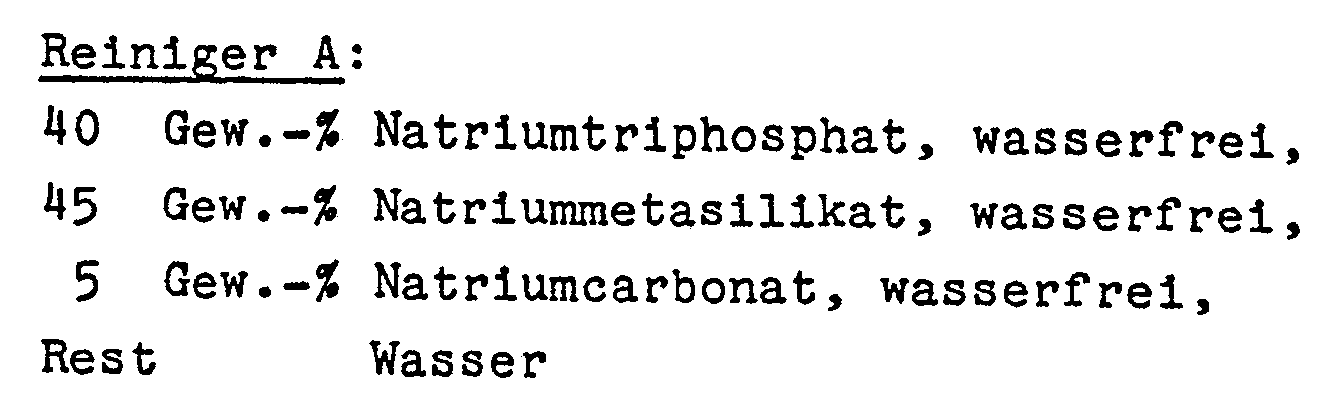
- Die Testanschmutzungen bestanden aus Haferflockenbrei und Stärke in Form von Kartoffelpürree, die auf Teller aufgebracht und abgekratzt wurden. Danach wurde das Geschirr 6 Stunden lang bei Raumtemperatur an der Luft stehengelassen und dann in die Geschirrspülmaschine eingebracht. Bei der Rindertalganschmutzung wurde wie folgt vorgegangen: 0,5 bis 0,8 g Rindertalg wurden bis zur Verflüssigung erwärmt und ca. 2 % Titandioxid eingerührt. Dann wurde die noch warme Masse mittels eines Pinsels gleichmäßig auf rote Kunststoffteller verstrichen. Zunächst wurde mit einem herkömmlichen Standardreinigungsmittel (A) gespült, das folgende Zusammensetzung aufwies:
- Es wurden weitere Reinigungsmittelzusammensetzungen unter Verwendung anderer anorganischer Komplexbildner, wie z. B. Natriumaluminiumsilikate vom Typ NaA oder NaX oder organischer Komplexbildner, wie z. B. des Na-Salzes der Nitrilotriessigsäure als Teil- bzw. Vollphosphatersatz mit in die Untersuchungen einbezogen. Diese Reiniger hatten folgende Zusammensetzungen;


- Die Reinigungsergebnisse sind der nachfolgenden Tabelle 1 zu entnehmen. Sie zeigt, daß der Einsatz von Reinigungsmitteln der vorstehend angegebenen konventionell variierten Rezepturen bei Reduzierung der Reinigungstemperatur um 25 °C zu erheblich verminderter Reinigungsleistung führt.

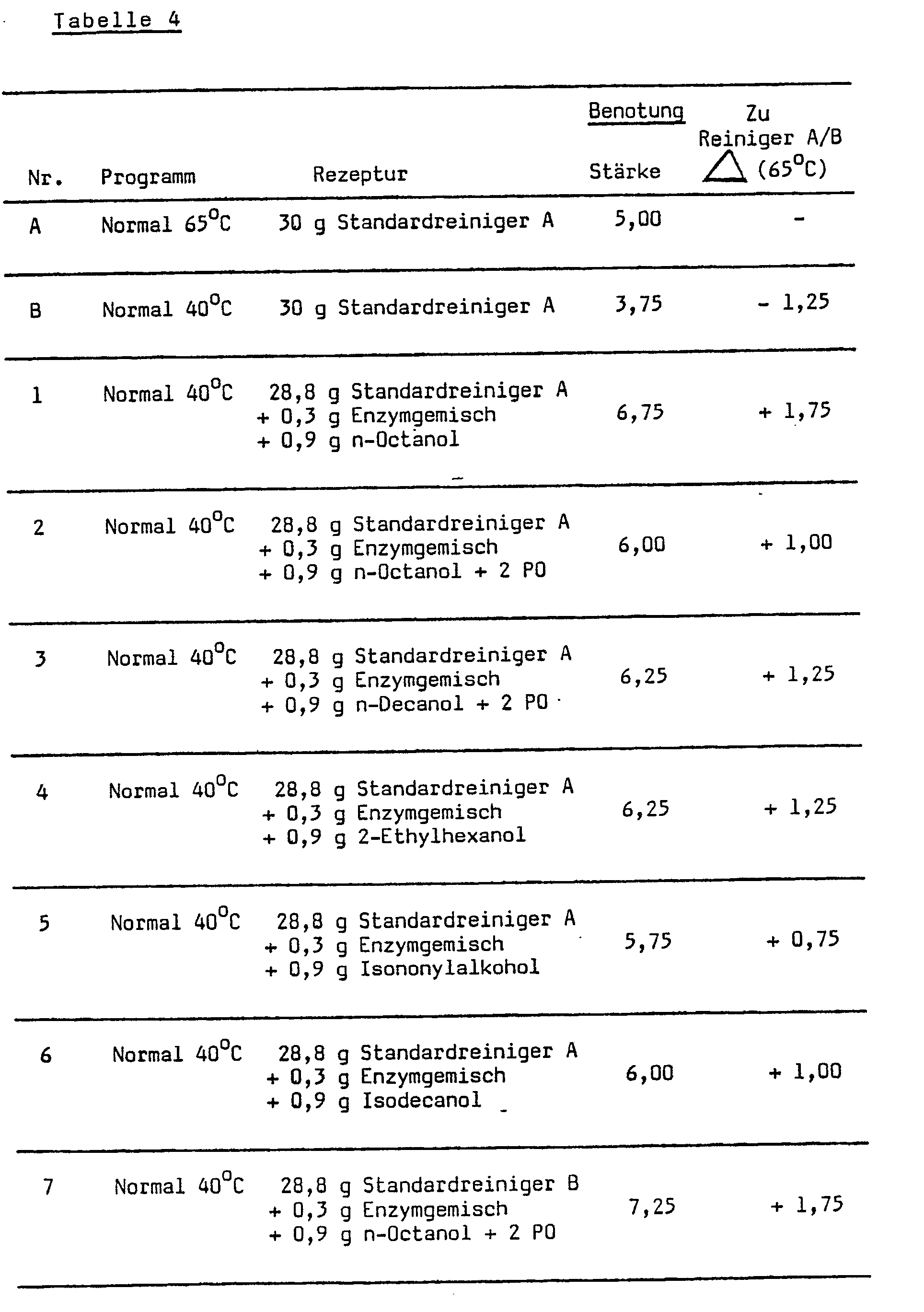
- Bei den nachfolgenden Beispielen wurden 4 Gew.-%, entsprechend 1,2 g, des Natriummetasilikats der Standardrezeptur A durch 1 Gew.-%, entsprechend 0,3 g, eines 1 : 1 Gemisches aus Amylase und Protease (Maxamyl (R)bzw. Maxatase (R) der Firma Koninklijke Nederlandsche Gist en Spiritus-Fabriek N.V., Delft) und 3 Gew.-%, entsprechend 0,9 g, der in der vorliegenden Tabelle angegebenen Verbindungen ersetzt.



Claims (2)
- Geschirreinigungsmittel auf Basis von polymeren Alkaliphosphaten und/oder deren Austauschstoffen, Alkalisilikaten, Alkalicarbonaten sowie gegebenenfalls Aktivsauerstoff abspaltenden Verbindungen und schwach schäumenden nichtionischen Tensiden, dadurch gekennzeichnet, daß sie Enzyme und primäre, gerad- oder verzweigtkettige C₈-C₁₀-Alkanole, die gegebenenfalls propoxyliert sein können, enthalten.
- Mittel nach Anspruch 1, dadurch gekennzeichnet, daß sie aus einer Kombination aus0 bis 50, vorzugsweise 10 bis 40 Gew.-% eines polymeren Alkaliphosphates aus der Gruppe der Alkalidiphosphate und Alkalitriphosphate,0 bis 60, vorzugsweise 5 bis 50 Gew.-% an wasserunlöslichen, komplexbildenden Zeolithen vom Typ NaA oder NaX bzw. deren Gemischen oder wasserlöslichen organischen Komplexierungsmittel für Calcium, wobei wenigstens eine dieser Verbindungen oder eines der polymeren Alkaliphosphate anwesend sein muß,10 bis 60, vorzugsweise 20 bis 50 Gew.-% Alkalimetasilikat,2 bis 40, vorzugsweise 5 bis 30 Gew.-% Natriumcarbonat,0 bis 20, vorzugsweise 5 bis 20 Gew.-% Natriumhydrogencarbonat,1 bis 20, vorzugsweise 1 bis 15 Gew.-% Wasserglas,0,1 bis 5, vorzugsweise 0,5 bis 3 Gew.-% eines Enzyms oder Enzymgemisches aus der Gruppe der Hydrolasen, vorzugsweise Amylasen, Proteasen und Lipasen,0,1 bis 10, vorzugsweise 0,5 bis 5 Gew.-% an primären, gerad- oder verzweigtkettigen C₈-C₁₀-Alkanolen, die gegebenenfalls noch mit 1 - 2 Mol Propylenoxid pro Mol Alkanol propoxyliert sein können,0 bis 10, vorzugsweise 0,5 bis 5 Gew.-% an aktivsauerstoffabspaltenden Verbindungen, gegebenenfalls auch Aktivatoren für diese, und0 bis 5, vorzugsweise 0,5 bis 2 Gew.-% eines schwachschäumenden nichtionogenen Tensids aus der Gruppe der Alkylenoxidaddukte an C₁₂-C₁₈-Alkanole, Nonylphenol oder an Polypropylenglykole der Molgewichte 900 bis 4 000 bestehen.
Priority Applications (1)
| Application Number | Priority Date | Filing Date | Title |
|---|---|---|---|
| AT85109465T ATE61398T1 (de) | 1984-08-04 | 1985-07-27 | Geschirreinigungsmittel. |
Applications Claiming Priority (2)
| Application Number | Priority Date | Filing Date | Title |
|---|---|---|---|
| DE3428834 | 1984-08-04 | ||
| DE19843428834 DE3428834A1 (de) | 1984-08-04 | 1984-08-04 | Geschirreinigungsmittel |
Publications (3)
| Publication Number | Publication Date |
|---|---|
| EP0171007A2 EP0171007A2 (de) | 1986-02-12 |
| EP0171007A3 EP0171007A3 (en) | 1989-05-03 |
| EP0171007B1 true EP0171007B1 (de) | 1991-03-06 |
Family
ID=6242387
Family Applications (1)
| Application Number | Title | Priority Date | Filing Date |
|---|---|---|---|
| EP85109465A Expired - Lifetime EP0171007B1 (de) | 1984-08-04 | 1985-07-27 | Geschirreinigungsmittel |
Country Status (4)
| Country | Link |
|---|---|
| US (1) | US4692260A (de) |
| EP (1) | EP0171007B1 (de) |
| AT (1) | ATE61398T1 (de) |
| DE (2) | DE3428834A1 (de) |
Cited By (9)
| Publication number | Priority date | Publication date | Assignee | Title |
|---|---|---|---|---|
| WO2014200658A1 (en) | 2013-06-13 | 2014-12-18 | Danisco Us Inc. | Alpha-amylase from promicromonospora vindobonensis |
| WO2014200656A1 (en) | 2013-06-13 | 2014-12-18 | Danisco Us Inc. | Alpha-amylase from streptomyces umbrinus |
| WO2014200657A1 (en) | 2013-06-13 | 2014-12-18 | Danisco Us Inc. | Alpha-amylase from streptomyces xiamenensis |
| WO2014204596A1 (en) | 2013-06-17 | 2014-12-24 | Danisco Us Inc. | Alpha-amylase from bacillaceae family member |
| WO2015050724A1 (en) | 2013-10-03 | 2015-04-09 | Danisco Us Inc. | Alpha-amylases from a subset of exiguobacterium, and methods of use, thereof |
| WO2015050723A1 (en) | 2013-10-03 | 2015-04-09 | Danisco Us Inc. | Alpha-amylases from exiguobacterium, and methods of use, thereof |
| WO2015077126A1 (en) | 2013-11-20 | 2015-05-28 | Danisco Us Inc. | Variant alpha-amylases having reduced susceptibility to protease cleavage, and methods of use, thereof |
| WO2017173324A2 (en) | 2016-04-01 | 2017-10-05 | Danisco Us Inc. | Alpha-amylases, compositions & methods |
| WO2017173190A2 (en) | 2016-04-01 | 2017-10-05 | Danisco Us Inc. | Alpha-amylases, compositions & methods |
Families Citing this family (18)
| Publication number | Priority date | Publication date | Assignee | Title |
|---|---|---|---|---|
| CA1334389C (en) * | 1986-03-26 | 1995-02-14 | Ernest H. Brumbaugh | Machine dishwasher water spot control composition |
| GB8619045D0 (en) * | 1986-08-05 | 1986-09-17 | Ici Plc | Dishwashing compositions |
| GB8629538D0 (en) † | 1986-12-10 | 1987-01-21 | Unilever Plc | Enzymatic dishwashing & rinsing composition |
| GB8727659D0 (en) * | 1987-11-26 | 1987-12-31 | Unilever Plc | Machine dishwashing compositions |
| US5269960A (en) * | 1988-09-25 | 1993-12-14 | The Clorox Company | Stable liquid aqueous enzyme detergent |
| EP0518720B1 (de) * | 1991-05-31 | 1995-09-06 | Colgate-Palmolive Company | Enzyme enthaltenes nichtwässriges flüssiges Maschinengeschirrspülmittel |
| AU655274B2 (en) * | 1991-05-31 | 1994-12-15 | Colgate-Palmolive Company, The | Nonaqueous liquid, phosphate-free, improved automatic dishwashing composition containing enzymes |
| US5256327A (en) * | 1991-08-01 | 1993-10-26 | Shaklee Corporation | Method of preparing a sequestering agent for a non-phosphate cleaning composition |
| US5429765A (en) * | 1993-04-29 | 1995-07-04 | Amway Corporation | Detergent and method for producing the same |
| TR28788A (tr) | 1993-05-25 | 1997-03-25 | Henkel Ecolab Gmbh & Co Ohg | Makinayla bulasik temizlemege mahsus usul ve tertibat. |
| DE4416303A1 (de) * | 1994-05-09 | 1995-11-16 | Bayer Ag | Schaumarmes Netzmittel und seine Verwendung |
| US5861366A (en) * | 1994-08-31 | 1999-01-19 | Ecolab Inc. | Proteolytic enzyme cleaner |
| US5876514A (en) * | 1997-01-23 | 1999-03-02 | Ecolab Inc. | Warewashing system containing nonionic surfactant that performs both a cleaning and sheeting function and a method of warewashing |
| US7415983B2 (en) * | 2003-12-18 | 2008-08-26 | Ecolab Inc. | Method of cleaning articles in a dish machine using an acidic detergent |
| WO2007123271A2 (en) * | 2006-04-21 | 2007-11-01 | Kao Corporation | Composition of biofilm control agent |
| JP5322400B2 (ja) * | 2006-04-21 | 2013-10-23 | 花王株式会社 | バイオフィルム制御剤組成物 |
| GB201105397D0 (en) * | 2011-03-31 | 2011-05-11 | Reckitt Benckiser Nv | Detergent composition |
| EP3399013B1 (de) * | 2017-05-05 | 2022-08-03 | The Procter & Gamble Company | Waschmittelzusammensetzungen mit verbesserter entfernung von fett |
Family Cites Families (14)
| Publication number | Priority date | Publication date | Assignee | Title |
|---|---|---|---|---|
| US2882244A (en) * | 1953-12-24 | 1959-04-14 | Union Carbide Corp | Molecular sieve adsorbents |
| US2882243A (en) * | 1953-12-24 | 1959-04-14 | Union Carbide Corp | Molecular sieve adsorbents |
| US3557002A (en) * | 1967-11-15 | 1971-01-19 | Procter & Gamble | Stabilized aqueous enzyme preparation |
| DE1767567A1 (de) * | 1968-05-24 | 1971-09-09 | Henkel & Cie Gmbh | Geschirrspuelmittel |
| US3882038A (en) * | 1968-06-07 | 1975-05-06 | Union Carbide Corp | Cleaner compositions |
| DE2062465B2 (de) * | 1970-12-18 | 1976-11-25 | Henkel & Cie GmbH, 4000 Düsseldorf | Geschirrspuelmittel |
| US3925224A (en) * | 1973-04-17 | 1975-12-09 | Church & Dwight Co Inc | Detergent additive composition |
| AR208392A1 (es) * | 1973-05-07 | 1976-12-27 | Henkel & Cie Gmbh | Composicion para lavar blanquear o limpiar materiales resistentes especialmente textiles adicional a la patente no 201687 adicional a la no 253286 |
| US4056355A (en) * | 1974-12-23 | 1977-11-01 | Texaco Inc. | Detergent formulations and their use |
| US4101457A (en) * | 1975-11-28 | 1978-07-18 | The Procter & Gamble Company | Enzyme-containing automatic dishwashing composition |
| DE2918826A1 (de) * | 1979-05-10 | 1980-11-27 | Basf Ag | Verwendung von alkoxylierten alkoholen als biologisch abbaubare, schaumarme tenside in wasch- und reinigungsmitteln |
| CH651314A5 (fr) * | 1981-12-23 | 1985-09-13 | Colgate Palmolive Co | Composition detergente pour lave-vaisselle. |
| SE450835B (sv) * | 1983-05-03 | 1987-08-03 | Eka Nobel Ab | Maskindiskmedelskomposition |
| GB8321923D0 (en) * | 1983-08-15 | 1983-09-14 | Unilever Plc | Machine-dishwashing compositions |
-
1984
- 1984-08-04 DE DE19843428834 patent/DE3428834A1/de not_active Withdrawn
-
1985
- 1985-07-19 US US06/757,039 patent/US4692260A/en not_active Expired - Fee Related
- 1985-07-27 AT AT85109465T patent/ATE61398T1/de not_active IP Right Cessation
- 1985-07-27 DE DE8585109465T patent/DE3581978D1/de not_active Expired - Fee Related
- 1985-07-27 EP EP85109465A patent/EP0171007B1/de not_active Expired - Lifetime
Cited By (9)
| Publication number | Priority date | Publication date | Assignee | Title |
|---|---|---|---|---|
| WO2014200658A1 (en) | 2013-06-13 | 2014-12-18 | Danisco Us Inc. | Alpha-amylase from promicromonospora vindobonensis |
| WO2014200656A1 (en) | 2013-06-13 | 2014-12-18 | Danisco Us Inc. | Alpha-amylase from streptomyces umbrinus |
| WO2014200657A1 (en) | 2013-06-13 | 2014-12-18 | Danisco Us Inc. | Alpha-amylase from streptomyces xiamenensis |
| WO2014204596A1 (en) | 2013-06-17 | 2014-12-24 | Danisco Us Inc. | Alpha-amylase from bacillaceae family member |
| WO2015050724A1 (en) | 2013-10-03 | 2015-04-09 | Danisco Us Inc. | Alpha-amylases from a subset of exiguobacterium, and methods of use, thereof |
| WO2015050723A1 (en) | 2013-10-03 | 2015-04-09 | Danisco Us Inc. | Alpha-amylases from exiguobacterium, and methods of use, thereof |
| WO2015077126A1 (en) | 2013-11-20 | 2015-05-28 | Danisco Us Inc. | Variant alpha-amylases having reduced susceptibility to protease cleavage, and methods of use, thereof |
| WO2017173324A2 (en) | 2016-04-01 | 2017-10-05 | Danisco Us Inc. | Alpha-amylases, compositions & methods |
| WO2017173190A2 (en) | 2016-04-01 | 2017-10-05 | Danisco Us Inc. | Alpha-amylases, compositions & methods |
Also Published As
| Publication number | Publication date |
|---|---|
| US4692260A (en) | 1987-09-08 |
| DE3581978D1 (de) | 1991-04-11 |
| DE3428834A1 (de) | 1986-02-13 |
| ATE61398T1 (de) | 1991-03-15 |
| EP0171007A3 (en) | 1989-05-03 |
| EP0171007A2 (de) | 1986-02-12 |
Similar Documents
| Publication | Publication Date | Title |
|---|---|---|
| EP0171007A2 (de) | Geschirreinigungsmittel | |
| DE68925560T2 (de) | Enzymhaltige Detergenszusammensetzung | |
| DE4232170C2 (de) | Schwachalkalische Geschirreinigungsmittel | |
| DE2038103A1 (de) | Waessrige Reinigungsmittelkonzentrate mit einem Gehalt an stabilisierten Enzymen | |
| DE69433032T2 (de) | VERFLÜSSIGENDE -[alpha]-AMYLASE, VERFAHREN ZU IHRER HERSTELLUNG, UND SIE ENTHALTENDE WASCHMITTELZUSAMMENSETZUNG | |
| EP0416366B1 (de) | Schichtsilikate enthaltendes Geschirrspülmittel | |
| EP0530635B1 (de) | Neutrales maschinelles Geschirrspülmittel | |
| DE102007029643A1 (de) | Reinigungsmittel | |
| EP1000136B1 (de) | Glucanasehaltiges reinigungsmittel für harte oberflächen | |
| DE2101508A1 (de) | Geschirrspülmittel | |
| EP0239379A2 (de) | Geschirrspülmittel mit Wasserfleckenkontrolle | |
| DE2062465A1 (en) | Scouring agent - for dish washing machines, contg aminopolycarboxylic acid and alkali silicate | |
| EP0171006B1 (de) | Geschirreinigungsmittel | |
| EP0171008B1 (de) | Geschirreinigungsmittel | |
| DE2435479A1 (de) | Geschirrspuelmittel | |
| DE2153460A1 (de) | Geschirrspuelmittel | |
| US6362150B1 (en) | Detergent composition in the form of a solid detergent containing surfactant and bleaching peroxide | |
| DE1767567A1 (de) | Geschirrspuelmittel | |
| WO1996012783A1 (de) | Kristalline schichtsilikate in maschinellen geschirrspülmitteln | |
| EP0569365B1 (de) | Phosphatfreies reinigungsmittel | |
| DE2149251C3 (de) | Geschirrspulmittel | |
| DE2259201A1 (de) | Mittelalkalische enzymatische reinigungsmittel | |
| EP0256679A1 (de) | Geschirrwaschmittel-Zusammensetzungen | |
| DE4036695C2 (de) | Verwendung von beta-Alaninderivaten als Gerüstsubstanzen in phosphatfreien Mitteln für das maschinelle Geschirrspülen | |
| EP0846155B1 (de) | Verwendung von lipasen in niederalkalischen mitteln zum maschinellen geschirrspülen |
Legal Events
| Date | Code | Title | Description |
|---|---|---|---|
| PUAI | Public reference made under article 153(3) epc to a published international application that has entered the european phase |
Free format text: ORIGINAL CODE: 0009012 |
|
| AK | Designated contracting states |
Designated state(s): AT BE CH DE FR GB IT LI NL |
|
| PUAL | Search report despatched |
Free format text: ORIGINAL CODE: 0009013 |
|
| AK | Designated contracting states |
Kind code of ref document: A3 Designated state(s): AT BE CH DE FR GB IT LI NL |
|
| RHK1 | Main classification (correction) |
Ipc: C11D 3/386 |
|
| 17P | Request for examination filed |
Effective date: 19891023 |
|
| 17Q | First examination report despatched |
Effective date: 19900405 |
|
| GRAA | (expected) grant |
Free format text: ORIGINAL CODE: 0009210 |
|
| AK | Designated contracting states |
Kind code of ref document: B1 Designated state(s): AT BE CH DE FR GB IT LI NL |
|
| PG25 | Lapsed in a contracting state [announced via postgrant information from national office to epo] |
Ref country code: NL Effective date: 19910306 Ref country code: IT Free format text: LAPSE BECAUSE OF FAILURE TO SUBMIT A TRANSLATION OF THE DESCRIPTION OR TO PAY THE FEE WITHIN THE PRESCRIBED TIME-LIMIT;WARNING: LAPSES OF ITALIAN PATENTS WITH EFFECTIVE DATE BEFORE 2007 MAY HAVE OCCURRED AT ANY TIME BEFORE 2007. THE CORRECT EFFECTIVE DATE MAY BE DIFFERENT FROM THE ONE RECORDED. Effective date: 19910306 Ref country code: GB Effective date: 19910306 Ref country code: FR Effective date: 19910306 Ref country code: BE Effective date: 19910306 |
|
| REF | Corresponds to: |
Ref document number: 61398 Country of ref document: AT Date of ref document: 19910315 Kind code of ref document: T |
|
| REF | Corresponds to: |
Ref document number: 3581978 Country of ref document: DE Date of ref document: 19910411 |
|
| EN | Fr: translation not filed | ||
| PG25 | Lapsed in a contracting state [announced via postgrant information from national office to epo] |
Ref country code: AT Effective date: 19910727 |
|
| PG25 | Lapsed in a contracting state [announced via postgrant information from national office to epo] |
Ref country code: LI Effective date: 19910731 Ref country code: CH Effective date: 19910731 |
|
| NLV1 | Nl: lapsed or annulled due to failure to fulfill the requirements of art. 29p and 29m of the patents act | ||
| GBV | Gb: ep patent (uk) treated as always having been void in accordance with gb section 77(7)/1977 [no translation filed] | ||
| PLBE | No opposition filed within time limit |
Free format text: ORIGINAL CODE: 0009261 |
|
| STAA | Information on the status of an ep patent application or granted ep patent |
Free format text: STATUS: NO OPPOSITION FILED WITHIN TIME LIMIT |
|
| 26N | No opposition filed | ||
| REG | Reference to a national code |
Ref country code: CH Ref legal event code: PL |
|
| PG25 | Lapsed in a contracting state [announced via postgrant information from national office to epo] |
Ref country code: DE Effective date: 19920401 |