EP0166901A2 - Verfahren zur Herstellung von D,L-Carnitinamidchlorid - Google Patents
Verfahren zur Herstellung von D,L-Carnitinamidchlorid Download PDFInfo
- Publication number
- EP0166901A2 EP0166901A2 EP85105309A EP85105309A EP0166901A2 EP 0166901 A2 EP0166901 A2 EP 0166901A2 EP 85105309 A EP85105309 A EP 85105309A EP 85105309 A EP85105309 A EP 85105309A EP 0166901 A2 EP0166901 A2 EP 0166901A2
- Authority
- EP
- European Patent Office
- Prior art keywords
- chloride
- reaction
- carnitine
- preparation
- temperature
- Prior art date
- Legal status (The legal status is an assumption and is not a legal conclusion. Google has not performed a legal analysis and makes no representation as to the accuracy of the status listed.)
- Granted
Links
Classifications
-
- C—CHEMISTRY; METALLURGY
- C07—ORGANIC CHEMISTRY
- C07C—ACYCLIC OR CARBOCYCLIC COMPOUNDS
- C07C231/00—Preparation of carboxylic acid amides
- C07C231/06—Preparation of carboxylic acid amides from nitriles by transformation of cyano groups into carboxamide groups
-
- C—CHEMISTRY; METALLURGY
- C07—ORGANIC CHEMISTRY
- C07C—ACYCLIC OR CARBOCYCLIC COMPOUNDS
- C07C237/00—Carboxylic acid amides, the carbon skeleton of the acid part being further substituted by amino groups
Definitions
- the invention relates to a new process for the preparation of D, L-carnitine amide chloride in high purity and good yield.
- L-carnitine amide chloride is an important intermediate for the production of L-carnitine amide and thus also for the production of L-carnitine (BE-PS 877 609). Both compounds, but especially L-carnitine, are of great therapeutic importance (Römpps Lexikon der Chemie, 8th ed., P. 607).
- D, L-carnitinamide chloride can be prepared in an advantageous manner if, in a first reaction step, 2,3-epoxypropyltrimethylammonium chloride in aqueous solution with 0.8 to 2.0 hydrocyanic acid at a pH above 7 and at a temperature between 0 20 and 100 C and the resulting nitrile treated without intermediate isolation in the reaction solution with 1.5 to 5 equivalents of aqueous hydrogen peroxide at a temperature between 30 and 100 C and the reaction product isolated in a manner known per se.
- the reaction takes place in aqueous solution.
- the starting product of the synthesis is 2,3-epoxypropyltrimethylammonium chloride, which does not necessarily have to be manufactured according to McClure. It is even preferable to start from an epoxy compound which has been prepared by the process according to DE-OS 31 03 713.
- the reaction is carried out using hydrocyanic acid. Pure hydrocyanic acid or an aqueous hydrocyanic acid with a content of 1 to 100% hydrocyanic acid can be used.
- the reaction takes place at a pH above 7. If one starts from an epoxy compound which has been prepared according to DE-OS 31 03 713, a pH value above 8, generally between 9.5 to 12, is established. If necessary, the pH can be adjusted by adding a small amount of a base.
- the temperature at which the reaction is carried out is not critical. It should only be chosen so that good sales can be achieved. A reaction temperature above 20 C is usually sufficient for this. The preferred temperature range is between +20 and 100 C.
- a ratio of epoxy compound: hydrocyanic acid such as 1: 0.8 to 2, preferably 1: 0.95 to 1.25, is usually maintained.
- Another essential feature of the invention is that the nitrile chloride formed in aqueous solution is not isolated, but is processed directly. For this, hydrogen peroxide is added.
- An aqueous solution of hydrogen peroxide of between 3 and 90% by weight is usually used, preferably between 20 and 90% by weight.
- excess amounts of hydrogen peroxide are usually used, based on the nitrile used.
- 1.5 to 5 equivalents of hydrogen peroxide based on nitrile are used. It is preferred to use 2 to 3.5 equivalents.
- the temperature is not critical for the second stage of the reaction, it should be chosen so that good conversions are achieved but there is still no further reaction to other secondary products, such as carnitine. Temperatures between 30 and 100 ° C. are usually chosen, preferably between 40 and 80 ° C. The end of the reaction can be easily recognized, for example, by the fact that gas formation during the reaction has ended.
- the D, L-carnitinamide chloride thus prepared in solution is isolated in a manner known per se. Because of the very high solubility of D, L-carnitinamide chloride in water, water is usually largely evaporated first and then the D, L-carnitinamide chloride is precipitated by adding an organic solvent. For example, methanol, ethanol, propanols, butanols or other alcohols or acetone or other ketones can be used for this. But it can also, for. B. the entire aqueous solution by spray crystallization in D, L-carnitine amide chloride.
Landscapes
- Chemical & Material Sciences (AREA)
- Organic Chemistry (AREA)
- Organic Low-Molecular-Weight Compounds And Preparation Thereof (AREA)
- Pharmaceuticals Containing Other Organic And Inorganic Compounds (AREA)
- Compounds Of Alkaline-Earth Elements, Aluminum Or Rare-Earth Metals (AREA)
- Manufacture And Refinement Of Metals (AREA)
Abstract
Description
- Die Erfindung betrifft ein neues Verfahren zur Herstellung von D,L-Carnitinamidchlorid in hoher Reinheit und guter Ausbeute.
- D,L-Carnitinamidchlorid entspricht der Strukturformel (I).
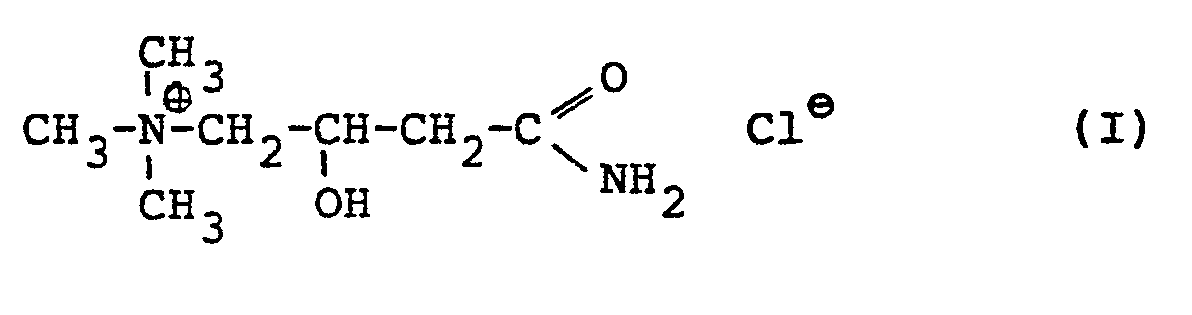
- Es ist das D,L-α-trimethylammonium-ß-hydroxybutyramid- chlorid.
- D,L-Carnitinamidchlorid ist ein wichtiges Zwischenprodukt für die Herstellung von L-Carnitinamid und damit auch zur Herstellung von L-Carnitin (BE-PS 877 609). Beide Verbindungen, insbesondere aber das L-Carnitin, besitzen eine große therapeutische Bedeutung (Römpps Lexikon der Chemie, 8. Aufl., S. 607).
- Es ist bekannt, das D,L-Carnitinamidchlorid durch Hydrolyse von isoliertem Carnitinnitril in konzentrierter Salzsäure und anschließender Fällung aus großen Mengen Isopropanol und Aceton herzustellen. Die Reaktionszeiten betragen dabei mehr als 46 Stunden. Außerdem besteht durch die Gegenwart einer konzentrierten Säure die Gefahr einer Weiterreaktion zu dem an dieser Stelle unerwünschten Carnitin. Aus diesen Gründen hat dieses Verfahren keinen Eingang in die Technik gefunden (BE-PS 659 194).
- Es ist weiter bekannt, das Amid durch Umsetzung des Ethylesters von Carnitinchlorid mit Ammoniaklösung in einer 40-stündigen Reaktion herzustellen. Auch dieses Verfahren hat keinen Eingang in die Technik gefunden (Takeda Kenkyusho Nempo 22, 13 - 18 (1963) ).
- Außerdem ist es bekannt, bei der Herstellung des D,L-Carnitinamidchlorids von isoliertem Carnitinnitril auszugehen und beispielsweise mit doppelt äquivalenten Mengen Ammoniak und Wasserstoffperoxid in einer 20-stündigen Reaktion umzusetzen. Auch dieses Verfahren hat keinen Eingang in die Technik gefunden, da die dabei zu verwendenden großen Mengen an Base zu Schwierigkeiten bei der Isolierung des Carnitinamids führten, wenn eine Salzbildung durch Neutralisation mit Säure notwendig wurde. Außerdem entstanden Umweltprobleme bei der Eindampfung der Lösung. Weiter standen die langen Reaktionszeiten und die Notwendigkeit, ein isoliertes Nitril einzusetzen, der Überführung in den technischen Maßstab im Wege (JP-PS 38 - 23 (63) ).
- Schließlich ist noch die Umsetzung von 2,3-Epoxypropyltrimethylammoniumchlorid mit einer Cyanoverbindung zum entsprechenden Nitril bekannt, wobei aber zur Erzielung guter Ergebnisse von einer Epoxidverbindung ausgegangen werden muß, die nach McClure in einem organischen Medium hergestellt worden ist (US-Pat. 4 070 394) McClure, J. Org. Chem. 35, 2059 (1970). Die Herstellung des Carnitinamidchlorids wird in dieser Patentschrift nicht beschrieben.
- Es bestand daher ein dringendes Bedürfnis nach einem technisch gut durchführbaren und wirtschaftlich interessanten Verfahren zur Herstellung von D,L-Carnitinamid- chlorid.
- Es wurde nun gefunden, daß man D,L-Carnitinamidchlorid in vorteilhafter Weise herstellen kann, wenn man in einer ersten Reaktionsstufe 2,3-Epoxypropyltrimethylammoniumchlorid in wäßriger Lösung mit 0,8 bis 2,0 Blausäure bei einem pH-Wert oberhalb 7 und bei einer Temperatur zwischen 0 20 und 100 C umsetzt und das entstandene Nitril ohne Zwischenisolierung in der Reaktionslösung mit 1,5 bis 5 Äquivalenten wäßrigem Wasserstoffperoxid bei einer Tem-0 peratur zwischen 30 und 100 C behandelt und das Reaktionsprodukt in ansich bekannter Weise isoliert.
- Eine wesentliche Bedingung bei der Durchführung des Verfahrens ist, daß die Reaktion in wäßriger Lösung erfolgt. Ausgangsprodukt der Synthese ist das 2,3-Epoxypropyltrimethylammoniumchlorid, welches aber nicht notwendigerweise nach McClure hergestellt sein muß. Vorzugsweise geht man sogar von einer Epoxyverbindung aus, die nach dem Verfahren gemäß DE-OS 31 03 713 hergestellt worden ist. Die Umsetzung erfolgt erfindungsgemäß mit Blausäure. Dabei kann reine Blausäure oder eine wäßrige Blausäure mit Gehalten von 1 bis 100 % Blausäure verwendet werden. Die Umsetzung läuft bei einem pH-Wert oberhalb 7 ab. Geht man von einer Epoxyverbindung aus, die gemäß der DE-OS 31 03 713 hergestellt worden ist, so stellt sich ein pH-Wert oberhalb von 8, im allgemeinen zwischen 9,5 bis 12, ein. Im Bedarfsfalle kann der pH-Wert durch Zugabe einer geringfügigen Menge einer Base eingestellt werden.
- Die Temperatur, bei der die Reaktion durchgeführt wird, ist nicht kritisch. Sie sollte nur so gewählt werden, daß gute Umsätze erreichbar sind. Üblicherweise reicht dazu 0 eine Reaktionstemperatur oberhalb von 20 C aus. Der bevor-0 zugte Temperaturbereich liegt etwa zwischen +20 und 100 C.
- Obgleich das Molverhältnis zwischen Epoxyverbindung und Blausäure frei gewählt werden kann, wird üblicherweise ein Verhältnis von Epoxyverbindung : Blausäure wie 1 : 0,8 bis 2, bevorzugt von 1 : 0,95 bis 1,25, eingehalten.
- Ein weiteres wesentliches Merkmal der Erfindung ist, daß das in wäßriger Lösung entstandene Nitrilchlorid nicht isoliert, sondern direkt weiterverarbeitet wird. Dazu wird Wasserstoffperoxid zugegeben. Üblicherweise wird eine wäßrige Lösung von Wasserstoffperoxid zwischen 3 bis 90 Gew.-% verwendet, bevorzugt zwischen 20 bis 90 Gew.-%.
- Bei dem erfindungsgemäßen Verfahren werden üblicherweise, bezogen auf das eingesetzte Nitril, überschüssige Mengen Wasserstoffperoxid eingesetzt. Beispielsweise werden 1,5 bis 5 Äquivalente Wasserstoffperoxid bezogen auf Nitril verwendet. Bevorzugt setzt man 2 bis 3,5 Äquivalente ein.
- Obwohl die Temperatur für die zweite Stufe der Reaktion nicht kritisch ist, sollte sie so gewählt werden, daß gute Umsätze erreicht werden, aber doch noch keine Weiterreaktion zu anderen Folgeprodukten, wie beispielsweise Carnitin, erfolgt. So werden üblicherweise Temperaturen zwischen 30 und 100 C gewählt, bevorzugt zwischen 40 und 80 C. Das Ende der Umsetzung ist beispielsweise leicht daran zu erkennen, daß eine bei der Reaktion vorhandene Gasbildung beendet ist.
- Die Isolierung des so in Lösung hergestellten D,L-Carni- tinamidchlorids geschieht in an sich bekannter Weise. Wegen der in Wasser sehr hohen Löslichkeit des D,L-Carni- tinamidchlorids wird üblicherweise zunächst weitgehend Wasser abgedampft und dann das D,L-Carnitinamidchlorid durch Zugabe eines organischen Lösungsmittels ausgefällt. Beispielsweise können hierfür Methanol, Ethanol, Propanole, Butanole oder andere Alkohole oder Aceton oder andere Ketone verwendet werden. Es kann aber auch z. B. die gesamte wäßrige Lösung durch Sprühkristallisation in D,L-Carnitinamidchlorid überführt werden.
- Zu 253 g einer 59,8 %igen (1,0 Mol) Lösung von 2,3-Epoxytrimethylammoniumchlorid, das nach dem Verfahren gemäß DE-OS 31 03 713 hergestellt worden war und einen pH-Wert von 11 aufzeigt, werden in einer Rührapparatur bei einer 0 Temperatur von 50 C 27,8 g (1,03 Mol) wasserfreier Blausäure während einer Stunde zudosiert. Nach einer weiteren Stunde Nachreaktion werden ohne weitere Maßnahme bei derselben Temperatur in die entstandene Lösung 111,7 g 70 %iges Wasserstoffperoxid (2,3 Mol) während etwa 3 Stun- den eindosiert und weitere 3 Stunden bei 50° C nachreagiert. Danach werden bei etwa 70 mbar 110 g Wasser abdestilliert und der entstandene Sirup mit 300 ml Ethanol versetzt und ausgerührt. Nach Abkühlung auf O C wird die entstandene Suspension abgesaugt und der erhaltene Feststoff getrocknet. Nach dem Trocknen erhält man 178,5 g (91 % bezogen auf eingesetztes Epoxid) eines blütenweißen Feststoffes 0 vom Schmelzpunkt 210 C.
- Die Elementaranalyse zeigt folgende Ergebnisse:

Claims (1)
- Verfahren zur Herstellung von D,L-Carnitinamidchlorid (I),

dadurch gekennzeichnet,
daß man in einer ersten Reaktionsstufe 2,3-Epoxytrimethylammoniumchlorid in wäßriger Lösung mit 0,8 bis 2,0 Äquivalenten Blausäure bei einem pH-Wert oberhalb 7 und bei 0 einer Temperatur zwischen 20 und 100 C umsetzt und das entstandene Nitril ohne Zwischenisolierung in der Reaktionslösung mit 1,5 bis 5 Äquivalenten wäßrigem Wasser- stoffperoxid bei einer Temperatur zwischen 30 und 100 C behandelt und das Reaktionsprodukt in ansich bekannter Weise isoliert.
Priority Applications (1)
| Application Number | Priority Date | Filing Date | Title |
|---|---|---|---|
| AT85105309T ATE44728T1 (de) | 1984-06-01 | 1985-05-02 | Verfahren zur herstellung von d,lcarnitinamidchlorid. |
Applications Claiming Priority (2)
| Application Number | Priority Date | Filing Date | Title |
|---|---|---|---|
| DE3420391 | 1984-06-01 | ||
| DE3420391A DE3420391C1 (de) | 1984-06-01 | 1984-06-01 | Verfahren zur Herstellung von D,L-Carnitinamidchlorid |
Publications (3)
| Publication Number | Publication Date |
|---|---|
| EP0166901A2 true EP0166901A2 (de) | 1986-01-08 |
| EP0166901A3 EP0166901A3 (en) | 1986-10-15 |
| EP0166901B1 EP0166901B1 (de) | 1989-07-19 |
Family
ID=6237339
Family Applications (1)
| Application Number | Title | Priority Date | Filing Date |
|---|---|---|---|
| EP85105309A Expired EP0166901B1 (de) | 1984-06-01 | 1985-05-02 | Verfahren zur Herstellung von D,L-Carnitinamidchlorid |
Country Status (5)
| Country | Link |
|---|---|
| EP (1) | EP0166901B1 (de) |
| JP (1) | JPS611649A (de) |
| AT (1) | ATE44728T1 (de) |
| DE (1) | DE3420391C1 (de) |
| ES (1) | ES8607202A1 (de) |
Cited By (1)
| Publication number | Priority date | Publication date | Assignee | Title |
|---|---|---|---|---|
| US7714166B2 (en) * | 2005-09-28 | 2010-05-11 | Mitsubishi Gas Chemical Company, Inc. | Process for producing carnitinamide |
Family Cites Families (2)
| Publication number | Priority date | Publication date | Assignee | Title |
|---|---|---|---|---|
| US4070394A (en) * | 1976-01-23 | 1978-01-24 | Ethyl Corporation | Carnitine nitrile halide preparation |
| CH648287A5 (de) * | 1981-01-21 | 1985-03-15 | Lonza Ag | Verfahren zur herstellung von carnitinamid. |
-
1984
- 1984-06-01 DE DE3420391A patent/DE3420391C1/de not_active Expired
-
1985
- 1985-05-02 AT AT85105309T patent/ATE44728T1/de not_active IP Right Cessation
- 1985-05-02 EP EP85105309A patent/EP0166901B1/de not_active Expired
- 1985-05-27 ES ES543529A patent/ES8607202A1/es not_active Expired
- 1985-05-30 JP JP60115554A patent/JPS611649A/ja active Granted
Cited By (1)
| Publication number | Priority date | Publication date | Assignee | Title |
|---|---|---|---|---|
| US7714166B2 (en) * | 2005-09-28 | 2010-05-11 | Mitsubishi Gas Chemical Company, Inc. | Process for producing carnitinamide |
Also Published As
| Publication number | Publication date |
|---|---|
| ES543529A0 (es) | 1986-06-01 |
| DE3420391C1 (de) | 1985-08-14 |
| JPS611649A (ja) | 1986-01-07 |
| ATE44728T1 (de) | 1989-08-15 |
| EP0166901A3 (en) | 1986-10-15 |
| ES8607202A1 (es) | 1986-06-01 |
| EP0166901B1 (de) | 1989-07-19 |
| JPH0468304B2 (de) | 1992-11-02 |
Similar Documents
| Publication | Publication Date | Title |
|---|---|---|
| DE4228084C1 (de) | Verfahren zur Herstellung von N-Acylderivaten der 5-Aminolävulinsäure sowie des Hydrochlorids der freien Säure | |
| DE2515629C3 (de) | 2"-N-substituierte Paromomycine, Verfahren zu ihrer Herstellung und diese Verbindungen enthaltende Arzneimittel | |
| DD142713A1 (de) | Verfahren zur herstellung von lysergol-derivaten | |
| DE1770510C3 (de) | Verfahren zur Herstellung von Triglycidyl-isocyanurat | |
| DE69401979T2 (de) | Verfahren zur Herstellung von L-(-)-Carnitin aus Abfallprodukten mit entgegengesetzter Konfiguration | |
| EP0166901B1 (de) | Verfahren zur Herstellung von D,L-Carnitinamidchlorid | |
| EP1268411A1 (de) | Verfahren zur herstellung von n-methyl-n'-nitroguanidin | |
| DE1793444C3 (de) | Verfahren zur Herstellung von 5-Methyl-4-hydroxy-23-dihydrofuranon- | |
| DE2519943B2 (de) | Verfahren zur herstellung von amiden der abietinsaeure, dehydro-, dihydro- bzw. tetrahydroabietinsaeure | |
| DE68910912T2 (de) | Herstellung von Pyridazinon. | |
| DE2245892B2 (de) | Verfahren zur Herstellung von Citronensäure | |
| DE3538746C2 (de) | ||
| EP0032374B1 (de) | Verfahren zur Herstellung von p-Hydroxyphenylessigsäure | |
| DE2065698C3 (de) | Verfahren zur Herstellung von 2-Isopropyl-6-methyl-4(3H)-pyrimidon | |
| EP0010165B1 (de) | Verfahren zur Herstellung von 6-Hydroxypyrid-2-onen | |
| DE3538747C2 (de) | ||
| DE3602180C2 (de) | ||
| EP0003052B1 (de) | Verfahren zur Herstellung von 4-Methyl-5-chlormethylimidazol | |
| EP0006140B1 (de) | Verfahren zur Herstellung von alpha-Hydroxycarbonsäureamiden | |
| EP0028375B1 (de) | Verfahren zur Herstellung von Phenylessigsäure und von deren einfachen Derivaten | |
| EP0548618B1 (de) | Verfahren zur Herstellung von 2-Aminobenzaldehyden | |
| EP0463466A2 (de) | Verfahren zur Herstellung sehr reiner 5-Aminosalicylsäure | |
| DE3102984A1 (de) | Verfahren zur herstellung von cysteamin-s-substituierten verbindungen und deren derivaten | |
| EP0037474B1 (de) | Verfahren zur Herstellung von 1-Acetoxy-3-chlor-pentan-4-on | |
| EP0027956A1 (de) | Verfahren zur Herstellung von (1-(4-Chlorbenzoyl)-5-methoxy-2-methyl-3-indol)acetoxyessigsäure |
Legal Events
| Date | Code | Title | Description |
|---|---|---|---|
| PUAI | Public reference made under article 153(3) epc to a published international application that has entered the european phase |
Free format text: ORIGINAL CODE: 0009012 |
|
| 17P | Request for examination filed |
Effective date: 19850502 |
|
| AK | Designated contracting states |
Designated state(s): AT BE CH DE FR GB IT LI NL SE |
|
| RBV | Designated contracting states (corrected) |
Designated state(s): AT BE CH FR GB IT LI NL SE |
|
| PUAL | Search report despatched |
Free format text: ORIGINAL CODE: 0009013 |
|
| AK | Designated contracting states |
Kind code of ref document: A3 Designated state(s): AT BE CH FR GB IT LI NL SE |
|
| 17Q | First examination report despatched |
Effective date: 19880520 |
|
| ITF | It: translation for a ep patent filed | ||
| GRAA | (expected) grant |
Free format text: ORIGINAL CODE: 0009210 |
|
| AK | Designated contracting states |
Kind code of ref document: B1 Designated state(s): AT BE CH FR GB IT LI NL SE |
|
| REF | Corresponds to: |
Ref document number: 44728 Country of ref document: AT Date of ref document: 19890815 Kind code of ref document: T |
|
| GBT | Gb: translation of ep patent filed (gb section 77(6)(a)/1977) | ||
| ET | Fr: translation filed | ||
| PGFP | Annual fee paid to national office [announced via postgrant information from national office to epo] |
Ref country code: SE Payment date: 19900425 Year of fee payment: 6 |
|
| PLBE | No opposition filed within time limit |
Free format text: ORIGINAL CODE: 0009261 |
|
| STAA | Information on the status of an ep patent application or granted ep patent |
Free format text: STATUS: NO OPPOSITION FILED WITHIN TIME LIMIT |
|
| 26N | No opposition filed | ||
| PG25 | Lapsed in a contracting state [announced via postgrant information from national office to epo] |
Ref country code: SE Effective date: 19910503 |
|
| ITTA | It: last paid annual fee | ||
| EUG | Se: european patent has lapsed |
Ref document number: 85105309.0 Effective date: 19911209 |
|
| PGFP | Annual fee paid to national office [announced via postgrant information from national office to epo] |
Ref country code: GB Payment date: 19980414 Year of fee payment: 14 |
|
| PGFP | Annual fee paid to national office [announced via postgrant information from national office to epo] |
Ref country code: FR Payment date: 19980417 Year of fee payment: 14 |
|
| PGFP | Annual fee paid to national office [announced via postgrant information from national office to epo] |
Ref country code: AT Payment date: 19980422 Year of fee payment: 14 |
|
| PGFP | Annual fee paid to national office [announced via postgrant information from national office to epo] |
Ref country code: BE Payment date: 19980427 Year of fee payment: 14 |
|
| PGFP | Annual fee paid to national office [announced via postgrant information from national office to epo] |
Ref country code: NL Payment date: 19980430 Year of fee payment: 14 Ref country code: CH Payment date: 19980430 Year of fee payment: 14 |
|
| PG25 | Lapsed in a contracting state [announced via postgrant information from national office to epo] |
Ref country code: GB Free format text: LAPSE BECAUSE OF NON-PAYMENT OF DUE FEES Effective date: 19990502 Ref country code: AT Free format text: LAPSE BECAUSE OF NON-PAYMENT OF DUE FEES Effective date: 19990502 |
|
| PG25 | Lapsed in a contracting state [announced via postgrant information from national office to epo] |
Ref country code: LI Free format text: LAPSE BECAUSE OF NON-PAYMENT OF DUE FEES Effective date: 19990531 Ref country code: CH Free format text: LAPSE BECAUSE OF NON-PAYMENT OF DUE FEES Effective date: 19990531 Ref country code: BE Free format text: LAPSE BECAUSE OF NON-PAYMENT OF DUE FEES Effective date: 19990531 |
|
| BERE | Be: lapsed |
Owner name: DEGUSSA A.G. Effective date: 19990531 |
|
| PG25 | Lapsed in a contracting state [announced via postgrant information from national office to epo] |
Ref country code: NL Free format text: LAPSE BECAUSE OF NON-PAYMENT OF DUE FEES Effective date: 19991201 |
|
| GBPC | Gb: european patent ceased through non-payment of renewal fee |
Effective date: 19990502 |
|
| REG | Reference to a national code |
Ref country code: CH Ref legal event code: PL |
|
| PG25 | Lapsed in a contracting state [announced via postgrant information from national office to epo] |
Ref country code: FR Free format text: LAPSE BECAUSE OF NON-PAYMENT OF DUE FEES Effective date: 20000131 |
|
| NLV4 | Nl: lapsed or anulled due to non-payment of the annual fee |
Effective date: 19991201 |
|
| REG | Reference to a national code |
Ref country code: FR Ref legal event code: ST |