EP0163471B1 - Method for continuous drawing of wire rod - Google Patents
Method for continuous drawing of wire rod Download PDFInfo
- Publication number
- EP0163471B1 EP0163471B1 EP85303540A EP85303540A EP0163471B1 EP 0163471 B1 EP0163471 B1 EP 0163471B1 EP 85303540 A EP85303540 A EP 85303540A EP 85303540 A EP85303540 A EP 85303540A EP 0163471 B1 EP0163471 B1 EP 0163471B1
- Authority
- EP
- European Patent Office
- Prior art keywords
- lubricant
- wire rod
- rod
- lubrication
- zinc phosphate
- Prior art date
- Legal status (The legal status is an assumption and is not a legal conclusion. Google has not performed a legal analysis and makes no representation as to the accuracy of the status listed.)
- Expired
Links
Images


Classifications
-
- B—PERFORMING OPERATIONS; TRANSPORTING
- B21—MECHANICAL METAL-WORKING WITHOUT ESSENTIALLY REMOVING MATERIAL; PUNCHING METAL
- B21C—MANUFACTURE OF METAL SHEETS, WIRE, RODS, TUBES, PROFILES OR LIKE SEMI-MANUFACTURED PRODUCTS OTHERWISE THAN BY ROLLING; AUXILIARY OPERATIONS USED IN CONNECTION WITH METAL-WORKING WITHOUT ESSENTIALLY REMOVING MATERIAL
- B21C43/00—Devices for cleaning metal products combined with or specially adapted for use with machines or apparatus provided for in this subclass
- B21C43/02—Devices for cleaning metal products combined with or specially adapted for use with machines or apparatus provided for in this subclass combined with or specially adapted for use in connection with drawing or winding machines or apparatus
- B21C43/04—Devices for de-scaling wire or like flexible work
-
- B—PERFORMING OPERATIONS; TRANSPORTING
- B21—MECHANICAL METAL-WORKING WITHOUT ESSENTIALLY REMOVING MATERIAL; PUNCHING METAL
- B21C—MANUFACTURE OF METAL SHEETS, WIRE, RODS, TUBES, PROFILES OR LIKE SEMI-MANUFACTURED PRODUCTS OTHERWISE THAN BY ROLLING; AUXILIARY OPERATIONS USED IN CONNECTION WITH METAL-WORKING WITHOUT ESSENTIALLY REMOVING MATERIAL
- B21C1/00—Manufacture of metal sheets, wire, rods, tubes or like semi-manufactured products by drawing
- B21C1/006—Manufacture of metal sheets, wire, rods, tubes or like semi-manufactured products by drawing using vibratory energy
-
- B—PERFORMING OPERATIONS; TRANSPORTING
- B21—MECHANICAL METAL-WORKING WITHOUT ESSENTIALLY REMOVING MATERIAL; PUNCHING METAL
- B21C—MANUFACTURE OF METAL SHEETS, WIRE, RODS, TUBES, PROFILES OR LIKE SEMI-MANUFACTURED PRODUCTS OTHERWISE THAN BY ROLLING; AUXILIARY OPERATIONS USED IN CONNECTION WITH METAL-WORKING WITHOUT ESSENTIALLY REMOVING MATERIAL
- B21C9/00—Cooling, heating or lubricating drawing material
-
- B—PERFORMING OPERATIONS; TRANSPORTING
- B21—MECHANICAL METAL-WORKING WITHOUT ESSENTIALLY REMOVING MATERIAL; PUNCHING METAL
- B21C—MANUFACTURE OF METAL SHEETS, WIRE, RODS, TUBES, PROFILES OR LIKE SEMI-MANUFACTURED PRODUCTS OTHERWISE THAN BY ROLLING; AUXILIARY OPERATIONS USED IN CONNECTION WITH METAL-WORKING WITHOUT ESSENTIALLY REMOVING MATERIAL
- B21C9/00—Cooling, heating or lubricating drawing material
- B21C9/02—Selection of compositions therefor
-
- C—CHEMISTRY; METALLURGY
- C10—PETROLEUM, GAS OR COKE INDUSTRIES; TECHNICAL GASES CONTAINING CARBON MONOXIDE; FUELS; LUBRICANTS; PEAT
- C10M—LUBRICATING COMPOSITIONS; USE OF CHEMICAL SUBSTANCES EITHER ALONE OR AS LUBRICATING INGREDIENTS IN A LUBRICATING COMPOSITION
- C10M103/00—Lubricating compositions characterised by the base-material being an inorganic material
- C10M103/06—Metal compounds
-
- C—CHEMISTRY; METALLURGY
- C10—PETROLEUM, GAS OR COKE INDUSTRIES; TECHNICAL GASES CONTAINING CARBON MONOXIDE; FUELS; LUBRICANTS; PEAT
- C10M—LUBRICATING COMPOSITIONS; USE OF CHEMICAL SUBSTANCES EITHER ALONE OR AS LUBRICATING INGREDIENTS IN A LUBRICATING COMPOSITION
- C10M105/00—Lubricating compositions characterised by the base-material being a non-macromolecular organic compound
- C10M105/08—Lubricating compositions characterised by the base-material being a non-macromolecular organic compound containing oxygen
- C10M105/22—Carboxylic acids or their salts
- C10M105/24—Carboxylic acids or their salts having only one carboxyl group bound to an acyclic carbon atom, cycloaliphatic carbon atom or hydrogen
-
- C—CHEMISTRY; METALLURGY
- C10—PETROLEUM, GAS OR COKE INDUSTRIES; TECHNICAL GASES CONTAINING CARBON MONOXIDE; FUELS; LUBRICANTS; PEAT
- C10M—LUBRICATING COMPOSITIONS; USE OF CHEMICAL SUBSTANCES EITHER ALONE OR AS LUBRICATING INGREDIENTS IN A LUBRICATING COMPOSITION
- C10M107/00—Lubricating compositions characterised by the base-material being a macromolecular compound
- C10M107/02—Hydrocarbon polymers; Hydrocarbon polymers modified by oxidation
- C10M107/04—Polyethylene
-
- C—CHEMISTRY; METALLURGY
- C10—PETROLEUM, GAS OR COKE INDUSTRIES; TECHNICAL GASES CONTAINING CARBON MONOXIDE; FUELS; LUBRICANTS; PEAT
- C10M—LUBRICATING COMPOSITIONS; USE OF CHEMICAL SUBSTANCES EITHER ALONE OR AS LUBRICATING INGREDIENTS IN A LUBRICATING COMPOSITION
- C10M107/00—Lubricating compositions characterised by the base-material being a macromolecular compound
- C10M107/38—Lubricating compositions characterised by the base-material being a macromolecular compound containing halogen
-
- C—CHEMISTRY; METALLURGY
- C10—PETROLEUM, GAS OR COKE INDUSTRIES; TECHNICAL GASES CONTAINING CARBON MONOXIDE; FUELS; LUBRICANTS; PEAT
- C10M—LUBRICATING COMPOSITIONS; USE OF CHEMICAL SUBSTANCES EITHER ALONE OR AS LUBRICATING INGREDIENTS IN A LUBRICATING COMPOSITION
- C10M107/00—Lubricating compositions characterised by the base-material being a macromolecular compound
- C10M107/40—Lubricating compositions characterised by the base-material being a macromolecular compound containing nitrogen
- C10M107/44—Macromolecular compounds obtained otherwise than by reactions only involving carbon-to-carbon unsaturated bonds
-
- C—CHEMISTRY; METALLURGY
- C10—PETROLEUM, GAS OR COKE INDUSTRIES; TECHNICAL GASES CONTAINING CARBON MONOXIDE; FUELS; LUBRICANTS; PEAT
- C10M—LUBRICATING COMPOSITIONS; USE OF CHEMICAL SUBSTANCES EITHER ALONE OR AS LUBRICATING INGREDIENTS IN A LUBRICATING COMPOSITION
- C10M111/00—Lubrication compositions characterised by the base-material being a mixture of two or more compounds covered by more than one of the main groups C10M101/00 - C10M109/00, each of these compounds being essential
-
- C—CHEMISTRY; METALLURGY
- C10—PETROLEUM, GAS OR COKE INDUSTRIES; TECHNICAL GASES CONTAINING CARBON MONOXIDE; FUELS; LUBRICANTS; PEAT
- C10M—LUBRICATING COMPOSITIONS; USE OF CHEMICAL SUBSTANCES EITHER ALONE OR AS LUBRICATING INGREDIENTS IN A LUBRICATING COMPOSITION
- C10M111/00—Lubrication compositions characterised by the base-material being a mixture of two or more compounds covered by more than one of the main groups C10M101/00 - C10M109/00, each of these compounds being essential
- C10M111/02—Lubrication compositions characterised by the base-material being a mixture of two or more compounds covered by more than one of the main groups C10M101/00 - C10M109/00, each of these compounds being essential at least one of them being a non-macromolecular organic compound
-
- C—CHEMISTRY; METALLURGY
- C10—PETROLEUM, GAS OR COKE INDUSTRIES; TECHNICAL GASES CONTAINING CARBON MONOXIDE; FUELS; LUBRICANTS; PEAT
- C10M—LUBRICATING COMPOSITIONS; USE OF CHEMICAL SUBSTANCES EITHER ALONE OR AS LUBRICATING INGREDIENTS IN A LUBRICATING COMPOSITION
- C10M111/00—Lubrication compositions characterised by the base-material being a mixture of two or more compounds covered by more than one of the main groups C10M101/00 - C10M109/00, each of these compounds being essential
- C10M111/04—Lubrication compositions characterised by the base-material being a mixture of two or more compounds covered by more than one of the main groups C10M101/00 - C10M109/00, each of these compounds being essential at least one of them being a macromolecular organic compound
-
- C—CHEMISTRY; METALLURGY
- C23—COATING METALLIC MATERIAL; COATING MATERIAL WITH METALLIC MATERIAL; CHEMICAL SURFACE TREATMENT; DIFFUSION TREATMENT OF METALLIC MATERIAL; COATING BY VACUUM EVAPORATION, BY SPUTTERING, BY ION IMPLANTATION OR BY CHEMICAL VAPOUR DEPOSITION, IN GENERAL; INHIBITING CORROSION OF METALLIC MATERIAL OR INCRUSTATION IN GENERAL
- C23C—COATING METALLIC MATERIAL; COATING MATERIAL WITH METALLIC MATERIAL; SURFACE TREATMENT OF METALLIC MATERIAL BY DIFFUSION INTO THE SURFACE, BY CHEMICAL CONVERSION OR SUBSTITUTION; COATING BY VACUUM EVAPORATION, BY SPUTTERING, BY ION IMPLANTATION OR BY CHEMICAL VAPOUR DEPOSITION, IN GENERAL
- C23C22/00—Chemical surface treatment of metallic material by reaction of the surface with a reactive liquid, leaving reaction products of surface material in the coating, e.g. conversion coatings, passivation of metals
- C23C22/05—Chemical surface treatment of metallic material by reaction of the surface with a reactive liquid, leaving reaction products of surface material in the coating, e.g. conversion coatings, passivation of metals using aqueous solutions
- C23C22/06—Chemical surface treatment of metallic material by reaction of the surface with a reactive liquid, leaving reaction products of surface material in the coating, e.g. conversion coatings, passivation of metals using aqueous solutions using aqueous acidic solutions with pH less than 6
- C23C22/07—Chemical surface treatment of metallic material by reaction of the surface with a reactive liquid, leaving reaction products of surface material in the coating, e.g. conversion coatings, passivation of metals using aqueous solutions using aqueous acidic solutions with pH less than 6 containing phosphates
- C23C22/08—Orthophosphates
- C23C22/22—Orthophosphates containing alkaline earth metal cations
-
- C—CHEMISTRY; METALLURGY
- C23—COATING METALLIC MATERIAL; COATING MATERIAL WITH METALLIC MATERIAL; CHEMICAL SURFACE TREATMENT; DIFFUSION TREATMENT OF METALLIC MATERIAL; COATING BY VACUUM EVAPORATION, BY SPUTTERING, BY ION IMPLANTATION OR BY CHEMICAL VAPOUR DEPOSITION, IN GENERAL; INHIBITING CORROSION OF METALLIC MATERIAL OR INCRUSTATION IN GENERAL
- C23C—COATING METALLIC MATERIAL; COATING MATERIAL WITH METALLIC MATERIAL; SURFACE TREATMENT OF METALLIC MATERIAL BY DIFFUSION INTO THE SURFACE, BY CHEMICAL CONVERSION OR SUBSTITUTION; COATING BY VACUUM EVAPORATION, BY SPUTTERING, BY ION IMPLANTATION OR BY CHEMICAL VAPOUR DEPOSITION, IN GENERAL
- C23C22/00—Chemical surface treatment of metallic material by reaction of the surface with a reactive liquid, leaving reaction products of surface material in the coating, e.g. conversion coatings, passivation of metals
- C23C22/73—Chemical surface treatment of metallic material by reaction of the surface with a reactive liquid, leaving reaction products of surface material in the coating, e.g. conversion coatings, passivation of metals characterised by the process
-
- C—CHEMISTRY; METALLURGY
- C23—COATING METALLIC MATERIAL; COATING MATERIAL WITH METALLIC MATERIAL; CHEMICAL SURFACE TREATMENT; DIFFUSION TREATMENT OF METALLIC MATERIAL; COATING BY VACUUM EVAPORATION, BY SPUTTERING, BY ION IMPLANTATION OR BY CHEMICAL VAPOUR DEPOSITION, IN GENERAL; INHIBITING CORROSION OF METALLIC MATERIAL OR INCRUSTATION IN GENERAL
- C23C—COATING METALLIC MATERIAL; COATING MATERIAL WITH METALLIC MATERIAL; SURFACE TREATMENT OF METALLIC MATERIAL BY DIFFUSION INTO THE SURFACE, BY CHEMICAL CONVERSION OR SUBSTITUTION; COATING BY VACUUM EVAPORATION, BY SPUTTERING, BY ION IMPLANTATION OR BY CHEMICAL VAPOUR DEPOSITION, IN GENERAL
- C23C22/00—Chemical surface treatment of metallic material by reaction of the surface with a reactive liquid, leaving reaction products of surface material in the coating, e.g. conversion coatings, passivation of metals
- C23C22/82—After-treatment
- C23C22/83—Chemical after-treatment
-
- C—CHEMISTRY; METALLURGY
- C10—PETROLEUM, GAS OR COKE INDUSTRIES; TECHNICAL GASES CONTAINING CARBON MONOXIDE; FUELS; LUBRICANTS; PEAT
- C10M—LUBRICATING COMPOSITIONS; USE OF CHEMICAL SUBSTANCES EITHER ALONE OR AS LUBRICATING INGREDIENTS IN A LUBRICATING COMPOSITION
- C10M2201/00—Inorganic compounds or elements as ingredients in lubricant compositions
- C10M2201/06—Metal compounds
- C10M2201/0603—Metal compounds used as base material
-
- C—CHEMISTRY; METALLURGY
- C10—PETROLEUM, GAS OR COKE INDUSTRIES; TECHNICAL GASES CONTAINING CARBON MONOXIDE; FUELS; LUBRICANTS; PEAT
- C10M—LUBRICATING COMPOSITIONS; USE OF CHEMICAL SUBSTANCES EITHER ALONE OR AS LUBRICATING INGREDIENTS IN A LUBRICATING COMPOSITION
- C10M2201/00—Inorganic compounds or elements as ingredients in lubricant compositions
- C10M2201/06—Metal compounds
- C10M2201/061—Carbides; Hydrides; Nitrides
- C10M2201/0613—Carbides; Hydrides; Nitrides used as base material
-
- C—CHEMISTRY; METALLURGY
- C10—PETROLEUM, GAS OR COKE INDUSTRIES; TECHNICAL GASES CONTAINING CARBON MONOXIDE; FUELS; LUBRICANTS; PEAT
- C10M—LUBRICATING COMPOSITIONS; USE OF CHEMICAL SUBSTANCES EITHER ALONE OR AS LUBRICATING INGREDIENTS IN A LUBRICATING COMPOSITION
- C10M2201/00—Inorganic compounds or elements as ingredients in lubricant compositions
- C10M2201/06—Metal compounds
- C10M2201/062—Oxides; Hydroxides; Carbonates or bicarbonates
- C10M2201/0623—Oxides; Hydroxides; Carbonates or bicarbonates used as base material
-
- C—CHEMISTRY; METALLURGY
- C10—PETROLEUM, GAS OR COKE INDUSTRIES; TECHNICAL GASES CONTAINING CARBON MONOXIDE; FUELS; LUBRICANTS; PEAT
- C10M—LUBRICATING COMPOSITIONS; USE OF CHEMICAL SUBSTANCES EITHER ALONE OR AS LUBRICATING INGREDIENTS IN A LUBRICATING COMPOSITION
- C10M2201/00—Inorganic compounds or elements as ingredients in lubricant compositions
- C10M2201/06—Metal compounds
- C10M2201/063—Peroxides
-
- C—CHEMISTRY; METALLURGY
- C10—PETROLEUM, GAS OR COKE INDUSTRIES; TECHNICAL GASES CONTAINING CARBON MONOXIDE; FUELS; LUBRICANTS; PEAT
- C10M—LUBRICATING COMPOSITIONS; USE OF CHEMICAL SUBSTANCES EITHER ALONE OR AS LUBRICATING INGREDIENTS IN A LUBRICATING COMPOSITION
- C10M2201/00—Inorganic compounds or elements as ingredients in lubricant compositions
- C10M2201/06—Metal compounds
- C10M2201/065—Sulfides; Selenides; Tellurides
- C10M2201/0653—Sulfides; Selenides; Tellurides used as base material
-
- C—CHEMISTRY; METALLURGY
- C10—PETROLEUM, GAS OR COKE INDUSTRIES; TECHNICAL GASES CONTAINING CARBON MONOXIDE; FUELS; LUBRICANTS; PEAT
- C10M—LUBRICATING COMPOSITIONS; USE OF CHEMICAL SUBSTANCES EITHER ALONE OR AS LUBRICATING INGREDIENTS IN A LUBRICATING COMPOSITION
- C10M2201/00—Inorganic compounds or elements as ingredients in lubricant compositions
- C10M2201/06—Metal compounds
- C10M2201/065—Sulfides; Selenides; Tellurides
- C10M2201/066—Molybdenum sulfide
- C10M2201/0663—Molybdenum sulfide used as base material
-
- C—CHEMISTRY; METALLURGY
- C10—PETROLEUM, GAS OR COKE INDUSTRIES; TECHNICAL GASES CONTAINING CARBON MONOXIDE; FUELS; LUBRICANTS; PEAT
- C10M—LUBRICATING COMPOSITIONS; USE OF CHEMICAL SUBSTANCES EITHER ALONE OR AS LUBRICATING INGREDIENTS IN A LUBRICATING COMPOSITION
- C10M2201/00—Inorganic compounds or elements as ingredients in lubricant compositions
- C10M2201/08—Inorganic acids or salts thereof
- C10M2201/0803—Inorganic acids or salts thereof used as base material
-
- C—CHEMISTRY; METALLURGY
- C10—PETROLEUM, GAS OR COKE INDUSTRIES; TECHNICAL GASES CONTAINING CARBON MONOXIDE; FUELS; LUBRICANTS; PEAT
- C10M—LUBRICATING COMPOSITIONS; USE OF CHEMICAL SUBSTANCES EITHER ALONE OR AS LUBRICATING INGREDIENTS IN A LUBRICATING COMPOSITION
- C10M2201/00—Inorganic compounds or elements as ingredients in lubricant compositions
- C10M2201/085—Phosphorus oxides, acids or salts
-
- C—CHEMISTRY; METALLURGY
- C10—PETROLEUM, GAS OR COKE INDUSTRIES; TECHNICAL GASES CONTAINING CARBON MONOXIDE; FUELS; LUBRICANTS; PEAT
- C10M—LUBRICATING COMPOSITIONS; USE OF CHEMICAL SUBSTANCES EITHER ALONE OR AS LUBRICATING INGREDIENTS IN A LUBRICATING COMPOSITION
- C10M2201/00—Inorganic compounds or elements as ingredients in lubricant compositions
- C10M2201/085—Phosphorus oxides, acids or salts
- C10M2201/0853—Phosphorus oxides, acids or salts used as base material
-
- C—CHEMISTRY; METALLURGY
- C10—PETROLEUM, GAS OR COKE INDUSTRIES; TECHNICAL GASES CONTAINING CARBON MONOXIDE; FUELS; LUBRICANTS; PEAT
- C10M—LUBRICATING COMPOSITIONS; USE OF CHEMICAL SUBSTANCES EITHER ALONE OR AS LUBRICATING INGREDIENTS IN A LUBRICATING COMPOSITION
- C10M2201/00—Inorganic compounds or elements as ingredients in lubricant compositions
- C10M2201/086—Chromium oxides, acids or salts
- C10M2201/0863—Chromium oxides, acids or salts used as base material
-
- C—CHEMISTRY; METALLURGY
- C10—PETROLEUM, GAS OR COKE INDUSTRIES; TECHNICAL GASES CONTAINING CARBON MONOXIDE; FUELS; LUBRICANTS; PEAT
- C10M—LUBRICATING COMPOSITIONS; USE OF CHEMICAL SUBSTANCES EITHER ALONE OR AS LUBRICATING INGREDIENTS IN A LUBRICATING COMPOSITION
- C10M2201/00—Inorganic compounds or elements as ingredients in lubricant compositions
- C10M2201/087—Boron oxides, acids or salts
- C10M2201/0873—Boron oxides, acids or salts used as base material
-
- C—CHEMISTRY; METALLURGY
- C10—PETROLEUM, GAS OR COKE INDUSTRIES; TECHNICAL GASES CONTAINING CARBON MONOXIDE; FUELS; LUBRICANTS; PEAT
- C10M—LUBRICATING COMPOSITIONS; USE OF CHEMICAL SUBSTANCES EITHER ALONE OR AS LUBRICATING INGREDIENTS IN A LUBRICATING COMPOSITION
- C10M2201/00—Inorganic compounds or elements as ingredients in lubricant compositions
- C10M2201/10—Compounds containing silicon
- C10M2201/1006—Compounds containing silicon used as base material
-
- C—CHEMISTRY; METALLURGY
- C10—PETROLEUM, GAS OR COKE INDUSTRIES; TECHNICAL GASES CONTAINING CARBON MONOXIDE; FUELS; LUBRICANTS; PEAT
- C10M—LUBRICATING COMPOSITIONS; USE OF CHEMICAL SUBSTANCES EITHER ALONE OR AS LUBRICATING INGREDIENTS IN A LUBRICATING COMPOSITION
- C10M2201/00—Inorganic compounds or elements as ingredients in lubricant compositions
- C10M2201/10—Compounds containing silicon
- C10M2201/102—Silicates
- C10M2201/1023—Silicates used as base material
-
- C—CHEMISTRY; METALLURGY
- C10—PETROLEUM, GAS OR COKE INDUSTRIES; TECHNICAL GASES CONTAINING CARBON MONOXIDE; FUELS; LUBRICANTS; PEAT
- C10M—LUBRICATING COMPOSITIONS; USE OF CHEMICAL SUBSTANCES EITHER ALONE OR AS LUBRICATING INGREDIENTS IN A LUBRICATING COMPOSITION
- C10M2201/00—Inorganic compounds or elements as ingredients in lubricant compositions
- C10M2201/10—Compounds containing silicon
- C10M2201/102—Silicates
- C10M2201/103—Clays; Mica; Zeolites
- C10M2201/1033—Clays; Mica; Zeolites used as base material
-
- C—CHEMISTRY; METALLURGY
- C10—PETROLEUM, GAS OR COKE INDUSTRIES; TECHNICAL GASES CONTAINING CARBON MONOXIDE; FUELS; LUBRICANTS; PEAT
- C10M—LUBRICATING COMPOSITIONS; USE OF CHEMICAL SUBSTANCES EITHER ALONE OR AS LUBRICATING INGREDIENTS IN A LUBRICATING COMPOSITION
- C10M2201/00—Inorganic compounds or elements as ingredients in lubricant compositions
- C10M2201/10—Compounds containing silicon
- C10M2201/105—Silica
- C10M2201/1053—Silica used as base material
-
- C—CHEMISTRY; METALLURGY
- C10—PETROLEUM, GAS OR COKE INDUSTRIES; TECHNICAL GASES CONTAINING CARBON MONOXIDE; FUELS; LUBRICANTS; PEAT
- C10M—LUBRICATING COMPOSITIONS; USE OF CHEMICAL SUBSTANCES EITHER ALONE OR AS LUBRICATING INGREDIENTS IN A LUBRICATING COMPOSITION
- C10M2201/00—Inorganic compounds or elements as ingredients in lubricant compositions
- C10M2201/12—Glass
- C10M2201/123—Glass used as base material
-
- C—CHEMISTRY; METALLURGY
- C10—PETROLEUM, GAS OR COKE INDUSTRIES; TECHNICAL GASES CONTAINING CARBON MONOXIDE; FUELS; LUBRICANTS; PEAT
- C10M—LUBRICATING COMPOSITIONS; USE OF CHEMICAL SUBSTANCES EITHER ALONE OR AS LUBRICATING INGREDIENTS IN A LUBRICATING COMPOSITION
- C10M2205/00—Organic macromolecular hydrocarbon compounds or fractions, whether or not modified by oxidation as ingredients in lubricant compositions
- C10M2205/02—Organic macromolecular hydrocarbon compounds or fractions, whether or not modified by oxidation as ingredients in lubricant compositions containing acyclic monomers
- C10M2205/022—Ethene
-
- C—CHEMISTRY; METALLURGY
- C10—PETROLEUM, GAS OR COKE INDUSTRIES; TECHNICAL GASES CONTAINING CARBON MONOXIDE; FUELS; LUBRICANTS; PEAT
- C10M—LUBRICATING COMPOSITIONS; USE OF CHEMICAL SUBSTANCES EITHER ALONE OR AS LUBRICATING INGREDIENTS IN A LUBRICATING COMPOSITION
- C10M2205/00—Organic macromolecular hydrocarbon compounds or fractions, whether or not modified by oxidation as ingredients in lubricant compositions
- C10M2205/02—Organic macromolecular hydrocarbon compounds or fractions, whether or not modified by oxidation as ingredients in lubricant compositions containing acyclic monomers
- C10M2205/022—Ethene
- C10M2205/0225—Ethene used as base material
-
- C—CHEMISTRY; METALLURGY
- C10—PETROLEUM, GAS OR COKE INDUSTRIES; TECHNICAL GASES CONTAINING CARBON MONOXIDE; FUELS; LUBRICANTS; PEAT
- C10M—LUBRICATING COMPOSITIONS; USE OF CHEMICAL SUBSTANCES EITHER ALONE OR AS LUBRICATING INGREDIENTS IN A LUBRICATING COMPOSITION
- C10M2205/00—Organic macromolecular hydrocarbon compounds or fractions, whether or not modified by oxidation as ingredients in lubricant compositions
- C10M2205/02—Organic macromolecular hydrocarbon compounds or fractions, whether or not modified by oxidation as ingredients in lubricant compositions containing acyclic monomers
- C10M2205/024—Propene
-
- C—CHEMISTRY; METALLURGY
- C10—PETROLEUM, GAS OR COKE INDUSTRIES; TECHNICAL GASES CONTAINING CARBON MONOXIDE; FUELS; LUBRICANTS; PEAT
- C10M—LUBRICATING COMPOSITIONS; USE OF CHEMICAL SUBSTANCES EITHER ALONE OR AS LUBRICATING INGREDIENTS IN A LUBRICATING COMPOSITION
- C10M2205/00—Organic macromolecular hydrocarbon compounds or fractions, whether or not modified by oxidation as ingredients in lubricant compositions
- C10M2205/04—Organic macromolecular hydrocarbon compounds or fractions, whether or not modified by oxidation as ingredients in lubricant compositions containing aromatic monomers, e.g. styrene
-
- C—CHEMISTRY; METALLURGY
- C10—PETROLEUM, GAS OR COKE INDUSTRIES; TECHNICAL GASES CONTAINING CARBON MONOXIDE; FUELS; LUBRICANTS; PEAT
- C10M—LUBRICATING COMPOSITIONS; USE OF CHEMICAL SUBSTANCES EITHER ALONE OR AS LUBRICATING INGREDIENTS IN A LUBRICATING COMPOSITION
- C10M2205/00—Organic macromolecular hydrocarbon compounds or fractions, whether or not modified by oxidation as ingredients in lubricant compositions
- C10M2205/06—Organic macromolecular hydrocarbon compounds or fractions, whether or not modified by oxidation as ingredients in lubricant compositions containing conjugated dienes
-
- C—CHEMISTRY; METALLURGY
- C10—PETROLEUM, GAS OR COKE INDUSTRIES; TECHNICAL GASES CONTAINING CARBON MONOXIDE; FUELS; LUBRICANTS; PEAT
- C10M—LUBRICATING COMPOSITIONS; USE OF CHEMICAL SUBSTANCES EITHER ALONE OR AS LUBRICATING INGREDIENTS IN A LUBRICATING COMPOSITION
- C10M2205/00—Organic macromolecular hydrocarbon compounds or fractions, whether or not modified by oxidation as ingredients in lubricant compositions
- C10M2205/14—Synthetic waxes, e.g. polythene waxes
-
- C—CHEMISTRY; METALLURGY
- C10—PETROLEUM, GAS OR COKE INDUSTRIES; TECHNICAL GASES CONTAINING CARBON MONOXIDE; FUELS; LUBRICANTS; PEAT
- C10M—LUBRICATING COMPOSITIONS; USE OF CHEMICAL SUBSTANCES EITHER ALONE OR AS LUBRICATING INGREDIENTS IN A LUBRICATING COMPOSITION
- C10M2207/00—Organic non-macromolecular hydrocarbon compounds containing hydrogen, carbon and oxygen as ingredients in lubricant compositions
- C10M2207/10—Carboxylix acids; Neutral salts thereof
- C10M2207/12—Carboxylix acids; Neutral salts thereof having carboxyl groups bound to acyclic or cycloaliphatic carbon atoms
- C10M2207/1203—Carboxylix acids; Neutral salts thereof having carboxyl groups bound to acyclic or cycloaliphatic carbon atoms used as base material
-
- C—CHEMISTRY; METALLURGY
- C10—PETROLEUM, GAS OR COKE INDUSTRIES; TECHNICAL GASES CONTAINING CARBON MONOXIDE; FUELS; LUBRICANTS; PEAT
- C10M—LUBRICATING COMPOSITIONS; USE OF CHEMICAL SUBSTANCES EITHER ALONE OR AS LUBRICATING INGREDIENTS IN A LUBRICATING COMPOSITION
- C10M2207/00—Organic non-macromolecular hydrocarbon compounds containing hydrogen, carbon and oxygen as ingredients in lubricant compositions
- C10M2207/10—Carboxylix acids; Neutral salts thereof
- C10M2207/12—Carboxylix acids; Neutral salts thereof having carboxyl groups bound to acyclic or cycloaliphatic carbon atoms
- C10M2207/121—Carboxylix acids; Neutral salts thereof having carboxyl groups bound to acyclic or cycloaliphatic carbon atoms having hydrocarbon chains of seven or less carbon atoms
- C10M2207/1213—Carboxylix acids; Neutral salts thereof having carboxyl groups bound to acyclic or cycloaliphatic carbon atoms having hydrocarbon chains of seven or less carbon atoms used as base material
-
- C—CHEMISTRY; METALLURGY
- C10—PETROLEUM, GAS OR COKE INDUSTRIES; TECHNICAL GASES CONTAINING CARBON MONOXIDE; FUELS; LUBRICANTS; PEAT
- C10M—LUBRICATING COMPOSITIONS; USE OF CHEMICAL SUBSTANCES EITHER ALONE OR AS LUBRICATING INGREDIENTS IN A LUBRICATING COMPOSITION
- C10M2207/00—Organic non-macromolecular hydrocarbon compounds containing hydrogen, carbon and oxygen as ingredients in lubricant compositions
- C10M2207/10—Carboxylix acids; Neutral salts thereof
- C10M2207/12—Carboxylix acids; Neutral salts thereof having carboxyl groups bound to acyclic or cycloaliphatic carbon atoms
- C10M2207/125—Carboxylix acids; Neutral salts thereof having carboxyl groups bound to acyclic or cycloaliphatic carbon atoms having hydrocarbon chains of eight up to twenty-nine carbon atoms, i.e. fatty acids
-
- C—CHEMISTRY; METALLURGY
- C10—PETROLEUM, GAS OR COKE INDUSTRIES; TECHNICAL GASES CONTAINING CARBON MONOXIDE; FUELS; LUBRICANTS; PEAT
- C10M—LUBRICATING COMPOSITIONS; USE OF CHEMICAL SUBSTANCES EITHER ALONE OR AS LUBRICATING INGREDIENTS IN A LUBRICATING COMPOSITION
- C10M2207/00—Organic non-macromolecular hydrocarbon compounds containing hydrogen, carbon and oxygen as ingredients in lubricant compositions
- C10M2207/10—Carboxylix acids; Neutral salts thereof
- C10M2207/12—Carboxylix acids; Neutral salts thereof having carboxyl groups bound to acyclic or cycloaliphatic carbon atoms
- C10M2207/125—Carboxylix acids; Neutral salts thereof having carboxyl groups bound to acyclic or cycloaliphatic carbon atoms having hydrocarbon chains of eight up to twenty-nine carbon atoms, i.e. fatty acids
- C10M2207/1253—Carboxylix acids; Neutral salts thereof having carboxyl groups bound to acyclic or cycloaliphatic carbon atoms having hydrocarbon chains of eight up to twenty-nine carbon atoms, i.e. fatty acids used as base material
-
- C—CHEMISTRY; METALLURGY
- C10—PETROLEUM, GAS OR COKE INDUSTRIES; TECHNICAL GASES CONTAINING CARBON MONOXIDE; FUELS; LUBRICANTS; PEAT
- C10M—LUBRICATING COMPOSITIONS; USE OF CHEMICAL SUBSTANCES EITHER ALONE OR AS LUBRICATING INGREDIENTS IN A LUBRICATING COMPOSITION
- C10M2207/00—Organic non-macromolecular hydrocarbon compounds containing hydrogen, carbon and oxygen as ingredients in lubricant compositions
- C10M2207/10—Carboxylix acids; Neutral salts thereof
- C10M2207/12—Carboxylix acids; Neutral salts thereof having carboxyl groups bound to acyclic or cycloaliphatic carbon atoms
- C10M2207/129—Carboxylix acids; Neutral salts thereof having carboxyl groups bound to acyclic or cycloaliphatic carbon atoms having hydrocarbon chains of thirty or more carbon atoms
-
- C—CHEMISTRY; METALLURGY
- C10—PETROLEUM, GAS OR COKE INDUSTRIES; TECHNICAL GASES CONTAINING CARBON MONOXIDE; FUELS; LUBRICANTS; PEAT
- C10M—LUBRICATING COMPOSITIONS; USE OF CHEMICAL SUBSTANCES EITHER ALONE OR AS LUBRICATING INGREDIENTS IN A LUBRICATING COMPOSITION
- C10M2207/00—Organic non-macromolecular hydrocarbon compounds containing hydrogen, carbon and oxygen as ingredients in lubricant compositions
- C10M2207/10—Carboxylix acids; Neutral salts thereof
- C10M2207/16—Naphthenic acids
-
- C—CHEMISTRY; METALLURGY
- C10—PETROLEUM, GAS OR COKE INDUSTRIES; TECHNICAL GASES CONTAINING CARBON MONOXIDE; FUELS; LUBRICANTS; PEAT
- C10M—LUBRICATING COMPOSITIONS; USE OF CHEMICAL SUBSTANCES EITHER ALONE OR AS LUBRICATING INGREDIENTS IN A LUBRICATING COMPOSITION
- C10M2207/00—Organic non-macromolecular hydrocarbon compounds containing hydrogen, carbon and oxygen as ingredients in lubricant compositions
- C10M2207/10—Carboxylix acids; Neutral salts thereof
- C10M2207/16—Naphthenic acids
- C10M2207/163—Naphthenic acids used as base material
-
- C—CHEMISTRY; METALLURGY
- C10—PETROLEUM, GAS OR COKE INDUSTRIES; TECHNICAL GASES CONTAINING CARBON MONOXIDE; FUELS; LUBRICANTS; PEAT
- C10M—LUBRICATING COMPOSITIONS; USE OF CHEMICAL SUBSTANCES EITHER ALONE OR AS LUBRICATING INGREDIENTS IN A LUBRICATING COMPOSITION
- C10M2207/00—Organic non-macromolecular hydrocarbon compounds containing hydrogen, carbon and oxygen as ingredients in lubricant compositions
- C10M2207/10—Carboxylix acids; Neutral salts thereof
- C10M2207/18—Tall oil acids
- C10M2207/183—Tall oil acids used as base material
-
- C—CHEMISTRY; METALLURGY
- C10—PETROLEUM, GAS OR COKE INDUSTRIES; TECHNICAL GASES CONTAINING CARBON MONOXIDE; FUELS; LUBRICANTS; PEAT
- C10M—LUBRICATING COMPOSITIONS; USE OF CHEMICAL SUBSTANCES EITHER ALONE OR AS LUBRICATING INGREDIENTS IN A LUBRICATING COMPOSITION
- C10M2207/00—Organic non-macromolecular hydrocarbon compounds containing hydrogen, carbon and oxygen as ingredients in lubricant compositions
- C10M2207/10—Carboxylix acids; Neutral salts thereof
- C10M2207/20—Rosin acids
-
- C—CHEMISTRY; METALLURGY
- C10—PETROLEUM, GAS OR COKE INDUSTRIES; TECHNICAL GASES CONTAINING CARBON MONOXIDE; FUELS; LUBRICANTS; PEAT
- C10M—LUBRICATING COMPOSITIONS; USE OF CHEMICAL SUBSTANCES EITHER ALONE OR AS LUBRICATING INGREDIENTS IN A LUBRICATING COMPOSITION
- C10M2207/00—Organic non-macromolecular hydrocarbon compounds containing hydrogen, carbon and oxygen as ingredients in lubricant compositions
- C10M2207/10—Carboxylix acids; Neutral salts thereof
- C10M2207/20—Rosin acids
- C10M2207/203—Rosin acids used as base material
-
- C—CHEMISTRY; METALLURGY
- C10—PETROLEUM, GAS OR COKE INDUSTRIES; TECHNICAL GASES CONTAINING CARBON MONOXIDE; FUELS; LUBRICANTS; PEAT
- C10M—LUBRICATING COMPOSITIONS; USE OF CHEMICAL SUBSTANCES EITHER ALONE OR AS LUBRICATING INGREDIENTS IN A LUBRICATING COMPOSITION
- C10M2207/00—Organic non-macromolecular hydrocarbon compounds containing hydrogen, carbon and oxygen as ingredients in lubricant compositions
- C10M2207/10—Carboxylix acids; Neutral salts thereof
- C10M2207/24—Epoxidised acids; Ester derivatives thereof
- C10M2207/243—Epoxidised acids; Ester derivatives thereof used as base material
-
- C—CHEMISTRY; METALLURGY
- C10—PETROLEUM, GAS OR COKE INDUSTRIES; TECHNICAL GASES CONTAINING CARBON MONOXIDE; FUELS; LUBRICANTS; PEAT
- C10M—LUBRICATING COMPOSITIONS; USE OF CHEMICAL SUBSTANCES EITHER ALONE OR AS LUBRICATING INGREDIENTS IN A LUBRICATING COMPOSITION
- C10M2209/00—Organic macromolecular compounds containing oxygen as ingredients in lubricant compositions
-
- C—CHEMISTRY; METALLURGY
- C10—PETROLEUM, GAS OR COKE INDUSTRIES; TECHNICAL GASES CONTAINING CARBON MONOXIDE; FUELS; LUBRICANTS; PEAT
- C10M—LUBRICATING COMPOSITIONS; USE OF CHEMICAL SUBSTANCES EITHER ALONE OR AS LUBRICATING INGREDIENTS IN A LUBRICATING COMPOSITION
- C10M2209/00—Organic macromolecular compounds containing oxygen as ingredients in lubricant compositions
- C10M2209/02—Macromolecular compounds obtained by reactions only involving carbon-to-carbon unsaturated bonds
-
- C—CHEMISTRY; METALLURGY
- C10—PETROLEUM, GAS OR COKE INDUSTRIES; TECHNICAL GASES CONTAINING CARBON MONOXIDE; FUELS; LUBRICANTS; PEAT
- C10M—LUBRICATING COMPOSITIONS; USE OF CHEMICAL SUBSTANCES EITHER ALONE OR AS LUBRICATING INGREDIENTS IN A LUBRICATING COMPOSITION
- C10M2209/00—Organic macromolecular compounds containing oxygen as ingredients in lubricant compositions
- C10M2209/02—Macromolecular compounds obtained by reactions only involving carbon-to-carbon unsaturated bonds
- C10M2209/04—Macromolecular compounds obtained by reactions only involving carbon-to-carbon unsaturated bonds containing monomers having an unsaturated radical bound to an alcohol or ester thereof; bound to an aldehyde, ketonic, ether, ketal or acetal radical
-
- C—CHEMISTRY; METALLURGY
- C10—PETROLEUM, GAS OR COKE INDUSTRIES; TECHNICAL GASES CONTAINING CARBON MONOXIDE; FUELS; LUBRICANTS; PEAT
- C10M—LUBRICATING COMPOSITIONS; USE OF CHEMICAL SUBSTANCES EITHER ALONE OR AS LUBRICATING INGREDIENTS IN A LUBRICATING COMPOSITION
- C10M2209/00—Organic macromolecular compounds containing oxygen as ingredients in lubricant compositions
- C10M2209/02—Macromolecular compounds obtained by reactions only involving carbon-to-carbon unsaturated bonds
- C10M2209/06—Macromolecular compounds obtained by reactions only involving carbon-to-carbon unsaturated bonds containing monomers having an unsaturated radical bound to an acyloxy radical of saturated carboxylic or carbonic acid
-
- C—CHEMISTRY; METALLURGY
- C10—PETROLEUM, GAS OR COKE INDUSTRIES; TECHNICAL GASES CONTAINING CARBON MONOXIDE; FUELS; LUBRICANTS; PEAT
- C10M—LUBRICATING COMPOSITIONS; USE OF CHEMICAL SUBSTANCES EITHER ALONE OR AS LUBRICATING INGREDIENTS IN A LUBRICATING COMPOSITION
- C10M2209/00—Organic macromolecular compounds containing oxygen as ingredients in lubricant compositions
- C10M2209/02—Macromolecular compounds obtained by reactions only involving carbon-to-carbon unsaturated bonds
- C10M2209/06—Macromolecular compounds obtained by reactions only involving carbon-to-carbon unsaturated bonds containing monomers having an unsaturated radical bound to an acyloxy radical of saturated carboxylic or carbonic acid
- C10M2209/062—Vinyl esters of saturated carboxylic or carbonic acids, e.g. vinyl acetate
-
- C—CHEMISTRY; METALLURGY
- C10—PETROLEUM, GAS OR COKE INDUSTRIES; TECHNICAL GASES CONTAINING CARBON MONOXIDE; FUELS; LUBRICANTS; PEAT
- C10M—LUBRICATING COMPOSITIONS; USE OF CHEMICAL SUBSTANCES EITHER ALONE OR AS LUBRICATING INGREDIENTS IN A LUBRICATING COMPOSITION
- C10M2209/00—Organic macromolecular compounds containing oxygen as ingredients in lubricant compositions
- C10M2209/02—Macromolecular compounds obtained by reactions only involving carbon-to-carbon unsaturated bonds
- C10M2209/08—Macromolecular compounds obtained by reactions only involving carbon-to-carbon unsaturated bonds containing monomers having an unsaturated radical bound to a carboxyl radical, e.g. acrylate type
- C10M2209/084—Acrylate; Methacrylate
-
- C—CHEMISTRY; METALLURGY
- C10—PETROLEUM, GAS OR COKE INDUSTRIES; TECHNICAL GASES CONTAINING CARBON MONOXIDE; FUELS; LUBRICANTS; PEAT
- C10M—LUBRICATING COMPOSITIONS; USE OF CHEMICAL SUBSTANCES EITHER ALONE OR AS LUBRICATING INGREDIENTS IN A LUBRICATING COMPOSITION
- C10M2209/00—Organic macromolecular compounds containing oxygen as ingredients in lubricant compositions
- C10M2209/10—Macromolecular compoundss obtained otherwise than by reactions only involving carbon-to-carbon unsaturated bonds
-
- C—CHEMISTRY; METALLURGY
- C10—PETROLEUM, GAS OR COKE INDUSTRIES; TECHNICAL GASES CONTAINING CARBON MONOXIDE; FUELS; LUBRICANTS; PEAT
- C10M—LUBRICATING COMPOSITIONS; USE OF CHEMICAL SUBSTANCES EITHER ALONE OR AS LUBRICATING INGREDIENTS IN A LUBRICATING COMPOSITION
- C10M2211/00—Organic non-macromolecular compounds containing halogen as ingredients in lubricant compositions
- C10M2211/06—Perfluorinated compounds
-
- C—CHEMISTRY; METALLURGY
- C10—PETROLEUM, GAS OR COKE INDUSTRIES; TECHNICAL GASES CONTAINING CARBON MONOXIDE; FUELS; LUBRICANTS; PEAT
- C10M—LUBRICATING COMPOSITIONS; USE OF CHEMICAL SUBSTANCES EITHER ALONE OR AS LUBRICATING INGREDIENTS IN A LUBRICATING COMPOSITION
- C10M2213/00—Organic macromolecular compounds containing halogen as ingredients in lubricant compositions
-
- C—CHEMISTRY; METALLURGY
- C10—PETROLEUM, GAS OR COKE INDUSTRIES; TECHNICAL GASES CONTAINING CARBON MONOXIDE; FUELS; LUBRICANTS; PEAT
- C10M—LUBRICATING COMPOSITIONS; USE OF CHEMICAL SUBSTANCES EITHER ALONE OR AS LUBRICATING INGREDIENTS IN A LUBRICATING COMPOSITION
- C10M2213/00—Organic macromolecular compounds containing halogen as ingredients in lubricant compositions
- C10M2213/02—Organic macromolecular compounds containing halogen as ingredients in lubricant compositions obtained from monomers containing carbon, hydrogen and halogen only
-
- C—CHEMISTRY; METALLURGY
- C10—PETROLEUM, GAS OR COKE INDUSTRIES; TECHNICAL GASES CONTAINING CARBON MONOXIDE; FUELS; LUBRICANTS; PEAT
- C10M—LUBRICATING COMPOSITIONS; USE OF CHEMICAL SUBSTANCES EITHER ALONE OR AS LUBRICATING INGREDIENTS IN A LUBRICATING COMPOSITION
- C10M2213/00—Organic macromolecular compounds containing halogen as ingredients in lubricant compositions
- C10M2213/02—Organic macromolecular compounds containing halogen as ingredients in lubricant compositions obtained from monomers containing carbon, hydrogen and halogen only
- C10M2213/023—Organic macromolecular compounds containing halogen as ingredients in lubricant compositions obtained from monomers containing carbon, hydrogen and halogen only used as base material
-
- C—CHEMISTRY; METALLURGY
- C10—PETROLEUM, GAS OR COKE INDUSTRIES; TECHNICAL GASES CONTAINING CARBON MONOXIDE; FUELS; LUBRICANTS; PEAT
- C10M—LUBRICATING COMPOSITIONS; USE OF CHEMICAL SUBSTANCES EITHER ALONE OR AS LUBRICATING INGREDIENTS IN A LUBRICATING COMPOSITION
- C10M2213/00—Organic macromolecular compounds containing halogen as ingredients in lubricant compositions
- C10M2213/04—Organic macromolecular compounds containing halogen as ingredients in lubricant compositions obtained from monomers containing carbon, hydrogen, halogen and oxygen
- C10M2213/043—Organic macromolecular compounds containing halogen as ingredients in lubricant compositions obtained from monomers containing carbon, hydrogen, halogen and oxygen used as base material
-
- C—CHEMISTRY; METALLURGY
- C10—PETROLEUM, GAS OR COKE INDUSTRIES; TECHNICAL GASES CONTAINING CARBON MONOXIDE; FUELS; LUBRICANTS; PEAT
- C10M—LUBRICATING COMPOSITIONS; USE OF CHEMICAL SUBSTANCES EITHER ALONE OR AS LUBRICATING INGREDIENTS IN A LUBRICATING COMPOSITION
- C10M2213/00—Organic macromolecular compounds containing halogen as ingredients in lubricant compositions
- C10M2213/06—Perfluoro polymers
- C10M2213/0606—Perfluoro polymers used as base material
-
- C—CHEMISTRY; METALLURGY
- C10—PETROLEUM, GAS OR COKE INDUSTRIES; TECHNICAL GASES CONTAINING CARBON MONOXIDE; FUELS; LUBRICANTS; PEAT
- C10M—LUBRICATING COMPOSITIONS; USE OF CHEMICAL SUBSTANCES EITHER ALONE OR AS LUBRICATING INGREDIENTS IN A LUBRICATING COMPOSITION
- C10M2213/00—Organic macromolecular compounds containing halogen as ingredients in lubricant compositions
- C10M2213/06—Perfluoro polymers
- C10M2213/062—Polytetrafluoroethylene [PTFE]
-
- C—CHEMISTRY; METALLURGY
- C10—PETROLEUM, GAS OR COKE INDUSTRIES; TECHNICAL GASES CONTAINING CARBON MONOXIDE; FUELS; LUBRICANTS; PEAT
- C10M—LUBRICATING COMPOSITIONS; USE OF CHEMICAL SUBSTANCES EITHER ALONE OR AS LUBRICATING INGREDIENTS IN A LUBRICATING COMPOSITION
- C10M2213/00—Organic macromolecular compounds containing halogen as ingredients in lubricant compositions
- C10M2213/06—Perfluoro polymers
- C10M2213/062—Polytetrafluoroethylene [PTFE]
- C10M2213/0623—Polytetrafluoroethylene [PTFE] used as base material
-
- C—CHEMISTRY; METALLURGY
- C10—PETROLEUM, GAS OR COKE INDUSTRIES; TECHNICAL GASES CONTAINING CARBON MONOXIDE; FUELS; LUBRICANTS; PEAT
- C10M—LUBRICATING COMPOSITIONS; USE OF CHEMICAL SUBSTANCES EITHER ALONE OR AS LUBRICATING INGREDIENTS IN A LUBRICATING COMPOSITION
- C10M2217/00—Organic macromolecular compounds containing nitrogen as ingredients in lubricant compositions
- C10M2217/02—Macromolecular compounds obtained from nitrogen containing monomers by reactions only involving carbon-to-carbon unsaturated bonds
- C10M2217/024—Macromolecular compounds obtained from nitrogen containing monomers by reactions only involving carbon-to-carbon unsaturated bonds containing monomers having an unsaturated radical bound to an amido or imido group
-
- C—CHEMISTRY; METALLURGY
- C10—PETROLEUM, GAS OR COKE INDUSTRIES; TECHNICAL GASES CONTAINING CARBON MONOXIDE; FUELS; LUBRICANTS; PEAT
- C10M—LUBRICATING COMPOSITIONS; USE OF CHEMICAL SUBSTANCES EITHER ALONE OR AS LUBRICATING INGREDIENTS IN A LUBRICATING COMPOSITION
- C10M2217/00—Organic macromolecular compounds containing nitrogen as ingredients in lubricant compositions
- C10M2217/02—Macromolecular compounds obtained from nitrogen containing monomers by reactions only involving carbon-to-carbon unsaturated bonds
- C10M2217/026—Macromolecular compounds obtained from nitrogen containing monomers by reactions only involving carbon-to-carbon unsaturated bonds containing monomers having an unsaturated radical bound to a nitrile group
-
- C—CHEMISTRY; METALLURGY
- C10—PETROLEUM, GAS OR COKE INDUSTRIES; TECHNICAL GASES CONTAINING CARBON MONOXIDE; FUELS; LUBRICANTS; PEAT
- C10M—LUBRICATING COMPOSITIONS; USE OF CHEMICAL SUBSTANCES EITHER ALONE OR AS LUBRICATING INGREDIENTS IN A LUBRICATING COMPOSITION
- C10M2217/00—Organic macromolecular compounds containing nitrogen as ingredients in lubricant compositions
- C10M2217/04—Macromolecular compounds from nitrogen-containing monomers obtained otherwise than by reactions only involving carbon-to-carbon unsaturated bonds
- C10M2217/0403—Macromolecular compounds from nitrogen-containing monomers obtained otherwise than by reactions only involving carbon-to-carbon unsaturated bonds used as base material
-
- C—CHEMISTRY; METALLURGY
- C10—PETROLEUM, GAS OR COKE INDUSTRIES; TECHNICAL GASES CONTAINING CARBON MONOXIDE; FUELS; LUBRICANTS; PEAT
- C10M—LUBRICATING COMPOSITIONS; USE OF CHEMICAL SUBSTANCES EITHER ALONE OR AS LUBRICATING INGREDIENTS IN A LUBRICATING COMPOSITION
- C10M2217/00—Organic macromolecular compounds containing nitrogen as ingredients in lubricant compositions
- C10M2217/04—Macromolecular compounds from nitrogen-containing monomers obtained otherwise than by reactions only involving carbon-to-carbon unsaturated bonds
- C10M2217/041—Macromolecular compounds from nitrogen-containing monomers obtained otherwise than by reactions only involving carbon-to-carbon unsaturated bonds involving a condensation reaction
- C10M2217/0415—Macromolecular compounds from nitrogen-containing monomers obtained otherwise than by reactions only involving carbon-to-carbon unsaturated bonds involving a condensation reaction used as base material
-
- C—CHEMISTRY; METALLURGY
- C10—PETROLEUM, GAS OR COKE INDUSTRIES; TECHNICAL GASES CONTAINING CARBON MONOXIDE; FUELS; LUBRICANTS; PEAT
- C10M—LUBRICATING COMPOSITIONS; USE OF CHEMICAL SUBSTANCES EITHER ALONE OR AS LUBRICATING INGREDIENTS IN A LUBRICATING COMPOSITION
- C10M2217/00—Organic macromolecular compounds containing nitrogen as ingredients in lubricant compositions
- C10M2217/04—Macromolecular compounds from nitrogen-containing monomers obtained otherwise than by reactions only involving carbon-to-carbon unsaturated bonds
- C10M2217/042—Macromolecular compounds from nitrogen-containing monomers obtained otherwise than by reactions only involving carbon-to-carbon unsaturated bonds between the nitrogen-containing monomer and an aldehyde or ketone
-
- C—CHEMISTRY; METALLURGY
- C10—PETROLEUM, GAS OR COKE INDUSTRIES; TECHNICAL GASES CONTAINING CARBON MONOXIDE; FUELS; LUBRICANTS; PEAT
- C10M—LUBRICATING COMPOSITIONS; USE OF CHEMICAL SUBSTANCES EITHER ALONE OR AS LUBRICATING INGREDIENTS IN A LUBRICATING COMPOSITION
- C10M2217/00—Organic macromolecular compounds containing nitrogen as ingredients in lubricant compositions
- C10M2217/04—Macromolecular compounds from nitrogen-containing monomers obtained otherwise than by reactions only involving carbon-to-carbon unsaturated bonds
- C10M2217/042—Macromolecular compounds from nitrogen-containing monomers obtained otherwise than by reactions only involving carbon-to-carbon unsaturated bonds between the nitrogen-containing monomer and an aldehyde or ketone
- C10M2217/0425—Macromolecular compounds from nitrogen-containing monomers obtained otherwise than by reactions only involving carbon-to-carbon unsaturated bonds between the nitrogen-containing monomer and an aldehyde or ketone used as base material
-
- C—CHEMISTRY; METALLURGY
- C10—PETROLEUM, GAS OR COKE INDUSTRIES; TECHNICAL GASES CONTAINING CARBON MONOXIDE; FUELS; LUBRICANTS; PEAT
- C10M—LUBRICATING COMPOSITIONS; USE OF CHEMICAL SUBSTANCES EITHER ALONE OR AS LUBRICATING INGREDIENTS IN A LUBRICATING COMPOSITION
- C10M2217/00—Organic macromolecular compounds containing nitrogen as ingredients in lubricant compositions
- C10M2217/04—Macromolecular compounds from nitrogen-containing monomers obtained otherwise than by reactions only involving carbon-to-carbon unsaturated bonds
- C10M2217/043—Mannich bases
-
- C—CHEMISTRY; METALLURGY
- C10—PETROLEUM, GAS OR COKE INDUSTRIES; TECHNICAL GASES CONTAINING CARBON MONOXIDE; FUELS; LUBRICANTS; PEAT
- C10M—LUBRICATING COMPOSITIONS; USE OF CHEMICAL SUBSTANCES EITHER ALONE OR AS LUBRICATING INGREDIENTS IN A LUBRICATING COMPOSITION
- C10M2217/00—Organic macromolecular compounds containing nitrogen as ingredients in lubricant compositions
- C10M2217/04—Macromolecular compounds from nitrogen-containing monomers obtained otherwise than by reactions only involving carbon-to-carbon unsaturated bonds
- C10M2217/043—Mannich bases
- C10M2217/0435—Mannich bases used as base material
-
- C—CHEMISTRY; METALLURGY
- C10—PETROLEUM, GAS OR COKE INDUSTRIES; TECHNICAL GASES CONTAINING CARBON MONOXIDE; FUELS; LUBRICANTS; PEAT
- C10M—LUBRICATING COMPOSITIONS; USE OF CHEMICAL SUBSTANCES EITHER ALONE OR AS LUBRICATING INGREDIENTS IN A LUBRICATING COMPOSITION
- C10M2217/00—Organic macromolecular compounds containing nitrogen as ingredients in lubricant compositions
- C10M2217/04—Macromolecular compounds from nitrogen-containing monomers obtained otherwise than by reactions only involving carbon-to-carbon unsaturated bonds
- C10M2217/044—Polyamides
-
- C—CHEMISTRY; METALLURGY
- C10—PETROLEUM, GAS OR COKE INDUSTRIES; TECHNICAL GASES CONTAINING CARBON MONOXIDE; FUELS; LUBRICANTS; PEAT
- C10M—LUBRICATING COMPOSITIONS; USE OF CHEMICAL SUBSTANCES EITHER ALONE OR AS LUBRICATING INGREDIENTS IN A LUBRICATING COMPOSITION
- C10M2217/00—Organic macromolecular compounds containing nitrogen as ingredients in lubricant compositions
- C10M2217/04—Macromolecular compounds from nitrogen-containing monomers obtained otherwise than by reactions only involving carbon-to-carbon unsaturated bonds
- C10M2217/044—Polyamides
- C10M2217/0443—Polyamides used as base material
-
- C—CHEMISTRY; METALLURGY
- C10—PETROLEUM, GAS OR COKE INDUSTRIES; TECHNICAL GASES CONTAINING CARBON MONOXIDE; FUELS; LUBRICANTS; PEAT
- C10M—LUBRICATING COMPOSITIONS; USE OF CHEMICAL SUBSTANCES EITHER ALONE OR AS LUBRICATING INGREDIENTS IN A LUBRICATING COMPOSITION
- C10M2217/00—Organic macromolecular compounds containing nitrogen as ingredients in lubricant compositions
- C10M2217/04—Macromolecular compounds from nitrogen-containing monomers obtained otherwise than by reactions only involving carbon-to-carbon unsaturated bonds
- C10M2217/045—Polyureas; Polyurethanes
-
- C—CHEMISTRY; METALLURGY
- C10—PETROLEUM, GAS OR COKE INDUSTRIES; TECHNICAL GASES CONTAINING CARBON MONOXIDE; FUELS; LUBRICANTS; PEAT
- C10M—LUBRICATING COMPOSITIONS; USE OF CHEMICAL SUBSTANCES EITHER ALONE OR AS LUBRICATING INGREDIENTS IN A LUBRICATING COMPOSITION
- C10M2217/00—Organic macromolecular compounds containing nitrogen as ingredients in lubricant compositions
- C10M2217/04—Macromolecular compounds from nitrogen-containing monomers obtained otherwise than by reactions only involving carbon-to-carbon unsaturated bonds
- C10M2217/045—Polyureas; Polyurethanes
- C10M2217/0453—Polyureas; Polyurethanes used as base material
-
- C—CHEMISTRY; METALLURGY
- C10—PETROLEUM, GAS OR COKE INDUSTRIES; TECHNICAL GASES CONTAINING CARBON MONOXIDE; FUELS; LUBRICANTS; PEAT
- C10M—LUBRICATING COMPOSITIONS; USE OF CHEMICAL SUBSTANCES EITHER ALONE OR AS LUBRICATING INGREDIENTS IN A LUBRICATING COMPOSITION
- C10M2217/00—Organic macromolecular compounds containing nitrogen as ingredients in lubricant compositions
- C10M2217/04—Macromolecular compounds from nitrogen-containing monomers obtained otherwise than by reactions only involving carbon-to-carbon unsaturated bonds
- C10M2217/046—Polyamines, i.e. macromoleculars obtained by condensation of more than eleven amine monomers
- C10M2217/0465—Polyamines, i.e. macromoleculars obtained by condensation of more than eleven amine monomers used as base material
-
- C—CHEMISTRY; METALLURGY
- C10—PETROLEUM, GAS OR COKE INDUSTRIES; TECHNICAL GASES CONTAINING CARBON MONOXIDE; FUELS; LUBRICANTS; PEAT
- C10M—LUBRICATING COMPOSITIONS; USE OF CHEMICAL SUBSTANCES EITHER ALONE OR AS LUBRICATING INGREDIENTS IN A LUBRICATING COMPOSITION
- C10M2217/00—Organic macromolecular compounds containing nitrogen as ingredients in lubricant compositions
- C10M2217/06—Macromolecular compounds obtained by functionalisation op polymers with a nitrogen containing compound
-
- C—CHEMISTRY; METALLURGY
- C10—PETROLEUM, GAS OR COKE INDUSTRIES; TECHNICAL GASES CONTAINING CARBON MONOXIDE; FUELS; LUBRICANTS; PEAT
- C10M—LUBRICATING COMPOSITIONS; USE OF CHEMICAL SUBSTANCES EITHER ALONE OR AS LUBRICATING INGREDIENTS IN A LUBRICATING COMPOSITION
- C10M2229/00—Organic macromolecular compounds containing atoms of elements not provided for in groups C10M2205/00, C10M2209/00, C10M2213/00, C10M2217/00, C10M2221/00 or C10M2225/00 as ingredients in lubricant compositions
- C10M2229/02—Unspecified siloxanes; Silicones
-
- C—CHEMISTRY; METALLURGY
- C10—PETROLEUM, GAS OR COKE INDUSTRIES; TECHNICAL GASES CONTAINING CARBON MONOXIDE; FUELS; LUBRICANTS; PEAT
- C10M—LUBRICATING COMPOSITIONS; USE OF CHEMICAL SUBSTANCES EITHER ALONE OR AS LUBRICATING INGREDIENTS IN A LUBRICATING COMPOSITION
- C10M2229/00—Organic macromolecular compounds containing atoms of elements not provided for in groups C10M2205/00, C10M2209/00, C10M2213/00, C10M2217/00, C10M2221/00 or C10M2225/00 as ingredients in lubricant compositions
- C10M2229/04—Siloxanes with specific structure
- C10M2229/05—Siloxanes with specific structure containing atoms other than silicon, hydrogen, oxygen or carbon
-
- C—CHEMISTRY; METALLURGY
- C10—PETROLEUM, GAS OR COKE INDUSTRIES; TECHNICAL GASES CONTAINING CARBON MONOXIDE; FUELS; LUBRICANTS; PEAT
- C10N—INDEXING SCHEME ASSOCIATED WITH SUBCLASS C10M RELATING TO LUBRICATING COMPOSITIONS
- C10N2010/00—Metal present as such or in compounds
-
- C—CHEMISTRY; METALLURGY
- C10—PETROLEUM, GAS OR COKE INDUSTRIES; TECHNICAL GASES CONTAINING CARBON MONOXIDE; FUELS; LUBRICANTS; PEAT
- C10N—INDEXING SCHEME ASSOCIATED WITH SUBCLASS C10M RELATING TO LUBRICATING COMPOSITIONS
- C10N2010/00—Metal present as such or in compounds
- C10N2010/02—Groups 1 or 11
-
- C—CHEMISTRY; METALLURGY
- C10—PETROLEUM, GAS OR COKE INDUSTRIES; TECHNICAL GASES CONTAINING CARBON MONOXIDE; FUELS; LUBRICANTS; PEAT
- C10N—INDEXING SCHEME ASSOCIATED WITH SUBCLASS C10M RELATING TO LUBRICATING COMPOSITIONS
- C10N2010/00—Metal present as such or in compounds
- C10N2010/04—Groups 2 or 12
-
- C—CHEMISTRY; METALLURGY
- C10—PETROLEUM, GAS OR COKE INDUSTRIES; TECHNICAL GASES CONTAINING CARBON MONOXIDE; FUELS; LUBRICANTS; PEAT
- C10N—INDEXING SCHEME ASSOCIATED WITH SUBCLASS C10M RELATING TO LUBRICATING COMPOSITIONS
- C10N2010/00—Metal present as such or in compounds
- C10N2010/06—Groups 3 or 13
-
- C—CHEMISTRY; METALLURGY
- C10—PETROLEUM, GAS OR COKE INDUSTRIES; TECHNICAL GASES CONTAINING CARBON MONOXIDE; FUELS; LUBRICANTS; PEAT
- C10N—INDEXING SCHEME ASSOCIATED WITH SUBCLASS C10M RELATING TO LUBRICATING COMPOSITIONS
- C10N2040/00—Specified use or application for which the lubricating composition is intended
- C10N2040/20—Metal working
- C10N2040/24—Metal working without essential removal of material, e.g. forming, gorging, drawing, pressing, stamping, rolling or extruding; Punching metal
-
- C—CHEMISTRY; METALLURGY
- C10—PETROLEUM, GAS OR COKE INDUSTRIES; TECHNICAL GASES CONTAINING CARBON MONOXIDE; FUELS; LUBRICANTS; PEAT
- C10N—INDEXING SCHEME ASSOCIATED WITH SUBCLASS C10M RELATING TO LUBRICATING COMPOSITIONS
- C10N2040/00—Specified use or application for which the lubricating composition is intended
- C10N2040/20—Metal working
- C10N2040/241—Manufacturing joint-less pipes
-
- C—CHEMISTRY; METALLURGY
- C10—PETROLEUM, GAS OR COKE INDUSTRIES; TECHNICAL GASES CONTAINING CARBON MONOXIDE; FUELS; LUBRICANTS; PEAT
- C10N—INDEXING SCHEME ASSOCIATED WITH SUBCLASS C10M RELATING TO LUBRICATING COMPOSITIONS
- C10N2040/00—Specified use or application for which the lubricating composition is intended
- C10N2040/20—Metal working
- C10N2040/242—Hot working
-
- C—CHEMISTRY; METALLURGY
- C10—PETROLEUM, GAS OR COKE INDUSTRIES; TECHNICAL GASES CONTAINING CARBON MONOXIDE; FUELS; LUBRICANTS; PEAT
- C10N—INDEXING SCHEME ASSOCIATED WITH SUBCLASS C10M RELATING TO LUBRICATING COMPOSITIONS
- C10N2040/00—Specified use or application for which the lubricating composition is intended
- C10N2040/20—Metal working
- C10N2040/243—Cold working
-
- C—CHEMISTRY; METALLURGY
- C10—PETROLEUM, GAS OR COKE INDUSTRIES; TECHNICAL GASES CONTAINING CARBON MONOXIDE; FUELS; LUBRICANTS; PEAT
- C10N—INDEXING SCHEME ASSOCIATED WITH SUBCLASS C10M RELATING TO LUBRICATING COMPOSITIONS
- C10N2040/00—Specified use or application for which the lubricating composition is intended
- C10N2040/20—Metal working
- C10N2040/244—Metal working of specific metals
-
- C—CHEMISTRY; METALLURGY
- C10—PETROLEUM, GAS OR COKE INDUSTRIES; TECHNICAL GASES CONTAINING CARBON MONOXIDE; FUELS; LUBRICANTS; PEAT
- C10N—INDEXING SCHEME ASSOCIATED WITH SUBCLASS C10M RELATING TO LUBRICATING COMPOSITIONS
- C10N2040/00—Specified use or application for which the lubricating composition is intended
- C10N2040/20—Metal working
- C10N2040/244—Metal working of specific metals
- C10N2040/245—Soft metals, e.g. aluminum
-
- C—CHEMISTRY; METALLURGY
- C10—PETROLEUM, GAS OR COKE INDUSTRIES; TECHNICAL GASES CONTAINING CARBON MONOXIDE; FUELS; LUBRICANTS; PEAT
- C10N—INDEXING SCHEME ASSOCIATED WITH SUBCLASS C10M RELATING TO LUBRICATING COMPOSITIONS
- C10N2040/00—Specified use or application for which the lubricating composition is intended
- C10N2040/20—Metal working
- C10N2040/244—Metal working of specific metals
- C10N2040/246—Iron or steel
-
- C—CHEMISTRY; METALLURGY
- C10—PETROLEUM, GAS OR COKE INDUSTRIES; TECHNICAL GASES CONTAINING CARBON MONOXIDE; FUELS; LUBRICANTS; PEAT
- C10N—INDEXING SCHEME ASSOCIATED WITH SUBCLASS C10M RELATING TO LUBRICATING COMPOSITIONS
- C10N2040/00—Specified use or application for which the lubricating composition is intended
- C10N2040/20—Metal working
- C10N2040/244—Metal working of specific metals
- C10N2040/247—Stainless steel
-
- C—CHEMISTRY; METALLURGY
- C10—PETROLEUM, GAS OR COKE INDUSTRIES; TECHNICAL GASES CONTAINING CARBON MONOXIDE; FUELS; LUBRICANTS; PEAT
- C10N—INDEXING SCHEME ASSOCIATED WITH SUBCLASS C10M RELATING TO LUBRICATING COMPOSITIONS
- C10N2050/00—Form in which the lubricant is applied to the material being lubricated
- C10N2050/10—Form in which the lubricant is applied to the material being lubricated semi-solid; greasy
-
- C—CHEMISTRY; METALLURGY
- C10—PETROLEUM, GAS OR COKE INDUSTRIES; TECHNICAL GASES CONTAINING CARBON MONOXIDE; FUELS; LUBRICANTS; PEAT
- C10N—INDEXING SCHEME ASSOCIATED WITH SUBCLASS C10M RELATING TO LUBRICATING COMPOSITIONS
- C10N2070/00—Specific manufacturing methods for lubricant compositions
-
- C—CHEMISTRY; METALLURGY
- C10—PETROLEUM, GAS OR COKE INDUSTRIES; TECHNICAL GASES CONTAINING CARBON MONOXIDE; FUELS; LUBRICANTS; PEAT
- C10N—INDEXING SCHEME ASSOCIATED WITH SUBCLASS C10M RELATING TO LUBRICATING COMPOSITIONS
- C10N2080/00—Special pretreatment of the material to be lubricated, e.g. phosphatising or chromatising of a metal
Definitions
- the present invention relates to a method for continuous drawing ot a wire rod tor cold-torgmg, in which the wire rod (inclusive of a steel bar) is descaled, pretreated for lubrication, lubricated and drawn into wire while being moved continuously.
- any of the batch treatment system or the in-line system used zinc phosphate solution as the lubrication pretreatment, and therefore, had a disadvantage that the lubricant coating had unsatisfactory resistance to heat.
- lubricant is indispensable to improve the working efficiency, to prolong the tool life, and to maintain the surface quality of drawn wire.
- the lubricant for wire drawing reduces the friction between the dies and the wire rod to thereby make it possible to draw the wire rod with a smaller drawing force and prevents wear of the dies.
- the lubricant has important advantage that it remains securely as a coating on the surface of the wire after drawing and acts as an effective lubricant during cold forming (for example, bolt making).
- stearate or palmitinate of alkali earth metals or sodium were normally used.
- the typical inorganic material used in the prior art wire drawing lubricant is lime which prevents temperature rise in heavy working to thereby prevent adhesion between the wire rod and the dies and to control the softening temperature of the lubricant.
- the additives used in the prior art were one or more of sulfur, molybdenum disulfide and graphite which were added to prevent adhesion between the wire rod and dies under severe wire drawing conditions and to improve the lubricating properties.
- the drawn wire rods are mostly cold-forged into products.
- the lubricant used in the wire drawing is left adhering onto the surface of the wire brought to the cold-forging process so that the wire can be cold-forged into products without adding any lubricant. Therefore, while much better adhesiveness after wire drawing and higher heat-resistance sufficient to prevent cracking in the adhering lubricant coating after wire drawing have been demanded for the lubricant for wire drawing, no successful lubricant for wire drawing which satisfactorily answer to these demands has been found yet.
- An object of the present invention is to provide a method for continuous drawing of wire rod, in which the wire rod is descaled, pretreated for lubrication, lubricated, dried and drawn into wire in an in-line system to thereby make it possible to obtain a lubricant coating highly resistant to heat and to carry out the wire drawing operation efficiently in a shorter period of time than prior art methods.
- Another object of the present invention is to provide a lubricant for wire drawing, which is capable of overcoming the above-described problems of the prior art lubricants and has highly desirable properties such as reduction in friction, resistance to heat, and deposition and adherence to the wire rod, to thereby prolong the life of the dies for wire drawing and cold-forging.
- a method for continuous drawing of a wire rod comprises the steps of descaling said rod; pre-heating said rod, pre-treating said rod for lubrication with passage of said wire rod through a calcium zinc phosphate solution heated to 70-90°C; lubricating said preheated wire rod after rinsing it with a calcium stearate or a sodium stearate; and after drying said lubricating wire rod, drawing it to form a wire while being moved continuously.
- the calcium stearate may be applied to the wire rod at room temperature or said sodium stearate may be applied by passing the wire rod through a sodium stearate solution maintained in the temperature range 70°-90°C.
- the wire rod may, after the aforesaid drying, be coated with a predies lubricant having metallic soap as the main component added with 1-10 weight % of a thermoplastic resin (for example, Teflon, polyethylene, nylon, acrylic resin, polycarbonate).
- a thermoplastic resin for example, Teflon, polyethylene, nylon, acrylic resin, polycarbonate.
- thermoplastic resin to the prior art predies lubricant having metallic soap as the main component improves the lubricating properties of the lubricant considerably. That is, by adding 1-10% by weight of a thermoplastic resin to the prior art predies lubricant having metallic soap as the main component, the lubricating properties of the lubricant, such as reduction of friction and resistance to heat, can be greatly improved.
- thermoplastic resin is less than 1% by weight is insufficient to improve the lubricating properties satisfactorily.
- addition of it in more than 10% by weight increases the cost unduly and may result in generation of thermally decomposing gases during heat treatment after cold-forging.
- addition of it in a percentage higher than specified above is accompanied by the risk of generation of fluoric gas during heat treatment after cold-forging. Accordingly, great care must be taken in determination of the percentage of addition of the thermoplastic resin.
- metallic soap as used herein is to be understood to mean metallic salts other than alkali salt, of, such as, fatty acid, resin acid and naphthenic acid, inclusive of sodium salt of these acids and their mixtures, preferably of common composition (commonly used as wire drawing lubricant) containing calcium stearate or sodium stearate in 90% or more in weight added with one or more of aluminum stearate, zinc stearate and barium stearate in several percent by weight.
- common composition commonly used as wire drawing lubricant
- a predies lubricant having metallic soap as the main component is to be understood to mean any of lubricants containing said metallic soap in 60% or more by weight, inorganic material (such as lime) in 20% or more by weight, and several percent of additives (one or more of sulfur, molybdenum disulfide and graphite), that is, this term is applicable to any of known wire drawing lubricants.
- thermoplastic resin as used herein is to be understood to apply to any of polyethylene resin, polypropylene resin, fluorine-contained polymers known as Teflon (trademark), polystyrene resin, vinyl acetal resin, polyacrylate resin, polymethacrylate resin, polyvinyl chloride resin, polyvinylidene chloride resin, polyacrylonitrile resin, polyvinylether resin, polyvinylketone resin, polyether resin, polycarbonate resin, thermoplastic polyester resin, polyamide resin, diene resin, polyurethane resin, and silicone resin. These resins are used solely or in combination of two or more kinds of them.
- thermoplastic resin is added preferably in the form of powder of the size approximately of 10-20 !-1m diameter.
- a wire bar is payed out from a pay-off stand 1 and descaled in descaling process 2 by, for example, shot blasting.
- the calcium zinc phosphate solution is preheated to the temperature 70-90°C.
- the pretreated wire rod is lubricated by calcium stearate or sodium stearate to adhere thereto in lubricating process 6.
- Lubrication by calcium stearate is carried out at room temperature.
- sodium stearate is to be preheated to 70-90°C for lubrication in process 6.
- the wire rod is dried sufficiently in its lubricant coating in drying process 7, drawn with a predies lubricant in wire drawing process 8, and coiled by coiler 9.
- Method of descaling rod used in descaling process 2 is not limited. Any of pickling, shot blasting and roll bending may be used to descale the rod in process 2. Among the three methods mentioned above, shot blasting is most preferable for the phosphate coating in an in-line system.
- the temperature of removing crystal water of the calcium zinc phosphate coating is 415°C while the temperature of removing crystal water of the heretofore used zinc phosphate coating is 280-290°C.
- This means that the prior art zinc phosphate coating is removed of its crystal water by the heat (normally up to 300°C) developed during wire drawing operation to thereby cause cracks in the coating.
- the temperature of removing crystal water of the calcium zinc phosphate coating according to the present invention is, as mentioned above, as high as 415°C, no crack is caused in the coating by the wire drawing operation.
- An ultrasonic wave may be used in treatment to obtain a sufficient zinc calcium phosphate coating weight and to control the coating weight. This is because the calcium zinc phosphite solution is less sensitive to chemical conversion treatment than the zinc phosphate solution and is more difficult to obtain the coating weight.
- the zinc calcium phosphate coating weight is increased by application of the ultrasonic wave thereto.
- the frequency of the ultrasonic wave applied to the solution is preferably in the range 10-60 KHZ because the frequency lower than 10 KHZ presents a problem of noise and, on the other hand, the frequency higher than 60 KHZ is less effective to obtain a sufficient coating weight.
- Output of the ultrasonic wave is preferably 25 W per litre of the solution.
- the Ca/Zn ratio of the calcium zinc phosphate coating is determined to 0.3-1.0 for the reason described below.
- Fig. 4 shows the relationship between the CalZn ratio of the calcium zinc phosphate coating (concentration of the solution 160 points) and the coating weight.
- the Ca/Zn ratio when the Ca/Zn ratio is lower than 0.3, effect of addition of Ca is small and the resistance to heat is not sufficient.
- the Ca/Zn ratio when the Ca/Zn ratio is higher than 1.0, the sensitiveness to chemical conversion treatment is not sufficient and it is difficult to obtain a predetermined coating weights (?6 g/m 2 ) and of metallic soap (?1 g/m 2 ).
- the Ca/Zn ratio of the calcium zinc coating is preferably in the range 0.3-1.0.
- the predetermined coating weight of the calcium zinc phosphate coating weight of 6 g/m 2 or larger is obtained in a short period of time 10-20 seconds only when the concentration of the calcium zinc phosphate solution is 160 points or higher.
- the concentration of the solution of 200 points or higher is not economical since the coating weight in proportion to the increase in the concentration is not obtained.
- the lower limit of the coating weight of the calcium zinc phosphate coating is predetermined to 6 g/m 2 .
- the prior art zinc phosphate coating having lower resistance to heat requires the coating weight of the lower limit 7-8 g/m 2, However, since the calcium zinc phosphate coating according to the present invention has a high resistance to heat, the coating weight of it can satisfactorily be as low as 6 g/ m 2 .
- the apparatus used for ultrasonic pretreatment for lubrication may take the construction in which, as shown in Figs. 7 and 8, a plurality of ultrasonic wave applying devices 12 are disposed vertically or horizontally in pairs in parallel or staggered positions on the outer peripheral surface of a cylindrical treating bath 11, return pipes 14 are provided between treating solution receivers 13 projecting from the inlet side and the outlet side, respectively, of the treating bath 11 and a treating solution tank 15 to collect treating solution 19 therethrough, and a pump 16 is provided to supply the treating solution from the treating solution tank 15 to the treating bath 11 through piping 17.
- the calcium zinc phosphate solution is subjected to the ultrasonic wave and agitated, and caused to rapidly adhere to the surface of a wire rod 18 by cavitation. Further, it is made possible to control the coating weight of the calcium zinc phosphate solution by using or not using the application of the ultrasonic wave or by changing the frequency or the output of the ultrasonic wave applying device.
- the lubrication process is carried out after the lubrication preatreatment process by passing the wire rod either (1) through calcium stearate solution at room temperature or (2) through sodium stearate solution heated to the temperature 70-90°C.
- the concentration must be 300 g/litre or higher in order to obtain the predetermined coating weight of 5 g/m 2 or higher. While any of wet spraying (coating solution) and dry spraying (coating powder) can be used to cause calcium stearate to adhere to the wire rod, coating by wet spraying is preferred in view of the coating weight of the lubricant and the adhesiveness of the lubricant coating. Treating time of 2-3 seconds is normally required for physical adhesion.
- lubrication with sodium stearate (2) batch treatment system can be used.
- substitution takes place between the calcium zinc phosphate coating formed by lubrication pretreatment and the sodium stearate solution to produce a zinc stearate layer which adheres to the surface of the wire rod.
- it is normally required to obtain the coating weight of the substitution product layer of 1 g/m 2 or higher.
- a period of time of 20 seconds or longer is required.
- the predies lubricant is added to increase the heat-resistance and lubricating properties.
- the predies lubricant that may be used is the lubricant having metallic soap as the main component added with a thermoplastic resin such as Teflon, polyethylene, nylon, acrylic resin, and polycarbonate in 1-10% by weight.
- the thermoplastic resin is added to the metallic soap lubricant to make use of the heat-resistance and the low friction of the thermoplastic resin such, for example, as Teflon.
- the quantity of addition of the thermoplastic resin is determined to 1-10% by weight because addition of it in less than 1% is not sufficient to provide an effect to the drawing force and, on the other hand, while a larger quantity of addition of it provides a larger effect, the upper limit of the quantity of its addition is determined to 10% considering the cost and the fact that the decomposition gas of, for example, Teflon is fluorine gas.
- Fig. 9 shows graphically the relationship between the quantity of addition of ethylene tetrafluoride (trademark “Teflon”) to the wire drawing lubricant containing metallic soap as the main component (having the content: calcium stearate 70%, lime 27%, and sulfur 3% by weight) and the drawing force required to draw a steel rod (equivalent to S45C of JIS-Japanese Industrial Standard) into wire.
- the graph of Fig. ' 9 shows the results of drawing of said steel rod coated with zinc phosphate as the lubrication pretreatment and having the diameter 5.5 mm° into wires with two different reduction of area, approximately 20% and approximately 30%, respectively.
- Fig. 10 shows graphically the comparative results of the adhesiveness of the lubricant coating to the rod being worked between the predies lubricant with no resin added and the predies lubricant with a thermoplastic resin added.
- the wire drawing lubricant, the thermoplastic resin added and the lubrication pretreatment method used in the tests shown in Fig. 10 were the same as those used in the tests of Fig. 9, and the wire rod used was a boron steel equivalent to 10B22M of AISI.
- the coating weight was measured in the manner described below.
- a rod shown in Fig. 11 a is formed to, as shown in Fig. 11 b, a bolt-like shape (diameter of shank: d 1 ) leaving a head undrawn, with the ratio of maximum accumulated reduction of area of approximately 80%.
- the ratio of reduction of area is given by the formula:
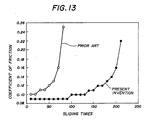
- Fig. 12 shows the results of Bowden tests (using a Bowden tester for rubbing the surface of the test piece by a steel ball to determine the coefficient of friction corresponding to the number of sliding times) using extruded rods obtained by the cold-forging process described above (extrusion reduction of area: approximately 79.5%).
- Fig. 12 shows that the predies lubricant added with the thermoplastic resin is superior in lubricating properties and adhesiveness of its coating.
- Table 1 shows the drawing force in the method according to the present invention in comparison with prior art method (lubrication pretreatment: zinc phosphate, predies lubrication: only a lubricant on the market having calcium stearate as the main component).
- Fig. 10 shows the results of Bowden tests (lubricating properties and adhesiveness of the lubricant coating) of the rod after winding.
- Table 3 shows the life of each of the wire drawing dies and the cold-forging dies used for drawing rods under the conditions described above (provided, the drawing reduction of area: 5.5 ⁇ ⁇ 4.95 ⁇ ) and then cold-forging them into high tension bolt in comparison with such life in the prior art.
- the lubricant coating according to the present invention is superior in heat resistance and adhesiveness to the zinc phosphate coating according to the prior art. Accordingly, the life of the drawing and the cold forging dies is considerably prolonged in the method according to the present invention.
- the lubrication pretreating agent since calcium zinc phosphate is used as the lubrication pretreating agent, it is made possible to obtain a coating having a higher temperature of removing crystal water and a higher heat resistance than the zinc phosphate coating according to the prior art, and since an ultrasonic wave applying device may be used, it is made possible to secure and control freely coating weight of the calcium zinc phosphate coating. Further, since the lubricant pretreated rod is lubricated by calcium stearate or sodium stearate, the lubricating properties as well as the heat resistance can be improved.
Landscapes
- Chemical & Material Sciences (AREA)
- Organic Chemistry (AREA)
- Chemical Kinetics & Catalysis (AREA)
- General Chemical & Material Sciences (AREA)
- Oil, Petroleum & Natural Gas (AREA)
- Engineering & Computer Science (AREA)
- Mechanical Engineering (AREA)
- Materials Engineering (AREA)
- Metallurgy (AREA)
- Emergency Medicine (AREA)
- Health & Medical Sciences (AREA)
- Metal Extraction Processes (AREA)
- Lubricants (AREA)
Description
- The present invention relates to a method for continuous drawing ot a wire rod tor cold-torgmg, in which the wire rod (inclusive of a steel bar) is descaled, pretreated for lubrication, lubricated and drawn into wire while being moved continuously.
- Secondary working for a wire rod for cold-forging is performed normally in the order: descaling (pickling)-lubrication pretreatment-lubrication-drying-wire drawing-coiling. Among them, pickling, lubrication pretreatment and lubrication are usually rendered in batch treatment system. That is, heretofore, a pickled wire rod coil was dipped in a phosphate solution of, for example, zinc phosphate and, thereafter, dipped in a lubricate solution of, for example, sodium stearate to form a lubricate coating of such materials as sodium stearate, zinc stearate, or zinc phosphate on the surface of the wire rod. The batch treatment system was heretofore used for the reason that a long period of reaction was required to obtain a coating having a thickness sufficient to provide satisfactory lubricating properties, this required a longer treatment time and made an in-line system difficult.
- Therefore, in, for example, Japanese Patent Public Disclosure No. 163047/1981 Official Gazette, there is proposed a method for performing lubrication pretreatment and lubrication in an in-line system to thereby reduce equipment cost and improve productivity. This prior art method has been put into practical use. This prior art method is characterized in that, after descaling, a wire rod is coated with zinc phosphate (lubrication pretreatment), further coated thereon with calcium stearate at room temperature (lubrication), and then rapidly dried. In this prior art method, it is made possible to reduce running cost, to coat a required quantity of lubricant in a very short time, to dry it in a short time, and to make it in an in-line system without extending the entire line unduly.
- According to prior art methods, however, any of the batch treatment system or the in-line system used zinc phosphate solution as the lubrication pretreatment, and therefore, had a disadvantage that the lubricant coating had unsatisfactory resistance to heat.
- Generally in metal wire drawing operation, as described above, lubricant is indispensable to improve the working efficiency, to prolong the tool life, and to maintain the surface quality of drawn wire.
- The lubricant for wire drawing reduces the friction between the dies and the wire rod to thereby make it possible to draw the wire rod with a smaller drawing force and prevents wear of the dies. In addition to these functions, the lubricant has important advantage that it remains securely as a coating on the surface of the wire after drawing and acts as an effective lubricant during cold forming (for example, bolt making).
- Heretofore, a predies lubricant having metallic soap as the main component as follows was normally used in drawing wire:

- In the prior art lubricant for wire drawing having metallic soap as the main component in which the metallic soap displays the basic lubricating properties, stearate or palmitinate of alkali earth metals or sodium were normally used. The typical inorganic material used in the prior art wire drawing lubricant is lime which prevents temperature rise in heavy working to thereby prevent adhesion between the wire rod and the dies and to control the softening temperature of the lubricant. The additives used in the prior art were one or more of sulfur, molybdenum disulfide and graphite which were added to prevent adhesion between the wire rod and dies under severe wire drawing conditions and to improve the lubricating properties.
- However, while the prior art wire drawing lubricant having metallic soap as the main component had better properties than other wet type lubricants, it was still insufficient in the lubricating properties such as resistance to heat produced in drawing and adhesiveness of the lubricant coating formed, which made the life of the wire drawing dies and the life of the dies for cold-forging subsequent to drawing relatively short.
- The drawn wire rods are mostly cold-forged into products. However, it has become a recent trend that the lubricant used in the wire drawing is left adhering onto the surface of the wire brought to the cold-forging process so that the wire can be cold-forged into products without adding any lubricant. Therefore, while much better adhesiveness after wire drawing and higher heat-resistance sufficient to prevent cracking in the adhering lubricant coating after wire drawing have been demanded for the lubricant for wire drawing, no successful lubricant for wire drawing which satisfactorily answer to these demands has been found yet.
- An object of the present invention is to provide a method for continuous drawing of wire rod, in which the wire rod is descaled, pretreated for lubrication, lubricated, dried and drawn into wire in an in-line system to thereby make it possible to obtain a lubricant coating highly resistant to heat and to carry out the wire drawing operation efficiently in a shorter period of time than prior art methods.
- Another object of the present invention is to provide a lubricant for wire drawing, which is capable of overcoming the above-described problems of the prior art lubricants and has highly desirable properties such as reduction in friction, resistance to heat, and deposition and adherence to the wire rod, to thereby prolong the life of the dies for wire drawing and cold-forging.
- According to the present invention a method for continuous drawing of a wire rod comprises the steps of descaling said rod; pre-heating said rod, pre-treating said rod for lubrication with passage of said wire rod through a calcium zinc phosphate solution heated to 70-90°C; lubricating said preheated wire rod after rinsing it with a calcium stearate or a sodium stearate; and after drying said lubricating wire rod, drawing it to form a wire while being moved continuously.
- The calcium zinc phosphate solution (Ca/Zn=0.3-1.0) may be added with an ultrasonic wave (frequency: 10-60 KHZ, output: 25 w/I litre solution). The calcium stearate may be applied to the wire rod at room temperature or said sodium stearate may be applied by passing the wire rod through a sodium stearate solution maintained in the temperature range 70°-90°C.
- As a further step in the present method the wire rod may, after the aforesaid drying, be coated with a predies lubricant having metallic soap as the main component added with 1-10 weight % of a thermoplastic resin (for example, Teflon, polyethylene, nylon, acrylic resin, polycarbonate).
- We have discovered that in wire drawing operation addition of a thermoplastic resin to the prior art predies lubricant having metallic soap as the main component improves the lubricating properties of the lubricant considerably. That is, by adding 1-10% by weight of a thermoplastic resin to the prior art predies lubricant having metallic soap as the main component, the lubricating properties of the lubricant, such as reduction of friction and resistance to heat, can be greatly improved.
- Addition of the thermoplastic resin is less than 1% by weight is insufficient to improve the lubricating properties satisfactorily. On the other hand, addition of it in more than 10% by weight increases the cost unduly and may result in generation of thermally decomposing gases during heat treatment after cold-forging. Particularly when any of fluorine-contained polymers is used, addition of it in a percentage higher than specified above is accompanied by the risk of generation of fluoric gas during heat treatment after cold-forging. Accordingly, great care must be taken in determination of the percentage of addition of the thermoplastic resin.
- The term "metallic soap" as used herein is to be understood to mean metallic salts other than alkali salt, of, such as, fatty acid, resin acid and naphthenic acid, inclusive of sodium salt of these acids and their mixtures, preferably of common composition (commonly used as wire drawing lubricant) containing calcium stearate or sodium stearate in 90% or more in weight added with one or more of aluminum stearate, zinc stearate and barium stearate in several percent by weight.
- Further, the term "a predies lubricant having metallic soap as the main component" as used herein is to be understood to mean any of lubricants containing said metallic soap in 60% or more by weight, inorganic material (such as lime) in 20% or more by weight, and several percent of additives (one or more of sulfur, molybdenum disulfide and graphite), that is, this term is applicable to any of known wire drawing lubricants.
- The term "thermoplastic resin" as used herein is to be understood to apply to any of polyethylene resin, polypropylene resin, fluorine-contained polymers known as Teflon (trademark), polystyrene resin, vinyl acetal resin, polyacrylate resin, polymethacrylate resin, polyvinyl chloride resin, polyvinylidene chloride resin, polyacrylonitrile resin, polyvinylether resin, polyvinylketone resin, polyether resin, polycarbonate resin, thermoplastic polyester resin, polyamide resin, diene resin, polyurethane resin, and silicone resin. These resins are used solely or in combination of two or more kinds of them.
- The thermoplastic resin is added preferably in the form of powder of the size approximately of 10-20 !-1m diameter.
- The invention will be better understood from the following description taken in connection with the accompanying drawings in which:
- Fig. 1 is a block diagram of the process of the method for continuous drawing of wire rod according to the present invention;
- Fig. 2 is a graph showing the effect of application of an ultrasonic wave to lubrication pretreatment in the present invention;
- Fig. 3 is a graph showing the relationship between the frequency of the ultrasonic wave and the zinc calcium phosphate coating weight;
- Fig. 4 is a graph showing the relationship between Ca/Zn ratio of the calcium zinc phosphate coating and the zinc calcium phosphate coating weight;
- Fig. 5 is a graph showing the relationship between the concentration of calcium stearate and the calcium stearate coating weight;
- Fig. 6 is a graph showing the relationship between the treating time of the sodium stearate and the zinc stearate coating weight;
- Fig. 7 is a schematic side view of an apparatus for ultrasonic pretreatment for lubrication;
- Fig. 8 is a schematic front view of a treating bath;
- Fig. 9 is a graph showing the relationship between the quantity of ethylene tetrafluoride resin added to the predies lubricant having metallic soap as the main component and the drawing force in the wire drawing operation using the lubricant;
- Fig. 10 is a graph showing the adhesiveness of the lubricant coating in the cold-forging process;
- Fig. 11 a is a schematic view of the shape of the cut wire rod before cold-forging;
- Fig. 11b is a schematic view of the shape of the product of the cold-forging;
- Fig. 12 is a graph showing comparatively the results of Bowden tests of the materials subjected to wire drawing and cold-forging using the lubricant according to the present invention and the conventional lubricant, respectively; and
- Fig. 13 is a graph showing the results of Bowden tests of the material in an example of the present invention.
- With reference now to the drawings and more particularly to Fig. 1 thereof, there is shown in block diagram treating processes of the method according to the present invention. As shown, a wire bar is payed out from a pay-off
stand 1 and descaled indescaling process 2 by, for example, shot blasting. Subsequently, the wire rod is preheated by apreheating device 3 to a predetermined temperature (80°C or higher) and then pretreated for lubrication inlubrication pretreatment process 4 by passing it through a calcium zinc phosphate solution (Ca/Zn=0.3-1.0) added with an ultrasonic wave. The calcium zinc phosphate solution is preheated to the temperature 70-90°C. Then, afterrinsing process 5, the pretreated wire rod is lubricated by calcium stearate or sodium stearate to adhere thereto inlubricating process 6. Lubrication by calcium stearate is carried out at room temperature. However, sodium stearate is to be preheated to 70-90°C for lubrication inprocess 6. After lubrication, the wire rod is dried sufficiently in its lubricant coating indrying process 7, drawn with a predies lubricant inwire drawing process 8, and coiled bycoiler 9. - Method of descaling rod used in
descaling process 2 is not limited. Any of pickling, shot blasting and roll bending may be used to descale the rod inprocess 2. Among the three methods mentioned above, shot blasting is most preferable for the phosphate coating in an in-line system. - The method according to the present invention is characterized in that calcium zinc phosphate (CalZn=0.3-1.0) having a good resistance to heat is used in
process 4 to preatreat the wire rod for lubrication. The temperature of removing crystal water of the calcium zinc phosphate coating is 415°C while the temperature of removing crystal water of the heretofore used zinc phosphate coating is 280-290°C. This means that the prior art zinc phosphate coating is removed of its crystal water by the heat (normally up to 300°C) developed during wire drawing operation to thereby cause cracks in the coating. In contrast to this, since the temperature of removing crystal water of the calcium zinc phosphate coating according to the present invention is, as mentioned above, as high as 415°C, no crack is caused in the coating by the wire drawing operation. - An ultrasonic wave may be used in treatment to obtain a sufficient zinc calcium phosphate coating weight and to control the coating weight. This is because the calcium zinc phosphite solution is less sensitive to chemical conversion treatment than the zinc phosphate solution and is more difficult to obtain the coating weight. However, as shown in Fig. 2, the zinc calcium phosphate coating weight is increased by application of the ultrasonic wave thereto. The results shown in Fig. 2 were obtained under the treatment conditions:
concentration 160 points,temperature 80°C, and frequency of theultrasonic wave 50 KHZ at 1 KW. - As shown in Fig. 3, the frequency of the ultrasonic wave applied to the solution is preferably in the range 10-60 KHZ because the frequency lower than 10 KHZ presents a problem of noise and, on the other hand, the frequency higher than 60 KHZ is less effective to obtain a sufficient coating weight. Output of the ultrasonic wave is preferably 25 W per litre of the solution.
- The Ca/Zn ratio of the calcium zinc phosphate coating is determined to 0.3-1.0 for the reason described below. Fig. 4 shows the relationship between the CalZn ratio of the calcium zinc phosphate coating (concentration of the
solution 160 points) and the coating weight. As understood from Fig. 4, when the Ca/Zn ratio is lower than 0.3, effect of addition of Ca is small and the resistance to heat is not sufficient. On the other hand, when the Ca/Zn ratio is higher than 1.0, the sensitiveness to chemical conversion treatment is not sufficient and it is difficult to obtain a predetermined coating weights (?6 g/m2) and of metallic soap (?1 g/m2). Accordingly, the Ca/Zn ratio of the calcium zinc coating is preferably in the range 0.3-1.0. - The predetermined coating weight of the calcium zinc phosphate coating weight of 6 g/m2 or larger is obtained in a short period of time 10-20 seconds only when the concentration of the calcium zinc phosphate solution is 160 points or higher. On the other hand, the concentration of the solution of 200 points or higher is not economical since the coating weight in proportion to the increase in the concentration is not obtained. Here, the lower limit of the coating weight of the calcium zinc phosphate coating is predetermined to 6 g/m2. The prior art zinc phosphate coating having lower resistance to heat requires the coating weight of the lower limit 7-8 g/m2, However, since the calcium zinc phosphate coating according to the present invention has a high resistance to heat, the coating weight of it can satisfactorily be as low as 6 g/m 2.
- The apparatus used for ultrasonic pretreatment for lubrication may take the construction in which, as shown in Figs. 7 and 8, a plurality of ultrasonic
wave applying devices 12 are disposed vertically or horizontally in pairs in parallel or staggered positions on the outer peripheral surface of a cylindrical treating bath 11, returnpipes 14 are provided between treatingsolution receivers 13 projecting from the inlet side and the outlet side, respectively, of the treating bath 11 and a treatingsolution tank 15 to collect treatingsolution 19 therethrough, and a pump 16 is provided to supply the treating solution from the treatingsolution tank 15 to the treating bath 11 through piping 17. By the apparatus constructed as described above, the calcium zinc phosphate solution is subjected to the ultrasonic wave and agitated, and caused to rapidly adhere to the surface of awire rod 18 by cavitation. Further, it is made possible to control the coating weight of the calcium zinc phosphate solution by using or not using the application of the ultrasonic wave or by changing the frequency or the output of the ultrasonic wave applying device. - The lubrication process is carried out after the lubrication preatreatment process by passing the wire rod either (1) through calcium stearate solution at room temperature or (2) through sodium stearate solution heated to the temperature 70-90°C.
- In lubrication with calcium stearate (1), as will be understood from the relationship between the concentration and the coating weight shown in Fig. 5, the concentration must be 300 g/litre or higher in order to obtain the predetermined coating weight of 5 g/m2 or higher. While any of wet spraying (coating solution) and dry spraying (coating powder) can be used to cause calcium stearate to adhere to the wire rod, coating by wet spraying is preferred in view of the coating weight of the lubricant and the adhesiveness of the lubricant coating. Treating time of 2-3 seconds is normally required for physical adhesion.
- In lubrication with sodium stearate (2), batch treatment system can be used. In this lubrication with sodium stearate, substitution takes place between the calcium zinc phosphate coating formed by lubrication pretreatment and the sodium stearate solution to produce a zinc stearate layer which adheres to the surface of the wire rod. In this lubrication, it is normally required to obtain the coating weight of the substitution product layer of 1 g/m2 or higher. For this purpose, as seen from the relationship between the treating time with sodium stearate and the zinc stearate coating weight shown in Fig. 6, a period of time of 20 seconds or longer is required.
- The predies lubricant is added to increase the heat-resistance and lubricating properties. The predies lubricant that may be used is the lubricant having metallic soap as the main component added with a thermoplastic resin such as Teflon, polyethylene, nylon, acrylic resin, and polycarbonate in 1-10% by weight. The thermoplastic resin is added to the metallic soap lubricant to make use of the heat-resistance and the low friction of the thermoplastic resin such, for example, as Teflon. Further, the quantity of addition of the thermoplastic resin is determined to 1-10% by weight because addition of it in less than 1% is not sufficient to provide an effect to the drawing force and, on the other hand, while a larger quantity of addition of it provides a larger effect, the upper limit of the quantity of its addition is determined to 10% considering the cost and the fact that the decomposition gas of, for example, Teflon is fluorine gas.
- Fig. 9 shows graphically the relationship between the quantity of addition of ethylene tetrafluoride (trademark "Teflon") to the wire drawing lubricant containing metallic soap as the main component (having the content: calcium stearate 70%, lime 27%, and
sulfur 3% by weight) and the drawing force required to draw a steel rod (equivalent to S45C of JIS-Japanese Industrial Standard) into wire. The graph of Fig. '9 shows the results of drawing of said steel rod coated with zinc phosphate as the lubrication pretreatment and having the diameter 5.5 mm° into wires with two different reduction of area, approximately 20% and approximately 30%, respectively. - It is clear from Fig. 9 that the required drawing force shows the tendency to decrease suddenly when the quantity of addition of the ethylene tetrafluoride containing resin exceeds 1 % by weight. This tendency has been confirmed to appear likewise when other thermoplastic resin is added. While the graph of Fig. 9 shows that the thermoplastic resin is added preferably in larger quantity from the view to increase the lubrication, the quantity of its addition is required to be limited to 10% by weight or less in view of the environmental pollution and economy as mentioned hereinabove.
- Fig. 10 shows graphically the comparative results of the adhesiveness of the lubricant coating to the rod being worked between the predies lubricant with no resin added and the predies lubricant with a thermoplastic resin added.
- The wire drawing lubricant, the thermoplastic resin added and the lubrication pretreatment method used in the tests shown in Fig. 10 were the same as those used in the tests of Fig. 9, and the wire rod used was a boron steel equivalent to 10B22M of AISI. The coating weight was measured in the manner described below.
- A boron steel rod of the diameter 22 mm* coated with zinc phosphate or zinc calcium phosphate (pretreatment for lubrication) was drawn into rod of 19.5 mm° with the reduction of area of approximately 21.4% using both of the predies lubricant added with no resin and the predies lubricant added with ethylene tetrafluoride containing 3% by weight, and subjected to cold-forging (extruding to make bolts) during which sampling is started to find the rate of residual lubricant on the drawn rod (extruding reduction of area=0) at each extruding reduction of area. That is, the adhesiveness of the lubricant coating is understood as the following ratio:

- The larger the value of the rate of residual lubricant coating is, the better the adhesiveness of the coating is or the more the lubricant remains and, accordingly, the less frequently the seizure occurs during the cold-forging operation. In the cold-forging used in the method according to the present invention, a rod (diameter: do) shown in Fig. 11 a is formed to, as shown in Fig. 11 b, a bolt-like shape (diameter of shank: d1) leaving a head undrawn, with the ratio of maximum accumulated reduction of area of approximately 80%. In this case, the ratio of reduction of area is given by the formula:

- It is understood from the results shown in Fig. 10 that the predies lubricant added with ethylene tetrafluoride containing 3% by weight is obviously superior in adhesiveness of the lubricant coating to the lubricant added with no resin. This shows that the addition of the ethylene tetrafluoride increases the heat resistance of the lubricant and prevents its deterioration by heat generated during working.
- Fig. 12 shows the results of Bowden tests (using a Bowden tester for rubbing the surface of the test piece by a steel ball to determine the coefficient of friction corresponding to the number of sliding times) using extruded rods obtained by the cold-forging process described above (extrusion reduction of area: approximately 79.5%).
- It is understood from Fig. 12 that the rod coated thereon with the predies lubricant added with the ethylene tetrafluoride in 3% by weight has obviously lower coefficient of friction than the rod coated thereon with the predies lubricant added with no such resin and is lower in the rise of the coefficient of friction than it. Therefore, Fig. 12 shows that the predies lubricant added with the thermoplastic resin is superior in lubricating properties and adhesiveness of its coating.
- By the equipment having the line construction shown in Fig. 1, using shot blasting for descaling of the wire rod, and including the ultrasonic pretreatment apparatus for lubrication shown in Figs. 7 and 8, a material of 5.5 mm° (S45C) was drawn in the following operating conditions into rods of 4.95 mm° and 4.6 mm*, respectively:
- Operating conditions:
- (1) Descaling condition
- Shot blasting material: steel balls 0.3 mmΦ
- Shot density: approximately 300 Kg/m2
- (2) Preheating condition
- Steam blowing: at temperature of 80°C
- (3) Lubrication pretreatment condition
- Lubrication pretreating agent: calcium zinc phosphate solution (Ca/Zn=0.5)
- Treatment condition: 160 points (concentration)x 80°C (temperature)x15 sec (reaction time), ultrasonic wave: 50 KHZ, 1 KW
- (4) Lubricating condition
- (i) When using calcium stearate
- Concentration: 300 g/litre
- Temperature: room temperature
- Time: 3 seconds
- (i) When using calcium stearate
- (ii) When using sodium stearate
- Concentration: 90 g/litre
- Temperature: 80°C
- Time: 25 seconds
- (5) Drying condition
- Infrared drying furnace:
furnace temperature 80°C
- Infrared drying furnace:
- (6) Wire drawing condition
- Predies lubricant: lubricant having calcium stearate as the main component added with Teflon in 3%
- Reduction of area:
- approximately 19% (5.5 mmϕ→4.95 mmϕ)
- approximately 30% (5.5 mmϕ→4.6 mmϕ)
- Wire drawing speed: 80 m/mm.
- Table 1 shows the drawing force in the method according to the present invention in comparison with prior art method (lubrication pretreatment: zinc phosphate, predies lubrication: only a lubricant on the market having calcium stearate as the main component).

- Fig. 10 shows the results of Bowden tests (lubricating properties and adhesiveness of the lubricant coating) of the rod after winding. Table 2 shows the number of sliding times when p=0.2 in comparison between the method according to the present invention and the prior art method.

- Table 3 shows the life of each of the wire drawing dies and the cold-forging dies used for drawing rods under the conditions described above (provided, the drawing reduction of area: 5.5 ϕ→4.95 ϕ) and then cold-forging them into high tension bolt in comparison with such life in the prior art.

- Life is expressed by tons of products before replacement of the dies for wear or damage thereof.
- As will be seen from Tables 1 and 2 and Fig. 13, the lubricant coating according to the present invention is superior in heat resistance and adhesiveness to the zinc phosphate coating according to the prior art. Accordingly, the life of the drawing and the cold forging dies is considerably prolonged in the method according to the present invention.
- In the method according to the present invention, as described hereinabove, since calcium zinc phosphate is used as the lubrication pretreating agent, it is made possible to obtain a coating having a higher temperature of removing crystal water and a higher heat resistance than the zinc phosphate coating according to the prior art, and since an ultrasonic wave applying device may be used, it is made possible to secure and control freely coating weight of the calcium zinc phosphate coating. Further, since the lubricant pretreated rod is lubricated by calcium stearate or sodium stearate, the lubricating properties as well as the heat resistance can be improved. Moreover, since a prior art lubricant having metallic soap as the main component added with a thermoplastic resin such as Teflon is used as the predies lubricant during wire drawing operation, it is made possible to improve the heat resistance and the lubricating properties of the lubricant coating and to prolong considerably the life of the cold-working tools.
- While we have described and illustrated a present preferred method of practicing the invention, it is to be distinctly understood that the invention is not limited thereto but may be otherwise variously practiced within the scope of the following claims.
Claims (7)
Applications Claiming Priority (5)
| Application Number | Priority Date | Filing Date | Title |
|---|---|---|---|
| US06/505,843 US4553416A (en) | 1983-06-20 | 1983-06-20 | Dry type continuous wire drawing process |
| JP59102339A JPS60260693A (en) | 1984-05-21 | 1984-05-21 | Lubricant for wire drawing |
| JP102339/84 | 1984-05-21 | ||
| JP16415084A JPS6142415A (en) | 1984-08-03 | 1984-08-03 | Continuous drawing method of wire rod |
| JP164150/84 | 1984-08-03 |
Publications (3)
| Publication Number | Publication Date |
|---|---|
| EP0163471A2 EP0163471A2 (en) | 1985-12-04 |
| EP0163471A3 EP0163471A3 (en) | 1986-06-18 |
| EP0163471B1 true EP0163471B1 (en) | 1989-07-19 |
Family
ID=27309677
Family Applications (1)
| Application Number | Title | Priority Date | Filing Date |
|---|---|---|---|
| EP85303540A Expired EP0163471B1 (en) | 1983-06-20 | 1985-05-20 | Method for continuous drawing of wire rod |
Country Status (2)
| Country | Link |
|---|---|
| US (1) | US4553416A (en) |
| EP (1) | EP0163471B1 (en) |
Families Citing this family (22)
| Publication number | Priority date | Publication date | Assignee | Title |
|---|---|---|---|---|
| DE3571562D1 (en) * | 1984-05-21 | 1989-08-24 | Sumitomo Metal Ind | Method for continuous drawing of wire rod |
| EP0468278B1 (en) * | 1990-07-12 | 1996-04-10 | DAIDO MACHINERY, Ltd. | A forging lubricant and a method for forming a lubricant coat on the surface of a linear material |
| DE4122224A1 (en) * | 1991-07-04 | 1993-01-07 | Patent Treuhand Ges Fuer Elektrische Gluehlampen Mbh | METHOD FOR PRETREATING TREADED WIRE |
| US5209092A (en) * | 1991-09-03 | 1993-05-11 | Russo Anthony J | Continuous wire drawing process with chemical descaling and post-die treatment and apparatus |
| US5593956A (en) * | 1992-05-26 | 1997-01-14 | Elf Atochem North America, Inc. | Dry wire drawing lubricants |
| DE4336220A1 (en) * | 1993-10-23 | 1995-04-27 | August Neuhoff Fa | Method and device for applying a lubricant carrier layer, in particular to a wire material to be deformed in the drawing process |
| ATE181858T1 (en) * | 1994-11-11 | 1999-07-15 | Ecoform Umformtechnik Gmbh | METHOD AND DEVICE FOR FORMING AND/OR COATING STRONG-SHAPED METALLIC FORMING PRODUCT |
| GB2300752B (en) * | 1995-05-12 | 1999-12-15 | Tanaka Electronics Ind | Method of manufacturing bonding wire for semiconductor device |
| US5953944A (en) * | 1997-12-31 | 1999-09-21 | American Precision Steel Company Lp | In-line wire drawing continuous treatment process |
| FR2773817A1 (en) * | 1998-01-22 | 1999-07-23 | Cfpi Ind | A new lubricating composition for the pretreatment of steel components before cold forming |
| DE19817088C2 (en) * | 1998-04-17 | 2000-02-17 | Ecoform Umformtechnik Gmbh | Method and device for coating and shaping strand-shaped metal material by drawing |
| DE19834853A1 (en) * | 1998-08-01 | 2000-02-03 | August Neuhoff Fa | Backing material and its use as well as cold-forming processes |
| RU2201304C2 (en) * | 2001-05-29 | 2003-03-27 | Закрытое акционерное общество "Межотраслевое юридическое агентство "Юрпромконсалтинг" | Apparatus for cleaning wire or round rolled rods |
| DE10314700A1 (en) | 2003-03-31 | 2004-10-14 | Behr Gmbh & Co. Kg | Method for producing surface-modified workpieces |
| EP1707763A4 (en) * | 2003-12-12 | 2010-06-23 | Honda Motor Co Ltd | CAMSHAFT, CAMSHAFT CAM MANUFACTURING METHOD, AND CAMSHAFT TREE MANUFACTURING METHOD |
| RU2273538C1 (en) * | 2004-10-08 | 2006-04-10 | Череповецкий государственный университет (ЧГУ) | Apparatus for removing dust-like scale residues from surface of metallic article |
| RU2283713C1 (en) * | 2005-03-03 | 2006-09-20 | Общество с ограниченной ответственностью "Межотраслевое юридическое агентство "Юрпромконсалтинг" | Wire or round rolled piece surface activating or cleaning apparatus |
| IT1401449B1 (en) * | 2010-06-10 | 2013-07-26 | Trafilerie Brambilla S P A | METHOD AND PLANT FOR THE PRODUCTION OF STAINLESS STEEL BARS AND / OR OF COLD DRAFTED STAINLESS STEEL ALLOYS. |
| CN102641912B (en) * | 2012-05-11 | 2014-03-26 | 江苏亚太轻合金科技股份有限公司 | Technology for continuously extruding coils by aluminum and aluminum alloy parallel flow pipes |
| CN103170515A (en) * | 2013-03-20 | 2013-06-26 | 常州凯翔医用不锈钢有限公司 | Medical stainless steel production technology |
| CN109807188B (en) * | 2019-04-01 | 2020-10-09 | 江苏兄弟合金有限公司 | Continuous drawing process for heating wire |
| CN111496005A (en) * | 2020-04-30 | 2020-08-07 | 苏州强新合金材料科技有限公司 | Steel wire rod lime wire stretching process |
Family Cites Families (21)
| Publication number | Priority date | Publication date | Assignee | Title |
|---|---|---|---|---|
| US2239044A (en) * | 1938-12-23 | 1941-04-22 | John W Leighton | Method of treating steel bars |
| US2318614A (en) * | 1940-06-06 | 1943-05-11 | American Steel & Wire Co | Art of producing wire |
| US2319393A (en) * | 1941-08-30 | 1943-05-18 | Bethlehem Steel Corp | Lubricant for solid dies |
| GB723858A (en) * | 1951-12-20 | 1955-02-09 | Pyrene Co Ltd | Improvements relating to the drawing of steel |
| US2883039A (en) * | 1955-04-04 | 1959-04-21 | Bethlehem Steel Corp | Lubricating guide for wire drawing |
| BE546758A (en) * | 1955-04-06 | |||
| DE1103108B (en) * | 1955-11-10 | 1961-03-23 | Dr Stefan Klinghoffer | Method and device for the pretreatment of wires for the purpose of drawing |
| US3080962A (en) * | 1959-06-12 | 1963-03-12 | Copperweld Steel Co | Die drawing of clad rod or wire |
| GB894048A (en) * | 1959-10-12 | 1962-04-18 | British Oxygen Co Ltd | Manufacture and treatment of wires |
| US3145832A (en) * | 1961-05-02 | 1964-08-25 | Anchor Post Prod | Pressure die for wire drawing |
| US3413832A (en) * | 1965-07-27 | 1968-12-03 | Nat Standard Co | Wire drawing method |
| GB1320133A (en) * | 1969-05-15 | 1973-06-13 | Abrasive Dev | Treatment of rod or wire |
| US3841126A (en) * | 1972-03-22 | 1974-10-15 | Kobe Steel Ltd | Method of lubricating a work, especially a wire in a warm forging process |
| GB1423826A (en) * | 1972-03-24 | 1976-02-04 | Abrasive Dev | Treatment of elongated metal articles |
| US3763680A (en) * | 1972-08-23 | 1973-10-09 | Cf & I Steel Corp | Method and apparatus for treating wire |
| DE2357045C2 (en) * | 1973-11-15 | 1983-01-27 | Kabel- und Metallwerke Gutehoffnungshütte AG, 3000 Hannover | Device for applying lubricants in the manufacture of longitudinally welded pipes |
| AT383513B (en) * | 1979-08-29 | 1987-07-10 | Uralsky Inst Chernykh Metall | DRAWING PROCEDURE WITH HYDRODYNAMIC LUBRICATION |
| DD154334A1 (en) * | 1980-12-09 | 1982-03-17 | Joachim Wolf | METHOD FOR LUBRICATING THE PULLING MACHINE IN WIRE DRAWING MACHINES |
| JPS6028611B2 (en) * | 1981-04-11 | 1985-07-05 | 株式会社神戸製鋼所 | How to remove surface scratches from wire rods on a drawing line |
| JPH0229403B2 (en) * | 1981-06-15 | 1990-06-29 | Sumitomo Metal Ind | SENZAINOKANSHIKIRENZOKUSHINSENHOHO |
| DD204420A1 (en) * | 1981-09-30 | 1983-11-30 | Juergen Schumann | METHOD OF MULTI-TAKING UNWORKED METALLIC FORMING |
-
1983
- 1983-06-20 US US06/505,843 patent/US4553416A/en not_active Expired - Lifetime
-
1985
- 1985-05-20 EP EP85303540A patent/EP0163471B1/en not_active Expired
Also Published As
| Publication number | Publication date |
|---|---|
| EP0163471A2 (en) | 1985-12-04 |
| US4553416A (en) | 1985-11-19 |
| EP0163471A3 (en) | 1986-06-18 |
Similar Documents
| Publication | Publication Date | Title |
|---|---|---|
| US4688411A (en) | Method for continuous drawing of wire rod | |
| EP0163471A2 (en) | Method for continuous drawing of wire rod | |
| JP4271573B2 (en) | Manufacturing method of metal wire for header processing | |
| Bay | The state of the art in cold forging lubrication | |
| US3939014A (en) | Aqueous zinc phosphating solution and method of rapid coating of steel for deforming | |
| US4944813A (en) | Process for phosphating metal surfaces | |
| US2884351A (en) | Method of cold rolling ferrous strip stock | |
| US10479957B2 (en) | Lubricant for metal cold forming processes and methods of use of the same | |
| US2357269A (en) | Art of treating ferrous metal articles | |
| US3144361A (en) | Pretreating iron or steel | |
| US20160236236A1 (en) | Method for manufacturing non-phosphate coated metal material for cold heading-plastic working process | |
| US2859145A (en) | Cold rolling of steel | |
| GB894048A (en) | Manufacture and treatment of wires | |
| US2043300A (en) | Cleaning process | |
| JPH07164042A (en) | Manufacturing method of steel bar wire rod for cold forging excellent in lubricity and corrosion resistance | |
| US3433038A (en) | Cold working metal | |
| JP4788101B2 (en) | Manufacturing method of cold drawn steel pipe | |
| JP3462632B2 (en) | Aqueous lubricant composition for plastic working of metal materials and surface treatment method thereof | |
| JPH09295038A (en) | Cold drawing method and manufacturing method of carbon steel pipe | |
| US2546447A (en) | Art of drawing fine steel wire | |
| US2522176A (en) | Drawing ferrous wire and other metal-working processes | |
| JPH0245921B2 (en) | ||
| KR20080072274A (en) | Application method of water soluble lubricant in cold forging and its applicator | |
| JPS63130212A (en) | Continuous wiring method for wire rod for cold forging | |
| JPS6341646B2 (en) |
Legal Events
| Date | Code | Title | Description |
|---|---|---|---|
| PUAI | Public reference made under article 153(3) epc to a published international application that has entered the european phase |
Free format text: ORIGINAL CODE: 0009012 |
|
| AK | Designated contracting states |
Designated state(s): DE FR GB |
|
| PUAL | Search report despatched |
Free format text: ORIGINAL CODE: 0009013 |
|
| AK | Designated contracting states |
Kind code of ref document: A3 Designated state(s): DE FR GB |
|
| 17P | Request for examination filed |
Effective date: 19861117 |
|
| 17Q | First examination report despatched |
Effective date: 19871208 |
|
| GRAA | (expected) grant |
Free format text: ORIGINAL CODE: 0009210 |
|
| AK | Designated contracting states |
Kind code of ref document: B1 Designated state(s): DE FR GB |
|
| REF | Corresponds to: |
Ref document number: 3571562 Country of ref document: DE Date of ref document: 19890824 |
|
| ET | Fr: translation filed | ||
| PLBE | No opposition filed within time limit |
Free format text: ORIGINAL CODE: 0009261 |
|
| STAA | Information on the status of an ep patent application or granted ep patent |
Free format text: STATUS: NO OPPOSITION FILED WITHIN TIME LIMIT |
|
| 26N | No opposition filed | ||
| PGFP | Annual fee paid to national office [announced via postgrant information from national office to epo] |
Ref country code: GB Payment date: 19950510 Year of fee payment: 11 Ref country code: FR Payment date: 19950510 Year of fee payment: 11 |
|
| PGFP | Annual fee paid to national office [announced via postgrant information from national office to epo] |
Ref country code: DE Payment date: 19950523 Year of fee payment: 11 |
|
| PG25 | Lapsed in a contracting state [announced via postgrant information from national office to epo] |
Ref country code: GB Effective date: 19960520 |
|
| GBPC | Gb: european patent ceased through non-payment of renewal fee |
Effective date: 19960520 |
|
| PG25 | Lapsed in a contracting state [announced via postgrant information from national office to epo] |
Ref country code: FR Effective date: 19970131 |
|
| PG25 | Lapsed in a contracting state [announced via postgrant information from national office to epo] |
Ref country code: DE Effective date: 19970201 |
|
| REG | Reference to a national code |
Ref country code: FR Ref legal event code: ST |