EP0162345A2 - Verfahren zur Herstellung eines Phosphatüberzugs auf einer Stahloberfläche auf chemischem Wege - Google Patents
Verfahren zur Herstellung eines Phosphatüberzugs auf einer Stahloberfläche auf chemischem Wege Download PDFInfo
- Publication number
- EP0162345A2 EP0162345A2 EP85105225A EP85105225A EP0162345A2 EP 0162345 A2 EP0162345 A2 EP 0162345A2 EP 85105225 A EP85105225 A EP 85105225A EP 85105225 A EP85105225 A EP 85105225A EP 0162345 A2 EP0162345 A2 EP 0162345A2
- Authority
- EP
- European Patent Office
- Prior art keywords
- bath
- ions
- reaction
- steel
- orp
- Prior art date
- Legal status (The legal status is an assumption and is not a legal conclusion. Google has not performed a legal analysis and makes no representation as to the accuracy of the status listed.)
- Granted
Links
- 229910019142 PO4 Inorganic materials 0.000 title claims abstract description 38
- 238000000034 method Methods 0.000 title claims abstract description 38
- 239000011248 coating agent Substances 0.000 title claims abstract description 37
- 238000000576 coating method Methods 0.000 title claims abstract description 37
- 229910000831 Steel Inorganic materials 0.000 title claims abstract description 36
- 239000010959 steel Substances 0.000 title claims abstract description 36
- NBIIXXVUZAFLBC-UHFFFAOYSA-K phosphate Chemical compound [O-]P([O-])([O-])=O NBIIXXVUZAFLBC-UHFFFAOYSA-K 0.000 title claims abstract description 26
- 239000010452 phosphate Substances 0.000 title claims abstract description 26
- 239000000126 substance Substances 0.000 title claims abstract description 18
- -1 nitrite ions Chemical class 0.000 claims abstract description 33
- 239000007800 oxidant agent Substances 0.000 claims abstract description 16
- 230000033116 oxidation-reduction process Effects 0.000 claims abstract description 14
- NBIIXXVUZAFLBC-UHFFFAOYSA-N Phosphoric acid Chemical compound OP(O)(O)=O NBIIXXVUZAFLBC-UHFFFAOYSA-N 0.000 claims abstract description 11
- 239000001257 hydrogen Substances 0.000 claims abstract description 11
- 229910052739 hydrogen Inorganic materials 0.000 claims abstract description 11
- 239000003929 acidic solution Substances 0.000 claims abstract description 8
- 229910021645 metal ion Inorganic materials 0.000 claims abstract description 8
- UFHFLCQGNIYNRP-UHFFFAOYSA-N Hydrogen Chemical compound [H][H] UFHFLCQGNIYNRP-UHFFFAOYSA-N 0.000 claims abstract description 6
- 239000003513 alkali Substances 0.000 claims description 14
- 229910052751 metal Inorganic materials 0.000 claims description 13
- 239000002184 metal Substances 0.000 claims description 13
- 229910000147 aluminium phosphate Inorganic materials 0.000 claims description 8
- 150000004715 keto acids Chemical class 0.000 claims description 2
- GPRLSGONYQIRFK-UHFFFAOYSA-N hydron Chemical compound [H+] GPRLSGONYQIRFK-UHFFFAOYSA-N 0.000 claims 1
- 239000007864 aqueous solution Substances 0.000 abstract description 7
- 150000002500 ions Chemical class 0.000 abstract description 7
- MHAJPDPJQMAIIY-UHFFFAOYSA-N Hydrogen peroxide Chemical compound OO MHAJPDPJQMAIIY-UHFFFAOYSA-N 0.000 abstract description 4
- 239000012670 alkaline solution Substances 0.000 abstract description 2
- 238000006243 chemical reaction Methods 0.000 description 88
- 238000009740 moulding (composite fabrication) Methods 0.000 description 28
- 229910002651 NO3 Inorganic materials 0.000 description 19
- NHNBFGGVMKEFGY-UHFFFAOYSA-N Nitrate Chemical compound [O-][N+]([O-])=O NHNBFGGVMKEFGY-UHFFFAOYSA-N 0.000 description 18
- 239000010802 sludge Substances 0.000 description 17
- HEMHJVSKTPXQMS-UHFFFAOYSA-M Sodium hydroxide Chemical compound [OH-].[Na+] HEMHJVSKTPXQMS-UHFFFAOYSA-M 0.000 description 14
- PTFCDOFLOPIGGS-UHFFFAOYSA-N Zinc dication Chemical compound [Zn+2] PTFCDOFLOPIGGS-UHFFFAOYSA-N 0.000 description 14
- 239000000463 material Substances 0.000 description 13
- 229910021607 Silver chloride Inorganic materials 0.000 description 10
- 230000015572 biosynthetic process Effects 0.000 description 10
- 238000007796 conventional method Methods 0.000 description 10
- HKZLPVFGJNLROG-UHFFFAOYSA-M silver monochloride Chemical compound [Cl-].[Ag+] HKZLPVFGJNLROG-UHFFFAOYSA-M 0.000 description 10
- 238000005260 corrosion Methods 0.000 description 9
- 230000007797 corrosion Effects 0.000 description 9
- 238000003487 electrochemical reaction Methods 0.000 description 9
- 229910000165 zinc phosphate Inorganic materials 0.000 description 9
- XEEYBQQBJWHFJM-UHFFFAOYSA-N Iron Chemical compound [Fe] XEEYBQQBJWHFJM-UHFFFAOYSA-N 0.000 description 8
- 230000009467 reduction Effects 0.000 description 8
- 239000007789 gas Substances 0.000 description 7
- 238000005507 spraying Methods 0.000 description 7
- PXHVJJICTQNCMI-UHFFFAOYSA-N Nickel Chemical compound [Ni] PXHVJJICTQNCMI-UHFFFAOYSA-N 0.000 description 6
- 230000008859 change Effects 0.000 description 6
- 150000003839 salts Chemical class 0.000 description 6
- 239000007921 spray Substances 0.000 description 6
- XLYOFNOQVPJJNP-UHFFFAOYSA-N water Substances O XLYOFNOQVPJJNP-UHFFFAOYSA-N 0.000 description 6
- 239000003795 chemical substances by application Substances 0.000 description 5
- 239000000203 mixture Substances 0.000 description 5
- 230000001276 controlling effect Effects 0.000 description 4
- 230000002401 inhibitory effect Effects 0.000 description 4
- 229910052742 iron Inorganic materials 0.000 description 4
- 239000003973 paint Substances 0.000 description 4
- 235000011121 sodium hydroxide Nutrition 0.000 description 4
- 239000011701 zinc Substances 0.000 description 4
- LRXTYHSAJDENHV-UHFFFAOYSA-H zinc phosphate Chemical compound [Zn+2].[Zn+2].[Zn+2].[O-]P([O-])([O-])=O.[O-]P([O-])([O-])=O LRXTYHSAJDENHV-UHFFFAOYSA-H 0.000 description 4
- KWYUFKZDYYNOTN-UHFFFAOYSA-M Potassium hydroxide Chemical compound [OH-].[K+] KWYUFKZDYYNOTN-UHFFFAOYSA-M 0.000 description 3
- HCHKCACWOHOZIP-UHFFFAOYSA-N Zinc Chemical compound [Zn] HCHKCACWOHOZIP-UHFFFAOYSA-N 0.000 description 3
- 230000002159 abnormal effect Effects 0.000 description 3
- 239000002253 acid Substances 0.000 description 3
- 238000000354 decomposition reaction Methods 0.000 description 3
- 230000007423 decrease Effects 0.000 description 3
- 238000005259 measurement Methods 0.000 description 3
- 229910052759 nickel Inorganic materials 0.000 description 3
- 230000020477 pH reduction Effects 0.000 description 3
- 239000000243 solution Substances 0.000 description 3
- 238000005979 thermal decomposition reaction Methods 0.000 description 3
- 229910052725 zinc Inorganic materials 0.000 description 3
- CDBYLPFSWZWCQE-UHFFFAOYSA-L Sodium Carbonate Chemical compound [Na+].[Na+].[O-]C([O-])=O CDBYLPFSWZWCQE-UHFFFAOYSA-L 0.000 description 2
- 239000000470 constituent Substances 0.000 description 2
- 238000007598 dipping method Methods 0.000 description 2
- 229910017604 nitric acid Inorganic materials 0.000 description 2
- 230000001590 oxidative effect Effects 0.000 description 2
- 238000004448 titration Methods 0.000 description 2
- NAWXUBYGYWOOIX-SFHVURJKSA-N (2s)-2-[[4-[2-(2,4-diaminoquinazolin-6-yl)ethyl]benzoyl]amino]-4-methylidenepentanedioic acid Chemical compound C1=CC2=NC(N)=NC(N)=C2C=C1CCC1=CC=C(C(=O)N[C@@H](CC(=C)C(O)=O)C(O)=O)C=C1 NAWXUBYGYWOOIX-SFHVURJKSA-N 0.000 description 1
- 229910000851 Alloy steel Inorganic materials 0.000 description 1
- OYPRJOBELJOOCE-UHFFFAOYSA-N Calcium Chemical compound [Ca] OYPRJOBELJOOCE-UHFFFAOYSA-N 0.000 description 1
- 229910001335 Galvanized steel Inorganic materials 0.000 description 1
- DGAQECJNVWCQMB-PUAWFVPOSA-M Ilexoside XXIX Chemical compound C[C@@H]1CC[C@@]2(CC[C@@]3(C(=CC[C@H]4[C@]3(CC[C@@H]5[C@@]4(CC[C@@H](C5(C)C)OS(=O)(=O)[O-])C)C)[C@@H]2[C@]1(C)O)C)C(=O)O[C@H]6[C@@H]([C@H]([C@@H]([C@H](O6)CO)O)O)O.[Na+] DGAQECJNVWCQMB-PUAWFVPOSA-M 0.000 description 1
- FYYHWMGAXLPEAU-UHFFFAOYSA-N Magnesium Chemical compound [Mg] FYYHWMGAXLPEAU-UHFFFAOYSA-N 0.000 description 1
- GRYLNZFGIOXLOG-UHFFFAOYSA-N Nitric acid Chemical compound O[N+]([O-])=O GRYLNZFGIOXLOG-UHFFFAOYSA-N 0.000 description 1
- NBIIXXVUZAFLBC-UHFFFAOYSA-L Phosphate ion(2-) Chemical compound OP([O-])([O-])=O NBIIXXVUZAFLBC-UHFFFAOYSA-L 0.000 description 1
- 229910000746 Structural steel Inorganic materials 0.000 description 1
- 230000002378 acidificating effect Effects 0.000 description 1
- 238000004458 analytical method Methods 0.000 description 1
- 150000001450 anions Chemical class 0.000 description 1
- 239000011575 calcium Substances 0.000 description 1
- 229910052791 calcium Inorganic materials 0.000 description 1
- 238000005266 casting Methods 0.000 description 1
- TVWHTOUAJSGEKT-UHFFFAOYSA-N chlorine trioxide Chemical compound [O]Cl(=O)=O TVWHTOUAJSGEKT-UHFFFAOYSA-N 0.000 description 1
- 238000005352 clarification Methods 0.000 description 1
- 239000010960 cold rolled steel Substances 0.000 description 1
- 238000010276 construction Methods 0.000 description 1
- 230000002596 correlated effect Effects 0.000 description 1
- 239000013078 crystal Substances 0.000 description 1
- 238000005520 cutting process Methods 0.000 description 1
- 230000003247 decreasing effect Effects 0.000 description 1
- 238000006356 dehydrogenation reaction Methods 0.000 description 1
- 239000002659 electrodeposit Substances 0.000 description 1
- 239000003822 epoxy resin Substances 0.000 description 1
- 230000003628 erosive effect Effects 0.000 description 1
- 239000008397 galvanized steel Substances 0.000 description 1
- 238000010438 heat treatment Methods 0.000 description 1
- 230000006872 improvement Effects 0.000 description 1
- 230000005764 inhibitory process Effects 0.000 description 1
- 239000003446 ligand Substances 0.000 description 1
- 230000001050 lubricating effect Effects 0.000 description 1
- 239000011777 magnesium Substances 0.000 description 1
- 229910052749 magnesium Inorganic materials 0.000 description 1
- WPBNNNQJVZRUHP-UHFFFAOYSA-L manganese(2+);methyl n-[[2-(methoxycarbonylcarbamothioylamino)phenyl]carbamothioyl]carbamate;n-[2-(sulfidocarbothioylamino)ethyl]carbamodithioate Chemical compound [Mn+2].[S-]C(=S)NCCNC([S-])=S.COC(=O)NC(=S)NC1=CC=CC=C1NC(=S)NC(=O)OC WPBNNNQJVZRUHP-UHFFFAOYSA-L 0.000 description 1
- 238000004519 manufacturing process Methods 0.000 description 1
- 238000002844 melting Methods 0.000 description 1
- 230000008018 melting Effects 0.000 description 1
- 239000007769 metal material Substances 0.000 description 1
- LNOPIUAQISRISI-UHFFFAOYSA-N n'-hydroxy-2-propan-2-ylsulfonylethanimidamide Chemical compound CC(C)S(=O)(=O)CC(N)=NO LNOPIUAQISRISI-UHFFFAOYSA-N 0.000 description 1
- OXHXATNDTXVKAU-UHFFFAOYSA-N phosphoric acid zinc Chemical compound [Zn].OP(O)(O)=O OXHXATNDTXVKAU-UHFFFAOYSA-N 0.000 description 1
- 229920000647 polyepoxide Polymers 0.000 description 1
- 230000008569 process Effects 0.000 description 1
- 230000001737 promoting effect Effects 0.000 description 1
- 239000000376 reactant Substances 0.000 description 1
- 239000002683 reaction inhibitor Substances 0.000 description 1
- 230000002829 reductive effect Effects 0.000 description 1
- 230000000630 rising effect Effects 0.000 description 1
- 229910000029 sodium carbonate Inorganic materials 0.000 description 1
Images


Classifications
-
- C—CHEMISTRY; METALLURGY
- C23—COATING METALLIC MATERIAL; COATING MATERIAL WITH METALLIC MATERIAL; CHEMICAL SURFACE TREATMENT; DIFFUSION TREATMENT OF METALLIC MATERIAL; COATING BY VACUUM EVAPORATION, BY SPUTTERING, BY ION IMPLANTATION OR BY CHEMICAL VAPOUR DEPOSITION, IN GENERAL; INHIBITING CORROSION OF METALLIC MATERIAL OR INCRUSTATION IN GENERAL
- C23C—COATING METALLIC MATERIAL; COATING MATERIAL WITH METALLIC MATERIAL; SURFACE TREATMENT OF METALLIC MATERIAL BY DIFFUSION INTO THE SURFACE, BY CHEMICAL CONVERSION OR SUBSTITUTION; COATING BY VACUUM EVAPORATION, BY SPUTTERING, BY ION IMPLANTATION OR BY CHEMICAL VAPOUR DEPOSITION, IN GENERAL
- C23C22/00—Chemical surface treatment of metallic material by reaction of the surface with a reactive liquid, leaving reaction products of surface material in the coating, e.g. conversion coatings, passivation of metals
- C23C22/05—Chemical surface treatment of metallic material by reaction of the surface with a reactive liquid, leaving reaction products of surface material in the coating, e.g. conversion coatings, passivation of metals using aqueous solutions
- C23C22/06—Chemical surface treatment of metallic material by reaction of the surface with a reactive liquid, leaving reaction products of surface material in the coating, e.g. conversion coatings, passivation of metals using aqueous solutions using aqueous acidic solutions with pH less than 6
- C23C22/07—Chemical surface treatment of metallic material by reaction of the surface with a reactive liquid, leaving reaction products of surface material in the coating, e.g. conversion coatings, passivation of metals using aqueous solutions using aqueous acidic solutions with pH less than 6 containing phosphates
-
- C—CHEMISTRY; METALLURGY
- C23—COATING METALLIC MATERIAL; COATING MATERIAL WITH METALLIC MATERIAL; CHEMICAL SURFACE TREATMENT; DIFFUSION TREATMENT OF METALLIC MATERIAL; COATING BY VACUUM EVAPORATION, BY SPUTTERING, BY ION IMPLANTATION OR BY CHEMICAL VAPOUR DEPOSITION, IN GENERAL; INHIBITING CORROSION OF METALLIC MATERIAL OR INCRUSTATION IN GENERAL
- C23C—COATING METALLIC MATERIAL; COATING MATERIAL WITH METALLIC MATERIAL; SURFACE TREATMENT OF METALLIC MATERIAL BY DIFFUSION INTO THE SURFACE, BY CHEMICAL CONVERSION OR SUBSTITUTION; COATING BY VACUUM EVAPORATION, BY SPUTTERING, BY ION IMPLANTATION OR BY CHEMICAL VAPOUR DEPOSITION, IN GENERAL
- C23C22/00—Chemical surface treatment of metallic material by reaction of the surface with a reactive liquid, leaving reaction products of surface material in the coating, e.g. conversion coatings, passivation of metals
- C23C22/05—Chemical surface treatment of metallic material by reaction of the surface with a reactive liquid, leaving reaction products of surface material in the coating, e.g. conversion coatings, passivation of metals using aqueous solutions
- C23C22/06—Chemical surface treatment of metallic material by reaction of the surface with a reactive liquid, leaving reaction products of surface material in the coating, e.g. conversion coatings, passivation of metals using aqueous solutions using aqueous acidic solutions with pH less than 6
- C23C22/07—Chemical surface treatment of metallic material by reaction of the surface with a reactive liquid, leaving reaction products of surface material in the coating, e.g. conversion coatings, passivation of metals using aqueous solutions using aqueous acidic solutions with pH less than 6 containing phosphates
- C23C22/08—Orthophosphates
- C23C22/12—Orthophosphates containing zinc cations
- C23C22/13—Orthophosphates containing zinc cations containing also nitrate or nitrite anions
-
- C—CHEMISTRY; METALLURGY
- C23—COATING METALLIC MATERIAL; COATING MATERIAL WITH METALLIC MATERIAL; CHEMICAL SURFACE TREATMENT; DIFFUSION TREATMENT OF METALLIC MATERIAL; COATING BY VACUUM EVAPORATION, BY SPUTTERING, BY ION IMPLANTATION OR BY CHEMICAL VAPOUR DEPOSITION, IN GENERAL; INHIBITING CORROSION OF METALLIC MATERIAL OR INCRUSTATION IN GENERAL
- C23C—COATING METALLIC MATERIAL; COATING MATERIAL WITH METALLIC MATERIAL; SURFACE TREATMENT OF METALLIC MATERIAL BY DIFFUSION INTO THE SURFACE, BY CHEMICAL CONVERSION OR SUBSTITUTION; COATING BY VACUUM EVAPORATION, BY SPUTTERING, BY ION IMPLANTATION OR BY CHEMICAL VAPOUR DEPOSITION, IN GENERAL
- C23C22/00—Chemical surface treatment of metallic material by reaction of the surface with a reactive liquid, leaving reaction products of surface material in the coating, e.g. conversion coatings, passivation of metals
- C23C22/73—Chemical surface treatment of metallic material by reaction of the surface with a reactive liquid, leaving reaction products of surface material in the coating, e.g. conversion coatings, passivation of metals characterised by the process
-
- C—CHEMISTRY; METALLURGY
- C23—COATING METALLIC MATERIAL; COATING MATERIAL WITH METALLIC MATERIAL; CHEMICAL SURFACE TREATMENT; DIFFUSION TREATMENT OF METALLIC MATERIAL; COATING BY VACUUM EVAPORATION, BY SPUTTERING, BY ION IMPLANTATION OR BY CHEMICAL VAPOUR DEPOSITION, IN GENERAL; INHIBITING CORROSION OF METALLIC MATERIAL OR INCRUSTATION IN GENERAL
- C23C—COATING METALLIC MATERIAL; COATING MATERIAL WITH METALLIC MATERIAL; SURFACE TREATMENT OF METALLIC MATERIAL BY DIFFUSION INTO THE SURFACE, BY CHEMICAL CONVERSION OR SUBSTITUTION; COATING BY VACUUM EVAPORATION, BY SPUTTERING, BY ION IMPLANTATION OR BY CHEMICAL VAPOUR DEPOSITION, IN GENERAL
- C23C22/00—Chemical surface treatment of metallic material by reaction of the surface with a reactive liquid, leaving reaction products of surface material in the coating, e.g. conversion coatings, passivation of metals
- C23C22/73—Chemical surface treatment of metallic material by reaction of the surface with a reactive liquid, leaving reaction products of surface material in the coating, e.g. conversion coatings, passivation of metals characterised by the process
- C23C22/77—Controlling or regulating of the coating process
Definitions
- This invention relates to a method of forming a chemical phosphate coating, such as of zinc phosphate, on the surface of steel.
- a chemical phosphate coating is used, for example, as an undercoat for rustproofing a steel plate or improving the adhesion of a paint thereto, or for improving the lubricating property of a frictionally slidable structural steel member.
- a chemical phosphate coating has hitherto been formed by employing a treatment bath having a temperature of at least 40°C and supplying it with those quantities of a principal component containing phosphoric acid ions and zinc or other metal ions and an auxiliary component containing nitrite ions which are determined by the chemical volumetric analysis of the total acid, free acid and oxidizing agent in the bath with the aid cf the worker's experience.
- the inventor of this invention has studied the reaction and had a new recognition as will hereinafter be set forth.
- the bath has a hich temperature (at least 40°C)
- the components therein always have the energy which activates their reaction. Even a slight change in temperature, concentration, etc. affects the bath and causes the reactions between its components, such as (1) the formation of a sludge and (2) decomposition of the oxidizing agent, resulting in an unbalance between the components in the bath. This makes abnormal the reaction between the components in the bath and the steel to be treated, which is the most important reaction.
- the method of this invention is characterized by employing a treatment bath receiving no oxidizing agent such as nitrite ions or hydrogen peroxide, and maintaining its temperature in a range not exceeding 40°C, its pH in the range of 2.5 to 4.5 and its oxidation-reduction potential (ORP in terms of the normal hydrogen electrode potential unless otherwise noted) in the range of 150 to 550 mV.
- the bath is formed from two components (agents) as will hereinafter be described.
- the first component is an acidic solution consisting mainly of H 2 PO 4 - , (H 3 PO 4 ) , and oxo acid ions such as NO 3 - , and metal ions, such as Zn 2+ . It will hereinafter be called the principal component.
- the second component is an alkaline solution containing hydroxide ions (OH - ) and will hereinafter be called the auxiliary component.
- the bath is an aqueous solution of the principal and auxiliary components. According to this invention, the bath preferably has a temperature of 20°C to 30°C, a pH value of 3.0 to 4.0 and an ORP of 350 to 450 mV.
- oxidizing agent such as NO 2 -
- NO 2 - nitrite ions
- the zinc ions are not the only metal ions that the principal component can contain. It is equally possible to use manganese, calcium, magnesium or other metal which forms a hydrogenphosphate which is stable in an aqueous solution, and which shows a great reduction in solubility as a result of dehydrogenation as represented by formula (1) :
- the bath may further contain in its principal component nickel or like metal ions, other than zinc ions, as is usually the case with the bath employed by the conventional method.
- the negative oxo acid ions which the principal component contains, such as NO 3 and ClO 3 serve to dissolve the film-forming constituents, such as H 2 PC 4 and Zn 2- , in water in the bath and also promote a cathode reaction in the electrochemical reaction on the metal surface to thereby assist the formation of a coated film.
- the constituents of the auxiliary component undergo an electrochemical reaction with the oxo acid ions in the principal component tc assist the formation of a coated film by the principal component.
- This invention is characterized by the electrochemical general corrosion reaction which takes place on the steel surface to form a phosphate coating thereon.
- the electrochemical general corrosion reaction is featured by the simultaneous occurrence on the metal surface of an anode reaction (oxidizing reaction such as the melting of the metal) and a cathode reaction (reducing reaction). This reaction enables the uniform erosion(dissolving)of steel and the product of corrosion forms a uniform film on the steel surface to inhibit any further disolving of the steel when the composition of the negative ions, the concentration of components and other conditions are appropriately selected.
- the cathode reaction employs the NO 2 - which is formed by the electrochemical reaction of NOH 3 - as shown by formulas (6) and (7), when the auxiliary component (alkali) is added to the bath.
- the potential (V) shown for each of reactions (2), (5), (6) and (7) is the potential of a normal hydrogen electrode (NHE).
- the reactions of formulas (6) and (7) take place electrochemically to form the NO 2 required for causing the reaction of formula (5) in the bath only when the auxiliary component is added to the bath. It is in a very small quantity (10 ppm or less) that the NO 2 ions formed by the reactions of formulas (6) and (7) stay free in the bath. This is obvious from the fact that no N 2 gas indicating the presence of free NO 2 is detected bv a method which is widely employed for measuring the concentration of free NO 2 - by using sulfamic acid. Therefcre, the NO 2 - ions formed by reactions (6 and (7) are believed to exist in the bath in a state other than free (i.e., forming a cc- ordinate bond with metal ions).
- the chemical reaction proceeds in a direction which brings about a reduction in the Gibbs free energy ( ⁇ G) of the whole reaction system.
- Formulas (2) to (5) can be regarded as defining an electrochemical reaction system for forming a phosphate coating on the metal surface.
- ⁇ G of the reaction system is reduced at an ambient temperature, it is possible to form a coating without applying any heat.
- This invention enables the formation of a phosphate coating on the steel surface at an ambient temperature by control- ing the reaction, which is basically understood as an electrochemical reaction defined by formulas (2) to (5), in such a way that the reaction system may not contain any reaction inhibitor, such as sludge Zn 3 (PO 4 ) 2 .
- the method of this invention employs a bath temperature of 0°C to 40°C for suppressing the nonelectro- chemical (thermal) reaction which takes place in the bath according to the conventional method, and causing the electrochemical general corrosion reaction to form a chemical coating.
- a high bath temperature as by the conventional method, facilitates the progress of thermal decomposition reaction.
- the resulting chemical reaction is usually endothermic and increases the entropy ( ⁇ S) of the reaction system.
- the reactions of formulas (8) and (9) cause the reactions (10) and (11) tc take place in the bath:
- the reaction of formula (8) consumes nitrite ions and produces NO 2 gas and the reaction of formula (10) produces H 2 gas.
- the reaction of formula ( 11 ) produces sludge Zn 3 (PO 4 ) 2 .
- the components of the hot bath decompose themselves under heat and are consumed tc form NO 2 gas, H 2 gas and sludge. An additional supply of the components is, therefore, required for the bath to form a phosphate coating.
- the method of this invention makes it possible tc inhibit the reactions of formulas (8) and (9), since the bath has a temperature not exceeding 40°C and no oxidizing agent (free NO 2 ) is directly added to the bath. This enables the presence of stable positive and negative ions in the bath. It is further possible to suppress the reactions of formulas (10) and (11) and thereby reduce the generation of H2 gas and sludge greatly.
- the method of this invention thus, restricts the inhibiting reactions and the formation of the inhibiting substances and permits the reactions of formulas (2) to (5) to take place only when the steel to be treated has been placed in the bath, thereby enabling them to proceed efficiently at an ambient temperature.
- Fig. 1 is a graph showing the pH and oxidation-reduction potential ranges of the bath according to this invention
- Fig. 2 is a schematic view of the apparatus used for carrying out this invention
- Fig. 3 is a chart showing the record of the pH value obtained as a result of automatic control according to the method of this invention
- Fig. 4 is a chart showing the record of the ORP value obtained as a result of automatic control according to the method of this invention
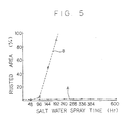
- Fig. 5 is a graph comparing the materials treated by the method of this invention and by the conventional method with respect to the rusted area in relation to the salt water spray time.
- the concentration of the reaction substance for the dissolving reaction of iron represented by formula (2) it is preferable to employ both the oxidizing agent, such as NO 2 , and the hydrogen ions at high concentrations, but for the film forming reaction of formulas (3) and (4), it is necessary to maintain the concentration of hydrogen ions at or below a certain level.
- the electrode potential it is necessary to ensure at least that the potential of reaction of the oxidising agent (potential of the cathode reaction) be higher than the potential of dissolving reaction of steel (anode potential).
- the requirement (a) is satisfied by a bath containing phosphoric acid ions, nitrate ions, zinc-ions and the others as its principal component and an alkali, e.g. caustic soda, as its auxiliary component and having a pH range of 2.5 to 4-5 and an ORP range of 150 to 550 mV.
- the requirement (b) is satisfied by a bath (1) containing at least 2 g of phosphoric acid ions per liter, (2) having a sufficiently low sludge content and (3) having a pH range of 2.5 to 4.5 and an ORP range of 150 to 550 mV.
- auxiliary component containing OH - which is one of the salient features of this invention, is necessary for converting NO 3 - to NO 2 - in the bath.
- auxiliary component containing OH - which is one of the salient features of this invention, is necessary for converting NO 3 - to NO 2 - in the bath.
- H 2 PO 4 - and Zn 2+ show a positive decrease with the formation of a film.
- the bath has an ORP range of 150 to 550 mV. If its ORP has increased, the auxiliary component (alkali) is added to the bath so that the anode reaction of formula (6) may take place to lower its ORP.
- the bath has a pH range of 2.5 to 4.5. If the pH of the bath has exceeded a particular level between 2.5 and 4.5, the principal component, which is an acidic solution, is added to the bath, and if it has dropped below that level, the auxiliary component (alkali) is added to the bath, so that its pH may be maintained within the specific range. (The addition of the principal component raises the ORP of the bath.)
- the reaction of formula (6) is an anode reaction, while that of formula (7) is a cathode reaction, and the NC 3 - ions in the bath are thereby converted to NO 3 - .
- the NO 2 - ions are a strong "ligand" according to the chemistry of complex salts.
- the reaction of formula (7), etc removes NO 3 - from a bath having a high temperature (40°C or above), as from a bath at an ambient temperature. This is, however, not as a result of electrochemical reaction, but mainly due to a reduction in the heat content ( ⁇ H) of the reaction system.
- the alkali which can be used as the auxiliary component is not only sodium or potassium hydroxide, but also sodium carbonate or any other salt that forms an alkaline aqueous solution. It is also possible to use ZnO 2 2- .
- the method of this invention employs a wider pH range, though a narrower ORP range, than that of Patent Application No. 152150/1983. A brief discussion of these differences will hereinafter be made.
- the narrower ORP range is due to the fact that the method of this invention does not use free NO 2 - .
- the ORP of the bath is affected more easily by the presence of free radicals than by any other factor. According to the method of this invention, the bath hardly contains any free NO 2 - and its ORP can, therefore, be kept in a low and narrow range.
- This invention enables a higher and wider pH range than the method of Patent Application No. 152150/1983. This is also due to the absence of free NO 2 - in the bath.
- the conventional high temperature bath has usually a pH range of 3.0 to 3.4 if it is used for treatment by spraying, or a pH range of 1.0 to 3.0 if it is used for dipping treatment.
- the bath temperature not exceeding 40°C makes it difficult for sludge to form in the bath and the reactions of formulas (3) and (4) take place mainly on the steel surface. This enables the bath to have a wider pH range of 2.5 to 4.5. If its pH is lower than 2.5, the film forming reactions of formulas (3) and (4) are restricted.
- the bath employed by the method of this invention has an ORP range of 150 to 550 mV. It is low as compared with the oxidation-reduction potential of about 500 mV or higher of the bath which has hitherto been used at a high temperature.
- the high ORP of the conventional bath is apparently due to the synergism of two factors, i.e., that the self-decomposition of the bath components is promoted by heat and necessitates the constant supply of a large amount of oxidizing agent in addition to the principal component such as phosphoric acid, and that the bath is held at a high temperature.
- the method of this invention it is possible to promote the electrochemical film-forming reaction with an ideally high degree of efficiency in a wider - pH range and a lower oxidation-reduction potential range (not exceeding 550 mV) than those of the conventional bath, since the bath is substantially free from any sludge and has a low temperature, and since no oxidizing agent, such as NO 2 - , is added directly to the bath.
- FIGURE 1 shows the pH and oxidation-reduction potential ranges of the bath which is employed by this invention.
- the rectangle marked “A” in FIGURE 1 indicates the pH and ORP ranges defined by this invention.
- Iron and steel are the metal materials which can be treated by the method of this invention.
- the term "iron and steel” does not simply mean ordinary iron and steel, but also covers alloy steel and surface-treated steel such as galvanized steel plate.
- the concentration control of the bath can be effected automatically in accordance with the results of measurement of its pH and ORP, as the film forming reaction proceeds electrochemically. If steel is placed in the bath, its principal component (H 2 PO 4 - , Zn 2+ and NO 2 - form- ing a coordinate bond with Zn 2+ ) reacts with the steel and is removed from the bath by forming a coating cn the steel.
- the pH and ORP of the bath are correlated to the concentra- tion of the principal component.
- the bath now contains a relatively large amount of NO 3 - . Accordingly, the pH of the bath decreases and its ORP increases. If the auxiliary component (alkali) is added to the bath, the reactions of formulas (6) and (7) take place to convert NO 3 - to NO 2 - (NO 2 - forming a coordinate bond) to thereby raise the pH of the bath and lower its ORP.
- auxiliary component alkali
- valve for supplying the principal component so that it may, for example, open when the pH of the bath has risen above 3.2 and close when it has dropped below 3.2.
- auxiliary component alkali
- the supply of the auxiliary component can likewise be controlled. It is, for example, effective to adapt a valve for supplying it so that it may open when the oxidation-reduction potential of the bath has risen above 430 mV and close when it has dropped below 430 mV. Both of the pH and ORP are very easy to determine electrically without recurring any chemical analysis. It is, therefore, easy to realize the automatic control of the bath.
- Examples of the bath are a bath containing the principal component A [3800 mg/l of Zn 2+ , 10,000 mg, l of H 2 PO 4 - , 2600 mg/l of NO 3 - (containing NO 2 - forming a coordinate bond), 10 to 15 mg/l of Ni 2+ , etc.] and having a pH range of 3.0 to 3.4, and a bath containing the principal component B [1600 mg/l of Zn 2+ , 4800 mg/l of H-PC 4 - , 960 mg/l of NO 3 - (containing NO2 forming a coordinate bond), 4 to 5 mg/l of Ni 2+ , etc.] and having a pH range of 3.8 to 4.1
- the auxiliary component may be an aqueous solution containing 1 to 10% by weight cf sodium hydroxide (NaOH) and added to the bath containing the principal component A or B.
- the phosphate coating obtained by the method of this invention is higher in density than the coating formed by the conventional method.
- the higher density means the improved corrosion resistance of the paint applied to the coating and the improved stretchability of the coating during, for example, cold forming.
- the excellent coating owes itself to a reason which can be explained by the experience relating to the electrochemical reaction taking place on the metal surface which is, for example, plated. It is known from experience that an increase in the overvoltage of the metal (electrode) surface gives a higher density and a higher stability to the electrodeposit coating) formed thereon if the anions in the solution are of the same composition and concentration.
- the method of this invention is superior to the conventional method not only in the density and stability of the phosphate coating which it forms, but also in the ease of bath control and even its automatic control, since it enables the bath control based on the measurement of its pH and oxidation-reduction potential. Moreover, it employs a bath at an ambient temperature not exceeding 40°C and does not require the heating of the bath, as opposed to the conventional method. This means a reduction in the consumption of energy. Moreover, it enables a reduction in the self-decomposition cf the bath components and thereby the efficient use thereof. It reduces to a half or less the quantity of the bath components which has hitherto been required. This enables a drastic reduction in the sludge formed in the bath. The method of this invention can be carried out by a simpler apparatus, as it does not require any settling tank that has been essential for the conventional bath.
- a principal component supply pipe 22 extending from a principal component tank 2 and having a solenoid valve 21 and an auxiliary component supply pipe 25 extending from an auxiliary component tank 3 and having a solenoid valve 24 were connected to a treatment tank 1 holding 0.8 m 3 of a bath containing 3800 mg/l of zinc ions, 10,000 mg/l of phosphoric acid ions, 2600 mg/l of nitric acid ions (containing NO 2 - forming a coordinate bond) and 10 to 15 mg/l of nickel, as shown schematically in FIGURE 3.
- the solenoid valves 21 and 24 were electrically connected to each other by an electric circuit (not shown) adapted for opening or closing by a pH meter 23 and an oxidation-reduction potential meter 33, which were immersed in the bath, so that the valve 21 might open tc supply the principal component from the tank 2 to the tank 1 with an increase in the pH of the bath to 3.2 or above and close with a drop in the pH of the bath to 3.2 or below, and so that the valve 24 might open and supply the auxiliary component from a drop in the tank 3 tc the tank 1 with/the pH of the bath to below 3.2 and close with its rise to 3.2 or above.
- the solenoid valve 24 was elso adapted to open and supply the auxiliary component from the tank 3 to the tank 1 if the oxidation- reduction potential meter (silver chloride electrode 33 indicated a potential of 230 mV or above (AgCl electrode potential), and close if it indicated a potential of 230 mV or below (AgCl electrode potential).
- a spray pipe 4 was provided on the sidewall of the tank 1 and connected through a pump 5 to two vertically spaced apart rows 6 of spray nozzles disposed above the tank 1 to spray the bath against the surface of the work-piece W .
- the principal component used for replenishing purposes was an acidic aqueous solution supplying 1.4 g of zinc, 4.0 g of phosphoric acid, 0.8 g of nitric acid and 0.05 g of nickel per minute, and the auxiliary component was an aqueous solution supplying 0.14 g of OH per minute.
- the work-piece was a pulley for an AC generator for an automobile made by press forming cold rolled steel plate or cutting casting steel (FC-15) and having a diameter of about 6 to 9 cm.
- the work was decreased by spraying an aqueous alkali solution at 55°C for two minutes, washed in water at 45°C for 0.5 minute, washed by spraying water at an ambient temperature (20°C to 30°C) for C.5 minute, subjected to phosphate coating treatment by spraying the bath at an ambient temperature (20°C to 30°C) for two minutes by the apparatus of FIGURE 3, washed by spraying water at an ambient temperature for 0.5 minute, washed by spraying water at an ambient temperature for 0.5 minute and dried by hot air at 80°C to 90°C for two minutes, whereby a phosphate coating consisting mainly of zinc phosphate was formed on the work-piece surface. Two thousand pieces of work were treated per hour by this apparatus, while the bath was controlled fully automatically. The treatment, was continued for 100 days and nothing abnormal was found in the bath.
- FIGURES 3 and 4 The records of automatic control of the bath are shown in FIGURES 3 and 4.
- FIGURE 3 is a typical representation of a part of the pH recorder.
- the abscissas denote the pH value and the ordinates denote time.
- the crdinates are graduated in hours.
- the area marked [C] in FIGURE 3 represents the records of control achieved by supplying the principal component when the pH of the bath rose to 3.2 or above and discontinuing its supply when the pH dropped to 3.2 or below.
- the pH values were always 3.2 or higher despite the constant supply of the principal component consisting of an acidic solution, because the ORP control of the bath maintained a constant supply of the auxiliary component (sodium hydroxide sclution) in the bath by adding it if the pH of the bath dropped below 3.2.
- the auxiliary component sodium hydroxide sclution
- the bath was used for treatment for 16 hours a day. The bath was ar a temperature of 23°C to 35°C.
- the pH of the bath did not show any appreciable change irrespective of the presence of the steel to be treated therein. This is obviously due to the fact that the ions in the bath, such as Zn 2+ , H 2 PO 4 - and NO 2 - , formed coordinate bonds with one another, as hereinbefore stated. (The ratio of N03 to NO 2 forming a coordinate bond is not clear, nor is its clarification required.)
- the pH range shown at [D] in FIGURE 3 is of the bath in which no steel was present, and hardly differs from the range shovm [C].
- FIGURE 4 shows a part of the ORP recorder.
- the abscissas denote the oxidation-reduction potential and the ordinates denote time. The ordinates are graduated in hours.
- pH and ORP values herein shown are those as measured at the temperature at which the bath was used, as hereinbefore stated, and do not take the temperature coefficient of formula (13) into consideration.
- the auxiliary component (alkali) was supplied to the bath when its ORP had risen to a level of 230 mV or above (AgCl electrode potential), and its supply was discontinued when the ORP had dropped to 230 mV or below (AgCl electrode potential).
- the ORP of the bath was maintained in the range of 230 + 10 mV (AgCl electrode potential).
- the method of this invention enables the fully automatic electrochemical control of the bath as hereinabove described. It is, however, necessary to prevent any electrochemical reaction between the bath and the material of the treatment tank. It is, therefore, desirable to make the tank of highly insulated construction (for example, by lining it with rubber).
- a black urethane-epoxy resin paint was sprayed onto the material on which a phosphate coating had been formed as hereinabove described.
- the paint was allowed to set for three minutes and baked for six minutes in a baking furnace having a temperature of 180°C to yield a coated film having a thickness of 8 to 12 ⁇ .
- a salt spray test was conducted in accordance with the procedure of JIS k-5400-7.8 to examine the corrosion resistance of the coated film. The results are shown in FIGURE 5.
- Curve A in FIGURE 5 shows the rusted area of the coated material treated according to the method of this invention in relation to the salt spray time.
- Curve B shows the results obtained on the coated material treated according to the conventional method.
- the material on which the phosphate coating had been formed by the method of this invention showed a drastic improvement in corrosion resistance over the material which had been treated with the conventional bath having a high temperature exceeding 40°C (i.e. having a temperature of 50°C to 55°C, a pH range of 3.1 to 3.3 and an ORP range of 730 to 750 mV, its principal component being equal in composition to that of the bath employed by the method of this invention).
Landscapes
- Chemical & Material Sciences (AREA)
- General Chemical & Material Sciences (AREA)
- Chemical Kinetics & Catalysis (AREA)
- Engineering & Computer Science (AREA)
- Materials Engineering (AREA)
- Mechanical Engineering (AREA)
- Metallurgy (AREA)
- Organic Chemistry (AREA)
- Chemical Treatment Of Metals (AREA)
Applications Claiming Priority (2)
| Application Number | Priority Date | Filing Date | Title |
|---|---|---|---|
| JP93643/84 | 1984-05-09 | ||
| JP59093643A JPS60238486A (ja) | 1984-05-09 | 1984-05-09 | 鉄鋼表面にリン酸塩化成被膜を形成する方法 |
Publications (3)
| Publication Number | Publication Date |
|---|---|
| EP0162345A2 true EP0162345A2 (de) | 1985-11-27 |
| EP0162345A3 EP0162345A3 (en) | 1987-12-16 |
| EP0162345B1 EP0162345B1 (de) | 1990-04-18 |
Family
ID=14088044
Family Applications (1)
| Application Number | Title | Priority Date | Filing Date |
|---|---|---|---|
| EP85105225A Expired - Lifetime EP0162345B1 (de) | 1984-05-09 | 1985-04-29 | Verfahren zur Herstellung eines Phosphatüberzugs auf einer Stahloberfläche auf chemischem Wege |
Country Status (5)
| Country | Link |
|---|---|
| US (1) | US4657600A (de) |
| EP (1) | EP0162345B1 (de) |
| JP (1) | JPS60238486A (de) |
| KR (1) | KR890004789B1 (de) |
| DE (1) | DE3577216D1 (de) |
Cited By (2)
| Publication number | Priority date | Publication date | Assignee | Title |
|---|---|---|---|---|
| EP0271069A3 (en) * | 1986-12-09 | 1989-04-19 | Nippondenso Co., Ltd. | Process for the phosphate chemical conversion treatment of a steel material |
| EP0513598A1 (de) * | 1991-05-01 | 1992-11-19 | Nippondenso Co., Ltd. | Verfahren zur chemischen Behandlung mit Phosphat |
Families Citing this family (5)
| Publication number | Priority date | Publication date | Assignee | Title |
|---|---|---|---|---|
| US4774145A (en) * | 1985-11-07 | 1988-09-27 | Nippondenso Co., Ltd. | Zinc phosphate chemical conversion film and method for forming the same |
| US5236565A (en) * | 1987-04-11 | 1993-08-17 | Metallgesellschaft Aktiengesellschaft | Process of phosphating before electroimmersion painting |
| US5645706A (en) * | 1992-04-30 | 1997-07-08 | Nippondenso Co., Ltd. | Phosphate chemical treatment method |
| DE19703641B4 (de) * | 1997-01-31 | 2006-10-19 | Marx, Joachim, Dr. | Verfahren zum Herstellen geschweißter Hohlkörper mit verbessertem Korrosionsschutz und auf diese Weise hergestellte Hohlkörper |
| CN102094195B (zh) * | 2011-01-14 | 2012-07-18 | 中国科学院宁波材料技术与工程研究所 | 一种金属材料表面的磷化处理方法 |
Family Cites Families (9)
| Publication number | Priority date | Publication date | Assignee | Title |
|---|---|---|---|---|
| DE872298C (de) * | 1943-07-01 | 1953-03-30 | Metallgesellschaft Ag | Phosphatierungsverfahren |
| AT282285B (de) * | 1965-12-22 | 1970-06-25 | Plaut Fa J | Zinkphosphatüberzüge |
| US3939014A (en) * | 1974-11-20 | 1976-02-17 | Amchem Products, Inc. | Aqueous zinc phosphating solution and method of rapid coating of steel for deforming |
| FR2308696A1 (fr) * | 1975-04-23 | 1976-11-19 | Ici Ltd | Procede de phosphatation |
| JPS52141439A (en) * | 1976-04-27 | 1977-11-25 | Nippon Paint Co Ltd | Method of managing chemicallconversion treating liquid for acidic phosphate coating |
| JPS5456038A (en) * | 1977-10-12 | 1979-05-04 | Nippon Paint Co Ltd | Controlling method for acidic phosphate film forming liquid |
| JPS58199874A (ja) * | 1982-05-18 | 1983-11-21 | Nippon Denso Co Ltd | 鉄鋼表面に隣酸塩化成被膜を形成する方法 |
| DE3244715A1 (de) * | 1982-12-03 | 1984-06-07 | Gerhard Collardin GmbH, 5000 Köln | Verfahren zur phosphatierung von metalloberflaechen sowie hierfuer geeignete badloesungen |
| JPS6043491A (ja) * | 1983-08-19 | 1985-03-08 | Nippon Denso Co Ltd | 鉄鋼表面に燐酸塩化成被膜を形成する方法 |
-
1984
- 1984-05-09 JP JP59093643A patent/JPS60238486A/ja active Granted
-
1985
- 1985-04-24 KR KR1019850002765A patent/KR890004789B1/ko not_active Expired
- 1985-04-29 DE DE8585105225T patent/DE3577216D1/de not_active Expired - Lifetime
- 1985-04-29 EP EP85105225A patent/EP0162345B1/de not_active Expired - Lifetime
- 1985-05-07 US US06/731,523 patent/US4657600A/en not_active Expired - Lifetime
Cited By (3)
| Publication number | Priority date | Publication date | Assignee | Title |
|---|---|---|---|---|
| EP0271069A3 (en) * | 1986-12-09 | 1989-04-19 | Nippondenso Co., Ltd. | Process for the phosphate chemical conversion treatment of a steel material |
| EP0513598A1 (de) * | 1991-05-01 | 1992-11-19 | Nippondenso Co., Ltd. | Verfahren zur chemischen Behandlung mit Phosphat |
| US5336336A (en) * | 1991-05-01 | 1994-08-09 | Nippondenso Co., Ltd. | Process for chemical treatment with phosphate |
Also Published As
| Publication number | Publication date |
|---|---|
| EP0162345B1 (de) | 1990-04-18 |
| KR890004789B1 (ko) | 1989-11-27 |
| KR850008504A (ko) | 1985-12-18 |
| JPS60238486A (ja) | 1985-11-27 |
| DE3577216D1 (de) | 1990-05-23 |
| US4657600A (en) | 1987-04-14 |
| EP0162345A3 (en) | 1987-12-16 |
| JPH0442472B2 (de) | 1992-07-13 |
Similar Documents
| Publication | Publication Date | Title |
|---|---|---|
| US4565585A (en) | Method for forming a chemical conversion phosphate film on the surface of steel | |
| Abrantes et al. | On the mechanism of electroless Ni‐P plating | |
| AU608374B2 (en) | Conversion coating solution for treating metal surfaces | |
| US20010054557A1 (en) | Electroplating of metals using pulsed reverse current for control of hydrogen evolution | |
| EP0972862A2 (de) | Verfahren zur Herstellung eines Phosphatfilmes auf Stahldrähten und Vorrichtung | |
| US4363708A (en) | Process for exposing silicon crystals on the surface of a component of an aluminum alloy of high silicon content | |
| EP0162345B1 (de) | Verfahren zur Herstellung eines Phosphatüberzugs auf einer Stahloberfläche auf chemischem Wege | |
| US5628893A (en) | Halogen tin composition and electrolytic plating process | |
| KR900007534B1 (ko) | 강철재를 위한 인산염의 화학적 변환처리방법 | |
| US3520737A (en) | Processes for the production of zinc phosphate coatings | |
| US2326309A (en) | Method of producing phosphate coatings on ferrous metal articles | |
| US3333988A (en) | Phosphate coating process | |
| JPH08134661A (ja) | 金属表面のリン酸亜鉛皮膜形成方法 | |
| US4086103A (en) | Accelerator for phosphating solutions | |
| KR900000302B1 (ko) | 강표면상에 화성처리인산염피막을 형성시키는 방법 | |
| GB2032963A (en) | Non-chromate Conversion Coating Solutions | |
| US4443273A (en) | Method for replenishing chemical in zinc phosphate treatment | |
| JP3256009B2 (ja) | ぶりき材表面処理液及び表面処理方法 | |
| CA2236512C (en) | Process of phosphatizing metal surfaces | |
| US4774145A (en) | Zinc phosphate chemical conversion film and method for forming the same | |
| JP3274917B2 (ja) | 鉄鋼用りん酸マンガン系化成処理液及び化成皮膜形成方法 | |
| KR930007924B1 (ko) | 상온형 화성피막제 조성물 | |
| JPS6344837B2 (de) | ||
| JPH0411630B2 (de) | ||
| JPH0379438B2 (de) |
Legal Events
| Date | Code | Title | Description |
|---|---|---|---|
| PUAI | Public reference made under article 153(3) epc to a published international application that has entered the european phase |
Free format text: ORIGINAL CODE: 0009012 |
|
| AK | Designated contracting states |
Designated state(s): DE FR GB IT |
|
| PUAL | Search report despatched |
Free format text: ORIGINAL CODE: 0009013 |
|
| AK | Designated contracting states |
Kind code of ref document: A3 Designated state(s): DE FR GB IT |
|
| 17P | Request for examination filed |
Effective date: 19871211 |
|
| 17Q | First examination report despatched |
Effective date: 19890216 |
|
| GRAA | (expected) grant |
Free format text: ORIGINAL CODE: 0009210 |
|
| AK | Designated contracting states |
Kind code of ref document: B1 Designated state(s): DE FR GB IT |
|
| REF | Corresponds to: |
Ref document number: 3577216 Country of ref document: DE Date of ref document: 19900523 |
|
| ITF | It: translation for a ep patent filed | ||
| ET | Fr: translation filed | ||
| REG | Reference to a national code |
Ref country code: GB Ref legal event code: 746 |
|
| PLBE | No opposition filed within time limit |
Free format text: ORIGINAL CODE: 0009261 |
|
| STAA | Information on the status of an ep patent application or granted ep patent |
Free format text: STATUS: NO OPPOSITION FILED WITHIN TIME LIMIT |
|
| ITPR | It: changes in ownership of a european patent |
Owner name: OFFERTA DI LICENZA AL PUBBLICO |
|
| 26N | No opposition filed | ||
| ITTA | It: last paid annual fee | ||
| REG | Reference to a national code |
Ref country code: FR Ref legal event code: DL |
|
| PGFP | Annual fee paid to national office [announced via postgrant information from national office to epo] |
Ref country code: FR Payment date: 20010409 Year of fee payment: 17 |
|
| PGFP | Annual fee paid to national office [announced via postgrant information from national office to epo] |
Ref country code: DE Payment date: 20010423 Year of fee payment: 17 |
|
| PGFP | Annual fee paid to national office [announced via postgrant information from national office to epo] |
Ref country code: GB Payment date: 20010425 Year of fee payment: 17 |
|
| REG | Reference to a national code |
Ref country code: GB Ref legal event code: IF02 |
|
| PG25 | Lapsed in a contracting state [announced via postgrant information from national office to epo] |
Ref country code: GB Free format text: LAPSE BECAUSE OF NON-PAYMENT OF DUE FEES Effective date: 20020429 |
|
| PG25 | Lapsed in a contracting state [announced via postgrant information from national office to epo] |
Ref country code: DE Free format text: LAPSE BECAUSE OF NON-PAYMENT OF DUE FEES Effective date: 20021101 |
|
| GBPC | Gb: european patent ceased through non-payment of renewal fee |
Effective date: 20020429 |
|
| PG25 | Lapsed in a contracting state [announced via postgrant information from national office to epo] |
Ref country code: FR Free format text: LAPSE BECAUSE OF NON-PAYMENT OF DUE FEES Effective date: 20021231 |
|
| REG | Reference to a national code |
Ref country code: FR Ref legal event code: ST |