EP0162017B1 - Homo- und Copolymere, Verfahren zu deren Vernetzung und derenVerwendung - Google Patents
Homo- und Copolymere, Verfahren zu deren Vernetzung und derenVerwendung Download PDFInfo
- Publication number
- EP0162017B1 EP0162017B1 EP85810222A EP85810222A EP0162017B1 EP 0162017 B1 EP0162017 B1 EP 0162017B1 EP 85810222 A EP85810222 A EP 85810222A EP 85810222 A EP85810222 A EP 85810222A EP 0162017 B1 EP0162017 B1 EP 0162017B1
- Authority
- EP
- European Patent Office
- Prior art keywords
- aromatic
- radical
- atoms
- substituted
- group
- Prior art date
- Legal status (The legal status is an assumption and is not a legal conclusion. Google has not performed a legal analysis and makes no representation as to the accuracy of the status listed.)
- Expired - Lifetime
Links
- 238000000034 method Methods 0.000 title claims description 22
- 229920001577 copolymer Polymers 0.000 title claims description 21
- 229920001519 homopolymer Polymers 0.000 title claims description 9
- 238000004132 cross linking Methods 0.000 title description 3
- -1 phenyloxy Chemical group 0.000 claims description 131
- 125000004432 carbon atom Chemical group C* 0.000 claims description 89
- 125000003118 aryl group Chemical group 0.000 claims description 54
- 229920000642 polymer Polymers 0.000 claims description 45
- 125000000217 alkyl group Chemical group 0.000 claims description 44
- 239000004642 Polyimide Substances 0.000 claims description 31
- 229920001721 polyimide Polymers 0.000 claims description 31
- 125000001997 phenyl group Chemical group [H]C1=C([H])C([H])=C(*)C([H])=C1[H] 0.000 claims description 25
- 125000002496 methyl group Chemical group [H]C([H])([H])* 0.000 claims description 23
- 125000003545 alkoxy group Chemical group 0.000 claims description 21
- 125000004435 hydrogen atom Chemical group [H]* 0.000 claims description 21
- 125000002947 alkylene group Chemical group 0.000 claims description 17
- 125000004183 alkoxy alkyl group Chemical group 0.000 claims description 15
- 125000004433 nitrogen atom Chemical group N* 0.000 claims description 15
- 125000001424 substituent group Chemical group 0.000 claims description 15
- 125000001495 ethyl group Chemical group [H]C([H])([H])C([H])([H])* 0.000 claims description 14
- 125000001797 benzyl group Chemical group [H]C1=C([H])C([H])=C(C([H])=C1[H])C([H])([H])* 0.000 claims description 13
- 150000001875 compounds Chemical class 0.000 claims description 13
- 239000000463 material Substances 0.000 claims description 13
- 239000000203 mixture Substances 0.000 claims description 13
- 125000001449 isopropyl group Chemical group [H]C([H])([H])C([H])(*)C([H])([H])[H] 0.000 claims description 11
- 125000001931 aliphatic group Chemical group 0.000 claims description 10
- 125000000753 cycloalkyl group Chemical group 0.000 claims description 10
- 238000004519 manufacturing process Methods 0.000 claims description 10
- 125000000383 tetramethylene group Chemical group [H]C([H])([*:1])C([H])([H])C([H])([H])C([H])([H])[*:2] 0.000 claims description 10
- 125000003710 aryl alkyl group Chemical group 0.000 claims description 9
- 229920000728 polyester Polymers 0.000 claims description 9
- 230000005855 radiation Effects 0.000 claims description 9
- 125000003258 trimethylene group Chemical group [H]C([H])([*:2])C([H])([H])C([H])([H])[*:1] 0.000 claims description 9
- 125000004414 alkyl thio group Chemical group 0.000 claims description 8
- 239000004952 Polyamide Substances 0.000 claims description 7
- 125000006350 alkyl thio alkyl group Chemical group 0.000 claims description 7
- 229920002647 polyamide Polymers 0.000 claims description 7
- 229920000647 polyepoxide Polymers 0.000 claims description 7
- 238000002360 preparation method Methods 0.000 claims description 7
- 230000001681 protective effect Effects 0.000 claims description 7
- 239000004962 Polyamide-imide Substances 0.000 claims description 6
- 229920002312 polyamide-imide Polymers 0.000 claims description 6
- 229920000570 polyether Polymers 0.000 claims description 6
- 229920001296 polysiloxane Polymers 0.000 claims description 6
- 239000000758 substrate Substances 0.000 claims description 6
- 229920003055 poly(ester-imide) Polymers 0.000 claims description 5
- 125000004123 n-propyl group Chemical group [H]C([H])([H])C([H])([H])C([H])([H])* 0.000 claims description 4
- 125000000951 phenoxy group Chemical group [H]C1=C([H])C([H])=C(O*)C([H])=C1[H] 0.000 claims description 4
- 229920001643 poly(ether ketone) Polymers 0.000 claims description 4
- 229920006149 polyester-amide block copolymer Polymers 0.000 claims description 4
- 229920006393 polyether sulfone Polymers 0.000 claims description 4
- 229920001470 polyketone Polymers 0.000 claims description 4
- 229920006295 polythiol Polymers 0.000 claims description 4
- 229920006305 unsaturated polyester Polymers 0.000 claims description 4
- 125000000051 benzyloxy group Chemical group [H]C1=C([H])C([H])=C(C([H])=C1[H])C([H])([H])O* 0.000 claims description 3
- 125000000623 heterocyclic group Chemical group 0.000 claims description 3
- 229920000515 polycarbonate Polymers 0.000 claims description 3
- 239000004417 polycarbonate Substances 0.000 claims description 3
- 239000011241 protective layer Substances 0.000 claims description 3
- 229920006395 saturated elastomer Polymers 0.000 claims description 3
- 238000000576 coating method Methods 0.000 claims description 2
- 229920006037 cross link polymer Polymers 0.000 claims description 2
- 125000005842 heteroatom Chemical group 0.000 claims description 2
- 239000003960 organic solvent Substances 0.000 claims description 2
- 238000002161 passivation Methods 0.000 claims description 2
- 125000003356 phenylsulfanyl group Chemical group [*]SC1=C([H])C([H])=C([H])C([H])=C1[H] 0.000 claims description 2
- 125000004191 (C1-C6) alkoxy group Chemical group 0.000 claims 1
- MALIONKMKPITBV-UHFFFAOYSA-N 2-(3-chloro-4-hydroxyphenyl)-n-[2-(4-sulfamoylphenyl)ethyl]acetamide Chemical compound C1=CC(S(=O)(=O)N)=CC=C1CCNC(=O)CC1=CC=C(O)C(Cl)=C1 MALIONKMKPITBV-UHFFFAOYSA-N 0.000 claims 1
- KCNKJCHARANTIP-SNAWJCMRSA-N allyl-{4-[3-(4-bromo-phenyl)-benzofuran-6-yloxy]-but-2-enyl}-methyl-amine Chemical compound C=1OC2=CC(OC/C=C/CN(CC=C)C)=CC=C2C=1C1=CC=C(Br)C=C1 KCNKJCHARANTIP-SNAWJCMRSA-N 0.000 claims 1
- JYNZIOFUHBJABQ-UHFFFAOYSA-N allyl-{6-[3-(4-bromo-phenyl)-benzofuran-6-yloxy]-hexyl-}-methyl-amin Chemical compound C=1OC2=CC(OCCCCCCN(C)CC=C)=CC=C2C=1C1=CC=C(Br)C=C1 JYNZIOFUHBJABQ-UHFFFAOYSA-N 0.000 claims 1
- SYGWYBOJXOGMRU-UHFFFAOYSA-N chembl233051 Chemical compound C1=CC=C2C3=CC(C(N(CCN(C)C)C4=O)=O)=C5C4=CC=CC5=C3SC2=C1 SYGWYBOJXOGMRU-UHFFFAOYSA-N 0.000 claims 1
- 230000001678 irradiating effect Effects 0.000 claims 1
- 150000003254 radicals Chemical class 0.000 description 37
- 150000004985 diamines Chemical class 0.000 description 27
- 150000001991 dicarboxylic acids Chemical class 0.000 description 24
- 150000002009 diols Chemical class 0.000 description 21
- GTDPSWPPOUPBNX-UHFFFAOYSA-N ac1mqpva Chemical compound CC12C(=O)OC(=O)C1(C)C1(C)C2(C)C(=O)OC1=O GTDPSWPPOUPBNX-UHFFFAOYSA-N 0.000 description 16
- 125000001989 1,3-phenylene group Chemical group [H]C1=C([H])C([*:1])=C([H])C([*:2])=C1[H] 0.000 description 13
- 239000002253 acid Substances 0.000 description 11
- 239000002904 solvent Substances 0.000 description 10
- HEDRZPFGACZZDS-UHFFFAOYSA-N Chloroform Chemical compound ClC(Cl)Cl HEDRZPFGACZZDS-UHFFFAOYSA-N 0.000 description 9
- OFOBLEOULBTSOW-UHFFFAOYSA-N Malonic acid Chemical compound OC(=O)CC(O)=O OFOBLEOULBTSOW-UHFFFAOYSA-N 0.000 description 8
- 206010034972 Photosensitivity reaction Diseases 0.000 description 8
- 230000036211 photosensitivity Effects 0.000 description 8
- 125000001118 alkylidene group Chemical group 0.000 description 7
- 150000004820 halides Chemical class 0.000 description 7
- 229910052736 halogen Inorganic materials 0.000 description 7
- SECXISVLQFMRJM-UHFFFAOYSA-N N-Methylpyrrolidone Chemical compound CN1CCCC1=O SECXISVLQFMRJM-UHFFFAOYSA-N 0.000 description 6
- ZMANZCXQSJIPKH-UHFFFAOYSA-N Triethylamine Chemical compound CCN(CC)CC ZMANZCXQSJIPKH-UHFFFAOYSA-N 0.000 description 6
- 125000002915 carbonyl group Chemical group [*:2]C([*:1])=O 0.000 description 6
- 150000002367 halogens Chemical class 0.000 description 6
- 125000003178 carboxy group Chemical group [H]OC(*)=O 0.000 description 5
- 125000000113 cyclohexyl group Chemical group [H]C1([H])C([H])([H])C([H])([H])C([H])(*)C([H])([H])C1([H])[H] 0.000 description 5
- 238000010438 heat treatment Methods 0.000 description 5
- 150000003949 imides Chemical group 0.000 description 5
- 239000010410 layer Substances 0.000 description 5
- 239000000178 monomer Substances 0.000 description 5
- 229910052757 nitrogen Inorganic materials 0.000 description 5
- 239000004215 Carbon black (E152) Substances 0.000 description 4
- VGGSQFUCUMXWEO-UHFFFAOYSA-N Ethene Chemical compound C=C VGGSQFUCUMXWEO-UHFFFAOYSA-N 0.000 description 4
- 239000005977 Ethylene Substances 0.000 description 4
- JUJWROOIHBZHMG-UHFFFAOYSA-N Pyridine Chemical compound C1=CC=NC=C1 JUJWROOIHBZHMG-UHFFFAOYSA-N 0.000 description 4
- KKEYFWRCBNTPAC-UHFFFAOYSA-N Terephthalic acid Chemical compound OC(=O)C1=CC=C(C(O)=O)C=C1 KKEYFWRCBNTPAC-UHFFFAOYSA-N 0.000 description 4
- 150000007513 acids Chemical class 0.000 description 4
- 239000000654 additive Substances 0.000 description 4
- 150000008064 anhydrides Chemical class 0.000 description 4
- 150000001491 aromatic compounds Chemical class 0.000 description 4
- 150000004984 aromatic diamines Chemical class 0.000 description 4
- BVKZGUZCCUSVTD-UHFFFAOYSA-N carbonic acid Chemical class OC(O)=O BVKZGUZCCUSVTD-UHFFFAOYSA-N 0.000 description 4
- 239000011248 coating agent Substances 0.000 description 4
- USIUVYZYUHIAEV-UHFFFAOYSA-N diphenyl ether Chemical compound C=1C=CC=CC=1OC1=CC=CC=C1 USIUVYZYUHIAEV-UHFFFAOYSA-N 0.000 description 4
- KZTYYGOKRVBIMI-UHFFFAOYSA-N diphenyl sulfone Chemical compound C=1C=CC=CC=1S(=O)(=O)C1=CC=CC=C1 KZTYYGOKRVBIMI-UHFFFAOYSA-N 0.000 description 4
- 239000003822 epoxy resin Substances 0.000 description 4
- LNEPOXFFQSENCJ-UHFFFAOYSA-N haloperidol Chemical compound C1CC(O)(C=2C=CC(Cl)=CC=2)CCN1CCCC(=O)C1=CC=C(F)C=C1 LNEPOXFFQSENCJ-UHFFFAOYSA-N 0.000 description 4
- 229930195733 hydrocarbon Natural products 0.000 description 4
- QQVIHTHCMHWDBS-UHFFFAOYSA-N isophthalic acid Chemical compound OC(=O)C1=CC=CC(C(O)=O)=C1 QQVIHTHCMHWDBS-UHFFFAOYSA-N 0.000 description 4
- 125000000843 phenylene group Chemical group C1(=C(C=CC=C1)*)* 0.000 description 4
- 238000006467 substitution reaction Methods 0.000 description 4
- BDHFUVZGWQCTTF-UHFFFAOYSA-M sulfonate Chemical compound [O-]S(=O)=O BDHFUVZGWQCTTF-UHFFFAOYSA-M 0.000 description 4
- 125000001140 1,4-phenylene group Chemical group [H]C1=C([H])C([*:2])=C([H])C([H])=C1[*:1] 0.000 description 3
- WFDIJRYMOXRFFG-UHFFFAOYSA-N Acetic anhydride Chemical compound CC(=O)OC(C)=O WFDIJRYMOXRFFG-UHFFFAOYSA-N 0.000 description 3
- UHOVQNZJYSORNB-UHFFFAOYSA-N Benzene Chemical compound C1=CC=CC=C1 UHOVQNZJYSORNB-UHFFFAOYSA-N 0.000 description 3
- KXDHJXZQYSOELW-UHFFFAOYSA-N Carbamic acid Chemical group NC(O)=O KXDHJXZQYSOELW-UHFFFAOYSA-N 0.000 description 3
- YMWUJEATGCHHMB-UHFFFAOYSA-N Dichloromethane Chemical compound ClCCl YMWUJEATGCHHMB-UHFFFAOYSA-N 0.000 description 3
- XEKOWRVHYACXOJ-UHFFFAOYSA-N Ethyl acetate Chemical compound CCOC(C)=O XEKOWRVHYACXOJ-UHFFFAOYSA-N 0.000 description 3
- ZHNUHDYFZUAESO-UHFFFAOYSA-N Formamide Chemical compound NC=O ZHNUHDYFZUAESO-UHFFFAOYSA-N 0.000 description 3
- ZMXDDKWLCZADIW-UHFFFAOYSA-N N,N-Dimethylformamide Chemical compound CN(C)C=O ZMXDDKWLCZADIW-UHFFFAOYSA-N 0.000 description 3
- SJRJJKPEHAURKC-UHFFFAOYSA-N N-Methylmorpholine Chemical compound CN1CCOCC1 SJRJJKPEHAURKC-UHFFFAOYSA-N 0.000 description 3
- RWRDLPDLKQPQOW-UHFFFAOYSA-N Pyrrolidine Chemical compound C1CCNC1 RWRDLPDLKQPQOW-UHFFFAOYSA-N 0.000 description 3
- YXFVVABEGXRONW-UHFFFAOYSA-N Toluene Chemical compound CC1=CC=CC=C1 YXFVVABEGXRONW-UHFFFAOYSA-N 0.000 description 3
- 150000001649 bromium compounds Chemical class 0.000 description 3
- 125000004956 cyclohexylene group Chemical group 0.000 description 3
- 125000001511 cyclopentyl group Chemical group [H]C1([H])C([H])([H])C([H])([H])C([H])(*)C1([H])[H] 0.000 description 3
- 125000005442 diisocyanate group Chemical group 0.000 description 3
- 150000002148 esters Chemical class 0.000 description 3
- 125000000219 ethylidene group Chemical group [H]C(=[*])C([H])([H])[H] 0.000 description 3
- 229910052739 hydrogen Inorganic materials 0.000 description 3
- 125000005462 imide group Chemical group 0.000 description 3
- 125000000956 methoxy group Chemical group [H]C([H])([H])O* 0.000 description 3
- 125000000325 methylidene group Chemical group [H]C([H])=* 0.000 description 3
- 125000004957 naphthylene group Chemical group 0.000 description 3
- 229910052760 oxygen Inorganic materials 0.000 description 3
- 125000001147 pentyl group Chemical group C(CCCC)* 0.000 description 3
- 125000001436 propyl group Chemical group [H]C([*])([H])C([H])([H])C([H])([H])[H] 0.000 description 3
- 239000011253 protective coating Substances 0.000 description 3
- UMJSCPRVCHMLSP-UHFFFAOYSA-N pyridine Natural products COC1=CC=CN=C1 UMJSCPRVCHMLSP-UHFFFAOYSA-N 0.000 description 3
- 150000003457 sulfones Chemical class 0.000 description 3
- 150000003628 tricarboxylic acids Chemical class 0.000 description 3
- QPFMBZIOSGYJDE-UHFFFAOYSA-N 1,1,2,2-tetrachloroethane Chemical compound ClC(Cl)C(Cl)Cl QPFMBZIOSGYJDE-UHFFFAOYSA-N 0.000 description 2
- PAMIQIKDUOTOBW-UHFFFAOYSA-N 1-methylpiperidine Chemical compound CN1CCCCC1 PAMIQIKDUOTOBW-UHFFFAOYSA-N 0.000 description 2
- XLLIQLLCWZCATF-UHFFFAOYSA-N 2-methoxyethyl acetate Chemical compound COCCOC(C)=O XLLIQLLCWZCATF-UHFFFAOYSA-N 0.000 description 2
- HLBLWEWZXPIGSM-UHFFFAOYSA-N 4-Aminophenyl ether Chemical compound C1=CC(N)=CC=C1OC1=CC=C(N)C=C1 HLBLWEWZXPIGSM-UHFFFAOYSA-N 0.000 description 2
- FJKROLUGYXJWQN-UHFFFAOYSA-N 4-hydroxybenzoic acid Chemical compound OC(=O)C1=CC=C(O)C=C1 FJKROLUGYXJWQN-UHFFFAOYSA-N 0.000 description 2
- DLFVBJFMPXGRIB-UHFFFAOYSA-N Acetamide Chemical compound CC(N)=O DLFVBJFMPXGRIB-UHFFFAOYSA-N 0.000 description 2
- IJGRMHOSHXDMSA-UHFFFAOYSA-N Atomic nitrogen Chemical compound N#N IJGRMHOSHXDMSA-UHFFFAOYSA-N 0.000 description 2
- 229920001634 Copolyester Polymers 0.000 description 2
- IAZDPXIOMUYVGZ-UHFFFAOYSA-N Dimethylsulphoxide Chemical compound CS(C)=O IAZDPXIOMUYVGZ-UHFFFAOYSA-N 0.000 description 2
- QIGBRXMKCJKVMJ-UHFFFAOYSA-N Hydroquinone Chemical compound OC1=CC=C(O)C=C1 QIGBRXMKCJKVMJ-UHFFFAOYSA-N 0.000 description 2
- SIKJAQJRHWYJAI-UHFFFAOYSA-N Indole Chemical compound C1=CC=C2NC=CC2=C1 SIKJAQJRHWYJAI-UHFFFAOYSA-N 0.000 description 2
- NQRYJNQNLNOLGT-UHFFFAOYSA-N Piperidine Chemical compound C1CCNCC1 NQRYJNQNLNOLGT-UHFFFAOYSA-N 0.000 description 2
- KAESVJOAVNADME-UHFFFAOYSA-N Pyrrole Chemical compound C=1C=CNC=1 KAESVJOAVNADME-UHFFFAOYSA-N 0.000 description 2
- PPBRXRYQALVLMV-UHFFFAOYSA-N Styrene Chemical compound C=CC1=CC=CC=C1 PPBRXRYQALVLMV-UHFFFAOYSA-N 0.000 description 2
- WYURNTSHIVDZCO-UHFFFAOYSA-N Tetrahydrofuran Chemical compound C1CCOC1 WYURNTSHIVDZCO-UHFFFAOYSA-N 0.000 description 2
- 125000004450 alkenylene group Chemical group 0.000 description 2
- 125000004849 alkoxymethyl group Chemical group 0.000 description 2
- 125000004104 aryloxy group Chemical group 0.000 description 2
- GCAIEATUVJFSMC-UHFFFAOYSA-N benzene-1,2,3,4-tetracarboxylic acid Chemical compound OC(=O)C1=CC=C(C(O)=O)C(C(O)=O)=C1C(O)=O GCAIEATUVJFSMC-UHFFFAOYSA-N 0.000 description 2
- RWCCWEUUXYIKHB-UHFFFAOYSA-N benzophenone Chemical group C=1C=CC=CC=1C(=O)C1=CC=CC=C1 RWCCWEUUXYIKHB-UHFFFAOYSA-N 0.000 description 2
- IISBACLAFKSPIT-UHFFFAOYSA-N bisphenol A Chemical compound C=1C=C(O)C=CC=1C(C)(C)C1=CC=C(O)C=C1 IISBACLAFKSPIT-UHFFFAOYSA-N 0.000 description 2
- 125000000484 butyl group Chemical group [H]C([*])([H])C([H])([H])C([H])([H])C([H])([H])[H] 0.000 description 2
- 238000005266 casting Methods 0.000 description 2
- MVPPADPHJFYWMZ-UHFFFAOYSA-N chlorobenzene Chemical compound ClC1=CC=CC=C1 MVPPADPHJFYWMZ-UHFFFAOYSA-N 0.000 description 2
- 239000008199 coating composition Substances 0.000 description 2
- 125000002993 cycloalkylene group Chemical group 0.000 description 2
- YQLZOAVZWJBZSY-UHFFFAOYSA-N decane-1,10-diamine Chemical compound NCCCCCCCCCCN YQLZOAVZWJBZSY-UHFFFAOYSA-N 0.000 description 2
- 125000006159 dianhydride group Chemical group 0.000 description 2
- CZZYITDELCSZES-UHFFFAOYSA-N diphenylmethane Chemical compound C=1C=CC=CC=1CC1=CC=CC=C1 CZZYITDELCSZES-UHFFFAOYSA-N 0.000 description 2
- 239000000975 dye Substances 0.000 description 2
- 238000005530 etching Methods 0.000 description 2
- 150000002170 ethers Chemical class 0.000 description 2
- 125000005745 ethoxymethyl group Chemical group [H]C([H])([H])C([H])([H])OC([H])([H])* 0.000 description 2
- MTZQAGJQAFMTAQ-UHFFFAOYSA-N ethyl benzoate Chemical compound CCOC(=O)C1=CC=CC=C1 MTZQAGJQAFMTAQ-UHFFFAOYSA-N 0.000 description 2
- 125000000524 functional group Chemical group 0.000 description 2
- 239000007789 gas Substances 0.000 description 2
- 230000009477 glass transition Effects 0.000 description 2
- 125000004051 hexyl group Chemical group [H]C([H])([H])C([H])([H])C([H])([H])C([H])([H])C([H])([H])C([H])([H])* 0.000 description 2
- 239000001257 hydrogen Substances 0.000 description 2
- 125000002887 hydroxy group Chemical group [H]O* 0.000 description 2
- CKFGINPQOCXMAZ-UHFFFAOYSA-N methanediol Chemical compound OCO CKFGINPQOCXMAZ-UHFFFAOYSA-N 0.000 description 2
- 125000004108 n-butyl group Chemical group [H]C([H])([H])C([H])([H])C([H])([H])C([H])([H])* 0.000 description 2
- LQNUZADURLCDLV-UHFFFAOYSA-N nitrobenzene Chemical compound [O-][N+](=O)C1=CC=CC=C1 LQNUZADURLCDLV-UHFFFAOYSA-N 0.000 description 2
- BDJRBEYXGGNYIS-UHFFFAOYSA-N nonanedioic acid Chemical compound OC(=O)CCCCCCCC(O)=O BDJRBEYXGGNYIS-UHFFFAOYSA-N 0.000 description 2
- WLJVNTCWHIRURA-UHFFFAOYSA-N pimelic acid Chemical compound OC(=O)CCCCCC(O)=O WLJVNTCWHIRURA-UHFFFAOYSA-N 0.000 description 2
- 239000004033 plastic Substances 0.000 description 2
- 229920003023 plastic Polymers 0.000 description 2
- 239000004848 polyfunctional curative Substances 0.000 description 2
- 229920006254 polymer film Polymers 0.000 description 2
- 239000002243 precursor Substances 0.000 description 2
- 238000007639 printing Methods 0.000 description 2
- 239000004065 semiconductor Substances 0.000 description 2
- 210000002023 somite Anatomy 0.000 description 2
- TYFQFVWCELRYAO-UHFFFAOYSA-N suberic acid Chemical compound OC(=O)CCCCCCC(O)=O TYFQFVWCELRYAO-UHFFFAOYSA-N 0.000 description 2
- 229910052717 sulfur Inorganic materials 0.000 description 2
- ARCGXLSVLAOJQL-UHFFFAOYSA-N trimellitic acid Chemical compound OC(=O)C1=CC=C(C(O)=O)C(C(O)=O)=C1 ARCGXLSVLAOJQL-UHFFFAOYSA-N 0.000 description 2
- GETQZCLCWQTVFV-UHFFFAOYSA-N trimethylamine Chemical compound CN(C)C GETQZCLCWQTVFV-UHFFFAOYSA-N 0.000 description 2
- XLYOFNOQVPJJNP-UHFFFAOYSA-N water Substances O XLYOFNOQVPJJNP-UHFFFAOYSA-N 0.000 description 2
- SZCWBURCISJFEZ-UHFFFAOYSA-N (3-hydroxy-2,2-dimethylpropyl) 3-hydroxy-2,2-dimethylpropanoate Chemical compound OCC(C)(C)COC(=O)C(C)(C)CO SZCWBURCISJFEZ-UHFFFAOYSA-N 0.000 description 1
- 125000006832 (C1-C10) alkylene group Chemical group 0.000 description 1
- 125000003161 (C1-C6) alkylene group Chemical group 0.000 description 1
- UOCLXMDMGBRAIB-UHFFFAOYSA-N 1,1,1-trichloroethane Chemical compound CC(Cl)(Cl)Cl UOCLXMDMGBRAIB-UHFFFAOYSA-N 0.000 description 1
- AVQQQNCBBIEMEU-UHFFFAOYSA-N 1,1,3,3-tetramethylurea Chemical compound CN(C)C(=O)N(C)C AVQQQNCBBIEMEU-UHFFFAOYSA-N 0.000 description 1
- WSLDOOZREJYCGB-UHFFFAOYSA-N 1,2-Dichloroethane Chemical compound ClCCCl WSLDOOZREJYCGB-UHFFFAOYSA-N 0.000 description 1
- GEYOCULIXLDCMW-UHFFFAOYSA-N 1,2-phenylenediamine Chemical compound NC1=CC=CC=C1N GEYOCULIXLDCMW-UHFFFAOYSA-N 0.000 description 1
- 125000005838 1,3-cyclopentylene group Chemical group [H]C1([H])C([H])([H])C([H])([*:2])C([H])([H])C1([H])[*:1] 0.000 description 1
- WZCQRUWWHSTZEM-UHFFFAOYSA-N 1,3-phenylenediamine Chemical compound NC1=CC=CC(N)=C1 WZCQRUWWHSTZEM-UHFFFAOYSA-N 0.000 description 1
- RYHBNJHYFVUHQT-UHFFFAOYSA-N 1,4-Dioxane Chemical compound C1COCCO1 RYHBNJHYFVUHQT-UHFFFAOYSA-N 0.000 description 1
- 125000004955 1,4-cyclohexylene group Chemical group [H]C1([H])C([H])([H])C([H])([*:1])C([H])([H])C([H])([H])C1([H])[*:2] 0.000 description 1
- CBCKQZAAMUWICA-UHFFFAOYSA-N 1,4-phenylenediamine Chemical compound NC1=CC=C(N)C=C1 CBCKQZAAMUWICA-UHFFFAOYSA-N 0.000 description 1
- NIOYEYDJTAEDFH-UHFFFAOYSA-N 1-(2-hydroxyethoxy)-2-methylpropan-2-ol Chemical compound CC(C)(O)COCCO NIOYEYDJTAEDFH-UHFFFAOYSA-N 0.000 description 1
- DGVSYJXJJQOOTG-UHFFFAOYSA-N 1-(3,4-dicarboxyphenyl)-1,3,3-trimethyl-2h-indene-5,6-dicarboxylic acid Chemical compound C12=CC(C(O)=O)=C(C(O)=O)C=C2C(C)(C)CC1(C)C1=CC=C(C(O)=O)C(C(O)=O)=C1 DGVSYJXJJQOOTG-UHFFFAOYSA-N 0.000 description 1
- IPDNVUKUQYAJFT-UHFFFAOYSA-N 1-(3-amino-4-methylphenyl)-1,3,3-trimethyl-2h-inden-5-amine Chemical compound C1=C(N)C(C)=CC=C1C1(C)C2=CC=C(N)C=C2C(C)(C)C1 IPDNVUKUQYAJFT-UHFFFAOYSA-N 0.000 description 1
- LIRNFNXOTBZTPP-UHFFFAOYSA-N 1-[2-(2-hydroxyethoxy)ethoxy]-2-methylpropan-2-ol Chemical compound CC(C)(O)COCCOCCO LIRNFNXOTBZTPP-UHFFFAOYSA-N 0.000 description 1
- YLHUPYSUKYAIBW-UHFFFAOYSA-N 1-acetylpyrrolidin-2-one Chemical compound CC(=O)N1CCCC1=O YLHUPYSUKYAIBW-UHFFFAOYSA-N 0.000 description 1
- WOXWUZCRWJWTRT-UHFFFAOYSA-N 1-amino-1-cyclohexanecarboxylic acid Chemical compound OC(=O)C1(N)CCCCC1 WOXWUZCRWJWTRT-UHFFFAOYSA-N 0.000 description 1
- DURPTKYDGMDSBL-UHFFFAOYSA-N 1-butoxybutane Chemical compound CCCCOCCCC DURPTKYDGMDSBL-UHFFFAOYSA-N 0.000 description 1
- VLDPXPPHXDGHEW-UHFFFAOYSA-N 1-chloro-2-dichlorophosphoryloxybenzene Chemical compound ClC1=CC=CC=C1OP(Cl)(Cl)=O VLDPXPPHXDGHEW-UHFFFAOYSA-N 0.000 description 1
- URUJZHZLCCIILC-UHFFFAOYSA-N 1-chloro-4-(4-chlorophenoxy)benzene Chemical compound C1=CC(Cl)=CC=C1OC1=CC=C(Cl)C=C1 URUJZHZLCCIILC-UHFFFAOYSA-N 0.000 description 1
- RRQYJINTUHWNHW-UHFFFAOYSA-N 1-ethoxy-2-(2-ethoxyethoxy)ethane Chemical compound CCOCCOCCOCC RRQYJINTUHWNHW-UHFFFAOYSA-N 0.000 description 1
- AVFZOVWCLRSYKC-UHFFFAOYSA-N 1-methylpyrrolidine Chemical compound CN1CCCC1 AVFZOVWCLRSYKC-UHFFFAOYSA-N 0.000 description 1
- GUOSQNAUYHMCRU-UHFFFAOYSA-N 11-Aminoundecanoic acid Chemical compound NCCCCCCCCCCC(O)=O GUOSQNAUYHMCRU-UHFFFAOYSA-N 0.000 description 1
- GBURUDXSBYGPBL-UHFFFAOYSA-N 2,2,3-trimethylhexanedioic acid Chemical compound OC(=O)C(C)(C)C(C)CCC(O)=O GBURUDXSBYGPBL-UHFFFAOYSA-N 0.000 description 1
- XMXCPDQUXVZBGQ-UHFFFAOYSA-N 2,3,6,7-tetrachloronaphthalene-1,4,5,8-tetracarboxylic acid Chemical compound ClC1=C(Cl)C(C(O)=O)=C2C(C(=O)O)=C(Cl)C(Cl)=C(C(O)=O)C2=C1C(O)=O XMXCPDQUXVZBGQ-UHFFFAOYSA-N 0.000 description 1
- VOZKAJLKRJDJLL-UHFFFAOYSA-N 2,4-diaminotoluene Chemical compound CC1=CC=C(N)C=C1N VOZKAJLKRJDJLL-UHFFFAOYSA-N 0.000 description 1
- SDWGBHZZXPDKDZ-UHFFFAOYSA-N 2,6-dichloronaphthalene-1,4,5,8-tetracarboxylic acid Chemical compound C1=C(Cl)C(C(O)=O)=C2C(C(=O)O)=CC(Cl)=C(C(O)=O)C2=C1C(O)=O SDWGBHZZXPDKDZ-UHFFFAOYSA-N 0.000 description 1
- JZWGLBCZWLGCDT-UHFFFAOYSA-N 2,7-dichloronaphthalene-1,4,5,8-tetracarboxylic acid Chemical compound ClC1=CC(C(O)=O)=C2C(C(=O)O)=CC(Cl)=C(C(O)=O)C2=C1C(O)=O JZWGLBCZWLGCDT-UHFFFAOYSA-N 0.000 description 1
- HIXDQWDOVZUNNA-UHFFFAOYSA-N 2-(3,4-dimethoxyphenyl)-5-hydroxy-7-methoxychromen-4-one Chemical compound C=1C(OC)=CC(O)=C(C(C=2)=O)C=1OC=2C1=CC=C(OC)C(OC)=C1 HIXDQWDOVZUNNA-UHFFFAOYSA-N 0.000 description 1
- OHKOAJUTRVTYSW-UHFFFAOYSA-N 2-[(2-aminophenyl)methyl]aniline Chemical compound NC1=CC=CC=C1CC1=CC=CC=C1N OHKOAJUTRVTYSW-UHFFFAOYSA-N 0.000 description 1
- NGNBDVOYPDDBFK-UHFFFAOYSA-N 2-[2,4-di(pentan-2-yl)phenoxy]acetyl chloride Chemical group CCCC(C)C1=CC=C(OCC(Cl)=O)C(C(C)CCC)=C1 NGNBDVOYPDDBFK-UHFFFAOYSA-N 0.000 description 1
- DNUYOWCKBJFOGS-UHFFFAOYSA-N 2-[[10-(2,2-dicarboxyethyl)anthracen-9-yl]methyl]propanedioic acid Chemical compound C1=CC=C2C(CC(C(=O)O)C(O)=O)=C(C=CC=C3)C3=C(CC(C(O)=O)C(O)=O)C2=C1 DNUYOWCKBJFOGS-UHFFFAOYSA-N 0.000 description 1
- RPKCLSMBVQLWIN-UHFFFAOYSA-N 2-n-methylbenzene-1,2-diamine Chemical compound CNC1=CC=CC=C1N RPKCLSMBVQLWIN-UHFFFAOYSA-N 0.000 description 1
- WMRCTEPOPAZMMN-UHFFFAOYSA-N 2-undecylpropanedioic acid Chemical compound CCCCCCCCCCCC(C(O)=O)C(O)=O WMRCTEPOPAZMMN-UHFFFAOYSA-N 0.000 description 1
- HSTOKWSFWGCZMH-UHFFFAOYSA-N 3,3'-diaminobenzidine Chemical group C1=C(N)C(N)=CC=C1C1=CC=C(N)C(N)=C1 HSTOKWSFWGCZMH-UHFFFAOYSA-N 0.000 description 1
- ULKFLOVGORAZDI-UHFFFAOYSA-N 3,3-dimethyloxetan-2-one Chemical compound CC1(C)COC1=O ULKFLOVGORAZDI-UHFFFAOYSA-N 0.000 description 1
- GWHLJVMSZRKEAQ-UHFFFAOYSA-N 3-(2,3-dicarboxyphenyl)phthalic acid Chemical compound OC(=O)C1=CC=CC(C=2C(=C(C(O)=O)C=CC=2)C(O)=O)=C1C(O)=O GWHLJVMSZRKEAQ-UHFFFAOYSA-N 0.000 description 1
- PEQMXHDQUPCPQJ-UHFFFAOYSA-N 3-(3,4-dicarboxyphenyl)-1,1,3-trimethyl-2h-indene-4,5-dicarboxylic acid Chemical compound C1=CC(C(O)=O)=C(C(O)=O)C2=C1C(C)(C)CC2(C)C1=CC=C(C(O)=O)C(C(O)=O)=C1 PEQMXHDQUPCPQJ-UHFFFAOYSA-N 0.000 description 1
- QPWBTLYTNOIFFC-UHFFFAOYSA-N 3-(3,4-dicarboxyphenyl)-1-methyl-2,3-dihydro-1h-indene-4,5-dicarboxylic acid Chemical compound C1=CC(C(O)=O)=C(C(O)=O)C2=C1C(C)CC2C1=CC=C(C(O)=O)C(C(O)=O)=C1 QPWBTLYTNOIFFC-UHFFFAOYSA-N 0.000 description 1
- RXGHBXDLEQVZFB-UHFFFAOYSA-N 3-(3-aminopropyl)-5,5-dimethylimidazolidine-2,4-dione Chemical compound CC1(C)NC(=O)N(CCCN)C1=O RXGHBXDLEQVZFB-UHFFFAOYSA-N 0.000 description 1
- RNLHGQLZWXBQNY-UHFFFAOYSA-N 3-(aminomethyl)-3,5,5-trimethylcyclohexan-1-amine Chemical compound CC1(C)CC(N)CC(C)(CN)C1 RNLHGQLZWXBQNY-UHFFFAOYSA-N 0.000 description 1
- YBRVSVVVWCFQMG-UHFFFAOYSA-N 4,4'-diaminodiphenylmethane Chemical compound C1=CC(N)=CC=C1CC1=CC=C(N)C=C1 YBRVSVVVWCFQMG-UHFFFAOYSA-N 0.000 description 1
- GPAPPPVRLPGFEQ-UHFFFAOYSA-N 4,4'-dichlorodiphenyl sulfone Chemical compound C1=CC(Cl)=CC=C1S(=O)(=O)C1=CC=C(Cl)C=C1 GPAPPPVRLPGFEQ-UHFFFAOYSA-N 0.000 description 1
- VPWNQTHUCYMVMZ-UHFFFAOYSA-N 4,4'-sulfonyldiphenol Chemical compound C1=CC(O)=CC=C1S(=O)(=O)C1=CC=C(O)C=C1 VPWNQTHUCYMVMZ-UHFFFAOYSA-N 0.000 description 1
- WVDRSXGPQWNUBN-UHFFFAOYSA-N 4-(4-carboxyphenoxy)benzoic acid Chemical compound C1=CC(C(=O)O)=CC=C1OC1=CC=C(C(O)=O)C=C1 WVDRSXGPQWNUBN-UHFFFAOYSA-N 0.000 description 1
- NZGQHKSLKRFZFL-UHFFFAOYSA-N 4-(4-hydroxyphenoxy)phenol Chemical compound C1=CC(O)=CC=C1OC1=CC=C(O)C=C1 NZGQHKSLKRFZFL-UHFFFAOYSA-N 0.000 description 1
- BCJIMAHNJOIWKQ-UHFFFAOYSA-N 4-[(1,3-dioxo-2-benzofuran-4-yl)oxy]-2-benzofuran-1,3-dione Chemical compound O=C1OC(=O)C2=C1C=CC=C2OC1=CC=CC2=C1C(=O)OC2=O BCJIMAHNJOIWKQ-UHFFFAOYSA-N 0.000 description 1
- ALYNCZNDIQEVRV-UHFFFAOYSA-N 4-aminobenzoic acid Chemical compound NC1=CC=C(C(O)=O)C=C1 ALYNCZNDIQEVRV-UHFFFAOYSA-N 0.000 description 1
- 229940090248 4-hydroxybenzoic acid Drugs 0.000 description 1
- VQVIHDPBMFABCQ-UHFFFAOYSA-N 5-(1,3-dioxo-2-benzofuran-5-carbonyl)-2-benzofuran-1,3-dione Chemical compound C1=C2C(=O)OC(=O)C2=CC(C(C=2C=C3C(=O)OC(=O)C3=CC=2)=O)=C1 VQVIHDPBMFABCQ-UHFFFAOYSA-N 0.000 description 1
- QQGYZOYWNCKGEK-UHFFFAOYSA-N 5-[(1,3-dioxo-2-benzofuran-5-yl)oxy]-2-benzofuran-1,3-dione Chemical compound C1=C2C(=O)OC(=O)C2=CC(OC=2C=C3C(=O)OC(C3=CC=2)=O)=C1 QQGYZOYWNCKGEK-UHFFFAOYSA-N 0.000 description 1
- PHCJRSXXXCZFPL-UHFFFAOYSA-N 5-[(1,3-dioxo-2-benzofuran-5-yl)sulfanyl]-2-benzofuran-1,3-dione Chemical compound C1=C2C(=O)OC(=O)C2=CC(SC=2C=C3C(=O)OC(C3=CC=2)=O)=C1 PHCJRSXXXCZFPL-UHFFFAOYSA-N 0.000 description 1
- ZHBXLZQQVCDGPA-UHFFFAOYSA-N 5-[(1,3-dioxo-2-benzofuran-5-yl)sulfonyl]-2-benzofuran-1,3-dione Chemical compound C1=C2C(=O)OC(=O)C2=CC(S(=O)(=O)C=2C=C3C(=O)OC(C3=CC=2)=O)=C1 ZHBXLZQQVCDGPA-UHFFFAOYSA-N 0.000 description 1
- ALTVSEFNOLOASZ-UHFFFAOYSA-N 5-[2-(1,3-dioxo-2-benzofuran-5-yl)propan-2-yl]-2-benzofuran-1,3-dione Chemical compound C1=C2C(=O)OC(=O)C2=CC(C(C)(C=2C=C3C(=O)OC(=O)C3=CC=2)C)=C1 ALTVSEFNOLOASZ-UHFFFAOYSA-N 0.000 description 1
- SLXKOJJOQWFEFD-UHFFFAOYSA-N 6-aminohexanoic acid Chemical compound NCCCCCC(O)=O SLXKOJJOQWFEFD-UHFFFAOYSA-N 0.000 description 1
- WKBOTKDWSSQWDR-UHFFFAOYSA-N Bromine atom Chemical compound [Br] WKBOTKDWSSQWDR-UHFFFAOYSA-N 0.000 description 1
- RYGMFSIKBFXOCR-UHFFFAOYSA-N Copper Chemical compound [Cu] RYGMFSIKBFXOCR-UHFFFAOYSA-N 0.000 description 1
- LVZWSLJZHVFIQJ-UHFFFAOYSA-N Cyclopropane Chemical compound C1CC1 LVZWSLJZHVFIQJ-UHFFFAOYSA-N 0.000 description 1
- MQJKPEGWNLWLTK-UHFFFAOYSA-N Dapsone Chemical compound C1=CC(N)=CC=C1S(=O)(=O)C1=CC=C(N)C=C1 MQJKPEGWNLWLTK-UHFFFAOYSA-N 0.000 description 1
- SNRUBQQJIBEYMU-UHFFFAOYSA-N Dodecane Chemical group CCCCCCCCCCCC SNRUBQQJIBEYMU-UHFFFAOYSA-N 0.000 description 1
- 239000004593 Epoxy Substances 0.000 description 1
- PIICEJLVQHRZGT-UHFFFAOYSA-N Ethylenediamine Chemical compound NCCN PIICEJLVQHRZGT-UHFFFAOYSA-N 0.000 description 1
- 206010073306 Exposure to radiation Diseases 0.000 description 1
- UFHFLCQGNIYNRP-UHFFFAOYSA-N Hydrogen Chemical compound [H][H] UFHFLCQGNIYNRP-UHFFFAOYSA-N 0.000 description 1
- 239000002841 Lewis acid Substances 0.000 description 1
- RJUFJBKOKNCXHH-UHFFFAOYSA-N Methyl propionate Chemical compound CCC(=O)OC RJUFJBKOKNCXHH-UHFFFAOYSA-N 0.000 description 1
- FXHOOIRPVKKKFG-UHFFFAOYSA-N N,N-Dimethylacetamide Chemical compound CN(C)C(C)=O FXHOOIRPVKKKFG-UHFFFAOYSA-N 0.000 description 1
- AHVYPIQETPWLSZ-UHFFFAOYSA-N N-methyl-pyrrolidine Natural products CN1CC=CC1 AHVYPIQETPWLSZ-UHFFFAOYSA-N 0.000 description 1
- 229910019142 PO4 Inorganic materials 0.000 description 1
- 206010034960 Photophobia Diseases 0.000 description 1
- QAOWNCQODCNURD-UHFFFAOYSA-L Sulfate Chemical compound [O-]S([O-])(=O)=O QAOWNCQODCNURD-UHFFFAOYSA-L 0.000 description 1
- GKXVJHDEWHKBFH-UHFFFAOYSA-N [2-(aminomethyl)phenyl]methanamine Chemical compound NCC1=CC=CC=C1CN GKXVJHDEWHKBFH-UHFFFAOYSA-N 0.000 description 1
- ABPUBUORTRHHDZ-UHFFFAOYSA-N [4-(aminomethyl)-3-bicyclo[2.2.1]heptanyl]methanamine Chemical compound C1CC2(CN)C(CN)CC1C2 ABPUBUORTRHHDZ-UHFFFAOYSA-N 0.000 description 1
- YIMQCDZDWXUDCA-UHFFFAOYSA-N [4-(hydroxymethyl)cyclohexyl]methanol Chemical compound OCC1CCC(CO)CC1 YIMQCDZDWXUDCA-UHFFFAOYSA-N 0.000 description 1
- CIUQDSCDWFSTQR-UHFFFAOYSA-N [C]1=CC=CC=C1 Chemical compound [C]1=CC=CC=C1 CIUQDSCDWFSTQR-UHFFFAOYSA-N 0.000 description 1
- 125000002252 acyl group Chemical group 0.000 description 1
- 239000002318 adhesion promoter Substances 0.000 description 1
- 239000000853 adhesive Substances 0.000 description 1
- 230000001070 adhesive effect Effects 0.000 description 1
- 230000002411 adverse Effects 0.000 description 1
- 150000001299 aldehydes Chemical class 0.000 description 1
- 229910052783 alkali metal Inorganic materials 0.000 description 1
- 150000001336 alkenes Chemical class 0.000 description 1
- 230000002152 alkylating effect Effects 0.000 description 1
- IYABWNGZIDDRAK-UHFFFAOYSA-N allene Chemical group C=C=C IYABWNGZIDDRAK-UHFFFAOYSA-N 0.000 description 1
- 125000003368 amide group Chemical group 0.000 description 1
- 150000001408 amides Chemical class 0.000 description 1
- 150000001414 amino alcohols Chemical class 0.000 description 1
- 125000003277 amino group Chemical group 0.000 description 1
- 229960004050 aminobenzoic acid Drugs 0.000 description 1
- 150000001450 anions Chemical class 0.000 description 1
- 239000003963 antioxidant agent Substances 0.000 description 1
- 239000000010 aprotic solvent Substances 0.000 description 1
- 125000001204 arachidyl group Chemical group [H]C([*])([H])C([H])([H])C([H])([H])C([H])([H])C([H])([H])C([H])([H])C([H])([H])C([H])([H])C([H])([H])C([H])([H])C([H])([H])C([H])([H])C([H])([H])C([H])([H])C([H])([H])C([H])([H])C([H])([H])C([H])([H])C([H])([H])C([H])([H])[H] 0.000 description 1
- 150000004945 aromatic hydrocarbons Chemical class 0.000 description 1
- WYLQRHZSKIDFEP-UHFFFAOYSA-N benzene-1,4-dithiol Chemical compound SC1=CC=C(S)C=C1 WYLQRHZSKIDFEP-UHFFFAOYSA-N 0.000 description 1
- DEYSDTBRAVABGB-UHFFFAOYSA-N benzene;ethene Chemical compound C=C.C=C.C1=CC=CC=C1 DEYSDTBRAVABGB-UHFFFAOYSA-N 0.000 description 1
- 150000001555 benzenes Chemical class 0.000 description 1
- MYONAGGJKCJOBT-UHFFFAOYSA-N benzimidazol-2-one Chemical compound C1=CC=CC2=NC(=O)N=C21 MYONAGGJKCJOBT-UHFFFAOYSA-N 0.000 description 1
- 125000003785 benzimidazolyl group Chemical class N1=C(NC2=C1C=CC=C2)* 0.000 description 1
- 239000012965 benzophenone Substances 0.000 description 1
- 239000004305 biphenyl Substances 0.000 description 1
- 235000010290 biphenyl Nutrition 0.000 description 1
- 125000006267 biphenyl group Chemical group 0.000 description 1
- 229940106691 bisphenol a Drugs 0.000 description 1
- WKDNYTOXBCRNPV-UHFFFAOYSA-N bpda Chemical compound C1=C2C(=O)OC(=O)C2=CC(C=2C=C3C(=O)OC(C3=CC=2)=O)=C1 WKDNYTOXBCRNPV-UHFFFAOYSA-N 0.000 description 1
- GDTBXPJZTBHREO-UHFFFAOYSA-N bromine Substances BrBr GDTBXPJZTBHREO-UHFFFAOYSA-N 0.000 description 1
- 229910052794 bromium Inorganic materials 0.000 description 1
- 230000001680 brushing effect Effects 0.000 description 1
- OWBTYPJTUOEWEK-UHFFFAOYSA-N butane-2,3-diol Chemical compound CC(O)C(C)O OWBTYPJTUOEWEK-UHFFFAOYSA-N 0.000 description 1
- VHRGRCVQAFMJIZ-UHFFFAOYSA-N cadaverine Chemical compound NCCCCCN VHRGRCVQAFMJIZ-UHFFFAOYSA-N 0.000 description 1
- 229910052799 carbon Inorganic materials 0.000 description 1
- 229910002091 carbon monoxide Inorganic materials 0.000 description 1
- 125000006297 carbonyl amino group Chemical group [H]N([*:2])C([*:1])=O 0.000 description 1
- 150000003857 carboxamides Chemical class 0.000 description 1
- 150000001244 carboxylic acid anhydrides Chemical class 0.000 description 1
- 150000001733 carboxylic acid esters Chemical class 0.000 description 1
- 239000012876 carrier material Substances 0.000 description 1
- 239000000919 ceramic Substances 0.000 description 1
- 238000006243 chemical reaction Methods 0.000 description 1
- 239000003795 chemical substances by application Substances 0.000 description 1
- 150000001805 chlorine compounds Chemical class 0.000 description 1
- PMMYEEVYMWASQN-IMJSIDKUSA-N cis-4-Hydroxy-L-proline Chemical compound O[C@@H]1CN[C@H](C(O)=O)C1 PMMYEEVYMWASQN-IMJSIDKUSA-N 0.000 description 1
- 238000009833 condensation Methods 0.000 description 1
- 230000005494 condensation Effects 0.000 description 1
- 229910052802 copper Inorganic materials 0.000 description 1
- 239000010949 copper Substances 0.000 description 1
- 150000001896 cresols Chemical class 0.000 description 1
- 150000001925 cycloalkenes Chemical class 0.000 description 1
- 125000004977 cycloheptylene group Chemical group 0.000 description 1
- QYQADNCHXSEGJT-UHFFFAOYSA-N cyclohexane-1,1-dicarboxylate;hydron Chemical class OC(=O)C1(C(O)=O)CCCCC1 QYQADNCHXSEGJT-UHFFFAOYSA-N 0.000 description 1
- VKIRRGRTJUUZHS-UHFFFAOYSA-N cyclohexane-1,4-diamine Chemical compound NC1CCC(N)CC1 VKIRRGRTJUUZHS-UHFFFAOYSA-N 0.000 description 1
- FNIATMYXUPOJRW-UHFFFAOYSA-N cyclohexylidene Chemical group [C]1CCCCC1 FNIATMYXUPOJRW-UHFFFAOYSA-N 0.000 description 1
- 125000004978 cyclooctylene group Chemical group 0.000 description 1
- 125000004979 cyclopentylene group Chemical group 0.000 description 1
- PWAPCRSSMCLZHG-UHFFFAOYSA-N cyclopentylidene Chemical group [C]1CCCC1 PWAPCRSSMCLZHG-UHFFFAOYSA-N 0.000 description 1
- 125000004427 diamine group Chemical group 0.000 description 1
- 150000001990 dicarboxylic acid derivatives Chemical class 0.000 description 1
- 125000001142 dicarboxylic acid group Chemical group 0.000 description 1
- 239000003085 diluting agent Substances 0.000 description 1
- BTVWZWFKMIUSGS-UHFFFAOYSA-N dimethylethyleneglycol Natural products CC(C)(O)CO BTVWZWFKMIUSGS-UHFFFAOYSA-N 0.000 description 1
- ZZTCPWRAHWXWCH-UHFFFAOYSA-N diphenylmethanediamine Chemical class C=1C=CC=CC=1C(N)(N)C1=CC=CC=C1 ZZTCPWRAHWXWCH-UHFFFAOYSA-N 0.000 description 1
- 238000007598 dipping method Methods 0.000 description 1
- UXWHXEQADOLPLB-UHFFFAOYSA-N docosane-7,16-diamine Chemical compound CCCCCCC(N)CCCCCCCCC(N)CCCCCC UXWHXEQADOLPLB-UHFFFAOYSA-N 0.000 description 1
- QFTYSVGGYOXFRQ-UHFFFAOYSA-N dodecane-1,12-diamine Chemical compound NCCCCCCCCCCCCN QFTYSVGGYOXFRQ-UHFFFAOYSA-N 0.000 description 1
- 125000003438 dodecyl group Chemical group [H]C([H])([H])C([H])([H])C([H])([H])C([H])([H])C([H])([H])C([H])([H])C([H])([H])C([H])([H])C([H])([H])C([H])([H])C([H])([H])C([H])([H])* 0.000 description 1
- 238000004870 electrical engineering Methods 0.000 description 1
- 238000010894 electron beam technology Methods 0.000 description 1
- 238000005516 engineering process Methods 0.000 description 1
- 125000003700 epoxy group Chemical group 0.000 description 1
- JBKVHLHDHHXQEQ-UHFFFAOYSA-N epsilon-caprolactam Chemical compound O=C1CCCCCN1 JBKVHLHDHHXQEQ-UHFFFAOYSA-N 0.000 description 1
- 125000005678 ethenylene group Chemical group [H]C([*:1])=C([H])[*:2] 0.000 description 1
- RTZKZFJDLAIYFH-UHFFFAOYSA-N ether Substances CCOCC RTZKZFJDLAIYFH-UHFFFAOYSA-N 0.000 description 1
- 239000000945 filler Substances 0.000 description 1
- 238000001914 filtration Methods 0.000 description 1
- 239000003063 flame retardant Substances 0.000 description 1
- 235000019256 formaldehyde Nutrition 0.000 description 1
- 239000011521 glass Substances 0.000 description 1
- 150000008282 halocarbons Chemical class 0.000 description 1
- NAQMVNRVTILPCV-UHFFFAOYSA-N hexane-1,6-diamine Chemical compound NCCCCCCN NAQMVNRVTILPCV-UHFFFAOYSA-N 0.000 description 1
- XXMIOPMDWAUFGU-UHFFFAOYSA-N hexane-1,6-diol Chemical compound OCCCCCCO XXMIOPMDWAUFGU-UHFFFAOYSA-N 0.000 description 1
- WJRBRSLFGCUECM-UHFFFAOYSA-N hydantoin Chemical group O=C1CNC(=O)N1 WJRBRSLFGCUECM-UHFFFAOYSA-N 0.000 description 1
- 150000001469 hydantoins Chemical class 0.000 description 1
- 125000002768 hydroxyalkyl group Chemical group 0.000 description 1
- 238000003384 imaging method Methods 0.000 description 1
- PZOUSPYUWWUPPK-UHFFFAOYSA-N indole Natural products CC1=CC=CC2=C1C=CN2 PZOUSPYUWWUPPK-UHFFFAOYSA-N 0.000 description 1
- RKJUIXBNRJVNHR-UHFFFAOYSA-N indolenine Natural products C1=CC=C2CC=NC2=C1 RKJUIXBNRJVNHR-UHFFFAOYSA-N 0.000 description 1
- 229910010272 inorganic material Inorganic materials 0.000 description 1
- 239000011147 inorganic material Substances 0.000 description 1
- 125000000959 isobutyl group Chemical group [H]C([H])([H])C([H])(C([H])([H])[H])C([H])([H])* 0.000 description 1
- 150000002576 ketones Chemical class 0.000 description 1
- 239000004922 lacquer Substances 0.000 description 1
- 150000003951 lactams Chemical class 0.000 description 1
- 150000002596 lactones Chemical class 0.000 description 1
- 150000007517 lewis acids Chemical class 0.000 description 1
- 208000013469 light sensitivity Diseases 0.000 description 1
- 239000004611 light stabiliser Substances 0.000 description 1
- 239000004973 liquid crystal related substance Substances 0.000 description 1
- VZCYOOQTPOCHFL-UPHRSURJSA-N maleic acid Chemical compound OC(=O)\C=C/C(O)=O VZCYOOQTPOCHFL-UPHRSURJSA-N 0.000 description 1
- 239000011976 maleic acid Substances 0.000 description 1
- 239000006224 matting agent Substances 0.000 description 1
- IJFXRHURBJZNAO-UHFFFAOYSA-N meta--hydroxybenzoic acid Natural products OC(=O)C1=CC=CC(O)=C1 IJFXRHURBJZNAO-UHFFFAOYSA-N 0.000 description 1
- 239000002184 metal Substances 0.000 description 1
- 229910052751 metal Inorganic materials 0.000 description 1
- 229910001092 metal group alloy Inorganic materials 0.000 description 1
- 150000002739 metals Chemical class 0.000 description 1
- 125000004184 methoxymethyl group Chemical group [H]C([H])([H])OC([H])([H])* 0.000 description 1
- 125000006178 methyl benzyl group Chemical group 0.000 description 1
- 125000004372 methylthioethyl group Chemical group [H]C([H])([H])SC([H])([H])C([H])([H])* 0.000 description 1
- 125000001421 myristyl group Chemical group [H]C([*])([H])C([H])([H])C([H])([H])C([H])([H])C([H])([H])C([H])([H])C([H])([H])C([H])([H])C([H])([H])C([H])([H])C([H])([H])C([H])([H])C([H])([H])C([H])([H])[H] 0.000 description 1
- AJFDBNQQDYLMJN-UHFFFAOYSA-N n,n-diethylacetamide Chemical compound CCN(CC)C(C)=O AJFDBNQQDYLMJN-UHFFFAOYSA-N 0.000 description 1
- KADGVXXDDWDKBX-UHFFFAOYSA-N naphthalene-1,2,4,5-tetracarboxylic acid Chemical compound OC(=O)C1=CC=CC2=C(C(O)=O)C(C(=O)O)=CC(C(O)=O)=C21 KADGVXXDDWDKBX-UHFFFAOYSA-N 0.000 description 1
- OBKARQMATMRWQZ-UHFFFAOYSA-N naphthalene-1,2,5,6-tetracarboxylic acid Chemical compound OC(=O)C1=C(C(O)=O)C=CC2=C(C(O)=O)C(C(=O)O)=CC=C21 OBKARQMATMRWQZ-UHFFFAOYSA-N 0.000 description 1
- DOBFTMLCEYUAQC-UHFFFAOYSA-N naphthalene-2,3,6,7-tetracarboxylic acid Chemical compound OC(=O)C1=C(C(O)=O)C=C2C=C(C(O)=O)C(C(=O)O)=CC2=C1 DOBFTMLCEYUAQC-UHFFFAOYSA-N 0.000 description 1
- 150000002790 naphthalenes Chemical class 0.000 description 1
- YTVNOVQHSGMMOV-UHFFFAOYSA-N naphthalenetetracarboxylic dianhydride Chemical compound C1=CC(C(=O)OC2=O)=C3C2=CC=C2C(=O)OC(=O)C1=C32 YTVNOVQHSGMMOV-UHFFFAOYSA-N 0.000 description 1
- 125000001624 naphthyl group Chemical group 0.000 description 1
- 125000000449 nitro group Chemical group [O-][N+](*)=O 0.000 description 1
- 125000002347 octyl group Chemical group [H]C([*])([H])C([H])([H])C([H])([H])C([H])([H])C([H])([H])C([H])([H])C([H])([H])C([H])([H])[H] 0.000 description 1
- 230000003287 optical effect Effects 0.000 description 1
- UUEVFMOUBSLVJW-UHFFFAOYSA-N oxo-[[1-[2-[2-[2-[4-(oxoazaniumylmethylidene)pyridin-1-yl]ethoxy]ethoxy]ethyl]pyridin-4-ylidene]methyl]azanium;dibromide Chemical compound [Br-].[Br-].C1=CC(=C[NH+]=O)C=CN1CCOCCOCCN1C=CC(=C[NH+]=O)C=C1 UUEVFMOUBSLVJW-UHFFFAOYSA-N 0.000 description 1
- 125000004430 oxygen atom Chemical group O* 0.000 description 1
- XPEFOHCUPVNIAG-UHFFFAOYSA-N perylene-2,3,9,10-tetracarboxylic acid Chemical compound C1=CC2=C(C(O)=O)C(C(=O)O)=CC(C=3C4=C5C=CC(=C4C(C(O)=O)=CC=3)C(O)=O)=C2C5=C1 XPEFOHCUPVNIAG-UHFFFAOYSA-N 0.000 description 1
- JGGWKXMPICYBKC-UHFFFAOYSA-N phenanthrene-1,8,9,10-tetracarboxylic acid Chemical compound C1=CC=C(C(O)=O)C2=C(C(O)=O)C(C(O)=O)=C3C(C(=O)O)=CC=CC3=C21 JGGWKXMPICYBKC-UHFFFAOYSA-N 0.000 description 1
- 150000002989 phenols Chemical class 0.000 description 1
- ZUOUZKKEUPVFJK-UHFFFAOYSA-N phenylbenzene Natural products C1=CC=CC=C1C1=CC=CC=C1 ZUOUZKKEUPVFJK-UHFFFAOYSA-N 0.000 description 1
- 125000000286 phenylethyl group Chemical group [H]C1=C([H])C([H])=C(C([H])=C1[H])C([H])([H])C([H])([H])* 0.000 description 1
- NBIIXXVUZAFLBC-UHFFFAOYSA-K phosphate Chemical compound [O-]P([O-])([O-])=O NBIIXXVUZAFLBC-UHFFFAOYSA-K 0.000 description 1
- 239000010452 phosphate Substances 0.000 description 1
- 230000000704 physical effect Effects 0.000 description 1
- 239000000049 pigment Substances 0.000 description 1
- 229920005575 poly(amic acid) Polymers 0.000 description 1
- 229920000768 polyamine Polymers 0.000 description 1
- 239000002685 polymerization catalyst Substances 0.000 description 1
- 229920005862 polyol Polymers 0.000 description 1
- 150000003077 polyols Chemical class 0.000 description 1
- 150000008442 polyphenolic compounds Chemical class 0.000 description 1
- 235000013824 polyphenols Nutrition 0.000 description 1
- 239000005077 polysulfide Substances 0.000 description 1
- 229920001021 polysulfide Polymers 0.000 description 1
- 150000008117 polysulfides Polymers 0.000 description 1
- 238000001556 precipitation Methods 0.000 description 1
- 238000011085 pressure filtration Methods 0.000 description 1
- 239000001294 propane Substances 0.000 description 1
- 125000005767 propoxymethyl group Chemical group [H]C([H])([H])C([H])([H])C([H])([H])[#8]C([H])([H])* 0.000 description 1
- AOHJOMMDDJHIJH-UHFFFAOYSA-N propylenediamine Chemical compound CC(N)CN AOHJOMMDDJHIJH-UHFFFAOYSA-N 0.000 description 1
- KIDHWZJUCRJVML-UHFFFAOYSA-N putrescine Chemical compound NCCCCN KIDHWZJUCRJVML-UHFFFAOYSA-N 0.000 description 1
- 230000036633 rest Effects 0.000 description 1
- 238000007363 ring formation reaction Methods 0.000 description 1
- 230000035945 sensitivity Effects 0.000 description 1
- 150000004756 silanes Chemical class 0.000 description 1
- 239000011734 sodium Substances 0.000 description 1
- 159000000000 sodium salts Chemical class 0.000 description 1
- 239000011877 solvent mixture Substances 0.000 description 1
- 238000009987 spinning Methods 0.000 description 1
- 238000005507 spraying Methods 0.000 description 1
- 239000003381 stabilizer Substances 0.000 description 1
- 238000003860 storage Methods 0.000 description 1
- 239000000126 substance Substances 0.000 description 1
- 125000001174 sulfone group Chemical group 0.000 description 1
- 150000003462 sulfoxides Chemical class 0.000 description 1
- LXEJRKJRKIFVNY-UHFFFAOYSA-N terephthaloyl chloride Chemical compound ClC(=O)C1=CC=C(C(Cl)=O)C=C1 LXEJRKJRKIFVNY-UHFFFAOYSA-N 0.000 description 1
- 150000003512 tertiary amines Chemical class 0.000 description 1
- 150000000000 tetracarboxylic acids Chemical class 0.000 description 1
- YLQBMQCUIZJEEH-UHFFFAOYSA-N tetrahydrofuran Natural products C=1C=COC=1 YLQBMQCUIZJEEH-UHFFFAOYSA-N 0.000 description 1
- 239000004753 textile Substances 0.000 description 1
- 230000008646 thermal stress Effects 0.000 description 1
- 150000003568 thioethers Chemical class 0.000 description 1
- LUEGQDUCMILDOJ-UHFFFAOYSA-N thiophene-2,3,4,5-tetracarboxylic acid Chemical compound OC(=O)C=1SC(C(O)=O)=C(C(O)=O)C=1C(O)=O LUEGQDUCMILDOJ-UHFFFAOYSA-N 0.000 description 1
- 125000005628 tolylene group Chemical group 0.000 description 1
- VZCYOOQTPOCHFL-UHFFFAOYSA-N trans-butenedioic acid Natural products OC(=O)C=CC(O)=O VZCYOOQTPOCHFL-UHFFFAOYSA-N 0.000 description 1
- 239000002966 varnish Substances 0.000 description 1
- 125000006839 xylylene group Chemical group 0.000 description 1
- PAPBSGBWRJIAAV-UHFFFAOYSA-N ε-Caprolactone Chemical compound O=C1CCCCCO1 PAPBSGBWRJIAAV-UHFFFAOYSA-N 0.000 description 1
Classifications
-
- G—PHYSICS
- G03—PHOTOGRAPHY; CINEMATOGRAPHY; ANALOGOUS TECHNIQUES USING WAVES OTHER THAN OPTICAL WAVES; ELECTROGRAPHY; HOLOGRAPHY
- G03C—PHOTOSENSITIVE MATERIALS FOR PHOTOGRAPHIC PURPOSES; PHOTOGRAPHIC PROCESSES, e.g. CINE, X-RAY, COLOUR, STEREO-PHOTOGRAPHIC PROCESSES; AUXILIARY PROCESSES IN PHOTOGRAPHY
- G03C11/00—Auxiliary processes in photography
- G03C11/08—Varnishing, e.g. application of protective layers on finished photographic prints
-
- C—CHEMISTRY; METALLURGY
- C08—ORGANIC MACROMOLECULAR COMPOUNDS; THEIR PREPARATION OR CHEMICAL WORKING-UP; COMPOSITIONS BASED THEREON
- C08G—MACROMOLECULAR COMPOUNDS OBTAINED OTHERWISE THAN BY REACTIONS ONLY INVOLVING UNSATURATED CARBON-TO-CARBON BONDS
- C08G73/00—Macromolecular compounds obtained by reactions forming a linkage containing nitrogen with or without oxygen or carbon in the main chain of the macromolecule, not provided for in groups C08G12/00 - C08G71/00
- C08G73/06—Polycondensates having nitrogen-containing heterocyclic rings in the main chain of the macromolecule
- C08G73/10—Polyimides; Polyester-imides; Polyamide-imides; Polyamide acids or similar polyimide precursors
- C08G73/1067—Wholly aromatic polyimides, i.e. having both tetracarboxylic and diamino moieties aromatically bound
-
- G—PHYSICS
- G03—PHOTOGRAPHY; CINEMATOGRAPHY; ANALOGOUS TECHNIQUES USING WAVES OTHER THAN OPTICAL WAVES; ELECTROGRAPHY; HOLOGRAPHY
- G03F—PHOTOMECHANICAL PRODUCTION OF TEXTURED OR PATTERNED SURFACES, e.g. FOR PRINTING, FOR PROCESSING OF SEMICONDUCTOR DEVICES; MATERIALS THEREFOR; ORIGINALS THEREFOR; APPARATUS SPECIALLY ADAPTED THEREFOR
- G03F7/00—Photomechanical, e.g. photolithographic, production of textured or patterned surfaces, e.g. printing surfaces; Materials therefor, e.g. comprising photoresists; Apparatus specially adapted therefor
- G03F7/004—Photosensitive materials
- G03F7/038—Macromolecular compounds which are rendered insoluble or differentially wettable
-
- Y—GENERAL TAGGING OF NEW TECHNOLOGICAL DEVELOPMENTS; GENERAL TAGGING OF CROSS-SECTIONAL TECHNOLOGIES SPANNING OVER SEVERAL SECTIONS OF THE IPC; TECHNICAL SUBJECTS COVERED BY FORMER USPC CROSS-REFERENCE ART COLLECTIONS [XRACs] AND DIGESTS
- Y10—TECHNICAL SUBJECTS COVERED BY FORMER USPC
- Y10T—TECHNICAL SUBJECTS COVERED BY FORMER US CLASSIFICATION
- Y10T428/00—Stock material or miscellaneous articles
- Y10T428/31504—Composite [nonstructural laminate]
- Y10T428/31551—Of polyamidoester [polyurethane, polyisocyanate, polycarbamate, etc.]
- Y10T428/31623—Next to polyamide or polyimide
-
- Y—GENERAL TAGGING OF NEW TECHNOLOGICAL DEVELOPMENTS; GENERAL TAGGING OF CROSS-SECTIONAL TECHNOLOGIES SPANNING OVER SEVERAL SECTIONS OF THE IPC; TECHNICAL SUBJECTS COVERED BY FORMER USPC CROSS-REFERENCE ART COLLECTIONS [XRACs] AND DIGESTS
- Y10—TECHNICAL SUBJECTS COVERED BY FORMER USPC
- Y10T—TECHNICAL SUBJECTS COVERED BY FORMER US CLASSIFICATION
- Y10T428/00—Stock material or miscellaneous articles
- Y10T428/31504—Composite [nonstructural laminate]
- Y10T428/31721—Of polyimide
Definitions
- the present invention relates to homopolymers and copolymers which contain benzoylpyromellitic acid imide units and / or imide units of aromatic tetracarboxylic acids in which the aromatic groups bearing imide groups are bonded to aromatic groups via carbonyl groups, a material coated with these polymers and the use of the coated material for the preparation of protective films or photographic relief images by irradiation.
- Photographic imaging processes using radiation-sensitive polymers to produce relief images have become very important for the production of components in electronics and semiconductor technology.
- certain properties are required of such photopolymers and various types of polymers have become known for this purpose.
- the photosensitivity of such polymers is relatively low, which requires the addition of photoinitiators or sensitizers in order to achieve economical exposure times.
- a disadvantage of such additives is that they can reduce the mechanical and physical properties.
- polyimides are particularly suitable for this. Because of their insolubility, soluble precursors must be assumed, which are only converted into polyimides by thermal aftertreatment after photopolymerization. A direct photocrosslinking of polyimides has so far not been disclosed.
- FR-PS 1 601 094 and FR-PS 1 565 700 describe polyimides of aromatic tetracarboxylic acids whose aromatic cores which carry the carboxyl groups are bonded to further aromatic cores via carbonyl groups. Aromatic polyimides which are substituted in at least one N atom in both ortho positions are not mentioned. Nor can it be gathered from the publications that the polyimides are sensitive to radiation.
- the present invention thus relates to a process for the preparation of crosslinked polymers, characterized in that a homopolymer or copolymer which has an average molecular weight of at least 2000 and which has at least 5 mol%, based on the polymer, of at least one structural element of the formula I and / or II contains wherein
- Another object of the present invention is a homo- or copolyimide with an average molecular weight of at least 2000, which contains at least 5 mol%, based on the polyimide, of at least one structural element of the formulas Ib or IIb in which R 1 , R 2 , R 3 , a, b, c and d have the defined meaning given above and R is an aromatic radical which is in both ortho positions of at least one N atom by alkyl, cycloalkyl, alkoxy, alkoxyalkyl, alkylthio, Alkylthioalkyl or aralkyl is substituted or in which two adjacent C atoms of the aromatic radical are substituted by alkylene.
- the amount is this Structural elements preferably at least 50 mol%, especially if the homopolymers and copolymers are polyamides and polyesters.
- R 1 is preferably F or CI as halogen.
- R 1 as alkyl, alkoxy and alkylthio are methyl, ethyl, propyl, i-propyl, butyl, pentyl, hexyl, methoxy, ethoxy, propoxy, methylthio, ethylthio and benzylthio.
- a, b and d are preferably 1 and in particular 0 and c are preferably 1 or 2 and in particular 0.
- R a can be C 1 -C 6 alkyl, phenyl, benzyl or cyclohexyl.
- R 2 is preferably a direct bond, -O-, -S-, CH 2 , ethylidene, 2,2-propylidene and especially -CO-.
- R 3 is especially aroyl benzoyl.
- R 3 is preferably a hydrogen atom.
- the R 2 group can be in the para position, more preferably in the meta position to the carbonyl groups.
- R or R 'in the formulas I and 11 in the meaning of a divalent aliphatic radical preferably contains 2 to 30, particularly 6 to 30 and in particular 6 to 20 C atoms.
- R or R ' is linear or branched alkylene, which can be interrupted by oxygen atoms, S, SO, S0 2 , NH, c ⁇ NR 2 c G ⁇ , cyclohexylene, naphthylene, phenylene or hydantoin residues.
- R ° can be, for example, alkyl with 1 to 12 carbon atoms or cycloalkyl with 5 or 6 ring carbon atoms, phenyl or benzyl.
- G e means an anion of a protonic acid, for example halide, sulfate, phosphate.
- R or R ' are linear or branched alkylene having 6 to 30 C atoms, - (CH 2 ) m -R 4 - (CH 2 ) n -, wherein R 4 is phenylene, naphthylene, cyclopentylene or cyclohexylene and m and n are independently the number 1, 2 or 3, wherein R 5 is ethylene, 1,2-propylene, 1,3-propylene or 2-methyl-1,3-propylene and R 6 is ethylene, 1,2-propylene, 1,2-butylene, 1,3-propylene or 1 , 4-butylene and p are a number from 1 to 100, or
- R or R ' are particularly preferred long-chain, branched
- R or R 'in the formulas I and II can also be a polysiloxane radical of the formula as an aliphatic radical mean in which R 3 'and R 32 are C 1 -C 6 alkyl, especially methyl, or phenyl, R 30 cycloalkylene such as cyclohexylene and especially C 1 -C 12 , especially C 1 -C 6 alkylene, eg 1, 3-propylene or 1,4-butylene, and y represents a rational number of at least 1, for example 1 to 100, preferably 1 to 10.
- Such diamines with this residue are described in U.S. Patent 3,435,002 and U.S. Patent 4,030,948.
- the aliphatic radicals which are interrupted by heterocyclic radicals can be, for example, those which are derived from N, N'-aminoalkylated hydantoins or benzimidazoles. Examples are N, N '- ( ⁇ -aminopropyl) -5,5-dimethylhydantoin or benzimidazolone and those of the formula wherein R d alkylene having 1 to 12, preferably 1 to 4 carbon atoms or wherein R I is a hydrogen atom or methyl and e are integers from 1-20.
- Suitable substituents for the aliphatic radicals are e.g. Hydroxyl, halide such as F or CI or alkoxy with 1 to 6 carbon atoms.
- Heterocyclic diamine residues are preferably derived from N-heterocyclic diamines, e.g. of pyrrolidine, indole, piperidine, pyridine, pyrrole, the N atom of which is alkylated, e.g. can be methylated.
- N-heterocyclic diamines e.g. of pyrrolidine, indole, piperidine, pyridine, pyrrole, the N atom of which is alkylated, e.g. can be methylated.
- An example is N-methyl-4-amino-5-aminoethylpiperidine.
- R or R 'in the formulas I and II in their meaning as a divalent cycloaliphatic radical preferably contain 5 to 8 ring C atoms and are particularly unsubstituted or substituted with alkyl, which preferably contains 1 to 4 C atoms binuclear cycloalkylene with 5 to 7 ring carbon atoms in a ring.
- R and R 'as cycloaliphatic radical are those of the formulas wherein Z is 0 or 1, the R 7 are independently hydrogen or alkyl having 1 to 6 carbon atoms and X for a direct bond, 0, S, S0 2 , alkylene having 1 to 3 carbon atoms or alkylidene having 2 to 6 C atoms.
- R 7 is preferably a hydrogen atom, ethyl and methyl
- X is preferably methylene and the alkylidene preferably contains 2 or 3 carbon atoms, such as ethylidene and 1,1- or 2,2-propylidene.
- R or R 'as cycloalkylene are: 1,2- or 1,3-cyclopentylene, 1,2-, 1,3- or 1,4-cyclohexylene, cycloheptylene, cyclooctylene, methylcyclopentylene, methyl or dimethylcyclohexylene, 5 -Methyl-3-methylenecyclohex-1-yl, 3,3'- or 4,4'-bis-cyclohexylene, 3,3'-dimethyl-4,4'-biscyclohexylene, 4,4'-biscyclohexlene ether or sulfone or -methane or -2,2-propane, as well as the residues of bis-aminomethyltricyclodecan, bis-aminomethylnorbornane and menthandiamine.
- R or R ' are particularly preferred as cycloaliphatic radical 1,4- or 1,3-cyclohexylene, 2,2,6-trimethyl-6-methylene-cyclohex-4-y1, methylenebis (cyclohex-4-yl) or methylenebis (3-methylcyclohex-4-yl).
- R or R 'as an araliphatic radical preferably contain 7 to 30 carbon atoms. If the aromatic group of the araliphatic radical is bonded to the N atoms in the rest of the formulas I and 11, which is preferred, these aromatic groups are preferably substituted as R or R 'as an aromatic radical, including the preferences.
- the araliphatic radical preferably contains 7 to 30, especially 8 to 22, carbon atoms.
- the aromatic radical in the araliphatic radical is preferably a phenyl radical.
- R or R ' are particularly unsubstituted or aralkylene which is substituted on the aryl by alkyl, the alkylene radical being linear or branched.
- the araliphatic radical corresponds to the formula wherein the R 7 independently of one another represent a hydrogen atom or especially alkyl having 1-6 C atoms and v are integers from 1-20.
- the free bond can be in the o-position, m-position and especially in the p-position to the C v H 2v group and one or both R 7 are preferably bonded in the o-position to the free bond.
- R or R 'as araliphatic radical are: m- or p-benzylene, 3-methyl-p-benzylene, 3-ethyl-p-benzylene, 3,5-dimethyl-p-benzylene, 3,5-diethyl -p-benzylene, 3-methyl-5-ethyl-p-benzylene, p-phenylene propylene, 3-methyl-p-phenylene propylene, p-phenylene butylene, 3-ethyl-p-phenylene pentylene and in particular longer-chain phenylene alkylene radicals, for example EP-A-0 069 062 describes: 6- (p-phenylene) -6-methylhept-2-yl, 6- (3'-methyl-p-phenylene) -6-methylhept-2-yl, 6 - (3'-Ethyl-p-phenylene) -6-methylhept-2-yl, 6- (3 ', 5'-dimethyl-p-phenylene)
- R or R ' can also be an aromatic radical with preferably 13 to 30 C atoms, in which two aryl nuclei, for example naphthyl and especially phenyl, are linked via an aliphatic group with preferably 1 to 12 C atoms.
- A is Ci-C 12 -, especially Ci-C 6 -alkylene, which can be interrupted by 0 or S.
- A are ethylene, 1,2- or 1,3-propylene, butylene, -CH 2 -0-CH 2 -, -CH 2 -S-CH 2 -and -CH 2 CH 2 -O-CH 2 CH 2 -.
- R and R ' are substituted aromatic radicals.
- the substituent on the aromatic radical preferably contains 1 to 20, especially 1-12 and in particular 1-6 C atoms.
- the substituent is Cs- or CG-cycloalkyl, linear or branched alkyl, alkoxy, alkoxyalkyl, alkylthio, alkylthioalkyl, with 1 to 6 carbon atoms, benzyl, trimethylene or tetramethylene.
- the substituent alkyl, alkoxy or alkoxyalkyl having 1 to 6 carbon atoms, benzyl, trimethylene or tetramethylene is more preferred.
- the substituent C 1 -C 4 alkyl is very special. Alkoxymethyl is preferred as alkoxyalkyl and methoxy as alkoxy. Examples of the substituent are: methyl, ethyl, propyl, isopropyl, n-butyl, isobutyl, tertiary butyl, pentyl, hexyl, octyl, dodecyl, tetradecyl, eicosyl, cyclopentyl, cyclohexyl, methylcyclohexyl, methoxy, ethoxy, propoxy, butoxy, pentoxy, Hexoxy, methoxmethyl, methoxyethyl, ethoxymethyl, propoxymethyl, butoxymethyl, benzyl, methylbenzyl, phenylethyl, methylthio, ethylthio, hydroxyethyl, methylthioethyl and hydroxyethylthi
- Preferred radicals are methoxymethyl, ethoxymethyl, methyl, ethyl, n-propyl, i-propyl, trimethylene and tetramethylene, cyclopentyl and cyclohexyl. Methyl, ethyl and i-propyl are particularly preferred.
- the substituted aromatic radical can be mononuclear or multinuclear, especially dinuclear, radicals. Mononuclear radicals can contain 1 to 4, preferably 1 or 2, substituents and dinuclear radicals can contain 1 to 4, preferably 1 or 2, substituents in each nucleus.
- the photosensitivity of homo- or copolymers is particularly high if one or two substituents are bonded ortho to the N atom.
- the substitution in ortho position is therefore preferred.
- the aromatic radical is preferably bound to the N atom in the meta or para position.
- R or R 'can contain 7 to 30, in particular 7 to 20, carbon atoms as the aromatic radical.
- the aromatic radical is preferably a hydrocarbon radical or pyridine radical which is substituted as previously defined.
- a preferred subgroup are such aromatic radicals of the formulas or where R 7 in the case of mono substitution is alkyl with 1 to 6 C atoms and the other R 7 are hydrogen, and in the case of di, tri or tetra substitution two R 7 alkyl with 1 to 6 C atoms and the other R 7 are a hydrogen atom or alkyl with 1 to 6 carbon atoms or, in the case of di, tri or tetra substitution, two vicinal R 7 in the phenyl ring for trimethylene or tetramethylene and the other R 7 for a hydrogen atom or alkyl with 1 to 6 carbon atoms
- Y is O, S, NH, CO or CH 2
- R 8 is a hydrogen atom or alkyl having 1 to 5 C atoms and R 9 is alkyl having 1 to 5 C atoms
- Z is a direct bond, 0, S, SO, S0 2 , CO, NR f , CONH, NH, R 10 SiR 11 , R 10 OSi
- Z can continue the formula correspond in which G is S and in particular 0, f is 0 or especially 1, g is 1 to 6 and h is 1 to 50, in particular 1 to 10, and R 10 and R 11 have the meaning indicated above, and a radical of the formula correspond, where K for where R 33 is H, C 1 -C 6 alkyl or phenyl.
- R 8 and R 9 are preferably methyl
- Y preferably represents -CH 2 - or -O-
- Z preferably represents a direct bond, -O-, -CH 2 - or alkylidene having 2 to 4 carbon atoms.
- R 10 and R 11 are especially methyl, ethyl and phenyl.
- the alkylene preferably contains 2 to 4 carbon atoms and is especially ethylene.
- Alkenylene is especially ethenylene.
- a preferred subgroup are tolylene residues, residues O, O'-substituted diaminodiphenylenes, diaminodiphenylmethanes and diaminodiphenyl ether.
- a particularly preferred group are such aromatic radicals of the formulas or wherein Z 'is a direct bond, 0 and especially CH 2 and R 12 represents a hydrogen atom, methyl, ethyl or isopropyl.
- substituted aromatic radicals are: 4-methyl-1,3-phenylene, 4-ethyl-1,3-phenylene, 2-methyl-1,3-phenylene, 4-benzyl-1,3-phenylene, 4-methoxymethyl -1,3-phenylene, tetrahydro-1,3- or -1,4-naphthylene, 3-propyl-1,3- or -1,4-phenylene, 3-isopropyl-1,4-phenylene, 3.5 -Dimethyl-1,4-phenylene, 2,4-dimethyl-1,3-phenylene, 2,3-dimethyl-1,4-phenylene, 5-methyl-1,3-phenylene, tetramethyl-1,4- or -1,3-phenylene, 3-methyl-2,6-pyridylene, 3,5-dimethyl-2,6-pyridylene, 3-ethyl-2,6-pyridylene, 1-methyl-2,7-naphthylene, 1 ,
- the diamines from which R or R 'are derived are known or can be prepared by known processes.
- Diamines with polysiloxane units are known from US Pat. No. 3,435,002 and from EP-A-0 054 426.
- Diamine with the Groups are described in DE-A-2 318 170.
- the homopolymers and copolymers according to the invention are produced by customary processes in facilities provided for this purpose.
- the polymers are preferably linear. However, they can also be branched with small amounts of at least trifunctional compounds.
- the homo- or copolymers are preferably selected from the group of polyimides, polyamides, saturated polyesters, polycarbonates, polyamideimides, polyesterimides, polyesteramides, polysiloxanes, unsaturated polyesters, epoxy resins, aromatic polyethers, aromatic polyether ketones, aromatic polyether sulfones, aromatic polyketones, aromatic polythioethers, aromatic polyimidazoles, aromatic polypyrrones or mixtures of these polymers.
- a homo- or copolyimide with 5 to 100 mol% of structural elements of the formulas I and / or II, in which q O, and R is an aromatic radical which is in both ortho positions of at least one N atom, is very particularly preferred substituted by alkyl, cycloalkyl, alkoxy, alkoxyalkyl, alkylthio, alkylthioalkyl, aralkyl or two adjacent C atoms of the aromatic radical by alkylene are, and 0 to 95 mol% of structural elements of the formula III wherein Q is a tetravalent organic radical and R 13 is a divalent organic radical or R 13 has the meaning of R.
- R and R 13 in the copolyimides represent particularly aromatic organic radicals.
- those are particularly preferred which contain at least 50 mol%, preferably 80 mol% of structural elements of the formulas I and / or II.
- Q preferably contains 6 to 30, especially 6 to 20, carbon atoms as the tetravalent aromatic radical.
- Q in formula III can be selected from the following groups: aromatic, aliphatic, cycloaliphatic, heterocyclic groups, combinations of aromatic and aliphatic groups.
- the groups can also be substituted.
- Group Q can be characterized by the following structures: wherein R 14 is a direct bond or a bridging group of the formulas is in which R 15 , R 16 and R 17 are alkyl having 1 to 6 C atoms, phenyl or benzyl and R 16 and R 17 are alkoxy having 1 to 6 C atoms, phenyloxy or benzyloxy.
- a preferred subgroup for Q are residues of the formulas wherein R 14 is a direct bond, -O-, -SO-, -CH 2 - and especially -CO-.
- Residues of the formulas are very particularly preferred or mixtures thereof, for example those with at least 5 mol% of tetravalent benzophenone radicals.
- the free bonds in the benzophenone residue are in the ortho position.
- R in the polyimides is preferably a divalent, mono- or dinuclear phenylene radical.
- the substituents of R as linear or branched alkyl and alkoxy can contain 1 to 20, preferably 1 to 6 and especially 1 to 4, carbon atoms as linear or branched alkoxyalkyl containing 2 to 12, especially 2 to 6 carbon atoms, as alkylene 3 or 4 carbon atoms, as cycloalkyl 5 to 8, especially 5 or 6 ring carbon atoms and as aralkyl containing 7 to 12 carbon atoms.
- the alkoxyalkyl is preferably alkoxymethyl and the aralkyl benzyl.
- R can contain 7 to 30, especially 8 to 25, carbon atoms as a substituted aromatic radical.
- the aromatic radical is preferably a pyridine radical and in particular a hydrocarbon radical which is substituted by alkyl, alkoxyalkyl, alkoxy, trimethylene or tetramethylene.
- the aromatic radical may contain further substituents, e.g. Halide such as CI or Br.
- the aromatic radicals are phenylene radicals as mononuclear radicals and naphthylene or bisphenylene radicals as dinuclear radicals.
- a preferred subgroup of polyimides according to the invention are those in which R as an aromatic radical corresponds to the formulas IV, IVa and / or IVb, wherein in formula IV the free bonds are in meta or para position to each other, in formula IVa the free bonds are preferably in meta or para position to the R 24 group and R 18 and R 19 are bonded in the two ortho positions of the free bond, and in formula IVb the free bonds are bonded in the 2-, 3-, 6- and 7-position and R 18 and R 19 are in the two ortho positions of the free bond, R24 for a direct bond, -O-, -S- , -SS-, -SO-, -S0 2 -, -CO-, -COO-, -NH-, -N-alkyl with 1 to 6 carbon atoms in the alkyl, -CONH-, -CON-alkyl- with 1 to 6 carbon atoms in alkyl, -CON-phenyl-, -CON-benzyl-, where
- the free bonds of the formula IVa are located h preferred in the meta and especially para position to the R 24 group.
- the alkyl in the R 24 radicals can be, for example, methyl, ethyl, propyl, isopropyl, n-butyl or pentyl.
- R 24 as alkylene is preferably ethylene and especially methylene.
- R 24 preferably contains 2 to 6 C atoms as alkylidene. Examples are ethylidene, 2,2-butylidene, 2,2- or 3,3-pentylidene, hexafluoropropylidene and especially 2,2-propylidene.
- R24 as cycloalkylidene can be, for example, cyclopentylidene and especially cyclohexylidene.
- the R 24 group is preferably a direct bond, -O-, -S-, -S0 2 -, -CO-, alkylene and alkylidene.
- R 24 is particularly preferably a direct bond or -O-, and in particular -CO-or -CH 2 -.
- R 26 and R 27 are preferably alkyl, especially methyl or phenyl.
- R "is preferably -0- and X is preferably methylene or ethylene, w is preferably a number from 1 to 10 and r is a number from 1-20, especially 1-10.
- Another group of diamine residues are those of the formula wherein the free bond is bound in the 4'- or 5'-position and the other in the 3-, 5-, and preferably 4-position, R 18 and R 19 and / or R 20 and R 21 are in the ortho positions of the free position Binding and are alkyl or alkoxy with 1 to 12 carbon atoms or alkoxyalkyl with 2 to 12 carbon atoms.
- a particularly preferred subgroup of polyimides according to the invention are those in which R in formulas I and / or II residues of the formulas corresponds in which the free bonds are in meta or para position to each other, or the formula correspond in which R 18 and R 19 are independently methyl, ethyl, n-propyl or isopropyl and R 20 and R 21 are a hydrogen atom or have the meaning of R 18 or R 18 and R 20 together are tri- or tetramethylene and R 19 and R 21 is a hydrogen atom and R 24 is a direct bond, CH 2 , 2,2-propylidene or CO.
- these binuclear radicals those in which R 18 , R 19 , R 20 and R 21 are methyl are particularly preferred.
- Copolyimides which contain at least 2 different radicals of these formulas are a further preferred embodiment of the invention.
- Copolyimides according to the invention contain at least two different structural elements, the number of different structural elements essentially depending on the desired properties and the field of application. They preferably contain 2 to 4 different structural elements, the structural elements being able to differ only in the radical R of the formulas I and / or II. In a particularly preferred embodiment of such copolyimides, structural elements of orthodisubstituted phenylenes are contained, in particular of 1,3-phenylenes.
- R in polyimides according to the invention are: 2,6-dimethyl-1,4- or 1,3-phenylene, 2,6-diethyl-1,4- or 1,3-phenylene, 2,6-dimethyl-5- chloro-1,4- or 1,3-phenylene, 2-methyl-6-ethyl-1,4- or 1,3-phenylene, 2-methyl-6-isopropyl-1,4- or 1,3-phenylene , 2,6-diisopropyl-1,4- or 1,3-phenylene, 2,6-dimethoxy-1,4-or 1,3-phenylene, 2,6-diethoxy-1,4- or 1,3- phenylene, 2-methyl-6-methoxy-1,4- or 1,3-phenylene, 2,6-dibenzyl-1,4- or 1,3-phenylene, 2,6-dimethoxymethyl-1,4- or 1 , 3-phenylene, 2,5,6-trimethyl-1,4- or 1,3-phenylene, 2,5,6-
- the diamines from which R is derived are known or can be prepared by known processes. Si-containing diamines are described in US Pat. No. 3,435,002 and EP-A-0 054 426. Diamine with the Group can be prepared from the diisocyanates described in DE-A-2 318 170. Alkyl- or cycloalkyl-substituted, especially ethyl or propyl-substituted diamines can be obtained by alkylating unsubstituted or partially-substituted aromatic diamines with alkenes or cycloalkenes (cf. US Pat. No. 3,275,690). Multinuclear, especially dinuclear aromatic diamines are available via the condensation of corresponding monoamines with aldehydes or ketones.
- R 13 can correspond to the radicals R described above, the aromatic radicals not being substituted in both o-positions relative to the N atom.
- R 13 corresponds to the formula V, where m is 0 or 1, the free bonds in the meta and preferably in the para position to the R 29 group are bound, R 29 has the same meaning as R 24 in formula IVa and R 28 has the same meaning as R 18 .
- a preferred subgroup are arylene radicals of the formulas Va, Vb or Vc wherein R 29 is a direct bond, -O- -CO- or -CH 2 - and R 28 is methyl, ethyl, isopropyl, methoxy, ethoxy or a hydrogen atom.
- polyimides according to the invention consist of recurring structural elements of the formulas or mixtures of these structural elements.
- the homo- and copolyimides are prepared in a customary manner by reacting tetracarboxylic anhydride with diamines of the formula NH 2 RNH 2 , if appropriate together with further tetracarboxylic anhydrides of the formula and / or further diamines of the formula NH 2 R 13 NH 2 , and subsequent imide cyclization under the action of carboxylic anhydrides and / or subsequent heating.
- diisocyanates are reacted directly with tetracarboxylic dianhydrides to give polyimides.
- the polyimides from the structural elements of the formulas I and II are, as mentioned at the outset, partially known or can be prepared by the analogous processes described.
- Functional imide derivatives of tetracarboxylic acids are used to prepare the other selected homo- and copolymers. They can be formulas VI or Vla, wherein R, R ', R'-R 3 and a - d have the meaning given above, k is a number from 1 to about 500 and W are a functional group.
- Such functional groups can be, for example: NHR 38 , OH, SH, O-acyl, COOR 38 , CON (R 38 ) 2 , COCI, COBr, and halogen, especially CI and Br.
- R 38 represents a hydrogen atom or an optionally hydroxylated hydrocarbon radical, for example alkyl or hydroxyalkyl with preferably 1-20 especially 1-12 C atoms, aralkyl preferably 7-20, particularly 7-16 C- Atoms, aryl with preferably 6-20, especially 6-16 carbon atoms or cycloalkyl with preferably 5-7 ring carbon atoms.
- R 39 can have the same meaning as R 38 or mean.
- the acyl group can contain 1 to 20, preferably 1-12 C atoms. In the formulas VI and Via, R 'preferably has the same meaning as R.
- the polymers can be those whose molecular chains consist of dicarboxylic acids and Diamines of the formulas VI and / or Via are built up, or around those whose molecular chains are built up from dicarboxylic acids or diamines of the formula VI and / or Vla and other organic diamines or dicarboxylic acids.
- Copolyamides can contain further diamine or dicarboxylic acid residues or aminocarboxylic acid residues.
- Suitable dicarboxylic acids are e.g. linear or branched aliphatic dicarboxylic acids with preferably 2 to 20, especially 4 to 16 C atoms, unsubstituted or substituted by especially alkyl cycloaliphatic dicarboxylic acids with 5 to 7 ring C atoms and unsubstituted or e.g. aromatic dicarboxylic acids substituted with alkyl, CI or bromine and preferably having 8 to 22 carbon atoms.
- Examples are: malonic acid, adinpic acid, trimethyladipic acid, pimelic acid, suberic acid, azelaic acid, dodecanedicarboxylic acid, cyclohexanedicarboxylic acids, isophthalic acid, terephthalic acid, p-diphenyldicarboxylic acid, bis (4-carboxylphenyl) ether or bis (4-carboxylphenyl sulfonyl).
- Suitable diamines are e.g. linear or branched aliphatic diamines with preferably 2 to 30, especially 4 to 20 C atoms, unsubstituted or substituted by alkyl, especially methyl, cycloaliphatic diamines with preferably 5 to 7 ring C atoms, araliphatic diamines with preferably 7 to 24 C atoms and aromatic diamines having 6 to 22, preferably 6 to 18 carbon atoms, which may be unsubstituted or especially substituted by alkyl.
- Examples are: ethylenediamine, propylenediamine, 1,3- or 1,4-butylenediamine, pentylenediamine, 1,6-hexylenediamine, octylenediamine, decylenediamine, dodecylenediamine, 1,10-alkyl substituted 1,10-decylenediamines such as e.g.
- the amino carboxylic acids can be aromatic, cycloaliphatic or aliphatic amino carboxylic acids, e.g. Aminobenzoic acid, aminocyclohexane carboxylic acid and w-aminocarboxylic acids such as e-aminocaproic acid or 11-aminoundecanoic acid.
- the polyesters can be those whose molecular chains are composed of diols and dicarboxylic acids of the formulas VI or Vla, or those whose molecular chains are composed of dicarboxylic acids or diols of the formulas VI or Via and other organic diols or dicarboxylic acids.
- the copolyesters contain further residues of dicarboxylic acids, diols and / or hydroxycarboxylic acids.
- Suitable dicarboxylic acids have been mentioned previously. Polyesters based on aromatic dicarboxylic acids, especially terephthalic acid and / or isophthalic acid, are preferred. Suitable diols are cycloaliphatic diols such as 1,4-cyclohexanediol, aromatic diols such as bisphenol-A and particularly optionally substituted aliphatic diols such as branched and particularly linear alkylene diols with e.g. 2 to 12, preferably 2 to 6 carbon atoms and 1,4-bis-hydroxymethylcyclohexane and hydroxypivalic acid neopentyl glycol ester in question.
- cycloaliphatic diols such as 1,4-cyclohexanediol
- aromatic diols such as bisphenol-A and particularly optionally substituted aliphatic diols
- alkylene diols with e.g. 2 to 12, preferably 2 to 6 carbon atoms and
- Ethylene, trimethylene, tetramethylene and hexamethylene glycol are particularly preferred.
- hydroxycarboxylic acids are m- or p-hydroxybenzoic acid or aliphatic w-hydroxycarboxylic acids such as e.g. y-hydroxyvaleric acid, -hydroxypivalic acid and e-caprolactone in question.
- the polymers according to the invention are a polyamideimide or a polyesterimide.
- Such polymers can be obtained by incorporating tricarboxylic acids of the formula VII or their polymer-forming derivatives, such as esters, anhydrides or acid halides:
- the trivalent radical can be a hydrocarbon radical with preferably 6 to 16 carbon atoms, in which two carboxyl groups are bonded to two adjacent carbon atoms. Trimellitic acid is preferred.
- the polyamideimides can only be composed of diamines of the formulas VI or Vla and tricarboxylic acids of the formula VII. Copolymers are obtained if dicarboxylic acids and / or diamines, such as those e.g. previously mentioned for the polyamides, used in the preparation of the polyamideimides.
- Polyesterimides are available if an amino carboxylic acid or an amino alcohol is first reacted with tricarboxylic acids of the formula VII to form dicarboxylic acids or hydroxycarboxylic acids, and these are then polycondensed to polyesters with diols and / or dicarboxylic acids of the formulas VI and / or via siert.
- additional dicarboxylic acids and / or diols can also be used to prepare copolymers.
- Polyester amides are also preferred. These polymers are obtained when dicarboxylic acids of the formulas VI or Vla and / or further dicarboxylic acids are polycondensed with diols of the formulas VI or Vla and / or other diols and diamines of the formulas VI and / or Vla and / or other diamines, the individual monomers have already been mentioned.
- N atoms of the amide groups in the aforementioned polymers can be replaced by alkyl having preferably 1 to 6 C atoms, aryl such as e.g. Phenyl, aralkyl such as e.g. Benzyl or cycloalkyl such as e.g. Cyclohexyl to be substituted.
- aryl such as e.g. Phenyl
- aralkyl such as e.g. Benzyl
- cycloalkyl such as e.g. Cyclohexyl to be substituted.
- These polymers can additionally be thermally polymerized in the presence of customary polymerization catalysts by the presence of the ethylenically unsaturated groups, optionally together with reactive diluents such as styrene.
- aromatic tetramines e.g. 3,3 ', 4,4'-tetraaminobiphenyl
- the polymers according to the invention are soluble in different solvents, if necessary with heating, and the polyimides according to the invention have elevated glass transition temperatures which can be up to 400.degree. They are outstandingly suitable for the production of films and protective coatings, it being possible for coating compositions from a solution of the polymers, preferably the polyimides, to be used in a solvent.
- Another subject of the present invention is such a coating agent, a material coated with it and the use of the polymers according to the invention for the production of protective coatings.
- the polymer or mixtures thereof is expediently dissolved in a suitable organic solvent, if appropriate with heating.
- suitable solvents are e.g. polar, aprotic solvents that can be used alone or in mixtures of at least two solvents.
- ethers such as dibutyl ether, tetrahydrofuran, dioxane, methylene glycol, dimethyl ethylene glycol, dimethyl diethylene glycol, diethyl diethylene glycol, dimethyltriethylene glycol, halogenated hydrocarbons such as methylene chloride, chloroform, 1,2-dichloroethane, 1,1,1-trichloroethane, 1,1,2,2- Tetrachloroethane, carboxylic acid esters and lactones such as ethyl acetate, propionic acid methyl ester, ethyl benzoate, 2-methoxyethyl acetate, y-butyrolactone, 8-valerolactone and pivalolactone, carboxamides and lactams such as formamide, acetamide, N-methylformethylformamide, N, N-dimethylformamide, N, N-N-formamide N, N-dimethylacetamide, N, N-die
- Undissolved parts can be removed by filtration, preferably pressure filtration.
- concentration of polymer in the coating composition thus obtained is preferably not more than 50% by weight, particularly not more than 30% by weight and in particular not more than 20% by weight, based on the solution.
- customary additives which do not adversely affect photosensitivity can be incorporated in the preparation of the solutions.
- these are matting agents, leveling agents, finely divided fillers, flame retardants, optical brighteners, antioxidants, light stabilizers, stabilizers, dyes, pigments, adhesion promoters and antihalation dyes, such as those e.g. in U.S. Patent 4,349,619.
- the coating agent can be applied to suitable substrates or carrier materials by means of customary methods, such as dipping, brushing and spraying methods, centrifugal, cascade casting and curtain casting coating.
- Suitable substrates are, for example, plastics, metals and metal alloys, semimetals, semiconductors, glass, ceramics and other inorganic materials such as Si0 2 and SiaN 4 .
- the solvent is then removed, if appropriate by heating and, if appropriate, in vacuo. Tack-free, dry and uniform films are obtained.
- the films applied can have layer thicknesses of up to approximately 500 ⁇ m and more, preferably from 0.5 to 500 ⁇ m and particularly from 1 to 50 ⁇ m.
- the polymers according to the invention are autophoto-crosslinkable and can be crosslinked under the action of radiation.
- Photosensitivity increases with increasing content of such structural elements, a content of at least 50 mol%, preferably at least 60 mol% and particularly at least 90 mol% is advantageous. Photosensitivity also depends on the molecular weight of the polymer.
- Protective films made from such polymers can be further modified by exposure to radiation, which means e.g. increased thermal stabilities are possible. It is also possible to use such polymers as photographic recording material for relief images.
- the direct crosslinking under the influence of radiation enables additives such as sensitizers to be avoided and the protective layers and images have excellent electrical properties.
- the protective layers and images are distinguished by their high thermal stability and by little or no shrinkage under thermal stress, which has considerable advantages in use because practically no distortion of the structures shown is observed.
- the layer thickness for this application is preferably 0.5 to 100 ⁇ m, in particular 1 to 50 ⁇ m and in particular 1-10 ⁇ m.
- the photostructuring or photo crosslinking can be caused by high-energy radiation, for example by light in particular in the UV range, by X-rays, laser light, electron beams etc.
- the material according to the invention is outstandingly suitable for the production of protective films, passivation lacquers and as a photographic recording material for thermostable relief images.
- Areas of application are e.g. Protective, insulating and passivating varnishes in electrical engineering and electronics, photomasks for electronics, textile printing and the graphics industry, etching resist for the production of printed circuits and printing plates and integrated circuits, relays for the production of X-ray masks, as a release mask, as a dielectric for multilayer circuits , as a structural element for liquid crystal displays.
- Protective films are produced by direct exposure, the exposure times essentially depending on the layer thicknesses and light sensitivity
- the relief structure is photographically produced by imagewise exposure through a photomask, followed by development with removal of the unexposed portions using a solvent or a solvent mixture, after which the image formed can optionally be stabilized by a thermal aftertreatment.
- Another object of the invention is such a method for applying relief structures.
- the solvents mentioned above are suitable as developers.
- the polymer layer of the material according to the invention has a photosensitivity which is sufficient and sometimes high for many purposes and it can be directly photocrosslinked.
- the protective films and relief images are characterized by high adhesive strength and thermal, mechanical and chemical resistance. Only slight shrinkage is observed with thermal aftertreatments. Furthermore, additives for generating or increasing photosensitivity can be avoided.
- the material is stable in storage, but is advantageous to protect against exposure to light.
- the viscosity is determined in a solution of 0.5 g of polymer in 100 ml of N-methylpyrrolidone at 25 ° C.
- the glass transition temperature is determined by differential scanning calometril (DSC).
- the dianhydrides used in the examples have the structures A to D:
- the polyimide is isolated by precipitation with 1 liter of water.
- the polymer is filtered, treated again with 1 liter of water, filtered again and dried at 80 ° C. in vacuo.
- the properties of the polyimide are summarized in Table 1.
- a thin polymer film is created on a one-sided copper-clad plastic plate by spinning on a 5% polymer solution and then removing the solvent in a forced air oven. N-methylpyrrolidone is used as solvent.
- the plates coated in this way are exposed through a photomask (Stouffer wedge) at room temperature with a 1000 watt UV lamp from a distance of 18 cm.
- the exposed plates are then developed with a solvent, the unexposed portions of the polymer film being dissolved away.
- the relief image is then made visible by etching away the exposed copper layer with FeCl 3 solution.
- the exposure time, the developer used and the photosensitivity (21-step Stouffer sensitivity guide) are summarized in the following table.
Landscapes
- Physics & Mathematics (AREA)
- Chemical & Material Sciences (AREA)
- General Physics & Mathematics (AREA)
- Medicinal Chemistry (AREA)
- Health & Medical Sciences (AREA)
- Chemical Kinetics & Catalysis (AREA)
- Spectroscopy & Molecular Physics (AREA)
- Polymers & Plastics (AREA)
- Organic Chemistry (AREA)
- Macromolecular Compounds Obtained By Forming Nitrogen-Containing Linkages In General (AREA)
- Polymers With Sulfur, Phosphorus Or Metals In The Main Chain (AREA)
- Other Resins Obtained By Reactions Not Involving Carbon-To-Carbon Unsaturated Bonds (AREA)
- Paints Or Removers (AREA)
Description
- Die vorliegende Erfindung betrifft Homo- und Copolymere, die Benzoylpyromellitsäureimideinheiten und/oder Imideinheiten von aromatischen Tetracarbonsäuren, bei denen die Imidgruppen tragenden aromatischen Reste über Carbonylgruppen an aromatische Reste gebunden sind, enthalten, ein mit diesen Polymeren beschichtetes Material und die Verwendung des beschichteten Materials zur Herstellung von Schutzfilmen oder photographischen Reliefabbildungen durch Bestrahlung.
- Photographische Abbildungsverfahren mit strahlungsempfindlichen Polymeren zur Erzeugung von Reliefabbildungen haben zur Herstellung von Bauteilen in der Elektronik und Halbleitertechnologie grosse Bedeutung erlangt. Von solchen Photopolymeren werden je nach Verwendungszweck bestimmte Eigenschaften verlangt und es sind hierfür verschiedenartige Polymere bekannt geworden. Die Lichtempfindlichkeit solcher Polymerer ist relativ gering, was den Zusatz von Photoinitiatoren oder Sensibilisatoren erfordert, um wirtschaftliche Belichtungszeiten zu erzielen. Nachteilig bei solchen Additiven ist, dass sie die mechanischen und physikalischen Eigenschaften vermindern können.
- Für bestimmte Anwendungen sind ferner hohe Temperaturbeständigkeiten der erzeugten Strukturen oder photochemisch hergestellter Schutzüberzüge gewünscht. Besonders geeignet hierfür sind Polyimide. Wegen ihrer Unlöslichkeit muss man von löslichen Vorstufen ausgehen, die erst nach der Photopolymerisation durch eine thermische Nachbehandlung in Polyimide überführt werden. Eine direkte Photovernetzung von Polyimiden ist bisher nicht bekannt geworden.
- Aus der GB-PS 1 222 630 sind Polyimide mit Benzoyl- oder Naphtoylpyromellitsäure bekannt. In der FR-PS 1 601 094 und der FR-PS 1 565 700 sind Polyimide von aromatischen Tetracarbonsäuren beschrieben, deren aromatischen, die Carboxylgruppen tragenden Kerne über Carbonylgruppen an weitere aromatische Kerne gebunden sind. Aromatische Polyimide, die in beiden Orthostellungen zu mindestens einem N-Atom substituiert sind, sind nicht erwähnt. Den Publikationen kann auch nicht entnommen werden, dass die Polyimide strahlungsempfindlich sind.
- Es wurde nun gefunden, dass Polymere mit den beschriebenen Imideinheiten autophotovernetzbar sind.
- Ein Gegenstand vorliegender Erfindung ist somit ein Verfahren zur Herstellung vernetzter Polymerer, dadurch gekennzeichnet, dass man ein Homo- oder Copolymeres, das ein mittleres Molekulargewicht von mindestens 2000 aufweist und das mindestens 5 Mol%, bezogen auf das Polymer, mindestens eines Strukturelementes der Formel I und/oder II enthält


- R1 für Halogen, Nitro, C1-CG-Alkyl, C1-CG-Alkoxy, C1-CG-Alkylthio, das durch Phenyl substituiert sein kann, Phenyl, Phenoxy oder Phenylthio steht,
- R2 eine direkte Bindung oder eine Brückengruppe bedeutet
- R3 für ein Wasserstoffatom oder Aryl steht oder die gleiche Bedeutung wie R1 hat,
- a für 0, 1, 2 oder 3, b für 0, 1, 2, 3 oder 4, c und d für 0, 1, 2, 3, 4 oder 5 stehen, q für 0 oder 1 steht, und falls
- a, b und d 2 sind, auch beide R1 in o-Stellung gebunden sein und zusammen -CH = CH-CH = CH- bedeuten können, und
- R und R' ein unsubstituierter oder substituierter zweiwertiger aliphatischer Rest, der durch Heteroatome, aromatische, heterocyclische oder cycloaliphatische Gruppen unterbrochen sein kann, ein unsubstituierter oder substituierter cycloaliphatischer oder araliphatischer Rest, ein aromatischer Rest, bei dem zwei Arylkerne über eine aliphatische Gruppe verknüpft sind, oder ein durch mindestens eine Alkylgruppe, Cycloalkylgruppe, Alkoxygruppe, Alkoxyalkylgruppe, Alkylthiogruppe, Alkylthioalkylgruppe oder Aralkylgruppe substituierter aromatischer Rest oder an zwei benachbarten C-Atomen des aromatischen Restes durch eine Alkylengruppe substituierter aromatischer Rest sind, wobei R ein aromatischer Rest ist, der in beiden Orthostellungen mindestens eines N-Atoms substituiert ist, wenn q = 0 ist, mit energiereicher Strahlung bestrahlt.
- Ein weiterer Gegenstand vorliegender Erfindung ist ein Homo- oder Copolyimid mit einem mittleren Molekulargewicht von mindestens 2000, das mindestens 5 Mol%, bezogen auf das Polyimid, mindestens eines Strukturelementes der Formeln Ib oder IIb enthält


- Die vorliegende Erfindung betrifft auch ein Copolymer mit einem mittleren Molekulargewicht von mindestens 2000, das ausgewählt ist aus der Gruppe der Polyamide, gesättigten Polyester, Polycarbonate, Polyamidimide, Polyesterimide, Polyesteramide, Polysiloxane, ungesättigten Polyester, Epoxidharze, der aromatischen Polyäther, der aromatischen Polyätherketone, der aromatischen Polyäthersulfone, der aromatischen Polyketone, der aromatischen Polythioäther oder Gemischen dieser Polymeren, dadurch gekennzeichnet, dass das Copolymer mindestens 5 Mol %, bezogen auf das Copolymer, mindestens eines Strukturelementes der Formeln I oder 11 enthält, worin q = 1 ist.
- Bei Homo- oder Copolyimiden und den Copolymeren mit Strukturelementen der Formel I und/oder 11, worin R und R' einen aliphatischen oder cycloaliphatischen Rest bedeuten, beträgt die Menge dieser Strukturelemente bevorzugt mindestens 50 Mol-%, besonders wenn es sich bei den Homo- und Copolymeren um Polyamide und Polyester handelt.
- R1 ist als Halogen bevorzugt F oder CI. Beispiele für R1 als Alkyl, Alkoxy und Alkylthio sind Methyl, Ethyl, Propyl, i-Propyl, Butyl, Pentyl, Hexyl, Methoxy, Aethoxy, Propoxy, Methylthio, Ethylthio und Benzylthio.
- In den Formeln I und II stehen a, b und d bevorzugt für 1 und besonders für 0 und c steht bevorzugt für 1 oder 2 und besonders für 0.
- Bei der Brückengruppe R2 kann es sich zum Beispiel um Reste wie -O-, -S-, -SO-, -S02-, -CO-, -NRa-, lineares oder verzweigtes C1-C10-Alkylen, das mit F oder CI substituiert sein kann, -C02-, -CONRa-C2-C6-Alkyliden,


- Weitere Brückengruppen sind zum Beispiel -N = N-,

- Bevorzugt ist R2 eine direkte Bindung, -O-, -S-, CH2, Aethyliden, 2,2-Propyliden und besonders -CO-.
- R3 ist als Aroyl besonders Benzoyl. Bevorzugt ist R3 ein Wasserstoffatom.
- Die Carbonylgruppen in Formel I befinden sich bevorzugt in Metastellung zu den Carbonylgruppen der Imidgruppe. Wenn c = 0 ist, befinden sich auch die Carbonylgruppen zueinander bevorzugt in Metastellung. Die R2 -Gruppe kann sich in Parastellung, bevorzugter in Metastellung zu den Carbonylgruppen befinden.
- Bevorzugte Strukturelemente entsprechen den Formeln la und IIa

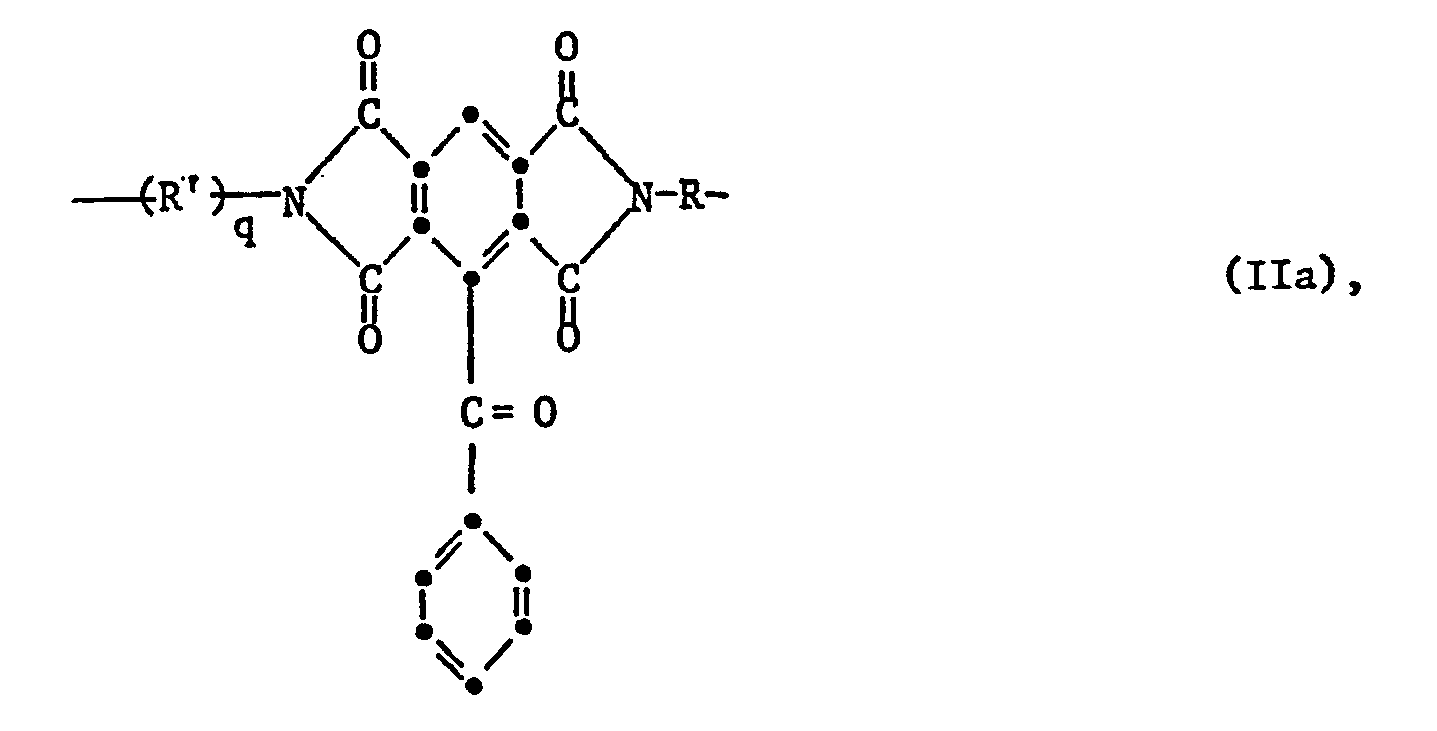
- R bzw. R' in den Formeln I und 11 in der Bedeutung als zweiwertiger aliphatischer Rest enthält bevorzugt 2 bis 30, besonders 6 bis 30 und insbesondere 6 bis 20 C-Atome. In einer bevorzugten Untergruppe ist R bzw. R' lineares oder verzweigtes Alkylen, das durch Sauerstoffatome, S, SO, S02, NH,c⊕NR2 cG⊖, Cyclohexylen, Naphthylen, Phenylen oder Hydantoinreste unterbrochen sein kann. R° kann z.B. Alkyl mit 1 bis 12 C-Atomen oder Cycloalkyl mit 5 oder 6 Ring-C-Atomen, Phenyl oder Benzyl sein. Gebedeutet ein Anion einer Protonensäure, z.B. Halogenid, Sulfat, Phosphat. In einer bevorzugten Ausführungsform sind R bzw. R' lineares oder verzweigtes Alkylen mit 6 bis 30 C-Atomen, -(CH2)m-R4-(CH2)n-, worin R4 Phenylen, Naphthylen, Cyclopentylen oder Cyclohexylen und m und n unabhängig voneinander die Zahl 1, 2 oder 3 sind,


- Beispiele für aliphatische Reste sind: Methylen, Aethylen, 1,2-oder 1,3-Propylen, 2,2-Dimethyl-1,3-propylen, 1,2-, 1,3- oder 1,4-Butylen, 1,3- oder 1,5-Pentylen, Hexylene, Heptylene, Octylene, Decylene, Dodecylene, Tetradecylene, Hexadecylene, Octadecylene, Eicosylene, 2,4,4-Trimethylhelen, 1,10-Dialkyldecylen, wobei das Alkyl bevorzugt 1- bis 6 C-Atome aufweist, substituierte 1,11-Undecylene, wie sie z.B. in der EP-B-0 011 559 beschrieben sind, Jeffamine wie z.B.


- R bzw. R' in den Formeln I und II kann als aliphatischer Rest auch einen Polysiloxanrest der Formel

- Bei den durch heterocyclische Reste unterbrochenen aliphatischen Resten kann es sich z.B. um solche handeln, die sich von N,N'-aminoalkylierten Hydantoinen oder Benzimidazolen ableiten. Beispiele sind N,N'-(γ-Aminopropyl)-5,5-dimethyl-hydantoin oder -benzimidazolon und solche der Formel


- Geeignete Substituenten für die aliphatischen Reste sind z.B. Hydroxyl, Halogenid wie F oder CI oder Alkoxy mit 1 bis 6 C-Atomen.
- Heterocyclische Diaminreste leiten sich bevorzugt von N-heterocyclischen Diaminen ab, z.B. von Pyrrolidin, Indol, Piperidin, Pyridin, Pyrrol, deren N-Atom alkyliert, z.B. methyliert, sein kann. Ein Beispiel ist N-Methyl-4-amino-5-aminoethylpiperidin.
- R bzw. R' in den Formeln I und II in ihrer Bedeutung als zweiwertiger cycloaliphatischer Rest enthalten bevorzugt 5 bis 8 Ring-C-Atome und sind besonders unsubstituiertes oder mit Alkyl, das vorzugsweise 1 bis 4 C-Atome enthält, substituiertes ein- oder zweikerniges Cycloalkylen mit 5 bis 7 Ring-C-Atomen in einem Ring. In einer bevorzugten Ausführungsform sind R bzw. R' als cycloaliphatischer Rest solche der Formeln

- Beispiele für R bzw. R' als Cycloalkylen sind: 1,2- oder 1,3-Cyclopentylen, 1,2-, 1,3- oder 1,4-Cyclohexylen, Cycloheptylen, Cyclooctylen, Methylcyclopentylen, Methyl- oder Dimethylcyclohexylen, 5-Methyl-3-methylencyclohex-1-yl, 3,3'- oder 4,4'-Bis-cyclohexylen, 3,3'-Dimethyl-4,4'-biscyclohexylen, 4,4'-Biscyclohexlenäther oder -sulfon oder -methan oder -2,2-propan, sowie die Reste von Bis-aminomethyltricyclodecan, Bis-aminomethylnorbornan und Menthandiamin.
- Besonders bevorzugt sind R bzw. R' als cycloaliphatischer Rest 1,4- oder 1,3-Cyclohexylen, 2,2,6-Trimethyl-6-methylen-cyclohex-4-y1, Methylenbis(cyclohex-4-yl) oder Methylenbis(3-methylcyclohex-4-yl).
- R bzw. R' als araliphatischer Rest enthalten bevorzugt 7 bis 30 C-Atome. Sofern die aromatische Gruppe des araliphatischen Restes an die N-Atome im Rest der Formeln I und 11 gebunden sind, was bevorzugt ist, so sind diese aromatischen Gruppen bevorzugt so substituiert wie R bzw. R' als aromatischer Rest, einschliesslich der Bevorzugungen.
- Der araliphatische Rest enthält bevorzugt 7 bis 30, besonders 8 bis 22 C-Atome. Der aromatische Rest im araliphatischen Rest ist bevorzugt ein Phenylrest. In ihrer Bedeutung als araliphatischer Rest bedeuten R bzw. R' besonders unsubstituiertes oder am Aryl durch Alkyl substituiertes Aralkylen, wobei der Alkylenrest linear oder verzweigt ist. In einer bevorzugten Ausführungsform entspricht der araliphatische Rest der Formel

- Die freie Bindung kann sich in o-Stellung, m-Stellung und besonders in p-Stellung zur CvH2v-Gruppe befinden und eine oder beide R7 sind bevorzugt in o-Stellung zur freien Bindung gebunden.
- Beispiele für R bzw. R' als araliphatischer Rest sind: m- oder p-Benzylen, 3-Methyl-p-benzylen, 3-Aethyl-p-benzylen, 3,5-Dimethyl-p-benzylen, 3,5-Diäthyl-p-benzylen, 3-Methyl-5-äthyl-p-benzylen, p-Phenylenpropylen, 3-Methyl-p-phenylen-propylen, p-Phenylenbutylen, 3-Aethyl-p-phenylenpentylen sowie insbesondere längerkettige Phenylenalkylenreste, die z.B. in der EP-A-0 069 062 beschrieben sind: 6- (p-Phenylen)-6-methylhept-2-yl, 6-(3'-Methyl-p-phenylen)-6-methylhept-2-yl, 6-(3'-Aethyl-p-phenylen)-6-methylhept-2-yl, 6-(3',5'-Dimethyl-p-phenylen)-6-methylhept-2-yl, 11-(p-Phenylen)-2,11-dimethyl-dodec-1-yl, 13-(p-Phenylen)-2,12-dimethyltetradec-3-yl.
- R bzw. R' können auch ein aromatischer Rest mit bevorzugt 13 bis 30 C-Atomen sein, bei dem zwei Arylkerne, zum Beispiel Naphthyl und besonders Phenyl über eine aliphatische Gruppe mit bevorzugt 1 bis 12 C-Atomen verknüpft sind.
- Dieser Rest entspricht besonders der Formel
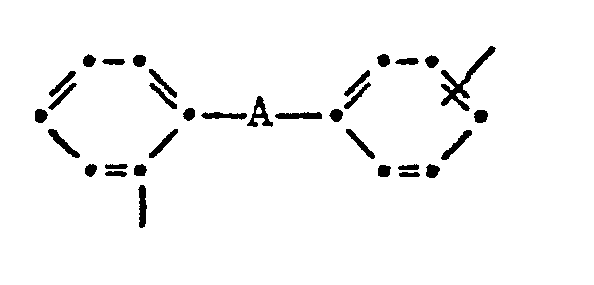
- Unter den Homo- und Copolymeren sind besonders solche mit Strukturelementen der Formeln I und 11 bevorzugt, in der R bzw. R' substituierte aromatische Reste bedeuten. Der Substituent am aromatischen Rest enthält bevorzugt 1 bis 20, besonders 1-12 und insbesondere 1-6 C-Atome. Insbesondere ist der Substituent Cs- oder CG-Cycloalkyl, lineares oder verzweigtes Alkyl, Alkoxy, Alkoxyalkyl, Alkylthio, Alkylthioalkyl, mit 1 bis 6 C-Atomen, Benzyl, Trimethylen oder Tetramethylen. Bevorzugter ist der Substituent Alkyl, Alkoxy oder Alkoxyalkyl mit 1 bis 6 C-Atomen, Benzyl, Trimethylen oder Tetramethylen. Ganz besonders ist der Substituent C1-C4-Alkyl. Als Alkoxyalkyl ist Alkoxymethyl bevorzugt und als Alkoxy Methoxy. Beispiele für den Substituenten sind: Methyl, Aethyl, Propyl, Isopropyl, n-Butyl, Isobutyl, Tertiärbutyl, Pentyl, Hexyl, Octyl, Dodecyl, Tetradecyl, Eicosyl, Cyclopentyl, Cyclohexyl, Methylcyclohexyl, Methoxy, Aethoxy, Propoxy, Butoxy, Pentoxy, Hexoxy, Methoxmethyl, Methoxyäthyl, Aethoxymethyl, Propoxymethyl, Butoxymethyl, Benzyl, Methylbenzyl, Phenyläthyl, Methylthio, Aethylthio, Hydroxyäthyl, Methylthioäthyl und Hydroxy- äthylthio. Bevorzugte Reste sind Methoxymethyl, Aethoxymethyl, Methyl, Aethyl, n-Propyl, i-Propyl, Trimethylen und Tetramethylen, Cyclopentyl und Cyclohexyl. Besonders bevorzugt ist Methyl, Aethyl und i-Propyl. Bei dem substituierten aromatischen Rest kann es sich um einkernige oder mehrkernige, besonders zweikernige Reste handeln. Einkernige Reste können 1 bis 4, bevorzugt 1 oder 2, Substituenten enthalten und zweikernige Reste können 1 bis 4, bevorzugt 1 oder 2 Substituenten in jedem Kern enthalten. Es wurde gefunden, dass die Lichtempfindlichkeit von Homo- oder Copolymeren besonders hoch ist, wenn ein oder zwei Substituenten in Orthostellung zum N-Atom gebunden sind. Die Substitution in Orthostellung ist daher bevorzugt. Der aromatische Rest ist bevorzugt in Meta- oder Parastellung zum N-Atom gebunden.
- R bzw. R' kann als aromatischer Rest 7 bis 30, besonders 7 bis 20 C-Atome enthalten. Der aromatische Rest ist bevorzugt ein Kohlenwasserstoffrest oder Pyridinrest, der wie zuvor definiert substituiert ist.
- Eine bevorzugte Untergruppe sind solche aromatische Reste der Formeln



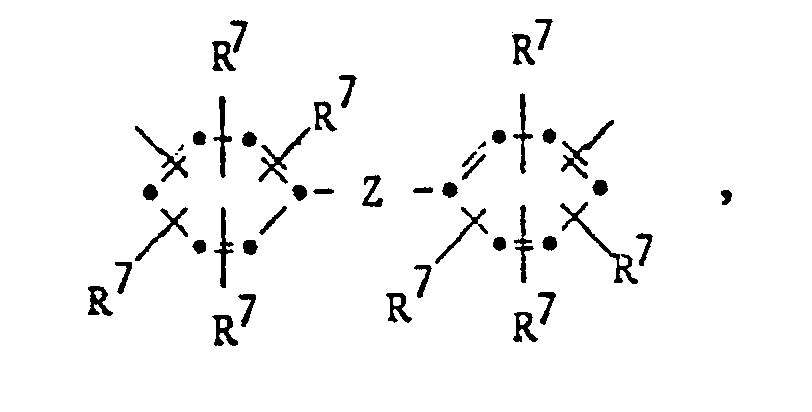


- Eine bevorzugte Untergruppe sind Toluylenreste, Reste O,O'-substituierter Diaminodiphenylene, Diaminodiphenylmethane und Diaminodiphenyläther.
- Eine besonders bevorzugte Gruppe sind solche aromatischen Reste der Formeln
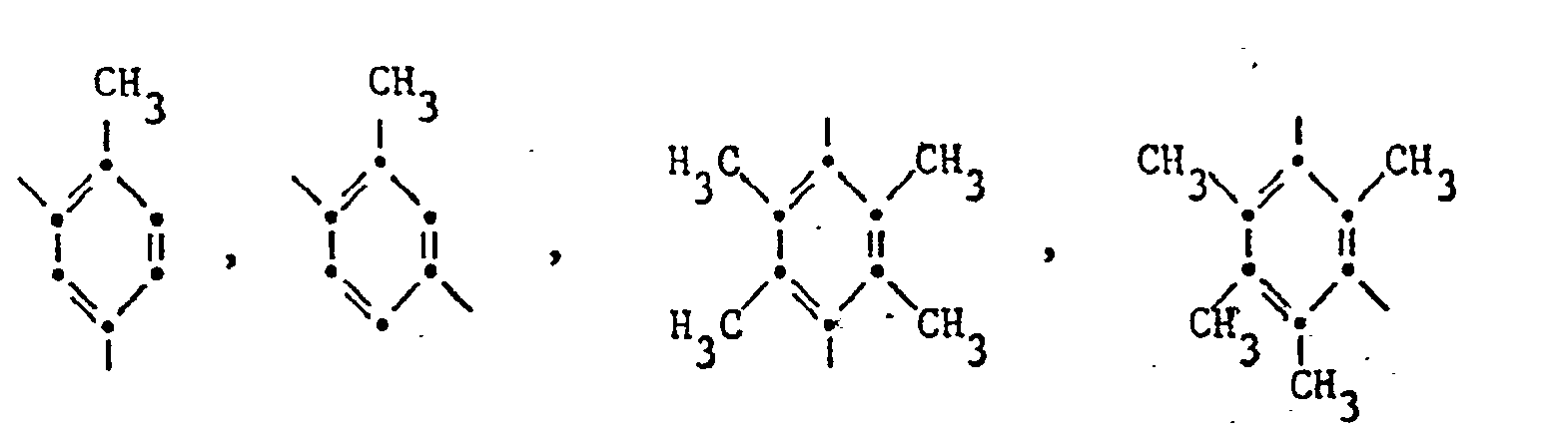

- Beispiele für substituierte aromatische Reste sind: 4-Methyl-1,3-phenylen, 4-Aethyl-1,3-phenylen, 2-Methyl-1,3-phenylen, 4-Benzyl-1,3-phenylen, 4-Methoxymethyl-1,3-phenylen, Tetrahydro-1,3- oder -1,4-naphthylen, 3-Propyl-1,3- oder -1,4-phenylen, 3-Isopropyl-1,4-phenylen, 3,5-Dimethyl-1,4-phenylen, 2,4-Dimethyl-1,3-phenylen, 2,3-Dimethyl-1,4-phenylen, 5-Methyl-1,3-phenylen, Tetramethyl-1,4- oder -1,3-phenylen, 3-Methyl-2,6-pyridylen, 3,5-Dimethyl-2,6-pyridylen, 3-Aethyl-2,6-pyridylen, 1-Methyl-2,7-naphthylen, 1,6-Dimethyl-2,7-naphthylen, 1-Methyl-2,4-naphthylen, 1,3-Dimethyl-2,4-naphthylen, die zweiwertigen Reste von 5-Amino-1-(3'-amino-4'-methylphenyl)-1,3,3-trimethylindan oder 6-Amino-5-methyl-1-(3'-amino-4'-methyl)-1,3,3-trimethylindan, 4-Methoxymethyl-1,3-phenylen, 3-Methyl-biphen-4,4'diyl, 3-Aethyl-biphen-4,4'-diyl,3,3'-Dimethyl-biphen-4,4'-diyl, 3,3'-Diäthyl-biphen-4,4'-diyl, 3-Methyl-3'-äthyl-biphen-4,4'diyi,3,3',5,5'-Tetramethyl-biphen diyl, 3,3'-Dimethyl-5,5'-diäthyl-biphen-4,4'-diyl, 4,4'-Dimethyl-biphen-3,3'-diyl, 3,3'-Diisopropyl-biphendiyl, Reste der Formeln

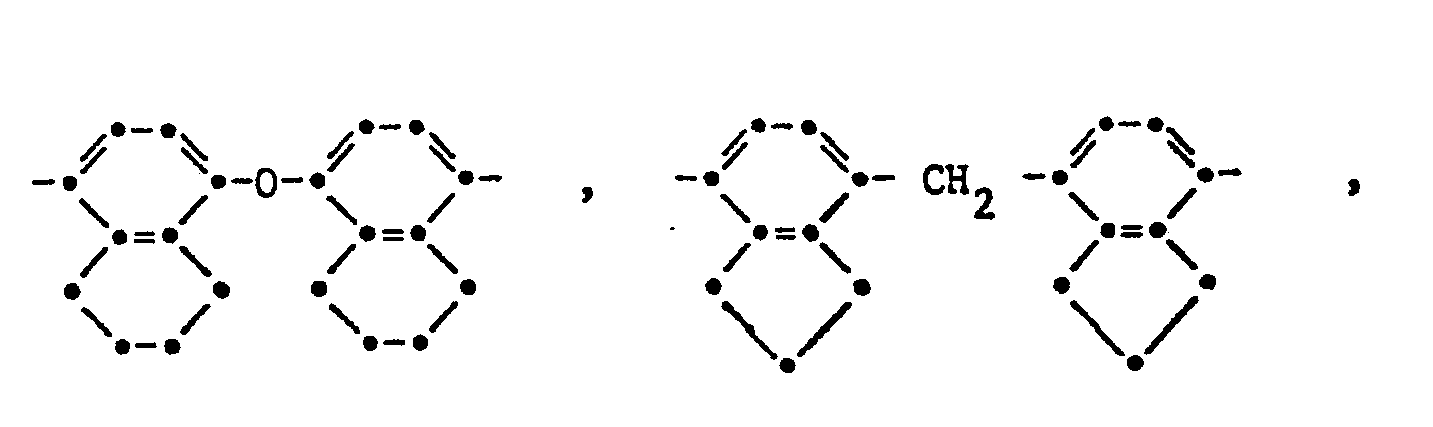

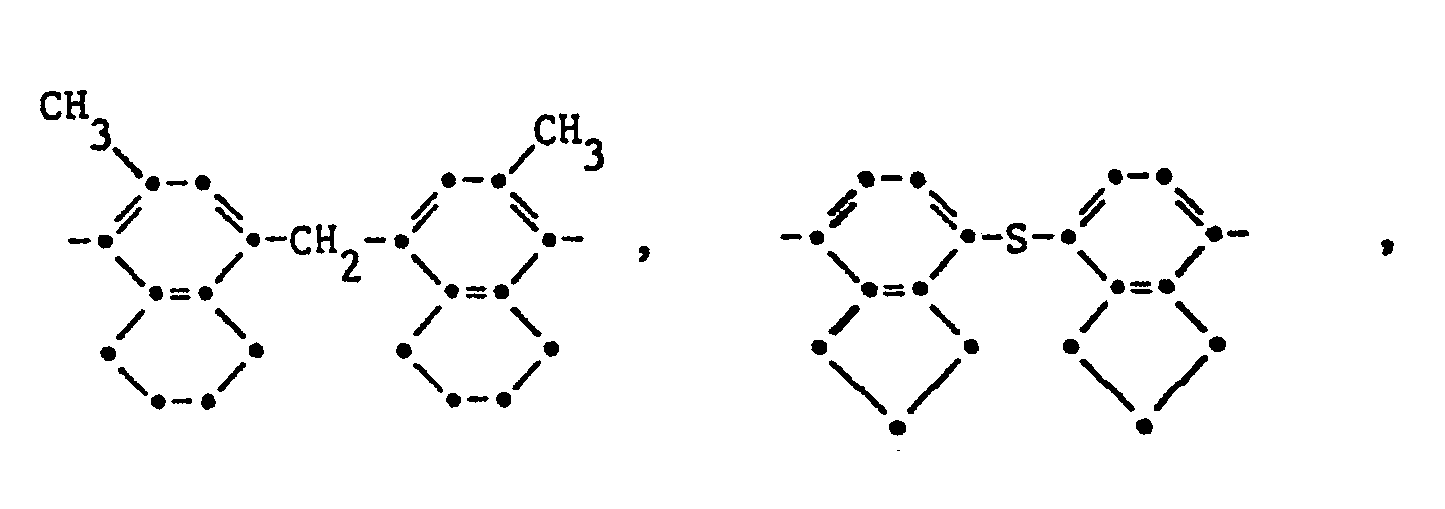


- Die Diamine, von denen sich R bzw. R' ableiten, sind bekannt oder können nach bekannten Verfahren hergestellt werden. Diamine mit Polysiloxaneinheiten sind aus der US-PS 3 435 002 und aus der EP-A- 0 054 426 bekannt. Diamine mit der
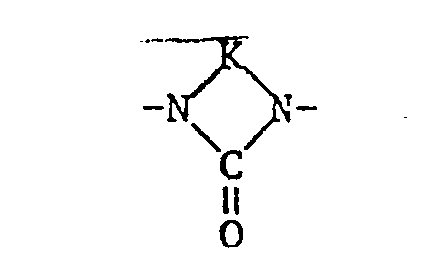
- Die Homo- oder Copolymeren sind bevorzugt ausgewählt aus der Gruppe der Polyimide, Polyamide, gesättigte Polyester, Polycarbonate, Polyamidimide, Polyesterimide, Polyesteramide, Polysiloxane, ungesättigten Polyester, Epoxidharze, der aromatischen Polyäther, der aromatischen Polyätherketone, der aromatischen Polyäthersulfone, der aromatischen Polyketone, der aromatischen Polythioäther, der aromatischen Polyimidazole, der aromatischen Polypyrrone oder Gemischen dieser Polymeren.
- Ganz besonders bevorzugt sind unter diesen Polymeren ein Homo- oder Copolyimid mit 5 bis 100 Mol- % Strukturelementen der Formeln I und/oder II, worin q = O ist, und R ein aromatischer Rest ist, der in beiden Orthostellungen mindestens eines N-Atomes durch Alkyl, Cycloalkyl, Alkoxy, Alkoxyalkyl, Alkylthio, Alkylthioalkyl, Aralkyl oder zwei benachbarte C-Atome des aromatischen Restes durch Alkylen substituiert sind, und 0 bis 95 Mol-% Strukturelementen der Formel III

- R und R13 stellen in den Copolyimiden besonders aromatische organische Reste dar. Von diesen Copolyimiden sind besonders solche bevorzugt, die mindestens 50 Mol-%, vorzugsweise 80 Mol-% Strukturelemente der Formeln I und/oder II enthalten.
- Es ist bekannt, dass einige aliphatische und aromatische Diamine, z.B. Phenylendiamin oder Di-(aminophenyl)methan, die Unlöslichkeit von Polyimiden fördern können. Solche Diamine werden daher bevorzugt in geringeren Mengen eingesetzt. Insbesondere sind für diesen Fall die Strukturelemente der Formeln I und/oder 11 zu mindestens 50 Mol-%, besoners 80 Mol-% und ganz besonders 90 Mol-% enthalten.
- Q enthält als vierwertiger aromatischer Rest bevorzugt 6 bis 30, besonders 6 bis 20 C-Atome.
- Q in Formel III kann aus den folgenden Gruppen ausgewählt sein: aromatische, aliphatische, cycloaliphatische, heterocyclische Gruppen, Kombinationen von aromatischen und aliphatischen Gruppen. Die Gruppen können auch substituiert sein. Die Gruppe Q kann durch die folgenden Strukturen gekennzeichnet sein:


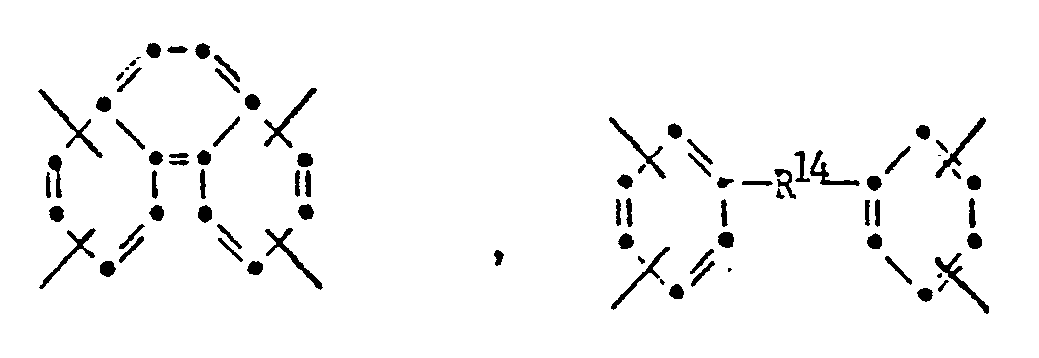


- In den vorausstehenden Formeln befinden sich stets je zwei der freien Bindungen in Orthostellung, und/oder bei der Naphthalin-derivaten in Peristellung.
- Eine bevorzugte Untergruppe für Q sind Reste der Formeln

- Ganz besonders bevorzugt sind Reste der Formeln

- Beispiele für Tetracarbonsäureanhydride mit einem Rest Q sind:
- 2,3,9,10-Perylentetracarbonsäuredianhydrid,
- 1,4, 5,8-Naphthalintetracarbonsäuredianhydrid,
- 2,6-Dichlornaphthalin-1,4,5,8-tetracarbonsäuredianhydrid,
- 2,7-Dichlornaphthalin-1,4,5,8-tetracarbonsäuredianhydrid,
- 2,3,6,7-Tetrachlornaphthalin-1,4,5,8-tetracarbonsäuredianhydrid,
- Phenanthren-1,8,9,10-tetracarbonsäuredianhydrid,
- Pyromellitsäuredianhydrid,
- 3,3',4,4'-Biphenyltetracarbonsäuredianhydrid,
- 2,2',3,3'-Biphenyltetracarbonsäuredianhydrid,
- 4,4'-Isopropylidendiphthalsäureanhydrid,
- 3,3'-Isopropylidendiphthalsäureanhydrid,
- 4,4'-Oxydiphthalsäureanhydrid,
- 4,4'-Sulfonyldiphthalsäureanhydrid,
- 3,3'-Oxydiphthalsäureanhydrid,
- 4,4'-Methylendiphthalsäureanhydrid,
- 4,4'-Thiodiphthalsäureanhydrid,
- 4,4'-Aethylidendiphthalsäureanhydrid,
- 2,3,6,7-Naphthalintetracarbonsäuredianhydrid,
- 1,2,4,5-Naphthalintetracarbonsäuredianhydrid,
- 1,2,5,6-Naphthalintetracarbonsäuredianhydrid,
- Benzol-1,2,3,4-tetracarbonsäuredianhydrid,
- Thiophen-2,3,4,5-tetracarbonsäuredianhydrid,
- 1-(3',4'-Dicarboxyphenyl)-1,3,3-trimethylindan-5,6-dicarbonsäuredianhydrid,
- 1-(3',4'-Dicarboxyphenyl)-1,3,3-trimethylindan-6,7-dicarbonsäuredianhydrid,
- 1-(3',4'-Dicarboxyphenyi)-3-methyiindan-5,6-dicarbonsäuredianhydrid,
- 1-(3',4'-Dicarboxyphenyl)-3-methylindan-6,7-dicarbonsäuredianhydrid,
- 3,3',4,4'-Benzophenontetracarbonsäureanhydrid,
- 4,5,3',4'-Benzophenontetracarbonsäureanhydrid.
- Als aromatischer Rest stellt R in den Polyimiden bevorzugt einen zweiwertigen, ein- oder zweikernigen Phenylenrest dar. Die Substituenten von R können als lineares oder verzweigtes Alkyl und Alkoxy 1 bis 20, bevorzugt 1 bis 6 und besonders 1 bis 4 C-Atome, als lineares oder verzweigtes Alkoxyalkyl 2 bis 12, besonders 2 bis 6 C-Atome, als Alkylen 3 oder 4 C-Atome, als Cycloalkyl 5 bis 8, besonders 5 oder 6 Ringkohlenstoffatome und als Aralkyl 7 bis 12 C-Atome enthalten. Das Alkoxyalkyl ist bevorzugt Alkoxymethyl und das Aralkyl Benzyl.
- Beispiele für Substituenten von aromatischen Resten R sind weiter oben aufgeführt. Besonders bevorzugt ist Isopropyl, Aethyl und insbesondere Methyl.
- R kann als substituierter aromatischer Rest 7 bis 30, besonders 8 bis 25 C-Atome enthalten. Der aromatische Rest ist bevorzugt ein Pyridinrest und besonders ein Kohlenwasserstoffrest, der durch Alkyl, Alkoxyalkyl, Alkoxy, Trimethylen oder Tetramethylen substituiert ist. Der aromatische Rest kann weitere Substituenten enthalten, z.B. Halogenid wie CI oder Br. In einer bevorzugten Untergruppe sind die aromatischen Reste als einkernige Reste Phenylenreste und als zweikernige Reste Naphthylen oder Bisphenylenreste.
- Eine bevorzugte Untergruppe von erfindungsgemässen Polyimiden sind solche, in denen R als aromatischer Rest den Formeln IV, IVa und/oder IVb entspricht,
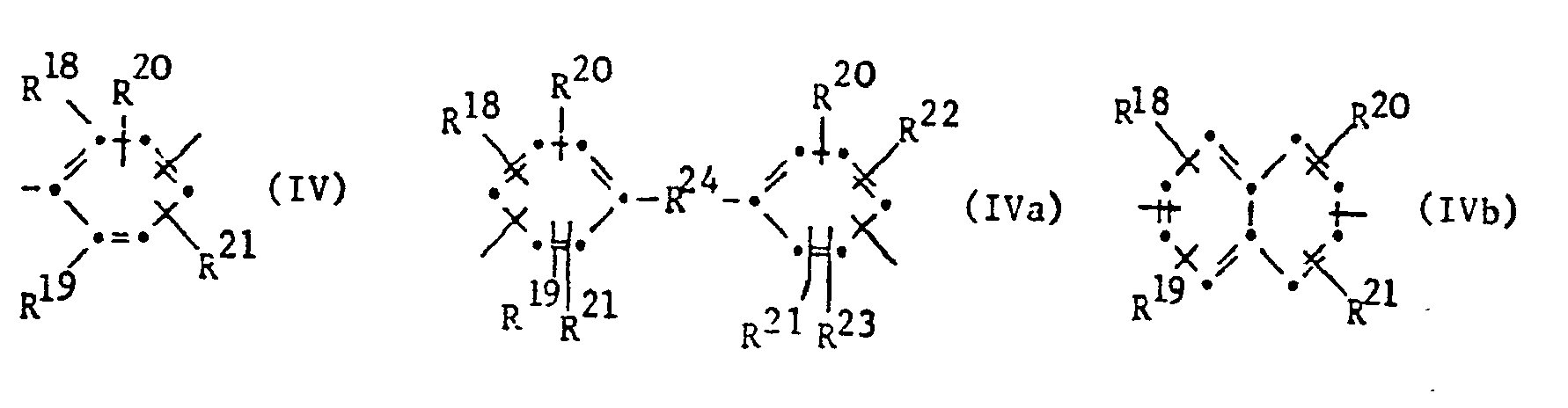



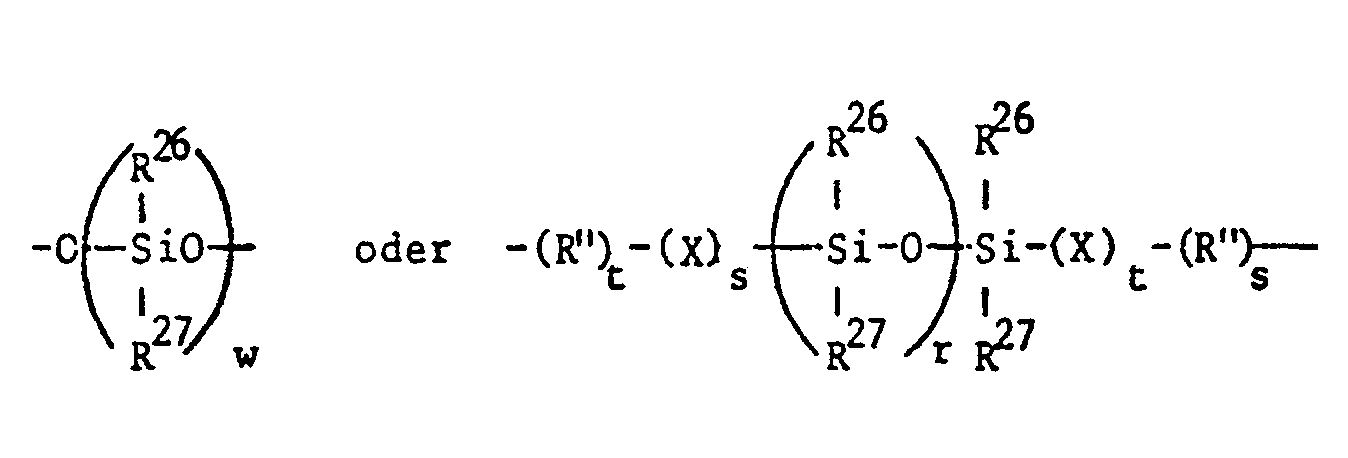
- Eine weitere Gruppe von Diaminresten sind solche der Formel
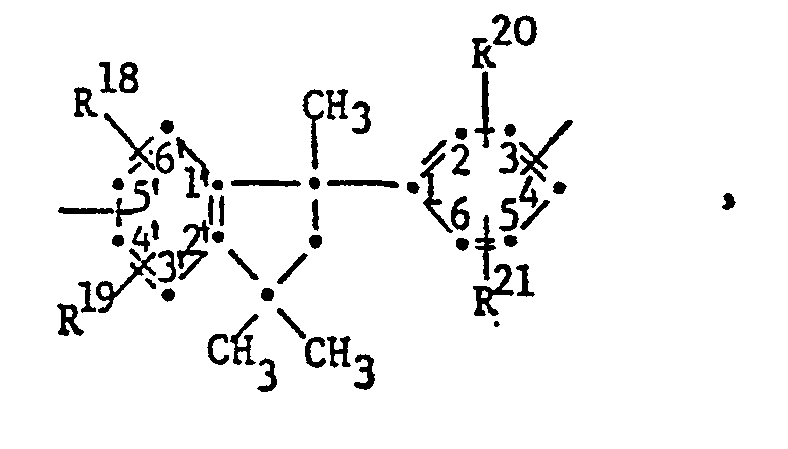

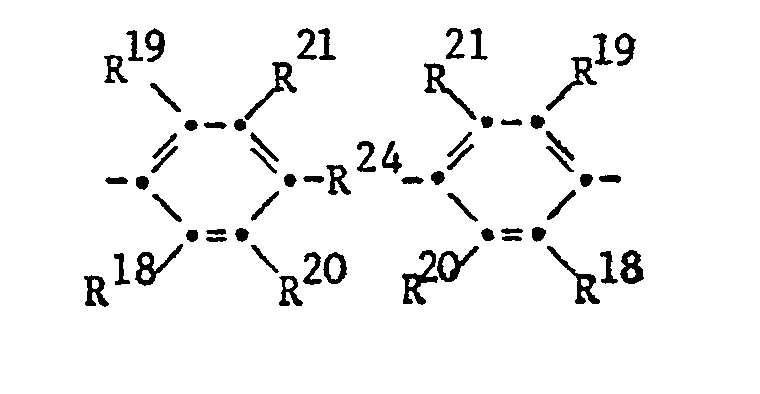
- Erfindungsgemässe Copolyimide enthalten mindestens zwei verschiedene Strukturelemente, wobei sich die Anzahl an verschiedenen Strukturelementen im wesentlichen nach den gewünschten Eigenschaften und dem Anwendungsgebiet richten. Bevorzugt enthalten sie 2 bis 4 verschiedene Strukturelemente, wobei sich die Strukturelemente nur im Rest R der Formeln I und/oder II unterscheiden können. In einer besonders bevorzugten Ausführungsform solcher Copolyimide sind Strukturelemente von Orthodisubstituierten Phenylenen enthalten, besonders von 1,3-Phenylenen.
- Beispiele für R in erfindungsgemässen Polyimiden sind: 2,6-Dimethyl-1,4- oder 1,3-phenylen, 2,6-Diäthyl-1,4- oder 1,3-phenylen, 2,6-Dimethyl-5-chlor-1,4- oder 1,3-phenylen, 2-Methyl-6-äthyl-1,4- oder 1,3-phenylen, 2-Methyl-6-isopropyl-1,4- oder 1,3-phenylen, 2,6-Diisopropyl-1,4- oder 1,3-phenylen, 2,6-Dimethoxy-1,4-oder 1,3-phenylen, 2,6-Diäthoxy-1,4- oder 1,3-phenylen, 2-Methyl-6-methoxy-1,4- oder 1,3-phenylen, 2,6-Dibenzyl-1,4- oder 1,3-phenylen, 2,6-Dimethoxymethyl-1,4- oder 1,3-phenylen, 2,5,6-Trimethyl-1,4- oder 1,3-phenylen, 2,5,6-Triäthyl-1,4- oder 1,3-phenylen, 2,4,6-Trimethyl-1,3-phenylen, 2,3,5,6-Tetramethyl-1,4-phenylen, 2,4,5,6-Tetramethyl-1,3-phenylen, Tetrahydro-1,4- oder 1,3-naphthylen, Reste der Formeln
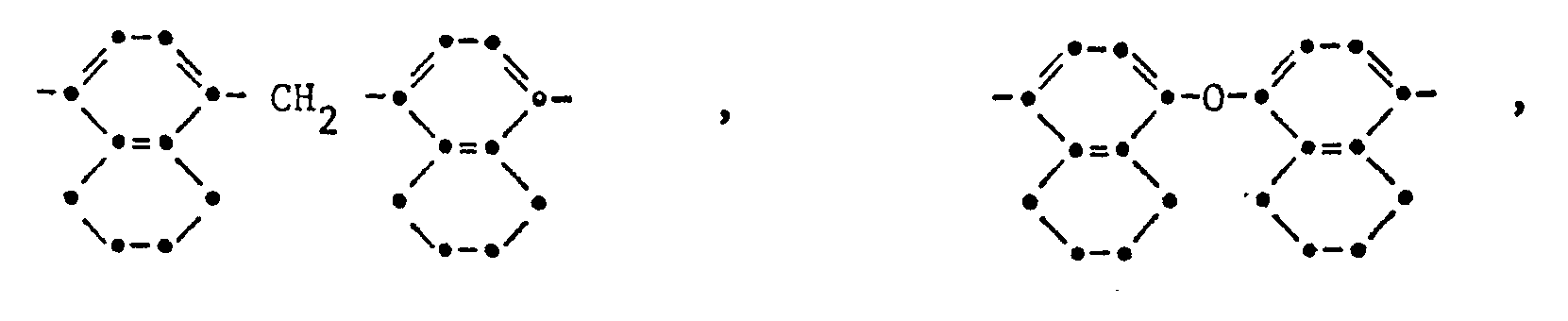


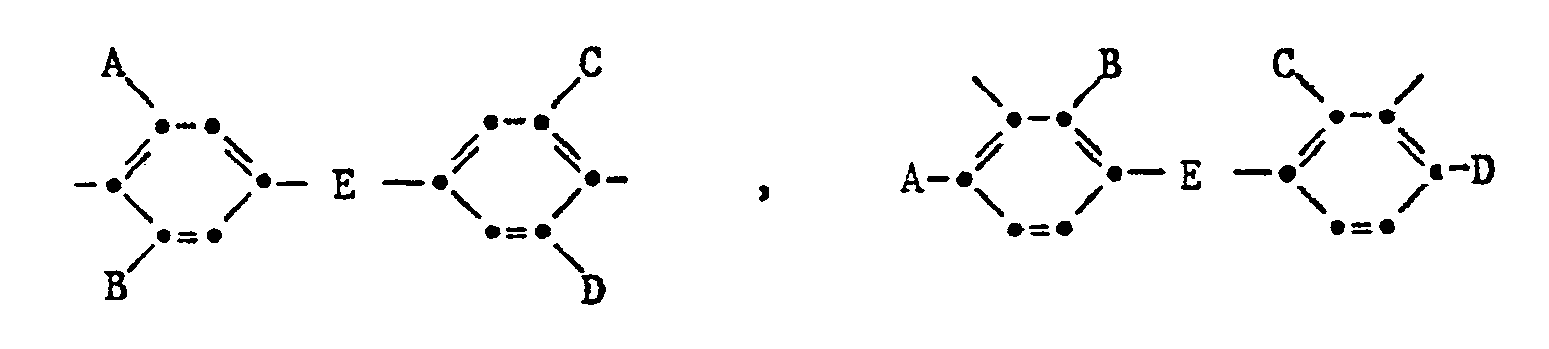


- Die Diamine, von denen sich R ableitet, sind bekannt oder nach bekannten Verfahren herstellbar. Sihaltige Diamine sind in der US-PS 3,435,002 und der EP-A-0 054 426 beschrieben. Diamine mit der

- R13 kann den zuvor beschriebenen Resten R entsprechen, wobei die aromatischen Reste nicht in beiden o-Stellungen zum N-Atom substituiert sind.
- In einer Ausführungsform entspricht R13 der Formel V,

- Eine bevorzugte Untergruppe sind Arylenreste der Formeln Va, Vb oder Vc


- In einer besonders bevorzugten Ausführungsform bestehen erfindungsgemässe Polyimide aus wiederkehrenden Strukturelementen der Formeln

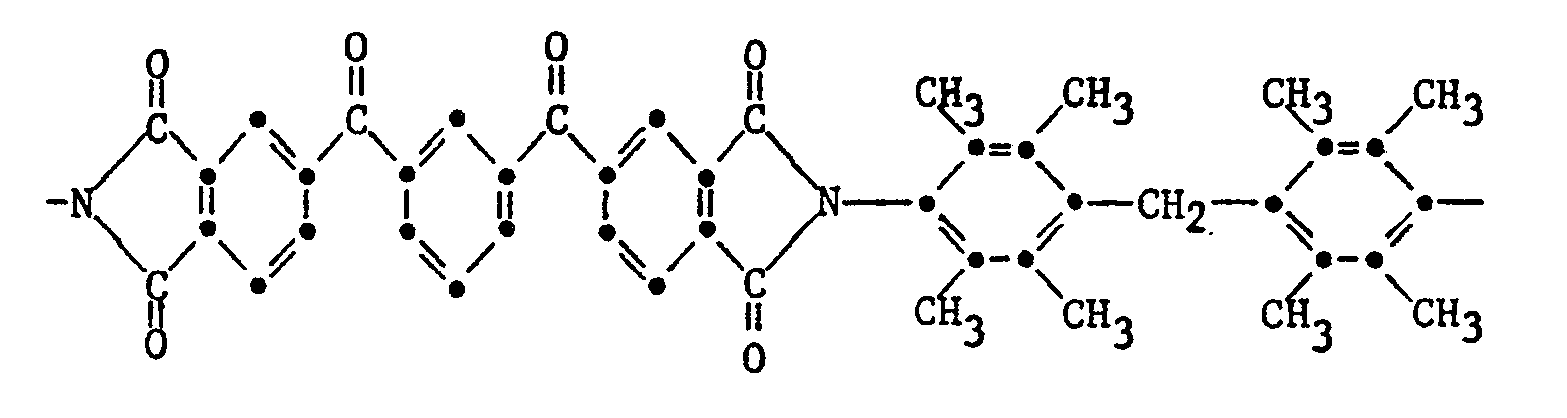
- Die Herstellung der Homo- und Copolyimide erfolgt in üblicher Weise durch Umsetzung von Tetracarbonsäureanhydrid mit Diaminen der Formel NH2RNH2, gegebenenfalls zusammen mit weiteren Tetracarbonsäureanhydriden der Formel

- Zur Herstellung der anderen ausgewählten Homo- und Copolymeren geht man von funktionellen Imidderivaten der Tetracarbonsäuren aus. Sie können den Formeln VI oder Vla entsprechen,


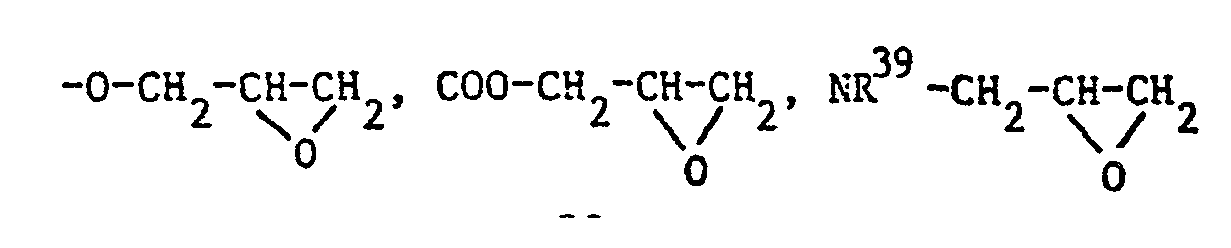

- Die Verbindungen der Formeln VI und Via sind neu. Es handelt sich um oligomere und niedermolekulare Polyimide mit funktionellen Endgruppen. Sie werden nach analogen Verfahren erhalten wie Polyimide, wobei die Grösse von k durch die Menge an miteingesetzten Monomeren der Formel W-R-NH2 bestimmt wird. Mit diesen Monomeren (c = 1), Oligomeren und niedermolekularen Polymeren werden z.B. Blockpolymere mit Polyimidblöcken erhalten, die über z.B. Ester-, Amid- oder Imidgruppen verknüpft sind.
- Eine weitere bevorzugte Gruppe von erfindungsgemässen Polymeren ist ein Polyamid oder Copolyamid aus organischen Diaminen, Dicarbonsäuren, ω-Aminocarbonsäuren und Diaminen oder Dicarbonsäuren mit Strukturelementen der Formeln I und/oder II, worin q = 1 ist und in denen an die R- und R'-Gruppen Amingruppen oder Carboxylgruppen gebunden sind, sowie aus Mischungen der Monomeren.
- Bei den Polymeren kann es sich um solche handeln, deren Molekülketten aus Dicarbonsäuren und Diaminen der Formeln VI und/oder Via aufgebaut sind, oder um solche, deren Molekülketten aus Dicarbonsäuren bzw. Diaminen der Formel VI und/oder Vla und anderen organischen Diaminen bzw. Dicarbonsäuren aufgebaut sind. Copolyamide können weitere Diamine- bzw. Dicarbonsäurereste bzw. Aminocarbonsäurereste enthalten.
- Geeignete Dicarbonsäuren sind z.B. lineare oder verzweigte aliphatische Dicarbonsäuren mit bevorzugt 2 bis 20, besonders 4 bis 16 C-Atomen, unsubstituierte oder durch besonders Alkyl substituierte cycloaliphatische Dicarbonsäuren mit 5 bis 7 Ring-C-Atomen und unsubstituierte oder z.B. mit Alkyl, CI oder Brom substituierten aromatischen Dicarbonsäuren mit bevorzugt 8 bis 22 C-Atomen. Beispiele sind: Malonsäure, Adinpinsäure, Trimethyladipinsäure, Pimelinsäure, Korksäure, Azelainsäure, Dodecandicarbonsäure, Cyclohexandicarbonsäuren, Isophthalsäure, Terephthalsäure, p-Diphenyldicarbonsäure, Bis-(4-carboxylphenyl)-äther oder Bis (4-carboxylphenyl-sulfon.
- Geeignete Diamine sind z.B. lineare oder verzweigt aliphatische Diamine mit bevorzugt 2 bis 30, besonders 4 bis 20 C-Atomen, unsubstituierte oder durch Alkyl, besonders Methyl substituierte cycloaliphatische Diamine mit bevorzugt 5 bis 7 Ring-C-Atomen, araliphatische Diamine mit bevorzugt 7 bis 24 C-Atomen und aromatische Diamine mit 6 bis 22, vorzugsweise 6 bis 18 C-Atomen, die unsubstituiert oder besonders durch Alkyl substituiert sein können. Beispiele sind: Aethylendiamin, Propylendiamin, 1,3- oder 1,4-Butylendiamin, Pentylendiamin, 1,6-Hexylendiamin, Octylendiamin, Decylendiamin, Dodecylendiamin, 1,10-Alkyl substituierte 1,10-Decylendiamine wie z.B. 1,10-Dimethyl-1,10-dacylendiamin oder 1,10-Di-n-Hexyl-1,10-decylendiamin, Xylylendiamin, Isophorondiamin, 1,3- oder 1,4-Cyclohexandiamin, 1,3- oder 1,4-Phenylendiamin, Methylphenylen-diamin, Toluylendiamin, p-Biphenylendiamin, Bis-(p-aminophenyl)äther, Bis-(p-aminophenyl)sulfon, Bis-(-p-aminophenyl)methan.
- Bei den Aminocarbonsäuren kann es sich um aromatische, cycloaliphatische oder aliphatische Aminocarbonsäuren handeln, z.B. Aminobenzoesäure, Aminocyclohexancarbonsäure und w-Aminocarbonsäurenwie e -Aminocapronsäure oder 11-Aminoundecansäure.
- Eine weitere bevorzugte Gruppe von erfindungsgemässen Polymeren ist ein Polyester oder Copolyester aus organischen Diolen, Dicarbonsäuren, Hydroxycarbonsäuren und Diolen oder Dicarbonsäuren mit Strukturelementen der Formeln I und/oder 11, worin q = 1 ist und in denen an die R- und R'-Gruppen Hydroxyl oder Carboxylgruppen gebunden sind, sowie aus Mischungen der Monomeren.
- Bei den Polyestern kann es sich um solche handeln, deren Molekülketten aus Diolen und Dicarbonsäuren der Formeln VI oder Vla aufgebaut sind, oder um solche, deren Molekülketten aus Dicarbonsäuren oder Diolen der Formeln VI oder Via und anderen organischen Diolen bzw. Dicarbonsäuren aufgebaut sind. Die Copolyester enthalten weitere Reste von Dicarbonsäuren, Diolen und/oder Hydroxycarbonsäuren.
- Geeignete Dicarbonsäuren wurden zuvor erwähnt. Polyester auf der Basis aromatischer Dicarbonsäuren, besonders Terephthalsäure und/oder Isophthalsäure sind bevorzugt. Als Diole kommen cycloaliphatische Diole wie 1,4-Cyclohexandiol, aromatische Diole wie Bisphenol-A und besonders gegebenenfalls substituierte aliphatische Diole wie verzweigte und besonders lineare Alkylendiole mit z.B. 2 bis 12, vorzugsweise 2 bis 6 C-Atomen sowie 1,4-Bis-hydroxymethylcyclohexan und Hydroxypivalinsäureneopentylglycolester in Frage. Besonders bevorzugt sind Aethylen-, Trimethylen-, Tetramethylen- und Hexamethylenglykol. Als Hydroxycarbonsäuren kommen z.B. m- oder p-Hydroxybenzoesäure oder aliphatische w-Hydroxycarbonsäuren wie z.B. y-Hydroxyvaleriansäure, -Hydroxypivalinsäure sowie e-Caprolacton in Frage.
- In einer weiteren bevorzugten Ausführungsform sind die erfindungsgemässen Polymeren ein Polyamidimid oder ein Polyesterimid. Solche Polymeren sind durch den Einbau von Tricarbonsäuren der Formel VII oder deren polymerbildenden Derivaten, wie Ester, Anhydrid oder Säurehalogenid, erhältlich:

- Der dreiwertige Rest kann ein Kohlenwasserstoffrest mit bevorzugt 6 bis 16 C-Atomen sein, in dem zwei Carboxylgruppen an zwei benachbarte C-Atome gebunden sind. Bevorzugt ist Trimellitsäure.
- Die Polyamidimide können nur aus Diaminen der Formeln VI oder Vla und Tricarbonsäuren der Formel VII aufgebaut sein. Copolymere erhält man, wenn man zusätzlich Dicarbonsäuren und/oder Diamine, wie sie z.B. zuvor für die Polyamide erwähnt wurden, bei der Herstellung der Polyamidimide mitverwendet.
- Polyesterimide sind erhältlich, wenn man zunächst eine Aminocarbonsäure bzw. einen Aminoalkohol mit Tricarbonsäuren der Formel VII zu Dicarbonsäuren bzw. Hydroxycarbonsäuren umsetzt, und diese darauf mit Diolen und/oder Dicarbonsäuren der Formeln VI und/oder Via weiter zu Polyestern polykondensiert. Auch hier können zusätzlich weitere Dicarbonsäuren und/oder Diole zur Herstellung von Copolymeren verwendet werden.
- Ferner sind auch Polyesteramide bevorzugt. Diese Polymeren erhält man, wenn Dicarbonsäuren der Formeln VI oder Vla und/oder weitere Dicarbonsäuren mit Diolen der Formeln VI oder Vla und/oder anderen Diolen und Diaminen der Formeln VI und/oder Vla und/oder anderen Diaminen polykondensiert werden, wobei die einzelnen Monomeren zuvor schon erwähnt wurden.
- Die N-Atome der Amidgruppen in den zuvor genannten Polymeren können durch Alkyl mit vorzugsweise 1 bis 6 C-Atomen, Aryl wie z.B. Phenyl, Aralkyl wie z.B. Benzyl oder Cycloalkyl wie z.B. Cyclohexyl substituiert sein.
- Weitere erfindungsgemässe Polymere sind zum Beispiel:
- a) Polysiloxane aus Diolen der Formeln VI und/oder Via und gegebenenfalls weiteren Diolen und Silanen der Formel (R4°)2SiB2, worin R40 bevorzugt Alkyl mit 1 bis 6 C-Atomen, besonders Methyl und Aryl, besonders Phenyl ist, und B für Br und besonders CI oder Alkoxy sowie Aryloxy mit bevorzugt 1 bis 6 C-Atomen besonders Methoxy oder Phenoxy steht. Diese Polymere können somit Strukturelemente der Formel
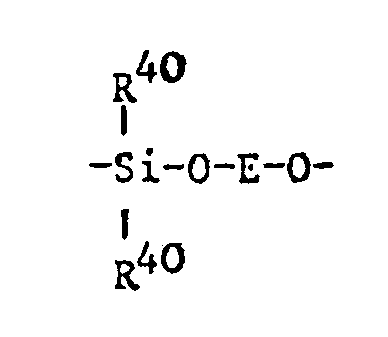
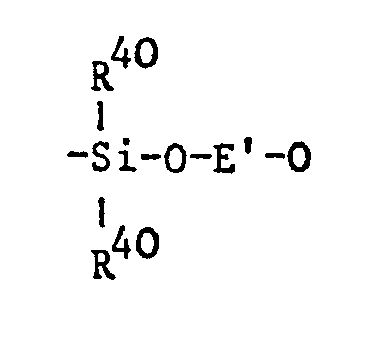

- b) Ungesättigte Polyester aus ungesättigten Dicarbonsäuren, besonders Maleinsäure und Diolen der Formeln I und/oder II (HOEOH) und gegebenenfalls weiteren Dicarbonsäuren, auch der Formeln I und/oder II und weiteren Diolen HOE'OH. Geeignete Dicarbonsäuren wurden bereits zuvor erwähnt. Diese Polymeren können somit Strukturelemente der Formel
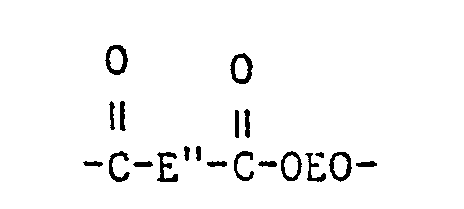

- Diese Polymeren können zusätzlich thermisch in Gegenwart üblicher Polymerisationskatalysatoren durch die Anwesenheit der äthylenisch ungesättigten Gruppen polymerisiert werden, gegebenenfalls zusammen mit reaktiven Verdünnern wie Styrol.
-
- c) Geeignete Epoxidharze sind auf verschiedene Weise erhältlich. So können die Epoxidverbindungen der Formeln VI oder Vla alleine oder zusammen mit weiteren Polyepoxidverbindungen mit mehr als einer Epoxidgruppe im Molekül katalytisch z.B. mit tertiären Aminen zu Poyäthern umgesetzt werden oder sie können mit üblichen Härtern wie Polyolen, bevorzugt Polyphenolen, Polycarbonsäuren und deren Anhydriden oder Polyaminen reagiert werden. Als Härter können auch die Diamine, Diole und Dicarbonsäuren der Formeln VI und Via verwendet werden, wobei dann auch nur übliche Polyepoxidverbindungen eingesetzt werden können. Die Epoxidharze können als Präpolymere verwendet werden, die man nach der Bestrahlung thermisch aushärten kann.
- d) Aromatische Polyäther sind z.B. durch die Umsetzung von Verbindungen der Formeln VI und/oder Vla, worin W = OH bzw. Halogen, besonders Br oder CI ist, und R und R' ein aromatischer Rest bedeuten, mit phenylaromatischen Dichloriden oder Bromiden bzw. Diolen erhältlich. Geeignete Halogenide bzw. Diole sind z.B. ein- oder zweikernige phenylaromatische Derivate wie Hydrochinon, p-Dichlor-oder p-Dibromphenylen, p-Dihydroxyphenylen, p-Dichlor- oder p-Dibromdiphenylen, Bis(-p-Hydroxyphenyl)äther, Bis-(p-Chlorphenyl)äther. Die phenylaromatischen Reste könne weitere Substituenten wie z.B. Alkyl mit bevorzugt 1 bis 4 C-Atomen enthalten. Verwendet man zweikernige phenylaromatische Reste, bei denen die Phenylgruppen in eine Sulfongruppe gebunden sind, so erhält man Polyäthersulfone. Beispiele für solche Derivate sind Bis(p-Chlorphenyl)-sulfon und Bis(p-hydroxyphenyl)sulfon. Polyäther, die nur Strukturelemente der Formel I und/oder II enthalten, erhält man aus Verbindungen der Formel VI und/oder Vla, worin W = OH ist, mit Verbindungen der Formeln VI oder Via, worin W = Halogen ist.
- e) Aromatische Polyketone sind erhältlich durch die Umsetzung von aromatischen Verbindungen der Formeln VI und/oder Vla, worin W = H ist, mit aromatischen Säurehalogeniden der Formeln VI und/oder Vla, worin W = eine Säurehalogenidgruppe, besonders eine Säurechloridgruppe bedeutet, in Gegenwart von Lewis-Säuren. Zusätzlich können weitere aromatische, besonders phenylaromatische Verbindungen und/oder aromatische, besonders phenylaromatische Dicarbonsäuredihalogenide mitverwendet werden. Bei den aromatischen Verbindungen handelt es sich bevorzugt um ein- oder zweikernige Phenylaromaten bzw. um ihre Dicarbonsäuredihalogenidderivate. Beispiele sind Benzol, Toluol, Diphenyl, Diphenylmethan, Diphenylketon, Diphenylsulfon, Diphenläther, Terephthalsäuredichlorid, 4,4'-Chlorcarbonyldiphenyl, -diphenylmethan, -diphenyläther oder -diphenylsulfon. Bei Verwendung der Aetherderivate erhält man Polyätherketone. Die aromatischen Kohlenwasserstoffe bzw. Dicarbonsäuredihalogenide können substituiert sein, z.B. mit Alkyl mit 1 bis 4 C-Atomen.
- f) Aromatische Polythioäther sind z.B. erhältlich durch die Umsetzung von aromatischen Verbindungen der Formeln VI und/oder Vla worin W = Halogen wie CI und besonders Br ist, mit Dialkalisulfiden, z.B. Na2S. Es können auch andere aromatische, besonders phenylaromatische Dihalogenverbindungen, bevorzugt Chloride und besonders Bromide mitverwendet werden. Aromatische Polysulfide sind auch erhältlich durch die Umsetzung von aromatischen Verbindungen der Formeln VI und/oder Via, worin W = SH ist, alleine oder zusammen mit anderen besonders phenylaromatischen Dimerkaptanen, bzw. besonders deren Alkalisalzen wie z.B. der Natriumsalze, mit Verbindungen der Formeln VI und/oder Via, worin W für Halo-Halogen, besonders Br steht, und/oder anderen besonders phenylaromatischen Dihalogeniden, wie z.B. Bromiden. Solche Halogenide wurden schon zuvor erwähnt. Geeignete aromatische Dimercaptane sind z.B. 1,4-Phenylendimerkaptan oder p-Biphenylendimerkaptan.
- g) Weitere geeignete Polymere sind z.B. solche, die durch die Umsetzung von Verbindungen der Formeln VI und/oder Via, worin W für OH, NH2 oder COOH steht, mit Diisocyanaten oder Diepoxyden erhältlich sind.
- h) Eine weitere Gruppe geeigneter Polymerer sind aromatische Polyimidazole. Sie sind erhältlich durch Umsetzung von Estern der Formeln VI und/oder Vla alleine oder zusammen mit weiteren aromatischen
- Dicarbonsäurediestern und aromatischen Tetraminen, z.B. 3,3' ,4,4'-Tetraaminobiphenyl, zu Polyamidvorstufen, die dann durch Erhitzen zu den Polyimidazolen kondensiert werden.
- Die erfindungsgemässen Polymeren sind in unterschiedlichen Lösungsmitteln löslich, gegebenenfalls unter Erwärmen,und die erfindungsgemässen Polyimide weisen erhöhte Glasumwandlungstemperaturen auf, die bis zu 400 C betragen können. Sie eignen sich hervorragend zur Herstellung von Filmen und Shutzüberzügen, wobei Beschichtungsmittel aus einer Lösung der Polymeren, bevorzugt der Polyimide in einem Lösungsmittel Anwendung finden können. Ein weiterer Gegenstand vorliegender Erfindung ist ein solches Beschichtungsmittel, ein hiermit beschichtetes Material und die Verwendung der erfindungsgemässen Polymere zur Herstellung von Schutzüberzügen. Beschichtungsmittel und beschichtetes Material umfassen auch die zuvor definierten Polyimide mit q = O und R gleich aliphatischem, cycloaliphatischen, araliphatischen, verknüpften aromatischen und mono- oder polysubstituierten aromatischen Resten.
- Zur Herstellung des erfindungsgemässen beschichteten Materials löst man das Polymer oder Gemische davon zweckmässig in einem geeigneten organischen Lösungmittel, gegebenenfalls unter Erwärmung. Geeignete Lösungsmittel sind z.B. polare, aprotische Lösungsmittel, die alleine oder in Mischungen aus mindestens zwei Lösungsmitteln verwendet werden können. Beispiele sind: Aether wie Dibutyläther, Tetrahydrofuran, Dioxan, Methylenglykol, Dimethyläthylenglykol, Dimethyldiäthylenglykol, Diäthyldiäthylenglykol, Dimethyltriäthylenglykol, halogenierte Kohlenwasserstoffe wie Methylenchlorid, Chloroform, 1,2-Dichloräthan, 1,1,1-Trichloräthan, 1,1,2,2-Tetrachloräthan, Carbonsäureester und Lactone wie Essigäureäthylester, Propionsäuremethylester, Benzoesäureäthylester, 2-Methoxyäthylacetat, y-Butyrolacton, 8-Valerolacton und Pivalolacton, Carbonsäureamide und Lactame wie Formamid, Acetamid, N-Methylformamid, N,N-Dimethylformamid, N,N-Diäthylformamid, N,N-Dimethylacetamid, N,N-Diäthylacetamid, y-Butyrolactam, e-Caprolactam, N-Methypyrrolidon, N-Acetylpyrrolidon, N-Methylacaprolactam, Tetramethylharnstoff, Hexamethylphosphorsäureamid, Sulfoxide wie Dimethylsulfoxid, Sulfone wie Dimethylsulfon, Diäthylsulfon, Trimethylensulfon, Tetramethylensulfon, Trimethylamin, Triäthylamin, N-Methylpyrrolidin, N-Methylpiperidin, N-Methylmorpholin, substituierte Benzole wie Chlorbenzol, Nitrobenzol, Phenole oder Kresole.
- Ungelöste Anteile können durch Filtration, bevorzugt einer Druckfiltration entfernt werden. Die Konzentration an Polymer im so erhaltenen Beschichtungsmittel beträgt vorzugsweise nicht mehr als 50 Gew.-%, besonders nicht mehr als 30 Gew.-% und insbesondere nicht mehr als 20 Gew.-%, bezogen auf die Lösung.
- Bei der Herstellung der Lösungen können weitere übliche Zusatzstoffe einveileibt werden, die die Lichtempfindlichkeit nicht negativ beeinflussen. Beispiele hierfür sind Mattierungsmittel, Verlaufmittel, feinteilige Füllstoffe, Flammschutzmittel, optische Aufheller, Antioxidantien, Lichtschutzmittel, Stabilisatoren, Farbstoffe, Pigmente Haftvermittler und Antihalofarbstoffe, wie sie z.B. in der US-PS 4 349 619 beschrieben sind.
- Das Beschichtungsmittel kann mittels üblichen Methoden wie Tauch-, Streich- und Sprühverfahren, Schleuder-, Kaskadenguss- und Vorhanggussbeschichtung, auf geeignete Substrate bzw. Trägermaterialien, aufgebracht werden. Geeignete Substrate sind z.B. Kunststoffe, Metalle und Metallegierungen, Halbmetalle, Halbleiter, Glas, Keramik und andere anorganische Materialien wie z.B. Si02 und SiaN4. Danach wird das Lösungsmittel gegebenenfalls durch Erwärmen und gegebenenfalls im Vakuum entfernt. Man erhält klebfreie, trockene und gleichmässige Filme. Die aufgebrachten Filme können je nach Anwendung Schichtdicken bis zu ca 500 µm und mehr, bevorzugt von 0,5 bis 500 pm und besonders von 1 bis 50 µm aufweisen.
- Es wurde gefunden, dass die erfindungsgemässen Polymere autophotovernetzbar sind und unter Strahlungseinwirkung vernetzt werden können.
- Da die Lichtempfindlichkeit mit steigendem Gehalt an solchen Strukturelementen steigt, ist ein Gehalt von mindestens 50 Mol-%, bevorzugt mindestens 60 Mol-% und besonders mindestens 90 Mol-% vorteilhaft. Die Lichtempfindlichkeit hängt auch vom Molekulargewicht des Polymeren ab.
- Schutzfilme aus solchen Polymeren können durch Strahlungseinwirkung weiter modifiziert werden, womit z.B. erhöhte Thermostabilitäten möglich sind. Ferner besteht die Möglichkeit, solche Polymere als photographisches Aufzeichnungsmaterial für Reliefabbildungen einzusetzen. Durch die Direktvernetzung unter Strahlungseinwirkung können Zusätze wie Sensibilisatoren vermieden werden und die Schutzschichten und Abbildungen weisen ausgezeichnete elektrische Eigenschaften auf. Weiter zeichnen sich die Schutzschichten und Abbildungen durch ihre hohe Thermostabilität aus sowie durch keinen oder nur einen geringen Schwund bei thermischer Belastung, was in der Anwendung erhebliche Vorteile hat, weil praktisch keine Verzerrung abgebildeter Strukturen beobachtet wird. Die Schichtdicke beträgt für diese Anwendung bevorzugt 0,5 bis 100 JLm, besonders 1 bis 50 pm und insbesondere 1-10 pm.
- Die Photostrukturierung bzw. Photovernetzung kann durch energiereiche Strahlung hervorgerufen werden, z.B. durch Licht insbesondere im UV-Bereich,durch Röntgenstrahlen, Laserlicht, Elektronenstrahlen usw. Das erfindungsgemässe Material eignet sich hervorragend zur Herstellung von Schutzfilmen, Passivierlacken, und als photographisches Aufzeichnungsmaterial für thermostabile Reliefabbildungen.
- Anwendungsgebiete sind z.B. Schutz-, Isolier- und Passivierlacke in der Elektrotechnik und Elektronik, Photomasken für die Elektronik, den Textildruck und das graphische Gewerbe, Aetzresist zur Herstellung gedruckter Schaltungen und Druckplatten und integrierter Schaltkreise, Relais für die Herstellung von Röntgenmasken, als Löststopplack, als Dielektrikum für Mehrlagenschaltungen, als Strukturelement für Flüssigkristallanzeiger.
- Die Herstellung von Schutzfilmen erfolgt durch direktes Belichten, wobei sich die Belichtungszeiten im wesentlichen nach den Schichtdicken und der Lichtempfindlichkeit richten
- Die photographische Erzeugung der Reliefstruktur erfolgt durch bildmässige Belichtung durch eine Photomaske, anschliessende Entwicklung unter Entfernung der unbelichteten Anteile mit einem Lösungsmittel oder einem Lösungsmittelgemisch, wonach gegebenenfalls das erzeugte Bild durch eine thermische Nachbehandlung stabilisiert werden kann.
- Ein weiterer Gegenstand der Erfindung ist ein solches Verfahren zum Aufbringen von Reliefstrukturen. Als Entwickler sind z.B' die zuvor erwähnten Lösungsmittel geeignet.
- Die Polymerschicht des erfindungsgemässen Materials weist eine für viele Anwendunszwecke ausreichende und teilweise hohe Lichtempfindlichkeit auf und sie kann direkt photovernetzt werden. Die Schutzfilme und Reliefabbildungen zeichnen sich durch hohe Haftfestigkeit und thermische, mechanische und chemische Widerstandsfähigkeit aus. Bei thermischen Nachbehandlungen wird nur ein geringer Schwund beobachtet. Ferner können Zusätze zur Erzeugung bzw. Steigerung der Lichtempfindlichkeit vermieden werden. Das Material ist lagerstabil, aber vorteilhaft vor Lichteinwirkung zu schützen.
- Die nachfolgenden Beispiele erläutern die Erfindung näher. Die Viskosität wird in einer Lösung von 0,5 g Polymer in 100 ml N-Methylpyrrolidon bei 25 C bestimmt. Die Glasumwandlungstemperatur wird durch Differential-Scanning-Calometril (DSC) ermittelt.
- Die in den Beispielen verwendeten Dianhydride haben die Strukturen A bis D:
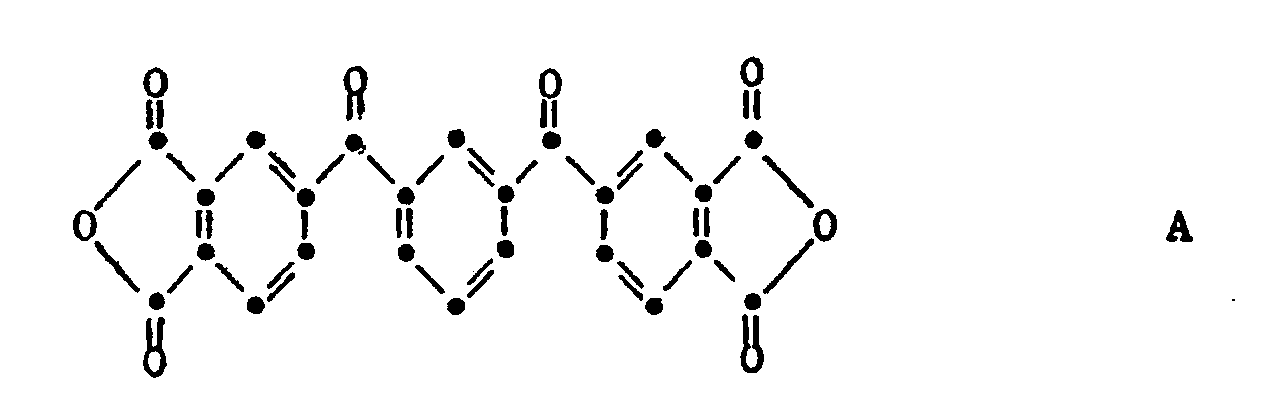


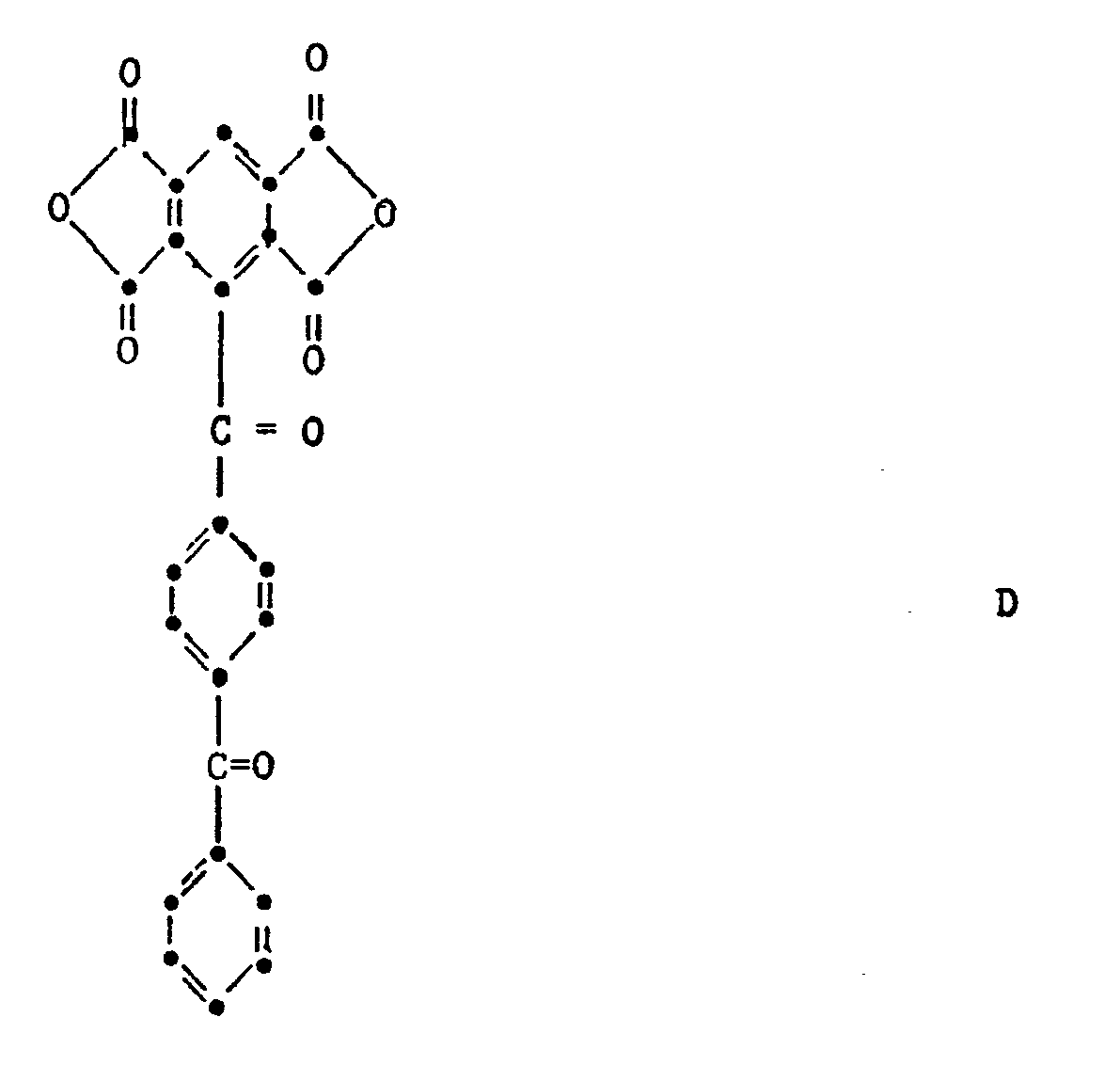
- Die Herstellung von A und B ist in der französischen Patentschrift 1,601,094 beschrieben. Die Herstellung von C ist in der US-Patent-schrift 3,299.101 beschrieben. D wird analog zu C hergestellt.
- In einem zylindrischen Gefäss, das mit Rührer, Tropftrichter, Innenthermometer und Gaseinleitungsrohr sowie Gasableitungsrohr ausgestattet ist, werden 1,642 g (0,01 Mol) 3,6-Diaminodurol unter Stickstoff in 25 ml N-Methylpyrrolidon (NMP) gelöst und die Lösung auf 5 bis 0" C abgekühlt. Dann werden 4,263 g Dianhydrid der Formel A zugegeben und eine Stunde lang gerührt. Im Verlaufe einer weiteren Stunde werden noch 2 Portionen Dianhydrid zu je 0,0426 g Dianhydrid zugesetzt.
- Nach 3 Stunden werden 3,1 ml Triäthylamin und 8,5 ml Acetanhydrid zugegeben und 16 Stunden bei Raumtemperatur gerührt, wobei die Polyamidsäure zum Polyimid cyclisiert wird.
- Die Isolierung des Polyimids erfolgt durch Ausfällen mit 1 Liter Wasser. Das Polymer wird filtriert, erneut mit 1 Liter Wasser behandelt, wieder filtriert und bei 80 C im Vakuum getrocknet. Die Eigenschaften des Polyimids sind in Tabelle 1 zusammengefasst.
- Analog Beispiel 1 werden verschiedene Diamine oder Diaminmischungen mit Dianhydriden der Formeln A, B, C oder D in NMP umgesetzt umgesetzt und zu den entsprechenden Polyimiden cyclisiert.
- Die Zusammensetzung und die Eigenschaften sind in Tabelle 1 zusammengefasst:
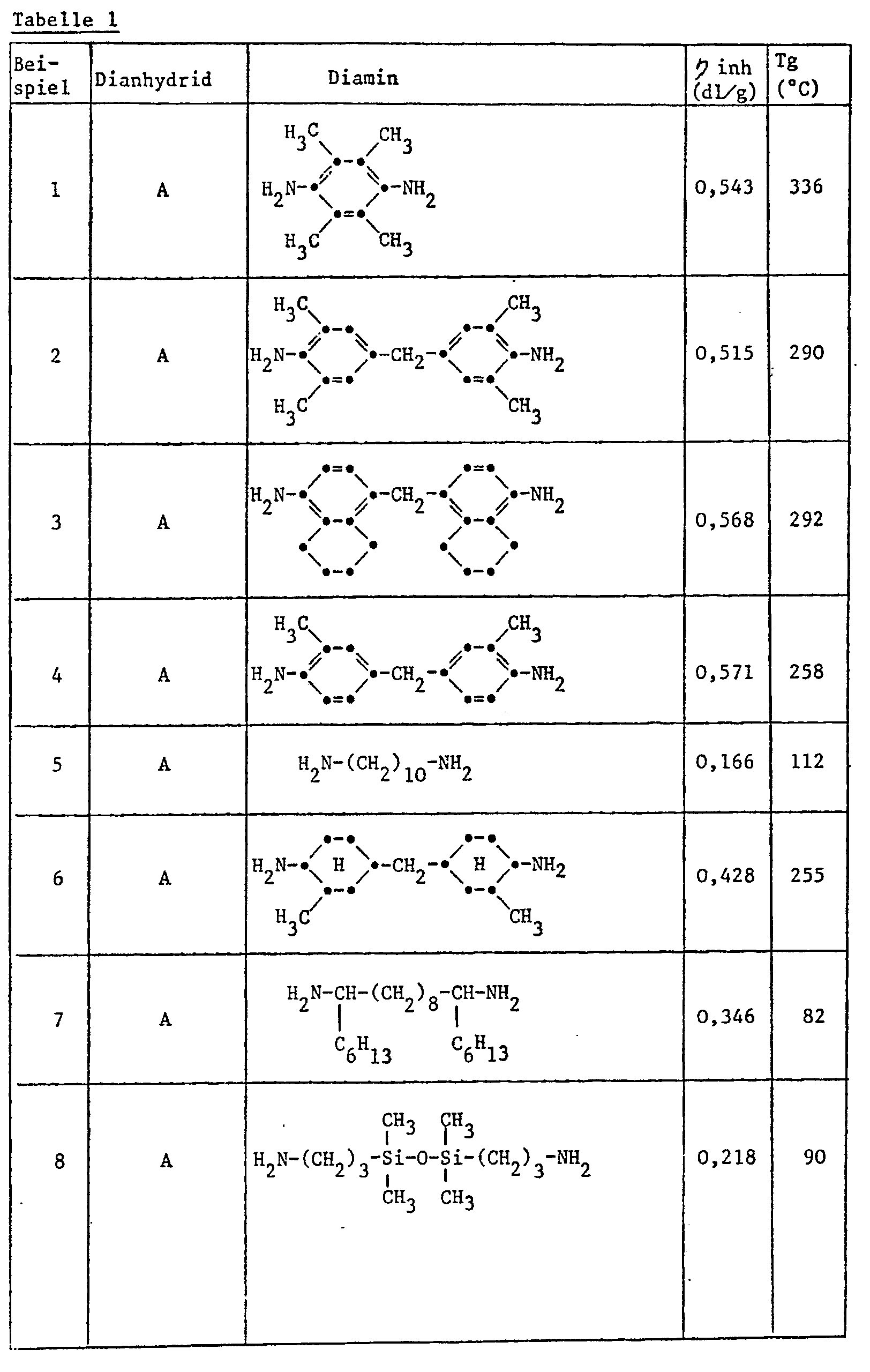


- Auf einer einseitig Kupfer-kaschierten Kunststoffplatte wird ein dünner Polymerfilm erzeugt, indem eine 5 %ige Polymerlösung aufgeschleudert wird und das Lösungsmittel anschliessend in einem Umluftofen entfernt wird. Als Lösungsmittel wird N-Methylpyrrolidon verwendet.
- Die so beschichteten Platten werden durch eine Photomaske (Stouffer-Keil) bei Raumtemperatur mit einer 1000 Watt-UV-Lampe aus 18 cm Entfernung belichtet. Die belichteten Platten werden anschliessend mit einem Lösungsmittel entwickelt, wobei die unbelichteten Anteile des Polymerfilms weggelöst werden. Die Sichtbarmachung des Reliefbildes geschieht anschliessend durch Wegätzen der freigelegten Kupferschicht mit FeCl3-Lösung.
- Die Belichtungszeit, der verwendete Entwickler und die Photoempfindlichkeit (21-step Stouffer sensitivity guide) sind in der folgenden Tabelle zusammengefasst.
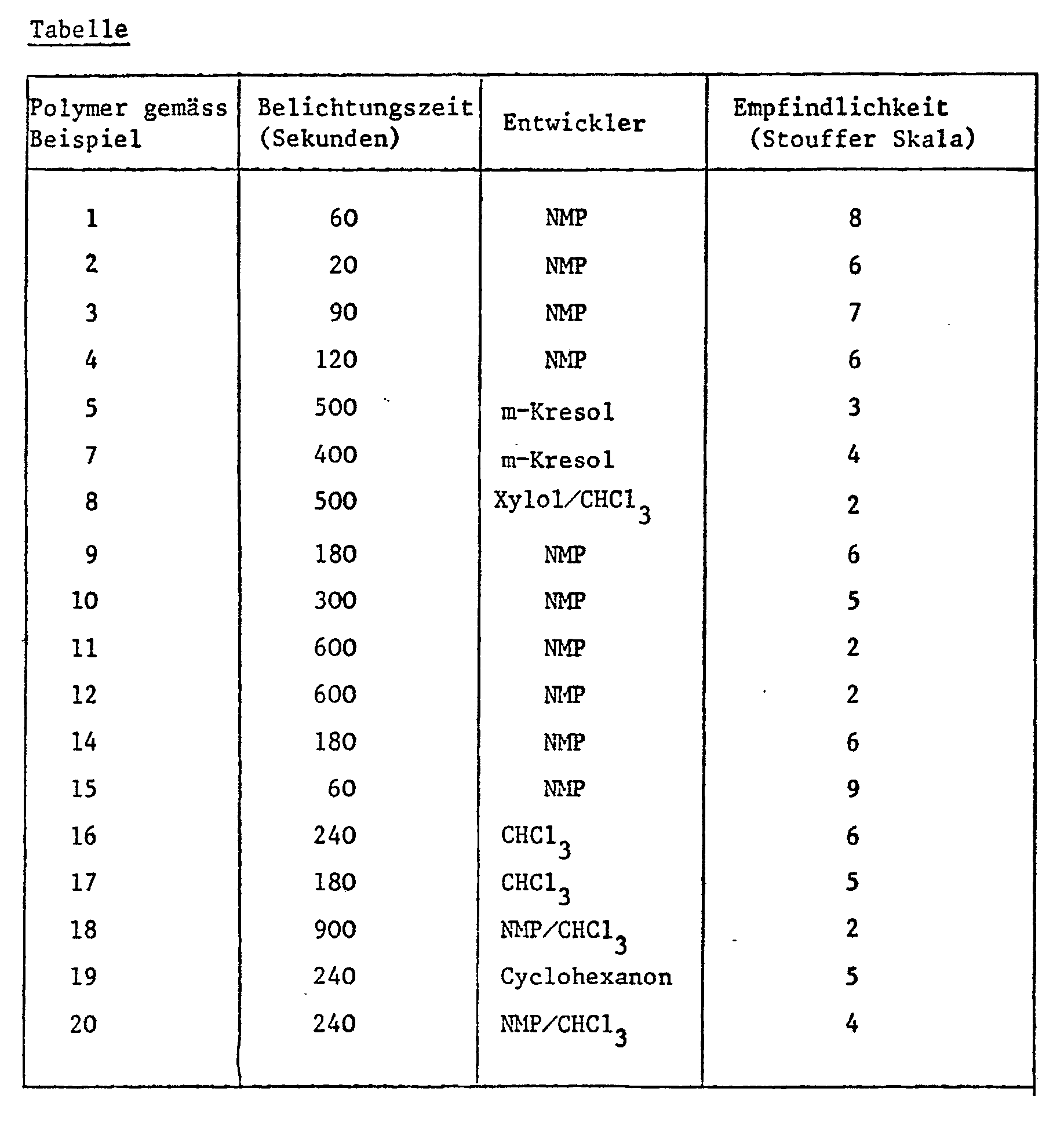
Claims (16)


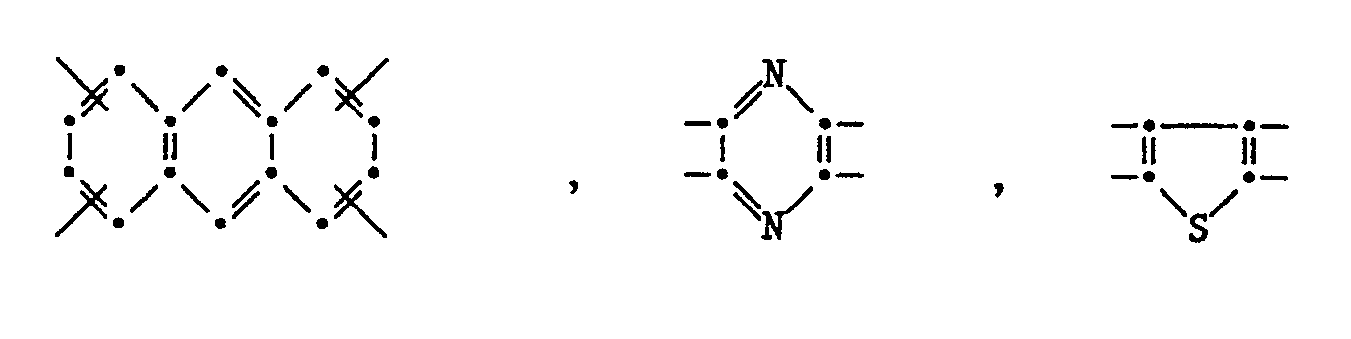
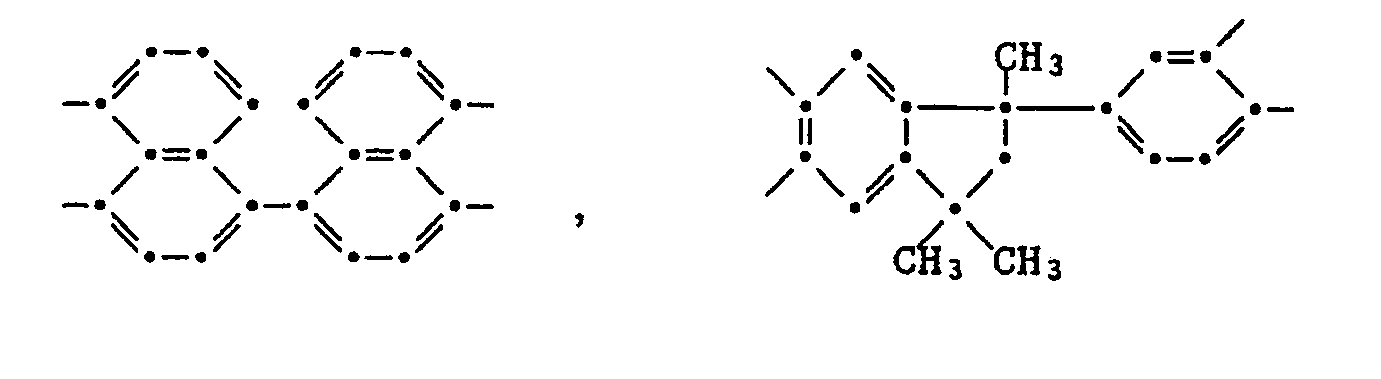

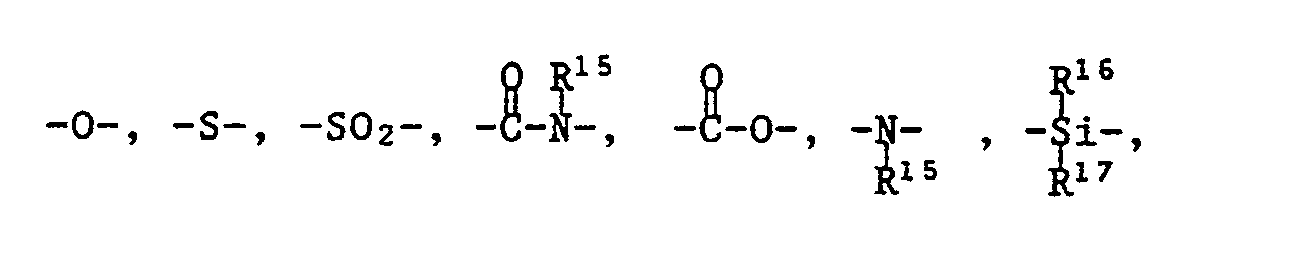


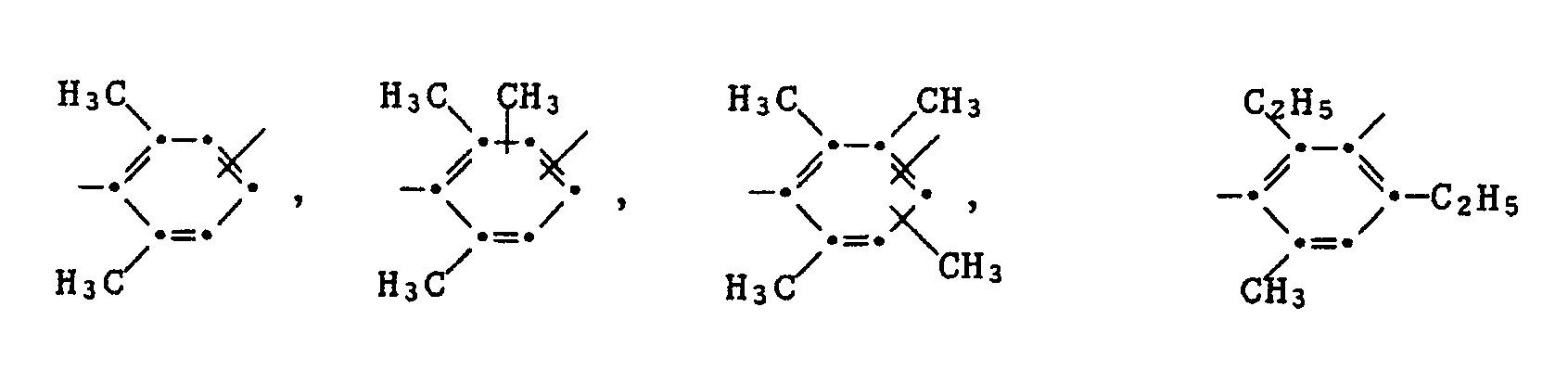
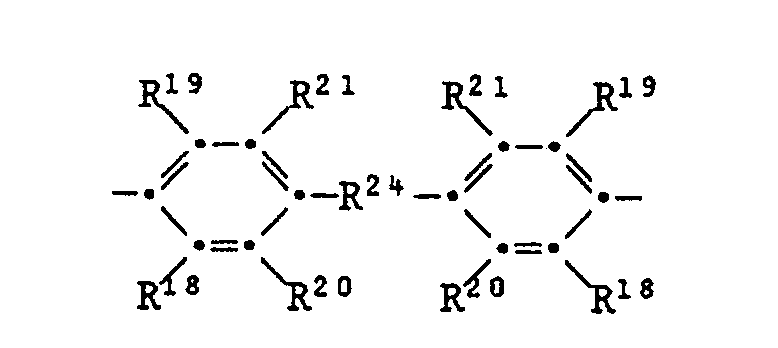


Applications Claiming Priority (2)
| Application Number | Priority Date | Filing Date | Title |
|---|---|---|---|
| CH241784 | 1984-05-17 | ||
| CH2417/84 | 1984-05-17 |
Publications (3)
| Publication Number | Publication Date |
|---|---|
| EP0162017A2 EP0162017A2 (de) | 1985-11-21 |
| EP0162017A3 EP0162017A3 (en) | 1986-04-02 |
| EP0162017B1 true EP0162017B1 (de) | 1991-08-21 |
Family
ID=4233318
Family Applications (1)
| Application Number | Title | Priority Date | Filing Date |
|---|---|---|---|
| EP85810222A Expired - Lifetime EP0162017B1 (de) | 1984-05-17 | 1985-05-09 | Homo- und Copolymere, Verfahren zu deren Vernetzung und derenVerwendung |
Country Status (5)
| Country | Link |
|---|---|
| US (2) | US4680195A (de) |
| EP (1) | EP0162017B1 (de) |
| JP (1) | JPS60255821A (de) |
| CA (1) | CA1271584A (de) |
| DE (1) | DE3583817D1 (de) |
Families Citing this family (20)
| Publication number | Priority date | Publication date | Assignee | Title |
|---|---|---|---|---|
| US4786569A (en) * | 1985-09-04 | 1988-11-22 | Ciba-Geigy Corporation | Adhesively bonded photostructurable polyimide film |
| US4847359A (en) * | 1986-06-30 | 1989-07-11 | Ciba-Geigy Corporation | Diamino-9,10-dihydroanthracenes and polyamide acid (esters) and polyimides derived therefrom |
| EP0252883B1 (de) * | 1986-07-08 | 1991-01-16 | Ciba-Geigy Ag | Beschichtetes Material enthaltend eine strahlungsempfindliche Polyimidschicht mit speziellen Diaminodiphenylmethaneinheiten |
| US4717393A (en) * | 1986-10-27 | 1988-01-05 | E. I. Du Pont De Nemours And Company | Polyimide gas separation membranes |
| US4767191A (en) * | 1986-11-14 | 1988-08-30 | U.S. Philips Corporation | Display cell |
| EP0274354B1 (de) * | 1986-12-29 | 1992-01-08 | Ciba-Geigy Ag | Photostrukturierbare Polyimidmischungen, Polyimide auf Basis von Benzhydroltetracarbonsäure und deren Herstellung |
| US4925912A (en) * | 1987-12-15 | 1990-05-15 | Ciba-Geigy Corporation | Auto-photocrosslinkable copolyimides and polyimide compositions |
| US5102959A (en) * | 1987-12-15 | 1992-04-07 | Ciba-Geigy Corporation | Auto-photocrosslinkable copolyimides and polyimide compositions |
| DE3833437A1 (de) * | 1988-10-01 | 1990-04-05 | Basf Ag | Strahlungsempfindliche gemische und deren verwendung |
| DE3833438A1 (de) * | 1988-10-01 | 1990-04-05 | Basf Ag | Strahlungsempfindliche gemische und deren verwendung |
| US5116703A (en) * | 1989-12-15 | 1992-05-26 | Xerox Corporation | Functional hybrid compounds and thin films by sol-gel process |
| US5166308A (en) * | 1990-04-30 | 1992-11-24 | E. I. Du Pont De Nemours And Company | Copolyimide film with improved properties |
| DE59105367D1 (de) * | 1990-08-17 | 1995-06-08 | Ciba Geigy Ag | Copolyimide, Verfahren zu deren Herstellung und deren Verwendung. |
| US5198316A (en) * | 1990-08-17 | 1993-03-30 | Ciba-Geigy Corporation | Copolyimides, their preparation and the use thereof |
| DE69115171T2 (de) * | 1990-08-27 | 1996-05-15 | Du Pont | Flexible Polyimid-Mehrschichtlaminate und ihre Herstellung. |
| US5198555A (en) * | 1991-11-15 | 1993-03-30 | Amoco Corporation | Dianhydrides from catalyzed reaction of monoanhydide monoacid halides with polyalkylated mononuclear aromatics |
| EP0593397B1 (de) * | 1992-10-15 | 1996-12-27 | Ciba-Geigy Ag | Polymerisierbare photochrome Napthacendione, Polymere dieser Monomeren, Verfahren zu deren Herstellung, und deren Verwendung |
| US6391524B2 (en) | 1999-11-19 | 2002-05-21 | Kodak Polychrome Graphics Llc | Article having imagable coatings |
| AU2003260979A1 (en) * | 2002-09-13 | 2004-04-30 | Lg Chem, Ltd. | Bio-chip prepared by gelation on a chip substrate |
| GB201004940D0 (en) * | 2010-03-24 | 2010-05-12 | Hexcel Composites Ltd | Novel curing agents |
Family Cites Families (22)
| Publication number | Priority date | Publication date | Assignee | Title |
|---|---|---|---|---|
| US3275690A (en) * | 1955-07-14 | 1966-09-27 | Bayer Ag | Process for the production of aromatic amines which are alkylated on the nucleus |
| US3424718A (en) * | 1964-09-23 | 1969-01-28 | Du Pont | Copolymers of aromatic tetracarboxylic acids with at least two organic diamines |
| US3299101A (en) * | 1965-05-04 | 1967-01-17 | Du Pont | Substituted pyromellitic dianhydrides |
| US3435002A (en) * | 1967-05-15 | 1969-03-25 | Gen Electric | Polyamide acid resins and polyimides therefrom |
| GB1230421A (de) * | 1967-09-15 | 1971-05-05 | ||
| FR1565700A (de) * | 1968-03-22 | 1969-05-02 | ||
| FR1601094A (en) * | 1968-03-25 | 1970-08-10 | Bis (dicarboxy-3,4-benzoyl)-1,3-benzene and its - anhydride as polymer precursors | |
| FR1603640A (de) * | 1968-12-16 | 1971-05-10 | ||
| US3875116A (en) * | 1970-12-29 | 1975-04-01 | Gen Electric | Polyetherimides |
| DE2318170A1 (de) * | 1973-04-11 | 1974-10-31 | Bayer Ag | Heterocyclische diisocyanate |
| JPS573692B2 (de) * | 1973-12-06 | 1982-01-22 | ||
| US4197397A (en) * | 1975-03-14 | 1980-04-08 | University Of Notre Dame Du Lac | Chain-extending anhydride end-capped polyimides |
| US4030948A (en) * | 1975-07-21 | 1977-06-21 | Abe Berger | Polyimide containing silicones as protective coating on semiconductor device |
| US4395527A (en) * | 1978-05-17 | 1983-07-26 | M & T Chemicals Inc. | Siloxane-containing polymers |
| JPS559539A (en) * | 1978-07-07 | 1980-01-23 | Asahi Chem Ind Co Ltd | Heat resistant paste for photoforming |
| DE2933826A1 (de) * | 1979-08-21 | 1981-03-19 | Siemens AG, 1000 Berlin und 8000 München | Polyimid-, polyisoindolochinazolindion-, polyoxazindion- und polychinazolindion-vorstufen sowie deren herstellung |
| US4402907A (en) * | 1980-08-13 | 1983-09-06 | Ciba-Geigy Corporation | Triazine carboxylic acids as corrosion inhibitors for aqueous systems |
| US4480009A (en) * | 1980-12-15 | 1984-10-30 | M&T Chemicals Inc. | Siloxane-containing polymers |
| US4499149A (en) * | 1980-12-15 | 1985-02-12 | M&T Chemicals Inc. | Siloxane-containing polymers |
| DE3372983D1 (en) * | 1982-04-21 | 1987-09-17 | Ciba Geigy Ag | Radiation-sensible coating composition and its use |
| US4657832A (en) * | 1983-05-18 | 1987-04-14 | Ciba-Geigy Corporation | Photosensitive polymers as coating materials |
| JP2516897B2 (ja) * | 1983-10-21 | 1996-07-24 | 信越化学工業株式会社 | 感光性組成物 |
-
1985
- 1985-05-09 DE DE8585810222T patent/DE3583817D1/de not_active Expired - Lifetime
- 1985-05-09 EP EP85810222A patent/EP0162017B1/de not_active Expired - Lifetime
- 1985-05-10 US US06/732,334 patent/US4680195A/en not_active Expired - Fee Related
- 1985-05-15 CA CA000481558A patent/CA1271584A/en not_active Expired
- 1985-05-16 JP JP60102812A patent/JPS60255821A/ja active Pending
-
1987
- 1987-04-22 US US07/041,889 patent/US4783372A/en not_active Expired - Fee Related
Also Published As
| Publication number | Publication date |
|---|---|
| DE3583817D1 (de) | 1991-09-26 |
| US4680195A (en) | 1987-07-14 |
| US4783372A (en) | 1988-11-08 |
| CA1271584A (en) | 1990-07-10 |
| EP0162017A3 (en) | 1986-04-02 |
| EP0162017A2 (de) | 1985-11-21 |
| JPS60255821A (ja) | 1985-12-17 |
Similar Documents
| Publication | Publication Date | Title |
|---|---|---|
| EP0134752B1 (de) | Beschichtetes Material und seine Verwendung | |
| EP0132221B1 (de) | Polyimide, Verfahren zu deren Herstellung und deren Verwendung | |
| EP0138768B1 (de) | Strahlungsempfindliche Polykondensate, Verfahren zu deren Herstellung, beschichtetes Material und dessen Verwendung | |
| EP0181837B1 (de) | Verfahren zur Herstellung von Filmen und Reliefabbildungen aus Polyimiden | |
| EP0141781B1 (de) | Strahlungsempfindliches Beschichtungsmittel und dessen Verwendung | |
| EP0162017A2 (de) | Homo- und Copolymere, Verfahren zu deren Vernetzung und derenVerwendung | |
| EP0182745B1 (de) | Polyimide, Verfahren zu deren Herstellung und deren Verwendung | |
| DE3850459T2 (de) | Lichtempfindliche Zusammensetzungen. | |
| EP0200680A2 (de) | Beschichtetes Material und dessen Verwendung | |
| EP0203030B1 (de) | Beschichtetes Material und seine Verwendung | |
| EP0092524B1 (de) | Strahlungsempfindliches Beschichtungsmittel und seine Verwendung | |
| US4925912A (en) | Auto-photocrosslinkable copolyimides and polyimide compositions | |
| JPS59231533A (ja) | 塗膜を被覆した材料およびその使用方法 | |
| EP0321398B1 (de) | Autophotovernetzbare Copolyimide und Polyimidzusammensetzungen | |
| EP0198798B1 (de) | Strahlungsempfindliche Polykondensate, Verfahren zu deren Herstellung, beschichtetes Material und dessen Verwendung | |
| US4914181A (en) | Polyimides, a process for their preparation and their use, and tetracarboxylic acids and tetracarboxylic acid derivatives | |
| US5153303A (en) | Polyimides prepared from disubstituted aromatic tetracarboxylic acid dianhydrides | |
| EP0252883B1 (de) | Beschichtetes Material enthaltend eine strahlungsempfindliche Polyimidschicht mit speziellen Diaminodiphenylmethaneinheiten | |
| JPH02154262A (ja) | 感光性樹脂組成物及びこれを用いた感光性エレメント | |
| EP0315216A2 (de) | Polyimide, Verfahren zu deren Herstellung und deren Verwendung |
Legal Events
| Date | Code | Title | Description |
|---|---|---|---|
| PUAI | Public reference made under article 153(3) epc to a published international application that has entered the european phase |
Free format text: ORIGINAL CODE: 0009012 |
|
| 17P | Request for examination filed |
Effective date: 19850511 |
|
| AK | Designated contracting states |
Designated state(s): BE CH DE FR GB IT LI NL SE |
|
| PUAL | Search report despatched |
Free format text: ORIGINAL CODE: 0009013 |
|
| AK | Designated contracting states |
Kind code of ref document: A3 Designated state(s): BE CH DE FR GB IT LI NL SE |
|
| 17Q | First examination report despatched |
Effective date: 19880211 |
|
| GRAA | (expected) grant |
Free format text: ORIGINAL CODE: 0009210 |
|
| AK | Designated contracting states |
Kind code of ref document: B1 Designated state(s): BE CH DE FR GB IT LI NL SE |
|
| ITF | It: translation for a ep patent filed | ||
| REF | Corresponds to: |
Ref document number: 3583817 Country of ref document: DE Date of ref document: 19910926 |
|
| ET | Fr: translation filed | ||
| GBT | Gb: translation of ep patent filed (gb section 77(6)(a)/1977) | ||
| PLBE | No opposition filed within time limit |
Free format text: ORIGINAL CODE: 0009261 |
|
| STAA | Information on the status of an ep patent application or granted ep patent |
Free format text: STATUS: NO OPPOSITION FILED WITHIN TIME LIMIT |
|
| 26N | No opposition filed | ||
| PGFP | Annual fee paid to national office [announced via postgrant information from national office to epo] |
Ref country code: FR Payment date: 19930322 Year of fee payment: 9 |
|
| PGFP | Annual fee paid to national office [announced via postgrant information from national office to epo] |
Ref country code: DE Payment date: 19930401 Year of fee payment: 9 |
|
| PGFP | Annual fee paid to national office [announced via postgrant information from national office to epo] |
Ref country code: GB Payment date: 19930426 Year of fee payment: 9 |
|
| PGFP | Annual fee paid to national office [announced via postgrant information from national office to epo] |
Ref country code: NL Payment date: 19930531 Year of fee payment: 9 |
|
| PGFP | Annual fee paid to national office [announced via postgrant information from national office to epo] |
Ref country code: SE Payment date: 19930601 Year of fee payment: 9 |
|
| PGFP | Annual fee paid to national office [announced via postgrant information from national office to epo] |
Ref country code: BE Payment date: 19930608 Year of fee payment: 9 |
|
| PGFP | Annual fee paid to national office [announced via postgrant information from national office to epo] |
Ref country code: CH Payment date: 19930726 Year of fee payment: 9 |
|
| PG25 | Lapsed in a contracting state [announced via postgrant information from national office to epo] |
Ref country code: GB Effective date: 19940509 |
|
| PG25 | Lapsed in a contracting state [announced via postgrant information from national office to epo] |
Ref country code: SE Effective date: 19940510 |
|
| PG25 | Lapsed in a contracting state [announced via postgrant information from national office to epo] |
Ref country code: LI Effective date: 19940531 Ref country code: CH Effective date: 19940531 Ref country code: BE Effective date: 19940531 |
|
| BERE | Be: lapsed |
Owner name: CIBA-GEIGY A.G. Effective date: 19940531 |
|
| PG25 | Lapsed in a contracting state [announced via postgrant information from national office to epo] |
Ref country code: NL Effective date: 19941201 |
|
| GBPC | Gb: european patent ceased through non-payment of renewal fee |
Effective date: 19940509 |
|
| NLV4 | Nl: lapsed or anulled due to non-payment of the annual fee | ||
| EUG | Se: european patent has lapsed |
Ref document number: 85810222.1 Effective date: 19941210 |
|
| PG25 | Lapsed in a contracting state [announced via postgrant information from national office to epo] |
Ref country code: FR Effective date: 19950131 |
|
| REG | Reference to a national code |
Ref country code: CH Ref legal event code: PL |
|
| PG25 | Lapsed in a contracting state [announced via postgrant information from national office to epo] |
Ref country code: DE Effective date: 19950201 |
|
| EUG | Se: european patent has lapsed |
Ref document number: 85810222.1 |
|
| REG | Reference to a national code |
Ref country code: FR Ref legal event code: ST |