EP0158660B1 - Method for manufacturing a composition for coating substrates with an abrasion-resistant translucent film - Google Patents
Method for manufacturing a composition for coating substrates with an abrasion-resistant translucent film Download PDFInfo
- Publication number
- EP0158660B1 EP0158660B1 EP84903586A EP84903586A EP0158660B1 EP 0158660 B1 EP0158660 B1 EP 0158660B1 EP 84903586 A EP84903586 A EP 84903586A EP 84903586 A EP84903586 A EP 84903586A EP 0158660 B1 EP0158660 B1 EP 0158660B1
- Authority
- EP
- European Patent Office
- Prior art keywords
- charge
- particles
- mineral
- organic phase
- grafted
- Prior art date
- Legal status (The legal status is an assumption and is not a legal conclusion. Google has not performed a legal analysis and makes no representation as to the accuracy of the status listed.)
- Expired
Links
- 238000000576 coating method Methods 0.000 title claims abstract description 26
- 238000005299 abrasion Methods 0.000 title claims abstract description 13
- 239000000203 mixture Substances 0.000 title claims description 61
- 238000000034 method Methods 0.000 title claims description 39
- 239000000758 substrate Substances 0.000 title claims description 19
- 239000011248 coating agent Substances 0.000 title claims description 9
- 238000004519 manufacturing process Methods 0.000 title claims description 7
- VYPSYNLAJGMNEJ-UHFFFAOYSA-N Silicium dioxide Chemical compound O=[Si]=O VYPSYNLAJGMNEJ-UHFFFAOYSA-N 0.000 claims abstract description 63
- 239000002245 particle Substances 0.000 claims abstract description 45
- 229910052500 inorganic mineral Inorganic materials 0.000 claims abstract description 38
- 239000011707 mineral Substances 0.000 claims abstract description 38
- 239000012074 organic phase Substances 0.000 claims abstract description 27
- 239000000377 silicon dioxide Substances 0.000 claims abstract description 23
- 230000007062 hydrolysis Effects 0.000 claims abstract description 18
- 238000006460 hydrolysis reaction Methods 0.000 claims abstract description 18
- 238000001694 spray drying Methods 0.000 claims abstract description 16
- PNEYBMLMFCGWSK-UHFFFAOYSA-N aluminium oxide Inorganic materials [O-2].[O-2].[O-2].[Al+3].[Al+3] PNEYBMLMFCGWSK-UHFFFAOYSA-N 0.000 claims abstract description 12
- 239000000178 monomer Substances 0.000 claims description 21
- 238000001035 drying Methods 0.000 claims description 17
- XLYOFNOQVPJJNP-UHFFFAOYSA-N water Substances O XLYOFNOQVPJJNP-UHFFFAOYSA-N 0.000 claims description 15
- 238000003801 milling Methods 0.000 claims description 14
- 125000001424 substituent group Chemical group 0.000 claims description 14
- 239000011521 glass Substances 0.000 claims description 10
- 239000011324 bead Substances 0.000 claims description 8
- 238000000926 separation method Methods 0.000 claims description 8
- 238000010348 incorporation Methods 0.000 claims description 7
- 238000013019 agitation Methods 0.000 claims description 6
- 239000012736 aqueous medium Substances 0.000 claims description 6
- 239000002609 medium Substances 0.000 claims description 6
- 238000006116 polymerization reaction Methods 0.000 claims description 6
- 239000002904 solvent Substances 0.000 claims description 5
- 238000001704 evaporation Methods 0.000 claims description 4
- 239000007970 homogeneous dispersion Substances 0.000 claims description 4
- 125000000217 alkyl group Chemical group 0.000 claims description 3
- 230000008020 evaporation Effects 0.000 claims description 3
- 230000003301 hydrolyzing effect Effects 0.000 claims description 3
- 239000002685 polymerization catalyst Substances 0.000 claims description 3
- 238000003756 stirring Methods 0.000 claims description 3
- HTSGKJQDMSTCGS-UHFFFAOYSA-N 1,4-bis(4-chlorophenyl)-2-(4-methylphenyl)sulfonylbutane-1,4-dione Chemical compound C1=CC(C)=CC=C1S(=O)(=O)C(C(=O)C=1C=CC(Cl)=CC=1)CC(=O)C1=CC=C(Cl)C=C1 HTSGKJQDMSTCGS-UHFFFAOYSA-N 0.000 claims description 2
- 239000012071 phase Substances 0.000 claims description 2
- 239000003505 polymerization initiator Substances 0.000 claims description 2
- DAHWFTWPSFSFMS-UHFFFAOYSA-N trihydroxysilane Chemical compound O[SiH](O)O DAHWFTWPSFSFMS-UHFFFAOYSA-N 0.000 claims description 2
- 229940125904 compound 1 Drugs 0.000 claims 1
- 239000011369 resultant mixture Substances 0.000 claims 1
- 125000000524 functional group Chemical group 0.000 abstract description 2
- 239000010408 film Substances 0.000 description 22
- -1 Polysiloxane Polymers 0.000 description 17
- 239000000243 solution Substances 0.000 description 13
- 239000006185 dispersion Substances 0.000 description 12
- 238000002474 experimental method Methods 0.000 description 10
- 230000003287 optical effect Effects 0.000 description 10
- 229910052681 coesite Inorganic materials 0.000 description 9
- 229910052906 cristobalite Inorganic materials 0.000 description 9
- 229910052682 stishovite Inorganic materials 0.000 description 9
- 229910052905 tridymite Inorganic materials 0.000 description 9
- 239000011805 ball Substances 0.000 description 8
- 230000002209 hydrophobic effect Effects 0.000 description 8
- 238000005507 spraying Methods 0.000 description 8
- 238000002156 mixing Methods 0.000 description 7
- 239000007921 spray Substances 0.000 description 7
- 238000012360 testing method Methods 0.000 description 7
- QTBSBXVTEAMEQO-UHFFFAOYSA-N Acetic acid Chemical compound CC(O)=O QTBSBXVTEAMEQO-UHFFFAOYSA-N 0.000 description 6
- 238000002835 absorbance Methods 0.000 description 6
- 230000015572 biosynthetic process Effects 0.000 description 6
- 239000003153 chemical reaction reagent Substances 0.000 description 6
- 239000000463 material Substances 0.000 description 6
- 229920005989 resin Polymers 0.000 description 6
- 239000011347 resin Substances 0.000 description 6
- 238000001723 curing Methods 0.000 description 5
- 229910000077 silane Inorganic materials 0.000 description 5
- BLRPTPMANUNPDV-UHFFFAOYSA-N Silane Chemical compound [SiH4] BLRPTPMANUNPDV-UHFFFAOYSA-N 0.000 description 4
- 230000008901 benefit Effects 0.000 description 4
- 239000008199 coating composition Substances 0.000 description 4
- 230000000052 comparative effect Effects 0.000 description 4
- 239000000945 filler Substances 0.000 description 4
- 239000007788 liquid Substances 0.000 description 4
- 239000011806 microball Substances 0.000 description 4
- 239000000843 powder Substances 0.000 description 4
- 230000002035 prolonged effect Effects 0.000 description 4
- 230000001681 protective effect Effects 0.000 description 4
- 150000004756 silanes Chemical class 0.000 description 4
- 239000007787 solid Substances 0.000 description 4
- WSFSSNUMVMOOMR-UHFFFAOYSA-N Formaldehyde Chemical compound O=C WSFSSNUMVMOOMR-UHFFFAOYSA-N 0.000 description 3
- XUIMIQQOPSSXEZ-UHFFFAOYSA-N Silicon Chemical compound [Si] XUIMIQQOPSSXEZ-UHFFFAOYSA-N 0.000 description 3
- 239000002253 acid Substances 0.000 description 3
- 239000000654 additive Substances 0.000 description 3
- 238000006243 chemical reaction Methods 0.000 description 3
- 150000001875 compounds Chemical class 0.000 description 3
- 238000005260 corrosion Methods 0.000 description 3
- 238000000151 deposition Methods 0.000 description 3
- 230000000694 effects Effects 0.000 description 3
- 229920001971 elastomer Polymers 0.000 description 3
- 230000002349 favourable effect Effects 0.000 description 3
- 238000009434 installation Methods 0.000 description 3
- 229920001296 polysiloxane Polymers 0.000 description 3
- 239000011253 protective coating Substances 0.000 description 3
- 125000005372 silanol group Chemical group 0.000 description 3
- 230000009974 thixotropic effect Effects 0.000 description 3
- LEJBBGNFPAFPKQ-UHFFFAOYSA-N 2-(2-prop-2-enoyloxyethoxy)ethyl prop-2-enoate Chemical compound C=CC(=O)OCCOCCOC(=O)C=C LEJBBGNFPAFPKQ-UHFFFAOYSA-N 0.000 description 2
- 229910002019 Aerosil® 380 Inorganic materials 0.000 description 2
- OKTJSMMVPCPJKN-UHFFFAOYSA-N Carbon Chemical compound [C] OKTJSMMVPCPJKN-UHFFFAOYSA-N 0.000 description 2
- 239000004593 Epoxy Chemical group 0.000 description 2
- LFQSCWFLJHTTHZ-UHFFFAOYSA-N Ethanol Chemical compound CCO LFQSCWFLJHTTHZ-UHFFFAOYSA-N 0.000 description 2
- 230000002378 acidificating effect Effects 0.000 description 2
- 150000001252 acrylic acid derivatives Chemical class 0.000 description 2
- NIXOWILDQLNWCW-UHFFFAOYSA-N acrylic acid group Chemical group C(C=C)(=O)O NIXOWILDQLNWCW-UHFFFAOYSA-N 0.000 description 2
- 230000002776 aggregation Effects 0.000 description 2
- 239000003795 chemical substances by application Substances 0.000 description 2
- IJOOHPMOJXWVHK-UHFFFAOYSA-N chlorotrimethylsilane Chemical compound C[Si](C)(C)Cl IJOOHPMOJXWVHK-UHFFFAOYSA-N 0.000 description 2
- 239000000470 constituent Substances 0.000 description 2
- 238000001816 cooling Methods 0.000 description 2
- 230000007797 corrosion Effects 0.000 description 2
- 230000018044 dehydration Effects 0.000 description 2
- 238000006297 dehydration reaction Methods 0.000 description 2
- 230000001627 detrimental effect Effects 0.000 description 2
- 238000005516 engineering process Methods 0.000 description 2
- WOXXJEVNDJOOLV-UHFFFAOYSA-N ethenyl-tris(2-methoxyethoxy)silane Chemical compound COCCO[Si](OCCOC)(OCCOC)C=C WOXXJEVNDJOOLV-UHFFFAOYSA-N 0.000 description 2
- 238000000265 homogenisation Methods 0.000 description 2
- 238000011065 in-situ storage Methods 0.000 description 2
- 239000003999 initiator Substances 0.000 description 2
- 239000012764 mineral filler Substances 0.000 description 2
- 125000000962 organic group Chemical group 0.000 description 2
- 239000011368 organic material Substances 0.000 description 2
- 239000005416 organic matter Substances 0.000 description 2
- 229920000515 polycarbonate Polymers 0.000 description 2
- 239000004417 polycarbonate Substances 0.000 description 2
- 230000002028 premature Effects 0.000 description 2
- 230000001698 pyrogenic effect Effects 0.000 description 2
- 230000003678 scratch resistant effect Effects 0.000 description 2
- 230000035939 shock Effects 0.000 description 2
- 229910052710 silicon Inorganic materials 0.000 description 2
- 239000010703 silicon Substances 0.000 description 2
- 150000003377 silicon compounds Chemical class 0.000 description 2
- 238000003860 storage Methods 0.000 description 2
- 239000000126 substance Substances 0.000 description 2
- 125000000391 vinyl group Chemical group [H]C([*])=C([H])[H] 0.000 description 2
- 229920002554 vinyl polymer Polymers 0.000 description 2
- WYTZZXDRDKSJID-UHFFFAOYSA-N (3-aminopropyl)triethoxysilane Chemical compound CCO[Si](OCC)(OCC)CCCN WYTZZXDRDKSJID-UHFFFAOYSA-N 0.000 description 1
- DMYOHQBLOZMDLP-UHFFFAOYSA-N 1-[2-(2-hydroxy-3-piperidin-1-ylpropoxy)phenyl]-3-phenylpropan-1-one Chemical compound C1CCCCN1CC(O)COC1=CC=CC=C1C(=O)CCC1=CC=CC=C1 DMYOHQBLOZMDLP-UHFFFAOYSA-N 0.000 description 1
- YXHQEJLMUHAYAA-UHFFFAOYSA-N 1-hydroxysiline Chemical group O[Si]1=CC=CC=C1 YXHQEJLMUHAYAA-UHFFFAOYSA-N 0.000 description 1
- OXYZDRAJMHGSMW-UHFFFAOYSA-N 3-chloropropyl(trimethoxy)silane Chemical compound CO[Si](OC)(OC)CCCCl OXYZDRAJMHGSMW-UHFFFAOYSA-N 0.000 description 1
- LVNLBBGBASVLLI-UHFFFAOYSA-N 3-triethoxysilylpropylurea Chemical compound CCO[Si](OCC)(OCC)CCCNC(N)=O LVNLBBGBASVLLI-UHFFFAOYSA-N 0.000 description 1
- UUEWCQRISZBELL-UHFFFAOYSA-N 3-trimethoxysilylpropane-1-thiol Chemical compound CO[Si](OC)(OC)CCCS UUEWCQRISZBELL-UHFFFAOYSA-N 0.000 description 1
- XDLMVUHYZWKMMD-UHFFFAOYSA-N 3-trimethoxysilylpropyl 2-methylprop-2-enoate Chemical compound CO[Si](OC)(OC)CCCOC(=O)C(C)=C XDLMVUHYZWKMMD-UHFFFAOYSA-N 0.000 description 1
- 229910002012 Aerosil® Inorganic materials 0.000 description 1
- 208000034656 Contusions Diseases 0.000 description 1
- 240000004658 Medicago sativa Species 0.000 description 1
- 235000010624 Medicago sativa Nutrition 0.000 description 1
- 235000006679 Mentha X verticillata Nutrition 0.000 description 1
- 240000003321 Mentha requienii Species 0.000 description 1
- 235000002899 Mentha suaveolens Nutrition 0.000 description 1
- 235000001636 Mentha x rotundifolia Nutrition 0.000 description 1
- 229910002808 Si–O–Si Inorganic materials 0.000 description 1
- 229920001079 Thiokol (polymer) Polymers 0.000 description 1
- 238000003848 UV Light-Curing Methods 0.000 description 1
- YPCHGLDQZXOZFW-UHFFFAOYSA-N [2-[[4-methyl-3-[[3-prop-2-enoyloxy-2,2-bis(prop-2-enoyloxymethyl)propoxy]carbonylamino]phenyl]carbamoyloxymethyl]-3-prop-2-enoyloxy-2-(prop-2-enoyloxymethyl)propyl] prop-2-enoate Chemical compound CC1=CC=C(NC(=O)OCC(COC(=O)C=C)(COC(=O)C=C)COC(=O)C=C)C=C1NC(=O)OCC(COC(=O)C=C)(COC(=O)C=C)COC(=O)C=C YPCHGLDQZXOZFW-UHFFFAOYSA-N 0.000 description 1
- 230000009471 action Effects 0.000 description 1
- 230000002411 adverse Effects 0.000 description 1
- 239000000443 aerosol Substances 0.000 description 1
- 238000005054 agglomeration Methods 0.000 description 1
- 238000004220 aggregation Methods 0.000 description 1
- 150000001298 alcohols Chemical class 0.000 description 1
- 150000001336 alkenes Chemical class 0.000 description 1
- 125000003545 alkoxy group Chemical group 0.000 description 1
- 229910052782 aluminium Inorganic materials 0.000 description 1
- XAGFODPZIPBFFR-UHFFFAOYSA-N aluminium Chemical compound [Al] XAGFODPZIPBFFR-UHFFFAOYSA-N 0.000 description 1
- 125000003277 amino group Chemical group 0.000 description 1
- 239000012431 aqueous reaction media Substances 0.000 description 1
- 125000000484 butyl group Chemical group [H]C([*])([H])C([H])([H])C([H])([H])C([H])([H])[H] 0.000 description 1
- 238000005266 casting Methods 0.000 description 1
- 230000008859 change Effects 0.000 description 1
- 229910021357 chromium silicide Inorganic materials 0.000 description 1
- 239000008119 colloidal silica Substances 0.000 description 1
- 239000002131 composite material Substances 0.000 description 1
- 238000006482 condensation reaction Methods 0.000 description 1
- 239000003431 cross linking reagent Substances 0.000 description 1
- 125000000000 cycloalkoxy group Chemical group 0.000 description 1
- 125000000753 cycloalkyl group Chemical group 0.000 description 1
- 125000000113 cyclohexyl group Chemical group [H]C1([H])C([H])([H])C([H])([H])C([H])(*)C([H])([H])C1([H])[H] 0.000 description 1
- 125000001511 cyclopentyl group Chemical group [H]C1([H])C([H])([H])C([H])([H])C([H])(*)C1([H])[H] 0.000 description 1
- 238000000354 decomposition reaction Methods 0.000 description 1
- 230000008021 deposition Effects 0.000 description 1
- 238000011161 development Methods 0.000 description 1
- 238000002845 discoloration Methods 0.000 description 1
- KPUWHANPEXNPJT-UHFFFAOYSA-N disiloxane Chemical group [SiH3]O[SiH3] KPUWHANPEXNPJT-UHFFFAOYSA-N 0.000 description 1
- 230000008030 elimination Effects 0.000 description 1
- 238000003379 elimination reaction Methods 0.000 description 1
- 239000000839 emulsion Substances 0.000 description 1
- 239000003822 epoxy resin Substances 0.000 description 1
- FWDBOZPQNFPOLF-UHFFFAOYSA-N ethenyl(triethoxy)silane Chemical compound CCO[Si](OCC)(OCC)C=C FWDBOZPQNFPOLF-UHFFFAOYSA-N 0.000 description 1
- 125000001495 ethyl group Chemical group [H]C([H])([H])C([H])([H])* 0.000 description 1
- 239000007888 film coating Substances 0.000 description 1
- 238000009501 film coating Methods 0.000 description 1
- 239000010419 fine particle Substances 0.000 description 1
- 239000000417 fungicide Substances 0.000 description 1
- 239000007789 gas Substances 0.000 description 1
- 150000002334 glycols Chemical class 0.000 description 1
- 238000000227 grinding Methods 0.000 description 1
- 238000010438 heat treatment Methods 0.000 description 1
- 125000004051 hexyl group Chemical group [H]C([H])([H])C([H])([H])C([H])([H])C([H])([H])C([H])([H])C([H])([H])* 0.000 description 1
- 229920001477 hydrophilic polymer Polymers 0.000 description 1
- 125000001165 hydrophobic group Chemical group 0.000 description 1
- 125000002887 hydroxy group Chemical group [H]O* 0.000 description 1
- 230000006872 improvement Effects 0.000 description 1
- 239000012212 insulator Substances 0.000 description 1
- 238000009688 liquid atomisation Methods 0.000 description 1
- 238000003754 machining Methods 0.000 description 1
- 239000011159 matrix material Substances 0.000 description 1
- 229910044991 metal oxide Inorganic materials 0.000 description 1
- 150000004706 metal oxides Chemical class 0.000 description 1
- 125000005641 methacryl group Chemical group 0.000 description 1
- 125000002496 methyl group Chemical group [H]C([H])([H])* 0.000 description 1
- 230000007935 neutral effect Effects 0.000 description 1
- 150000002894 organic compounds Chemical class 0.000 description 1
- 150000003961 organosilicon compounds Chemical class 0.000 description 1
- 125000004430 oxygen atom Chemical group O* 0.000 description 1
- LCCNCVORNKJIRZ-UHFFFAOYSA-N parathion Chemical compound CCOP(=S)(OCC)OC1=CC=C([N+]([O-])=O)C=C1 LCCNCVORNKJIRZ-UHFFFAOYSA-N 0.000 description 1
- 125000001147 pentyl group Chemical group C(CCCC)* 0.000 description 1
- 239000004033 plastic Substances 0.000 description 1
- 229920003023 plastic Polymers 0.000 description 1
- 238000006068 polycondensation reaction Methods 0.000 description 1
- 229920000647 polyepoxide Polymers 0.000 description 1
- 229920000728 polyester Polymers 0.000 description 1
- 229920000139 polyethylene terephthalate Polymers 0.000 description 1
- 239000005020 polyethylene terephthalate Substances 0.000 description 1
- 229920000642 polymer Polymers 0.000 description 1
- 239000002952 polymeric resin Substances 0.000 description 1
- 229920000193 polymethacrylate Polymers 0.000 description 1
- 229920000098 polyolefin Polymers 0.000 description 1
- 229920002635 polyurethane Polymers 0.000 description 1
- 239000004814 polyurethane Substances 0.000 description 1
- 238000010944 pre-mature reactiony Methods 0.000 description 1
- 230000008569 process Effects 0.000 description 1
- 230000000750 progressive effect Effects 0.000 description 1
- 125000001436 propyl group Chemical group [H]C([*])([H])C([H])([H])C([H])([H])[H] 0.000 description 1
- 230000035484 reaction time Effects 0.000 description 1
- 230000009257 reactivity Effects 0.000 description 1
- 238000009877 rendering Methods 0.000 description 1
- 239000006120 scratch resistant coating Substances 0.000 description 1
- SCPYDCQAZCOKTP-UHFFFAOYSA-N silanol Chemical class [SiH3]O SCPYDCQAZCOKTP-UHFFFAOYSA-N 0.000 description 1
- 150000004760 silicates Chemical class 0.000 description 1
- 229910052814 silicon oxide Inorganic materials 0.000 description 1
- 238000001179 sorption measurement Methods 0.000 description 1
- 239000003381 stabilizer Substances 0.000 description 1
- 201000009032 substance abuse Diseases 0.000 description 1
- 239000000725 suspension Substances 0.000 description 1
- 238000003786 synthesis reaction Methods 0.000 description 1
- 229920003002 synthetic resin Polymers 0.000 description 1
- 229920001187 thermosetting polymer Polymers 0.000 description 1
- 239000010409 thin film Substances 0.000 description 1
- DQZNLOXENNXVAD-UHFFFAOYSA-N trimethoxy-[2-(7-oxabicyclo[4.1.0]heptan-4-yl)ethyl]silane Chemical compound C1C(CC[Si](OC)(OC)OC)CCC2OC21 DQZNLOXENNXVAD-UHFFFAOYSA-N 0.000 description 1
- BPSIOYPQMFLKFR-UHFFFAOYSA-N trimethoxy-[3-(oxiran-2-ylmethoxy)propyl]silane Chemical compound CO[Si](OC)(OC)CCCOCC1CO1 BPSIOYPQMFLKFR-UHFFFAOYSA-N 0.000 description 1
- 239000005051 trimethylchlorosilane Substances 0.000 description 1
- 238000001947 vapour-phase growth Methods 0.000 description 1
Images
Classifications
-
- C—CHEMISTRY; METALLURGY
- C08—ORGANIC MACROMOLECULAR COMPOUNDS; THEIR PREPARATION OR CHEMICAL WORKING-UP; COMPOSITIONS BASED THEREON
- C08F—MACROMOLECULAR COMPOUNDS OBTAINED BY REACTIONS ONLY INVOLVING CARBON-TO-CARBON UNSATURATED BONDS
- C08F292/00—Macromolecular compounds obtained by polymerising monomers on to inorganic materials
-
- C—CHEMISTRY; METALLURGY
- C08—ORGANIC MACROMOLECULAR COMPOUNDS; THEIR PREPARATION OR CHEMICAL WORKING-UP; COMPOSITIONS BASED THEREON
- C08G—MACROMOLECULAR COMPOUNDS OBTAINED OTHERWISE THAN BY REACTIONS ONLY INVOLVING UNSATURATED CARBON-TO-CARBON BONDS
- C08G83/00—Macromolecular compounds not provided for in groups C08G2/00 - C08G81/00
- C08G83/001—Macromolecular compounds containing organic and inorganic sequences, e.g. organic polymers grafted onto silica
-
- C—CHEMISTRY; METALLURGY
- C08—ORGANIC MACROMOLECULAR COMPOUNDS; THEIR PREPARATION OR CHEMICAL WORKING-UP; COMPOSITIONS BASED THEREON
- C08K—Use of inorganic or non-macromolecular organic substances as compounding ingredients
- C08K9/00—Use of pretreated ingredients
- C08K9/04—Ingredients treated with organic substances
- C08K9/06—Ingredients treated with organic substances with silicon-containing compounds
-
- C—CHEMISTRY; METALLURGY
- C09—DYES; PAINTS; POLISHES; NATURAL RESINS; ADHESIVES; COMPOSITIONS NOT OTHERWISE PROVIDED FOR; APPLICATIONS OF MATERIALS NOT OTHERWISE PROVIDED FOR
- C09D—COATING COMPOSITIONS, e.g. PAINTS, VARNISHES OR LACQUERS; FILLING PASTES; CHEMICAL PAINT OR INK REMOVERS; INKS; CORRECTING FLUIDS; WOODSTAINS; PASTES OR SOLIDS FOR COLOURING OR PRINTING; USE OF MATERIALS THEREFOR
- C09D7/00—Features of coating compositions, not provided for in group C09D5/00; Processes for incorporating ingredients in coating compositions
- C09D7/40—Additives
- C09D7/60—Additives non-macromolecular
- C09D7/61—Additives non-macromolecular inorganic
- C09D7/62—Additives non-macromolecular inorganic modified by treatment with other compounds
-
- C—CHEMISTRY; METALLURGY
- C08—ORGANIC MACROMOLECULAR COMPOUNDS; THEIR PREPARATION OR CHEMICAL WORKING-UP; COMPOSITIONS BASED THEREON
- C08K—Use of inorganic or non-macromolecular organic substances as compounding ingredients
- C08K3/00—Use of inorganic substances as compounding ingredients
- C08K3/18—Oxygen-containing compounds, e.g. metal carbonyls
- C08K3/20—Oxides; Hydroxides
- C08K3/22—Oxides; Hydroxides of metals
-
- C—CHEMISTRY; METALLURGY
- C08—ORGANIC MACROMOLECULAR COMPOUNDS; THEIR PREPARATION OR CHEMICAL WORKING-UP; COMPOSITIONS BASED THEREON
- C08K—Use of inorganic or non-macromolecular organic substances as compounding ingredients
- C08K3/00—Use of inorganic substances as compounding ingredients
- C08K3/34—Silicon-containing compounds
- C08K3/36—Silica
-
- C—CHEMISTRY; METALLURGY
- C08—ORGANIC MACROMOLECULAR COMPOUNDS; THEIR PREPARATION OR CHEMICAL WORKING-UP; COMPOSITIONS BASED THEREON
- C08K—Use of inorganic or non-macromolecular organic substances as compounding ingredients
- C08K9/00—Use of pretreated ingredients
- C08K9/08—Ingredients agglomerated by treatment with a binding agent
-
- Y—GENERAL TAGGING OF NEW TECHNOLOGICAL DEVELOPMENTS; GENERAL TAGGING OF CROSS-SECTIONAL TECHNOLOGIES SPANNING OVER SEVERAL SECTIONS OF THE IPC; TECHNICAL SUBJECTS COVERED BY FORMER USPC CROSS-REFERENCE ART COLLECTIONS [XRACs] AND DIGESTS
- Y10—TECHNICAL SUBJECTS COVERED BY FORMER USPC
- Y10T—TECHNICAL SUBJECTS COVERED BY FORMER US CLASSIFICATION
- Y10T428/00—Stock material or miscellaneous articles
- Y10T428/31504—Composite [nonstructural laminate]
- Y10T428/31652—Of asbestos
- Y10T428/31663—As siloxane, silicone or silane
Definitions
- the present invention relates to scratch-resistant surfaces and more particularly concerns a method for making a polymerizable composition to be applied on substrates so as to produce thereon translucent or transparent coatings resisting corrosion and abrasion.
- Said coatings are intended to protect substrates against shocks, bruises and other mechanical accidents as well as against wear resulting from normal use.
- Such compositions are very useful in all industrial fields where it is desirable to avoid, as much as possible, progressive damage to sensitive objects of any kind exposed to shock and wear. This is particularly important when deailing with transparent articles such as optical goods the surface of which must be protected by all means against scratches so as not to lose their desirable optical properties.
- colloidal silicas which are essentially hydrophilic (as are also the other types of silica such as amorphous, crystalline, microcrystalline, precipitated and pyrogenic silicas) are compatible in general, only with hydrophilic polymers. Such silicas are much less or not miscible with typical hydrophobic resins such as polyolefins, which very strongly restricts their use as a filler in film forming thermosetting or photo-setting compositions. Moreover, adding hydrophilic silica to organic polymerizable monomers leads to the formation, with relatively low concentrations of solids, e.g. about 5 to 10% by weight, of highly thixotropic masses (non-Newtonian rheologic behavior) which are very difficult to apply as thin layers on substrates.
- compatible and compatibility shall be understood to mean that the filler must be made compatible with the hydrophobic vehicle, i.e., it must be made oleophilic, highly dispersible without aggregation into the vehicle to form a finely divided dispersion either transparent or transluscent depending on the degree of matching of refractive index, and capable of addition at high concentration without forming viscous or thixotropic solutions).
- the substituents must be selected so as to ensure proper transparency of the protective coatings without detracting from resistance to abrasion.
- particles of alumina are coated with y-(glycidyloxy)-propyl-trimethoxysilane and a mixture containing about 25% by weight of such treated alumina and an epoxy resin is used for coating a polycarbonate article so as to obtain, after polymerization, an abrasion-resistant film.
- organic groups such as vinyl, methacryl, epoxy, glycidoxy to hydrophilic silica so to impart ; thereto hydrophobic properties: L. P. Ziemianski et al, Rubber World 163, 1 (1970); M. W. Raney et al, Meeting of the Div.
- composition for providing thin translucent or transparent films very resistant to abrasion by virtue of a high level therein of hydrophobic silica.
- This composition comprises an organic phase consisting of one or more photopolymerizable monomers or prepolymers, at least one photo-initiator and charges of Si0 2 or AI 2 0 3 particles having, grafted on some of the oxygen atoms thereof, silane or siloxane substituents.
- the mineral particles to be incorporated into the organic phases are rendered hydrophobic by reacting with trialkoxysilane compounds.
- the trialkoxysilane compounds are first dispersed into an aqueous medium (mainly a water phase) wherein they are converted to some extent by hydrolysis into corresponding hydroxysilane compounds.
- aqueous medium mainly a water phase
- the mineral particles Si0 2 or A1 2 0 3
- a condensation reaction between the hydroxy groups of the hydroxysilanes and that of the particles occurs with consequent attachment of said silane compounds onto the particles.
- the grafted charge must be separated from the aqueous reaction medium and dried to an extent sufficient to enable it to be subsequently incorporated into the organic phase of the composition while avoiding difficulties inherent to the presence of an excess of moisture.
- this aim was achieved by centrifuging the aqueous dispersion of grafted particles in order to separate the heavier solids from the liquid, then by drying the separated solids in an oven and finally by grinding the dried solids in a mill to the desired mesh size, this last operation being intended to break the agglomerates of particles formed during the drying stage.
- this separation and drying step has shortcomings. For instance, during centrifuging, all liquids including possible still ungrafted hydroxysiloxane are eliminated. This elimination is undesirable because of loss of reagent and overall decrease of the grafting yields. Also, during the drying stage in an oven, the heat developed there can possibly damage, at least in part, the organic substituents grafted on the particles or, in the case when such substituents carry reactive functions to be reacted later with monomers in the organic phase upon curing, such functions may prematurely react together and produce unwanted early cross-links between the substituents. These conditions change the rheological properties of the composition upon mixing of the grafted particles with the organic phase (high viscosity build-up at relatively low levels of mineral charge incorporation).
- the first drawback mentioned was cured by replacing the centrifuging step by an evaporative step (for instance in a conventional Rotavapor apparatus) of the aqueous grafting medium (under ordinary or reduced pressure), but this did not remove the agglomeration problems nor the problems associated with premature reaction since evaporation of large amounts of water requires prolonged heating periods even under relatively low-pressures.
- the groups defined by RO in formula I above can be lower alkoxy or cycloalkoxy groups such as methoxy, ethoxy, propoxy (n and iso), butoxy, pentoxy and the like.
- the groups defined by R 1 and R 2 can be extremely variable, the only requirements therefor being chemical availability, stability, reasonable cost and compatibility with the organic monomers and/or prepolymers involved in the composition.
- Typical silane compounds useful in the present invention are:
- step 1) can be performed are not critical provided that enough water is used to effect hydrolysis.
- the alkoxysilane is added to water in concentration by weight of about 1 to 20% although higher concentrations, i.e. up to 50% by weight or lower concentrations are possible although less practical.
- the two reagents are stirred together for a variable period (for instance from 15 minutes to 15 hours) at temperatures from about 10°C to 50°C. Lower temperatures will unnecessarily prolong the reaction time while temperatures above 50°C may be undesirable or even detrimental as being prone to favor premature autocondensation (prepolymerization into siloxane chains).
- the hydrolysis is carried out using 1 to 10% by weight of the alkoxysilane in water and agitating for 15-30 minutes at room temperature.
- the resulting aqueous dispersion or solution of hydrolysis is quite stable at room temperature at least up to 24 hours in the case of a 2% solution which is a significant technical advantage since there is no need, after the end of step 1), to immediately perform step 2) of the present method.
- the pH of the aqueous medium when effecting the aforementioned hydrolysis is normally comprised between 3 and 5.5 for the y-methacryloxypropyl derivative; a pH value of about 3.5-4 is preferred.
- any acid, mineral or organic is suitable provided it has the required strength.
- the types of mineral particles to be used in step 2) include many varieties of Si0 2 and AI203.
- the size of the particles is important with respect to the optical properties to be given to the ultimately obtained abrasion-resisting coating.
- using relatively large particles i.e. with a diameter of several micrometers (pm) may provide at the surface of the film microscopic prominences not visible with the eye but detrimental to the optical properties thereof (undesirable light reflection and diffraction effects). This may impart to the film a milky appearance.
- the film should have a flawless, smooth, mirror-like surface. Consequently, one will preferably use particles of a size about one order of magnitude less than the coating thickness.
- step 2 The conditions under which the grafting of step 2) can be carried out are not critical either.
- the properties of the ultimately obtained product however depend on the dispersing ability of the equipment with which this step is performed, particularly regarding its ability to overcome the tendency of the particles to agglomerate during grafting or to break down by attrition the aggregates already formed.
- Suitable dispersing apparatus for this step are for instance homogenizers of types "PRESTO-MILL” (O. Krieger, Muttenz, Switzerland) or “HOMOREX” (BROGLI, Alschwil, Switzerland) and ULTRA TURRAX (KINEMATICA, Lucerne, Switzerland).
- the ratio by weight of the mineral charge to the alkoxy silane subjected to step 1) can vary in step 2) between widely spread limits; however this ratio is usually kept between 1:1 and 10:1.
- the higher the above ratio the higher the viscosity of the composition after incorporating the grafted charge in step 5) (comparisons made on the basis of 20% by weight of grafted charge in 80% of an organic phase).
- low ratios of mineral charge to silane i.e. mineral particles having a high level of grafted substituents
- this apparent advantage would in reality be offset by the higher cost of products containing larger quantities of expensive silanes.
- step 2) is carried out by adding the determined amount of charge to the aqueous dispersion or solution resulting in step 1) and homogenizing vigorously for about 15 minutes to 2 hours between 10 and 50°C, preferably for 30 minutes at room temperature. It is not advantageous to maintain the agitation over about 2 hours as, after that time, the mixture thickens and mixing becomes more difficult. Also, when the mineral charge has been subjected to a grafting step exceeding 2 hours, it imparts a higher viscosity (still on the 20% by weight basis) to the composition after incorporation into the organic phase. It is therefore preferable to undertake step 4) (separation) as soon as possible after step 3) is terminated, i.e., as soon as the dispersion is homogeneous.
- steps 1) and 2) can actually be carried out practically simultaneously, i.e. the alkoxysilane can be added to the aqueous medium, then the mineral charge is added and both are homogeneously dispersed together for about 30-60 minutes at room temperature.
- the results are however not as favorable as with the standard stepwise procedure with regard to end properties.
- step 4) is carried out by subjecting the dispersion resulting from step 2) and 3) to spray-drying, i.e. the mixture is atomized in a current of hot air which results in the instantaneous removal of-water and deposition of the graft charge as a low moisture content powdered mass at the bottom of the spray-drying apparatus.
- the residual moisture of the spray-dried product is then sufficiently low not to impede the subsequent implementation of step 5), that is, the incorporation and dispersion of the grafted charge into the organic phase of the composition.
- the conditions prevailing in spray-drying may be considered relatively mild (despite the relatively high temperature of the air) as compared to previously used standard drying conditions.
- the grafted mineral particles obtained after step 4) are dispersed into the polymerizable organic phase mentioned heretofore.
- This dispersion is carried out by usual means which include homogenizing mills such as the HOMOREX OOHR, PRESTOMILL and ULTRA TURRAX already mentioned in connection with step 2), ball mills and planetary mills.
- a preferred mill is a mill using micro-balls (size 1-1.5 mm) (DYNO-MILL KDL-pilot, WAB, Basel, Switzerland).
- the organic phase in which the grafted charge is incorporated includes most monomers and/or prepolymers and mixtures thereof capable of providing transparent or translucent coatings and known in the field.
- monomers and/or prepolymers and mixtures thereof capable of providing transparent or translucent coatings and known in the field.
- the photopolymerizable monomers and mixtures of monomers generally known to photopolymerize and the photopolymerization of which is fast enough under usual conditions to be completed in a short time frame (i.e. with exposure times from about a few seconds to a few minutes) and the refractive index "n" of which is close to that of the grafted charge used.
- monomers olefinic and preferably acrylic
- UV Curing by S. Peter PAPPAS Science & Technology, Technology Marketing Corp., USA (1978).
- momomers also usable in the present method, are olefinic prepolymers with a photopolymerizable functionability and possessing, at the start, a significant intrinsic viscosity.
- a significant intrinsic viscosity is valuable for achieving compositions of mixtures of monomers and prepolymers of suitable viscosity.
- low molecular weight monomers decrease the viscosity of the composition but too high a proportion of such low molecular weight monomers can lead to surface tensions in the films during curing. Such tensions can be reduced by increasing the proportion of higher molecular weight prepolymers.
- prepolymers are known in practice most often under generic commercial names such as UVITHANE (Thiokol Cor), EBECRYL (Union Chimique Belge), UCAR-X (Union Carbide), SETAROL (Kunstharfabrik Synthese NV, Holland), ACTILANE (S.N.P.E), GALGARD (Gulf Corp), CHEMLINK (Arco Chem).
- UVITHANE Thiokol Cor
- EBECRYL Union Chimique Belge
- UCAR-X Union Carbide
- SETAROL Kerunstharfabrik Synthese NV, Holland
- ACTILANE S.N.P.E
- GALGARD Gaf Corp
- CHEMLINK Arco Chem
- step 5 polymerization catalysts and other additives for various purposes such as stabilizers, initiators, fungicides, anti-discoloring agents and the like can be added.
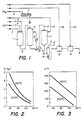
- the present installation comprises a first reactor 1 supplied with water, acid for adjusting the pH of the medium and the alkoxysilane reagent from lines 2, 3 and 4 respectively.
- the solution or dispersion of the hydrolyzed alkoxysilane is transferred into a second reactor 5 of the installation from a line 6, this reactor being fed with the mineral charge to be organophilized from a measuring feed hopper 7 connected to a supply line 8.
- the mineral charge and the hydrolyzed reagent are then vigorously mixed and homogenized in reactor 5 (step 2) whereby the mixture is recirculated into a cooling device 9 for maintaining the temperature within the prescribed limits in case the heat of mixing would raise the temperature unacceptably.
- step 2) the mixture is pumped with a pump 10 from the reactor 5 and transferred at a well determined rate into the spray-drying apparatus (step 4) consisting of an "atomizer" 11 followed by a cyclone 12.
- the arriving liquid (see arrow 13) is atomized or reduced a spray-like aerosol (step 4) by conventional liquid atomization means in a hot air current arriving sidewise into the atomizer and represented schematically by line 14.
- the hot humid air (from evaporation of the mixture) containing in suspension the powdered spray dried material is sent to the cyclone wherein, according to means known in the art, it is subjected to a turbulent action along the walls of the cyclone whereby separation of the powder from the humid air occurs.
- the grafted mineral powder then accumulates to the bottom of the cyclone wherefrom it can be removed through a valve 15 and sent to a first mixer 16 while the humid gases escape by line 17 into the aspirator.
- the mixer 16 serves to carry out a first part of step 5) by mixing the grafted charge issued from cyclone 15 with a suitable organic phase brought in through supply line 18. Then, the mixture of the mineral charge and the organic monomer(s) is sent to a second mixer 19 in which mixing with the additives arriving by line 20 is effected. If desired, mixer 19 can be omitted, the mixing with the additives being done in mixer 16.
- y-MPS y-methacryloxypropyl-trimethoxysilane
- the dispersion step (2) was carried out for 15 minutes at 18.5°C after which the mixture was spray dried using a "MINISPRAY HO N-58" (from BUCHI, Flawil, Switzerland) apparatus under the following conditions: temperature of spraying enclosure (see numeral 11 in the figure) 83-86°C; drying air temperature (numeral 14) 160°C; flow rate (see pump 10) 600 ml/hr.
- grafted powder obtained in this way were mixed with 80 g of a 2:1 by weight mixture of diethylene glycol diacrylate and EBECRYL 220 (UNION CHEMIQUE BELGE) in a "PULERISETTE" planetary mill (FRITISCH CO, Germany) for 2 hours. Then it was filtered on a wire mesh (40 micrometer mesh size). The absorbance of 50 nm of this composition and its viscosity at room temperature were 0.164 and 342 ⁇ 30.10- 3 Pas, respectively. The composition was then mixed with a photoinitiator as disclosed in detail in PCT/EP82/00004 and films of the composition were applied on a substrate and irradiated also as disclosed in the PCT reference. The cured films obtained had good abrasion-resisting properties.
- step 1) The present example was repeated twice using in step 1) solutions with a pH of 4.25 and 3.6, respectively.
- the hydrolysis periods under identical conditions were 3/4 hour and 1/4 hour, respectively; the end properties of the compositions obtained using the hydrolyzed reagent and then proceeding exactly as described above were not significantly different.
- Steps 2 to 4 as in Examples 1 and 2 at room temperature.
- step 2 was carried out using an ordinary magnetic stirrer.
- homogenizers with high dispersive capacity PRESTO MILL and HOMOREX
- PRESTO MILL homogenizers with high dispersive capacity
- HOMOREX external temperature control (18°C) was exercised.
- the results again expressed in terms of the visocsities of the resulting compositons and transparency, are given below and show that use of powerful homogenizers rotating in high speed (4-10xlO' rpm) is advantageous in step 2.
- step 2 was carried out with 240 g of Si0 2 (AEROSIL 380) for 15 minutes in the PRESTO MILL homogenizer at 18.5°C. After homogenization, the dispersion was kept for various periods under moderate agitation to check the stability before undertaking step 3. Steps 3 and 4 were carried out as in the previous example except for the temperature at the spray compartment which was 90-95°C. The results below show that after about 5 hours storage under agitation the grafted aqueous dispersion undergoes strong viscosity increase (thixotropic behavior).
- variable parameter was related to the type of charge used (various kinds of silicas and aluminas).
- Absorbance, refractive index and viscosity are measured at 20% of charge in the standard organic resin.
- the temperature of both the drying air and the spraying room has an influence on the spray-drying rate and the residual moisture of the pulverized product.
- the drying rate is higher at 260°C than at 200°C.
- the residual moisture is however higher at 260°C than at 200°C since at the lower temperature, the material remains longer in the enclosure than at the higher temperature.
- the importance of the enclosure temperature is the following: the lower the temperature, the higher the drying rate and the residual moisture level.
- the viscosity and the absorbance of the standard control composition decrease together with the temperature in the spraying enclosure. This results from the increase in humidity of the charge and therefore from the actual decrease in the effective weight of silica introduced into the organic phase. This can be evidenced by bringing about the complete dehydration (in a vacuum oven) of the spray dried silica before its incorporation into the resin.
- the preferred spray drying conditions should be selected as a compromise between a high spraying rate (favorable time yield) and a low moisture level. With the NIRO apparatus, such conditions are about 260-270°C for the drying air and 80-90°C for the spraying enclosure.
- a charge of grafted silica (AEROSIL-380) was prepared according to the conditions of the previous examples.
- the pertinent data are as follows: Step 1: 4% by weight of y-MPS in water; 30 minutes hydrolysis at 25°C, pH 3.6.
- Step 2 40 g of silica for 500 ml of the aqueous hydrolyzed silane solution, 20 minutes grafting time in the PRESTO MILL apparatus at 20°C.
- Step 3 spray drying with the NIRO apparatus, drying air 260 ⁇ 270°C, enclosure 80-90°C, pump pressure 4 kg/cm 2 ; rate about 230 g/hr.
- the obtained charge was distributed in the proportion of 20% by weight in the aforementioned standard testing organic phase, the variables tested being the milling technique and the milling time.
- compositions were passed through different mesh sieves, the quality criteria being fineness of particles filterability and low viscosity.
- a cylindrical ball mill This consists of a horizontally rotating jar containing glass balls.
- the size of the balls is about 1 cm or more. Smaller balls are not appropriate as they are not heavy enough to properly tumble in viscous media.
- a planetary ball mill “PULVERISETTE”. This mill comprises symmetrically pfaced containers which simultaneously rotate in the vertical and in the horizontal plane. The containers also enclose balls of about 1 cm or more.
- a micro-ball mill This mill can be a cylindrical container equipped with a stirrer and filled with very small glass beads (size in the order of 1-2 mm or less). The beads are forced into agitation by the stirrer. The weight ratio of viscous composition to the beads is relatively small.
- a “DYNO-MILL” This is a continuous type mill in which a mixture of composition and micro-balls (beads) is continuously circulated in a rotating stirred enclosure.
- the weight ratio bead/liquid was about 1:1 1 to 10: 1, preferably 5: 1; the stirring velocity was about 10 m/sec; the tempreature raised from about 20°C to about 30°C during milling.
Landscapes
- Chemical & Material Sciences (AREA)
- Organic Chemistry (AREA)
- Health & Medical Sciences (AREA)
- Chemical Kinetics & Catalysis (AREA)
- Medicinal Chemistry (AREA)
- Polymers & Plastics (AREA)
- Inorganic Chemistry (AREA)
- Materials Engineering (AREA)
- Engineering & Computer Science (AREA)
- Life Sciences & Earth Sciences (AREA)
- Wood Science & Technology (AREA)
- Paints Or Removers (AREA)
- Compositions Of Macromolecular Compounds (AREA)
- Polymerisation Methods In General (AREA)
- Graft Or Block Polymers (AREA)
- Pigments, Carbon Blacks, Or Wood Stains (AREA)
- Silicon Polymers (AREA)
Priority Applications (1)
| Application Number | Priority Date | Filing Date | Title |
|---|---|---|---|
| AT84903586T ATE34179T1 (de) | 1983-09-29 | 1984-09-17 | Verfahren zur herstellung einer zusammensetzung fuer das ueberziehen von substraten mit einem gegen abrieb widerstandsfaehigen durchscheinenden film. |
Applications Claiming Priority (2)
| Application Number | Priority Date | Filing Date | Title |
|---|---|---|---|
| US06/537,215 US4482656A (en) | 1983-09-29 | 1983-09-29 | Method for manufacturing a composition for coating substrates with an abrasion-resistant transparent and translucent film |
| US537215 | 1983-09-29 |
Publications (2)
| Publication Number | Publication Date |
|---|---|
| EP0158660A1 EP0158660A1 (en) | 1985-10-23 |
| EP0158660B1 true EP0158660B1 (en) | 1988-05-11 |
Family
ID=24141713
Family Applications (1)
| Application Number | Title | Priority Date | Filing Date |
|---|---|---|---|
| EP84903586A Expired EP0158660B1 (en) | 1983-09-29 | 1984-09-17 | Method for manufacturing a composition for coating substrates with an abrasion-resistant translucent film |
Country Status (7)
| Country | Link |
|---|---|
| US (1) | US4482656A (https=) |
| EP (1) | EP0158660B1 (https=) |
| JP (1) | JPS61500022A (https=) |
| AU (1) | AU569119B2 (https=) |
| CA (1) | CA1273441A (https=) |
| DE (1) | DE3471111D1 (https=) |
| WO (1) | WO1985001511A1 (https=) |
Families Citing this family (34)
| Publication number | Priority date | Publication date | Assignee | Title |
|---|---|---|---|---|
| JPS58500251A (ja) * | 1981-01-15 | 1983-02-17 | バテル デイベロプメント コ−ポレイシヨン | 耐磨耗性の透明又は半透明フィルムで支持体をコ−トする光硬化組成物 |
| US4584340A (en) * | 1984-11-05 | 1986-04-22 | Dow Corning Corporation | Phenolic resin-containing aqueous compositions |
| JPS61261365A (ja) * | 1985-05-14 | 1986-11-19 | Nippon Oil Co Ltd | 光硬化性被覆組成物 |
| US4640868A (en) * | 1986-02-10 | 1987-02-03 | Morton Thiokol Inc. | Clear, weather resistant adherent coating |
| US5204219A (en) * | 1987-07-30 | 1993-04-20 | Minnesota Mining And Manufacturing Company | Photographic element with novel subbing layer |
| US4822828A (en) * | 1987-11-23 | 1989-04-18 | Hoechst Celanese Corporation | Radiation curable coating composition based on a silica/vinyl-functional silanol dispersion |
| US5521053A (en) * | 1988-07-30 | 1996-05-28 | Nippon Petrochemicals Co., Ltd. | Photocurable resin composition for the preparation of a printed wiring board |
| JP2992591B2 (ja) * | 1989-12-18 | 1999-12-20 | ジーイー東芝シリコーン株式会社 | シリカコア―シリコーンシェル体、これを分散含有するエマルジョンおよびエマルジョンの製造方法 |
| FR2669033B1 (fr) * | 1990-11-14 | 1993-01-29 | Inst Francais Du Petrole | Polyarylsilsesquioxanes comportant au moins un groupe sulfonique, greffes sur un support inorganique, leurs preparations et leurs applications. |
| JPH04202008A (ja) * | 1990-11-29 | 1992-07-22 | Moon Star Co | 水系ポリウレタン用フロスト剤およびその製造方法 |
| ATE196919T1 (de) * | 1994-02-02 | 2000-10-15 | Mitsubishi Rayon Co | Beschichtungszusammensetzung und daraus hergestellte oberflächenbeschichtete form |
| FR2721615A1 (fr) * | 1994-06-24 | 1995-12-29 | Rhone Poulenc Chimie | Procédé de préparation de particules d'oxyde métallique organophiles. |
| JPH0860100A (ja) * | 1994-08-19 | 1996-03-05 | Nippon Unicar Co Ltd | 艶出し剤組成物 |
| US5888290A (en) * | 1996-05-24 | 1999-03-30 | Minnesota Mining And Manufacturing Company | Composition and process for imparting durable repellency to substrates |
| US6210790B1 (en) * | 1998-07-15 | 2001-04-03 | Rensselaer Polytechnic Institute | Glass-like composites comprising a surface-modified colloidal silica and method of making thereof |
| JP4389315B2 (ja) | 1999-12-28 | 2009-12-24 | Jsr株式会社 | 反応性粒子、これを含有する硬化性組成物及び硬化物 |
| DE10016485A1 (de) * | 2000-04-01 | 2001-10-11 | Dmc2 Degussa Metals Catalysts | Glas-, Keramik- und Metall-Substrate mit selbstreinigender Oberfläche, Verfahren zu deren Herstellung und deren Verwendung |
| EP1191143A1 (en) * | 2000-09-05 | 2002-03-27 | The Mead Corporation | Process for manufacture of wear resistant paper useful in forming decorative laminates |
| US6800353B1 (en) | 2000-09-08 | 2004-10-05 | Ecolab Inc. | Scratch-resistant strippable finish |
| DE50016061D1 (de) * | 2000-10-21 | 2011-03-03 | Evonik Degussa Gmbh | Strahlenhärtende Lacksysteme |
| US6896958B1 (en) * | 2000-11-29 | 2005-05-24 | Nanophase Technologies Corporation | Substantially transparent, abrasion-resistant films containing surface-treated nanocrystalline particles |
| DE10063739B4 (de) | 2000-12-21 | 2009-04-02 | Ferro Gmbh | Substrate mit selbstreinigender Oberfläche, Verfahren zu deren Herstellung und deren Verwendung |
| DE10106213A1 (de) * | 2001-02-10 | 2002-08-22 | Dmc2 Degussa Metals Catalysts Cerdec Ag | Selbstreinigende Lackbeschichtungen und Verfahren und Mittel zur Herstellung derselben |
| US6833186B2 (en) * | 2002-04-10 | 2004-12-21 | Ppg Industries Ohio, Inc. | Mineral-filled coatings having enhanced abrasion resistance and wear clarity and methods for using the same |
| US6790904B2 (en) * | 2002-06-03 | 2004-09-14 | Ppg Industries Ohio, Inc. | Liquid coating of film-forming resin and particles chemically modified to lower surface tension |
| US7141618B2 (en) * | 2002-06-03 | 2006-11-28 | Ppg Industries Ohio, Inc. | Coating compositions with modified particles and methods of using the same |
| DE10260337A1 (de) * | 2002-12-20 | 2004-07-08 | Basf Ag | Verwendung wässriger Dispersionen aus Polymerisat und feinteiligem anorganischem Feststoff zur Grundierung mineralischer Untergründe |
| DE10304849A1 (de) * | 2003-02-06 | 2004-08-19 | Institut für Neue Materialien gemeinnützige Gesellschaft mit beschränkter Haftung | Chemomechanische Herstellung von Funktionskolloiden |
| WO2005103172A2 (en) * | 2004-04-15 | 2005-11-03 | Avery Dennison Corporation | Dew resistant coatings |
| JP2006016538A (ja) * | 2004-07-02 | 2006-01-19 | Nissan Motor Co Ltd | 樹脂組成物、樹脂組成物の製造方法及び樹脂組成物中間体 |
| DE102006002596A1 (de) * | 2006-01-18 | 2007-07-19 | Tesa Ag | Verbundfolie |
| US8827893B2 (en) * | 2009-03-09 | 2014-09-09 | A. M. Surgical, Inc. | Slotted clear cannula |
| CN103068884B (zh) * | 2010-08-13 | 2015-06-17 | 旭化成电子材料株式会社 | 感光性有机硅树脂组合物 |
| JP2013032262A (ja) * | 2011-06-30 | 2013-02-14 | Dic Corp | 表面処理されたシリカ粒子の製造方法、シリカ粒子分散体、及び樹脂組成物 |
Family Cites Families (15)
| Publication number | Priority date | Publication date | Assignee | Title |
|---|---|---|---|---|
| CA531785A (en) * | 1956-10-16 | Dow Corning Silicones Limited | Siloxane elastomers containing treated fillers | |
| US3004859A (en) * | 1958-05-28 | 1961-10-17 | Gen Electric | Process for treating fillers |
| US3350330A (en) * | 1964-12-28 | 1967-10-31 | Gen Electric | Siloxane-based, non-skid coating composition |
| US3708225A (en) * | 1971-06-09 | 1973-01-02 | Mbt Corp | Coated synthetic plastic lens |
| US3986997A (en) * | 1974-06-25 | 1976-10-19 | Dow Corning Corporation | Pigment-free coating compositions |
| JPS6018707B2 (ja) * | 1974-10-09 | 1985-05-11 | 日本原子力研究所 | 防曇性被覆用硬化性樹脂組成物 |
| JPS5277154A (en) * | 1975-12-24 | 1977-06-29 | Seiko Epson Corp | Transparent palstic molded articles |
| US4177315A (en) * | 1977-03-04 | 1979-12-04 | E. I. Du Pont De Nemours And Company | Coated Polymeric substrates |
| US4188451A (en) * | 1978-04-12 | 1980-02-12 | General Electric Company | Polycarbonate article coated with an adherent, durable, silica filled organopolysiloxane coating and process for producing same |
| GB1604405A (en) * | 1978-05-31 | 1981-12-09 | Univ Cardiff | Articles made from resin compositions containing aggregate materials eg glass |
| US4343857A (en) * | 1978-08-23 | 1982-08-10 | Goodyear Aerospace Corporation | Coatings for optical systems |
| US4418165A (en) * | 1980-06-03 | 1983-11-29 | Dow Corning Corporation | Optically clear silicone compositions curable to elastomers |
| US4348462A (en) * | 1980-07-11 | 1982-09-07 | General Electric Company | Abrasion resistant ultraviolet light curable hard coating compositions |
| JPS58500251A (ja) * | 1981-01-15 | 1983-02-17 | バテル デイベロプメント コ−ポレイシヨン | 耐磨耗性の透明又は半透明フィルムで支持体をコ−トする光硬化組成物 |
| US4382109A (en) * | 1981-08-07 | 1983-05-03 | General Electric Company | Abrasion resistant silicone coated thermoplastic article and method for making |
-
1983
- 1983-09-29 US US06/537,215 patent/US4482656A/en not_active Expired - Fee Related
-
1984
- 1984-09-17 WO PCT/US1984/001470 patent/WO1985001511A1/en not_active Ceased
- 1984-09-17 JP JP59503557A patent/JPS61500022A/ja active Granted
- 1984-09-17 AU AU34327/84A patent/AU569119B2/en not_active Ceased
- 1984-09-17 DE DE8484903586T patent/DE3471111D1/de not_active Expired
- 1984-09-17 EP EP84903586A patent/EP0158660B1/en not_active Expired
- 1984-09-19 CA CA000463554A patent/CA1273441A/en not_active Expired - Fee Related
Also Published As
| Publication number | Publication date |
|---|---|
| CA1273441A (en) | 1990-08-28 |
| AU3432784A (en) | 1985-04-23 |
| JPS61500022A (ja) | 1986-01-09 |
| EP0158660A1 (en) | 1985-10-23 |
| US4482656A (en) | 1984-11-13 |
| AU569119B2 (en) | 1988-01-21 |
| JPH0423673B2 (https=) | 1992-04-22 |
| WO1985001511A1 (en) | 1985-04-11 |
| DE3471111D1 (en) | 1988-06-16 |
Similar Documents
| Publication | Publication Date | Title |
|---|---|---|
| EP0158660B1 (en) | Method for manufacturing a composition for coating substrates with an abrasion-resistant translucent film | |
| EP0730015B1 (en) | Method for making organically-modified, radiation-curable siloxane resins | |
| US4311738A (en) | Method for rendering non-ferrous metals corrosion resistant | |
| EP0069133B1 (en) | Photo setting composition for coating substrates with an abrasion-resistant transparent or translucent film | |
| US4373061A (en) | Silicone coating for unprimed plastic substrate and coated articles | |
| KR101694806B1 (ko) | 수성 실란화 실리카 분산액 | |
| RU2469837C2 (ru) | Абразивные зерна, модифицированные гидрофильным и гидрофобным силаном, и способ их образования | |
| KR100809758B1 (ko) | 주석 변성 루틸형 산화티탄 미립자 | |
| US6586502B2 (en) | Inorganic/organic compositions | |
| JPH0753837B2 (ja) | 合成樹脂で被覆した金属顔料、該顔料の製造方法及び用途 | |
| US20060042508A1 (en) | SiO2 coated pearlescent pigments | |
| WO2005040294A1 (en) | Composition for producing a barrier layer for gases | |
| EP0574274B1 (en) | Coating composition | |
| WO2006128793A1 (en) | Dispersible silica particles | |
| US5401579A (en) | Siloxane organic hybrid polymers | |
| JP3071447B2 (ja) | 水性媒体中での分散性が改良された表面改質雲母質粒子 | |
| US8349399B2 (en) | Powder particles that are uniformly coated with functional groups, method for their production and use thereof | |
| US4443579A (en) | Silicone resin coating composition adapted for primerless adhesion to plastic and process for making same | |
| Marsden | Organofunctional silane coupling agents | |
| EP0113367B1 (en) | Method for producing cross-linked resin coatings on substrates | |
| US4414349A (en) | Silicone resin coating composition adapted for primerless adhesion to plastic substrates and process for making same | |
| US5626964A (en) | Radiation-curable silicone resins formulated from amine alcohols, tetra-alkoxysilanes and multifunctional acrylates | |
| CN101522777A (zh) | 含有膦酸酯官能化粒子的组合物 | |
| JPS5945906A (ja) | 無機固体粒子組成物 | |
| CA1207932A (en) | Photocuring composition for coating substrates with an abrasion-resistant transparent or translucent film |
Legal Events
| Date | Code | Title | Description |
|---|---|---|---|
| PUAI | Public reference made under article 153(3) epc to a published international application that has entered the european phase |
Free format text: ORIGINAL CODE: 0009012 |
|
| 17P | Request for examination filed |
Effective date: 19850528 |
|
| AK | Designated contracting states |
Designated state(s): AT BE CH DE FR GB LI LU NL SE |
|
| 17Q | First examination report despatched |
Effective date: 19860509 |
|
| GRAA | (expected) grant |
Free format text: ORIGINAL CODE: 0009210 |
|
| AK | Designated contracting states |
Kind code of ref document: B1 Designated state(s): AT BE CH DE FR GB LI LU NL SE |
|
| REF | Corresponds to: |
Ref document number: 34179 Country of ref document: AT Date of ref document: 19880515 Kind code of ref document: T |
|
| REF | Corresponds to: |
Ref document number: 3471111 Country of ref document: DE Date of ref document: 19880616 |
|
| ET | Fr: translation filed | ||
| PLBE | No opposition filed within time limit |
Free format text: ORIGINAL CODE: 0009261 |
|
| STAA | Information on the status of an ep patent application or granted ep patent |
Free format text: STATUS: NO OPPOSITION FILED WITHIN TIME LIMIT |
|
| 26N | No opposition filed | ||
| PGFP | Annual fee paid to national office [announced via postgrant information from national office to epo] |
Ref country code: GB Payment date: 19930909 Year of fee payment: 10 |
|
| PGFP | Annual fee paid to national office [announced via postgrant information from national office to epo] |
Ref country code: BE Payment date: 19930914 Year of fee payment: 10 Ref country code: AT Payment date: 19930914 Year of fee payment: 10 |
|
| PGFP | Annual fee paid to national office [announced via postgrant information from national office to epo] |
Ref country code: SE Payment date: 19930915 Year of fee payment: 10 Ref country code: LU Payment date: 19930915 Year of fee payment: 10 |
|
| PGFP | Annual fee paid to national office [announced via postgrant information from national office to epo] |
Ref country code: FR Payment date: 19930917 Year of fee payment: 10 |
|
| PGFP | Annual fee paid to national office [announced via postgrant information from national office to epo] |
Ref country code: CH Payment date: 19930923 Year of fee payment: 10 |
|
| PGFP | Annual fee paid to national office [announced via postgrant information from national office to epo] |
Ref country code: NL Payment date: 19930930 Year of fee payment: 10 Ref country code: DE Payment date: 19930930 Year of fee payment: 10 |
|
| EPTA | Lu: last paid annual fee | ||
| PG25 | Lapsed in a contracting state [announced via postgrant information from national office to epo] |
Ref country code: LU Free format text: LAPSE BECAUSE OF NON-PAYMENT OF DUE FEES Effective date: 19940917 Ref country code: GB Effective date: 19940917 Ref country code: AT Effective date: 19940917 |
|
| PG25 | Lapsed in a contracting state [announced via postgrant information from national office to epo] |
Ref country code: SE Effective date: 19940918 |
|
| PG25 | Lapsed in a contracting state [announced via postgrant information from national office to epo] |
Ref country code: LI Effective date: 19940930 Ref country code: CH Effective date: 19940930 Ref country code: BE Effective date: 19940930 |
|
| EAL | Se: european patent in force in sweden |
Ref document number: 84903586.0 |
|
| BERE | Be: lapsed |
Owner name: BATTELLE DEVELOPMENT CORP. Effective date: 19940930 |
|
| PG25 | Lapsed in a contracting state [announced via postgrant information from national office to epo] |
Ref country code: NL Effective date: 19950401 |
|
| NLV4 | Nl: lapsed or anulled due to non-payment of the annual fee | ||
| GBPC | Gb: european patent ceased through non-payment of renewal fee |
Effective date: 19940917 |
|
| PG25 | Lapsed in a contracting state [announced via postgrant information from national office to epo] |
Ref country code: FR Effective date: 19950531 |
|
| REG | Reference to a national code |
Ref country code: CH Ref legal event code: PL |
|
| PG25 | Lapsed in a contracting state [announced via postgrant information from national office to epo] |
Ref country code: DE Effective date: 19950601 |
|
| EUG | Se: european patent has lapsed |
Ref document number: 84903586.0 |
|
| REG | Reference to a national code |
Ref country code: FR Ref legal event code: ST |