EP0157107A1 - Verfahren zur Herstellung von Copolymerisaten des Ethylens mit carboxylgruppenhaltigen Comonomeren - Google Patents
Verfahren zur Herstellung von Copolymerisaten des Ethylens mit carboxylgruppenhaltigen Comonomeren Download PDFInfo
- Publication number
- EP0157107A1 EP0157107A1 EP85101054A EP85101054A EP0157107A1 EP 0157107 A1 EP0157107 A1 EP 0157107A1 EP 85101054 A EP85101054 A EP 85101054A EP 85101054 A EP85101054 A EP 85101054A EP 0157107 A1 EP0157107 A1 EP 0157107A1
- Authority
- EP
- European Patent Office
- Prior art keywords
- ethylene
- copolymerized
- moles
- mol
- acids
- Prior art date
- Legal status (The legal status is an assumption and is not a legal conclusion. Google has not performed a legal analysis and makes no representation as to the accuracy of the status listed.)
- Granted
Links
- VGGSQFUCUMXWEO-UHFFFAOYSA-N Ethene Chemical compound C=C VGGSQFUCUMXWEO-UHFFFAOYSA-N 0.000 title claims abstract description 36
- 239000005977 Ethylene Substances 0.000 title claims abstract description 35
- 238000000034 method Methods 0.000 title claims abstract description 8
- 229920001577 copolymer Polymers 0.000 title description 5
- 239000002253 acid Substances 0.000 claims abstract description 20
- 150000007513 acids Chemical class 0.000 claims abstract description 20
- 229920001897 terpolymer Polymers 0.000 claims abstract description 19
- 230000009477 glass transition Effects 0.000 claims abstract description 11
- 125000005907 alkyl ester group Chemical group 0.000 claims abstract description 9
- 150000001735 carboxylic acids Chemical class 0.000 claims abstract description 4
- 238000001816 cooling Methods 0.000 claims abstract description 4
- 238000010438 heat treatment Methods 0.000 claims abstract description 4
- 239000000155 melt Substances 0.000 abstract description 3
- 238000002360 preparation method Methods 0.000 abstract description 2
- XEEYBQQBJWHFJM-UHFFFAOYSA-N Iron Chemical compound [Fe] XEEYBQQBJWHFJM-UHFFFAOYSA-N 0.000 description 14
- 229910052782 aluminium Inorganic materials 0.000 description 12
- XAGFODPZIPBFFR-UHFFFAOYSA-N aluminium Chemical compound [Al] XAGFODPZIPBFFR-UHFFFAOYSA-N 0.000 description 12
- SMZOUWXMTYCWNB-UHFFFAOYSA-N 2-(2-methoxy-5-methylphenyl)ethanamine Chemical compound COC1=CC=C(C)C=C1CCN SMZOUWXMTYCWNB-UHFFFAOYSA-N 0.000 description 10
- NIXOWILDQLNWCW-UHFFFAOYSA-N 2-Propenoic acid Natural products OC(=O)C=C NIXOWILDQLNWCW-UHFFFAOYSA-N 0.000 description 10
- 239000000203 mixture Substances 0.000 description 10
- 238000006243 chemical reaction Methods 0.000 description 8
- 229910052742 iron Inorganic materials 0.000 description 7
- QVGXLLKOCUKJST-UHFFFAOYSA-N atomic oxygen Chemical compound [O] QVGXLLKOCUKJST-UHFFFAOYSA-N 0.000 description 6
- 150000002148 esters Chemical class 0.000 description 6
- 239000001301 oxygen Substances 0.000 description 6
- 229910052760 oxygen Inorganic materials 0.000 description 6
- QQONPFPTGQHPMA-UHFFFAOYSA-N Propene Chemical compound CC=C QQONPFPTGQHPMA-UHFFFAOYSA-N 0.000 description 5
- 239000007789 gas Substances 0.000 description 5
- 150000002978 peroxides Chemical class 0.000 description 5
- 238000006116 polymerization reaction Methods 0.000 description 5
- NBBJYMSMWIIQGU-UHFFFAOYSA-N Propionic aldehyde Chemical compound CCC=O NBBJYMSMWIIQGU-UHFFFAOYSA-N 0.000 description 4
- 230000000052 comparative effect Effects 0.000 description 4
- 238000007334 copolymerization reaction Methods 0.000 description 4
- -1 for example Chemical class 0.000 description 4
- ZWEHNKRNPOVVGH-UHFFFAOYSA-N 2-Butanone Chemical compound CCC(C)=O ZWEHNKRNPOVVGH-UHFFFAOYSA-N 0.000 description 3
- UHOVQNZJYSORNB-UHFFFAOYSA-N Benzene Chemical compound C1=CC=CC=C1 UHOVQNZJYSORNB-UHFFFAOYSA-N 0.000 description 3
- 229910000906 Bronze Inorganic materials 0.000 description 3
- LFQSCWFLJHTTHZ-UHFFFAOYSA-N Ethanol Chemical compound CCO LFQSCWFLJHTTHZ-UHFFFAOYSA-N 0.000 description 3
- OKKJLVBELUTLKV-UHFFFAOYSA-N Methanol Chemical compound OC OKKJLVBELUTLKV-UHFFFAOYSA-N 0.000 description 3
- LRHPLDYGYMQRHN-UHFFFAOYSA-N N-Butanol Chemical compound CCCCO LRHPLDYGYMQRHN-UHFFFAOYSA-N 0.000 description 3
- 239000004698 Polyethylene Substances 0.000 description 3
- 239000010974 bronze Substances 0.000 description 3
- 239000002131 composite material Substances 0.000 description 3
- 150000001875 compounds Chemical class 0.000 description 3
- KUNSUQLRTQLHQQ-UHFFFAOYSA-N copper tin Chemical compound [Cu].[Sn] KUNSUQLRTQLHQQ-UHFFFAOYSA-N 0.000 description 3
- 150000002432 hydroperoxides Chemical class 0.000 description 3
- 229910052751 metal Inorganic materials 0.000 description 3
- 239000002184 metal Substances 0.000 description 3
- 229920000573 polyethylene Polymers 0.000 description 3
- 229920000642 polymer Polymers 0.000 description 3
- 239000003505 polymerization initiator Substances 0.000 description 3
- VXNZUUAINFGPBY-UHFFFAOYSA-N 1-Butene Chemical compound CCC=C VXNZUUAINFGPBY-UHFFFAOYSA-N 0.000 description 2
- CSCPPACGZOOCGX-UHFFFAOYSA-N Acetone Chemical compound CC(C)=O CSCPPACGZOOCGX-UHFFFAOYSA-N 0.000 description 2
- VZCYOOQTPOCHFL-OWOJBTEDSA-N Fumaric acid Chemical compound OC(=O)\C=C\C(O)=O VZCYOOQTPOCHFL-OWOJBTEDSA-N 0.000 description 2
- CERQOIWHTDAKMF-UHFFFAOYSA-N Methacrylic acid Chemical compound CC(=C)C(O)=O CERQOIWHTDAKMF-UHFFFAOYSA-N 0.000 description 2
- ATUOYWHBWRKTHZ-UHFFFAOYSA-N Propane Chemical compound CCC ATUOYWHBWRKTHZ-UHFFFAOYSA-N 0.000 description 2
- 239000000853 adhesive Substances 0.000 description 2
- 230000001070 adhesive effect Effects 0.000 description 2
- 150000001298 alcohols Chemical class 0.000 description 2
- 150000008064 anhydrides Chemical class 0.000 description 2
- IAQRGUVFOMOMEM-UHFFFAOYSA-N butene Natural products CC=CC IAQRGUVFOMOMEM-UHFFFAOYSA-N 0.000 description 2
- CQEYYJKEWSMYFG-UHFFFAOYSA-N butyl acrylate Chemical compound CCCCOC(=O)C=C CQEYYJKEWSMYFG-UHFFFAOYSA-N 0.000 description 2
- ZTQSAGDEMFDKMZ-UHFFFAOYSA-N butyric aldehyde Natural products CCCC=O ZTQSAGDEMFDKMZ-UHFFFAOYSA-N 0.000 description 2
- 239000000084 colloidal system Substances 0.000 description 2
- 238000001938 differential scanning calorimetry curve Methods 0.000 description 2
- 239000012442 inert solvent Substances 0.000 description 2
- 238000002844 melting Methods 0.000 description 2
- 230000008018 melting Effects 0.000 description 2
- 239000007870 radical polymerization initiator Substances 0.000 description 2
- 238000010526 radical polymerization reaction Methods 0.000 description 2
- 239000002904 solvent Substances 0.000 description 2
- CIHOLLKRGTVIJN-UHFFFAOYSA-N tert‐butyl hydroperoxide Chemical compound CC(C)(C)OO CIHOLLKRGTVIJN-UHFFFAOYSA-N 0.000 description 2
- VZCYOOQTPOCHFL-UHFFFAOYSA-N trans-butenedioic acid Natural products OC(=O)C=CC(O)=O VZCYOOQTPOCHFL-UHFFFAOYSA-N 0.000 description 2
- XLYOFNOQVPJJNP-UHFFFAOYSA-N water Substances O XLYOFNOQVPJJNP-UHFFFAOYSA-N 0.000 description 2
- 239000001124 (E)-prop-1-ene-1,2,3-tricarboxylic acid Substances 0.000 description 1
- JAHNSTQSQJOJLO-UHFFFAOYSA-N 2-(3-fluorophenyl)-1h-imidazole Chemical compound FC1=CC=CC(C=2NC=CN=2)=C1 JAHNSTQSQJOJLO-UHFFFAOYSA-N 0.000 description 1
- FEUFEGJTJIHPOF-UHFFFAOYSA-N 2-butyl acrylic acid Chemical compound CCCCC(=C)C(O)=O FEUFEGJTJIHPOF-UHFFFAOYSA-N 0.000 description 1
- YIVJZNGAASQVEM-UHFFFAOYSA-N Lauroyl peroxide Chemical compound CCCCCCCCCCCC(=O)OOC(=O)CCCCCCCCCCC YIVJZNGAASQVEM-UHFFFAOYSA-N 0.000 description 1
- OFOBLEOULBTSOW-UHFFFAOYSA-N Propanedioic acid Natural products OC(=O)CC(O)=O OFOBLEOULBTSOW-UHFFFAOYSA-N 0.000 description 1
- 229940091181 aconitic acid Drugs 0.000 description 1
- 239000002318 adhesion promoter Substances 0.000 description 1
- 150000001299 aldehydes Chemical class 0.000 description 1
- 229910052799 carbon Inorganic materials 0.000 description 1
- 125000004432 carbon atom Chemical group C* 0.000 description 1
- 150000001732 carboxylic acid derivatives Chemical class 0.000 description 1
- 239000003054 catalyst Substances 0.000 description 1
- GTZCVFVGUGFEME-IWQZZHSRSA-N cis-aconitic acid Chemical compound OC(=O)C\C(C(O)=O)=C\C(O)=O GTZCVFVGUGFEME-IWQZZHSRSA-N 0.000 description 1
- HNEGQIOMVPPMNR-IHWYPQMZSA-N citraconic acid Chemical compound OC(=O)C(/C)=C\C(O)=O HNEGQIOMVPPMNR-IHWYPQMZSA-N 0.000 description 1
- 229940018557 citraconic acid Drugs 0.000 description 1
- 239000002826 coolant Substances 0.000 description 1
- 238000000354 decomposition reaction Methods 0.000 description 1
- LSXWFXONGKSEMY-UHFFFAOYSA-N di-tert-butyl peroxide Chemical compound CC(C)(C)OOC(C)(C)C LSXWFXONGKSEMY-UHFFFAOYSA-N 0.000 description 1
- 229920006242 ethylene acrylic acid copolymer Polymers 0.000 description 1
- 238000002474 experimental method Methods 0.000 description 1
- 239000001530 fumaric acid Substances 0.000 description 1
- 239000011521 glass Substances 0.000 description 1
- 229930195733 hydrocarbon Natural products 0.000 description 1
- 150000002430 hydrocarbons Chemical class 0.000 description 1
- 239000003999 initiator Substances 0.000 description 1
- 150000002576 ketones Chemical class 0.000 description 1
- VZCYOOQTPOCHFL-UPHRSURJSA-N maleic acid Chemical compound OC(=O)\C=C/C(O)=O VZCYOOQTPOCHFL-UPHRSURJSA-N 0.000 description 1
- 239000011976 maleic acid Substances 0.000 description 1
- 238000004519 manufacturing process Methods 0.000 description 1
- LVHBHZANLOWSRM-UHFFFAOYSA-N methylenebutanedioic acid Natural products OC(=O)CC(=C)C(O)=O LVHBHZANLOWSRM-UHFFFAOYSA-N 0.000 description 1
- 239000002480 mineral oil Substances 0.000 description 1
- 239000000178 monomer Substances 0.000 description 1
- 239000001294 propane Substances 0.000 description 1
- 125000004805 propylene group Chemical group [H]C([H])([H])C([H])([*:1])C([H])([H])[*:2] 0.000 description 1
- 150000003254 radicals Chemical class 0.000 description 1
- 239000011541 reaction mixture Substances 0.000 description 1
- 239000007858 starting material Substances 0.000 description 1
- OPQYOFWUFGEMRZ-UHFFFAOYSA-N tert-butyl 2,2-dimethylpropaneperoxoate Chemical compound CC(C)(C)OOC(=O)C(C)(C)C OPQYOFWUFGEMRZ-UHFFFAOYSA-N 0.000 description 1
- VSJBBIJIXZVVLQ-UHFFFAOYSA-N tert-butyl 3,5,5-trimethylhexaneperoxoate Chemical compound CC(C)(C)CC(C)CC(=O)OOC(C)(C)C VSJBBIJIXZVVLQ-UHFFFAOYSA-N 0.000 description 1
- GJBRNHKUVLOCEB-UHFFFAOYSA-N tert-butyl benzenecarboperoxoate Chemical compound CC(C)(C)OOC(=O)C1=CC=CC=C1 GJBRNHKUVLOCEB-UHFFFAOYSA-N 0.000 description 1
- ISXSCDLOGDJUNJ-UHFFFAOYSA-N tert-butyl prop-2-enoate Chemical compound CC(C)(C)OC(=O)C=C ISXSCDLOGDJUNJ-UHFFFAOYSA-N 0.000 description 1
- GTZCVFVGUGFEME-UHFFFAOYSA-N trans-aconitic acid Natural products OC(=O)CC(C(O)=O)=CC(O)=O GTZCVFVGUGFEME-UHFFFAOYSA-N 0.000 description 1
- 238000001291 vacuum drying Methods 0.000 description 1
Images

Classifications
-
- C—CHEMISTRY; METALLURGY
- C08—ORGANIC MACROMOLECULAR COMPOUNDS; THEIR PREPARATION OR CHEMICAL WORKING-UP; COMPOSITIONS BASED THEREON
- C08F—MACROMOLECULAR COMPOUNDS OBTAINED BY REACTIONS ONLY INVOLVING CARBON-TO-CARBON UNSATURATED BONDS
- C08F210/00—Copolymers of unsaturated aliphatic hydrocarbons having only one carbon-to-carbon double bond
- C08F210/02—Ethene
Definitions
- the invention was therefore based on the object of finding suitable terpolymers of ethylene with the most balanced possible property profile with regard to low-temperature toughness and adhesion to both iron and aluminum.
- the terpolymers of ethylene according to the invention have melt indexes of 100 g / 10 min, preferably of 60 g / 10 min, but especially in the range of 2 to 20 g / 10 min, measured according to DIN 53 735 at 190 ° C. and 2.16 kp.
- the terpolymers of ethylene with C 1 - to C 8 -alkyl esters of C 3 - to C 6 -alkenecarboxylic acids and C 3 - to C 6 -alkenecarboxylic acids can be prepared by conventional, conventional high-pressure polymerization processes (cf.Ullmann's Encyclopedia of Industrial Chemistry, 4 Edition, vol. 19, (1980), pages 169 to 175, Verlag Chemie GmbH, D-6940 Weinheim).
- the copolymerization of the ethylene takes place at pressures of 350 to 5000 bar, preferably 1500 to 3000 bar.
- When making the copoly Merisate of ethylene one works in particular at pressures from 1700 to 2900 bar.
- the temperatures in the polymerization system are between 50 and 450 * C, preferably between 150 and 300 * C.
- the conditions in the polymerization system can be set in apparatus in so-called tubular reactors or autoclaves.
- Tubular reactors are tubular polymerization vessels whose linear expansion is more than 2000 times, preferably 5000 to 50,000 times the tube diameter.
- part of the heat of polymerization is removed from the outside by cooling the tubular reactor with water.
- Autoclaves are pressure vessels with a length / diameter ratio of 1 to approx. 20.
- radical initiators are understood to mean those catalysts which are also used for the homopolymerization of ethylene under high pressure.
- oxygen is suitable, advantageously in amounts of 10 to 100 mol ppm, based on the ethylene to be polymerized.
- Peroxides and other radical-forming compounds and mixtures of peroxides which have different decomposition temperatures and hydroperoxides, but above all also mixtures of oxygen and peroxides / hydroperoxides, are also suitable.
- peroxides and hydroperoxides examples include: tert-butyl perpivalate, di-tert-butyl peroxide, tert-butyl hydroperoxide, tert-butyl perbenzoate, dilauroyl peroxide and tert-butyl perisononanoate.
- Free-radical polymerization initiators are also to be understood as meaning compounds such as, for example, azo-isobutyronitrile. Mixtures of oxygen and one or more peroxides can also be used.
- the molecular weight of the terpolymer obtained can be determined by the usual regulators, e.g. Hydrocarbons such as propane, propene, butene etc., ketones such as acetone, methyl ethyl ketone etc. or aldehydes such as propionaldehyde can be brought to the desired value. Propionaldehyde, propene and butene are particularly suitable.
- Hydrocarbons such as propane, propene, butene etc.
- ketones such as acetone, methyl ethyl ketone etc.
- aldehydes such as propionaldehyde
- the copolymerization is generally carried out in the absence of a solvent.
- an inert solvent such as benzene, mineral oils or other inert solvents, in which the polymerization initiators are dissolved, can be neglected compared to the other starting materials. If oxygen is used as the polymerization initiator, any solvent can be omitted.
- copolymers according to the invention are thus obtained if, for example, one works in a two-zone tubular reactor at a pressure of 1800 to 3000 bar and at a maximum temperature of 340 ° C., and a mixture of ethylene, 1.9% by weight of acrylic acid-n- butyl ester, 0.9% by weight of acrylic acid were metered in at the start of the tubular reactor and, after the maximum temperature had been exceeded at the point where the temperature had reached or fallen below 200 ° C., the same amount of the mixture as was used at the start of the reactor was also metered in .
- Suitable C 3 - to C 6 -alkenecarboxylic acids are all such compounds which copolymerize with ethylene under the conditions specified above.
- the following can be used: acrylic acid, methacrylic acid, itaconic acid, aconitic acid, maleic acid or its anhydride, citraconic acid or its anhydride or fumaric acid.
- Acrylic acid and methacrylic acid are particularly suitable.
- Mixtures of various C 3 -C 6 -alkenecarboxylic acids can also be used.
- the copolymers of ethylene according to the invention contain 0.9 to 2.6, preferably 1.1 to 2.1 moles of C 3 -C 6 -alkenecarboxylic acids copolymerized onto 100 moles of ethylene.
- Esters of the C 3 -C 6 -alkenecarboxylic acids (a) are esters of the above-mentioned alkenecarboxylic acids of alcohols having 1 to 8 carbon atoms.
- the esters of acrylic acid with C 1 to C 8 alcohols are particularly suitable.
- the esters of acrylic acid with methanol, ethanol or 1-butanol are particularly distinguished.
- Mixtures of various C 1 -C 6 -alkyl esters of C 3 -C 6 -alkenecarboxylic acids can also be used.
- the copolymers of ethylene according to the invention contain 0.9 to 3.2 mol, preferably 1.4 to 2.6 mol, of the esters polymerized onto 100 mol of ethylene.
- the glass transition temperature is below -15 ° C, preferably below -20 ° C, in particular between -21 and -24 ° C.
- the glass transition temperature was determined using the DSC method, the DSC method being understood as the differential scanning calorimeter method.
- the determination of the glass transition temperature includes by K.H. Illers in the reference: "Colloid and Polymer Science, Colloid Journal & Journal for Polymers” 258, (1980), No. 2, pages 177 to 124.
- the samples were heated to 120 ° C. in the calorimeter after thorough vacuum drying to free residual monomers, and were cooled from 120 ° C. at 20 ° C./min to 20 ° C.
- the heat-efficiency curves were recorded at a heating rate of 20 ° C./min on the samples which had been given a uniform thermal history in this way.
- the DSC curve of the melt (approx. 100 ° C) was linearly exrapulated to a lower temperature. It is assumed that the intersection of this baseline with the DSC curve represents the upper end of the glass transition area and the lower end of the melting area (melting start).
- the glass transition temperature Tg is defined as the temperature at which the endothermic heat flow stage has reached half its value.
- the terpolymers of ethylene according to the invention with C 1 to C 6 alkyl esters of C 3 to C 6 alkenecarboxylic acids and C 3 to C 6 alkenecarboxylic acids have a balanced property profile with regard to low-temperature toughness and adhesion to both iron and aluminum. They are particularly suitable as adhesion promoters.
- the adhesion to metal is determined as described below.
- a cleaned and degreased 0.5 mm thick aluminum sheet measuring 16 x 16 cm is coated on one side over a length of 4 cm with aluminum bronze as a separating layer.
- the 0.3 mm thick film of adhesive with the same dimensions as the plate is then placed on the aluminum sheet prepared in this way, and a 1 mm thick sheet of polyethylene is placed on top.
- the plate pack is connected in a press under a pressure of 2 kp per cm 3 within 3 minutes at a temperature of 180 ° C.
- the composite panel is then cut into strips 2.0 cm wide.
- the polyethylene (1) be easily separated from the metal (2), ie an adhesive strength cannot be measured at these points.
- holes with a diameter of 5 mm are drilled in the strips at a distance of 120 mm.
- the strip With the metal side, the strip is bent over a roll (3) with a diameter of 100 mm.
- the hole in the end of the strip, coated with aluminum bronze, is hung in a hook (4) attached to the roll; In the other hole, a hook (5) attached to one degree is hooked, which is pulled tightly over the wire via a tension screw (6) to the roller.
- a fork (7) which guides the axle (8) of the roller, is clamped in a clamp (9) of a tractor, the free polyethylene end of the strip in the other clamp (10).
- the clamps When the clamps are moved apart, the composite is peeled open.
- the force is given in N / 2 cm strip width (see figure).
- the copolymerization of ethylene with n-butyl acrylic acid and acrylic acid was carried out in all cases in a tubular reactor.
- the ethylene with the comonomers was mixed in two separate gas streams with a ratio of 1: 1 with the specified amount of oxygen and the necessary amount of regulator and compressed to the reaction pressure.
- one of the gas strands was fed to the inlet point of the reactor and the other at a second gas feed point approximately after 1: 3 of the entire length of the reactor after the reaction in the first part of the reactor had developed at a maximum temperature and the temperature of the mixture had returned was decaying, fed to the reactor.
- two reaction zones were formed in the tubular reactor (two-zone reactor).
- the length and diameter ratio of the reactor in both reaction zones was about 10,000.
- the tube walls were cooled from the outside with water.
- the amounts of acrylic acid and ester required for the terpolymerization were divided approximately in a ratio of 1: 3 between the gas line to the first reaction zone and the gas line to the second feed point.
- the comparative examples were carried out, work was carried out in a reactor as described in DE-B-17 20 355. in the In contrast, in Comparative Example 2, the copolymerization is carried out in a 50 l autoclave as described in US 3,520,861.
- the mixture was used as a polymerization initiator
- reaction mixture Due to the released heat of reaction, which was not released to the coolant via the reactor wall, the reaction mixture reached a maximum temperature of 300 * C in the first part of the reactor and a maximum temperature of 270 ° C in the second part of the reactor after the second feed point.
- Propylene was added as a molecular weight regulator.
- the amount of regulator was measured so that a molecular weight corresponding to a melt index of g / 10 min, measured according to DIN 53 735.
- the terpolymers obtained also have an adhesion to aluminum and iron, measured as previously described, of 200 N / 2 cm.
- Example 22 of DE-B-17 20 355 was used.
- the polymer obtained contains 2.1 mol of t-butyl acrylate and 1.7 mol of acrylic acid, based on 100 mol of ethylene.
- the glass temperature was -15 ° C, 10.7 Nm were measured for the damage work.
- the adhesion on aluminum sheet resulted in a value of 180 N / 2 cm and on iron sheet of 170 N / 2 cm.
- An ethylene-acrylic acid copolymer is prepared as described in US Pat. No. 3,520,861 in Example 11.
- the acrylic acid content is 3.7 mol / -100 mol ethylene.
- the product shows a glass transition temperature of 0 * C, the damage work was found to be 12 Nm.
- the adhesion to aluminum sheet was 150 N / 2 cm and to iron sheet 180 N / 2 cm.
Landscapes
- Chemical & Material Sciences (AREA)
- Health & Medical Sciences (AREA)
- Chemical Kinetics & Catalysis (AREA)
- Medicinal Chemistry (AREA)
- Polymers & Plastics (AREA)
- Organic Chemistry (AREA)
- Addition Polymer Or Copolymer, Post-Treatments, Or Chemical Modifications (AREA)
- Adhesives Or Adhesive Processes (AREA)
Abstract
Description
- Die Erfindung betrifft Terpolymerisate des Ethylens mit Schmelzindices von kleiner als 100 g/10 min, die aus
- 1) 100 Mol einpolymerisiertem Ethylen
- 2) 0,9 bis 3,2 Mol einpolymerisierten Cl- bis C8-Alkylestern von C3- bis C6-Alkencarbonsäuren und
- 3) 0,9 bis 2,6 Mol einpolymerisierten C3- bis C6-Alkencarbonsäuren bestehen.
- Terpolymerisate des Ethylens mit C3- bis C6-Alkencarbonsäuren und mit Cl- bis C8 Alkylestern von C3- bis C6-Alkencarbonsäuren sind in der Literatur beschrieben (vgl. GB-A-1 394 883, DE-A-2 341 462 und US-A-3 132 120). All diese Produkte weisen in verschiedenen Anwendungsbereichen mehr oder weniger gute Eigenschaften auf. Unbefriedigend hingegen ist ein ausgewogenes Eigenschaftsbild hinsichtlich Kältezähigkeit und Haftung sowohl auf Eisen als auch auf Aluminium.
- Der Erfindung lag daher die Aufgabe zugrunde, entsprechende Terpolymerisate des Ethylens mit einem möglichst ausgewogenen Eigenschaftsbild hinsichtlich Kältezähigkeit und Haftung auf sowohl Eisen als auch Aluminium aufzufinden.
- Diese Aufgabe wurde erfindungsgemäß dadurch gelöst, daß in den eingangs beschriebenen Ethylenterpolymerisaten die Molteile an Alkylestern (a) zu Carbonsäuren (b), bezogen auf 100 Mol einpolymerisiertem Ethylen, innerhalb der eingangs definierten Bereiche der Beziehung a = x . b-1,6 gehorchen, wobei x eine Zahl von 2 bis 6 bedeutet, und die Terpolymerisate eine Glasübergangstemperatur, bestimmt nach der DSC-Methode bei einer Abkühl- und Aufheizgeschwindigkeit von 20°C/min, unterhalb von -15°C aufweisen.
- Die erfindungsgemäßen Terpolymerisate des Ethylens haben Schmelzindices von 100 g/10 min, vorzugsweise von 60 g/10 min, besonders aber im Bereich von 2 bis 20 g/10 min, gemessen nach DIN 53 735 bei 190°C und 2,16 kp.
- Die Herstellung der Terpolymerisate des Ethylens mit C1- bis C8-Alkylestern von C3- bis C6-Alkencarbonsäuren und C3- bis C6-Alkencarbonsäuren kann nach herkömmlichen, üblichen Hochdruckpolymerisationsverfahren erfolgen (vgl. Ullmann's Enzyklopädie der technischen Chemie, 4. Auflage, Bd. 19, (1980), Seiten 169 bis 175, Verlag Chemie GmbH, D-6940 Weinheim). Die Copolymerisation des Ethylens erfolgt bei Drücken von 350 bis 5000 bar, vorzugsweise 1500 bis 3000 bar. Bei der Herstellung der Copolymerisate des Ethylens arbeitet man insbesondere bei Drücken von 1700 bis 2900 bar. Die Temperaturen im Polymerisationssystem liegen zwischen 50 und 450*C, vorzugsweise zwischen 150 und 300*C. Die Bedingungen im Polymerisationssystem lassen sich apparativ in sogenannten Rohrreaktoren oder Autoklaven einstellen. Unter Rohrreaktoren versteht man rohrförmige Polymerisationsgefäße, deren Längenausdehnung das über 2000-fache, bevorzugt 5000- bis 50 000-fache des Rohrdurchmessers beträgt. Wie üblich, wird ein Teil der Polymerisationswärme durch Kühlen des Rohrreaktors mit Wasser von außen abgeführt. Autoklaven sind Druckgefäße mit einem Längen-/Durchmesser-Verhältnis von 1 bis ca. 20.
- Die Terpolymerisation des Ethylens erfolgt in Gegenwart radikalischer Initiatoren. Unter radikalischen Polymerisationsinitiatoren sollen diejenigen Katalysatoren verstanden werden, die auch für die Homopolymerisation des Ethylens unter Hochdruck verwendet werden. Geeignet ist beispielsweise Sauerstoff, zweckmäßigerweise in Mengen von 10 bis 100 Mol-ppm, bezogen auf das zu polymerisierende Ethylen. In Betracht kommen außerdem Peroxide und andere radikalbildende Verbindungen sowie Gemische von Peroxiden, die unterschiedliche Zerfallstemperaturen haben und Hydroperoxide, vor allem aber auch Mischungen aus Sauerstoff und Peroxiden/Hydroperoxiden. Als Beispiele für Peroxide und Hydroperoxide seien genannt: tert.-Butylperpivalat, Di-tert.-butylperoxid, tert.-Butylhydroperoxid, tert.-Butylperbenzoat, Dilauroylperoxid und tert.-Butylperisono- nanat.
- Unter radikalischen Polymerisationsinitiatoren sollen auch Verbindungen wie beispielsweise Azo-iso-buttersäuredinitril verstanden werden. Man kann auch Mischungen aus Sauerstoff und einem oder mehreren Peroxiden verwenden.
- Das Molekulargewicht des anfallenden Terpolymerisats kann durch die üblichen Regler, z.B. Kohlenwasserstoffe wie Propan, Propen, Buten etc., Ketone wie Aceton, Methylethylketon etc. oder Aldehyde wie Propionaldehyd, auf den gewünschten Wert gebracht werden. Besonders eignet sich hierbei Propionaldehyd, Propen und Buten.
- Die Copolymerisation wird im allgemeinen in Abwesenheit eines Lösungsmittels durchgeführt. Die geringen Mengen eines inerten Lösungsmittels, wie Benzol, Mineralöle oder andere inerte Lösungsmittel, in denen die Polymerisationsinitiatoren gelöst werden, können gegenüber den anderen Einsatzstoffen vernachlässigt werden. Wird mit Sauerstoff als Polymerisationsinitiator gearbeitet, kann jegliches Lösungsmittel entfallen.
- Bei der Herstellung der speziellen Ethylenterpolymerisate ist zu beachten, daß das Comonomerverhältnis von C1- bis C8-Alkylestern und von C3- bis C6-Alkencarbonsäuren und die Reaktionsbedingungen so gewählt werden, daß im Copolymerisat die Molanteile von Alkylester (a) zu Carbonsäure (b) der Beziehung a = x . b-1,6 gehorchen, wobei x eine Zahl von 2 bis 6 bedeutet. So gelangt man zu den erfindungsgemäßen Copolymerisaten, wenn man beispielsweise in einem Zweizonen-Rohrreaktor bei einem Druck von 1800 bis 3000 bar und bei einer Maximaltemperatur von 340°C arbeitet und dabei eine Mischung aus Ethylen, 1,9 Gew.% Acrylsäure-n-butylester, 0,9 Gew.X Acrylsäure am Beginn des Rohrreaktors zudosiert und nach Übersteigen der Maximaltemperatur an der Stelle, wo die Temperatur 200°C erreicht oder unterschritten hat, noch zusätzlich die selbe Menge der Mischung, wie sie am Reaktorbeginn verwendet wurde, zudosiert.
- Als C3- bis C6-Alkencarbonsäuren (b) kommen alle derartigen Verbindungen in Frage, die unter den oben angegebenen Bedingungen mit Ethylen copolymerisieren. So sind beispielsweise verwendbar: Acrylsäure, Methacrylsäure, Itaconsäure, Aconitsäure, Maleinsäure bzw. deren Anhydrid, Citraconsäure bzw. deren Anhydrid oder Fumarsäure. Besonders geeignet sind Acrylsäure und Methacrylsäure. Es können aber auch Mischungen aus verschiedenen C3- bis C6-Alkencarbonsäuren verwendet werden. Die erfindungsgemäßen Copolymerisate des Ethylens enthalten 0,9 bis 2,6, vorzugsweise 1,1 bis 2,1 Mol an C3- bis C6-Alkencarbonsäuren auf 100 Mol Ethylen einpolymerisiert.
- Als Ester der C3- bis C6-Alkencarbonsäuren (a) kommen Ester der oben genannten Alkencarbonsäuren von Alkoholen mit 1 bis 8 Kohlenstoffatomen in Frage. Besonders geeignet sind die Ester der Acrylsäure mit C1- bis C8-Alkoholen. Ganz besonders zeichnen sich die Ester der Acrylsäure mit Methanol, Ethanol oder 1-Butanol aus. Es können aber auch Mischungen aus verschiedenen C1- bis Cg-Alkylestern von C3- bis C6-Alkencarbonsäuren verwendet werden. Die erfindungsgemäßen Copolymerisate des Ethylens enthalten 0,9 bis 3,2 Mol, vorzugsweise 1,4 bis 2,6 Mol der Ester auf 100 Mol Ethylen einpolymerisiert.
- Wesentlich ist hierbei, daß die Molanteile an Alkylester (a) zu Carbonsäuren (b), bezogen auf 100 Mol Ethylen, der Beziehung a = x . b-1,6 gehor-chen, wobei x eine Zahl von 2 bis 6, vorzugsweise von 3,2 bis 5,5 bedeutet. Des weiteren ist zu beachten, daß dies nur in den oben definierten Bereichen für die Alkylester und die Alkencarbonsäuren gilt. So wird beim Unterschreiten der Grenzen die Haftung sowohl auf Eisen als auch auf Aluminium merkbar verschlechtert; beim Überschreiten der Grenzen wiederum wird keine Verbesserung der Haftung mehr erzielt. Die Herstellung der Produkte mit steigendem Comonomerengehalt wird aber unwirtschaftlicher.
- Bei den erfindungsgemäßen Terpolymerisaten liegt die Glasübergangstemperatur unter -15°C, bevorzugt unter -20°C, insbesondere zwischen -21 und -24°C. Die Bestimmung der Glasübergangstemperatur wurde dabei nach der DSC-Methode vorgenommen, wobei unter DSC-Methode die Differential--Scanning-Calorimeter-Methode zu verstehen ist. Die Bestimmung der Glasübergangstemperatur ist u.a. von K.H. Illers in der Literaturstelle: "Colloid and Polymer Science, Kolloid-Zeitschrift & Zeitschrift für Polymere" 258, (1980), Nr. 2, Seiten 177 bis 124 beschrieben. Dazu wurden die Proben nach gründlicher Vakuum-Trocknung zur Befreiung von Restmonomeren im Kaliorimeter auf 120°C erwärmt, von 120°C mit 20°C/min auf 20°C abgekühlt. An dem auf diese Weise eine einheitliche thermische Vorgeschichte erteilten Proben, wurden die Wärmeffußkurven mit einer Aufheizgeschwindigkeit von 20°C/min aufgenommen. Zur Bestimmung der Glasübergangstemperatur wurde die DSC-Kurve der Schmelze (ca. 100°C) linear zu tieferer Temperatur exrapoliert. Es wird angenommen, daß der Schnittpunkt dieser Basislinie mit der DSC-Kurve das obere Ende des Glasübergangbereiches und das untere Ende des Schmelzbereiches (Schmelzbeginn) darstellt. Als Glasübergangstemperatur Tg wird wie üblich die Temperatur definiert, bei der die endotherme Wärmeflußstufe ihren halben Wert erreicht hat.
- Die erfindungsgemäßen Terpolymerisate des Ethylens mit Cl- bis C6-Alkylestern von C3- bis C6-Alkencarbonsäuren und C3- bis C6-Alkencarbonsäuren besitzen ein ausgewogenes Eigenschaftsbild hinsichtlich Kältezähigkeit und Haftung sowohl auf Eisen als auch auf Aluminium. Sie eignen sich vor allem als Haftvermittler.
- Die Bestimmung der Haftung auf Metall wird wie im folgenden beschrieben, vorgenommen.
- Ein gereinigtes und entfettetes 0,5 mm dickes Aluminiumblech der Dimension 16 x 16 cm wird an einer Seite auf einer Länge von 4 cm mit Aluminiumbronze als Trennschicht bestrichen. Auf das so präparierte Aluminiumblech wird dann die 0,3 mm dicke Folie des Klebers mit gleicher Abmessung wie das Blech gelegt, darauf eine 1 mm dicke Platte an Polyethylen. Das Plattenpaket wird in einer Presse unter einem Druck von 2 kp pro cm3 innerhalb von 3 Minuten bei einer Temperatur von 180°C miteinander verbunden.
- Anschließend wird die Verbundplatte in 2,0 cm breite Steifen geschnitten. An der mit Aluminiumbronze bestrichenen Seite kann das Polyethylen (1) leicht vom Metall (2) getrennt werden, d.h. eine Haftfestigkeit ist an diesen Stellen nicht meßbar. Zur Prüfung der Haftfestigkeit des Verbundes bohrt man in 120 mm Abstand Löcher mit 5 mm Durchmesser in den Streifen.
- Mit der Metallseite wird der Streifen über eine Rolle (3) mit 100 mm Durchmesser gebogen. Das Loch des mit Aluminiumbronze bestrichenen Ende des Streifens wird in einem auf der Rolle befestigten Haken (4) eingehängt; in das andere Loch wird ein an einem Grad befestigter Haken (5) eingehängt, der über eine Spannschraube (6) über den Draht straff an die Rolle gezogen wird.
- Eine Gabel (7), die die Achse (8) der Rolle führt, wird in eine Klemme (9) einer Zugmaschine eingespannt, das freie Polyethylenende des Streifens in die andere Klemme (10). Beim Auseinanderfahren der Klemmen wird der Verbund aufgeschält. Angegeben wird die Kraft in N/2 cm Streifenbreite (vgl. Figur).
- Als Maß für die Kältezähigkeit dient die Schädigungsarbeit, ermittelt nach DIN 53 443, Blatt 1, an 2 mm starken Prüfkörpern.
- Die Copolymerisation des Ethylens mit Acrylsäure-n-butylester und Acrylsäure wurde in allen Fällen in einem rohrförmigen Reaktor durchgeführt. Das Ethylen mit den Comonomeren wurde in zwei separaten Gasströmen mit dem Mengenverhältnis 1 : 1 mit der jeweils angegebenen Sauerstoffmenge und der notwendigen Reglermenge versetzt und bis auf Reaktionsdruck aufkomprimiert. Von den Gassträngen wurde in allen Fällen der eine der Einlaßstelle des Reaktors zugeführt und der andere an einer zweiten Gaszufuhrstelle etwa nach 1 : 3 der gesamten Reaktorlänge, nachdem sich die Reaktion in dem ersten Reaktorteil mit einem Temperaturmaximum ausgebildet hatte und die Temperatur des Gemisches schon wieder am Abklingen war, dem Reaktor zugeführt. Durch diese Maßnahme bildeten sich zwei Reaktionszonen in dem rohrförmigen Reaktor (Zweizonen-Reaktor).
- Der Reaktor hatte in beiden Reaktionszonen ein Längen-/Durchmesserverhältnis von etwa 10 000. Zur Abführung eines Teils der Reaktionswärme wurden die Rohrwände von außen mit Wasser gekühlt. Bei der Durchführung der in den Beispielen angeführten Versuche wurden die zur Terpolymerisation benötigen Acrylsäure- und -estermengen etwa im Verhältnis von 1 : 3 auf den Gasstrang zur ersten Reaktionszone und den Gasstrang zur zweiten Zufuhrstelle aufgeteilt. Bei der Durchführung der Vergleichsbeispiele wurde in einem Reaktor gearbeitet, wie er in DE-B-17 20 355 beschrieben ist. Im Gegensatz dazu wird in Vergleichsbeispiel 2 die Copolymerisation in einem 50 1 Autoklaven derart durchgeführt, wie sie in US 3 520 861 beschrieben ist.
- Dem oben beschriebenen Reaktor wurde ein Gemisch aus
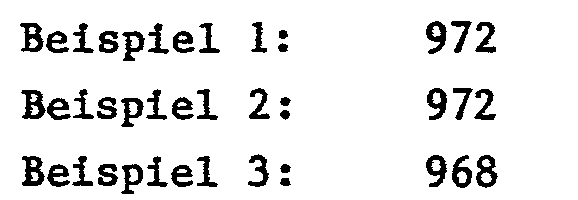
- Gewichtsteilen/Stunde Ethylen und

- Gewichtsteilen/Stunde Acrylsäure-n-butylester und

- Gewichtsteile Acrylsäure, welches auf einen Druck von 2200 bar komprimiert ist, zugeführt.
- Als Polymerisationsstarter wurde dem Gemisch

- Mol-ppm Sauerstoff, bezogen auf Ethylen, zugesetzt.
- Durch die freiwerdende Reaktionswärme, die nicht über die Reaktorwand an das Kühlmittel abgegeben wurde, erreichte das Reaktionsgemisch im ersten Teil des Reaktors eine maximale Temperatur von 300*C und im zweiten Teil des Reaktors nach der zweiten Zufuhrstelle eine maximale Temperatur von 270°C.
- Als Molekulargewichtsregler wurde Propylen zugesetzt. Die Reglermenge wurde so bemessen, daß sich ein Molekulargewicht entsprechend eines Schmelzindex von

- Auf diese Weise wurden

- Gewichtsteile eines Ethylen-Acrylsäure-n-butylester-Acrylsäure-Terpolymerisates erhalten, dessen Comonomeranteile


- Für die Schädigungsarbeitung, als Maß der Kälteschlagzähigkeit, ermittelt nach DIN 53 443, Blatt 1 an 2 mm starken Prüfkörpern wurde gefunden aus

- Die gewonnenen Terpolymerisate besitzen außerdem eine Haftung auf Aluminium und Eisen, gemessen wie vorher beschrieben von 200 N/2 cm.
- Es wurde das Beispiel 22 der DE-B-17 20 355 verwendet. Das gewonnene Polymerisat enthält 2,1 Mol t-Butylacrylat und 1,7 Mol Acrylsäure, bezogen auf 100 Mol Ethylen. Die Glastemperatur betrug -15°C, für die Schädigungsarbeit wurden 10,7 Nm gemessen. Die Haftung auf Aluminiumblech ergab einen Wert von 180 N/2 cm und auf Eisenblech von 170 N/2 cm.
- Es wird ein Ethylen-Acrylsäure-Copolymer hergestellt wie in US 3 520 861 in Beispiel 11 beschrieben. Der Gehalt an Acrylsäure beträgt 3,7 Mol/-100 Mol Ethylen. Das Produkt zeigt eine Glastemperatur von 0*C, die Schädigungsarbeit wurde mit 12 Nm ermittelt. Die Haftung auf Aluminiumblech betrug 150 N/2 cm und auf Eisenblech 180 N/2 cm.
Claims (1)
- Terpolymerisate des Ethylens mit Schmelzindices von kleiner als 100 g/10 min, die aus1) 100 Mol einpolymerisiertem Ethylen2) 0,9 bis 3,2 Mol einpolymerisierten C1- bis C8-Alkylestern von C3- bi C6-Alkencarbonsäuren und3) 0,9 bis 2,6 Mol einpolymerisierten C3- bis C6-Alkencarbonsäuren bestehen, dadurch gekennzeichnet, daß die Molteile an einpolymerisiertem Alkylester (a) zu einpolymerisierten Carbonsäuren (b), bezogen auf 100 Mol einpolymerisiertem Ethylen, innerhalb der oben definierten Bereiche der Beziehung a = x . b-1'6 gehorchen, wobei x eine Zahl von 2 bis 6 bedeutet, und die Terpolymerisate eine Glasübergangstemperatur, bestimmt nach der DSC-Methode bei einer Abkühl- und Aufheizgeschwindigkeit von 20°C/min, unterhalb von -15°C aufweisen. Zeichn.
Priority Applications (1)
| Application Number | Priority Date | Filing Date | Title |
|---|---|---|---|
| AT85101054T ATE39934T1 (de) | 1984-02-10 | 1985-02-01 | Verfahren zur herstellung von copolymerisaten des ethylens mit carboxylgruppenhaltigen comonomeren. |
Applications Claiming Priority (2)
| Application Number | Priority Date | Filing Date | Title |
|---|---|---|---|
| DE19843404743 DE3404743A1 (de) | 1984-02-10 | 1984-02-10 | Copolymerisate des ethylens mit carboxylgruppenhaltigen comonomeren |
| DE3404743 | 1984-02-10 |
Publications (2)
| Publication Number | Publication Date |
|---|---|
| EP0157107A1 true EP0157107A1 (de) | 1985-10-09 |
| EP0157107B1 EP0157107B1 (de) | 1989-01-11 |
Family
ID=6227338
Family Applications (1)
| Application Number | Title | Priority Date | Filing Date |
|---|---|---|---|
| EP85101054A Expired EP0157107B1 (de) | 1984-02-10 | 1985-02-01 | Verfahren zur Herstellung von Copolymerisaten des Ethylens mit carboxylgruppenhaltigen Comonomeren |
Country Status (4)
| Country | Link |
|---|---|
| EP (1) | EP0157107B1 (de) |
| JP (1) | JPS6128514A (de) |
| AT (1) | ATE39934T1 (de) |
| DE (2) | DE3404743A1 (de) |
Cited By (1)
| Publication number | Priority date | Publication date | Assignee | Title |
|---|---|---|---|---|
| US5302520A (en) * | 1990-09-25 | 1994-04-12 | Board Of Regents, The University Of Texas System | Enzymatic synthesis of isotopically labeled carbohydrates |
Families Citing this family (1)
| Publication number | Priority date | Publication date | Assignee | Title |
|---|---|---|---|---|
| US5717048A (en) * | 1994-12-07 | 1998-02-10 | Dai-Ichi Kogyo Seiyaku Co., Ltd. | Cation-modified acrylamide or methacrylamide copolymer as well as antistatic agent, thermoplastic resin composition, aqueous composition and thermoplastic resin laminate comprising same |
Citations (5)
| Publication number | Priority date | Publication date | Assignee | Title |
|---|---|---|---|---|
| DE1520493A1 (de) * | 1961-06-21 | 1969-07-24 | Du Pont | AEthylencopolymerisate und Verfahren zu ihrer Herstellung |
| FR2103098A5 (de) * | 1970-07-20 | 1972-04-07 | Ici Ltd | |
| GB2091745A (en) * | 1981-01-27 | 1982-08-04 | Charbonnages Ste Chimique | Copolymers of ethylene |
| EP0061038A1 (de) * | 1981-03-14 | 1982-09-29 | BASF Aktiengesellschaft | Hartwachse aus Terpolymerisaten des Ethylens mit ungesättigten Carbonsäuren und ungesättigten Carbonsäureestern |
| EP0106999A1 (de) * | 1982-09-17 | 1984-05-02 | BASF Aktiengesellschaft | Copolymerisate des Ethylens mit (Meth)acrylsäurealkylestern |
Family Cites Families (1)
| Publication number | Priority date | Publication date | Assignee | Title |
|---|---|---|---|---|
| DE2524274C3 (de) * | 1975-05-31 | 1987-09-10 | Basf Ag, 6700 Ludwigshafen | Verfahren zur Herstellung von Mischpolymerisaten des Äthylens |
-
1984
- 1984-02-10 DE DE19843404743 patent/DE3404743A1/de not_active Withdrawn
-
1985
- 1985-02-01 AT AT85101054T patent/ATE39934T1/de not_active IP Right Cessation
- 1985-02-01 DE DE8585101054T patent/DE3567466D1/de not_active Expired
- 1985-02-01 EP EP85101054A patent/EP0157107B1/de not_active Expired
- 1985-02-08 JP JP2209585A patent/JPS6128514A/ja active Pending
Patent Citations (5)
| Publication number | Priority date | Publication date | Assignee | Title |
|---|---|---|---|---|
| DE1520493A1 (de) * | 1961-06-21 | 1969-07-24 | Du Pont | AEthylencopolymerisate und Verfahren zu ihrer Herstellung |
| FR2103098A5 (de) * | 1970-07-20 | 1972-04-07 | Ici Ltd | |
| GB2091745A (en) * | 1981-01-27 | 1982-08-04 | Charbonnages Ste Chimique | Copolymers of ethylene |
| EP0061038A1 (de) * | 1981-03-14 | 1982-09-29 | BASF Aktiengesellschaft | Hartwachse aus Terpolymerisaten des Ethylens mit ungesättigten Carbonsäuren und ungesättigten Carbonsäureestern |
| EP0106999A1 (de) * | 1982-09-17 | 1984-05-02 | BASF Aktiengesellschaft | Copolymerisate des Ethylens mit (Meth)acrylsäurealkylestern |
Cited By (1)
| Publication number | Priority date | Publication date | Assignee | Title |
|---|---|---|---|---|
| US5302520A (en) * | 1990-09-25 | 1994-04-12 | Board Of Regents, The University Of Texas System | Enzymatic synthesis of isotopically labeled carbohydrates |
Also Published As
| Publication number | Publication date |
|---|---|
| ATE39934T1 (de) | 1989-01-15 |
| DE3404743A1 (de) | 1985-08-14 |
| JPS6128514A (ja) | 1986-02-08 |
| DE3567466D1 (en) | 1989-02-16 |
| EP0157107B1 (de) | 1989-01-11 |
Similar Documents
| Publication | Publication Date | Title |
|---|---|---|
| DE3486025T2 (de) | Interpolymere von aethylen und ungesaettigten saeuren. | |
| EP0245773B1 (de) | Verfahren zur Herstellung von Copolymerisaten des Ethylens mit Acrylsäureestern in einem Röhrenreaktor bei Drücken oberhalb 500 bar | |
| EP0244855B1 (de) | Verfahren zur Herstellung von Copolymerisaten des Ethylens mit Vinylestern in einem Röhrenreaktor bei Drücken oberhalb 500 bar | |
| EP0157108B1 (de) | Verfahren zur Herstellung von Copolymerisaten des Ethylens mit carboxylgruppenhaltigen Comonomeren in einem 2-Zonen-Reaktor bei Drücken oberhalb 500 bar | |
| EP0106999B1 (de) | Copolymerisate des Ethylens mit (Meth)acrylsäurealkylestern | |
| DE3141507C2 (de) | ||
| DE2236471A1 (de) | Terpolymeres | |
| DE4219983A1 (de) | Verfahren zur Herstellung von Copolymerisaten des Ethylens mit Acrylsäureestern oder Acrylsäure | |
| EP0157106B1 (de) | Copolymerisate des Ethylens mit carboxylgruppenhaltigen Comonomeren | |
| EP0157107B1 (de) | Verfahren zur Herstellung von Copolymerisaten des Ethylens mit carboxylgruppenhaltigen Comonomeren | |
| EP0098488B1 (de) | Verfahren zur Herstellung von Ethylen-Acrylsäureester-Copolymerisaten in einem Zweizonen-Reaktor bei Drücken oberhalb 500 bar | |
| EP1187858B1 (de) | Verfahren zur herstellung von ethylen/(meth)acrylatcopolymerisaten mit geringem restcomonomergehalt | |
| DE2524274A1 (de) | Verfahren zur herstellung von mischpolymerisaten des aethylens | |
| EP0175318B1 (de) | Verfahren zur Herstellung von Copolymerisaten des Ethylens mit (Meth)acrylsäurealkylestern | |
| DE2524204C2 (de) | Verfahren zur Herstellung von Hochdruckpolyäthylen | |
| EP0224029B1 (de) | Copolymerisate des Ethylens mit Polyalkylenglykol(meth)acrylsäureestern | |
| DE2119047B2 (de) | Verfahren zur herstellung von mischpolymerisaten des aethylens | |
| EP0131707B1 (de) | Nichtklebende Copolymerisate des Ethylens, deren Herstellung und Verwendung | |
| DE2524474C2 (de) | Verfahren zur Herstellung von Hochdruckpolyäthylen | |
| DE3237107A1 (de) | Terpolymerisate des ethylens | |
| EP0121756A2 (de) | Verfahren zur Herstellung von Ethylenpolymerisaten bei Drücken oberhalb von 500 bar in einem Einzonen-Rohrreaktor | |
| DE4441822A1 (de) | Verfahren zur Herstellung von Copolymerisaten des Ethylens mit Alkencarbonsäuren | |
| EP0092070A2 (de) | Copolymerisate des Ethylens mit 3-Methyl-buten-3-ol-1 | |
| DE3312151A1 (de) | Copolymerisate des ethylens mit acrylsaeureester des tricyclodecenylalkohols | |
| DE3227331A1 (de) | Copolymerisate des ethylens |
Legal Events
| Date | Code | Title | Description |
|---|---|---|---|
| PUAI | Public reference made under article 153(3) epc to a published international application that has entered the european phase |
Free format text: ORIGINAL CODE: 0009012 |
|
| AK | Designated contracting states |
Designated state(s): AT BE DE FR GB NL |
|
| 17P | Request for examination filed |
Effective date: 19850812 |
|
| 17Q | First examination report despatched |
Effective date: 19870119 |
|
| GRAA | (expected) grant |
Free format text: ORIGINAL CODE: 0009210 |
|
| AK | Designated contracting states |
Kind code of ref document: B1 Designated state(s): AT BE DE FR GB NL |
|
| REF | Corresponds to: |
Ref document number: 39934 Country of ref document: AT Date of ref document: 19890115 Kind code of ref document: T |
|
| REF | Corresponds to: |
Ref document number: 3567466 Country of ref document: DE Date of ref document: 19890216 |
|
| GBT | Gb: translation of ep patent filed (gb section 77(6)(a)/1977) | ||
| ET | Fr: translation filed | ||
| PLBE | No opposition filed within time limit |
Free format text: ORIGINAL CODE: 0009261 |
|
| STAA | Information on the status of an ep patent application or granted ep patent |
Free format text: STATUS: NO OPPOSITION FILED WITHIN TIME LIMIT |
|
| 26N | No opposition filed | ||
| R20 | Corrections of a patent specification |
Effective date: 19891211 |
|
| REG | Reference to a national code |
Ref country code: GB Ref legal event code: IF02 |
|
| PGFP | Annual fee paid to national office [announced via postgrant information from national office to epo] |
Ref country code: NL Payment date: 20020121 Year of fee payment: 18 |
|
| PGFP | Annual fee paid to national office [announced via postgrant information from national office to epo] |
Ref country code: BE Payment date: 20020222 Year of fee payment: 18 |
|
| PGFP | Annual fee paid to national office [announced via postgrant information from national office to epo] |
Ref country code: FR Payment date: 20030117 Year of fee payment: 19 |
|
| PGFP | Annual fee paid to national office [announced via postgrant information from national office to epo] |
Ref country code: AT Payment date: 20030121 Year of fee payment: 19 |
|
| PGFP | Annual fee paid to national office [announced via postgrant information from national office to epo] |
Ref country code: GB Payment date: 20030129 Year of fee payment: 19 |
|
| PG25 | Lapsed in a contracting state [announced via postgrant information from national office to epo] |
Ref country code: BE Free format text: LAPSE BECAUSE OF NON-PAYMENT OF DUE FEES Effective date: 20030228 |
|
| PGFP | Annual fee paid to national office [announced via postgrant information from national office to epo] |
Ref country code: DE Payment date: 20030303 Year of fee payment: 19 |
|
| PG25 | Lapsed in a contracting state [announced via postgrant information from national office to epo] |
Ref country code: NL Free format text: LAPSE BECAUSE OF NON-PAYMENT OF DUE FEES Effective date: 20030901 |
|
| NLV4 | Nl: lapsed or anulled due to non-payment of the annual fee |
Effective date: 20030901 |
|
| PG25 | Lapsed in a contracting state [announced via postgrant information from national office to epo] |
Ref country code: GB Free format text: LAPSE BECAUSE OF NON-PAYMENT OF DUE FEES Effective date: 20040201 Ref country code: AT Free format text: LAPSE BECAUSE OF NON-PAYMENT OF DUE FEES Effective date: 20040201 |
|
| PG25 | Lapsed in a contracting state [announced via postgrant information from national office to epo] |
Ref country code: DE Free format text: LAPSE BECAUSE OF NON-PAYMENT OF DUE FEES Effective date: 20040901 |
|
| GBPC | Gb: european patent ceased through non-payment of renewal fee |
Effective date: 20040201 |
|
| PG25 | Lapsed in a contracting state [announced via postgrant information from national office to epo] |
Ref country code: FR Free format text: LAPSE BECAUSE OF NON-PAYMENT OF DUE FEES Effective date: 20041029 |
|
| REG | Reference to a national code |
Ref country code: FR Ref legal event code: ST |