EP0154094B2 - Fasermattenbedeckte Gipsplatte und ihre Verwendung in Aussenisolation, in Aussenbekleidungssystemen von Gebäuden und in Schachtwandbau - Google Patents
Fasermattenbedeckte Gipsplatte und ihre Verwendung in Aussenisolation, in Aussenbekleidungssystemen von Gebäuden und in Schachtwandbau Download PDFInfo
- Publication number
- EP0154094B2 EP0154094B2 EP84309124A EP84309124A EP0154094B2 EP 0154094 B2 EP0154094 B2 EP 0154094B2 EP 84309124 A EP84309124 A EP 84309124A EP 84309124 A EP84309124 A EP 84309124A EP 0154094 B2 EP0154094 B2 EP 0154094B2
- Authority
- EP
- European Patent Office
- Prior art keywords
- gypsum
- mat
- core
- slurry
- gypsum board
- Prior art date
- Legal status (The legal status is an assumption and is not a legal conclusion. Google has not performed a legal analysis and makes no representation as to the accuracy of the status listed.)
- Expired - Lifetime
Links
Images

Classifications
-
- B—PERFORMING OPERATIONS; TRANSPORTING
- B32—LAYERED PRODUCTS
- B32B—LAYERED PRODUCTS, i.e. PRODUCTS BUILT-UP OF STRATA OF FLAT OR NON-FLAT, e.g. CELLULAR OR HONEYCOMB, FORM
- B32B13/00—Layered products comprising a a layer of water-setting substance, e.g. concrete, plaster, asbestos cement, or like builders' material
- B32B13/14—Layered products comprising a a layer of water-setting substance, e.g. concrete, plaster, asbestos cement, or like builders' material next to a fibrous or filamentary layer
-
- B—PERFORMING OPERATIONS; TRANSPORTING
- B28—WORKING CEMENT, CLAY, OR STONE
- B28B—SHAPING CLAY OR OTHER CERAMIC COMPOSITIONS; SHAPING SLAG; SHAPING MIXTURES CONTAINING CEMENTITIOUS MATERIAL, e.g. PLASTER
- B28B19/00—Machines or methods for applying the material to surfaces to form a permanent layer thereon
- B28B19/0092—Machines or methods for applying the material to surfaces to form a permanent layer thereon to webs, sheets or the like, e.g. of paper, cardboard
-
- B—PERFORMING OPERATIONS; TRANSPORTING
- B28—WORKING CEMENT, CLAY, OR STONE
- B28B—SHAPING CLAY OR OTHER CERAMIC COMPOSITIONS; SHAPING SLAG; SHAPING MIXTURES CONTAINING CEMENTITIOUS MATERIAL, e.g. PLASTER
- B28B23/00—Arrangements specially adapted for the production of shaped articles with elements wholly or partly embedded in the moulding material; Production of reinforced objects
- B28B23/0006—Arrangements specially adapted for the production of shaped articles with elements wholly or partly embedded in the moulding material; Production of reinforced objects the reinforcement consisting of aligned, non-metal reinforcing elements
-
- B—PERFORMING OPERATIONS; TRANSPORTING
- B32—LAYERED PRODUCTS
- B32B—LAYERED PRODUCTS, i.e. PRODUCTS BUILT-UP OF STRATA OF FLAT OR NON-FLAT, e.g. CELLULAR OR HONEYCOMB, FORM
- B32B3/00—Layered products comprising a layer with external or internal discontinuities or unevennesses, or a layer of non-planar shape; Layered products comprising a layer having particular features of form
- B32B3/26—Layered products comprising a layer with external or internal discontinuities or unevennesses, or a layer of non-planar shape; Layered products comprising a layer having particular features of form characterised by a particular shape of the outline of the cross-section of a continuous layer; characterised by a layer with cavities or internal voids ; characterised by an apertured layer
-
- B—PERFORMING OPERATIONS; TRANSPORTING
- B32—LAYERED PRODUCTS
- B32B—LAYERED PRODUCTS, i.e. PRODUCTS BUILT-UP OF STRATA OF FLAT OR NON-FLAT, e.g. CELLULAR OR HONEYCOMB, FORM
- B32B7/00—Layered products characterised by the relation between layers; Layered products characterised by the relative orientation of features between layers, or by the relative values of a measurable parameter between layers, i.e. products comprising layers having different physical, chemical or physicochemical properties; Layered products characterised by the interconnection of layers
- B32B7/04—Interconnection of layers
- B32B7/12—Interconnection of layers using interposed adhesives or interposed materials with bonding properties
-
- E—FIXED CONSTRUCTIONS
- E04—BUILDING
- E04C—STRUCTURAL ELEMENTS; BUILDING MATERIALS
- E04C2/00—Building elements of relatively thin form for the construction of parts of buildings, e.g. sheet materials, slabs, or panels
- E04C2/02—Building elements of relatively thin form for the construction of parts of buildings, e.g. sheet materials, slabs, or panels characterised by specified materials
- E04C2/04—Building elements of relatively thin form for the construction of parts of buildings, e.g. sheet materials, slabs, or panels characterised by specified materials of concrete or other stone-like material; of asbestos cement; of cement and other mineral fibres
- E04C2/043—Building elements of relatively thin form for the construction of parts of buildings, e.g. sheet materials, slabs, or panels characterised by specified materials of concrete or other stone-like material; of asbestos cement; of cement and other mineral fibres of plaster
-
- E—FIXED CONSTRUCTIONS
- E04—BUILDING
- E04C—STRUCTURAL ELEMENTS; BUILDING MATERIALS
- E04C2/00—Building elements of relatively thin form for the construction of parts of buildings, e.g. sheet materials, slabs, or panels
- E04C2/02—Building elements of relatively thin form for the construction of parts of buildings, e.g. sheet materials, slabs, or panels characterised by specified materials
- E04C2/26—Building elements of relatively thin form for the construction of parts of buildings, e.g. sheet materials, slabs, or panels characterised by specified materials composed of materials covered by two or more of groups E04C2/04, E04C2/08, E04C2/10 or of materials covered by one of these groups with a material not specified in one of the groups
- E04C2/284—Building elements of relatively thin form for the construction of parts of buildings, e.g. sheet materials, slabs, or panels characterised by specified materials composed of materials covered by two or more of groups E04C2/04, E04C2/08, E04C2/10 or of materials covered by one of these groups with a material not specified in one of the groups at least one of the materials being insulating
-
- E—FIXED CONSTRUCTIONS
- E04—BUILDING
- E04C—STRUCTURAL ELEMENTS; BUILDING MATERIALS
- E04C2/00—Building elements of relatively thin form for the construction of parts of buildings, e.g. sheet materials, slabs, or panels
- E04C2/02—Building elements of relatively thin form for the construction of parts of buildings, e.g. sheet materials, slabs, or panels characterised by specified materials
- E04C2/26—Building elements of relatively thin form for the construction of parts of buildings, e.g. sheet materials, slabs, or panels characterised by specified materials composed of materials covered by two or more of groups E04C2/04, E04C2/08, E04C2/10 or of materials covered by one of these groups with a material not specified in one of the groups
- E04C2/284—Building elements of relatively thin form for the construction of parts of buildings, e.g. sheet materials, slabs, or panels characterised by specified materials composed of materials covered by two or more of groups E04C2/04, E04C2/08, E04C2/10 or of materials covered by one of these groups with a material not specified in one of the groups at least one of the materials being insulating
- E04C2/288—Building elements of relatively thin form for the construction of parts of buildings, e.g. sheet materials, slabs, or panels characterised by specified materials composed of materials covered by two or more of groups E04C2/04, E04C2/08, E04C2/10 or of materials covered by one of these groups with a material not specified in one of the groups at least one of the materials being insulating composed of insulating material and concrete, stone or stone-like material
-
- E—FIXED CONSTRUCTIONS
- E04—BUILDING
- E04D—ROOF COVERINGS; SKY-LIGHTS; GUTTERS; ROOF-WORKING TOOLS
- E04D11/00—Roof covering, as far as not restricted to features covered by only one of groups E04D1/00 - E04D9/00; Roof covering in ways not provided for by groups E04D1/00 - E04D9/00, e.g. built-up roofs, elevated load-supporting roof coverings
- E04D11/02—Build-up roofs, i.e. consisting of two or more layers bonded together in situ, at least one of the layers being of watertight composition
-
- E—FIXED CONSTRUCTIONS
- E04—BUILDING
- E04D—ROOF COVERINGS; SKY-LIGHTS; GUTTERS; ROOF-WORKING TOOLS
- E04D13/00—Special arrangements or devices in connection with roof coverings; Protection against birds; Roof drainage ; Sky-lights
- E04D13/16—Insulating devices or arrangements in so far as the roof covering is concerned, e.g. characterised by the material or composition of the roof insulating material or its integration in the roof structure
- E04D13/1606—Insulation of the roof covering characterised by its integration in the roof structure
- E04D13/1643—Insulation of the roof covering characterised by its integration in the roof structure the roof structure being formed by load bearing corrugated sheets, e.g. profiled sheet metal roofs
-
- E—FIXED CONSTRUCTIONS
- E04—BUILDING
- E04D—ROOF COVERINGS; SKY-LIGHTS; GUTTERS; ROOF-WORKING TOOLS
- E04D13/00—Special arrangements or devices in connection with roof coverings; Protection against birds; Roof drainage ; Sky-lights
- E04D13/16—Insulating devices or arrangements in so far as the roof covering is concerned, e.g. characterised by the material or composition of the roof insulating material or its integration in the roof structure
- E04D13/1606—Insulation of the roof covering characterised by its integration in the roof structure
- E04D13/1668—Insulation of the roof covering characterised by its integration in the roof structure the insulating material being masses or granules applied in situ
-
- E—FIXED CONSTRUCTIONS
- E04—BUILDING
- E04F—FINISHING WORK ON BUILDINGS, e.g. STAIRS, FLOORS
- E04F13/00—Coverings or linings, e.g. for walls or ceilings
- E04F13/02—Coverings or linings, e.g. for walls or ceilings of plastic materials hardening after applying, e.g. plaster
- E04F13/04—Bases for plaster
- E04F13/047—Plaster carrying meshes
-
- B—PERFORMING OPERATIONS; TRANSPORTING
- B32—LAYERED PRODUCTS
- B32B—LAYERED PRODUCTS, i.e. PRODUCTS BUILT-UP OF STRATA OF FLAT OR NON-FLAT, e.g. CELLULAR OR HONEYCOMB, FORM
- B32B2262/00—Composition or structural features of fibres which form a fibrous or filamentary layer or are present as additives
- B32B2262/10—Inorganic fibres
- B32B2262/101—Glass fibres
-
- B—PERFORMING OPERATIONS; TRANSPORTING
- B32—LAYERED PRODUCTS
- B32B—LAYERED PRODUCTS, i.e. PRODUCTS BUILT-UP OF STRATA OF FLAT OR NON-FLAT, e.g. CELLULAR OR HONEYCOMB, FORM
- B32B2305/00—Condition, form or state of the layers or laminate
- B32B2305/08—Reinforcements
-
- B—PERFORMING OPERATIONS; TRANSPORTING
- B32—LAYERED PRODUCTS
- B32B—LAYERED PRODUCTS, i.e. PRODUCTS BUILT-UP OF STRATA OF FLAT OR NON-FLAT, e.g. CELLULAR OR HONEYCOMB, FORM
- B32B2307/00—Properties of the layers or laminate
- B32B2307/30—Properties of the layers or laminate having particular thermal properties
- B32B2307/304—Insulating
-
- B—PERFORMING OPERATIONS; TRANSPORTING
- B32—LAYERED PRODUCTS
- B32B—LAYERED PRODUCTS, i.e. PRODUCTS BUILT-UP OF STRATA OF FLAT OR NON-FLAT, e.g. CELLULAR OR HONEYCOMB, FORM
- B32B2307/00—Properties of the layers or laminate
- B32B2307/70—Other properties
- B32B2307/726—Permeability to liquids, absorption
- B32B2307/7265—Non-permeable
-
- B—PERFORMING OPERATIONS; TRANSPORTING
- B32—LAYERED PRODUCTS
- B32B—LAYERED PRODUCTS, i.e. PRODUCTS BUILT-UP OF STRATA OF FLAT OR NON-FLAT, e.g. CELLULAR OR HONEYCOMB, FORM
- B32B2607/00—Walls, panels
-
- Y—GENERAL TAGGING OF NEW TECHNOLOGICAL DEVELOPMENTS; GENERAL TAGGING OF CROSS-SECTIONAL TECHNOLOGIES SPANNING OVER SEVERAL SECTIONS OF THE IPC; TECHNICAL SUBJECTS COVERED BY FORMER USPC CROSS-REFERENCE ART COLLECTIONS [XRACs] AND DIGESTS
- Y10—TECHNICAL SUBJECTS COVERED BY FORMER USPC
- Y10T—TECHNICAL SUBJECTS COVERED BY FORMER US CLASSIFICATION
- Y10T428/00—Stock material or miscellaneous articles
- Y10T428/249921—Web or sheet containing structurally defined element or component
- Y10T428/249953—Composite having voids in a component [e.g., porous, cellular, etc.]
- Y10T428/249967—Inorganic matrix in void-containing component
- Y10T428/249968—Of hydraulic-setting material
-
- Y—GENERAL TAGGING OF NEW TECHNOLOGICAL DEVELOPMENTS; GENERAL TAGGING OF CROSS-SECTIONAL TECHNOLOGIES SPANNING OVER SEVERAL SECTIONS OF THE IPC; TECHNICAL SUBJECTS COVERED BY FORMER USPC CROSS-REFERENCE ART COLLECTIONS [XRACs] AND DIGESTS
- Y10—TECHNICAL SUBJECTS COVERED BY FORMER USPC
- Y10T—TECHNICAL SUBJECTS COVERED BY FORMER US CLASSIFICATION
- Y10T428/00—Stock material or miscellaneous articles
- Y10T428/31504—Composite [nonstructural laminate]
- Y10T428/31801—Of wax or waxy material
-
- Y—GENERAL TAGGING OF NEW TECHNOLOGICAL DEVELOPMENTS; GENERAL TAGGING OF CROSS-SECTIONAL TECHNOLOGIES SPANNING OVER SEVERAL SECTIONS OF THE IPC; TECHNICAL SUBJECTS COVERED BY FORMER USPC CROSS-REFERENCE ART COLLECTIONS [XRACs] AND DIGESTS
- Y10—TECHNICAL SUBJECTS COVERED BY FORMER USPC
- Y10T—TECHNICAL SUBJECTS COVERED BY FORMER US CLASSIFICATION
- Y10T428/00—Stock material or miscellaneous articles
- Y10T428/31504—Composite [nonstructural laminate]
- Y10T428/31815—Of bituminous or tarry residue
-
- Y—GENERAL TAGGING OF NEW TECHNOLOGICAL DEVELOPMENTS; GENERAL TAGGING OF CROSS-SECTIONAL TECHNOLOGIES SPANNING OVER SEVERAL SECTIONS OF THE IPC; TECHNICAL SUBJECTS COVERED BY FORMER USPC CROSS-REFERENCE ART COLLECTIONS [XRACs] AND DIGESTS
- Y10—TECHNICAL SUBJECTS COVERED BY FORMER USPC
- Y10T—TECHNICAL SUBJECTS COVERED BY FORMER US CLASSIFICATION
- Y10T442/00—Fabric [woven, knitted, or nonwoven textile or cloth, etc.]
- Y10T442/60—Nonwoven fabric [i.e., nonwoven strand or fiber material]
- Y10T442/659—Including an additional nonwoven fabric
- Y10T442/665—Including a layer derived from a water-settable material [e.g., cement, gypsum, etc.]
-
- Y—GENERAL TAGGING OF NEW TECHNOLOGICAL DEVELOPMENTS; GENERAL TAGGING OF CROSS-SECTIONAL TECHNOLOGIES SPANNING OVER SEVERAL SECTIONS OF THE IPC; TECHNICAL SUBJECTS COVERED BY FORMER USPC CROSS-REFERENCE ART COLLECTIONS [XRACs] AND DIGESTS
- Y10—TECHNICAL SUBJECTS COVERED BY FORMER USPC
- Y10T—TECHNICAL SUBJECTS COVERED BY FORMER US CLASSIFICATION
- Y10T442/00—Fabric [woven, knitted, or nonwoven textile or cloth, etc.]
- Y10T442/60—Nonwoven fabric [i.e., nonwoven strand or fiber material]
- Y10T442/696—Including strand or fiber material which is stated to have specific attributes [e.g., heat or fire resistance, chemical or solvent resistance, high absorption for aqueous compositions, water solubility, heat shrinkability, etc.]
Definitions
- This invention relates to improvements in exterior finishing systems and exterior insulation systems for buildings, and also to improvements in shaft wall assemblies for buildings. More particularly, this invention provides an improved structural component for use as a support surface in an exterior finishing system, including an exterior insulation system (sometimes referred to herein for convenience as "ElSystem). In addition, the present invention encompasses improvements in hollow shaft wall assemblies, for example, those used in constructing elevator shafts and stairwells.
- ElSystems are presently being used more and more widely to insulate existing buildings and buildings under construction including industrial, commercial, municipal, institutional, and residential buildings. Installation of a typical ElSystem in new construction generally involves the following sequential steps: (A) constructing a frame for support of the outside wall of a building; (B) affixing to the frame structural panels to provide a smooth continuous surface for the support of other of the components of the ElSystem; (C) affixing to the support surface panels of insulation; and (D) affixing to the panels of insulation a mesh-like material which in turn is covered with an exterior finishing material having weathering and aesthetic properties. Such systems are designed to be not only highly insulative in character and attractive in appearance, but also weather resistant. ElSystems can be used to advantage to conserve energy used for heating and to conserve energy used for air-conditioning.
- ElSystems have inherent advantages over interior insulating systems and, in addition, they can be used to better advantage than interior insulating systems in many applications.
- the range of temperature variation in structural components comprising the walls of a building insulated from the outside is less than that for such components in a building which is insulated from the inside. Accordingly, such structural components when insulated from the outside are subjected to significantly lower amounts of stress caused by thermal expansion and contraction than those insulated from the inside. This is particularly advantageous in applications where the structural components comprise materials having markedly different coefficients of expansion, as is often the case.
- the interior space in a building having an ElSystem tends to have a more uniform temperature and be less drafty than that of a building insulated from the inside.
- Certain buildings are not capable of being insulated from the interior except that valuable inside space is lost to the system.
- the installation of an EISystem does not disturb the inside space of the building.
- An ElSystem can be used also to modernize or otherwise renovate the exterior of a building in need of renovation.
- Various of the ElSystems which are commercially available give the architect a wide range of aesthetically pleasing designs from which to choose.
- the cost of installing an ElSystem is relatively low when there is taken into account both the costs of other systems and the improved thermal efficiencies that can be realized.
- the relatively light weight of both the insulation and the exterior finish in an ElSystem is particularly advantageous in new construction because of reduced foundation requirements.
- a typical ElSystem includes a supporting member to which there is affixed insulating material, which in turn is covered with an exterior finishing material.
- An exemplary ElSystem includes a wood or metal frame which is mechanically held in place by nails or screws to appropriate structural members of the building, with panels of the supporting member in turn mechanically affixed by nails or screws to the frame.
- the supporting member which typically consists of a smooth continuous surface comprising individual panels of material positioned in abutting relationship, must be strong enough to carry the weight of the components which overlie it, including the insulating and exterior finishing materials.
- the exterior finishing material is generally a much denser and heavier weight material, for example, an acrylic resin/cement coating that may include decorative aggregate embedded therein.
- Certain of the commercialized ElSystems include the use of panels of a Portland cement-based composition as the structural member for the support of the overlying panels of insulation and exterior finishing material. It is believed that such cement-based panels are described in US-A-3,284,980 which discloses a building panel comprising a core consisting of a mixture of hydraulic cement and light-weight aggregate (for example, perlite) sandwiched between sheets of fibrous material (for example, woven glass fiber screen), which are adhered to the faces of the core by separate layers of bonding material containing at least 50% hydraulic cement. Although the cores of such panels include a light-weight aggregate, the panels are nevertheless relatively heavy.
- a panel 91.4 X 121.9 cm (3 ' X 4 ') and 1.11 cm (7/16 ")in thickness weighs about 18.4 Kg (40 1/2 pounds).
- the handling and installation of such panels lead to the consumption of relatively large amounts of energy. This is a burden to workmen and makes transportation of the panels relatively costly.
- gypsum board A material which is used more widely in ElSystems than the aforementioned cement board is gypsum board, that is, panels comprising a core of set gypsum (calcium sulfate dihydrate) sandwiched between paper cover sheets.
- gypsum sheathing which is gypsum board designed for use on the exterior of buildings where it serves as an underlying surface which is covered with such materials as aluminum, wood siding, Portland cement stucco and, in the case of an ElSystem, with insulating and exterior finishing materials.
- Conventional gypsum sheathing as opposed to conventional gypsum wallboard for use in the interior of a building, includes a set gypsum core which contains one or more additives which improve the water resistance of the set core.
- the gypsum core of commercially available wallboard can absorb as much as 40-50 wt.% water when immersed therein at a temperature of 21.1° C (70° F) for about 2 hours.
- materials which reduce the tendency of the core to absorb water are included therein.
- sheathing has water-repellant paper cover sheets which shed water. This is temporary protection for the sheathing before it is installed and before it is covered with the exterior finishing material.
- Gypsum sheathing has many desirable characteristics which make it suitable for use in an ElSystem. For example, such sheathing has relatively good fire-resistant properties, it is relatively light in weight, it has satisfactory water-resistant properties and it can be mechanically affixed in convenient fashion to a metal or wooden frame which underlies the sheathing.
- gypsum sheathing has a water-repellant paper surface which provides some limited protection against water degradation, this type of surface forms a relatively poor bond with water-based adhesives which are used to adhere to the surface other components of the EISystem.
- German Utility model No. 78 06 114 is directed to structural panels including a gypsum core having a glass fiber mantle or facing.
- the glass mantle contains a glass fiber fabric or interlaid scrim with a chopped strand mat adhered thereto to form a composite.
- the composite mat is free of gypsum on its surface, once it is applied to the core, by a denser portion of the chopped strand mat which acts as a barrier to penetrating gypsum slurry.
- German laid open patent specification No. 2 008 744 discloses a gypsum wallboard covered with a fiber glass sheath. At least the lower fiber glass sheath is provided with a removable paper coating on its outer side. This measure is suggested to avoid possible soiling of the belt conveyor by gypsum slurry during manufacturing.
- the present invention is directed to use in EISystems of a support member comprising an improved gypsum-based structural component which is modified in a manner such that problems of the type associated with the use of conventional gypsum sheathing are either overcome or alleviated significantly.
- an improved structural support element comprising a fibrous mat-faced gypsum support surface for use in an exterior finishing system, including exterior insulating systems, for buildings.
- the invention also includes an exterior insulation system for a building which includes a support surface comprising gypsum board according to the invention facing away from said building, insulating material having an inner surface and an outer surface, the inner surface of which is adhered to said support surface by an adhesive material, the insulating material being substantially free of channels penetrating therethrough and between said inner and outer surfaces, and exterior finishing material overlying the outer surface of said insulating material.
- the fibrous mat-faced gypsum board according to the invention comprises a gypsum core having one or more additives therein which improve the water resistance of the core.
- a structural member comprising a water-resistant gypsum core faced with glass mat, which itself is hydrophobic, has outstanding weathering characteristics.
- the glass fiber mat surface which is free of set gypsum in the gypsum board according to the invention provides an excellent substrate to which overlying panels of insulation can be adhered.
- the outer surface of the other mat of the gypsum board is also substantially free of set gypsum, with set gypsum of the core penetrating but part-way into the thickness of both the mats.
- the set gypsum of the core penetrates substantially through the thickness of the other mat over substantial area portions thereof in amounts which are sufficient to coat glass fibers of the mat with a thin film of set gypsum, but not sufficient to form a smooth, continuous coating of set gypsum.
- This embodiment in which significant portionsof the outer surface of the mat have set gypsum thereon provides a protective surface in a two-board package in which the boards are packed together with the gypsum-free surfaces in face-to-face relationship and with the gypsum-covered faces being exposed.
- this preferred form of board comprises a set gypsum core sandwiched between two adhering sheets of porous glass mat of predetermined thickness, each of said mats having an inner and outer surface and comprising randomly distributed glass fibers bonded by an adhesive material, the inner surface of each of said mate being adhered to said gypsum core, and with set gypsum of the core at one surface thereof penetrating substantially through the thickness of one of said mats over substantial area portions thereof and coating substantial area portions of the outer surface thereof and with set gypsum of the core at the other surface thereof penetrating but part-way into the thickness of the other of said mats, the outer surface of the other of said mats being substantially free of set gypsum.
- Still another aspect of the present invention comprises a process as defined in the appended process claim for making the aforementioned embodiments of gypsum board, that is, the embodiment in which both outer surfaces of the mats are substantially free of set gypsum and the embodiment in which the outer surface of one of the mats is substantially free of set gypsum and that of the other mat has set gypsum thereon.
- the process includes known steps used heretofore in manufacturing in continuous fashion conventional wallboard and known glassfiber mat-faced gypsum board, but differs therefrom in that the viscosity of the aqueous gypsum slurry from which the board core is made is controlled in a manner such that the slurry penetrates into the mats to the extent needed to achieve the desired result.
- the viscosity of the slurry is maintained at a value such that portions of said slurry penetrate but part-way through the thickness of each of said underlying and overlying mats and the panel-like shape of slurry is maintained as the calcined gypsum sets to form a set gypsum core having adhered to its surfaces the underlying and overlying fiber glass mats.
- the viscosity of the slurry is maintained at a value such that portions of said slurry penetrate substantially through the thickness of said underlying mat over substantial area portions thereof to coat substantial area portions of the outer surface and at a value such that portions of said slurry penetrate but part-way into the thickness of said overlying mat.
- An ElSystem which includes a fibrous mat-faced gypsum support surface that has affixed thereto insulating material by adhesive only, that is, without fastening means which extend through the insulating material, has higher tensile or cohesive strength than a like system which includes conventional paper-faced gypsum board.
- Testing of systems of this invention which include insulation in the form of expanded polystyrene panels has shown that initial failure is experienced by a pulling apart of the expanded polystyrene panel, thus evidencing improvement in strength relative to conventional systems where initial failure is experienced in the paper plies of the gypsum support member.
- the fibrous mat-faced surface of the gypsum support member is water resistant in contrast to conventional paper cover sheets of gypsum board which can soak up water. This improved water resistance gives the applicator greater flexibility in selecting adhesives that can be used to adhere insulation directly to the mat-faced surface of the gypsum support element as adverse affects are not encountered by the use of water-based adhesives.
- the fibrous mat-faced surface of the gypsum support element is "nailable", and accordingly, it can be secured readily to an underlying frame or other substrate by nailing.
- the improved support surface of the present invention has improved rigidity and strength uniformity in both the length and width dimensions of the system.
- the fibrous mat does not expand or contract during the manufacture of the product; this reduces cockle and leads to uniformity of dimensions.
- the preferred embodiment of the invention which includes the use of a water-resistant core provides a substantially improved weather-resistant product which better resists degradation both within and outside of the system.
- the essential components of an ElSystem comprise insulating material which is sandwiched between an underlying support surface and an exterior finishing material which can be an integral part of the insulating material, but which is usually applied to the insulating material at the site of installation. From one ElSystem to the next, there exist variations in structural details and components.
- the exterior finishing material may be affixed directly to the insulating material
- various systems include a reinforcing component sandwiched between the exterior finishing material and the insulating material.
- the reinforcing component comprises generally one or more plies of fiber glass reinforcing fabric or mesh which is adhered by suitable mastic to the surface of the insulating material.
- the support surface is affixed to a wooden frame attached to the exterior surface of the outside wall of a building, whereas in other systems a metal frame is used.
- the support surface may be affixed directly to the exterior surface of an outside wall, for example, one comprising cinder blocks or concrete blocks.
- the support surface is typically affixed directly to the frame of the building.
- the adhesive or mastic for adhering together components of the system tends to vary from one system to the next, and typically comprises specially formulated proprietary compositions.
- the improved support surface of the present invention can be used satisfactorily and to good advantage in ElSystems which include overlying plies of insulating and exterior finishing materials, and other optional components.
- the most popularly used insulating material in ElSystems is expanded or foamed polystyrene, a material which has good moisture resistant properties. Although it has desirably low water vapor transmission, it is not a vapor barrier, but instead is capable of breathing.
- Rigid panels of expanded polystyrene are used most widely in ElSystems. Such panels have satisfactory compressive strength and resilience and are presently available in thicknesses ranging from 1.27 to 15.2 cm (1/2 to 6 inches), widths from 15.2 to 121.9 cm (6 to 48 inches) and lengths ranging from 121.9 to 487.7 cm (4 feet to 16 feet).
- One commercially available system utilizes rigid, expanded polystyrene panels which are 61.0 X 121.9 X 2.54cm (2' X 4' X 1").
- thermal insulating materials can be used in ElSystems also. Examples of such materials include extruded polystyrene, polyurethane, isocyanurate, cement-based insulating plasters, and phenolic foam. Insulating materials generally have low thermal conducting and low density.
- various ElSystems include a reinforcing component, for example, in cloth form, sandwiched between the insulating material and the exterior finishing material.
- Glass cloth is most widely used at the Present tide to reinforce the system, that is, to improve the impact strength of the system.
- the particular type or types of glass cloth used and the number of plies thereof which are used depend on the impact resistance which is desired.
- Examples of reinforcing cloth or fabric which can be used in the system are woven glass, glass fiber skrim and glass fiber mesh.
- Installation of the reinforcing fabric generally involves applying a suitable adhesive to the surface of the insulating material and then applying the fabric thereto. Additional plies of fabric can be applied if desired.
- a cement/ acrylic resin is an example of an adhesive that can be used.
- the exterior finishing material can be affixed directly to the insulating material or to an intermediate surface such as, for example, the surface of a reinforcing member as described above.
- the exterior finishing material has weathering characteristics and is preferably appealing in appearance.
- the most widely used exterior finish is an acrylic resin-based composition which is available in a paste-type form which is spread or troweled on the underlying substrate.
- One type of such composition can be described as a ready-mixed synthetic resin plaster.
- the resin sets to form a tough, weather-resistant solid material which adheres tightly to the underlying substrate.
- Such resin compositions are available commercially in a variety of colors. They include optionally aggregate which can vary in size. This allows the applicator to choose a particular composition which permits him to apply a finish that can vary in texture from fine to coarse. Finishes which have a stucco-like appearance are popular. Small stones of various colors can be embedded in the composition for decorative purposes.
- Portland cement stucco including, for example, sand and larger aggregate.
- the exterior finish can vary in thickness over a wide range, with a thickness of about 0.159 to 0.635 cm (1/16" to 1/4") being exemplary.
- the improved gypsum board for use as support member in exterior systems of the present invention, it comprises a set gypsum core faced with a fibrous mat.
- the gypsum core is basically of the type used in those gypsum structural products which are known as gypsum wallboard, dry wall, gypsum board and gypsum sheathing.
- the core of such a product is formed by mixing water with powdered anhydrous calcium sulfate or calcium sulfate hemihydrate (CaSO 4 ⁇ 1/2H 2 O), also known as calcined gypsum; and thereafter allowing the mixture to hydrate or set into calcium sulfate dihydrate (CaSO 4 ⁇ 2H 2 O), a relatively hard material.
- the core of the support member will in general comprise at least about 85 wt. percent of set gypsum.
- composition from which the set gypsum core is made can include optional constituents, including, for example, those included conventionally in gypsum sheathing.
- optional constituents include set accelerators, foaming agents, and dispersing agents.
- a preferred gypsum core for use in the present invention includes one or more additives which improve the water resistant properties of the core.
- the surface of the core to which the insulating material of tile system is affixed is faced with a fibrous mat,.
- the fibrous mat should be sufficiently porous to permit water in the aqueous gypsum slurry from which the gypsum core is made to evaporate therethrough.
- the gypsum support element for use in the present invention can be made efficiently by forming an aqueous gypsum slurry which contains excess water and placing thereon the fibrous mat. aided by healing, excess water evaporates through the porous mat as the calcined gypsum sets.
- the fibrous mat comprises material which is capable of forming a strong bond with the set gypsum comprising the core of the support surface.
- materials include a mineral-type material such as glass fibers and synthetic resin fibers.
- the mat can comprise continuous or discrete strands or fibers. Nonwoven mats such as chopped strand mat and continuous strand mat can be used satisfactorily.
- the strands of such mats are bonded together by suitable adhesive.
- the mat can range in thickness, for example, from about 0.038 to 0.102 cm (15 to 40 mils), with a thickness of about 0.063 to 0.089 cm (25 to 35 mils) being preferred.
- the aforementioned fibrous mats are known and are commercially available in many forms.
- the preferred fibrous mat is a fiber glass mat comprising fiberglass filaments orientated in random pattern and bound together with a resin binder.
- Fiber glass mats of this type are commercially available, for example, those sold under the trademark DURA-GLASS by Manville Building Materials Corporation and those sold by ELK Corporation as BUR or shingle mat.
- the preferred form of the fibrous mat-faced gypsum support surface comprises a gypsum core which has water-resistant properties.
- the preferred means for impartingwater-resistant properties to the gypsum core is to include in the gypsum composition from which the core is made one or more additives which improve the ability of the set gypsum composition to resist being degraded by water, for example, to resist dissolution.
- the water resistance of the core is such that it absorbs less than 5 percent water when tested in accordance with ASTM method C-473 with only the edges exposed.
- the fibrous mat for use in the present invention has substantially better water-resistant properties than the conventional paper facing of gypsum wallboard or sheathing. Nevertheless, evaluations have shown that the bond between the fibrous mat and gypsum core can deteriorate relatively quickly under the influence of water. For example, samples exposed to the weather showed loosening at the glass fiber facing within one to two months. In contrast, evaluations of water-resistant gypsum core faced with fibrous mat in accordance with the present invention have shown the bond between the mat and core resists being degraded by water for indefinite periods of time.
- Examples of materials which have been reported as being effective for improving the water-resistant properties of gypsum products are the following: poly (vinyl alcohol), with or without a minor amount of poly(vinyl acetate); metallic resinates; wax or asphalt or mixtures thereof; a mixture of wax and/or asphalt and also cornflower and potassium permanganate; water insoluble thermoplastic organic materials such as petroleum and natural asphalt, coal tar, and thermoplastic synthetic resins such as poly(vinyl acetate), poly(vinyl chloride) and a copolymer of vinyl acetate and vinyl chloride and acrylic resins; a mixture of metal rosin soap, a water soluble alkaline earth metal salt, and residual fuel oil; a mixture of petroleum wax in the form of an emulsion and either residual fuel oil, pine tar or coal tar; a mixture comprising residual fuel oil and rosin; aromatic isocyanates and diisocyanates; organohydrogenpolysiloxanes; a wax-asphalt emulsion with
- a preferred material for use in improving the water-resistant properties of the gypsum core comprises wax-asphalt emulsion, species of which are available commercially.
- the wax portion of the emulsion is preferably a paraffin or microcrystalline wax, but other waxes can be used also.
- the asphalt in general should have a softening point of about 46° C (115° F), determined by the ring and ball method.
- the total amount of wax and asphalt in the aqueous emulsion will generally comprise about 50 to 60 wt.% of the aqueous emulsion, with the weight ratio of asphalt to wax varying from about 1 to 1 to about 10 to 1.
- wax-asphalt emulsion Various methods are known for preparing the wax-asphalt emulsion, as reported in US-A-3,935,021 to D.R. Greve and E.D. O'Neill, assigned to the same assignee as the present invention.
- Commercially available wax asphalt emulsions that can be used in the composition of the present invention are sold by United States Gypsum Co. (Wax Emulsion), Monsey Products, (No. 52 Emulsion) and Douglas Oil Co. (Docal No. 1034).
- the amount of wax-asphalt emulsion used can be within the range of about 3 to about 10 wt.%, preferrably about 5 to about 7 wt.%, based on the total weight of the ingredients of the composition from which the set gypsum core is made, said ingredients including the water of the wax-asphalt emulsion, but not including additional amounts of water that are added to the gypsum composition for forming an aqueous slurry thereof.
- a particularly preferred material for use in improving the water-resistant properties of the gypsum core comprises a mixture of materials, namely, poly(vinyl alcohol) and wax-asphalt emulsion of the aforementioned type.
- the use of such additives to improve the water resistance of gypsum products is described in aforementioned US-A-3,935,021.
- the source of the poly(vinyl alcohol) is preferably a substantially completely hydrolyzed form of poly(vinyl acetate), that is, about 97 to 100% hydrolyzed polyvinyl acetate.
- the poly(vinyl alcohol) should be cold-water insoluble and soluble in water at elevated temperatures, for example, at temperatures of about 60 to 96° C (140 to 205° F). In general, a 4 wt.% water solution of poly(vinyl alcohol) at 20° C will have a viscosity of about 25 to 70 mPas (25 to 70 cp) as determined by means of the Hoeppler falling ball method.
- Commercially available poly(vinyl alcohols) for use in the composition of the present invention are available from E. I.
- the amounts of poly(vinyl alcohol) and wax-asphalt emulsion used should be at least about 0.05 wt. % and about.2 wt. % respectively.
- the preferred amounts of poly(viny) alcohol) and wax-asphalt emulsion are about 0.15 to about 0.4 wt. % and about 3.0 to about 5.0 wt. % respectively. Unless stated otherwise, the term "wt.
- % when used herein and in the claims means weight percent based on the total weight of the ingredients of the composition from which the set gypsum core is made, said ingredients including the water of the wax-asphalt emulsion, but not including additional amounts of water that are added to the gypsum composition for forming an aqueous slurry thereof.
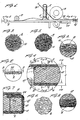
- the fibrous mat-faced gypsum support member can be made utilizing existing wallboard manufacturing lines, for example, as shown somewhat diagramatically in Figure 1.
- dry ingredients (not shown) from which the gypsum core is formed are pre-mixed and then fed to a mixer of the type commonly referred to as a pin mixer 2.
- Water and other liquid constituents (not shown) used in making the core are metered into the pin mixer 2 where they are combined with the dry ingredients to form an aqueous gypsum slurry.
- Foam is generally added to the slurry in the pin mixer to control the density of the resulting core.
- the slurry 4 is dispersed through one or more outlets at the bottom of the mixer 2 onto a moving sheet of fibrous mat 6.
- the sheet of fibrous mat 6 is indefinite in length and is fed from a roll (not shown) of the mat.
- FIG. 1 shows an edge of the set gypsum core 42 covered by the overlapped edge portion 6a of the mat 6.
- Figure 7 shows also score marks 10 and 10a of the mat 6, the score marks permitting the formation of good edges and flat surfaces.
- the score marks 10 and 10a are made by a conventional scoring wheel 12.
- Another sheet of fibrous mat 16 is fed from a roll (not shown) onto the top of the slurry 4, thereby sandwiching the slurry between the two moving fibrous mats which form the facings of the set gypsum core 42 which is formed from the slurry.
- the mats 6 and 16 with the slurry 4 sandwiched therebetween enter the nip between the upper and lower forming or shaping rolls 18 and 20, and are thereafter received on a conveyer belt 22.
- Conventional edge guiding devices, such as indicated at 24 shape and maintain the edges of the composite until the gypsum has set sufficiently to retain its shape. In due course, sequential lengths of the board are cut and further processed by exposure to heat which accelerates the drying of the board by increasing the rate of evaporation of excess water in the gypsum slurry.
- the preferred form of mats 6, and 16, as shown in Figures 2 and 3, comprises glass fiber filaments 30 oriented in random pattern and bound together with a resin binder (not shown).
- a preferred form of glass fiber mat-faced gypsum board 40 is shown in Figures 4 and 7, It comprises one in which the set gypsum of the core 42 penetrates substantially through the thickness of the mat 6 over substantial area portions thereof and in which the set gypsum of the core 42 penetrates the mat 16 partially, with the surface being thus substantially free of set gypsum.
- the gypsum-free surface of mat 16, as seen in Figure 8, is highly textured, and provides an excellent substrate for adhering thereto an overlying component inasmuch as it comprises many interstices into which an adhesive composition can flow and bond.
- substantially penetrated by set gypsum means that the set gypsum of the core, extends from the mat surface which is contiguous to the core to the outer mat surface and coats glass fibers on the outer surface with a thin film of set gypsum to the extent that the outline of glass fibers can be seen through the thin film of set gypsum.
- over substantial area portions of the outer surface means that about 30 to about 75% of the outer surface area of the mat is substantially penetrated by set gypsum. Preferably, about 45 to about 55% of the outer surface area of the mat is substantially penetrated by set gypsum.
- the gypsum-coated surface of this preferred embodiment of the board comprises a surface that has a roughened or patterned appearance; it does not comprise a smooth continuous coating of set gypsum.
- This preferred form of board can be formed with relatively small amounts of gypsum slurry being deposited on the underlying support surface, thus minimizing the need to clean the surface.
- this preferred form of board has two gypsum-free fiber-faced surfaces.
- the manufacture of the aforementioned preferred forms of board can be accomplished by controlling the viscosity of the aqueous slurry of the calcined gypsum in a manner such that the slurry penetrates the underlying and overlying mats to the desired degree.
- the viscosity of the slurry should be such that it penetrates about 10 to 50% of the thickness of the overlying mat over the entire surface area thereof.
- the recommended means for controlling the viscosity of the slurry is to add thereto a viscosity-control agent.
- a viscosity-control agent are known in the field of gypsum board manufacture.
- a preferred viscosity-control agent is paper fiber. Examples of other agents that can be used are cellulosic thickeners, bentonite clays and starches.
- the particular viscosity values that are used in the manufacturing operation can vary from one application to the next, depending on the porosity of the mat, and the desired penetration of the slurry. Accordingly, for any particular application, the viscosity value is best determined empirically.
- the viscosity value refers to Brookfield viscosity measured at a temperature of 21.1°C (70°F) at 10 rpm utilizing paddle No.3. It should be appreciated that the amount of viscosity-control agent added to the slurry to give the desired viscosity will vary depending on the particular agent used and the specific viscosity desired.
- the core of the fibrous mat-faced gypsum board has a density of 640 to 800 kg/m3 (40 to 50 lbs/cubic ft.), most preferably about 670 to 720 kg/m 3 (42 to 45 lbs/cubic ft).
- the manufacture of cores having densities within the preferred range can be effected by using knob techniques, for example, by introducing an appropriate amount of foam into the aqueous gypsum slurry from which the core is formed.
- the weight of a widely used paper facing in the manufacture of conventional gypsum sheathing is in the range of about 585 kg/1000 m 2 (120 lbs/1000 sq. ft) of board, whereas the weight of a preferred form of glass fiber mat for use in the present invention is about 195 kg/1000 m 2 (40 lbs/1000 sq. ft) of board.
- FIG. 12 and 13 there is shown therein an example of an exterior insulating system fabricated in accordance with the present invention and comprising the exterior portion of the building 81.
- the ElSystem 80 comprises panels of fibrous mat-faced board 82 affixed by nails 84 to wood framing 86.
- a reinforcing member comprising glass fiber skrim 92 is sandwiched between the polystyrene panel 88 and the final finishing material 94 by adhesive 96.
- the preferred forms of the gypsum board of the present invention can be used also to good advantage in place of conventional gypsum sheathing in applications other than ElSystems.
- the preferred forms of board can be used as an underlying support surface which is covered with overlying finishing materials, for example, aluminum, wood siding, plaster and Portland cement stucco.
- the formulation set forth below is an example of a preferred aqueous gypsum slurry which can be used in making the core of a gypsum support member in accordance with the present invention.
- wax/asphalt emulsion wax/asphalt emulsion 635 (130) aqueous solution of 10 wt% poly(vinyl alcohol) 274 (56) paper fiber 73.3
- water 1270 260
- the wax/asphalt emulsion used in the above formulation contained approximately 48 wt.% solids of which about 11 wt.% was paraffin wax and about 37 wt.% was asphalt.
- the above formulation was used to prepare gypsum board, the surfaces of which were covered with nonwoven-fiber glass mat.
- the mat was composed of glass fiber filaments oriented in a random pattern bonded together by an adhesive referred to by the manufacturer as a "modified urea-formaldehyde resin".
- the mat had a thickness of 0.084 cm (33 mils), was more porous than paper of the type used as the cover sheet of gypsum wallboard, and was not significantly weakened by water.
- the air permeability of the mat was) 213 m 3 /min/m 2 (700 CFM/sq. f) (test method FG 436-910).
- the mat is available commercially as DURA-GLASS 7502-2 Ibs. and is an example of a preferred fibrous mat for use in the practice of the present invention.
- Continuous length board was made from the above gypsum slurry and glass fiber mat on a conventional wallboard machine.
- the slurry was fed onto a moving sheet of the mat as it was unrolled from a roll onto a moving support surface.
- the mat had a width of about 129.5 cm (51 inches) and was scored continuously by conventional scoring blades prior to the deposition of the slurry thereon.
- Each edge of the mat was scored with two score marks, with each of the outer scores being about 2.54 cm (1 inch) from its respective edge of the mat and each of the inner scores being about 3.81 cm (1 1/2 inch) from its respective edge. After the slurry was deposited on the mat, the edges were folded at the score marks and overlapped on top of the slurry.
- the gypsum core formed from this operation had a width of 121.5 cm (47 7/8 inches) and a thickness of 1.27 cm (1/2 inch).
- Mat from another roll thereof and having a width of 120.6 cm (47 1/2 inches) was fed onto the top of the gypsum slurry and the overlapped edge portions of the underlying mat.
- the gypsum slurry penetrated the overlapped edge portions and served to bond the edge portions of the overlying mat to the overlapped edge portions of the underlying. mat.
- the viscosity of the gypsum slurry was about 5.9 Pas (5900 cp) at 21.1° C (70°F). At this viscosity, the slurry penetrated substantially through some portions of the underlying mat to form a thin film thereof on about 40 to 50% of the area of the outer surface of the mat. As the gypsum in the film set, substantial portions of the outer surface of the mat were covered with a thin film of set gypsum. The surface had a roughened appearance with outlines of the glass filaments being observable underneath the thin coatings of gypsum which covered them.
- the slurry penetrated but a portion (about 0.013 cm - 5 mils) of the thickness of the overlying mat over the entire area thereof, with no slurry being observed on the outer surface of the mat.
- the gypsum set in the intermediate portions of the mat that were penetrated by the slurry it formed a bond that included a mechanical interlock with the set gypsum core.
- the continuous length board is cut into lengths of about 243.8 cm (8 feet). Drying of the gypsum board is accelerated by heating in an oven at 177° C (350' F) for about 2 hours and until the board is almost dry and then at 93° C (200° F) for about 1 hour until it is dried completely.
- the density of the board is about 689 kg/m 3 (43 Ib. cu.ft).
- System B In the other system, hereafter "System B", the same steps as described above for System A were followed except that an acrylic adhesive was applied to the gypsum-free surface of the board and the polystyrene panel adhered thereto.
- glass fiber mat-faced gypsum board in accordance with the present invention and having a core which includes wax-asphalt emulsion as a water-resistant additive better resists deterioration than a like board having a core which includes sodium methyl siliconate as the water-resistant additive.
- Gypsum board comprising a set gypsum core faced with a fibrous mat, as described herein, and preferably gypsum board comprising a set gypsum core sandwiched between two sheets of porous glass mat, can be used to particular advantage also as a component of a shaft wall assembly or similar assembly in the interior of a building.
- the fibrous mat-faced board can be used to particular advantage in place of conventional paper-faced gypsum core board or shaft liner panels, the core of which generally includes fire-resistant additives.
- Assemblies of this type generally comprise metal framework of studs for support of the gypsum panels which form the walls of the shafts of elevators, stairwells and the like.
- Fibrous mat-faced board as described herein, can be used, for example, in the assemblies described in the aforementioned patents, and particularly as the shaft liner panel.
- the core of the board can include fire resistant additives.
- the present invention provides in a practical way important functional improvements in exterior finishing systems for buildings, including particularly exterior insulating systems, and in shaft wall assemblies.
Landscapes
- Engineering & Computer Science (AREA)
- Architecture (AREA)
- Structural Engineering (AREA)
- Civil Engineering (AREA)
- Chemical & Material Sciences (AREA)
- Ceramic Engineering (AREA)
- Mechanical Engineering (AREA)
- Manufacturing & Machinery (AREA)
- Building Environments (AREA)
- Laminated Bodies (AREA)
- Panels For Use In Building Construction (AREA)
- Finishing Walls (AREA)
Claims (17)
- Gipsplatte, die einen Kern aus abgebundenem Gips umfasst, der zwischen zwei Lagen aus einlagiger poröser Glasfasermatte eingeschlossen ist, die ausschließlich aus willkürlich verteilten Glasfäden bestehen, die durch einen Klebstoff gebunden sind, und die beide eine Innenfläche sowie eine Außenfläche und eine vorgegebene Dicke aufweisen, wobei die Innenfläche beider Matten dadurch direkt an dem Gipskern haftet, dass abgebundener Gips des Kerns in die Dicke der Matten eindringt, wobei die Viskosität der Suspension, aus der der Kern hergestellt wird, so gesteuert wird, dass die Außenfläche einer der Matten im Wesentlichen frei von abgebundenem Gips ist, wobei der abgebundene Gips des Kerns nur teilweise in die Dicke der Matte mit der gipsfreien Außenfläche eindringt.
- Gipsplatte nach Anspruch 1, dadurch gekennzeichnet, dass die Außenfläche beider Matten im Wesentlichen frei von abgebundenem Gips ist, wobei der abgebundene Gips nur teilweise in die Dicke beider Matten eindringt.
- Gipsplatte nach Anspruch 1, dadurch gekennzeichnet, dass die Außenfläche der anderen Matte teilweise mit abgebundenem Gips, der teilweise aus abgebundenem Gips des Kerns besteht, beschichtet ist.
- Gipsplatte nach Anspruch 3, dadurch gekennzeichnet, dass etwa 45 bis 55 % der Außenfläche der gipsbeschichteten anderen Matte im Wesentlichen mit abgebundenem Gips durchsetzt ist.
- Gipsplatte nach Anspruch 3 oder 4, dadurch gekennzeichnet, dass sie in Paketform vorliegt, in der zwei der Gipsplatten mit ihren gipsfreien Außenflächen aufeinanderliegend angeordnet sind, wobei ihre gipsbeschichteten Außenflächen die Außenflächen des Pakets bilden.
- Gipsplatte nach einem der Ansprüche 1 bis 5, dadurch gekennzeichnet, dass der Gipskern ein oder mehrere Hilfsmittel enthält, die eine Verbesserung der wasserbeständigen Eigenschaften der Platte bewirken, wobei das/die Hilfsmittel in einer mindestens ausreichenden Menge vorhanden ist/sind, um der Platte verbesserte wasserbeständige Eigenschaften zu verleihen.
- Gipsplatte nach Anspruch 6, dadurch gekennzeichnet, dass der Kem bei der Prüfung nach ASTM-Methode C-473, wobei nur die Kanten freiliegen, weniger als 5 % Wasser aufnimmt.
- Gipsplatte nach Anspruch 6 oder 7, dadurch gekennzeichnet, dass das/die Hilfsmittel aus Polyorganohydrogensiloxanen besteht/bestehen.
- Verfahren zum kontinuierlichen Herstellen beschichteter Gipsplatte unbestimmter Länge, das umfasst:(A) Herstellen einer wässrigen Suspension aus kalziniertem Gips;(B) kontinuierliches Aufbringen der wässrigen Suspension direkt auf eine darunterliegende, sich bewegende und aufliegende einlagige poröse Glasmatte, die ausschließlich aus willkürlich verteilten Glasfäden besteht, die durch einen Klebstoff gebunden sind,(C) Bringen der aufgebrachten Suspension in eine plattenartige Form, während sie von der sich bewegenden darunterliegenden Matte getragen wird;(D) direktes Auftragen einer darüberliegenden einlagigen Glasfasermatte, die ausschließlich aus willkürlich verteilten Glasfäden besteht, die durch einen Klebstoff gebunden sind, und eine vorgegebene Dicke hat, auf die Oberseite der plattenartige Form aus Suspension; und(E) Beibehalten der plattenartigen Form, während der kalzinierte Gips abbindet, um einen Kem aus abgebundenem Gips herzustellen, an dessen einer Fläche die darüberliegende Matte haftet; und(F) Steuern der Viskosität der Suspension auf einen Wert, aufgrund dessen die Suspension nur teilweise in die Dicke der darüberliegenden Matte eindringt, so dass beim Abbinden des kalzinierten Gipses die Außenfläche der darüberliegenden Matte im Wesentlichen frei von abgebundenem Gips ist.
- Verfahren nach Anspruch 9, wobei die untere Matte aus einer porösen Glasfasermatte mit einer Außenfläche und einer vorbestimmten Stärke besteht, dadurch gekennzeichnet, dass die Viskosität der Suspension auf einem solchen Wert gehalten wird, dass die Suspension nur teilweise in die Dicke der unteren Matte eindringt, so dass beim Abbinden des kalzinierten Gipses die Außenfläche der unteren Matte im Wesentlichen frei abgebundenem Gips ist.
- Verfahren nach Anspruch 9, wobei die untere Matte aus einer porösen Glasfasermatte mit einer Außenfläche und einer vorbestimmten Stärke besteht, dadurch gekennzeichnet, dass man die Viskosität der Suspension auf einem solchen Wert hält, dass die untere Matte im Wesentlichen über größere Bereiche ihrer Außenfläche von der Suspension durchdrungen wird.
- Verfahren nach einem der Ansprüche 9 bis 11, dadurch gekennzeichnet, dass die Viskosität jener Suspension bei 21°C etwa 5000 bis etwa 7000 mPas (cp bei 70°F) beträgt.
- Außenisolationssystem für Gebäude mit u.a. einer Trägerfläche, Isoliermaterial mit einer Innenfläche und einer Außenfläche, dessen Innenfläche mit der Trägerfläche mittels eines Klebstoffs verbunden ist, und einem auf der Außenfläche des Isoliermaterials liegenden Außenverkleidungsmaterial, dadurch gekennzeichnet, dass die Trägerfläche aus einer Gipsplatte nach einem der Ansprüche 1 bis 9 besteht und das Isoliermaterial im Wesentlichen frei von dieses durchdringenden, sich zwischen der Innen- und Außenfläche befindlichen Kanälen ist.
- Außenisolationssystem nach Anspruch 13, dadurch gekennzeichnet, dass die Trägerfläche aus einer Mehrzahl von Gipsplatten in der Form aneinanderstoßender Platten besteht, wobei die aneinanderstoßenden Platten des Isoliermaterials an den gipsfreien Außenflächen der Gipsplatten haften und dass auf den Platten des Isoliermaterials liegende Verkleidungsmaterial witterungsbeständige und ästhetische Kennzeichen aufweist.
- Außenisolationssystem nach Anspruch 13 oder 14, dadurch gekennzeichnet, dass ein Verstärkungselement zwischen dem Isoliermaterial und dem Verkleidungsmaterial eingelagert ist.
- Außenverkleidungssystem für Gebäude bestehend aus einem unteren tragenden Bauelement, das mit einem oberen Verkleidungsmaterial bedeckt ist, dadurch gekennzeichnet, dass das tragende Element u.a. Gipsplatten nach einem der Ansprüche 6 bis 8 enthält.
- Verfahren zum Einbau eines Außenisolationssystems in einem Gebäude, wobei man an diesem eine Gipsplatte befestigt, ein Isoliermaterial mit einer Innenfläche und einer Außenfläche an der Gipsplatte mit einem Klebstoff befestigt und ein Außenverkleidungsmaterial an der Außenfläche des Isoliermaterials befestigt, dadurch gekennzeichnet, dass die Gipsplatte eine Gipsplatte nach einem der Ansprüche 1 bis 8 darstellt und so befestigt ist, dass ihre im Wesentlichen gipsfreie Außenfläche vom Gebäude weg zeigt, die Innenfläche des Isoliermaterials an der gipsfreien Außenfläche der Gipsplatte haftet, das Isoliermaterial im Wesentlichen frei von dieses durchdringenden, sich zwischen der Innen- und gipsfreien Außenfläche des Isoliermaterials befindlichen Kanälen ist.
Priority Applications (1)
| Application Number | Priority Date | Filing Date | Title |
|---|---|---|---|
| AT84309124T ATE62959T1 (de) | 1984-02-27 | 1984-12-28 | Fasermattenbedeckte gipsplatte und ihre verwendung in aussenisolation, in aussenbekleidungssystemen von gebaeuden und in schachtwandbau. |
Applications Claiming Priority (2)
| Application Number | Priority Date | Filing Date | Title |
|---|---|---|---|
| US06/583,874 US4647496A (en) | 1984-02-27 | 1984-02-27 | Use of fibrous mat-faced gypsum board in exterior finishing systems for buildings |
| US583874 | 1984-02-27 |
Publications (4)
| Publication Number | Publication Date |
|---|---|
| EP0154094A2 EP0154094A2 (de) | 1985-09-11 |
| EP0154094A3 EP0154094A3 (en) | 1987-07-01 |
| EP0154094B1 EP0154094B1 (de) | 1991-04-24 |
| EP0154094B2 true EP0154094B2 (de) | 2001-07-18 |
Family
ID=24334943
Family Applications (1)
| Application Number | Title | Priority Date | Filing Date |
|---|---|---|---|
| EP84309124A Expired - Lifetime EP0154094B2 (de) | 1984-02-27 | 1984-12-28 | Fasermattenbedeckte Gipsplatte und ihre Verwendung in Aussenisolation, in Aussenbekleidungssystemen von Gebäuden und in Schachtwandbau |
Country Status (7)
| Country | Link |
|---|---|
| US (1) | US4647496A (de) |
| EP (1) | EP0154094B2 (de) |
| JP (2) | JPH07914B2 (de) |
| AT (1) | ATE62959T1 (de) |
| CA (2) | CA1250727A (de) |
| DE (1) | DE3484508D1 (de) |
| MX (2) | MX170893B (de) |
Cited By (2)
| Publication number | Priority date | Publication date | Assignee | Title |
|---|---|---|---|---|
| US7049251B2 (en) | 2003-01-21 | 2006-05-23 | Saint-Gobain Technical Fabrics Canada Ltd | Facing material with controlled porosity for construction boards |
| US7846278B2 (en) | 2000-01-05 | 2010-12-07 | Saint-Gobain Technical Fabrics America, Inc. | Methods of making smooth reinforced cementitious boards |
Families Citing this family (142)
| Publication number | Priority date | Publication date | Assignee | Title |
|---|---|---|---|---|
| US5220762A (en) * | 1984-02-27 | 1993-06-22 | Georgia-Pacific Corporation | Fibrous mat-faced gypsum board in exterior and interior finishing systems for buildings |
| US5644880A (en) * | 1984-02-27 | 1997-07-08 | Georgia-Pacific Corporation | Gypsum board and systems containing same |
| US4783942A (en) * | 1985-10-18 | 1988-11-15 | Loadmaster Systems, Inc. | Composite roof deck assembly with polymeric membrane adhered to fiberglass mat |
| US4916004A (en) * | 1986-02-20 | 1990-04-10 | United States Gypsum Company | Cement board having reinforced edges |
| CA1290587C (en) * | 1986-02-20 | 1991-10-15 | Robert P. Ensminger | Cement board having reinforced edges |
| GB8612314D0 (en) * | 1986-05-21 | 1986-06-25 | Brown G P W | Fibre reinforced articles |
| JPS6344066A (ja) * | 1986-08-07 | 1988-02-25 | 株式会社 ラザ− | 合成樹脂製の塗り材料のための下地材 |
| US4811538A (en) * | 1987-10-20 | 1989-03-14 | Georgia-Pacific Corporation | Fire-resistant door |
| CA1341084C (en) * | 1987-11-16 | 2000-08-15 | George W. Green | Coated fibrous mat-faced gypsum board resistant to water and humidity |
| US4879173A (en) * | 1988-01-06 | 1989-11-07 | Georgia-Pacific Corporation | Glass mat with reinforcing binder |
| GB2219814B (en) * | 1988-06-15 | 1992-08-19 | Steel Shield Limited | Improvements in,or relating to panels |
| GB8825747D0 (en) * | 1988-11-03 | 1988-12-07 | Bpb Industries Plc | Cementitious board |
| US5155959A (en) | 1989-10-12 | 1992-10-20 | Georgia-Pacific Corporation | Firedoor constructions including gypsum building product |
| US5632848A (en) * | 1989-10-12 | 1997-05-27 | Georgia-Pacific Corporation | Continuous processing equipment for making fiberboard |
| US5079078A (en) * | 1990-01-29 | 1992-01-07 | Owens-Corning Fiberglas Corp. | Fire-resistant panel system |
| US5030502A (en) * | 1990-02-02 | 1991-07-09 | Teare John W | Cementitious construction panel |
| US5763043A (en) * | 1990-07-05 | 1998-06-09 | Bay Mills Limited | Open grid fabric for reinforcing wall systems, wall segment product and methods of making same |
| WO1992013645A1 (en) * | 1991-02-01 | 1992-08-20 | Glascrete, Inc. | Method and apparatus for production of reinforced cementitious panels |
| US5350554A (en) * | 1991-02-01 | 1994-09-27 | Glascrete, Inc. | Method for production of reinforced cementitious panels |
| US5308692A (en) * | 1992-06-26 | 1994-05-03 | Herbert Malarkey Roofing Company | Fire resistant mat |
| ATE199852T1 (de) * | 1992-08-06 | 2001-04-15 | Georgia Pacific Corp | Ausrüstung zum kontinuierlichen herstellen von faserplatten |
| US5543188A (en) * | 1992-08-25 | 1996-08-06 | Te'eni; Moshe | Flexible protective membrane particularly useful for waterproofing and protecting reinforced concrete bodies and metal pipes |
| CA2130508C (en) * | 1993-08-20 | 2005-04-12 | Peter Douglas Chase | Process for making thin, sealant-coated, fiber-reinforced gypsum panel and panel made thereby |
| US5584153A (en) * | 1994-03-29 | 1996-12-17 | Loadmaster Systems, Inc. | Composite roof system with an improved anchoring mechanism |
| US5945182A (en) * | 1995-02-14 | 1999-08-31 | G-P Gypsum Corporation | Fire-resistant members containing gypsum fiberboard |
| CA2157337C (en) * | 1995-06-07 | 2006-01-31 | Debbie O'haver-Smith | Improved fibrous mat and mat-faced gypsum board |
| US6001496A (en) * | 1995-08-18 | 1999-12-14 | G-P Gypsum Corporation | Mat-faced gypsum board and method of manufacturing same |
| DE19650432A1 (de) * | 1996-12-05 | 1998-06-10 | Wolfgang Weiser | Verfahren und Vorrichtung zum Herstellen eines Flächenproduktes mit einer faserverstärkten Beton-Matrix |
| US5772846A (en) * | 1997-01-09 | 1998-06-30 | Johns Manville International, Inc. | Nonwoven glass fiber mat for facing gypsum board and method of making |
| US6054205A (en) | 1997-05-29 | 2000-04-25 | Clark-Schwebel Tech-Fab Company | Glass fiber facing sheet and method of making same |
| EP1457467A1 (de) * | 1997-06-27 | 2004-09-15 | Elk Premium Building Products, Inc. | Beschichtete strukturierte Gegenstände |
| CA2211984C (en) | 1997-09-12 | 2002-11-05 | Marc-Andre Mathieu | Cementitious panel with reinforced edges |
| US6410118B1 (en) * | 1997-11-14 | 2002-06-25 | Usg Interiors, Inc. | Water durable board for exterior wall assembly water management system |
| EP0962605B1 (de) | 1998-06-01 | 2004-08-18 | Clark-Schwebel Tech-Fab Company | Glasfaserdeckschicht |
| US6508895B2 (en) | 1998-09-09 | 2003-01-21 | United States Gypsum Co | Method of producing gypsum/fiber board |
| US6368024B2 (en) | 1998-09-29 | 2002-04-09 | Certainteed Corporation | Geotextile fabric |
| CA2249823A1 (en) * | 1998-10-08 | 2000-04-08 | Meho Karalic | Building components and methods of making same |
| US6187697B1 (en) * | 1998-12-31 | 2001-02-13 | Alan Michael Jaffee | Multiple layer nonwoven mat and laminate |
| US6872440B1 (en) | 1999-11-30 | 2005-03-29 | Elk Premium Building Products, Inc. | Heat reflective coated structural article |
| US6673432B2 (en) | 1999-11-30 | 2004-01-06 | Elk Premium Building Products, Inc. | Water vapor barrier structural article |
| US6586353B1 (en) | 1999-11-30 | 2003-07-01 | Elk Corp. Of Dallas | Roofing underlayment |
| US6708456B2 (en) * | 1999-11-30 | 2004-03-23 | Elk Premium Building Products, Inc. | Roofing composite |
| US6500560B1 (en) | 1999-11-30 | 2002-12-31 | Elk Corporation Of Dallas | Asphalt coated structural article |
| GR1003563B (el) * | 2000-06-01 | 2001-03-22 | Caretta Interiors �.�. | Συστημα πυρανθεκτικων και ηχομονωτικων πετασματων για επενδυση εσωτερικων χωρων πλοιων |
| FR2812012B1 (fr) * | 2000-07-18 | 2003-06-13 | Lafarge Platres | Plaque de platre a resistance au feu amelioree et sa reparation |
| KR100887460B1 (ko) * | 2000-10-10 | 2009-03-10 | 제임스 하디 인터내셔널 파이낸스 비.브이. | 복합 건축 재료 |
| US20030194584A1 (en) * | 2000-12-05 | 2003-10-16 | Arne Clausen | Mould resistant decorative panel |
| US20020071954A1 (en) * | 2000-12-08 | 2002-06-13 | Nelson Christopher R. | Cellulose gypsum based substrate with increased water resistance and strength by surface application of polymeric diphenylmethane diisocyanate |
| US6748826B2 (en) * | 2001-02-22 | 2004-06-15 | Work Tools, Inc. | Slide switch adjustable wrench |
| US7399718B2 (en) * | 2001-02-26 | 2008-07-15 | Fraunhofer-Gesellschaft Zur Foerderung Der Angewandten Forschung E.V. | Water-repellent and vapor-permeable multilayer material for outdoor applications |
| DE10109264B4 (de) * | 2001-02-26 | 2005-06-23 | Fraunhofer-Gesellschaft zur Förderung der angewandten Forschung e.V. | Wasserabweisender und dampfdurchlässiger Mehrschicht-Werkstoff für Außenanwendungen |
| US6770354B2 (en) | 2001-04-19 | 2004-08-03 | G-P Gypsum Corporation | Mat-faced gypsum board |
| US7435369B2 (en) * | 2001-06-06 | 2008-10-14 | Bpb Plc | Method for targeted delivery of additives to varying layers in gypsum panels |
| US20090087616A1 (en) * | 2001-06-06 | 2009-04-02 | Hennis Mark E | Coatings for glass reinforced faced gypsum board |
| US20050159057A1 (en) * | 2001-06-06 | 2005-07-21 | Bpb Plc | Exterior sheathing weather barrier construction and method of manufacture |
| US6524679B2 (en) | 2001-06-06 | 2003-02-25 | Bpb, Plc | Glass reinforced gypsum board |
| AU2002364965A1 (en) * | 2001-12-20 | 2003-07-09 | Atlas Roofing Corporation | Method and composition for coating mat and articles produced therewith |
| US7645490B2 (en) * | 2001-12-20 | 2010-01-12 | Atlas Roofing Corporation | Method and composition for coating mat and articles produced therewith |
| US6737156B2 (en) * | 2002-05-08 | 2004-05-18 | Gp Gypsum Corp. | Interior wallboard and method of making same |
| US6746781B2 (en) * | 2002-08-21 | 2004-06-08 | G-P Gypsum Corporation | Gypsum board having polyvinyl alcohol binder in interface layer and method for making the same |
| US20040048110A1 (en) * | 2002-09-09 | 2004-03-11 | Steven Butler | Wallboard comprising an improved multi-layer facing material and a method for making the same |
| US7028436B2 (en) * | 2002-11-05 | 2006-04-18 | Certainteed Corporation | Cementitious exterior sheathing product with rigid support member |
| US7155866B2 (en) | 2002-11-05 | 2007-01-02 | Certainteed Corporation | Cementitious exterior sheathing product having improved interlaminar bond strength |
| EP1599294A4 (de) * | 2002-12-13 | 2010-03-03 | Georgia Pacific Gypsum Llc | Gipstafel mit uv-ausgehärtetem feuchtigkeitsbeständigen mantel und herstellungsverfahren davon |
| US6995098B2 (en) * | 2003-04-15 | 2006-02-07 | National Gypsum Properties, Llc | Wallboard containing scrim and matt |
| US20040209074A1 (en) * | 2003-04-17 | 2004-10-21 | Georgia-Pacific Gypsum Corporation | Mat faced gypsum board |
| US20040219845A1 (en) * | 2003-04-29 | 2004-11-04 | Graham Samuel E. | Fabric reinforced cement |
| US20040224584A1 (en) * | 2003-05-08 | 2004-11-11 | Techfab, Llc - Anderson, Sc | Facing sheet of open mesh scrim and polymer film for cement boards |
| US20040266303A1 (en) * | 2003-06-27 | 2004-12-30 | Jaffee Alan Michael | Gypsum board faced with non-woven glass fiber mat |
| US7842629B2 (en) | 2003-06-27 | 2010-11-30 | Johns Manville | Non-woven glass fiber mat faced gypsum board and process of manufacture |
| CA2484792C (en) * | 2003-10-15 | 2009-12-08 | Progressive Foam Technologies, Inc. | Drainage plane for exterior wall product |
| US7989370B2 (en) | 2003-10-17 | 2011-08-02 | Georgia-Pacific Gypsum Llc | Interior wallboard and method of making same |
| US8225567B1 (en) | 2003-10-17 | 2012-07-24 | Exterior Portfolio, Llc | Siding having backer with features for drainage, ventilation, and receiving adhesive |
| US20050108965A1 (en) * | 2003-11-26 | 2005-05-26 | Morse Rick J. | Clapboard siding panel with built in fastener support |
| US7932193B2 (en) * | 2004-02-17 | 2011-04-26 | Johns Manville | Coated mat products, laminates and method |
| US7745357B2 (en) * | 2004-03-12 | 2010-06-29 | Georgia-Pacific Gypsum Llc | Use of pre-coated mat for preparing gypsum board |
| US7744994B2 (en) * | 2004-03-30 | 2010-06-29 | Coveright Surfaces Holding Gmbh | Coating composition, coated article and a method to manufacture the same |
| US20050247021A1 (en) * | 2004-04-19 | 2005-11-10 | Schauffele Roy F | Mold resistant exterior wall assembly |
| US7762040B2 (en) | 2004-08-12 | 2010-07-27 | Progressive Foam Technologies, Inc. | Insulated fiber cement siding |
| US8910443B2 (en) | 2004-08-12 | 2014-12-16 | Progressive Foam Technologies, Inc. | Foam backer for insulation |
| US8857123B2 (en) | 2004-08-12 | 2014-10-14 | Progressive Foam Technologies, Inc. | Foam insulation board |
| US8844233B2 (en) | 2004-08-12 | 2014-09-30 | Progressive Foam Technologies, Inc. | Foam insulation board with edge sealer |
| US7892472B2 (en) * | 2004-08-12 | 2011-02-22 | United States Gypsum Company | Method of making water-resistant gypsum-based article |
| US8910444B2 (en) | 2004-08-12 | 2014-12-16 | Progressive Foam Technologies, Inc. | Foam insulation backer board |
| US7700505B2 (en) * | 2004-09-01 | 2010-04-20 | Lafarge Platres | Gypsum board and systems comprising it |
| US20060068188A1 (en) * | 2004-09-30 | 2006-03-30 | Morse Rick J | Foam backed fiber cement |
| US7846536B2 (en) * | 2004-12-16 | 2010-12-07 | United States Gypsum Company | Building panels with aesthetic edges |
| US8006455B1 (en) | 2004-12-29 | 2011-08-30 | Exterior Portfolio, Llc | Backed panel and system for connecting backed panels |
| US7849648B2 (en) * | 2004-12-30 | 2010-12-14 | United States Gypsum Company | Non-combustible reinforced cementitious lightweight panels and metal frame system for flooring |
| US7849649B2 (en) * | 2005-01-27 | 2010-12-14 | United States Gypsum Company | Non-combustible reinforced cementitious lightweight panels and metal frame system for shear walls |
| US7841148B2 (en) * | 2005-01-27 | 2010-11-30 | United States Gypsum Company | Non-combustible reinforced cementitious lightweight panels and metal frame system for roofing |
| US7849650B2 (en) * | 2005-01-27 | 2010-12-14 | United States Gypsum Company | Non-combustible reinforced cementitious lightweight panels and metal frame system for a fire wall and other fire resistive assemblies |
| US7635657B2 (en) * | 2005-04-25 | 2009-12-22 | Georgia-Pacific Gypsum Llc | Interior wallboard and method of making same |
| US8034416B2 (en) | 2005-05-26 | 2011-10-11 | Georgia-Pacific Chemicals Llc | Method for making mold-and moisture-resistant gypsum boards |
| US8051611B2 (en) | 2005-06-24 | 2011-11-08 | Dryvit Systems, Inc. | Exterior insulation and finish system and method and tool for installing same |
| US20070012414A1 (en) * | 2005-07-12 | 2007-01-18 | Kajander Richard E | Multilayer nonwoven fibrous mats with good hiding properties, laminates and method |
| US7803226B2 (en) | 2005-07-29 | 2010-09-28 | United States Gypsum Company | Siloxane polymerization in wallboard |
| US7473440B2 (en) * | 2005-10-20 | 2009-01-06 | Johns Manville | Method of treating a coated fibrous mat |
| US20070141304A1 (en) * | 2005-12-21 | 2007-06-21 | Gaurav Agrawal | Perforated board formed from cementitious material and process and system for producing same |
| US20070175154A1 (en) * | 2005-12-21 | 2007-08-02 | Progressive Foam Technologies, Inc. | Exterior wall panel with enhanced interior facing surface |
| US20070141931A1 (en) * | 2005-12-21 | 2007-06-21 | Malay Nandi | Faced board material having a smooth aesthetically pleasing outer surface and good adhesion of facer to core |
| US20070148430A1 (en) * | 2005-12-22 | 2007-06-28 | Gaurav Agrawal | Perforated, coated nonwoven mat |
| US20070149083A1 (en) * | 2005-12-22 | 2007-06-28 | Gaurav Agrawal | Board formed from a cementitious material and a facer containing a laminate |
| US20070149078A1 (en) * | 2005-12-22 | 2007-06-28 | Malay Nandi | Perforated non-woven fiberglass mat |
| US7845130B2 (en) * | 2005-12-29 | 2010-12-07 | United States Gypsum Company | Reinforced cementitious shear panels |
| US7908814B2 (en) * | 2005-12-30 | 2011-03-22 | Progressive Foam Technologies, Inc. | Composite siding using a shape molded foam backing member |
| US20070175173A1 (en) * | 2005-12-30 | 2007-08-02 | Babineau Francis J Jr | Board construction assembly for reducing sound transmission and method |
| US8993462B2 (en) * | 2006-04-12 | 2015-03-31 | James Hardie Technology Limited | Surface sealed reinforced building element |
| US7870698B2 (en) * | 2006-06-27 | 2011-01-18 | United States Gypsum Company | Non-combustible reinforced cementitious lightweight panels and metal frame system for building foundations |
| US7897079B2 (en) | 2006-09-21 | 2011-03-01 | United States Gypsum Company | Method and apparatus for scrim embedment into wet processed panels |
| CN101924598B (zh) | 2006-09-30 | 2012-11-21 | 华为技术有限公司 | 通信系统中序列分配方法、序列处理方法及装置 |
| US8070895B2 (en) | 2007-02-12 | 2011-12-06 | United States Gypsum Company | Water resistant cementitious article and method for preparing same |
| US20090029141A1 (en) * | 2007-07-23 | 2009-01-29 | United States Gypsum Company | Mat-faced gypsum board and method of making thereof |
| WO2009038786A1 (en) * | 2007-09-21 | 2009-03-26 | Scuderi Group, Llc | Composite wall system |
| US7829488B2 (en) | 2008-01-22 | 2010-11-09 | Johns Manville | Non-woven glass fiber mat faced gypsum board and process of manufacture |
| US20090208714A1 (en) * | 2008-02-18 | 2009-08-20 | Georgia-Pacific Gypsum Llc | Pre-coated non-woven mat-faced gypsum panel |
| RU2375172C1 (ru) * | 2008-07-15 | 2009-12-10 | Юлия Алексеевна Щепочкина | Способ изготовления гипсовых изделий |
| RU2375327C1 (ru) * | 2008-07-15 | 2009-12-10 | Юлия Алексеевна Щепочкина | Сырьевая смесь для изготовления гипсовых изделий |
| US8111813B2 (en) * | 2008-09-30 | 2012-02-07 | Avaya Inc. | Unified greeting service for telecommunications events |
| US7803723B2 (en) | 2008-12-16 | 2010-09-28 | Saint-Gobain Technical Fabrics America, Inc. | Polyolefin coated fabric reinforcement and cementitious boards reinforced with same |
| US8329308B2 (en) * | 2009-03-31 | 2012-12-11 | United States Gypsum Company | Cementitious article and method for preparing the same |
| DE102009038773B4 (de) | 2009-08-27 | 2022-04-07 | Veit Dennert Kg Baustoffbetriebe | Innendämmpaneel mit einem hydrophilen, porösen Grundkörper |
| US20110086214A1 (en) * | 2009-10-09 | 2011-04-14 | Rockwell Anthony L | Building products constructed from thermoplastic polymer mat impregnated wtih cementitious material |
| WO2011159379A1 (en) * | 2010-06-18 | 2011-12-22 | Georgia-Pacific Gypsum Llc | Building material containing latent heat storage material and methods of making the same |
| US8795813B2 (en) | 2011-02-22 | 2014-08-05 | Exterior Portfolio, Llc | Ribbed backed panels |
| US10259196B2 (en) | 2011-03-10 | 2019-04-16 | Georgia-Pacific Gypsum Llc | Lightweight gypsum wallboard |
| US8968466B2 (en) | 2011-08-22 | 2015-03-03 | Momentive Specialty Chemicals Inc. | Sizing and rheology agents for gypsum stucco systems for water resistant panel production |
| US8932401B2 (en) | 2011-08-22 | 2015-01-13 | Momentive Specialty Chemicals Inc. | Sizing and rheology agents for gypsum stucco systems for water resistant panel production |
| EP2623310A1 (de) | 2012-02-03 | 2013-08-07 | Ahlstrom Corporation | Für nasse und feuchte Bereiche geeignete Gipsplatte |
| CN102635212A (zh) * | 2012-04-11 | 2012-08-15 | 张家港市玉龙科技板材有限公司 | 纸面增强石膏板 |
| US10336036B2 (en) | 2013-03-15 | 2019-07-02 | United States Gypsum Company | Cementitious article comprising hydrophobic finish |
| CA2946652C (en) * | 2014-04-24 | 2021-12-07 | Ardex Anlagen Gmbh | Decoupling mat for a surface covering structure that can be covered by covering elements |
| US10272641B2 (en) | 2014-06-17 | 2019-04-30 | United States Gypsum Company | Gypsum products with fortified glass fiber mat |
| WO2016055128A1 (en) | 2014-10-06 | 2016-04-14 | Siniat International | Improved mat and related gypsum boards suitable for wet or humid areas |
| GB201417905D0 (en) * | 2014-10-09 | 2014-11-26 | Bpb United Kingdom Ltd | Improved acoustic performance of timber frame partitions |
| US20210207378A1 (en) * | 2018-05-31 | 2021-07-08 | Georgia-Pacific Gypsum Llc | Self-adhering construction panels, assemblies, and methods |
| MX2021014667A (es) * | 2019-06-07 | 2022-01-11 | Georgia Pacific Gypsum Llc | Paneles de edificacion, ensamblajes y metodos asociados. |
| US20200399889A1 (en) * | 2019-06-18 | 2020-12-24 | United States Gypsum Company | Shipping container noncombustible building fire design |
| CN113356484A (zh) * | 2021-06-08 | 2021-09-07 | 上海宏诺建筑科技有限公司 | 紧密型屋面系统的传力构件 |
| WO2023014771A1 (en) | 2021-08-06 | 2023-02-09 | Owens Corning Intellectual Capital, Llc | Coated reinforced composite facer and insulation assembly including the same |
| US12479767B2 (en) | 2021-09-29 | 2025-11-25 | Owens Corning Intellectual Capital, Llc | Gypsum cement with reduced permeability |
| WO2023055347A1 (en) * | 2021-09-29 | 2023-04-06 | Owens Corning Intellectual Capital, Llc | Gypsum cement with reduced permeability |
Family Cites Families (27)
| Publication number | Priority date | Publication date | Assignee | Title |
|---|---|---|---|---|
| DE7806114U1 (de) * | 1979-04-12 | Rigips Baustoffwerke Gmbh & Co Kg, 3452 Bodenwerder | Bauplatte aus Gips mit einer Ummantelung aus Glasfasern | |
| GB772581A (en) * | 1954-06-23 | 1957-04-17 | Saint Gobain | Reinforced plaster panels and process for their manufacture |
| DE1033123B (de) * | 1954-06-23 | 1958-06-26 | Saint Gobain | Gipsplatte sowie Verfahren und Vorrichtung zu deren Herstellung |
| US3185297A (en) * | 1961-04-21 | 1965-05-25 | William W Rutledge | Building wall material |
| US3993822A (en) * | 1970-02-25 | 1976-11-23 | Gebr. Knauf Westdeutsche Gipswerke | Multi-layer plasterboard |
| DE2008744A1 (de) * | 1970-02-25 | 1971-09-23 | Gebr Knauf, Westdeutsche Gips werke, 8715 Iphofen | Verfahren zur Herstellung emer glas faservhesummantelten Gipsbauplatte |
| US3947398A (en) * | 1971-05-13 | 1976-03-30 | John Williams | Surfacing composition containing aqueous resin emulsion and calcium sulfate hemihydrate plaster |
| CA993779A (en) * | 1971-08-17 | 1976-07-27 | Nicholas F. Morrone | Inorganic felt covered gypsum board |
| JPS49116446U (de) * | 1973-02-05 | 1974-10-04 | ||
| US3935021A (en) * | 1973-11-05 | 1976-01-27 | Georgia-Pacific Corporation | Water-resistant gypsum products |
| US4195110A (en) * | 1973-11-12 | 1980-03-25 | United States Gypsum Company | Glass-reinforced composite gypsum board |
| US3944698A (en) * | 1973-11-14 | 1976-03-16 | United States Gypsum Company | Gypsum wallboard and process for making same |
| CA1080870A (en) * | 1976-03-24 | 1980-07-01 | William J. Long | Water-resistant gypsum composition and products and process of making same |
| JPS5321244A (en) * | 1976-08-10 | 1978-02-27 | Kuraray Co Ltd | Construction sheet material having tenacity |
| DE2755879A1 (de) * | 1977-12-15 | 1979-06-21 | Rigips Baustoffwerke Gmbh | Verfahren und vorrichtung zur herstellung einer bauplatte unter verwendung von gips |
| US4265979A (en) * | 1978-06-05 | 1981-05-05 | United States Gypsum Company | Method for the production of glass fiber-reinforced gypsum sheets and gypsum board formed therefrom |
| JPS5516024U (de) * | 1978-07-15 | 1980-02-01 | ||
| IE49483B1 (en) * | 1979-05-30 | 1985-10-16 | Bpb Industries Ltd | Production of building board |
| JPS622103Y2 (de) * | 1979-07-19 | 1987-01-19 | ||
| US4278468A (en) * | 1979-09-10 | 1981-07-14 | United States Gypsum Company | Gypsum fire barrier for cable fires |
| DE2946129A1 (de) * | 1979-11-15 | 1981-05-21 | Rigips Baustoffwerke Gmbh & Co Kg, 3452 Bodenwerder | Bauplatte |
| DE3012293C2 (de) * | 1980-03-29 | 1982-11-11 | Gebr. Knauf Westdeutsche Gipswerke, 8715 Iphofen | Beschichtete Gipsbauplatte |
| EP0048582A1 (de) * | 1980-09-20 | 1982-03-31 | Torvale Holdings Limited | Zusammengesetzte Bauplatte, Verfahren und Vorrichtung zu ihrer Herstellung |
| JPS5796151A (en) * | 1980-12-03 | 1982-06-15 | Mitsubishi Chem Ind | Fireproof heat insulated outer wall |
| GB2119703B (en) * | 1982-04-30 | 1985-10-23 | Bpb Industries Plc | Cementitious board manufacture |
| DE3238093A1 (de) * | 1982-10-14 | 1984-04-19 | Porelith Baustoffwerk GmbH & Co KG, 3050 Wunstorf | Mehrschichtige bauplatte |
| FR2547533B1 (fr) * | 1983-06-17 | 1986-03-21 | Montana Jacqueline | Element prefabrique a base de platre notamment pour le batiment et son procede de fabrication |
-
1984
- 1984-02-27 US US06/583,874 patent/US4647496A/en not_active Expired - Lifetime
- 1984-12-28 EP EP84309124A patent/EP0154094B2/de not_active Expired - Lifetime
- 1984-12-28 DE DE8484309124T patent/DE3484508D1/de not_active Expired - Lifetime
- 1984-12-28 AT AT84309124T patent/ATE62959T1/de not_active IP Right Cessation
-
1985
- 1985-02-06 CA CA000473643A patent/CA1250727A/en not_active Expired
- 1985-02-25 JP JP60034687A patent/JPH07914B2/ja not_active Expired - Lifetime
- 1985-02-27 MX MX025631A patent/MX170893B/es unknown
- 1985-02-27 MX MX204450A patent/MX164255B/es unknown
-
1989
- 1989-01-24 CA CA000589064A patent/CA1293606C/en not_active Expired - Lifetime
-
1996
- 1996-02-16 JP JP8053958A patent/JP2875202B2/ja not_active Expired - Lifetime
Cited By (4)
| Publication number | Priority date | Publication date | Assignee | Title |
|---|---|---|---|---|
| US7846278B2 (en) | 2000-01-05 | 2010-12-07 | Saint-Gobain Technical Fabrics America, Inc. | Methods of making smooth reinforced cementitious boards |
| US9017495B2 (en) | 2000-01-05 | 2015-04-28 | Saint-Gobain Adfors Canada, Ltd. | Methods of making smooth reinforced cementitious boards |
| US7049251B2 (en) | 2003-01-21 | 2006-05-23 | Saint-Gobain Technical Fabrics Canada Ltd | Facing material with controlled porosity for construction boards |
| US7300892B2 (en) | 2003-01-21 | 2007-11-27 | Saint-Gobain Technical Fabrics Canada, Ltd. | Facing material with controlled porosity for construction boards |
Also Published As
| Publication number | Publication date |
|---|---|
| MX164255B (es) | 1992-07-27 |
| CA1250727A (en) | 1989-03-07 |
| JPH08232442A (ja) | 1996-09-10 |
| JPS60226933A (ja) | 1985-11-12 |
| MX170893B (es) | 1993-09-21 |
| EP0154094B1 (de) | 1991-04-24 |
| EP0154094A2 (de) | 1985-09-11 |
| JPH07914B2 (ja) | 1995-01-11 |
| CA1293606C (en) | 1991-12-31 |
| EP0154094A3 (en) | 1987-07-01 |
| US4647496A (en) | 1987-03-03 |
| DE3484508D1 (de) | 1991-05-29 |
| ATE62959T1 (de) | 1991-05-15 |
| JP2875202B2 (ja) | 1999-03-31 |
Similar Documents
| Publication | Publication Date | Title |
|---|---|---|
| EP0154094B1 (de) | Fasermattenbedeckte Gipsplatte und ihre Verwendung in Aussenisolation, in Aussenbekleidungssystemen von Gebäuden und in Schachtwandbau | |
| US5371989A (en) | Use of fibrous mat-faced gypsum board in exterior finishing systems for buildings and shaft wall assemblies | |
| US5148645A (en) | Use of fibrous mat-faced gypsum board in shaft wall assemblies and improved fire resistant board | |
| US5791109A (en) | Gypsum board and finishing system containing same | |
| US5220762A (en) | Fibrous mat-faced gypsum board in exterior and interior finishing systems for buildings | |
| CA2377518C (en) | Improved mat-faced gypsum board | |
| US6737156B2 (en) | Interior wallboard and method of making same | |
| CA2495551C (en) | Gypsum board having polyvinyl alcohol binder in interface layer and method for making the same | |
| US5552187A (en) | Coated fibrous mat-faced gypsum board | |
| US7700505B2 (en) | Gypsum board and systems comprising it | |
| JP2523523B2 (ja) | 繊維のマツトの面を有する石膏板 | |
| CA1309831C (en) | Fibrous mat-faced gypsum board | |
| WO2015039064A1 (en) | Lightweight cementitious panel possessing high durability | |
| CA1326625C (en) | Use of fibrous mat-faced gypsum board in shaft wall assemblies and improved fire-resistant board | |
| HK1050230A (en) | Improved mat-faced gypsum board | |
| HK1089414B (en) | Gypsum board having polyvinyl alcohol binder in interface layer and method for making the same |
Legal Events
| Date | Code | Title | Description |
|---|---|---|---|
| PUAI | Public reference made under article 153(3) epc to a published international application that has entered the european phase |
Free format text: ORIGINAL CODE: 0009012 |
|
| AK | Designated contracting states |
Designated state(s): AT CH DE FR GB LI |
|
| PUAL | Search report despatched |
Free format text: ORIGINAL CODE: 0009013 |
|
| AK | Designated contracting states |
Kind code of ref document: A3 Designated state(s): AT CH DE FR GB LI |
|
| 17P | Request for examination filed |
Effective date: 19871229 |
|
| 17Q | First examination report despatched |
Effective date: 19890801 |
|
| GRAA | (expected) grant |
Free format text: ORIGINAL CODE: 0009210 |
|
| AK | Designated contracting states |
Kind code of ref document: B1 Designated state(s): AT CH DE FR GB LI |
|
| PG25 | Lapsed in a contracting state [announced via postgrant information from national office to epo] |
Ref country code: LI Effective date: 19910424 Ref country code: CH Effective date: 19910424 Ref country code: AT Effective date: 19910424 |
|
| REF | Corresponds to: |
Ref document number: 62959 Country of ref document: AT Date of ref document: 19910515 Kind code of ref document: T |
|
| REF | Corresponds to: |
Ref document number: 3484508 Country of ref document: DE Date of ref document: 19910529 |
|
| ET | Fr: translation filed | ||
| REG | Reference to a national code |
Ref country code: CH Ref legal event code: PL |
|
| PLBI | Opposition filed |
Free format text: ORIGINAL CODE: 0009260 |
|
| 26 | Opposition filed |
Opponent name: GEBR. KNAUF WESTDEUTSCHE GIPSWERKE Effective date: 19920115 |
|
| K2C3 | Correction of patent specification (complete document) published |
Effective date: 19910424 |
|
| APAC | Appeal dossier modified |
Free format text: ORIGINAL CODE: EPIDOS NOAPO |
|
| APAC | Appeal dossier modified |
Free format text: ORIGINAL CODE: EPIDOS NOAPO |
|
| PLBL | Opposition procedure terminated |
Free format text: ORIGINAL CODE: EPIDOS OPPC |
|
| PLBM | Termination of opposition procedure: date of legal effect published |
Free format text: ORIGINAL CODE: 0009276 |
|
| PLAW | Interlocutory decision in opposition |
Free format text: ORIGINAL CODE: EPIDOS IDOP |
|
| PLBL | Opposition procedure terminated |
Free format text: ORIGINAL CODE: EPIDOS OPPC |
|
| PLAD | Information related to termination of opposition procedure modified |
Free format text: ORIGINAL CODE: 0009299OPPC |
|
| 27C | Opposition proceedings terminated |
Effective date: 20000630 |
|
| D27C | Opposition proceedings terminated (deleted) | ||
| PLAW | Interlocutory decision in opposition |
Free format text: ORIGINAL CODE: EPIDOS IDOP |
|
| RTI2 | Title (correction) |
Free format text: FIBROUS MAT-FACED GYPSUM BOARD AND ITS USE IN EXTERIOR INSULATION, IN FINISHING SYSTEMS FOR BUILDINGS AND IN SHAFT WALL ASSEMBLIES |
|
| PUAH | Patent maintained in amended form |
Free format text: ORIGINAL CODE: 0009272 |
|
| STAA | Information on the status of an ep patent application or granted ep patent |
Free format text: STATUS: PATENT MAINTAINED AS AMENDED |
|
| 27A | Patent maintained in amended form |
Effective date: 20010718 |
|
| AK | Designated contracting states |
Kind code of ref document: B2 Designated state(s): AT CH DE FR GB LI |
|
| ET3 | Fr: translation filed ** decision concerning opposition | ||
| REG | Reference to a national code |
Ref country code: GB Ref legal event code: IF02 |
|
| PGFP | Annual fee paid to national office [announced via postgrant information from national office to epo] |
Ref country code: FR Payment date: 20031210 Year of fee payment: 20 |
|
| PGFP | Annual fee paid to national office [announced via postgrant information from national office to epo] |
Ref country code: GB Payment date: 20031224 Year of fee payment: 20 |
|
| PGFP | Annual fee paid to national office [announced via postgrant information from national office to epo] |
Ref country code: DE Payment date: 20040108 Year of fee payment: 20 |
|
| PG25 | Lapsed in a contracting state [announced via postgrant information from national office to epo] |
Ref country code: GB Free format text: LAPSE BECAUSE OF EXPIRATION OF PROTECTION Effective date: 20041227 |
|
| REG | Reference to a national code |
Ref country code: GB Ref legal event code: PE20 |
|
| APAH | Appeal reference modified |
Free format text: ORIGINAL CODE: EPIDOSCREFNO |