EP0147388B1 - Einsturzverhindernde verbindung für baukonstruktionen - Google Patents
Einsturzverhindernde verbindung für baukonstruktionen Download PDFInfo
- Publication number
- EP0147388B1 EP0147388B1 EP83901952A EP83901952A EP0147388B1 EP 0147388 B1 EP0147388 B1 EP 0147388B1 EP 83901952 A EP83901952 A EP 83901952A EP 83901952 A EP83901952 A EP 83901952A EP 0147388 B1 EP0147388 B1 EP 0147388B1
- Authority
- EP
- European Patent Office
- Prior art keywords
- pull
- tie device
- anchoring
- tie
- cast material
- Prior art date
- Legal status (The legal status is an assumption and is not a legal conclusion. Google has not performed a legal analysis and makes no representation as to the accuracy of the status listed.)
- Expired
Links
- 238000004873 anchoring Methods 0.000 claims abstract description 23
- 239000000463 material Substances 0.000 claims description 32
- 239000004567 concrete Substances 0.000 claims description 23
- 229910000831 Steel Inorganic materials 0.000 claims description 14
- 239000010959 steel Substances 0.000 claims description 14
- 238000005266 casting Methods 0.000 claims description 7
- 238000003466 welding Methods 0.000 claims description 3
- 239000004570 mortar (masonry) Substances 0.000 claims description 2
- 150000001875 compounds Chemical class 0.000 abstract description 7
- 230000000750 progressive effect Effects 0.000 abstract description 5
- 238000009408 flooring Methods 0.000 description 7
- XEEYBQQBJWHFJM-UHFFFAOYSA-N Iron Chemical compound [Fe] XEEYBQQBJWHFJM-UHFFFAOYSA-N 0.000 description 4
- 230000000694 effects Effects 0.000 description 4
- 230000002787 reinforcement Effects 0.000 description 4
- 238000006073 displacement reaction Methods 0.000 description 3
- 239000004568 cement Substances 0.000 description 2
- 230000000295 complement effect Effects 0.000 description 2
- 230000001419 dependent effect Effects 0.000 description 2
- 238000009826 distribution Methods 0.000 description 2
- 229910052742 iron Inorganic materials 0.000 description 2
- 230000009191 jumping Effects 0.000 description 2
- 239000011150 reinforced concrete Substances 0.000 description 2
- 238000005452 bending Methods 0.000 description 1
- 238000010276 construction Methods 0.000 description 1
- 230000003292 diminished effect Effects 0.000 description 1
- 238000005516 engineering process Methods 0.000 description 1
- 238000004880 explosion Methods 0.000 description 1
- 239000011440 grout Substances 0.000 description 1
- 238000002347 injection Methods 0.000 description 1
- 239000007924 injection Substances 0.000 description 1
- 238000004519 manufacturing process Methods 0.000 description 1
- 239000002184 metal Substances 0.000 description 1
- 229910052751 metal Inorganic materials 0.000 description 1
- 238000000034 method Methods 0.000 description 1
- 239000000203 mixture Substances 0.000 description 1
- 239000011148 porous material Substances 0.000 description 1
- 230000000284 resting effect Effects 0.000 description 1
- 238000005096 rolling process Methods 0.000 description 1
Images




Classifications
-
- E—FIXED CONSTRUCTIONS
- E04—BUILDING
- E04B—GENERAL BUILDING CONSTRUCTIONS; WALLS, e.g. PARTITIONS; ROOFS; FLOORS; CEILINGS; INSULATION OR OTHER PROTECTION OF BUILDINGS
- E04B1/00—Constructions in general; Structures which are not restricted either to walls, e.g. partitions, or floors or ceilings or roofs
- E04B1/62—Insulation or other protection; Elements or use of specified material therefor
- E04B1/92—Protection against other undesired influences or dangers
- E04B1/98—Protection against other undesired influences or dangers against vibrations or shocks; against mechanical destruction, e.g. by air-raids
Definitions
- the present invention concerns a connection device for building structures according to the preamble of claim 1.
- connections between various structural parts can have many forms. Common for most of them is, however, that they contain ties (tie means) anchored in the facing structural parts, and generally made of steel and having the ability to transfer tensile forces. When the structural units are made of reinforced concrete, the ties normally extend a distance into the structural parts where they are anchored.
- the aim of this invention is to disclose a tie arrangement providing tie connections between precast elements or other structural parts with a large ductile capacity which tie arrangement complementary to conventional ties possibly shall prevent that a progressive collapse will occur in case of accidental loading acting upon a building structure.
- the ductile capacity of a connection may be designed at option choosing a tensile stress in the tie which is equal to or larger than that necessary for the transfer of forces due to design loading, but which is that much lower than the ultimate tensile stress of the tie that the risk for tensile failure is prevented by the slippage of end anchors of the tie through a material cast around the tie approximately at a predetermined stress in the tie between said limits, preferably between 60 and 90% of the ultimate tensile stress.
- the tie means includes one or more bars or wires of preferably high tensile steel having an ultimate tensile stress larger than 1 000 MPa.
- the tie means is surrounded by a cast material within a zone the length of which is equal to or greater than the predetermined length of possible displacement (distance of slippage).
- the length of said zone includes also the necessary anchoring length for anchoring the full tensile capacity of the tie.
- the tie is at least at one of its ends provided with an end anchor, for example a cold formed button head of such a size that the end anchor slips through the cast material at a predetermined tensile force within the tie.
- One embodiment of the invention makes use of concrete or grout using cement as binding component for the cast material which surrounds the tie.
- the supporting area of the end anchor A a against the cast material may be dimensioned according to the formula: where
- the tie device also includes means for stopping the slippage of the end anchor after a desired displacement so that the anchor capacity becomes larger than the force at which slippage occurs, whereby the full tensile capacity of the tie can be used and pull-out from the structural part is prevented.
- stopping means include, e.g., spiral wound wire, a tube provided with surface deformations, or a washer, which are placed around the tie along a relatively short length and which are cast in into the surrounding cast material within the zone where further slippage shall be prevented. Stopping means in the shape of spiral wound wire or a tube have the advantage of not stopping the slippage of end anchors suddenly but successively in case of dynamic action. Essentially the stopping means are placed within a zone around the plane of the bar.
- the tie devices according to the invention can be given various configurations. They can be directly cast into the concrete in the same way as ordinary reinforcement in connection with the casting of the facing structural parts, or, in case tie devices are placed in joints between precast structural units, in connection with the casting of said joints.
- the drawback of this method is that the strength and density of the concrete as well as the distribution of the coarse aggregate in the concrete normally varies such that the predetermined anchor slip load of the tie will vary correspondingly.
- the material qualities of the structural concrete normally are governed by other criteria than those of current interest.
- the tie connection according to the invention provides a well functioning, progressive collapse preventing joint as a complement to conventional ties in the joint.
- the elements When connecting precast elements of concrete the elements may be provided with holes or recesses into which tie devices according to the invention are introduced, the holes or recesses thereafter being grouted by injection or concreted with a material that is specifically composed for the purpose.
- Tie devices according to the invention can also be prefabricated.
- the tie devices then include a pull bar and a cast material which may or may not be surrounded by a tubular means which is adapted to the specific use.
- Such precast tie devices which shall be cast into concrete, are suitably provided with a surface suitable for anchoring in concrete, e.g. corrugation.
- the tubular means may, if they shall be cast into concrete, consist of spiral wound wire, spiral wound sheet metal tubes or similar, adding then the technical effect that splitting forces generated by the end anchor will not appreciably effect the structural concrete outside the tie device.
- the tubular means is provided with sufficient material thickness to counteract current splitting forces caused by slip motion and for making welding connections possible.
- the inside diameter of the tubular means should, dependent on the density of the cast material (porosity), preferably be chosen at least two to three times the average outer diameter of the end anchor.
- Figs. 1 and 2 show a section through a part of a building structure provided with a tie device according to the invention before and after, respectively, an accidental loading
- Figs. 3 to 8 show examples of pull means according to the invention
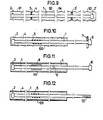
- Figs. 9 to 12 show examples of prefabricated tie devices according to the invention
- Figs. 13 and 13a show an example of how a prefabricated tie element according to the invention can be arranged
- Figs. 14 and 14a show an example of how a pull bar according to the invention can be arranged
- Figs. 15 to 18 show examples of how prefabricated tie devices can be arranged for connecting different building parts
- Fig. 19 shows two further examples of how the pull bar can be arranged in a concrete element.
- Another tie device 194 is bent to hairpin shape and introduced in a hole 193 so that the bent portion 194' protrudes from the element 190. Both legs of the tie means are provided with anchoring means 2 and stop means 3 and are fixed in the hole 193 by means of a casting compound.
Landscapes
- Engineering & Computer Science (AREA)
- Architecture (AREA)
- Environmental & Geological Engineering (AREA)
- Physics & Mathematics (AREA)
- Electromagnetism (AREA)
- Civil Engineering (AREA)
- Structural Engineering (AREA)
- Joining Of Building Structures In Genera (AREA)
- Buildings Adapted To Withstand Abnormal External Influences (AREA)
Claims (15)
Applications Claiming Priority (1)
| Application Number | Priority Date | Filing Date | Title |
|---|---|---|---|
| PCT/SE1983/000216 WO1984004773A1 (en) | 1983-05-30 | 1983-05-30 | Collapse preventing connection device for building structures |
Publications (2)
| Publication Number | Publication Date |
|---|---|
| EP0147388A1 EP0147388A1 (de) | 1985-07-10 |
| EP0147388B1 true EP0147388B1 (de) | 1986-10-01 |
Family
ID=20349625
Family Applications (1)
| Application Number | Title | Priority Date | Filing Date |
|---|---|---|---|
| EP83901952A Expired EP0147388B1 (de) | 1983-05-30 | 1983-05-30 | Einsturzverhindernde verbindung für baukonstruktionen |
Country Status (5)
| Country | Link |
|---|---|
| US (1) | US4630412A (de) |
| EP (1) | EP0147388B1 (de) |
| JP (1) | JPS60501463A (de) |
| DE (1) | DE3366557D1 (de) |
| WO (1) | WO1984004773A1 (de) |
Families Citing this family (18)
| Publication number | Priority date | Publication date | Assignee | Title |
|---|---|---|---|---|
| US5842312A (en) * | 1995-03-01 | 1998-12-01 | E*Sorb Systems | Hysteretic damping apparati and methods |
| US5657597A (en) * | 1995-04-11 | 1997-08-19 | Environmental Building Technology, Ltd. | Building construction method |
| US5675943A (en) * | 1995-11-20 | 1997-10-14 | Southworth; George L. | Lateral load-resisting structure having self-righting feature |
| US7305799B2 (en) * | 2002-05-29 | 2007-12-11 | Sme Steel Contractors, Inc. | Bearing brace apparatus |
| US7174680B2 (en) * | 2002-05-29 | 2007-02-13 | Sme Steel Contractors, Inc. | Bearing brace apparatus |
| FR2902814A1 (fr) * | 2006-06-22 | 2007-12-28 | Jean Louis Desbordes | Noeud de portique parasismique a joints amortisseurs armes par cables en forme de ceinture ductilisable et reparable |
| US8215068B2 (en) * | 2008-10-27 | 2012-07-10 | Steven James Bongiorno | Method and apparatus for increasing the energy dissipation of structural elements |
| EP2350402B1 (de) * | 2008-11-03 | 2015-04-15 | Ti.Pe.Co S.R.L. | Vorgefertigte struktur |
| DE102009033032A1 (de) | 2009-07-02 | 2011-01-05 | Gartner Steel And Glass Gmbh | Seilendverankerung mit Überlastungsschutz |
| US8671634B2 (en) * | 2011-03-29 | 2014-03-18 | Board Of Regents Of The University Of Nebraska | Shallow flat soffit precast concrete floor system |
| US9139972B2 (en) * | 2012-12-17 | 2015-09-22 | University Of Houston | Periodic material-based seismic isolation system |
| US9745741B2 (en) | 2013-03-14 | 2017-08-29 | Timothy A. Hayes | Structural connection mechanisms for providing discontinuous elastic behavior in structural framing systems |
| US9080339B2 (en) | 2013-03-14 | 2015-07-14 | Timothy A. Hayes | Structural connection mechanisms for providing discontinuous elastic behavior in structural framing systems |
| SG11201710668WA (en) * | 2015-07-17 | 2018-02-27 | Sumitomo Mitsui Construction Co Ltd | Frame structure and method of constructing frame structure |
| US9765521B1 (en) * | 2016-10-18 | 2017-09-19 | King Saud University | Precast reinforced concrete construction elements with pre-stressing connectors |
| RU168410U1 (ru) * | 2016-11-09 | 2017-02-02 | федеральное государственное бюджетное образовательное учреждение высшего образования "Донской государственный технический университет" (ДГТУ) | Конструкция усиления растянутой зоны многопустотной плиты |
| CN110158878B (zh) * | 2019-05-19 | 2020-11-06 | 北京工业大学 | 一种内藏多维耗能阻尼颗粒的装配式减振楼板 |
| US10934734B1 (en) * | 2020-02-21 | 2021-03-02 | King Saud University | Damped reinforced joint for beam-column connection |
Family Cites Families (13)
| Publication number | Priority date | Publication date | Assignee | Title |
|---|---|---|---|---|
| US2035143A (en) * | 1935-07-29 | 1936-03-24 | Grace F Marquis | Earthquake protected building construction |
| GB717333A (en) * | 1951-10-31 | 1954-10-27 | Charles Aquila Vincent Smith | Improvements in or relating to building or like structures |
| US3198288A (en) * | 1962-04-04 | 1965-08-03 | Mary Presunka | Impact energy absorber |
| US3232012A (en) * | 1963-02-15 | 1966-02-01 | Proctor Edward Augustus | Auxiliary wind bracing |
| US3308908A (en) * | 1965-01-11 | 1967-03-14 | Lockheed Aircraft Corp | Energy absorber |
| US3866367A (en) * | 1971-06-09 | 1975-02-18 | State Of New Jersey | Deformable coupling |
| US3736712A (en) * | 1972-02-28 | 1973-06-05 | Composite building structure and walls therefor | |
| US3794277A (en) * | 1972-08-14 | 1974-02-26 | A Smedley | Earthquake resistant support |
| US4166344A (en) * | 1972-09-21 | 1979-09-04 | Ikonomou Aristarchos S | Earthquake guarding system |
| FR2283361A1 (fr) * | 1973-06-07 | 1976-03-26 | Casciola Massimo | Amortisseur de securite |
| SE7311391L (de) * | 1973-08-22 | 1975-02-24 | Hoeganaes Ab | |
| SU554387A1 (ru) * | 1974-09-10 | 1977-04-15 | Кишиневский Трест "Сельстрой" | Многоэтажное сейсмостойкое здание |
| US4417427A (en) * | 1981-04-06 | 1983-11-29 | Oskar Bschorr | Method and apparatus for damping vibrations in large structures, such as buildings |
-
1983
- 1983-05-30 JP JP58502009A patent/JPS60501463A/ja active Pending
- 1983-05-30 US US06/704,248 patent/US4630412A/en not_active Expired - Fee Related
- 1983-05-30 WO PCT/SE1983/000216 patent/WO1984004773A1/en not_active Ceased
- 1983-05-30 DE DE8383901952T patent/DE3366557D1/de not_active Expired
- 1983-05-30 EP EP83901952A patent/EP0147388B1/de not_active Expired
Also Published As
| Publication number | Publication date |
|---|---|
| JPS60501463A (ja) | 1985-09-05 |
| DE3366557D1 (en) | 1986-11-06 |
| EP0147388A1 (de) | 1985-07-10 |
| WO1984004773A1 (en) | 1984-12-06 |
| US4630412A (en) | 1986-12-23 |
Similar Documents
| Publication | Publication Date | Title |
|---|---|---|
| EP0147388B1 (de) | Einsturzverhindernde verbindung für baukonstruktionen | |
| US6247279B1 (en) | Retrofitting existing concrete columns by external prestressing | |
| US5099628A (en) | Apparatus for enhancing structural integrity of masonry structures | |
| JPH0115646B2 (de) | ||
| CN111608415B (zh) | 一种基于高延性水泥基材料的方钢管混凝土柱加固方法 | |
| US20100325998A1 (en) | Masonry with vertical reinforced concrete strengthening | |
| US20050050837A1 (en) | Meshed (porous) steel pipe/tube used as concrete reinforcement | |
| KR20180069554A (ko) | 프리스트레스가 도입된 콘크리트 부분 충전 원형강관 거더 및 이를 이용한 구조물의 시공방법 | |
| JP2019116778A (ja) | 二重円形スパイラルせん断補強筋が配置されたpc橋脚を用いた高架橋 | |
| JP2005155036A (ja) | 建築物の柱及び該柱を用いたラーメン骨組構造 | |
| JP5411375B1 (ja) | 制震柱状体を用いた建物 | |
| KR102483445B1 (ko) | 복합말뚝 연결부 및 이를 이용한 구조물과 시공방법 | |
| JPH07247632A (ja) | プレストレスト・プレキャストコンクリート梁及び同梁と柱の接合構造 | |
| JP2729129B2 (ja) | コア柱 | |
| KR200263281Y1 (ko) | 단면확대를 통한 구조물의 내진보강장치 | |
| JP3629700B2 (ja) | 落石・雪崩等保護構造物用充填鋼管とその製造方法 | |
| KR20030006681A (ko) | 단면확대를 통한 구조물의 내진보강방법 및 그 장치 | |
| JP3306226B2 (ja) | 連層耐震壁の付帯柱脚部構造 | |
| JP2762906B2 (ja) | Rc架構 | |
| JP2000282710A (ja) | 塔状建造物における制振構造 | |
| JP7783582B1 (ja) | 杭頭部の接合構造及びその接合方法 | |
| KR102811772B1 (ko) | 프리캐스트 콘크리트 골조시스템의 연쇄붕괴방지를 위한 외부정착긴장재 보강장치 및 이의 시공 방법 | |
| CN116163412B (zh) | 一种装配式预制管柱抗剪连接结构及其施工方法 | |
| JPH0512505B2 (de) | ||
| KR200377338Y1 (ko) | 교각의 내진 보강용 구조체 |
Legal Events
| Date | Code | Title | Description |
|---|---|---|---|
| PUAI | Public reference made under article 153(3) epc to a published international application that has entered the european phase |
Free format text: ORIGINAL CODE: 0009012 |
|
| 17P | Request for examination filed |
Effective date: 19850123 |
|
| AK | Designated contracting states |
Kind code of ref document: A1 Designated state(s): BE DE FR GB NL Designated state(s): BE DE FR GB NL |
|
| GRAA | (expected) grant |
Free format text: ORIGINAL CODE: 0009210 |
|
| AK | Designated contracting states |
Kind code of ref document: B1 Designated state(s): BE DE FR GB NL |
|
| REF | Corresponds to: |
Ref document number: 3366557 Country of ref document: DE Date of ref document: 19861106 |
|
| ET | Fr: translation filed | ||
| PLBE | No opposition filed within time limit |
Free format text: ORIGINAL CODE: 0009261 |
|
| STAA | Information on the status of an ep patent application or granted ep patent |
Free format text: STATUS: NO OPPOSITION FILED WITHIN TIME LIMIT |
|
| 26N | No opposition filed | ||
| PGFP | Annual fee paid to national office [announced via postgrant information from national office to epo] |
Ref country code: GB Payment date: 19900518 Year of fee payment: 8 Ref country code: FR Payment date: 19900518 Year of fee payment: 8 |
|
| PGFP | Annual fee paid to national office [announced via postgrant information from national office to epo] |
Ref country code: BE Payment date: 19900523 Year of fee payment: 8 |
|
| PGFP | Annual fee paid to national office [announced via postgrant information from national office to epo] |
Ref country code: NL Payment date: 19900531 Year of fee payment: 8 |
|
| PGFP | Annual fee paid to national office [announced via postgrant information from national office to epo] |
Ref country code: DE Payment date: 19900710 Year of fee payment: 8 |
|
| PG25 | Lapsed in a contracting state [announced via postgrant information from national office to epo] |
Ref country code: GB Effective date: 19910530 |
|
| PG25 | Lapsed in a contracting state [announced via postgrant information from national office to epo] |
Ref country code: BE Effective date: 19910531 |
|
| BERE | Be: lapsed |
Owner name: A.B. STRANGBETONG Effective date: 19910531 |
|
| PG25 | Lapsed in a contracting state [announced via postgrant information from national office to epo] |
Ref country code: NL Effective date: 19911201 |
|
| NLV4 | Nl: lapsed or anulled due to non-payment of the annual fee | ||
| GBPC | Gb: european patent ceased through non-payment of renewal fee | ||
| PG25 | Lapsed in a contracting state [announced via postgrant information from national office to epo] |
Ref country code: FR Effective date: 19920131 |
|
| PG25 | Lapsed in a contracting state [announced via postgrant information from national office to epo] |
Ref country code: DE Effective date: 19920303 |
|
| REG | Reference to a national code |
Ref country code: FR Ref legal event code: ST |